Joint Continuum of
e
Learning:
Implementing Engaging, Effective, and Meaningful Military E-Learning
David T. Fautua, Ph.DJoint & Coalition Warfighting J7 Joint Staff [email protected] Sae Schatz, Ph.D. MESH Solutions, LLC a DSCI Company [email protected] Emilie Reitz General Dynamics Information Technology [email protected] John Killilea MESH Solutions, LLC a DSCI Company [email protected] ABSTRACT
The potential benefits of e-learning are well established: It is available anytime/anywhere, boasts high return-on-investment, and offers a range of other practical advantages. Well-designed e-learning systems also possess impres-sive training benefits, engaging students and enhancing their learning outcomes. However, think back to your last e-learning experience: Was it inherently engaging, particularly efficient, well-aligned with military training objectives, or truly meaningful? In many cases, the answer is probably “no.”
Unfortunately, in real-world practice, many online courses emphasize lower-order cognitive skills, have limited in-teractivity, use primarily didactic training approaches, incorporate superficial metrics (e.g., recall tests), only offer one-size-fits-all training, and lack clear linkages to meaningful military training objectives. Fortunately, the science and technology exists to correct these limitations; however, instructional best-practices and interactive web applica-tions need to be implemented in a practical, measurable, and sustainable framework in order to realistically support online military instruction. The Continuum of eLearning (CoL) intends to do this.
The CoL is an individual, web-based training package that is being designed to boost knowledge of joint mission-relevant topics before, during, and after an exercise or deployment. The CoL is intended to support a blended learn-ing approach, emphasize (and measure) the acquisition of deeper knowledge, be personalized to the needs of each trainee, and use historical vignettes and video interviews to convey high-quality, relevant, and engaging content. The initial version of the CoL is being developed, tested, and refined by Joint and Coalition Warfighting (JCW), J7 Joint Staff, in 2012, and it will ultimately reside on Joint Knowledge Online (JKO).
This paper describes the prototype CoL, implemented for U.S. Southern Command’s PANAMAX 2012 multina-tional training exercise. The paper also articulates the ultimate vision for the CoL, including the research-based foundations for the system’s andragogical (adult-learning) instructional approaches, adaptive learning mechanisms, and higher-order learning assessments. Finally, the paper offers lessons-learned for implementing next-generation e-learning, like the CoL, in real-world contexts, such as JKO.
ABOUT THE AUTHORS
David T. Fautua, Ph.D., is Chief, Individual Training & Learning, Joint & Coalition Warfighting, J7 Joint Staff. He formerly served as US Joint Forces Command Academic Chair, held an appointment as visiting associate professor at the Joint Forces Staff College, and was special assistant to two NATO Supreme Allied Commanders. Most recent-ly, he served as the principal investigator for the NTSA-award winning Border Hunter research project.
Sae Schatz, Ph.D., is the Chief Scientist of MESH Solutions, LLC. Her work focuses on education and training for the Defense community, particularly the skills associated with “cognitive readiness.” In addition to her research, Dr. Schatz teaches and mentors University of Central Florida (UCF) Modeling & Simulation graduate students.
Ms. Emilie Reitz is a research analyst with General Dynamics Information Technologies. In addition to working on the CoL, she also serves as one of the lead researchers for human factors in Bold Quest and acted as a research assis-tant for the Border Hunter initiative. Emilie holds a Master’s Degree in international studies.
Mr. John Killilea is a research assistant at MESH Solutions, LLC. He holds a Master’s Degree in Modeling and Simulation and is actively pursuing his Ph.D. in M&S at UCF.
Joint Continuum of
e
Learning:
Implementing Engaging, Effective, and Meaningful Military E-Learning
David T. Fautua, Ph.DJoint & Coalition Warfighting J7 Joint Staff [email protected] Sae Schatz, Ph.D. MESH Solutions, LLC a DSCI Company [email protected] Emilie Reitz General Dynamics Information Technology [email protected] John Killilea MESH Solutions, LLC a DSCI Company [email protected] INTRODUCTION
This paper outlines a variety of challenges associated with joint military training and education. It begins by detailing gaps in collective (live) training and discuss-ing limitations associated with online learndiscuss-ing. These limitations were uncovered through reviews of the liter-ature as well as interviews with military stakeholders and reactions surveys from military online learners. Finally, the paper outlines a phased approach to address the gaps and limitations of individual, team, and collec-tive training by reinventing the way courses are pre-sented on Joint Knowledge Online (JKO).
COLLECTIVE JOINT TRAINING
Each year, Joint and Coalition Warfighting, J7 Joint Staff, coordinates dozens of large-scale joint and coali-tion training events for the Combatant Commands (CCMDs). These annual or semi-annual exercises help prepare personnel at the operational staff level for their duties at CCDMs and Joint Task Forces (JTFs). Despite the effectiveness of these training events, military lead-ers are constantly looking for ways to enhance their training outcomes. In particular, joint training personnel have identified five areas that could be improved upon. 1. “Untrained” Staff
Forming a joint headquarters staff presents several unique logistical challenges, particularly from the per-sonnel and manning perspective. Joint billets are often filled with individual augmentees from across the Ser-vices’ reserve components. Despite access to well-planned joint training events, these individuals are often left in a lurch to prepare beforehand, and they may struggle during training to apply their service-specific skills in a joint context.
This challenge is magnified further if the augmentees or late-arriving staffs miss the collective training event altogether. More specifically, commanders frequently deploy with up to 40% of their Joint Manning Docu-ment (JMD) still unfilled. (The JMD is a record of as-signed personnel and billets.) One JTF even reported deploying with less than 50% of its JMD (Wright &
Reese, 2008). When this occurs, it means that a signifi-cant portion of a joint staff misses the opportunity to training prior to deployment and, therefore, receives less preparation for their joint billets.
Establishing a fully-manned joint headquarters with a staff that is completely competent in the arts of joint warfighting has been a longstanding struggle for joint trainers. While every effort is made to ensure the quali-ty and authenticiquali-ty of the training environment, many personnel fail to fully benefit from the training, either due to late assignment or because of their inability to attend the training altogether. In short, high percentages of joint staffs do not receive the full advantage of the pre-deployment training exercises, and these personnel remain “untrained” since no alternative mechanisms currently substitute for the collective event. This creates weaknesses in the shared knowledge-base of operation-al staffs.
2. Stovepipe Training and Education
Large-scale joint exercises primarily emphasize in-residence collective training versus a blend individual and collective, training and education approaches. In other words, despite the quality of training offered, this instruction is currently executed in stovepipes, with little correspondence among individual training con-cepts, joint academics, and collective exercise objec-tives. To individual trainees, the flow between the stag-es of training and education can seem disjoint, and each component may appear to lack context. Integration across these three areas, i.e., in a blended framework, would help increase the impact of each instructional intervention and make the stages of learning more rele-vant for personnel (Hirumi, 2011).
3. Service Mindsets
Personnel assigned to a joint billet may not have served in any joint position previously. They bring with them their years of service experience but not necessarily an understanding of the larger context of joint, interorgani-zational, and multinational operations. They may not yet know how to function in a joint manner; similarly, they may not yet possess a full understanding of the
advantages of their sister services, of the possible bene-fits of service integration, or of the joint doctrinal pro-cesses for planning and integration (Menaker et al., 2006). Consequently, personnel may exhibit service-centric attitudes that initially inhibit their effectiveness in their new Joint roles.
4. Commanders Could Have Greater Insight
Targeted, objective assessment of personnel’s cognitive capacities is rarely conducted across the entire cohort of trainees. This is a problem because individual aug-mentees and new arrivals may carry with them unfore-seen gaps in critical joint knowledge; alternatively, they could possess life experiences that would distinguish them as high-utility officers. Having enhanced individ-ual readiness data would give commanders more de-tailed, constructive insights into their staff’s prepared-ness. Further, knowing this shortly after a service mem-ber joins the command would speed their integration into the staff and facilitate more efficient operations, overall.
5. Unknown Retention Between Events
Staffs are constantly changing, due to routine rotations and re-assignments. As such, there is an ongoing strug-gle to maintain a high “band of excellence” in the expe-rience and expertise of the permanent staff. In addition to this unique difficulty, joint training personnel also face the conventional challenge of training transfer. That is, it is unclear how much training transfers to in-dividuals during a collective training event, as well as how much of that transferred knowledge personnel ac-tually retain between events. A capability that offered enduring and relevant training support before, during, and after the larger Joint Event Life Cycle (JELC) could facilitate, and give greater insight into, training transfer and individuals’ levels of retention. In turn, this would help personnel maintain a consistently high level of individual, staff, and collective readiness.
ONLINE LEARNING: A SOLUTION? Supplementary online learning seems like an obvious solution for the challenges outlined above. Online courses are available anytime and anywhere, which can help reduce the number of “untrained” staff and serve as ongoing refresher training thereafter. Online courses can include elements of both training and education, as well as content specifically geared to address joint mindsets, and e-learning can be readily tailored to a variety of training objectives, in order to better prepare personnel for designated collective events. Individual performance scores can also be recorded and aggregat-ed to give commanders constructive insights into their
personnel’s readiness. In the academic literature, these sorts of obvious advantages are well documented (e.g., Welsh et al., 2003).
Research also demonstrates that well-designed online courses enhance learning outcomes. For instance, ac-cording to a recent meta-analysis by the Department of Education (2010), in a review of 50 studies, both adult and child learners performed modestly better in online environments as compared to traditional face-to-face classroom settings (Cohen’s d = +0.20 in favor of online learning).
However, think back to your most recent online learn-ing experiences: Were they inherently engaglearn-ing, partic-ularly efficient, or truly meaningful? In the case of mili-tary courses, was the online content aligned with collec-tive training objeccollec-tives or did the courses attempt to bridge the gap between stovepiped training and educa-tion events? Finally, do you think the outcome scores provided useful insights to commanders? In many cas-es, the answer is probably “no.” Despite the potential benefits of well-designed e-learning, online courses in practice often suffer from a range of limitations that negatively affect their effectiveness, utility, and appeal. Military E-Learning Challenges
We conducted structured interviews with seven active duty and government civilian stakeholders associated with the major military e-learning enterprises in the Air Force, Army, Navy, Marine Corps, and Joint Staff. These subject-matter experts offered informed opinions about military online courses, and they suggested that military e-learning often suffers from a range of limita-tions, which are summarized in Table 1.
CONTINUUM OF eLEARNING
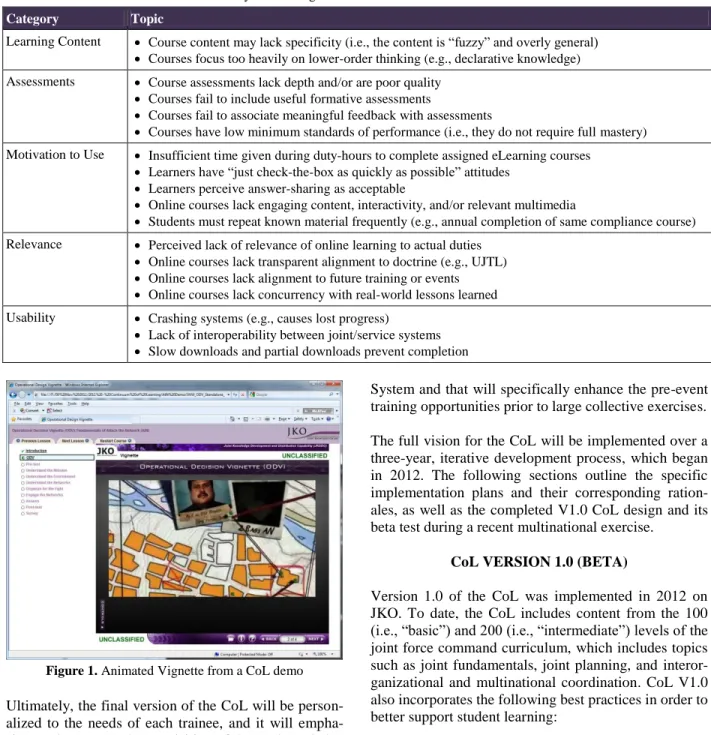
The Joint Staff J7, Joint and Coalition Warfighting, Individual Training & Learning Division recently initi-ated the Continuum of eLearning (CoL) project, which intends to revise Joint online learning in order to over-come the challenges described in the previous section and then leverage e-learning to address gaps in joint collective training (described in the first section). The CoL represents both a capability (i.e., the course con-tent) and a methodology (i.e., the implementation ap-proach) for bolstering joint training and education. More precisely, the CoL is an individual, web-based training package that is being designed to boost knowledge of joint mission-relevant topics before, dur-ing, and after an exercise or deployment (see Figure 1).
Table 1. Barriers to Effectiveness in Military E-Learning
Category Topic
Learning Content Course content may lack specificity (i.e., the content is “fuzzy” and overly general)
Courses focus too heavily on lower-order thinking (e.g., declarative knowledge) Assessments Course assessments lack depth and/or are poor quality
Courses fail to include useful formative assessments
Courses fail to associate meaningful feedback with assessments
Courses have low minimum standards of performance (i.e., they do not require full mastery) Motivation to Use Insufficient time given during duty-hours to complete assigned eLearning courses
Learners have “just check-the-box as quickly as possible” attitudes
Learners perceive answer-sharing as acceptable
Online courses lack engaging content, interactivity, and/or relevant multimedia
Students must repeat known material frequently (e.g., annual completion of same compliance course) Relevance Perceived lack of relevance of online learning to actual duties
Online courses lack transparent alignment to doctrine (e.g., UJTL)
Online courses lack alignment to future training or events
Online courses lack concurrency with real-world lessons learned Usability Crashing systems (e.g., causes lost progress)
Lack of interoperability between joint/service systems
Slow downloads and partial downloads prevent completion
Figure 1. Animated Vignette from a CoL demo
Ultimately, the final version of the CoL will be person-alized to the needs of each trainee, and it will empha-size (and measure) the acquisition of deeper knowledge in addition to basic declarative and procedural facts. CoL courses will incorporate historical vignettes and video interviews in order to convey high-quality, rele-vant, engaging, and humanized content. Course content will be strongly aligned with joint force command train-ing objectives, and outcome data will be designed to give commanders and training personnel additional constructive insight into the staff’s preparedness. Equally important, the CoL will offer an integrated cur-riculum designed to blend the stovepipe training and education components of the existing Joint Training
System and that will specifically enhance the pre-event training opportunities prior to large collective exercises. The full vision for the CoL will be implemented over a three-year, iterative development process, which began in 2012. The following sections outline the specific implementation plans and their corresponding ration-ales, as well as the completed V1.0 CoL design and its beta test during a recent multinational exercise.
CoL VERSION 1.0 (BETA)
Version 1.0 of the CoL was implemented in 2012 on JKO. To date, the CoL includes content from the 100 (i.e., “basic”) and 200 (i.e., “intermediate”) levels of the joint force command curriculum, which includes topics such as joint fundamentals, joint planning, and interor-ganizational and multinational coordination. CoL V1.0 also incorporates the following best practices in order to better support student learning:
1. Emphasize Higher-Order Learning
Higher-order learning emphasizes those cognitive, af-fective, and psychosocial skills that involve more so-phisticated mental processes, such as analysis, synthe-sis, evaluation, and metacognition (Krathwohl 2002; Bloom, 1956). Like the content of traditional class-room-based courses, online learning can be enhanced by intentionally incorporating activities that engage such higher-level cognitive skills (Redecker, 2009).
Courses can employ instructional techniques that en-courage higher-level thinking. For instance, situated learning approaches and scaffolding principles can help students perform just beyond their expertise levels and encourage them to exhibit a “cognitive stretch” (Fox & Helford, 1999; Jonassen, 2000). Similarly, the delivery mechanisms of e-learning courses can bolster (or inhib-it) learners’ higher-level thinking. For example, em-ploying interactive learning activities and effectively incorporating multimedia can encourage students to reach for a higher level of performance (Garrison & Anderson, 2003), and simply ensuring the content is clear and well-organized can have a profound impact, as well (Swan, 2001; Collison, Elbaum, Haavind, & Tinker, 2000).
The CoL V1.0 incorporates some of these content and delivery best practices, including the use of scaffolding, multimedia, and (limited) situated learning. Future ver-sion of the system will expand upon these features and offer more opportunities for trainees to engage in high-er-level cognitive processes.
2. Pre-tests and Performance Adaptation
In his classic study, Bloom (1984) found that students who received one-on-one tutoring performed two standard deviations superior to students who were taught via the conventional group method. That is, the average tutored student performed better than 98% of the control class. Although there is on-going debate regarding the conditions under which these gains were obtained, it is clear from this study and others like it that human tutors tailor their instruction to their stu-dents and impressive learning gains often result from that interaction.
In the first version of the CoL, some personalization has been incorporated. Students begin courses by complet-ing a diagnostic knowledge test and, dependcomplet-ing upon their scores, are able to take or skip certain modules. This diagnostic not only tailors course content to each trainee’s knowledge and information gaps, but to a lim-ited extent, it also enhances students’ motivation by allowing them to omit training they have already mas-tered. Future versions of the CoL will feature additional adaptive learning components.
3. Higher-Order Assessments
One of the primary objectives of the CoL is to engender higher-order thinking. To motivate students to engage in deeper thinking during CoL courses, and in order to assess whether they are meeting these training goals, corresponding higher-order measurement approaches must be employed for both the formative and
summa-tive assessments.
Many common apparatus, however, only measure low-er-level skills. For instance, many tests simply measure recognition (e.g., select the right vocabulary word from a short list of multiple choice options), recall (e.g., giv-en a short definition, determine whether it is true or false), or basic procedural application (e.g., correctly number the order of steps associated with a given task). Fortunately, researchers have developed a variety of approaches for better assessing higher-order skills; the-se include the uthe-se of Behaviorally Anchored Rating Scales (BARS), rubrics, concept maps, card sorting tests, Situational Judgment Tests (SJTs), metacognitive prompts, and self/team-correction. Unfortunately, such assessments usually require expert human graders, and even if they could be automatically scored by a com-puter, the JKO system does not currently support such algorithms. Hence, one challenge for the CoL is to uti-lize assessments that address higher-order outcomes while using components that can be implemented and scored by the online system.
CoL V1.0 employs several creative assessments that encourage trainees to reflect on their own knowledge and provide trainees with formative feedback. These include the following:
Concept maps with drop-down boxes SJTs designed as multiple-choice tests Card sorting using radio buttons in columns Open-ended (i.e., text areas) metacognitive
prompts that are not graded, but instead facilitate formative (self-)assessment
Future version of the CoL will include additional high-er-order assessment approaches, as well as more dy-namic feedback mechanisms.
4. Formative and Summative Assessments
A common practice in education and training is to pro-vide “checks on learning,” both during and immediately following the instruction. More formally, these are called formative and summative assessments.
Formative assessments are used during the learning process in order to gauge students’ progress, modify teaching and learning activities, and improve learner achievement. These assessments are typically less for-mal than summative tests because their primary goal is to enhance learning rather than to grade trainees. In fact, the actual scores earned on formative assessments need not be officially recorded. Students who complete formative assessments learn to recognize and correct
their errors, and they build deeper knowledge and stronger skills (Crooks, 1988). When used appropriate-ly, formative assessments can improve learning out-comes by 20–40 percentile points (Ainsworth & Viegut, 2006).
The CoL V1.0 incorporates formative assessments into about 25% of its modules (inclusion of more formative assessments was deemed too time-consuming for stu-dents). These quizzes are designed to enhance learning by encouraging students to reflect on their knowledge and think about the feedback given after the quizzes. The actual scores associated with the formative assess-ments are not saved in the learning management sys-tem.
Summative assessments are formal tests used to meas-ure cumulative learning outcomes, such as at the end of a course. Summative assessments facilitate the go/no-go decision on whether the student has adequately completed the course, and they reinforce the KSAs gained throughout a curriculum (McAlpine, 2002). In the CoL V1.0, summative assessments are conducted immediately following each course. The test items for each summative assessment are associated with the course’s terminal and enabling learning objectives, and posttest items are randomly selected from the same test bank as the pretest items (discussed in bullet #2 above). Students who did not already pass the course at the pre-test stage must successfully complete the summative assessment in order to pass each CoL course.
5. Mastery Learning
The CoL employs a mastery learning approach. In mas-tery learning, performance standards remain constant and the amount of time different students require to reach mastery is allowed to vary. This approach differs from common instructional models in which all learners are given the same amount of time and, often, the same instructional interventions, but their achievement levels are allowed to vary (Block & Burns, 1976; Anderson, 2000). When given enough time and appropriate in-struction, 90–95% of students can achieve mastery (Er-icsson, in press).
As such, in addition to using summative assessments as final learning measures, the CoL uses the outcomes of summative assessments to guide individual trainees’ remediation, when necessary.
6. Historical vignettes
Successful curricula engage students and present mate-rial in a way that helps learners contextualize and
per-sonally relate with the content. To better frame the online learning material, each 100-level CoL V1.0 course begins with a multimedia vignette about a histor-ic (or historhistor-ically based) event that established the need for the joint policies that the rest of the lesson covers. These historical vignettes are intended to convey the relevance of the course material, describe the rationale behind the joint doctrine, and engage students through the use of interactive media, storytelling, and history. 7. Higher-Levels of interactivity
As consumers of online learning, most people already realize that “not all online courses provide high quality learning experiences, as many consist of little more than books behind glass with little or no interaction” (Nagel & Kotzé, 2009; p. 1). Instead, (like poorly de-signed face-to-face classes), many e-learning courses simply use one-way, “‘transmissive’ rather than ‘inter-active’ learning strategies” (Waddoups & Howell, 2002). This contributes to lower levels of engagement and can inhibit the learning process.
In order to move beyond didactic “page-turner” deliv-ery, the CoL V1.0 incorporates higher levels of interac-tivity than most military e-learning courses. In addition to the historical vignettes, the courses incorporate vide-os, games, animations, narration, and other multimedia content. This both enhances the course material and motivates students.
8. Better Alignment
All CoL V1.0 courses “align” to joint force command publications and training requirements. Content from the 100-level CoL courses is doctrinally focused, and it explicitly links to the Universal Joint Task List (UJTL). Content in the 200- and 300-level courses derives from best practices and operational lessons learned, and these courses align with those joint publications.
The CoL courses are primarily intended to support col-lective training events, including the pre-event training and education activities (e.g., the academic sessions prior to an exercise). To best support these activities, the CoL course material, training objectives (selected from Mission Essential Task Lists), situated learning scenarios, and assessment approaches are aligned to each collective training exercise. In this way, CoL courses help carry the specific commander-selected training concepts across the individual, staff, and col-lective elements of large-scale training events. Future versions of the CoL will continue to enhance the blend-ing of these individual and collective, trainblend-ing and edu-cation events.
PANAMAX ‘12 BETA-TEST
PANAMAX ‘12, a U.S. Southern Command (USSOUTHCOM) multinational training exercise, pro-vided an excellent opportunity to beta-test the first ver-sion of the CoL. PANAMAX is an annual training event in which over a dozen countries participate (see Figure 2). The exercise involves the Panama Canal and typically features scenario elements involving illegal trafficking, drug trafficking, terrorism, and natural dis-asters (ILWU Coast Longshore Division, 2012). Per-sonnel from nearly 20 countries participated in this year’s PANAMAX. These interorganizational and mul-tinational staff members collectively addressed a varie-ty of simulated threats and practiced their planning and coordination skills during the week-long exercise in August 2012.
Figure 2. U.S. Army Maj. Castro addresses foreign nations’ participants of last year’s PANAMAX exercise during the academics phase at Fort Sam Houston, Texas, Aug. 11, 2011. Photo courtesy of www.dvidshub.net.
The CoL beta-test, executed as part of PANAMAX ’12, included modules from the 100- and 200-levels of the joint force command curriculum. The particular courses were selected by USSOUTHCOM leadership because of their relevance for the exercise. Beta-test modules became available online in time to support USSOUTHCOM and Multinational Force South (MNFS) pre-exercise academics, as well as the collec-tive PANAMAX exercise itself. Additionally, all of these lessons are enduring and, once initially devel-oped, were made available on JKO for the entire joint community.
Throughout the beta-test, the research team documented the efficacy of the CoL through a multi-part experi-ment. The team examined the learning effectiveness of the courses, as well as their usability, motivational
ef-fects, operational relevance, and ability to engender a “joint mindset.” We also documented the extent to which courses impacted trainees’ PANAMAX ‘12 op-erational performance.
These empirical data are helping to refine the CoL im-plementation approach, uncover additional e-learning requirements, and generate a baseline against which future iterations of the CoL can be compared. As of the writing of this paper, data collection is ongoing. We expect to publish results in 2013.
NEXT STEPS
After the data from PANAMAX ’12 are fully analyzed, they will inform Version 2.0 of the CoL, which is scheduled to be completed in 2013. V2.0 will expand the content of the V1.0 CoL, incorporating additional 100- and 200-level courses, as well as 300-level joint fundamentals content and lessons aligned with opera-tional plans and COCOM mission needs. Addiopera-tionally, depending upon the beta test results, we plan to further enhance CoL V2.0’s delivery mechanisms in the fol-lowing ways:
First, the limited personalization of V1.0 will be ex-panded to include more adaptive mechanisms, such as tailoring content to students’ prior experiences or func-tional duty areas. It will also incorporate more refined formative assessments, with better feedback and more sophisticated scoring mechanisms.
Second, V2.0 will also include more sophisticated, more detail metrics as well as data visualizations of the outcome data designed to give commanders and train-ing personnel additional insights into the staff’s indi-vidual cognitive readiness. This may manifest as a commander/trainer “dash-board” with accessible, ma-nipulatable, and human-readable interpretations of out-come the data.
Third, V2.0 of the CoL will incorporate a peer-learning web-based training simulation, called the Joint Opera-tions Center Simulation (JOCSIM). After students complete their individual courses (i.e., the 100–300 level courses), they will be able to interact with fellow personnel in the JOCSIM (see Figure 3). JOCSIM sce-narios are intended to target each functional area; in other words, logisticians will interact with other logisti-cians, and Joint planners will interact with other Joint planners in this online, operational training simulation.
Figure 3. Full vision for the progression of training and education in the Continuum of eLearning
The JOCSIM will continue the CoL V1.0’s practice of aligning training content to doctrinal and exercise ob-jectives. Specifically, Master Scenario Event Lists (MSELs) will be aligned with the training objectives for designated upcoming collective training events. Joint Coalition and Warfighting is currently validating the demand signal for the JOCSIM, and investigating the potential to build it from the foundations of the Small Group Scenario Trainer (SGST). The existing SGST 1.0 capability is more limited than the ultimate vision for the JOCSIM, but it does incorporate storytell-ing scenario introductions, real-time remediation, ad-vanced sequencing, learning content navigation, and the use of avatars that support team training, critical think-ing, and learning. Also, even in its current state, the SGST successfully supports staff training. In fact, the Lead Observer/Trainer for Unified Endeavour recently remarked that the “SGST seems to be the gap filler we have been looking for between academics, which is the crawl, to MRX [Mission Rehearsal Exercise], which is the run.”
Fourth, we plan to develop policies that better facilitate blended learning across the individual, team, and col-lective (staff) elements. As stated in the first section of the paper, the joint training opportunities associated with a collective exercise often seem stovepiped to stu-dents. V1.0 of the CoL (with its intentional alignment to exercise objectives and joint doctrine) helps address this issue, but a more formal policy to support blended learning will help completely close the gap.
Finally, V2.0 of the CoL will need to expand the tech-nological capabilities and general functionality of JKO’s hardware and software. This includes addressing usability issues (e.g., Rovai & Wighting, 2005), as well
as expanding interactive capabilities, database features, and available assessment tools.
CONCLUSION
The joint Continuum of eLearning (CoL) is designed to be personalized, engaging, focused on higher-level thinking, supported by more effective metrics, and aligned to commanders’ training objectives. The CoL incorporates best practices of e-learning in order to fos-ter deeper learning (Garrison & Anderson, 2003), en-hance trainees’ conceptual understanding (Chickering & Erhmann, 1996), and engender greater cognitive readiness. The CoL also pushes the instruction “left-of-bang,” so that learning takes place before a collective exercise, which allows the collective event to empha-size practice, coordination, and skill enhancement.CoL V1.0 partially meets these objectives, and it addresses many of the issues commonly experienced in military e-learning.
We intend to continue expansion of the CoL using best practices of human-systems integration, including ex-tensive testing and iterative development. Initial results from PANAMAX ’12 will directly influence CoL V2.0, and that version of the system will be similarly tested in one or more joint exercises. As these test results are analyzed, they will help refine the CoL and, in turn, better support military personnel’s education. More than that, this research contributes to the body of empir-ically validated best practices and, potentially, it can provide insights for a wide array of improved online courses, within or beyond the military.
ACKNOWLEDGEMENTS
This work is supported by Joint and Coalition Warf-ighting (JCW), J7 Joint Staff. The views and
conclu-sions contained in this document are those of the au-thors and should not be interpreted as representing the official policies, either expressed or implied, of the De-partment of Defense or the Joint Staff. The U.S. Gov-ernment is authorized to reproduce and distribute re-prints for Government purposes.
REFERENCES
Ainsworth, L. & Viegut, D. (2006). Common formative assessments: How to connect standards-based in-struction and assessment. Thousand Oaks, CA: Cor-win Press.
Anderson, L. W. (2000). Why should reduced class size lead to increased student achievement? In M. C. Wang & J. D. Finn (Eds.), How small classes help teachers do their best (pp. 3-24). Philadelphia: Tem-ple University Center for Research in Human Devel-opment.
Block, J. H. & Burns, R. B. (1976). Mastery learning. Review of Research in Education, 4, 3-49.
Bloom, B.S., Engelhart, M.D., Furst, E.J., Hill, W.H., & Krathwohl, D.R. (1956). Taxonomy of educational objectives book 1: Cognitive domain. New York: David McKay Company, Inc.
Bloom, B. S. (1984). The 2 sigma problem. The search for methods of group instruction as effective as one-to-one tutoring. Educational Researcher, 13, 3-16. Chickering, A., & Ehrmann, S. C. (1996). Implementing
the seven principles: Technology as lever. AAHE Bulletin , October, 3-6.
Collison, G., Elbaum, B., Haavind, S., and Tinker, R. 2000. Facilitating online learning: Effective strate-gies for moderators. Madison, WI: Atwood.
Crooks, T.J. (1988). The impact of classroom evaluation practices on students, Review of Educational Re-search, 58, pp. 438-481.
Ericsson, K. A. (in press). Adaptive expertise & cogni-tive readiness: A perspeccogni-tive from the expert-performance approach. In H. F. O’Neil, R. S. Perez, & E. L. Baker (Eds.), Teaching and measuring cogni-tive readiness. Houten, the Netherlands: Springer. Fox, M., & Helford, P. (1999). Northern Arizona
Uni-versity: Advancing the boundaries of higher educa-tion in Arizona using the World Wide Web. Interac-tive Learning Environments, 7(2-3), 155-174. Garrison, D. R., & Anderson, T. (2003). E-learning in
the 21st century: A framework for research and prac-tice. London: Routledge/Falmer.
Graham, C. R., Allen, S., and Ure, D. (2005). Benefits and Challenges of Blended Learning Environments. In M. Khosrow-Pour (Ed.), Encyclopedia of infor-mation science and technology, pp 253–259. Her-shey, PA: Idea Group.
Hirumi, A., Bradford, G. &Rutherford, L. (2011) Select-ing Delivery Systems and Media to Facilitate
Blend-ed Learning: A Systematic Process basBlend-ed on Skill Level, Content Stability, Cost and Instructional Strat-egy. Journal of Online Learning and Teaching, Vol. 7, No. 4 (December 2011), 489-501.
ILWU Coast Longshore Division (2012). U.S., Panama tout importance of Panama Canal military drill. Retrieved http://ilwu13.com/u.s.-panama-tout-importance-of-panama-canal-military-drill-322.html. Jonassen, D., Davidson, M. Collins, M. & Haag B.
(2000) Constructivism and Computer-Mediated Communication in Distance Education. Educational Technology & Society Vol. 3, No. 2, pp. 7-26. Krathwohl, D.R. (2002). A Revision of Bloom’s
Taxon-omy: An Overview, Theory into Practice, Vol. 41, No. 4 (Autumn 2002), 212-218.
McAlpine, M. (2002). Principles of assessment. Glas-gow: University of Glasgow, Robert Clark Center for Technological Education. Available at: http://www.caacentre.ac.uk/dldocs/Bluepaper1.pdf Menaker, E, MacDonald, J, Hendrick, A., & O'Conner,
D. (2006) Training a Joint and Expeditionary Mindset. United States Army Research Institute for the Behavioral and Social Sciences
Nagel, L., & Kotzé, T.G. (2009). Supersizing e-learning: What a CoI survey reveals about teaching presence in a large online class. Internet and Higher Education. Redecker, Christine (2009). "Review of Learning 2.0
Practices: Study on the Impact of Web 2.0 Innova-tions on Education and Training in Europe". JRC Scientific and technical report.
Rovai, A. P. & Wighting, M. J. (2005). Feelings of al-ienation and community among higher education stu-dents in a virtual classroom. Internet and Higher Ed-ucation, 8(2), 97-110.
Swan, K., Shea, P.J., Fredericksen, E.E., Pickett, A.M., & Pelz, W.E. (2000). Course Design Factors Influ-encing the Success of Online Learning. Paper pre-sented at the WebNet 2000 World Conference on the WWW and Internet, San Antonio.
U.S. Department of Education, Office of Planning, Eval-uation, and Policy Development. (2010). Evaluation of Evidence-Based Practices in Online Learning: A Meta-Analysis and Review of Online Learning Stud-ies: Washington, D.C.
Waddoups, G., & Howell, S. (2002). Bringing online learning to campus: The hybridization of teaching and learning at BYU. International Review of Re-search in Open and Distance Learning, 2(2). Welsh, E. T., Wanberg, C. R., Brown, K. G., &
Simmer-ing, M. j. (2003). E-learning: emerging uses, empiri-cal results and future directions. International Jour-nal of Training and Development, 7(4), 245-258. Wright, D. P., & Reese, T. R. (2008). On Point II:
Transition to the New Campaign. Combat Studies In-stitute Press, US Combined Arms Center. Fort Leav-enworth, Kansas.