Volume 6, Number 1, 2014, 15-22
© Copyright 2014 the authors. 15
Differential Effectiveness of Contingency Management and Cognitive Restructuring in the Reduction of Truancy among Secondary School Adolescent
Oliha Josephine. A
Educational Psychology and Curriculum studies, University of Benin, Benin City, Nigeria
Abstract. The main thrust of this paper is on the efficacy of two instructional strategies – contingency management and cognitive restructuring in the reduction of truancy among secondary school adolescents in Edo State. Experimental pre-test, post-test and control group design was adopted in the study. One hundred and forty four students were randomly selected in the four chosen schools. Three hypotheses were tested at 0.05 level of significance and the results obtained indicated significant differences in truant behaviour of students exposed to treatment strategies than those in control group. Also, significant difference existed in truancy treatment between students exposed to contingency management strategy and those exposed to cognitive restructuring. The researcher however recommends these two strategies to be introduced in the school’s programme and that seminars, conferences and symposia are organized for the class teachers on how to effectively use these behaviour modification strategies in the management of students with truant behaviour.
Keywords: Contigency Management, Cognitive Restructuring, Truancy, Adolescent.
Introduction
Truancy is one of the behaviour problems of children and adolescents. These are behaviours that are not in conformity with the accepted norms and values of the school. Most of the time, these behaviours are considered anti-social as they threaten the peaceful co-existence of the students and at the same time pose problem to the school. These behaviours include stealing, fighting, bullying aggressiveness, absenteeism and so on.
Truancy among students has been defined as the act of absenting oneself from school without a legitimate reason and without the permission of one’s parents or the school authorities (Herbert, 2005). This definition at best
describes the truancy behaviour among students. This is because truant behaviour is a deviant behaviour.
Truancy is associated with poor school achievement, conduct disorders ranging from social maladjustment and manifest aggression to rebellious and delinquent behaviour.
Researches on causal factors for truancy suggest a number of factors such as family structure, personality traits, school factor and individual factors. Gesinde (2004) opines that the aetiology of truancy involves an interaction of social economic background of student, school environment and social factor. Reid (2000) and McCluskey (2004) opined that truant students lack social skills to maintain friendships and risk being isolated from peer groups. Accordingly, rejection by peers is often a prelude to deviant peer group membership making the risk for drug abuse and antisocial behaviours even higher. Reading problems and poor academic achievement have been linked to truancy. Such problems may create barriers to school adjustment in the early years by decreasing effective student – teacher and student – peer interactive.
In the views of Reid (1999), there is abundant evidence that school building that are clean and well cared for are likely to make learners feel welcome and that an unattractive school environment which is characterised by poor toilet facilities, a lack of proper ventilation, heating and dilapidated buildings, is unlikely to encourage school attendance.
Marital instability was also identified as associated with truancy. Shittu (2004) posited that marital conflict may have indirect effect on student’s truant problems as the child exhibits anti-social habits of conflict resolution and seeing fewer examples of pro-social skills and negotiation. There are a number of empirically supported clinically available programmes used in the management of truancy. For instance, Brook (2001) evaluated the effectiveness of child psychotherapy intervention for truancy reduction using a randomized design; the study measured the treatment outcome following contingency management compared with an attention – placebo control (study habit). It was discovered that contingency management produced a high treatment effect on student’s truancy reduction than the attention placebo condition of the control group
Numerous intervention programmes have been developed for children to manage behavioural problems. These treatment programmes focus on further skills development, including self-esteem building and rewarding appropriate classroom behaviour. Skill development of the students includes regular school attendance, problem-solving, how to peacefully interact in school and how to succeed in school. For example, Mathew Shylaja and Jan (2001) in pursuance of reduction in aggressive behaviour of students, used contingency contracting and self management strategies. They discovered a significant effect of treatment, but self management strategies were more effective than contingency contracting.
In another study, Webster–Stratton and Taylor (2007) in an attempt to prevent substance abuse, delinquency and violence in adolescence through self-management and contingency self-management techniques found a significant improvement of participants, but discovered the potency of contingency management over self-management.
This study tends to apply two behaviour modification techniques such as contingency management and cognitive restructuring strategies in reducing truancy among secondary school adolescent
Contingency management is the systematic reinforcement of desired behaviours and the withholding of undesired behaviours as a means for treating problem behaviour. It uses the processes of reinforcement and punishment to affect behaviour change. The basic components of contingency management programmes involve the establishment of clear behaviour goals that include positive behaviour (e.g. appropriate expressions of anger, proper interactions with peers and respectful comments to adults) that are designed to be increased by proving consistent positive consequences when they are exhibited and negative behaviours (e.g. rule breaking behaviours, non-compliance to adults) that are designed to be decreased through consistent negative consequences when they are exhibited. The term contingency means there is a relationship between what one does and the consequences. Clearly teachers are taught a variety of skills such as contingent use of praise, positive attention, token reinforcement specific instructions, planned ignoring for minor problem
behaviour, time out and contingency contracts teacher learn to apply these skills at school and with target students in order to shape their behaviour. Contingency contracting involves:-
1. A written agreement, to which the student must agree; 2. The target behaviours must be stated;
3. The goals must be manageable for the students to achieve;
4. The student is then rewarded according to the terms of the contract.
Cognitive restructuring is an insightful behavioural procedure that emphasizes recognizing and changing negative thoughts and maladaptive beliefs. It is based on the assumption that cognitions are the major determinants of how we feel and act (Beck, 1999). It is also common that wrong decisions often result in catastrophic life-styles. The cognitive restructuring technique will be helpful for reducing truant behaviour since truant behaviour validates negative thoughts about schooling and class attendance. The therapy will aid in changing the beliefs and values of the participants so as to decrease the undesirable truant behaviour.
Statement of problem
Truancy or unexcused absence from school has become a major problem in communities across the nation. Everyday hundreds of thousands of students are absent from school without an excuse - truancy is creating an obvious threat to students academic progress. It is the first precursor to future juvenile delinquency, teen pregnancy, substance use and dropping out of school.
Purpose of the study
The study is focused on the effectiveness of contingency management and cognitive restructuring on the reduction of truancy among secondary school adolescents.
The study is also designed to assess the difference between contingency management and cognitive restructuring on truancy reduction.
Research hypotheses
1. There is no significant difference in adolescent truant behaviour between participant exposed to training and the control group;
2. There is no significant difference in student truant behaviour between contingency management group and cognitive restructuring group.
Procedure
The researcher was assisted by respective teachers in the chosen schools to identify students who are truants. The intervention lasted for a period of 6 weeks consisting of 90 minutes weekly sessions each for the two groups; first sessions were on briefing the participants on the purpose and nature of the research and the first administration of the instrument (pre-treatment) to form the base line data. The remaining five sessions for contingency group covered two of the items on the truancy checklist each, with last session combining the second administration of the instrument (post-treatment) to assess the efficacy of the treatment programme. The next four sessions for Cognitive Restructuring Skill Training (CORST) were training sessions on effect of self-statements on behaviour and the importance of substituting negative self-statements with positive statement. Assignment include giving example of negative self-statement with positive self-self-statements such as substituting, ”I have to cheat in exam before I can pass” with “I have to study hard to pass exams”, the last session covered the second administration of the instrument (post treatment) to assess the efficacy of the treatment programme.
The first session for the control group covered briefing on the purpose and nature of the study, and also the first administration of the instrument (pre-treatment) to form the baseline data. The second session was the last and it covered the second administration of the instrument against which the first set of data was computed (this came after training intervention sessions for the treatment group ended)
Data Analysis
Results
The results are presented in forms of tables and explanations are made with reference to the table.
Hypothesis I
There is no significant difference in adolescent truant behaviour between participant exposed to training and the control group.
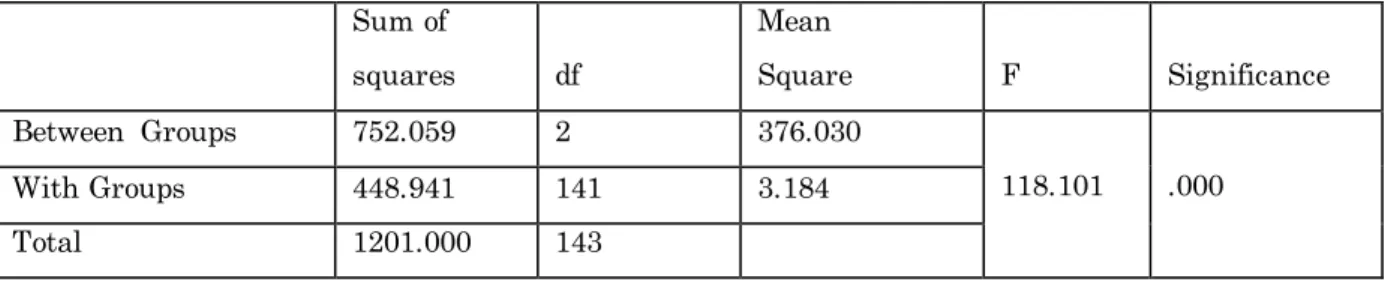
Table I: One way ANOVA of truancy due to treatment types at post – test
Sum of squares df Mean Square F Significance Between Groups 752.059 2 376.030 118.101 .000 With Groups 448.941 141 3.184 Total 1201.000 143
The result on table one shows an F of 118.10 with a df = (2,143) which was significant at p > 0.05. The null hypothesis which states that there is no significant difference in truancy management due to treatment type (contingency management, desensitization and control) is rejected. Consequently, there is a significant difference between the groups at post – test.
Hypothesis 2
There is no significant difference in student truant behaviour between contingency management group and cognitive restructuring group.
Table 2 t-test for independent measure of CM & SD
Group N Mean Std t Significance
Contingency management 36 7764 :990 6.140 .000 Cognitive restructuring 36 75.94 347
The second hypothesis states that there is no significant difference in student truant behaviour between contingency management group and cognitive restructuring group. The result however has shown that there exist significant difference between the two groups (t = 5.54, df = 142; P > 0.05). Table 3 above showed the comparative of the mean of the two groups
Discussion of findings
The study revealed that contingency management and cognitive restructuring strategies had significant impact on student’s truant behaviour. The result obtained showed that the two strategies were effective in the management of student truancy. This finding corroborated the findings of Kearney and Beasley (2000) where it was confirmed that contingency management and cognitive restructuring were effective in the reduction of truancy. Also it was discovered that this finding has similarity with the investigation made by Brooks (2001) on truancy using contingency management strategy as an intervention; the result shows that reduction brought a significant positive effect as it helps in the reduction of identified truant behaviour. Equally, Matthew, Shylaja and Jan (2000) affirmed that parents learn to apply contingency management at home to teach children pro-social behaviours.
In the same vein, cognitive restructuring was found to be effective in the study; this is in line with the findings of Adeyemi (2009) which was found to be effective in increasing school attendance among students.
The result obtained in hypothesis 2 showed significant difference between contingency management and cognitive restructuring. These findings was in line with that of Kearney and Bate (2005) who investigated school phobia in children and adolescents using contingency management and cognitive restructuring strategy as an intervention. They discovered a significant positive effect as it helps in the reduction of identified school phobia.
Recommendation
Based on the findings of this study which brought into lime light truant behaviour among adolescent and the designed intervention programme such as
contingency management and cognitive restructuring were effectively addressed. The researcher recommends that our various schools through the assistance of their government should introduce the two behaviour change strategies in the regular school programme so as to develop in these students a desirable and proper personality.
Equally to make the programme effective, seminars, conferences and symposium should be organized for classroom teachers on how to use these behaviour modification strategies to help in managing other unwanted behaviour problem among school adolescent.
References
[1] Adeyemi, L. I. (2009). Cognitive restructuring and social decision-making techniques on Truancy reduction among secondary school Adolescent in Ibadan. Oyo state of Nigeria. Unpublished PhD Dissertation in University of Ibadan.
[2] Brook, B. D. (2001). Contingency management as a means of reducing school truancy. Education 95, 206-211
[3] Garry, E. M. (1996). Truancy first step to a lifetime of problems. Juvenile justice bulletin 76. U.S dept justice office of juvenile justice and delinquency prevention
[4] Gesinde, A. M. (2004). Multi-Aetiological predictors of non-school attendance behaviour among secondary students in Oyo State Nigeria. unpublished PhD dissertation, University of Ibadan.
[5] Herbert, M. (2005). Problems of childhood. London Pan books.
[6] Kearney C. A. & bates, M. (2005) addressing school refusal behaviour: suggestions for frontline professional’s children & schools, 27, 207 – 216.
[7] Kearney, C. (2001). School refusal behaviour in youth: A functional approach to assessment and treatment Washington D.C. American Psychological Association
[8] Mathew, R. S.; Shylaja, G. & Jan, N. (2000) the Australia Early Intervention Network for Mental health in young people. Health promotion Journal of Australia a9, 103-111
[9] Reid, K. (1999) truancy and schools, London: Rout ledge
[10] Reid, K. (2000). Tackling Truancy in Schools. A practical guide for primary and secondary Schools. London Rout ledge
[11] Webster – Straton, C. & Taylor. T. (2001). Nipping early risk factors in the bind: preventing substance Abuse, Delinquency and Violence in Adolescence through interventions targeted at young children (0.8 years) prevention science 2 (8) 165-192.