DESIGN, SIMULATION AND ANALYSIS
OF COLLABORATIVE STRATEGIES
IN MULTI-AGENT SYSTEMS:
THE CASE OF SUPPLY CHAIN MANAGEMENT
Thèse présentée
à la Faculté des études supérieures de l’Université Laval dans le cadre du programme de doctorat en informatique pour l’obtention du grade de Philosophiæ Doctor (Ph.D.).
FACULTÉ DES SCIENCES ET DE GÉNIE UNIVERSITÉ LAVAL
QUÉBEC
NOVEMBRE 2004
c
Résumé court
Une chaîne logistique est composée d’entreprises fabriquant et distribuant des produits aux consommateurs. En modélisant chacune de ses entreprises comme un agent intel-ligent, nous étudions l’effet « coup de fouet » qui s’y propage. Cet effet consiste en l’amplification de la variabilité des commandes passées par les entreprises lorsque l’on s’éloigne du client final.
Dans un premier temps, nous modélisons chaque entreprise d’une chaîne logistique forestière québécoise comme un agent intelligent, afin de proposer deux mécanismes de coordination décentralisés réduisant ce phénomène. Des simulations de ce système multiagent montrent que ce mécanisme est efficace pour une chaîne logistique dans son ensemble.
Dans un second temps, d’autres simulations sont utilisées pour construire un jeu, que nous analysons avec la Théorie de Jeux. Nous vérifions ainsi que les entreprises n’ont pas intérêt d’arrêter unilatéralement d’utiliser nos mécanismes de coordination (équilibre de Nash).
Résumé long
Une chaîne logistique est composée d’entreprises fabriquant et distribuant des produits aux consommateurs. En modélisant chacune de ses entreprises comme un agent intel-ligent, nous étudions l’effet « coup de fouet » (Bullwhip effect) qui s’y propage. Cet effet est une amplification de la variabilité de la demande lorsque l’on s’éloigne du client final. On peut aussi voir ce phénomène comme un cas particulier de fluctuations des flux dans un système distribué. Ces fluctuations réduisent l’efficacité de la chaîne logis-tique, principalement du fait de l’élévation des niveaux d’inventaire et de la réduction de l’agilité. . .On estime que ce phénomène coûterait de 40 à 60 millions USD pour une papetière de 300 kilotonnes.
L’effet coup de fouet étant provoqué par un manque de coordination entre les agents, nous proposons deux principes qui doivent inspirer tout mécanisme de coordination, à savoir : (i) commander ce que l’on nous commande élimine l’effet coup de fouet mais ne gèrent pas les inventaires, et (ii) les entreprises ne devraient réagir qu’une seule fois à chaque changement dans la consommation du marché. Afin de valider ces deux principes, nous simulons une chaîne logistique forestière appelée le Jeu du Bois Québécois. Ce jeu permet d’enseigner ce qu’est l’effet coup de fouet. Chaque joueur-entreprise y est modélisé par un agent intelligent appliquant une stratégie donnée pour passer ses commandes. À cet effet, nous avons conçu deux stratégies suivant nos deux principes.
Dans un premier temps, nous comparons expérimentalement l’efficacité de ces deux stratégies avec cinq autres stratégies. Nous supposons ici que la chaîne logistique est homogène, c’est-à-dire que toutes ses entreprises utilisent la même stratégie de com-mande. Nous vérifions ainsi que nos deux mécanismes de coordination, implémentés sous la forme de stratégies, sont efficaces pour la chaîne logistique dans son ensemble.
Dans un second temps, nous cessons de supposer la chaîne homogène pour faire davantage de simulations nous permettant de construire un jeu. En analysant ce jeu avec la Théorie de Jeux, nous vérifions que les entreprises n’ont pas intérêt d’arrêter unilatéralement d’utiliser nos deux mécanismes de coordination (équilibre de Nash).
Short abstract
A supply chain is a set of companies that manufacture and distribute products to consumers. We study the “bullwhip effect” that is propagated therein by modelling each company as an intelligent agent. This effect is the amplification of the variability of orders placed by companies, as one moves away from end-customers.
Firstly, we model each company in a Québec wood supply chain as an intelligent agent, in order to propose two decentralized coordination mechanisms reducing this phe-nomenon. Simulations of this multi-agent system show that our mechanism is efficient for a supply chain as a whole.
Secondly, additional simulations are used to build a game, which we analyze with Game Theory. We verify here that companies have no incentive to cease unilaterally from using our two coordination mechanisms (Nash equilibrium).
Long abstract
A supply chain is a set of companies that manufacture and distribute products to end-customers. We model each company as an intelligent agent to study the “bullwhip effect”, that is, the amplifcation of the variability in orders placed by companies. This phenomenon can also be seen as a particular case of stream fluctuations in a distributed system. Such fluctuations incur costs due to higher inventory levels and supply chain agility reduction. This cost has been estimated at 40-60 million USD for a 300 kton paper mill.
Since the bullwhip effect is due to a lack of coordination, we propose two principles that any coordination mechanism should respect: (i) ordering what is ordered from us eliminates the bullwhip effect but do not manage inventory, and (ii) companies should react only once to each market consumption change. In order to validate these two principles, we simulate a forest supply chain called the Québec Wood Supply Game. This game is used to teach the bullwhip effect. Each company-player is modelled as an intelligent agent applying a given ordering rule. For this simulation, we have designed two rules that respect our two principles.
Firstly, we compare experimentally the efficiency of these two rules with five other rules. We assume here that the supply chain is homogeneous, that is, every company uses the same ordering rule. In this way we check that our two coordination mechanisms, i.e., our two ordering rules, are efficient for the supply chain as a whole.
Secondly, we stop assuming the supply chain is homogeneous to carry out additional simulations in order to build a game. The analysis of this game according to Game Theory shows that companies do not have incentive to cease unilaterally from using our two coordination mechanisms (Nash equilibrium).
Je tiens tout d’abord à exprimer ma plus grande reconnaissance à mon directeur Brahim Chaib-draa et à ma co-directrice Sophie D’Amours pour m’avoir soutenu moralement et financièrement dans le cheminement de quatre ans1 que représente la présente thèse. Étant donné qu’ils œuvrent dans deux domaines différents, je les remercie d’avoir guidé ma recherche dans leur domaine respectif, tout en faisant l’effort de comprendre les problèmes apparaissant dans le domaine de leur collègue. Je tiens également à exprimer ma profonde gratitude à Bernard Espinasse (Professeur à l’Université Paul Cézanne de Marseille, France) qui a co-dirigé « à distance » cette thèse et qui fut auparavent mon directeur de DEA. C’est en particulier lui qui m’a motivé à poursuivre des études de doctorat.
Que Jean-Paul Barthès (Professeur à l’Université de Technologie de Compiègne, France) et Peter Kropf (Professeur à l’Université de Neuchâtel, Suisse) reçoivent ma reconnaissance pour m’avoir fait l’honneur d’évaluer ma thèse et d’assister à sa sou-tenance. J’exprime aussi ma gratitude à Jean-Marc Frayret (Professeur à l’Université Laval et directeur adjoint de la recherche à FOR@C) pour avoir non seulement évalué ma thèse et assisté à sa défense, mais aussi adapté le jeu du bois finlandais au contexte québécois afin que je m’en serve dans mes travaux.
Ensuite, il m’est très important de mentionner la collaboration de plusieurs per-sonnes sans qui ce travail n’aurait pas été possible. Je commencerai par les mem-bres du laboratoire DAMAS, à savoir Amar, Arsène, Charles, Dominic, Étienne, Em-manuel, Fabiola, François, Frédérick, Houssein, Imed, Jean-François, Julien, Ludovic, Marc-André, Martin, Maxime, Mathieu, Mourad, Nicolas (deux fois), Olivier, Patrick, Philippe (deux fois), Pierrick, Roberto, Sébastien, Simon, Stéphane et Vincent. Il ne manque à cette liste qu’Ève que je remercie plus particulièrement pour la belle interface graphique qu’elle m’a programmée (voir la figure6.10). Je remercie aussi les membres de FOR@C, et particulièrement Martin Cloutier qui m’a gentiment donné les paramètres nécessaires à l’application de mon travail au contexte de l’industrie forestière
coise. Je tiens également à exprimer ma reconnaissance à Connie et Phyllis qui ont corrigé tout ce que j’ai rédigé en anglais.
Enfin, j’adresse toute ma sympathie à mon entourage personnel, et en premier lieu à mes colocataires : notre « propriétaire-colocataire » Jean-François bien sûr, mais aussi Cecilia, Christian, Éric, France, Jocelyn et Richard. Ma gratitude va aussi aux membres de ma famille pour leur patience durant ces quatre années passées chez « nos cousins » québécois. En particulier, mes derniers remerciements, mais non les moindres, s’adressent à mes parents qui m’ont donné le goût de la découverte.
Là où y’a d’la chaîne, y’a du plaisir !
1 Introduction 1
1.1 Stream Fluctuations in Distributed Systems: The Bullwhip Effect . . . 2
1.2 Motivations . . . 5
1.2.1 Motivation to Propose a Coordination Mechanism . . . 5
1.2.2 Motivations for Studying Incentives to Use our Coordination Mech-anism . . . 8
1.3 Methodology . . . 9
1.3.1 Methodology for Validating our Coordination Mechanism . . . . 10
1.3.2 Methodology for Checking Incentives for Collaboration . . . 10
1.4 Contributions . . . 11
1.4.1 Contributions to Supply Chain Management . . . 12
1.4.2 Contributions to Multi-Agent Systems . . . 13
1.5 Related Work . . . 15
1.6 Chapter Layout . . . 18
2 Supply Chain Management and Multi-Agent Systems: Background 21 2.1 Supply Chain Management . . . 22
2.1.1 Background . . . 22
2.1.2 Order Placement in Supply Chains: the EOQ Model . . . 27
2.2 Multi-Agent Systems . . . 30
2.2.1 The Concept of Agents . . . 30
2.2.2 Comparison with Objects . . . 31
2.2.3 Agent Architectures . . . 32
2.2.4 Motivations for Multi-Agent Systems . . . 35
2.2.5 Differences between Multi-Agent Systems and Other Fields . . . 36
2.2.6 Some Applications of Multi-Agent Systems . . . 37
2.3 Multi-Agent Systems in Supply Chain Management . . . 40
2.3.1 Information Technologies in Supply Chain Management . . . 41
2.3.2 Using Multi-Agent Systems in Supply Chain Management: Mo-tivations . . . 43
2.3.3 Using Multi-Agent Systems in Supply Chains: Examples . . . . 46
3 The Bullwhip Effect 50
3.1 Stream Fluctuations in Distributed Systems . . . 50
3.2 The Particular Case of the Bullwhip Effect . . . 53
3.2.1 Consequences of the Bullwhip Effect . . . 54
3.2.2 Known Causes and Some Solutions to the Bullwhip Effect . . . 55
3.3 Different points of view on the Bullwhip Effect . . . 59
3.3.1 Formal studies relative to the bullwhip effect . . . 59
3.3.2 Empirical studies of the bullwhip effect . . . 61
3.3.3 Simulation-Based Studies of the Bullwhip Effect . . . 63
3.4 Conclusion . . . 63
4 Formalizing Interactions with Game Theory 65 4.1 Coordination . . . 66
4.1.1 Decentralized Coordination Mechanisms for Supply Chains . . . 67
4.1.2 Multi-Agent Coordination . . . 71
4.1.3 Comparison of Both Types of Coordinations . . . 76
4.2 Game Theory . . . 78
4.2.1 Assumptions . . . 79
4.2.2 Basic Definitions . . . 80
4.2.3 Definition of Dominance Relations . . . 82
4.2.4 Definition of Concepts of Solution . . . 85
4.2.5 An illustration: The Battle of the Sexes . . . 89
4.2.6 Remarks . . . 90
4.3 Computational Complexity and Game Theory . . . 91
4.4 Conclusion . . . 92
5 Delays as a Cause of The Bullwhip Effect 94 5.1 Why Delays Cause the Bullwhip Effect . . . 94
5.2 Two Basic Principles for Reducing the Bullwhip Effect Caused by Delays 99 5.3 Two Collaborative Ordering Schemes for Reducing the Bullwhip Effect Caused by Delays . . . 101
5.3.1 Ordering Scheme B . . . 101
5.3.2 Ordering Scheme D . . . 102
5.4 Supply Chain Behavior under the Proposed Information Sharing Scheme 103 5.5 Illustration . . . 106
5.6 Consequences for Multi-Agent Systems . . . 108
5.6.1 Consequences for Information Systems Modelled as Multi-Agent Systems . . . 108
5.6.2 Consequences for any Multi-Agent Systems . . . 109
6 Multi-Agent Simulation of a Québec Forest Supply Chain 114
6.1 The Québec Wood Supply Game (QWSG) . . . 115
6.1.1 Pedigree of the QWSG . . . 115
6.1.2 Description of the QWSG . . . 118
6.2 Implementation of the QWSG: The Spreadsheet Approach . . . 123
6.2.1 Notations . . . 124
6.2.2 Simulation Model . . . 125
6.3 Implementation of the QWSG: The Software Agent Approach . . . 128
6.3.1 The Agent-Oriented Programming Language JACKTM . . . . 129
6.3.2 Adaption of the Québec Wood Supply Game to agents . . . 131
6.3.3 Simulation mechanism . . . 134
6.3.4 Addressing known causes of the bullwhip effect . . . 138
6.4 Conclusion . . . 139
7 First Series of Experiments: Homogeneous Supply Chains 141 7.1 Description of our Methodology . . . 142
7.2 QWSG costs . . . 146
7.3 Simulation Outcomes . . . 147
7.3.1 Simulation Outputs . . . 148
7.3.2 Comparison of the Bullwhip Effect Under the Nineteen Market Consumption Patterns . . . 167
7.3.3 Comparison of the costs incurred under the nineteen market con-sumption patterns . . . 168
7.3.4 Comparison of the Customer Service Level Under the Nineteen Market Consumption Patterns . . . 171
7.3.5 Comparison of the Inventory Levels Variations Under the Nine-teen Market Consumption Patterns . . . 172
7.3.6 Synthesis of the Results with the Four Metrics . . . 173
7.4 Comments . . . 174
7.5 Conclusion . . . 176
8 Second Series of Experiments: Heterogeneous Supply Chains 177 8.1 Description and Computational Complexity of our Methodology . . . . 178
8.2 Realistic Costs and Optimization of Initial Inventory Levels . . . 183
8.2.1 Realistic costs . . . 183
8.2.2 Optimization of Scheme A” . . . 186
8.2.3 Optimization of Scheme B . . . 186
8.2.4 Optimization of Scheme D . . . 187
8.3 Adaptation of Game Theory Concepts to our Simulation . . . 188
8.3.1 Definitions . . . 190
8.4 Simulation of Heterogeneous Supply Chains . . . 195
8.4.1 Analysis of Simulation Outcomes with one Player: The Homogeneous Supply Chain . . . 196
8.4.2 Analysis of Simulation Outcomes with two players . . . 198
8.4.3 Analysis of Simulation Outcomes with three players . . . 204
8.4.4 Analysis of Simulation Outcomes with six players: The heteroge-neous supply chain . . . 206
8.4.5 Comments . . . 213
8.5 Practical Implications . . . 215
8.6 Conclusion . . . 217
9 Conclusion 219 9.1 Summary . . . 219
9.1.1 Decentralized Coordination Mechanism . . . 220
9.1.2 Individual vs. Common Interest for Coordination . . . 221
9.2 Discussion on our Methodologies . . . 222
9.2.1 Methodology to Propose a Decentralized Coordination Mechanism222 9.2.2 Methodology to Check That our Two Principles Will be Adopted 224 9.3 Future Work . . . 225
9.3.1 How to Make Agents Take into Account their Impact on Other Agents? . . . 226
9.3.2 Why are Agents Reluctant to Share Information? . . . 228
9.3.3 How to Smooth Demand in the Supply Chain? . . . 229
9.3.4 How to Consider a More Realistic Model? . . . 231
9.3.5 How to Formalize our Interactions? . . . 233
A Simulation Model of the Québec Wood Supply Game 254 A.1 Recall of Notations . . . 254
A.2 Scheme-independent equations . . . 255
A.3 Scheme-dependent equations . . . 259
A.4 Implementation of the JACKTM agents . . . . 262
B Detail about Simulations with a Homogeneous Supply Chain 268 B.1 Market Consumption Patterns . . . 268
B.2 Parameters of Scheme A” . . . 270
B.2.1 Why the Classic EOQ Model Has to Be Adapted to the QWSG 270 B.2.2 Adaptation of the EOQ model to the QWSG . . . 274
B.3 Parameters of Scheme B . . . 276
B.3.1 Value ofλ . . . 277
B.3.2 Initial inventory levels . . . 277
B.4.1 Value ofλ . . . 278
B.4.2 Initial inventory levels . . . 279
B.5 Simulation outcomes . . . 279
B.5.1 Comparison of the Bullwhip Effect . . . 280
B.5.2 Comparison of the Costs Incurred . . . 281
B.5.3 Comparison of the Customer Service Levels . . . 282
B.5.4 Comparison of the Inventory Level Variations . . . 284
C Detail about Simulations with a Heterogeneous Supply Chain 292 C.1 Optimization of Scheme B . . . 292
C.1.1 Value ofλ . . . 293
C.1.2 Initial inventory levels . . . 293
C.2 Optimization of Scheme D . . . 297
C.2.1 Value ofλ . . . 297
C.2.2 Initial inventory levels . . . 297
C.3 Discussion and Implications for our Simulations . . . 298
2.1 Agent-based vs. conventional technologies. . . 45
2.2 Some projects applying agents to supply chains. . . 47
3.1 Distributed systems affected by stream fluctuations. . . 51
3.2 The bullwhip effect: causes and solutions. . . 56
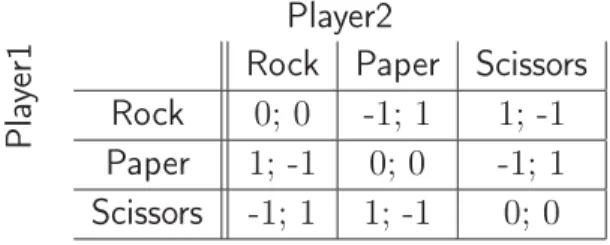
4.1 The game “Rock, Paper, Scissors”. . . 81
4.2 An instance of the game “Rock, Paper, Scissors”, when a= 1 in Table4.1. 81 4.3 Strictly dominant strategy. . . 83
4.4 A possible measure of the social welfare in Table 4.3(a). . . 86
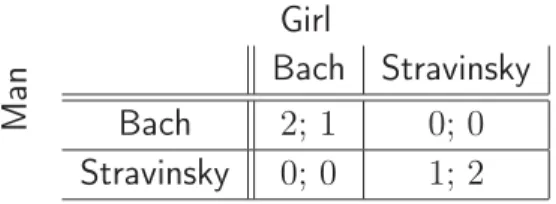
4.5 The game “Battle of the Sexes” in general. . . 89
4.6 An instance of the game “Battle of the Sexes” in Table 4.5. . . 90
5.1 Instantiation of multi-agent vocabulary into supply chain vocabulary. . 110
6.1 Experimented ordering schemes. . . 120
7.1 The nineteen consumption patterns, where Dlumber w =Dpaperw (detailed in Tables B.1, B.2and B.3). . . 145
7.2 Standard-deviation of PaperMill’s orders . . . 168
7.3 Supply chain costs Cimproved . . . 170
7.4 Sum of PaperMill’s backorders . . . 171
7.5 Standard-deviation of PaperMill’s inventories and backorders . . . 173
8.1 Optimal initial inventories and induced costs of homogeneous supply chains (recall of Table C.7). . . 189
8.2 Adaptation of the Prisoners’ Dilemma to cost minimization. . . 194
8.3 Costs with one player (similar to the homogeneous supply chain presented in Table 8.1, but with another data format). . . 197
8.4 The nine simulations required to study thePaperRetailervs. the RestOfThe-SupplyChain (two player game). . . 200
8.5 Outcomes when thePaperRetailerand theRestOfTheSupplyChainare self-ish (two player game). . . 200
8.7 New Table8.5 after the second turn of elimination of dominated strategies.201
8.8 Overall supply chain’s costs when the PaperRetailer and the RestOfThe-SupplyChain are selfish. . . 202
8.9 Strictly dominated strategies when the PaperRetailerand the RestOfThe-SupplyChain are selfish. . . 203
8.10 Results of analysis when thePaperRetailerand theRestOfTheSupplyChain
are selfish (1/3). . . 204
8.11 Results of analysis when thePaperRetailerand theRestOfTheSupplyChain
are selfish (2/3). . . 204
8.12 Results of analysis when thePaperRetailerand theRestOfTheSupplyChain
are selfish (3/3). . . 205
8.13 Strictly dominated strategies when theLumberRetailer, thePaperRetailer
and the RestOfTheSupplyChain are selfish. . . 207
8.14 Results of analysis when the LumberRetailer, the PaperRetailer and the
RestOfTheSupplyChain are selfish (1/3). . . 208
8.15 Results of analysis when the LumberRetailer, the PaperRetailer and the
RestOfTheSupplyChain are opponents (2/3). . . 209
8.16 Results of analysis when the LumberRetailer, the PaperRetailer and the
RestOfTheSupplyChain are opponents (3/3). . . 209
8.17 Strictly dominated strategies when all companies are selfish (six player game). . . 210
8.18 Results of simulation analysis when all companies are selfish (1/3). . . . 210
8.19 Results of simulation analysis when all companies are selfish (2/3). . . . 211
8.20 Results of simulation analysis when all companies are selfish (3/3). . . . 212
B.1 Details of the nine lumber consumptions patterns in Table 7.1. . . 269
B.2 Details of the ten Uniform random10A to 10J consumptions patterns for the lumber. . . 271
B.3 Details of the ten Uniform random10A to 10J consumptions patterns for the paper. . . 272
B.4 Correct λ for ordering scheme B for different ordering and shipping de-lays for all market demand patterns (also applicable for retailers using Scheme D). . . 277
B.5 Correct λ for ordering scheme for all market demand patterns D for different ordering and shipping delays (not applicable to retailers). . . . 279
B.6 Standard-deviation of orders, i.e., σOpiw+Θpiw (extension of Table 7.2, 1/4). 280 B.7 Standard-deviation of orders, i.e., σOpiw+Θpiw (extension of Table 7.2, 2/4). 281 B.8 Standard-deviation of orders, i.e., σOpiw+Θpiw (extension of Table 7.2, 3/4). 282 B.9 Standard-deviation of orders, i.e., σOpiw+Θpiw (extension of Table 7.2, 4/4). 283 B.10 Supply chain costs Cimproved (detail of Table 7.3, 1/4). . . 284
B.12 Supply chain costs Cimproved (detail of Table 7.3, 3/4). . . 286
B.13 Supply chain costs Cimproved (detail of Table 7.3, 4/4). . . 287
B.14 Sum of backorders, i.e., w(Obiw+ Θbiw) (extension of Table 7.4, 1/4). 288
B.15 Sum of backorders, i.e., w(Obiw+ Θbiw) (extension of Table 7.4, 2/4). 288
B.16 Sum of backorders, i.e., w(Obiw+ Θbiw) (extension of Table 7.4, 3/4). 289
B.17 Sum of backorders, i.e., w(Obiw+ Θbiw) (extension of Table 7.4, 4/4). 289
B.18 Standard-deviation of inventories, i.e., σI+Op+Θp (extension of Table 7.5, 1/4). . . 290
B.19 Standard-deviation of inventories, i.e., σI+Op+Θp (extension of Table 7.5, 2/4). . . 290
B.20 Standard-deviation of inventories, i.e., σI+Op+Θp (extension of Table 7.5, 3/4). . . 291
B.21 Standard-deviation of inventories and backorders, i.e., σI+Ob+Θb (exten-sion of Table 7.5, 4/4). . . 291
C.1 Optimal initial inventory for ordering schemeBfor different ordering and shipping delays and for the Step pattern (all initial inventories may be different). . . 294
C.2 Optimal initial inventory for ordering schemeBfor different ordering and shipping delays and for the Step pattern (all initial inventories may be different, except by the Sawmill). . . 295
C.3 Optimal initial inventory for ordering scheme B for different ordering and shipping delays and for the Step pattern (all initial inventories are identical). . . 296
C.4 Optimal initial inventory for ordering schemeDfor different ordering and shipping delays and for the Step pattern (all initial inventories may be different). . . 299
C.5 Optimal initial inventory for ordering schemeDfor different ordering and shipping delays and for the Step pattern (all initial inventories may be different, except by the Sawmill). . . 300
C.6 Optimal initial inventory for ordering scheme D for different ordering and shipping delays and for the Step pattern (all initial inventories are identical). . . 301
C.7 Optimal initial inventory for two-week ordering and shipping delays when all initial inventories may be different except by the Sawmill(recalled in Table 8.1). . . 303
C.8 Tables C.7 when the Sawmill bases its order on the maximum of lumber and paper requirements. . . 305
C.9 Table C.7 when the Sawmill bases its order only on paper requirements 306
1.1 The bullwhip effect. . . 3
2.1 A supply chain . . . 24
2.2 Overlap of some collaboration techniques. . . 25
2.3 A cycle for the inventory system. . . 29
2.4 Architectures of intelligent agents . . . 33
2.5 Goals and means of Information Technologies for Supply Chain Manage-ment. . . 42
3.1 The bullwhip effect (recall of Figure 1.1). . . 54
3.2 The supply chain complexity triangle . . . 62
4.1 Generic classes of coordination mechanisms . . . 67
4.2 The PAC system . . . 70
4.3 Strictly dominated strategy. . . 84
5.1 Lot-for-lot ordering policy with (O,Θ)orders. . . 97
5.2 Information streams cut into two parts. . . 100
6.1 Supply chain in the Beer Game . . . 115
6.2 Forest supply chain in the two original Wood Supply Games . . . 116
6.3 Forest supply chain in the Québec Wood Supply Game (QWSG) . . . . 117
6.4 Some relations between variables. . . 126
6.5 Implementation of the Québec Wood Supply Game (QWSG) in Excel. . 127
6.6 The modelled forest supply chain. . . 132
6.7 The PaperMilland Sawmillmodel. . . 133
6.8 The model SCOR . . . 134
6.9 JACKTM plans in thePaperMill and the Sawmill. . . . 135
6.10 Graphical user interface of the second simulator. . . 137
7.1 Orders in Scheme A . . . 149
7.2 Inventories in Scheme A . . . 150
7.3 Orders in Scheme A’ . . . 151
7.5 Orders in Scheme A” . . . 153
7.6 Inventories in Scheme A” . . . 154
7.7 Orders in Scheme B . . . 157 7.8 Inventories in Scheme B . . . 158 7.9 Orders in Scheme B’ . . . 160 7.10 Inventories in Scheme B’ . . . 161 7.11 Orders in Scheme C . . . 162 7.12 Inventories in Scheme C . . . 163 7.13 Orders in Scheme D. . . 164 7.14 Inventories in Scheme D . . . 165
8.1 Forest supply chain in the QWSG (recall from Figure 6.3). . . 191
8.2 Outcomes when theLumberRetailer, thePaperRetailerand the RestOfThe-SupplyChain are selfish (Step demand). . . 206
8.3 The e-Hub model . . . 217
A.1 Some relations between variables (recall of Figure 6.4). . . 258
A.2 JACKTM plans in thePaperMill and the Sawmill(recall of Figure 6.9). . 263
A.3 The PaperMilland Sawmillmodel (recall of Figure 6.7). . . 265
6.1 playAweek(incomingOrder, incomingShipping) . . . 121
7.1 methodology in the first series of experiments . . . 143
8.1 methodology in the second series of experiments . . . 179
8.2 optimizeInventories(m) . . . 180
8.3 simulateSupplyChain(m) . . . 181
8.4 simulateSupplyChain’(m) . . . 182
Introduction
Stream fluctuations may occur in many types of distributed systems, or in other words, the streams in these systems are not stable. Since such an instability decreases the efficiency of the considered distributed system, we would like to reduce it. In particular, Multi-Agent Systems are distributed systems that are made of several autonomous entities, called agents, that interact by requesting to other to carry out some tasks (request stream) and by carrying out these tasks (task stream). Since such multi-agent systems are distributed, their efficiency may also be reduced by fluctuations in their internal streams. In this dissertation, we focus on supply chains dynamics using multi-agent systems to come up with fundamental learning about the value of collaboration within a supply chain. A supply chain is a network of companies producing and distributing products to end-customers. In this context, fluctuations affect order stream, and are called the “bullwhip effect”. This phenomenon decreases supply chain efficiency, because it induces an inventory level increase and a supply chain agility decrease. The problem of stream fluctuations, and in particular the bullwhip effect, are presented in Section 1.1.
This dissertation pursues two goals:
• the understanding of the dynamics of a whole supply chain in order to propose some coordination mechanisms reducing the bullwhip effect while taking into ac-count operational constraints and maintaining service level;
• the verifying of agents’ incentive to use such coordination mechanisms.
To achieve these goals, we model each company as an intelligent agent, i.e., as an autonomous, software entity, which allows us to consider a whole supply chain, instead
of one or two companies, as is usually done in other studies of the bullwhip effect. With this agent model, our first goal is addressed by designing each company-agent’s behaviour in order to reduce the bullwhip effect in the supply chain. More precisely, agent behaves according to the distributed coordination mechanism that we propose as a solution to the bullwhip effect. However, the emphasis of this work is more on methodology than on optimization of the coordination mechanism, because simulations show that coodination decreases logistics costs by several orders of magnitude.
The problem is that agents may disagree to use our coordination mechanism. For this reason, our second goal is to check whether every agent has an individual incentive to behave according to our coordination mechanism. Precisely, game theory is used to analyze inter-agent interactions in our simulation of a supply chain. These research questions are motivated in Section1.2. Those questions are interesting for both supply chain management and multi-agent systems. We detail our contributions for these two fields in Section 1.4. Next, we compare our work with existing research contribution in Section 1.5. Finally, Section 1.6 outlines the content of this thesis.
1.1
Stream Fluctuations in Distributed Systems: The
Bullwhip Effect
The performance of many distributed systems is reduced by the unstability of their internal streams. As a distributed system, a multi-agent system may face this problem too. In this dissertation, we focus on supply chains modelled using multi-agent systems. This dissertation focusses on this particular type of stream fluctuation.
Supply chains are distributed systems composed of different companies producing and distributing products to customers. In such a supply chain, fluctuations affect order streams, as illustrated in Figure 1.1:
• the Retailer sells to the customer and buys from theWholesaler; • the Wholesaler sells to the Retailer and buys from thePaperMill;
• the PaperMill sells to the Wholesaler and buys from an unknown supplier.
As orders flow within the supply chain, their variability increases. This phenomenon of fluctuation of the order stream is known as the “bullwhip effect”. Lee et al. [1997a]
Time Time Time
Retailer
the customer the wholesaler
Orders from the retailer Orders from
σ
σ
σ
µ
Retailer Retailer Wholesalerµ
Wholes. Orders fromAmplification of order variability = Bullwhip effect Wholesaler
µ
Paper mill
Paperm.
Paper mill
Figure 1.1: The bullwhip effect [Lee et al.,1997a,b].
said about this phenomonon: “The ordering patterns of the three companies share a common, recurring theme: the variabilities of an upstream site are always greater than those of the downstream site”. As a variability, the bullwhip effect is measured by the standard deviation σ of orders (notice that the means µ of orders are all equal in our example in Figure1.1).
Forrester [1958] was the first author to describe this phenomenon. Next, Lee et al.
[1997a,b] have proposed four causes of this effect: (i) demand forecast updating, (ii) order batching, (iii) price fluctuation and (iv) rationing and shortage gaming. Other authors have extended Lee and his colleagues’ causes and solutions to the bullwhip effect: (v) misperception of feedback in the supply chain [Sterman, 1989], (vi) local optimization without global vision [Kahn, 1987; Naish, 1994; Shen, 2001], and (vii) variabilities due to company processes [Taylor,1999].
There are several consequences of the bullwhip effect. In a few words, this effect incurs costs due to higher inventory levels, supply chain agility reduction, decrease of customer service levels, ineffective transportation, missed production schedules. . . In fact, such fluctuations of the demand lead every participant in the supply chain to stockpile because of a high degree of demand uncertainties and variabilities [Lee et al.,
1997b]. An insight into the importance of this problem is given byCarlsson and Fullér
[2001] who estimate that the costs incurred by the bullwhip effect are 200-300 MFIM (40-60 millions USD) annually for a 300 kton North-European paper mill.
According to Cooper et al. [1997], the bullwhip effect is a coordination problem be-tween autonomous companies, which can thus be considered as agents. Therefore, the proposed solution to the bullwhip effect is a decentralized coordination technique. On account of this, the first point addressed by this dissertation is the design of
coordi-nation techniques reducing information flow fluctuations1 in distributed systems. This point is studied for the special case of a supply chain modelled as a multi-agent system, in which the demand amplification has to be reduced, while keeping low inventories and good customer service levels. It is worth noting here the difference between the words “distributed” and “decentralize”. In fact, the systems considered in this dissertation are distributed in a geographic and/or in a functional way. It follows that the proposed coordination mechanism has to take into account this distribution. The simplest so-lution would be to centralized the coordination, i.e., to transmit the whole requested information to a node in the system, then to compute the optimal optimization, and finally to make this coordination run in the system. This approach is not the actual philosophy of multi-agent systems. In fact, our coordination mechanism has no center, or more precisely, every node in the system takes part to the coordination process.
Another issue may appear with such coordination techniques: some agents may dis-agree to use it, because they are better off with fluctuations. More generally, agents may refuse to coordinate in a multi-agent system, because they do not profit, or even suffer, from the increase of the system efficiency incurred by the coordination mech-anism. Similarly, coordination may be expensive, and each agent would prefer that the rest of the multi-agent system coordinates, but without itself, because this agent would profit from the effort of coordination made by the others without participating in this effort. In most supply chain, companies have different conflicting objectives. In particular, on the one hand, the bullwhip effect disturbs the PaperMill in Figure 1.1
while it cannot reduce it, and on the other hand, the Retailer in Figure 1.1 is the first company to generate this phenomenon while it does not have incentives to reduce it, because it does not directly suffer from it. This problem is thus interesting, because if theRetailer spends money to reduce the bullwhip effect, it does not directly profit from this reduction while it pays for it. In fact, the Wholesaler and the PaperMill directly profit from this reduction, and the Retailerhas only an indirect benefit, due to the fact that it receives product with lower delays, because the Wholesaler and the PaperMill
have less stockouts and are thus able to ship product to the Retailer in time. In other words, the problem is not only to understand the dynamics generating fluctuations in order to propose some solutions, but also to check if companies will individually profit from this solution, and if this is not the case, to propose some incentive alignment mechanism. This problem of individual incentive that may be in contradiction with the group welfare is the second point addressed in this dissertation, in the special case of the adoption of a mechanism reducing the bullwhip effect in the supply chain.
To sum up, the two goals of this thesis are (i) to study how stream fluctuation propagates in a distributed system by considering the case of a supply chain modelled
as a multi-agent system reducing these fluctuations, and to propose a coordination mechanism as solution, and (ii) to check if company-agents have individual incentives to use such a coordination mechanism. We now motivate our approach to address these two points.
1.2
Motivations
We have previously presented the bullwhip effect as a particular case of stream fluc-tuations in a distributed system. In this thesis, we use simulations to address the two questions related to stream fluctuations, as stated in the previous section. First, we study how such fluctuations are generated and how to reduce them. To achieve that, we see each company in a supply chain as an intelligent agent, and we look for agents’ individual decisions reducing order fluctuations, i.e., reducing the bullwhip effect. In this dissertation, an intelligent agent is a software conceived as an autonomous entity interacting with other agents. Inter-agent interactions are formalised with game theory in the second question addressed. This question concerns company-agents’ incentive to reduce stream fluctuations by adopting the behaviour proposed in our coordination mechanism. We now develop our motivations to address these two questions.
1.2.1
Motivation to Propose a Coordination Mechanism
First, we take the agent model of a company in the QWSG (Québec Wood Supply Game), which is a board-game based on the Beer Game to teach supply chain dynam-ics in the Québec forest industry. That is, we replace human players in the QWSG by intelligent agents. The supply chain model in the QWSG is interesting, because it is simple while the emerging dynamics are very complex. In this context, our goal is to understand how these agents have to place orders in order to minimize the overall supply chain cost, according to the QWSG rules. From the viewpoint of supply chain management, we look for an ordering scheme that stabilizes placed orders, while min-imizing inventory levels, avoiding stockouts, and fulfilling market demand. From the viewpoint of multi-agent systems, the market demand can be seen as the output of the multi-agent system, and our goal is to design agent’s behaviour so that the system reponses the most efficiently to the demand. To do that, we design a decentralized co-ordination mechanism making each agent behave according to the set point requested as system output, where the set point corresponds to the market demand when the considered system is a supply chain.
To obtain this stabilization, the basic idea is to make all agents’ orders conform to the market consumption. This solution to the bullwhip effect is intuitive, but as we will see later, it does not take operational constraints into account, i.e., inventories in the QWSG are not well managed. Such a solution can be summarized in two principles: Principle 1: Lot-for-lot orders eliminate the bullwhip effect, but do not manage
inven-tories.
Lot-for-lot ordering means that each company orders what has been demanded from it, e.g., if its client wants 10 products, the company places an order for 10 products. With such a strategy, the bullwhip effect is eliminated, but inventory levels are not managed. Therefore, we keep lot-for-lot orders, but we add another piece of information to manage inventory levels. Now, orders are vectors(O,Θ)instead of a unique number X. O in (O,Θ) are set according to the lot-for-lot scheme. This second piece of information is also an order, but its objective is only to stabilize inventory at its initial level. Therefore, theRetailertransmits the market consumption to theWholesalerinO, next the Wholesaler transmits this information to the PaperMill, etc. As a result, the first principle rules O, but we need another principle to rule Θ. The way to emit this information is also studied in order to avoid that this second type of order be emitted at any time, i.e., to avoid the bullwhip effect being moved in this second type of order. The needs for this point are summarized in our second principle:
Principle 2: Companies should react only once (by under- or overordering) to each market consumption change.
In this context, Θ are equal to zero all the time, except when market consumption changes, in which case companies react to this change by sending non-zero Θin order to stabilize their inventory to the initial level. In other words, Θ are proportional to the variation of the market consumption. As we can see, these two principles imply collaboration in the supply chain, where thecollaboration is based on information shar-ing. In this thesis, we consider that collaboration is demand information sharing, that is, companies share their demand with their suppliers. We also study information cen-tralization, where retailers multi-cast the market consumption in real-time to the whole supply chain, accelerating real demand transmission.
As an illustrative example of our two principles, we propose two ordering schemes reducing the bullwhip effect. As stated above, agents place (O,Θ) vectors as orders, whereO are ruled according to our first principle and Θ according to our second prin-ciple. As a result, there is information sharing, because each company transmits in O
the market consumption, the difference between the two proposed ordering schemes lies in the manner of performing this information sharing. In our first scheme, O rep-resent the market consumption transmitted from each company to its suppliers, and
Θ are used to order more or less than O when required. In this case, O are used to perform the information sharing. Our second scheme works in a similar way, except that we assume there is information centralization, i.e., retailers multi-cast inreal-time
the market consumption in the whole supply chain. As a consequence, company-agents base their placed orders directly on the actual market consumption, instead of on O. In this case, O also represent the market consumption transmitted by the client, but a ‘fresher’ information is provided by information centralization. In fact, the market consumption transmitted inO in the first scheme is as slow as orders, while information centralization in the second scheme is assumed to be instantaneous and in real-time.
The efficiency for reducing the bullwhip effect of these two schemes is validated by simulations of the QWSG. Precisely, our two schemes are compared with five other ordering rules that are not ruled by our two principles. As we focus on the bullwhip effect, our metric is the standard deviation of orders placed by companies. We also use three other metrics to measure the consequences of the bullwhip effect. We note in our simulations that our two ordering schemes change the supply chain dynamics in two ways. The first way is the reduction of information stream fluctuations, i.e., our goal of reducing the bullwhip effect is reached. The second way is more surprising: there is a distribution change in backorder durations among companies. In fact, retailers’ backorders become longer within a collaborative scheme, while the retailers are the least disturbed companies by backorders within a traditional approach. The consequence of this change in backorder duration distribution is a change in the cost distribution in the supply chain.
These solutions to the bullwhip effect are also interesting for multi-agent systems, because some causes of this effect may also exist for other types of distributed systems. When this is the case, our solution only needs to be translated for these other types of distributed systems; we will see the example of vehicles on roads in Subsection 5.6.2. Moreover, conclusions drawn from experiments on our special case of distributed system, i.e., the supply chain in the QWSG, may also apply to these other distributed systems, such as multi-agent systems. For instance, the effect noted on the change in backorder duration distribution may also occur in other distributed systems, but in a different way affecting system dynamics.
1.2.2
Motivations for Studying Incentives to Use our
Coordina-tion Mechanism
As previously stated, there is a change in backorder duration distribution, that arises the second question addressed in this dissertation. In fact, companies may refuse to use our schemes because of this distribution change, which may be an issue, because our ordering schemes are based on the market consumption measured by retailers and transmitted to other companies. In this context, if a company disagrees to communicate the market consumption information to the rest of the supply chain, our two ordering schemes using
(O,Θ)orders cannot work properly, and companies become unable to apply our second principle. Moreover, each company may prefer that all other companies collaborate but not itself. This is the reason why we study individual incentives to use either the(s, S) policy (a classic ordering policy in the field of Inventory Management), or one of the two proposed schemes.
Each company decides which ordering schemes to use. This choice is made to min-imize its costs, but this choice also impacts on the rest of the supply chain. Many simulations are carried out to check this effect, that is, what happens for each company when a particular company chooses a particular scheme. Game theory is used to an-alyze this huge quantity of simulation outcomes. During this analysis, overall supply chain cost is again taken into account, as well as each company’s cost, to find when each company has the lowest cost depending on others’ choice.
The result of our analysis is that all companies prefer to use our ordering schemes, because if Companyidoes not choose one of our two schemes while the rest of the supply chain does so, then Company ihas a higher cost. In other words, using one of our two schemes is a Nash equilibrium, and using the (s, S) policy is not a Nash equilibrium. Thus, we got significant results with game theory. Notice that game theory is more and more frequent in both supply chain management [Cachon and Netessine,2003] and multi-agent system fields [Boutilier et al.,1994]. Furthermore, Geoffrion and Krishnan
[2003] cite program objectives forNational Science Foundation[2004]’s Advanced Com-putational Research Program showing that simulations are very useful in research, i.e., our multi-agent simulations are useful for supply chain management, even if they are not theoretical:
As pointed out in many documents and reports, computer simulation has now joined theory and experimentation as a third path to scientific knowl-edge. Simulation plays an increasingly critical role in all areas of science and engineering.
Geoffrion and Krishnan [2003] also support this idea:
Our second main observation concerning management science work [. . . ] is that there is a trend toward making greater use of computation and communication.
Next, they explain this observation:
Both empirical and methodological work are gaining at the expense of purely theoretical work. It is easy to understand such a trend in terms of the chang-ing relative productivities of these three kinds of research work, because computation, data, and communication are much more important as fac-tors of production in empirical and methodological work than in theoretical work. The cost and availability of these factors have changed enormously while technology has made thinking, the main ingredient of theoretical work, only moderately more productive per labour hour or per resource dollar.
We now present how we use agent-based simulations in supply chain management.
1.3
Methodology
In this research, we propose two decentralized coordination mechanisms to reduce order fluctuations in a supply chain, next we check if company-agents will agree to use this mechanism. In the simulations used in these two parts2, each company is programmed as an agent that is travelled by order and product streams, and we combine these agents to form our simulation of a supply chain. Each agent’s behaviour is implemented by its ordering scheme. In the first part, we simulate the seven following ordering schemes:
• an ordering scheme called (s, S) policy, which is a classic ordering policy in the field of inventory management;
• two ordering schemes which are the decentralized coordination mechanisms using
(O,Θ)orders that we propose;
• four ordering schemes which are used to understand which base principles are key factors to reduce the bullwhip effect.
Since the four latter schemes were simulated only to understand that we need our two principles to reduce the bullwhip effect, we drop them in the second part of our work, in order to focus on the confrontation of the well-known (s, S) with our two schemes. The methodology in these two parts is now detailed.
1.3.1
Methodology for Validating our Coordination Mechanism
In this first part, we check if the two schemes based on our two principles minimize the bullwhip effect, while inventories are well managed, that is, inventory levels are as low as possible, but sufficient to fulfill incoming demand (in practice, the two schemes are designed so that inventory levels stabilize at the initial inventory level when the demand is constant for a sufficient time, but we only do so in our simulation to check the efficiency of our concepts). Here, all companies behave the same, which is referred to a “homogeneous supply chain”.Since our goal is to reduce the bullwhip effect, the considered metric is the standard deviation of orders placed by companies, and in particular, orders placed by the most upstream supplier. We also consider three indirect metrics measuring the harmful consequences of the bullwhip effect. The first of these three indirect metrics is the logistics cost incurred by the entire supply chain. We consider in this first part the supply chain as a whole, without considering each company’s interest for the moment. The two other indirect metrics are (i) the standard deviation of the inventory level, to measure the average inventory level (the greater the standard deviation of inventory level is, the more inventory level fluctuates, and thus, the higher the average inventory level is, because companies increase their safety stock to avoid stockouts), and (ii) the number of backordered items, to measure the customer service levels.
1.3.2
Methodology for Checking Incentives for Collaboration
In the second part, we assume that the supply chain is heterogeneous by letting com-panies use any of the three schemes: the classic (s, S) or one of our two schemes. The question is now to find which scheme will be chosen by each company. In fact, our two schemes may incur negative consequences for some agents, although these schemes
are good for the overall supply chain. The methodology consists in using the same simulation as in the homogeneous case, but each company can use different ordering schemes from other companies. Precisely,36 = 729simulations are carried out, in which all companies use the first ordering scheme in the first simulation, next, all companies use the first ordering scheme except one company which uses the second scheme in the second simulation, . . . and all companies use the third scheme in the 729th simulation. As a comparison, we have carried out only one simulation per each of the 7 ordering schemes in the first part of our experiment program.
For each simulation and for each company, we record the backorder and inventory holding costs. We use these 6×36 costs to build a game in the normal form in which we look for dominated strategies, Nash equilibria and Pareto dominations of these equilibria. As this game is very large, a software called “Gambit” was used for this analysis. Results from Gambit show that using one of our ordering schemes is a Nash equilibrium, that is, no company would like to stop using this scheme if the rest of the supply chain also continues using it, while using (s, S)is never a Nash equilibrium.
We can note that we have not only used multi-agent systems to model the supply chain, but we also contribute to this field by designing a decentralized coordination mechanism aiming at reducing the bullwhip effect, and by proposing a game theory-based methodology to study incentives for using a coordination mechanism. We should note that this methodology appears as the main contribution of this work because it allows evaluating if collaborative approaches are collectively and individually efficient. We now develop how our work contributes to the two fields of supply chain management and multi-agent systems.
1.4
Contributions
As previously stated, our main contribution is the methodology that applies game theory to analyze multi-agent simulations. This methodology is interesting for the two fields adressed in this disseratation; our contributions for supply chain management are presented first, followed by our contributions for multi-agent systems.
1.4.1
Contributions to Supply Chain Management
Contributions to supply chain management are obvious, because the studied problem belongs to this field. In fact, the three main contributions of this thesis for supply chain management are:
1. the explanation of why delays are themselves a cause of the bullwhip effect, while such delays are only seen in the literature as an aggravating factor of another cause of the bullwhip effect;
2. the proposition of two principles for minimizing this cause of the bullwhip effect, and two schemes illustrating these two principles;
3. the study ofcompanies’ incentive for collaboration, i.e., the use of our methodol-ogy that appliesgame theory to verify the incentive for applying our two principles; 4. a broad, critical review of literature about the bullwhip effect, that presents this
effect as a special case of stream fluctuations in distributed systems;
5. the study of the dynamics in an entire supply chain. In particular, we verify that collaboration is not only the best strategy for the whole supply chain, but also, that no companies have incentives to stop collaborating.
The two first contributions are closely related. On the one hand, our explanation of why delays are themselves a cause of the bullwhip effect permits us to propose our two principles, and on the other hand, these two principles aim at reducing the bullwhip effect generated by delays. Two ordering schemes are then proposed based on these two principles. In the first scheme, companies only have O to know the market consumption. Therefore, Θ are proportional to the variation of O to respect the second principle. This first version is called “Ordering scheme B” in this document. In the second ordering scheme, information centralization is used, that is, retailers multi-cast the market consumption to the whole supply chain. Like (O,Θ) orders, information centralization also transmits the market consumption information, except that information centralization is much quicker because it is instantaneous and in real-time. To profit from this acceleration of information sharing, our second ordering scheme is made more efficient by setting Θ proportional to the variation of the market consumption: as soon as the market consumption changes, non-zero Θ are sent by all companies. Moreover, companies set O equal to the market consumption transmitted by retailers instead of on incoming O, again in order to react quicker to the market consumption change.
These two ordering schemes are then compared with simulations under different scenarios. Precisely, we compare our two ordering schemes with five other schemes under nineteen different market demand patterns to study the efficiency of our schemes at the supply chain and individual levels, that is, we check if our schemes are efficient for the entire supply chain in the QWSG, and if every company agrees to use them.
In order to address the third main contribution listed above, i.e., companies’ incen-tive for collaboration, we carry out additional simulations. In these simulations, we use a cost function adapted from the Québec forest industry, and we apply ordering pa-rameters that are optimized so that the overall supply chain cost is minimum. In fact, our two ordering schemes assume companies collaborate, because they share demand information, but we have to check if they agree to share this information. Here, we consider not only the efficiency of collaboration by information sharing for the whole supply chain, but also the efficiency for each company. That is, we study selfish com-panies’ behaviours versus the minimization of the overall cost with game theory. The analysis of simulation outcomes with game theory shows that collaborating is a Nash equilibrium, while non-collaborating is not a Nash equilibrium. Therefore, every com-pany prefers collaboration, because its logistics cost increases when it ceases unilaterally to collaborate.
Finally, our last contribution to supply chain management is a broad, critical review of literature about the bullwhip effect. In particular, we introduce the bullwhip effect as a particular case of stream fluctuations in distributed systems, and we present some studies of the bullwhip effect in several fields, such as inventory management, economics, traffic flow theory, control theory. . . We now present contributions of this dissertation for the multi-agent field.
1.4.2
Contributions to Multi-Agent Systems
Multi-Agent Systems allow us to design, simulate and analyze our collaboration strate-gies, but we also contribute to this field by doing our research. In particular:
1. We have proposed a decentralized coordination mechanism based on communica-tion to stabilize linked streams in a distributed system;
2. We have taken into accountboth the global efficiency of the system and individual agents’ incentives to evaluate our coordination mechanism by applying concepts from game theory. This point was addressed with a methodology involving game theory to analyze simulation outcomes;
3. We have used game theory and multi-agent systems in a complex realistic study of a problem from supply chain management, and to our knowledge, this is the first time that these three fields have been applied in a common approach. 4. We have written a broad, critical review of literature about the use of multi-agent
systems in supply chain management.
5. We have compared coordination in supply chain management and coordination in multi-agent systems.
Before we see these three main contributions for multi-agent systems, we recall that the bullwhip effect is a distortion of demand information when this information is trans-mitted as orders along the supply chain up to the most upstream suppliers. Therefore, we can note that this deformation of information not only interests supply chain man-agement, but also Computer Science, because Computer Science studies information processing, and thus, information distortion.
From a less general point of view, this thesis studies the dynamics in a complex distributed system that can be viewed as a multi-agent system. In particular, the performance of many systems is reduced by fluctuations in their internal streams, e.g., traffic density during computerized network and road congestions. As a distributed system, a multi-agent system may face this problem too. For this reason, reducing the bullwhip effect in supply chains may give some hints for fluctuation reduction in other kinds of distributed systems, in particular when these systems are modelled as multi-agent systems. Therefore, the two above principles may be adapted by replacing some words, e.g., the bullwhip effect can be replaced by system instability, e.g., traffic congestions, market consumption by system input, company by agent, ordering scheme by agents’ behaviour. . . With these replacements, the first principle ‘Lot-for-lot orders eliminate the bullwhip effect’ can be translated into ‘If agents do exactly what they are asked to, according to the system output, the system fluctuations will be eliminated’ and the second principle ‘Companies should react only once to each market consumption change’ into ‘Agents should react only once to each change in the system input’.
Of course, like in supply chain management, these two principles only hold for fluctuations incurred by delays in the system, and these principles have to be adapted if other causes of fluctuations also occur. But these principles are general, because delays may also cause fluctuations in many other types of distributed systems than supply chains or multi-agent systems. For example, if all cars on a highway were decelerating and accelerating at the same rate and as soon as the first car, the road stream would be smoother, which would reduce the number of traffic jams.
Next, the agents’ behaviour based on these two principles can be seen as a decen-tralized coordination mechanism based on communication. The problem lies in the fact that agents are selfish, and have therefore the choice of obeying or not to this coordina-tion mechanism. This is the reason why the second contribucoordina-tion of this thesis is to take into account both individual and common interests. This is achieved through our third contribution consisting in the use of game theory to analyze inter-agent interactions. This methodology can easily be applied to analyze other kinds of multi-agent systems. The advantage of game theory is to give a high point of view on local interactions in a multi-agent system. Precisely, this high point of view allows researchers to immediately identify bad and good agents’ behaviours before they implement a multi-agent system. In our case, we do not know how companies choose their ordering scheme, but we know which one they may eventually choose, because they correspond to a Nash equilibrium. Moreover, game theory allows understanding why local optimizations do not lead to a global optimum, and how to add social rules constraining agents such as to reach this optimum. In this thesis, game theory is used to analyze a huge quantity of simulation outputs. Each simulation computes company’s costs in the supply chain when each company decides to use a specific ordering scheme. Next, the application of some game-theoretic concepts such as dominations, Nash equilibria or Pareto-dominations causes relevant simulation outputs to appear, and therefore, the inter-agent dynamics in the multi-agent system is made clearer.
Finally, our approach is supported by a broad review of literature about the use of multi-agent systems in supply chain management. In particular, this review allows us to compare our work with some others, and also, to compare coordination in supply chain management with coordination in multi-agent systems. Some of the possible comparisons of our work with others are described in the next section.
1.5
Related Work
We first compare our work with other studies of the bullwhip effect with multi-agent systems. In fact, the nearest approach is fromKimbrough et al.[2002] who use a multi-agent system and a genetic algorithm to find a good ordering scheme for Sterman
[1989]’s Beer Game. It is close to our approach because it used multi-agent concepts with a model of company from the Beer Game. From this point of view, the only difference is in the structure of the supply chain, straight in the Beer Game versus divergent in the QWSG. However, there are many other differences. The main one is that they fix an ordering scheme and the genetic algorithm looks for the optimal value
of the parameter in this scheme. This optimal value is calculated so that the overall cost of the supply chain is minimized for the duration of the simulation. The optimum may therefore change depending on the simulation duration. On the other hand, our work focuses on the design of the ordering scheme itself, and we do fewer efforts to find optimal parameters, because we rely on theSolverinExcelfromMicrosoft Corp.[2004a], while they implement an optimization algorithm (genetic algorithm) by themselves. Conversely to their work, our ordering schemes are not designed to be efficient, but to stabilize ordering flows and inventories. We focus on efficiency only after this, when we optimize parameters in our two ordering schemes, but this is the essence of our approach. Though, these parameters are determined like Kimbrough and his colleagues, that is, they are set up such as the overall supply chain cost is a minimum for a specific duration of the simulation (but not for any duration).
The second approach using multi-agent systems is from Yung and Yang [1999a,b] who, like us, seek to reduce the bullwhip effect by improving the visibility and taking constraints into account. Instead of basing their model on the Beer Game, they use a model very close to the reality that can be operated by managers in an actual supply chain. Conversely to our higher level approach, they model processes in companies, but the supply chain considered in their experiments has only two levels (manufacturers and warehouses, where customers buy from these warehouses), while we consider four levels (retailers, wholesalers, paper and sawmill, and forest). Conversely to our agents applying an ordering scheme, their agents are more complex because they are able to:
• process routine jobs in place of humans on real installations;
• communicate information about operations, and use this information to optimize decisions with genetic algorithms;
• give managers a view of the state of the whole supply chain state, and in particular, a detection of the bullwhip effect, and an extraction of useful information received from other companies by a technique of constraint propagation.
The last approach with multi-agent systems is Yan [2001]’s study of the impact of delay distribution on the bullwhip effect. As it focuses on impact of delays in the supply chain, this work is very similar to ours. Basically, this agent-based supply chain checks experimentally that Chen et al. [2000]’s formal quantification of the bullwhip effect is correct. In particular, they verify like us that information centralization improves the efficiency of the overall supply chain.
We now compare our work with research studying the impact of delays on the bullwhip effect. All the following work focuses on the difficulty of forecasting future
demand when delays are longer, because the forecast has to be made on a longer horizon, conversely to our view, in which the bullwhip effect is also increased when there are no forecasts, because delays are a cause of the bullwhip effect by themselves. In this context, the approach from Chen et al. [2000], mentioned above, proposes a formal model in which the bullwhip effect is both induced by a forecasting technique, a moving average, and aggravated by delays. This paper was extended for another forecasting technique, an exponential smoothing, by Ryan [1997] and Simchi-Levi et al. [2000].
Lee et al. [1997a,b] also explain how forecasting techniques induce the bullwhip effect, and how this is aggravated when delays are longer.
In general, such models are based on the Beer Game. As we use a simulation model derived from this game, we do so, but in a more empirical way. The Beer Game was studied by Sterman [1989] with human players, while we replace people by software agents. Therefore, we do not focus on players’ psychology that cannot understand the whole dynamics of the supply chain. Nevertheless, we also have to take such dynamics into account when proposing the ordering schemes used by our agents. As presented in this thesis, the design of our ordering schemes addresses the issue of delays in supply chains, because it is the only chain dynamics explaining the apparition of the bullwhip effect in the QWSG and the Beer Game played by software agents. From this point of view, we give a better understanding of Sterman’s “supply chain dynamics”, so that players should know how to play the Beer Game more efficiently. On the other hand, issues related to delays are very well known in supply chain management. In particular,
Sjöström[2001] studied their impact in the North European forest industry. This work is similar to ours because it addresses a forest industry, but ours is less “empirical” as it uses simulation rather than real-life.
The last point of comparison that we consider is information sharing in supply chains, which has been well studied [Anderson and Morrice,2000;Cachon and Lariviere,
1999; Chatfield, 2001; D’Amours et al., 1999; Lee and Whang, 1998; Yu et al., 2001]. In fact, we propose to share information to reduce the bullwhip effect induced by delays, but information may be shared for other reasons. In our proposition of a mechanism for sharing information, we were inspired byPorteus [2000]’s Responsability Tokens to design our solution, even if our ordering scheme is eventually very different from this mechanism. In fact, Responsability Tokens deal with transfer payments in the supply chain to give incentives to upstream suppliers to ship products required downstream by retailers. On the contrary, our ordering scheme does not rely on money, because its only objective is to give enough information to companies, so that they can stabilize orders without neglecting operational constraints, and in particular inventory manage-ment. In fact, information sharing is the most often proposed solution to the bullwhip effect [Chen et al., 2000; Lee et al., 1997a; Simchi-Levi et al., 2000]. In this context,
![Figure 1.1: The bullwhip effect [Lee et al., 1997a,b].](https://thumb-us.123doks.com/thumbv2/123dok_us/9941516.2888114/22.892.156.796.201.390/figure-bullwhip-effect-lee-et-al-a-b.webp)
![Figure 2.1: A supply chain [Swaminathan et al., 1998; Davidsson and Werstedt, 2002].](https://thumb-us.123doks.com/thumbv2/123dok_us/9941516.2888114/43.892.176.754.186.628/figure-supply-chain-swaminathan-et-al-davidsson-werstedt.webp)
![Figure 2.3: A cycle for the inventory system [Johnson and Montgomery, 1974].](https://thumb-us.123doks.com/thumbv2/123dok_us/9941516.2888114/48.892.171.768.199.544/figure-cycle-inventory-johnson-montgomery.webp)
![Figure 2.5: Goals and means of Information Technologies for Supply Chain Manage- Manage-ment [Simchi-Levi et al., 2000].](https://thumb-us.123doks.com/thumbv2/123dok_us/9941516.2888114/61.892.339.698.187.520/figure-goals-information-technologies-supply-manage-manage-simchi.webp)
![Figure 3.1: The bullwhip effect [Lee et al., 1997a,b] (recall of Figure 1.1).](https://thumb-us.123doks.com/thumbv2/123dok_us/9941516.2888114/73.892.152.796.201.390/figure-bullwhip-effect-lee-et-al-recall-figure.webp)
![Figure 4.1: Generic classes of coordination mechanisms [Frayret, 2002].](https://thumb-us.123doks.com/thumbv2/123dok_us/9941516.2888114/86.892.155.730.218.836/figure-generic-classes-coordination-mechanisms-frayret.webp)
![Figure 4.2: The PAC system [Buzacott and Shanthikumar, 1992].](https://thumb-us.123doks.com/thumbv2/123dok_us/9941516.2888114/89.892.159.811.175.417/figure-pac-buzacott-shanthikumar.webp)