J Wood Sci (2000) 46:130-136 9 The Japan Wood Research Society 2000
Y i m i n X i e 9 S e i i c h i Y a s u d a 9 H o n g W u 9 H u a n b i n L i u
Analysis of the structure of lignin-carbohydrate complexes by the specific
13C tracer method
Received: November 9, 1998/Accepted: May 17, 1999
A b s t r a c t In the present study the specifically ~3C-enriched lignin precursors of biosynthesis (i.e., coniferin-[side chain- a-13C], coniferin-[side chain-fl-~3C] and coniferin-[side chain-)~53C]) were synthesized and administered exoge- neously to ginkgo shoots (Ginkgo biloba L.) to obtain ~3C- enriched lignin-carbohydrate complexes (LCCs). The specifically 13C-enriched LCCs were isolated from the newly formed xylem of ginkgo shoots administered with the 13C- enriched precursors and degraded by enzymes. Lignin-rich fractions, so called enzyme-degraded LCCs (EDLCCs), were obtained. By determining their 13C-NMR spectra, in- formation related to the chemical structure of lignin build- ing units and linkages between phenylpropane units of lignin and carbohydrates were obtained. It was found that these precursors were incorporated in natural lignin suc- cessfully. Three lignin-carbohydrates linkages (i.e., ether type, ester type, ketal type) were found at the Ca-position of the side chain of phenylpropane units in ginkgo LCC. No lignin-carbohydrate bond at the C~- or C<position of the lignin side chain was observed in the ~3C-NMR spectra of the ~3C-enriched LCCs. This fact indicates that a specific 13C tracer technique can be useful in N M R study of the chemi- cal structure of LCCs.
K e y w o r d s Lignin-carbohydrate complexes - N M R 9 13C tracer 9 Coniferin 9 Ketal linkage
Y. Xie ~ 9 H. Wu. H. Liu
State Key Laboratory of Pulp and Paper Engineering, South China University of Technology, Guangzhou 510641, China
Tel. +86-20-87113940; Fax +86-20-85511266 e-mail: [email protected]
S. Yasuda
Laboratory of Forest Chemistry, School of Agricultural Sciences, Nagoya University, Nagoya 464-8601, Japan
Part of this paper was presented at the 5th Pacific Polymer Conference, Kyongju, Korea, October 1997
Introduction
It is commonly assumed that lignin polymer is bound covalently to polysaccharides to form lignin-carbohydrate
complexes
(LCCs). 1-3 The lignin-carbohydrate covalentlinkages were suggested as the most probable cause for the residual lignin to resist delignification during Kraft pulping and bleaching. Many experiments with LCCs strongly sug- gest that such bonds exist between lignin and hemicellu- lose. ~12 The proposed linkage type is classified into the following six groups.
1. Ether linkage of the hydroxyl group at the (z-position of the lignin side chain with alcoholic hydroxyl of sugar residue 4
2. Ester linkage of the alcoholic O H of lignin with the carboxylic group of uronic acid 5
3. Hemiacetal or acetal linkage of the carbonyl group lo- cated at fi-position of lignin with carbohydrates 6 4. Glycoside linkage with the primary alcoholic O H at the
y-position of the phenylpropane unit 7
5. Glycosidic linkage at the phenolic O H of lignin s-9 6. Ester linkage of the carboxylic group of the cin-
namic acid unit in lignin with the alcoholic O H of carbohydrates 1~
Much of the information about LCC bonds stated above was obtained by degradation analysis as acid hydrolysis and alkaline hydrolysis. However, it is almost impossible to de- polymerize and degrade LCCs into their constituent units quantitatively by these methods. Furthermore, it is inevi- table that many undesirable modifications occur during their degradation reactions. Therefore, little direct evidence of this linkage has been obtained so far. 13 It is advantageous to adopt a nondestructive analytical method for this purpose.
observation of the LCC bonds by 13C-NMR is difficult be- cause the strong signals arising from carbohydrates in LCC overlap with those from lignin. To overcome this difficulty, the method of specific ~3C-enrichment of lignin in situ can be applied successfully. 16-2~ By 13C-NMR analysis of 13C- enriched LCC biosynthesized in a plant signals arising from the carbons with LCC bonds may be observed clearly, lead- ing to elucidation of the chemical structure of LCC. In the present work, precursors of lignin biosynthesis with specifically 13C-enriched side-chain carbons (i.e., coniferin- [side chain-a53C], coniferin-[side chain-/3-13C] and coniferin-[side chain-?~53C]) were synthesized and adminis- tered to cut shoots of ginkgo (Ginkgo biloba L.). LCCs specially enriched with ~3C were isolated from the newly formed xylem and treated With enzyme; they were then analyzed by ultraviolet photometry, infrared spectroscopy, and 13C-NMR.
Materials and methods
Synthesis of ~3C-enriched lignin precursors
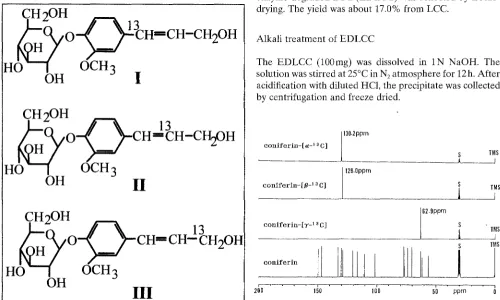
Coniferin-[side chain-a53C] (I) (Fig. 1), coniferin-[side chain-fi-~3C] (II), and coniferin-[side chain-y-13C] (Ili) were synthesized according to the reported methods. 16'ls Their estimated 13C-enrichment was 99%. As shown in Fig. 2, only the resonance signals from the enriched carbons could be observed in their ~3C-NMR spectra.
C, H2OH
~HQ)/ o -~__~3CH"~CH-CH2
OH
HO''IOH OCH3 I
'
C H 2 O H
" - - "
13
~HC~O-~//.__~'CH = CH-CH~ H
HO "-"1
OCH 3
O H
I I
C. H20H ._._.
~HC~ 0-~//.._..~- CH----"
CH1 3H2 OH
HO "--'[
OCH 3
OH
I l l
13
Fig. 1. Structure of C-enriched Coniferins
Administration of lignin precursor to ginkgo shoots Cut shoots with 25-30 leaves (about 35 cm long) of a 4-year- old ginkgo tree were obtained in June and put in vials containing a solution of coniferin (2.5 mg/ml), with water as control. The shoots were allowed to stand at 25~ in a plant- growth chamber for 4 weeks, and 250mg of each kind of coniferin was administered.
Preparation of LCC and enzyme-degraded LCC from ginkgo xylem
A ginkgo shoot, treated with coniferin, was debarked, and 100 ~tm thick tangential sections were cut on a sliding micro- tome from cambium to pith by a procedure described ear- lier. 16 The dried xylem sections of the ginkgo were milled to the size of 100 mesh by a Wiley mill and then extracted thoroughly with ethanol-benzene (1 : 2, v/v) and hot water, successively. The extractive-free wood meals were ground in a vibratory ball mill for 72 h, and then the wood powder was used to prepare LCCs by the procedure of Bj6rkman. 1 A sample of 600 mg of LCC was suspended in an enzyme solution containing 0.4% cellulase (Onozuka RS, Yakult Pharmaceutical Chemical Industries), 0.4% hemicellulase (Sigama), and 0.4% pectinase (macerozyme R-10; Yakult). The buffer (pH 4.6), composed of 0.5 M sodium acetate and 0.5 M acetic acid, was applied; and a few drops of toluene were added as a preservative. The mixture was agitated gently on a shaker at 50~ for 2 days. After centrifugation and washing with distilled water, the precipitate of the enzyme-degraded LCC (EDLCC) was collected by freeze- drying. The yield was about 17.0% from LCC.
Alkali treatment of E D L C C
The E D L C C (100rag) was dissolved in 1N NaOH. The solution was stirred at 25~ in N2 atmosphere for 12h. After acidification with diluted HC1, the precipitate was collected by centrifugation and freeze dried.
c o n i f e r i n _ [ a _ l a C]
c o n i f e r i n - [ B - ' a C]
c o n i f e r i n - [ y - t 3 C]
c o n i f e r i n
~.2ppm
129.0pprn
S TMS
- k J
i . . . . J
150
lO0
62.9ppm
S TMS
1
j
S
TM$
1
S INS
I_
i . . . . . . . . i . . . . i
200
50
ppm 0132
Determination of lignin content
A sample of 6 mg of LCC or 3 mg of E D L C C was dissolved in 100 ml dimethyl formamide (DMF). The ultraviolet (UV) absorbance at 280 nm (A280) was determined with a Shimadzu 2201 UV-VIS spectrometer. The lignin content was calculated with the following formula. 21
Lignin content (%) = A280 • 0.1 / D W
where D (absorptivity) is 20.71 g ~cm -~, and W is the sample weight in grams.
Determination of infrared spectra
Infrared (IR) spectra were determined on a Hitachi model 260-10 infrared spectrometer. The spectra of the LCC and (MWL) samples were measured by the KBr tech- nique. Each KBr disc contained 1.3 mg of sample in 180mg of KBr.
Determination of 13C-NMR spectra
An 80-rag sample of E D L C C was dissolved in 0.5ml DMSO-d6 and put in a 5ram probe tube. The I3C-NMR spectra were recorded on a J E O L JNM-EX 270 FT N M R spectrometer at 67.8MHz under total proton decoupled conditions at 25~ Tetramethylsilane (TMS) was added to the solution as an internal reference. Pulse width was 3.9 9s (45 ~ pulse) with a 2.2s pulse delay, and 3 • 104 scans were accumulated.
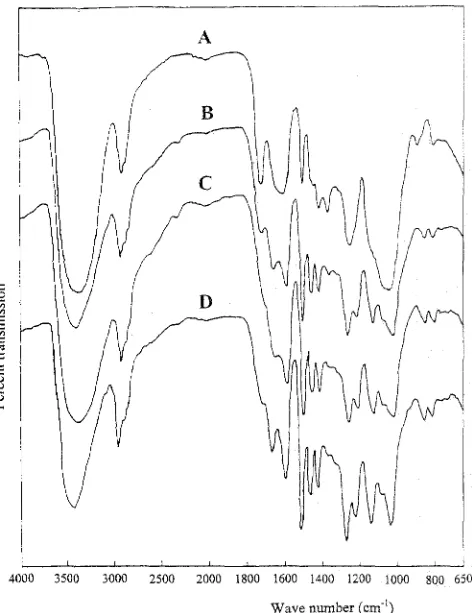
Figure 3 shows the [R spectra of LCC, EDLCC~ alkali- treated EDLCC, and M W L from intact ginkgo wood. In the LCC spectrum, the absorbance in the vicinity of 1730cm -1 due to the esterified carbonyl groups, which may be the acetyl group attached to xylose and esters of glucuronic acid, was strong compared with that of M W L ] :~ This indi- cates that LCC contained a high content of carbohydrates, as expected. However, the intensity of the band of 1730cm -1 was greatly reduced after the enzyme treatment, as shown in the E D L C C spectrum, which was similar to that of M W L generally. This fact indicates that most of the carbohydrate was hydrolyzed by enzymes, and it agrees well with the determination by U V photometry. All ester link- ages in E D L C C were saponified completely under the alkaline condition used, as the band at 1730cm -1 has disappeared from the spectrum of alkali-treated EDLCC.
Incorporation of coniferin into ginkgo LCC
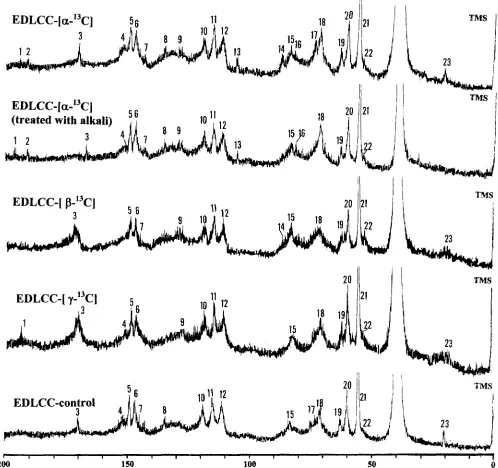
Figure 4 shows the ~3C-NMR spectra of EDLCCs prepared from 13C-enriched ginkgo wood and control wood. Tenta- tive assignment of the signals shown in Table 2 were made by comparisons with signal chemical shifts reported for the main structures of monolignots, dilignols, LCC models and carbohydrates in lignin preparations. 2347
As shown in Fig. 4, in the aromatic region of 111- 149ppm, there was no appreciable qualitative difference
A
Results and discussion
Chemical composition of LCC and E D L C C s
As shown in Table 1, the EDLCCs recovered from the treatment of LCCs with cellulase, hemicellulase, and pecti- nase were lignin-rich fractions. This result indicates that the enzymatic treatment was effective in shortening the hemi- cellulose chain in the LCCs and reducing the sugar content. This result also is in satisfactory agreement with the experi- ment by Eriksson et al. 3 Because the strong signals from carbohydrate disturb the correct assignment of signals from phenylpropane units in LCCs when determined with ~3C- NMR, it is necessary to enrich the lignin content before N M R analysis.
Table 1. Lignin content in ginkgo LCC and EDLCCs
Sample Lignin content (%)
LCC-control 31.8
EDLCC-control 84.5
EDLCC-[a-13C] 86.6
EDLCC-[fi-13C] 85.7
EDLCC-[y-13C] 86.3
LCC, lignin-carbohydrate complex; EDLCC, enzyme-degraded LCC
B
L
i
4 0 0 0 3 5 0 0
C
!
o
I
/
L
i i i i i 1 a_.__ i L ~
3 0 0 0 2 5 0 0 2 0 0 0 1 8 0 0 1 6 0 0 1 4 0 0 1 2 0 0 1 0 0 0 8 0 0 6 5 0
Wave number (era -*)
EDLCC-[(~33C]
5 61!
182? [t'21
3 4 ~ t 10 ~ 12 17 t ~ H
7 8 ~ , J ~ J l . 9 ' 14 1516 ~ 19
1 2 . ~,.,,,~'~,lt# 13 22
E D L C C ' [ ( x ' 1 3 C ]
5 6
11
18
20(treated with alkali)
~i
10 , 12 , J3 4 8 9 15)6
1 2 7 , 13 19
E D L C C - [ [3-13C] ~ ~ 11 20
!
~?
910 ','
1,2
1~
18..1
~
~
1
7
,
14
~
20
EDLCC-[
7-13oC] 5~ 10 11 12 t1
~
4t?
9L ! [
18 19tl12, I
9 20 i
EDLCC-control
1 6 7 8
1,01112
~718
ti!2l
/
3
411~,,,
IJ~,~
15 ~7t 191! .b
t
2oo" ' ' ~ ' 1"o5 ' ' ' ' ' 1"oo . . . . . 5 0
Fig. 4. ~3C-NMR spectra of EDLCCs from ginkgo wood. TMS, reference
133
TMS I
TMS
1
TM~
L ~ s t
"~.~.~
, i , ,,r 10
between the spectra of EDLCC-control and 13C-enriched EDLCCs. However, in the regions of aliphatic carbons (53- 105ppm and 191-194ppm), some signals were enhanced greatly by ~3C enrichment at the side-chain position. This indicates that coniferin administered exogeneously is incor- porated into the LCCs with no disturbance of the normal formation of LCCs.
13C-NMR spectra of EDLCC-[a53C]
If the spectrum of EDLCC-[a-Z3C] was compared with that of EDLCC-control, the intensities of signal 1 (194.4ppm) and signal 2 (191.0ppm) were enhanced in the spectrum of
134
Table 2. ~3C chemical shifts and assignments for EDLCCs from ginkgo wood
Signal no. Chemical shifts (6, ppm)
cr a-13C (treated) fi-~3C 7-~3C Control
Assignments
1 194.4 194.4 194.4 -
2 191.0 191.0 - -
3 170.2 167.4 172.0 170.6 170.1
4 i52.2 152.2 152.3 151.7
5 149.3 149.0 149.1 149.0 149.1
6 147.2 147.1 147.2 147.2 146.9
7 143.1 143.1 143.1 143.3
8 134.9 134.9 - - 134.7
9 129.5 129.5 130.0 130.0 129.5
10 118.8 118.9 118.9 118.9 119.1
11 115.2 115.1 115.2 115.2 115.2
12 111.2 111.2 111.3 111.2 111.3
13 105.6 105.6 - -
14 87.4 - 87.1 - -
15 83.4 83.0 83.4 83.0 83.0
16 81.7 81.6 - - -
17 73.6 - - - 73.4
18 71.6 71.4 71.5 71.2 71.5
19 63.1 63.0 63.0 62.5 63.3
20 60.1 59.7 60.1 60.1 60.0
21 55.5 55.5 55.5 55.5 55.5
22 53.2 53.2 53.2 53.1 53.2
23 20.1 - 20.1 20.0 20.1
a-CO, and y-CHO in cinnamaldehyde a-CHO
Unknown
C-4 in G with a-ether; C-a in cinnamaldehyde C-4 in G; C-3 in G with a-CO
C-3 in G
C-a in cinnamic acid; C-4 in phenyicoumarart C-1 in G
C-1 in G with C-a in HC-C; C-2 and C-6 in H; C-fi in cinnamaldehyde
C-6 in G
C-6 in phenylcoumaran; C-5 in G; C-3 and C-5 in H C-2 in G
C-a with ketal linkage; C-1 in fi-a-g!ucuronate C-a in phenylcoumaran
C-fi in fi-arylether; C-a in pinoresinol; C-4 in Ara C-a etherified to carbohydrates; C-4 in 4-O-MeG1eA;
C-2 in Ara
C-a esterified to carbohydrates; C-2 in Xyi C-a in fi-arylether; C-2 in 4-O-MeGlcA
C-a and C-fi in fi-1 dilignols; C-y in phenylcoumaran and cinnamylalcohol; C-5 in Xyl
C-y in fi-arylether; C-6 in Glc; C-5 in 4-O-MeGlcA OCH3
C-fi in fi-fi and fi-5 units
- C H 3 in units in acetyl group
G, guaiacyl; H, p-hydroxyphenyl; Ara, arabinose; 4-O-MeGlcA, 4-O-methyl gtucuronic acid; Xyl, xylose; GIc, glucose
position but not at the fi-position of p h e n y l p r o p a n e units. E n h a n c e d signals w e r e n o t e d at 8 7 . 4 p p m (signal 14) and 81.Tppm (signal 16) in the s p e c t r u m of EDLCC-[a-13C] and assigned to the C - a in p h e n y l c o u m a r a n ( V I I I ) and C - a etherified to c a r b o h y d r a t e s (IX), r e s p e c t i v e l y Y '29 H o w e v e r , signal 14 b e c a m e weak, b u t signal 16 r e m a i n e d in the spec- t r u m of a l k a l i - t r e a t e d E D L C C - [ a 5 3 C ] . This result strongly supports the assignment of these two signals b e c a u s e p h e n o l i c - t y p e p h e n y l c o u m a r a n is easily d e g r a d e d by hy- drolysis, and the b e n z y l e t h e r - t y p e L C C b o n d is stable dur- ing alkali t r e a t m e n t . 2s'3~ A n e n h a n c e d signal at 7 3 . 6 p p m (signal 17) m a y arise f r o m C - a in p h e n y l p r o p a n e units con- taining ester linkage with c a r b o h y d r a t e s (X) and C-2 in xylose, 32 and the existence of ester linkage could be p r o v e d by the alkali t r e a t m e n t e x p e r i m e n t as the signal could not b e o b s e r v e d in the s p e c t r u m of a l k a l i - t r e a t e d EDLCC-[a- ~3C]. This fact also agrees well with the I R d e t e r m i n a t i o n of ginkgo E D L C C , as m e n t i o n e d above. T h e great e n h a n c e - m e n t of signal 18 indicates the high c o n t e n t of fi-arylether structure (XI) in the newly f o r m e d LCC.
13C-NMR s p e c t r a of EDLCC-[fi-t3C]
In the s p e c t r u m of EDLCC-[fi-13C] (Fig. 4), the intensities of signals 15 and 22 w e r e e n h a n c e d by '3C e n r i c h m e n t com- p a r e d with that of E D L C C - c o n t r o l . Signal 15 could b e as- signed to C-fi in the fi-arylether structure shown in Fig. 5 (XI) and to C-4 in arabinose. Signal 22 was assigned to C-fi
in the p i n o r e s i n o l ( X I l ) and p h e n y l c o u m a r a n ( V I I I ) sub- units in LCCs. 26'27 H o w e v e r , no L C C linkage was o b s e r v e d t h r o u g h o u t the fi-~3C t r a c e r e x p e r i m e n t .
t3C-NMR spectra of E D L C C - [ y 5 3 C ]
T h e ~3C-NMR s p e c t r u m of the E D L C C - [ y 5 3 C ] p r e p a r e d from the 13C-enriched ginkgo cut shoot t r e a t e d with coniferin-[y-~3C] is shown in the Fig. 4. E n h a n c e d signal 1 at 194.4ppm was assigned the C-V carbonyl group in the c i n n a m y l a l d e h y d e structure (Fig. 5) (V) in ginkgo LCC. A s could be expected, the intensities of signals 18 at 71.2ppm, 19 at 62.5 p p m , and 20 at 60.1ppm, m a i n l y from "/-carbons in p i n o r e s i n o l (XII), p h e n y l c o u m a r a n ( V I I I ) , and fi-arylether structure (XI), were e n h a n c e d , respectively, by 13C enrich- m e n t at the ,/-position. W e o b s e r v e d no signal r e l a t e d to linkages b e t w e e n lignin m o i e t i e s a n d c a r b o h y d r a t e s in the '/-13C-enrichment e x p e r i m e n t .
Conclusions
W e r e a c h e d the following conclusions.
OCH 3 OCH3 OCH 3
Ov) (v) (vI)
HOC. H2 L H ' ~ O H ~ ' N ~ --O-cH'HO~H"
'~ O'--''~L ~ O C H 3
~"--L OCH3 OR l O--L
(VII) (VIII) (IX)
o--L
HO C H2 CH 3
H2CO H2~/'O NC H
--O--~H O ~) H ~ - - 6 t ~ _ _ ~ H
,
OCH ~ O C B 3 OCH3
O--L OR 1 ORj
(x)
(xl)
(xn)
Fig. 5. Substructures found in ginkgo LCCs. R~, H, alkyl or aryl; L, polylignol
2. EDLCCs recovered from the treatment of ginkgo LCCs with cellulase, hemicellulase, and pectinase were lignin-rich and useful in the 13C-NMR analysis.
3. The ~3C-NMR spectra of 13C-enriched E D L C C pro- vided definite information on the structure of LCC.
4. Three kinds of lignin-carbohydrate linkage (i.e., ether type, ester type, and ketal type) were found in the a-posi- tion of the side chain of phenylpropane units in ginkgo LCC.
5. No lignin-carbohydrate bond was observed at the/3-
o r )/-position of the phenylpropane units.
Acknowledgments This work was support by the Laboratory of Cellulose and Lignocellulosic Chemistry, Guangzhou Institute of Chemistry, Chinese Academy of Science and by the Research Fund for the Doctoral Program of Higher Education (RFDP) from the Ministry of Education of China.
References
l. Bj6rkman A (1957) Lignin and lignin-carbohydrate complexes: extraction from wood meal with neutral solvents. Ind Eng Chem 49:1395-1398
2. Lai YZ, Sarkanan KV (1.957) Isolation and structural studies. In: Sarknen KV, Ludwig CH (eds) Lignins: occurrence, formation,
structure and reactions, Wiley-Interscience, New York, pp 165- 230
3. Eriksson O, Goring DAI, Lindgren BO (1980) Structural studies on the chemical bonds between lignins and carbohydrates in spruce wood. Wood Sci Technol 14:267-279
4. Freudenberg K (1965) Lignin: its constitution and formation from p-hydroxycinnamyl alcohols. Science 148:595-600
5. Yaku F, Yamada Y, Koshijima T (1976) Lignin carbohydrate complex. II. Enzymic degragation of acidic polysaccharides in BjOrkman LCC. Holzforschung 30:148-156
6. Bolker HI, Sommerville NG (1963) A lignin-carbohydrate bond as revealed by infrared spectroscopy. Nature 197:489- 490
7. Enoki A, Koshijima T (1978) The mode of linkage of lignin with carbohydrates, In: Nakano J (ed) Chemistry of lignin. Uni-Koho, Tokyo, p 54
8. Hayashi A (1961) Study on the chemical combination between iignin and carbohydrate. X. The existence of phenol-fl-glycoside bond. J Agr Chem Soc Jpn 35:83-86
9. Smelstorius JA (1974) Chemical composition of wood of Australian-grown Pinus radiata. III. Lignin-polysaccharide com- plexes. Holzforschung 28(3):99-101
10. Kato A, Azuma J, Koshijima T (1983) A new feruloylated trisac- charide from bagasse. Chem Lett 1983:137-140
11. Lain TBT, Iiyama K, Stone BA (1992) Changes in phenolic acids from internode walls of wheat and PHALA RIS during maturation. Phytochemistry 31:2655-2658
12. Iiyama K, Stone BA (1994) Lignin and hydroxycinnamic acids in walls of brown midrib mutant of sorgham, pearl millet and maize stems. In: Proceedings of the 39 th Iignin symposium, Fukuoka, Japan, 1994, pp 9-12
13. Sipilfi J, Brunow G (1991) On the mechanism of formation of non- cyclic benzyl ethers during lignin biosynthesis. Holzforschung 45(suppl):3-7
14. Watanabe T, Ohnishi J, Yamasaki Y, Kaizu S, Koshijima T (1989) Binding-site analysis of the ether likages between lignin and hemi- celluloses in lignin-carbohydrate complexes by DDQ-Oxidation. Agric Biol Chem 53(8):2233-2252
15. Lewis NG, Razal RA, Yamamoto E, Bokelman GH, Wooten JB (1989) ~3C specific labeling of lignin in intact plants. In: Plant cell wall polymers: Biogenesis and biodegradation. ACS Symposium Series 399. American Chemical Society, Washington, DC, pp 169- 181
16. Xie Y, Terashima N (199i) Selective carbon 13-enrichment of side chain carbons of ginkgo lignin traced by carbon 13 nuclear mag- netic resonance. Mokuzai Gakkaishi 37:935-941
17. Xie Y, Terashima N (1993) Selective carbon 13-enrichment of side chain carbons of rice stalk lignin traced by carbon 13 nuclear magnetic resonance. Mokuzai Gakkaishi. 39:91-97
18. Xie Y, Robert DR, Terashima N (1994) Selective carbon 13 enrich- ment of side chain carbons of ginkgo lignin traced by carbon 13 nuclear magnetic resonance. Plant Physiol Biochem 32:243- 249
19. Xie Y, Yasuda S, Terashima N (1994) Selective carbon 13- enrichment of side chain carbons of oleander lignin traced by carbon 13 nuclear magnetic resonance. Mokuzai Gakkaishi 40:191-198
20. Xie Y, Liu H, Yasuda S (1997) Study on the structure of lignin- carbohydrate complexes by biosynthesis and selective carbon 13- enrichment. In: Preprints of the 5 th pacific polymer conference, Kyongju, Korea, p 112
21. Lin SY (1992) Ultraviolet spectrophotometry. In: Lin SY, Dence CW (eds) Methods in lignin chemistry. Springer, Berlin, pp 220-221
22. Takahash N, Koshijima T (1988) Ester linkages between lignin and glucuronoxylan in a lignin-carbohydrate complex from beech
(Fagus crenata) wood. Wood Sci Technol 22:231-241
23. Lfidemann HD, Nimz H (1974)13C-Kernresonanzspektren yon ligninen. 1. Chemische verschiebungen bei monomeren und dimeren modellsubstanzen. Makromol Chem 175:2393-2407 24. Liidemann HD, Nimz H (1974) ~3C-Kernresonanzspektren von
ligninen. 2. Buchen- und fichten-bjorkman-lignin. Makromol Chem 175:2409-2422
136
of international symposium on wood and pulping chemistry, Canada, pp 117-118
26. Scalbert A, Monties B, Guittet E, Lallemand JY (1986) Compari- son of wheat straw lignin preparations. I. Chemical and spectro- scopic characterizations. Holzforschung 40:119-127
27. Himmelsbach DS, Barton F E I I (1980) ~3C nuclear magnetic reso- nance of grass lignins. J Agric Food Chem 28:1203-1208
28. Jacques D (1974) Plant proanthocyanidins. II. Proanthocyanidin- A2 and its derivatives. J Chem Soc [Perkin I] 1974:2663-2670
29. Taneda H, Nakano J; Hosoya S, Chang H-M (1987) Stability of a- ether type model compounds during chemicai pulping process. J Wood Chem Technol 7:485
30. Gierer J, Lenz B, Wallin NH (1964) The reactions of lignin during sulphate cooking. Part V. Acta Chem Scand 18:1469- 1476