Towards A Process-Oriented
Software Architecture Reconstruction Taxonomy
Damien Pollet
Stéphane Ducasse
Loïc Poyet
Ilham Alloui
Sorana Cîmpan
Hervé Verjus
LISTIC, Université de Savoie, France
E-mail:
hdamien.pollet,[email protected]
Abstract
To maintain and understand large applications, it is
cru-cial to know their architecture. The first problem is that unlike classes and packages, architecture is not explicitly represented in the code. The second problem is that success-ful applications evolve over time, so their architecture
in-evitably drifts. Reconstructing the architecture and checking whether it is still valid is therefore an important aid. While
there is a plethora of approaches and techniques support-ing architecture reconstruction, there is no comprehensive state of the art and it is often difficult to compare the ap-proaches. This article presents a state of the art on software
architecture reconstruction approaches.
1. Introduction
Software architecture acts as a shared mental model of a system expressed at a high-level of abstraction [50]. By leaving details aside, this model plays a key role as a bridge between requirements and implementation. It allows you to reason architecturally about a software application during the various steps of the software life cycle. According to Gar-lan, software architecture plays an important role in at least
six aspects of software development: understanding, reuse,
construction, evolution, analysis and management [34]. Software architecture is thus crucial for software devel-opment, but architectures are not explicitly represented in the code as classes and packages. Another problem is that successful software applications are doomed to continually evolve and grow [71]; and as a software application evolves and grows, so does its architecture. The conceptual archi-tecture often becomes inaccurate with respect to the
im-plemented architecture; this results in architectural erosion
[83, 98], drift [98], mismatch [35], or chasm [106]. Several approaches and techniques have been proposed in the literature to support Software architecture reconstruction (SAR). Mendonçaet al.presented a first raw classification of SAR environments based on a few typical scenarios [85].
O’Brienet al.surveyed SAR practice needs and approaches [95]. Still, there is no comprehensive state of the art and it is often difficult to compare the approaches. This article presents a state of the art of software architecture recon-struction approaches. It takes the perspective of a reverse engineer who would like to reconstruct the architecture of an existing application and would like to know which tools or approaches to consider. We structure the study around
the processes, the inputs, the techniques and the outputs of
SAR approaches and we propose a taxonomy for SAR in this context.
About selecting the approaches. In this paper, we select
works in two steps. First, in addition to works that extract architectural information, we consider approaches that visu-alize programs since they are often the basis for abstracting and extracting architectural views, but we limit ourselves to the program visualization approaches that support the over-all extraction process. For the sake of space, we exclude approaches that do not specifically extract architecture but related artefacts such as design patterns, features or roles.
In a second step, we support the comparison of the ap-proaches with a table for each axis that structures this survey. We only list in the tables works that are the most concerned about architectural extraction. For the sake of space again, we consider only two categories of works: the important onesi.e., those which were influential or were precursors, and the original works taking a specific approach to the gen-eral problem. This latter category is interesting because it opens the survey space.
Section 2 describes the criteria that we adopted in our
taxonomy. Sections 3 to 6 then cover each of those criteria
before concluding.
2. SAR taxonomy axes
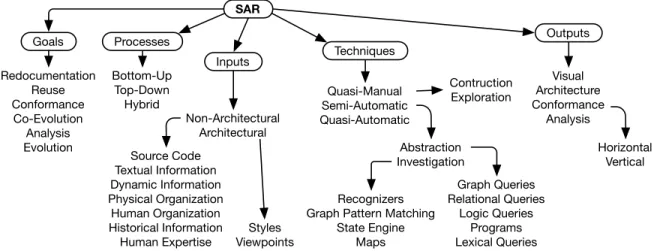
We propose a deeper classification (Fig. 1) based on the
life time of SAR approaches: intended goals, followed pro-cesses, required inputs, used techniques and expected out-puts. Our taxonomy treats a larger number of approaches than the previous attempts at classifying the field.
Goals Redocumentation Reuse Conformance Co-Evolution Analysis Evolution Bottom-Up Top-Down Hybrid Processes Inputs Techniques Outputs Non-Architectural Architectural SAR Styles Viewpoints Source Code Textual Information Dynamic Information Physical Organization Human Organization Historical Information Human Expertise Graph Queries Relational Queries Logic Queries Programs Lexical Queries Recognizers
Graph Pattern Matching State Engine Maps Abstraction Investigation Contruction Exploration Quasi-Manual Semi-Automatic Quasi-Automatic Visual Architecture Conformance Analysis Horizontal Vertical
Figure 1. A process-oriented taxonomy for SAR.
Goals. SAR is considered by the community as a proactive approach to answer stakeholder’s business goals [23,118]. The reconstructed architecture is the basis for
redocumen-tation, reuse investigation and migration to product lines,
or co-evolution of implementation and architecture. Some approaches do not extract the architecture itself but related
and orthogonal artifacts that provide valuable additional
information to engineers such as design patterns, roles or features. For sake of space, as previously said, we do not expand further this axis.
Processes. We distinguish three kinds of SAR processes based on their flow to identify an architecture: bottom-up, top-down or hybrid.
Inputs. Most SAR approaches are based on source code in-formation and human expertise. However, some of them exploit other architectural or non-architectural informa-tion sources such as dynamic informainforma-tion or historical information. It is worth noting that not all approaches use architectural styles and viewpoints even though those are the paramount of software architecture.
Techniques. The research community has explored various
architecture reconstruction techniques that we classify according to their level of automation.
Outputs. While all SAR approaches intend to provide ar-chitectural views, some of them produce other valuable outputs such as information about the conformance of architecture and implementation.
3. SAR processes
SAR follows either a bottom-up, a top-down or an hybrid opportunistic process.
3.1. Bottom-up processes
Bottom-up processes start with low-level knowledge to recover architecture. In most cases, from source code models,
they progressively raise the abstraction level until a high-level understanding of the application is reached [9,120] (see Fig. 2).
Also called architecturerecoveryprocesses, bottom-up processes are closely related to the well-known extract-abstract-present cycle described by Tilley et al. [129]. Source code analyses populate a repository, which is queried to yield abstract system representations, which are then pre-sented in a suitable interactive form to reverse engineers.
2 Extracted architecture A B C Source code 1
+
-- --- -- A B *(a)/s --> .... B extends A --> Extraction Techniques RefinementFigure 2. A bottom-up process: from the source code, views are (1) extracted and (2) refined. Examples. The Dali tool by Kazmanet al. [56,57]
sup-ports a typical example of a bottom-up process: (1)
Hetero-geneous low-level knowledge is extracted from the software implementation, fusioned and stored in a relational database; (2) Using the Rigi visualization tool [91,128], a reverse engineer visualizes and manually abstracts this information; (3) A reverse engineer specifies patterns by selecting source model entities with SQL queries and abstracting them with
Perl expressions. Based on Dali, Guoet al.proposed ARM
[40] which focuses on design patterns conformance. In Intensive, Menset al. use intension logic to group
related source-code entities [87,145]. Reverse engineers incrementally define views and their relations with intensions specified as Smalltalk or logic queries. Intensive classifies the views and displays consistencies and inconsistencies with the code and between architectural views. Intensive visualizes its results with CodeCrawler [70].
Lunguet al. built both a method and the Softwarenaut tool [77] to interactively explore packages. They enhance the exploration process in the package architectural structure by guiding the reverse engineer towards the relevant pack-ages. They characterize packages based on their relations and on their internal structure. A set of packages are high-lighted and associated to exploration operations that indicate to the reverse engineer the actions to perform to get a better understanding of the software architecture.
Other bottom-up approaches include ArchView [99], Re-vealer [100,101], ARES [26], ARMIN [58] and Gupro [24]. We classify the works around PBS/SBS in this category, but since they consider conceptual architectures to steer the pro-cess, we could as well have classified them with the hybrid processes [8, 31, 49, 113].
3.2. Top-down processes
Top-down processes start with high-level knowledge such as requirements or architectural styles and aim to discover architecture by formulating conceptual hypotheses and by matching them to the source code [12,92, 120] (see Fig-ure 3). The term architectFig-urediscoveryoften describes this process. 1 2 3 Refinement Hypothesized architecture -- --- -- ----A B C
Source code checking
Figure 3. A top-down process: (1) an hypothe-sized architecture is defined, (2) the architecture is checked against the source code, (3) the archi-tecture is refined.
Examples. The Reflexion Model of Murphy et al. is a typical example of a top-down process [92,93]. First, the reverse engineer defines his high-level hypothesized con-ceptual view of the application. Second, he specifies how this view maps to the source code concrete view. Finally, RMTool confronts both conceptual and concrete views to compute a reflexion model that highlightsconvergences,
di-vergencesandabsences. The reverse engineer iteratively
computes and interprets reflexion models until satisfied. In a reflexion model, a convergence locates an element that is
present in both views, a divergence an element that is only in the concrete view, and an absence an element that is only in the conceptual view. The reflexion model offers a better sup-port to express the conceptual architecture and the results of the process than the approach developed in SoFi [12]. The re-flexion model influenced other works [13,44,61,105,132].
3.3. Hybrid processes
Hybrid processes combine bottom-up with top-down pro-cesses [120]. On one hand, low-level knowledge is
ab-stractedusing various techniques. On the other hand, high-level knowledge isrefinedand confronted against the
pre-viously extracted views. By reconciling the conceptual and concrete architectures, hybrid processes are frequently used to stop architectural erosion [83,98]. Hybrid approaches
often use hypothesis recognizers that provide bottom-up
re-verse engineering strategies to support top-down exploration of architectural hypotheses [97].
Examples. Sartipi implements a pattern-based SAR ap-proach in Alborz [110]. The architecture reconstruction has two phases. During the first bottom-up phase, Alborz parses the source code, presents it as a graph, then divides that graph in cohesive regions using data mining techniques. The resulting model is at a higher abstraction level than the code. During the second top-down phase, the reverse engineer iter-atively specifies his hypothesized views of the architecture in terms of patterns. These patterns are approximately mapped with graph regions from the previous phase using graph
matching and clustering techniques. Finally, the reverse
en-gineer decides to proceed or not to a new iteration based on the partially reconstructed architecture and evaluation information that Alborz provides.
Christlet al.present an evolution of the Reflexion Model [13]. They enhance it with automated clustering to facilitate
the mapping phase. As in the Reflexion Model, the reverse
engineer defines his hypothesized view of the architecture in a top-down process. However, instead of manually mapping hypothetic entities with concrete ones, the new method in-troduces clustering analysis to partially automate this step. The clustering algorithm groups concrete entities that are not mapped yet with similar concrete entities already mapped to hypothesized entities.
To assess the creation of product lines, Stoermeret al.
introduce the MAP method [117]. MAP combines (1) a bottom-up process to recover the concrete architectures of ex-isting products; (2) a top-down process to map architectural styles onto recovered architectural views; (3) an approach to analyze commonalities and variabilities among recovered architectures. They stress the ability of architectural styles to act as the structural glue of the components, and to highlight architecture strengths and weaknesses.
Other hybrid processes include Focus [18,84], Nimeta [106], ManSART [4,43], ART [32], X-Ray [86], ARM [40] and DiscoTect [146]. In ManSART, a top-down
recogni-tion engine maps a style-compliant conceptual view with a system overview defined in a bottom-up way using a visual-ization tool [4, 43].
Table 1. SAR process overview
Alborz [110] hybrid ArchView [99] bottom-up ArchVis [45] bottom-up ARES [26] bottom-up ARM [40] hybrid ARMIN [58] bottom-up ART [32] hybrid Bauhaus [13, 25, 62] hybrid Bunch [79, 90] bottom-up Cacophony [28] hybrid Dali [56, 57] bottom-up DiscoTect [146] hybrid Focus [18, 84] hybrid Gupro [24] bottom-up Intensive [87, 145] bottom-up ManSART [4, 43] hybrid MAP [117] hybrid PBS/SBS [8, 31, 49, 113] hybrid PuLSE/SAVE [61, 103] top-down QADSAR [118, 119] hybrid Revealer [100, 101] bottom-up RMTool [92, 93] top-down SARTool [30, 64] bottom-up SAVE [89, 94] top-down Softwarenaut [77] bottom-up
... with Hapax [67, 76, 77] bottom-up
Symphony,Nimeta [106, 135] hybrid URCA [6] bottom-up W4 [44] top-down X-Ray [86] hybrid — [7] hybrid — [51] hybrid — [75] bottom-up — [97] hybrid — [132] hybrid
4. SAR Inputs
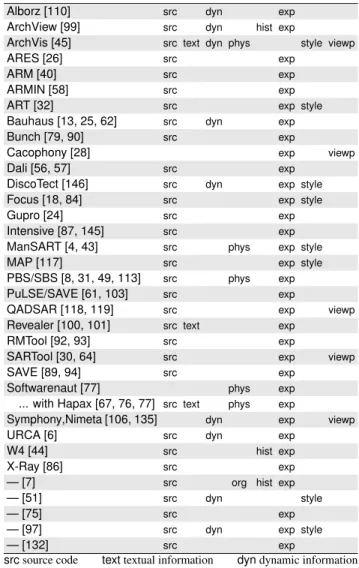
Most often, SAR works from source code representations, but it also considers other kinds of information, such as
dynamic information extracted from a system execution, or
historical data held by version control system repositories. A few approaches work from architectural elements such as styles or viewpoints. There is no clear trend because SAR approaches are fed with heterogeneous information of various abstraction levels. In this section, we present first the non-architectural inputs, then the architectural inputs.
4.1. Non-architectural inputs
Source Code Constructs. The source code is an om-nipresent trustworthy source of information that most ap-proaches consider. Some of the apap-proaches directly query the source code using regular expressions like in RMTool [92,93] or [100,101]. However, most of them do not work from the source code text but represent it using metamodels.
These metamodels cope with the paradigm of the analyzed
software. For instance, the language independent metamodel FAMIX is used to reverse engineer object-oriented appli-cations [17]; its concepts include classes, methods, calls or accesses. FAMIX is used in ArchView [99],
Software-naut [77] and Nimeta [106]. Other metamodels such as the
Dagstuhl Middle Metamodel [72] or GXL [48] have been proposed with the same intent of abstracting the source code.
Symbolic Textual Information. Some approaches work from the symbolic information available in the comments [100, 101] or in the method names [66].
Dynamic Information. Static information is often
insuf-ficient for SAR since it only provides a limited insight into
the runtime nature of the analyzed software; to understand
behavioral system properties, dynamic information is more
relevant [68]. Some SAR approaches use dynamic informa-tion alone [138,146] while others mix static and dynamic knowledge [51,73,99,107,137]. A lot of approaches us-ing dynamic information extract design views rather than architecture [41,42,104,125,126]. Huanget al.consider runtime events such as method calls, CPU utilization or net-work bandwidth consumption because it may inform reverse engineers about system security properties or system perfor-mance aspects [51]. DiscoTect uses dynamic information too [146]. Liet al. use run-time process information to derive architectural views [73]. Some works focus on dynamic soft-ware information visualization [21, 54, 126]. To get a more precise analysis of these works, we refer the reader to the survey of Hamou-Lhadjet al. [42]. Dynamic information is also used to identify features [25,38,109], design patterns
[46, 139], or collaborations and roles [105, 142].
Physical Organization. The physical organization of ap-plications in terms of files and folders often reveals architec-tural information. ManSART [4,43] and Softwarenaut [77]
work from the structural organization of physical elements
such as files, folders, or packages. Some approaches map
packages or classes to components and use the hierarchical
nature of the physical organization as architectural input [69, 102, 143].
Human Organization. According to Conway [15]: “Or-ganizations which design systems are constrained to produce
designs which are copies of the communication structures
of these organizations”. It is then important to consider the
influence of the human organization on the extracted
archi-tectures or views. Inspired by Conway’s thesis, Bowman
architecture that helps stakeholders reconstruct the software architecture [7].
Historical Information. Historical information is rarely used in SAR. Wuyts worked on the co-evolution between
code and design [145]. ArchView is a recent approach that
exploits source control system data and bug reports to an-alyze the evolution of recovered architectural views [99]. Menset al.analyse the evolution of extracted software views
with Intensive [87,145]. To assist a reverse engineer in
un-derstanding dependency gaps in a reflexion model [92,93], Hassanet al.annotate entity dependencies with sticky notes that record dependency evolution and rationale with infor-mation extracted from version control systems [44].
Human Expertise. Although one cannot entirely trust hu-man knowledge, it is very helpful when it is available. At high abstraction levels, SAR is iterative and requires human knowledge to guide it and to validate its results. To specify a conceptual architecture [44,84,92], reverse engineers have to study system requirements, read available documentation, interview stakeholders, recover design rationale, investigate hypotheses and analyze the business domain. Human exper-tise is also required when specifying viewpoints, selecting architectural styles (Section 4.2), or investigating orthog-onal artifacts. While SAR processes involve strategy and knowledge of the domain and the application itself, only a few approaches take human expertise explicitly into ac-count. Ivkovicet al.[53] propose to systematically update a knowledge base that would become a helpful collection of domain-specific architectural artifacts.
4.2. Architectural inputs
Architectural styles and viewpoints are the paramount of software architecture, therefore we analyzed whether SAR
approaches consider them as input to steer the extraction process.
Styles. Architectural styles such as pipes and filters,
lay-ered system, data flow and blackboard are popular because
like design patterns, they represent recurrent architectural situations [11,59]. They are valuable, expressive, and ac-cepted abstractions for SAR and more generally for software understanding.
Recognizing them is however a challenge because they span several architectural elements and can be implemented in various ways [100,101]. The question that turns up is whether SAR helps reverse engineers specify and extract architectural styles.
Examples. In Focus, Dinget al. use architectural styles to infer a conceptual architecture that will be mapped to a concrete architecture extracted from the source code [18,84].
Closely related to this work, Medvidovicet al.introduce an approach to stop architectural erosion. In a top-down pro-cess, requirements serve as high-level knowledge to discover the conceptual architecture [83]. In a bottom-up process,
system implementation serves as low level knowledge to re-cover the concrete architecture. Both the conceptual and the concrete architectures are incrementally built. The reverse engineer reconciles the two architectures, based on architec-tural styles. Their approach considers architecarchitec-tural styles as key design idioms since they capture a large number of design decisions, their rationale, effective compositions of
architectural elements, and system qualities that will likely
result from using the style.
DiscoTect reconstructs style-compliant architectures
[146]. Using a state machine, DiscoTect incrementally
rec-ognizes interleaved patterns in filtered execution traces of the application. The state machine represents an architectural style; by refining it, the reverse engineer defines which hy-pothesized architectural style the tool should look for [123]. ManSART [4,43], ART [32] and MAP [117] are other SAR approaches taking architectural styles into account.
Viewpoints. The system architecture acts as a mental model shared among stakeholders [50]. Since the stakehold-ers’ interests are diverse, viewpoints are important aspects that SAR may consider [52,114]. Viewpoint catalogues were built to address this issue: the4 + 1viewpoints of Kruchten [65]; the four viewpoints of Soniet al.[47,116], the build-time viewpoint introduced by Tuet al. [134] or the implicit viewpoints inherent to the UML standard. Most
SAR approaches reconstruct architectural views according
either to a single viewpoint or a few preselected viewpoints. Smolanderet al. highlight that viewpoints cannot be
stan-dardized but should be selected or defined according to the
environment and to the situation [114]. O’Brienet al.present the View-Set Scenario pattern that helps determine which ar-chitectural views sufficiently describe the system and cover the stakeholders’ needs [95].
Examples. The Symphony approach of van Deursenet al. aims at reconstructing software architecture using appro-priate viewpoints [135]. Viewpoints are selected from a catalogue or are defined if they do not exist, and they evolve throughout the process. They constrain SAR to provide ar-chitectural views matching the stakeholders’ expectations, and ideally immediately usable. The authors show how to define viewpoints step by step, and applied their approach on four case studies with different stakeholders’ goals. They provide architectural views to reverse engineers following the viewpoints those reverse engineers typically use dur-ing design phases. Based on Symphony, Riva proposed the view-based SAR approach Nimeta [106].
Favre outlines Cacophony, a generic SAR metamodel-driven approach [28]. Like Symphony, Cacophony recog-nizes the need to identify the viewpoints that are relevant to the stakeholders’ concerns and that SAR must consider.
Contrary to Symphony, Cacophony states that metamodels
are keys for representing viewpoints.
architec-ture of a system and drives quality attribute analyses on it [118,119]. To identify the relevant architectural viewpoints, reverse engineers formulate scenarios that highlight interest-ing quality attributes of the system. ARES [26] and SARTool [30, 64] also take viewpoints into account.
4.3. Mixing inputs
Most approaches work from a limited source of informa-tion, even if multiple inputs are necessary to generate rich and different architectural views. Kazmanet al.[55] advo-cate the fusion of multiple source of inputs to produce richer architectural views: for example, they produce interprocess communication and file access views. Langeet al.[68] mix dynamic and static views to extract design patterns.
ArchVis [45] works from source code, file structures and dynamic information such as network log or message sends. Knodelet al. [60] discuss the combination of different information sources such as documents, source code and historical data. However it is not clear whether the approach is used in practice. Multiple inputs must be organized and Ivkovitch proposes a systematic way to organize application domain knowledge into a unified structure [53].
5. SAR Techniques
There is a variety of formalisms used to express, query and exchange data representing applications [36,107]. A couple of exchange formats exist from simple textual tuples in RSF [141] or in TA [8,31,49,113], to XML in GXL [48] and in [24,106], or to CDIF in FAMIX [17]. The format may limit the merging or manipulation of the information [22]. An important property of an exchange format is that it can be easily generated and used with simple tools [19].
SAR techniques are often correlated with the data they
operate on and the formalisms used for their representation
and manipulation: for example, Menset al. express logic queries on facts [87,145] while Ebertet al. perform queries
on graphs [24]. Thus, instead of using data formalisms as a
criterion, we classify techniques into three automation levels: Quasi-manual. the reverse engineer manually identifies
ar-chitectural elements using a tool to assist him in under-standing his findings;
Semi-automatic. the reverse engineer manually instructs the tool how to automatically discover refinements or recover abstractions;
Quasi-automatic. the tool has the control and the reverse engineer steers the iterative recovery process.
Of course, the boundaries in the classification are not clear-cut. Moreover, reverse engineers often use visualization tools to understand the results of their analyses, but a comparison of the visualization tools is beyond the scope of this article. Table 3 synthesizes the classification of SAR techniques.
Table 2. SAR input overview
Alborz [110] src dyn exp
ArchView [99] src dyn hist exp
ArchVis [45] src text dyn phys style viewp
ARES [26] src exp
ARM [40] src exp
ARMIN [58] src exp
ART [32] src exp style
Bauhaus [13, 25, 62] src dyn exp
Bunch [79, 90] src exp
Cacophony [28] exp viewp
Dali [56, 57] src exp
DiscoTect [146] src dyn exp style
Focus [18, 84] src exp style
Gupro [24] src exp
Intensive [87, 145] src exp
ManSART [4, 43] src phys exp style
MAP [117] src exp style
PBS/SBS [8, 31, 49, 113] src phys exp
PuLSE/SAVE [61, 103] src exp
QADSAR [118, 119] src exp viewp
Revealer [100, 101] src text exp
RMTool [92, 93] src exp
SARTool [30, 64] src exp viewp
SAVE [89, 94] src exp
Softwarenaut [77] phys exp
... with Hapax [67, 76, 77] src text phys exp
Symphony,Nimeta [106,135] dyn exp viewp
URCA [6] src dyn exp
W4 [44] src hist exp
X-Ray [86] src exp
— [7] src org hist exp
— [51] src dyn style
— [75] src exp
— [97] src dyn exp style
— [132] src exp
srcsource code texttextual information dyndynamic information
physphysical organization orghuman organization
histhistorical information exphuman expertise stylestyles
viewpviewpoints
5.1. Quasi-manual techniques
SAR is a reverse engineering activity which faces
scala-bility issues in manipulating knowledge. In response to this problem, researchers have proposed slightly assisted tech-niques; we group those into two categories: construction-based techniques and exploration-construction-based techniques.
Construction-based techniques. These techniques recon-struct the software architecture by manually abstracting low-level knowledge, thanks to interactive and expressive visualization tools: Rigi [91, 128], CodeCrawler [70], Shrimp/Creole [121, 122], Verso [69], 3D [81] or GraphViz [33].
Exploration-based techniques. These techniques give re-verse engineers an architectural view of the system by guid-ing them through the highest-level artifacts of the
imple-mentation, like in Softwarenaut [77]. The architectural view is then closely related to the developer’s view. Instead of providing guidance, the SAB browser [27] allows reverse engineers to assign architectural layers to classes and then to navigate the resulting architectural views. ArchView1[29] visualizes simple architectural elements and their relation-ships in 3D.
5.2. Semi-automatic techniques
Semi-automatic techniques automate repetitive aspects of SAR. The reverse engineer steers the iterative refine-ment or abstraction, leading to the identification of archi-tectural elements. As in the quasi-manual techniques, we distinguish two categories: abstraction-based techniques and investigation-based ones.
Abstraction-based techniques. These techniques aim at mapping low-level concepts with high-level ones. Reverse engineers specify reusable abstraction rules and execute them automatically; we identified five approaches:
Graph queries. Gupro queries graphs using a specialized declarative expression language called GReQL [24]. Rigi is based on graph transformations written in Tcl [91,128]. Relational queries. Often, relational algebra engines ab-stract data out of entity-relation databases. Dali [56,57] and ARMIN [58] use SQL queries to define grouping rules.
Relational algebra defines a repeatable set of
transforma-tions such as abstraction or decomposition to create a par-ticular architectural view. In PBS/SBS, Holtet al.propose
the Grok relational expression calculator to reason about
software facts [49]. Krikhaar presents a SAR approach based on an extension of relational algebra [30, 64]. Logic queries. Logic queries are powerful because of the
un-derlying unification mechanism which allows us the writ-ing of dense multi valued queries. Kramer and Prechelt [63], Wuyts [144], Gueneheuc [39] use Prolog queries to identify design patterns. Mens and Wuyts use Prolog as a meta programming language to extract intensional source-code views and relations in Intensive [87,145]. Richner also chose a logic query based approach to reconstruct architectural views from static and dynamic facts [104]. Programs. Some approaches build analyses as plain
object-oriented programs. For example, the analyses made in the Moose environment are performed as object-oriented programs that manipulate models representing the various inputs [20].
Lexical and structural queries. Some approaches are di-rectly based on the lexical and structural information in the source code. Pinzgeret al.state that some hot-spots clearly localize patterns in the source code and consider them as the starting point of SAR [100,101]. To drive a
pattern-supported architecture recovery, they introduce a 1Different of ArchView Pinzger’s approach [99], though homonymous.
pattern specification language and the Revealer tool. RM-Tool identifies architectural elements and relations using lexical queries [92,93]. The Searchable Bookshelf is a typical example of supporting navigation via queries [113]. ArchVis [45] supports multiple inputs (files, programs, Acme information), works from static and dynamic infor-mation (program execution but also log files and network traffic), and provides different views to specific stakehold-ers (component, developer, manager views).
Investigation-based techniques. These techniques map high-level concepts with low-level ones. The considered high-level concepts cover a wide area from architectural descriptions and styles to design patterns and features. Ex-plored approaches are:
Recognizers. ManSART [4,43], ART [32], X-Ray [86] and ARM [40] are based on recognizers for architectural styles or patterns written in a query language. The tools then report the source code elements matching the recognized structures. More precisely, pattern definitions in ARM are progressively refined and finally transformed in SQL queries exploitable in Dali [56, 57].
Graph pattern matching. In ARM [40], pattern definitions can also be transformed into graph patterns to match a graph-based source code representation; this is similar to what is done in [110].
State engine. In DiscoTect state machines are defined to check architectural styles conformance [146]. A state engine tracks the system execution at run-time and outputs architectural events when the execution satisfies the state machine description.
Maps. SAR approaches based on the Reflexion Model [92,93] use rules to map hypothesized high-level
enti-ties with source code entienti-ties. Since these Perl-like rules take plain source code as input, we could have classified
the reflexion model in thelexical and structural queries
group mentioned previously, but the real focus is on the
mapping. SoFi [12] use naming conventions of files and
folders to automatically group entities.
5.3. Quasi-automatic techniques
Purely automated SAR techniques do not exist. Reverse engineers must still steer the most automated approaches. Those often combine concept, dominance and cluster analy-sis techniques.
Concepts. Formal concept analysis is a branch of lattice theory used to identify design patterns [3], features [25,38], or modules [111]. Tilleyet al. [130] present a survey of works using formal concept analysis [5,16,108,112,115, 131, 136].
Clustering algorithms. Clustering algorithms identify
groups of objects whose members are similar in some way.
They have been used to produce software views of appli-cations. To identify subsystems, Anquetil and Lethbridge
cluster files using naming conventions [2]. Some approaches automatically partition software products into cohesive clus-ters that are loosely interconnected [1,79,80,90,133,140]. Clustering algorithms are also used to extract features from object interactions [109]. Koschke emphasizes the need to re-fine existing clustering techniques, first by combining them, and second by integrating the reverse engineer as a confor-mance supervisor of the reconstruction process [13, 62].
Dominance. In directed graph, a nodeDdominates a node N if all paths from a given root toN go throughD. In soft-ware maintenance, dominance analysis identifies the related parts in an application [10,14,37]. In the context of software
architecture extraction, adhering to Koschke’s thesis, Trifu
unifies cluster and dominance analysis techniques to recover
architectural components in object-oriented legacy systems [133]. Similarly, Lundberget al.outline a unified approach
centered around dominance analysis [75]. On one hand, they demonstrate how dominance analysis identifies passive components. On the other hand, they state that dominance analysis is not sufficient to recover the complete architecture: this requires other techniques such as concept analysis to take component interactions into account.
6. SAR Outputs
SAR approaches result in different outputs, among which
visual software views, architectures and conformance data,
as well as analyses.
6.1. Visual software views
A lot of approaches offer architectural views or use visu-alizations as output. As we mentioned earlier, several tools such as Rigi [91,128], Shrimp/Creole [121,122], GraphViz [33] or CodeCrawler [70] are used to visualize graph rep-resentations of software views [31,56,62,101,106,110]. Some authors propose open toolkits to build architectural extractors [74, 88, 127].
Classifying the outputs of the various visualization ap-proaches is difficult and outside of the scope of this arti-cle, but we can still distinguish some groups: some visual-ization approaches present source code entities and group them as boxes using the visualization tools mentioned above [31, 56, 62,101,106, 110]. Some offer enhanced views that provide architectural information [77,87,99]. In this
context some approaches improve their visualizations with
2D/3D [29,69,74,81,127]. Finally some approaches define dedicated tool support to represent architectural elements and layers; for example, the Software Architecture Browser is a graphical editor dedicated to navigation in layers [27]. Pacione proposed both the architecture-oriented visualiza-tion tool Vanessa, and a taxonomy in which he surveyed related tools [96].
Some SAR approaches focus on the behavior of software (Section 4). Hamou-Lhadjet al.surveyed trace visualization
Table 3. SAR technique overview
Quasi- Semi-automatic
Quasi-Tools manual Abstr. Invest. auto.
Alborz [110] gpm auto
ArchView [99] rel
ArchVis [45] cns rel, prg auto
ARES [26]
ARM [40] cns gra, rel
ARMIN [58] gra
ART [32] rec
Bauhaus [13, 25, 62] rec, map auto
Bunch [79, 90] auto Cacophony [28] Dali [56, 57] cns rel DiscoTect [146] sta Focus [18, 84] cns Gupro [24] gra Intensive [87, 145] log ManSART [4, 43] cns rec MAP [117] PBS/SBS [8, 31, 49, 113] rel map PuLSE/SAVE [61, 103] map QADSAR [118, 119] Revealer [100, 101] lex RMTool [92, 93] map SARTool [30, 64] rel SAVE [89, 94] map Softwarenaut [77] exp
... with Hapax [67, 76, 77] gra
Symphony,Nimeta [106, 135]
URCA [6] auto
W4 [44] map
X-Ray [86] rec auto
— [7]
— [51] auto
— [75] auto
— [97] cns, exp auto
— [132] rel map
cnsconstruction expexploration gragraph queries
relrelational queries loglogic queries prgprograms
lexlexical queries recrecognizers gpmgraph pattern matching
stastate engine mapmaps autoquasi-automatic
tools [42]. To offer multiple views of an application, it is interesting to combine static and dynamic analyses [45,68, 104,124]. For example, Shimba [124] combines static and
dynamic information to produce high-level views of Java systems; it displays static information with Rigi [91,128], and dynamic information as state diagrams. Both views
are thus displayed separately, but the reverse engineers can
constrain the abstraction of each view to the other one.
6.2. Architecture
Since SAR approaches focus on providing better
under-standing of the applications, they tend to present recon-structed architectural views to stakeholders. As the code evolves, some approaches focus on the co-evolution of the
reconstructed architecture: Intensive [87,145] synchronizes
the architecture with its implementation and highlights the
differences due to evolution.
Iterative approaches based on the reflexion model [13, 61,92,105] make explicit the absences, convergences and divergences between the conceptual architecture and the architecture that results from mapping source code elements to architectural elements.
Architecture Description Languages (ADLs) have been proposed both to formally define architectures and to
sup-port architecture-centric development activities [82]. In the
context of SAR, X-Ray [86] uses Darwin [78] to express reconstructed architectural views. Darwin was also extended by Eixelsbergeret al. [26]. Acme [36] has ADL-like fea-tures and is used in DiscoTect [146]. Huanget al. specify architectures with the ABC ADL [51].
6.3. Conformance
Some approaches focus on determining the conformance of an application to a given architecture. We distinguish two kinds of architecture conformance: horizontal conformance between similar abstractions and vertical conformance be-tween different abstraction levels.
Horizontal conformanceis checked between two
recon-structed views, or between a conceptual and a concrete ar-chitecture, or between a product line reference architecture
and the architecture of a given product. For example, SAR
approaches for product line migration identify commonal-ities and variabilcommonal-ities among products, like in MAP [117]. Sometimes, SAR compares a conceptual architecture with the reconstructed one [40,132]. Sometimes, an architecture must conform to architectural rules or styles, as discussed
in Nimeta [106], the SARTool tool [30,64], Focus [18,84]
and DiscoTect [146].
Vertical conformanceassesses whether the recontructed
architecture conforms to the implementation. Both Reflexion Model-based [92,93] and co-evolution-oriented [87,145] approaches revolve around vertical conformance.
6.4. Analysis
Some approaches perform extra analysis on the extracted architecture to qualify it or to refine it further. Reverse engineers use modularity quality metrics either to iteratively assess current results and steer the process, or to get cues about reuse and possible system improvement [62, 110].
A few SAR approaches propose other analyses:
ArchView [99] provides structural and evolutionary
proper-ties of a software application. Eixelsbergeret al.in ARES [26], and Stoermer in QADSAR [118,119] reconstruct soft-ware architectures to highlight properties like safety, concur-rency, portability or other high-level statistics [51].
ARM [40], Revealer [100,101], Alborz [110] highlight architectural patterns or orthogonal artifacts.
Table 4. SAR output overview
Alborz [110] vis ana
ArchView [99] vis
ArchVis [45] vis desc
ARES [26] vis desc ana
ARM [40] vis
ARMIN [58] vis ana
ART [32] vis
Bauhaus [13, 25, 62] vis vert
Bunch [79, 90] vis
Cacophony [28]
Dali [56, 57] vis desc ana
DiscoTect [146] vis desc horz vert
Focus [18, 84] vis Gupro [24] vis Intensive [87, 145] vis ManSART [4, 43] vis MAP [117] vis PBS/SBS [8, 31, 49, 113] vis
PuLSE/SAVE [61, 103] vis vert ana
QADSAR [118, 119] vis ana
Revealer [100, 101] vis
RMTool [92, 93] vis vert
SARTool [30, 64] vis horz vert ana
SAVE [89, 94] vis vert
Softwarenaut [77] vis
... with Hapax [67, 76, 77] vis
Symphony,Nimeta [106, 135] vis horz vert ana
URCA [6] vis
W4 [44] vis vert ana
X-Ray [86] vis desc
— [7] vis horz
— [51] desc horz ana
— [75] vis
— [97] vis
— [132] vis vert
visarchitecture visualization descarchitecture description
horzhorizontal conformance vertvertical conformance
anaanalysis
7. Discussion and conclusion
Here are some general points that appeared to us at the light of this survey. A lot of approaches visualize software entities but few work from diverse information sources or even take advantage of having different kinds of informa-tion. Several times this paper stresses the need to provide stakeholders with a large variety of views at different levels of abstraction. SAR must be integrated in an environment that provides reverse engineers with views at different levels
of abstraction and means to navigate horizontally and
verti-cally. To fulfill this requirement, we state that a mechanism
is required to express consistently viewpoints whatever the level of abstraction of the views they respectively describe.
In this perspective, the metamodel-based SAR outlined by Favre is promising [28].
such as design patterns but stopped building on this
knowl-edge up to the architectural level. Similarly few works bring together features and architectural information.
Because it is complex to extract architectural components from source code, those are often simply mapped to packages or files. Even if this practice is understandable, we think it limits and overloads thecomponentterm.
We see that few works really take into account archi-tectural styles. That may be the result of having different communities working on architectural description languages and maintenance.
SAR is complex and time consuming. The iterative as-pects of SAR imposed themselves as a key point to ensure a successful reconstruction. Now to reach a high-level of ma-turity in leading such an activity, we advocate that SAR has
to support co-evolution and conformance checking
mecha-nisms. Indeed both horizontal and vertical conformance help bringing all the recovered views face to face. That confronta-tion allows reverse engineers to refine views iteratively, to identify commonalities and variabilities among views (espe-cially if they represent product line architectures), to lead impact analysis or still to update views when the system evolves.
Since successful systems are doomed to continually evolve and grow, SAR approaches should support
co-evolution mechanisms to keep all recovered views
synchro-nized with the source code. The logic-based approach of Intensive proved to be efficient in checking horizontal and vertical conformance and in allowing co-evolution [87,145].
It is hard to classify research approaches in a complex
field where the subject matter is as fuzzy as software
archi-tecture. Still this survey has provided an organization of the significant fundamental contributions made on software architecture reconstruction. To structure the paper, we fol-lowed the general process of SAR: what are the stakeholders’ goals; how does the general reconstruction proceed; what are the available sources of information; based on this, which techniques can we apply, and finally what kind of knowledge does the process provide. We believe that software archi-tecture reconstruction is still an important topic since it is crucial for the understanding of large industrial applications and their evolution.
References
[1] Anquetil and Lethbridge. Experiments with Clustering as a Soft-ware Remodularization Method. InWCRE, 1999.
[2] Anquetil and Lethbridge. Recovering software architecture from the names of source files.Journal of Software Maintenance:
Re-search and Practice, 11, 1999.
[3] Arévalo, Buchli, and Nierstrasz. Detecting implicit collaboration patterns. InWCRE, 2004.
[4] A.S.Yeh, Harris, and Chase. Manipulating recovered software architecture views. InICSE, 1997.
[5] Bojic and Velasevic. Reverse Engineering of Use Case Realizations in UML. InSAC, 2000.
[6] Bojic and Velasevic. A use-case driven method of architecture recovery for program understanding and reuse reengineering. In
CSMR, 2000.
[7] Bowman and Holt. Software architecture recovery using conway’s law. Inthe Centre for Advanced Studies Conference, CASCON’98,
1998.
[8] Bowman, Holt, and Brewster. Linux as a case study: its extracted
software architecture. InICSE, 1999.
[9] Brooks. Towards a theory of the comprehension of computer programs. International Journal of Man-Machine Studies, 18, 1983.
[10] Burd and Munro. An initial approach towards measuring and characterizing software evolution. InWCRE, 1999.
[11] Buschmann, Meunier, Rohnert, Sommerlad, and Stad. Pattern-Oriented Software Architecture — A System of Patterns. Wiley, 1996.
[12] Carmichael, Tzerpos, and Holt. Design maintenance: Unexpected
architectural interactions. InICSM, 1995.
[13] Christl, Koschke, and Storey. Equipping the reflexion method with
automated clustering. InWCRE, 2005.
[14] Cimitile and Visaggio. Software salvaging and the call dominance tree.JSS, 28, 1995.
[15] Conway. How do committees invent ?Datamation, 14(4), 1968. [16] Dekel and Gil. Revealing class structure with concept lattices. In
WCRE, 2003.
[17] Demeyer, Tichelaar, and Ducasse. FAMIX 2.1 — The FAMOOS Information Exchange Model. Technical report, Univ. of Bern, 2001.
[18] Ding and Medvidovic. Focus: A light-weight, incremental
ap-proach to software architecture recovery and evolution. InWICSA,
2001.
[19] Ducasse and Demeyer, eds.The FAMOOS Object-Oriented
Reengi-neering Handbook. Univ. of Bern, 1999.
[20] Ducasse, Gîrba, Lanza, and Demeyer. Moose: a collaborative and extensible reengineering environment. InTools for Software
Maintenance and Reengineering. Franco Angeli, 2005.
[21] Ducasse, Lanza, and Bertuli. High-level polymetric views of
con-densed run-time information. InCSMR, 2004.
[22] Ducasse and Tichelaar. Dimensions of reengineering environment
infrastructures.Journal on Software Maintenance, 15(5), 2003. [23] Dueñas, Lopes de Oliveira, and de la Puente. Architecture recovery
for software evolution. InCSMR, 1998.
[24] Ebert, Kullbach, Riediger, and Winter. GUPRO – generic un-derstanding of programs, an overview. Fachberichte Informatik 7–2002, Universität Koblenz-Landau, 2002.
[25] Eisenbarth, Koschke, and Simon. Locating features in source code.
IEEE Computer, 29(3), 2003.
[26] Eixelsberger, Ogris, Gall, and Bellay. Software architecture recov-ery of a program family. InICSE, 1998.
[27] Erben and Löhr. Sab - the software architecture browser. In
VISSOFT, 2005.
[28] Favre. CacOphoNy: Metamodel-driven software architecture re-construction. InWCRE, 2004.
[29] Feijs and Jong. 3d visualization of software architectures.
Commu-nications of the ACM, 41(12), 1998.
[30] Feijs, Krikhaar, and van Ommering. A relational approach to support software architecture analysis. Software – Practice and
Experience, 28(4), 1998.
[31] Finnigan, Holt, Kalas, Kerr, Kontogiannis, Mueller, Mylopoulos, Perelgut, Stanley, and Wong. The software bookshelf.IBM Systems
Journal, 36(4), 1997.
[32] Fiutem, Antoniol, Tonella, and Merlo. Art: an architectural
re-verse engineering environment.Journal of Software Maintenance:
Research and Practice, 11(5), 1999.
[33] Gansner and North. An open graph visualization system and its applications to software engineering.Software Practice Experience, 30(11), 2000.
[34] Garlan. Software architecture: a roadmap. InICSE – Future of SE
Track, 2000.
[35] Garlan, Allen, and Ockerbloom. Architectural mismatch: Why reuse is so hard.IEEE Software, 12(6), 1995.
[36] Garlan, Monroe, and Wile. Acme: Architectural description of component-based systems. InFoundations of Component-Based
Systems, chapter 3. Cambridge University Press, 2000.
[37] Girard and Koschke. Finding components in a hierarchy of modules: a step towards architectural understanding. InICSM, 1997. [38] Greevy and Ducasse. Correlating features and code using a compact
two-sided trace analysis approach. InCSMR, 2005.
[39] Guéhéneuc, Sahraoui, and Zaidi. Fingerprinting design patterns. InWCRE, 2004.
[40] Guo, Atlee, and Kazman. A software architecture reconstruction method. InWICSA, 1999.
[41] Hamou-Lhadj, Braun, Amyot, and Lethbridge. Recovering
behav-ioral design models from execution traces. InCSMR, 2005. [42] Hamou-Lhadj and Lethbridge. A survey of trace exploration tools
and techniques. InCASON. IBM Press, 2004.
[43] Harris, Reubenstein, and Yeh. Reverse engineering to the
architec-tural level. InICSE. ACM, 1995.
[44] Hassan and Holt. Using development history sticky notes to
under-stand software architecture. InIWPC, 2004.
[45] Hatch.Software Architecture Visualisation. PhD thesis, Research
Institute in Software Engineering, Univ. of Durham, 2004. [46] Heuzeroth, Holl, Högström, and Löwe. Automatic design pattern
detection. InIWPC, 2003.
[47] Hofmeister, Nord, and Soni.Applied Software Architecture. Addi-son Wesley, 2000.
[48] Holt, Schürr, Sim, and Winter. Gxl: A graph-based standard
exchange format for reengineering.Science of Computer
Program-ming, 60(2), 2006.
[49] Holt. Structural manipulations of software architecture using tarski relational algebra. InWCRE, 1998.
[50] Holt. Sofware architecture as a shared mental model. InASERC
Workshop on Software Architecture, Univ. of Alberta, 2001. [51] Huang, Mei, and Yang. Runtime recovery and manipulation of
software architecture of component-based systems. Automated
Software Engineering, 13(2), 2006.
[52] IEEE. Ieee recommended practice for architectural description
for software-intensive systems. Technical report, The Architecture
Working Group of the Software Engineering Committee, 2000. [53] Ivkovic and Godfrey. Enhancing domain-specific software
archi-tecture recovery. InIWPC, 2003.
[54] Jerding and Rugaber. Using visualization for architectural localiza-tion and extraclocaliza-tion. In Baxter, Quilici, and Verhoef, eds.,WCRE, 1997.
[55] Kazman and Carriere. View extraction and view fusion in
architec-tural understanding. InICSR, 1998.
[56] Kazman and Carriere. Playing detective: Reconstructing software
architecture from available evidence. Automated Software
Engi-neering, 1999.
[57] Kazman, O’Brien, and Verhoef. Architecture reconstruction guide-lines. CMU/SEI-2001-TR-026, Carnegie Mellon Univ., Software
Engineering Institute, 2001.
[58] Kazman, O’Brien, and Verhoef. Architecture reconstruction
guide-lines, third edition. CMU/SEI-2002-TR-034, Carnegie Mellon Univ., Software Engineering Institute, 2003.
[59] Klein.Sources of Power — How People Make Decisions. Addison
Wesley, 1999.
[60] Knodel, John, Ganesan, Pinzger, Usero, Arciniegas, and Riva. Asset recovery and their incorporation into product lines. InWCRE, 2005.
[61] Knodel, Muthig, Naab, and Lindvall. Static evaluation of software
architectures. InCSMR, 2006.
[62] Koschke.Atomic Architectural Component Recovery for Program
Understanding and Evolution. PhD thesis, Univ. Stuttgart, 2000.
[63] Kramer and Prechelt. Design Recovery by Automated Search for Structural Design Patterns in Object-Oriented Software. InWCRE,
1996.
[64] Krikhaar.Software Architecture Reconstruction. PhD thesis, Univ. of Amsterdam, 1999.
[65] Kruchten. The 4+1 view model of architecture. IEEE Software, 12(6), 1995.
[66] Kuhn, Ducasse, and Gîrba. Enriching reverse engineering with semantic clustering. InWCRE, 2005.
[67] Kuhn, Ducasse, and Gîrba. Semantic clustering: Identifying topics
in source code.Information and Software Technology, 2006. [68] Lange and Nakamura. Interactive visualization of design patterns
can help in framework understanding. InOOPSLA, New York NY,
1995.
[69] Langelier, Sahraoui, and Poulin. Visualization-based analysis of quality for large-scale software systems. InASE, 2005.
[70] Lanza and Ducasse. Polymetric views—a lightweight visual ap-proach to reverse engineering.IEEE TSE, 29(9), 2003.
[71] Lehman and Belady.Program Evolution: Processes of Software
Change. London Academic Press, 1985.
[72] Lethbridge, Tichelaar, and Plödereder. The dagstuhl middle
meta-model: A schema for reverse engineering. InElectronic Notes in Theoretical Computer Science, volume 94, 2004.
[73] Li, Chu, Hu, Chen, and Yun. Architecture recovery and abstraction from the perspective of processes. InWCRE, 2005.
[74] Lowe and Panas. Rapid construction of software comprehension tools. InJournal of Software Engineering and Knowledge
Engi-neering, 2005.
[75] Lundberg and Löwe. Architecture recovery by semi-automatic com-ponent identification. Electronic Notes in Theoretical Computer
Science, 82(5), 2003.
[76] Lungu, Kuhn, Gîrba, and Lanza. Interactive exploration of semantic clusters. InVISSOFT, 2005.
[77] Lungu, Lanza, and Gîrba. Package patterns for visual architecture
recovery. InCSMR, 2006.
[78] Magee, Dulay, Eisenbach, and Kramer. Specifying distributed software architectures. InESEC, volume 989 ofLNCS. Springer, 1995.
[79] Mancoridis and Mitchell. Using Automatic Clustering to produce High-Level System Organizations of Source Code. InIWPC, 1998. [80] Maqbool and Babri. The weighted combined algorithm: A linkage
algorithm for software clustering. InCSMR, 2004.
[81] Marcus, Feng, and Maletic. 3d representations for software
visual-ization. InSoftVis. IEEE, 2003.
[82] Medvidovic and Taylor. A classification and comparison framework
for software architecture description languages.IEEE TSE, 26(1),
2000.
[83] Medvidovic, Egyed, and Gruenbacher. Stemming architectural erosion by architectural discovery and recovery. InInternational Workshop from Software Requirements to Architectures (STRAW),
2003.
[84] Medvidovic and Jakobac. Using software evolution to focus archi-tectural recovery.Automated Software Engineering, 13(2), 2006. [85] Mendonca and Kramer. Requirements for an effective architecture
recovery framework. InISAW-2), 1996.
[86] Mendonça and Kramer. An approach for recovering distributed system architectures. Automated Software Engineering, 8(3-4), 2001.
[87] Mens, Kellens, Pluquet, and Wuyts. Co-evolving code and de-sign with intensional views – a case study. Journal of Computer
Languages, Systems and Structures, 32(2), 2006.
[88] Meyer, Gîrba, and Lungu. Mondrian: An agile visualization frame-work. InSoftVis, 2006.
[89] Miodonski, Forster, Knodel, Lindvall, and Muthig. Evaluation of
software architectures with eclipse. Technical report, Fraunhofer
IESE, 2004.
software systems using the bunch tool.IEEE TSE, 32(3), 2006. [91] Müller, Wong, and Tilley. Understanding software systems using
reverse engineering technology. In Alagar and Missaoui, eds., Object-Oriented Technology for Database and Software Systems. World Scientific, 1995.
[92] Murphy, Notkin, and Sullivan. Software reflexion models: Bridging the gap between source and high-level models. InFSE, 1995. [93] Murphy.Lightweight Structural Summarization as an Aid to
Soft-ware Evolution. PhD thesis, Univ. of Washington, 1996. [94] Naab. Evaluation of graphical elements and their adequacy for the
visualization of software architectures. Master’s thesis, Fraunhofer
IESE, 2005.
[95] O’Brien, Stoermer, and Verhoef. Software architecture reconstruc-tion: Practice needs and current approaches. Technical Report CMU/SEI-2002-TR-024, Carnegie Mellon Univ., 2002. [96] Pacione.A Novel Software Visualisation Model to Support
Object-Oriented Program Comprehension. PhD thesis, Univ. Strathclyde,
2005.
[97] Pashov and Riebisch. Using feature modelling for program com-prehension and software architecture recovery. InECBS, 2004. [98] Perry and Wolf. Foundations for the study of software architecture.
ACM SIGSOFT Software Engineering Notes, 17(4), 1992. [99] Pinzger.ArchView – Analyzing Evolutionary Aspects of Complex
Software Systems. PhD thesis, Vienna Univ. of Technology, 2005. [100] Pinzger, Fischer, Gall, and Jazayeri. Revealer: A lexical pattern
matcher for architecture recovery. InWCRE, 2002.
[101] Pinzger and Gall. Pattern-supported architecture recovery. In
IWPC, 2002.
[102] Pinzger, Gall, and Fischer. Towards an integrated view on architec-ture and its evolution.Electronic Notes in Theoretical Computer
Science, 127(3), 2005.
[103] Pinzger, Gall, Girard, Knodel, Riva, Pasman, Broerse, and Wijnstra. Architecture recovery for product families. InInt’l Workshop on
Product Family Engineering, LNCS 3014. Springer, 2004. [104] Richner and Ducasse. Recovering high-level views of
object-oriented applications from static and dynamic information. In
ICSM, 1999.
[105] Richner and Ducasse. Using dynamic information for the iterative recovery of collaborations and roles. InICSM, 2002.
[106] Riva. View-based Software Architecture Reconstruction. PhD thesis, Technical Univ. of Vienna, 2004.
[107] Riva and Rodriguez. Combining static and dynamic views for architecture reconstruction. InCSMR, 2002.
[108] Sahraoui, Melo, Lounis, and Dumont. Applying Concept
Forma-tion Methods to Object IdentificaForma-tion in Procedural Code. InASE, 1997.
[109] Salah and Mancoridis. A hierarchy of dynamic software views: from object-interactions to feature-interacions. InICSM, 2004. [110] Sartipi.Software Architecture Recovery based on Pattern Matching.
PhD thesis, Univ. of Waterloo, Canada, 2003.
[111] Siff and Reps. Identifying Modules via Concept Analysis. InICSM, 1997.
[112] Siff and Reps. Identifying modules via concept analysis. IEEE
TSE, 25(6), 1999.
[113] Sim, Clarke, Holt, and Cox. Browsing and searching software architectures. InICSM, 1999.
[114] Smolander, Hoikka, Isokallio, Kataikko, Mäkelä, and Kälviäinen. Required and optional viewpoints – what is included in software architecture? Technical report, Univ. Lappeenranta, 2001. [115] Snelting and Tip. Reengineering Class Hierarchies using Concept
Analysis. InACM Trans. Programming Languages and Systems, 1998.
[116] Soni, Nord, and Hofmeister. Software architecture in industrial applications. InICSE, 1995.
[117] Stoermer and O’Brien. Map - Mining architectures for product line evaluations. InWICSA, 2001.
[118] Stoermer, O’Brien, and Verhoef. Moving towards quality attribute
driven software architecture reconstruction. InWCRE, 2003. [119] Stoermer, Rowe, O’Brien, and Verhoef. Model-centric software
architecture reconstruction.Software — Practice and Experience,
36(4), 2006.
[120] Storey, Fracchia, and Müller. Cognitive Design Elements to
Sup-port the Construction of a Mental Model during Software Explo-ration.Journal of Software Systems, 44, 1999.
[121] Storey and Müller. Manipulating and Documenting Software Struc-tures using SHriMP Views. InICSM, 1995.
[122] Storey, Wong, and Müller. How do program understanding tools affect how programmers understand programs? InWCRE, 1997. [123] Svetinovic and Godfrey. A lightweight architecture recovery
pro-cess. InWCRE, 2001.
[124] Systä, Koskimies, and Müller. Shimba — an environment for reverse engineering Java software systems.Software — Practice
and Experience, 1(1), 2001.
[125] Systä. On the relationships between static and dynamic models in reverse engineering java software. InWCRE, 1999.
[126] Systä. Static and Dynamic Reverse Engineering Techniques for
Java Software Systems. PhD thesis, Univ. of Tampere, 2000. [127] Telea, Maccari, and Riva. An open visualization toolkit for reverse
architecting. InIWPC, 2002.
[128] Tilley. Domain-retargetable reverse engineering II: Personalised user interfaces. InICSM, 1994.
[129] Tilley, Smith, and Paul. Towards a framework for program
under-standing. InIWPC, 1996.
[130] Tilley, Cole, Becker, and Eklund. A Survey of Formal Concept
Analysis Support for Software Engineering Activities. In Stumme,
ed.,ICFCA. Springer, 2003.
[131] Tonella. Concept Analysis for Module Restructuring.IEEE TSE,
27(4), 2001.
[132] Tran and Holt. Forward and reverse repair of software architecture.
InCASCON, 1999.
[133] Trifu. Using Cluster Analysis in the Architecture Recovery of
Object-Oriented Systems. PhD thesis, Univ. Karlsruhe, 2001. [134] Tu and Godfrey. The build-time software architecture view. In
ICSM, 2001.
[135] van Deursen, Hofmeister, Koschke, Moonen, and Riva. Symphony:
View-driven software architecture reconstruction. InWICSA, 2004.
[136] van Deursen and Kuipers. Identifying objects using cluster and concept analysis. InICSE, 1999.
[137] Vasconcelos and Werner. Software architecture recovery based on dynamic analysis. InBrazilian Symposium on Software
Engineer-ing, 2004.
[138] Walker, Murphy, Freeman-Benson, Wright, Swanson, and Isaak. Visualizing dynamic software system information through high-level models. InOOPSLA. ACM, 1998.
[139] Wendehals. Improving design pattern instance recognition by dynamic analysis. InICSE WODA, 2003.
[140] Wiggerts. Using Clustering Algorithms in Legacy Systems Remod-ularization. InWCRE, 1997.
[141] Wong. The rigi user’s manual — version 5.4.4. Technical report, Univ. of Victoria, 1998.
[142] Wu, Sahraoui, and Valtchev. Program comprehension with dynamic recovery of code collaboration patterns and roles. InCASCON. IBM Press, 2004.
[143] Wu, Murray, Storey, and Lintern. A reverse engineering approach to support software maintenance: Version control knowledge ex-traction. InWCRE, 2004.
[144] Wuyts. Declarative reasoning about the structure object-oriented systems. InTOOLS USA, 1998.
[145] Wuyts.A Logic Meta-Programming Approach to Support the Co-Evolution of Object-Oriented Design and Implementation. PhD thesis, Vrije Univ. Brussel, 2001.
[146] Yan, Garlan, Schmerl, Aldrich, and Kazman. Discotect: A system