CERMES Technical Report No 55
Management and Conservation of Reef
Biodiversity and Reef Fisheries Pilot Project:
Governance assessment for Pedro Bank,
Jamaica
R. MAHON,
Centre for Resource Management and Environmental Studies (CERMES) The University of the West Indies, Cave
Hill Campus, Barbados
Sustainable Management of the Shared Living Marine Resources of the Caribbean Large Marine Ecosystem
(CLME) and Adjacent Regions
DRAFT
Management and Conservation of Reef Biodiversity and Reef Fisheries Pilot
Project: Governance assessment for Pedro Bank, Jamaica
Robin Mahon1
1Centre for Resource Management and Environmental Studies (CERMES), University of the West Indies,
Cave Hill Campus, St. Michael, Barbados
Acknowledgements
We thank …..Funding was provided through the project on the Sustainable Management of the Shared Living Marine Resources of the Caribbean Sea Large Marine Ecosystem (CLME) and Adjacent Regions (CLME Project). However, all information provided and opinions expressed in this report, including any errors and omissions, are the responsibilities of the authors.
Cite as:
Mahon, R. 2012. Management and Conservation of Reef Biodiversity and Reef Fisheries Pilot Project: Governance assessment for Pedro Bank, Jamaica. Centre for Resource Management and Environmental Studies (CERMES), University of the West Indies, Cave Hill Campus, Barbados, Technical Report No 55: 34p.
Contents
Acknowledgements... i
Acronyms and abbreviations ... iii
Summary... v
1 Introduction ...1
1.1 The CLME Project and LME Governance Framework ...1
1.2 LMR governance assessment ...1
1.3 The reef ecosystem pilot project ...1
2 Level 1 assessment - architecture ...2
2.1.1 System to be governed...2
2.1.2 Issues to be governed...2
2.1.3 Identify arrangements for each issue...2
2.1.4 Clustering and linkages of arrangements ... 12
2.2 Level 2 assessment - performance of governance arrangements... 16
2.2.1 Assessment of principles ... 16
2.2.2 Assessment of interactions... 19
3 Conclusions and recommendations... 19
4 References... 20
Appendix 1: Scores provided by key stakeholder agencies for completeness of policy cycle stages for the six governance issues for Pedro bank and Pedro Cays... 22
Appendix 2. Tables for identification of stakeholders in Pedro Bank marine governance by issue ... 24
Appendix 3: The importance and presence of principles in the policy process for each issue as indicated by each stakeholder group ... 28
Acronyms and abbreviations
ACS Association of Caribbean States
BPoA Barbados Programme of Action for the Sustainable Development of SIDS CANARI Caribbean Natural Resources Institute
CARICOM Caribbean Community and Common Market CARICOMP Caribbean Coastal Marine Productivity Programme CBD Convention on Biological Diversity
CCA Causal Chain Analysis
CEHI Caribbean Environmental Health Institute CEP Caribbean Environment Programme
CERMES Centre for Resource Management and Environmental Studies
CFRAMP CARICOM Fisheries Resource Assessment and Management Programme CITES Convention on International Trade of Endangered Species
CLME Caribbean Large Marine Ecosystem CRFM CARICOM Regional Fisheries Mechanism CSC Caribbean Sea Commission
CSI Caribbean Sea Initiative EA Ecosystem Approach
EBM Ecosystem-based Management EEZ Exclusive Economic Zone EU European Union
FAO Food and Agricultural Organization GEF Global Environmental Fund
IOC Intergovernmental Oceanographic Commission of UNESCO
IOCARIBE Inter-governmental Oceanographic Commission – Caribbean Subcommision IUCN International Union for the Conservation of Nature
IUU Illegal, Unregulated and Unreported (fishing) LME Large Marine Ecosystem
LOSC Law of the Sea Convention
MARPOL Convention on the Prevention of Marine Pollution from Ships MCS Monitoring, Control and Surveillance
MEA Multilateral Environmental Agreement
MERF Monitoring and Evaluation and Reporting Framework MIS Marine Invasive Species
MPA Marine Protected Area MSY Maximum Sustainable Yield
NEPA National Environmental Protection Agency NGO Non-Governmental Organization
NIC National Inter-ministerial/Inter-sectoral Committee RMGF Regional Management and Governance Framework SIDS Small Island Developing States
SPAW Protocol Concerning Specially Protected Areas and Wildlife TDA Transboundary Diagnostic Analysis
TNC The Nature Conservancy
TWAP GEF Transboundary Waters Assessment Project UN United Nations
UNCLOS United Nations Convention on the Law of the Sea UNDP United Nations Development Programme
UNEP United Nations Environment Programme WCR Wider Caribbean Region
WECAFC Western Central Atlantic Fishery Commission Widecaste Wider Caribbean Sea Turtle Network
Summary
Detailed assessments of governance architecture such as the one carried out in this study for the Pedro Bank are few. Technical assessments of resources and their habitats are far more common. The purpose of the assessment carried out here is to dissect and display the suite of governance arrangements for the major governance issues identified for Pedro Bank in order to facilitate discussion among
stakeholders. This discussion can lead to shared perceptions of what should be in place, what principles should be prominent and how the system should be structured. The assessment is not intended to provide a prescriptive output regarding what should be in place. Nonetheless, some broad observations can be made on aspects of the system that need attention if arrangements are to be structured in way that is likely to lead to effective governance, including the promotion of intersectoral and inter-issue integration that is needed for an ecosystem approach.
The assessment was carried out at two levels:
Level 1 examined the governance arrangements or architecture
Level 2 made a preliminary assessment of functionality according to several basic principles. The area for the assessment was the entire Pedro Bank with an initial focus on the Pedro Cays where most human activity and impact occur. The assessment focuses on living marine resources and the requirement for an ecosystem approach to their sustainable use.
Six key living marine resource issues were identified for governance on the Pedro Bank:
Finfish fishing (entire bank, consider invasive lionfish)
Conch fishing (entire bank)
Lobster fishing (entire bank)
Seabird and sea turtle biodiversity
Land based pollution on marine ecosystem
Marine-based pollution.
It should be noted that there are also social issues on the Pedro Cays relating to human health, crime and safety that are considered to be beyond the scope of this assessment. Individual arrangements for the six issues above were examined with input from key stakeholders. The extent of interaction among these arrangements, such as would be needed for an ecosystem approach, was also examined.
The first observation is that there is the need to clarify and make known the individual governance arrangements for the six issues and make them known to all stakeholders so that they can take part in the processes effectively.
This requires separating the two aspects of uncertainty relating to these processes: (1) uncertainty among responsible agencies regarding which agency is ultimately responsible for what stage of the cycle; and (2) lack of awareness amongst other stakeholders about agency responsibility, even when there is certainty among responsible agencies themselves.
A second observation is that the governance arrangements for the six issues do not appear to be well integrated at the policy level or at the management level. At the policy level there is a body the
NCOCZM that is assumed to have the mandate for policy integration and advice at the national level for the entire country. It also appears to be responsible for policy integration in oceans affairs for national inputs into regional and international processes. The functionality of this council, especially in the context of Pedro Bank is unclear. It may not be adequately funded or staffed for the role it is expected to play.
At the management level, there is an ad hoc management committee that can make a start in management integration; however, it is recommended that an integrating mechanism with clear responsibilities and accounting be established. The exact nature of this mechanism remains to be determined, but it must be known to all stakeholders, capable of adapting to evolving needs, and be recognised by the Government of Jamaica as the responsible body.
With regard to the Level 2 assessment which is based on the extent to which stakeholders perceived certain principles as being observed in the arrangements, the general conclusion is that the processes were not perceived as being highly functional with regard to the principles. Improvement of these perceptions and scores could be a governance objective. This general conclusion provides the opportunity for stakeholders to reflect collectively on what might be done differently in order to improve the arrangements with respect to the principles.
It is recognised that the management of marine ecosystems is in a state of flux in Jamaica, as the draft Fisheries Act has not been passed. As pointed out by Otuokon (2012) this Act makes provisions for addressing several of the uncertainties regarding responsibilities for individual issues, as well as for integrating mechanisms. Its passage is expected to strengthen the national capacity for marine
ecosystem based management. It is hoped that dissecting the living marine resource governance issues as has been done in this assessment will provide insights and a framework for developing a robust governance architecture and principled processes for the marine ecosystem of the Pedro Bank and Pedro Cays.
1 Introduction
1.1 The CLME Project and LME Governance Framework
The Caribbean Large Marine Ecosystem and Adjacent Areas (CLME) Project aims to improve
management of shared living marine resources (LMRs) within the Wider Caribbean Region (WCR). The Transboundary Diagnostic Analyses have identified weak governance as a root cause of the problems facing these social ecological systems (Mahon et al 2011a). Therefore, the CLME Project has a strong emphasis on assessing LMR governance systems and on proposing ways of strengthening them. The background to the way that governance is treated in the CLME Project including the development of the LME Governance Framework is discussed in (Mahon et al 2011a).
The CLME Project is designed to begin the process of building the framework for the WCR through a series of targeted activities aimed at specific parts of the framework and at testing the effectiveness of the LME Governance Framework concept (Mahon et al., 2008, Fanning et al 2009b).
The purpose of the CLME pilot projects and case studies is to explore and understand various key parts of the framework in a 'learning by doing' mode. They will explore how the approach of developing functionality of policy cycles and linkages in various parts of the framework could lead to improved transboundary LMR governance in the WCR. These CLME Project components have been designed to encompass the full range of transboundary LMR situations with emphasis on different level of the framework and different geographical regions of the WCR. The governance assessment of these pilots and case studies is being approached through a common methodology. The Case Study for the Pedro bank, Jamaica, addressed in this report is one such component.
1.2 LMR governance assessment
The LMR governance assessment approach for the CLME project builds on the methodology developed by Mahon et al (2011b, 2011c) for the Transboundary Waters Assessment Programme (TWAP). TWAP is a GEF project to develop indicators for monitoring all aspects of the projects in The GEF's International Waters (IW) portfolio. The discussion and methodology paper by Mahon et al (2011) addresses the monitoring of governance. While the focus is on the Large Marine Ecosystem (LME) component of the IW Programme, the assessment approach and methodology was developed for the entire GEF IW programme. To a large extent it was based on experience gained in developing the CLME Project and is therefore considered to be appropriate for adaptation to the CLME Pilots and Case Studies.
The TWAP approach to be adopted and adapted here is a two-Level one as described by Mahon et al (2011b, 2011c). It has been adapted to the CLME Pilots and Case Studies in a working paper (Mahon et al 2011d). Level 1 will assess governance architecture and a methodology has been developed for this. Level 2 will assess the performance of the arrangements identified in Level 1 (Figure 1).
1.3 The reef ecosystem pilot project
The Reef Ecosystem Pilot Project comprises three sub-projects: Seaflower Marine Reserve, San Andres Islands, Colombia; Pedro Bank, Jamaica; and Montecristi, Dominican Republic. Governance assessments will be carried out as a part of each of these three sub-projects. This document reports on the
governance assessment for the Pedro Bank subproject.
The main aim of the Pedro Bank sub-project is to develop a management plan for the Pedro Cays and adjacent waters. This plan has been prepared and reviewed by stakeholders. The present document provides a complementary in-depth governance assessment in support of the proposed actions in the management plan.
2 Level 1 assessment - architecture
The steps required for the Level 1 assessment are outlined in Figure 1 and the outputs of the assessment will be described step-by-step in this section.
2.1.1 System to be governedi
Governance of LMR must be place-based (Crowder et al 2006, Young et al 2007). Therefore, the geographical boundaries of the system and the countries involved in the fishery ecosystem must be clearly identified as a basis for determining issues and arrangements.
In this study, the area to be managed is the entire Pedro Bank (Figure 1). However, this will require that the linkages with communities on the south coast of Jamaica be taken into consideration. Whereas, the management area is the entire bank, the current project and governance assessment does not have the resources to address the entire bank and its linkages in full detail at this time. Therefore, the area of most intensive human use and impact, the three cays and the area around them, has been identified as a focus for this project. This focus will be pursued with reference to the entire bank and to the linkages of the focal area with the rest of the bank and the south coast. A particular aspect of the focal area is the establishment of a fish sanctuary which has defined boundary.
Physical and biological details of the Pedro Bank and Pedro Cays can be found in the management plan document (Otuokon 2012). This plan also reviews the human uses of marine resources and the threats to them posed by exploitation and the human settlements on the cays.
2.1.2 Issues to be governed
The desired approach to governance of the Pedro Bank and Cays is an integrated one that is consistent with ecosystem based management or the ecosystem approach to fisheries (EAF) of FAO. This requires that the full range of issues that may be relevant to sustainable use of living marine resources be considered.
The key issues for governance on the Pedro Bank were identified through consultation with the UNEP RCU, TNC, the Fisheries Division and NEPA.
These key issues are;
Finfish fishing (entire bank, consider invasive lionfish)
Conch fishing (entire bank)
Lobster fishing (entire bank)
Seabird and sea turtle biodiversity
Land based pollution on marine ecosystem
Marine-based pollution (include rigs (future), ships)
Clearly these are linked or interacting and need more detailed discussion to determine the extent to which they can be combined, or need further disaggregation into sub-issues for purposes of developing effective governance arrangements. It should be noted that there are also social issues on the Pedro Cays relating to human health, crime and safety (Espeut 2006) that are considered to be beyond the scope of this assessment. It should be noted that they would be considered to be a part of the EAF (FAO 2003).
2.1.3 Identify arrangements for each issue
The assessment of incompleteness of an arrangement for an issue (Table 1) is based upon whether there are organizations with responsibility for the various stages of the policy cycle for that issue. The column showing responsible agency or body in Tables 2-7 (one for each issue), were populated in consultation
with persons from the Fisheries Division, NEPA, Coast Guard, TNC and UNEP. These tables were then showed to representatives from the main stakeholders groups (Fisheries Division, NEPA, Maritime Authority, Coast Guard, a commercial fishing company, the Jamaica Fishers Cooperative Union, fishers from the Pedro Cays and The Nature Conservancy (TNC)) who were asked to provide a score for completeness of each stage of each policy process1.
The perceived completeness of policy cycle stages for the governance processes identified for the six issues in Tables 3-7 above is summarized in Figure 2, which shows that for all policy cycles the perceived completeness is low to medium. Note that this is the average for the six stakeholder types and that there variation among stakeholders (Tables 2-7 and Appendix 1). However, even if the policy cycle stage is formal and well known to some, it is important that all stakeholders in a process are aware of it and of who is responsible for the various stages of the governance process that they are involved in. Further to this point, note also from Appendix 3 that some stakeholders declined to provide a completeness score for processes that they were not involved in. These were treated as missing values, but it could be argued that they should be zeros if all stakeholders involved in Pedro Bank LMR governance should be expected to be aware of the arrangements for all six of the issues, even if not directly involved. Figure 2 shows that that the conch issue governance arrangement is best known among stakeholders, whereas that for the LBS is least known, being considered by them to be entirely within the absent to low area of the diagram. For conch, lobster and LBS the scores are similar for all stages of the policy cycle. For finfish the score was particularly low for the decision-making stage.
A governance improvement target could be to have these governance arrangements clarified,
formalized and made known to all stakeholders so that they can take part in the processes effectively. This will involve separating the two aspects of the low scores that are apparent in figure 2: (1)
uncertainty among responsible agencies regarding which agency is responsible for what stages of the cycle; and (2) lack of awareness among stakeholders, even when there is certainty among responsible agencies.
1We need to document how many and what positions they held in an Appendix. Were representatives
ID system ID key issues Issue 1 Issue 2 Issue …n Assess arrangement in place for each issue
Arrangement 1 Arrangement 2 Arrangement…n Score 1 Score 2 Score…n Average score for system
Assess existing integration or linkages among arrangements
Average score for system
Figure 1. Level 1 and Level 2 process for assessing governance for CLME fishery ecosystems
Level 1 assessment - architecture of governance arrangements
Level 2 assessment - performance of governance arrangements
Propose desirable integration or linkages among arrangements and compare to existing linkages Identify substantial and procedural principles to guide arrangements Arrangement 1 Arrangement 2 Arrangement…n Assess extent to which substantial and procedural principles
are reflected in arrangements
Arrangement 1 Arrangement 2
Arrangement…n
Propose measures to ensure that substantial and procedural principles are applied in each arrangement
Propose measures to establish missing interactions and strengthen weak ones
Table 1: CLME fishery ecosystem governance architecture - System summaryii
System name: Pedro Bank marine ecosystem, Jamaica Region: Wider Caribbean Complete these columns then
assess issues using the arrangements tables (Table 4)
After completing the arrangements tables, complete these columns Trans-boundary
issueiii Importance forstakeholders
involvediv Average (range) Completeness of governance arrangementv (score/category) Priority for intervention to improve governancevi Observationsvii Finfish fishing
(entire bank) 3.0(3) 12.52 6.0 Includes invasive lionfishissue Conch fishing
(entire bank) 3.0(3) 8.22 6.0 Lobster fishing
(entire bank) (2-3)2.7 10.22 5.4 Seabird and sea
turtle biodiversity 2.7 (1-3) 10.22 5.4 Land-based sources of pollution 1.9 (0-3) 15.33 5.7 Marine-based sources of pollution 2.3 (1-3) 12.52 4.6
System architecture incompleteness
Table 2: CLME fishery ecosystem governance architecture for Pedro Bank, Jamaica – Assessment summary for finfish fishery arrangement
Arrangement: Issue: Finfish Fishing
Policy cycle stage (governance
function)
Responsible organisation
or body Scale levelor levels Complete-ness Observations
Policy analysis
and advice Fisheries Division –Fisheries Advisory Board, NCOCZM2
National 1.4 (0-3)
Lionfish3Is there an
Ecosystem-based Management4
Policy
decision-making Cabinet National (0-3)1.1
Includes Fishing Industry Act, Fish Sanctuary Policy, Draft Fisheries Policy, Draft Fisheries Act
Planning analysis and advice
Fisheries Advisory Board
-Fisheries Division, NRCA National, Sub-national (Parish?)
1.3 (0-3)
TNC to be delegated
management authority – working with Advisory Committee
Planning decision-making
Minister of Agriculture
and Fisheries National (0-3)0.9 Implementatio
n Fisheries Division, MarinePolice, JDF & Coast Guard, Game/Fisheries Wardens (when appointed) National, Sub-national (parish?) 1.4 (0-3) Review and
evaluation Fisheries Div National, Sub-national (parish?)
1.4 (0-3) Data and
information Fisheries Sub-national (parish?) National 1.1 (0-3) Total 8.5/21 40%
Table 3: CLME fishery ecosystem governance architecture for Pedro Bank, Jamaica – Assessment summary for conch fishery arrangement
2The National Committee on Ocean and Coastal Zone Management (NCOCZM) was formally declared by Cabinet as a forum for policy level discussion. It includes all relevant agencies (Fisheries, NEPA, UWI). Does the council give its fisheries policy responses to cabinet? It is not funded
3
Invasive Species Working Group (Chaired by NEPA – with UWI, Fisheries)
Arrangement: Issue: Conch Policy cycle stage (governance function) Responsible organisation
or body Scale levelor levels Complete-ness Observations
Policy analysis
and advice Fisheries Division, NEPA(CITES Scientific Authority), NCOCZM, Ministry of Industry and Trade involved?
National 1.5 (0-3)
Do bilateral discussions or international designations play a role
Policy
decision-making Cabinet National (0-3)2.1 Planning
analysis and advice
NRCA5, Fisheries Division6 National 1.9
(0-3) Planning decision-making Minister of Fisheries, NRCA National (0-3)2 Implementatio
n Fisheries Division, NRCA National (0-3)2.1 Review and
evaluation Ministry of Agricultureand Fisheries, NRCA National (0-2)1.8 Data and
information Fisheries Division, NRCA(CITES Committee) Subnational (0-2)1.6
Use of Data in GDP value, economic discussions (PIOJ)
Total 12.8/21
61%
5CITES scientific authority – designates export quota 6Sets allowable catch levels
Table 4: CLME fishery ecosystem governance architecture for Pedro Bank, Jamaica – Assessment summary for lobster fishery arrangement
Arrangement: Issue: Lobster
Policy cycle stage (governance
function)
Responsible organisation
or body Scale levelor levels Complete-ness Observations
Policy analysis
and advice Fisheries Division(Fisheries Advisory Board) National (0-3)1.5 Policy
decision-making Cabinet National (0-3)1.5 Planning
analysis and advice
Fisheries Division National 1.5 (0-3)
Is there a lobster licence quota or quota for exporters?
Planning decision-making
Cabinet National 1.5
(0-3) Implementation Fisheries Division National 1.5
(0-3) Review and
evaluation Ministry of Agricultureand Fisheries National (0-3)1.5 Data and
information Fisheries Division Subnational (0-3)1.5
Total 10.5/21
50%
Table 5: CLME fishery ecosystem governance architecture for Pedro Bank, Jamaica – Assessment summary for biodiversity arrangement
Arrangement: Issue: Seabird and Sea Turtle Biodiversity
Policy cycle stage (governance
function)ix
Responsible organisation
or bodyx Scale levelor levelsxi Complete-nessxii Observations
Policy analysis and advice
NRCA7
Fisheries Advisory Board?8
Fisheries Division9
NCOCZM?
National 1.7 (0-3)
New Fisheries Policy and Act – refers to need for Mgt Plans
Policy decision-making
Cabinet – Minister
responsible for NRCA Act National (0-3)1.1 Planning
analysis and advice
NRCA, Fisheries Advisory
Board? Fisheries Division? Nationaland sub-national (parish?)
1.3 (0-3)
PBPMC working to coordinate stakeholder agencies – informal committee
Planning decision-making
NRCA – Minister of Housing Environment and Water (for NRCA)
Minister of Agriculture and Fisheries National 1.6 (0-3) Implementatio n
NRCA , Fisheries, Marine Police, Coast Guard), Game Wardens National and sub-national (parish?) 1.3 (0-3) TNC – when agreement is formalised? Review and evaluation
NEPA, Fisheries Advisory
Board? Fisheries Division? Nationaland sub-national (Parish?)
0.9 (0-2) Data and
information NEPA, Fisheries Division? sub-national (parish?)
0.9 (0-2)
(TNC – MOA for Fish Sanctuary expected)
Totalxiv 8.8/21
42%
Table 6: CLME fishery ecosystem governance architecture for Pedro Bank, Jamaica – Assessment summary for LBS and human Impact arrangement
Arrangement: Issue: Land-based Pollution
Policy cycle stage (governance
function)
Responsible organisation
or body Scale levelor levels Complete-ness Observations
Policy analysis
and advice NRCA
10- Min of Housing
Environment Water, Nationaland Sub- (0-1)0.6
Potential for Fisheries Div
involvement if declared a Fisheries
7Through CITES and the Wildlife Protection Act for birds and turtles. Sea turtles are protected under the Wildlife Protection Act (WPA), with NEPA as newer legislation; seabirds under WPA.
8Will a formal Board of the National Fisheries Agency be responsible in future? 9 Turtles are fish under Fishing Ind. Act and Morant and Pedro Cays Act
KSAC11 national
and Parish Management Area under the newFisheries Act12
Policy
decision-making Cabinet National (0-3)0.7
Policy process long. Further regulations and legislation still required
Planning analysis and advice
NEPA (TCPA&LBS) &
Ministry, KSAC National (0-2)0.9
Level and method of inclusion of LBS matters/Human impact Planning decision-making Cabinet/Ministries (Environment, Fisheries), NRCA National 1.0 (0-3) Implementation NRCA/NEPA & Ministry of
Housing Environment and Water Sub-national (parish?) 0.7 (0-2)
Fisheries has potential under new Fisheries Mgt Area designation Review and
evaluation NRCA & Ministry ofHousing Environment and Water Sub-national (parish?) 0.9 (0-2) Data and
information NEPA & Ministry ofHousing Environment and Water Sub-national (parish?) 1.0 (0-2) Total 5.7/21 27%
10 LBS and NRCA Act – solid and liquid waste
11Planning, settlement management, infrastructure and health permit for effluent such as sewage
Table 7: CLME fishery ecosystem governance architecture for Pedro Bank, Jamaica – Assessment summary for marine based sources of pollution
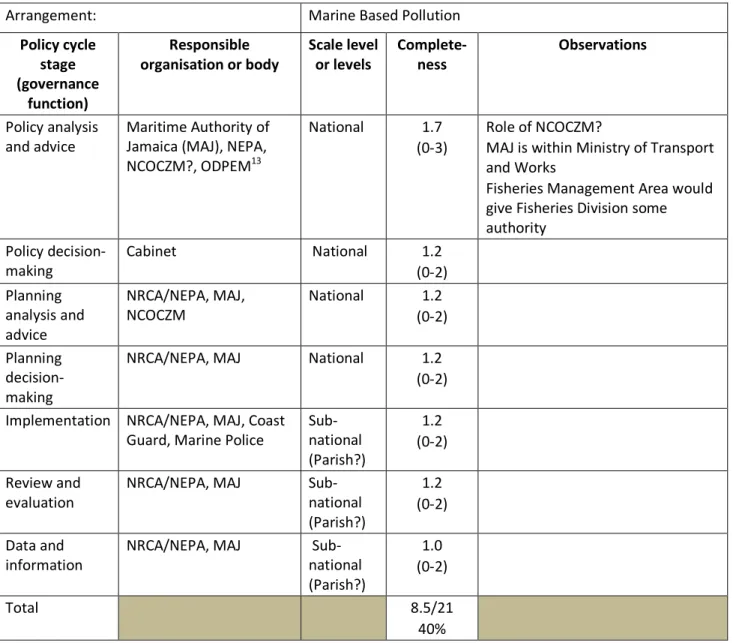
Arrangement: Marine Based Pollution
Policy cycle stage (governance
function)
Responsible
organisation or body Scale levelor levels Complete-ness Observations
Policy analysis
and advice Maritime Authority ofJamaica (MAJ), NEPA, NCOCZM?, ODPEM13
National 1.7 (0-3)
Role of NCOCZM?
MAJ is within Ministry of Transport and Works
Fisheries Management Area would give Fisheries Division some authority
Policy
decision-making Cabinet National (0-2)1.2 Planning analysis and advice NRCA/NEPA, MAJ, NCOCZM National (0-2)1.2 Planning decision-making
NRCA/NEPA, MAJ National 1.2 (0-2) Implementation NRCA/NEPA, MAJ, Coast
Guard, Marine Police Sub-national (Parish?)
1.2 (0-2) Review and
evaluation NRCA/NEPA, MAJ Sub-national (Parish?)
1.2 (0-2) Data and
information NRCA/NEPA, MAJ national Sub-(Parish?) 1.0 (0-2) Total 8.5/21 40% 13
Tables 2-7 identify only the bodies with formal responsibility for governance with regard to the specific issues being considered. This provides the formal arena in which the governance process may be played out. However, governance as understood in the CLME Project includes the interactions of all the actors with interests in governance outcomes. This is also reflected in Jamaica’s National Development Plan – Vision 2030 where partnerships among stakeholders have been identified as a necessary approach to the successful implementation of natural resource management. Therefore in order to understand and assess governance processes the roles of and interactions among these actors must be considered. This requires identification of the actors and their roles with reference to the policy cycle. It also provides the opportunity to identify where partnerships exist and/or can be developed. The full identification of all stakeholders is beyond the scope of this assessment of governance architecture and arrangements. However, tables in which the stakeholders can be identified are set up in Appendix 1 for future use. The Management Plan for the Pedro Cays and Surrounding Waters provides a stakeholder analysis that can be used as a basis for developing this policy cycle based perspective on partnerships.
2.1.4 Integration and linkages of arrangements
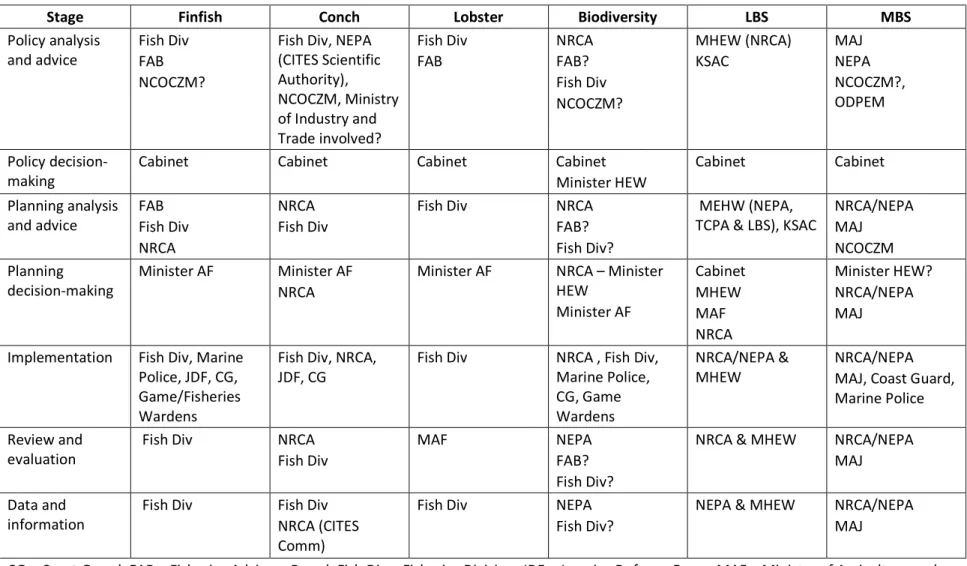
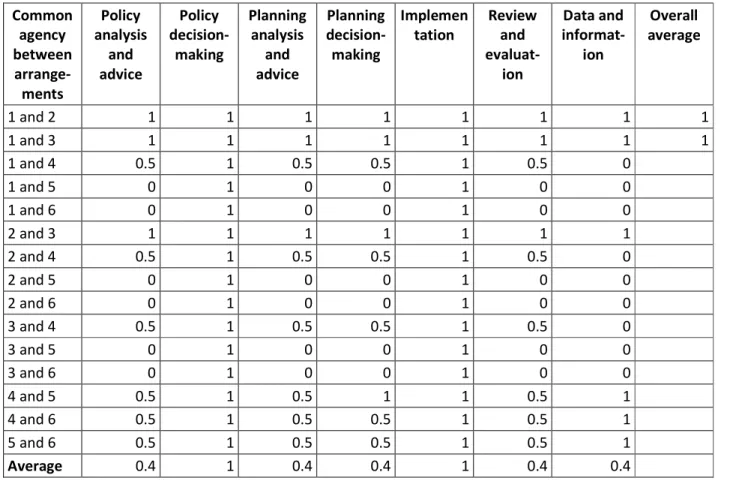
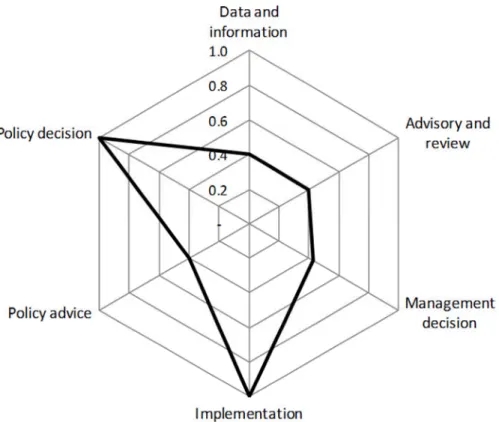
The assessment of integration is based on the extent to which issue specific arrangements in a system share a responsible body at various policy cycle levels. The information on responsibility for various stages from Tables 2-7 is summarized in Table 8. The degree of overlap of responsibility among the six issues is assessed in Table 9 and summarized in Figure 3.
Figure 2. Summary of completeness of the stages of the policy cycles for the six arrangements for the key governance issues on Pedro Bank, Jamaica (see notes in Table 1 for an explanation of the completeness scale).
Table 8. Comparison of agencies considered to have some responsibility or potential responsibility for the six LMR issues for Pedro bank and the Pedro Cays
Stage Finfish Conch Lobster Biodiversity LBS MBS
Policy analysis
and advice Fish DivFAB NCOCZM?
Fish Div, NEPA (CITES Scientific Authority), NCOCZM, Ministry of Industry and Trade involved? Fish Div
FAB NRCAFAB? Fish Div NCOCZM?
MHEW (NRCA)
KSAC MAJNEPA NCOCZM?, ODPEM Policy
decision-making Cabinet Cabinet Cabinet CabinetMinister HEW
Cabinet Cabinet Planning analysis
and advice FABFish Div NRCA
NRCA Fish Div
Fish Div NRCA FAB? Fish Div?
MEHW (NEPA,
TCPA & LBS), KSAC NRCA/NEPAMAJ NCOCZM Planning
decision-making Minister AF Minister AFNRCA
Minister AF NRCA – Minister HEW Minister AF Cabinet MHEW MAF NRCA Minister HEW? NRCA/NEPA MAJ
Implementation Fish Div, Marine Police, JDF, CG, Game/Fisheries Wardens
Fish Div, NRCA,
JDF, CG Fish Div NRCA , Fish Div,Marine Police, CG, Game Wardens
NRCA/NEPA &
MHEW NRCA/NEPAMAJ, Coast Guard, Marine Police Review and
evaluation Fish Div NRCAFish Div
MAF NEPA
FAB? Fish Div?
NRCA & MHEW NRCA/NEPA MAJ Data and
information Fish Div Fish DivNRCA (CITES Comm)
Fish Div NEPA Fish Div?
NEPA & MHEW NRCA/NEPA MAJ
CG = Coast Guard, FAB = Fisheries Advisory Board, Fish Div = Fisheries Division, JDF = Jamaica Defence Force, MAF = Ministry of Agriculture and Fisheries, MAJ = Marine Authority of Jamaica, MEHW = Ministry of Environment Health Water, NEPA = National Environmental Planning Agency, NRCA =
Table 9. The integration of the six issue arrangements (I1-I6) for the Pedro Bank system. A '1' means that the two arrangements have a responsible agency in common. A '0' means they have no responsible agency in common. A 0.5 has been used where there is some uncertainty about responsibility and there appears to be some overlap.. Common agency between arrange-ments Policy analysis and advice Policy decision-making Planning analysis and advice Planning decision-making Implemen
tation Reviewand
evaluat-ion Data and informat-ion Overall average 1 and 2 1 1 1 1 1 1 1 1 1 and 3 1 1 1 1 1 1 1 1 1 and 4 0.5 1 0.5 0.5 1 0.5 0 1 and 5 0 1 0 0 1 0 0 1 and 6 0 1 0 0 1 0 0 2 and 3 1 1 1 1 1 1 1 2 and 4 0.5 1 0.5 0.5 1 0.5 0 2 and 5 0 1 0 0 1 0 0 2 and 6 0 1 0 0 1 0 0 3 and 4 0.5 1 0.5 0.5 1 0.5 0 3 and 5 0 1 0 0 1 0 0 3 and 6 0 1 0 0 1 0 0 4 and 5 0.5 1 0.5 1 1 0.5 1 4 and 6 0.5 1 0.5 0.5 1 0.5 1 5 and 6 0.5 1 0.5 0.5 1 0.5 1 Average 0.4 1 0.4 0.4 1 0.4 0.4
Figure 3 indicates that the degree of integration among the six issues is considered to be highest at the policy decision-making and implementation levels. In the case of policy decision-making, in the national context, Cabinet is the ultimate policy-setting body for action to be taken under laws that have already been enacted. This is well known. However, policy decisions by Cabinet will only be as good as the quality of advice provided. The score in this area was low.
The National Council on Ocean and Coastal Zone Management (NCOCZM), established under the Office of the Prime Minister, was formally declared by Cabinet as a forum for policy level discussion. It includes most relevant agencies (Fisheries, NEPA, UWI). It would appear that there was the intention of having integrated policy advice on ocean and coastal management. However, it is not clear if this Council is funded or to what degree it is functional. In order for it to formulate policy it must have access to expert analysis and advice; which require funds. It must also be borne in mind that the mandate of the
NCOCZM is national and not Pedro Bank specific. If ocean and coastal management for living marine resources in Jamaica is to proceed through the establishment of a series of Marine Management Areas as suggested by the Draft Fisheries Policy and Draft Fisheries Act a key role of the NCOCZM will be to harmonise and integrate policy among those areas.
Figure 3. The extent of integration of the six governance arrangements for the Pedro Bank and Pedro Cays broken out by policy cycle stage (1 = full integration of responsibility for all issues).
Institutional integration appears to be low at the level of management advice and decisions making as well as in providing the data and information needed to support these processes. Closer inspection of tables 8 and 9 shows that the three fishery processes are likely to be well integrated as the Fisheries Division has primary responsibility for all three. However, they are largely separated from the seabird/sea turtle biodiversity issue and entirely separate from the two pollution issues.
Even if policy integration is achieved through the NCOCZM, it would appear that there is still the need for an integrating mechanism at the functional, management level for the Pedro Bank and Pedro Cays management area. The ad hoc arrangement that is in place for Pedro Bank and Pedro Cays at present provides a start on integrating at the management level and might serve to get the integrating process underway. However, in the long run it would be desirable that an integrating mechanism with clear responsibilities and accounting be established. The exact nature of this mechanism remains to be determined, but it must be known to all stakeholders, capable of adapting to evolving needs, and be recognised by the Government of Jamaica as the responsible body. It would also be most rational and probably efficient to have a consistent approach to the management mechanisms for the management areas that will be established throughout the country.
2.2 Level 2 assessment - performance of governance arrangements
The Level 2 assessment evaluates the functionality and performance of governance arrangements according to criteria that will be agreed by stakeholders. Mahon et al (2010) provide the conceptual background to what might be involved in examining governance arrangements in transboundary water systems.
2.2.1 Assessment of principles
The principles that should guide the establishment and the functioning of a governance arrangement, and the extent to which they are being observed in the processes, are an important part of a governance assessment. Assessing them can provide insight into where the system may need attention. Key
substantial principles are: sustainability, efficiency, rationality, inclusiveness, equity, precaution and responsiveness. Examples of key procedural principles are: transparency, accountability,
comprehensiveness, inclusivity, representativeness, information and empowerment.
For the Pedro Bank assessment 13 principles were selected as shown in Table 10. Representatives of the key stakeholder groups were asked to provide a score for the governance arrangement for each issue for each of the 13 principles based on the extent to which they agreed or disagreed with the statement associated with the principle in Table 10 (disagree strongly = 1, disagree =2, agree = 3, agree strongly = 4). The stakeholders groups were: Fisheries Division, NEPA, Maritime Authority, Coast Guard, a commercial fishing company, the Jamaica Fishers Cooperative Union, fishers from the Pedro Cays and The Nature Conservancy (TNC). They were also asked to indicate the importance of the principle for the particular issue.
The responses provided by stakeholders for the six arrangements are summarised in Figure 4. The detailed responses showing differences in response among stakeholder groups are shown in Appendix 3. On average all principles received high scores for importance from all stakeholders (Figure 4a). At the same time, most stakeholders indicated that they did not think these principles were well reflected in the governance arrangement for the six issues. The average scores tended to lie in the band between disagree (score = 2) and agree (score = 3). Again there was considerable variability among stakeholders (Appendix 3). Detailed inspection of the diagrams in Appendix 3 does provide some additional insight as to the extent to which principles were observed in the various arrangements.
Table 10. Principles assessed and the statements that were used to assess them
Principle Statement
Accountability The persons/agencies responsible for the governance processes can be held responsible for their action/inaction
Adaptability The process has ways of learning from its experiences and changing what it does Appropriateness Under normal conditions, this process seems like the right one for what it is trying to
achieve
Capability The human and financial resources needed for the process meet its responsibility are available.
Effectiveness This process should succeed in leading to sustainable use of ecosystem resources and/or control harmful practices
Efficiency This process makes good use of the money, time and human resources available and does not waste them.
Equity Benefits and burdens that arise from this process are shared fairly, but not necessarily equally, among stakeholders
Inclusiveness All those who will be affected by this process also have a say in how it works and are not excluded for any reason.
Integration This process is well connected and coordinated with other related processes. Legitimacy The majority of people affected by this process see it as correct and support it,
including the authority of leaders
Representativeness The people involved in this process are accepted by all as being able to speak on behalf of the groups they represent
Responsiveness When circumstances change this process can respond to the changes in what most think is a reasonable period of time
Transparency The way that this process works and its outcomes are clearly known to stakeholders through information sharing
Overall, capability, efficiency and transparency were perceived to be low in most cases. No principle appeared to be generally high or low, with the possible exception of effectiveness which tended around the 'agree' mark for most arrangements. The conch arrangement was perceived as being highest in accountability and appropriateness; again possibly because it is the most well known one and appears to be working.
The general picture is that stakeholders did not perceive the processes as being highly functional with regard to the principles remains the same. Improvement of these perceptions and scores could be a governance objective. This general conclusion provides the opportunity to reflect on what might be done differently in order to improve the arrangements with respect to the principles. This would be best done in consultation with the stakeholders by asking them what they would like to see changed in order for them to feel comfortable that the principle was being observed in the process. Indeed, the evaluate of the processes with regard to the principles that they are supposed to operate by should be an ongoing activity which is built into the process itself (Garcia et al 2008).
In pursuing the question of how to improve the processes, one could ask, what is it about the biodiversity process that resulted in such a low score on inclusiveness, yet a high one on equity and legitimacy, and what needs to be done to make the process more inclusive? One could also ask, what is it about the conch and finfish processes that result in the difference in appropriateness, and what needs to be done with the finfish process to make it more appropriate. Differences in stakeholder perception can also be explored. In Figure A.3.2b for example, one might wish to explore why NEPA thought the Figure 4. Assessment of the extent to which desired principles are considered to be (a) important and (b) represented, in the governance processes for the five issues identified for the Pedro Bank.
process was high in equity but the fishers thought it was low, and how the fisher's perception of low equity could be addressed. As indicated above, these conversations are not one-off conversations; they should be part of an ongoing process of governance assessment and that will a framework. Stakeholders should consider if the current assessment methodology provides such a framework or can be adapted to do so.
2.2.2 Assessment of interactions
Functional linkages and interaction within governance arrangements as well as between them are a critical component of the governance system. While the integration analysis can identify structural (governance architecture) arrangements that would make integration possible, or even likely, their existence does not mean that integration is actually taking place. This can only be determined by interviews and by examination of the documentation of the functioning of the processes. The architecture is seen as a necessary, but not sufficient condition for the integration required for an Ecosystem Approach. It should be noted that integration can take place in the absence of appropriate structure on an ad hoc basis, through individual initiative and personal contacts. While this is better than nothing and may in cases be all that is possible give the prevailing architecture, it is not considered to be a sustainable, transparent, accountable approach to addressing the problem of integration across issues.
3 Conclusions and recommendations
Detailed assessments of governance architecture such as the one carried out in this study for the Pedro Bank are few. Technical assessments of resources and their habitats are far more common. The purpose of the assessment carried out here is to dissect and display the suite of governance arrangements for the six major issues identified for Pedro Bank in order to facilitate discussion among stakeholders. This discussion can lead to shared perceptions of what should be in place, what principles should be prominent and how the system should be structured. The assessment is not intended to lead to a prescriptive output regarding what should be in place. Nonetheless, some broad observations can be made on aspects of the system that need attention if arrangements are to be structured in way that is likely to lead to effective governance, including the promotion of intersectoral and inter-issue
integration that is needed for an ecosystem approach.
The first observation is that there is the need to clarify and formalize the individual governance arrangements for the six issues and make them known to all stakeholders so that they can take part in the processes effectively.
This require separating the two aspects of uncertainty relating to these processes: (1) uncertainty among responsible agencies regarding which agency is responsible for what stages of the cycle; and (2) lack of awareness among stakeholders, even when there is certainty among responsible agencies. A second observation is that the governance arrangements for the six issues do not appear to be well integrated at the policy level or at the management level. At the policy level there is a body the NCOCZM that is assumed to have the mandate for policy integration and advice at the national level. It also appears to be responsible for policy integration in oceans affairs for national inputs into regional and international processes (Mahon et al 2010). The functionality of this council, especially in the context of Pedro Bank is unclear. It may not be adequately funded or staffed for the role it is expected to play.
At the management level, there is an ad hoc management committee that can make a start in
management integration; however, it is recommended that a formal integrating committee with clear responsibilities and accounting be established.
With regard to the Level 2 assessment based on the extent to which stakeholders perceived certain principles as being observed in the arrangements, the general picture is that stakeholders did not perceive the processes as being highly functional with regard to the principles remains the same. Improvement of these perceptions and scores could be a governance objective. This general conclusion provides the opportunity to reflect on what might be done differently in order to improve the
arrangements with respect to the principles.
It is recognised that the management of marine ecosystems is in a state of flux in Jamaica, as the draft Fisheries Act has not been passed. As pointed out by Otuokon (2012) this Act makes provisions for addressing several of the uncertainties regarding responsibilities for individual issues, as well as for integrating mechanisms. Its passage is expected to strengthen the national capacity for marine
ecosystem based management. It is hoped that dissecting the living marine resource governance issues as has been done in this assessment will provide insights and a framework for developing a robust governance architecture and principled processes for the marine ecosystem of the Pedro Bank and Pedro Cays.
4 References
Appropriate Technologies Ltd. 2007. Feasibility study on water, health, sanitation, infrastructure and carrying capacity of the Pedro Cays, Jamaica. The Nature Conservancy, Kingston, Jamaica. 53 p. Crowder, L. B., G. Osherenko, O. R. Young, S. Airamé, E. A. Norse, N. Baron, J. C. Day, F. Douvere, C. N.
Ehler, B. S. Halpern, S. J. Langdon, K. L. McLeod, J. C. Ogden, R. E. Peach, A. A. Rosenberg and J. A. Wilson. 2006. Resolving mismatches in U.S. ocean governance. Science 213: 617-618. Espeut, P. A. 2006. The wild frontier: Living and fishing on the Pedro Cays of Jamaica – A socioeconomic
assessment. The Nature Conservancy, Kingston, Jamaica. 116 p.
Fanning, L., R. Mahon and P. McConney. 2009b. Focusing on living marine resource governance: the Caribbean Large Marine Ecosystem and Adjacent Areas Project. Coastal Management 37: 219 – 234.
FAO. 2003. The ecosystem approach to fisheries. FAO Technical Guidelines for Responsible Fisheries. No. 4, Suppl. 2. Rome: Food and Agriculture Organisation. 112 p.
Garcia, S. M., E. H. Allison, N. J. Andrew, C. Béné, G. Bianchi, G. J. de Graaf, D. Kalikoski, R. Mahon and J. M. Orensanz. 2008. Towards integrated assessment and advice in small-scale fisheries:
principles and processes. FAO Fisheries Technical Paper. No. 515. 84p.
Mahon, R., L. Fanning and P. McConney. 2011a. CLME TDA update for fisheries ecosystems: governance issues. CLME Project, Consultant Report. 113 p.
Mahon, R, L. Fanning and P. McConney. 2011b. Observations on governance in the Global Environment Facility (GEF) International Waters (IW) Programme. CERMES Technical Report No. 45, 36 p. (www.cavehill.uwi.edu\cermes)
Mahon, R., L. Fanning and P. McConney. 2011c. Governance assessment for Global Environmental Facility (GEF) International Waters Systems: governance arrangements and architecture. Earth Systems Governance Project, Working Paper.
Mahon, R., L. Fanning and P. McConney. 2011d. Sustainable Management of the Shared Living Marine Resources Large Marine Ecosystem (CLME) and Adjacent Regions: Governance assessment for pilot projects and case studies. CLME Project Working Paper.
Mahon, R., P. McConney, K. Parsram, B. Simmons, M. Didier, L. Fanning, P. Goff, B. Haywood and T. Shaw. 2010. Ocean governance in the Wider Caribbean Region: Communication and coordination mechanisms by which states interact with regional organisations and projects. CERMES Technical Report No. 40. 84pp.
Otuokon, S. 2012. DRAFT Management Plan for the Pedro Cays and Surrounding Waters 2012 – 2017. The Nature Conservancy, Kingston, Jamaica.
Young, O. R., G. Osherenko, J. Ekstrom, L. B. Crowder, J. Ogden, J. A. Wilson, J. C. Day, F. Douvere, C. N. Ehler, K. L. McLeod, B. S. Halpern and R. Peach. 2007. Solving the crisis in Ocean Governance: place-based management of marine ecosystems. Environment, 49 (4): 20–32.
Appendix 1: Scores provided by key stakeholder agencies for
completeness of policy cycle stages for the six governance issues for
Pedro bank and Pedro Cays
Policy cycle stage Coast
Guard Commer-cial Fishers
TNC Fishers Fisher
coop Mari-time Author-ity NEPA Fisheries Division Finfish fishing Policy advice 2 0 3 3 1 0 3 3 Policy setting 1 0 3 3 1 0 2 2 Management advice 2 0 3 3 2 0 2 3 Decision-making 2 1 3 3 2 0 2 3 Implementation 2 3 2 3 1 0 3 3 Review 2 2 2 2 2 0 2 2
Data and information 1 2 2 2 2 0 2
Conch fishing Policy advice 3 0 1 2 2 0 2 1 Policy setting 3 0 1 2 2 0 1 0 Management advice 3 0 1 0 3 0 2 1 Decision-making 3 0 1 0 1 0 1 1 Implementation 3 0 1 2 2 0 1 2 Review 2 1 1 2 3 0 1 1
Data and information 1 1 1 3 1 0 1 1
Lobster fishing Policy advice 2 3 2 1 1 0 1 2 Policy setting 2 3 2 1 1 0 3 1 Management advice 2 3 2 1 2 0 1 2 Decision-making 2 3 2 1 1 0 3 1 Implementation 2 3 1 1 2 0 1 2 Review 2 3 2 1 2 0 1 1
Data and information 1 3 1 1 2 0 1 2
Sea turtles-seabirds Policy advice 2 2 3 1 0 3 1 Policy setting 2 2 3 1 0 1 0 Management advice 1 2 3 1 0 1 1 Decision-making 1 2 3 2 0 1 1 Implementation 2 1 3 1 0 1 1 Review 1 1 1 2 0 1 1
Policy cycle stage Coast
Guard Commer-cial Fishers
TNC Fishers Fisher
coop Mari-time Author-ity NEPA Fisheries Division Land-based pollution Policy advice 0 0 1 1 1 0 1 Policy setting 0 0 1 0 1 0 3 Management advice 0 1 2 0 2 0 1 Decision-making 0 0 2 0 2 0 3 Implementation 0 1 1 0 2 0 1 Review 0 0 1 2 2 0 1
Data and information 0 1 1 2 2 0 1
Marine-based pollution Policy advice 0 2 1 2 2 3 Policy setting 0 2 1 2 0 2 Management advice 0 1 0 2 2 2 Decision-making 0 1 0 2 2 2 Implementation 0 1 0 2 2 2 Review 0 1 0 1 2 2
Appendix 2. Tables for identification of stakeholders in Pedro Bank
marine governance by issue
Pedro Bank Fishery Ecosystem stakeholders for the finfish issue by policy cycle stage
Policy cycle stage (governance function)
Regional National/local
Meta level - policy advice
Meta level - Policy setting
Policy cycle -management advice
CamPAm, FAO? UWI
Policy cycle - decision-making
Policy cycle -Implementation Policy cycle – Review of implementation Policy cycle - Data and information
Caribbean Regional Fisheries
Mechanism?? FAO WECAFC?? National Fisher group? South coast coops(Old Harbour, Whitehouse??...others?? Treasure Beach?? Parrottee??), other fish sanctuaries (Oracabessa, CCAM)
Pedro Bank Fishery Ecosystem stakeholders for the conch fishery issue by policy cycle stage
Policy cycle stage (governance function)
Regional National/local
Meta level - policy advice
Meta level - Policy setting
Policy cycle -management advice
CITES (International), CRFM, CFMC
(Caribbean Fisheries Mgt Council)? Conch fishers group? Formal committee ofgov’t/stakeholders? Policy cycle -
decision-making
CITES (International), CRFM?? Policy cycle
-Implementation Policy cycle – Review of implementation
Policy cycle - Data and information
CITES, CRFM UWI/other Universities? (UPR)
Pedro Bank Fishery Ecosystem stakeholders for the lobster fishery issue by policy cycle stage
Policy cycle stage (governance function)
Regional National/local
Meta level - policy advice
Meta level - Policy setting
Policy cycle -management advice
CRFM, FAO WECAFC Lobster group??
Policy cycle - decision-making
Policy cycle -Implementation Policy cycle – Review of implementation Policy cycle - Data and information
UWI/other Universities? (UPR)
Pedro Bank Fishery Ecosystem stakeholders for the biodiversity issue by policy cycle stage
Policy cycle stage (governance function)
Regional National/local
Meta level - policy advice
Meta level - Policy setting
Policy cycle -management advice
Links with TNC? Policy cycle -
decision-making Policy cycle -Implementation Policy cycle – Review of
implementation TNC, UWI, PBPC, community, CGTNC Formal role for the fish sanctuary re fisheries
Pedro Bank Management Plan Advisory Committee (UWI, TNC, NEPA, Fish Div, Coast Guard, Jamaica Fishermen's Coop, MHEW,
Finder) NEPA
Fisheries Division, Coast Guard, Community/fishers
UWI Policy cycle - Data and
information
Links to SPAW, WIDECAST, Seabirds
Sub-Committee?? UNEP RCU?? Links to National Committees re sea turtles,Biodiversity Policy?? Protected Areas Committee?? UWI – Marine Labs?? NCOCZM
Pedro Bank Fishery Ecosystem stakeholders for the LBS issue by policy cycle stage
Policy cycle stage (governance function)
Regional National/local
Meta level - policy advice
UNEP LBS Protocol Meta level - Policy
setting Policy cycle -management advice Policy cycle - decision-making
Policy cycle -Implementation Policy cycle – Review of implementation Policy cycle - Data and information
TNC, Pedro Fisher assn?? CCAM
Pedro Bank Fishery Ecosystem stakeholders for the marine based sources of pollution issue by policy cycle stage
Policy cycle stage (governance function)
Regional National/local
Meta level - policy advice
Meta level - Policy setting
Policy cycle -management advice Policy cycle - decision-making
Policy cycle -Implementation
Policy cycle – Review of implementation Policy cycle - Data and information
Appendix 3: The importance and presence of principles in the policy
process for each issue as indicated by each stakeholder group
Figure A3.2. Assessment of the extent to which desired principles are considered to be (a) important (0 = none, 1 = low, 2 = medium, 3 = high) and (b) present (1 = Disagree strongly, 2 = Disagree, 3 = Agree, 4 = Agree strongly), in the Pedro Bank governance process for the finfish issue.
Figure A3.3. Assessment of the extent to which desired principles are considered to be (a) important (0 = none, 1 = low, 2 = medium, 3 = high) and (b) present (1 = Disagree strongly, 2 = Disagree, 3 = Agree, 4 = Agree strongly), in the Pedro Bank governance process for the conch fishery issue.
Figure A3.4. Assessment of the extent to which desired principles are considered to be (a) important (0 = none, 1 = low, 2 = medium, 3 = high) and (b) present (1 = Disagree strongly, 2 = Disagree, 3 = Agree, 4 = Agree strongly), in the Pedro Bank governance process for the lobster fishery issue.
Figure A3.1. Assessment of the extent to which desired principles are considered to be (a) important (0 = none, 1 = low, 2 = medium, 3 = high) and (b) present (1 = Disagree strongly, 2 = Disagree, 3 = Agree, 4 = Agree strongly), in the Pedro Bank governance process for the biodiversity (seabirds and sea turtles) issue.
Figure A3.1. Assessment of the extent to which desired principles are considered to be (a) important (0 = none, 1 = low, 2 = medium, 3 = high) and (b) present (1 = Disagree strongly, 2 = Disagree, 3 = Agree, 4 = Agree strongly), in the Pedro Bank governance process for the land based sources of pollution issue.
Figure A3.6. Assessment of the extent to which desired principles are considered to be (a) important (0 = none, 1 = low, 2 = medium, 3 = high) and (b) present (1 = Disagree strongly, 2 = Disagree, 3 = Agree, 4 = Agree strongly), in the Pedro Bank governance process for the marine based sources of pollution issue.
End notes
Hi Prof. Mahon,
I noticed the following footnote on pg. 3 of the Draft Governance Assessment Report,
“We need to document how many and what positions they held in an Appendix. Were representatives self-chosen, etc? Was the scoring process done individually, in a group?”
Here is the information (to the best of my knowledge – not sure of the titles/positions):
Agency/Organisation Who Involved/Positions Self-chosen?
Fisheries Division Mr. Stephen Smikle
(2ndin charge)
I sent the document by email to Messrs. Kong & Smikle as top management. I gave a hard copy to Mr. Smikle when I met with himself and a team of Officers. I don’t know if he liaised with Mr. Kong in completing the form
NEPA Ms. Yvette Srong (head of
Dept)
Ms. Andrea Donaldson Mr. Sean Green
I sent the document to Ms. Donaldson, Mr Green & Mr. Henry (as the persons on the Pedro Mgmt Committee) but Ms. Donaldson was the only one who responded so I liaised with her. She involved Mr. Green and indicated that they would have to involve Ms. Strong as head of the Dept.
Coast Guard Lt. Aceion Prescott
Lt. Alvin Gayle
I sent Lt. Prescott and Lt. Alvin Gayle the form as they were the ones initially attending the Pedro Committee meetings
Maritime Authority Mr. Bertrand Smith
Director – Legal Affairs
I sent the form to Rear Admiral Brady (head of the Maritime Authority) and he asked me to liaise with Mr. Bertrand Smith for my meetings with the Maritime Authority in regard to Pedro Cays generally
Small-scale fishers Mr. Winston Kerr Mr. Kerr is one of the long-time fishers that
TNC is thinking of involving as a Community Enforcement Officer due to his interest and knowledge
NGO (TNC) Mrs. Donna Blake Mrs. Blake is head of TNC - Jamaica
Commercial Fishers Mr. Ricky Francis
B&D Trawling Co. Ltd.
Mr Francis is CEO of the company and the only commercial fisher I was able to talk to (others did not respond to calls/messages left) Jamaica Fisherman
Cooperative Union
Mr. Anthony Drysdale Mr. Drysdale indicated that the Board went through the form and answered it together, at one of their meetings.
iQuestions that arose in discussing the area to be managed
Will the MPA be a NEPA MPA vs Fisheries Fish Sanctuary. What about an NRCA Environmental Protection Area – that is broad enough to include land and marine provisions. Management areas are sufficiently outlined in current draft fisheries act…entire area of cays considered fish landing beach
Role and relationship of NCOCZM? To be explored?
Look at the Act for Pedro and Morant Cays Act 1907 (rev 1975). Is there provision for management of communities, species? What is the role of the KSAC?
Fisheries Division indicated that the project should proceed based on the new Fisheries legislation. What is the status of Pedro Bank Committee? Is it formal? What is required to formalize it to take action? iiThis page provides an overview of all the arrangements in the system and their status.
iiiThere is the question of how far down in detail these should go. This can be a matter of choice, and part of the flexibility of the system, but it should ideally be to the level where the transboundary issue requires a separate arrangement for management. To use a fishery example, individual species or groups of species may each require their own assessment and measures, but may all be handled in one institutional arrangement. However, for geopolitical reasons, some species or groups of species may require separate processes and should be treated as separate issues needing separate arrangements. Ideally, these issues should be identified and quantified in a TDA. If not, experts knowledgeable about the system may have to identify them.
ivThis should be based on the TDA but may have to be based on expert judgement, or other sources of regional information. It is to be scored from 0-3.
vThe incompleteness score given in this column will be derived from the completeness scores allocated on the arrangement specific page (Tables 2-7) by subtracting the latter score from 21, which is the maximum possible. This score will then be reallocated into a category where none = 0, low = 1, medium = 2 and high = 3) for input into the Priority for intervention column.
viThis priority would be calculated as the product of the 'collective priority for countries involved for the issue' and 'incompleteness'. It can range from 0-9. Another way of examining the data in the incompleteness and collective priority columns would be a 2x2 high/low matrix.
viiThis provides the opportunity for brief comments that may help the user interpret the information provided on the summary page, but is not intended to be a substitute for annotation.
viiiAverage.
ixThis column list the governance function that are considered to be necessary at two levels (a) the policy setting level and (2) the policy cycle level.
xOrganisation or organisations responsible for the function should be listed here
xiThese are the institutional scale level or levels at which the function is performed (local, national, subregional, regional, extra-regional)
xiiRate on a scale of 0 = absent, 1 = low (ad hoc, irregular, unsupported by formal documentation or little known by stakeholders) , 2 = medium, 3 = high (clearly identifiable, regular, documented or supported by policy and
legislation and widely known among stakeholders)
xiiiThis provides the opportunity for brief comments that may help the user interpret the information provided, but is not intended to be a substitute for annotation.