NUEVAS APLICACIONES Y COMUNICACIÓN INTERNACIONAL
Scaffolding oral interaction in a CLIL context:
A qualitative study
Presented by: Olga Gerakopoulou Tutor: Dr. Emma Dafouz-Milne June 2011
Durante los últimos años se está realizando una gran investigación en torno a una aproximación educativa relativamente novedosa dentro del marco de la Unión Europea que se llama Aprendizaje Integrado de Contenidos y Lenguas. Este aprendizaje integrado de contenidos y lenguas en el aprendizaje de de una segunda, o incluso tercera, lengua se había iniciado a partir de las clases de inmersión principalmente de Canadá. En la recién establecida Unión Europea temas de internacionalización, de movilidad, de interculturalidad y de multilingüismo crearon la necesidad de una enseñanza rápida, con los mejores resultados, y de un aprendizaje de más lenguas teniendo como objetivo la comunicación. Bajo estas condiciones el aprendizaje integrado de contenidos y lenguas en el entorno escolar apareció como una solución con unos resultados prometedores.
Conforme el Aprendizaje Integrado de Contenidos y Lenguas (AICLE) suponía una nueva aproximación de dimensiones políticas, educativas y socio-culturales, suscitó el interés de muchos estudiosos, pero también de los centros educativos, de los profesores, de los alumnos, incluso de los padres, que habían de adaptarse a la nueva realidad educativa y colaborar en el establecimiento del Aprendizaje Integrado de Contenidos y Lenguas. La socialización del alumno en el aula del Aprendizaje Integrado de Contenidos y Lenguas se expresa en la interacción profesor-alumno o entre los mismos alumnos. La interacción que tiene lugar durante la clase se logra con la enseñanza planeada y la ayuda que ofrece el profesor a sus alumnos. La metodología y las estrategias lingüísticas que utiliza el profesor para ayudar a sus alumnos a desarrollar sus capacidades cognitivas y lingüísticas , para ampliar su capacidad de comprensión y llegar a ser unos estudiantes capaces e independientes de una segunda lengua, estando comprendido todo esto en la noción del “andamio o apoyo”.
El Aprendizaje Integrado de Contenidos y Lenguas está basado en antiguos métodos que proponían el aprendizaje de la lengua dentro del contenido, como por ejemplo la Enseñanza Comunicativa de la Lengua y la Instrucción basada en el contenido. El filólogo y psicólogo ruso Lev Vygotsky desarrolló la Teoría Sociocultural que sostiene que el aprendizaje está directamente vinculado e influído por la cultura y la
independiente. El papel del profesor/a es el de apoyar al alumno/a con técnicas de apoyo dentro de la Zona de Apoyo Central hasta llegar a ser un estudiante autónomo. Características básicas del andamiaje son la extensión de la comprensión, el apoyo temporal que ofrece, como también el “macro andamio” y “micro andamio”.
A pesar de que las técnicas de apoyo son un elemento muy importante para la enseñanza en el ámbito del aprendizaje de una segunda lengua, hay una generalidad en relación con las técnicas de apoyo que puede aplicar el profesor/a en el marco del Aprendizaje Integrado de Contenidos y Lenguas. Objeto, pues, de este estudio es investigar y describir casos de técnicas de andamio que son aplicadas a la enseñanza secundaria por profesores del Aprendizaje Integrado de Contenidos y Lenguas. Para este fin quince vídeos elegidos, de corta duración que provienen de clases holandesas de Aprendizaje Integrado de Contenidos y Lenguas de educación secundaria, fueron analizados y comentados. Los resultados mostraron que los profesores aplicaron técnicas verbales y no verbales las cuales diferían según la especialidad del profesor y la edad de los alumnos. También, un resultado todavía importante es que los profesores promovían la interacción dentro del aula y la activa participación.
En conclusión, se espera que los resultados de este estudio contribuyan a una investigación más amplia que se lleva a cabo en torno a la aproximación del Aprendizaje Integrado de Contenidos y Lenguas en las prácticas que aplican en clase y que constituyan el comienzo de otras investigaciones que están relacionadas con el Aprendizaje Integrado de Contenidos y Lenguas y las técnicas de apoyo.
In the last years the learning of languages as a basic prerequisite in the European Union has created a new educational paradigm called Content and Language Integrated Learning (CLIL). This integration of content and language for the learning of a second / foreign language has been followed, among others, by research in the field of second language acquisition. In the CLIL classroom the role of the teacher has become twofold; to assist students in the learning of content and language at the same time. The support that the teacher offers to the learners to accomplish this dual target is expressed through the notion of
scaffolding (Vygotsky, 1978; Bruner, 1985), that is a temporary assistance until the student is able to work autonomously. The purpose of this study is to investigate and describe instances of scaffolding strategies applied in the CLIL secondary education classroom. Fifteen videos of CLIL practice were analyzed in detail to show that CLIL teachers apply a number of verbal and non-verbal techniques to extend their students’ understanding and aim at promoting interaction and the students’ participation in order to help them become independent learners.
Key words: second / foreign language learning, CLIL, socialization, scaffolding strategies, classroom interaction
Chapter 1: Introduction 1
1.1 Aims and Research Questions of the study 2
1.2 Structure of the current paper 3
Chapter 2: Theoretical Background 4
2.1 Theories of Second Language Acquisition and Teaching 4
2.1.1 Communicative Language Teaching 4
2.1.2 The Natural Approach 5
2.1.3 Content-based instruction 6
2.2 Language Pedagogy in the European Union 7
2.2.1 CLIL Definitions and Development 7
2.2.2 CLIL Dimensions and Outcomes 9
2.3 Conceptual Frameworks on Scaffolding 10
2.3.1 Vygotsky and the Sociocultural Theory of Learning 11
2.3.2 Bruner’s (1985) scaffolding model 13
2.3.3 Scaffolding and Language 14
2.3.4 Main characteristics of Scaffolding 16
2.3.4.1 Extending understanding 16
2.3.4.2 Temporary support 17
2.3.4.3 Macro and micro focuses 17
2.3.5 Scaffolding in Second Language Acquisition 18 2.3.5.1 The teacher – learner relationship 18 2.3.5.2 Features and levels of scaffolding 19 2.3.5.3 Scaffolding strategies: an approach to different taxonomies 20 Chapter 3: Data, Methodology & Qualitative Analysis 22
3.1 Data collection 22
3.1.1 CLIL in the Netherlands 22
3.1.2 The Dutch research 23
3.1 Methodology 25 3.2.1 Qualitative analysis of videotaped material 25
3.2.2 Procedure and method of analysis 25
3.3 Qualitative data analysis 29
3.3.1 History Teacher 1 29
3.3.2 The Geography Teacher 33
3.3.3 History Teacher 2 36
3.3.4 The Biology Teacher 45
3.3.5 English Teacher 1 48
Chapter 4: Findings, Comments & Discussion 52
4.1 Findings of the study and comments 52
4.2 Discussion of the findings 56
Chapter 5: Conclusions and Pedagogical Implications 59 5.1 Restrictions and pedagogical implications of the study 60
LIST OF FIGURE AND TABLES
Figure 1 Expanded ZPD 19
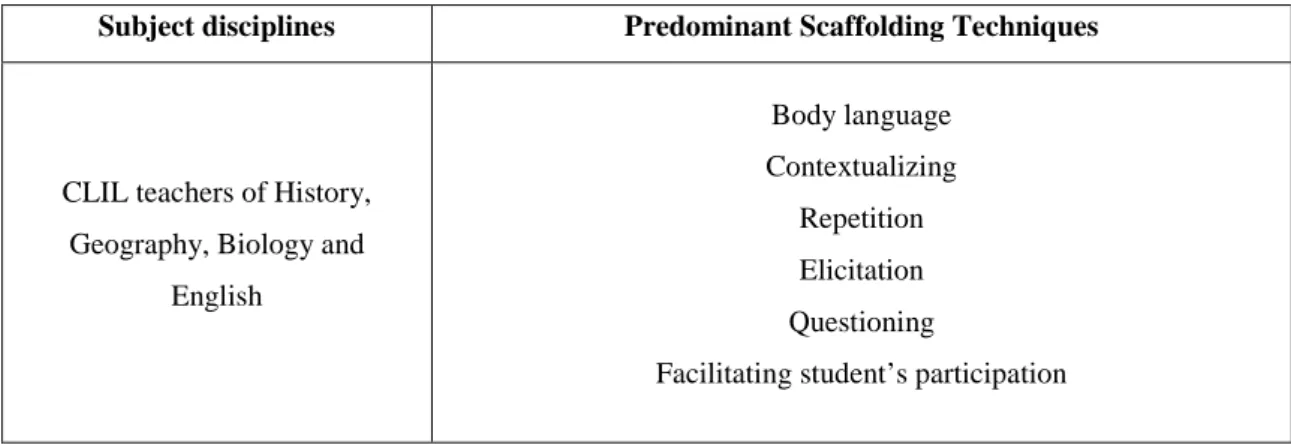
Table 1 Subjects, teachers and students in CLIL and EFL lessons 24 Table 2 Disciplines, corresponding videos and extracts of the analysis 26-27 Table 3 Scaffolding strategies identified in the specific study 28-29 Table 4 Scaffolding strategies used by History Teacher 1 52 Table 5 Scaffolding strategies used by the Geography Teacher 53 Table 6 Scaffolding strategies used by History Teacher 2 54 Table 7 Scaffolding strategies used by the Biology Teacher 55 Table 8 Scaffolding strategies used by English Teacher 1 55 Table 9 Scaffolding techniques used more by the CLIL teachers analyzed 58
Chapter 1: Introduction
In recent years there has been a great proliferation of research on a relatively new area of an educational paradigm in the European Union called Content and Language Integrated Learning (CLIL). The integration of content and language for the acquisition of a second, or even third, language (Baetens-Beardsmore, 2001) had started long ago in the immersion classes of North America, mainly in Canada, seeking for teaching methodologies to cover the linguistic differences that existed in their society and their schools (Genesee, 1994; Swain and Lapkin, 2002; Walqui, 2006). In Europe the same need came up when, in the newly-constituted European Union, the issues of internationalization, mobility, cross-culturalism and multilingualism came to the surface. The teaching and learning of more languages for communication became a target that had to be reached in a short time and with the best possible outcomes. Under these conditions, the integration of content and language in the school curriculum was viewed as a solution with hopeful results.
As CLIL was a novel approach with political, educational and socio-cultural dimensions, it attracted the interest of many scholars and created inquiries for academic research (see Coyle, 2000; Dalton-Puffer 2008). De Bot (2001: 12) notices that “In the recent past a number of research projects have been carried out to establish the effectiveness of the CLIL approach” and comments the need for more research on CLIL in present time. Apart from the academic interest in the area, though, directly involved with the European programme were educational institutions, teachers, students and even parents who, on the one hand, saw CLIL as an innovative attempt for language learning and, on the other, had to adjust to the new educational reality. Schools started to incorporate CLIL into the school curriculum, content and language teachers had to be trained, students and parents had to be informed and convinced about the advantages of CLIL methodology. In whole, CLIL became accepted with enthusiasm from all stakeholders whose cooperation and collaboration was necessary for its establishment.
One aspect of CLIL which is connected to the way the language learner is confronted in the classroom is its social nature. The language learner’s socialization is expressed through the practice of interaction between teacher and student. Interaction during the lesson is accomplished through carefully planned instruction, class practices and the help that the teacher offers to the students when it is considered necessary. The methodology and the linguistic strategies that the teacher employs in order to assist students to develop their cognitive and linguistic skills, extend their understanding and become competent and independent second language learners are all included in the notion of scaffolding. Learning that is retrieved through scaffolding and interaction and the role of the ‘reflective practitioner’ are considered basic concepts in CLIL education (Hansen-Pauly, M. A., project coordinator, et al, 2009: 1).
The metaphor of scaffolding is directly connected to the Zone of Proximal Development (ZPD) (Vygotsky, 1978) which refers to the child’s gradual development towards independence as a learner. In the educational stream, the role of the teacher is associated with the assistance s/he should offer to the student through his/her ZPD until s/he reaches linguistic competence. In CLIL contexts the teacher’s scaffolding is twofold due to its dual nature. The CLIL teacher has to scaffold both on the content and on the linguistic area and apply a number of techniques, verbal or non-verbal, that will challenge and at the same time support the student’s learning.
1.1 Aims and Research Questions of the study
Although scaffolding appears to be essential in the field of second language acquisition and is considered an important element of effective teacher instruction (Mercer, 1994; Walqui and van Lier, 2010), there is still certain vagueness and generalization on the scaffolding strategies that the teacher can employ in a CLIL context. One reason for this generalization could be the fact that scaffolding refers to all areas of instruction, oral and written, and a specific framework is difficult to be developed. The teacher is given the freedom to choose among a number of techniques what is most beneficial and appropriate for the students, depending on their comprehension level and their linguistic competence.
A. Investigating educational practices in a CLIL context
B. Describing instances of scaffolding strategies applied by CLIL teachers in their oral production
C. Reporting on the findings and developing their implications for the establishment of scaffolding strategies as a pedagogical practice in CLIL secondary education
It is expected that the study in question will give a more specific picture and will summarize a number of scaffolding techniques that might prove to be useful for the CLIL teachers and effective for the learners’ acquisition of a second language in general. Therefore, the current research intends to provide answers to the following questions:
1. What scaffolding strategies do CLIL teachers use to assist students in their content, linguistic and cognitive development?
2. Are there differences in the scaffolding strategies that each CLIL teacher uses depending on their subject discipline and the students’ age / CLIL level?
3. How does teacher instruction encourage classroom interaction?
4. Do teachers stimulate the students’ participation in the construction of the lesson?
1.2 Structure of the current paper
This paper is organized in five different chapters starting from the introduction that is presented above. Chapter two contains the theories and the conceptual frameworks that underline CLIL and the notion of scaffolding. Subsequently, chapter three refers to the data collection and the methodology selected for the analysis of the research in question. Data analysis is included in the same chapter divided in five subsections, each one corresponding to one CLIL teacher analyzed. Next, chapter four presents the findings and a discussion of the results follows. Finally, the conclusions and implications of the current study are included in the final chapter, chapter five.
Chapter 2: Theoretical Background
2.1 Theories of Second Language Acquisition and Teaching
There is a variety of theories and approaches related to second language teaching and learning. Their analyses provide information about the way people acquire language in general, as well as the methods that are most suitable for teaching the language successfully. As the theory of scaffolding is highly related to interaction and a socio-cultural view of language, there will be a reference to the communicative approaches on which second language teaching and learning are based in our days.
2.1.1 Communicative Language Teaching
Changes in the socio-political scenery of Europe and North America in the early 1970s (for example, high immigration and population movement) led to linguistic and pedagogical changes as well. Classes adopted a more communicative behaviour, with interaction being the central point of language teaching and learning. The focus was now on the learner and notions such as ‘negotiation of meaning’ came to the surface. All these elements are the concrete characteristics of Communicative Language Teaching (CLT), an approach with significant implications for the science of language pedagogy among others. According to Savignon (2002: 4) “communicative language teaching derives from a multidisciplinary perspective that includes, at the least, linguistics, psychology, philosophy, sociology, and educational research”.
Basic in CLT is the theory of Communicative Competence introduced from the sociolinguist Dell Hymes (1966). Hymes developed this theory as an answer to Chomsky’s idea of linguistic competence. In his theory Chomsky made a distinction between “competence, the speaker-hearer’s knowledge of his language” and “performance, the actual use of language in concrete situations” (Chomsky, 1965: 4), considering the first an innate process. Hymes, on the other hand, spoke of the learner’s competence to combine grammatical and socio-cultural knowledge as well.
This theory was further enhanced by Canale and Swain (1980) who stressed the division of communicative competence into strategic, grammatical and sociolinguistic. This division did not underestimate the importance of grammar, it just put grammatical competence into a more widely defined communicative competence model (Savignon, 2002: 7). Later on, discourse competence was added to comprise with the other three components of a learner’s communicative competence (Savignon, 2002: 7-9). Today CLT includes a variety of interactive activities, games, use of songs and movies, use of the internet, among others, so that the learner will be able to expand most effectively his/her communicative competence of a second language.
2.1.2 The Natural Approach
The Natural Approach was developed in 1977 by a teacher, Tracy Terrell, in cooperation with the famous linguist, Stephen Krashen. Their communicative views on second language learning and teaching immediately found many supporters. Terrell and Krashen (1983) claimed that there is a natural way of learning the language. In the field of language acquisition, Krashen (1982) distinguishes between the terms acquiring a language and learning a language. He asserts that the competence of acquiring a language is a subconscious process that applies both to children and adults, while the learning of a language is a conscious procedure that is accompanied by a series of rules. Krashen developed five hypotheses that surround and characterize second language acquisition (SLA). He talked about ‘the acquisition/learning distinction’ which was previously explained, the ‘monitor hypothesis’ which refers to the way the already acquired input is monitored by learning and the ‘natural order hypothesis’ which claims that there is an order in the way grammar rules are learned. Furthermore, the idea that language is better acquired if it is offered one level beyond the existing linguistic level of the learner belongs to the ‘input hypothesis’, while the ‘affective filter hypothesis’ posits that second language acquisition is affected by different factors, as for example the psychological state of the learner. Krashen’s views, although they were questioned by many scholars, have highly contributed to second language teaching and learning, and “influenced the development of integrated instruction at all levels” (Crandall, 1994), as it will be discussed immediately after.
2.1.3 Content-based instruction
Under the umbrella of Communicative Language Teaching lies the approach of Content-based instruction. CBI is defined as the integration of content and language in second language teaching and learning with special emphasis on the subject matter. “CBI is a teaching method that emphasizes learning about something rather than learning about language” (Davies, 2003). Although the idea of integrating content and language existed many years ago, for example in immersion classes in Canada and the USA, it has been in the last few years that this new approach applies in the European L2 classes as well.
In CBI classes the focus is mainly on the content area rather than on the language. Genesee (1994: 2) observes that “language serves as a vehicle for discussions of academic matters and is only a secondary focus of instructional attention”. However, the acquisition of language comes forth from the constant contact of the learner with language as s/he is taught the subject matter but at the same time learns and practises in the target language. “They [the students] learn about this subject [a subject they are interested in] using the language they are trying to learn, rather than their native language, as a tool for developing knowledge and so they develop their linguistic ability in the target language” (Peachey, 2003). Cummins (1994) and Grabe and Stoller (1997) claim that CBI is supported by Krashen’s (1983) comprehensible input hypothesis which, as Krashen and Terrell state (1983: 37), says that “we acquire by understanding language a bit beyond our current level of competence. This is done with the help of context” (cited in Troncale, 2002). The academic input, as new material to be learned, offers to the student the opportunity to practise and acquire language in a level above the comprehension level s/he already has. On this topic Snow, Met and Genesee (1989) argue that there is more effective language acquisition when language is learned in meaningful and important situations for communication, such as the subject matter content offered at school (cited in Genesee, 1994). The main point is that the integration of content and language in CBI offers to the student along with content knowledge also the opportunity for second language acquisition in a communicative environment that s/he might not find in a class of solid language instruction. In the last years a variety of content-based approaches have been issued for more effective language pedagogy, such as sheltered content instruction, sustained
content teaching, theme-based and adjust language instruction and, in the European curriculum in particular, content and language integrated learning or CLIL (Lyster, 2007: 6).
2.2 Language Pedagogy in the European Union
In the last ten years there has been a shift in the way language pedagogy is treated in the European Union. In fact, great attention has been paid to the learning of languages and its educational perspectives which have caused a significant amount of research in the scholars’, language educators’ and teacher trainers’ circles. This special attention was promoted by the Commission of the European Communities which in November 1995 issued a White Paper on education called Teaching and Learning: Towards the Learning Society that caused changes and established new policies in the educational scene of Europe (European Commission, 1995: 47). The upgrading of the business and market needs, the cultural unification of the European citizens and the necessity for foreign language acquisition in an early age were mainly the reasons for the European Committee to propose the 2+1 formula in languages, which means that every citizen of the European Union is suggested to learn and speak, apart from the mother tongue, two more Community languages in a proficient level. This new formula led to the inquiry of educational practices and approaches suitable for the promotion of 2+1 languages, one of which is Content and Language Integrated Learning, or else CLIL.
2.2.1 CLIL Definitions and Development
The entry of Content and Language Integrated Learning in the educational system of the European schools started as a prerequisite in order to assist the scheme of multilingualism that characterizes the European Union. On this go, the parallel teaching of language and subject matter in a language different from the mother tongue was proposed. In 2006 a report on the European Union’s educational system on bilingualism was issued defining CLIL as follows:
The acronym CLIL is used as a generic term to describe all types of provision in which a second language (a foreign, regional or minority language and/or another
official state language) is used to teach certain subjects in the curriculum other than the language lessons themselves (Eurydice, 20061)
There is not a limitation in the second language chosen for instruction in CLIL. Due to the internalization and expansion of the English language, though, most students in the European schools that attend a CLIL programme are instructed in English. However, there are some cases in which a regional or minority language has been selected. Besides, one of the scopes of the European Committee is the preservation of languages, especially the minority ones, and the promotion of multilingualism at the same time.
The integration of content and language was again chosen as the most adequate educational paradigm. CBI and immersion programmes had already built the ground for the integration of content and language teaching and learning in the school curriculum. Pérez-Vidal (2009: 6) explains that “CLIL is essentially the natural development of communicative approaches, updated with the incorporation of the effects of recent developments” and on the go, she sets three factors that seem to have strengthened the emergence of CLIL:
Factor 1: The European Union political project and increasing globalisation and mobility, which Union policies promote.
Mobility of young people in the European Union became an important feature for the expansion of multilingualism and cross-cultural attitudes. Mobility was expressed through exchange programmes such as Erasmus, Comenius and Leonardo, among others.
Factor 2: New pedagogical insights such as the key role played by individual differences, attitude and motivation in the development of autonomy in language learning.
1
The new pedagogical perspectives created teaching strategies which set as target the language learner’s autonomy that is translated as the learner’s development of cognitive and linguistic abilities in order to become responsible for his/her own learning.
Factor 3: Technological progress.
The incorporation of new technologies in language education, firstly with Computer Assisted Learning (CALL) and later on with Information and Communication Technologies (ICT), contributed to the development of CLIL which, as a modern approach to language learning, depends on new technologies for the promotion of the language learner’s autonomy.
2.2.2 CLIL Dimensions and Outcomes
The reasons for the implementation of CLIL in the European schools was launched in 2001 in a book called the Profiling European CLIL Classrooms – Languages Open Doors (Marsh et al, 2001) accompanied by the CLIL Compendium website2 which contain the analysis of significant research that provides information on the effectiveness of CLIL in the school curriculum. Marsh, Maljers and Hartiala (2001) propose five dimensions and focuses of CLIL, which Pérez-Vidal (2009: 8-11) summarizes in three in the subsequent way:
1. Socio-cultural dimension: This dimension is related to the general vision hidden behind the unification of the European Union and the sharing of values which are accomplished through the exchange of cultural elements among its members and the learning of languages for better communication.
2. Educational / curricular dimension: The main idea in this dimension is the way knowledge is presented and introduced in the CLIL classroom. A socio-constructivist idea thus is suggested in which oral interaction and communication, a socio-constructivist type of learning, are considered the best
2
methodology. On this issue, Do Coyle (2000) proposes the 4 Cs curriculum, i.e. Culture, Content, Cognition and Communication, explaining that, if these four elements are combined, successful learning will occur in the CLIL context.
3. Psycholinguistic and Language Acquisition dimension: This third dimension focuses on the linguistic acquisition that learners have when they attend a CLIL programme. CLIL puts more emphasis on the language acquisition than previous approaches of CLT. Factors that contribute to successful linguistic achievement are sufficient and meaningful exposure to input for more hours per week than the conventional language classes along with the students’ beneficial production of the language in the classroom setting as much as possible.
The general outcomes of the establishment of CLIL in the European school system may be reached from a pedagogical, linguistic and social perspective (Marsh et al, 2001). Schools re-organise their curriculum structure to be in accordance with the new European standards and support exchange programmes that promote communication and internalization. Teachers are trained on and become agents of new methodologies and technologies. They contribute to the students’ acquisition of knowledge in a basically socialized environment that prepares students to become competent and multilingual European citizens. Finally, students of CLIL courses gain in terms of content, develop their cognitive abilities and are more successful language learners as they acquire the second language more effectively than students of solid language instruction (Dalton-Puffer, 2008: 4).
2.3 Conceptual Frameworks on Scaffolding
Scaffolding is a multi-faceted and, many times, misunderstood term that is related to second language teaching and learning and has been subject to intensive research by scholars and educators (Bruner, 1985; Mercer, 1994; Hammond, 2001; Walqui, 2006; Walqui and van Lier, 2010). Its literal meaning refers to the constructions (scaffolds) that workers make little by little in order to be helped when they arise a building and which they dismantle when the building is ready to stand on its own. Metaphorically, the term has been borrowed from the fields of children’s psychology and pedagogy and
seems to be part of a more modern view of second language teaching and learning which posits the child into learner-centered and task-based approaches and theories, and where the learner is seen as a social being who acquires knowledge in general and language more specifically through interaction with the teacher and his/her peers and not as an individual unit.
2.3.1 Vygotsky and the Sociocultural Theory of Learning
The notion of scaffolding was initially presented and analyzed in the learning theories of the Russian lawyer, philologist and psychologist Lev S. Vygotsky (1896-1936), although it should be mentioned that he did not use the exact word, ‘scaffolding’, in the description of the support that a child may receive from others as it mentally and psychologically grows up.
Vygotsky introduced the idea of Sociocultural Theory (SCT), opposite to already established theories of second language teaching and learning (for example Piaget’s theories), which supports that learning is closely related to and influenced by culture and the child’s social interaction. Aida Walqui (2006: 160) summarizes the most significant points of SCT, as they were developed by Vygotsky:
• Learning precedes development.
• Language is the main vehicle (tool) of thought. • Mediation is central to learning.
• Social interaction is the basis of learning and development. Learning is a process of apprenticeship and internalization in which skills and knowledge are transformed from the social into the cognitive plane.
• The Zone of Proximal Development (ZPD) is the primary activity space in which learning occurs.
Vygotsky elaborated on the relationship between learning and development by explaining that first comes learning and, then, maturation (1978: 84-85), rejecting at the same time previous theories that wanted development to precede learning, the two of them to coincide, or not. In order to make clearer the relationship between learning
and development he distinguished two developmental levels, the actual developmental level (1978: 85), which corresponds to the level of mental development that a child has in reality and accomplishes it by “independent problem solving” (1978: 86), and a potential developmental level (1978: 86), for which Vygotsky notes:
If we offer leading questions or show how the problem is to be solved and the child then solves it, or if the teacher initiates the solution and the child completes it or solves it in collaboration with other children – in short, if the child barely misses an independent solution of the problem – the solution is regarded as indicative of his mental development. (1978: 85)
The distance between these two levels is what he called the Zone of Proximal Development which later became a fundamental feature of scaffolding and second language acquisition and which is most widely defined as: “…the distance between the actual development level [of the learner] as determined by independent problem solving and the level of potential development as determined through problem solving under adult guidance or in collaboration with more capable peers” (Vygotsky, 1978: 86).
Another key concept of SCT that Vygotsky elaborated on in relation to learning is mediation. He explained that people use a number of tools (physical, symbolic or psychological) and signs to deal with issues that concern themselves or their relationship with others (Lantolf, 2000:1). A child’s mental and linguistic development is influenced by these tools and especially by language. Walqui points out that these tools “are made available to the child in social interaction” and “when language comes along, it provides the most powerful mediation tool of all: mediation by signs, or semiotic mediation” (2006: 161).
Finally, in his SCT Vygotsky paid great attention to the importance of social interaction. He believed that young children use speech to communicate firstly with the people around them, their parents or other adults, so as to be able to make their message clear, to find solution to problems and cover their needs, thus they socialize and do not learn individually, as Piaget used to portray. But Vygotsky moves further on and says that on the course of things children turn this socialized speech inwards and start possessing language not only for social interaction but also for the development of their own capacities and the expansion of their cognitive field.
According to Vygotsky the interpersonal use of language acquires an intrapersonal function (1978: 27) and it is communication with adults that is responsible for this change. Donato (1994: 37) claims that “the dialogically constituted interpsychological event between individuals of unequal abilities is a way for the novice to extend current competence”. This procedure affects children’s cultural development not only linguistically and cognitively but also psychologically, firstly on the social level and then on the individual level. As the Russian psychologist asserts, an external activity becomes internal and, in continuation, the interpersonal process is turned into an intrapersonal one through a series of developmental events (1978: 56-57). For Vygotsky the socialization process is evident in the child’s learning as well, since at the beginning the child needs to interact and cooperate with the teacher or its peers, and not work individually, in order to grasp the desired knowledge and, then, to internalize this knowledge and master it cognitively and psychologically.
2.3.2 Bruner’s (1985) scaffolding model
Vygotsky’s theories concerning the cultural and social dimension of learning were met and supported by the American psychologist J. Bruner. Bruner was more specific in his analysis of the zone of proximal development on the grounds that he connected it with the cognitive and social development of a child that learns from a tutor, who transmits culture and an understanding of the world, and he was the one who first spoke of the term ‘scaffolding’ to characterize the assistance and support offered by the tutor to the child when it encounters new learning material.
As it was mentioned above, Bruner paid special attention to the role of the tutor who has the task of transmitting the language to the child. He argued that “learning to know the language” may be accomplished without considerable external help while “learning to use the language” cannot be conquered solely without the assistance of other factors, such as the tutor, because the use of language demands the learning of notions that someone has to explain thoroughly (Bruner, 1985: 26).
As far as the Zone of Proximal Development is concerned, Bruner analyzes Vygotsky’s definition in his own understanding by saying that:
If the child is enabled to advance by being under the tutelage of an adult or a more capable peer, then the tutor or the aiding peer serves the learner as a vicarious form of consciousness until such a time as the learner is able to master his own action through his own consciousness and control. When the child achieves that conscious control over a new function or conceptual system, it is then that he is able to use it as a tool. Up to that point, the tutor in effect performs the critical function of “scaffolding” the learning task to make it possible for the child, in Vygotsky’s word, to internalize external knowledge and convert it into a tool for conscious control (1985: 24).
For Bruner the learner’s consciousness and control form an internal goal, they are significant for the acquisition of new material, because when the learner conquers these characteristics s/he will be able to work autonomously. However, until that happens, the tutor will scaffold so as to support the child within its zone of proximal development.
2.3.3 Scaffolding and Language
Vygotsky was concerned with the child’s mental development and learning from a psychological point of view within its zone of proximal development. Following a similar theoretical line but going a step further, Bruner focused more on the language taught in the classroom and the importance of the role of the teacher who scaffolds. Both scholars developed their theories based on the cultural influence and the social interaction as essential features in learning.
Special notice should be made, though, on the function of the language used in teaching and learning. Based on the theory which encounters language as a social semiotic system, Jennifer Hammond (2001: 22) proposes that “the functional model of language developed by Halliday (1978; 1994) and his colleagues, which draws on the notion of language as a semiotic system, complements the notion of scaffolding”. The connection between the social identity of language and scaffolding will be analyzed further on.
A view of language as a social semiotic system means that language is not just a tool that transmits meaning and helps in communication. Language is seen as a sign system whose function is to create meaning depending on the occasion and the way it is used by the speakers (Halliday, 1978; 1994; 2004). In a classroom situation teaching and learning are affected by this constructivist use of language and
interaction is considered central between teacher and student or student with his/her peers. Hammond maintains that “a social semiotic view of language ultimately implies a social constructivist model of teaching and learning, where teacher and students are seen as actively engaged in the process of negotiating understandings” (2001: 21). This view of language shares common characteristics with features of teaching and learning within the ZPD. More specifically, Wells points out that “rather than being a ‘fixed’ attribute of the learner, the ZPD constitutes a potential for learning that is created in the interaction between participants as they engage in a particular activity together” (1999: 330). The cooperation between teacher and student is a prerequisite in order for an activity or a task to be accomplished. Interaction and exchange of personal ideas, thus socialization, are necessary to construct meaning and the student to reach the desirable level of knowledge and become independent through the use of the language.
As it was mentioned above, Halliday developed a functional model of language which uses as its basic source a view of language as social semiotic. Halliday (1994: 27) spoke of the importance of the semantic system for a sociolinguistic context and explained the role the three components of the semantic system, the interpersonal, the ideational and the textual which “are present in every use of language in every social context”. In addition, the functional model of language is derived from the interrelation between language and context which are affected by the field, the tenor and the mode that correspond to each situation (Halliday, 1994). In a classroom situation the teacher is responsible for the language s/he is going to employ depending on the material or context s/he wishes to teach each time. Especially, in the case of scaffolding, the teacher has to plan in advance (if s/he already knows what s/he is going to teach) or think well (if it is a spontaneous case of scaffolding, usually oral) and make such linguistic choices that will eventually assist students within their zone of proximal development until they progress and are able to work on their own in the new context. This careful planning and choice of words will make the process of scaffolding effective.
2.3.4 Main characteristics of Scaffolding
Theories concerning the creation of the notion of scaffolding from a psychological and linguistic point of view have already been discussed. It is considered rather important, however, to mention some of the main characteristics of scaffolding in relation to its educational dimension that have concerned several scholars and researchers. Jennifer Hammond and Pauline Gibbons identify three “key features” (2001: 3) of scaffolding, 1) extending understanding, 2) temporary support and 3) macro and micro focuses. Let’s take a closer look to each one of these characteristics.
2.3.4.1 Extending understanding
The purpose of the teacher who scaffolds is not only to help the student acquire new knowledge, but also to provide him/her with such assistance and support so as to be able to receive the new context, to internalize it and, then, use it on his/her own. Scaffolding helps the learner to understand better and in depth the new material that is offered to him/her. Hammond (2001: 3) comments:
The argument here is that teachers, through their sequencing of teaching activities, and through the quality of their support and guidance, are able to challenge and extend what students are able to do. It is by participating in such activities that students are pushed beyond their current abilities and levels of understanding, and it is then that learning occurs and students are able to ‘internalize’ new understandings.
The type of support and challenge that the teacher will choose to offer is basic in the extension of students’ understanding. According to Mariani (1997), support and challenge in classroom may be combined in three ways: 1) high challenge – low support, which might be interesting to the students but it will lead to their frustration and insecurity if they are not able to understand or solve a task, 2) low challenge – low support, which will make the students be bored and unmotivated and they will probably learn little, and 3) low challenge – high support, which might prove easy or enjoyable to the students but again they will not learn much (cited in Hammond and Gibbons, 2001: 4). All three combinations seem to lack something that will ensure students’ learning and the teacher has to be very careful on each case. “It is when the learning context provides both high challenge and high support that most learning takes place”, explain Hammond and Gibbons (2001: 4). This means that the new material should be well organized and the teacher well prepared to deal with such a
combination, but this is a case that will be discussed later on in macro and micro focuses subsection.
2.3.4.2 Temporary support
Apart from the quality of the challenge and the support that the teacher provides to students for effective understanding, it is equally significant for the teacher to know when the students have grasped the desired knowledge and are therefore ready to work on their own. In this case the teacher stops scaffolding and withdraws his assistance so that students can work independently.
Furthermore, temporary support is related to contingency (see Hammond and Gibbons, 2001: 5; van Lier, 1996; Wells, 1986, and others). Most classes are formed by mixed-ability students who have a different level of understanding and acquire knowledge with a different pace, others faster, others not. This situation creates the need for the teacher to be capable of scaffolding in such a way that his support will be truly effective to all his learners. “The notion of contingency emphasizes the importance of teaching strategies being based on, and responsive to, student’s current understandings”, point out Hammond and Gibbons (2001: 5), meaning that the teacher has to be able to judge his/her students’ level of knowledge or understanding so as to use the correct teaching strategies that will be mostly effective.
2.3.4.3 Macro and micro focuses
Behind macro and micro scaffolding hide the teacher’s preparation and educational goals. Effective scaffolding depends both on the general area of knowledge that the material to be taught belongs to, but also on the activities prepared by the teacher and the spontaneous interactions between teacher and student or student with his peers on the course of learning. Hammond and Gibbons (2001: 6) argue that effective scaffolding needs clear goals and learning activities prepared in such a way that students will go beyond the level of understanding they already have and for this reason a particular activity has to belong into the general curricula which in turn has got its own broader goals. In more details, Tina Sharpe (2001:33) talks about the designed – in scaffolding, which corresponds to the macro level, and point-of-need scaffolding, which corresponds to the micro level. In the first one “the teacher uses the unit-planning stage to consider both the outcomes to be assessed (knowledge,
skills and understandings) and the students’ previous experiences”, while in the second one “this contingent scaffolding relies on the teacher being able to identify a ‘teachable moment’ and maximize the learning potential of that moment” (Sharpe, 2001: 33). Each one of these types of scaffolding, either on a whole unit or during interaction in class, include a number of teaching strategies which may lead to successful teaching and learning if they are well-planned by a well-prepared and qualified teacher.
2.3.5 Scaffolding in Second Language Acquisition
In all educational contexts teachers tend to scaffold but scaffolding is mostly connected to the teaching of language. L1 acquisition lends theories and strategies to second language teaching and learning with students struggling to master a second language. The learning of English as a basic second language is a prerequisite and the tendency for integration of content and language creates new conditions for research. Learning theories are extended being adapted to the modern educational and pedagogical data and frameworks. Under these circumstances, scaffolding as well appears to be a significant term in SLA and the need for teachers and ELLs (English Language Learners) to adjust to these new conditions seems to be obligatory. Notions connected to the socio-cultural view of scaffolding continue to be the basis of the specific theory but are also strengthened and combined as it may be seen underneath.
2.3.5.1 The teacher – learner relationship
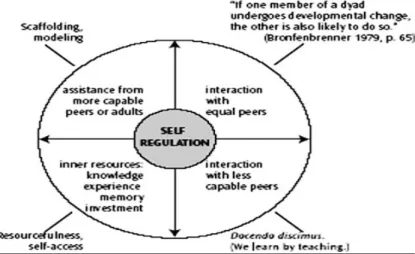
Another important characteristic that has been added to the theory of the ZPD is related to the relationship of the teacher, who offers his/her support, and the learner, who takes over this support. The relationship between an adult and the child or a teacher and the student is the most common one. Donato (1994), among other scholars, spoke of knowledge that is ‘co-constructed’ and he researched over the assistance offered from student to student, i.e. scaffolding between peers, which he called ‘collective scaffolding’. However, in addition to these two cases of scaffolding, van Lier (1996) added two more, first the case where a student takes the role of scaffolding another weaker student and second the case in which a student assists
himself/herself by drawing from the knowledge already taken from the teacher or other contents. Figure 1 represents the four cases of scaffolding underneath:
Figure 1 Expanded ZPD (cited in Walqui, 2006; van Lier, 2004)
Therefore, within his/her ZPD the student has got the opportunity to learn supported by his/her teacher, in collaboration with the classmates, by assisting another student with less understanding of the new material and, finally, on his/her own by using his/her background knowledge. The ultimate goal is for the student to learn and this is accomplished in all four cases.
2.3.5.2 Features and levels of scaffolding
Wood (1988: 96, cited in Walqui, 2006: 163) characterizes scaffolding as “tutorial behaviour that is contingent, collaborative and interactive”. Walqui (2006: 163) explains that contingent behaviour is the one that influences and is influenced by other actions, collaborative behaviour is when the result is co-constructed, and interactive behaviour is when two or more people work together for a common result. In continuation, she extends the macro and micro levels of scaffolding into “three related pedagogical ‘scales’” (Walqui, 2006: 164) under the following schema:
Scaffolding 1 Planned curriculum progression over time (e.g. a series of tasks over time, a project, a classroom ritual)
Scaffolding 2 The procedures used in particular activity (an instantiation of Scaffolding 1)
Scaffolding 3 The collaborative process of interaction (the process of achieving Scaffolding 2)
Walqui is slightly more analytical on the procedure of scaffolding which starts with the planning of a unit, moves on to the development of this planning in the classroom and ends with the unexpected part where the teacher grabs opportunities to scaffold on new material offered from the interaction with the students. What is interesting to notice is Walqui’s comment that, although the abovementioned procedure seems to require a top-to-bottom lining, a bottom – up scaffolding could also be proposed. The fact that students receive the teacher’s support and eventually evolve linguistically and cognitively and become more autonomous as learners may engender changes in the planned curriculum so as to be readjusted to the students’ abilities.
2.3.5.3 Scaffolding strategies: an approach to different taxonomies
There is an abounding number of scaffolding techniques that may be appropriate for second language learners. Teachers choose depending on the needs of their students, their linguistic abilities and the material they have to cover. Moreover, language researchers propose and analyze different strategies depending on the object of their study. For instance, Aida Walqui remarks that there are numerous ways to help students learn English either as a second language or in content subjects and she identifies six kinds of instructional scaffolding which she considers “especially salient” (2006: 170). These strategies are presented underneath3:
• Modelling • Bridging • Contextualization • Building schema • Re-presenting text • Developing metacognition. 3
Another set of scaffolding strategies useful for team-work are brainstorming, where a student takes notes of the ideas discussed over a topic, and floorstorming, where the teacher uses pictures, probably located on the floor, to raise a discussion over a topic. These techniques are considered ways of “negotiating field knowledge” (Jones, 2001: 78). The notion of negotiating field knowledge is very significant in language pedagogy because it contributes to the co-construction of knowledge between the teacher and his/her students for a better acquisition of a second language.
A taxonomy of scaffolding strategies devised at the Australian setting is the genre-based curriculum cycle (Hammond, 2001: 28) which includes:
• building the field (the teacher sets activities which focus on curriculum knowledge and relevant language)
• modelling (the teacher introduces a genre and guides students through demonstration)
• joint construction (the teacher co-constructs with the students through joint participation but at the same time starts withdrawing his/her support taking the role of the monitor)
• independent construction (the teacher withdraws support and the student works independently on the genre)
Finally, Sharpe (2001: 37) suggests for point-of-need scaffolding, appropriate for building on technical vocabulary mostly, the following techniques:
• repetition of students’ remarks
• recasting ( the teacher repeats the student’s remark modifying it in the appropriate form)
• appropriation (the teacher takes the idea behind the student’s remark and modifies it to be technically appropriate)
The scaffolding strategies that a teacher may use in the CLIL classroom are many and, as it was mentioned before, it depends on the instructed material and the students’ needs, level of knowledge and understanding which ones are suitable to apply.
Chapter 3: Data, Methodology & Qualitative Analysis
3.1 Data collection
The data of this study were obtained and selected from material originally collected by Dutch researchers (de Graaf et al, 2007) who conducted a research on CLIL classes of secondary education. For a comprehensive picture of the study there will be firstly a reference to the CLIL programme in the Netherlands, subsequently details will be provided about the Dutch research regarding the nature of data collection and the participants, and, finally, information related to the current study will follow.
3.1.1 CLIL in the Netherlands
The CLIL programme in the Netherlands was implemented in the Dutch educational system in 1989 and since then there has been an advance in the number of schools that participate in the programme (de Graaf et al, 2007: 605). According to the europeesplatform (European Platform) website4 which is responsible for internationalization in the Netherlands (Coleman, 2006: 36) and coordinates the Dutch bilingual education programming, in the school year 2008-2009 there were 101 schools registered in the CLIL stream while 49 have already been certified from the European Platform as qualified with the necessary standards for bilingual education.
Students may attend CLIL classes when they enter secondary education in a number of subjects (for instance History or Biology) but there is usually a turn to mother tongue instructed content courses as it is obligatory the final exams to be taken in Dutch (see de Graaf et al, 2007; Marsh et al, 2001). Great importance is also given to the training of the teachers who decide to become CLIL instructors. In their majority they are Dutch professors who attend training courses that might even last three to four years in language and didactics, called Classroom English, before they are allowed to enter the CLIL programme. In the language level they have to become proficient users of the English language and preferably be holders of a C2 level degree, according to the
4
Common European Framework of Reference for Languages5, which is required by most Dutch schools (Coleman, 2006: 36).
The fact that the CLIL programme has been running in the Netherlands for so many years and with such a great acceptance and participation from the schools somewhat proves its effectiveness. According to Dutch CLIL evaluating data, the learning results are hopeful and remove any misbelieves about the effects of CLIL (Huibregtse, 2001 cited in De Graaf et al., 2007). It appears therefore that for the Dutch curriculum the implementation of CLIL works well with emphasis on the good organisation of the programme and the high standards for the teachers.
3.1.2 The Dutch research
According to de Graaf et al. (2007: 603), the purpose of the Dutch research, from which the data of this study were extracted, was to identify “effective CLIL teaching performance facilitating [students’] language development and proficiency”. The original material was collected and videotaped by CLIL teacher trainees who observed nine CLIL lessons from the subjects of History, Geography, Maths, Biology, Arts and Crafts, and English.
3.1.2.1 The Dutch CLIL teachers
Nine CLIL secondary education teachers of different specialization participated in the Dutch research, more specifically three male teachers of History, one male teacher of Geography, one female teacher of Biology, one female teacher of Maths, one female teacher of Arts and Crafts, and two female teachers of English. Apart from one English teacher who was a native speaker, the other eight teachers’ mother tongue was the Dutch language. All of them had an almost five year teaching experience and a two year CLIL experience, and were holders of the Cambridge Proficiency certificate. Moreover, they all taught their subjects in the English language.
5
3.1.2.2 Schools and students
Three medium-sized schools that ran the CLIL programme for six years were chosen for the specific research. Of the 1200 students that each school hosted, almost 300 attended the CLIL classes. Students aged from 12 to 17 years old and ranged from the first until the fifth year of CLIL education.
3.1.3 Data of the current study
For the current paper twenty instances of scaffolding were chosen from a CD entitled “Identifying effective CLIL pedagogy for L2 learning, Utrecht University, IVLOS”. The CD, which contains videotaped moments of the abovementioned material and other relevant information concerning the Dutch research, was created in 2006 by the Dutch researchers De Graaf, R. and Koopman, G.J. and a copy of it is attached at the end of this paper. Each case of scaffolding is included in a video of short duration that shows either teacher instruction or oral interaction between teacher and student. The selected videos are fifteen in total and consist of the subjects of History (two male teachers), Geography (one male teacher), Biology (one female teacher) and English (one female teacher).
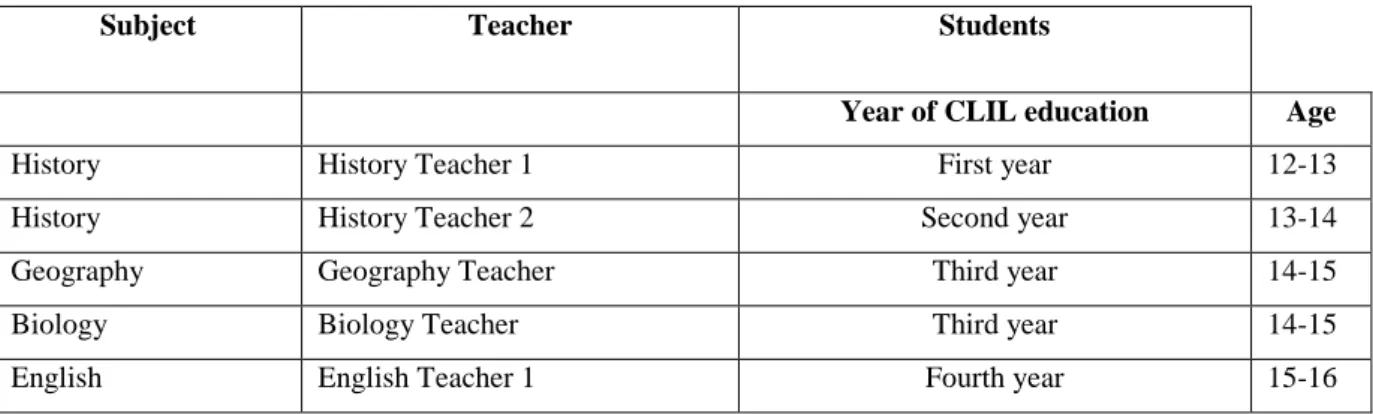
Table 1 underneath presents the profile of the subjects, teachers and students used specifically in this study:
Subject Teacher Students
Year of CLIL education Age
History History Teacher 1 First year 12-13
History History Teacher 2 Second year 13-14
Geography Geography Teacher Third year 14-15
Biology Biology Teacher Third year 14-15
English English Teacher 1 Fourth year 15-16
3.2 Methodology
3.2.1 Qualitative analysis of videotaped material
Being a relatively new pedagogical area in second language teaching and learning, CLIL classes attract researchers’ and teacher trainers’ interest, while CLIL teachers and students are very often subjected to study and analyses either of a quantitative research method, for instance questionnaires or tests, or a qualitative research method, i.e. interviews, videotaping, recordings and others. This study follows a qualitative analysis and uses as form of data videotaped material that was obtained from the abovementioned Dutch CLIL classes.
Classroom observation is a common type of method chosen from researchers who wish to carry out a qualitative research in the field of language acquisition (see Nunan, 1992: 91; Mackey and Gass, 2005: 175-176). The main reason for using videotaped material is that it can be kept inalterable and be reused as many times as the researcher wishes to see or hear it for the purposes of his/her analysis. Mackey and Gass (2005: 175) explain that “audio or visual recordings allow the researcher to analyze language use in greater depth later and involve outside researchers in the consideration of data”. The researcher can transcribe and answer to ‘how’ and ‘why’ questions related to language teaching and learning. This is also the reason why it was decided that videotaped material from a CLIL setting would be the most adequate material to analyze for the investigation and precise identification of scaffolding strategies used in these particular contexts.
3.2.2 Procedure and method of analysis
The original CD6 contains in total thirty-three short-duration videos of CLIL instruction which were all carefully observed. However, from the thirty-three videos, only fifteen were selected for a detailed turn-by-turn analysis, the reasons being the following:
6 Before the CD with the data was used for the current study, an approval was asked and taken for their
First of all, not all videos were suitable for the purposes of this study, i.e. they did not offer instances of scaffolding, but they showed and served other pedagogical contexts.
Secondly, the duration of some videos was so short that there was lack of basic contextual information and comprehension related to these videos, for example there was lack of what was said before the recorded material.
Thirdly, the analysis of more videos would go beyond the space limitations of this paper, so the most representative and characteristic cases of scaffolding were analyzed.
The fifteen selected videos were firstly observed and later on classified according to the discipline of the teacher. Therefore, five different sections were created each one for a different teacher. Afterwards, the fifteen videos were distributed to the corresponding disciplines and they were transcribed creating in turn a number of extracts for analysis. The discipline of each teacher, the corresponding videos and the extracts transcribed from each video are presented in detail in Table 2 for a complete picture of the analysis while the transcripts of the fifteen videos can be found in the Appendix.
Subject Disciplines Videos Extracts
History Teacher 1 Video 1_1T
Extracts 1 and 2 Video 1_4T
Extracts 3 and 4
Geography Teacher
Video 1_3A Extracts 5 and 6
Video 2_3A Extract 7 History Teacher 2 Video 1_4Wa Extract 8 Video 2_1Wa Extract 9 Video 2_1Wb Extract 10 Video 4_6Wa Extract 11 Video 4_6Wb Extracts 12, 13 and 14 Video 3_5Wa
Video 3_5Wb Video 2_3Wa Extract 15 Biology Teacher Video 2_4K Extracts 16, 17 and 18 English Teacher 1 Video 3_1Wi Extract 19 Video 5_4Wi Extract 20
Table 2 Disciplines, corresponding videos and extracts of the analysis
Following this, a discursive analysis was developed for each extract with a detailed description of the exchanges between teacher and students or of the teacher’s instruction. Apart from the description of the interactions, the discourse analysis also worked as an indicator of the non-verbal scaffolding techniques, for example gestures, facial expressions, intonation, etc., that were used by the teachers during instruction. At the end of each video analysis, observations on the findings followed. The purpose of the observations was the identification of the scaffolding instances that were found in each video separately and the interpretation of what was noticed, for example in what area of language acquisition the teacher has worked on, what he has accomplished or what the students have gained as learners.
After the data analysis was finished, five tables were presented and commented. These tables displayed the general picture of the scaffolding strategies that each teacher applied depending on the topic s/he was talking about. At this point it should be mentioned that, although this study does not analyze the data based on a specific framework or taxonomy, it intends to identify the general scaffolding techniques used by CLIL teachers. Nevertheless, there was major influence from two main frameworks proposed by scholars7, namely by Walqui (2006) and Mercer (1994).
Walqui (2006: 170-177) analyzes six main scaffolding strategies. These include:
• modelling (the teacher offers examples that students can imitate or clearly demonstrates what they have to do)
7 Scaffolding strategies are many and there is not a framework that teachers use exclusively, some of
• bridging (connecting new input with students’ previous knowledge, for example activating knowledge they already have from personal experience) • contextualizing (the teacher enhances learning with pictures, graphs, etc. or
verbally with metaphors or analogies to make the input more comprehensible) • schema building (the teacher helps students organize their thinking or
knowledge by creating schemas that are mutually connected)
• re-presenting text (students change a text into another written or visual form, for instance a story can be changed into a dialogue)
• developing metacognition ( students learn how to evaluate themselves and are taught strategies of thinking)
Another category of strategies taken under consideration in data analysis came from the list suggested by Mercer (1994: 99) which are the following:
• the teacher sets themes and elicits responses that draw students along a line of reasoning. Sharpe (2001: 41) explains that drawing students along a line of reasoning leads to a metastatement, a kind of summary of what has been said. • the teacher elicits responses through cues in the form of questions (for instance
“a term that starts with ‘a’…”)
• the teacher elaborates and redefines what the students should do in an activity • the teacher uses ‘we’ to show shared experience
As a summary, the resulting taxonomy used in this study is presented in Table 3:
Taxonomy of scaffolding strategies 1. Modelling 2. Bringing 3. Contextualizing 4. Schema building 5. Re-presenting 6. Developing metacognition
7. Elicitation of responses Drawing students along a line of reasoning Metastatement 8. Elicitation of responses through cues (in the form of questions)
9. Elaboration and redefining on an activity
10.Showing shared experience use of pronoun ‘we’
Table 3 Scaffolding strategies identified in the specific study (Gerakopoulou, 2011)
Keeping the aforementioned taxonomy in mind the author of this study moved to the analysis of the scaffolding strategies found in the fifteen selected videos. After the presentation of the five tables and their comments, a general discussion on the findings and a final table that included the most predominant scaffolding strategies were developed so as to present and report on the outcomes of this study in relation to its aims and research questions.
3.3 Qualitative data analysis
This subsection includes the analyses of the scaffolding techniques that the Dutch CLIL teachers have engendered in order to assist their English language students understand either the subject matter material or the linguistic material (i.e. vocabulary, grammar, etc) that might be difficult for them. For each teacher whose instruction has been chosen here to be analyzed, there will be, firstly, a detailed discourse analysis of the scaffolding techniques that s/he has used followed by a short discussion.
3.3.1 History Teacher 1 Video 1_1T:
In video 1_1T History Teacher 1 and his students talk about Stonehenge and the transferring of heavy material for its construction. The students have to choose between ‘sledges’, ‘timber cranes’ and ‘logs’. A student gives a possible answer, which is ‘log’, the teacher accepts it and then he elaborates explaining how logs were used. As can be seen in Extract 1, through the description of the procedure with logs the teacher intends to create an image to the students’ mind so as to comprehend the procedure better:
Extract 18
S: Yeah, log.
HT1: Yeah. (1) That is the theory I heard as well. (2) They used logs, boomstammen9, and they put all these logs next to each other and they put the stone on it and they roll and they put the log at the backside of the stone and put it in front and they roll.
The teacher in video 1_1T offers feedback and then goes further in order to scaffold and support his students’ learning. In (1) he involves himself agreeing on what the students have just read by saying “That is the theory I heard as well”, in order to enhance the meaning of what they are learning and make it more believable. With simple words he explains how the procedure with logs worked so that the heavy stones to be carried. What is actually worth commenting in exchange 2 is that the teacher, during the explanation of the procedure with the logs, uses his body, his voice and intense gestures so that students can have a visual picture of his description and better comprehension. The teacher uses his hands to show how the logs were put one next to the other and rapidly jumps from one place of the classroom to the other to explain how logs where transferred from the front to the back to continue the procedure. He also gives special emphasis to the verb ‘roll’ by pulling his voice each time he uses it. In that way he shows the motion that the verb ‘roll’ includes. Moreover, in (2) the teacher translates the word ‘log’ in the native language, boomstammen, so as for students not to be confused with misunderstanding in vocabulary.
In Extract 2 now the teacher continues his explanation and elaborates more into the students’ understanding.
Extract 2
HT1: Ok. So we’ve got three answers. We’ve got sledges, sledges, no (inaudible word), big sledges, we’ve got cranes. (3) Do you believe the cranes? And we’ve got the timber logs. (4) There was a teacher in England, did I tell you about that? And he was teaching his first class, he was talking about Stonehenge. (5) Who has been to Stonehenge? Here. And Stonehenge is in England. And they have these very very very big (pause) stones. Em, and they cannot find these stones in the place of
8 HT1=History Teacher 1 and S=Student 9