Scientific quarterly journal I S N N 1 4 2 9 - 7 2 6 4
Agricultural Engineering
2 0 1 4 : 4 ( 1 5 2 ) : 1 7 5 - 1 8 4 H o m e p a g e : http://ir.ptir.org
THE ACQUISITION AND PROCESSING DATABASE SYSTEM "ANIMAL HOUSING TECHNOLOGIES"
Paulina Mielcarek*, Wojciech Rzeźnik
Institute of Technology and Life Sciences in Falenty, Branch in Poznan
Contact details: ul. Biskupińska 67, 60-463 Poznań, e-mail: [email protected]
A R T I C L E I N F O A B S T R A C T
Article history: Received: August 2014 Received in the revised form: October 2014
Accepted: October 2014
Many initiatives have been taken to reduce the environmental impact of the livestock production for many years. Development and evalua-tion of innovative animal producevalua-tion technologies require detailed research based on the collected data. The database systems are used for this purpose. The aim of the study was to design and create the acquisition and processing database system "Animal Housing Tech-nologies". The system allows collection, processing, reporting and analysing the data on the livestock production technologies. It is a useful tool for comprehensive evaluation of the technical and tech-nological solutions in the animal production including the animal welfare, environmental protection and energy consumption criteria. It can be helpful in developing modern, innovative technologies of the animal housing, with the principles of sustainable development. Keywords:
database system animal housing technology animal welfare
sustainable agriculture
Introduction
In the recent decades development of livestock production is related to its progressing intensification and specialization. High concentration of production and a high degree of mechanization and automation of the production processes follows from intensification. It is related to housing of farm animals only in the livestock buildings and to a drop in the human labour demand. A specialization means production of one animal species on the industrial scale (Hartung, 2013). On one hand, intensification and concentration of the production ensures profitability but on the other hand it is related to a negative impact on the environment (Szymańska, 2006; Mroczek and Kostecka, 2008). Various types of initia-tives, which aim at limiting the environmental threats related to the animal production, have been taken for a long time. The Common Agricultural Policy (CAP) is one of them. As a part of it, minimal requirements of cross-compliance for farms have been developed. Adjusting Polish commodity and agricultural farms to the requirements of cross-compliance is related mainly to balancing of the production and improvement of techniques and technologies of animal housing, which results in the improvement of the production efficiency ensuring at the same time the animal welfare and the work ergonomics. It also allows limitation of the unfavourable impact on the environment (Wójcicki, 2007; Romani-uk et al., 2009). Development and assessment of innovative solutions for livestock
tion technologies, which meet the principles of the cross-compliance, require detailed re-search based on the collected data (Strzałkowski, 1999; Šařec et al., 2007). For this pur-pose, the distributed and one-stand IT systems are created. Their task is to collect, process and visualize data (Mueller et al., 2008; Mielcarek, 2013).
The objective of the paper was to design and develop the database acquisition and pro-cessing system "Animal Housing Technologies" which enables assessment of technologies taking into consideration the economic and environmental production aspect and the animal welfare.
The database system
The database system of data acquisition and processing "Animal Housing Technolo-gies" was designed and developed in the Institute of Technology of Life Sciences in Poznan with cooperation of the ZETO company in Katowice [Electronic Calculation Technique Company] as a part of the Multi-annual Programme for 2011-2015 "Standardization and monitoring of the environmental projects, agricultural technique and infra-structural solu-tions for safety and the sustainable development of agriculture and the rural areas", Meas-ure 4.2. "Standardization of livestock production mechanization, including the environmen-tal protection and animal welfare". The developed system enables collection, processing, reporting and analysis of the data on the livestock production technologies.
The system characteristics
The data acquisition and processing system "Animal Housing Technologies" is a rela-tional database developed in the server with the data management system SQL. The devel-oped software is a closed application, which uses the internal data record format. It allows stable system operation and limitation of the external unwanted access in the database. When designing a database application, a special attention was paid to the system simplici-ty and transparency while preserving functionalisimplici-ty.
A logical and physical structure may be separated from the system organization. The logical structure is related to the application functioning. The following modules comprise this area:
– the data collection module (entering and saving the inventory and measurement data), – the data processing module (presenting the collected data and their record in the
pro-cessed form),
– the data presentation (presenting the recorded and processed data in the form of previ-ously defined lists and reports).
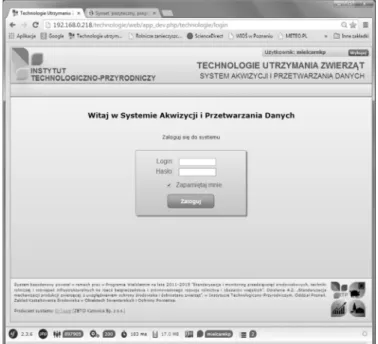
The physical structure is related to the system access. Connecting with the application takes place through the internet browser. All users have an easy access to the system at the same time from any location, maintaining at the same time the integrity and data safety. Due to the secret nature of some information, using the system is possible after previous certification and obtaining access to the private network, where the server is placed with the installed internet website of the application (fig. 1). The users were divided into groups with various entitlements. Each of them has its own login and a password.
Administrators are the first group of users. They may manage the system and para-metrize and configure the basic parameters of the program e.g.: vocabulary lists and indi-vidual data sets. The other group comprise employees, which have a possibility to intro-duce, up-date and preview of the data in the system. The third group consists of the agricultural producers who have access to the data on their business activity. The last group includes e.g. the selected employees of the administration and governmental institutions as well as the scientific institutions. The entitlements of this group allow them only to preview the reports generated in the system (Dokumentacja techniczna, 2013; Dokumentacja użytkownika, 2013).
The properties of the system
The developed database system has features which ensure its functionality, simplicity of use and correct operation. The management system used for the operation of the data base ensures optimal efficiency. Even, simultaneous use by many users does not result in signifi-cant slowing down and the decrease of efficiency and reliability of use. The system enables cooperation with the peripheral devices and other programmes, such as: Microsoft Excel (within transferring and presentation of reports), Adobe Acrobat (within data export).
The following, can be listed among the operated formats:
XML, TXT (a text file including data in the alphanumeric form), CSV (a text file, where values are separated with a comma) and DBF (a database file).
According to the assumptions, all reports generated in the system are displayed on the screen and printed at request. The system enables control of the data integrity. However, there is a possibility of saving incomplete data and their completion in later time. They are automatically verified on account of essential facts and completeness. The program alarms possible errors in the entered data and their incompleteness (Dokumentacja techniczna, 2013; Dokumentacja użytkownika, 2013).
The structure of data collection, processing and presentation
In the database system, six basic modules with the following functions have been de-veloped:
1. Users – adding new users and their objects and automatic generation of the users' list and the possibility of their edition.
2. Objects – automatic generation of the list of objects and the possibility of their edition. 3. Questionnaires – the list of questionnaires with the possibility of edition and generation
of new questionnaires, adding and edition of questions. 4. Reports – generation of defined reports.
5. Advanced – data export to files.
6. Assistance – instruction of the program operation.
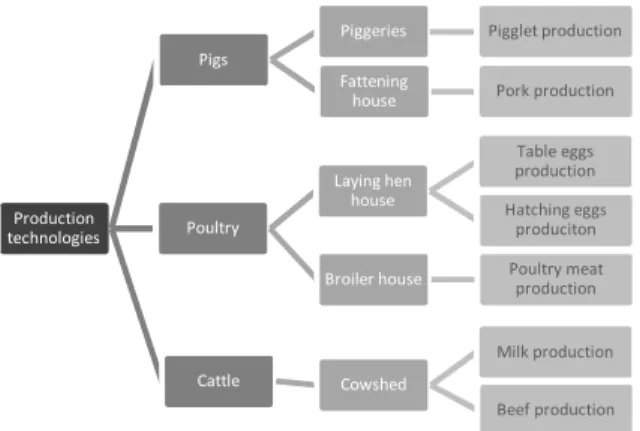
First three modules are used for entering and edition of data in the database system, mainly by users of the Employee type. Information, which constitutes the appropriate data-base, is assigned to the users of the Producer type. For each of them, the basic contact data are entered and the possessed Objects, the list of which is in the module Objects, are as-signed to them. Object is meant by a single livestock building, where the animal production is carried out. The building type and the kind of production (the so-called production tech-nology) is selected as a part of the Object. 5 types of buildings and 7 production technolo-gies for 3 farm animal species were distinguished (fig. 2). Additionally, data on the build-ings location and construction are entered.
Figure 2. Production technologies
Production technologies Poultry Laying hen house Table eggs production Hatching eggs produciton
Broiler house Poultry meat production Pigs
Piggeries Pigglet production
Fattening
house Pork production
Cattle Cowshed
Milk production Beef production
For each Object the Systems of: animal housing, ventilation, cooling, lighting, watering, feeding, manure removing, egg collection and milking, related to the production are selected (fig. 3).
Figure 3. Data collection modules
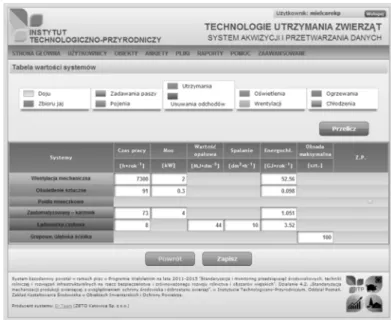
In relation to the Systems selected for the specific Object values to the particular proper-ties (represented by attributes) are assigned to them: work time, power and the calorific value. Energy consumption is calculated on this basis (fig.4).
Figure 4. Table of Systems values
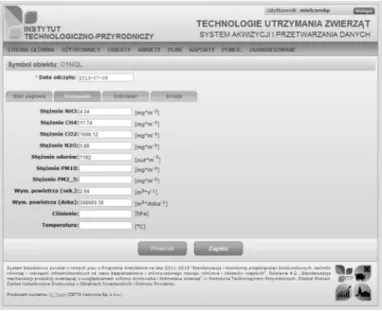
The Objects also have properties, values of which result from the Measurements which were carried out in the buildings. The Measurements are marked with a specific moment of time and concern the livestock number, environment and animal welfare. As a part of the research such values as the following are measured: gas pollution concentration, dust pollu-tion concentrapollu-tion and odours concentrapollu-tion as well as air exchange and velocity of air
Users
Producer Object
Systems
Measurements
movement, temperature and relative humidity of air and lighting intensity and the level of noise (fig. 5). Based on the collected measurement data and available methodologies, val-ues of the total gas and dust pollution emission and the momentary odours emission are calculated. In order to compare the objects within the impact on the environment, the emis-sion factors of these pollutions expressed per 1 animal and 1 kilo of animal body mass are determined (PN-EN 13725:2007; PN-EN 12599:2013-04E; Karłowski et al., 2008; Jugowar and Piotrkowski, 2012).
Figure 5. Form for measurement results
The animal welfare is assessed based on the questionnaire developed individually for each of the distinguished production technologies. For each Object any number of ques-tionnaires may be generated. Quesques-tionnaires similarly to the Measurements are atrributed to given date. Four categories of questions: animals housing, building equipment and techno-logical systems, micro-climate and animal health safety and hygiene, can be distinguished. Edition of the questionnaires which have been entered to the system in the module Ques-tionnaires, as well as from the module level Objects is possible. Additionally, the module
Questionnaires gives an opportunity to correct particular questions and to add new ques-tions within the above-mentioned four categories. The system informs the user on the in-complete questionnaire and does not include it in the generated reports.
The processed data are presented in the module Reports, where the synthetic and de-tailed result reports are generated. 8 reports were defined in the system:
1. Welfare – histogram - a group list of results of the welfare assessment questionnaires within the selected production technology, divided into four categories of the question-naire questions; graphical presentation of the distribution of the questionquestion-naire results in the form of a histogram.
2. Energy consumption – histogram – a group list of energy consumption in the selected production technology; a graphical presentation in the form of a histogram.
3. Annual emissions – the list of the annual gas, dust pollution emission and a momentary odour emission for particular Objects.
4. Emission factors (animal) – the list of mean values of emission factors per 1 animal for the particular Objects.
5. Emission factors (kilo) – the list of mean values of emission factors per 1 kilo of animal body mass for the particular Objects.
6. Welfare – the list of results of the questionnaires expressed with percentages for the particular Objects.
7. Energy consumption the list of the data on energy consumption of production divided into the Systems for the particular Objects.
8. A general report – a synthetic list of the energy consumption results, animal welfare assessment and average emission factors for the particular Objects.
Figure 6. Fragment of an individual report
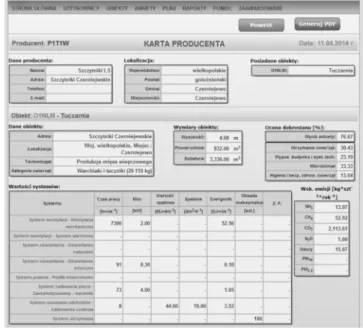
Reports may be filtrated with regard to the production technology, voivodeship and province. Whereas the data included therein may be sorted with regard to the selected pa-rameter. Moreover, the module includes individual reports. They include results of the animal welfare assessment, energy consumption and environmental assessment of the Ob-ject compared to others within a specific production technology (fig.6). Information on the agricultural producers and the Objects, which they possess, are presented in the so-called producer report. It contains the synthetic data and is generated in the module Users (fig.7).
Figure 7. Producer Report
The module Advanced enables data export to the files, which contain information on the
Systems, Measurements and Questionnaires. The measurement and questionnaires results may be filtrated by entering the searched phrase in the field above the column or by click-ing its name. Under the lists there is information on the number of all found positions shown on the website and the number of all websites. The exported files may serve for a starting point for further analysis in the external tools. The module Assistance includes the User's Manual of the program and the detailed information on the system function, availa-ble for a particular user (Dokumentacja techniczna, 2013; Dokumentacja użytkownika, 2013).
Conclusion
The knowledge obtained from collection and data analysis by a system may be helpful at developing new, innovative animal housing technologies maintaining the sustainable development principles. In the future it is planned to complement the system with addition-al modules, which addition-allow a complete assessment of the livestock production impact on the environment, taking into consideration transport, production of feed components and man-agement of natural fertilizers. Development of a methodology, which would allow a total assessment of the animal housing technology is also assumed. It would include three frac-tional assessments in the following areas: animal welfare, environment and energy con-sumption.
References
Dokumentacja techniczna. (2013). Technologie Utrzymania Zwierząt. System Akwizycji i Przetwarza-nia Danych. Wersja 1.0. ZETO, Katowice.
Dokumentacja użytkownika. (2013). Technologie Utrzymania Zwierząt. System Akwizycji i Przetwa-rzania Danych. Wersja 1.0. ZETO, Katowice.
Hartung, J. (2013). A short history of livestock production. [W]: Livestock housing. Modern man-agement to ensure optimal health and welfare of farm animals. Red. Aland A., Banhazi T. Wa-geningen Academic Publishers, the Netherlands, 21-34.
Jugowar, J.L.; Piotrkowski, M. (2012). Porównanie emisji odorów z kurników dla różnych systemów utrzymania ptaków. Journal of Research and Applications in Agricultural Engineering, 57(3), 182-185.
Karłowski, J.; Myczko, R.; Kołodziejczyk, T.; Kuczyński, T. (2008). Współczynniki emisji amoniaku i gazów cieplarnianych z obór z wentylacją mechaniczną. Problemy Inżynierii Rolniczej, 1, 151-158.
Mielcarek, P. (2013). Analiza dostępnych baz danych w kontekście monitoringu zanieczyszczeń powietrza z produkcji rolniczej. Inżynieria Rolnicza, 4(147), 223-236.
Mroczek, J.R.; Kostecka, J. (2008). Zagrożenia zrównoważonego rozwoju środowiska obszarów wiejskich spowodowane intensyfikacją produkcji zwierzęcej. Zeszyty Naukowe Południowo-Wschodniego Oddziału Polskiego Towarzystwa Inżynierii Ekologicznej z siedzibą w Rzeszowie i Polskiego Towarzystwa Gleboznawczego, 10, 94-100.
Mueller, W.; Joachimiak, H.; Weres, J. (2008). Systemy informatyczne sektora rolniczego bazujące na technologii .NET 2005 i SQL Server 2005. Journal of Research and Applications in Agricul-tural Engineering, 53(1), 32-34.
PN-EN 12599:2013-04E. Wentylacja budynków – Procedury badań i metody pomiarowe stosowane podczas odbioru instalacji wentylacji i klimatyzacji.
PN-EN 13725:2007. Jakość Powietrza. Oznaczanie stężenia zapachowego metodą olfaktometrii dynamicznej.
Romaniuk, W.; Domasiewicz, T.; Karbowy, A.; Wardal, W. J. (2009). Ograniczanie wpływu produk-cji zwierzęcej na środowisko. Inżynieria Rolnicza, 1(110), 233-242.
Šařec, O.; Šařec, P.; Dobek, T. (2007). Baza danych jako naukowe narzędzie wykorzystywane w technologiach produkcji roślinnej. Inżynieria Rolnicza, 2(90), 271-277.
Strzałkowski, K. (1999). Wizualizacja informacji zawartych w bazie danych gospodarstwa Rolne-go. Inżynieria Rolnicza, 1(7), 173-180.
Szymańska, E. (2006). Wpływ chowu trzody chlewnej na środowisko. Zeszyty Naukowe Akademii Rolniczej we Wrocławiu, 540, 531-536.
Wójcicki, Z. (2007). Rozwój rolnictwa zrównoważonego i precyzyjnego. Problemy Inżynierii Rolni-czej, 1, 5-12.
BAZODANOWY SYSTEM AKWIZYCJI I PRZETWARZANIA DANYCH „TECHNOLOGIE UTRZYMANIA ZWIERZĄT”
Streszczenie. Od lat podejmowane są inicjatywy mające na celu ograniczanie zagrożeń środowisko-wych związanych z produkcją zwierzęcą. Opracowanie i ocena innowacyjnych rozwiązań w zakresie technologii w produkcji zwierzęcej wymaga szczegółowych badań w oparciu o gromadzo-ne dagromadzo-ne. Stosowagromadzo-ne są do tego dedykowagromadzo-ne systemy informatyczgromadzo-ne. Celem pracy było zaprojektowa-nie i wykonazaprojektowa-nie bazodanowego systemu akwizycji i przetwarzania danych „Technologie Utrzymania Zwierząt” umożliwiającego ocenę technologii biorąc pod uwagę ekonomiczny i środowiskowy aspekt produkcji oraz dobrostan zwierząt. System umożliwia gromadzenie, przetwarzanie, raportowanie i analizę danych, dotyczących technologii produkcji zwierzęcej. Jest on praktycznym narzędziem do oceny rozwiązań technicznych i technologicznych produkcji zwierzęcej, uwzględniającej dobrostan zwierząt, ochronę środowiska oraz energochłonność produkcji. Wiedza ta może być pomocna przy opracowywaniu nowych, innowacyjnych technologii utrzymania zwierząt gospodarskich, z zachowa-niem zasad zrównoważonego rozwoju.
Słowa kluczowe: system bazodanowy, technologia utrzymania zwierząt, dobrostan, rolnictwo zrów-noważone