2351-9789 © 2015 The Authors. Published by Elsevier B.V. This is an open access article under the CC BY-NC-ND license (http://creativecommons.org/licenses/by-nc-nd/4.0/).
Peer-review under responsibility of AHFE Conference doi: 10.1016/j.promfg.2015.07.548
Procedia Manufacturing 3 ( 2015 ) 5155 – 5160
ScienceDirect
6th International Conference on Applied Human Factors and Ergonomics (AHFE 2015) and the
Affiliated Conferences, AHFE 2015
Visualizing Constraints and Awareness of Submarine
Maneuverability and Detectability
Jennifer Danczyk*, Paula Jacobs, Capt. Wayne Thornton,Stephanie Kane, Mike Farry
Charles River Analytics 625 Mount Auburn Street, Cambridge, MA
Abstract
Submariners must balance mission imperatives with own ship safety and operational security. A prime measure of safety is avoiding collisions with other contacts, including fishing and other commercial vessels—and especially other submarines and warships. A current problem for submariners is maintaining the submarine’s manueverability when factors change, including the density of surrounding contacts, sea state, and weather/visibility, which impose constraints on the submarine’s manueverability. These factors can also increase the submarine’s detectability if the situation requires longer or more frequent periscope views to maintain situation awareness. Having visualization tools that help submariners manage manueverability and detectability aids decision making by identifying recommended boundaries in the area of operation and recommended patterns of periscope operation. To provide the tools submariners need, we designed and developed several visual aids that identify recommended courses of action for various situations, which promotes greater awareness for future missions. These visual aids were formulated from a combination of Knowledge Elicitation (KE) sessions and cognitive task analysis with development of an abstraction hierarchy and a decision ladder. Our visual aids consist of mapping out a submariner’s area of operation by highlighting an optimized path the submariner can take when trying to avoid collisions. By having the ability to visualize these important factors and metrics that are involved in lowering a submarine’s detectability while still promoting safety helps increase a submariner’s awareness while also providing continuous improvement through risk management and mitigation for risky situations.
© 2015 The Authors.Published by Elsevier B.V. Peer-review under responsibility of AHFE Conference.
Keywords:visualization; situational awareness; maneuverability; contact management; detectability
* Jennifer Danczyk Tel.: +1-617-491-3474;
E-mail address:[email protected]
© 2015 The Authors. Published by Elsevier B.V. This is an open access article under the CC BY-NC-ND license (http://creativecommons.org/licenses/by-nc-nd/4.0/).
1. Introduction
Within the Navy, maintaining a strong perception of one’s environmental surroundings is an essential component that supports a submarine operator in balancing two main goals during a mission: 1) increasing safety by avoiding collision with surrounding contacts and 2) optimizing the submarine’s stealth by minimizing detectability to radar technologies. While avoiding collision and maintaining low detectability may seem very attainable for experienced submarine operators, it can be difficult to balance the outcomes of both of these goals when environmental factors are constantly changing. For example, a submarine may begin a mission predicting a specific sea-state which affects visibility, thus making it difficult for a submarine operator to accurately identify surrounding contacts. However, the sea-state level makes it easier for the submarine to remain undetected to neighboring contacts on water, ground and airspace. A change in sea-state can make it easier for one goal to be achieved over another and exemplifies how the two mission goals conflict each other, making these goals an operational challenge to overcome.
There have been prime examples of when submarine operators have failed to maintain high situational awareness. In a 2012 training exercise, the San Jacinto cruiser collided with the submarine Montpelier resulting in over 80 million dollars in damage[1]. While the exercise was intended to be basic, the Montpelier’s watch standers failed to detect a 180-degree turn by the San Jacinto thinking it was moving further away from the submarine rather than quickly approaching them. Reports claimed theMontpelierwas not following the standard submarine safety practices[1]. In 2001, there was another submarine collision due to lack of situational awareness that resulted in the sinking of a Japanese fishing vessel. The USS Greenville had set out giving a submarine tour to civilians and watch commanders were not fully aware of their surroundings given that the tour wasn’t an actual mission. They collided with a Japanese fishing vessel during the tour from not adequately performing contact analysis[2]. Out of 20 crewmembers, only 11 survived the sinking of the Japanese fishing vessel[2] not to mention the millions of dollars spent on resurrecting damages.
While there are differences between the two accidents mentioned above, both accidents failed to accurately track the actions of their surrounding contacts and lacked situational awareness. Collision accidents similar to that of the USS Montpelier and the USS Greenville may be prevented with better visualization tools that enable watch and sonar operators to quickly analyze unseen changes that occur in external situations during any event (i.e. unpredicted contact movement, sea-state status). In this paper, we present our process for the design of visualizations that enable submariners analyze their post-mission decisions regarding their course of actions (COAs) taken while optimizing their safety and detectability. We start by detailing our analysis approach for understanding and modeling a submariner’s domain. We then use this to explain our designs for the Commanding Officer’s Safe Operating Environment(COSOE), visual, radar, and overall detectability. Finally, the conclusion touches on the future challenges and transition points for the development of our designs.
2. Design Approach
Our method for creating visualization to enhance contact management and detectability analytics was fueled from our previous work in designing a post-mission reconstruction tool to help submariners account for and analyze their actions taken over the course of a mission. This tool was built using a Work Domain Analysis (WDA) of submarine operations during and after a mission. Knowledge obtained from approximately 400 hours of knowledge elicitation (KE) was used to construct functional models that included an Abstraction Hierarchy and a Decision Ladder[3]. These artifacts mapped out work ecologies associated with methods currently used to track detectability on a submarine. They also allowed us to view gaps within current operational processes that occur during a submarine mission and highlighted critical areas of scope to include in reconstructing a mission[3].
After presenting a prototype of our mission reconstruction tool through current and retired submarine commanders as well as with our Office of Naval Research (ONR) Sponsor, we were guided towards implementing advanced analytics to help submarine commanders reflect and support resilient planning for future mission tactics. To provide these metrics effectively,we designed visualizations that were suitable to current submarine operator demands to prevent any additional cognitive demands and increased learning curves[4]. This was done by another round of extensive KE sessions from our subject matter expert (SME) Captain Wayne Thornton and literature reviews on correlations between the different factors that affect detectability (i.e. sea-state, periscope exposure, radar
technologies, etc.). This information was eventually used in the design of visualizations supporting the Commanding Officer’s Safe Operating Environment (COSOE) and the initial creation of Visual, Radar, and Overall detectability measures.
3. Commanding Officer’s Safe Operating Environment (COSOE)
The Commanding Officer’s Safe Operation Environment (COSOE) is an analytic toolthat helps submarine operators troubleshoot future movement decisions when they are surrounded by multiple contacts during a mission. When there are contacts present in a submarine’s mission path, quick decisions are made to maneuver to certain areas to avoid collision ultimately affecting a submarine’s future acceptable area of maneuverability. We visualized this concept by providing a highlighted COSOE path on our geospatial map view and also provided metrics on a submarine’s predicted Closest Point of Approach (CPA) (shown inFigure 1) of surrounding contacts. The Closest Point of Approach is calculated using vectors in the x-y coordinates[5] taken from the geospatial view. During the mission, this information is recorded contact status is updated and recorded. Having this COSOE support increases the situational awareness by displaying an area limit that the submarine should stay within to prevent collision while not veering far off their planned mission path. Yellow vectors are added to contacts to give an indication of their direction and speed via the length and direction of the vectors.
Fig. 1.Geospatial map view showing the submarine in the blue dot. Surrounding contact are shown in green and yellow dots that signify their approximate distance to the submarine. The COSOE is shown by the translucent gray triangle. The Moveable Range within COSOE is the orange
triangle recommending the submariner of an acceptable path to follow..
To supplement the COSOE analysis we wanted to provide further analytical reasoning to show the submariner where they can maneuver within the COSOE support. We added a Moveable Range within the COSOE visualization, shown by the orange triangle inFigure 1. This is used if the crew has made any decisions that lowered future maneuverability and helps crewmembers identify and analyze instances where they may have restricted their future movement. The Moveable Range within COSOE helps to identify tradeoffs that may have occurred during the mission (e.g. areas where the maneuverable range was restricted, but there was no other choice due to erratic behavior from contacts). Since these contact management elements are shown in the mission reconstruction tool, it enables a crew to improve their situational awareness performance for future missions rather than relying solely on remembering the outcomes from decisions made in past missions.
4. Visualizing Detectability
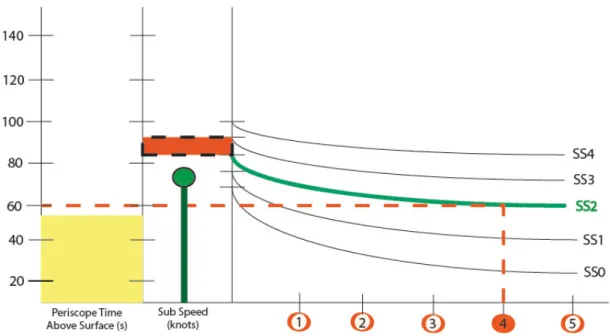
There are several factors (i.e. amount of wake, sea-state, and closeness of contacts) that affect how detectable a submarine is. Having a lowered detectability compromises the submarine’s stealth to contacts that may be hostile threats in a high-risk mission. In our previous work we focused on visualizing areas where the periscope may be at a higher vulnerability and more likely detected by neighboring ships’ radar technologies. These areas identified the ship’s speed (which correlates to the amount of wake generated from the submarine), change of thermal temperature of the periscope, times when the periscope remained above sea surface too long, and fog or visibility information throughout the mission [3]. Our current work has been on incorporating these detectability factors into a representation that coherently measures the crewmembers visual detectability performance. Figure 2shows our design of an ecological interface that tracks the submarine speed and periscope time above sea surface with regards to the estimated sea-state. Previous literature states that different sea-states can be represented on a set of logarithmic scales[6]. An operator selects a preferred periscope height on the horizontal axis. The periscope height corresponds to the given sea-state and gives a recommendation to the appropriate submarine speed and periscope exposure time. A speed barrier is also shown that tracks the submarine speed while the periscope is above surface. This tool allows submariner to pinpoint areas where they may have lacked on their detectability performance and it also helps them validate any actions that may have been taken that compromised their detectability during the mission.
Fig. 2.The Visual Detectability tracker maps the chosen periscope height with the mission sea-state and tracks the periscope exposure time and submarine speed over the mission.
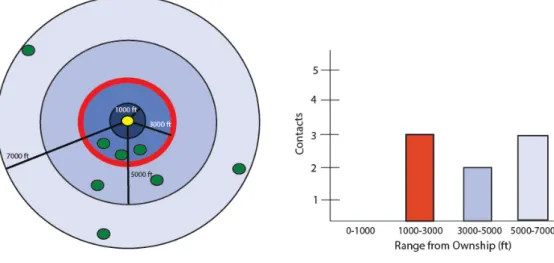
Estimating radar and IR detectability is difficult, especially with how quickly new technologies are developed and implemented in not only ships but also contacts that occupy the ground and airspace. Current technologies have the ability to pick up signals from as far as 20 miles away[7]. Since many radar and IR technologies really heavily on distance, we have created a visualization that assesses the amount of contacts in acceptable radar ranges throughout the entire mission. This visualization (Figure 3, left) is based on the theory that the closer contacts are to the submarine the more likely they are detected by radar technologies. The bulls-eye visualization displays the number of contacts within different distance thresholds and color is used to distinguish the severity of the distance.A
red outline appears around a range in the bulls-eye when radar and IR detectability is highly compromised (i.e. a sudden increase of close contacts). The number of contacts in each threshold is displayed in the chart on the right enabling a submarine operator to quickly distinguish times during the mission where they lacked in radar detectability performance. The color of the bars also correspond to the range colors in the bulls-eye and also turn red when the red outline appears on the bulls-eye. The radar detectability visualization can also be tied into our past work with contact management and future work will be done to enhance the analytics provided between radar and neighboring contacts.
Fig. 3.Radar Detectability tracker that shows a bull-eye view of contacts within radar threshold distances (left) and shows a bar chart representation of the number of contacts in each of these thresholds (right).
We have also started to design a way to combine visual and radar detectability into a single quantitative performance measure that signifies how well submariners executed on their detectability performance. This metric may have the ability to be included within our reporting feature which is also located within the reconstruction tool. This overalldetectability metric (Figure 4) design attempts to separate the two elements of detectability (i.e. visual and radar) into simplified metrics that correlate with our past work on contact management and detectability. The Visual element tracks the number of times the periscope was up too long and information is pulled from the Visual Detectability Chart (Figure 2). The Radar element lists the average number of contacts within 5000 yards during the mission and is calculated from Radar and IR Detectability Chart (Figure 3). In future work, we will continue iterating on these initial designs to validate and create additional metrics that may be suitable and helpful for submarine operators to review and advance their decision making in emerging submarine missions.
Fig. 4.Overall Detectability tracker that displays a submarine operator’s detectability performance over the mission in regards to both visual and radar detectability components.
5. Future Work and Conclusions
While the ability to provide post-mission analytics with regards to contact management and detectability revolutionary in concept, there is still a large amount of work to be done for the development of visualizations. Future work will include extensive iteration on our current designs before we implement them into our reconstruction tool. The iterations will be focused on providing additional analytics that are relevant to user needs. The design of the current visualizations will also be iterated to ensure usability and relevance to other elements in our current reconstruction tool. For example, we are currently integrating text based help messages through rule chaining methods that give some indication of why certain issues occurred during the mission. This may provide an easier and faster post-mission analysis for submarine commanders.After developing our designs into our software we will conduct user testing with current submarine operators to validate the usability and relevance of these visualizations along with the rest of our reconstruction tool components.
With this further development and input added from operational users, we believe that the use of visualizing essential submarine mission metrics can add resilience to future submarine missions in several ways.By visualizing relevant mission data, submarine operators can use post-mission reconstruction as a tool to help them recognize and remember specific situations, actions taken, and outcomes that occurred from their actions. This additional analysis may not only prevent collision catastrophes like the USS Greenville and USS Montpelier from occurring,but may have the ability to improve the quality and accuracy of judgements made in a constantly changing environment by influencing submarine commander and operator’s future decisions with past mission data.
References
[1] C. Reilly, Norfolk Virginia-Pilot.Undersea Warfare News. 17 June 2014. [2] Marine Accident Brief, National Transportation Safety Board, 1 May 2001.
[3] J. Danczyk, P. Jacobs, S. Kane, M. Farry, and W. Thornton, Combining Human Knowledge and Operational Data to Promote Detailed and Effective Reporting, CogSIMA, 2015.
[4] D. Woods and E. Patterson, How Unexpected Events Produce an Escalation of Cognitive and Coordinative Demands, Lawrence Erlbaum, 2001.
[5] D. Sunday, Distance between 3D Lines & Segments, Segments and their CPA, 2012.
[6] J. Ousborne, D. Griffith, and R. Yuan, A Periscope Detection Radar, Johns Hopkins APL Technical Digest, 18.1, 1997.
[7] J. Smith, and R. Logan, AN/APS-116 Periscope-Detecting Radar, IEEE Transactions On Aerospace and Electronic Systems, AES-16.1, January 1980.