Network Analysis in the Social Sciences
Stephen P. Borgatti, Ajay Mehra, Daniel J. Brass, Giuseppe Labianca
Over the past decade, there has been an explosion of interest in network research across the physical and social sciences. For social scientists, the theory of networks has been a gold mine, yielding explanations for social phenomena in a wide variety of disciplines from psychology to economics. Here, we review the kinds of things that social scientists have tried to explain using social network analysis and provide a nutshell description of the basic assumptions, goals, and explanatory mechanisms prevalent in the field. We hope to contribute to a dialogue among researchers from across the physical and social sciences who share a common interest in understanding the antecedents and consequences of network phenomena.
O
ne of the most potent ideas in the social sciences is the notion that individuals are embedded in thick webs of social rela-tions and interacrela-tions. Social network theory provides an answer to a question that has pre-occupied social philosophy since the time of Plato, namely, the problem of social order: how autonomous individuals can combine to create enduring, functioning societies. Network theory also provides explanations for a myriad of social phenomena, from individual creativity to corpo-rate profitability. Network research is“hot”today, with the number of articles in the Web of Science on the topic of“social networks”nearly tripling in the past decade. Readers ofScienceare already familiar with network research in physics and biology (1), but may be less familiar with what has been done in the social sciences (2). HistoryIn the fall of 1932, there was an epidemic of runaways at the Hudson School for Girls in up-state New York. In a period of just 2 weeks, 14 girls had run away—a rate 30 times higher than the norm. Jacob Moreno, a psychiatrist, suggested the reason for the spate of runaways had less to do with individual factors pertaining to the girls’ personalities and motivations than with the po-sitions of the runaways in an underlying social network (3). Moreno and his collaborator, Helen Jennings, had mapped the social network at Hudson using“sociometry,”a technique for eliciting and graphically representing individuals’ subjective feelings toward one another (Fig. 1). The links in this social network, Moreno argued, provided channels for the flow of social influence and ideas among the girls. In a way that even the girls them-selves may not have been conscious of, it was their location in the social network that determined whether and when they ran away.
Moreno envisioned sociometry as a kind of physics, complete with its own“social atoms” and its laws of“social gravitation”(3). The idea
of modeling the social sciences after the physical ones was not, of course, Moreno’s invention. A hundred years before Moreno, the social philos-opher Comte hoped to found a new field of “social physics.” Fifty years after Comte, the French sociologist Durkheim had argued that human societies were like biological systems in that they were made up of interrelated compo-nents. As such, the reasons for social regularities were to be found not in the intentions of individ-uals but in the structure of the social environ-ments in which they were embedded (4). Moreno’s sociometry provided a way of making this abstract social structure tangible.
In the 1940s and 1950s, work in social net-works advanced along several fronts. One front was the use of matrix algebra and graph theory to formalize fundamental social-psychological con-cepts such as groups and social circles in network
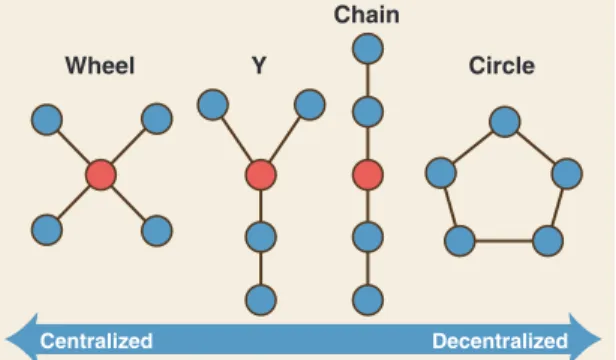
terms, making it possible to objectively discover emergent groups in network data (5). Another front was the development of a program of lab-oratory experimentation on networks. Researchers at the Group Networks Laboratory at the Massa-chusetts Institute of Technology (MIT) began studying the effects of different communication network structures on the speed and accuracy with which a group could solve problems (Fig. 2). The more centralized structures, such as the star structure, outperformed decentralized struc-tures, such as the circle, even though it could be shown mathematically that the circle structure had, in principle, the shortest minimum solution time (6). Why the discrepancy? Achieving the mathematically optimal solution would have required the nodes to execute a fairly complex sequence of information trades in which no single node served as integrator of the information. But the tendency in human networks seemed to be for the more peripheral members of a network (i.e., the nodes colored blue in the“Star,” “Y,”and“Chain” net-works in Fig. 2) to channel infor-mation to the most central node (i.e., the nodes colored red in Fig. 2), who then decided what the correct answer was and sent this answer back out to the other nodes. The fastest performing network struc-tures were those in which the dis-tance of all nodes from the obvious integrator was the shortest (7).
The work done by Bavelas and his colleagues at MIT captured the imagination of researchers in a num-ber of fields, including psychology, political science, and economics. In the 1950s, Kochen, a mathematician, and de Sola Pool, a political scien-tist, wrote a highly circulated paper, eventually published in 1978 (8), which tackled what is known today as the“small world”problem: If two persons are selected at random from a population, what are the chances that they would know each other, and, more generally, how long a chain of acquaint-anceship would be required to link them? On the basis of mathematical models, they speculated that in a population like the United States, at least 50% of pairs could be linked by chains with no more than two intermediaries. Twenty years later, Stanley Milgram tested their propositions empir-ically, leading to the now popular notion of“six degrees of separation”(9).
During this period, network analysis was also used by sociologists interested in studying the changing social fabric of cities. The common con-viction at the time was that urbanization destroyed community, and that cities played a central role in this drama. These sociologists saw concrete rela-tions between people—love, hate, support, and so
REVIEW
LINKS Center for Network Research in Business, Gatton College of Business and Economics, University of Kentucky, Lexington, KY 40506–0034, USA. E-mail: [email protected] (S.P.B.), [email protected] (A.M.), [email protected] (D.J.B.), and [email protected] (G.L.) SN SR C12 C5 C10 C3 LW JN HL ZR HL HIL HC FL RT HN DD LS LC
Fig. 1.Moreno’s network of runaways. The four largest circles (C12, C10, C5, C3) represent cottages in which the girls lived. Each of the circles within the cottages represents an individual girl. The 14 runaways are identified by initials (e.g., SR). All nondirected lines between a pair of individuals represent feelings of mutual attraction. Directed lines represent one-way feelings of attraction.
on—as the basic stuff of community, and they used network analysis to represent community structure. For example, researchers interviewed 1050 adults living in 50 northern Californian communities with varying degrees of urbanism about their social relations (10). The basic pro-cedure for eliciting network data was to get re-spondents (egos) to identify people (alters) with whom they had various kinds of relationships and then to also ask ego about the relationships between some or all of the alters. They found that urbanism did in fact reduce network density, which, in turn, was negatively related to psycho-logical measures of satisfaction and overall well-being. A similar study of 369 boys and 366 girls between the ages of 13 and 19 in a Midwestern town of about 10,000 residents found that the adolescents’behaviors were strongly influenced by the “cliques” to which they belonged (11). The representation and analysis of community network structure remains at the forefront of net-work research in the social sciences today, with growing interest in unraveling the structure of computer-supported virtual communities that have proliferated in recent years (12).
By the 1960s, the network per-spective was thriving in anthropol-ogy. Influenced by the pioneering work of Radcliffe Brown (13), there were three main lines of inquiry. First, at the conceptual level, an-thropologists like S. F. Nadel began to see societies not as monolithic entities but rather as a“pattern or network (or‘system’) of relation-ships obtaining between actors in their capacity of playing roles rel-ative to one another”(14). Second, building on the insights of the an-thropologist Levi-Strauss, scholars began to represent kinship systems as relational algebras that consisted
of a small set of generating relations (such as “parent of”and“married to”) together with binary composition operations to construct derived re-lations such as“in-law”and“cousin.”It was soon discovered that the kinship systems of such peoples as the Arunda of Australia formed elegant math-ematical structures that gave hope to the idea that deep lawlike regularities might underlie the ap-parent chaos of human social systems (15,16).
Third, a number of social anthropologists began to use network-based explanations to account for a range of outcomes. For example, a classic eth-nographic study by Bott (17) examined 20 urban British families and attempted to explain the con-siderable variation in the way husbands and wives performed their family roles. In some families, there was a strict division of labor: Husband and wife carried out distinct household tasks sepa-rately and independently. In other families, the husband and wife shared many of the same tasks and interacted as equals. Bott found that the degree of segregation in the role-relationship of husband and wife varies directly with the
con-nectedness (or density) of the family’s social network. The more connected the network, the more likely the couple would maintain a tradi-tional segregation of husband and wife roles, showing that the structure of the larger network can affect relations and behaviors within the dyad. In the 1970s, the center of gravity of network research shifted to sociology. Lorrain and White (18) sought ways of building reduced models of the complex algebras created when all possible compositions of a set of relations were constructed (e.g., the spouse of the parent of the parent of…). By collapsing together nodes that were structurally equivalent—i.e., those that had similar incoming and outgoing ties—they could form a new network (a reduced model) in which the nodes consisted of structural positions rather than individuals. This idea mapped well with the anthropologists’ view of social structure as a network of roles rather than individuals, and was broadly applica-ble to the analysis of roles in other settings, such as the structure of the U.S. economy (19).It was also noted that structurally equivalent individuals faced similar social environments and therefore
could be expected to develop similar responses, such as similar attitudes or behaviors (20).
Another key contribution was the influential strength of weak ties (SWT) theory developed by Granovetter (21). Granovetter argued that strong ties tend to be“clumpy”in the sense that one’s close contacts tend to know each other. As a result, some of the information they pass along is redundant—what a person hears from contact A is the same as what the person heard from B. In contrast, weak ties (e.g., mere acquaintances) can easily be unconnected to the rest of one’s net-work, and therefore more likely to be sources of novel information. Twenty years later, this work has developed into a general theory of social capital—the idea that whom a person is connected to, and how these contacts are connected to each other, enable people to access resources that ulti-mately lead them to such things as better jobs and faster promotions (22).
By the 1980s, social network analysis had become an established field within the social sciences, with a professional organization (INSNA,
International Network for Social Network Analysis), an annual conference (Sunbelt), specialized soft-ware (e.g., UCINET), and its own journal (Social
Networks). In the 1990s, network analysis radiated into a great number of fields, including physics and biology. It also made its way into several applied fields such as management consulting (23), public health (24), and crime/war fighting (25). In management consulting, network analysis is often applied in the context of knowledge manage-ment, where the objective is to help organizations better exploit the knowledge and capabilities dis-tributed across its members. In public health, net-work approaches have been important both in stopping the spread of infectious diseases and in providing better health care and social support.
Of all the applied fields, national security is probably the area that has most embraced social network analysis. Crime-fighters, particularly those fighting organized crime, have used a network perspective for many years, covering walls with huge maps showing links between“persons of interest.”This network approach is often credited with contributing to the capture of Saddam Hussein. In addition, terrorist groups are widely seen as networks rather than organizations, fueling research on how to disrupt functioning networks (26). At the same time, it is often asserted that it takes a network to fight a network, sparking military experiments with decentralized units.
Social Network Theory
Perhaps the oldest criticism of social network research is that the field lacks a (native) theo-retical understanding—it is“merely descriptive” or“just methodology.”On the contrary, there is so much of it that one of the main purposes of this article is to organize and simplify this burgeoning body of theory. We will give brief summaries of the salient points, using comparisons with the network approach used in the physical sciences (including biology).
Types of ties.In the physical sciences, it is not unusual to regard any dyadic phenomena as a network. In this usage, a network and a mathe-matical graph are synonymous, and a common set of techniques is used to analyze all instances, from protein interactions to coauthorship to in-ternational trade. In contrast, social scientists typically distinguish among different kinds of dyadic links both analytically and theoretically. For example, the typology shown in Fig. 3 divides dyadic relations into four basic types—similarities, social relations, interactions, and flows. Much of social network research can be seen as working out how these different kinds of ties affect each other.
The importance of structure.As in the study of isomers in chemistry, a fundamental axiom of social network analysis is the concept that struc-ture matters. For example, teams with the same composition of member skills can perform very differently depending on the patterns of relation-ships among the members. Similarly, at the level of the individual node, a node’s outcomes and
Y Wheel
Chain
Circle
Centralized Decentralized
Fig. 2. Four network structures examined by Bavelas and colleagues at MIT. Each node represents a person; each line represents a potential channel for interpersonal communication. The most central node in each network is colored red.
www.sciencemag.org SCIENCE VOL 323 13 FEBRUARY 2009 893
REVIEW
future characteristics depend in part on its posi-tion in the network structure. Whereas tradiposi-tional social research explained an individual’s outcomes or characteristics as a function of other character-istics of the same individual (e.g., income as a function of education and gender), social network researchers look to the individual’s social environ-ment for explanations, whether through influence processes (e.g., individuals adopting their friends’ occupational choices) or leveraging processes (e.g., an individual can get certain things done because of the connections she has to powerful others). A key task of social network analysis has been to invent graph-theoretic properties that characterize structures, positions, and dyadic properties (such as the cohesion or connectedness of the structure) and the overall“shape”(i.e., distribution) of ties. At the node level of analysis, the most widely studied concept is centrality—a family of node-level properties relating to the structural impor-tance or prominence of a node in the network. For example, one type of centrality is Freeman’s betweenness, which captures the property of fre-quently lying along the shortest paths between pairs of nodes (27). This is often interpreted in terms of the potential power that an actor might wield due to the ability to slow down flows or to distort what is passed along in such a way as to serve the actor’s interests. For example, Padgett and Ansell (28) analyzed historical data on mar-riages and financial transactions of the powerful Medici family in 15th-century Florence. The study suggested that the Medici’s rise to power was a function of their position of high betweenness within the network, which allowed them to broker business deals and serve as a crucial hub for communication and political decision-making.
Research questions.In the physical sciences, a key research goal has been formulating univer-sal characteristics of nonrandom networks, such as the property of having a scale-free degree distri-bution. In the social sciences, however, researchers have tended to emphasize variation in structure across different groups or contexts, using these variations to explain differences in outcomes. For example, Granovetter argued that when the city of Boston sought to absorb two neighboring towns, the reason that one of the towns was able to successfully resist was that its more diffuse network structure was more conducive to collective action (21).
A research goal that the social and physical sciences have shared has been to explain the
formation of network ties and, more generally, to predict a host of network properties, such as the clusteredness of networks or the distributions of node centrality. In the social sciences, most work of this type has been conducted at the dyadic level to examine such questions as: What is the basis of friendship ties? How do firms pick alli-ance partners? A host of explanations have been proposed in different settings, but we find they can usefully be grouped into two basic categories: opportunity-based antecedents (the likelihood that two nodes will come into contact) and benefit-based antecedents (some kind of utility maximi-zation or discomfort minimimaximi-zation that leads to tie formation).
Although there are many studies of network antecedents, the primary focus of network research in the social sciences has been on the consequences of networks. Perhaps the most fundamental axiom in social network research is that a node’s position in a network determines in part the opportunities and constraints that it encounters, and in this way plays an important role in a node’s outcomes. This is the network thinking behind the popular con-cept of social capital, which in one formulation posits that the rate of return on an actor’s invest-ment in their human capital (i.e., their knowledge, skills, and abilities) is determined by their social capital (i.e., their network location) (29).
Unlike the physical sciences, a multitude of node outcomes have been studied as
conse-quences of social network variables. Broadly speaking, these outcomes fall into two main cat-egories: homogeneity and performance. Node homogeneity refers to the similarity of actors with respect to behaviors or internal structures. For example, if the actors are firms, one area of research tries to predict which firms adopt the same organizational governance structures (30); similarly, where the nodes are individuals, a key
research area has been the pre-diction of similarity in time-to-adoption of an innovation for pairs of actors (31). Performance refers to a node’s outcomes with respect to some good. For exam-ple, researchers have found that firm centrality predicts the firm’s ability to innovate, as measured by number of patents secured (32), as well as to perform well finan-cially (33). Other research has linked individual centrality with power and influence (34).
Theoretical mechanisms. Perhaps the most common mechanism for explaining conse-quences of social network variables is some form of direct transmission from node to node. Whether this is a physical transfer, as in the case of mate-rial resources such as money (35), or a mimetic (imitative) process, such as the contagion of ideas, the underlying idea is that something flows along a network path from one node to the other.
The adaptation mechanism states that nodes become homogeneous as a result of experiencing and adapting to similar social environments. Much like explanations of convergent forms in biology, if two nodes have ties to the same (or equivalent) others, they face the same environ-mental forces and are likely to adapt by becoming increasingly similar. For example, two highly central nodes in an advice network could develop similar distaste for the telephone and e-mail, because both receive so many requests for help through these media. Unlike the case of trans-mission, the state of“distaste for communication media” is not transmitted from one node to another, but rather is similarly created in each node because of their similar relations to others.
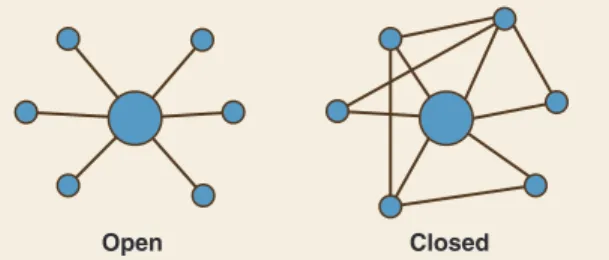
The binding mechanism is similar to the old concept of covalent bonding in chemistry. The idea is that social ties can bind nodes together in such a way as to construct a new entity whose properties can be different from those of its constituent elements. Binding is one of the mechanisms behind the popular notion of the performance benefits of“ structur-al holes”(Fig. 4). Given an ego-network (the set of nodes with direct ties to a focal node, called“ego,” together with the set of ties among members of the ego network), a structural hole is the absence of a tie among a pair of nodes in the ego network (22). A well-established proposition in social network analysis is that egos with lots of structural holes are better per-formers in certain competitive settings (19). The lack of structural holes around a node means that the node’s contacts are“bound”together—they can communicate and coordinate so as to act as one, creating a formidable“other”to negotiate with. This is the basic principle behind the ben-efits of worker’s unions and political alliances. In
Similarities Location e.g., Same spatial and temporal space e.g., Same clubs Same events etc. e.g., Same gender Same attitude etc. Membership Interactions e.g., Sex with Talked to Advice to Helped Harmed etc. Flows e.g., Information Beliefs Personnel Resources etc. Attribute Social Relations Kinship e.g., Mother of Sibling of e.g., Friend of Boss of Student of Competitor of e.g., Likes Hates etc.
Other role Affective
e.g., Knows Knows about Sees as happy etc. Cognitive
Fig. 3.A typology of ties studied in social network analysis.
Open Closed
Fig. 4. Two illustrative ego networks. The one on the left contains many structural holes; the one on the right contains few.
contrast, a node with many structural holes can play unconnected nodes against each other, divid-ing and conquerdivid-ing.
The exclusion mechanism refers to com-petitive situations in which one node, by forming a relation with another, excludes a third node. To illustrate, consider a“chain”network (Fig. 5) in which nodes are allowed to make pairwise“deals” with those they are directly connected to. Node d can make a deal with either node c or node e, but not both nodes. Thus, node d can exclude node c by making a deal with node e. A set of exper-iments (36) showed that nodes b and d have high bargaining power, whereas nodes a, c, and e have low power. Of special interest is the situation of node c, which is more central than, and has as many trading partners as, nodes b and d. How-ever, nodes b and d are stronger because each have partners (nodes a and e) that are in weak positions (no alternative bargaining partners).
Having only strong nodes to bargain with makes node c weak. In this way, a node’s power be-comes a function of the powers of all other nodes in the network, and results in a situation in which a node’s power can be affected by changes in the network far away from the node. An example of the exclusion mechanism occurs in business-to-business supply chains. When a firm intentionally locks up a supplier to an exclusive contract, competitor firms are excluded from accessing that supplier, leaving them vulnerable in the marketplace.
In quantum physics, the Heisenberg uncer-tainty principle describes the effects of an observer on the system being measured. A foreseeable chal-lenge for network research in the social sciences is that its theories can diffuse through a population, influencing the way people see themselves and how they act, a phenomenon that Giddens de-scribed as the double-hermeneutic (37). For exam-ple, there has been an explosion in the popularity of social networking sites, such as Facebook and Linkedin, which make one’s connections highly visible and salient. Many of these sites offer users detailed information about the structure and con-tent of their social networks, as well as suggestions for how to enhance their social networks. Will this enhanced awareness of social network theories alter the way in which people create, maintain, and leverage their social networks?
Final Observations
A curious thing about relations among physical and social scientists who study networks is that each camp tends to see the other as merely de-scriptive. To a physical scientist, network research in the social sciences is descriptive because mea-sures of network properties are often taken at face
value and not compared to expected values gen-erated by a theoretical model such as Erdos-Renyi random graphs. For their part, social scientists have reacted to this practice with considerable be-musement. To them, baseline models like simple random graphs seem naïve in the extreme—like comparing the structure of a skyscraper to a random distribution of the same quantities of materials.
More importantly, however, social and physi-cal scientists tend to have different goals. In the physical sciences, it has not been unusual for a research paper to have as its goal to demonstrate that a series of networks have a certain property (and that this property would be rare in random networks). For social scientists, the default expec-tation has been that different networks (and nodes within them) will have varying network proper-ties and that these variations account for differ-ences in outcomes for the networks (or nodes). Indeed, it is the relating of network differences to outcomes that they see as constituting theoretical versus descriptive work.
Social scientists have also been more concerned than the physical scientists with the individual node, whether an individual or a collec-tive such as a company, than with the network as a whole. This focus on node-level outcomes is probably driven to at least some extent by the fact that traditional social science theories have focused largely on the individual. To compete against more established social sci-ence theories, network researchers have had to show that network theory can better explain the same kinds of outcomes that have been the tra-ditional focus of the social sciences.
Some physicists argue that direct observation of who interacts with whom would be preferable to asking respondents about their social contacts, on the grounds that survey data are prone to error. Social scientists agree that survey data contain error, but do not regard an error-free measurement of who interacts with whom to be a substitute for, say, who trusts whom, as these are qualitatively different ties that can have different outcomes. In addition, social scientists would note that even when objective measures are available, it is often more useful for predicting behavior to measure a person’s perception of their world than to measure their actual world. Furthermore, the varying abil-ity of social actors to correctly perceive the net-work around them is an interesting variable in itself, with strong consequences for such outcomes as workplace performance (38).
It is apparent that the physical and social sciences are most comfortable at different points along the (related) continua of universalism to particularism, and simplicity to complexity. From a social scientist’s point of view, network research in the physical sciences can seem alarmingly sim-plistic and coarse-grained. And, no doubt, from a physical scientist’s point of view, network re-search in the social sciences must appear oddly mired in the minute and the particular, using tiny data sets and treating every context as different.
This is one of many areas where we can each take lessons from the other.
References and Notes
1. M. Newman, A. Barabasi, D. J. Watts, Eds.,The Structure and Dynamics of Networks(Princeton Univ. Press, Princeton, NJ, 2006).
2. For a thorough history of the field, see the definitive work by Freeman (39).
3. J. L. Moreno,Who Shall Survive?Nervous and Mental Disease Publishing Company, Washington, DC, 1934). 4. E. Durkheim,Suicide:A Study in Sociology
(Free Press, New York, 1951).
5. R. D. Luce, A. Perry,Psychometrika14, 95 (1949). 6. H. Leavitt,J. Abnorm. Soc. Psychol.46, 38 (1951). 7. Later experiments suggested that this result was
contingent on other factors. For example, several experiments showed that, as the complexity of puzzles increased, decentralized networks performed better (40). 8. I. de S. Pool, M. Kochen,Soc. Networks1, 1 (1978). 9. S. Milgram,Psychol. Today1, 60 (1967).
10. C. S. Fischer,To Dwell Among Friends(Univ. of Chicago Press, Chicago, IL, 1948)
11. C. E. Hollingshead,Elmtown’s Youth(Wiley, London, 1949). 12. B. Wellmanet al.,Annu. Rev. Sociol.22, 213 (1996). 13. R. Brown,Structure and Function in Primitive Society
(Free Press, Glencoe, IL, 1952). 14. S. F. Nadel,The Theory of Social Structure
(Free Press, Glencoe, IL, 1957).
15. H. White,An Anatomy of Kinship: Mathematical Models for Structures of Cumulated Roles(Prentice Hall, Engelwood, NJ, 1963).
16. J. P. Boyd,J. Math. Psychol.6, 139 (1969). 17. E. Bott,Family and Social Network(Tavistock, London,
1957).
18. F. P. Lorrain, H. C. White,J. Math. Sociol.1, 49 (1971). 19. R. S. Burt,Corporate Profits and Cooptation(Academic
Press, NY, 1983).
20. R. S. Burt,Am. J. Sociol.92, 1287 (1987). 21. M. S. Granovetter,Am. J. Sociol.78, 1360 (1973). 22. R. S. Burt,Structural Holes: The Social Structure of
Competition(Harvard Univ. Press, Cambridge, MA. 1992). 23. R. Cross, A. Parker,The Hidden Power of Social Networks
(Harvard Business School Press, Boston, MA, 2004). 24. J. A. Levy, B. A. Pescosolido,Social Networks and Health
(Elsevier, London, 2002).
25. M. Sageman,Understanding Terror Networks(Univ. of Pennsylvania Press, Philadelphia, 2004).
26. S. P. Borgatti, inDynamic Social Network Modeling and Analysis: Workshop Summary and Papers, R. Breiger, K. Carley, P. Pattison, Eds. (National Academy of Sciences Press, Washington, DC, 2003), p. 241.
27. L. C. Freeman,Sociometry40, 35 (1977).
28. J. F. Padgett, C. K. Ansell,Am. J. Sociol.98, 1259 (1993). 29. R. S. Burt,Brokerage and Closure(Oxford Univ. Press,
New York, 2005).
30. G. F. Davis, H. R. Greve,Am. J. Sociol.103, 1 (1997). 31. T. W. Valente,Soc. Networks18, 69 (1996). 32. W. Powell, K. Koput, L. Smith-Doerr,Adm. Sci. Q.41,
116 (1996).
33. A. V. Shipilov, S. X. Li,Adm. Sci. Q.53, 73 (2008). 34. D. J. Brass,Adm. Sci. Q.29, 518 (1984). 35. N. Lin,Annu. Rev. Sociol.25, 467 (1999). 36. T. Yamagishi, M. R. Gilmore, K. S. Cook,Am. J. Sociol.
93, 833 (1988).
37. A. Giddens,The Constitution of Society(Univ. of California Press, Berkeley and Los Angeles, 1984). 38. D. Krackhardt, M. Kilduff,J. Pers. Soc. Psychol.76, 770 (1999). 39. L. C. Freeman,The Development of Social Network
Analysis: A Study in the Sociology of Science(Empirical Press, Vancouver, 2004).
40. M. E. Shaw, inAdvances in Experimental Social Psychology, L. Berkowitz, Ed. (Academic Press, New York, 1964), vol. 1, p. 111.
41. We thank A. Caster, R. Chase, L. Freeman, and B. Wellman for their help in improving this manuscript. This work was funded in part by grant HDTRA1-08-1-0002-P00002 from the Defense Threat Reduction Agency and by the Gatton College of Business and Economics at the University of Kentucky. 10.1126/science.1165821
a b c d e
Fig. 5. A five-person exchange network. Nodes represent persons; lines represent exchange relations.
www.sciencemag.org SCIENCE VOL 323 13 FEBRUARY 2009 895
REVIEW
ERRATUM
www.sciencemag.org SCIENCE ERRATUM POST DATE 24 APRIL 2009