Science Arts & Métiers (SAM)
is an open access repository that collects the work of Arts et Métiers ParisTech
researchers and makes it freely available over the web where possible.
This is an author-deposited version published in: http://sam.ensam.eu Handle ID: .http://hdl.handle.net/10985/9195
To cite this version :
Benjamin BOUDON, François MALBURET, Jean-Claude CARMONA - Design methodology of a complex CKC mechanical joint with a representation energetic tool multi-Bond graph: application to the helicopter - 2014
Any correspondence concerning this service should be sent to the repository Administrator : [email protected]
Design methodology of a complex CKC
mechanical joint with an energetic
representation tool “multibond graph”:
application to the helicopter
Benjamin BOUDON*, François MALBURET, Jean-Claude CARMONA
Abstract Due to the operation of the rotor, the helicopter is subject to important
vibration levels affecting namely the fatigue of the mechanical parts and the pas-senger comfort. Suspensions between the main gear box (MGB) and the fuselage help to filter theses problematic vibrations. Their design can be difficult since the filtering should be efficient for different types of external forces (pumping force and roll / pitch torque) which may appear during the flight.
As passive solutions classically show their limits, intelligent active solutions are proposed so that the filtering can be adjusted according to the vibration sources. Such studies still suffer from a lack of tools and methods, firstly, necessary to the design of complex mechanical systems (due to their multi-phase multi-physics multi-interaction characteristic, …) and secondly, to develop of an intelligent joint. The main objective of this paper is to provide a methodology for designing and analyzing an intelligent joint using an energetic representation approach: the multi-bond graph (MBG). This method is applied here to a complex mechanical system with closed kinematic chains (CKC) which is the joint between the main gear box (MGB) and the aircraft structure of a helicopter.
Firstly, the MBG method is analyzed. Secondly, after a brief state of art of the Fuselage joint, developments focus on the 2D and 3D modeling of the MGB-Fuselage joint with a MBG approach. The 20-sim software is used to conduct the simulation of bond graph. Finally, the MBG models results are presented, illustrat-ing the potential of the MBG tool to predict the dynamic of a complex CKC me-chanical system.
Keywords Multibody systems with closed kinematic chain (CKC), Bond graph,
Helicopter, 20-sim, Mechanical vibrations
*Benjamin BOUDON
Arts-et-Métiers ParisTech
CNRS, LSIS, 2 Cours des Arts-et-Métiers 13617 AIX-EN-PROVENCE – France e-mail : [email protected]
1
Introduction
The rotor of a helicopter is a powerful vibration generator that can generate var-ious vibration phenomena. Let us consider:
- forced vibrations,
- resonances "ground and air",
- dynamic problems of the power chain.
Blades undergo periodic and alternating aerodynamic forces whose fundamental frequency is the rotation frequency of the rotor. This result is explained in [1]. These efforts on the blades cause forces and moments on the hub which then becomes a mechanical excitation of the fuselage. Therefore, its behavior depends on its dy-namic characteristics and the filtering systems placed between the rotor and the fu-selage (as shown in Fig. 1). In this sequel, we will focus on one of these filtering systems: the Dynamic Anti-Resonant Vibration Absorber system (DAVI) (called Suspension Antivibratoire à Résonateur Intégré (SARIB) in French).
Fig. 1 Helicopter suspension between the MGB and the aircraft structure
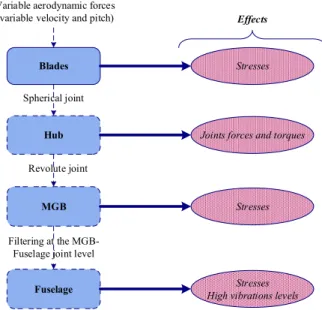
Fig. 2 summarizes the main consequences of forced vibrations in a helicopter as
explained above. For simplicity, the various couplings between the rotor and the fuselage, due to the actions of the fuselage on the dynamics of the blades, are not taken into account.
3 Fig. 2 Consequences of the forced vibrations on the helicopter
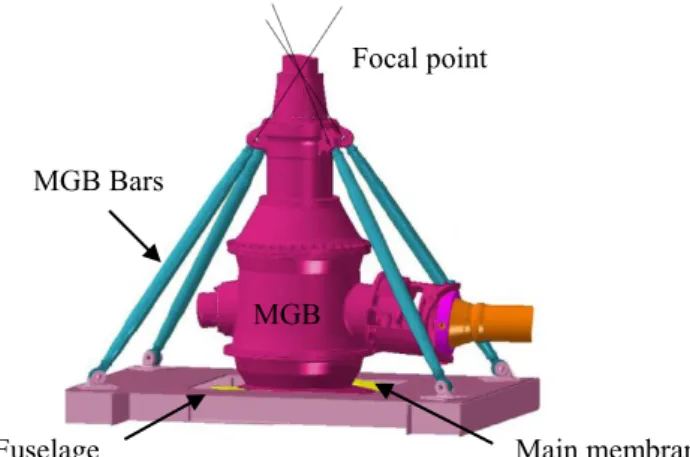
The MGB-Fuselage joint must ensure several important functions. Firstly, the joint allows the transmission of the static force necessary to the sustentation of the helicopter with a limited required static displacement. Moreover, the joint helps to reduce the mechanical vibrations transmitted to the fuselage according to the force and displacement aspects. Classically, the MGB-Fuselage joint is composed of four MGB bars and a main membrane as shown in Fig. 3.
Fig. 3MGB-Fuselage description
Hub MGB Fuselage Blades Spherical joint Revolute joint Filtering at the MGB-Fuselage joint level
Effects
Variable aerodynamic forces (variable velocity and pitch)
Stresses
Joints forces and torques
Stresses
Stresses High vibrations levels
Rotor Engine MGB Bars Main membrane Fuselage MGB
Different technical solutions exist for the realization of this joint. In this paper, the SARIB system is particularly studied. The architecture of this system is detailed in section 3.
The design and the analyze of such complex mechanical systems are usually conducted with analytical methods based on physical equations or signal-flow method based on transfer functions written on a block diagrams form. Unfortu-nately, these two classical approaches may cause a loss of the physical sense and the visibility of the modeling assumptions [2]. Moreover, taking account of increas-ing complexity requires partially to resume a part of the modelincreas-ing phase.
The “complex mechanical system dynamics” project, funded by European Aero-nautic Defense and Space foundation (EADS), focuses on helicopter dynamics and has as main objective the development of an analysis methodology together with the related tools in order to support design and control of such systems. The present paper presents an energetic representation tool for modeling: multibond graph (MBG). The MBG is applied to model the dynamic of a classical helicopter subsys-tem: the main gear box MGB-Fuselage joint. This approach enables to represent mechatronics systems in a graphical form describing the exchange of power be-tween basic elements like inertia, compliance, dissipation, conservative power transformation, gyrator actions and sources. The bond graph approach used for multibody system called multibond graph (MBG) has been introduced by A. M. Bos [3] [4]. Library models for a rigid body and for various types of joints have been provided and bond graph models of rigid multibody systems can be assembled in a systematic manner. Further, W. Marquis-Favre and S. Scavarda [5] proposed a method dedicated to systematic generation of bond graph models for multibody
sys-tems with kinematic loops.Nevertheless, few complex multibody systems with
kin-ematic closed loops have been simulated on dedicated softwares such as 20-sim software [6] (simulation package for dynamic systems using physical components, block diagrams, bond graphs and equations of motion).
The SARIB system here studied is a complex mechanical closed kinematic chain (CKC) system. The dynamics equations of such a CKC system are a differential-algebraic equations system (DAE) which are difficult to treat and which require specific solving methods. It will be shown that the multibond graph method together with the method of singular perturbations appears to be an elegant and easy solution to derive the simulation of CKC system.
The main objective of this paper is to present a design methodology based on an energetic representation tool : multibond graph and to show its benefits as a sys-temic approach. This method will be applied to model a joint between the main gear box (MGB) and the aircraft fuselage which is a complex multi-body system because of the numerous bodies and joints and the mechanical forces applied on the MGB.
The paper is organized as follows. In section 2, we shall explain the main ad-vantages of the energetic representation tool chosen: the multibond graph compared to other more classical methods. Section 3 describes the kinematic structure and the operation of the MGB-Fuselage joint. The construction of the multibond graph of the joint desired is then detailed in section 4. Simulation results will be presented in Section 5. Finally, conclusions and perspectives will be given in the last Section.
2
Energetic tool : MBG for complex mechatronic system modeling
2.1
Characterization of complex mechatronic system
The design of the MGB-Fuselage joint studied is within the scope of the design of mechatronic systems. Many definitions of mechatronic systems exist. For exam-ple, French standard NF E 01-010 [7] gives the following definition: “approach aiming at the synergistic integration of mechanics, electronics, control theory, and computer science within product design and manufacturing, in order to improve and/or optimize its functionality".
We shall not detail more the concept of mechatronic systems thereafter. This standard and the paper [8] have dealt with the issue sufficiently so as to define the perimeter of the mechatronics system studied. However, what we consider as a com-plex system is going to be defined in a more detailed way in the sequel. The goal is to facilitating a better understanding of the energetic representation tool chosen to describe complex multiphysic systems.
Let us remember that a multiphysic system is a multitechnology system which involves a multidisciplinary approach: mechanics, electronics and control. For the MGB-Fuselage joint equipped with adjustable SARIB system, the presence of con-trol systems and possible electronics devices to achieve energy harvesting widely justify this multiphysic characteristic.
Moreover, a multiphase system is characterized by different operating phases during its life cycle. For example, the joint is built into a helicopter system with many operating phases: on the ground, parking flight, in forward flight.
A multiscale system is characterized by the physical laws of different scales: distributed / lumped parameters and microscopic / macroscopic scale. The MGB- Fuselage joint connection equipped with adjustable SARIB system was modeled as a multibody lumped parameter model in this paper. Taking into account the nature of certain deformable bodies (as the fuselage) may require additional models with distributed parameters.
A multiinteraction system includes a large number of elements in relation to each other and whose interactions can make emerge new properties. This character-istic of complex systems emphasizes their holcharacter-istic character based on the principle that "the whole is greater than the sum of its parts". The MGB-Fuselage joint equipped with adjustable SARIB system is a system with many bodies constrained by kinematic links. Moreover, this joint is itself embedded in a larger system: the helicopter with which it has many interactions (the fuselage, the rotor, or the com-mand chain …).
Such systems present complex multibehavior (nonlinearity, friction, gap ...). In effect, in the case of the MGB-Fuselage joint equipped with adjustable SARIB sys-tem, there are primarily geometric nonlinearities and friction in the equations.
2.2
Interest of using a system approach
Given the multidisciplinary aspects and complexity of mechatronic systems we have stated in the previous paragraph, the design tools must have some essential features to enable their efficient modeling.
First, the design tool should be based on a unique and unified language for dif-ferent fields of physics in order to enable a common modeling early in the design phase of multiphysic systems.
Then, the design tool should lead to models describing the physics of the model regardless the purpose of modeling. Such a model having a structure independent of its inputs and its outputs is called acausal. This acausal type of model is particu-larly interesting to model multiphase systems since the model structure remains in-dependent of the type of inputs (related to the operating conditions considered) ap-plied to the system.
Then, the design tool should allow a multilevel approach like an object-oriented language. This object-oriented approach facilitates the decomposition of a system into subsystems with the encapsulation of these approaches property. This multi-level approach then permits a better management of two characteristics of complex systems studied. Firstly, it allows a simplification of the presentation of systems with multiple interactions almost essential for their analyses. Indeed, the decompo-sition of the system into subsystems helps to hide the internal interactions of each subsystem and, therefore, to distinguish the interactions between major subsystems and the internal interactions of these subsystems. Secondly, it facilitates the inclu-sion of the multiscale aspect since it allows one to encapsulate a distributed param-eter model in a lumped paramparam-eters model with higher level paramparam-eters. However, this last point discussed in [9] remains still under study and has not been validated in this paper.
Finally, the design tool should provide a modular aspect to the system model as presented in [10]. Indeed, the model must evolve to meet the levels of complexity required for each design problem by the addition or modification of new compo-nents and subsystems and by replacing behavior laws. This is intended to deal with all aspects multi-interaction and multibehavior of a mechatronic system.
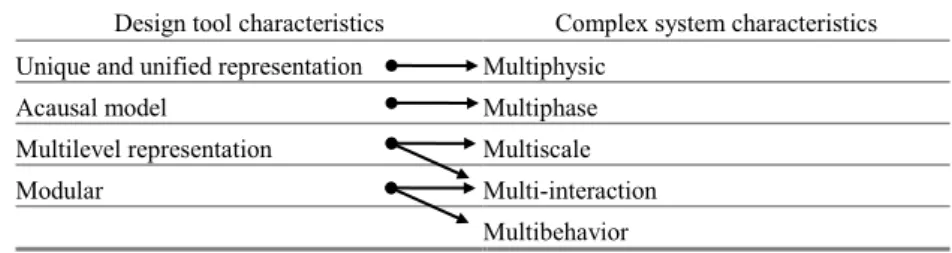
Table 1 Complexity of studied system
Design tool characteristics Complex system characteristics Unique and unified representation Multiphysic
Acausal model Multiphase Multilevel representation Multiscale Modular Multi-interaction
2.3
MBG modeling
2.3.1 Overview
The concept of energy is fundamental in the description of the evolution of tech-nological systems. Energy is present in all areas of physics and is the link between them. From this observation, a number of tools with energetic representation for modeling complex systems have been defined. One of the main tools is the bond graph (BG).
The bond graph was created by H. Paynter [11] in 1959 and developed by R. Rosenberg and D. Karnopp [12] at MIT Boston in the United States.
The bond graph is based on a study of the transfer of power in a system modeled by lumped parameters. The bond graph is a graphical modeling tool that covers all physical systems (mechanical, hydraulic, electronic, thermal...) regardless of their condition (linear, nonlinear, continuous …).
It is represented as an oriented graph showing dynamic variables and power bonds between these variables. The bond graph systematically associate two differ-ent variables for each bond: a generalized effort variable (which is a force or a torque in mechanics) and generalized flow variable (which is a translational or ro-tational velocity in mechanics) on each side of the half-arrow link. Each bond has therefore power information, obtained by the product of these two variables, and allows direct access to the energy transferred by simple integration of power. The bond graph is based on three fundamental types of elements: active element, passive element and junction element. The active elements noted Se and Sf respectively represent sources of effort and flow. These are the power inputs of the system. The fundamental property that defines a source is that the variable effort (Se) or flow (Sf) provided by a source to a model is assumed to be independent of the comple-mentary variable flow (Sf) or effort (Se) which depends on the characteristics of the system and the variable applied. Passive elements I, C and R are the three main components of a bond graph. The first two represent energy storage elements, re-spectively in kinetic and potential form, while the latter represents a dissipative el-ement. In a bond graph representation of a complete system, these previous ele-ments can be interconnected by connecting eleele-ments in common effort (0 junction) or common flow (junction 1), or processors elements (TF) or gyrators (GY).
More details on bond graph can be found [13] detailing its construction and op-eration that we can do.
The bond graph has been extended in the 90’s to the study of the multibody systems with three dimensions thanks to the multibond graph formalism. Here, the scalar power bonds become vectors bonds and the elements multiports.
2.3.2 Brief review of MBG
A brief review of multibond graph used for multibody systems is now presented. Readers wishing more details can refer to the multibond graph state of the art di-rected by W. Borutzky [14] which is quite exhaustive.
The first works were developed by M. J. L. Tiernego and A. M. Bos [3] to model robots. Then A. Zeid and C.-H. Chung [15] developed libraries of multibond graph model of three-dimensional kinematic joints. Then W. Marquis-Favre’s PhD [16] contains a large contributions of multibond graph applied to multibody system. The multibond graph is used to model both systems: serial systems and systems with kinematic loops. The concept of word bond graph (WBG) well illustrated in [17] [18] enables to have a more concise and simplified representation. The contributions of G. Rideout [19] and T. Rayman [20] present the simulation of multibody system with kinematic loops with multibond graph and 20-sim software. In their work, the method of singular perturbations from the work of A. Zeid and C.-H. Chung [15] is applied to allow the simulation of multibody system.
2.3.3 Benefits of MBG as a structural representation
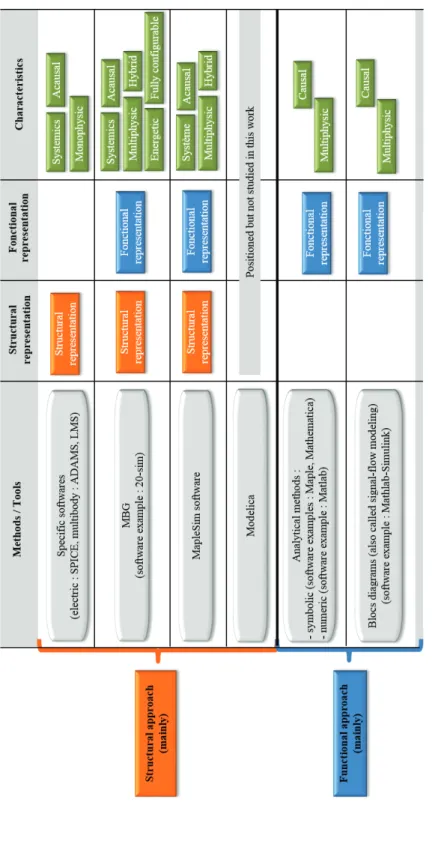
In the modeling phase, over the last 20 years, new tools based on structural ap-proach have emerged in comparison with the classic functional apap-proach. We can mention monophysic tools such as SPICE for electrical field, ADAMS or LMS for multibodies field and multiphysics tools such as MapleSim software, Modelica or multibond graph. The definition of the scope of structural and functional models can be found in [21]. The MBG approach belongs to this category of the tools
ena-bling the construction of structural models as mentioned in Fig. 4. Consequently, it
benefits from the same advantages.
This new structural approach as the multibond graph facilitates the systemic approach necessary to design a mechatronics system.
Firstly, the complexity of the system is taken into account more progressively than with conventional analytical techniques since the possible modular approach [10] makes it easier modeling a complex system subsystem by subsystem. Indeed, the modularity allowed by the MBG method enables to make the model evolve to meet the levels of complexity required for each design problem by the addition or modification of new components and subsystems and by replacing behavior laws. As a consequence, the global representation of the system built from subsystems facilitates the management of interactions and/or couplings.
Secondly, the multilevel representation of the system realized thanks to the use of word bond graph (WBG) allows to concatenate the bond graphs of bodies and joints. This technique makes possible to "zoom in / out" on different parts of the system as it can be done in a Simulink model [22].
9 Fi g. 4 Po sit io n of m ul ti bo nd gr aph m eth od am on g som e de si gn to ol
Consequently, the modular and multilevel aspects of this tool, essential for a systemic approach, help to simplify the representation and analysis of complex sys-tems.
Moreover, the structural approach generally enables the generation of acausal model which makes its structure independent of its inputs and outputs as we men-tion in secmen-tion 2.2.
2.3.4 Methods comparison : MBG versus others structural approach
In comparison with others structural tools, new interesting features naturally
ap-pears as mentioned in Fig. 4.
Firstly, this tool allows engineers and researchers working in multidisciplinary fields (especially mechanics and electronics) to have a unified representation show-ing power transfer between system’s elements in order to support complex mul-tiphysic system modeling. Indeed, it should enable to easily introduce an electronic model of energy harvester or active control system to the mechanical system thanks to the same modeling representation.
Secondly, the classical functional approach using signal-flow can complete the structural multibond graph model in the 20-sim software. This hybrid feature is very useful for performances evaluation and for the determination of a possible control law.
Thirdly, this approach allows to describe the exchange of power or energy be-tween the different components of a mechatronics system. Thanks to multibond graph representation, this energetic approach should permit to analyze the location where mechanical energy is optimum for energy harvesting consideration for ex-ample.
Fourthly, contrary to dedicated software enabling a structural approach in multi-body modeling where the multimulti-body elements have finite possibilities of parame-tering, the MBG is more completely configurable since the designer uses the multi-bond graph of bodies and joint built from the standard elements depicting physic laws and which can be thus easily modified.
3
Study case : the MGB-Fuselage joint of an helicopter
The classical MGB-Fuselage joint is composed of four MGB bars and a main membrane as we can see in Fig. 5. Let us analyze the principle of operation of this joint. The components of the mechanical actions of the
Rotor MGB
on the fu-selage are composed by a static part of the effort required to the lift and a dynamic part from dynamic excitations induced by the rotor on the fuselage due to its own rotation.The MGB bars can suspend without flexibility the fuselage to the rotor and thus transmit the lift from the rotor to the structure. In addition, the MGB bars allow the MGB to have a rotation around a point called the focal point which is the point of intersection of the MGB bars.
The membrane is a flexible suspension with some particularities:
- a low stiffness for angular movements on the roll and pitch axes and the linear vertical pumping displacement,
- a very high stiffness for linear movements perpendicular to the vertical direc-tion and for the yaw movement.
Thus, the membrane allows the angular movement of the MGB around the pitch and roll axes. The flexibility of the membrane around these axes allows a strong filtration of the dynamic moments around these axes. This filtering is achieved by adjusting the frequency of the pendulum system smaller than the excitation fre-quency of the rotor.
In addition, the membrane transmits to the main rotor torque thanks to its very high stiffness around the yaw axis.
In conclusion, the conventional suspensions allow filtering pitch and roll dy-namic moments without filtering the pumping dydy-namic efforts.
Fig. 5Flexible classical MGB-Fuselage joint
The purpose of the SARIB suspension is to render possible the filtering of these pumping dynamic efforts.
The SARIB system is composed of SARIB Bars with a tuning mass on each bar which are installed between the MGB bars and the fuselage. The SARIB system is designed so as to create inertial forces on the fuselage opposite to the force of the membrane. This system enables to reduce the efforts transmitted to the fuselage for a frequency called anti-resonance frequency.
To begin with, the analysis based on multibond graph focuses on the kinematic scheme of the 2D MGB-Fuselage joint. This simplified model is sufficient to iden-tify physical anti-resonance phenomenon.
MGB Bars
Main membrane Fuselage
MGB
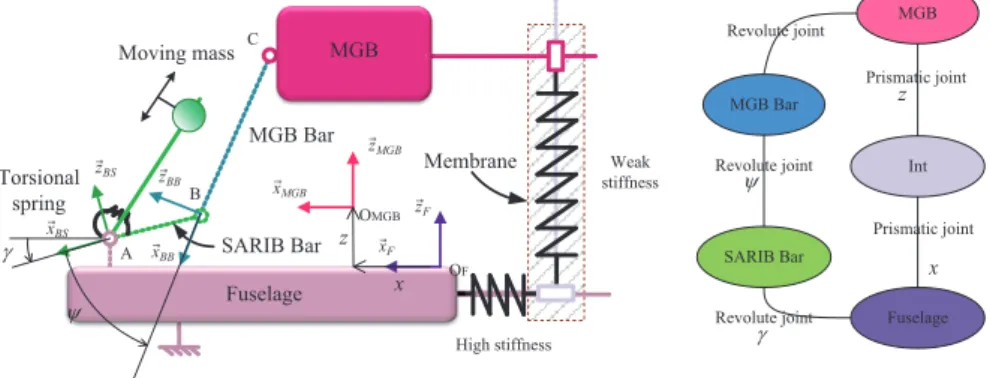
The kinematic scheme of the 2D MGB-Fuselage joint is composed of four bod-ies (the MGB, a MGB bar, a SARIB bar and the fuselage considered as fixed) and five joints (three revolute joints and two prismatic joints) as shown in Fig. 6. These bodies are assumed to be rigid. Some local moving reference frames are attached to these bodies:
0*% 0*% 0*% 0*% 0*% 5 2 [ \ ] attached to the MGB, %6 %6 %6 %6 %6 5 2 [ \ ] *% 0*% 0*% * * attached to the SARIB Bar, %% %% %% %% %% 5 2 [ \ ] %6 %6 %6 aattach %6 a attached to the MGB Bar, ) ) ) ) ) 5 2 [ \ ] % %% %% %%% a %% %% attached to the fuselage.The orientation of the SARIB Bar and the MGB bar are described respectively by angles Jand\. The flexible membrane located between the MGB and the fuse-lage is modeled with two prismatic joints in serial. The intermediate part (called Int) is considered with negligible mass. The position of MGB is described by x and z
coordinates.
Moreover, three springs enable the system to have a good filtration behavior. A torsional spring leads to the limitation of the high movement of the SARIB bar. A weak spring along z axis permits the vibrations filtering. A high spring along x axis prevents from a hyperstatic system.
Fig. 6Kinematic scheme of the 2D joint between the main gear box and the fuselage
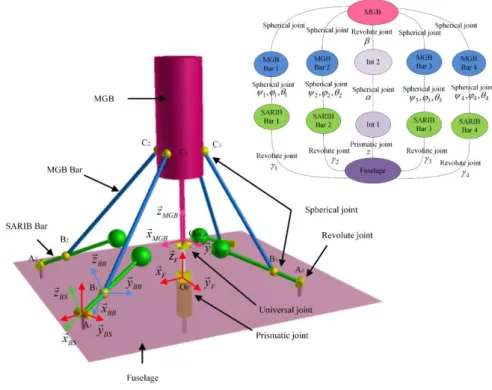
Next, the simulation of the 3D MGB-Fuselage joint with the same energetic ap-proach will be done. A kinematic scheme of the complete MGB-Fuselage is shown
in Fig. 7.The joint consists of a fuselage considered as fixed, a MGB and four
iden-tical legs and a membrane. Each leg consists of a SARIB Bar and a MGB Bar con-nected by a spherical joint. The upper end of these legs are concon-nected to the MGB with spherical joints and the lower end of these legs are connected to the fuselage through revolute joints. The flexible membrane located between the MGB and the fuselage is now modeled with a prismatic joint and two revolute joints in serial. The intermediate parts (called Int1 and Int2) are considered with negligible masses. For
0RYLQJPDVV 7RUVLRQDO VSULQJ $ % & :HDN VWLIIQHVV 0HPEUDQH 0*%%DU +LJKVWLIIQHVV 20*% 0*% )XVHODJH 2) 6$5,%%DU 0*%%DU 0*% 6$5,%%DU )XVHODJH ,QW [ ] 5HYROXWHMRLQW 5HYROXWHMRLQW 3ULVPDWLFMRLQW 3ULVPDWLFMRLQW J %6 [ %6 ] %% [ %% ] 0*% [ 0*% ] ) [ ) ] [ ] 5HYROXWHMRLQW \ J J \
simplicity, the orientation and position parameters are not represented in the kine-matic scheme but are described in the joints graph.
Fig. 7Kinematic scheme of the 3D joint between the main gear box and the fuselage
4
MBG modeling
4.1
Modeling a multibody system
Only the theoretical elements essential to the practical realization of the multi-body bond graph representation is developed.
Bond graph construction based on multi-body dynamics equations can be estab-lished either with the fundamental principle of dynamics (or Newton-Euler equa-tions) or by using Lagrange equations. Depending on the starting point, several bond graph construction methods have been developed:
- the “Tiernego and Bos” method from the application of the fundamental principle of dynamics,
- the “Karnopp and Rosenberg” method from the application of the Lagrange equa-tions.
The method used in this paper is the method of "Tiernego and Bos" since it allows to describe the system as an assembly of subsystems composed of bodies and joints. This assembly of sub-systems is clearly facilitated by the use of word bond graph (WBG). In the WBG, the bond graph of solids and joints are encapsu-lated in order to focus only on the relationship between solids and joints. Each word bond graph element (bodies or joints) is linked to another word bond graph element through two power bonds for the rotational and translational power transmissions. Each power bond carries a 3D generalized flow vector (rotational or translational velocity) and the complementary 3D generalized effort vector (torque or force).
Bond graph construction developed with the "Tiernego and Bos" method re-quires the knowledge of a number of multibond graph elements, the bond graph modeling of a rigid body and joints.
The multibond graph elements (multibond or vector bond, junctions, multiport energy storage elements, multiport transformers and gyrators) are directly used. Readers can refer to [14] to find the details of the modeling of those elements.
4.2
Simulation difficulties of CKC systems
The simulation of mechanical system with kinematic loops requires specific methods. This difficulty does not come from the multibond graph tool but from the application of dynamics equations to such systems where some kinematic variables are linked together. Regardless the analytical method employed (fundamental prin-ciple of dynamics or Lagrange equations with multipliers), the equations obtained are differential algebraic equations (DAEs) whose numerical resolution requires specific numerical integration methods. These difficulties to solve numerically dif-ferential equations are developed, for example, in W. Marquis-Favre [23]. A recent review of the methods for solving DAEs can be also found in [24]. To sum up, one can find three groups of methods: the direct resolution of the DAE thanks to specific solvers, the reduction of the DAE in an ODE like the Baumgarte stabilization method or partitioning method and the conversion to an ODE by modifying the model system. The singular perturbation method which is used in the paper belongs to the last category of these methods that is to say the conversion to an ODE by modifying the model system.
4.3
Use of the singular perturbation method
The multibond graph simulation with the method of the singular perturbation is quite easy to implement compared to conventional techniques used during an ana-lytical study. Others techniques based on multibond graph enabling to treat the sim-ulation of mechanical with kinematic loops exist and are described in W.
Marquis-Favre’s PhD [16]. However, we decided to use the method of singular perturbation which, to our point of view, keeps a physical insight and is the simpliest to apply.
The method of singular perturbation consists in augmenting the multibond graph of the joints with parasitic elements [19] [20]: stiffness and damping elements cor-responding to C energy store element and R resistive element. The values of the compliant elements must be chosen carefully. To our knowledge, two methods for selecting these elements exist : the eigenvalues decoupling between the parasitic frequency and the system frequency and the use of activity metric [19]. These pa-rameters can be chosen so as to model the joint compliances which exist in all me-chanical joints. Thus, this point gives to this method a physical significance. The stiffnesses introduced should be high enough in order not to change the dynamic of the system but not too high so as to prevent the numerical difficulties of stiff prob-lems (with high-frequency dynamics). This method leads to a necessary compro-mise between the accuracy of the results and the simulation time. Moreover, the stiffer the system is, the more numerical errors are reduced but the simulation time remains important. However, the increase of the simulation time can be balanced by parallel processing as the mass matrix in a block-diagonal form can enable to decouple the system as it is explained in [25]. As T. Rayman recommends, adding a damping element (R resistive element) in parallel with the stiff spring (C energy store element) enables to dampen the high eigen frequency associated with the high stiffness. The exact influence of these parameters still remains a research work in which the authors are particularly interested in.
If the kinematic constraints modeled by the multibond graph of the joint are rigidly imposed, derivative causality appears at the multibonds connected to the translational inertia elements. The derivative causality due to constraints requires that the equations derived from the bond graph are differential algebraic equations (DAEs). The resolution of such equations is quite complex from a computational point of view as we explained before. The method of singular perturbation enables to relax the kinematic joint constraints. The dynamic equations are in a ODE form with no geometric constraints to deal with. Consequently, it leads to a bond graph with integral causality which can be simulated easily.
As T. Rayman explains in [20], W. Marquis-favre and S. Scarvada developed the method of “privileged frame” [5] to facilitate the resolution of multibody system with kinematic loops. However, it is important to notice that even this method helps to minimize the number of coordinate transformations required in a multibody model with kinematic loops, it does not fundamentally permit the simulation of this system.
4.4
Construction of the MBG model of the MGB-Fuselage joint
In this section, the bond graph modeling of the rigid body is first recalled. The bond graph modeling of joints is described since they are modeled with some par-ticularities compared to the classical way of modeling that we can find enabling to
simulating serial mechanical system. Indeed, as already explained, the kinematic joints have compliant elements so as to enable the simulation of this system with kinematic closed loops.
4.4.1 Rigid body modeling
Let us remember (Fig. 8) the architecture of a rigid body multibond graph model based on [5], [14], [16] and [18].
This bond graph architecture is based on the Newton-Euler equations with re-spectively the inertia matrix (modeled with a multiport energy store element
i i
S ,G i
I in the upper part) associated with gyroscopic terms (modeled with a
multi-port gyrator element also called Eulerian Junction Structure about mass-center of body i expressed in its frame Gi
i
EJS and the mass matrix modeled with a
multi-port energy store element
mi 0 in the lower part). The upper part of the MBG represents the rotational dynamic part expressed in the body frame while the lower part is for the translational dynamic part expressed in a inertial reference frame (or Galilean frame). The two corresponding 1-junctions arrays correspond respectively to the angular velocity vector of body i
i/ 0iand the translational velocity vector of the center of mass of body i V G R
i/ 0
0expressed in these two coordinateframes.
The central part of the MBG describes the kinematic relations between the ve-locities of the two points of the body i (V M R
j / 0
iand
0 0 /
k
V M R ) and the ve-locity of the center of mass V G R
i / 0
iresulting from the formula of the rigid body.The modulated transformation element (MTF) between V G R
i / 0
iand
00
/
i
V G R represents the coordinate transformation between the body frame and the inertial frame.
1 0 mi
0 0 /i V G R
h i M h M h i 1 i G i I i G i EJ S
i i/0
i i/0
h i i i M h i i h hh M h i F M G 0 0 MT F : iP 0 pe s i P 0
hi h FInertial reference (or galilean) frame
Body frame
Dynamic moment theorem calculated
in G relative to the inertial reference frame
expressed
in the body frame
Kinematic relations
Force dynamic theorem calculated
relative to the inertial reference frame
expressed
in the inertial reference frame
1 0 0 1 1 1 i ji F M TF : i ij X G M M TF : i ik X G M 0
0 / i i V G R i ki F 0
0 / i k V M R
0 / i j V M R
0 0 0 h i pe s i i i 0 0 h d F P m V G /R dt
h i i i i i i ii p i i M h i S ,G i i S ,G i 0 hh d M h i F h i M G I S /0 S /0 I S /0 dt 0 0 00 j 0 i 0 i i j 0 0 0 0 k 0 i 0 i i k V M /R V G /R S /0 G M V M /R V G /R S /0 G M Frame transformation 0 0 0 0 / . / i i ii V G R P V G R F ig . 8 Mu ltib on d gr ap h rep resen tatio n of a r ig id b od y i4.4.2 Kinematic joints modeling
For simplicity, only the modeling of the joints necessary for modeling the 2D MGB-Fuselage are here considered: the joint revolute and prismatic including com-pliant elements are described. On this base, the modeling of different joints such as spherical joint and others needed for the 3D model could be easily derived.
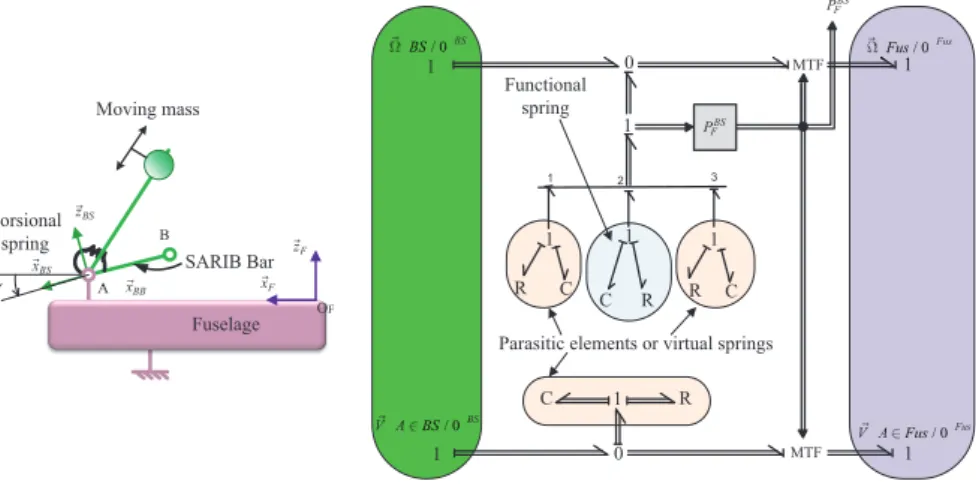
Revolute joint
The kinematic scheme and the multibond graph of the revolute joint between the SARIB Bar and Fuselage are illustrated in Fig. 9.
In this multibond graph model, the variables used are: - the angular velocity of the fuselage :
)XV )XVe variables
: and the SARIB bar
%6%6
:
%:
relative to the inertial reference frame. The subscripts refer to the frames where these velocities are expressed in,
- the translational velocities of the fuselage 9 $ )XV 5
)XVand the SARIB bar%6
9 $ %6 5
relative to the inertial reference frame at the point A,- the transformation matrix %6 )
3 determined thanks to the angular velocity as ex-plained in [19].
Fig. 9 Kinematic scheme and multibond graph of the revolute joint between
SARIB Bar and Fuselage
5 5 5 07) 07) & & & 5 & 3DUDVLWLFHOHPHQWVRUYLUWXDOVSULQJV )XQFWLRQDO VSULQJ 0RYLQJPDVV 7RUVLRQDO VSULQJ $ % )XVHODJH 2) 6$5,%%DU J %6 [ %6 ] %% [ [) ) ] J %6 %6 %6 %6 )XV )XV )XV )XV %6 9 $ %6%6 % 9 $ %6 9 $9 $ )XV)XV)XV )XV %6 ) 3 %6 ) 3
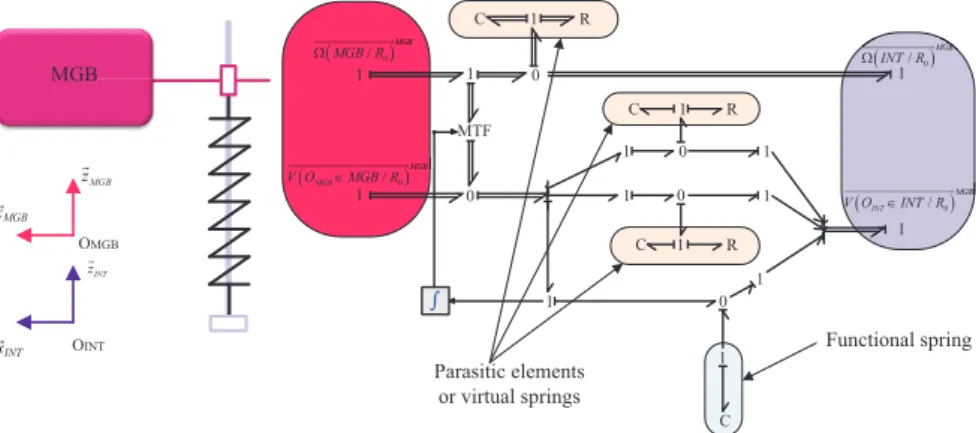
Prismatic joint
The kinematic scheme and the multibond graph of the prismatic joint along z axis between the MGB and the intermediate body are shown in Fig. 10 as follows:
In this multi bond graph model, the variables used are: - the angular velocity of the MGB :
0*% 0*%odel, th
: and the intermediate
0*%,17
:
: relative to the inertial reference frame,
- the translational velocities of the MGB 9 2
20*%0*% 5 0*%at the point0*%
2
and the intermediate body9 220*%,17 5 0*% relative to the inertialref-erence frame.
Fig. 10 Kinematic scheme and multibond graph of the prismatic joint between
MGB and Intermediate body
4.4.3 The complete model
Individual models of joints and bodies, previously described, are connected to-gether according to the kinematic scheme as shown in Fig. 11, Fig. 12 and Fig. 13. The MGB is excited by a vertical periodic force I W )FRV ZW . In these figures, three types of multibond graph elements can be thus distinguished:
- the rigid bodies, such as the fuselage, the SARIB Bar, the MGB Bar and the MGB. - the joints, such as revolute joint used between the SARIB Bar and the fuselage. - the multibond graphs power bonds (half-arrows).
The simulation of the 2D and 3D MGB-Fuselage multibond graphs is then pos-sible. 5 5 5 07) & & & & ³ 0*% 0*% 9 2 0*% 50*% 0*% 0*% 5 : 0*% 3DUDVLWLFHOHPHQWV RUYLUWXDOVSULQJV )XQFWLRQDOVSULQJ 0*% 20*% 0*% [ 0*% ] 2,17 ,17 [,17 [ 0*% ,17 5 : 0*%%% 0*% ,17 9 2 ,17 50*% ,17 ]
Fig. 11Word bond graph built on 20-sim of the 2D MGB-Fuselage ,QWHUPHGLDWH VROLG 5HYROXWHMRLQW 5HYROXWHMRLQW 5HYROXWH MRLQW 3ULVPDWLF MRLQW] )XVHODJH 0*% 6$5,% %DU 0*% %DU $HURG\QDPLFIRUFH 6H ([FLWDWLRQ 3ULVPDWLF MRLQW[
50*% 0*% 5 5 : : 50*% %DU 0*% %DU 5 5 : : 56$5,% %DU 6$5,% %DU 5 5 : : 56$5,% %DU 6$5,% %DU 5 5 : : 5)XVHODJH )XVHODJH 5 5 : : 50*% %DU 0*% %DU 5 5 : : 5)XVHODJH 9 $ )XVHODJH5$ 56$5,% %DU 9 $ 6$5,% %DU 5$ 6$ 56$5,% %DU 9 % 6$5,% %DU 5 6$ 50*% %DU 9 % 0*% %DU 5 * 50*% %DU9 &
&0*% %DU 5* 50*% 9 &&0*%5* 5)XVHODJH )XVHODJH 5 5 : : 5)XVHODJH )XV 9 22 )XV5 5)XVHODJH )XVHODJH 5 5 : : 5LQW LQW 5 5 : : 5LQW LQW 5 5 : : 50*% 0*% 9 2 0*% 5 0*% 2 0RYLQJPDVV 7RUVLRQDO VSULQJ $ % & :HDN VWLIIQHVV 0HPEUDQH 0*%%DU +LJKVWLIIQHVV 20*% 0*% )XVHODJH 2) 6$5,%%DU J %6 [ %6 ] %% [ %% ] 0*% [ 0*% ] ) [ ) ] [ ] J \ IW07) KL K ) o ¦ ) 6I 6I )XV 9$ ) XV 5 )XV )XV )XV : )XV 5 5 5 07) 07) & & & 5 & 3DUDVLWLFHOHPHQWVRUYLUWXDOVSULQJV )XQFWLRQDOVSULQJ 6I 6I %6 5 %6 : 5 %6 : (-6 %6 %6 5 * ªº ¬¼ , %6 %6 5 * ªº ¬¼ %6 5 %6 : 5 %6 : 07) %6 5 %6 ;* % ªº «» ¬¼ º %6 5 07) %6 5 %6 ;* $ ªº «» ¬¼ º %6 5 %6 5 %6 9* 5 9* 5 %6 5 9$ 5 5 9$ 5 %6 5 9% 5 5 9% 5 %6 535 >@ P%6 5 5 %6 9* 5 K 9* 5 SH V % 6 3 o 3 %6 535 Fi g. 1 2 Pa rtia lly det ai le d m ulti bo nd gr ap h of th e 3 D MGB-Fu se lage j oin t LQWHUPHGLDWH VROLG 5HYROXWH MRLQW 5HYROXWH MRLQW 5HYROXWH MRLQW 3ULVPDWLF MRLQW] )XVHODJH 0*% 6$5,% %DU 0*% %DU $HURG\QDPLFIRUFH )XVH ODJH 5 )XVH OD JH 5 5 : 5 : )X VHO DJ H 5 9 $ )XVH ODJH 5 9$ ) 6H ( [ FLWD WL R Q 3ULVPDWLF MRLQW[ 0* % 5 0*% 5 5 : 5 5 : 0*% %DU 5 0*% %DU 5 5 : 5 : 6$5,% %DU 5 6$5,% % DU 5 5 : 5 : 6$5,% %DU 5 6$5,% %DU 5 5 : 5 : 0*% %DU 5 0*% %DU 5 5 : 5 : 6$ 5,% %DU 5 9 $ 6$ 5, % % DU 5 9 $5 $6 $ 55 6$5,% %DU 5 9 % 6$5,% % DU 5 9% 6$ 5 0* % %DU 5 9% 0 * % % DU 5 9% 0 * 0*% %DU 5 9 & 0 * % % DU 5 9& 0 * 00 0*% 5 9& 0 * % 5 9& 0 * )XVH ODJH 5 ) XVH OD JH 5 5 : 5 : )XVH ODJH 5 )XV 9 2 )XV5 92 ) )XVH ODJH 5 ) XVH OD JH 5 5 : 5 : LQW 5 LQ W 5 5 : 5 5 : LQW 5 LQ W 5 5 : 5 5 : 0* % 5 0*% 92 0 * % 5 92 0
MG B Bar 1 MG B Bar 2 MG B Bar 3 MG B Bar 4 SA RIB Ba r 1 SA RIB Bar 2 SA RIB Ba r 3 SA RIB Ba r 4 MG B Fus elage Prismat ic joi nt z Revol ute j oint 1 Revol ute joi nt 2 Revol ute joi nt 3 Revol ute j oint 4 Revol ute joi nt a Revol ute joi nt b Spherica l joi nt 11 Spherica l joi nt 12 Spherica l joi nt 13 Spherica l joi nt 14 Spherica l joi nt 21 Spherica l joi nt 22 Spherica l joi nt 23 Spherica l joi nt 24 M G B R M G B 0 R /R M G B Ba r1 R M G B Bar 1 0 R /R SA RI B Ba r1 R SA RI B Bar 1 0 R /R SA RI B Ba r1 R SA RI B Bar 1 0 R /R Fu se la ge R Fus elag e 0 R /R M G B Ba r1 R M G B Bar 1 0 R /R Fu se la ge R 0 V A1 Fu se la ge /R 1 1 SA RI B Ba r R 0 V A1 SA RI B Ba r /R 1 1 SAR IB Ba r R 0 V B1 SAR IB Bar /R 1 1 M G B Ba r R 0 V B1 M G B Ba r /R 1 1 M G B Ba r R 0 V C1 M G B Ba r /R M G B R 0 V C1 M G B /R Se Fu se la ge R Fus elag e 0 R /R Fu se la ge R Fu s 0 V O Fu s/R Fu se la ge R Fus elag e 0 R /R int R int 0 R /R int R int 0 R /R MGB R M G B 0 V O M G B /R Aerodynami c force F ig . 1 3 Wo rd b on d gr ap h of th e 3D M GB -F use lag e jo in t
5
Results and comments
Like for all multibody simulation analyses, the evolution of the different movement parameters of the system may be deduced. For example, the position of MGB gravity center xG MGB,yG MGB,zG MGB, SARIB Bar 1 gravity center
1 1 1
G BS G BS G BS
x ,y ,z , the angular parameters of the SARIB Bars
1, , ,2 3 4
and the MGB Bars 1, , ,2 3 4are shown in Fig. 14. In the same way, forces transmitted to the fuselage joint (revolute joint between SARIB Bar and fuselage) may be de-duced immediately. For example, the components
1 , 1 , 1
A x A y A z
f f f of the forces ap-plied by the SARIB bars to the fuselage at the A1 point expressed in the fuselage frame are shown in Fig. 15. Let us note that, using mechanical analytic methods, some calculations are needed so as to express joint forces.
Fig. 14 Movements parameters of the 3D model
Position of MGB gravity center (in R0) G MGB x m G MGB y m G MGB z m
Position of SARIB Bar gravity center (in R0) G BS x m G BS y m G BS z m
SARIB Bars angles Psi angles of MGB Bars
1 deg 2 deg 3 deg 4 deg 1 deg 2 deg 3 deg 4 deg 0,4 0,6 0,2 0 0,8 0 0,5 1 1,5 2,5 3 3,5 4 0,3 0,4 0,2 0,1 00 0,5 1 1,5 2,5 3 3,5 4 0 0,5 1 1,5 Time [s] 2,5 3 3,5 4 Time [s] 0 0,5 1 1,5 Time [s] 2,5 3 3,5 4 Time [s] 20 30 10 0 40 30 40 20 10 50
Fig. 15 Excitation force and reaction forces in the revolute joints of the 3D model Thanks to complementary tool proposed in 20-sim software, frequency re-sponse can be determined after having chosen inputs and outputs.
First, the transmissibility function between the forces transmitted to the fuselage and the excitation force has been deduced for the 2D model. As we can see in Fig. 16, the transmissibility presents an anti-resonance frequency. The SARIB Bar plays his role since the joint enables to isolate the fuselage from the force coming from MGB at this specific frequency.
Component along x axis of reaction force in revolute joint A1
1 A x
f N
Component along y axis of reaction force in revolute joint A1
1 A y
f N
Component along z axis of reaction force in revolute joint A1
1 A z f N f N
Vertical periodical excitation force
0 0,5 1 1,5 Time [s] 2,5 3 3,5 4 0 0,5 1 1,5 Time [s] 2,5 3 3,5 4 0 0,5 1 1,5 Time [s] 2,5 3 3,5 4 0 0,5 1 1,5 Time [s] 2,5 3 3,5 4 50000 0 -50000 -100000 5000 0 -5000 -10000 5000 0 -5000 -10000 5000 0 -5000 -10000 Frequency (Hz) Magnitude 15 16 17 18 19 20 21 22 23 24 25 0 0.5 1 1.5 2 2.5 3 3.5 4 M ag ni tu de (a bs ) Transmissibilité Fréquence (Hz) Transmissibility function
Then, the transmissibilities between the joint reaction at the different revolute joints and the excitation force have been also determined for the 3D model.
Observing the transmissibility curves involving the vertical components of joint reactions (Fig.17 up), we also find the anti-resonance phenomenon that has already been described with the 2D model with antiresonance around 18 Hz
The layout of transmissibilities, involving components in the xy plane of joint reaction (Fig. 17 bottom) shows that the anti-resonance phenomenon does not occur at the same frequency as before. This anti-resonance phenomenon does not occur at the same frequencies according to the type of stress applied to the MGB. This vari-ation of the antiresonance frequency explains the interest of designing an intelligent joint SARIB adapted to external forces applied to the MGB.
This analysis can be also done with an energetic point of view. Indeed, adding power sensors in all connections in the multibond graph, the flow of power can then be evaluated. As expected, all the power provided from the excitation of MGB is sent to the SARIB Bar.
Transmissibility at A3 and A4 with Rx/Ry Transmissibility at A1 and A2 with Rz Transmissibility at A3 and A4 with Rz
Transmissibility at A1 and A2 with Rx/Ry
6
Conclusion
In this paper, it is shown how dynamic simulations of an aeronautic complex subsystem can be conducted thanks to a relevant multibond graph representation. In this sense, the proposed contributions consist in providing a relevant methodology to model a multibody system with closed kinematic chains using the bond graph formalism and in comparing this method with others classical methods of modeling. The proposed methodology is based on three steps. In the first step, the modeler has to build the bond graph of a rigid body. The second step is dedicated to model the different joints connecting the bodies of the system. A fundamental point of this step is the use of parasitic compliant elements for the modeling of the kinematic constraints provided by the joints. The third step treats the assembly of the different created models (rigid bodies and joints). This step can be easily conducted with the help of a well-structured library of components.
The simulation results of the MBG model of the studied joint have been pre-sented. It shows the need to keep a sufficiently complete model so as to predict the anti-resonance phenomenon which exists in this system. Indeed, the 3D model can highlight the existence of different values of anti-resonant frequencies following the direction of efforts observed that had not been visible with the 2D model.
The comparison of multibond graph with others classical methods of modeling shows that this tool appears to be a useful tool for engineers in the context of multi-body modeling. The main arguments are now recalled.
Its hierarchical and modular properties enables MBG to be a structural tool. Therefore, the constructed multi-body dynamic models enable to obtain a quite sim-ple representation of a comsim-plex system since the multibond graph model highlights the topology of systems. Moreover, the simulation of multibody systems with closed kinematic chains may appear easier to conduct than the classic analytical method. The method of singular perturbation employed in this multi bond graph representation enables to avoid dealing with kinematic constraints equations and consequently to have only ODE systems to solve instead of DAEs. The use of ded-icated software such as 20-sim may allow to hide this complex step for the modeler. Finally, we should not forget that the multibond graph is also a unified power based approach which enables to model many multi domains systems and to analyze the description of the energy between the components of such systems.
Future works are being conducted so as to exploit multibond graph models for control design purposes. The investigations will be lead in two directions. The first exploitation of multibond graph representation shall focus on scalar BG analysis. The second exploitation of multibond graph shall lead to control architecture by means of inversion techniques with the help of complementary tool such as ener-getic macroscopic representation (EMR) designed for this purpose. It should permit to design more robust control laws with less energy consumption.
Acknowledgments
This research work received support from the Chair "Dynamics of complex mechanical systems - EADS Corporate Foundation - Arts et Métiers ParisTech and Ecole Centrale de Marseille.".
Thanks to Paul B.T. Weustink working as Controllab Products for his help on the use of complementary tools of 20-sim software.
References
[1] T. KRYSINSKI and F. MALBURET, Mechanical Vibrations: Active and
Passive Control, Wiley-Iste ed., 2006.
[2] J. v. AMERONGEN and P. BREEDVELD, "Modelling of physical
systems for the design and control of mechatronc systems," Annual review
in Control, 2003.
[3] M. J. L. TIERNEGO and A. M. BOS, "Modelling the dynamics and
kinematics of mechanical systems with multibond graphs," Journal of the
Franklin Institute, vol. 319, pp. 37–50, 1985.
[4] A. M. BOS, "Multibody Systems in Terms of Multibond Graphs with
Application to a Motorcycle Multibody system," University of Twente, Enschede, The Netherlands, 1986.
[5] W. MARQUIS-FAVRE and S. SCAVARDA, "Bond graph representation
of multibody systems with kinematic loops," Journal of the Franklin
Institute, vol. 335B N°4, pp. 643-660, 1996. [6] http://www.20sim.com/.
[7] AFNOR, "Mécatronique - vocabulaire," ed: NF E01-010, 2008.
[8] R. ISERMANN, "Mechatronic systems—Innovative products with
embedded control," Control Engineering Practice, vol. 16, pp. 14-29,
2008.
[9] M. LEBRUN, "Simulation et CAO en automatique et mécatronique,"
Techniques de l'ingénieur, 2003.
[10] A. JARDIN, "Contribution à une méthodologie de dimensionnement des
systèmes mécatroniques : analyse structurelle et couplage à l'optimisation dynamique," Thèse de doctorat, Electronique, Electrotechnique, Automatique EEA, INSA de Lyon, Lyon, 2010.
[11] H. M. PAYNTER, Analysis and Design of Engineering systems, MIT Press
ed., 1961.
[12] D. C. KARNOPP, D. L. MARGOLIS, and R. C. ROSEMBERG, System
Dynamics - Modeling and Simulation of Mechatronics Systems, John Wiley & Sons ed., 2000.
[13] G. DAUPHIN-TANGUY, "Les bonds graphs et leur application en
mécatronique," Techniques de l'ingénieur, 1999.
[14] W. BORUTSKY, Bond Graph Methodology - Development and Analysis
[15] A. ZEID and C.-H. CHUNG, "Bond graph modeling of multibody
systems: a library of three-dimensional joints," Journal of the Franklin
Institute, vol. 329, pp. 605-636, 1992.
[16] W. MARQUIS-FAVRE, "Contribution à la représentation bond graph des
systèmes mécaniques multicorps," Thèse de doctorat, 1997.
[17] M. VERGE and D. JAUME, Modélisation structurée des systèmes avec
les Bonds Graphs, Technip ed., 2004.
[18] A. VAZ and S. HIRAI, "Modeling a Hand Prosthesis with Word Bond
Graph Objects," in Proc. Int. Conf. on Integrated Modeling & Analysis in
Applied Control & Automation (IMAACA 2004), 2004.
[19] G. RIDEOUT, "System partitioning and physical domain proper modeling
through assessment of power-conserving model structure," Thèse de doctorat, University of Michigan, 2004.
[20] T. RAYMAN, G. RIDEOUT, and N. KROUGLICOF, "Evaluation of
Dynamic Performance of Non-Spherical Parallel Orientation Manipulators through Bond Graph Multi-Body Simulation," presented at the Bond Graph Modeling Genoa, Italy, 2012.
[21] C. C. CHAN, A. BOUSCAYROL, and K. CHEN, "Electric, Hybrid, and
Fuel-Cell Vehicles : Architectures and Modeling," IEEE Transactions on
vehicular technology, 2010.
[22] http://www.mathworks.fr/products/simulink/.
[23] W. MARQUIS-FAVRE, "Simulation des mécanismes : Résolution des
équations dans les logiciels," Techniques de l'ingénieur Modélisation
mécanique, 2007.
[24] T. K. UCHIDA, "Real-tim Dynamic Simulation of Constrained Multibody
Systems using Symbolic Computation," Systems Design Engineering, University of Waterloo, Ontario, 2011.
[25] J. WANG, C. GOSSELIN, and L. CHENG, "Modeling and Simulation of
Robotic Systems with Closed Kinematic Chains Using the Virtual Spring