A Low Cost Real Time Embedded Control System Design
Using Infrared Signal Processing with Application to
Vehicle Accident Prevention
Prof Babu PG Reddy
1Dr Vudasreenivasarao
2Dr B V Mohan
3Potluri Chandra srinivas
4 1Associate Professor, Center for Research and Development, Defence Engineering College, Ethiopia2Professor, Dept of Computer and Information Technology, Defence Engineering College, Ethiopia 3Professor & Head Armament Engineering Section, Defence Engineering College, Ethiopia
4Asst Professor, Dept of CSE, Aurora Sci Tech & Research Academy,Hyderabad, India
1[email protected] 2[email protected]
ABSTRACT
Vehicle accidents are most common if the driving is inadequate. These happen on most factors if the driver is drowsy or if he is alcoholic. Driver drowsiness is recognized as an important factor in the vehicle accidents. It was demonstrated that driving performance deteriorates with increased drowsiness with resulting crashes constituting more than 20% of all vehicle accidents. But the life lost once cannot be re-winded. Advanced technology offers some hope avoid these up to some extent. A car simulator study was designed to collect physiological data for validation of this technology. Methodology for analysis of physiological data, independent assessment of driver drowsiness and development of drowsiness detection algorithm by means of sequential fitting and selection of regression models is presented. In this paper proposes an approach towards design of a Low cost real time embedded control system which involves measure and controls the eye blink using sensor. As car manufacturers / industrial automotive communities, incorporate intelligent vehicle systems in order to satisfy the consumer’s ever increasing demand for more assistant systems for comfort, navigation, or communication, to address the issue of increased level of cognitive stress on drivers to the sources of distraction from the most basic task at hand, i.e., driving the vehicle. Driver’s drowsiness detection systems are actually receiving a large interest in the academic and industrial automotive communities for their potentiality to reduce fatalities Eye detection is a crucial aspect in many useful applications ranging from face recognition / detection to human computer interface for, driver behavior analysis. Vision-based driver fatigue detection which is non-contact has a key advantage over applicability. In this paper proposes a simple and economical prototype design as a solution in developing a intelligent vehicles based on IR signal processing for monitoring the driver’s drowsiness level, vigilance and alerting the driver to prevent accidents. This approach is economical and all the lower income side vehicle owners can afford to installation of this system.
Keywords- Intelligent Vehicles, Driver Vigilance, Human fatigue, Safe Navigation
1. INTRODUCTION
The Increasing number of traffic accidents due to a driver’s diminished vigilance level has become a serious problem for society. A significant number of highway crashes are attributable to driver drowsiness and fatigue. In Europe, statistics show that between 10% to 20% of all traffic accidents are due to drivers with a diminished vigilance level caused by fatigue. In the trucking industry, about 60% of fatal truck accidents are related to driver fatigue. It is the main cause of heavy truck crashes [1]. According to the U.S. National Highway Traffic Safety Administration (NHTSA), falling asleep while driving is responsible for at least 100 000 automobile crashes annually. An annual average of roughly 40 000 nonfatal injuries and 1550 fatalities result from these crashes [2].
These figures only cover crashes happening between midnight and 6 a.m., involving a single vehicle and a sober driver traveling alone, including the car departing from the roadway without any attempt to avoid the crash. These figures underestimate the true level of the involvement of drowsiness because they do not include crashes during daytime hours involving multiple vehicles, alcohol, passengers, or evasive maneuvers. These statistics do not deal with crashes caused by driver distraction, which is believed to be a larger problem.
Arousal is important in regulating consciousness, attention, and information processing, it can be observed by complex variations of physiological measurements, such as brain and heart activities, and facial expressions. Many approaches have been proposed for improving driving safety. Driver’s drowsiness detection systems are actually receiving a large interest in the academic and industrial automotive communities for their potentiality to reduce fatalities [3], [4], [5]. Such techniques can be classified in three large distinct classes, which sometimes overlap: the first consists of methods which are based on the measure of physiological signals, such as brainwave activity (EEG), blood pressure, heartbeats [6], [7], [8].
The second is associated to methods which detect drowsiness from typical face expressions and body postures, such as frequent eyes closure and yawns, achieved by visual inspection of the driver with on-board cameras [9], [10], [11]. The third, of more interest here, class collects techniques which are based on the continuous monitoring of vehicle signals, such longitudinal and lateral speeds and accelerations, steering wheel angle and its derivatives [12], [13]. All the above methods have their specific merits and drawbacks and probably an effective solution will result from a smart blend of ideas from all the different approaches.
Eye detection is a crucial aspect in many useful applications ranging from face recognition / detection to human computer interface for, driver behavior analysis.
The face detection problem has been faced up with
different approaches: neural network, principal
components, independent components, skin color based methods [14],[15].Each of them imposes some constraints: frontal view, expressionless images, limited variations of
light conditions, hairstyle dependence, uniform
background, and so on. Vision-based driver fatigue detection which is non-contact has a key advantage over applicability.
Some of researchers utilized ordinary camera
[16],[17],[18], these fatigue detection algorithms suffered from the illumination changing, and can’t work during the night, some of researchers adopted the active infrared based approaches. By locating the position of the eyes, the gaze can be determined. In this way it is possible to know where people are looking at and understand the behaviors in order to evaluate the interests (for interface purposes)
and the attention levels ( for safety controls). Eyelid
closure has been identified as a reliable and valid measure of driver drowsiness. Many algorithms have been proposed to interpret the eye model, one of the starburst algorithms is Active Shape Model (ASM), proposed by Cootes and Taylor [19].
As car manufacturers / industrial automotive communities, incorporate intelligent vehicle systems in order to satisfy the consumer’s ever increasing demand for more assistant systems for comfort, navigation, or communication, to address the issue of increased level of cognitive stress on drivers to the sources of distraction from the most basic task at hand, i.e., driving the vehicle. With this background, developing intelligent vehicles become expensive for monitoring the driver’s level of vigilance and alerting the driver when he is not paying adequate attention to the road is essential in order to prevent accidents. The paper proposes a simple and economical prototype design as a solution in developing a intelligent vehicles for monitoring the driver’s level of vigilance and alerting the driver to prevent accidents .The rest of the paper is arranged as follows. In Section 2, we present a review of previous studies in this line. Section 3 describes the general
system architecture, explaining its main parts.
Experimental results are shown in Section 4. Finally, we present our conclusions and future studies in Section 5 & 6.
2. PREVIOUS STUDIES
In the past few years, many researchers have been working on the development of safety systems using different techniques. The most accurate techniques are based on physiological measures like brain waves, heart rate, pulse rate, respiration, etc. However, these techniques are intrusive since they require electrodes to be attached to the drivers, causing annoyance to them. A representative project in this line is the MIT Smart Car [20], where several sensors (electro-cardiogram, electro-myogram, respiration, and skin conductance) are embedded in a car and visual information for sensor confirmation are used.
In the advanced safety vehicle (ASV) project conducted by Toyota [21], the driver must wear a wristband in order to measure his heart rate. Others techniques monitor eyes and gaze movements using a helmet or special contact lenses [22]. A driver’s state of vigilance can also be characterized by indirect vehicle behaviors like the lateral position, steering wheel movements, and time-to-line crossing. Although these techniques are not intrusive, they are subject to several limitations such as vehicle type, driver experience, geometric characteristics, condition of the road, etc. On the other hand, these procedures require a considerable amount of time to analyze user behaviors and therefore, they do not work with the so called micro-sleeps—when a drowsy driver falls asleep for a few seconds on a very straight road section without changing the lateral position of the vehicle [23].These techniques, though less intrusive, are still not acceptable in practice.
3. SYSTEM ARCHITECURE MODEL
The designed system Installation is as shown in the figure 1. The general architecture of our system is shown in Figure 2. It consists of four major modules: 1) IR signal acquisition acquisition; 2) Analysis for eye-lid detection and tracking; 3) Information and decision making 4) driver vigilance. The image acquisition is based on a low-cost charge- sensitive to near IR. The received signal is digitized in the embedded system designed and programming for signal tracking continuously in order to detect some visual behaviors easily observable in people experiencing fatigue. Slow eyelid movement, smaller degree of eye opening, frequent nodding, blink frequency, and face pose.
Fig 2: General Architecture of system
4. EYELID-MOVEMENT PARAMETERS FOR DECISION MAKING AND EXPERIMENTAL RESULTS:
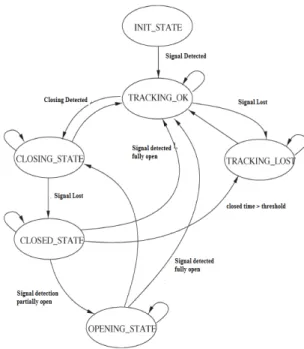
Eyelid movement is one of the visual behaviors that reflect a person’s level of fatigue. The primary purpose of eye tracking is to monitor eyelid movements and to compute the relevant eyelid-movement parameters. Here, we focus on two ocular measures to characterize the eyelid movement. To obtain a more robust estimation of the ocular measures and, e.g., to distinguish between a blink and an error in the tracking, we use a finite state machine (FSM), as depicted in figure 3. Apart from the
INIT_STATE, five states have been defined
TRACKING_OK, CLOSING_STATE, CLOSED_STAT OPENING_STATE, and TRACKING_LOST. Transitions between states is achieved from data sample with fixed interval as a function of the average signal strength values of six IR sensors framed in hexagon pattern from the module.
Figure 3: FSM for ocular measures
The system starts at the init_state. When the IR illuminated signals are detected, the FSM passes to the tracking_ok state, indicating that the tracking is working correctly. Being in this state, if the signals are not detected in a transition period to the tracking_lost state is produced. The FSM stays in this state until the signals are detected in a transition period are correctly detected again. In this moment, the FSM passes to the tracking_ok state. If the signal strength ratio decreases to a threshold (20% of the nominal ratio),a closing eye action is detected and the FSM changes to the closing_state, it is possible to return to the tracking_ok state if the ratio does not constantly decrease below 20%.
When signal strength ratio is below 20% of its nominal ratio indicating the closing_state, an FSM transition to the closed_state is provoked, which means that the eyes are closed. A new detection of the nominal ratio from the closed_state produces a change to the opening_state or the tracking_ok state, depending on the degree of the opening of the eyelid. If the signal strength ratio is between 20– 80%, a transition to the opening_state is produced. if it is below 20%, the system passes in the closed_state, a transition to the tracking_lost state is produced if the closed time goes over a threshold. The ocular parameters that characterize eyelid movements have been calculated as a function of the FSM.
The first is Percentage of eye closure over time (PERCLOS) and the second is average eye-closure speed
(AECS). PERCLOS has been validated and found to be the
most valid ocular parameter for monitoring fatigue [24]. The eye-closure/opening speed is a good indicator of fatigue. It is defined as the amount of time needed to fully close or open the eyes. Our previous study indicates that the eye-closure speed of a drowsy person is distinctively different from that of an alert person [25].
IR Signals acquisition from the operator
Analysis of Received Signal for Eye-lid movement and Tracking for blinking count and timing.
Information fusion and decision making
Driver’s vigilance Fatigue ?
Activate Warning Signal
N o
The experimental results are indicated in the figure 4 as the signal strength received for eyes closed and los of tracking to indicate driver’s fatigue status and signal strength for clear open eyes to track the driver’s alert status.
Figure 4: Nominal Signal Strength ration indicating the eyelid status( y-axis mV and x-axis 10 mS/ signal scan rate
Finally, in the driver vigilance evaluation stage, we fuse all individual parameters obtained in the previous stage, yielding the driver in attentiveness level. An alarm is activated if this level exceeds a certain threshold.
5. CONCLUSIONS
The developed embedded system is prototype vision system for the real-time monitoring of a driver’s vigilance. It is based on a hardware system for a real-time acquisition of driver’s status using an active IR illuminator and the implementation of software algorithms for the real-time monitoring of the fatigue level of a driver. These visual parameters are the PERCLOS, eye closure duration, blink frequency, face position, and fixed gaze.
The system is fully autonomous; it can initialize automatically, and reinitialize when necessary. It was tested using different sequences recorded in real driving conditions with different users during several hours. In each sequence, several fatigue behaviors were tested during the test. The system works robustly at night and for users not wearing glasses, yielding an accuracy percentage close to 95 %. The performance of the system decreases during daytime, especially in bright days, and at the moment, the system does not work with drivers wearing glasses.
6. FUTURE WORK:
In future studies it is possible that we intend to extend the system integration with Design and integrate a vibrator circuit to create vibrations in the driver seat to alert the driver for safe navigation in case the driver does not respond to the warning alert, when ever driver’s fatigue status is detected, to take over the driving towards safe parking in the parking lane.
7. REFERENCES
[1] Awake Consortium (IST 2000-28062), System for
effective assessment of driver vigilance and warning according to traffic risk estimation(AWAKE), Sep. 2001–2004. [Online].
Available: http://www.awake-eu.org
[2] D. Royal, “Volume I—Findings report; national survey on distracted and driving attitudes and
behaviours, 2002,” The Gallup Organization,
Washington, D.C., Tech. Rep. DOT HS 809 566, Mar. 2003.
[3] Ranney T. et al., “NHTSA Driver Distraction
Research: Past, Present and Future”, Driver
Distraction Internet Forum, 2000.
[4] AAA Foundation for Traffic Safety, “The Role of Driver Distraction in Traffic Crashes”, available at
http://www.aaafoundation.org/pdf/distraction.pdf , May 2001.
[5] European Transport Safety Council, “The Role
of Driver Fatigue in Commercial Road
Transport Crashes”, 2001.
[6] S. Lal, A. Craig, P. Boord, L. Kirkup, and H. Nguyen, “Development of an algorithm for an
eeg-based driver fatigue countermeasure,” Journal
of Safety Research, vol. 34, no. 3, pp. 321-328, Febuary 2003.
[7] A. Vuckovic, V. Radivojevic, A. Chen, and D. Popovic, “Automatic recognition of alertness and
drowsiness from eeg by an articial neural
network,” Medical Engineering and Physics, vol.
24, pp. 349-360, March 2002.
[8] Mervyn V.M. Yeo, Xiao-Ping Li et al. “Can SVM be
used for automatic EEG detection of
drowsiness during car driving?”, Safety Science,
vol. 47, Issue 1, pp. 115-124,2009.
[9] Q. Ji and X. Yang, “Real-time eye, gaze and
face pose tracking for monitoring driver
vigilance,” Real Time Imaging, vol. 1, no. 8,
pp. 357-377, Febuary 2002.
[10] M. Devi and P. Bajaj, “Driver fatigue detection
based on eye tracking,” 1st International
Conference on Emerging Trends in Engineering and Technology, (ICETET 08), pp. 649-652, July 2008.
[11] M. Sigari, “Driver hypo-vigilance detection based on
eyelid behavior,” 7st International
Conference on Advances in Pattern Recognition (ICAPR 09), 2009.
[12] Takei, Y., Furukawa, Y., “Estimate of driver’s
fatigue through steering motion”, SMC 05, Vol.
2, pp. 1765-1770, 2005.
[13] R. Sayed and A. Eskandarian, “Unobtrusive drowsiness detection by neural network learning
of driver steering,” Proceedings of the
Institution of Mechanical Engineers, Part D: Journal of Automobil Engineering, vol. 215, No. 9, pp. 969-975, June 2001.
[14] H. A.Rowley, S. Baluja, T. Kanade Neural
Network-Based Face DerecrionIEEE Transaction on
Panem Analysis and Machine Intelligence Vol.
[15] R. Hsu, M. Mottleb, A. K. lain Face Detection
in Color Images IEEE Transaction on Pattern
Analysis and Machine Intelligence Vo124, No. 5,
May 2002
[16] B. Jap, S. Lal, P. Fischer, and E. Bekiaris, “Using
eeg spectral components to assess algorithms for
detecting fatigue,” Expert Systems with
Applications, vol. 36, no. 2, 2009, pp. 2352–2359. [17] M. Sigari, “Driver hypovigilance detection based on
eyelid behavior,”Advances in Pattern
Recognition, 2009. ICAPR ’09. Seventh
International Conference on,2009, pp. 426–429. [18] M. Devi and P. Bajaj, “Driver fatigue detection
based on eye tracking,”Emerging Trends in
Engineering and Technology, 2008. ICETET
’08. First International Conference on, 2008, pp. 649–652.
[19] T. F. Cootes, C. J. Taylor, and A. Lanitis. "Active
shape models : Evaluation of a
multi-resolution method for improving image search." 5th British Machine Vison Conference, 1994, pp. 327–336.
[20] J. Healey and R. Picard, “SmartCar: Detecting
driver stress,” in Proc.15th Int. Conf. Pattern
Recognition, Barcelona, Spain, 2000, vol. 4,pp. 218–221.
[21] A. Kircher, M. Uddman, and J. Sandin, “Vehicle control and drowsiness,” Swedish National Road and Transport Research Institute, Linkoping,Sweden, Tech. Rep. VTI-922A, 2002.
[22] Anon, “Perclos and eyetracking: Challenge and opportunity,” Applied Science Laboratories, Bedford,
MA, 1999. [Online]. Available:
http://www.a-s-l.com
[23] H. Ueno, M. Kaneda, and M. Tsukino,
“Development of drowsiness detection system,” in Proc. Vehicle Navigation and Information Systems Conf., Yokohama, Japan, 1994, pp. 15– 20.
[24] D. F. Dinges, M. Mallis, G. Maislin, and J. W. Powell, “Evaluation of techniques for ocular measurement as an index of fatigue and the basis for alertness management,” Dept. Transp. Highway Safety, pub. 808 762, 1998.
[25] Q. Ji and X. Yang, “Real time visual cues extraction for monitoring driver vigilance,” presented
at the Proc. Int. Workshop Computer Vision
Systems, Vancouver, BC, Canada, 2001.
Authors’ Brief
PROF. BABU PG REDDY
received his Masters degree by research from Birla Institute of Technology-Pilani-India in 1995-96
in Electronics and Control
Engineering, currently pursuing
PhD studies in Control Engineering, Fault Modeling, Diagnosis and Computing. Currently working as Associate Professor and research staff in Center for Research and development, Defence University College, Deberezeit, Ethiopia. His main interests are Fault Detection Diagnosis and Computing, Design of Fault Tolerant Control Systems, Embedded systems. He worked on many research based projects in India and abroad and published 6 papers in national journals in India. He is a life member of various professional societies like MISTE. IAENG, IACSIT and SDIWC
Dr. VUDASREENIVASARAO
received his M.Tech degree in computer science and engineering from Sathyabama University from 2007.He received PhD degree in computer science and engineering from Singhania University from
2010. Currently working as
Professor in the department of
Computer and Information Technology, Defence
University College, Deberezeit, Ethiopia. His main research interests are Data mining, Fuzzy logic and Network Security. He has got 11 years of teaching experience. He has published 26 research papers in various international journals and one Springer international conference paper. He has 30 Editorial Board / Reviewers memberships in various international journals. He is a life member of various professional societies like IEEE, ACM, MAIRCC, MCSI, SMIACSIT, MIAENG, MCSTA and MISTE.
Dr. B V MOHAN, COLONEL (RETD), Currently working as Professor in the Department of
Armament Engineering, Defence
University College, Deberezeit,
Ethiopia.
CHANDRA SRINIVAS POTLURI
received his M.Tech degree in
Computer science from JNT
University. Currently working as
Assistant Professor in Aurora
Scientific Technological and
Research Academy, Hyderabad,
India. His main research interests are Data Mining & Mobile Computing. He has got 5 years of teaching experience & 4 years of Industrial experience worked in Satyam, Hyderabad, India.