UAKARI
AN INDUSTRY ANALYSIS OF THE FRESHWATER ORNAMENTAL
FISHERY WITH PARTICULAR REFERENCE TO THE SUPPLY OF
BRAZILIAN FRESHWATER ORNAMENTALS TO THE UK MARKET
Gregory Prang1
RESUMO
A proposta desta pesquisa foi desenvolver e entender o mercado potencial e a viabilidade para estabelecer um comercio sustentável de peixes ornamentais na Reserva de Desenvolvimento Sustentável Mamirauá, Brasil. Esta análise complementará e ajudará nas pesquisas e nos planos de negócios de outros paises. O objetivo principal da análise foi o mercado exportador (especificamente da UK) de peixes ornamentais. O projeto foi primariamente iniciado numa pesquisa bibliográfica, complementada por entrevistas com vários interventores e a participação em diferentes oficinas sobre o tema especifico.
PALAVRAS-CHAVE
Comercio de peixes ornamentais. Peixes amazônicos. Mercado de exportação de peixes ornamentais amazônicos.
ABSTRACT
The purpose of this research was to develop an understanding of the market potential and viability of establishing a sustainable ornamental fish trade in the Mamirauá Sustainable Development Reserve in Brazil. This analysis will complement and advise the project’s in-country investigations and business plan. The focus of the analysis was the export market (specifically UK) for ornamental fish. The project was undertaken primarily by desk research, complemented by interviews with a number stakeholders and participation in workshops.
KEY WORDS
Ornamental fish trade. Amazon fishes. Export market of ornamental amazon fishes.
Vol.3 (1): 7-51.
1 Project Sustainable Management of Ornamental Fish Species in Mamirauá, Brazil
INTRODUCTION
Review of global marketSize Size
The worldwide aquarium industry, including live ornamental fish equipment, accessories, supplies and publications, etc., has grown considerably during the last 35 years. Andrews (1992) estimated that in 1971, the total world market for aquarium fishes, equipment and accessories was worth $4 billion1, increasing to $7.2 billion in 1986. Dawes (2001) estimated the entire industry to be worth about $15 billion. The fish themselves represent only a fraction of the overall industry, maybe as little as three percent (WATSON, 2000). About 90% of the ornamental fish products originate in captivity, and the other 10% is wild-caught fish (ANDREWS, 1990; OLIVIER, 2001). Of the total of wild-caught fishes, 4-10 % are of marine origin and 90-96% are of fresh water origin (OLIVIER, 2001). Over the last ten years the value of global exports of ornamental fish has averaged just over $183 million/year, while global imports have averaged just over $281 million/year (Figura 1).2 Between 1985-1999, the international commerce of aquatic organisms had an average annual growth of around 14% (Figure 2). In 1996 and 1997 the global value of ornamental fish exports peaked around $200 million, dropping to just under $160 million in 1999. The drop in exports during the years 1998 and 1999 may be explained as repercussions of the
strong El Niño of 1997-8 (CHAO, pers. comm.). Since then, export value has increased steadily by about 14%/year, setting a record of $211,546,000 in 2003. Basleer (1994) estimates that the global wholesale trade value of ornamental fishes is near $900 million, excluding freight and packing, and the total retail value may reach $3 billion.
It is difficult to calculate the quantity of fishes traded annually with any accuracy due to reporting irregularities. Statistics provided by FAO do not clarify the number utilized in the their downloads as Figure 3 indicates. If numbers are given in thousands, then the number of individuals exported annually reaches just over 20 million. If numbers are given in ten thousands in order to reflect Brazilian exports as reported by FAO, which would thus total 11,000,000, then the global total reaches over 2 billion individuals. Fitzgerald (1989) has estimated that 350 million fishes are sold annually. Andrews (1992) estimated that only 150 million ornamental fishes were sold in the world market.
Prang, Industry analysis of freshwater ornamental fishery
UAKARI
1All values in this paper are expressed in US$.
2 There are several reasons for the discrepancy in export and
import figures. The principal reason is that freight charges are frequently included in import values. Additionally, there is no uniform nomenclature for reporting import and export statistics; there are no real standard units of volume for reporting imports and exports; and the various reports
0 50000 100000 150000 200000 250000 300000 350000 400000 1994 1995 1996 1997 1998 1999 2000 2001 2002 2003 Year Va lu e ($ U S ) Imports Exports
Figure 1. Value of global ornamental fish market. (Source: FAO Fishstat, 2005).) 0 50000 100000 150000 200000 250000 1976 1978 1980 1982 1984 1986 1988 1990 1992 1994 1996 1998 2000 2002 Year Va lu e ($ U S )
Figure 2. Evolution of ornamental fish export value. (Source: FAO Fishstat, 2005).
End markets End markets
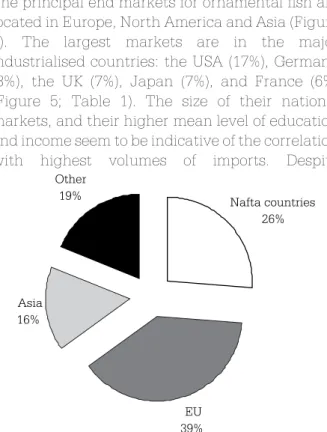
The principal end markets for ornamental fish are located in Europe, North America and Asia (Figure 4). The largest markets are in the major industrialised countries: the USA (17%), Germany (8%), the UK (7%), Japan (7%), and France (6%) (Figure 5; Table 1). The size of their national markets, and their higher mean level of education and income seem to be indicative of the correlation with highest volumes of imports. Despite
oscillations in imports from year to year in these five countries, their percentage of ornamental fish imports have remained relatively stable since FAO began compiling statistics in 1976.
Typical supply chain Typical supply chain
1. Collectors - Are generally organized in family units, utilizing artisanal technology and methods. 2.Breeders – As was mentioned above, ornamental fish culture provides about 90% of all ornamental fish in the market and, thus, serve as direct competition to those involved in the trade of wild-caught species.
3. Intermediaries – For wild-caught fish as many as three intermediaries may be involved in the chain between collectors and exporters.
4. Exporter – Buys fish from intermediaries or directly from collectors and breeders. Fish are generally quarantine for some period, although the time and husbandry methods vary, most likely in direct correlation with the number of exporters. Singapore exporters are a special case as they are specialized in conditioning and transporting fishes bred on farms throughout Southeast Asia.
5. Importer – Receive stock from exporters throughout the world, depending on the demand from their clients who may be wholesalers and/or retailers. Some may also be exporters as well transhippers. The importer must pay the freight costs associated with importation.
6. Transhippers – Consolidates orders from various buyers (importers, wholesalers or retailers) at airports and distributing them. Often they don’t
Vol.3 (1): 7-51.
UAKARI
EU 39% Asia 16% Other 19% Nafta countries 26%Figure 4. Percentage of import value by region in 2003. (Source: FAO Fishstat, 2005).).
0 5000 10000 15000 20000 25000 1994 1995 1996 1997 1998 1999 2000 2001 2002 2003 Year Qua n ti ty (1 ,0 0 0 s ) Imports Exports
Figure 3. Global imports/exports (number of individuals). (Source: FAO Fishstat, 2005).
0 10000 20000 30000 40000 50000 60000 70000 80000 90000 1994 1995 1996 1997 1998 1999 2000 2001 2002 2003 Year Va lu e (U S $ 1, 000)
France Germany Japan UK USA
Figure 5. Evolution of imports for the largest importers of ornamental fish in 2003. (Source: FAO Fishstat, 2005).
even possess installations. They are common where air routes are limited and/or shipping rates are high. Singapore, the USA, and Germany are known as key points of transhipment.
7. Wholesaler/Jobber – Wholesalers consolidate shipments from various importers to provide retailers in regional markets with stock. Jobbers serve the same function as wholesalers, but like transhippers, don’t maintain permanent installations. They are specialized in consolidating stocks according to retailer needs and making direct deliveries.
8. Retailer – Retailers can buy fish directly from importers, transhippers, wholesalers or jobbers. Buying from transhippers and jobbers carries risks and additional costs as the retailer must acclimatise the fish before sale. Olivier (2001)
claims there is a growing tendency in the retail segment to bypass the wholesalers.
9. Consumer – Consumers are fish-keepers with varying degrees of skill and preferences.
10. Key stakeholders a) Animal rights groups.
b) CBD - 1992 Convention on Biological Diversity. The CBD promises to promote of the rights of countries of origin to retain some of the benefits of their biodiversity resources that have entered the marketplace via other countries
c) CITES - Convention on Trade in Endangered Species. CITES works by subjecting international trade in biodiversity of selected species to certain controls. All import, export, re-export and introduction of species covered by the Convention have to be authorized through a licensing system.
Prang, Industry analysis of freshwater ornamental fishery
UAKARI
Rank Country 2003 Increase from 2002
Rank Country 2003 Increase from 2002
1 Singapore 41,427 -1% 1 USA 64215 38%
2 Czech Rep. 16,183 18% 2 Germany 28662 15%
3 Malaysia 14,147 -24% 3 UK 26506 11% 4 Spain 14,046 75% 4 Japan 24724 -4% 5 Indonesia 13,372 5% 5 France 22042 5% 6 Japan 12,395 33% 6 Singapore 13334 15% 7 USA 8,561 2% 7 Netherlands 11925 16% 8 Israel 8,525 34% 8 Belgium 11602 12% 9 Thailand 7,392 29% 9 Italy 11506 10%
10 Philippines 6,816 5% 10 Hong Kong 9663 2%
11 Morocco 6,475 90% 11 Spain 6756 22%
12 Sri Lanka 6,459 14% 12 Canada 6588 1%
13 Belgium 5,275 18% 13 Malaysia 3971 -12%
14 Hong Kong 4,871 2% 14 Switzerland 3174 15%
15 Colombia 4,599 7% 15 Sweden 2734 16%
16 France 3,62 16% 16 Mexico 2655 -6%
17 Peru 3,102 -107% 17 Australia 2568 -9%
18 China 3,025 28% 18 Korea, Rep. 2558 11%
19 Netherlands 2,971 42% 19 Austria 2517 26%
20 Brazil 2,379 -36% 20 Denmark 2297 12%
Top exporters of ornamental fish Top importers of ornamental fish
d) FAO - Helps developing countries and countries in transition modernize and improve agriculture, forestry and fisheries practices; Monitors world fisheries.
e) Governments-Environmental agencies, ministries of agriculture, etc
f) IATA – International Air Transport Association. The body responsible for the regulation of international airfreight, including live animals. g) IUCN - The Union’s mission is to influence, encourage and assist societies throughout the world to conserve the integrity and diversity of nature and to ensure that any use of natural resources is equitable and ecologically sustainable. The IUCN links research and results to local, national, regional and global policy by convening dialogues between governments, civil society and the private sector.
h) OIE - World Organisation for Animal Health. There are 167 member countries participating in the OIE. The OIE ensures transparency in the global animal disease and zoonosis situation; to collect, analyse and disseminate scientific veterinary information; and provide expertise and encourage international solidarity in the control of animal diseases. Within its mandate under the WTO SPS Agreement, it seeks to safeguard world trade by publishing health standards for international trade in animals.
i) OFI - Ornamental Fish International. The worldwide trade body for the ornamental fish industry.
j) WTO - World Trade Organisation. The Agreement on Technical Barriers to Trade (TBT) states that members do not use technical regulations or standards as disguised measures to protect domestic industries from foreign competition. Thus, certification programs must recognize this agreement.
Key competitors Key competitors
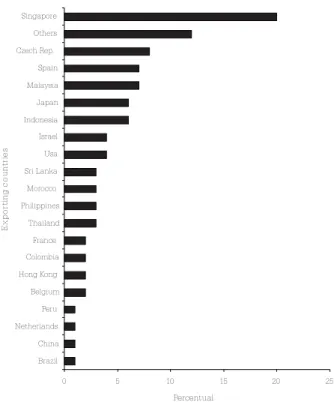
Most captive bred ornamental fishes originate from fish farms in Singapore, Malaysia, Japan, Israel, Czech Republic, Thailand, Hong Kong, and the US (Figure 6; Table 1). Although much of the exports of ornamental fish originating from these countries may be a consequence of some transhipping, their combined share of the global trade represents 53%. It should be noted that Singapore does breed ornamental fish, but typically imports fish from Malaysia, Thailand, and Indonesia and other Southeast Asian countries, and conditions them; adding value to the product and taking advantage of low freight costs to provide the market with high quality (according to Olivier (2000), it is now suffering from fish diseases however), low cost fish. Thus, if it imports $13,334,000 and exports $41,427,000, then it would gross $28,093,000 during 2003. What percentage of this total is comprised of internally bred fish I was unable to ascertain. Percentual
Legislative environment: welfare and Legislative environment: welfare and conservation
conservation
The only international legislation affecting the global trade in ornamental fish is CITES. Appendix 1 specimens cannot be used for commercial purposes. Appendix 2 and 3 specimens require an export permit or re-export certificate issued by the Management Authority of the State of export or re-export. The specimen must be obtained legally and not negatively affect the survival of the species. Any risk of injury, damage to health or cruel treatment must be minimized. Import permits are only needed if required by the importing country. The only the species that might be considered ornamental in the Brazilian Amazon that appears on the 2006 IUCN Red List of
Vol.3 (1): 7-51.
Threatened Species is the Arapaima gigas. This species has been on Appendix 1 since 1975. Increasingly, the World Organisation for Animal Health (OIE) is becoming a major actor regarding welfare in the ornamental fish trade. Exporting countries must now be certified as free from specific pathogens associated with certain cold-water species in the carp and salmon families common in aquaculture. Although these diseases are not presently found in tropical climates, the testing required is extensive and expensive. The problem is that there exists no laboratory in Brazil with the equipment to test for such diseases, but according to Brazilian law, only Brazilian certified laboratories can test for the diseases. As of today, Brazilian exporters are unable to export ornamental fishes to Spain. This issue may become more complicated as gold fish are now being raised on farms in some Amazonian countries such as
Colombia and Brazil. According to some exporters there is also the possibility that, with the avian flu epidemic, OIE and its member states may be frightened sufficiently to apply stringent welfare guidelines for all shipments of live animals.
Current status and key trends Current status and key trends
As of 2003, the value of ornamental fish exports were at their highest on record (FAO Fishstat, 2005). Unfortunately it is not possible to present more current data is there is a lag of two years in reporting by FAO.
According to Olivier (2001), two trends in the fish-keeping hobby are worth noting. The first is that marine aquariums are becoming more popular as technology necessary to maintain marine ornamentals becomes more available and less expensive. The quality of marine ornamentals has also improved as many NGOs such as the Marine Aquarium Council (MAC) and Ocean Voice have moved to eliminate harmful fishing practices. This trend can also be observed in the data provided by FAO (Fishstat, 2005). Since about 1989, and particularly since the mid-1990s, countries that exported next to nothing now have meaningful ornamental fish exports. In the South Pacific, countries such as Kiribati, Marshall Islands, Cook Islands, Fiji Islands, French Polynesia, Micronesia, New Caledonia, and Tonga are now present in FAO’s report. In the Middle East, Iran, Egypt, Libya, Morocco, Saudi Arabia, United Arab Emirates, and Yemen are now ornamental fish exporters. In the Indian Ocean, Maldives, Mauritius, and Sri Lanka, as well as Mexico, Costa Rica, Haiti, Martinique, Netherlands Antilles, and Trinidad and Tobago in the Caribbean have all shown growth in ornamental fish exports.3
Prang, Industry analysis of freshwater ornamental fishery
UAKARI
0 5 10 15 20 25 Brazil China Netherlands Peru Belgium Hong Kong Colombia France Thailand Philippines Morocco Sri Lanka Usa Israel Indonesia Japan Malaysia Spain Czech Rep. Others Singapore Ex p o rt in g c o u n tri e s PercentualFigure 6. Principal exporting countries of ornamental fish in 2003. (Source: FAO Fishstat, 2005).)
3MAC has a nice map of the marine ornamental fish trade:
The second trend, according to Olivier (2001), is that the fish-keeping hobby has broken down social barriers. She claims that the hobby is now open to all and that fish are being treated as standard consumer products. As such, she concludes that consumers are in search of low prices without thinking about quality. She does not offer any proof of her position however, so I am dubious of her claim.
A third trend can be identified as the growing recognition that wild-caught ornamental fish have socio-economic and environmental value (CHAOet al., 2001; TLUSTY, 2002; ROSSER, 2003). This trend is also reflected in the very project we are presently undertaking.
A fourth trend is the growth of large pet stores such as Petco and PetSmart and Wal-Mart in the US. There is some debate on what the effects of these super stores are exactly. Many trade participants feel that the small pet/aquarium store has benefited from their growth, as fish quality is low, causing the consumer to seek the local pet/aquarium store, as the staff is more knowledgeable. Others claim that the low prices for equipment is creating more hobbyists who then look for more variety offered at the local pet/aquarium store.
Lastly, with regard to freshwater fish species, personal communication with industry participants and with Dr. Chao of Project Piaba (who has intimate contact with many importers in Asia and Europe) indicate that consumer interest in specialty fishes such as stingrays
(Potamotrygonidae), Loricariidae, Apistogrammas and corydoras continues. He also noted that importers are interested in introducing new species verities that can often stimulate the enthusiasm of the hobby.
THE AMAZONIAN EXPORT MARKET
Size
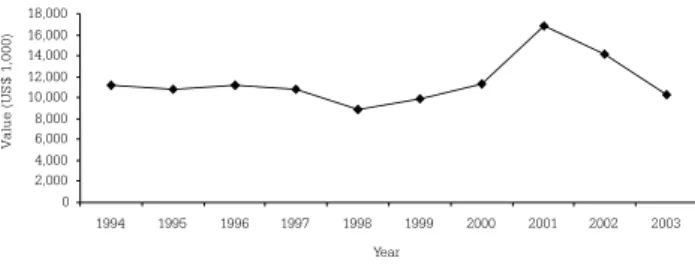
In the ten years between 1994 and 2003, the average value of Amazonian ornamental fish exports was about $11.5 million/year (Figure 7). Together, the countries of Brazil, Colombia, Ecuador, Guyana, Peru and Venezuela represent about 6% of the total global export value of ornamental fish. The largest exporting country is Colombia (46%) followed by Peru (30%), Brazil (23%)4, Guyana, Venezuela and Ecuador (Figure 8). Colombia is currently the largest exporter of ornamental fish in South America. Between 1991 and 2004, Colombia has exported an average of 18,185,357 individual fish per year (Figure 9). Over
Vol.3 (1): 7-51.
UAKARI
4 Market data for Brazil will be treated in forward.
Figure 7. Total value of ornamental fish exports from Amazonian countries. (Source: FAO Fishstat, 2005)
0 2,000 4,000 6,000 8,000 10,000 12,000 14,000 16,000 18,000 1994 1995 1996 1997 1998 1999 2000 2001 2002 2003 Year Va lu e (US $ 1, 0 0 0 ) 0 2 4 6 8 10 12 1993 1994 1995 1996 1997 1998 1999 2000 2001 2002 2003 2004 Year Va lu e ($ U S 1 ,000)
Brazil colombia Ecuador
Guyana Peru Venezuela
Figure 8. Ornamental fish export value from Amazonian countries. (Source: FAO Fishstat, 2005).
the last two years, exports have amounted to just over 20 million individuals. Although exports remained stable during 2003 and 2004, profits rose by $2,709,000 or roughly 61%.
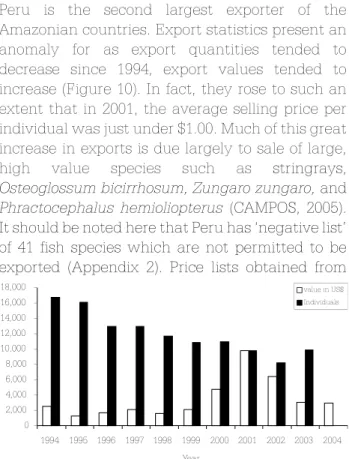
Peru is the second largest exporter of the Amazonian countries. Export statistics present an anomaly for as export quantities tended to decrease since 1994, export values tended to increase (Figure 10). In fact, they rose to such an extent that in 2001, the average selling price per individual was just under $1.00. Much of this great increase in exports is due largely to sale of large, high value species such as stringrays,
Osteoglossum bicirrhosum, Zungaro zungaro,and
Phractocephalus hemioliopterus (CAMPOS, 2005).
It should be noted here that Peru has ‘negative list’ of 41 fish species which are not permitted to be exported (Appendix 2). Price lists obtained from
exporters out of Iquitos indicate that several prohibited species are offered for sale anyway. The combined exports of Guyana, Venezuela and Ecuador only reach 1.4% of ornamental fish exports from Amazonian countries. Of these three countries, Guyana is the largest exporter (Figure 11).
End Markets End Markets
The United States is the largest importer of Colombian ornamental fishes, followed by the European Union and Asia (Table 2). While the United State is the largest importer, imports fell 36% between 1984 and 2004. The reason for this precipitous drop is due to the growing Asian market, and an increase in direct flights to Europe from Colombia that has reduced the number of transhipments through the USA (CASTRO, 2005). Within Europe (Figure 12), Germany is the largest importer of ornamental fish, followed by UK, and
Prang, Industry analysis of freshwater ornamental fishery
UAKARI
0 5000000 10000000 15000000 20000000 25000000 199 1 19 92 199 3 19 94 19 95 19 96 19 97 19 98 19 99 20 00 20 01 2 002 20 03 2 004 Year US$ individualsFigure 9. Evolution of Colombian exports of ornamental fish. (Source: SANABRIA, 2005).
Figure 10. Evolution of Peruvian exports of ornamental fish . (Source: FAO Fishstat, 2005; HUANQUI, 2005)
0 2,000 4,000 6,000 8,000 10,000 12,000 14,000 16,000 18,000 1994 1995 1996 1997 1998 1999 2000 2001 2002 2003 2004 Year value in US$ Individuals
Figure 11. Evolution of exports of ornamental fish from other Amazonian countries. (Source: FAO Fishstat, 2005).
0 100 200 300 400 500 600 1994 1995 1996 1997 1998 1999 2000 2001 2002 2003 Year V a lu e (U S $ 1 00)
Ecuador Guyana Venezuela
Destination 1984 1994 1999 2004 USA 73% 69% 58% 37% Europe 27% 24% 23% 22% Japan 6% 13% 12% Others 5% 11% Asia (other) 10% Central America 8% (Source: SANABRIA, 2005)
France. However, it should be noted that Frankfurt is a key transhipping point in Europe, and many ornamental fish imports into Germany are re-exported. In Asia, Japan is the largest importer, followed by Singapore, and Taiwan and Hong Kong, the latter two may be transshipping to China. Colombian exporters believe that it is in the Asian market that future sales growth will be the highest.
Peruvian ornamental fish are shipped to about 70 cities around the world. However, air routes out of Lima are not very extensive. Consequently, transhipping via Miami is very common. Peruvian exporters complain that transhipping negatively effects the prices of Peruvian fish as each carrier utilized increase the price/individual fish. Transhipping was common for shipping to some points in Europe. The US is the main importer of Peruvian ornamental fish (Figure 13). However, since 2001 Peruvian exports to Asia have increased from about 25% to over 50%, with Hong Kong and Taiwan nearly doubling their imports (HUANQUI, 2005). This increase is attributed to improved air routes, but might also result from the liberal export laws.
The largest importer of Venezuelan ornamental fish is also the US, followed by Germany, the UK, and Denmark (Figure 14). In 2003, Venezuela exported about $28,000 worth of ornamental fish (FAO, 2005). I was unable to obtain any more end market data for Venezuela, and found nothing for Ecuador. Exports from Guyana have declined in recent years for reasons are not clear. Watson (2005) attributes the decline to the lack of direct air routes to Europe, competition from other South American exporting countries, competition from fish farms, and the absence of a coherent marketing strategy by Guyanese exporters. Only the UK and Germany import fishes directly from Guyana.
Principal Product Offerings Principal Product Offerings
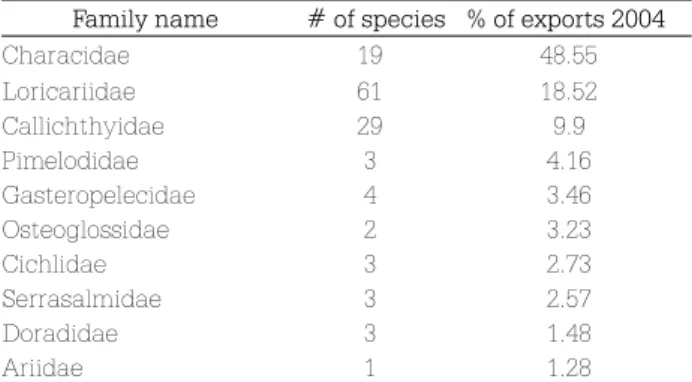
Colombia’s principal exports are composed of species from the Characidae (49%), Loricariidae
Vol.3 (1): 7-51.
UAKARI
% destinations 0 5 10 15 20 25 30 35 40 Russia France Holland Poland UK Hongkong Taiwan others Central Am. Singapore Germany Japan N. Amer. C ou n tr yFigure 12. Destinations of ornamental fish exports from Colombia in 2004. (Source: CASTRO, 2005)
Percentage 0 5 10 15 20 25 Malaysia Thailand UK Singapore Germany Taiwan Others Japan Hong Kong USA
Figure 13. Ornamental fish imports from Peru by world region in 2004. (Source: HUANQUI, 2005) 0 5 10 15 20 25 30 35 40 N.America Germany Denmark UK Belgium Mexico Other Fi s h im p o rt s Percentage
Figure 14. Ornamental fish imports from Venezuela by world region in 2004. (Source: MONAGAS, 2005).
(19%), and Callichthyidae (10%) families, representing around 78% of the total volume in 2004 (Table 3). Although the Characidae family represents the highest volume of exports, only 16 species are exported. The Loricariidae and Callichthyidae families, however, are represented by greater diversity, with 61 and 29 species exported respectively.
Of the 19 characins, as well as overall, the
Paracheirodon axelrodi is most popular ornamental
fish export, representing nearly 32% of exports and more than 6.5 million individuals (SANABRIA, 2005). Other important characins include the
Paracheirodon innesi (10%) Hemigrammus
rodwayi, which may in fact be Poecilocharax
weitzmani (7%),Hemigrammus rhodostomus [sic,
bleheri] (6%), and Hyphessobrycon sweglesi(6%).
Eleven genera of Loricariidae are permitted for export. In 2004, 61 varieties of Loricariidae were exported (Table 3). The Otocinclus genus contributes the second most to Colombian exports, representing 46% of the category. In addition to
Otocinclus, Hemiancistrus, Farlowella, and
Chaetostomas genera, there are a variety of
species exported from the genera Hypostomo,
Panaque,Peckoltia, and Ancistrus. Among the 29
Callichthyidae exported from Colombia are 6
genera: Bunocephalus, Brochis, Callicthys,
Corydoras,Dianema, and Hoplosternum. Although
Colombia permits the export of at least 14 species
ofCorydoras, 3 species (C.metae,C.melini and C.
aeneus) represent 15% of all exports from the
Callichthyidae family (SANABRIA, 2005).
According Campos (2005), at least 361 species of fish are exported as ornamentals (Appendix 3). Peru exports relatively high-priced fishes such as stingrays (Potamotrygonidae), aruanã, electric fishes (Gymnotiformes) and large catfishes (Pimeloidae), in large numbers, to international markets (MOREAU; COOMES, 2007). Based on price lists I obtained and the principal species of ornamental fish exported from Peru (Table 4 & 5), two species,Osteoglossum bicirrhosum (aruanã -1,257,112 x $.68/each5 = $852,043) and
Phractocephalus hemioliopterus (red tail catfish
-76,647 x $4.00/each = $306,588), represent of 37% of exports in 2003; probably more. The most commonly exported species in terms of quantity are the Otocinclus affinis, Osteoglossum
bicirrhosum, Hyphessobrycon erythrostigma and
the callichthyid catfishCorydoras julii(Table 4). I was unable to locate specific export data regarding product offerings for Guyana and Venezuela, but a list of species exported by each country is provided in Appendix 4.
Typical supply chain Typical supply chain
Prang, Industry analysis of freshwater ornamental fishery
UAKARI
Table 4. Export values of Peruvian ornamental fish in 2003. (Source: CAMPOS, 2005) Specie Otocinclus affinis Osteoglossum bicirrhosum Corydoras julii Hyphessobrycon eryrostigma Value ($1,000) 32,511 852,043 20,882 15,588
5The price lists I obtained indicate that export prices range
between $1.80-2.20 for juveniles and $6.00 for larger individuals. Thus, export revenues may reach near $2.5 million/year.
Family name # of species % of exports 2004
Characidae 19 48.55 Loricariidae 61 18.52 Callichthyidae 29 9.9 Pimelodidae 3 4.16 Gasteropelecidae 4 3.46 Osteoglossidae 2 3.23 Cichlidae 3 2.73 Serrasalmidae 3 2.57 Doradidae 3 1.48 Ariidae 1 1.28 (Source: SANABRIA, 2005).
Table 3. Principal Families of Fish Exported from Colombia in 2004.
1. Collectors – In Peru collectors have 250 fishing areas located along 21 rivers, with three rivers—the Nanay, Itaya and Ucayali—supplying over 80% of all fishes received at exporters’ facilities (CAMPOS, 2005). Moreau & Coomes (2007) estimate that there may be as many as 4,500 year-round collectors, and possibly 3-9,000 part-time collectors (probably a very generous estimate). The number of collectors in Colombia is not known precisely, but Perdomo (2005) estimates 2,309 collectors in all of Colombia. Collectors are active in the following river basins: Orinoco, Amazonas, Pacific, Magdalena, and Atlantic. 88 percent of exports in 2004 originated in the Orinoco basin (SANABRIA, 2005).
2. Intermediaries – There may be as many as 300 intermediaries working in the Peruvian Amazon (MOREAU; COOMES, 2007). In Peru intermediaries are known as proveedores, and there are two levels. Intermediaries consolidate the production of collectors and/or other smaller-scale intermediaries transactions may involve cash or
debt-merchandise contracts, termed locally as
habilitación (aviamento in Brazil). According to
Perdomo (2005), there are approximately 65 intermediaries involved in the ornamental fish trade in Colombia. Fish can pass through as many as three levels of intermediaries before reaching exporters’ facilities in Bogotá: primary intermediary; regional intermediary; national intermediary.
3. Exporter – There are eleven exporters operating in Iquitos (HUANQUI, 2005). Moreau & Coomes (2007) identify two categories of exporters:
‘miamero’ companies, whose main clients are
importers in the US, and ‘destino final’ (DF) companies that ship fish directly to clients across the globe. DF companies, in contrast to miameros, specialise in supplying specific varieties of quality fishes. There are about 16 exporters operating out of Colombia. Logistics in both countries are estimated at between 18-25% of the price of fish sold. There are two exporters currently active in Guyana, and 6 in Venezuela. In each of these countries, generally one to three firms dominate in export volume. Packing costs for exportation are about $12.00 per each double box. Boxes are made of Styrofoam inside a cardboard box, with dimensions of 42 x42 x 40 cm (16 x 16 x 15 inches). Each box holds 9-15 kg of water, depending on the number and size of fish being shipped. Shipping agent expenses from Iquitos and Bogotá are about $100.00/box. I was unable to obtain freight costs for Peru, but freight costs from Colombia (discussed later) are provided in Table 9. Freight may cost 100-500% of the cost of the fish themselves.
Key stakeholders Key stakeholders 1. Venezuela
a. The National Institute of Fisheries and Aquaculture (INAPESCA)
Vol.3 (1): 7-51.
UAKARI
Table 5. Principal species of ornamental fish exported from Peru in 2003. Otocinclus affinis Osteoglossum bicirrhosum Corydora s Hyphessobrycon erythrostigma Paracheirodon innesi Carnegiella strigata Corydoras hastatus Corydoras punctatus Boehlkea fredcochui Corydoras arcuatus Brochis splendens Leporinus fasciatus Carnegiella marthae Ancistrus dolichopterus Specie Individuals 2,421,184 1,257,112 julii 649,461 620,865 455,930 404,292 325,735 280,017 273,881 210,965 69,749 142,469 132,218 99,917 Pimelodus pictus 99,160 Hyphessobrycon bentosi 87,824 Corydoras elegans 86,025 Nannostomus trifasciatus 80,388 Phractocephalus hemioliopterus 76,647
b. Ministry of Agriculture and Land
c. Ministry of Environment and Natural Resources (MARN)
d. Ministry of Production and Commerce e. Ministry of Foreign Relations
2. Peru
a. Ministry of Production
b. National Fishery Development Fund (FONDEPES)
c. Institute of Fishery Technology (ITP) d. Peruvian Amazon Research Institute (IIAP) e. Agricultural Ministry
f. National Institute of Natural Resources (IRENA) g. State and Municipal Governments
h. State Production Centres
i. State and municipal secretaries of environmental protection
j. Foreign Relations Ministry (RR EE)
k. Commission for Export Promotion (PROMPEX) l. Customs Agency (ADUANAS)
m. Public Fishery Certification Company of Peru (CERPER)
3. Colombia
a. Colombian Association of Producers and Exporters of Ornamental Fish (ALCOPECES) b. Ministry of Agriculture
c. National Institute of Renewable Natural Resources (INDERENA)
d. Environmental Ministry
e. National Institute of Fisheries and Aquaculture (INPA)
f. Colombian Institute of Animal Husbandry (ICA) g. Colombian Institute of Rural Development (INCODER)
h. State and Municipal governments
i. State and municipal environmental protection secretaries
j. Colombian Customs and Tax Agency (DIAN)
Key competitors Key competitors
The key competitors in the Amazonian countries are Colombia, Peru, Brazil, Guyana, Venezuela and Ecuador. Among this group of countries, Colombia, Peru and Brazil, as the largest exporters, compete the most. Although each country has a number of species endemic only with in their geopolitical boundaries, many of the same species have distributions in more than one country. In Appendix 5 I have listed species which are permissible for export from both Brazil and Colombia and are also exported from Peru. Exporters in each country, depending on the quantities and quality they have available, may price these species attractively in order to fill orders of more rare and valuable species, with the effect of lowering the price of species for which a competing country may depend on as a sales leader.
Legislative environment: welfare and Legislative environment: welfare and conservation
conservation
The legislative environment varies from country to country. The Ministry of Production is the principal authority of legislation affecting the ornamental fish trade in Peru. With regard to conservation, the Ministry is responsible for: prohibition of certain species; setting the maximum volume of capture; establishing fishing zones and times of prohibition; stipulating equipment and methods of capture; establishing necessary actions for the conservation of species.
With regard to welfare, the Ministry establishes the minimum requirements ornamental fish export facilities, such as: system of treatment and distribution of the water; illumination and appropriate ventilation; deposits, aquariums or pools suitable in number and capacity to the volume of operation; implements for the
Prang, Industry analysis of freshwater ornamental fishery
manipulation of the species; material and equipment for the feeding, prophylaxis and boarding.
The Peruvian Ministry of production also requires that exporters obtain a Sanitary Certificate granted by CERPER before exportation; that fish remain in the commercial aquarium a minimum of 72 hours from their entrance for their adaptation and/or treatment, in case of the presence of diseases, before their packing for export; and a Certificate of Origin from the Ministry of Fisheries. In Colombia, the Colombian Institute of Rural Development (INCODER) is responsible for establishing management measures and ensuring conservation of ornamental fish. It also establishes the species that can (8 genera and 131 species) and cannot be considered ornamentals (Appendix 1), and the prohibition of fish resources in such areas as Puerto Carreño, Puerto Inirida and Rio Arauca during May and June, as well as periods of prohibition for aruanã (Osteoglossum bicirrhosum) in the Basin of the Ríos Amazonas (Sept.1-Nov.15), Putumayo (Nov. 1-Mar.15), Caqueta (Nov. 1-Mar.15).
The Colombian Institute of Animal Husbandry (ICA) is responsible for fish welfare. It has created measures for sanitary treatment of importation and exportation of live animals (and fish) and their by-products taken from the natural environment. Further, it establishes the registration of foreign firms that desire to export live Colombian aquatic (cultivated) and terrestrial animals to ensure their health.
In Venezuela, the capture of ornamental fish in the tributaries of Lakes Valencia and Maracaibo is prohibited. Between the period May 15 and July 15 ornamental fishing is prohibited in all the national territory. Venezuela has a short list of fish that may not be exported (Appendix 2; see Appendix 4 for species that are exported).
Current status and key trends Current status and key trends
The price of fuel has been increasing worldwide during the past several years. Exporters throughout Amazonia lament that a consequence of this fact is the rise in international freight costs. Rising freight costs lead to importers to demand decrease in prices to maintain stable consumer demand. Exporters appear to suffering from a lack of direct air routes to some key destinations within importing countries. In the case of Brazil and Peru the issue seems to be more severe where the exporters are established in more remote areas and thus enjoy the benefits of major international air hubs.
Peru and Colombia, however, seem to be benefiting from an increase of routes to Asia (Table 2; Figures 12 & 13). A consequence of this development is the increasing importance of the Asian market for both countries. These routes are important for the Peruvian exporters who can more easily supply the large, charismatic fishes such as stingrays (Potamotrygonidae), aruanã and catfishes (Pimeloididae) that are of increasing demand in that pat of the world. Although Colombia has a more conservative legal environment with regard to ornamental fish exportation, not permitting the exportation of the large catfishes for example, it has benefited from the ability to sell rays and aruanã.
Most exporters agree that there is continuing demand for rare and novel species. Further, some importers believe that it is the new species introductions to the market that maintain consumer interest in the hobby. Demand for species of Corydoras, Apistogrammas, Loricariidae main popular according to exporters. One key global trend in market preferences seems to the increasing demand for stingrays. Demand for these fishes is high in Europe, Asia and North America.
Vol.3 (1): 7-51.
ANALYSIS OF SUPPLY CHAIN OF BRAZILIAN
FRESH-WATER ORNAMENTALS TO UK
MARKET
6Size
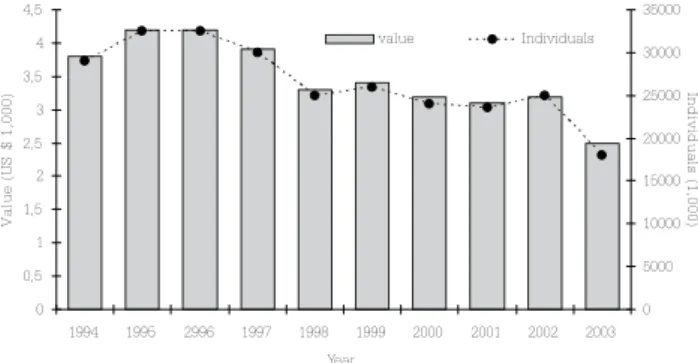
Brazil at present represents only 1% of the volume of ornamental fishes in the world market (Figure 6), and 23% of the Amazonian market. The State of Amazonas contributes approximately 60% of the total exported from Brazil (Figure 15). Most of the remaining volume originates in the State of the Pará, exporting about 32% of Brazilian ornamental fish exports (LACERDA, 2005). Although the quantity of exports has tended to fall in recent years (Figure 16), the demand of ornamental fishes from Amazonas has remained relatively stable along the last 30 years (Figure 17), oscillating between 10 and 20 million. The value of ornamental fish exports has averaged about $3.5 million/year, but has declined by 45% from the period 1995-2003 (Figure 16). Although we have yet to receive the export statistics from IBAMA-AM for the last five years, exporters have assured me that exports have continued to fall from 2004 to present. The reasons for this decline are provided below under the heading, Key competitors.
End Markets
In terms of exports of ornamental fish from Amazonas to global regions, Europe is the largest importer (40%), followed by North America (28%) and Asia (18%) (Figure 18). Europe is the principal importer of ornamental fish from Brazil, while North America is the largest importer from
Colombia and Asia the largest importer from Peru (Figure 19). The principal European importing
countries of ornamental fish from Amazonas are Germany (56%), the Netherlands (17%), France (6%), Belgium (6%) and the UK (4%) (Figure 20). The value of UK ornamental fish imports from Amazonas until 2000 were about $200,000/year (Figure 21).
Principal Product Offerings
The export potential of ornamental fish is probably much higher than is currently realized in Brazilian Amazonia, principally due to the restrictive measures (limit on the number of species) imposed by the Brazilian environmental authorities, specifically ‘Normative instruction number 3, 9 of
Prang, Industry analysis of freshwater ornamental fishery
UAKARI
6Although I will make reference to other regions of Brazil, data
presented refers mostly to the situation of the state of Amazonas. Additionally, as I have not yet received more recent export data from IBAMA, most statistical data is current as possible. 0 500 1000 1500 2000 2500 3000 3500 4000 4500 1996 1997 1998 1999 Year V a lu e (U S $1, 000) Brasil Amazonas
Figure 15. Amazonian contribution to Brazilian ornamental fish exports. (Source: SOUZA, 2001)
Year 0 0,5 1 1,5 2 2,5 3 3,5 4 4,5 1994 1995 2996 1997 1998 1999 2000 2001 2002 2003 V a lu e (U S $ 1 ,000) 0 5000 10000 15000 20000 25000 30000 35000 In d iv id u a ls (1, 000) value Individuals
Figure 16. Evolution of ornamental fish exports from Brazil. (Source: FAO Fishstat, 2005).
June 2005,’ of the MMA (Appendix 1). Rational planning for the use of a greater number of species of ornamental fish still not exploited, linked to the establishment of measures that generate an improvement in handling technology, may lead to an increase in the current production potential of this extractivist activity.
There are 800 species of fish registered for the Rio Negro (CHAO, 2001), but only around 70 species of fish from the basin are currently permitted for
exportation. The principal species, cardinal tetra
(Paracheirodon axelrodi) represents 76 to 89 % of
the total of fishes exported from the state of Amazonas annually (Figure 16)7. Other important species include the green neon (Paracheirodon
simulans), Aspidoras poecilus, Otoncinclus spp.,
Peckoltia spp., Bleeding heart tetras
(Hyphessobrycon spp.), and rummy nose tetras
(Hemigrammus bleheri) (Figure 22).
At present, the state of Pará is the principal producing centre of ornamental fishes of the family
Vol.3 (1): 7-51.
UAKARI
0 5 10 15 20 25 30 35 USA Germany Japan Netherlands Taiwam France Belgium UK Denmark Spain Singapore Israel Co u n tr y PercentageFigure 18. Principal importing countries of ornamental fish from Amazonas, Brazil in 1999. (Source: SOUZA, 2001)
0 10 20 30 40 50 60 Europa Asia US Region Pe rc e n ta g e
Brasil Peru Colombia
Figure 19. Percentage of exports ornamental fish by destination. (Source: CASTRO, 2005; HUANQUI,2005; SOUZA, 2001 Year 0 5 10 15 20 25 1974 1975 1976 1977 1978 1979 1980 1981 1982 1983 1984 1985 1986 1987 1988 1989 1990 1991 1992 1993 1994 1995 1996 1997 1998 1999 2000 2001 2002 2003 N u m b e r o f in di vi du a ls total cardinal
Figure 17. Ornamental fish exports from Amazonas. (Source: SOUZA, 2001; IBAMA N/D).
7 The cardinal tetra represents 32% of exports in Colombia
Loricariidae. The popularity of these fishes increased extraordinarily in the international
hobby market at the end of the 1980s when the first species of intense colouring were found in the Rivers Tocantins and Xingu. The Loricariidae present greater value when compared with other species of ornamental popular fishes like cardinal tetras, rummy nose tetras or Corydoras.
I was unable to gather much data for the rest of Brazil, but I can make some general comments. In the south of Brazil, particularly in the Rio Paraguay basin, varieties of Corydoras are available. There are also several species that originate in the
Pantanal and are sold from Goiania, São Paulo and Rio de Janeiro.
Stingrays (Potamotrygon spp.) are another important export because of their high demand and value, although I have no export data on them. They are exported through quotas controlled and distributed by IBAMA (Brazilian Institute of the Environment and Renewable Resources) to ACEPOAM (Association of Breeders and Exporters
of Ornamental fish of Amazonas), ACEPOPA (Association of Breeders and Exporters of Ornamental fish of Pará) and ACEPOAT (Association of Breeders and Exporters of Ornamental fish of Altamira). The current legislation ‘Normative instruction number27, 31 of August 2005, of the MMA)regarding the quota has expired and has yet to be renewed this year.
Prang, Industry analysis of freshwater ornamental fishery
UAKARI
Figure 22. Other ornamental fish exports from Amazonas by species. (Source: SOUZA, 2001).
Figure 21. Ornamental fish exports from Amazonas to UK. (Source: SOUZA, 2001). 0 50.000 100.000 150.000 200.000 250.000 300.000 1976 1977 1978 1979 980 1981 1997 1998 1999 mai/00 Year Va lu e (U S $ )
Figure 20. European destinations of Brazilian ornamental fish in 1999. (Source: SOUZA, 2001) 0% 10% 20% 30% 40% 50% 60% Germany Netherlands Belgium France Spain UK Denmark Austria Italy Swedem Finland Malta Switzerland Greece Portugal Czech R. E u ro p e a n d e s tin a tio n Percentage
BRAZIL: THE SUPPLY CHAIN
Typical supply chainAs is the case in other Amazonian countries ornamental fish pass through at least one level of intermediaries (Figure 23). The socioeconomic organization of the ornamental fish trade, from the collectors to the exporters, has strong undertones of family and kinship. Table 6 provides a general view of the product chain originating in the state of
Amazonas. The table contemplates the prices paid an a general description of the main expenses involved in the commerce process of the cardinal tetra. This table should be adapted to reflect the species of Mamirauá and Amanã, as well as importation into the United Kingdom.
Collectors
In State of Pará, the Rios Tapajós and Xingu are the principal locations of ornamental fish collection. Loricariidae are the principal targets in these regions where collectors must dive in order to capture them. Data of the ACEPOAT (Association of Creators and Exporters of Ornamental Fishes of Altamira) demonstrate that in the region of the Rivers Xingu and Iriri there are more than 500 families of fishermen involved in the fishing of Loricariidae (ABREA, 2005).
In the state of Amazonas, collectors are concentrated in various municipalities (see Table 7). The highst concentration of fish collectors is in
Vol.3 (1): 7-51.
UAKARI
E xporters E xporter
Re p re se nta tive s P iabeirosP atron A uto nom o us P iabeiros P a tro n P iabeiros C lients -C o lle cto rs C lients -C ollectors
Figure 23. Amazonas ornamental fish chain of custody
Point in distribution of fish
Price per thousand cardinal tetras sold (US$ = R$2.25)
Markup as percentage
Principle expenses involved in commerce, and other considerations
Piabeiro $6.7/1,000 or
$0.007/fish
Canoe, knife, machete, nylon mosquito netting., and fuel
Intermediary $11.00/1,000 or
$0.01/fish
100% Boat, fuel and oil, repairs non-payment of advances,
mortality of fishes, and possibly transport of fish to
-Manaus
Exporter $100.00/1,000 or
$0.10/fish
900% Transport of fish to Manaus, mortality, water,
utilities, installation, labor, food and medical treatment of fish, customs, taxes, packaging and marketing.
Importer $300.00/1,000 or
$0.30/fish
300% Transportation (Manaus-Miami), same as exporter.
W holesaler $750/1,000 or
$0.75/fish
250% Transportation (Miami-Detroit), same as exporter &
importer.
Retailer $3,000/1,000 or
$3.00/fish
400% Mortality, water, utilities, installation, labor, food and
medical treatment of fish, customs, taxes, packaging; buying in small lots and selling on a small scale.
the Rio Negro basin, in the municipalities of Barcelos and Santa Isabel, where as many as 1,000 families might be involved. Other than in these two municipalities, most collection areas are quite limited in the varieties of species sought: discus, corydoras, apistogrammma, loricaridae and otocinclus.
Methods and equipment
The methods and equipment utilized in the capture of ornamental fish are rudimentary and artisanal. The technology, and the collecting method employed, depends on environmental features and the species targeted.
1. Species of Geophagus and Apistogramma- Seine nets are used for in the leaf litter on stream margins and on sandy beaches. Fishing with a seine net requires at least two people (Figure 24).
2. Discus – Discus like to hide in downed trees or flooded vegetation. Discus collection, like most fishing for cichlid species in the region, occurs in the evening. Collectors fashion flashlights on their heads or in their mouths for spotting the fish and then scooping them with nets of about 8 inches of
diameter. Dip nets are made of one of two types of filament: soft (Figure 25) for fishing against the current, and firm (left) for fishing with the current. The latter causes much more abrasion on the fish than the former.
3. Loricariidae – In most areas, collectors look for downed trees and logs by walking along the surface or diving to river/stream bottom when the water is at its lowest level. The only equipment used, if any, is a diving mask. If possible, the logs are dragged with to beaches or other shallow
Prang, Industry analysis of freshwater ornamental fishery
UAKARI
Municipality Ornamental fish varieties Number of intermediaries
Lábrea Corydoras schwartzi, otocinclus 4
Maués Discus, Corydoras, Apistogramma 4
Nhamundá Discus, Corydoras, Loricaridae 4
Novo Airão Discus 4
Carauari Discus,Corydoras 4
São Gabriel da Cachoeira Corydoras, Apistogramma From S. Isabel
Barcelos Many varieties 60
Santa Isabel Many varieties 10
Tapauá Discus 4
Tefé Discus, Apistogramma 6
Manacapuru, Careiro da Várzea, Coari from Manaus, Codajás, and Silves, fished from Manaus
Discus 4
Table 7. Principal entreposts of ornamental fish in the State of Amazonas
locations. Pieces of wood are stripped by hand or machete in order to locate the species. In areas of rocky outcrops (i.e., Xingu), downstream from rapids, divers use masks and place fish in bags to bring them to the surface.
4. Stingrays used to be collected by stabbing a trident in the back of females, which then abort their fetus. The collector would then scoop the 1-2 young with a dipnet. Today, they use rapichês and toll (long) lines, and do not kill the female. Most are sought on beaches and stream margins during the low water season.
5.Corydoras– Are sought when water levels are at
their lowest, varying according to geographical location, between November and February along the Rio Negro. They are collected with seine nets or large dip nets (Figure 26). The dip nets are employed, the Corydoras as they come to the surface for air. The pots in the photo are used to carry fish back to camp.
6. Tetras and most varieties – Most Characoides can be located most easily when water level drops most precipitously. Again, this varies with geographical location. There are two basic methods of collection of piabas (small characins):
cacurís or traps, and rapichês or dip nets (Figure
27). Each collector fabricates his own fishing equipment using polyester mosquito netting. Both fishing methods require that the presence of fish be ascertained visually since the species targeted are
determined a priori (Figure 28). In addition, the amount of time spent paddling to and from the fishing areas may account for half of the time spent in the collection process.
Whether collecting with cacurí or rapichê, most collectors share the same preferences for the fishing gear that they carry to fishing areas: shotgun and ammunition for killing game and fowl; a plastic bowl (cubico or cuia) for scooping
Vol.3 (1): 7-51.
UAKARI
Figur 25. Dip nets for fishing against the current.
Figure 26. Dip nets employed for catchCorydoras.
Figure 27. Fishing gear. A. Armadilha (collapsible minnow-trap); B. rapichê (dip-net); C. cacurí (trap).
fishes and changing water; a terçado or machete for clearing trails, etc.; a zagaia or trident for killing large fish; fishing line and hooks; a knife; an
arpoeira or harpoon designed to penetrate the shell
of turtles on the stream bottom; andesticadeiras or
espinheis, or long lines for the capture of food and
bait fish, particularly in the igapó. Each fish collector also carries one or two paneiros (hand woven baskets) lined with plastic bags, or rodas (a twig formed into a ring) supporting a plastic bag, placed between two canoe benches. The paneiro
and roda are the principle means of transporting the fish from the fishing areas.
Dip nets (rapichê) are the fishing method of choice in the open flooded forest streams, and stream banks, particularly in tributaries of the left margin. In the left margin tributaries fishing is generally done from dugout canoes in which the collector is seated in the bow, with the stern being weighted down with sand, rocks, or old car batteries. Canoes are generally larger than those used in the rivers of the right margin of the Rio Negro, measuring as little as three meters, but most commonly about 4 -4.5 meters long, by 80 cm to a meter wide.
The method of capture using the rapichê involves the location of a school of the desired species, which often requires more time than the actual
netting of the fish. After the fish have been located, the collector gently extends the net horizontally into the stream, cutting off the downstream path of the cardinal tetras. He then carefully coaxes the fish down stream into the net with a canoe paddle. Although the collector generally fishes from the canoe, if necessary he will walk along the shore in order to capture the fish. It is also not uncommon for fishing partners to collaborate in the capture of fish by means of corralling fish into one or the other’s rapichê. Some species which are not rapid swimmers are relatively easy to capture.
Once the fish have been captured in the rapichê, the collector uses the plastic bowl to scoop out the fish. In this process the fish desired (or not desired, depending on the number of each) is isolated in the net, then the net surface is dipped into the water, and the bowl is then quickly slipped between the fish and the net. Piabeiros (ornamental fish collectors) go to great lengths to ensure that the volume of fish they transport back to the temporary storage facilities is as homogeneous as possible. The two basic reasons for this are that oxygenation of water is simplified, and more aggressive species must be separated from the selected species. The fish are then placed in the paneiro, where fresh water has been placed. Depending on the amount of detritus and the temperature of the water, the collector will use the bowl to throw out the old water and replace it with fresh water. This process is repeated at regular intervals, as the collector finds necessary, until they arrive at their place of residence, temporary or permanent. The fresh water is usually thrown in from about 20 – 50 cm above the paneiro in order to oxygenate the water. The water change process in the canoe, however, is the same whether fishing with a cacurí or rapichê.
The typical day of fishing by rapichê can vary from 6 – 10 hours, depending on the availability of fish, pressing domestic obligations, and personal
Prang, Industry analysis of freshwater ornamental fishery
UAKARI
motivation. Generally, the collector must paddle his canoe for 1 – 2 hours to the fishing area. He will then collect fish 2 – 3 hours, stopping to lunch for about an hour. After lunch, he may fish for another 1 – 3 hours, or return to his camp or home. The day of fishing is generally mixed with efforts to obtain protein in the form of game or fish, but this really depends upon whether there is a large enough assemblage of collectors in one place, either a permanent community, or temporary fishing camps. In these locations, fish collectors may assign certain individuals to concentrate more on obtaining food, than fish. Food getting may be a specialization for some, while for others it is part of a rotation; for others still, it is a daily task that is performed alongside fish collection activities.
The cacurí, a trap is a more passive means of
capture. It is the preferred fishing method for cardinal tetras in the floodplain of the larger tributaries where the fishery is located in dense vegetation and shallow water (Figure 29). The
cacurí is also commonly employed in left margin
igarapés of the Rio Negro at the beginning of the
fishing season (safra or harvest) when the fish have not yet begun to appear in the igarapés, and is the preferred method for collecting rapid swimming fish such as the Hyphessobrycon spp.,
Hemigrammus bleheri wherever they may be
collected.
The dugout canoes used by collectors on the rivers of the right margin of the Rio Negro differ from those used by collectors along the left margin streams. They are generally about three meters in length, by 80cm in width, with three benches. Unlike the canoes used on the left margin igarapés of the Rio Negro where the paddler sits in the front, the middle bench is used. The reason for this is that the igapó vegetation is very dense, or ‘fechado.’ Sitting in this position allows the piabeiro to have more balance to pull himself between small trees that are ubiquitous in the igapó (flooded forest) of the rivers.
Each collector utilizes about 20 - 25 cacurís on a normal day of fishing. The collector employing cacurís to capture fish differ from those who use a rapichê in the preferred fishing equipment in that they also carry an aluminum pan or plastic bucket of bait. They look for cardinals in areas close to the margin, in about 30cm - 60 cm in depth. Where the cacurí is used, the piabeiro ‘chama os peixes’ (calls the fish) by flicking his finger onto the surface of the water (as if shooting a marble), to replicate the sound of palm fruit hitting the water. If 5 - 10 fish appear, they clear an area (limpar, roçar) with a machete. The collector pulls out the cacurí; measures it up with a stick cut from branches, bush or young trees (arumã is the preferred stick); places the stick vertically in the cacurí to give it support; cuts 1 - 2 more sticks (escora) which are sliced at an angle at one end to secure the cacurí
into the ground. The thickness of the escora determines the size of the fish that enters the trap. The cacurís are generally set in about 20 – 50 cm of water.
Bait (pitiú), salted fish that is bathed (escaldado) in hot cooking oil, is then placed in the bottom of the cacurí. Baitfish is salted again when it is brought
Vol.3 (1): 7-51.
UAKARI
back to camp/boat to use again the next day. Consequently, salt comprises a large portion of collector expenses. It appears that not just any fish can serve as bait. According to fish collectors, the bait is the flesh of the reco-reco fish (Amblydoras
spp.). The oil rises immediately to the surface and flows with the current. Generally, the collector assists in dispersion of the oil by splashing the surface of the water around the cacurí. He then moves on to find another favorable area until all his cacurís are set, forming a varadouro (path). The cacurís are left for 1 – 3 hours, and may be left for additional 1 – 3 hours, depending on the productivity. The collection phase is rapid. The piabeiro simply retraces his route, dumps the fish into a paneiro, throws the bait back into the bucket, and paddles back to camp, changing water regularly.
Fishers of the major tributaries make intensive use of the rabeta motor. The rabeta allows the fishers to move easily from paragem to paragem along sections of the river courses in order to locate more productive areas, and to deliver their production at a central location identified by the patron. This is not true of the left margin streams where the fishers can easily paddle to fishing areas, as high concentrations of fish are readily located as the igapó drains. Consequently, the gasoline expense is an important issue for many fishers along the major tributaries.
The basic handling process is the same for collectors who use either the rapichê or the cacurí. When they get back to their camp or residence, fishes are immediately placed into stackable
bacias (caixas or boxes, plastic tubs which
measure 58 x 38 x 18 cm), ranging from 300 – 600 fish. Water is then added, and the collector, or family members, removes (catar) the piabas doidas
(unwanted fish) and piabas brabas (aggressive fish) that remain. If the fish are thought to be
batido (beaten, stressed, or in poor condition), a
tablespoon or two of table salt is added to the water. The following day, any dead fish are removed and remaining fish are placed in viveiros
or gaiolas, reservoirs made of mosquito netting
(Figure 30).
The viveiro can be set into a floating frame, or
grade, which vary in size, but the average size is 1.5
m x 2.5 m x 80 cm. Reservoirs may hold more than
5,000 fish, and are placed along the river bank by the encampment where a gentle current renews the water passively. If the fish are kept more than a couple of days, they are fed with foods including manioc flour, eggs, and cooked fish, but are not fed on the days preceding transport. Each day the dead fish are removed. Viveiros are cleaned once a week, generally Sunday, or when dirty. Fishes may remain in the viveiros for periods ranging from three days to three weeks, depending on when they are to be shipped to Barcelos or Santa Isabel, before making the journey to Manaus.
Intermediaries
There are over 100 intermediaries in the state of Amazonas, and I would estmate another 50 or so in
Prang, Industry analysis of freshwater ornamental fishery
UAKARI
Figure 30.Viveiros or gaiolas, reservoirs made of mosquito netting.
the state of Pará. At a predetermined date, the intermediary will visit the riverine communities/fishing camps to pick up the fish and transport them to Santa Isabel or Barcelos. The patron may also be present during the entire collecting period as well. Transactions may be realized with the exhange in currency and/or debt/merchandise (aviamento).
How often fish are taken to the cities for transshipment to Manaus depends on the quantity of fish available for shipping, and/or economic necessity. The process of embarking the fish
(embarque) involves the following activities: one
end of the viveiro is lifted from the water; fishes are put into a paneiro; 400-1,000 fish are placed in the bacias, depending on their size; about 5 cm of water is poured into the bacias. The bacias are then loaded onto the boat; tetracycline and/or table salt may added; and the total for each collector is noted in the patron’s caderno, or notebook; the fish are transported to Barcelos or Santa Isabel. Once the fish are placed in bacias, water changes (about 50%) are made every 24 hours or so, until they shipment reaches Manaus. Shipment from entreposts varies with distance. Fish are shipped via regional vessels called
recreios. The cost of transportation varies with the
distance traveled. Transportation varies between R$1.50-2.50/bacia. The trip from São Gabriel, Lábrea or Tefé to Manaus takes two days, while the trip from Barcelos or Tapuá requires only a one-day voyage. Water used for the change is obtained directly from the river. Depending on the water parameters in the location where water is obtained, intermediaries or transport personnel may opt not to make water changes at all. Along the Rio Negro, once water storage tanks on regional boats are replenished after passing the white, less acidic, waters of the the Rio Branco, many intermediaries will not change water for the rest of the voyage.
Exporters
There are five principal exporters, and three smaller ones, currently active in Manaus:
·Aquário Corydoras Tetra
·Edson Perreira Corrêa (affiliated)
·Shopping do Peixe (affiliated)
·K-2 Aquário
·Prestige Aquário
·K.M. de Oliveira Comercial (affiliated)
·Tabatinga Aquarium
·J. A. Loureiro
·Turkys Aquário
·Aquaneon Ltda.
·Aqua Fish Importação e Exportação
The largest four exporters control a slightly more than 90 percent of the value of ornamental fish exports from Manaus, Amazonas. Turkys Aquário has over 48% of the Amazonas market, followed by Tabatinga Aquário 20%, Aquário Corydoras Tetra 16.5%, and Prestige Aquário has about 7.5% (PRANG, 2001). K-2 Aquário is owned by a man of Japanese descent. He differs from most other exporters in Amazonas in that he is mostly interested in the export ofSymphysodonspp. and varieties of apistogramma. Often he is accused of approaching the intermediaries of other exporters and offering a higher price for select specimens. As Table 7 demonstrates, exporters obtain their supplies from various intermediaries in a number of locations throughout the state of Amazonas; most have buyers in the state of Pará as well. Although three exporters pay their buyers upon delivery, the rest do not pay transportation costs, paying only for those fishes that arrive alive in Manaus the next week or later. Exporters pay their intermediaries in cash for the fishes requested, albeit not always on time. Exporters claim that what happens to the money once it gets to their commercial agents is not their responsibility.
Vol.3 (1): 7-51.
The international demand for fish determines exporter supply requirements. Exporters then discipline production by controlling the distribution of bacias to their intermediaries. When exporters’ supplies are greater than demand, they withhold the distribution of bacias to avoid stocking unnecessary quantities of fish. On the other hand, for certain species, exporters frequently procure sufficient stocks to account for fluctuations in the supply due to the annual flood cycles.
Although there is a lot of variation in the handling practices of each exporter, generally conditions and treats fish before exportation. The bureaucratic process of ornamental fish exportation is as follows (see also Table 8.):
1. The exporter emits an invoice (fatura
commercial);
2. Shipping agent emits bill of lading to SISCOMEX; 3. Bill of sale (Nota Fiscal) with a seal from the Ministry of the Treasury;
4. IBAMA – must hand deliver ‘Bill of transit of fish of continental waters for ornamental ends, ID aquarist’ to the State Superintendent of IBAMA. The process takes 1-2 days. The exporter must then pick up the bill. The same information is required for the bill of lading sent to SISCOMEX; 5. Sanitary inspection (Atestado sanitário) – Shipments must be verified for health by a veterinarian; certified by the Ministry of Agriculture. This certificate is then passed to the Ministry of Agriculture.
6. Exporter must obtain a Sanitary Certificate
(Certificado sanitário) by filing an agricultural
inspection petition (requerimento para fiscalização
agropecuarial) with the Ministry of Agriculture.
This certificate is emitted upon inspection at the airport.
7. Copies of all of the above documents must accompany shipments of ornamental fish in order to be loaded by air carrier. The shipping agent/customs broker oversees this process. At the airport, inspections of shipments are performed by the following federal organs: IBAMA; Ministry of Agriculture; Receita Federal – customs
Key stakeholders
Key competitors
Over the last 30 years, Brazil has lost a substantial portion of the international ornamental fish market to Asian countries like Singapore, Thailand and Malaysia, as well as breeder in the U.S. and Europe. These countries that possess breeding technology are able to supply the global market with some Brazilian species that are of higher quality and lower prices. Such a threat is exemplified in the cases of Symphysodon
aequifasciatus and Pterophyllum scalare that are
already produced in great numbers, and hybrid varieties not found in nature (CHAO, 2001) (Table 8). These varieties are basically substituting wild-caught fish from Amazonia. Although these cultivated varieties dominate the marketplace, there remains a dependence on the varieties captured in the nature to prevent in-breeding, or to introduce new genetic characteristics into old ancestries in captivity. As such, there will always be a space for some number of wild-caught species (as is the case for the Tefé discus). However, the problems generated by the cultivated species outside of Brazil in industrial scale cannot be understated. While wild-caught discus fish represent less than 10% of the volume of the category commercialised worldwide, the aggregate value of these specimens is very low when is compared with the same product reproduced and exported from Asian countries.
Prang, Industry analysis of freshwater ornamental fishery
The cardinal tetra is now being reproduced in captivity in the Czech Republic, Southeast Asia and the U.S as well. As indicated above, the cardinal tetra is principal export for Brazil, Colombia and Venezuela. The only reason the cultivated varieties have not yet replaced wild-caught fish is that the prices still are not competitive with ones the captured in the Amazon
basin. Complicating the case of cardinal tetra, as with many other Amazonian fishes, is the violation of the Convention on Biodiversity (CBD), because the countries involved in the cultivation have not respected the premises of the treatise that calls for the sharing of profits of products originated from the use of genetic resources. Sanctions are difficult to apply however as the United States have failed
Vol.3 (1): 7-51.
UAKARI
Role Name of organisation Mandate Area of influence Key services provided or
requirements
Represents members concerning common issues, particularly economic and legal ones
ACEPOAM- Association of Breeders and Exporters of Ornamental fish of Amazonas
Voluntary trade org., NGO
State of Amazonas Financial support for research community and municipalities where activity occurs Social services, maintain
fisheries statistics and provision of credit
SEAP-Secretary of Aquaculture and Fishing
Federal regulatory agency
Federal Payment of unemployment insurance during periods in which fishing is prohibited
Tax collection and customs SFR-Secretariat of the Revenue Service
Federal regulatory agency
Federal & State Requires Bill of sale Formulate, execute and
regulate international commerce policy in Brazil
MDIC-Ministry of
Development, Industry, and Foreign Trade
Federal trade agency
Federal & State Represent exporters in international trade disputes
Integrates the activities of the Secretariat of Foreign Commerce - SECEX, Secretariat of Customs - SRF and the Brazilian Central Bank– BACEN
SISCOMEX – Integrated System of Foreign trade
Federal trade agency
Federal Requires bill of lading to register transaction
Coordinate and execute promotional policies of Brazilian government
APEX-Agency for the promotion of exports and investments
Federal trade agency
Federal Stimulate and facilitate the insertion of small and medium size firms in the international market Regulation, inspection, &
issuing of fishing and export licenses.
IPAAM-SDS- Institute of Environmental Protection of Amazonas/ Secretary of the Environment and
Sustainable Development
State regulatory agency
Amazonas Licensing & apprehension, & policy development for the activity
Policy Secretary of the Environment of Tefé
Municipal agency Tefé Policy development for the activity SEPA, Secretary of Fisheries
& Aquaculture
SEPROR, Secretary of Rural Production
Controls navigation, licensing and safety
Amazonas Port Authority State Amazonas Licensing of vessels, enforcement of laws
Represents its members concerning economic and political matters
Fishing colonies and fisher associations
Voluntary trade association
Municipal, state, & federal levels
Assist members with licensing, and represent the sector concerning economic and political matters Formulate, coordinate &
implement State policy regarding fisheries and aquaculture development
State Amazonas Promotes the growth of all segments of the product chain of fisheries and aquaculture , in order to balance the well-being of the environment and