
DOI: 10.2478/v10172-010-0010-8
B. BIEDA∗, A. HENCLIK∗∗ , J. KULCZYCKA∗∗
LIFE CYCLE ASSESSMENT IN THE ENERGY GENERATION PROCESS – VARIANT ANALYSIS IN METALLURGICAL INDUSTRY
OCENA WPŁYWU CYKLU ŻYCIA PROCESU WYTWARZANIA ENERGII – ANALIZA WARIANTÓW W PRZEMYŚLE METALURGICZNYM
The Life Cycle Assessment (LCA) is one of the environmental management techniques, which aims to assess potential hazards to the environment of products, processes or entire systems. The role of LCA has been increasing as it was proposed in many EU and Polish official documents. The present paper aims to analyse the environmental impact of the process of energy generation in a boiler station (hereinafter referred to as the power plant), incorporated in the integrated mill operating in the Polish ferrous metal industry. Obtained results show that the most harmful potential for the environment presents the emission of sulphur dioxide and nitrogen oxides – this affects the respiratory system. The following impact factors potentially affecting the production of energy in the power plant are the climate change category, carcinogenic factors and fossil fuels. Moreover, comparative study for four variants of annual operation of the power plant was performed, whereby the variants differed only by the proportion in dosage of two types of fuel: hard coal and blast furnace gas (other fuels such as natural and coke gas were left at the current levels – they are used as “starting” fuel). Using the blast furnace gas will always be less harmful alternative for the environment, as it is a waste fuel, a side product, which requires no material and energy cost to produce. The only drawback of this fuel is high carbon emission index while combusting the blast furnace gas.
Keywords: LCA, metallurgical industry, energy generation process
Ocena cyklu życia (Life Cycle Assessment – LCA) jest jedną z technik zarządzania środowiskowego mająca na celu ocenę potencjalnych zagrożeń dla środowiska produktów, procesów czy całych systemów. Znaczenie badań prowadzonych techniką LCA zwiększa się, gdyż jest ona rekomendowana ostatnio w wielu dokumentach krajowych oraz unijnych. W artykule przeanalizowano wpływ na środowisko procesu wytwarzania energii w kotłowni (zwanej dalej siłownią) wchodzącej w skład huty zintegrowanej działającej w polskim przemyśle metali żelaznych. Wyniki analiz wskazują, iż w największym stopniu potencjalne obciążenie środowiska powoduje emisja dwutlenku siarki i tlenków azotu – ma to niekorzystny wpływ na układ oddechowy. Kolejnymi co do wielkości kategoriami wpływu na które potencjalnie oddziałuje produkcja energii w siłowni jest kategoria zmiany klimatu, czynniki rakotwórcze oraz paliwa kopalne. Ponadto przeprowadzono również analizę porównawczą dla czterech wariantów pracy rocznej siłowni, przy czym warianty różniły się jedynie zmianą proporcji w dozowaniu dwóch rodzajów paliw: węgla kamiennego i gazu wielkopiecowego (pozostałe paliwa takie jak gaz ziemny i koksowniczy pozosta-wiono na obecnych poziomach – są one używane jako „paliwo rozpałkowe”). Wyniki analizy wskazują, iż stosowanie gazu wielkopiecowego zawsze będzie korzystniejszą opcją dla środowiska, ponieważ jest on paliwem odpadowym, powstającym jako produkt uboczny – nie wymaga nakładów materiałowych i energetycznych do jego wytworzenia. Jedyną słabą stroną jest wysoki wskaźnik emisji dwutlenku węgla w przypadku spalania gazu wielkopiecowego.
1. Introduction
The Life Cycle Assessment (LCA) is one of the environmental management techniques, which aims to assess potential hazards to the environment of products, processes or entire systems. Furthermore, the technique allows to identify, quantify and prioritise technology so-lutions from the point of view of environmental impacts
[1-3]. For that reason, the LCA-based analysis is most commonly used to:
– identify the improvement potential of environmental impacts of products at various stages of their life cycle;
– take decisions in industry, organisations (e.g. strate-gic planning, setting priorities, designing or modifi-cation of products or processes);
∗ AGH UNIVERSITY DEPARTMENT OF MANAGEMNT, 30-067 KRAKÓW, 10 GRAMATYKA STR., POLAND
– select substantial indices to evaluate the effects of environmental activity, including measuring tech-niques;
– carry out marketing activities [4,5].
LCA is recommended by a number of national and EU documents, such asthe State Ecological Policy, Strat-egy for the Implementation of Integrated Product Policy in PolandandDirective of the European Parliament and of the Council 2008/98/EC of November 19, 2008 on waste EMAS ordination. [1].
The present paper aims to analyse the environmental impact of the process of energy generation in a boiler sta-tion (hereinafter referred to as the power plant), incorpo-rated in the integincorpo-rated mill operating in the Polish ferrous metal industry. Integrated mills are mills with complete production cycles including ore sintering plant, pelletiz-ing plants, coke plant, iron blast furnaces and converter plants with steel casting (there are no pelletizing plants in Poland).
The main activity of the power plant in question is the production of electric energy, furnace blast, process steam, heat in heating water and production of degassed and heated softened water and heated demineralised wa-ter. Such media are used mainly for own needs of the integrated mill.
In order to determine the environmental impact of the power plant, the LCA method was used. According to guidelines provided in applicable standards, the LCA assessment identifies and determines the quantity of ma-terial and energy used, and of the waste released to the environment, and then, assesses how far such processes affect the environment and interpretation of results. It is important to determine the aim and scope of the analysis, as well as the functional unit and system of the analysis limits.
2. Aim and scope of the analysis, inventory analysis
The elaboration aims to determine the potential influences of the power plant on the environment in an annual operating cycle, and to carry out compara-tive study of four production processes, including elec-tric energy, based on the same energy carriers, but in different proportion. During production, among others, water and non-renewable sources of energy are con-sumed (hard coal, natural gas), and emission to air is produced, together with various waste and noise emis-sion.
As a functional unit, the power plant was select-ed, as a production plant operating in an annual cycle. Within the system analysed, the entire life cycle of the power plant was included in annual perspective, based on the year 2005. No infrastructure is considered in the
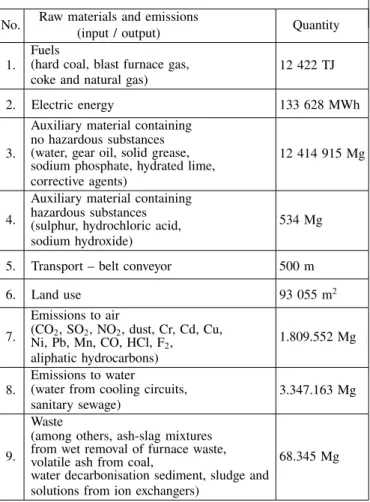
analysis (except for land occupation and band conveyors used). The analysis is based on the material and ener-gy balance, a simplified version of which is given in Table 1.
TABLE 1 Simplified inventory table for the energy generation process in the
power plant No. Raw materials and emissions
(input / output) Quantity 1.
Fuels
(hard coal, blast furnace gas,
coke and natural gas) 12 422 TJ 2. Electric energy 133 628 MWh
3.
Auxiliary material containing no hazardous substances (water, gear oil, solid grease, sodium phosphate, hydrated lime, corrective agents)
12 414 915 Mg
4.
Auxiliary material containing hazardous substances (sulphur, hydrochloric acid, sodium hydroxide)
534 Mg
5. Transport – belt conveyor 500 m
6. Land use 93 055 m2
7.
Emissions to air
(CO2, SO2, NO2, dust, Cr, Cd, Cu, Ni, Pb, Mn, CO, HCl, F2, aliphatic hydrocarbons)
1.809.552 Mg
8. Emissions to water(water from cooling circuits, sanitary sewage)
3.347.163 Mg
9. Waste
(among others, ash-slag mixtures from wet removal of furnace waste, volatile ash from coal,
water decarbonisation sediment, sludge and solutions from ion exchangers)
68.345 Mg
Carbon, nitrogen dioxide, sulphur dioxide, ash and metal emissions were assigned to individual types of fuel combusted according to respective emission indices [6,7].
In order to assess the potential effects of pro-duction variants on the environment, some types of waste were categorised – e.g. worn equipment, com-ponents removed from worn machinery and insulating materials (containing no hazardous substances) were categorised as other waste. The electric energy used by the plant itself was not considered, since it us-es the energy from own production; had it been con-sidered, the impact of energy production taken into account would have been doubled, as the entire life cycle of the materials and energy carriers is consid-ered. The fact that ca95% sewage after treatment is returned to the process has also been taken into ac-count.
3. Life cycle assessment, interpretation 3.1. Life cycle assessment – method
SimaPro software was used for the LCA analysis, together with databases implemented – mainly Ecoin-vent [8]. Also propriety processes were created for the analysis. Eco-indicator 99 method was selected for the analysis, in which the results can be presented in 11 impact categories or 3 damage categories. Furthermore, for detailed analysis, the results can be presented in in-dividual stages:
– characterisation – involving calculation of category index value for the LCI results, and allowing to eval-uate the share in the value related to given impact cat-egory. The values of damage or impact category are described in characterisation parameter units, which are most frequently expressed in equivalent units, e.g. for the greenhouse effect the kgs of CO2 equivalent,
or for land utilisation – sqm of land utilised. Since the values of each impact category are given in different units, they cannot be directly compared. However, based on characterisation results presented in such a manner, the share of individual data from inventory table can be determined for a selected damage cat-egory. For that purpose, characterisation histogram is created, which present analysis results scaled in 100%. Such presentation of results is difficult for the comparative study, as it fails to determine which parts of the case being analysed affect the environ-ment most significantly, as with the scale adopted it can be 100% of considerable or 100% of minor influence.
– normalisation – involves dividing the impact catego-ry values by the environmental impact per 1 Europe citizen during a year, i.e. non-nominated values.
– weighting – the results of normalisation were mul-tiplied by appropriate subjective significance coef-ficients – the values are expressed in eco-points Pt for individual impact categories. The value of 1 Pt (eco-point) is representative for one thansandth of the yearly environmental load of one average
Euro-pean inhabitant. It is calculated by dividing the total environmental load in Europe by the number of in-habitants and muliplying it with 1000 [12].
While presenting the analysis results, three damage categories can be addressed: human health, ecosystem quality, resources, or up to eleven impact categories which sum up to appropriate damage categories:
1) carcinogenics, respiratory organics and inorganics, climate changes, radiation, ozone layer (human health);
2) eco-toxicity, acidification/eutrophisation, land use (ecosystem quality);
3) mineral and fossil fuels (resource).
3.2. Life cycle assessment – analysis
Comparative study for four variants of annual op-eration of the power plant was performed, whereby the variants differed only by the proportion in dosage of two types of fuel: hard coal and blast furnace gas (other fu-els such as natural and coke gas were left at the current levels – they are used as “starting” fuel):
– plant 1 – current status – 62% energy from hard coal, 38% from blast furnace gas;
– plant 2 – assuming 100% energy delivered from hard coal;
– plant 3 – equal proportions of fuels assumed;
– plant 4 – assuming 30% energy from hard coal, 70% from blast furnace gas.
The last variant 4 assumes the minimum energy, which must be achieved from hard coal. This is because most of the boilers are suitable for combustion of coal dust, and such boiler will not operate below a certain critical amount of dust, as otherwise it would get extin-guished. The amounts of resultant ash, when combusting hard coal, were reduced accordingly.
The present paper presents the results for two se-lected stages: characterisation and weighting.
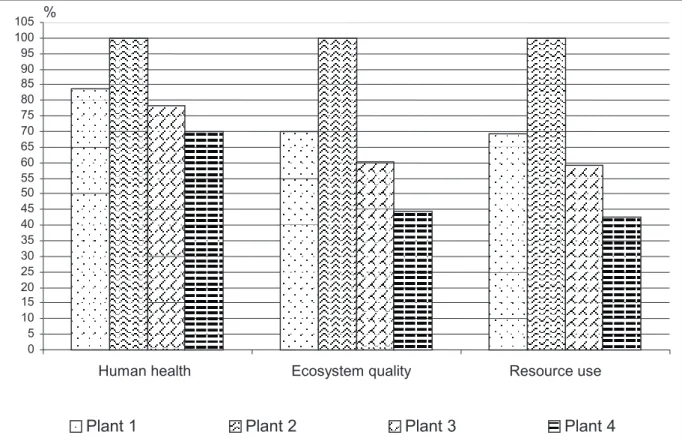
Results of the analysis were presented in a form of histograms: characterisation (division into 3 damage cat-egories) – Fig. 1 and weighting (division into 11 impact categories) – Fig. 2.
0 5 10 15 20 25 30 35 40 45 50 55 60 65 70 75 80 85 90 95 100 105
Human health Ecosystem quality Resource use
%
Plant 1 Plant 2 Plant 3 Plant 4
Fig. 1. Characterisation histogram – comparison of 4 variants in 3 damage category division
0 2 4 6 8 10 12 14 16 18 20 22 24 26 28 30 32 34 36 38 40 42 44 46
Plant 1 Plant 2 Plant 3 Plant 4
MPt Fossil fuel Minerals Land usc Acidification/ eutrophisation Ecotoxicity O zone layer Radiation Cli mate change Respiratory -organic Respiratory -in -organics Cancirogenis
TABLE 2 Results of comparative study for 4 variants in 11 impact category division [kPt]
Impact category Plant 1 Plant 2 Plant 3 Plant 4
Carcinogenicity 5 422.9 8 632.6 4 354.3 2 642.9 Respiratory – in organic 13.8 15.6 13.2 12.2 Respiratory – organics 14 570.0 20 667.0 12 540.1 9 289.3 Climate change 10 425.6 6 972.7 11 575.1 13 416.1 Radiation 15.8 23.2 13.4 9.4 Ozone layer 0.5 0.6 0.4 0.4 Ecotoxicity 289.8 453.9 235.1 147.6 Acidification/eutrophisation 1 505.2 2 104.7 1 305.6 986.0 Land usc 163.3 234.7 139.5 101.4 Minerals 1.2 1.9 1.0 0.6 Fossil fuels 3 748.7 5 408.4 3 196.1 2 311.2 Total 36 156.7 44 515.3 33 373.8 28 917.2
In figure 1, results for four production variants are given in 3 damage categories, and each of them is de-scribed by different units (human health – DALY, ecosys-tem quality – PDF*m2/year, resource consumption – MJ
surplus), hence, results of individual categories cannot be compared. Characterisation, on the other hand, allows comparative study for variants in a given damage cate-gory, where the least environmentally favourable variant is scaled to 100%, and other variants refer to it.
For all damage categories, variant 2 (power plant 2) is potentially least environmentally friendly – the total energy demand here (excluding the natural and coke gas) is satisfied by hard coal, which has ca. 70% influence on each damage category.
To determine the effects and its prioritisation, since the results are given in the same units (Pt), in figure 2 weighting histogram is presented for eleven impact categories.
Detailed impact values of four variants of an an-nual operation of the power plant on individual impact categories are given in Table 2.
“Respiratory – in organics” is the category which is considerably affected by the annual operation cycle of the power plant – the effects of each of the variants on the above category lies within the range of 30 – 48% of total influence. This is related to nitrogen dioxide and sulphur dioxide emissions directly from energy genera-tion process, and emission of dust from other processes – mainly the production of coke gas. The least favourable variant for that impact category is plant 2 – this is due to mainly high emission of NOx (hard coal which is almost
100% of fuels combusted, has the highest NOx emission rate of them).
In the other impact categories, individual variants cause the following hazards:
– climate change – CO2emission has over 90% impact,
since the blast furnace gas is characterised by higher emission index than CO2 (260.8 Mg/TJ for the blast
furnace gas, and 91.5 Mg/TJ for the hard coal) [9], plant 2 is therefore the most favourable one;
– carcinogenis – as much as above 90% influence comes from arsenic emission during coal floatation – this coal enrichment method, however, is not ade-quate for Polish conditions, the coal input from the database, although best suited to Polish conditions of coal types available in the databases, has almost double arsenic content than that from Polish mines [10,11]. It is also the case for resultant ash, when combusting hard coal. Omission of arsenic emissions to water during storage of post-floatation waste and reduction of its contents in ash, reduces the carcino-genicity by more than 70%;
– fossil fuels – the less the share of hard coal, the more environmentally friendly the variant is;
– acidification/eutrophisation – the critical factors in this category are mainly nitrogen and sulphur oxides – the rule: the less the share of hard coal, the less po-tential impact on the environment, also applies here.
4. Summary
The LCA analysis carried out made it possible to de-termine the potential impact of energy production in the
power plant on the environment, and to compare individ-ual variants of an annindivid-ual production cycle in the plant. It should be considered that processes derived from the database and used for the analysis do not refer to Polish conditions, they are only averaged, which, in some cases, can be misleading.
The most harmful potential for the environment presents the emission of sulphur dioxide and nitrogen oxides – this affects the respiratory system. The follow-ing impact factors potentially affectfollow-ing the production of energy in the power plant are the climate change category, carcinogenic factors and fossil fuels. For the climate change category, 90% of the influence poses the carbon emission; the less blast furnace gas is combust-ed, which affects the emission factor most significantly as compared to other fuels, the more environmentally friendly the variant is. In the carcinogenic factor catego-ry, most of the influence is due to a specific type of hard coal used for the analysis – choosing other type of coal from the database leads to different results. No individual production process of hard coal was created, but stony coal mined in Eastern Europe in an underground mine was selected, which, according to the inventory table, contains among other explosives, steel, wood, fuel for coal processing machinery, methane and dust emission etc., as it appears to be the closest to Polish conditions. The difference, however, lies in the enrichment process – floatation treatment is assigned to the coal from the data-base, whereas in Poland it is mainly enriched with heavy liquid, which does not produce post-floatation waste. For the fossil fuel category, the critical impact has the use of hard coal and natural gas recourses, which are used for production of energy, and indirectly also the natural gas and oil. Critical for the acidification/eutrophisation category is also the emission of sulphur and nitrogen oxides, which leads to so called ‘acid rain’. The impact of other categories is below 5%.
The influence of the variant currently used in the power plant, expressed in eco-points is 36.16 Mpt. Sup-posing that the plant does not use the blast furnace gas, which is a waste gas, but the hard coal alone, the en-vironmental impact of the annual operating cycle would increase to 44.52 MPt, it is more than 23%.
Suppose the proportion of the energy produced from hard coal to gas is 1:1, the potential environmental ef-fects of the plant operation would reduce by approx. 7.7%, in relation to the current variant. By reducing the share of energy from coal to minimum (30% GJ), the
potential environmental impact would decrease by more than 20%.
Using the blast furnace gas will always be less harm-ful alternative for the environment, as it is a waste fuel, a side product, which requires no material and energy cost to produce. The only drawback of this fuel is high carbon emission index while combusting the blast furnace gas.
REFERENCES
[1] J. K u l c z y c k a, Life cycle thinking in Polish official documents and researches. The determination of dis-count rate for green public procurement, International Journal of LCA 14, 5 (2009).
[2] Z. K o w a l s k i, J. K u l c z y c k a, G. S k o w r o n, Comparative evaluation of calcium feed phosphate pro-duction using life cycle assessment, [w:] Archives of environmental protection, Instytut Podstaw Inżynierii Środowiska PAN 33, 3, 83-94, Zabrze 2007, ISSN 0324-8461.
[3] Z. K o w a l s k i, J. K u l c z y c k a, M. G ó r a l -c z y k, Ekologi-czna o-cena -cyklu ży-cia pro-cesów wytwórczych (LCA), Wydawnictwo naukowe PWN (2007).
[4] PN-EN ISO 14040:2009 Environmental management – Life cycle assessment – Principles and framework (ISO 14040:2009).
[5] PN-EN ISO 14044:2009 Environmental management – Life cycle assessment – Requirements and guidelines (ISO 14044:2009).
[6] U. R a d o v i ć, Zanieczyszczenie atmosfery. Źródła oraz metodyka szacowania wielkości emisji zanieczyszczeń, CIE (1997).
[7] U. L o r e n z, Metoda oceny wartości węgla kamien-nego energetyczkamien-nego uwzględniająca skutki jego spala-nia dla środowiska przyrodniczego, Studia, Rozprawy, Monografie nr 64. Wyd. Instytut GSMiE PAN (1999).
[8] www.pre.nl
[9] BAT Reference Document for the Best Avalable Tech-nologies for Steel and Iron Production, European Com-mission (2001).
[10] R. N e y (red.), Surowce mineralne Polski. Surow-ce energetyczne: węgiel kamienny, węgiel brunatny, Wydawnictwo Centrum PPGSMiE PAN (1996).
[11] J. J ę d r z e j o w s k i, Procesy przemysłowe a zanieczyszczenie środowiska. Przemysł energetyczny, PWN (1987).
[12] M. S o e d k o o p, S. E f f h i n g, M. C o l l i g n o n, The Eco-indicator 99. Manual for designers. Pre Con-sultants B.V. (2000).
![TABLE 2 Results of comparative study for 4 variants in 11 impact category division [kPt]](https://thumb-us.123doks.com/thumbv2/123dok_us/10016551.2900115/5.892.188.706.152.488/table-results-comparative-study-variants-impact-category-division.webp)
