Volume 10 | Issue 3 Article 2
May 2018
An Adapted Framework for Environmental
Sustainability Reporting using Mobile
Technologies
Andre P. CalitzNelson Mandela University, [email protected]
Jaco F. Zietsman
Nelson Mandela University, [email protected]
Follow this and additional works at:https://digitalcommons.kennesaw.edu/ajis
Part of theOther Computer Sciences Commons,Other Environmental Sciences Commons, and theSustainability Commons
This Article is brought to you for free and open access by
DigitalCommons@Kennesaw State University. It has been accepted for inclusion in The African Journal of Information Systems by an authorized editor of DigitalCommons@Kennesaw State University. For more Recommended Citation
Calitz, Andre P. and Zietsman, Jaco F. (2018) "An Adapted Framework for Environmental Sustainability Reporting using Mobile Technologies,"The African Journal of Information Systems: Vol. 10 : Iss. 3 , Article 2.
An Adapted Framework for
Environmental Sustainability
Reporting using Mobile
Technologies
Research Paper
Volume 10, Issue 3, July 2018, ISSN 1936-0282 Andre P. Calitz
Nelson Mandela University [email protected]
Jaco F. Zietsman Nelson Mandela University [email protected]
(Received April 2017, accepted November 2017)
ABSTRACT
Corporate governance is the process by which organizations are directed and controlled. King IV is regarded as the cornerstone of corporate governance for businesses and emphasizes the importance of sustainability reporting in South Africa. Sustainability reporting guidelines inform organizations how to disclose their most critical effects on the environment, society and the economy. The Global Reporting Initiative (GRI) G4 sustainability reporting framework recommends the Standard Disclosures that all organizations should use to report their sustainability impacts and performance. Sustainability reporting frameworks proposed for the Higher Education sector require reporting principles specific to the needs of Higher Education Institutions (HEIs). The purpose of this study is to adapt a framework that includes environmental data to generate a GRI compliant sustainability report for a HEI. In South Africa, HEIs generally only report on financial and social aspects of sustainability reporting and exclude the environmental aspects. An environmental database capturing electricity, water and waste data was developed for the Nelson Mandela University. A review of existing sustainability reporting frameworks identified a lack of mobile technologies being used in the reporting process. In the adapted framework, financial, people (social) and environmental related data are gathered using Business Intelligence tools and mobile technologies.
Keywords
Sustainability reporting, Higher Education Institutions, Environmental Framework, Mobile technologies.
INTRODUCTION
In any organization, including Higher Education Institutions (HEIs), sound governance structures are critical for the development of sustainability reports (Bosire, Cullen & Calitz, 2012). Corporate governance can be defined as the set of systems, principles and process by which an organization is governed (Thomson, 2009). King IV (2017) is seen as the cornerstone of corporate governance for companies and emphasizes the importance of sustainability reporting. King IV’s (2017) core philosophy
governance in South Africa. Non-profit organizations, private companies and HEIs in the public sector have experienced challenges in interpreting and adapting King III to their circumstances. The aim of the King IV report is to become more accessible to all types of entities across sectors. The 75 King III principles have been consolidated into 17 principles, each linked to specific distinct outcomes (King IV, 2017).
Organizations are adopting dedicated sustainability reporting frameworks to assist them in complying with the complex sustainability reporting requirements (White, & Koester, 2012). These frameworks are limited in their capabilities and are not all suited to the requirements of HEIs. Many of the frameworks do not cover the entire sustainability spectrum but focus only on the financial and social aspects of sustainability, neglecting environmental reporting.
The number of sustainability reporting frameworks highlights the increased awareness in sustainability and frameworks are continuously being updated (Pina, 2011). These frameworks provide organizations with guidelines on how to report on sustainability. Examples of these reporting frameworks include the Global Reporting Initiative (GRI), ISO 14000 series, the Triple Bottom Line, the International Sustainable Campus Network (ISCN), the Association for the Advancement of Sustainability in Higher Education (AASHE) and the Sustainability Tracking, Assessment and Rating System (STARS). The two most relevant reporting standards for HEIs presently are STARS and the GRI (White & Koester, 2012). Each different category of sustainability is highlighted in both the GRI and STARS. The standard GRI is not optimized for higher education and therefore Lozano (2006) proposed a modified set of BI guidelines that include a category for education. The operations of HEIs differ from standard business enterprises, which causes many of the reporting tools and frameworks, including the GRI, ISO 14000 series and the Triple Bottom Line to be insufficient for HEIs (KPMG, 2012).
Universities that have adopted the GRI share a distinct conceptualization of their role in society (Bice & Coates, 2016). Bice and Coates (2016) further indicate that the GRI framework can assist universities when capturing environmental impacts. They would benefit from adopting an internationally accepted sustainability-reporting framework. HEIs have begun to realize the benefit of the STARS reporting framework (Pina, 2011). Nelson Mandela University (NMU), which will be the focus of this study, is one of these HEIs that has adopted the GRI as its sustainability-reporting framework.
In 2000, the GRI launched the first set of guidelines enabling corporations to conduct comprehensive sustainability reporting on a global level (GRI’s History, 2016). GRI’s latest sustainability reporting guidelines (G4) allow any organization to report their sustainability information and transform themselves from within, to be more sustainable (Global Reporting Initiative, 2013b). The success of GRI is due to the ability of the GRI guidelines to maintain a balance between the individual and collective interests of their diverse constituencies (Global Reporting Initiative, 2014).
The Stockholm Declaration of 1972 (United Nations, 2017) was the first declaration to reference the importance of environmental sustainability in the education sector. Although the sustainability initiatives of HEIs were not directly mentioned, the principles in the declaration have relevance to this study. The declaration has a clear human-centered focus stating that the protection and improvement of the human environment is a major issue which affects the well-being of the people and economic development throughout the world (United Nations, 2017).
According to Cullen, Bosire and Calitz (2015), the economic aspects are the focus of the majority of South African universities sustainability reporting efforts. The results show that as little as 10% of
reporting is done on environmental data (Cullen et al., 2015). Therefore, it appears that most of the environmental aspects of reporting done by Faculties and Departments at HEIs do not appear on the institutional reports. Almost 50% of South African HEIs do not report on aspects such as the impact on the environment and compliance with legislation, favoring financial reporting instead (Cullen, et al., 2015).
HEIs are in a unique position to demonstrate principles of stewardship and awareness of the natural environment (Neumayer & Dahle, 2001). Green IS initiatives enable environmentally sustainable business processes and products (Loeser, 2013). Green IS can contribute to sustainability through automating processes and behaviors to support environmental sustainability. Greening within the context of a HEI refers to the reduction of environmental impacts based on the decisions of the institution and promoting environmental awareness within the different human communities (Neumayer & Dahle, 2001).
Several frameworks have been developed for use by HEIs to assist with sustainability reporting (Wright, 2002). This paper discusses two existing sustainability frameworks developed at NMU and adapts one framework to make use of mobile technologies to capture environmental data. The literature review identifies how sustainability reporting is currently being implemented in HEIs and the influence that the GRI has on these processes. A lack of implementing mobile technologies in the reporting processes specifically relating to environmental sustainability reporting is identified as a problem with current sustainability reporting efforts. The adapted framework incorporates the use of mobile technologies into the reporting process to better extract the data needed to produce a GRI compliant sustainability report.
THE PROBLEM INVESTIGATED IN THIS STUDY
Presently there are various frameworks for sustainability reporting for South African HEIs. Generally, the economic, social (people), research and teaching and learning data are reported on by HEIs to the Department of Higher Education and Training. However, there are currently no frameworks using mobile technologies to report on environmental data. The reason for the omission is that the environmental data are mostly not available in the HEI environment. The environmental data generally includes electricity and water usage, waste management and CO2 emissions. The focus of this paper is to
obtain the environmental data and adapt a framework that uses the data to produce an integrated sustainability report. The study will specifically address the following research question:
What are the components of a framework that makes use of mobile technologies to include environmental data to enable the creation of a GRI report for HEIs in South Africa?
The main research objective (ROM) of this study is:
Adapt a sustainability-reporting framework for HEIs in South Africa that includes environmental data utilizing mobile technologies.
LITERATURE REVIEW
The number of HEIs internationally producing sustainability reports has increased; however, in Africa no HEIs have published a comprehensive GRI compliant integrated sustainability report. In this section sustainability reporting and specifically by HEIs will be discussed with a focus on environmental sustainability reporting.
Sustainability Reporting by HEIs
One of the fastest changing fields in Higher Education is sustainability reporting, however HEIs in Africa are having trouble in reporting on environmental sustainability (Cullen, et al., 2015). Presently, the first world opinion is generally united on achieving increased sustainable development. Industry leaders are incorporating environmental sustainability into their vision and sustainability reporting (Esty & Winston, 2009).
At the Stockholm Conference in 1972 (United Nations, 2017) it was established that there is a connection between the role that education plays in the fostering of environmental protection. Since then, declarations made by academic institutions have evolved to include the fostering of environmental education (Lozano, et al., 2013). According to Lozano et al. (2013), the number of HEIs engaged in sustainable development is still small. Out of over 20,000 HEI in the world, only 35 have published sustainability reports, none of them in South Africa (Cullen et al., 2015). In contrast, 5377 organizations globally published GRI sustainability reports in 2015 (GRI Reports List, 2015).
The process of sustainability reporting is a means for organizations to report their efforts with regard to Sustainable Development (SD) to various stakeholders (Joseph, 2012). According to Lozano (2010), sustainability reporting in HEIs is still in its infancy, both because of the low quality of reporting outcomes and the lack of a substantial number of HEIs reporting on their SD. In conjunction, with the lack of scientific studies in HEIs addressing the sustainability reporting topic (Fonseca, Macdonald, Dandy, & Valenti, 2011), there is a need for in-depth studies on sustainability reporting in HEIs. These studies require a large level of abstraction, where the results of each study can be transferred to other HEIs, offering added value to the research (Ceulemans, Molderez, & Van Liedekerke, 2015).
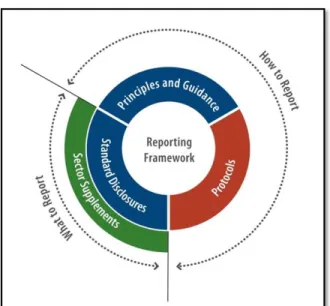
The GRI sustainability reporting process discloses results, within the reporting period, of the organization’s strategies, management and commitments. Sustainability reporting guidelines direct the process that is followed to create GRI reports. Different principles were defined to ensure the quality and correctness of GRI reports. Among these principles are Standard Disclosures, consisting of Performance Indicators and guidelines on specific technical topics. The Performance Indicators provide definitions and other information to assist report writers to interpret all the Performance Protocols consistently. Sector supplements are used to complement the application of the guidelines and should be used with the guidelines rather than in place of the guidelines (Global Reporting Initiative, 2011). Figure 1 provides an overview of the GRI Reporting Framework and indicates that standard disclosures are used to determine what to report. The protocols as well as principles and guidance are used to determine how to report the selected standard disclosures.
Reporting principles work in conjunction with the Reporting Guidelines to achieve transparency in sustainability reporting. It is recommended that all organizations following the GRI Reporting Guidelines implement the reporting principles when preparing a sustainability report. HEIs are lagging in the implementation of sustainability reporting. Thus far, the literature reveals a fragmented approach to the implementation of sustainability reporting in HEIs.
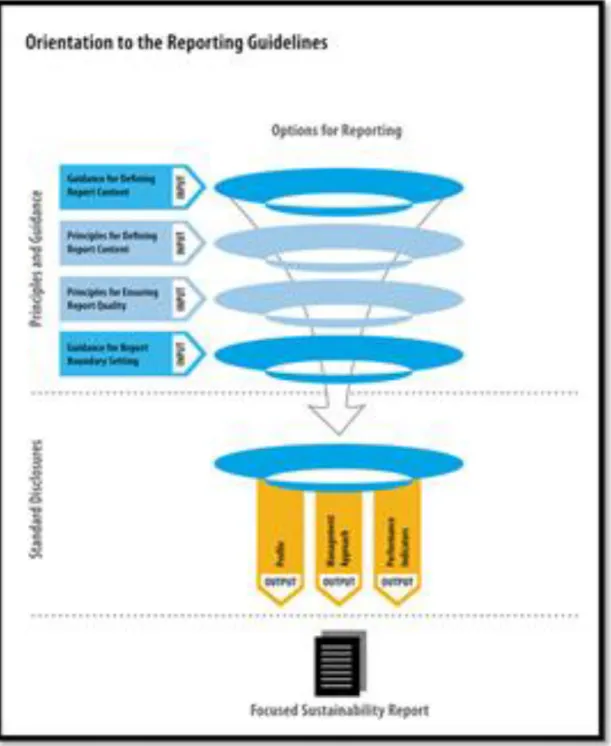
Figure 2 indicates the process of generating a sustainability report using the GRI Reporting Guidelines. The principles and guidelines determine how the topics and indicators are reported, while the Standard Disclosures determine what information should go into the report. There are three types of Standard Disclosure indicators (Global Reporting Initiative, 2011):
• Strategy and Profile disclosures set the context necessary to gain an understanding of the organization’s profile and governance;
• Management approach disclosures addresses organizational performance; and
• Performance Indicators disclosures are used as a comparative indicator for the organization’s performance.
Figure 1: The GRI Reporting Framework (Global Reporting Initiative, 2011)
Existing Sustainability Reporting Frameworks
Several frameworks have been developed for use by HEIs (Cullen, et al., 2015). The frameworks this study is based on are the frameworks developed by Jonamu’s (2014) and Haupt (2015).
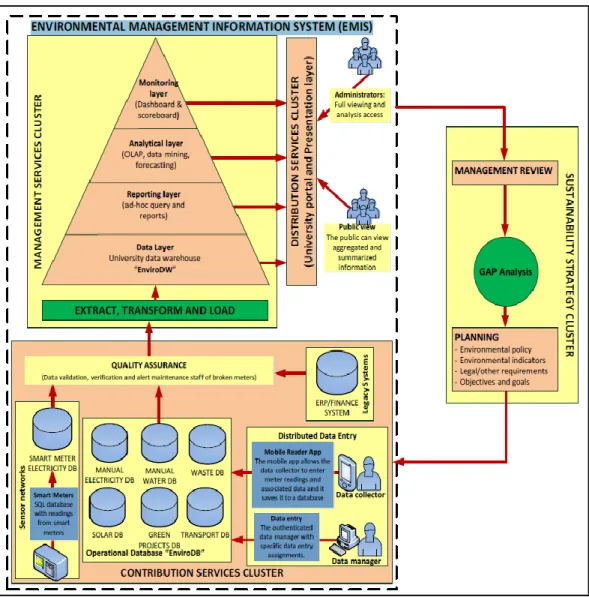
A framework for the management of environmental information in higher education institutions. Jonamu’s (2014) study identified a gap in the field of environmental sustainability at HEIs. Existing sustainability programs for HEIs have shown weaknesses that include failures to set effective baselines, flaws in data acquisition and missing documentation. The study therefore proposed and developed a framework to support effective and efficient management of environmental information in HEIs.
The proposed framework (Figure 3) analyzed the current state of environmental information management processes at HEIs and how these processes can be improved. Research revealed that the prioritization of environmental indicators and comprehensive data acquisition processes could dramatically improve the efficiency and availability of environmental data.
The acquisition of reliable data prohibited Jonamu (2014) from testing the developed prototype in a real-world environment. Even with this constraint, the study revealed the need for analytical tools to support senior management. It was recommended that future research of environmental performance dashboards is necessary for the communication of environmental data to the stakeholders of HEIs.
Figure 2: Environmental Information Management Framework for HEIs (Jonamu, 2014)
A business intelligence framework for supporting strategic sustainability information management in higher education
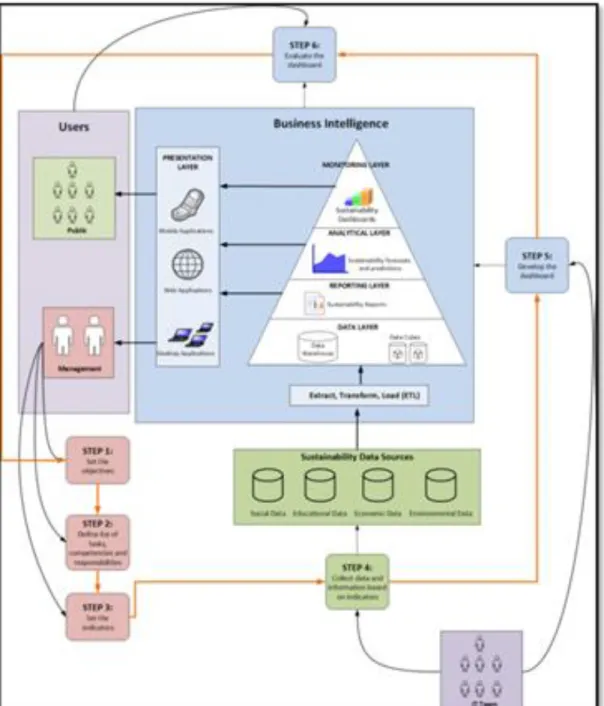
Haupt (2015) developed a Business Intelligence (BI) framework for supporting strategic sustainability information management in HEIs (Figure 4). Lozano (2011) indicated that the GRI guidelines are best suited for standard business enterprises and cautions against using these guidelines for HEIs without the necessary modifications. Lozano (2011) proposed a set of modified guidelines, however GRI have not yet officially accepted these guidelines for HEIs. Haupt (2015) therefore also considered the Sustainability Tracking, Assessment and Rating System reporting method. Combining these methods Haupt (2015) created a BI framework (Figure 4) to support sustainability information management for HEIs.
The BI framework was proposed by Haupt (2015) after an analysis of existing literature, as well as conducting interviews with relevant stakeholders at the Nelson Mandela University (NMU). Haupt (2015) used the information to determine the requirements for the proposed BI solution, as well as the challenges of implementing a BI solution.
Using NMU as a case study to test the created Sustainable BI prototype, Haupt (2015) integrated the environmental and educational data into the BI framework. Access to economic and social data prevented Haupt (2015) from covering the entire sustainability spectrum in the prototype evaluation. Haupt (2015) indicated that for future research, by including economic and social data, the prototype can cover the entire spectrum of sustainability. It was also mentioned that additional research is required to investigate approaches to improve the data collection from the different sources including environmental data at NMU.
Comparison of current Frameworks
An important step towards evaluating the efficiency of sustainability reporting frameworks in HEIs would be to reach greater consensus on the importance of sustainability reporting frameworks. Sustainability reporting practices are taking place in an increasingly environmentally friendly driven climate where the outcome of these reports is likely to be prioritized.
Both the frameworks make provision for the storage and retrieval of sustainability data for sustainability information management at HEIs. The Environmental Information Management framework (Figure 3) is more focused on recording environmental information to be included in a sustainability report. In doing so, it emphasizes the importance of the environmental aspect in sustainability reporting by describing its different components. The Environmental Information Management framework indicates the collection of electricity and water meter readings into the database. Zisman (2015) has implemented the use of mobile technologies, to record the meter readings directly into an environmental database.
Mobile Technologies
Mobile technology is defined as any device with Internet capability that is accessible from anywhere the user is. Current devices in this category include devices such as smartphones, tablets, some iPods and laptops (Zietsman, 2015). One of the Millennium Development Goals (United Nations, 2017) calls for using information and communications technologies to foster human development across the world. Since the goals were set in 2000, mobile technology has proven to be a powerful tool in bringing change to the field of development, especially monitoring and evaluation (PACT, 2014).
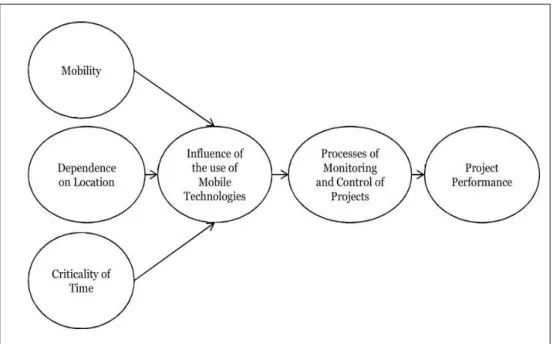
The rapid expansion of mobile technologies offers people real time interactive communication, using affordable communication channels to provide people with access to information where they previously had little or no access (Zambrano, Seward, & Ludwig, 2012). In addition, mobile phones increase personal security by keeping people in touch with each other (Zambrano et al., 2012). Comin, Klein and Rigoni (2014) suggest that the influence of the use of mobile technologies depends primarily on the location of the activity (Figure 5). Successful implementation of enterprise mobility can greatly benefit the efficiency of activities (Comin et al., 2014).
Figure 4: BI framework for strategic sustainability information management in higher education (Haupt, 2015)
Mobile applications are used to gather real time assessment data-demonstrating capabilities for
collecting data beyond simple self-reports. Applications can be designed to prompt the user for specific information at any time (Heron & Smyth, 2010). The use of mobile technologies further assist with the capturing of environmental data, such as electricity and water readings, in real-time. At NMU, water and electricity meter readings are captured monthly and is a manual process (Zietsman, 2015). The process consists of capturing meter readings using a paper-based system. Figure 6 shows one of the electricity meters currently in use at NMU.
Figure 3: Influences on mobile technology use (Comin et al., 2014)
Figure 6: Electricity meter with kWh output (Zietsman, 2015)
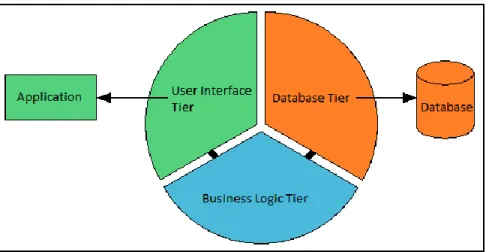
Zietsman (2015) developed a mobile application to capture the meter readings for electricity and water directly into an environment database. The application makes use of barcodes applied to the meters to identify each meter uniquely. Figure 7 indicates how the application uses a three-tier approach to communicate with the database.
Figure 4: Three-Tier Layout (Adapted from Marston (2012))
The application allows the user to scan the barcode of a meter (Figure 8), after which the application will allow the user to input the meter’s reading (Figure 9). Once the all the meter readings are collected, the user can synchronise the captured meter readings with the environmental database, in which the water and electricity meter readings are stored.
Figure 5: Scanner Screen Layout (Zietsman, 2015)
Figure 6: Mobile Application Capture Screen (Zietsman, 2015)
RESEARCH METHODOLOGY
This section discusses the research process. The methodology used as well as data collection methods are covered.
Research Design
The Design Science Research methodology was used in this study for the development of the environmental (electricity and water meter readings data) collection mobile application (Zietsman, 2015). Design Science Research (DSR) is a constructive research paradigm that is widely used by project managers specifically in the Information Technology sector. DSR has three cycles, namely the Relevance Cycle, the Design Cycle and the Rigor Cycle. The Relevance Cycle is used to determine the requirements for the artefacts in this research. The requirements were determined through a literature review and structured interviews with relevant stakeholders. The process of identifying problems in the relevance cycle are iterative in nature. Equivalently the solutions to the identified problems will also be an iterative process (Peffers et al., 2006). The criteria, by which the evaluation of the artefact will take place, are also be determined in the Relevance Cycle phase (Hevner & Chatterjee, 2010).
The Design Cycle involves developing and evaluating design alternatives based on the requirements identified in the Relevance Cycle and knowledge from the Rigor Cycle. The final version of the artefact developed in the Design Cycle should demonstrate experimental design and solve the problem identified in the Relevance Cycle. The Rigor Cycle evaluates the artefacts developed in the Design Cycle and in the process determines how the artefacts provide a solution to the problem in the Relevance Cycle. All past knowledge of existing systems in the domain is incorporated into the evaluation of the artefact in the Rigor Cycle.
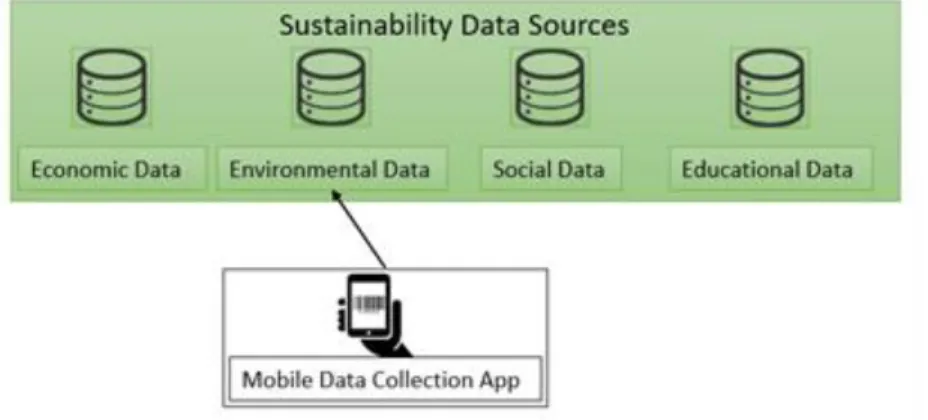
Two existing frameworks were used in this study as they gathered data from a variety of sources to assist in the compilation of a sustainability report. The frameworks developed by Jonamu (2014) and Haupt (2015) both included environmental data. The data these frameworks require are obtained from a variety of sources (Figure 10). The economic data is acquired from the ITS ERP database used by NMU. The educational data are a combination of teaching and learning information from the ITS database as well as data acquired from the research office. The environmental data, which could previously not be recorded is a combination of data from the mobile application developed by Zietsman (2015) and other sources. The mobile application records water and electricity data and waste data are obtained from technical management.
An evaluation of the mobile application revealed the effectiveness of the application regarding accuracy and the capturing time of the environmental data. The next section discusses the reporting of environmental sustainability data and the evaluation of the mobile application.
EVALUATION OF THE MOBILE APPLICATION
This section describes the tests that the mobile application went through for its evaluation phase. The evaluation of the system was done with a User-Centred Design (UCD) process. Due to the limitations of the applications functional environment, the UCD process was customised which resulted in an overlap between the evaluation and development phase of the application.
The mobile application was developed to replace the manual process of capturing the water and electricity meter readings at NMU. The manual process consisted of writing down the meter readings on paper by a field worker and then capturing the readings in an Excel spreadsheet. The mobile application replaced the process to reduce errors in the capturing process and make the data more readily available. Zietsman’s (2015) mobile application was a real world implementation and as such was tested in its functional environment.
The mobile application was evaluated in two phases. Both phases recorded the time it took to capture the meter readings with the mobile application as well as the conventional manual method. The functionality of the mobile application relies on operational data for each meter. The first evaluation recorded the average time it took to capture the meter readings with the mobile application as well as the conventional method. The evaluation also validated the operational data for each meter. Between the first and second evaluation, amendments to both the mobile application as well as the database were implemented to improve on the efficiency of the application. The second evaluation concentrated on the time it took to capture the data using the mobile application and well as usability of the application. On average, the capturing time is 93.7 seconds for the conventional method and 76.8 seconds for the mobile application.
Evaluation revealed that both the capturing speed and accuracy of information obtained was increased by using the mobile application. The mobile application lowers the cognitive load of the user and allows researchers quicker access to the meter readings. The next section proposes a framework that will be able to report on all the data required for GRI sustainability reporting by a HEI.
PROPOSED FRAMEWORK
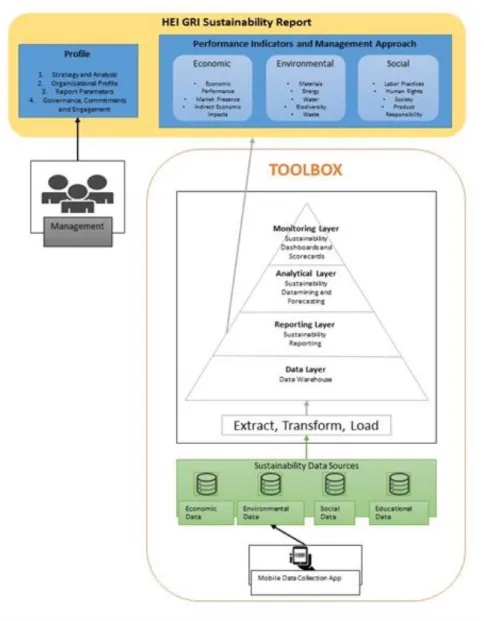
The top level GRI requirements for HEIs based on the G4 guidelines (Global Reporting Initiative, 2013a) are depicted in Figure 11. The Toolbox depicted in Figure 11 is extracts from work done by Haupt (2015) and Zietsman (2015) to indicate some of the Toolbox’s components. HEIs do require reports on some business processes, however these reports are not consolidated and depict limited sustainability information (Bosire, Cullen, & Calitz, 2012). Therefore, by consolidating systems developed by Jonamu (2014), Haupt (2015) and Zietsman (2015) it is possible to create a toolbox that can deliver the necessary information to create a sustainability report that adheres to the GRI requirements.
The GRI evaluates an organisation’s triple bottom line by looking at the effects of an organisations activities on the economy, social equity and the environment (Stenzel, 2010). The mobile collection app is responsible for collecting the water and electricity meter readings from the different collection points
on campus. The information is then uploaded to the environmental database where the toolbox will use the data to generate the report.
The NMU technical staff are required to visit the physical location of each electricity and water meter on the different campuses weekly, to record the meter readings. The meter readings recorded on the mobile devices are uploaded into the environmental database (Figure 11). The economic, environmental, social and educational data are then extracted through an extract, transform, load (ETL) process to be presented in the HEI GRI sustainability report for NMU.
Figure 11: Proposed Framework (Authors own construct)
Sustainability reporting requires a comprehensive report on all sustainability practises in a HEI. However, due to the nature of how reports are currently used in South African HEI environments, there is no easy method for creating a single sustainability report that would include all the reporting requirements for a GRI sustainability report.
CONCLUSIONS
Sustainability reporting in South African HEIs is receiving increased attention. There is a local and global need to promote sustainability and increase sustainability reporting practises. Most of the components needed to create sustainability reports have been researched in the past. Various systems and frameworks exist to create specific reports even though most of these reports are created for specific use by an entity in a HEI. This leads to reports that are created in a fragmented manner, leaving gaps in the overall reporting process. Most of the tools and mobile technologies necessary to create a complete sustainability report are in place, however no consolidated process exists that can combine these processes for effective use to create a sustainability report.
This paper examined existing sustainability reporting frameworks in a HEI context. A comparison of the sustainability frameworks suggested a lack of the use of mobile technologies. The resulting proposed framework incorporated mobile technologies into the reporting process. The proposed framework is currently in the design and development phase of the DSR methodology. Current research is creating a platform to retrieve and store all the data required to generate an integrated sustainability report in a data warehouse and to produce the first GRI compliant integrated sustainability report for a HEI in Africa.
REFERENCES
Bice S. & Coates, H. (2016) University sustainability reporting: taking stock of transparency, Tertiary Education and Management, 22:1, 1-18.
Bosire, S., Cullen, M., & Calitz, A. (2012). Sustainability Reporting Practices in Higher Education Institutions., International Business Conference (IBC) 2012. Kenya.
Brown, H. S., de Jong, M., & Lessidrenska, T. (2007). The Rise of the Global Reporting Initiative (GRI) as a Case of Institutional Entrepreneurship, 45. Retrieved from http://www.hks.harvard.edu/m-rcbg/CSRI/publications/workingpaper_36_brown.pdf.
Ceulemans, K., Lozano, R., & Alonso-Almeida, M. del M. (2015). Sustainability reporting in higher education: Interconnecting the reporting process and organisational change management for sustainability. Sustainability (Switzerland), 7(7), 8881–8903.
Ceulemans, K., Molderez, I., & Van Liedekerke, L. (2015). Sustainability reporting in higher education: A comprehensive review of the recent literature and paths for further research. Journal of Cleaner Production, 106, 127–143.
Ceulemans, K., Van Caillie, D., Molderez, I., & Van Liedekerke, L. (2014). A Management Control Perspective of Sustainability Reporting in Higher Education: In Search of a Holistic View. Proceedings in Finance and Risk Perspectives’13, 3(3), 1–17.
Comin, E., Klein, A., & Rigoni, E. (2014). The use of mobile technologies in the monitoring and control of projects. 20th Americas Conference on Information Systems, AMCIS 2014, 1–12. Retrieved from http://www.scopus.com/inward/record.url?eid=2-s2.0-84905985442&partnerID=tZOtx3y1.
Cullen, M. D. M., Bosire, S., & Calitz, A. P. (2015). Sustainability Reporting by South African Higher Education Institutions. In J. M. Gomez & B. Scholtz (Eds.), Information Technology in Environmental Engineering. Port Elizabeth: Springer.
Esty, D., & Winston, A. (2009). Green to Gold: How Smart Companies Use Environmental Strategy to Innovate, Create Value, and Build Competitive Advantage. John Wiley & Sons.
Fonseca, A., Macdonald, A., Dandy, E., & Valenti, P. (2011). The state of sustainability reporting at Canadian universities.
International Journal of Sustainability in Higher Education, 12(1), 67–78.
Global Reporting Initiative. (2013a). G4 Development Process Overview, 6. Retrieved from https://www.globalreporting.org/resourcelibrary/G4DevelopmentProcessOverview.pdf.
Global Reporting Initiative. (2013b). GRI Annual Activity Review 2012/13: From Information to Transformation: The next step in sustainability reporting, 50. Retrieved from https://www.globalreporting.org/resourcelibrary/GRI-Activity-Report-2012-13.pdf.
Global Reporting Initiative. (2014). The Benefits of Sustainability Reporting. Global Reporting Initiative. Retrieved from https://www.globalreporting.org/resourcelibrary/The-benefits-of-sustainability-reporting.pdf.
GRI’s History. (2016). Retrieved February 29, 2016, from https://www.globalreporting.org/information/about-gri/gri-history/Pages/GRI’s history.aspx.
GRI Reports List. (2015). Retrieved April 14, 2016, from https://www.globalreporting.org/services/Analysis/Reports_List/Pages/default.aspx.
Haupt, R. (2015). A Business Intelligence Framework for Supporting Strategic Sustainability Information Management in Higher Education. Maters Dissertation, Department of Computing Sciences Nelson Mandela Metropolitan University, Port Elizabeth, South Africa.
Hevner, A. R., & Chatterjee, S. (2010). Design Science Research in Information Systems. In A. R. Hevner & S. Chatterjee (Eds.), Design Research in Information Systems: Theory and Practice. New York, NY: Springer.
Heron, K. E., & Smyth, J. M. (2010). Ecological momentary interventions: Incorporating mobile technology into psychosocial and health behaviour treatments. British Journal of Health Psychology, 15(1), 1–39.
Jonamu, B. T. (2014). A Framework for the Management of Environmental Information in Higher Education Institutions. Maters Dissertation, Department of Computing Sciences Nelson Mandela Metropolitan University, Port Elizabeth, South Africa.
Joseph, G. (2012). Ambiguous but tethered: An accounting basis for sustainability reporting. Critical Perspectives on Accounting, 23(2), 93–106.
King IV. (2017). King IV Report on Corporate Governance for South Africa, 2016. Retrieved September 7, 2017, from http://c.ymcdn.com/sites/www.iodsa.co.za/resource/resmgr/king_iv/King_IV_Report/IoDSA_King_IV_Report_-_WebVe.pdf.
KPMG. (2012), Sustainability Reporting Systems. Retrieved September, 8, 2016 from https://home.kpmg.com/ru/en/home/media/press-releases/2012/08/sustainability-report-systems-review.html.
Loeser, F. (2013). Green IT and Green IS: Definition of Constructs and Overview of Current Practices. Proceedings of the Nineteenth Americas Conference on Information Systems, Chicago, Illinois, August 15-17, 2013.
Lozano, R. (2006). A tool for a Graphical Assessment of Sustainability in Universities (GASU). Journal of Cleaner Production, 14(9–11), 963–972.
Lozano, R. (2010). Diffusion of sustainable development in universities’ curricula: an empirical example from Cardiff University. Journal of Cleaner Production, 18(7), 637–644.
Lozano, R. (2011). The state of sustainability reporting in universities. International Journal of Sustainability in Higher Education, 12(1), 67–78.
Lozano, R., Lukman, R., Lozano, F. J., Huisingh, D., & Lambrechts, W. (2013). Declarations for sustainability in higher education: Becoming better leaders, through addressing the university system. Journal of Cleaner Production, 48, 10– 19.
Marston, T. (2012). A Development Infrastructure for PHP. Retrieved October 19, 2015, from http://www.tonymarston.net/php-mysql/infrastructure.html.
Neumayer, E., & Dahle, M. (2001). Overcoming Barriers to Campus Greening: A Survey among Higher Educational Institutions in London, UK, 2(2), 139–160.
PACT. (2014). Mobile Technology Handbook. Retrieved from http://pactworld.org/sites/default/files/Mobile Technology Handbook 2014.pdf.
Peffers, K., Tuunanen, T., Rothenberger, M. A., & Chatterjee, S. (2007). A Design Science Research Methodology for Information Systems Research. Journal of Management Information Systems, 24(3), 45–77.
Pina, R. (2011), Report on Sustainability Reporting and Reporting Tools, Stellenbosch.
Stenzel, P. L. (2010). Sustainability, the Triple Bottom Line and the Global Reporting Initiative. GlobalEDGE Business Review, 4(6), 2.
Thomson, L.M. (2009). What is Corporate Governance?, The Economic Times, Retrieved March 11, 2015, from http://articles.economictimes. indiatimes.com/2009-01-18/news/28462497_1_corporate-governance-satyam-books-fraud-by-satyam-founder.
United Nations Millennium Development Goals. (2016). Retrieved December 4, 2016, from http://www.un.org/millenniumgoals/.
United Nations (2017). Report of the United Nations Conference on the Human Environment. Retrieved September 7, 2017, from http://www.un-documents.net/aconf48-14r1.pdf.
White, G. B., & Koester, R. J. (2012). STARS and GRI: Tools for Campus Greening Strategies and Prioritizations.
Sustainability: The Journal of Record, 5(2), 100–106.
Wright, T. S. A. (2002). Definitions and frameworks for environmental sustainability in higher education. Intenational Journal of Sustainability in Higher Education, 3(3), 203–220.
Zambrano, R., Seward, R. K., & Ludwig, S. (2012). Mobile Technologies and Empowerment : Enhancing human development through participation and development, 1–58. Retrieved from http://www.undpegov.org/mgov-primer.html.
Zietsman, J. F. (2015). A Resource Data Management. Honours Treatise, Department of Computing Sciences Nelson Mandela University, Port Elizabeth, South Africa.