8.4
Motion of Charged Particles
in Magnetic Fields
Atoms and molecules are particles that are the building blocks of our universe. How do scientists study the nature of these small particles? The mass spectrometer shown in Figure 1 is an instrument scientists use to study atoms and molecules. Mass spec-trometers are used to define the elemental composition of a sample or molecule, to determine masses of particles, and to reveal the chemical structures of molecules.
Figure 1 A scientist inserts a sample into a mass spectrometer.
How does a mass spectrometer work? Imagine a billiard table with a billiard ball rolling across the table from your left to your right. If you hit the ball with a sideways force, the ball will move away from you. Now suppose a bowling ball rolls across the table in the same direction. If you apply the same sideways force on the bowling ball, it will also move away from you but not as far. The masses of the billiard ball and bowling ball determine the distance they will be deflected by the force. If you know the amount of force, the speeds of the balls, and the curve of their paths, you can calculate the mass of each ball. The less deflection there is, the heavier the ball must be.
In a similar way, a mass spectrometer uses a magnetic field to deflect electrically charged particles. Atoms are converted into ions and then accelerated into a finely focused beam. Different ions are then deflected by the magnetic field by different amounts, depending on the mass of the ion and its charge. Lighter ions are deflected more than heavier ones. Ions with more positive charges are deflected more than ions with fewer positive charges. Only some ions make it all the way through the machine to the ion detector, where they are detected electrically. If you vary the magnetic field, different types of ions will reach the detector.
Scientists use the mass spectrometer to identify unknown compounds, to deter-mine the structure of a compound, and to understand the isotopic makeup of molec-ular elements. The mass spectrometer has applications in the medical field, the food industry, genetics, carbon dating, forensics, and space exploration. CAREER LINK
Charges and Uniform Circular Motion
To understand how a mass spectrometer works, we first need to understand how a directional force affects the motion of an object—in this case, a charged particle. Consider the direction of a magnetic force F>M and how this force affects the motion of a charged particle. We know FM5qvBsinu. For simplicity, we assume the mag-netic field, B>, is uniform, so the magnitude and direction of B> are the same every-where. Figure 2(a) shows a charged particle, 1q, moving at velocity v> parallel to the direction of B>. In this case, the angle u between v> and B> is zero. The factor sin u in FM5qvBsinu is then zero, so the magnetic force in this case is also zero. If a charged particle has a velocity parallel to B>, the magnetic force on the particle is zero.
Figure 2(b) shows a charged particle moving perpendicular to B>. Now we have u5 908, and sin u5 1. The magnitude of the magnetic force is thus FM5qvB, and the force is perpendicular to the velocity.
Recall that when a particle experiences a force of constant magnitude perpen-dicular to its velocity, the result is circular motion, as shown in Figure 2(b). Hence, if a charged particle is moving perpendicular to a uniform magnetic field, the particle will move in a circle. This circle lies in the plane perpendicular to the field lines.
The radius of the circle can be determined from Newton’s second law and centrip-etal acceleration. Recall that for a particle to move in a circle of radius r, there must be a force of magnitude mvr2 directed toward the centre of the circle. Here, the force producing circular motion is the magnetic force, so we have
FM5mv 2
r
The magnetic force is perpendicular to the velocity and sin 9085 1, so we can insert FM5qvB:
qvB5mv
2
r Solving for r gives
r5mv qB
Now calculate the value of r for an electron that has a speed of 5.5 3 106 m/s moving in a magnetic field of strength 5.0 3 10−4 T. Inserting these values into the equation r5mv qB and using 1T51 kg C
#
s, we get r5mv qB 5 19.11310231 kg2 a5.53106m sb 11.60310219 C2 a5.031024 kg C#
sb r56.331022 mFigure 2 (a) When the velocity of a charged particle is parallel to the magnetic field B>, the magnetic force on the particle is zero. (b) When v> makes a right angle with B> (u 5 908), the charged particle moves in a circle that lies in a plane perpendicular to B>. v B (a) q v B q FM (b)
tutorial
1
Solving Problems related to Charged Particles in Circular Motion in Magnetic Fields
An electron starts from rest. A horizontally directed electric field accelerates the electron through a potential difference of 37 V. The electron then leaves the electric field and moves into a magnetic field. The magnetic field strength is 0.26 T, directed into the page (Figure 3), and the mass of the electron is 9.11 3 10231 kg. v B y Figure 3 (a) Determine the speed of the electron at the moment it enters the magnetic field. (b) Determine the magnitude and direction of the magnetic force on the electron. (c) Determine the radius of the electron’s circular path.Solution
(a) Given: DV 5 37 V; me 5 9.11 3 10231 kg; q 5 1.60 3 10219 C Required: vi Analysis: The decrease in the electron’s electric potential energy equals the increase in its kinetic energy, -DEE 5 DEk, where 2DEE 5 qDV and Ek5 1 2mv2. The speed of the electron before it enters the electric field is zero. Therefore, DEk5Ekf. Use 1 V51 J C and 1 J51kg#m 2 s2 . Solution: 2DEE5 DEk qDV5 1 2mvi2 vi5 Å 2qDV m 5 Å 211.60310219 C2 137 V2 9.11310231 kg 5 ã 211.60310219 C2 a37 kg#m2 C#s2 b 9.11310231 kg vi53.6053106m/s1two extra digits carried2 Statement: The initial speed of the electron at the moment it enters the magnetic field is 3.6 3 106 m/s. (b) Given: B 5 0.26 T; q 5 1.60 3 10-19 C; u 5 908; vi 5 3.605 3 106 m/s Required: FM and its directionAnalysis: Use FM5qvBsinu to determine the magnitude
of the force. Then use the right-hand rule to determine the direction. The magnetic force will be the opposite of this direction because the charge is negative. Solution: FM5qvBsinu 5 11.60310219 C2 a3.6053106 m sb a0.26 kg C#sb 1sin9082 FM51.5310213 N Apply the right-hand rule for an electric charge moving through a magnetic field: point the fingers of your right hand in the direction of the external magnetic field, into the page. Point your right thumb in the direction that the charge is moving, to the right. Your palm points in the direction of the magnetic force for a positive charge, up the page. The charge is negative, so the magnetic force is down the page. Statement: The magnitude of the magnetic force on the electron is 1.5 3 10-13 N down the page. (c) Given: me 5 9.11 3 10231 kg; B 5 0.26 T; q 5 1.60 3 10219 C; v 5 3.605 3 106 m/s Required: r Analysis: The only force acting on the electron is the magnetic force. This force is perpendicular to the electron’s velocity, causing it to move in uniform circular motion. The magnetic force is the centripetal force, Fc5mv 2 r . Solution: FM5Fc qvB5 mv 2 r 1because sin 908 512 r5 mv qB 5 19.11310231 kg2 a3.6053106 m sb 11.60310219 C2 a0.26 kg C#sb r57.931025 m Statement: The radius of the electron’s circular path is 7.9 3 10-5 m.
Sample Problem 1: An Electron in a Magnetic Field
This calculation shows that we can determine the radius of a particle’s deflection if we know the mass of the particle, its velocity, its charge, and the strength of the mag-netic field through which it moves.
Sample Problem 2: The Mass Spectrometer: Identifying Particles
A researcher using a mass spectrometer observes a particle travelling at 1.6 3 106 m/s in a circular path of radius 8.2 cm. The spectrometer’s magnetic field is perpendicular to the particle’s path and has a magnitude of 0.41 T. (a) Calculate the mass-to-charge ratio of the particle. (In 1910, Robert Millikan accurately determined the charge carried by an electron. His finding allowed researchers to calculate the mass of charged particles using the mass-to-charge ratio.) (b) Identify the particle using Table 1. Table 1Solution
(a) Given: v 5 1.6 3 106 m/s; r 5 8.2 cm 5 0.082 m; u 5 908; B 5 0.41 T Required: m q Analysis: The only force acting on the electron is the magnetic force, FM5qvBsinu. This force is perpendicular tothe electron’s velocity, causing it to move in uniform circular motion. The magnetic force is the centripetal force, Fc5 mv 2 r . Solution: FM5Fc qvB5 mv 2 r 1because sin 908 512 m q 5 rB v 5 10.082 m2 a0.41 kg C#sb 1.63106 m s m q 52.13102 8 kg/C Statement: The mass-to-charge ratio of the particle is 2.1 3 1028 kg/C. (b) According to Table 1, the particle is the isotope deuterium. Isotope m (kg) q (C) m q (kg/C) hydrogen 1.67 3 10227 1.60 3 10219 1.04 3 1028 deuterium 3.35 3 10227 1.60 3 10219 2.09 3 1028 tritium 5.01 3 10227 1.60 3 10219 3.13 3 1028
Sample Problem 3: The Mass Spectrometer: Separating Isotopes
A researcher uses a mass spectrometer in a carbon datingexperiment (Figure 4). The incoming ions are a mixture of 12C1
and 14C1, and they have speed v 5 1.0 3 105 m/s. The strength
of the magnetic field is 0.10 T. The mass of the electron is 9.11 3 10231 kg. The mass of the proton and the mass of the neutron are both 1.67 3 10227 kg. The researcher first positions the ion detector to determine the value of r for 12C1 and then moves it to determine the value of r for 14C1. How far must the detector move between detecting 12C1 and 14C1? B v incoming ions ion detector q r Figure 4 Given: q 5 1.60 3 10219 C; m e 5 9.11 3 10231 kg; mp 5 mn 5 1.67 3 10227 kg; v 5 1.0 3 105 m/s; B 5 0.10 T Required: Dd Analysis: Use the mass of the proton and the mass of the neutron to determine the mass of each isotope. Then use the equation for the radius of curvature for a particle deflected in a magnetic field, r5 mv qB. The detector will have to move a distance equal to twice the difference between the two radii. Solution: Determine the mass of each isotope. mC12 56mp16mn15me 5611.67310227 kg21611.67310227 kg21519.11310231 kg2 mC1252.004310226 kg1two extra digits carried2 mC1456mp18mn15me 5611.67310227 kg21811.67310227 kg21519.11310231 kg2 mC1452.338310226 kg1two extra digits carried2 Calculate the radius of curvature of each particle. rC125 mC12v qB 5 12.004310226 kg2 a1.03105 m sb 11.60310219 C2 a0.10 kg C#sb rC1250.1252 m 1two extra digits carried2
rC145 mC14v qB 5 12.338310226 kg2 a1.03105 m sb 11.60310219 C2 a0.10 kg C#sb rC1450.1461 m 1two extra digits carried2 Calculate how far the detector must move. Dd521rC142rC122 5210.1461 m20.1252 m2 Dd50.04 m Statement: The ion detector must move a distance equal to the difference in the diameters of the circular trajectories, so it must move a distance of 0.04 m.
Practice
1. A helium 21 ion with charge 3.2 3 10-19 C and mass 6.7 3 10-27 kg enters a uniform 2.4 T
magnetic fi eld at a velocity of 1.5 3 107 m/s, at right angles to the fi eld. Calculate the radius
of the ion’s path. T/i [ans: 0.13 m]
2. A proton with mass 1.67 3 10–27 kg moves in a plane perpendicular to a uniform 1.5 T magnetic
fi eld in a circle of radius 8.0 cm. Calculate the proton’s speed. T/i [ans: 1.1 3 107 m/s]
3. Consider a mass spectrometer used to separate the two isotopes hydrogen and deuterium. The isotope hydrogen has a proton, and deuterium has a proton and a neutron. Assume both ions have a 11 charge and they enter the magnetic fi eld region with a speed of 6.0 3 105 m/s. Calculate the magnitude of the magnetic fi eld that is required to give a
detector placement difference of 1.5 mm as measured from the initial entry point into the spectrometer compared to when the ions leave the spectrometer. T/i A [ans: 8.4 T]
4. The Bainbridge-type mass spectrometer uses a velocity selector to select only those ions with the proper velocity. The selector has two charged parallel plates to create an electric fi eld pointing up, and copper coils to create a magnetic fi eld. Positive ions pass through the selector, with velocity directed to the right (Figure 5). T/i A
(a) In which direction should the magnetic fi eld point in order to balance the electric force against the magnetic force? (b) If the electric fi eld has magnitude e, the magnetic fi eld has magnitude B, and the ion has charge q, determine the proper velocity for the ions to pass through the selector without defl ection. (c) Predict the paths of ions that have too great, and too small, a velocity. Justify your answers. e Figure 5
Mini
investigation
Equipment and Materials: eye protection; 50 cm wooden or plastic ramp; bar magnet; 2 small steel ball bearings of different masses Wear closed-toed shoes for this activity. 1. Set up the ramp at approximately a 458 angle. 2. Place the bar magnet on the level surface at the ramp’s base. One pole of the magnet should be facing the bottom of the ramp. 3. Put on your eye protection. Roll a steel ball bearing down the ramp, but not directly at the magnet. 4. Observe the path of the ball. 5. Draw its trajectory on a piece of paper. 6. Repeat Steps 3 to 5 using a ball bearing with a different mass. 7. Draw the new trajectory next to the fi rst one and note any differences. A. Compare this activity to the function of a mass spectrometer. How is it similar? K/U C B. How is this activity different from the function of a mass spectrometer? K/U C
Simulating a Mass Spectrometer
Skills: Performing, Observing, Analyzing, Communicating SKILLS
HANDBOOK A2.1
Earth’s Magnetic Field
Charged particles travelling parallel to a magnetic field do not experience a magnetic force and continue moving along the field direction. Charged particles travelling perpendicular to a magnetic field experience a force that keeps them moving in a circular path. Charged particles with velocity components that are both parallel and perpendicular to a magnetic field experience a combination of these effects. The result is a spiral path that resembles the shape of a coil of wire. The particle travels with a looping motion along the direction of the field (Figure 6).
x y z B v v v q Figure 6 When the velocity of a charged particle has non-zero components parallel and perpendicular to the magnetic field, the particle will move along a spiral path.
Charged particles entering Earth’s magnetic field are deflected in this way. Since they are charged particles with a component of the velocity perpendicular to the magnetic field, they will spiral along the field lines toward the magnetic poles. This motion results in a concentration of charged particles at Earth’s north and south magnetic poles (Figure 7).
Collisions between the charged particles and atoms in the atmosphere release light that causes the glow of the aurora borealis in the northern hemisphere and the aurora australis in the southern hemisphere (Figure 8).
B B Figure 7 Earth’s magnetic field deflects charged particles from outside the atmosphere. The particles travel in spiral paths along the field lines toward the magnetic poles. Figure 8 The aurora australis. The glow of the auroras occurs when charged particles spiral along Earth’s magnetic field lines and collide with molecules in the atmosphere above the polar regions.
At high altitudes in Earth’s magnetic field are zones of highly energetic charged particles called the Van Allen radiation belts (Figure 9). James A. Van Allen, an American physicist, discovered the toroidal (doughnut-shaped) zones of intense radiation while studying data from a satellite he built in 1958. Van Allen was able to show that charged particles from cosmic rays were trapped in Earth’s magnetic field.
Most intense over the equator, the Van Allen belts are almost absent over Earth’s poles and consist of an inner region and an outer region. The outer Van Allen belt contains charged particles from the atmosphere and the Sun, mostly ions from the solar wind. The inner Van Allen belt is a ring of highly energetic protons. The concentration of charged particles and radiation can easily damage electronic equipment, so researchers Earth’s magnetic field
inner Van Allen belt
outer Van Allen belt
B
Figure 9 The Van Allen belts are regions of charged particles and radiation
Field Theory
We associate the term force with a physical action of one object on another. When we talk about the force of a bat against a baseball, our minds use a concept of contact between the objects, which transmits the force. To develop a more accurate concept of force, we need to talk about it in terms of fields.
We know that all objects are made of atoms interacting without actually touching each other. There are spatial gaps between the atoms in a bat and a baseball, so the idea that the bat makes contact with the ball is deceptive. In reality, electromagnetic forces affect the interacting atoms in each object.
How do we create an understanding of the gravitational, electric, and magnetic forces? We need a scientific model that describes different types of forces that exist at different points in space, and field theory does that. Field theory is a scientific model that describes forces in terms of entities, called fields, that exist at every point in space. The general idea of fields links different kinds of forces once thought of as separate. Field theory states that if an object experiences a specific type of force over a continuous range of positions in an area, then a field exists in that area. Field theory can be applied in explaining the minute interactions of subatomic particles as well as describing motions of galaxies throughout the universe.
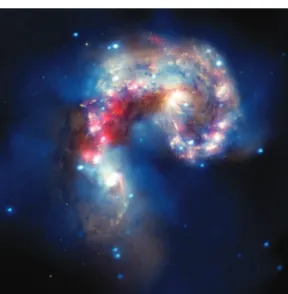
Studying gravitational, electric, and magnetic forces has revealed differences and similarities between these forces and their respective fields. The electric and magnetic fields have a stronger effect on the motion of subatomic particles, such as protons and electrons, but the gravitational field has a stronger effect on large objects, such as planets, galaxies, and clusters of galaxies (Figure 10).
Figure 10 Gravity controls the collision of two clusters of galaxies, while electricity and magnetism affect the release of radiation during the collision. (Colours have been added to the image to enhance the visual representation.)
The electric and gravitational forces resemble each other in that the force on an object depends on the location of the object. The magnetic force, however, depends on a charged object’s motion. The direction of electric and gravitational forces points from the object toward the charge or mass source. The direction of the magnetic force depends on the motion of charged particles with respect to the magnetic field.
Despite these similarities and differences, field theory states that electric and mag-netic fields are more closely related to one another than they are to the gravitational field. In fact, the electric and magnetic fields are thought to be different aspects of a single field, the electromagnetic field. They are used in conjunction with one another in a multitude of innovative technologies ranging from particle accelerators to artificial hearts.
field theory a scientific model that
describes forces in terms of entities that exist at every point in space
Questions
1. Explain how a mass spectrometer works. Include a sketch as part of your answer. K/U C
2. Consider a mass spectrometer used to separate the two isotopes of uranium, 238U31 (3.952 3 10-25 kg) and 235U31 (3.903 3 10-25 kg). Assume the ions enter the magnetic field region of strength 9.5 T with identical speeds and leave the spectrometer with a separation of 2.2 mm (as measured from the entry point) after completing a half-circle turn. Calculate the initial speed of the ions. T/i
3. An electron moves in a circular path perpendicular to a magnetic field of magnitude 0.424 T. The kinetic energy of the electron is 2.203 3 10-19 J. Calculate the radius of the electron’s path. Refer to Appendix B for the mass of the electron. T/i
4. A particle carries a charge of 4 3 10-9 C. When it moves with velocity 3 3 103 m/s [E 458 N], a uniform magnetic field exerts a force directly upward. When the particle moves with a velocity of 2 3 104 m/s directly upward, there is a force of 4 3 10-5 N [W] exerted on it. What are the magnitude and direction of the magnetic field? T/i
5. An electron, after being accelerated through a potential difference of 100.0 V, enters a uniform magnetic field of 0.0400 T perpendicular to its direction of motion. Calculate the radius of the path described by the electron. T/i
6. A velocity selector is a device that can choose the velocity of a charged particle moving through a region in which the electric field is perpendicular to the magnetic field, and with both fields
perpendicular to the initial velocity of the particle (Figure 11). To make the charged particle travel straight through the parallel plates, the downward deflection due to the electric field must equal the upward deflection due to the magnetic field. Suppose you want to design a velocity selector that will allow protons to pass through, undeflected, only if they have a speed of 5.0 3 102 m/s. T/i A
velocity selector P r e Bi Figure 11
(a) The magnetic field is B5 0.050 T. Calculate the electric field you need.
(b) What is the radius of the path the proton takes to get to point P? Refer to Appendix B for the
Summary
• If a charged particle moves in a uniform magnetic field so that its initial velocity is parallel to the field, it will not experience a magnetic force. If it moves so that its initial velocity is perpendicular to the field, it will move in a circular path in a plane perpendicular to the magnetic field.
• If a charged particle moves in a uniform magnetic field with a velocity that is neither parallel nor perpendicular to the field, it will move in a spiral path along the field lines.
• The radius r of the circular path a charged particle takes in a uniform magnetic field can be determined from Newton’s second law and centripetal acceleration and is given by r5mv
qB, where m is the mass of the particle, q is its charge, v is its speed, and B is the magnitude of the magnetic field. • Charged particles entering Earth’s magnetic field are deflected and spiral
along the field lines toward the magnetic poles. This motion results in a concentration of charged particles at Earth’s north and south magnetic poles. • Field theory states that if an object experiences a specific type of force over a
continuous range of positions in an area, then a field exists in that area.