DEVELOPING ENVIRONMENTAL INDICATORS FOR MINNESOTA
Prairies
The Environmental Indicators Initiative
State of Minnesota
Funded by the Minnesota Legislature
on recommendation of the
Legislative Commission on Minnesota Resources
Sponsored by
The Environmental Quality Board
1998
Citizens and decision makers use environmental indicators to help effectively manage and protect Minnesotas prairies. Environmental indicators answer four questions.
What is happening to our
prairies?
Environmental condition can be mea-sured by the relative abundance of native, exotic, and weedy plant species, soil organic matter content, and percentage of prairie acreage managed with fire.
Why is it happening?
Indicators of human activities that affect prairies include the conver-sion of prairie to other uses, the
exclusion of fire, and over-grazing by cattle.
How does it affect us?
Changes in prairie health and extent may diminish the flow of benefits. Indicators of how we are affected include changes in the number of native plant and animal species for scientific investigation and enjoyment, the availability of areas for hunting grassland wildlife, changes in forage quality, and changes in soil quality.
What are we doing about
it?
Societal strategies to maintain or restore healthy prairie include the imple-mentation of best management plans (that include grazing and prescribed burning), preservation
of remaining prairie through land acquisition and easements, and
restoration of permanent vegeta-tion.
In this chapter we outline important benefits from prairie ecosystems, the key ecological characteristics that determine the health of prairies, the pressures affecting prairies today, the current status and trends relating to prairies, and the most significant policies and programs that affect Minnesota prairies. In this chapter we give examples of indicators that provide important information about Minnesota prairies.
HIGHLIGHTS
Benefits of Healthy
Prairies
Habitat for wildlife, especially grassland birds and waterfowl Fertile soils and erosion control Opportunities for recreation,
including hunting and wildlife viewing and scientific research Plant species with potential for
agricultural and medicinal uses Sustainable forage for livestock Cultural and historical
significance to Minnesotans
Important Ecological
Characteristics
Underlying bedrock,
topography, soils, and moisture availability determine prairie plant community composition Productive prairies contain a
diverse assemblage of plants that exploit nutrients and water efficiently
Nitrogen and water availability often limit plant growth in prairie
Fire, grazing, drought, and burrowing animals are natural disturbances that help maintain prairie ecosystems
Impacts on Prairies
Fragmentation of remaining prairie habitat by agriculture, development, roads, and utilities Loss of prairie to mining and
associated road and building construction
Conversion of prairie to other uses (livestock production) via the introduction of exotic species and agricultural chemicals and the exclusion of periodic fires Isolation of small remnant
prairies from other natural communities
Inadequate management including elimination of fires, overgrazing, and recreational overuse
Airborne deposition of nitrogen
Status and Trends
Less than 1% of original Minnesota prairie remains Little high-quality prairie is
available for preservation The Red River region holds
most of the largest tracts of prairie remnants in the state Increased public interest in
prairie restoration and prairie plants for landscaping
Major Policies and
Programs
Scientific and Natural Areas Program protects significant examples of prairie Conservation Reserve Program reestablishes permanent grassland cover
Native Prairie Tax Exempt Program assists landowners in preserving prairie
Reinvest in Minnesota (RIM) Native Prairie Bank allows the DNR to preserve prairie by purchasing easements from landowners
The Nature Conservancy protects some of the highest-quality prairie tracts in the state
BENEFITS OF
PRAIRIES
Tallgrass prairies once covered a third of Minnesota in a zone
extending from the northwest to the south and southeast (Figure 1). The prairie supported an enormous diversity of plants, including members of the aster, legume, rose, lily, and grass families, and dozens of others. These grasslands produced the richest agricultural soil in the Midwest. The ecological, economic, scientific, and cultural values of Minnesotas tallgrass prairie are precariously preserved in the less than 1% of the original tallgrass prairie that remains today.
Prairie provides food and shelter for many species of wildlife. About half of the states rare species occur on prairies (MDNR 1990). Greater prairie chickens and sharp-tailed grouse depend on grasslands, and grassland songbirds, including upland plovers, bobolinks, meadowlarks, and longspurs, nest in prairie vegetation. Prairie wetlands provide habitat for many species of water-dependent birds, including mallards, pintails, canvasbacks, blue-winged teal, marbled godwit, and American bitterns. These wetlands are also important stop-over habitat for migrating waterfowl and sandhill cranes. Prairie plant communities support a rich assemblage of small
rodents, which in turn support mammals (badger, red fox, mink, and coyote) and raptors (red-tailed hawks, Swainsons hawks, kestrels). Roots of prairie plants are extensive and deep. The intertwining roots often form sod, which holds the soil and slows erosion. Decaying roots, soil organisms, and other organic material improve water and air penetration, and increase fertility. Fertile soils, a long growing season, and sufficient rainfall make the tallgrass prairie a very productive ecosystem (Tester 1995). High agricultural productivity promoted the conversion of tallgrass prairie to cropland. Native prairie grasses, which once supported vast herds of bison and elk, now provide
dependable forage for livestock. Prairie species have potential as crop plants and as medicines. Native Americans in North Dakota planted red-, white-, and black-seeded varieties of sunflower developed from wild species, one of the first improved crops developed from native prairie species (Wilson 1987). Jerusalem artichoke, the root of another prairie sunflower, can be found in supermarkets. Other native species, such as eastern gama grass and Illinois bundleflower, are
potential agricultural perennials (Piper 1993). Native Americans used many prairie plants as medicines. Purple coneflower was used against colds, has anti-inflammatory and painkilling properties, and stimulates the immune system (Chadwick 1995). New drugs and medicines may await discovery in prairie species.
Prairie has enormous scientific value to ecologists, wildlife biologists, soil scientists, and agronomists. Studying the genetic structure of wild grasses and forbs helped crop breeders develop new disease- and drought-resistant strains of hybrid grains. Soil scientists are interested in the ability of native prairie grasses to improve soil fertility. Because intact prairie in Minnesota is rare, scientific study of how prairie ecosystems function and the potential benefits they hold for us is imperative.
The use of prairie plants in low-maintenance landscapes for parks, corporate headquarters, roadsides, and other public areas is increasing in part because prairie plants control soil erosion effectively.
As a driving factor in our states history and economy, prairie is a culturally significant landscape for Minnesotans. Native Americans depended on prairie buffalo and other wildlife and plants for food and medicines. Immigrants farmed the rich prairie soil, built houses from its sod, and created Minnesotas agricultural economy.
ENVIRONMENTAL
INDICATORS
What are environmental indicators and how can they help us measure the health of prairie ecosystems? Indicators are selected measures that help us understand environmental conditions, alert us to potential problems, and suggest actions that prevent or fix problems before they become crises. The following scenario shows how environmental indicators can be used to improve environmental decision making in prairie ecosystems.
Frank and Mary are third-generation farmers. The pasture on their
property has never been plowed, but over the past few years, the quality of
forage has decreased, substantial supplemental feed was required for their cattle, and shrubs were becoming more common upslope from the stream than on the stream bank. In dry summers, weedy species, such as Canada thistle, reduced the amount of forage available. In addition, because cattle concentrate along the stream, the bank has eroded significantly. The stream is muddy and often full of algae. Although Frank and Mary depend on the pasture to provide high-quality forage for their cattle now, they want their children to inherit land that is productive and in good condition.
Working in partnership with conservation agencies, their local watershed coordinator, and the DNR, Frank and Mary developed a voluntary conservation plan to improve forage for cattle and enhance the native prairie. The plan included vegetation management practices, rotational grazing, and steps to stabilize the stream bank. They planted native switchgrass, big bluestem, and Indian grass and built a fence to exclude cattle from the stream banks. Prescribed burning helped the native grasses and removed weedy species from the site. Some of these activities were eligible for cost sharing through local agencies.
Under the plan Frank and Mary continue to cut hay and graze livestock on the pasture. Improved forage results in better cattle weight gain. The steam bank is stabilizing, and the water quality is improving.
The prairie scenario is representative of the complex issues affecting prairies. The EII framework provides insights into the relationships between human activities and environmental change and helps select indicators that measure progress toward solving complex problems. Some human activities adversely affect ecosystem health and diminish the flow of benefits. In the prairie scenario, indicators of human activities include
heavy livestock grazing and fire exclusion. These activities are pressures that cause changes in
environmental condition. Indicators of environmental condition include the
relative abundance of native and weedy plant species, stream-bank erosion, and sediment,
phosphorus, and nitrogen content of stream water.
Indicators can describe desired conditions (stable stream banks, clean water, soil retention, productive native grasses). They also can be used to guide restoration efforts by monitoring progress in returning the pasture to a healthier state. Strategies
for improvement may include
management activities that restore and maintain native plant species (rotational grazing, exclusion of cattle from stream-bank areas, prescribed burning, seeding with native species). Such strategies help restore and maintain the health of the prairie and ensure that the benefits (sustainable, high-quality forage, weight gain in cattle, erosion control, native grasses) we look for from prairies are . Table 1 shows how prairie indicators are organized within the EII framework.
PRAIRIE ECOLOGY
In Minnesota, tallgrass prairie has existed for centuries in a shifting balance with forests to the east. For example, prairie expanded to the east during a dry period 8,000 years ago and then retreated during cooling periods as forests expanded to the west. Fire was (and is) essential in maintaining tallgrass prairie. Although current rainfall amounts in the eastern prairie can support trees, prairie plants are better adapted to fire. Where fire is frequent, trees are eliminated, and grasses flourish. Compared to many forests, prairie is structurally simple. In Minnesota, a few woody shrubs, including wolfberry, wild rose, and smooth sumac, are native to tallgrass ecosystems (Chadwick 1995). However, Minnesota prairies consist largely of grasses (over 30 species) and nongrass, herbaceous plants (several hundred species; MDNR 1993). Historically, fires and bison created a patchy environment that supported a wide variety of plants and animals. Native prairie was productive and colorful, rich in insects, birds, and small and large mammals with varied environmental and habitat requirements (Figure 2). Deep, fertile soils, gentle topography, and a favorable climate made tallgrass prairie especially suitable for agriculture. Today, the tallgrass prairie region is the Midwests corn belt, and native tallgrass prairie persists only in small, scattered remnants. Approximately 150,000 acres of Minnesotas 18 million acres of prairie remain (Figure 3; Wendt 1984).Plant communities
Underlying bedrock, topography, soils, and moisture availability strongly influence plant community composition in Minnesota prairies (see text box; MDNR 1993) Grasses dominate in Upland Prairies, with tall grasses (big bluestem and Indian grass) more common on moist sites, and midheight grasses (little
bluestem, sideoats grama, porcupine grass, and June grass) common on drier sites. Forb species composition varies with soil moisture, but forbs typically are abundant and may be locally diverse. Several shrub or sub-shrub species (e.g., leadplant) are common, but trees and tall brush are generally absent. The presence of abundant shrubs, small aspen, balsam poplars, and bur oaks distinguishes Upland Brush-Prairies from Upland Prairies.
Biological productivity
Prairies are very productive
ecosystems, in part because hundreds of plant species exploit soil nutrients and water in diverse ways (Weaver 1954). For example, some species are adapted to cool, moist conditions (blue-joint reed grass, cordgrass, meadow rue, golden alexanders), while others tolerate heat and drought (grama grasses, needle grass, big bluestem, sage). Some species have shallow, fine roots to maximize collection of rainwater (little bluestem, June grass), while others have long taproots (compass plant, pale purple coneflower, upland boneset) to extract water from deep in the soil (Figure 4). In mesic tallgrass prairie in Wisconsin, annual production may reach 7,000 to 9,000 lbs/ac/yr. Average
MINNESOTA
PRAIRIE TYPES
Wet prairie occurs mainly in southern and western Minnesota, and occasionally within the deciduous forest zone, in low areas where the water table remains within the plant rooting zone for several weeks during the growing season but where inundation occurs only infrequently and briefly. Wet prairie is especially common in the Glacial Lake Agassiz Interbeach area, where artesian seepage occurs. Dominant wet prairie grasses include prairie cordgrass and blue-joint. Sedges and rushes are also important
components of the plant community. Although forbs are abundant in wet prairie, fewer forb species occur in wet prairie than in mesic prairie. Common forbs include panicled aster, New England aster, meadow ragwort, giant goldenrod, and sawtooth sunflower. Small willows are also common.
Mesic prairie occurs primarily in southern and western Minnesota on moderately well-drained to well-drained loamy soils. Once the most widespread type of grassland in the state, mesic prairie covered gently rolling glacial landforms. Mesic prairie is dominated by grasses: big bluestem and Indian grass on all site; little bluestem and porcupine grass on dryer site, and switchgrass and prairie cordgrass on wetter sites. Forbs (purple prairie clover, prairie turnip, rough blazing star, goldenrod, smooth aster, wood lily, leadplant, prairie rose, purple coneflower) are also abundant, with species
composition varying locally with soil moisture. Most of Minnesotas mesic prairie has been plowed, providing the most productive agricultural soils in the state. Northwestern Minnesota contains most of the states mesic prairies. Elsewhere only small remnants remain, many along railroad rights-of-way (Wendt
1984). Kentucky bluegrass is present at most sites indicating post-European settlement disturbance.
Dry prairie occurs on undulating to rough topography. Soils range from almost pure sand with little profile development to mollisols (prairie soils), but with a much thinner organic-rich surface horizon than soils of the mesic prairie. Soils are well drained to excessively drained. Dry prairies are maintained by fires but requires less frequent fires than mesic and wet prairies because droughty conditions slow the growth of woody species. Dry prairies vary considerably in species composition. Midheight and short grasses and sedges (porcupine grass, little bluestem, side-oats grama, and sun-loving sedge) usually dominate, but forb composition is variable (blazing star, prairie golden-aster, goldenrod, narrow-leaved puccoon, prairie smoke, prairie larkspur).
The Barrens subtype of Dry prairie
occurs on dry to somewhat moist stands on outwash plains, old dune blankets, and alluvial deposits along rivers and streams. These prairies occur in the northwest, central, and southeastern portions of the prairie zone, often as inclusions with Oak Savanna or Oak Woodland. Community composition and structure are determined by the low nutrient level, low levels of organic matter, and poor water-retaining capacity of sand. Distinctive forbs that occur in this subtype include prairie sagewort, large-flowered beard-tongue, hairy puccoon, and silky prairie-clover.
The Sand-gravel subtype of Dry prairie
occurs on gently to steeply sloping sites throughout the prairie zone including the former shorelines of Glacial Lake Agassiz, with scattered occurrences in the
deciduous forest-woodland zone. Prominent species include needle grass,
prairie dropseed, blue grama, prairie sagewort, small white beard-tongue, plains paintbrush, and milk-vetch.
Upland brush-prairies generally occur on somewhat poorly drained to well-drained, sandy clay loam to loamy fine sand soil, with mollisols predominating. The dominant vegetation is a mixture of prairie grasses (big bluestem and prairie dropseed on all sites; little bluestem, junegrass, and porcupine grass on drier sites; prairie cordgrass and mat muhly on moister sites) and shrubs. Shrub species include slender willow, pussy willow, bog birch on wet-mesic sites; hazel, sakatoon and chokecherry on dry-mesic and mesic sites; and prairie willow and leadplant on better drained, sandy sites. Quaking aspen suckers and stunted bur oak trees may be common on dry sites. Forb species are those common to mesic prairie.
Savannas are transitional communities between prairie and the forest. In savannas, fire-adapted trees coexist with prairie plants in an open, park-like landscape. Bur oak, protected by thick barks, survives fire and desiccation. Jack pine, in the north-central portion of the state, is adapted to poor soils and requires fire to open its cones, In the northwest portion of the state, quaking aspen forms clonal clumps interspersed with wet prairie and sedge meadow. Before European settlement, the savanna ecosystem covered 5 million acres of the Minnesota landscape (Wendt 1984). Today, less than one-tenth of 1 percent of oak savanna remains (MDNR 1977b).
productivity of temperate grassland worldwide (8,000 lbs/ac/yr; Whittaker 1975) compares favorably to that in temperate deciduous forest (10,800 lbs/ac/yr) and tropical dry forest (14,400 lbs/ac/yr; Whittaker 1975).
Indicators of productivity include measures of plant production and the abundance of grassland-dependent animal species (e.g., greater prairie chicken and sharp-tailed grouse). Fluctuations in the number of animals may also indicate changes in the amount of habitat due to fire management and increased area of grassland. On grazed prairies, long-term trends in forage
availability and livestock production are also measures of prairie health.
Biological diversity
Although a few species of tall and midheight grasses dominate, the northern tallgrass prairie contains a large number of nongrass plant species (Turner and Knapp 1996) and is one of the most diverse habitats in the Midwest. Its animal community is also very diverse. In many cases prairie species have adapted well to landscape changes and are abundant in pastures and woodlots near prairie remnants. Populations of other species with more restrictive habitat needs, however, have declined (Tester 1995). For example, monarch butterflies adapt well to agricultural landscapes, while Dakota skippers and regal and fritillary butterflies do not, and are found only on prairie remnants.
Indicators of biological diversity
should measure species, habitat, and landscape diversity. Plant community indicators include the relative abundance of exotics and native species, the abundance of
legumes, and the relative abundance of grazing-tolerant and grazing-intolerant plants. The
abundance of prairie chickens and sharp-tailed grouse and other species that require open habitats characteristic of prairies are also useful indicators. The abundance of adult butterflies and moths
(Dakota and other skippers, regal, fritillary) that are dependent on prairie help track plant community composition and habitat diversity. Landscape diversity indicators include indices of landscape fragmentation and connectivity
and the acreage and distribution of prairie.
Nutrient cycling
In prairies, the primary storage areas for carbon, nitrogen, phosphorus, and other nutrients are soils, living plant material, and plant detritus. Nutrient cycling is relatively fast for some nutrients, compared to that in forests, as prairies do not store vast reserves of nutrients in above-ground dead material (Tester 1995). Once nutrients become fixed in organic form by plants and microbes, they tend to be retained, and little is exported out of the system. Slow decay processes (including decomposer insects and microbes, and leaching) release nutrients from aboveground and belowground plant material. Some nutrients volatilized by fire are carried away by wind, while others are deposited in mineral rich ash.
Low nitrogen and phosphorus availability often limits plant growth. Big and little bluestem, however, have low nitrogen requirements and a competitive advantage over plants that need more nitrogen (Tester 1995). Air-deposited nitrogen compounds (produced when fossil fuels are burned or in windborne particles of agricultural fertilizer) may change species composition in favor of nitrogen-loving plants (Wedin and Tilman 1992). Many prairie plants obtain nutrients through associations with bacteria or fungi. The roots of many grasses and forbs form mutualistic associations with mycorrhizal fungi that greatly
increase the plants uptake of phosphorus, other scarce minerals, and water (Chadwick 1995). Nitrogen-fixing bacteria associated with prairie legumes enrich the soil with nitrogen (Magers 1992). Grasslands store twice as much carbon per acre as do forests because of the rapid turnover of plant material in prairies.
Approximately two-thirds of the plant tissue in prairies is located belowground in roots and rhizomes. In the course of three to four years, the roots of prairie grasses nearly all die and are replaced by new roots (Weaver 1954). Maintaining this dynamic root system removes carbon dioxide from the atmosphere and stores it as dead organic matter in the soil. Thus, prairie soils may contribute significantly to slowing climate change (Chadwick 1995). Comparisons of soils from prairies and agricultural areas provide valuable information on nutrient cycling. Soil aggregate size, nutrient-holding capacity, organic matter content, and level of soil disturbance, including soil compaction and erosion, measure prairie soil quality and prairie health.
Natural disturbance
regimes
Natural disturbances (i.e., fire, drought, grazing) help maintain prairie ecosystems. Native prairie perennials have strong, deep root systems and energy reserves and dormant buds that lie below the soil surface, which allow them to survive and recover following fires and periodic droughts. Plant and animal diversity is highest in tallgrass prairies
where fire, grazing, and burrowing animals interact.
Fire
Presettlement prairie fires, started by lightning or set by Native Americans, probably burned every 3 to 10 years (MDNR 1990). Frequent fires (and droughts) restrict woody plants to refuges near streams and ponds. In the absence of fire, dead plant material builds up, soils retain moisture, and the prairie is more susceptible to invasion by trees and shrubs (Curtis 1959). Fire also discourages exotic species by creating conditions more favorable to the sun-loving native species with which they must compete. Litter buildup increases shade, reduces soil temperature, and slows
photosynthesis, resulting in a more significant reduction in growth of native species than of more shade-tolerant exotics (Parenti 1978; Weaver and Rowland 1952; Olds 1969; Rice and Parenti 1978; Knapp and Seastedt 1986).
Prairie burning often results in a mosaic of burned and unburned patches. Wet areas, brushy areas, and streams retard fires, and grazing may reduce amounts of grass (fuel) enough to prevent the spread of fire. The resulting patchy landscape provides a diversity of habitat and nutrient resources that supports high plant and animal species diversity. Annual late-spring burning increases the growth of warm-season grasses (Abrams et al. 1986; Gibson and Hulbert 1987; Kucera and Koelling 1964; Sims 1988) and slows the growth of forbs (Towne and Owensby 1984). Midsummer and
late-fall fires favor spring blooming forbs. Forbs that bloom in
midsummer are not harmed by fire any time of year (Lovell et al. 1982). Fire also affects the distribution of small mammals (Collins and Wallace 1990), birds (Tester and Marshall 1961), and insects. Some rodents benefit from the removal of the tangled mat of stems. Deer mice colonize burned prairie from
surrounding unburned areas. Western harvest mice, meadow voles, and southern bog lemmings, however, are less common on burned prairie. Savannah sparrow populations are smaller in years immediately after fire, while LeContes sparrows are more numerous after a burn. Extensive fires may reduce populations of insects and other arthropods on small, isolated prairie remnants. Insect species that are more sensitive to fire, whose populations are small, or that are poor dispersers may be unable to recolonize isolated prairies (Reed 1997). A prairie landscape containing sites at different successional stages and sites that are burned with varying frequencies tends to support the highest number of arthropod species.
Grazing animals
Historically, prairies were grazed by elk, pronghorn, and large herds of bison. Grazing created structural diversity in the vegetation and influenced the relative abundance of plant species (MDNR 1990). For example, selective grazing of warm-season grasses allowed other plants to increase and typically resulted in higher overall plant diversity (Collins 1987; Collins and Barber 1985).
Bison wallows, patches of firm-packed earth where bison rolled and stamped, held water and remained moist into the dry summer season (Grinnell 1970). These wallows were refuges where moisture-loving plants and annual species could survive fire and drought (Collins and Uno 1983).
Drought
Most tallgrass prairie plants are well adapted to drought (Sims 1988; Vankat 1979). Some wait out drought as seeds or belowground storage organs and increase in number in wet years (Shelford 1963; Weaver 1954). In many species, roots store carbohydrates and grow rapidly after a drought. In addition, close-set hairs (pubescence), warm-season photosynthesis, and leaf shape (thin and divided leaves, common in prairie plants, give off heat faster than thick, nondivided leaves) are examples of structural adaptations that minimize water loss.
Burrowing animals
Burrowing mammals, such as pocket gophers, badgers, and ground squirrels, loosen and aerate soils and affect the distribution and density of plant species as they feed (Tester 1995). Burrowers create small mounds of bare soil where seeds germinate more readily than in competition with established plants. Some annuals are most common on old burrow sites (Estes et al. 1982). Bare areas around burrows and the burrows themselves are refuges from fire and summer heat for small animals. Mima mounds, hummocks of soft soil rising 1 to 2 feet above the surface of northwestern Minnesota prairies, are created by
prairie burrowers and are remixed year after year by toads digging winter burrows (Tester 1995). Indicators of natural disturbance regimes in prairie that help measure prairie health include the percentage of prairie area managed using fire, prairie litter density, the
relative abundance of warm- and cool-season grasses, and grazing intensity.
PRESSURES ON
PRAIRIES
Fragmentation
Roads, fields, woodlots, and development have fragmented the prairie ecosystem into small, isolated remnants (Figure 5). Fragmentation creates barriers to dispersal of wildlife and recolonization by plants and creates opportunities for invasive
exotic species. In addition, many grassland birds nest only in large tracts of grassland and avoid small patches that otherwise seem to be good habitat (Herkert 1994). One consequence of fragmentation is that birds and mammals that use edge habitat (raccoons, fox, white-tailed deer, and cowbirds) have increased, while species requiring large
unbroken grasslands, such as prairie chickens and marbled godwits, have declined.
Prairie remnants are more vulnerable to chance events than are large areas of prairie. Small populations of plants or insects often do not recover following disturbances as easily as do larger populations (Gilpin and Soule 1986). The Dakota skipper, for example, is a prairie butterfly endemic to northern tallgrass and mixed-grass prairies and a pollinator of prairie plants (Licht
1995). In large prairies, skippers recolonize burned areas from unburned areas. In small fragments of prairie, however, fire may reduce a population of skippers, leaving them vulnerable to other disturbances that could eliminate them.
Conversion to other uses
Conversion of prairie to agricultural land is the major cause of the continuing loss of prairie. Since 1837, when the steel moldboard plow allowed the sod to be turned easily, prairie has been fenced and plowed. Prairie loss was also extensive in the 1970s (MDNR 1990). Of
Minnesotas original 18 million acres of prairie, only 150,000 acres remain. Economic pressures and agricultural practices that may make it more profitable to plow or develop open land than to keep it in native
vegetation continue to threaten prairie remnants.
Overgrazing and exclusion of fire decrease the abundance of native species and promote exotics. Where herbicides, pesticides, or fertilizers are applied to increase forage yields, and where domestic pasture species such as red clover, brome, and timothy grass (MDNR 1990) are interseeded with native species, plant communities and the animals they support are altered.
Invasive species
To obtain fence posts and firewood, settlers planted trees and encouraged the expansion of forest from riparian areas. Invasive species (such as birds-foot trefoil and crown vetch) and trees (such as hybrid poplar) displace
native species and reduce the value of prairie pasture. In addition, introduced trees provide perches for hawks and attract cowbirds and mammalian predators, all of which threaten populations of prairie birds.
Fire suppression
While managers recognize the importance of fire in maintaining healthy prairie, burning of prairie refuges may be constrained by lack of resources, local fire ordinances, or the danger of fire and smoke to
adjacent residential or livestock operations. In the absence of fire, invasive woody plants displace native species.
Gravel mining
The beach ridges of Glacial Lake Agassiz in northwestern Minnesota contain some of the states highest-quality prairie remnants (MDNR 1997a). About 14,290 acres of prairie of high or medium significance, approximately 10% of all the prairie remaining in the state, are located in the eighteen eastern townships of Clay County (Figure 6).
Approximately 3,960 of these acres overlie valuable gravel deposits. Citizens of the beach ridges region are attempting to balance the use and preservation of these resources (Clay County Beach Ridges Forum 1997).
Air pollution
Even remote prairies are subject to airborne pollutants. Nitrogen compoundsfallout from fossil fuel combustion and agricultural fertilizer useare of particular concern. Increasing nitrogen levels encourage the invasion of nitrogen-loving plants, such as quack grass (Wedin and Tilman 1996), Kentucky bluegrass, and reed canary grass.
Off-highway vehicles
On some prairie preserves, improper or excessive use of off-highway vehicles (OHVs; all-terrain vehicles and snowmobiles) compacts the soil, leaves large ruts, and destroys native vegetation. Potential consequences of these activities include increased soil erosion, changes in plant species composition, and interference with ground-nesting birds.
Environmental indicators help demonstrate the relationships between human activities and the health of prairies. For example, the
ratio of edge to total prairie area
and the distribution of prairie land across the landscape measure fragmentation of prairie ecosystems. The percentage of prairie land converted to other uses, the
percentage of prairie acreage in best-grazing management, pesticide and herbicide
application rates, abundance of exotic species, and the extent of woody plant cover help measure the effect of human activities on prairie health.
PRAIRIE STATUS
AND TRENDS
Land conversion and
fragmentation
Less than 1% of Minnesotas prairie remains, and most occurs in small, isolated patches. The little high-quality prairie that remains occurs on hilly or marginal sites that escaped the plow. Railroad right-of-ways harbor many prairie remnants. These remnant prairies, maintained by periodic burning to clear vegetation, are valuable as wildlife habitat and sources of seed for prairie
restoration (MDNR 1986). While these areas have unique ecological value, we are missing large areas of mesic prairie, once the states hallmark prairie ecosystem. Minnesotas remaining prairie is vulnerable to further fragmentation and conversion to other uses as land is subdivided or plowed. Conversion of lands in permanent vegetative
cover (pasture, woodlands) into row crop production continues in Minnesota. For example, over 40% of non-Conservation Reserve Program (CRP) grasslands in the Glacial Lake Agassiz area of northwestern Minnesota have been converted in the past 10 years (Natural Resources Conservation Service, USDA, 1992 Natural Resource Inventory data). The impact of grassland habitat conversion and fragmentation is reflected in trends in grassland bird populations (Table 2).
Other indicators suggest positive change. Between 1985 and 1995, farmers enrolled 1.8 million acres of farmland in the Conservation Reserve Program. The CRP reduces erosion, protects soil resources, and provides habitat for wildlife by establishing permanent vegetative cover on highly erodible or
environmentally sensitive croplands (Figure 7). Native prairie vegetation has been established on some CRP lands. In addition, a Prairie
Stewardship Partnership promotes sound and sustainable economic development, while protecting the productivity and diversity of natural ecosystems in the tallgrass prairie region.
Protection and
restoration
Federal (National Park Service, National Wildlife Refuge), state (Native Prairie Bank, Scientific and Natural Areas), and private organizations (The Nature
Conservancy preserves) are working to protect and restore Minnesota prairie. Approximately 34,800 acres of Minnesota prairie is protected through these types of initiatives (Figure 8). In cities and suburbs, there is growing interest in
landscaping with native species, and some large prairie tracts have been restored around corporate
headquarters.
Restoration efforts that re-create natural disturbances, including fire and grazing, are often most successful. Although prescribed burning is vital to long-term
maintenance of prairie, mowing can simulate both fire and grazing and can be used on many more sites. Restored prairie, however, is not a substitute for native prairie. Many functional elements of natural prairie, including insect species, soil fungi, and nematode worms and the complex ecological relationships between plants, pollinators, herbivores, and predators
characteristic of intact prairies are not easily restored (Chadwick 1995).
EXISTING POLICIES
AND PROGRAMS
Several statewide programs protect Minnesotas prairie from conversion to other vegetation types or other land uses. Some permit selected agricultural uses of the prairie, such as grazing and hay cutting, while others manage prairie solely for its scientific and habitat value.Scientific and Natural Areas (SNAs) are managed by the DNR solely for the protection of Minnesotas rarest and most endangered natural features. Prairie SNAs are managed to preserve and enhance their native plant and animal communities. The Native Prairie Tax Exemption Program exempts eligible native prairie lands from property tax. To be eligible for tax abatement, the prairie must be at least 5 acres in size (in most counties), and livestock grazing is not allowed. In most cases, farmers can hay lands enrolled in the exemption program.
Designed to protect prairie from conversion to cropland or other uses, the Reinvest in Minnesota Native Prairie Bank program allows landowners to sell easements on prairie acres to the DNR. Easements may be permanent or of limited duration with priority given to permanent easements. Easements may allow grazing or hay cutting under guidelines agreed to by both the DNR and the landowner. The Prairie Wetland Heritage Conservation Initiative, funded by a grant from the federal Migratory Bird Conservation Commission,
preserves high-quality prairie in southern Minnesota. The initiative will purchase 2,380 acres of prairies and adjacent lands, obtain easements on 225 acres, and restore wetlands on 500 acres. Acquired lands will be managed by the DNR or the U.S. Fish and Wildlife Service as wildlife management areas.
The DNRs Section of Wildlife and Divisions of Parks and Recreation, Forestry, and Trails and Waterways protect prairie where it occurs on wildlife management lands and in state parks. Prairie is managed for its value to wildlife and its aesthetic and recreational value. The U.S. Fish and Wildlife Service protects and restores prairie on its wildlife refuges,
waterfowl production areas, and other lands. The Fish and Wildlife Service recognizes that prairie provides cover for nesting waterfowl and other wildlife, and has a program to re-seed former cropland to native warm-season grass cover.
The Nature Conservancy (TNC), a private nonprofit organization, acquires and preserves areas of undisturbed natural habitat supporting rare and endangered plants and animals. TNC protects some of the highest-quality prairie tracts left in the state. Its preserves are open for scientific use and have been burned in regular rotation since 1962. Eleven of TNCs preserves are leased to the DNR under the
Scientific and Natural Areas program.
EXAMPLE
INDICATORS
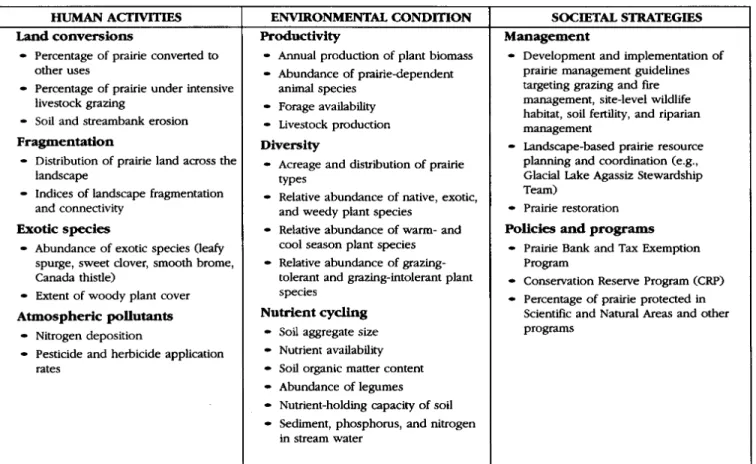
Table 3 collects the indicators used in this chapter. The indicators are organized within the EII framework, which helps illustrate relationships among human activities,
environmental condition, the flow of
benefits, and strategies for sustaining a healthy environment. The indicators used in this chapter are examples that illustrate how indicators may help assess prairie health. The process of developing a comprehensive set of indicators that assess prairie health and inform environmental decision making is ongoing. Developing
indicators will require collaboration with stakeholders interested in their use, testing, refinement, and standardization of measurement techniques.
REFERENCES
Abrams, M. D., et al. 1986. A ten year record of aboveground biomass in a Kansas tallgrass prairie. American Journal Botany
73(10):1509-15.
Chadwick, D. H. 1995. What good is a prairie? Audubon, Nov.-Dec. 1995, 37-46.
Clay County Beach Ridges Forum. 1997. Final report: Clay County Beach Ridges Forum for Gravel Mining and Prairie Protection. Minnesota Department of Natural Resources, Division of Minerals, St. Paul.
Collins, S. L. 1987. Interaction of disturbances in tallgrass prairie: A field experiment. Ecology 68(5):1243-50.
Collins, S. L. 1992. Fire frequency and community heterogeneity in tallgrass prairie. Ecology 73(6): 2001-6.
Collins, S. L., and S. C. Barber. 1985. Effects of disturbance on diversity in mixed-grass prairie. Vegetation 64:94-97.
Collins, S. L., and G. E. Uno. 1983. The effect of early spring burning on vegetation in buffalo wallows. Bulletin of the Torry Botanical Club 110:474-81.
Collins, S. L., and L. Wallace. 1990. Fire in North American tallgrass prairies. University of Oklahoma Press, Norman.
Curtis, J. T. 1959. The vegetation of Wisconsin: An ordination of plant communities. University of Wisconsin Press, Madison. Dawson, J. 1996. Air pollution threatens prairies, U study finds. Star Tribune, Dec. 6, 1996, B1.
Dinsmore, J. A country so full of game: The story of wildlife in Iowa. University of Iowa Press, Iowa City. Drew, W. B. 1947. Floristic
composition of grazed and ungrazed prairie vegetation in north-central Missouri. Ecology 28(1):28-41. Estes, J. R., R. J. Tyrl, and J. N. Brunken, eds. 1982. Grasses and grasslands: Systematics and ecology. University of Oklahoma Press, Norman.
Fairbanks, C., and S. B. Sundberg. 1983. Farm women on the prairie frontier: A sourcebook for Canada and the United States. Scarecrow Press, Metuchan, N.J.
Gibson, D. J., and L. C. Hulbert. 1987. Effects of fires, topography, and year to year climatic variation on species composition in tallgrass prairie. Vegetation 72:175-85. Gibbons, B. 1984. Do we treat our soil like dirt? National Geographic, Sept. 1984, 351-87.
Gilpin, M. E., and M. E. Soule. 1986. Minimum viable populations: Processes of species extinction. Pages 19-34 in M. E. Soule, ed.,
Conservation biology: The science of scarcity and diversity. Sinauer Press, Sunderland, Mass.
Grinnell, G. B. 1970. Last of the buffalo. Arno Publishing, New York.
Herbel, C. H., and K. L. Anderson. 1959. Response of true prairie vegetation on major Flint Hills range sites to grazing treatment. Ecological Monographs 29:171-86.
Herkert, J. 1994. The effects of habitat fragmentation on midwestern grassland bird communities.
Ecological Applications 4(3):461-71. Knapp, A. K., and T. R. Seastedt. 1986. Detritus accumulation limits productivity in tallgrass prairie. Bioscience 36:662-68.
Kucera C. L., and M. R. Koelling. 1964. The influence of fire on composition of central Missouri prairie. American Midland Naturalist 72:142-47.
LaRoe, E. T., G. S. Ferris, C. E. Puckett, P. D. Doran, and M. J. Mac, eds. 1995. Our living resources: A report to the nation on the
distribution, abundance, and health of U.S. plants, animals, and
ecosystems. U.S. Department of the Interior, National Biological Service, Washington, D.C.
Licht, D. S. 1995. Grass no good upside down: Ecology, economics, and the Great Plains. Unpublished manuscript. Address: 4350 Howard Lake Drive, Forest Lake, MN 55025. Telephone: 612-464-0761. Lovell, D. L., R. A. Henderson, and E. A. Howell. 1982. The response of forb species to seasonal timing of prescribed burns in remnant
Wisconsin prairies. Pages 11-15 in Proceedings of 8th North American Prairie Conference, R. Brewer, ed. Western Michigan University, Kalamazoo, Mich.
Magers, V. 1992. What can we learn from the prairie? The prospects for a sustainable agriculture. The World and I, Dec. 1992.
Minnesota Department of Natural Resources (MDNR). 1986. Other grasslands: A strategic plan 1986-1991. Div. of Fish and Wildlife, Minnesota Department of Natural Resources, St. Paul.
_____. 1990. Native Prairie. Chapter 37 in Long-range plan: Public review draft. Div. of Fish and Wildlife, Minnesota Department of Natural Resources, St. Paul.
_____. 1993. Minnesotas native vegetation. Biological report no. 20. Minnesota Department of Natural Resources, St. Paul.
_____. 1997a. The beach ridge landscape in Clay County: An information handbook. Div. of Minerals, Minnesota Department of Natural Resources, St. Paul.
_____. 1997b. Directions for natural resources: An ecosystem-based framework for setting natural resource management priorities. Minnesota Department of Natural Resources, St. Paul.
Piper, J. K. 1992. Size structure and yield over four years in an
experimental Cassia marilandica (Leguminosae) population. Canadian Journal of Botany 70:1324-30.
_____. 1993. A grain agriculture fashioned in natures image. Great Plains Research 3:249-72.
Old, S. M. 1969. Microclimate, fire, and plant production in an Illinois prairie. Ecological Monographs 39(4):355-94.
Panzer, R. 1988. Managing prairie remnants for insect conservation. Natural Areas Journal 8(2):83-90. Pyne, S. J. 1982. Fire in America: A cultural history of wildland rural fire. Princeton University Press, Princeton, N.J.
Reed, C. In press. Response of prairie insects and other arthropods to prescribed burns. From author, Department of Entomology, University of Minnesota, St. Paul, MN 55108; 612- 624-6740. Rice, E. L., and R. L. Parenti. 1978. Causes of decrease in productivity in undisturbed tallgrass prairie.
American Journal of Botany 65:1092-97.
Risser, P. G., et al. 1981. The true prairie ecosystem. Academic Press/ Hutchinson-Ross Publishing, Stroudsburg, PA.
Runkel, S. T., and D. M. Roosa. 1989. Wildflowers of the tallgrass prairie. Iowa State University Press, Ames.
Shelford, V. E. 1963. The ecology of North America. University of Illinois Press. Urbana.
Sims, P. L., and D. D. Dwyer. 1965. Pattern of retrogression of native vegetation in north-central Oklahoma. Journal of Range Management 18:20-25.
Sims, P. L. 1988. Grasslands. In North American terrestrial
vegetation, M. G. Barbour and W. D. Billings, eds. Cambridge University Press, New York. Tester, J. R. 1995. Minnesotas natural heritage: An ecological perspective. University of Minnesota Press, Minneapolis.
Tester, J. R., and W. H. Marshall. 1961. A study of certain plant and animal interrelations on a native prairie in northwestern Minnesota. University of Minnesota, Natural History Occasional Paper No. 8. The Nature Conservancy (TNC) Unpublished vegetation survey data from tallgrass prairie sites. Midwest Regional Office, 1313 5th St. SE, Minneapolis, MN 55414.
Towne, A., and C. Owensby. 1984. Long-term effects of annual burning at different dates in ungrazed Kansas tallgrass prairie. Journal of Range Management 37:392-97.
Turner, C. L., and A. K. Knapp. 1996. Responses of a C4 grass and three C3 forbs to variation in nitrogen and light in tallgrass prairie. Ecology 77(6): 1738-49.
U.S. Fish and Wildlife Service. 1995. Tallgrass prairie challenge:
Conserving our resources, preserving our heritage. U.S. Government Printing Office, #1995-658-774.
Vankat, J. L. 1979. The natural vegetation of North America, an introduction. Wiley, New York. Weaver, J. E. 1954. North American prairie. Johnson Publishing Co., Lincoln, Nebr.
Weaver, J. E., and N. W. Rowland. 1952. Effects of excessive natural mulch on development, yield and structure of native grassland. Botanical Gazette 114:1-19.
Wedin. D. A., and D. Tilman. 1992. Nitrogen cycling, plant competition, and the stability of tallgrass prairie. Proceedings of the North American Prairie Conference 12: 5-8.
Wedin, D. A., and D. Tilman. 1996. Influence of nitrogen loading on the carbon balance of grasslands. Science 274: 1720-23.
Wendt, K. M. 1984. A guide to Minnesota prairies. Natural Heritage Program, Minnesota Department of Natural Resources. St. Paul.
Whittaker, R. H. 1975. Communities and ecosystems. 2d ed. MacMillan Publishing Co., New York. Wilson, G. 1987. Buffalo Bird Womans garden: Agriculture of the Hidatsa Indians. Minnesota Historical Society Press, St. Paul