SPECIAL FEATURE: VEGETATION SURVEY
A phytosociological and phytogeographical survey of
the coastal vegetation of western North America: beach
and dune vegetation from Baja California to Alaska
Manuel Peinado, Francisco Manuel Oca ˜na-Peinado, Juan Luis Aguirre, Jos ´e Delgadillo, Miguel A´ngel Mac´ıas & Gustavo D´ıaz-SantiagoKeywords
Bioclimatology; Floristic analysis; Pacific coast of North America; Plant associations; Strand; Syntaxonomy; Vegetation classes and orders Abbreviations
ALC = Average Linkage Clustering; BIO = Bioclimate; MB = Macrobioclimate; PNV = Potential Natural Vegetation; RG = Relev ´e Group
Nomenclature
USDA (2010), except for the Bajacalifornian taxa (Wiggins 1980),Agave(Gentry 1978), Helianthus(Heiser et al. 1966), andIsocoma (Nesom 1991)
Received 19 November 2010 Accepted 18 March 2011 Co-ordinating Editor: Milan Chytry´
Peinado, M.(corresponding author, [email protected]);Aguirre, J.L. ([email protected]) &D´ıaz-Santiago, G. ([email protected]): C ´atedra de Medio Ambiente, Universidad de Alcal ´a, 28871 Alcal ´a de Henares, Madrid, Spain
Oca ˜na-Peinado, F.M.([email protected]): Departamento de Estad´ıstica e Investigaci ´on Operativa, Universidad de Granada, E–18071 Granada, Spain
Delgadillo, J.([email protected]): Facultad de Ciencias, Universidad Aut ´onoma de Baja California, Campus de Ensenada, BC, Mexico Mac´ıas, M.A´ .([email protected]): Departamento de Ciencias Ambientales, Centro Universitario de Ciencias Biol ´ogicas y Agropecuarias, Universidad de Guadalajara, carretera a Nogales Km. 15.5, Las Agujas, Nextipac, Zapopan, JAL, Mexico
Abstract
Questions: What is the floristic composition of the plant communities that inhabit the beaches and dunes of the Pacific coast of North America? What are their ecological relationships in the zonal and successional gradients typical of coastal dune systems? Does climate affect the latitudinal distribution of the azonal vegetation? What other environmental factors influence their distribu-tion on the regional or local scale?
Location:Pacific coast of North America, from Baja California (231020N) to Cook Inlet, Alaska (611300N).
Methods:A total of 1730 phytosociological relev ´es were obtained by sampling 279 coastal localities. In all localities, zonation was interpreted by considering transects from the shoreline inland. Through traditional phytosociological tabular classification and average linkage clustering, relev ´es were syntaxono-mically classified. Syntaxa, supported by fidelity calculations, are described and interpreted according to their phytogeographical distribution, their relation-ships with macrobioclimate (MB) and bioclimates (BIO), and to the topo-graphic and ecological gradients typical of coastal sandy areas.
Results:Our bioclimate analysis served to define four MB and 11 BIO, each characterized by a particular type of potential natural vegetation. By floristi-cally analysing the 522 vascular taxa detected, these were related to 16 phytogeographical elements. Syntaxonomically, the communities observed comprise 74 vegetation types, 70 of which are considered associations char-acterized by their diagnostic combination of species. These associations were classified into 24 alliances, 16 orders and 12 phytosociological classes. Two new classes, five new orders, 10 new alliances and 34 new associations are presented. Some syntaxa have been revised or validated.
Conclusions:The coastal vegetation of the northern Pacific shows a distribu-tion that is mainly linked to the four MB of the latitudinal gradient examined. Higher syntaxa are preferentially linked to a macrobioclimate, although some edaphic factors determine that some occupy two different but geographically close bioclimate zones. Regional factors, such as alkaline sands, induce the appearance of specialized vegetation types rich in endemic plants.
Introduction
This study of the beaches, dunes and their associated sandy plains from southern Alaska to Baja California is a survey the psammophilous plant communities of the NE
Pacific using phytosociological methods. Despite some excellent regional works and good territorial floras, to date there is no general survey of the strand and dune vegetation of the North American Pacific coast. After an
initial period of pioneer studies clearly influenced by Cowles’s (1899) theory of ecological succession on sand dunes, Cooper (1936) was the first to report the distribu-tion of 53 representative coastal plants from SW Alaska to northern Baja California. Almost 40 yr later, Breckon & Barbour (1974), Macdonald & Barbour (1974) and Barbour et al. (1975) published the only known floristic syntheses of North America’s Pacific beaches, but so far there have been no syntheses made of the plant communities of beaches and dunes in the Pacific coast of North America.
Using the Braun-Blanquet method, 20 yr ago we started to study the coastal vegetation of the North American Pacific coast. So far, we have recorded 3259 relev ´es of coastal plant communities. These relev ´es constitute the basis of a series of phytosociological publications analyzing saltmarshes and mangroves (Delgadillo et al. 1992; Peinado et al. 1994b, 1995) and the coastal vegetation of Baja California (Peinado et al. 2008). The present study focuses on plant communities of the Pacific coast between the tip of the Baja California peninsula in Mexico, to the northern-most site at Cook Inlet, Alaska.
The term coastal vegetation, as applied in this article, includes beach strand (not the beach itself but sparsely or densely vegetated areas behind the beach), foredunes, sand spits, and active to stable backdunes and sandsheets derived from quartz or alkaline sands. The vegetation of Mediterranean saltmarshes and tropical mangroves are outside the scope of this article, as these have been the subject of our above-mentioned studies. Estuarine wet-lands and boreo-temperate saltmarshes are also excluded. Methods
Study area
Facing the Pacific Ocean, the study area extends across an airline distance of approximately 5000 km from the southern tip of Baja California (Loc. 1; for localities see Fig. S1) to Cook Inlet, Alaska (Loc. 279). In longitude, the area reaches its eastern limit at Bah´ıa de Las Palmas (Loc. 2), while the westernmost site sampled was at Loc. 262, on Kodiak Island. The whole area forms part of the largest and highest of North American physiographic systems, the Pacific Border System (Brouillet & Whestone 1993), which is the backdrop for most of the ocean’s shores (Fig. S2).
Four zonobiomes (ZB) can be distinguished along this latitudinal band: ZB-VIII (cold-temperate or boreal), ZB-V (warm-temperate, maritime, humid), ZB-IV (winter rain and summer drought, arid-humid), and ZB-III or subtro-pical arid (Peinado et al. 1994a, 1997, 2007). From a phytogeographical standpoint, Dice (1943) included the boreal and the temperate climate zones within the Hud-sonian (continental boreal), Sitkan (oceanic boreal) and
Oregonian (temperate) provinces. The winter rain zone corresponds to the Californian Region, in which the provinces Northern California, Southern California, and Martirense have been defined. The tropical zone corre-sponds to the Xerophytic-Mexican region, which has been divided into two provinces: Baja Californian and Sanlucan (Fig. S2). For a more detailed phytogeographical classification see Peinado et al. (2008, 2009).
Patterns of vegetation on Pacific dunes are best under-stood in the context of underlying geologic processes and dune morphology. Subsequent to Cooper’s pioneering stu-dies (1958, 1967), several authors have described dune geology and morphology for specific localities or regions. Using the information from these works, we provide a summary (Appendix S3) with the geological and geomor-phological processes underlying coastal beaches and dunes, and a brief classification of beach and dune landscape as divided into major zones, each characterized by distinct plant habitats. See references in that table for additional and more extensive information on dune genesis.
Selection of stands
Prior to extensive fieldwork, some 300 potential strand localities were selected along the Pacific coast, from Cook Inlet, Alaska, to the southern tip of Baja California, includ-ing Kodiak and Vancouver islands. While the southern limit of the study area is marked by the extreme tip of the Baja California peninsula, its northern limit merely marks the end of the territory that we have explored. Localities were chosen to ensure an accessible strand and dune vegetation that was relatively well-preserved, and on the basis of satellite images, aerial photography, literature references, suggestions by other researchers, or our own knowledge of the coast. In subsequent fieldwork, we found that some of the localities selected were too disturbed by human activ-ities. Finally, 279 localities were considered appropriate for detailed sampling (Fig. S1). These fall into several ecoflor-istic zones, ecoregions, and four zonobiomes (Appendix S4).
Climate and potential natural vegetation (PNV) analyses
Climate data from 226 coastal weather stations in the study area were compiled from the Canadian Weather Office (http://www.climate.weatheroffice.ec.gc.ca), NOAA (2002), and the Mexican National Weather Service (http://smn.cna. gob.mx). Several climate indices were calculated and every station was ascribed to one macrobioclimate (MB) and bioclimate (BIO). Four MB, grouping 11 BIO, can be distinguished across the study area: boreal, temperate, Med-iterranean and tropical. For bioclimatic classification see Mac´ıas (2009) and Peinado et al. (2007, 2011a). Climate
diagrams are available at http://www2.uah.es/ambiente/ bioclimate/Climograms.rar.
Predicting vegetation type based on the structure or physiognomy of a community is the basic method of treating vegetation on a broad scale in relation to climate (Beard 1973). Accordingly, before the fieldwork, each weather station was initially assigned to a particular PNV, which is defined as the plant community that would become established if all successional sequences were completed without interference by man under the pre-sent climatic and edaphic conditions (Ricotta et al. 2002). In later fieldwork, this classification into vegetation types was checked. In this manner, the localities sampled were in turn assigned to a meteorological station and therefore to a BIO and PNV according to their geographical proxi-mity. The bioclimatic classification and PNV for each weather station are summarized in Appendix S4. Biocli-mates and PNV at association level along with climate data and indices for each station are available in Appendix S5.
Field procedures
This study is based on a set of 1730 relev ´es produced and analysed according to the Braun-Blanquet method (Westhoff & van der Maarel 1973; Braun-Blanquet 1979; Dierschke 1994). The localities were sampled from 1995 to 2009. Edaphic and geological data were previously ob-tained from bibliographic and cartographic sources. After reconnaissance of the entire locality, transects were defined along lines inland from the shoreline to the interior limit of the psammophilous vegetation. These transects represented a moisture or soil gradient (catena), such as from shoreline vegetation to dune ridges, or from the wet bottom of dune swales to the encircling drier dune slopes. Along each transect, zones were defined by changes in topography or vegetation. Significant vegetation changes included density, cover, and species composition.
Our vegetation analysis started with the subjective choice of one or more stands at each transect zone follow-ing the approach termed ‘subjective samplfollow-ing without preconceived bias’ (Mueller-Dombois & Ellenberg 1974). Sampled stands were selected according to the homogene-ity of physical features, structure of vegetation and dom-inance of species. Estimates of distance from the mean high tide, elevation, aspect, slope, position in the landscape, litter cover and parent material were recorded. Depending on the community type, plot sizes ranged from 1000 m2, for forest stands, to 2 m2, for some herbaceous communities. Cover-abundance was estimated for vascular plants according to the six-point ordinal scale of Braun-Blanquet (1979).
In total, 522 vascular taxa were recorded. Using several regional floras, plants were identified as far as possible in the field and specimens of doubtful identification
col-lected for subsequent laboratory determination. These plants were deposited in the herbarium of the Universi-dad Aut ´onoma de Baja California (BCMEX).
Phytogeographical analysis
The information available on the distribution range of each taxon recorded in the field was recompiled from the literature, mainly from the Flora of North America Editor-ial Committee (1993–2010), along with distribution maps obtained from the 2010 versions of three databases: Cal-Flora (http://www.calflora.org), E-Cal-Flora British Columbia (http://www.eflora.bc.ca) and USDA (http://plants.usda.-gov). According to their global distributions, each of the registered taxa was assigned to one of the 16 phytogeogra-phical elements shown in Appendix S6. For more detailed information on these elements, see Peinado et al. (2007, 2009). Distribution ranges of the 522 recorded taxa is also shown in Appendix S6. In all the phytosociological tables species are scored with abbreviations (in superscript) to indicate they belong to one of those elements.
Numerical analyses
For the numerical analysis, Braun-Blanquet cover/abun-dance values were ordinally transformed:1was replaced by 1, 1 by 2, 2 by 4, 3 by 6, 4 by 7 and 5 by 8. Analyses were performed using SPSS version 13.0 software (IBM, Somers, NY, US), starting with a data set (1730 relev ´es) that included each plant species recorded in the relev ´es (522), together with its respective transformed cover/ abundance value. Classification was based on squared Euclidean distances and the Average Linkage Clustering method (ALC; Wildi 2010).
A stepwise procedure of successive approximations through ALC and rearrangement of synoptic tables was used to classify our field data. A total of nine ALC were performed in two stages (for dendrograms see Appendix S7). In an initial ALC using the starting data set, 1691 relev ´es were included in 50 clusters or relev ´e groups (RG). The remaining 39 relev ´es, individually or in pairs, appeared distributed throughout the dendrogram. Com-bining clustering results with tabular rearrangement, literature survey, and field notes, 21 RG were directly related to already described Baja Californian associations (Table 1: associations 26 to 41, 43, 46 and 48 to 55).
Depending on their floristic, phytogeographical and ecological affinities, eight new data sets were built with the 29 remaining RG (Appendix S8). Of the 39 scattered relev ´es, 12 were included in one of these new data sets according to their floristic affinities, and 27 were removed because they did not correspond to true psammophilous vegetation types. As a new step, these new eight data sets were independently subjected to a further ALC, with the
Table 1. Complete syntaxonomical scheme and brief diagnoses of the new syntaxa. Complete diagnoses are done with the descriptions made along the main text and in App. 1. For the diagnostic species of each syntaxon see Appendices S10 and S11. Phytosociological tables for new associations in Appendix S12. Syntaxa marked with asterisk () are typified in App. 1.
(I)Honckenyo–Elymetea arenariiTx. 1966. (I.1)Honckenyo majoris–Elymetalia mollisOhba, Miyawaki et Tx. 1973.
(I.1.1)Senecioni pseudoarnicae–Leymion mollisOhba, Miyawaki et Tx. ex Peinado et al. 2011. (1)Mertensio maritimae–Honckenyetum majoris Peinado et al. 2011, boreal tide-mark association, occurring at the leading edge of the vegetation, periodically inundated by ocean waves and exposed to salt spray on well-drained gravelly and stony beaches, and on river and creek mouths prone to freshwater floods (Table S12.1). (2)Senecioni pseudoarnicae–Leymetum mollisPeinado et al. 2011,boreal beach and foredune meadows periodically influenced by salt spray (Table S12.2). (3)Lathyro palustris–Leymetum mollisPeinado et al. 2011, boreal foredune wet meadows, that substitutes association 2 inland, in ecotones with mesic graminoid meadows dominated byCalamagrostis canadensis(Table S12.3). (4)Lathyro maritimi–Leymetum mollisPeinado et al. 2011, temperate beach and foredune meadows (Table S12.4). (5)Leymo mollis–Caricetum macrocephalaePeinado et al. 2011, temperate beach meadow characterized by the dominance ofCarex macrocephala,a perennial sedge that spreads rhizomatously across the upper beach and among the jumble of driftwood at the furthest reach of winter storm tides and waves (Table S12.5). (6)Leymo mollis–Ammophiletum arenariae Peinado et al. 2011, foredune-builder naturalized vegetation on temperate sandy beaches (Table S12.6).
(II)Cakiletea maritimaeTx. et Prsg. ex Br.-Bl. et Tx. 1952. (II.2)Cakiletalia edentulae(Tx. 1950) Thannheiser 1981.
(II.2.2)Cakilion edentulaeThannheiser 1981. (7)Cakiletum maritimo–edentulaePeinado et al. 2011, temperate tide-mark association, occurring at the leading edge of the vegetation, periodically inundated by ocean waves and exposed to salt spray (Table S12.7).
(III)Ambrosietea chamissonisKohler 1970
(III.3).Abronietalia latifoliaeKnapp ex Peinado et al. 2011. Rhizomatous upper-beach and foredune vegetation of the Northern Californian phytogeograhical province (from Morro Bay northwards). (III.3.3)Ambrosion chamissonisOhba, Miyawaki et Tx. ex Biondi et Casavecchia 2001. (8)Abronietum latifoliaePeinado et al. 2011, association dominated by perennial herbs forming shadow dunes when colonizes the upper beach, and building discontinuous hummocks when thriving on the seaward edge of dunes. (8b)Ambrosietosum chamissonisPeinado et al. 2011, on the leeward side of the hummocks. (8c)leymetosum mollisBiondi et Casavecchia stat. nov., on wind-sheltered, rear mounds. (8d). In some sites leeward slopes are colonized by pure communities ofAmbrosia chamissonis(Table S12.8). (9)Lupino variicoloris–Ammophiletum australisBiondi & Casavecchia 2001.
(III.4)Abronietalia maritimaeKnapp ex Peinado et al. 2008. (III.4.4)Atriplici leucophyllae–Abronion maritimaeKnapp ex Peinado et al. 2008. Rhizomatous upper-beach and foredune vegetation of the Southern Californian and Martirense phytogeograhical provinces (from Morro Bay southwards). Ten.Ambrosio chamissonis–Abronietum maritimaePeinado et al. 2011, Thermo-mediterranean semi-arid association dominated by perennial herbs forming shadow dunes when colonizes the upper beach, and building conical hillocks on the seaward edge of dunes. (10b) Ambrosietosum chamissonisPeinado et al. 2011, on the leeward side of the hillocks. (10c) In some sites leeward slopes are colonized by pure communities ofAmbrosia chamissonis. (10d)atriplicetosum leucophyllaeBiondi et Casavecchia stat. nov.,forming shadow dunes and nebkhas in the open area of the strand. (10e) Pure communities ofAtriplex leucophyllagrowing rather close to the ocean, often near strandlines, along with Abroniaseedlings andCakilesingly plants, are assigned to theAtriplex leucophyllacommunity (Table S12.9). (10f) Variant ofLeymus mollis,on the leeward side of the hillocks at Morro Bay. (11)Abronietum maritimaePeinado et al. 2008. 12.Isocomo menziesii–Ambrosietum chamissonis Peinado et al. 2008
(III.5)Ambrosio chamissonis–Eriogonetalia latifoliiPeinado et al. 2011. Oceanic dune-scrubs: mesophanerophytic, nanophanerophytic, chamaephytic and suffrutescent vegetation growing on aeolian sands that constitutes the psammophilous edaphoclimax on half-stabilized and stabilized backdunes of the Californian phytogeographical region. Communities of this order replaces inland to the foredune vegetation of Abronietalia maritimaeandAbronietalia latifoliae.
(III.5.5)Artemision pycnocephalaePeinado et al. 2011, dune mats living on ridges, half stabilized mid dunes and in prograding shores near river mouths, from Monterey northward. (13)Ambrosio chamissonis–Artemisietum pycnocephalaePeinado et al. 2011, flourishes on ecotones between the herbaceous vegetation of foredunes and the typical dune scrubs on backdunes (Table S12.10). (14)Eriogono parvifolii–Artemisietum pycnocephalaePeinado et al. 2011, on dune ridges and leeward slopes in the Monterey Bay dune complex (Table S12.11). (15)Heterotheco bolanderi–-Artemisietum pycnocephalaePeinado et al. 2011, on dune ridges and leeward slopes in the Ten Mile River dune complex (Table S12.12). (16)Polygono paronychiae–Artemisietum pycnocephalaeBiondi & Casavecchia 2001. 17.Poetum douglasiiPeinado et al. 2011, pioneer dry meadow on blowouts and other inland sites with reworked sand (Table S12.13).
(III.5.6)Lupinion arboreo–chamissonisPeinado et al. 2011,open dune scrubs on windward, more exposed slopes, usually on re-worked sands. (18)Agoserido eastwoodieae–Lupinetum chamissonisPeinado et al. 2011, lupine scrubs from the Northern Californian province (Table S12.14). (19)Senecioni blochmaniae–Lupinetum chamissonisPeinado et al. 2011, lupine scrubs from the Southern Californian province. Variant of Ericameria ericoideson ecotones withCorethrogyno californicae–Ericamerietum ericoidis(Table S12.15). (20)Achilleo arenicolae–Lupinetum arboreiPeinado et al. 2011, nitrophilous dune shrubs on inland, disturbed, sites from the Northern Californian province. (20b)Eriophylletosum staechadifoliiPeinado et al. 2011, thriving on exposed slopes nearest the ocean (Table S12.16).
(III.5.7)Ericamerion ericoidisPeinado et al. 2011, dense dune scrubs on stabilized lee slopes. (21)Baccharido pilularis–Ericamerietum ericoidis Peinado et al. 2011, dune scrubs living on entirely stabilized hind dunes and lee slopes from the Northern Californian province (from Monterey Bay northward) (Table S12.17). (22)Corethrogyno californicae–Ericamerietum ericoidisPeinado et al. 2011, dune scrubs living on entirely stabilized hind dunes and lee slopes from the Southern Californian province (Table S12.18). (23)Dudleyo farinosae–Ericamerietum ericoidisPeinado et al. 2011, dune scrubs living on entirely stabilized hind dunes and lee slopes. Endemic to Monterey Bay dunes (Table S12.19).
(III.5.8)Erigeronto glauci–Eriophyllion staechadifoliiPeinado et al. 2011, dense dune scrubs on sea bluffs. (24)Eriogono parvifolii–Eriophylletum staechadifoliiPeinado et al. 2011, coastal scrub living on the ocean bluffs south of Monterey Bay (Table S12.20). (25)Erigeronto
Table 1.Continued
(IV)Atriplici julaceae–Frankenietea palmeriPeinado et al. 2008 (IV.6)Frankenietalia palmeriPeinado et al. 2008
(IV.6.9)Atriplici julaceae–Frankenion palmeriPeinado et al. 2008. 26.Atriplici linearis–Frankenietum palmeriPeinado et al. 2008. 27. Atriplici julaceae–Frankenietum palmeriPeinado et al. 2008. 28.Euphorbio miserae–Lycietum californiciPeinado et al. 2008. 29. Dudleyo cultratae–Lycietum californiciPeinado et al. 2008.
(IV) (7)Camissonio crassifoliae–Isocometalia menziesiiPeinado et al. 2008. (IV.7.10)Heliantho nivei–Isocomion menziesiiPeinado et al. 2008. 30.Loto bryanthii–Isocometum menziesiiPeinado et al. 2008. 31.Heliantho nivei–Isocometum vernonioidisPeinado et al. 2008.
32.Camissonio crassifoliae–Helianthetum niveiPeinado et al. 2008. 33.Heliantho nivei–Astragaletum anemophiliPeinado et al. 2008. (IV.7.11)Encelion ventoriPeinado et al. 2008. 34.Camissonio crassifoliae–Encelietum ventoriPeinado et al. 2008. 35.Sphaeralceo fulvae–Encelietum ventoriPeinado et al. 2008. (IV.7.12)Lycion richiiPeinado et al. 2008. 36.Lycietum brevipedisPeinado et al. 2005. (37)Ephedro californicae–Lycietum richii(Peinado et al. 2005) Peinado et al. 2008.
(V)Achyronichio cooperi–Abronietea villosaePeinado et al. 2008. (V.8)Nicolletio trifidae–Verbenetalia bajacalifornicaePeinado et al. 2008. (V.8.13) Chaenactido lacerae–Dyssodion anthemidifoliaePeinado et al. 2008. 38.Plantagini ovatae–Chaenactidetum laceraePeinado et al. 2008. (VI)Stellarietea mediaeTx., Lohm. et Prs. ex von Rochow 1951. (VI.9)Chenopodietalia muralisBr.-Bl. in Br.-Bl., Gajewski, Wraber et Walas 1936. (VI.9.14)
Mesembryanthemion crystalliniRivas-Mart´ınez et al. 1993. (39)Amblyopappo pusilli–Mesembryanthemetum crystalliniPeinado et al. 2008. (VII)Prosopido torreyanae–Fouquierietea splendentisRivas-Mart´ınez 1997
(VII.10)Parkinsonietalia florido-microphyllaeRivas-Mart´ınez 1997. (VII.10.15)Prosopido–Carnegeion giganteiRivas-Mart´ınez 1997. (40)Errazurizio megacarpae–Ephedretum trifurcaePeinado et al. 2006. (41)Pachycereo schottii–Prosopidetum torreyanaePeinado et al. 2006.
(VII.11)Opuntio chollae–Stenoceretalia gummosaePeinado et al. 2011, drought deciduous and succulent scrubs, and microphyll woodlands living on the tropical (thermotropical and mesotropical belts with hyperarid to arid ombroclimates) deserts of the Baja California peninsula (Baja Californian and Sanlucan phytogeographical provinces). Communities of this order also penetrate into the coastal infra-mediterranean desert of El Vizca´ıno, in the southernmost corner of the Martirense province.
(VII.11.16)Ferocacto towsendiani–Fouquierion diguetiiPeinado et al. 2011, drought deciduous and succulent scrubs, and microphyll woodlands living on the thermotropical deserts of the Baja California peninsula (Baja Californian and Sanlucan phytogeographical provinces). (42)Jatropho cordate–Cyrtocarpetum edulisPeinado et al. 2011, sarcocaulescent thornscrubs dominated by columnar cacti and deciduous–sarcocaulescent small trees growing on arenosols in the sandy inland plains immediately behind the Sanlucan dune systems (Table S12.22). (43)
Yucco validae–Fouquierietum diguetiiPeinado et al. 1995.
(VII.11.17)Lycio congesti–Maytenion phyllanthoidisPeinado et al. 2011, dense thickets dominated byMaytenus phyllanthoides accompanied with drought deciduous and succulent scrubs living on sea-exposed slopes with an inmediate influence of salt spray. (44) Cyrtocarpo edulis–Maytenetum phyllanthoidisPeinado et al. 2011,M. phyllanthoidesdense thickets thriving on the leeward slopes of the Sanlucan backdunes (Table S12.24). (45)Lycio congesti–Maytenetum phyllanthoidisPeinado et al. 2011,Maytenetum phyllanthoidesdense and flagged thickets thriving on the windward slopes of the Sanlucan backdunes (Table S12.23).
(VIII)Allenrolfeetea occidentalisPeinado et al. 2008. (VIII.12)Allenrolfeetalia occidentalisPeinado et al. 2008.
(VIII.12.18)Allenrolfeion occidentalisPeinado et al. 2008. 46.Suaedo taxifoliae–-Allenrolfeetum occidentalisPeinado et al. 2006. (IX)Euphorbio leucophyllae–Sporoboletea virginiciPeinado et al. 2008. (IX.13)Sporobolo virginici–Jouveetalia pilosaePeinado et al. 2008
(IX.13.19)Palafoxio linearis–Abronion maritimaePeinado et al. 2008. Hillock-builder associations thriving in the northern part of the Xerophytic-Mexican region, from central Baja California to Sinaloa in continental Mexico. (47)Sarcostemmato arenarii–Astragaletum magdalenaePeinado et al. 2008. 48.Atriplicetum magdalenaePeinado et al. 2008. 49.Palafoxio linearis–Daleetum tinctoriaePeinado et al. 2008. 50.Daleo maritimae–Jouveetum pilosaePeinado et al. 2008.
(IX.13.20)Oenothero talassaphilae-Jouveion pilosaePeinado et al. 2008. Beach and foredune grasslands endemic to southern Baja California (Sanlucan province and neighboring areas). (51)Euphorbio leucophyllae–Drymarietum crassifoliaePeinado et al. 2008. (52)Euphorbio leucophyllae–Jouveetum pilosae Peinado et al. 2008. (53)Sporobolo virginici–Ipomoeetum brassiliensisPeinado et al. 2008. 54.Ipomoeo imperati–Jouveetum pilosaePeinado et al. 2008. (55a)Daleo anthonyi–Jouveetum pilosaePeinado et al. 2008. (55b)Sporobolus virginicuscommunity.
(X)Tsugetea mertensiano–heterophyllaeRivas-Mart´ınez et al. 1999. (X.14)Tsugetalia mertensiano–heterophyllaeRivas-Mart´ınez et al. 1999. (X.14.21) Pinion contortaeRivas-Mart´ınez et al. 1999. (56)Carici obnuptae-Pinetum contortaePeinado et al. 2011b. (57)Arctostaphylo uva-ursi-Pinetum contortaePeinado et al. 2011a, b. (58)Lonicero ledebourii–Pinetum contortaeRivas-Mart´ınez et al. 1999. (59)Rhododendro macrophylli–Pinetum contortaePeinado et al. 2011b. (60)Morello californicae–Piceetum sitchensisPeinado et al. 2011b.
(XI)Salicetea lasiandro–exiguaePeinado et al. 2011a, b, riparian willow thickets. Open to dense broadleaved deciduous tickets typicallyo10 m in height, dominated by spindly shrubs, many with clonal growth by root sprouting, often accompanied by multi-stemmed small willow trees (2–12 m), and scattered taller willow trees (Salix gooddingii, Salix laevigata). Riparian willows are tolerant to frequent flooding and sustained inundation, occurring on streamside areas, river islands and oxbox lakes, lakeshores and wet meadows, often standing in quiet, shallow river backwaters. Riparian willows also replace riparian cottonwood, sycamore and red alder forests on exposed gravel bars. On coastal dunes, willow thickets occur on waterlogged swales. Currently, the class includes two new orders:Morello californicae–Salicetalia, andSalicetalia delnortensis-breweriPeinado et al. 2011a, b, which encloses riparian thickets occupying ultramafic streambeds, creeks and canyons in lowlands throughout the Northern Californian province (Coast Ranges, Klamath-Siskiyou Mountains).
(XI.15)Morello californicae–SalicetaliaPeinado et al. 2011a, b. (XI.15.22)Morello californicae–SalicionPeinado et al. 2011a, b, Mediterranean and temperate willow shrubs on dune swales and deflation plains of the Pacific coast of western North America. (61)Morello californicae–Salicetum bigeloviiPeinado et al. 2011a, b, Mediterranean willow shrubs (Table S12.25). (62)Lonicero ledebourii–Salicetum hookerianaePeinado et al. 2011a, b, northern Mediterranean and temperate–submediterranean willow shrubs (Table S12.26). (63)Lonicero involucratae–Salicetum hookerianaePeinado et al. 2011a, b, temperate willow shrubs (Table S12.27).
aim of defining floristic groups in more detail. For each of the resultant RG, new synoptic tables were prepared by scoring species for presence percentages (Appendix S9). Syntaxonomical analysis
The syntaxonomical analysis was performed in two suc-cessive steps. In the first step, the synoptic tables obtained in the numerical analysis served for a further tabular rearrangement using presence percentages and mean cover expressed as cover/abundance classes of Braun-Blanquet (1979). Comparisons of the frequencies in the synoptic tables in conjunction with expert judgement resulted in a vegetation typology based on similarities in presence/absence and cover/abundance values of the species. As a result, preliminary floristic groups were obtained. These were interpreted as vegetation types and used to generate a new presence table, which served to establish relationships among them and form the basis for a preliminary syntaxonomical treatment. To test the strength of this preliminary classification, in the second step diagnostic species for preliminary syntaxa were determined by fidelity calculations using the phi-coeffi-cient of association (Chytry´ et al. 2002a, b). For the statistical analysis of diagnostic species rare species (pre-sence o10% in any association) were eliminated. Thus, the final data set included 1703 relev ´es and 392 species. Calculations were done using the JUICE 7.0 program (http://www.sci.muni.cz/botany/juice.htm).
The hierarchical syntaxonomical vegetation classifica-tion system according to the Braun-Blanquet method consists of the units association, alliance, order, and class, which were delimited by their diagnostic species. The term ‘communities’, as we consider here, refers to recog-nizable vegetation units, but without diagnostic species; thus, they are not part of the formal hierarchy. The descriptions of the new phytosociological classes and, in general, of all the higher syntaxa proposed in this article, follow the concept of Pignatti et al. (1995). Nomenclature
and typification of syntaxa is in agreement with the International Code of Phytosociological Nomenclature (ICPN; Weber et al. 2000).
Results and Discussion
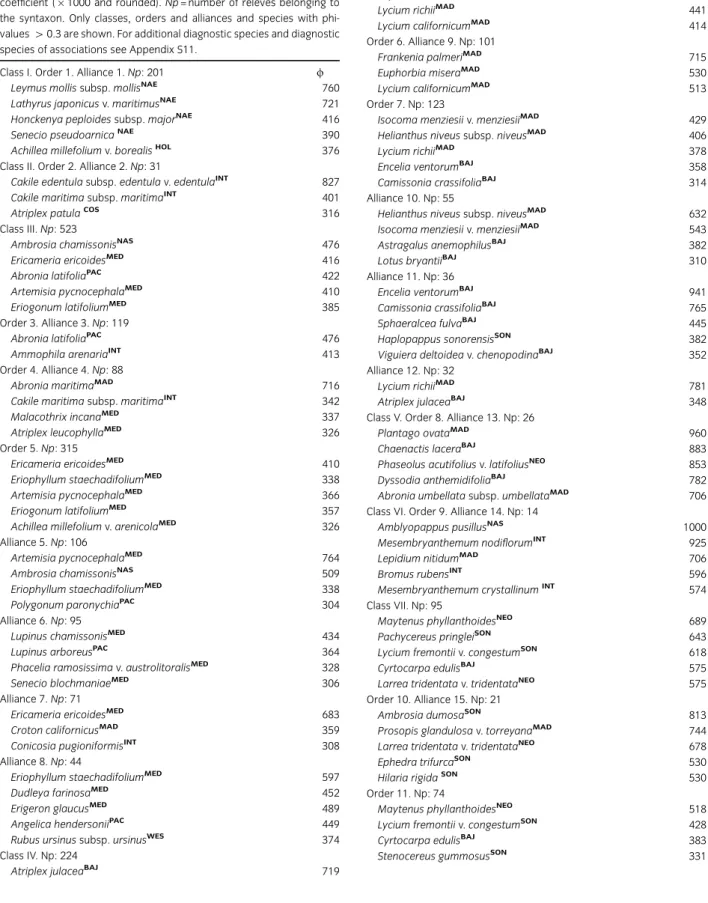
As a consequence of table rearrangements supported by determination of diagnostic species, the initial 50 RG were finally classified into 70 associations and four commu-nities. Main physiognomic, edaphic and ecological fea-tures of the recognized syntaxa are summarized in Table 1. Complete syntaxonomical tables in Appendix S10 show the floristic relations of associations with higher syntaxa. Summary Table 2 and Appendix S11 show diagnostic species and phi-values for higher syntaxa and associa-tions, respectively. Nomenclatural type relev ´es for each association and diagnoses for higher syntaxa are shown in App. 1. The complete tables for new associations may be found in Appendix S12, and a dichotomous key to associations based on floristic, phytogeographical and ecological features is provided in Appendix S13.
Boreal and temperate beach and foredune grasslands (Table S10.1)
On beaches and foredunes, four major types of vegetation occur: (1) boreal, temperate and northern Mediterranean grasslands with Leymus mollis subsp. mollis (hereafter
L. mollis); (2) tidemark pioneer communities dominated byCakilespecies; (3) Mediterranean hillock-builder dune mats, dominated by perennial forbs, and (4) tropical grasslands withEuphorbia leucophyllaandJouvea pilosa.
In our study area, meadows dominated or co-dominated byL. mollisoccur on Mediterranean, temperate and boreal MB, but the floristic assemblage of those communities differs such that they may be included within two phyto-sociological classes:Honckenyo–Elymetea arenariiand Ambro-sietea chamissonis.
Boreal and temperateL. mollismeadows are assigned to the amphi-Pacific allianceSenecioni pseudoarnicae–Leymion
Table 1.Continued
(XII)Juncetea breweriPeinado et al. 2011a, b. (XII.16)Juncetalia breweriPeinado et al. 2011a, b, herbaceous, usually rhizomatous, vegetation on oligotrophic habitats.
(XII. 16.23)Argentino egedii–Caricion obnuptaePeinado et al. 2011a, b, wet sedge and rush meadows thriving on periodically waterlogged habitats. (64)Argentino egedii–Caricetum obnuptaePeinado et al. 2011a, b, Mediterranean sedge meadows, on sites where water persists 4 to 6 months (Table S12.28). (65)Veronico scutellatae–Caricetum obnuptaePeinado et al. 2011, temperate sedge meadows, on sites where water persists four to 6 months (Table S12.29). (66)Juncetum breweri–falcatiPeinado et al. 2011, Mediterranean rush meadows on wet habitats where water persists on the surface for three or 4 months in winter (Table S12.30). (67)Juncetum breweri-sitchensisPeinado et al. 2011, vicariant of the previous association in temperate areas (Table S12.31). (68)Junco breweri–Caricetum pansaePeinado et al. 2011, sedge meadows on habitats where water persists on the surface for 1 or 2 months in winter (Table S12.32).
(XII.16.24)Lupino littoralis–Polygonion paronychiaePeinado et al. 2011, dry meadows thriving on dune crests and on the driest areas of the deflations plains. (69)Poo macranthae–Lupinetum littoralisPeinado et al. 2011, temperate open dry meadows (Table S12.33). (70)Polygono paronychiae–Tanacetetum camphoratiPeinado et al. 2011, dry meadows in prograding shores. (70a),Tanacetetosum camphoratiPeinado et al. 2011, temperate. (70b)Camissonietosum cheiranthifoliaePeinado et al. 2011, Mediterranean (Table S12.34).
Table 2.Synoptic table of relev ´es (N= 1703) with diagnostic taxa. Syntaxa codes as in Table 1. For each syntaxon, the most faithful species (according to their phi-coefficient) are listed in descending order.f= Phi-coefficient (1000 and rounded).Np= number of relev ´es belonging to the syntaxon. Only classes, orders and alliances and species with phi-values40.3 are shown. For additional diagnostic species and diagnostic species of associations see Appendix S11.
Class I. Order 1. Alliance 1.Np: 201 f
Leymus mollissubsp.mollisNAE 760
Lathyrus japonicusv.maritimusNAE 721
Honckenya peploidessubsp.majorNAE 416
Senecio pseudoarnicaNAE 390
Achillea millefoliumv.borealisHOL 376
Class II. Order 2. Alliance 2.Np: 31
Cakile edentulasubsp.edentulav.edentulaINT 827
Cakile maritimasubsp.maritimaINT 401
Atriplex patulaCOS 316
Class III.Np: 523
Ambrosia chamissonisNAS 476
Ericameria ericoidesMED 416
Abronia latifoliaPAC 422
Artemisia pycnocephalaMED 410
Eriogonum latifoliumMED 385
Order 3. Alliance 3.Np: 119
Abronia latifoliaPAC 476
Ammophila arenariaINT 413
Order 4. Alliance 4.Np: 88
Abronia maritimaMAD 716
Cakile maritimasubsp.maritimaINT 342
Malacothrix incanaMED 337
Atriplex leucophyllaMED 326
Order 5.Np: 315
Ericameria ericoidesMED 410
Eriophyllum staechadifoliumMED 338
Artemisia pycnocephalaMED 366
Eriogonum latifoliumMED 357
Achillea millefoliumv.arenicolaMED 326
Alliance 5.Np: 106
Artemisia pycnocephalaMED 764
Ambrosia chamissonisNAS 509
Eriophyllum staechadifoliumMED 338
Polygonum paronychiaPAC 304
Alliance 6.Np: 95
Lupinus chamissonisMED 434
Lupinus arboreusPAC 364
Phacelia ramosissimav.austrolitoralisMED 328
Senecio blochmaniaeMED 306
Alliance 7.Np: 71
Ericameria ericoidesMED 683
Croton californicusMAD 359
Conicosia pugioniformisINT 308
Alliance 8.Np: 44
Eriophyllum staechadifoliumMED 597
Dudleya farinosaMED 452
Erigeron glaucusMED 489
Angelica hendersoniiPAC 449
Rubus ursinussubsp.ursinusWES 374
Class IV. Np: 224
Atriplex julaceaBAJ 719
Table 2.Continued
Frankenia palmeriMAD 643
Euphorbia miseraMAD 455
Lycium richiiMAD 441
Lycium californicumMAD 414
Order 6. Alliance 9. Np: 101
Frankenia palmeriMAD 715
Euphorbia miseraMAD 530
Lycium californicumMAD 513
Order 7. Np: 123
Isocoma menziesiiv.menziesiiMAD 429
Helianthus niveussubsp.niveusMAD 406
Lycium richiiMAD 378
Encelia ventorumBAJ 358
Camissonia crassifoliaBAJ 314
Alliance 10. Np: 55
Helianthus niveussubsp.niveusMAD 632
Isocoma menziesiiv.menziesiiMAD 543
Astragalus anemophilusBAJ 382
Lotus bryantiiBAJ 310
Alliance 11. Np: 36
Encelia ventorumBAJ 941
Camissonia crassifoliaBAJ 765
Sphaeralcea fulvaBAJ 445
Haplopappus sonorensisSON 382
Viguiera deltoideav.chenopodinaBAJ 352
Alliance 12. Np: 32
Lycium richiiMAD 781
Atriplex julaceaBAJ 348
Class V. Order 8. Alliance 13. Np: 26
Plantago ovataMAD 960
Chaenactis laceraBAJ 883
Phaseolus acutifoliusv.latifoliusNEO 853
Dyssodia anthemidifoliaBAJ 782
Abronia umbellatasubsp.umbellataMAD 706 Class VI. Order 9. Alliance 14. Np: 14
Amblyopappus pusillusNAS 1000
Mesembryanthemum nodiflorumINT 925
Lepidium nitidumMAD 706
Bromus rubensINT 596
Mesembryanthemum crystallinumINT 574
Class VII. Np: 95
Maytenus phyllanthoidesNEO 689
Pachycereus pringleiSON 643
Lycium fremontiiv.congestumSON 618
Cyrtocarpa edulisBAJ 575
Larrea tridentatav.tridentataNEO 575
Order 10. Alliance 15. Np: 21
Ambrosia dumosaSON 813
Prosopis glandulosav.torreyanaMAD 744
Larrea tridentatav.tridentataNEO 678
Ephedra trifurcaSON 530
Hilaria rigidaSON 530
Order 11. Np: 74
Maytenus phyllanthoidesNEO 518
Lycium fremontiiv.congestumSON 428
Cyrtocarpa edulisBAJ 383
mollis (Honckenyo majoris–Elymetalia mollis), within the circumboreal class Honckenyo–Elymetea arenarii. Several amphi-Beringian taxa are present in both Japanese and North American associations (see NAE taxa in Table S10.1). Such relationships result from the ancient inter-continental connection between eastern Asia and western North America across the Bering bridge from the Late Cretaceous to the Pleistocene (Peinado et al. 2009).
This alliance encompasses six associations.Mertensio mar-itimae–Honckenyetum majorisis an open and species-poor tide-mark pioneer association common in the boreal part of the study area flourishing between the mean high and the extreme high tidal level; because it is periodically inundated by ocean waves, drift belts of organic matter are often present covering plants after high tides. Beach meadows with a similar ecology and dominated by M. maritima and/or H. peploideshave been described from northern Europe, Green-land, eastern North America and Canada (Lepping & Danie¨ls 2007) to continental Alaska (Boggs 2000), the Aleutian Islands (Talbot et al. 2010), and eastern Asia (Ohba et al. 1973). Griggs (1936) emphasized the role ofM. maritimaand
H. peploides subsp. major as pioneer plants colonizing the newly formed beaches after the eruption of the Katmai, Alaska. The nurse-plant role ofH. peploidesin the very first stages of primary succession on the upper beach facilitates the recruitment ofL. mollisby trapping seeds and improving seed germination and seedling emergence (Gagn´e & Houle 2001). Communities dominated by an upper field layer (height ranges from 0.5 to 1.5 m) ofL. mollis, in association with many forbs, occur as tall, dense, usually linear stands oriented parallel to the shore on gravelly, sandy or finer substrates at the storm line. In boreal areas, we recognize two associations: dry beach grasslands (Senecioni pseudoarni-cae–Leymetum mollis), and mesic beach grasslands (Lathyro palustris–Leymetum mollis). The former is the second coloni-zer of foredunes, flourishing on well-drained sites on level to steep slopes where it forms an inland zone as the frequency of tidal flooding decreases, immediately behind
Mertensio maritimae–Honckenyetum majoris, the initial pio-neer at or above beach storm lines.Lathyro palustris–Leyme-tum mollissubstitutesSenecioni pseudoarnicae–Leymetum mollis
inland, in ecotones with mesic graminoid meadows domi-nated byCalamagrostis canadensis,which are transitional to coastal and estuarine wetlands. Since the first descriptions by Hanson (1951), theL. mollisforedune meadow andH. peploides beach meadow are referred to different ‘‘Elymus mollisvegetation types’’, which are summarized by Viereck et al. (1992: 38). For additional references see Boggs (2000) and Talbot et al. (2010).
In temperate areas there are two associations dominated by native species: Leymo mollis–Caricetum macrocephalae, a beach meadow growing among drift-woods, andLathyro maritimi–Leymetum mollis, a foredune Table 2.Continued
Alliance 16. Np: 27
Yucca validaBAJ 701
Fouquieria diguetiiSON 701
Jatropha cinereaNEO 621
Larrea tridentatav.tridentataNEO 593
Opuntia ciribeBAJ 565
Alliance 17. Np: 47
Maytenus phyllanthoidesNEO 1000
Lycium fremontiiv.congestumSON 782
Jatropha cuneataSON 359
Class VIII. Order 12. Alliance 18. Np: 13
Allenrolfea occidentalisMAD 785
Suaeda taxifoliaMAD 649
Class IX. Order 13. Np: 158
Euphorbia leucophyllaSON 686
Oenothera drummondiiv.thalassaphilaBAJ 612
Jouvea pilosaNEO 553
Ipomoea pes-capraesubsp.brasiliensisNEO 400
Proboscidea althaefoliaSON 406
Alliance 19. Np: 41
Abronia maritimaMAD 701
Atriplex magdalenaeBAJ 589
Chamaesyce micromeraNEO 548
Dalea tinctoriav.tinctoriaBAJ 535
Alliance 20. Np: 117
Oenothera drummondiiv.thalassaphilaBAJ 477
Jouvea pilosaNEO 346
Euphorbia leucophyllaSON 423
Proboscidea althaefoliaSON 298
Drymaria holosteoidesv.crassifoliaBAJ 250
Class X. Order 14. Alliance 21. Np: 160
Gaultheria shallonPAC 844
Vaccinium ovatumPAC 820
Pinus contortav.contortaPAC 806
Picea sitchensisPAC 752
Morella californicaPAC 634
Class XI. Order 15. Alliance 22. Np: 81
Salix lasiolepisv.bigeloviiMED 629
Salix hookerianaPAC 542
Scrophularia oreganaTEM 361
Lonicera involucratav.ledebouriiMED 364
Class XII. Order 16. Np: 177
Juncus falcatusv.sitchensisTEM 535
Carex obnuptaPAC 487
Veronica scutellataNOA 478
Carex pansaPAC 467
Juncus breweriTEM 593
Alliance 23. Np: 135
Carex obnuptaPAC 555
Juncus falcatusv.sitchensisTEM 384
Argentina egediisubsp.egediiNAE 384
Carex pansaPAC 355
Veronica scutellataNOA 321
Alliance 24. Np: 42
Tanacetum camphoratumWES 675
Polygonum paronychiaPAC 856
Poa macranthaPAC 651
grassland, which now appears in small populations scat-tered across temperate coasts because its original area has been vastly reduced by the spread of marram grass,
Ammophila arenaria, the most pervasive dune invader of those coasts. Continuous foredune ridges similar to those on the white and grey coastal sand dunes of Europe did not originally exist on the Pacific coast of North America. Before the introduction ofA. arenaria, the foredune was generally a series of closely spaced mounds formed by native species, withL. mollisas dominant or co-dominant (Cooper 1967). The continuous and steep foredunes of northern California, Oregon and Washington are a recent phenomenon developed mostly since 1868, when A. arenariawas first introduced to California as a first sand binder to stabilize the dunes in San Francisco (Lamb 1898), and for use in dune control planting on the Oregon coast (Wiedemann & Pickart 2004).
On the temperate coasts,A. arenariahas built a steep, continuous foredune in the immediate shore area, where sand deposition by wind is greatest, replacing the original low, hummocky native foredunes and drastically redu-cing the amount of sand moving inland off the beach. Along most of those coasts, the foredune has attained heights of 10 m and a base width of over 100 m. These temperate foredune grasslands are here assigned toLeymo mollis–Ammophiletum arenariae, in which Ammophila
occurs at cover values of up to 99% with few associated species that are the remains of the olderLathyro maritimi– Leymetum mollis.
Temperate and Mediterranean ephemeral tidemark vegetation (Table S10.2)
The annual vegetation of drift lines (Cakiletea maritimae) is widely distributed across the study area, but only under Mediterranean and temperate MB. It is absent under boreal MB areas because of the short vegetation season and the temporary habitat, which is frequently disturbed by waves and drift ice. Such conditions do not allow therophytes to complete their life cycle in circumboreal areas (Lepping & Danie¨ls 2007).Cakiletea maritimaeis also absent from tropical areas around the world (Doing 1985). In our study area, the tropical tidemark vegetation is dominated by perennial species, which have been assigned to associations belonging toEuphorbio leucophyl-lae-Sporoboletea virginici(Peinado et al. 2008).
Although in our study area there are no nativeCakile species (Rodman 2010), annual tidemarks are dominated byCakile edentulasubsp.edentulavar.edentula(hereafterC. edentula), and C. maritima subsp. maritima (hereafter C. maritima) on temperate beaches, and only byC. maritima
on Mediterranean shores. Now,C. maritima, introduced from Europe, is replacing its introduced precursor C.
edentula(native to eastern North America) in central and southern California as a result of its ability to survive into a second or third reproductive season (Boyd & Barbour 1993), thus explaining the observed disappearance ofC. edentula along the Mediterranean coast of California (Barbour & Rodman 1970). On temperate coasts, species coexistence has been attributed to a strictly annual habit forced upon both species by more severe winter condi-tions (Pickart & Barbour 2007).
Couch (1914), Ramaley (1918), Purer (1936) and Pierce and Pool (1938) provided historical accounts of Californian strand vegetation. None of these authors documented the presence of annual, tidemark commu-nities, but they did mention four perennial species that colonized the upper beach immediately above the debris line:Abronia latifolia,Abronia maritima,Atriplex leucophylla, and Camissonia cheiranthifolia. Only A. leucophylla and C. cheiranthifolia spread throughout the Mediterranean MB zone, and both are the most aggressive of foredune builders in their advance toward the sea, building shadow, ephemeral mounds just above the mean high-water spring tides. Perennial communities ofA. leucophylla and C. cheiranthifoliahave been assigned here to Ambrosietea chamissonis. Currently, on some Californian beaches where the vegetation has not been completely destroyed by human activities such as trampling, beach cleaning and recreational use, the vegetation colonizing embryo dunes is dominated by communities of C. maritima covering scattered individuals of A. leucophylla half buried by the sand (seeAtriplex leucophyllacommunity on Table S12.9).
Historical data on the original composition of tidemark communities in temperate areas are not available, but the presence among driftwoods of species such as Calystegia soldanella,Carex macrocephala,Glehnia leiocarpaorL. mollis, suggests they could be the native dominants of the temperate tidemark vegetation. Communities dominated by both sea-rockets now flourish in the temperate zone and have been included in the new associationCakiletum maritimo-edentulae.
Mediterranean beach and foredune vegetation (Tables S10.1, S10.2 and S10.3)
While the fruticose dune vegetation on alkaline sands from Baja California was included within the class Atripli-ci–Frankenietea palmeri (Peinado et al. 2008), the beach and dune perennial vegetation on quartz sands that occurs along the Mediterranean climate coasts of both Americas is here assigned to the classAmbrosietea chamis-sonis. The amphi-American distribution of this class on Chilean and Californian shores was mentioned in its original description (Kohler 1970: 96) and later confirmed (Kohler 1975; Eskuche 1992).
The class is supported by plants that thrive on coastal dunes in Chile and in the Californian phytogeographical region (see NAS taxa in Appendix S5). These disjunctions have been related to hydrochloric seed dispersal by ocean streams (Kohler 1975; Ram´ırez & Romero 1978) but, considering the millions of birds that fly between North and South America every year, some transport of seeds seems likely, especially in communities such as those of seacoasts frequented by migratory birds, in which self-compatible and autogamous plants such asA. chamissonis
are dominants (Peinado et al. 2009). From 301N
north-ward, A. chamissonis spreads across the Mediterranean climate region of Baja California and California. North of 421, in the temperate region,A. chamissonispopulations
always inhabit sites whose BIO is temperate submediter-ranean or Meditersubmediter-ranean (in Vancouver Island).
In North America,Ambrosietea chamissonisis represented by three orders. Abronietalia maritimae and Abronietalia latifoliae group the vegetation dominated by perennial herbs forming shadow dunes when it colonizes the upper beach, and building discontinuous hillocks and hummocks when thriving on the seaward edge of dunes. On half-stabilized backdunes, the communities of both orders are progressively being replaced by fruticose communities of the new orderAmbrosio chamissonis–Eriogonetalia latifolii.
Abronietalia maritimaegroups the foredune associations from the Southern Californian and Martirense phytogeo-graphical provinces (i.e. from Morro Bay southwards). These foredunes are broken up into separate conical hillocks (about 1.5 m in average height) created by the sand-stilling qualities ofA. maritimaand other perennial herbs with woody taproots. Unlike the northern commu-nities ofA. latifoliae, dune grasses are almost completely absent from this southern order. The main features of the orderA. latifoliae and its unique alliance A. chamissonis, which group associations from Morro Bay northwards, arise from the sand-stilling abilities of the tap-rooted
Abronia latifoliaand two rhizomatous grasses, the native
L. mollis, and the introducedAmmophila arenaria.
Except for the communities of Ambrosion chamissonis, most of theAmbrosietea chamissonisassociations in Califor-nia correspond to the ‘Sand-verbena–Beach bursage series’ (Sawyer & Keeler-Wolf 1995), and to the ‘Ambrosion chamissonisalliance’ of Pickart & Barbour (2007). Sawyer and Keeler-Wolf’s series includes dune communities closest to ocean ones dominated by A. chamissonis
and sand-verbenas (Abronia species), as well as inland communities dominated by chamaephytes and nanopha-nerophytes that we assign to the orderAmbrosio chamissoni-s–Eriogonetalia latifolii. The highly invasive behaviour of some introduced species of Aizoaceae, such asCarpobrotus chilensis, Carpobrotus edulis and Conicosia pungioniformis is causing the replacement of nativeAmbrosietea species in
many places of California, mainly from Point Reyes south-wards. The communities of A. chamissonis massively in-vaded by Aizoaceae correspond to Sawyer and Keeler-Wolf’s ‘Iceplant series’.
The communities ofAmbrosietea chamissonisclosely corre-spond to the ‘Native Foredune Grassland’ (Pickart & Barbour 2007) and Sawyer and Keeler-Wolf’s ‘Native dunegrass series’. As in temperate foredunes, much of this alliance has been reduced and replaced north of San Francisco by the naturalization of European grassA. arenaria, which is con-sidered by Sawyer and Keeler-Wolf as an independent series: ‘European beachgrass series’. Native communities of
Ambrosietea chamissoniscreated discontinuous often isolated, low hummocks, that rose gradually perpendicular to the shoreline aligned with prevailing NW onshore winds (Bar-bour & Johnson 1988). Although such native foredunes are still preserved in some places, most of them have been replaced by steep, continuous foredunes created by Ammo-phila(occurring at cover values of up to 99%), which may reach heights of several metres giving rise inland to a series of ridges and swales parallel to the shoreline.
The dune scrub ofAmbrosietea chamissonis–Eriogonetalia latifolii,which closely corresponds to the ‘Isocoma menzie-sii–Lupinus chamissonis–Ericameria ericoidesshrubland alli-ance’ (Sawyer & Keeler-Wolf 1995), is endemic to Mediterranean California. It spreads from San Diego County northward to Bodega Bay. Except for some localities where Lupinus arboreus has been introduced, from Bodega northward evergreen shrubs such as Arctos-taphylos columbiana,A. uva-ursi,Gaultheria shallon,Garrya elliptica orVaccinium ovatum form sparse populations on backdunes under Pinion contortae forests. Although the Mediterranean rainfall pattern also exists north of Bodega Bay, precipitations are generally much greater than in the rest of California and summer drought is compensated by coastal fogs that supply an additional amount of unrec-orded water of up to 200 mm, and by extended periods of cloudiness and fog which greatly reduce evaporation (Peinado et al. 2007). Both factors could be the cause of limiting the northward distribution ofAmbrosio chamisso-nis–Eriogonetalia latifolii.
Two zones of vegetation encompass dune scrub: mid-dunes and hind-mid-dunes. The former are half-stabilized dunes transitional to foredune hillocks. Primary hillocks or foredune ridges built by pioneer species ofAbronietalia maritimaeorAbronietalia latifoliaeare secondarily invaded by pioneer species of dune scrubs on foredune backs. Once stabilized by those plants, hind dunes support more complex communities thriving in deeper soils with a layer of litter or duff. In addition to this successional sequence visible in the larger dune systems, there are also clear variations among dune scrubs found on windward, more exposed slopes, when compared with their counterparts
on leeward, more stable slopes. The shrub element is poorly represented on windward slopes, where many pioneer species of Ambrosietea chamissonis and Cakiletea maritimae occur as scattered individuals colonizing the dune-scrub gaps. Dune scrub on lee slopes is denser, with a nearly closed canopy of shrubs. In addition to these floristic changes according to the autoecological requisites of the scrubs (see Barbour & Johnson 1988: Table 7.8, and Pickart & Barbour 2007: 164 to 168), the phytogeogra-phical ranges of the main dune scrubs permit the distinc-tion of two phytosociological complexes: a northern complex constituted by taxa ranging from northern Cali-fornia southward to San Diego County, and a southern complex, constituted by many Baja Californian endemics, which corresponds to the xerohalophytic class Atriplici julaceae–Frankenietea palmeri,living on alkaline sandy soils (Peinado et al. 2008).
The northern complex is well-characterized by a set of psammophilous shrubs and sub-shrubs endemic to the Southern Californian and Northern Californian provinces of the Californian region. We assigned those dune scrubs to the new orderAmbrosio chamissonis–Eriogonetalia latifo-lii,which encloses four alliances:Artemision pycnocephalae, Lupinion arboreo-chamissonis, Ericamerion ericoidis and
Erigeronto glauci–Eriophyllion staechadifolii. Habitats occu-pied byA. pycnocephalae,whose associations corresponds to the ‘Artemision pycnocephalaealliance’ (McBride & Stone 1976; Pickart & Barbour 2007), are ecotones between the herbaceous vegetation of foredunes and the typical dune scrubs on backdunes. There is a gradual transition from dune mats dominated byArtemision pycnocephalaeto dune scrub, with pioneering herbs (mainlyA. chamissonis) able to colonize relatively unstable places on mid-dunes, and with pioneering shrubs (mainlyLupinus chamissonis
andA. pycnocephala) able to colonize foredune backs. This is the ecologically intermediate position occupied by the communities ofArtemision pycnocephalaein the psammosere, which is the same position occupied on the Mediterranean coasts by the suffrutescent communities ofCrucianelletalia maritimae. In fact, the associations ofArtemision pycnocepha-lae physiognomically resemble the European thermo-Atlantic grey dunes dominated by the suffrutescent
C. maritimaeon more or less stabilized soils low in humus.
Lupinion arboreo-chamissonis includes dune scrubs on half-stabilized mid-dunes, that closely corresponds to several ‘Lupinus chamissonis dune scrubs’ described by Williams & Potter (1972), Holton & Johnson (1979), and Barbour & Johnson (1988), and nitrophilous dune shrubs on disturbed backdunes, which correspond to the ‘Lupinus arboreusScrub’ (Heady et al. 1988), a widespread vegeta-tion type whose greatest abundance coincides with plots having the highest values of per cent nitrogen and organic matter (Holton & Johnson 1979). Ericamerion ericoidis
encloses denser dune scrubs on entirely stabilized hind dunes and lee slopes, which are comprised of a nearly closed canopy ofE. ericoidesunder which abundant litter accumulates, that physiognomically resemble European heaths on decalcified dunes (Empetrion nigri, Calluno-Ulicetea Genistion pilosae and Ericion tetralicis), and correspond to the ‘Haplopappus ericoidesdune scrub’ de-scribed in many Californian dune systems (Barbour & Johnson 1988; Pickart & Barbour 2007).Erigeronto glauci– Eriophyllion staechadifolii groups northern coastal scrubs on sea bluffs and on exposed slopes facing the ocean. Tropical beach and dune vegetation (Tables S10.3 and S10.4)
The vegetation dominated by perennial plants, mainly by tap-rooted, succulent perennials, rhizomatous grasses and prostrate hemicryptophytes and chamaephytes, which act as pioneer colonizers of beaches and foredunes builders from tropical Baja California to Mesoamerica, belong to the class Euphorbio leucophyllae–Sporoboletea virginici
(Peinado et al. 2008).
In the Tropical climate zone of Baja California, backdune communities are floristically well-defined. Dune scrubs of the Mediterranean associationLoto bryanthi–Isocometum men-ziesiiioccur only in the northeastern tropical–submediterra-nean zone, between southern El Vizca´ıno and the dune complex of the Magdalenan barrier islands. In the tropical Sanlucan province Maytenus phyllanthoidesdominates two backdune associations: Cyrtocarpo edulis–Maytenetum phyl-lanthoidis, thriving on the leeward of the backdunes whose windward slopes are occupied by dense and flagged com-munities of Lycio congesti–Maytenetum phyllanthoidis. The sandy inland plains immediately behind these dune systems are inhabited by columnar cacti and many small deciduous, sarcocaulescent trees. These sarcocaulescent thornscrubs growing on Arenosols form the associationJatropho corda-tae–Cyrtocarpetum edulis, which is floristically related to the psammophilous thornscrub climax of the association Anti-gono leptopi–Cyrtocarpetum edulis(Peinado et al. 2008). Temperate and northern Mediterranean forested backdunes (Tables S10.5 and S10.6)
The final succession stage on the coastal dunes of Oregon, Washington and in the forested dunes of Humboldt Bay and Tolowa in northern California comprises Picea sitch-ensis(on wet sands) orPseudotsuga menziesiivar.menziesii
(on dry sands), which develop from different Pinus con-tortavar.contortawoods. According to their autoecological requirements, the five dune coniferous forest associations (Table 1: alliance 21) occupy different edatopes of dune zonation and represent different successional stages (see Peinado et al. 2011b).
On moist soils coniferous forests develop from different
Salix thickets, which especially occur at the ecotone be-tween moving dunes and forests (Wiedemann 1966, 1984; Kumler 1969; Franklin & Dyrness 1988; Pickart & Barbour 2007). The closed canopy of those dense thickets results from the dominance of two willows with two distinct ranges:Salix lasiolepisvar.bigelovii, which thrives between Baja California and northern California, andSalix hookeri-ana, an essentially temperate species, which appears from British Columbia to the northwestern corner of California. Only there, north of Ten Mile, and in the adjacent south-ernmost part of the Oregon coast, do both willows intermix and many specimens show hybrid features. However, all willows on dune swales north of Ten Mile have been identified asS. hookeriana(references at Pickart & Barbour 2007: 160). The species making up the shrub layer of these thickets (1.5–4 m height) may become impenetrable and the ground under them devoid of plant life with only a layer of plant debris and leaves; an understory of sedges (Carex obnupta), rushes and other perennial herbs occurs in the usually more open thickets, but the herbaceous layer decreases as the canopy increases and in the tallest and thickest stands they flourish only on fringes and gaps.
We included the Mediterranean willow thickets within the association Morello californicae–Salicetum bigelovii, while those dominated by Hooker willows are ascribed to two associations:Lonicero ledebourii–Salicetum hookerianae
(Temperate Submediterranean) andLonicero involucratae– Salicetum hookerianae (Temperate Oceanic), both within the new classSalicetea lasiandro-exiguae. Early references toS. lasiolepis thickets in California are documented by Ramaley (1918) who described a ‘willow thicket associa-tion’ with the dominance of this willow andRubus ursinus,
and an understory of two rushes: Juncus falcatus and
Juncus leuseurii (a misapplied denomination for Juncus breweri in most early floras). There are swales with S. lasiolepis at Tomales Bay, Point Reyes, and Bodega Bay (Pickart & Barbour 2007) as well as at many other Californian localities (pers. obs.) but they are not regarded as distinct series by Sawyer & Keeler-Wolf (1995). In-stead, Sawyer & Keeler-Wolf’s Manual describes a ‘Hooker willow series’ on the coastal dunes of northern California (1995: 262). AlthoughS. lasiolepisthickets do not exist in Mediterranean Baja California, they are abundant as the understory of riparian sycamore forest dominated by Populus racemosa and in willow thickets along streams and rivers.
Vegetation on temperate and Mediterranean deflation plains and dune swales (Table S10.7)
Dune swales are seasonal or permanent wetlands that form in the troughs between dune ridges or in the
deflation plain behind moving dunes. The bottoms of the wettest dune swales, which are always flooded, support freshwater marshes withTypha latifoliaandScirpus califor-nicuswhere drainage off of the dunes provides sufficient fresh water. In areas transitional to salt marshes, where fresh and saline waters intermix, brackish marshes devel-op with species such as Carex lyngbyei, Juncus lesueurii,
Schoenoplectus acutusand Schoenoplectus maritimus. Where saline waters predominate, pure salt marshes develop. These permanent, fresh, brackish or saline marshes are not dealt with here.
Our analysis focuses on dune swales and on low level areas on deflation plains whose bottoms may be more or less waterlogged in winter and completely (or almost completely) dry during summer, and in which a zonation of herbaceous and woody communities develops because of a gentle gradation from the very wet, lowest bottoms, to the higher and drier margins. Differences of a few centimetres in ground surface elevation relative to the water table progressively separate distinct communities. Whereas in the isolated dune swales that appear encircled by dune mounds zonation is easily appreciable, on the deflation plains plant communities tend to form complex mosaics over the dune landscape.
The herbaceous vegetation of these oligotrophic more or less wet habitats, usually dominated by rhizomatous species, mainly sedges and rushes, are here assigned to the new classJuncetea breweri. In this class, we include humid dune supporting communities ecologically related to the European class Isoe¨to–Littorelletea, and grasslands and related short-lived, herb-rich plant communities of sandy, skeletal, and drought-stressed soils that thrive in the driest habitats of the deflation plains. In turn, these include communities ecologically and physiognomically related to the European classKoelerio–Corynephoretea, and even share species such as: Aira caryophyllea,Aira praecox, Brachythecium albicans,Cerastium arvense,Ceratodon purpur-eus,Cladoniaspp.,Festuca rubra,Hypochaeris radicata, Raco-mitrium canescens, Rumex acetosella and Vulpia myuros. According to the moisture degree, two clearly recogniz-able new alliances of herbaceous communities occur:
Argentino egedii–Caricion obnuptae and Lupino littoralis– Polygonion paronychiae.
The wettest bottoms support very dense (average cover 480%) and almost pure communities of slough sedges (C. obnupta) reaching a height of 1 m,thriving on sites that are quite wet most of the year. On the temperate dunes, Wiedemann (1984) described a ‘Carex obnupta–Potentilla pacificaCommunity’ (P. pacifica=Argentina egedii), which is almost entirely restricted to very waterlogged habitats, where water persists 4–6 months of the year. In northern California, references to communities dominated by C. obnuptaare limited to some plots and transects on ‘herb
hollows’ analysed at Humboldt Bay (references in Pickart & Barbour 2007: 160).
Moving away from the wettest bottoms, small changes in microtopography give rise to slightly more elevated and drier zones, where communities of small rushes (20–30 cm high) occur. These associations, dominated by two subspecies ofJuncus falcatus(subsp.falcatuson Med-iterranean swales, and subsp. sitchensis on temperate ones) accompanied by J. phaeocephalus, form meadows with scarce, scattered individuals of other species. The temperate association Juncetum breweri–sitchensis corre-spond to the ‘Rush Meadow Community’, which occurs when water persists on the surface for 3 or 4 months during the winter (Wiedemann et al. 1969). References to communities related to the Mediterranean association
Juncetum breweri–falcati in northern California are re-stricted to four studies conducted on the Ten Mile dunes that were summarized by Pickart & Barbour (2007: 160). On soils that remain flooded only a few weeks after rains, communities dominated by the small sedgeCarex pansa
(height of its tallest specimens o0.20 cm) develop. De-spite its relative abundance, we are unaware of any reports ofC. pansacommunities, except for the Monterey Peninsula dunes, where McBride & Stone (1976: 123) described aCarex pansacommunity on dry swales.
The new allianceLupino littoralis–Polygonion paronychiae
closely corresponds to Wiedemann’s ‘Dry Meadow Commu-nity’, which thrives in habitats where the water table is more than 91 cm below the surface during the summer months, and water never remains on the surface during the wet winter months (Wiedemann et al. 1969). These meadows were once dominated only by native species such asFestuca rubra, Glehnia leiocarpa, J. breweri, Lupinus littoralis, Poa macrantha,Polygonum paronychiaorSolidago spathulata, which are today accompanied byA. arenariain deteriorating stands.
Conclusions
The psammophilous coastal vegetation of the northern Pacific shows a distribution linked to the four MB (boreal, temperate, Mediterranean and tropical) that appear across the latitudinal gradient examined. This type of azonal vegetation follows patterns and shows limits of distribution that closely resemble those of the biocli-matically determined zonal vegetation. Generally, main physiognomic types are preferentially linked to a MB, although certain factors, mainly those related to soil moisture, determine that some psammophilous types, especially abundant in a particular MB, also appear in adjacent zones of different MB (bioclimatic ecotones).
The four MB are characterized by floristic differences, which include the presence of endemic elements as well as elements of wider distribution, allowing us to
establish relationships with the floras of Eurasia, South America and other continents. Each MB, in addition to its floristic peculiarities, shows both common and specific types of psammophilous vegetation spanning from asso-ciations to classes.
Among the 12 phytosociological classes in which the study area’s psammophilous vegetation is included, only two (C. maritimaeand Stellarietea mediae), both linked to human disturbances, show a cosmopolitan distribution. A third, Honckenyo–Elymetea arenarii, displays a Holarctic distribution and in the study area appears in the north-ernmost, coldest zones of boreal and temperate MB. Of the remaining nine classes, only one (Euphorbio leucophyl-lae–Sporoboletea virginici) is exclusively linked to the tropi-cal MB. The distribution of the communities of the further four classes is essentially linked to a given MB, but they also appear in ecotones of adjacent climate zones: (1)Ambrosietea chamissonis, which is exclusively Mediter-ranean but also exists in Temperate submediterMediter-ranean areas; (2) psammophilous coniferous forests of the class
Tsugetea mertensiano-heterophyllae, which are basically linked to the summer rains that characterize the tempe-rate MB, but also penettempe-rate the northern, wetter extreme of the Mediterranean zone, where fogs compensate sum-mer droughts; (3) the drought-deciduous shrub and succulent communities of the classProsopido torreyanae–-Fouquierietea splendentis, which are widespread across all North American deserts of Tropical Arid bioclimate, but also appear in the small Mediterranean arid bioclimate zone of the El Vizca´ıno desert in Baja California; and (4) the winter-annual communities of Achyronichio cooperi– Abronietea villosae,which are more abundant in the Med-iterranean arid bioclimate zone but also appear in some tropical areas of the Baja California Pacific, slightly influenced by winter rains.
Another three classes mainly occur in a particular MB, but owing to their dependence on soil factors these also appear in climatically close areas: (1) Atriplici julaceae– Frankenietea palmeri, whose distribution is mostly Medi-terranean but its floristic–ecological characterization is based on the presence of several Baja Californian ende-misms exclusively linked to alkaline sands; (2) also linked to alkaline yet periodically flooded soils is the class
Allenrolfeetea occidentalis, which is mainly linked to the study area’s tropical arid bioclimate but may also sporadi-cally appear in hyperarid Mediterranean zones of Baja California; and (3), the classJucetea breweri, which is well represented in the temperate MB zone, but its mesophytic associations dominated by sedges and rushes also enjoy the wet sandy soils of the Mediterranean zone. Finally, the edaphically conditioned willow thickets living on dune swales (Morello californicae–Salicetalia;Salicetea lasian-dro-exiguae) are well-represented in the temperate and