Developing Labour Standards
for Representation on Ships
_____________________________________________________
Carolyn A. E. Graham,
AFHEA
Sasakawa Fellow
Nippon Foundation Funded PhD Researcher
This thesis is submitted in candidature for the Degree of
Doctor of Philosophy
September 2018
Seafarers International Research Centre
School of Social Sciences
Cardiff University
Wales, UK
Declaration
This work has not been submitted in substance for any other degree or award at this or any other university or place of learning, nor is being submitted concurrently in candidature for any degree or other award.
Signed ……… (candidate) Date ……….…….…….………
STATEMENT 1
This thesis is being submitted in partial fulfillment of the requirements for the degree of PhD.
Signed ……….……… (candidate) Date ……….….………..………
STATEMENT 2
This thesis is the result of my own independent work/investigation, except where otherwise stated, and the thesis has not been edited by a third party beyond what is permitted by Cardiff University’s Policy on the Use of Third Party Editors by Research Degree Students. Other sources are acknowledged by explicit references. The views expressed are my own.
Signed ……….……….…… (candidate) Date ……….….………
STATEMENT 3
I hereby give consent for my thesis, if accepted, to be available online in the University’s Open Access repository and for inter-library loan, and for the title and summary to be made available to outside organizations.
Signed ………..…..….. (candidate) Date ……….………
Carolyn A. E. Graham Carolyn A. E. Graham Carolyn A. E. Graham Carolyn A. E. Graham September 30, 2018 September 30, 2018 September 30, 2018 September 30, 2018
To the Precariat
________________________________________________________________________
So spake the doleful mariner, Transfixing with his e’e, In fluent, graphic English – The language of the sea.
‘I had no wish to work on ships – Filipinos know it’s hard –
Mouths were many, jobs were scarce, From birth my life was marr’d.
‘From green island homes we travel, As mariner, nurse, or maid,
And remit to our loved ones The pittance we get paid.
Excerpt from: The Rime of the Globalised Mariner: Part I Michael Bloor (2012).
Acknowledgements
I owe the Nippon Foundation a debt of gratitude for having funded my education at the World Maritime University and their continued support in funding this PhD at the Seafarers International Research Centre, Cardiff University.
To my supervisors, Professors David Walters and Caroline Lloyd, who did an awesome job in guiding my research. I am forever grateful for your patience and tremendous support in seeing me through to the end. Thank you.
To the participants in the study at all levels and the seafarers who shared their experiences. I also received assistance from a number of persons in the UK shipping industry and other organizations in locating persons and gaining access to others, for which I am grateful. Special thanks to Rossen Karavatchev of the ITF who was a great help in this regard and who graciously responded to all my emails for assistance. Also, thanks to the staff of the seafarers’ centre in Liverpool for welcoming me.
Many thanks to Yonathan Preminger, Sean Ffrench, Joy Walcott, William Baker, Amaha Senu and Will Mason-Wilkes, for reading drafts at various points and giving constructive feedback. Thanks to members of the Employment Research Unit (ERU), Cardiff Business School, especially to Dr. Jean Jenkins, for welcoming me into the unit and Professor Edmund Heery, for taking the time to chat with me and share his knowledge.
Thanks to the staff at SIRC, Professor Helen Sampson, Director, and especially to Louise Deeley (Lou), for graciously assisting with all the various things for which I needed help. Thanks to fellow PhD researchers at SIRC and Museum Place, too numerous to name, but I am grateful for the encouragement and advice. Special thanks to Grace Kruse and Melissa Mendez, whose friendship from the first day helped me survived Cardiff, I will always remember your tribute – WWCD! To my SIRC office mate Rogenen Pepito for all the travel tips that have enriched my life. To Jesse Abrahams, thanks for your friendship and support. Thanks to Stella
Brown, for being kind when Cardiff was all new and importantly for helping with my trip to Kilimanjaro!
To my friends and family at home, especially my mother, Dorrett V. Graham, for your prayers and encouragement and my nephew Jowaine Graham. Thanks Mrs. Saunders (June) for 36 years of looking out. To my soul brothers, Oral Brown (OB) and Leonard Wynter (Leo), and the newest addition to my list of friends, Kenisha Nelson, thanks for not letting the distance diminish our friendship. Special thanks to my soul sister Nicola Smith Kea (Nikki) for never being too busy. Your unwavering friendship gave me fuel to press on. Dwayne Deer, thanks for arriving just-in-time. To Jordan Howell and my nephew R. Shaquille Bowie for being an inspiration. Your determination and successes at such a young age gave me courage. I had to do this for you and all the young people I mentor.
There are many others whom space will not allow me to single out, whose welcome greetings and cheerful smiles were nourishment for a stranger in a strange land, but I will do so personally. Thanks for helping me to come out the other side less scarred than I would have been on my own.
Finally, to Mother, The Source of all things that made this possible. Thanks for conspiring to help me realize my dreams. Maktub!
Abstract
__________________________________________________________________
Merchant shipping is considered one of the most dangerous industries for workers’ health and safety. The International Labour Organization (ILO), the agency responsible for regulating global labour standards, developed the Maritime Labour Convention 2006 (MLC) as what it describes as a “firm response” to an identified “deficit in decent work” on ships due to economic globalization. The MLC is therefore seen as an important instrument to govern employment and working conditions on commercial ships towards some positive outcomes in one of the most globalized of industries, where State regulatory capacities are said to be challenged. This dissertation focuses on provisions in the MLC for seafarers’ representative participation, and the role of such provisions in the regulatory regime for health and safety management on board ships. Studies from other industries, show representative participation in health and safety to be beneficial in improving working conditions providing certain preconditions exist. These are, firm regulations supported by a strong regulatory steer, senior management commitment and organized labour.
Using primarily documents and semi-structured interviews at the international level where such standards are developed, through to where they are operationalized and on to the level of the workplace where they are implemented, this study traces the thinking and practices driving these provisions for representative participation on ships, and their potential for positively impacting seafarers’ working conditions.
The findings of the study show that representative participation was included in the MLC based on customary practices, and there was a lack of deliberateness in its development. Equally, there was a lack of strategy for its operationalization, implementation and practice. At the shipboard level, representation emerged as an institution in disarray where the preconditions were not met, and seafarers lacked a full understanding and appreciation of
representative participation as a mechanism for their health and safety protection.
The study concludes that there is a disconnect between the theory and practice of representation for the seafaring workforce and suggests that an absence of consideration at the stage of developing the MLC, may account for this gap. In these findings, the study highlights the challenges to representative participation owing to the nature, organization and control of work on board and the absence of the preconditions for its support. In doing so, the study points to the limits of the regulatory lead and by extension the ILO’s global regulatory mechanism for addressing health and safety on board ships.
Key Words: Maritime Labour Convention; Seafarers’ Health and Safety; Worker Representative Participation; Global Labour Standards; International Labour Organization; Global Regulation; Decent Work.
Contents
________________________________________________________________________ Declaration………i Dedication………ii Acknowledgements……….iii Abstract……….vList of Tables and Figures……….xii
Abbreviations……….xiii
1 Problematizing Standards for Seafarers’ Representation 1.1. Introduction……….…………1
1.2. Motivation for the Research……….……….…………4
1.3. Conceptualizing the Research……….……….5
1.3.1. Research Questions and Objectives………..9
1.4. Thesis Structure……….…………9
2 Worker Representation in Health and Safety 2.1. Introduction……….……….12
2.2. Defining Representative Participation……….………13
2.3. The Origins of and Rationale for Representation in OHS……….………17
2.4. Why Worker Representation in OHSM?...22
2.4.1. Evidence for Direct Participation……….23
2.4.2. Effectiveness of Representation in OHSM………..………...26
2.5. Preconditions for Effective Representation………..………..30
2.5.1. A Strong Regulatory Lead………..31
2.5.2. Management Commitment……….34
2.5.3. Organized Labour and Active Constituents………..………….37
2.5.4. Enforcing the Regulatory Lead………..………41
3 Dangerous Work, Silenced Voices
3.1. Introduction………..………44
3.2. Health and Safety Concerns for the Seafaring Workforce….………...45
3.2.1. Seafarers’ Death Burden……….……….…..…………..47
3.2.2. Illnesses and Injuries Among Seafarers………49
3.3. Globalization and Seafarers’ Health and Safety……….51
3.4. Regulating OHSM at Sea Prior to the MLC………...54
3.4.1. The ISM Code……….57
3.5. Representation in Shipping……….62
3.5.1. Seafarers’ Participation on Ships………..64
3.6. The Maritime Labour Convention………68
3.7. Conclusion………..73
4 Methodology 4.1. Introduction………...74
4.2. Selecting an Appropriate Approach………75
4.2.1. The Case Study………..76
4.2.1.1. The UK Case……….78
4.3. Structuring the Inquiry: The Three Levels………...79
4.4. Data Collection……….80
4.4.1. Documentary Research………..80
4.4.2. Semi-structured Interviews……….83
4.5. Participants: Access and Challenges………...84
4.5.1. Elite Informants………86
4.5.2. Seafarers………..89
4.6. Fieldwork……….91
4.7. Data Processing and Analysis……….93
4.8. Ethical Considerations……….94
5 Negotiating Maritime Labour Standards
5.1. Introduction………..97
5.2. Negotiating Labour Standards at the ILO………98
5.2.1. A Framework Convention………..103
5.2.2. Contradictions in Negotiating Decent Work………..………107
5.2.2.1. Cooperation, Consensus and Compromise……….109
5.2.2.2. Constraints and Conflicts……….116
5.3. Representation in the MLC Framework………123
5.3.1. Origins of and Rationale for Representation in the MLC………127
5.4. Conclusion………130
6 Accounting for Representation in the MLC 6.1. Introduction………131
6.2. The Origins of Representation in the MLC………..132
6.2.1. ILO History, Structure and Traditions……….132
6.2.2. Consolidating Existing ILO Maritime Conventions……….139
6.2.3. The Influence of Other ILO Conventions………..142
6.3. Rationale for Representation in the MLC………144
6.3.1. Codifying Existing Practices………..144
6.3.2. Risk Assessment and Changes in Approaches to OHSM………...146
6.3.3. Uncontroversial………...149
6.4. Protecting Seafarers or Shipowners?...153
6.5. Conclusion………...159
7 Operationalizing Standards for Representation on Ships 7.1. Introduction………160
7.2. Operationalizing the Regulatory Lead………160
7.2.1. The UK’s Regulatory Steer for Representation on Ships……….165
7.3. Implementing and Enforcing the Standards for Representation……….171
7.3.1. Inspecting for Representation……….173
7.3.3. Selecting Representatives: Appointment versus Election………182
7.4. Union Involvement On Board………..………..183
7.6. Conclusion………..………….187
8 Experiencing the Regulatory Lead 8.1. Introduction………188
8.2. Who Represents the Seafarer On Board?……….…………..189
8.2.1. Knowledge of the MLC………...189
8.2.2. Supervision versus Representation……….194
8.3. Participation Practices on Ships……….198
8.3.1. “We Can All Speak”……….199
8.3.2. Consultation………203
8.3.3. Participating in Decision-Making………..205
8.3.4. The Complaints Procedure………208
8.3.5. Health and Safety Committees………210
8.4. Selective Partnership and Social Dialogue……….……….215
8.5. Conclusion………...217
9 Problems with Standards for Representation On Board 9.1. Introduction……….…………..219
9.2. Negotiating Standards……….221
9.3. Supports for Effective Representation……….223
9.3.1. Management Commitment in Theory…….……….…….………223
9.3.1.1. Paternalism and Enlightened Self-Interest as Commitment……….……….224
9.3.2. Management Commitment in Practice………...227
9.3.2.1. Participation Under the ISM and the MLC………...228
9.3.2.2. Direct Participation On Board………..229
9.3.2.3. Competence of Representatives and OHS Committee Members………...231
9.3.3. Trade Union Involvement………..234
9.3.3.1. Mind the Gap: Selective Cooperation in OHSM………234
9.3.3.2. A Long-Distance Relationship………..235
9.3.4. Challenges in Enforcing the Regulatory Lead………...237
9.4. Conclusion………240
10 Conclusion: Understanding the Disconnect 10.1. Introduction……….242
10.2. Research Summary and Key Findings……….243
10.2.1. Representation for Whom?...247
10.2.2. Unmet Preconditions……….………249
10.3. Contributions of the Study………...251
10.4. Limitations of the Study and Areas for Further Research………..………254
10.6. Representation Going Forward………..256
References……….259
Glossary………..276
Appendices Appendix I Report to the ILO on Abandoned Vessel………...281
Appendix II List of Key Documents Used in Documentary Analysis……….283
Appendix III Interview Guide – Developmental Level………287
Appendix IV Interview Guide – Administrative Level……….289
Appendix V Interview Guide – Shipboard Level………...291
Appendix VI Consent Form……….293
Appendix VII Codes and Themes……….………294
Appendix VIII Ethics Approval Letter………298
Appendix IX Maritime Labour Convention 2006 – Title 4………300
Tables and Figures
__________________________________________________________________
Tables
Table 3.1: Selected Maritime Casualties Influencing Development of the
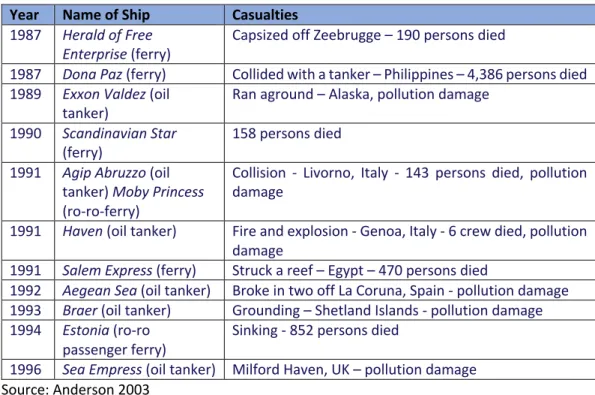
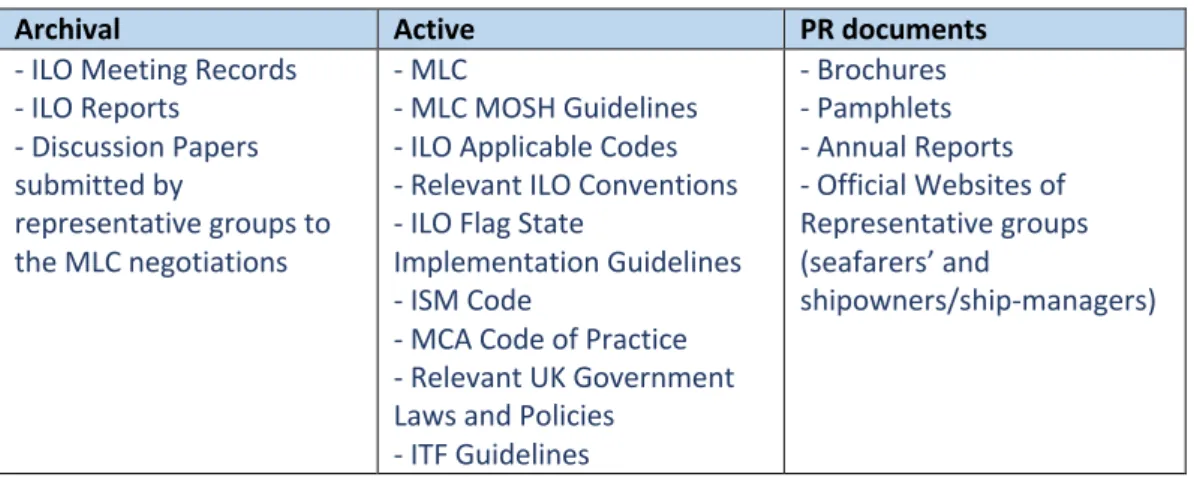
ISM………..58 Table 4.1: Categorisation of Documents used in this Research………82 Table 4.2: Description of Interviewees at the Developmental and
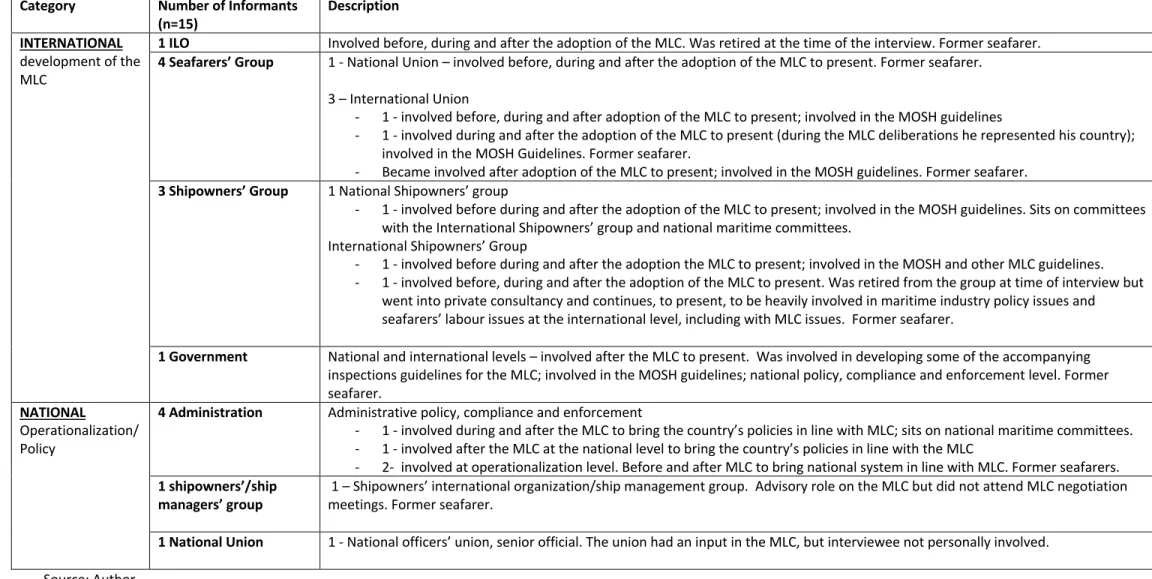
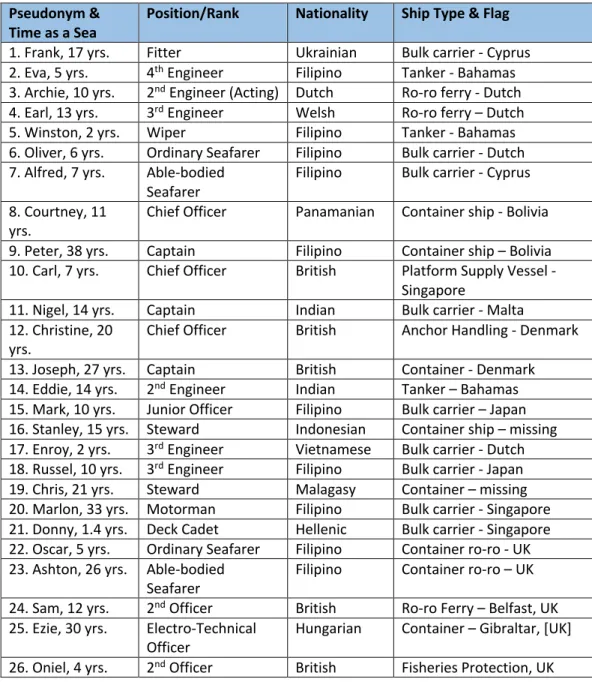
Administrative Levels……….85 Table 4.3: Description of Seafarers Interviewed………91 Table 5.1: Ratification Status of Seafarers’ Employment and
Working Conditions Conventions as at December 2002……….99 Table 5.2: The MLC Framework for the Roles and Rights of
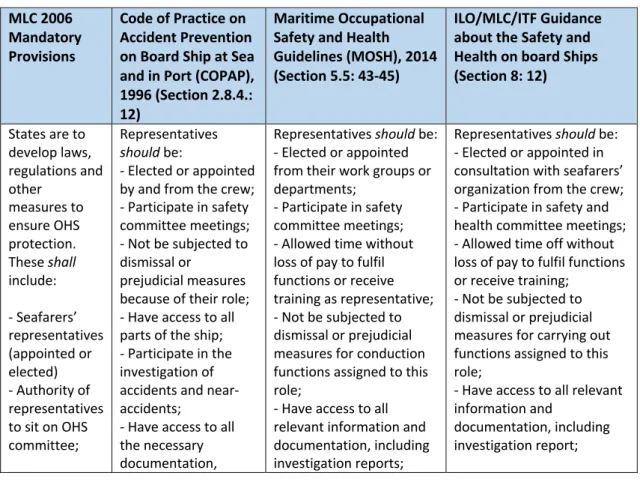
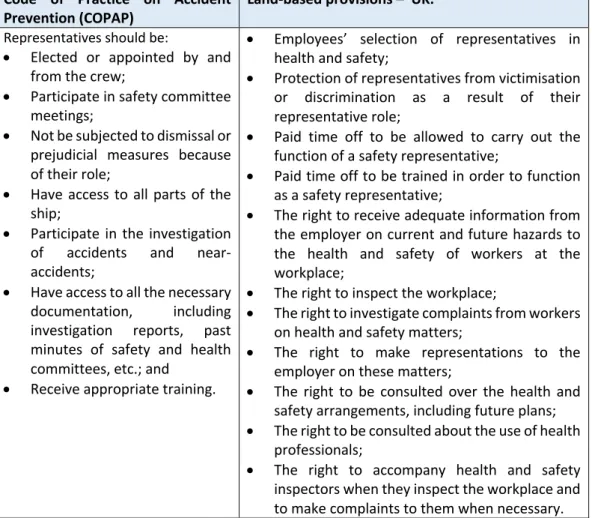
Representatives………..125 Table 5.3: Comparison of Regulatory Provisions for Seafarers’
Representatives with Land-based Provisions………..129
Figures
Figure 2.1: Preconditions for Effective Representation………31 Figure 2.2: Statutory Rights of Workers’ Representatives………..32 Figure 3.1: General distinctions between systematic OHSM
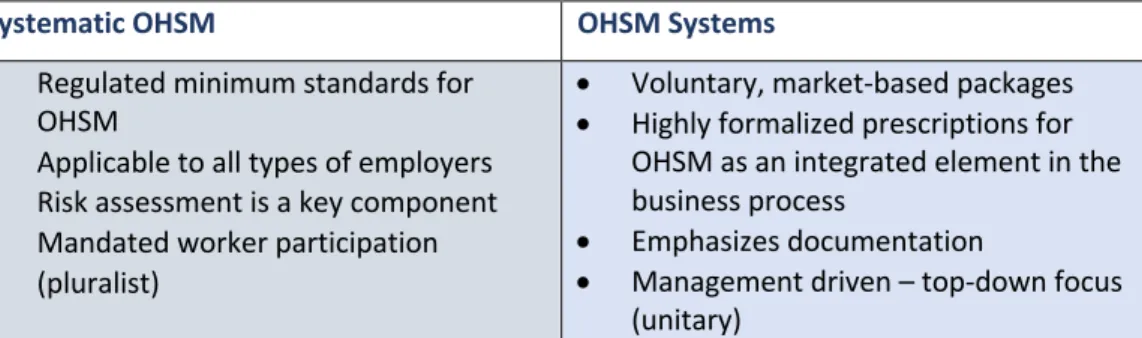
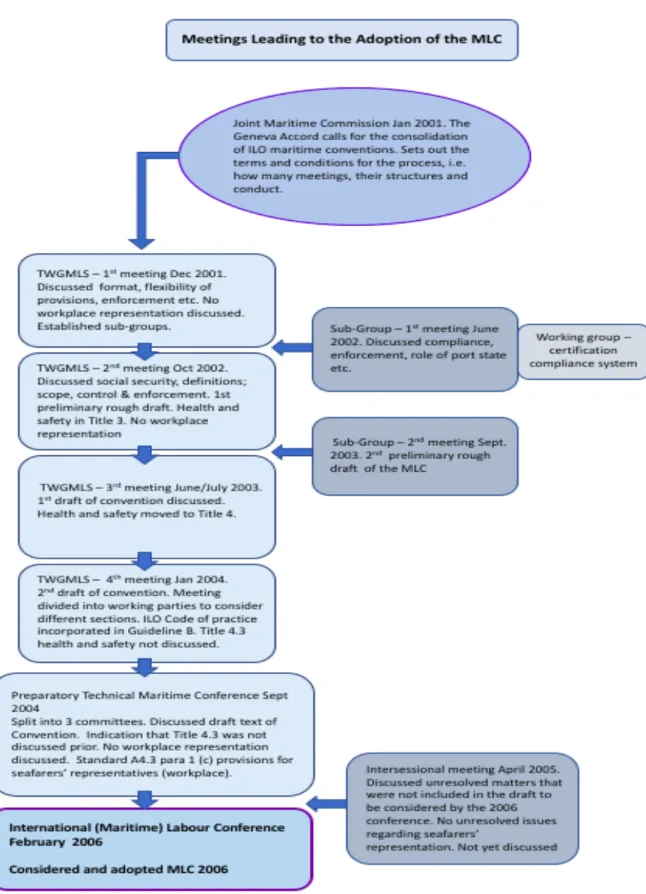
and OHSM systems………..60 Figure 4.1: Response to Interview Requests by Shipowners……..………..88 Figure 5.1: Timeline of the Meetings of the Working Groups that Negotiated
the MLC……….102 Figure 7.1: ILO Maritime OHS Conventions Influencing UK’s
Compliance Regime………..162 Figure 7.2: Provisions for Representation as written in the UK’s
Abbreviations
__________________________________________________________________ AB CBA CBT COPAP COSWP DMLC DPA ETO EU EU-OSHA HPWS HSC HSCE HSE HSWA IBF ICONS ICS ILC ILO IMO ISF ISM ITF JMC MAIB MARPOL MCA MLC MOSH MSNAble-bodied Seaman (Able Seaman or Able Seafarer as the gender-neutral term)
Collective Bargaining Agreement Computer-based Training
Code of Practice on Accident Prevention on Board Ship at Sea and in Port
Code of Safe Working Practices for Merchant Seamen (MCA) Declaration of Maritime Labour Compliance
Designated Person Ashore Electro-technical Officer European Union
The European Agency for Safety and Health at Work High Performance Work Systems
Health and Safety Committee
Health and Safety (Consultation with Employees) Regulations 1996 (UK)
Health and Safety Executive (UK)
Health and Safety at Work Act 1974 (UK) International Bargaining Forum
International Commission on Shipping International Chamber of Shipping International Labour Conference International Labour Organization International Maritime Organization International Shipping Federation
International Code for the Safe Management of Ships and for Pollution Prevention (International Safety Management Code) International Transport Workers’ Federation
Joint Maritime Commission
Marine Accident Investigation Branch (UK)
International Convention for the Prevention of Pollution from Ships, 1973, as modified by the Protocol of 1978 the Protocol of 1997
Marine and Coast Guard Agency (UK) Maritime Labour Convention, 2006
Maritime Occupational Safety and Health Guidelines, 2014 Merchant Shipping Notice
OHS OHSM OS PSC PTMC RoSPA SIRC SMS SOLAS SRSC STCW STWGMLS TWGMLS UK USA WERS 98
Occupational Health and Safety
Occupational Health and Safety Management Ordinary Seaman (Ordinary Seafarer)
Port State Control
Preparatory Technical Maritime Conference Royal Society for the Prevention of Accidents Seafarers International Research Centre Safety Management System
International Convention for Safety of Life at Sea 1974, as amended
Safety Representatives and Safety Committees Regulations 1977 (UK)
International Convention on Standards of Training Certification and Watchkeeping for Seafarers 1978, as amended, 1995 and 2010.
(Subcommittee) Transport Working Group on Maritime Labour Standards
(High-Level) Transport Working Group on Maritime Labour Standards
United Kingdom
United States of America
1
Problematizing Standards for Seafarers’ Representation
No moral endeavour, no political orientation, no human study that does not pay close attention to [people] at work, can possibly be adequate for our time. For work is affected by and in turn affects all that man is and all that he might become. The question we must ask of any society or of any social program is what kinds of men and women does it select, encourage, create? And in terms of this human evaluation, the most important question we can ask is whether work is a void in which men sacrifice themselves or whether work is a central feature of a style of life in which man may realize himself (C. Wright Mills, 1951, quoted in Abrams 2001).___________________________________________________________________________
1.1. Introduction
Developing labour standards for workplace health and safety is an important issue for contemporary society. There is ongoing academic and policy interest in how to protect workers from the dangers of the workplace (eg. Hilgert, 2013; EU-OSHA, 2012; 2018; RoSPA, 2010). Work risks are not confined to the immediate work environment but have social and economic consequences for wider society (Frayne, 2015; Hilgert, 2013; Abrams, 2001). Workplace disasters, such as the Rana Plaza in Bangladesh or Aberfan in Wales, devastate communities, rob families of their livelihood and the full capacities of their loved ones. The maritime industry has had its share of disasters, causing numerous loss of lives and destruction to the marine environment (see Anderson, 2003).
The International Labour Organization (ILO)1 estimates that 2.3 million
workers die annually from work-related injuries and diseases. Another 160 million workers are estimated to suffer from non-fatal work-related diseases and 313 million from non-fatal work-related injuries. It is argued that most injuries and fatalities are preventable if workplaces are effectively regulated and health and safety systematically managed (Walters and Nichols, 2013; Frick et. al., 2000). An important aspect of such efforts to regulate and manage health and safety at
1 ILO website: http://www.ilo.org/global/topics/dw4sd/themes/osh/lang--en/index.htm. Accessed February 7, 2018.
work, is worker representative participation (Walters and Nichols, 2007; Nichols, 1997).
In 2006, at the Ninety-fourth (Maritime) Session of the International Labour Conference (ILC)2, labour standards to govern seafarers working and living
conditions were adopted in the form of the Maritime Labour Convention 2006 (MLC). According to the ILO, the MLC was developed in response to a “deficit in decent work” on ships (TWGMLS/2001/10). 3 The ILO claims that these standards
represent a “firm response” to the poor working conditions for seafarers. They include provisions for seafarers’ representatives to participate in health and safety on ships.
Shipping is considered one of the most globalized industries and States are said to be challenged in effectively regulating labour standards due to the effects of economic globalization (DeSombre, 2006; Lillie, 2006; Bloor et. al., 2005). That is, shipowners are able to take advantage of global interconnections to reduce costs and avoid regulations. Among the adverse consequences of these practices have been a “race to the bottom” in labour standards for the seafaring workforce (Lillie, 2006). In this respect, global institutions are seen as important to establish global rules to contain the negative impacts of globalization (Ruggie, 2014; Karns and Mingst, 2004). The ILO is considered to be one such institution and the development of the MLC a regulatory mechanism to address the reduction in States’ abilities to police labour activities on board ships (Lillie, 2006). Indeed, the ILO considers the MLC to be a “firm” global response to the adverse effects that economic globalization has had on seafarers’ living and working conditions (JMC/29/2001/3).
Against this claim, this study aims to explore and understand the MLC regulatory framework for seafarers’ representative participation on ships and examine its potential to contribute to decent work as envisaged. Representation as it concerns this thesis is defined in Chapter 2. The MLC mandates
2 The ILO conference of member States where conventions are adopted. https://www.ilo.org/ilc/AbouttheILC/lang--en/index.htm
representatives to sit on health and safety committees on ships suggesting a structure for joint consultation. Structures for representative participation are understood as being outside the employers’ sphere of influence to give workers a chance to have some impact on their working conditions.
Reference to the MLC framework takes into consideration the mandatory provisions in the MLC (Title 4, Standard A4.3, paragraphs 1c & 2d), and its guidelines in Standard B, and the Maritime Occupational Safety and Health (MOSH) Guidelines 2014, as well as other guidelines and codes to which the MLC refers, particularly the ILO’s Code of Practice on Accident Prevention on Board Ship at Sea and in Port (COPAP). Together, these documents present a set of regulatory policies and practices for representative participation in the shipboard work environment. The presumed aim of these policies and practices is to give seafarers a “say” in their occupational health and safety (OHS) protection. It is argued that regulations are an important precondition for effective representation (Milgate et. al., 2002: 285). Regulations set the framework to guide the practice of representing workers towards positive health and safety management activities and workers health and safety outcomes (Walters and Nichols, 2007; Walters et. al., 2005).
The existing research evidence that seafarers face exceptional risks in their work is convincing (Sampson, 2013; Walters and Bailey, 2013; Nielsen, 1999) and, therefore, the MLC provisions might represent a positive move towards helping to manage these risks. In addition to exposure to extreme weather conditions, seafarers face risks from the cargo they transport, the physical worksite of the ship, the nature and organization of work, and geo-political threats, such as piracy and criminalization (Walters and Bailey, 2013). These conditions are exacerbated by seafarers living and working in the same space, from which often, they may not even temporarily ‘escape,’ due to increased difficulties in accessing shore leave (Sampson, 2013; Graham, 2009). Recent research points to an increase in poor mental health of seafarers (Sampson et. al., 2017). These are among the occupational risks which led the ILO to declare a “deficit in decent work” on ships and pointed to a need for the MLC. It is against this background of dangerous
work and the ILO’s claim that the MLC represents a “firm response” to such conditions, that this study explores the viability of the MLC provisions for seafarers’ representative participation to have some impact in a globalized industry, characterised by precarious work.
1.2. Motivation for the Research
In research, “The biography of the researcher is always implicated” (Schostak, 2002: 3). This thesis was motivated by personal experiences as an administrator in the Maritime Authority of Jamaica (MAJ). I worked there for 15 years in various positions leading to the final post as Registrar of Seafarers. During this time the hardships faced by seafarers and the lack of organized support became evident to me.
The MAJ was established under the Shipping Act 1998 as Jamaica’s maritime administration to oversee the country’s obligations to a number of International Maritime Organization’s (IMO) conventions it had ratified. While much effort was made to give effect to the technical and business aspects of being a flag and port State,4 the seafarers’ section of the Act received scant attention.
This became a concern for me as the country was, at the time, increasing enrolment at its seafarer training institution, without systems in place for their protection as cadets and afterwards. In my post as Registrar of Seafarers, to which I was appointed in 2009, I soon discovered that Jamaica’s neglect of seafarers was not unique as concerns about seafarers’ welfare were being expressed across the international shipping community (Kahveci, 2007; ILO, 2004).
As the Registrar of Seafarers, I dealt with Jamaican seafarers abandoned in foreign ports, foreign seafarers abandoned in Jamaican waters, victimization of Jamaican cadets and other OHS and welfare issues. However, training and other resources to support the post were not forthcoming. Also, there was no systematic programme in place to assist seafarers at the national or the
4 A flag State refers to the nationality of a ship under international maritime law. Ships on a country’s registry are subject to the laws of that country wherever in the world they are. When a ship enters the port of another country, the country has certain legal rights to board and inspect for compliance with international maritime standards, referred to as port State control (PSC).
international level. Seeking information was met with bureaucracy from organizations that showed little authority or willingness to act. On contacting the ILO regarding the abandonment of foreign seafarers in Jamaican waters, I was told to submit a report to the ILO (Appendix I) and nothing further. Of the two Consuls representing the nationalities of the abandoned seafarers that were contacted, only one responded initially without any sensitivity to the situation, and subsequently stopped responding to my follow-up emails. Fortunately, the seafarers were eventually repatriated on sale of the ship.
In 2012, the ILO announced that the ratification threshold to trigger the coming into effect of the MLC had been achieved.5 The MLC was one of my
portfolio items but efforts to prepare Jamaica for its entry into force were also given scant attention. Therefore, when subsequently pursuing the PhD research, I decided to further explore the topic of labour standards to protect seafarers’ health and safety, and to focus on measures to give them a “say,” as in my experience this was one of the areas in need of urgent attention.
1.3. Conceptualizing the Research
Theories, perspectives and concepts guiding this research are drawn from industrial relations, the sociology of work and the social-legal literature on representation in health and safety in land-based workplaces. These three disciplines overlap on the subject matter to present a combined body of work that offers a critical approach to the regulatory paradigm and workplace practices for representative participation in health and safety. “Regulated self-regulation,” or “internal control” is the paradigm driving regulatory provisions and practices for OHSM in the contemporary context (Bluff et. al., 2004: 4-5). Under this regime, the responsibility for health and safety outcomes rests on the organization, its management and workers. The State regulatory apparatus should operate from a distance and be concerned with general requirements for the “social processes”
5 ILO (2012). Milestone ratifications of seafarers’ labour rights charter. ILO News, August 20. Online. Available at: http://www.ilo.org/global/about-the-ilo/newsroom/news/ WCMS_187660/ lang--en/index.htm [Accessed 20 July, 2015].
in arriving at the OHS outcomes (Bluff et. al., 2004: 4). Workers’ input is seen as necessary under self-regulation but not necessarily representation which would entail union involvement (discussed in Chapter 2, Section 2.3).
The industrial relations perspective is concerned with the effectiveness of representative participation as a workplace relations institution for the collective participation of workers under self-regulation. The industrial relations perspective sees representation as occurring through the normal labour relations channels (Walters and Nichols, 2009: 2). This literature theorises a set of preconditions for effective representation (Walters and Nichols, 2007; 2009; Dawson et. al., 1988). These writers take a pluralist perspective of the workplace and their work overlaps with the sociology of work literature to emphasize the role of autonomous representative participation and the inclusion of unions in ensuring workers’ OHS is protected in situations of competing workplace interests. In turn, the sociology of work literature emphasizes the structural conditions in workplaces that result in injuries and underscores the need for workers to have effective representation (Nichols and Walters, 2013; Nichols, 1997).
Industrial relations frames of reference become important in this discourse on what makes representation effective. The literature seeks to establish underlying perspectives driving the regulation and practice of representation and in this way account for the origins and rationale of regulatory provisions on representation that have been developed and its successes and failures. This thesis draws on these frames at various points as concepts to talk about and to understand relevant aspects of the theory and practice of representation (eg. Cullinane and Dundon, 2014; Budd and Bhave, 2008; Fox, 1974; 1966).
The frames of relevance to this thesis are unitarist and pluralist consistent with the management practices described in research on the shipping industry which are unitarist in orientation, and the ILO’s pluralist context for the MLC. Budd and Bhave (2008: 94) argue that frames are the lens through which actors perceive and act on social phenomenon. A unitarist framing considers management as the sole authority in the workplace and external influences such as unions and the State as unnecessary interference. A pluralist framing considers the conflicts of
interest in the workplace and seeks to coordinate these interests through bargaining. Unions and State regulations are seen as necessary to counter the unequal power relations inherent in the employment relationship (Budd and Bhave, 2008).
From the socio-legal perspective, the self-regulatory paradigm comes under scrutiny, particularly in light of the changing nature of work. This literature highlights and critiques the inadequacies of self-regulation to address workplace health and safety issues in the contemporary world of work. It is argued that the self-regulatory regime was geared towards addressing a particular employment relationship comprising stable, predominantly male workforces in medium to large enterprises. Changes in the nature and organization of work resulting in an increase in small enterprises and less stable and identifiable work situations are said to have undermined the self-regulatory paradigm and regulations for workers’ representation and participation (Quinlan, 2013a; Dawson et. al., 1988). Further, the paradigm is said to be built on erroneous assumptions about the nature of workplace injuries and as such, seemed destined to fail from the outset (Nichols and Armstrong, 1973). These three disciplines, Industrial Relations, The Sociology of Work and Socio-Legal Studies, combine to present a convincing argument for the importance of representative participation in safeguarding workers’ OHS and the preconditions that support its effectiveness.
Worker representation in OHSM is an established workplace institution in many countries. For example, regional regulatory standards, such as the European Union (EU) Framework Directive 39/891, have institutionalized representation for all EU member States. Provisions for representation is also found in workplace regulations and practices in other developed countries, such as Australia, Canada, New Zealand and the United States of America (USA) (Walters and Nichols, 2009). At the global level, representation is a feature in ILO conventions, such as the health and safety Convention 155. Many developing countries also have some
statutory provision for workers’ representation on health and safety,6 although
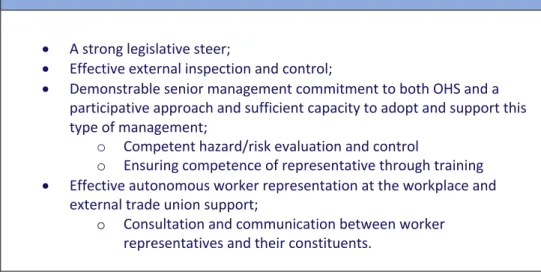
the extent to which these are operationalized and implemented is uncertain. Against a background that representative participation is an accepted workplace institution, this study examines the development, administration and implementation of representation on ships as laid out in the MLC framework. Research evidence from land-based studies shows that effective representation contributes to positive OHSM activities and positive OHS outcomes for workers (EU-OSHA, 2012; Shannon et. al., 2010). However, the benefits of representation are found to be contingent on the support of firm regulations giving a strong regulatory lead, senior management commitment and organized labour (Walters and Nichols, 2007; Walters et. al., 2005). These preconditions are said to work together to support effective implementation and practice of representation in the workplace (Menendez et. al., 2009; Walters and Nichols, 2007). While the shipboard work environment may have its own peculiarities, such as being remote and mobile, it is argued that seafarers may also benefit from arrangements for representation on health and safety providing these preconditions exist (Walters and Bailey, 2013; Walters, 2005). However, there are reasons to question the extent to which these preconditions exist in the shipping industry.
Studies examining health and safety in the shipboard work environment reveal that there are conditions relating to the nature, organization and control of work, that inhibit seafarers’ participation in measures to manage health and safety (Xue, et. al. 2017; Walters and Bailey, 2013; Bhattacharya, 2012a; 2012b; Kahveci and Nichols, 2006). These measures refer to unitarist management standards established to improve the safety record in the shipping industry. Based on this literature this thesis questions the extent to which the preconditions to support representation on ships exists. In this respect, the thesis problematizes these provisions and as a result, interrogates the ILO’s claim that the MLC is a “firm response” to poor working conditions on ships.
6 ILO Global Database on Occupational Safety and Health Legislation (LEGOSH), ILO, Geneva.
1.3.1. Research Question and Objectives
The central research question asks: Are the MLC provisions for seafarers’ representative participation in OHS a firm response to poor working conditions on ships? A “firm response” is described in Chapter 2 and refers to regulatory features to ensure responsible parties meet their obligations for effective representation. These include the rights and powers given to representatives to support them in their roles (Walters, et. al. 2005). The study is qualitative and driven by three interlinking objectives reflective of the stages in the development, administration and implementation and practice of ILO standards. The objectives are:
1) To examine the viability of the provisions for representation on ships by exploring their origins, and the rationale for their inclusion in the MLC, and supports for their effective implementation and practice on ships. This objective is aimed at examining the thinking behind the provisions and what measures the architects of the convention have considered for giving them effect.
2) To examine how the provisions are operationalized at the national level. The study uses the United Kingdom (UK) as a case to examine how a reputable administration might operationalize representation for its flagged ships and in port State control.
3) To examine seafarers’ experiences and perceptions of representation as intended by the provisions in the MLC. As the beneficiaries of the provisions, seafarers’ perspectives are important to determine the likelihood that the benefits of representation will be realized.
1.4. Thesis Structure
The remainder of the thesis consists of 9 Chapters. Chapter 2 introduces the subject of representation focussing on the land-based literature. The sparse literature for the shipping industry is reviewed in Chapter 3. The land-based
literature establishes the foundation for representation, its history and practices. It provides the inspiration for provisions in the MLC and it is therefore pertinent to a study of representation on ships.
Chapter 2 begins with a definition of representative participation to establish its meaning and use in the thesis. It explores the origins of statutory provisions for representation in OHSM and the paradigm shift in regulatory approaches during that time. The chapter reveals the underlying thinking driving the new paradigm and the source of some of the critique on statutory provisions for OHSM. This leads to an examination of the literature on what makes for effective representation. The research evidence and theory for what works in making representation beneficial to workers is explored.
Chapter 3 examines the literature for the shipping industry and along with Chapter 2, forms the basis for problematizing the MLC provisions. It outlines the evidence for seafarers’ work risks and explores research for regulatory provisions for OHSM on ships prior to the MLC. The previous research highlights the absence of good workplace relations practices which might support effective participation consistent with what is described for land-based industries. Consequently, this chapter sets the context for questioning the viability of provisions for seafarers’ representation in the MLC and raises questions as to the ILO’s claim for a “firm” regulatory response.
Chapter 4 presents the methodology. It details the study design, the data sources, participants and fieldwork. The research is framed as a case study of the MLC. It engages multiple sources of data: Documentary evidence of the deliberations spanning the 6 years of negotiating and developing the MLC; the testimonies of key participants who were involved in those negotiations; data from the UK used as a critical case at the national level; and interviews with seafarers at the shipboard level. The chapter discusses the field work and challenges faced during data collection. It ends with some reflections on ethics.
Chapters 5 to 8 deal with the findings and analysis of the data. Chapter 5 presents the findings from the documentary analysis of the meeting records and
other relevant documents to which the MLC refers, or which form part of the general MLC framework for representative participation. It explores the discussions, the conflicts and their resolutions towards producing the MLC as the ‘new’ labour standard for global shipping. Chapter 6 addresses the outcomes from the interviews with key informants directly involved in negotiating the MLC text. It explores some of the issues raised in the documents to clarify and substantiate events as they were recorded. Based on the testimonies of those interviewed, the chapter examines the intent of including representation in the text and what consideration was given to supports that might be required to ensure their implementation and effective practice.
In order to gain a fuller understanding of representative participation on ships as provided for in the MLC, the UK was selected as a case study and Chapter 7 presents these findings. Using documents and interviews with key personnel in the UK administration, the chapter presents the findings on how the provisions were operationalized and what adjustments were made for the UK to become compliant with the MLC. Chapter 8 further explores the viability of representation through the perceptions and experiences of seafarers as they reported. It presents the nature of representation on board ships and the views of seafarers on existing practices and changes brought about by the MLC. It also shows the constraints to effective representation at the shipboard level.
Chapter 9 discusses the key findings towards answering the research question. The main themes surrounding the development, operationalization and practice of representation are discussed. In drawing on the data, the chapter asks whether the MLC has provided a “firm” regulatory lead for representative participation and highlights the limits of global regulation.
Chapter 10 concludes the study. It revisits the main elements of the research and reflects on the core findings and explores the relationship between theory and practice of representative participation on ships. The chapter also presents the contributions of the study and highlights its implications for regulating representative participation and points to areas for future research.
2
Worker Representation on Health and Safety
When directors or take-over bidders assess the health of a company, it is balance sheets that they look at, not medical reports on the health of workers. In capitalism’s language of priorities, it is not safety that comes first, but profit (Nichols 1997: 105).
___________________________________________________________________________
2.1. Introduction
This thesis’ central aim is to assess the ILO’s claim that the MLC is a firm response to poor working conditions for seafarers, with specific reference to its provisions for representative participation in OHS. This chapter reviews the literature on representative participation expanding on issues raised in the Introduction regarding its importance in OHSM and the theoretical position that a certain set of preconditions ought to be in place for its effective implementation and practice.
That workplace injuries and ill-health are preventable is a position taken by those concerned with the effects of the work environment on workers’ health and safety (Nichols and Walters, 2013; Walters et. al. 2005; Quinlan et. al. 2001; Nichols, 1997). Nichols (1997: 2-3) for example, argues that the concept of an “accident” is misleading as this suggests something unforeseen or “unanticipated, that which is unintentional and that which is down to misfortune or bad luck.” He begins from the position that “accidents” are the result of how work is structured and organized therefore to call them “accidents” is a misnomer. Instead, he prefers terms such as “industrial injuries” and “industrial ill-health” which, he asserts, more accurately account for how most people come to suffer harm in their workplaces, and therefore can be managed as they are not unavoidable. This thesis supports this assertion and adopts a similar use of injuries and ill-health instead of “accidents.”
This review draws on the land-based literature for advanced market economies as countries such as Australia, Canada, New Zealand, the UK and other members of the European Union in particular, have been the focus of the majority
of studies. In combination, the land-based literature provides strong evidence as to the value of representation in contributing to the establishment of good OHSM practices and OHS outcomes for workers, and the preconditions required for its effectiveness. A few US studies are also included where they are relevant, particularly in showing how representation has been beneficial to workers. The limited literature on representation in the shipboard work environment is reviewed in Chapter 3.
This chapter begins with a definition of representative participation. This is to distinguish it from other participatory arrangements which are different in how they include workers and therefore, as the literature shows, have different outcomes for workers “voice”7 and OHS protection. Next, the chapter explores
the literature on the origins of and rationale for representation in OHSM, thus establishing the thinking behind statutory provisions for representative participation which is an important aspect in understanding the practice. The empirical evidence for the effectiveness of representation is then presented. The final section examines the preconditions for effective representation.
2.2. Defining Representative Participation
Representation is one of a number of ways that workers may be given the opportunity to participate in health and safety in their workplaces. Representation can take different forms such as individual employee representatives, joint consultation committees or work councils. As the structure most aligned with the MLC framework, joint consultation is defined by Marchington et. al. (1992) (quoted in Pyman, 2014: 264), as “a mechanism for managers and employee representatives to meet on a regular basis in order to exchange views, to utilize members’ knowledge and expertise, and to deal with matters of common interest which are not subject to collective bargaining.” This research is concerned with worker representative participation as a formal
7 While there is an understanding of ‘voice’ as its own subject matter which includes expression, silence or exit from the workplace, it is used in this thesis in its basic form to mean speaking out, participating, having an input or meaningful ‘say’ in workplace issues and decisions (Morrison, 2014; Budd and Bhave, 2008).
workplace structure having regulatory support for workers to collectively present their OHS interests to management8 as described in the literature (eg. Lewchuk,
2013a; Walters and Nichols, 2007; 2009; Nichols, 1997; Dawson et. al. 1988). Representation is embedded in employment relations practices on OHSM through industrial relations traditions and law. Throughout the thesis, representation as a stand-alone term to mean representative participation is the preferred usage to distinguish it from other participatory mechanisms. The particular model of concern is for workers to elect their representatives who then work through a health and safety committee to ensure their concerns are considered by management and they are given the opportunity to influence decisions (as outlined in the MLC, Regulation 4.3, Standard A4.3, paragraphs 1c and 2d).9 Representation or representative participation, is also termed “indirect
participation” in some of the literature (eg. Benders et. al. 2001), which is to be distinguished from “direct” or “individual participation” (Lansbury and Wailes, 2008).
Direct or individual participation is where workers represent their OHS interests individually to management and most likely through managerial channels (Walters, et. al., 2005: 9; Benders et. al., 2001). Walters et. al. (2005: 9) define direct participation as “formal arrangements for the engagement of workers with supervisors, managers or employers on health and safety matters individually rather than through their collective representatives.” While employers may allow workers to select representatives in direct participation, this happens without
8 This thesis uses managers or employers interchangeably to refer to those whose decisions affect the work environment in the context of this study. As will be made clear, most of the literature refers to senior management, although some recognition has been given to the importance of supervisory and line managers. Senior managers make the decisions in terms of expenditures and policies that affect workers and work, and therefore this is the understanding when management, managers or employers are used in this study, or additionally, the company or shipowners in the case of shipping. These terms are used with the understanding that employers may not necessarily be managers, particularly when the different layers of management are considered, compounded by the fragmented nature of employment.
9 Other models exist, such as works councils, found in some European countries eg. France and Germany, which, due to the EU Framework Directive 89/391 have to also incorporate its provisions for representative participation or direct participation (with the emphasis being consultation of workers to ensure genuine participation) (James and Walters, 1997).
support of an autonomous employee organization such as a union. As such direct participation most likely remains under the influence of the employer.
Direct participation is also of consequence to this study as in practice it is taken as an alternative to representative participation. The situation is also muddled by regulatory provisions which make allowances for both. For example, the EU Framework Directive 89/391 Article 11 says: “Employers shall consult workers and/or their representatives”. Further, the UK, which is the case selected for exploration in this study, has two sets of regulations, one that concerns unionized workers and the other, non-unionized workers. The latter gives employers the choice of consulting with workers or their representatives (James and Walters, 2002) (Direct participation is developed further in section 2.4.1).
Consultation is described as the mechanism through which employers and employees interact to bring about positive health and safety outcomes (Pyman, 2014: 264). It involves two-way communication between employers and employees, with the intention of giving workers a chance to influence decisions on OHS (Walters, 2010; Gunningham, 2008). Joint health and safety committees, sometimes termed joint consultative committees provide a structure through which consultation can take place. Consultation can involve both direct and indirect forms of participation. Direct consultation should occur where workers do not have union support or where employers chose to engage directly with workers rather than representatives. However, this does not necessarily happen in these situations (such as when employers simply inform individual workers of their actions or requirements). It is not uncommon however, to see reference being made in the literature to “consultation and representation” jointly to signify that a comprehensive and systematic approach is intended by the statutory provisions, where the aim is to achieve more than the unilateral conveyance of information from managers to workers (Walters, 2010: 29-35).
Legislative provisions for consultation in non-unionized workplaces (for example in the UK), have been viewed with scepticism. Commentators are sceptical when employers are deemed to have duties to consult workers outside
of organized labour.10 They argue that where workers are not organized,
consultation might fall into one of the “involvement” mechanisms where there is no guarantee that workers are listened to nor their views taken seriously (Guest et. al., 2015; Gunningham, 2008). Thus, the efficacy of consultation is doubted when it is not associated with representation. For example, Gunningham (2008:
344-345) contends that consultation may not be at the level to ensure workers’ genuine participation as employers may appear to consult to satisfy regulatory requirements but do not necessarily take employees’ views into account. This raises questions as to whether regulations that do not provide for autonomous representation are able to deliver effective health and safety outcomes, a point that is later raised in examining participation in the shipping industry (Chapter 3).
Participation as a generic term is also used to refer to “involvement” and “engagement.” These terms often describe managerialist practices aimed at motivating workers without any guarantee of effective two-way communication and consultation (Guest et. al. 2015). Indeed “engagement” and “involvement” are mostly associated with broader issues of participation, linked to human resources and management strategies that seek to simultaneously impact on productivity and worker satisfaction and commitment to the organization (Guest, 2015; Lansbury and Wailes, 2008; Strauss, 2006).
In relation to OHSM, commentators are also sceptical of the potential of the associated involvement and engagement practices, such as staff surveys, briefing groups and suggestion boxes, to effectively address workers’ OHS interests. These managerialist methods claiming to involve workers are direct participatory practices and it is argued that they have limited scope for real contribution to better OHSM (Walters and Nichols, 2009). Those commenting on broader participatory practices, such as Lansbury and Wailes (2008), believe that “participation” differs from “involvement” as participation implies some degree of influence by workers and that they have some power over decision-making, which
10 Organized labour consists of autonomous representation, trade union support and effective communication between representatives and their constituents. The presence of these activities is expected to contribute to effective representation (Walters et. al. 2005 p. 118).
“involvement” does not imply. From this wider perspective, these direct notions of participation have been implicated in the deterioration of workers’ health (Frost, 2008).
Examining these various concepts and their implications for contributing to effective OHSM and workers’ “voice,” demonstrates the importance of clarity. Section 2.3 will show that there are consequences for developing and implementing statutory provisions depending on how participation is viewed. Is participation a means to involve workers in their own protection or is it a means to cooperate with management for organizational outcomes? As Walters and Frick (2000) discuss, the answer determines which practices are deployed. Although the two should not be mutually exclusive, it appears that there are challenges in integrating the two in most instances as management is said to be interested in participatory arrangements when they see the benefits to productivity. Alternately, participatory arrangements may be neglected when such benefits are not apparent (Strauss, 2006). Understanding the differences among these concepts and the implications for making regulations and driving practices in the workplace is therefore important. Walters, et. al. (2005: v) stress the importance of “a shared understanding of the meaning and potential of worker representation and consultation…” in order to align regulatory provisions with practices.
2.3. The Origins of and Rationale for Representation on OHS
This section explores how and why representation achieved statutory status in OHSM. It highlights the principles underlying the regulatory paradigm for contemporary workplaces which emerged in the 1970s and so provides an understanding of some of the challenges facing representation today. Historically, representation emerged from pluralist thinking on workplace issues as modern views on work emerged to embrace notions of workplace democracy (Kaufman, 2010). Labour was thought to be embodied in the worker and meant more than economic exchange, therefore it was considered ethical that workers participated in determining their conditions of work (Kaufman and Kleiner, 1993).
These notions underpin the ILO’s development and is espoused in its most recent efforts at renewal evidenced by its Decent Work Agenda. The Decent Work Agenda is geared towards promoting social justice and is underpinned by the philosophy that labour is not a commodity (Hughes and Haworth, 2011). This agenda is said to be one of the main drivers of the MLC development (ILO, 2006a).11 A pluralist thinking is therefore embedded in the tripartite structure of
the ILO to demonstrate this non-commodification of labour and its importance alongside capital. Standards are negotiated by the social partners where labour is deemed to have equal “voice” as capital (that is the employers). In this structure, cooperation, consensus and compromise are key principles in arriving at decisions to satisfy the different and sometimes conflicting interests of all the parties (Hughes and Haworth, 2011) (as Chapter 5 reveals).
Contrary to the pluralist thinking, a unitarist position identifies the employer as the sole authority in the workplace and would consider social dialogue as an interference (Budd and Bhave, 2008; Fox, 1974). These opposing positions are also evident in health and safety matters in the workplace. A unitarist position would rationalise representation on the basis that health and safety should be managed internally where workers cooperate with management to achieve the organizations’ safety goals (Walters and Frick, 2000). While, a pluralist position would rationalise representation as necessary to ensure workers’ autonomous input to safeguard their OHS interests from management’s imperatives such as profit and production, which may over-ride attention to workers’ health and safety (Nichols, 1997).
Representation in the workplace is underpinned by these frames of reference as seen in the self-regulatory paradigm. Statutory provisions for representation on OHS was extended to all industries in the 1970s when there was a shift in how health and safety was managed (Walters, et. al. 2011). The UK’s reforms in particular, have received much attention in the literature because they also influenced regulatory reforms in other jurisdictions such as Canada, Australia
11 See Appendix II for reference.
and New Zealand (Walters et. al. 2005; Bluff et. al. 2004).12 The UK’s Robens
Committee report is at the centre of these reforms and the paradigm shift to regulated self-regulation (Bluff, et. al. 2004; Gunningham and Johnstone, 1999). As Bluff et. al. (2004) note, these reforms resulted in a distinctive move away from previous prescriptive “command and control” approaches to health and safety, where employers followed detailed standards, to an “internal control” approach, where a desired outcome is pursued in a less prescriptive manner. The State oversees the process towards this outcome. The idea was that employers and employees were to jointly manage safety internally in a systematic way with less intervention by the State (Gunningham and Johnstone 1999).
The assumptions underlying self-regulation were however exposed as flawed (Walters and Nichols, 2013; James, 1992; Nichols and Armstrong, 1973). The Robens Committee assumed that employers and employees had a common interest in health and safety and therefore collective bargaining on OHS, and the intervention of the State’s inspectorate were redundant. It therefore recommended that employers, as the main duty holders, consult with workers in solving OHS incidents, as these were claimed to result from apathy on both their parts (James and Walters, 2002; Dawson et. al., 1988; Barrett, 1977). In the Robens Committee’s thinking, the solution to bad OHSM was to allow those who were responsible for workplace incidents to manage them (Walters and Nichols, 2013: 3; Barrett, 1977).
This unitarist thinking drew criticisms from industrial sociologists on the grounds that they did not account for the power imbalance between workers and employers which was a more accurate explanation for workplace injuries than apathy (eg. Nichols and Armstrong, 1973). Such imbalances provided sound reasoning for advocating representative participation where workers could rely on trade unions to offset some of the employers’ power. These criticisms and arguments continue to be relevant for current work relationships. The argument
12 Walters et. al. (2016a: 421) point out that regulatory requirements for representation existed for certain industries such as mining in Australia and the UK well before they spread to all industries in the 1970s. Frick and Walters (1998) also refer to statutory provisions for representation in Sweden since the 1940s.
is that self-regulation is unsuited to the current work situations due to the changing nature of work and a return to precarious work, which characterise many work situations (Lewchuck, 2013a; 2013b; Quinlan, 2013a: 25-31; Nichols, 1997). Nichols (1997), for example, demonstrated that workers were far from apathetic and rather, were bound by workplace structures that made them vulnerable to injuries. He showed that workplace injuries went beyond the immediate work environment to the wider economic demands to keep production going within a competitive business environment. An even more critical perspective is shared by Beck and Woolfson (2000) who argue that the self-regulatory turn was in favour of business interests, which makes the subsequent statutory provisions susceptible to deregulation.
A more pluralist thinking was incorporated into the self-regulatory paradigm in the UK as trade unions won legal rights to representation (Glendon and Booth, 1982). The Safety Representatives and Safety Committees (SRSC) Regulations 1977 allowing recognized trade unions to appoint safety representatives was developed under the UK’s Health and Safety at Work Act (HSWA) 1974, which was heavily influenced by the Robens Committee recommendations (James and Walters, 2002: 144-143; Beck and Woolfson, 2000: 41-42). The UK subsequently developed the Health and Safety (Consultation with Employees) (HSCE) Regulations 1996, to satisfy EU requirements for employers to consult with non-unionized workers (Walters, 2006; James and Walters, 2002). In adopting the UK’s lead, Australia initially included measures for trade union representation in its regulatory provisions, but these were later removed (Milgate, et. al. 2002; Johnstone, 2009).
Other jurisdictions such as Canada were partially influenced by the Robens Committee recommendations (Lewchuk, 2013b; Walters et. al. 2011: 28-31). Trade unions’ pressure for regulatory reform resulted in the Ham Commission which, like the Robens Committee, recommended a form of self-regulation where external government control of OHS shifted to an internal responsibility regime. Nevertheless, this regime mandated joint health and safety committees with equal numbers of workers’ and management’s representatives (Lewchuk, 2013a;
Shannon, 1996). Likewise, the EU’s systematic approach to managing health and safety developed in the 1980s took a pluralist position by mandating representation and consultation of workers (Vogel and Walters, 2009). This meant an expansion of representation rights in OHS matters for workers across Europe. Walters and Nichols (2009: 5-6) point out that these EU requirements for representation were also influenced by trade unions.
Despite an apparently strong beginning (see Lewchuk, 2013a; Dawson et. al., 1988), where Robens’ recommendations were praised for insisting on the involvement of “work people” (Dawson et. al., 1988; Barrett, 1977), self-regulation eventually faced challenges as the nature and organization of work evolved (Gunningham and Johnstone, 1999). Dawson et. al. (1988), for example, found that the changes in UK workplaces in the 1980s exposed the limited ability of self-regulation to protect workers beyond the standard employment contract of permanent male workers in large manufacturing companies, the employment relationship on which self-regulation was based. Business practices, such as contracting out and downsizing, contributed to an increase in precarious workers and smaller workplaces, where employers are said to have less will and capacity to implement statutory provisions for OHSM and worker representation (Quinlan et. al. 2001). Such conditions of the limitation of the self-regulatory regime to protect workers in the face of work changes, were also found in other jurisdictions, for example, Canada and Australia (Lewchuk, 2013b; Johnstone et. al., 2005; Quinlan et. al., 2001).
Increase in small enterprises in particular, and the impact on regulating OHSM and representation, have received some focussed attention. Frick and Walters, (1998: 367-368) argue that small enterprises tend to be poorly organized for OHSM activities. They lack arrangements for representation; employers have limited knowledge of OHS regulations and preventive measures; limited resources; and limited use of professional services (EU-OSHA, 2018). Small businesses are also said to be more likely than large ones, to be directed by short-term economic pressures which may influence the prioritisation of profit and production over investment in measures to manage OHS (EU-OSHA, 2018;