Carnegie Mellon University
Research Showcase @ CMU
Software Engineering Institute
9-2013
Team Software Process (TSP) Coach Mentoring
Program Guidebook, Version 2.0
Timothy A. Chick
Carnegie Mellon University, [email protected]
James McHale
Carnegie Mellon University, [email protected]
William R. Nichols
Carnegie Mellon University, [email protected]
Follow this and additional works at:
http://repository.cmu.edu/sei
This Technical Report is brought to you for free and open access by Research Showcase @ CMU. It has been accepted for inclusion in Software Engineering Institute by an authorized administrator of Research Showcase @ CMU. For more information, please [email protected].
Team Software Process (TSP) Coach
Mentoring Program Guidebook,
Version 2.0
Timothy A. Chick James McHale William Nichols Marsha Pomeroy-Huff September 2013 SPECIAL REPORT CMU/SEI-2013-SR-024Team Software Process (TSP) Initiative
Copyright 2013 Carnegie Mellon University
Any opinions, findings and conclusions or recommendations expressed in this material are those of the author(s) and do not necessarily reflect the views of Cost Recovery or the United States Department of Defense.
This report was prepared for the SEI Administrative Agent AFLCMC/PZM
20 Schilling Circle, Bldg 1305, 3rd floor Hanscom AFB, MA 01731-2125
NO WARRANTY. THIS CARNEGIE MELLON UNIVERSITY AND SOFTWARE ENGINEERING INSTITUTE MATERIAL IS FURNISHEDON AN “AS-IS” BASIS. CARNEGIE MELLON
UNIVERSITY MAKES NO WARRANTIES OF ANY KIND, EITHER EXPRESSED OR IMPLIED, AS TO ANY MATTER INCLUDING, BUT NOT LIMITED TO, WARRANTY OF FITNESS FOR PURPOSE OR MERCHANTABILITY, EXCLUSIVITY, OR RESULTS OBTAINED FROM USE OF THE MATERIAL. CARNEGIE MELLON UNIVERSITY DOES NOT MAKE ANY
WARRANTY OF ANY KIND WITH RESPECT TO FREEDOM FROM PATENT, TRADEMARK, OR COPYRIGHT INFRINGEMENT.
This material has been approved for public release and unlimited distribution except as restricted be-low.
Internal use:* Permission to reproduce this material and to prepare derivative works from this material for internal use is granted, provided the copyright and “No Warranty” statements are included with all reproductions and derivative works.
External use:* This material may be reproduced in its entirety, without modification, and freely dis-tributed in written or electronic form without requesting formal permission. Permission is required for any other external and/or commercial use. Requests for permission should be directed to the Software Engineering Institute at [email protected].
* These restrictions do not apply to U.S. government entities.
Team Software ProcessSM and TSPSM are service marks of Carnegie Mellon University.
Table of Contents
Abstract x
Introduction 1
1.1 Audience 1
1.2 Why Mentoring? 1
1.3 Mentor and Mentee 2
1.3.1 What is a Mentor? 2
1.3.2 What is a Mentee? 3
1.4 TSP Coaching Qualification Overview 3
1.5 Similarities and Differences Between Coaching and Mentoring 5
Mentoring Concepts 7
2.1 What is Mentoring? 7
2.1.1 The Mentoring Process 7
2.1.2 Mentoring Relationships 7
2.1.3 Mentoring Objectives 7
2.1.4 Types of Mentoring 8
2.2 Stages in a Mentoring Relationship 8
2.2.1 The Preparation/Prescriptive Stage 9
2.2.2 The Persuasive Stage 9
2.2.3 The Enabling/Collaborative Stage 10
2.2.4 The Closure/Confirmative Stage 10
2.3 The Mentor and Mentee Roles 10
2.3.1 The Mentor Role 10
2.3.2 The Mentee Role 11
2.4 Obstacles to Successful Mentorships 11
Mentoring TSP Associate Coaches, Coaches, and Mentor Coaches 13 3.1 Why Is Mentoring Needed in the TSP Coach Qualification Model? 13
3.2 The Provisional Associate Coach 14
3.3 The Provisional Coach 14
3.4 The Provisional TSP Mentor Coach 14
TSP Associate Coach Observation Phase 16
4.1 Relationship Between Coach and Associate Coach 16
4.2 Provisional Associate Coach Observation 17
The TSP Coach Mentoring Program 19
5.1 TSP Mentoring Phases 19
5.2 Conducting Mentoring Sessions 22
5.3 Guidance for Mentors and Provisional Coaches 22 5.3.1 General Guidance for Answering Questions 22
5.4 TSP Coach Mentoring Roadmap 24
Communication and Record Keeping 25
6.1 SEI-Certified TSP Associate Coach 25
6.1.1 Becoming an SEI-Certified TSP Associate Coach 25 6.1.2 Provisional Associate Coach Evaluation and Data Submission 25
6.2 SEI-Certified TSP Coach 26
6.2.1 Becoming an SEI-Certified TSP Coach 26 6.2.2 Provisional Coach Evaluation and Data Submission 27
6.3 Becoming a Mentor Coach 28
6.3.1 Mentor Coach Application—Form MCA 28
6.3.2 Mentor Recommendation—Form MR 28
6.4 TSP Coach Mentoring Program Evaluations 29
6.4.1 Provisional Coach Mentoring Evaluation—Form PCME 29 6.4.2 Mentor Coach’s Mentoring Program Evaluation—Form MPE 29
Appendix A Targeted Questions 31
Appendix B TSP Coach Job Analysis Report 43
Appendix C Forms 49
List of Figures
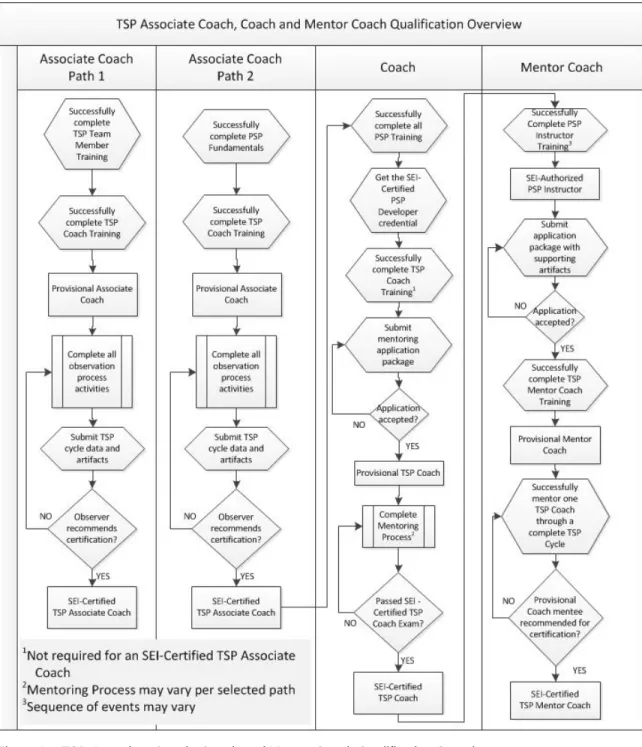
Figure 1: TSP Associate Coach, Coach and Mentor Coach Qualification Overview 4
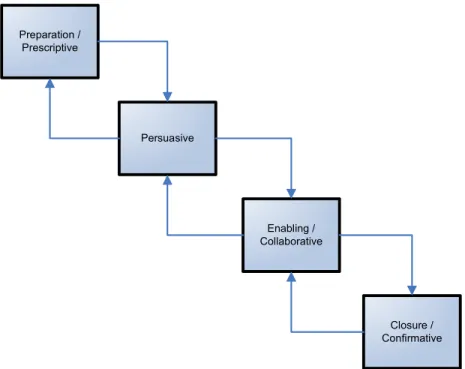
Figure 2: Mentoring Relationship Stages 9
Figure 3: TSP Coach and Associate Coach Relationship 17 Figure 4: TSP Mentoring Program - Preparation/Prescriptive and Persuasive Phases 20 Figure 5: TSP Mentoring Program - Enabling/Collaborative and Closure/Confirmation Phases 21
List of Tables
Acknowledgments
The authors would like to thank Rafael Salazar and the SEI’s TSP Team—Kimberley Campbell, Mark Kasunic, Gene Miluk, and James Over—for helping them develop the associate coach role and maintain the overall mentoring program.
Thanks are also due to the co-authors of the original guidebook—Robert Cannon, Jefferson Welch, and Alan Willett—for establishing the sound mentoring program on which this guidebook is built.
To create the original mentoring program, the authors consulted with several individuals who provided ideas and helped to shape the program. In particular, Kimberley Campbell, Anita Carleton, and Tracey Kelly helped provide a new perspective, and our editors William Thomas and Barbara White corrected defects and fixed formatting issues. Finally, the authors would like to thank the SEI-Certified TSP Coaches who contributed by reviewing the content and clarity of the report: Yoshi Akiyama, Lana Cagle, Luis Castro, Hazel Crofts, Ahmed El-Shikh, Bradley Hodgins, Michelle Jurkouich, Delwyn Kellogg, Juan Lopez, Andy Oughton, Rafael Salazar, and Jim Van Buren.
Abstract
This guidebook explains the mentoring process required to become an SEI-Certified Team Software Process (TSP) Associate Coach, SEI-Certified TSP Coach, or SEI-Certified TSP Mentor Coach. It also defines the structure and format of the mentor and mentee relationship and explains the steps and evaluation criteria for becoming a coach. Refer to the Team Software Process (TSP) Coach Certification Guidebook (CMU/SEI-2013-SR-025) for a description of the required steps and evaluation criteria for becoming an SEI-Certified TSP Associate Coach, Coach, or Mentor Coach.
Introduction
This guidebook explains the mentoring process required to become an SEI-Certified Team Software Process (TSP) Associate Coach, SEI-Certified TSP Coach, or SEI-Certified TSP Mentor Coach. It defines the structure and format of the mentor and mentee relationship and explains the steps and evaluation criteria for becoming a coach. All mentors and mentees should read the entire guidebook at least once and then refer to specific sections whenever necessary.
1.1 Audience
This document is intended for
• individuals who are interested in becoming SEI-Certified TSP Associate Coaches • individuals who are interested in becoming SEI-Certified TSP Coaches
• individuals who are interested in becoming SEI-Certified TSP Mentor Coaches • SEI-Authorized Personal Software Process (PSP) Instructors
• change agents who are responsible for transitioning and sustaining TSP in their organizations • individuals who are responsible for administering the TSP coaching program in their
organi-zations
1.2 Why Mentoring?
The SEI has begun transitioning the TSP technology from early adopters to the early majority by “crossing the chasm,” which Regis McKenna explains as “the gulf between two distinct
marketplaces for technology products—the first, an early market dominated by early adopters and insiders who are quick to appreciate the nature and benefits of the new development, and the second a mainstream market representing ‘the rest of us,’ people who want the benefits of new technology but who do not want to ‘experience’ it in all its gory details” [Moore 2002]. To help facilitate this transition, the SEI has begun modifying the TSP product suite in order to meet the market’s growing need for qualified TSP coaches. Prior to the creation of the SEI-Certified TSP Coach and SEI-Certified TSP Mentor Coach certification tracks, the SEI conferred coach status on individuals using the SEI-Authorized TSP Coach process. While the SEI-Authorized TSP Coach program met the needs of TSP’s early adopters, some of the authorization requirements created barriers to the early majority. These barriers included some of the following factors:
• Candidate coaches often did not follow through with authorization, resulting in unqualified users attempting to implement the TSP.
• The qualification process placed too much emphasis on the mechanics of the team launch and not enough emphasis on other important aspects of process implementation, such as conducting weekly team meetings, assisting the team leader, working with management, do-ing cycle and project postmortems, and developdo-ing repeatable core skills.
• Lack of continuing engagements with other experienced TSP practitioners created the poten-tial for insufficient and/or inconsistent coach development after authorization.
• TSP coach training was available only through the SEI.
• SEI authorization required candidates for coach authorization to conduct a launch or re-launch while being observed by an authorized member of the SEI TSP Initiative Team. • All training was conducted in English only, and observations were limited to
English-speaking coaches and teams.
The SEI TSP coaching program is designed to eliminate the need for observation by SEI
personnel (and the associated costs) by enabling the transfer of knowledge from experienced TSP coaches to new TSP coaches through mentoring, while still maintaining the high standard of quality that organizations, teams, and individuals have come to expect from TSP coaches.
The SEI TSP coaching program also enables the expansion of TSP implementation to non-English-speaking teams and organizations. This expanded capacity for qualifying candidate coaches will enable the available supply of qualified TSP coaches to keep pace with market demand. In addition to overcoming the transition barriers, the new qualification footprint for coaches provides a revised set of standards, processes, and procedures for producing highly qualified coaches. The qualification activities also give candidates a chance to gain real-world experience as they proceed through the steps needed to become certified by the SEI.
As the SEI continues transitioning the TSP technology, the role of an SEI-Certified TSP Associate Coach is needed in addition to the SEI-Certified TSP Coach and SEI-Certified TSP Mentor Coach in order to
• reduce the expense organizations incur in providing their teams adequate coaching support • reduce the amount of time experienced coaches and mentors spend on tasks such as launches
and team meeting facilitation that can be handled by a less comprehensively qualified or ex-perienced coach
• increase the rollout of TSP within organizations by reducing the lead time to train and men-tor those performing coaching support. The current investment required for coaches and mentor coaches necessitates a full-time coaching commitment, but there are too few potential coaches that are able or willing to make the commitment.
• develop a track for potential coaches for non-software teams who often have difficulty com-pleting the PSP training and certification and passing the SEI-Certified TSP Coach Exam. The requirement to have a software development background limits the growth of TSP out-side of software engineering (for example, in systems engineering and testing).
1.3 Mentor and Mentee
name of the centuries-old practice of pairing newcomers to a discipline with a more experienced person who will help the learners to master the needed skills and knowledge in that domain. Mentoring is effectively used in many organizations, not only as a way of developing knowledge, but also to impart the values, beliefs, and practices that compose the organizational culture [U.S. Navy 2009].
Further definition is provided by the People Capability Maturity Model (PCMM): “The purpose of mentoring is to transfer the lessons of greater experience in a workforce competency to improve the capability of other individuals or workgroups” [Curtis 2002].
1.3.2 What is a Mentee?
A mentee is, very simply, a person who is being mentored. In the TSP Coach Mentoring program, the candidate (provisional) associate coach or coach is the mentee who learns from the more experienced coach or mentor coach, respectively. The provisional associate coach or coach must be committed to learning and taking responsibility for his or her own personal development. For the provisional coach this commitment must include a willingness to make on-going and accurate assessments of current skills and competencies, participation in the development and execution of a mentoring action plan, and working with a mentor to achieve the agreed-upon goals.
The U.S. Department of Transportation, Departmental Office of Human Resource Management [DoT 2009] describes the various roles of a mentee as follows:
• The mentee must act as his, or her, own gauge for measuring how interactive the mentoring relationship will be. It is up to the mentee to determine the amount of dependence and guid-ance that he or she requires. The mentee must take the initiative to ask for help or advice, and to take on more challenging work as the relationship progresses.
• The mentee is a student who needs to grasp the mentor’s knowledge and have the ambition to know what to do with the knowledge. The mentee must practice and demonstrate what he or she has learned.
• The mentee is a trainee who should blend mentoring with other approaches to learning. The mentee should seek out other opportunities to grow and learn from people other than the mentor, and not be overly dependent on the mentor’s professional advice. Opportunities such as conferences or continuing education courses related to the professional domain can pro-vide mentees with additional perspectives from which to learn about the profession and its practices.
1.4 TSP Coaching Qualification Overview
Figure 1 outlines the Certified TSP Associate Coach, Certified TSP Coach, and SEI-Certified TSP Mentor Coach qualification tracks. An SEI-SEI-Certified TSP Associate Coach has the capability to facilitate (re)launches, weekly team meetings, and provide day-to-day team support under the guidance of an SEI-Certified TSP Coach. The SEI-Certified TSP Coach has
demonstrated competence of all aspects of the TSP cycle to a mentor and has the experience needed to act as the process experts in relation to the launch process, day-to-day work processes
Certified TSP Mentor Coach is an experienced coach who can train provisional coaches, analyze data using sophisticated methods, and perform complete postmortems that analyze process improvement. Refer to the Team Software Process (TSP) Coach Certification Guidebook (CMU/SEI-2013-SR-025) for a description of the required steps and evaluation criteria for becoming an SEI-Certified TSP Associate Coach, Coach, or Mentor Coach.
1.5 Similarities and Differences Between Coaching and Mentoring
Coaching and mentoring are not the same. However, these terms often are used interchangeably, partly because coaches and mentors often perform similar roles using similar skills and
techniques. Because the TSP coach mentoring process is designed to create better coaches, it is important to clearly delineate the similarities and differences between these two roles.
A coach is a person who instructs individuals in the knowledge and skills needed to gain proficiency in a specific domain. Coaches help individuals to achieve extraordinary results by helping them focus on the mastery of specific processes and procedures and encouraging them to set and achieve goals by enacting a series of action steps that produce the desired results quickly and easily. Coaching helps to sustain progress toward the desired goals by helping people learn from setbacks, turn problems into opportunities, and achieve positive results even in difficult circumstances. Coaches have a set agenda to reinforce and seek to change the skills and behaviors of others to enable realization of that agenda. Coaches work with individuals or teams to achieve a finite set of objectives in a defined timeframe. Studies show that when a professional coach is hired to work with individuals or teams, specific goals and measurable outcomes can be achieved in a shorter period of time than could have been done without the coach’s guidance. In other words, “While all of the steps of teambuilding, training, goal setting, and feedback are needed to produce a high-performing team, they are not sufficient. The final key ingredient is leadership and coaching” [Humphrey 2006].
As with a coach, a mentor is an experienced person who helps less experienced people gain proficiency in a particular domain. However, in addition to providing instruction, the mentor also acts as a trusted counselor, role model, and guide to the less experienced person or newcomer who is the mentee. Mentoring involves a two-way, mutually beneficial learning situation in which the mentor provides advice, shares knowledge and experiences, and teaches using a low-pressure approach that enables the mentee to discover his or her own particular strengths and areas for improvement. The mentor’s role is to help shape and guide an individual’s development in both professional and general life skills. Good communication and coaching skills are vital in fulfilling the role of a mentor.
Coaching and mentoring share many similarities. The roles of both mentors and coaches are filled by individuals who possess a great deal of experience in and knowledge about the domain in which they are working, and who have the job of helping less experienced individuals improve their knowledge and performance in that domain. Both roles require the coach or mentor to act as a guide and role model to the individual being coached or mentored, and both help their less-experienced charges to view setbacks as lessons that will help them learn from their own mistakes.
There are also several important differences that delineate coaching and mentoring as separate functions. Coaches often receive some sort of formal training in the skills required for effective coaching; mentors generally do not receive formal mentor training, but they usually possess the same skills and abilities as coaches, both in domain-specific skills and knowledge and in the communication and instructional skills needed for effective mentor-mentee relationships. The
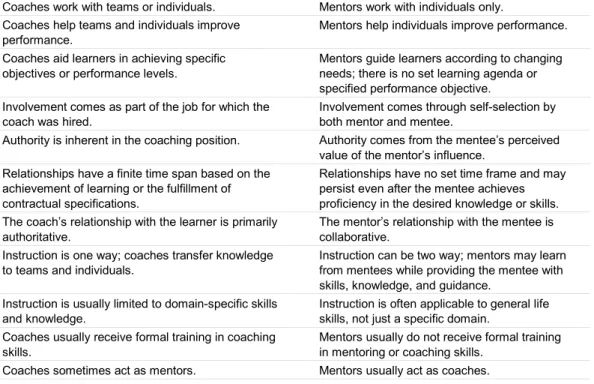
goals and measurable outcomes, which, when met, result either in the termination of the relationship or a renewal of the relationship based on a new set of goals and desired outcomes. Mentoring relationships typically do not have clearly stated learning goals or measurable outcomes, and tend to endure over time, even after the mentee has gained sufficient skills to perform independently and proficiently in the domain. Coaches can work either with individuals or teams, whereas mentors work one-on-one with a single mentee. Coaches have more of an authoritative role, and they provide direct instruction where learning flows in one direction only, from coach to learner. Mentors act more like facilitators or guides than instructors, and when instruction is needed, it is often done through counseling or discovery activities from which both the mentor and mentee may learn. The major similarities and differences between coaches and mentors are summarized in the following table.
Table 1: Similarities and Differences Between Coaches and Mentors
Coaches Mentors
Coaches work with teams or individuals. Mentors work with individuals only. Coaches help teams and individuals improve
performance.
Mentors help individuals improve performance. Coaches aid learners in achieving specific
objectives or performance levels.
Mentors guide learners according to changing needs; there is no set learning agenda or specified performance objective. Involvement comes as part of the job for which the
coach was hired.
Involvement comes through self-selection by both mentor and mentee.
Authority is inherent in the coaching position. Authority comes from the mentee’s perceived value of the mentor’s influence.
Relationships have a finite time span based on the achievement of learning or the fulfillment of contractual specifications.
Relationships have no set time frame and may persist even after the mentee achieves proficiency in the desired knowledge or skills. The coach’s relationship with the learner is primarily
authoritative.
The mentor’s relationship with the mentee is collaborative.
Instruction is one way; coaches transfer knowledge to teams and individuals.
Instruction can be two way; mentors may learn from mentees while providing the mentee with skills, knowledge, and guidance.
Instruction is usually limited to domain-specific skills and knowledge.
Instruction is often applicable to general life skills, not just a specific domain.
Coaches usually receive formal training in coaching skills.
Mentors usually do not receive formal training in mentoring or coaching skills.
Mentoring Concepts
Mentoring is a process by which an experienced person provides advice, support, and training to a less experienced person to enhance personal and professional growth to both parties in the
relationship. This section describes the fundamental concepts relevant to creating an effective mentor-mentee relationship.
2.1 What is Mentoring?
2.1.1 The Mentoring Process
Mentoring is a developmental process in which a more experienced individual commits to working and learning with a less experienced individual for the purpose of improving the professional development of both individuals [CIO 2002]. The mentoring process includes a series of stages (described in Section 2.2) in which the mentor’s leadership in the process is adapted to support the developing strengths and meet the changing needs of the mentee. The desired outcome of an effective mentoring process is a self-confident and competent professional who is prepared to mentor others.
2.1.2 Mentoring Relationships
A successful relationship between a mentor and a mentee is characterized by confidentiality, trust, caring, mutual support, and challenges for growth. The mentoring relationship creates the
necessary context of safety and confidence in which both the mentor and mentee can take the risks of trying new work strategies and learning from each other. This context is necessary for encouraging the professional growth of both individuals.
2.1.3 Mentoring Objectives
Mentoring can achieve many objectives. In addition to providing the mentee with opportunities for success and further growth, mentoring is also a means for accomplishing other desired outcomes, described below.
• Achieve scalability of a profession in a global environment. In many professions, the need for qualified practitioners is growing so rapidly that the capacity of academic institutions or training programs is unable to meet the demand for practica or internships that enable learn-ers to gain needed experience. Mentoring provides a cost-effective way to facilitate the trans-fer of practical skills and knowledge from experienced professionals to new professionals, while still maintaining the high standard of quality needed for proficiency in a discipline. In the case of TSP, having qualified mentors within an organization allows the organization to train and assess coaches without the need for costly travel by candidate coaches or external observers. Mentorships also allow training and observations to be conducted outside the United States and in languages other than English.
personal and career goals, introduce them to other practitioners in the professional communi-ty, and provide positive examples of ethical and masterful professional behavior. In turn, mentees can provide their mentors with fresh perspectives and new ways of approaching es-tablished problems in the profession.
• Contribute to individual transition (prepare professionals for greater responsibilities). Mentoring provides a mechanism for new practitioners to transfer the knowledge and skills learned in the classroom to real-world practice under the tutelage of an experienced profes-sional. Mentorships allow new practitioners to set and achieve goals that build on what they already know but cannot yet achieve alone, gradually increasing their proficiency in practice until they are able to capably perform all required functions without guidance or supervision.
2.1.4 Types of Mentoring
Although there are numerous types of mentoring, the SEI coach qualification tracks follow the formal/planned mentoring approach, which is described by the U.S. Department of Transportation Departmental Office of Human Resource Management as follows:
Formal or planned mentoring focuses on enabling the mentee to develop skills based on the needs of the profession, usually resulting in benefits to both the profession and the mentee. This type of mentoring promotes a “formal” approach to the relationship, with little social interaction between mentor and mentee; the mentor and mentee rarely (if ever) see each other outside the office. The mentor and mentee are more interested in meeting the needs of the profession than in developing a friendship; the basis for their relationship is professional commitment. Planned mentoring follows a predefined track that ends when the professional goals are reached. This type of mentoring takes a systematic approach to ensure that the mentee develops the skill set needed to benefit the profession.
2.2 Stages in a Mentoring Relationship
Numerous models of mentorship describe the process as having four distinct stages through which the mentor-mentee relationship evolves; the evolutionary sequence of stages is based on the changing knowledge levels of the mentee. The sequence of stages (depicted in Figure 2) is generally a forward progression (as in a pure waterfall model), but as with software, a stage sometimes must be revisited before moving forward again.
Figure 2: Mentoring Relationship Stages
2.2.1 The Preparation/Prescriptive Stage
The initial stage of the mentor-mentee relationship establishes the foundation upon which all progress will be measured and sets the ground rules under which the relationship will operate. During this phase, the mentor and mentee engage in discussion(s) to establish a sense of common purpose, as well as to develop a mutual understanding of the guidance that will be provided and to establish the expected outcomes of the process. In this stage, the mentee generally has little or no experience in the organization or the professional domain, so the mentor must assume a more proactive role in guiding, directing, and advising the mentee. This stage is generally the most demanding on the mentor because he or she must share a tremendous amount of information, and the mentee’s ability to function successfully depends in large part on the extent to which active guidance and in-depth advice is forthcoming from the mentor.
2.2.2 The Persuasive Stage
The second stage requires the mentor to take a strong approach in persuading the mentee to begin taking risks and acting more autonomously, with less direction and motivation provided from the mentor. The mentor must actively persuade the mentee to seek challenges and find answers. The mentee has begun to gain some experience in the organization or professional domain, but still needs some active direction from the mentor to be completely successful. The mentor may begin to help the mentee to develop and grow by suggesting new strategies, raising challenging questions, and pushing the mentee into making new discoveries.
Preparation / Prescriptive Enabling / Collaborative Persuasive Closure / Confirmative
2.2.3 The Enabling/Collaborative Stage
During the enabling/collaborative stage, the mentor allows the mentee to experience both successes and failures, while still guarding the mentee from total failure. The mentor persuades the mentee to consider problems and discuss solutions openly and without fear of embarrassment. The mentor uses feedback as the primary mechanism for communication.
During this stage, the mentor should purposely move the relationship from mentor-oriented to mentee-oriented. The mentor becomes a sounding board for questions and advice rather than the source of all information, and begins to use probing or evaluative questions to study the mentee’s grasp of the skills and concepts being mastered. At some point during this stage, the mentor will become satisfied that the mentee has crossed the acceptable threshold for competent and autonomous performance in the professional domain or organization.
2.2.4 The Closure/Confirmative Stage
The final stage of the mentor-mentee relationship commences when the mentee successfully meets the criteria needed for successful autonomous performance of a particular job function or professional skill set. The mentee is able to work independently of the mentor. Communications at this stage take place on a more equal level, often with the mentor and mentee working to solve problems together. As the mentee begins to function at a higher level of understanding in the professional domain or organization, the mentor gradually withdraws support and will eventually, by mutual consent, exit the relationship altogether.
2.3 The Mentor and Mentee Roles
2.3.1 The Mentor Role
Mentors facilitate personal, educational, and professional growth in another individual by sharing the knowledge and insights that they have gathered through years of experience. Successful mentors are characterized as supportive, patient, and respected, among other positive personality traits. Mentors have several responsibilities, including the following:
• helping the mentee to develop an appropriate learning plan/mentoring agreement, including goals that build on what the mentee knows and can do already, but cannot yet achieve alone • providing guidance based on the mentee’s learning and development needs
• helping the mentee access appropriate expert advice to extend knowledge and skills • creating a learning environment that supports risk taking and innovation, and encouraging
the mentee to expand his or her abilities
• listening actively, being accommodating, and using silence as a tool
• providing feedback as necessary, such as relating guidance from personal past experiences Some of the attributes and roles that a mentor may need to employ are as follows:
• motivator – providing encouragement, support, and positive feedback when a mentee is fac-ing a challenge
• coach – helping the mentee to overcome performance difficulties through positive feedback and constructive feedback
• guide – helping the mentee to set realistic goals
2.3.2 The Mentee Role
A mentee is an individual who is protected or trained, or whose career is furthered by a mentor or a person of greater experience, prominence, or influence. A mentee is a professional who needs to learn from the mentor and to practice and demonstrate what has been learned. A mentee is also a “trainee” who should blend mentoring with other training approaches. The mentee has several responsibilities, including the following:
• taking learning opportunities seriously
• preparing and completing each assignment according to the action plan that was negotiated with the mentor
• expressing needs clearly
• helping to identify development goals • seeking input from the mentor
• demonstrating commitment through action • maintaining confidentiality
• maintaining a positive attitude
• keeping an open mind when receiving feedback, whether positive or negative
2.4 Obstacles to Successful Mentorships
Mentor-mentee relationships are like any other situations that involve interpersonal interactions. The following list outlines some of the more common problems that are specific to a mentorship arrangement.
• Differences in learning/mentoring styles. A mentoring style may not meet the mentee’s learning needs or feel comfortable to the mentor. After evaluating the mentee to determine the required amount of guidance, the mentor can determine the mentoring style that is most appropriate. Both the mentor and the mentee need to be flexible in adjusting the amount and direction of “give-and-take” in their interactions. As the relationship evolves and the mentee’s skill level and confidence grow, the mentor may need to adjust mentoring tech-niques to stay synchronized with the mentee’s development. Typically, as the mentorship evolves and moves toward conclusion, the mentor tends to give less advice and accepts more input from the mentee, until the mentee is capable of fully autonomous performance. • Time required for mentoring activities. Schedule commitments may prevent a mentor
the mentoring relationship will suffer. The same is true if the situation is reversed, with the mentee failing to devote adequate time for interacting with and learning from the mentor. • Inappropriateexpectations. A common problem with mentors is that they may expect too
much progress from the mentee in an unrealistically short time. Mentors must allow their mentees to have sufficient time to grow professionally and to make mistakes along the way. Because of their greater knowledge and experience, mentors may have difficulty reining in their impatience with a mentee from whom they are expecting too much too soon. Converse-ly, some mentees may expect too much from their mentors, such as demanding more time than is realistic. Or, mentees may expect or ask for more attention than they actually need. • Control. A mentor should try to avoid the two extremes that may arise in a mentor-mentee
relationship—either exerting too much control over the learning situation and smothering the mentee’s attempts to act alone, or paying so little attention to the mentee that it amounts to neglect and leaves the mentee open to failure. Both parties should understand that this kind of relationship requires a firm time commitment from both parties and, if these commitments are not honored, the relationship will not meet its goals. Time constraints on both sides should be acknowledged and then managed effectively.
Other obstacles encountered in mentoring efforts may include the following:
• attempts by either party to control the relationship (instead of cooperating) • manipulation by either party (instead of mutual respect)
• inadequate attention to the preparation stage (for example, failing to set clear goals or to de-velop an action plan to meet desired goals)
• a casual approach to meetings or other forms of contact with a mentee (for example, unilat-eral changes to meeting times without good reason and not making further arrangements immediately)
• lack of organization or preparation for meetings with a mentee
• overstepping the boundaries of the agreed-to mentorship style; for example, straying into tutoring or direct training
Mentoring TSP Associate Coaches, Coaches, and Mentor
Coaches
Since the TSP has grown and transitioned through the technology adoption life-cycle curve from early adoption to the early majority phase [Moore 2002], the TSP introduction strategy has been modified to better support the needs of a different category of technology adaptors. An essential element in this strategy is the inclusion of a formal mentoring program for TSP coaches.
The qualification model detailed in this guidebook describes six levels of qualification, each with definitive entry and exit gates. These levels are Provisional TSP Associate Coach, SEI-Certified TSP Associate Coach, Provisional TSP Coach, SEI-Certified TSP Coach, Provisional TSP Mentor Coach, and SEI-Certified TSP Mentor Coach. This six-tiered model provides organizations with more scalability and decreased costs when broadening the implementation of TSP across multiple sectors of the organization, and it provides individuals with more options to apply their TSP experiences as coaches within the organization.
3.1 Why Is Mentoring Needed in the TSP Coach Qualification Model?
Recent studies and workforce research indicate that additional on-the-job training is needed to increase employee productivity and decrease the time needed to produce quality work. A study performed by the American Society of Training and Development found that while training alone increased manager productivity by 24 percent, productivity was increased by 88 percent when training was combined with coaching and mentoring support strategies [Sweeny 2003]. The study defined mentoring as
• a series of tasks that effective mentors must do to promote the professional development of others
• the intense, trusting, supportive, positive, confidential, low-risk relationship within which the partners can try ways of working and relating, make mistakes, gain feedback, accept chal-lenges, and learn in front of each other
• the complex developmental process that mentors use to support and guide their mentees through the necessary career transitions that are part of learning how to be an effective, re-flective professional and a career-long learner
The TSP coach qualification model includes mentoring in order to provide new coaches with guidance and support in a controlled environment that allows new coaches to implement the skills and knowledge gained through PSP/TSP training. The mentorship structure gives new coaches an opportunity to practice and gain feedback on performance, thereby optimizing the learning experiences gained through interactions with TSP teams, their coaching peers, and a qualified mentor coach.
3.2 The Provisional Associate Coach
To become certified, a provisional associate coach must successfully (re)launch a team while be-ing observed by an SEI-Certified TSP Coach or Mentor Coach and support the team’s day-to-day operations under the guidance of a SEI-Certified TSP Coach or Mentor Coach. The day-to-day support should include attending weekly team meetings, coaching role managers, and interpreting basic time, size, defect, and schedule data being generated by the team. In addition to the day-to-day support the provisional associate coach should assist the SEI-Certified TSP Coach or Mentor Coach in conducting the team’s checkpoints and postmortems.
The coach or mentor coach assigned to the provisional associate coach’s team must submit to the SEI the (re)launch observation findings along with a complete TSP cycle dataset, including (re)launch, checkpoint, and postmortem data, an assessment of the associate coach’s skills, and a final assessment report, within 12 months of entering provisional associate coach status. The final assessment report must include a recommendation that the provisional associate coach be allowed to become an SEI-Certified TSP Associate Coach.
3.3 The Provisional Coach
To become certified, a provisional coach must complete the activities described below while under the supervision of an SEI-Certified TSP Mentor Coach.
• As a provisional coach, successfully complete at least one each of the TSP events listed be-low within 18 months of entering provisional coach status.
− TSP launch or relaunch − TSP checkpoint
− TSP project or cycle postmortem
• Successfully complete all associated responsibilities of a TSP coach as outlined in tasking areas C through G of the TSP Coach Job Analysis Report (see Appendix B). Successful completion must be confirmed by an SEI-Certified TSP Mentor Coach, or a Provisional TSP Mentor Coach under the guidance of an SEI-Certified TSP Mentor Coach, via the final as-sessment report. The mentor coach must also provide a recommendation that the provisional coach be allowed to become an SEI-Certified TSP Coach.
• Successfully complete the TSP Coach Certification written exam. (NOTE: the provisional coach is allowed a maximum of three attempts at passing the exam. Failure to pass the exam on the third attempt will disqualify the individual from becoming an SEI-Certified TSP Coach.)
3.4 The Provisional TSP Mentor Coach
A provisional mentor coach must successfully mentor a provisional coach candidate through the process of becoming an SEI-Certified TSP Coach (see certification requirements listed in Section 3.3), under the guidance of an SEI-Certified TSP Mentor Coach. The SEI-Certified TSP Mentor
• completion of the Provisional Coach Mentoring Program Application (form MPA, page 57), which includes the completion of a Provisional Coach Developmental Needs
Self-Assessment (form DNSA, page 59) and the development of Mentoring Goals (form MG, page 65) and a Mentoring Action Plan (form MAP, page 69)
• completion of Mentoring Artifact Evaluations (form MAE, page 71) of the data and infor-mation provided at (re)launches, checkpoints, and postmortems
• if part of the mentor and mentee’s MAP, conducting (re)launch observations (form LOE, page 75)
• periodic assessment of the mentoring being provided to the provisional coach • submission of TSP data to the SEI (via the Partner Resource Center,
https://partner-resources.sei.cmu.edu/)
TSP Associate Coach Observation Phase
This section of the guidebook outlines the relationship between the associate coach and the coach or mentor coach. For the remainder of this section, “coach” will be used to represent either a SEI-Certified TSP Coach or Mentor Coach since either certification level is adequate for the purpose of working with associate coaches and performing observations and assessments of provisional associate coaches.
4.1 Relationship Between Coach and Associate Coach
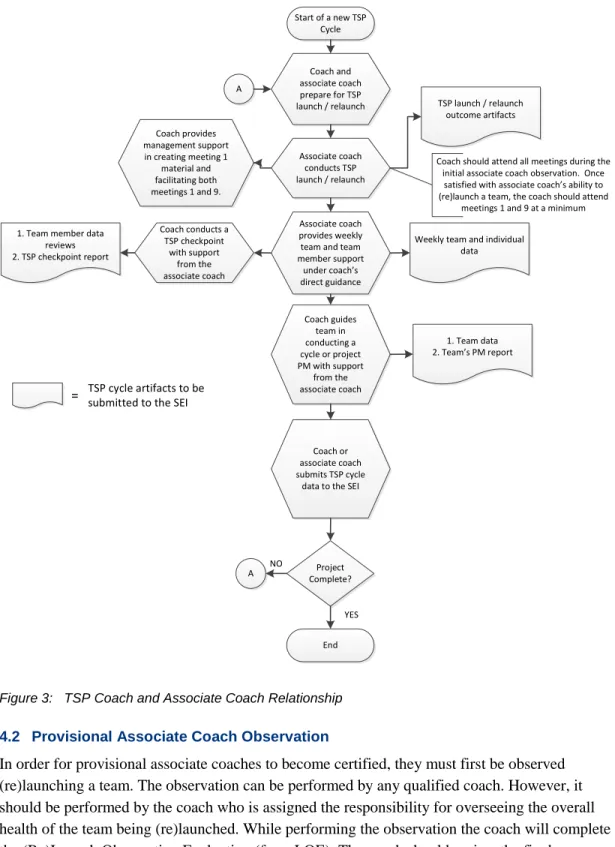
All TSP teams must be assigned an SEI-qualified coach. To allow coaches to expand their coach-ing capacity within organizations, associate coaches can be used to facilitate (re)launches and support the team’s day-to-day needs, such as attending weekly team meetings, coaching role man-agers, and interpreting basic time, size, defect, and schedule data being generated by the team or its members. In addition to the day-to-day support, the associate coach should assist the coach in conducting the team’s checkpoints and postmortems. Figure 3 shows the basic delineation of roles and responsibilities between the coach and associate coach. However, the coach is ultimately re-sponsible for supporting the team in meeting its established goals. This is accomplished by ensur-ing that
• the process is followed • everyone is involved
• everyone contributes to every part of the process
• there is complete communication among team members, team leader, management, and oth-er relevant stakeholdoth-ers
The relationship between coach and associate coach will be more like coaching than mentoring, as defined in Section 1.5. The qualified coach will aid the associate coach in achieving specific ob-jectives in connection with the teams being coached. The coach will also tutor the associate coach to improve the associate coach’s ability to perform the skills identified in the TSP Coach Skills Analysis. Refer to the TSP Coaching Certification Guidebook’s Appendix A for details.
Figure 3: TSP Coach and Associate Coach Relationship 4.2 Provisional Associate Coach Observation
In order for provisional associate coaches to become certified, they must first be observed (re)launching a team. The observation can be performed by any qualified coach. However, it should be performed by the coach who is assigned the responsibility for overseeing the overall health of the team being (re)launched. While performing the observation the coach will complete the (Re)Launch Observation Evaluation (form LOE). The coach should review the final
(re)launch observation findings with the associated coach before sending it to the SEI. The LOE form should be sent to the SEI along with the coach’s Final Assessment Report (form AFAR).
TSP launch / relaunch outcome artifacts
Weekly team and individual data Coach and associate coach prepare for TSP launch / relaunch Associate coach conducts TSP launch / relaunch Associate coach provides weekly team and team member support under coach’s direct guidance Coach conducts a TSP checkpoint with support from the associate coach 1. Team member data
reviews 2. TSP checkpoint report Coach guides team in conducting a cycle or project PM with support from the associate coach 1. Team data 2. Team’s PM report Coach or associate coach submits TSP cycle
data to the SEI Coach provides management support in creating meeting 1 material and facilitating both meetings 1 and 9. A
Coach should attend all meetings during the initial associate coach observation. Once
satisfied with associate coach’s ability to (re)launch a team, the coach should attend
meetings 1 and 9 at a minimum Start of a new TSP Cycle Project Complete? End YES NO A TSP cycle artifacts to be submitted to the SEI
Once the (re)launch is complete, the coach should support the associate coach in day-to-day coaching of the (re)launched team. At a minimum the coach must perform a checkpoint and cycle postmortem for the team being coached by the associated coach. The coach should use the TSP Associate Coach Skills Checklist to guide the observation and evaluation of the provisional asso-ciate coach’s performance. Immediate feedback should be given to the assoasso-ciate coach by the coach when the associate coach’s performance on any given competency listed in the checklist is deemed unacceptable or identified as “Remediation Required.” Once the team’s cycle postmortem has been completed the coach can submit a Final Assessment Report (form AFAR), along with the (Re)Launch Observation Evaluation (form LOE) and the TSP Associate Coach Skills Check-list, to the SEI. In addition to this report, a complete TSP cycle dataset, including (re)launch, checkpoint, and postmortem data, must be submitted to the SEI via the Partner Resource Center (https://partner-resources.sei.cmu.edu/).
Once the complete TSP cycle dataset and AFAR is received, the SEI will evaluate the data and recommendation to determine if certification can be granted. If certification is denied, the SEI will inform the provisional associate coach of what remedial actions are required in order to be granted certification.
The TSP Coach Mentoring Program
This guidebook will help mentors and provisional coaches to set achievable goals and assess areas in which growth and development are needed to complete the qualification track. This section defines the TSP mentoring program and provides guidelines to be used while executing the mentoring program.
5.1 TSP Mentoring Phases
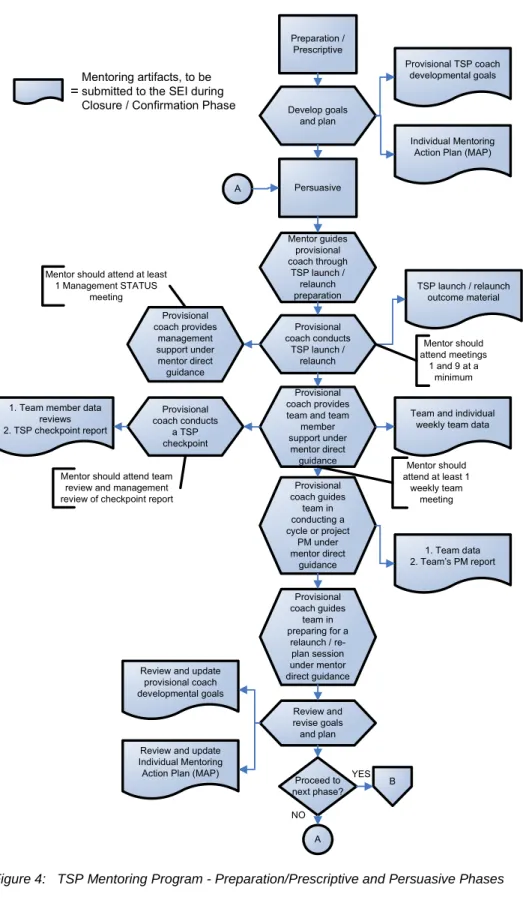
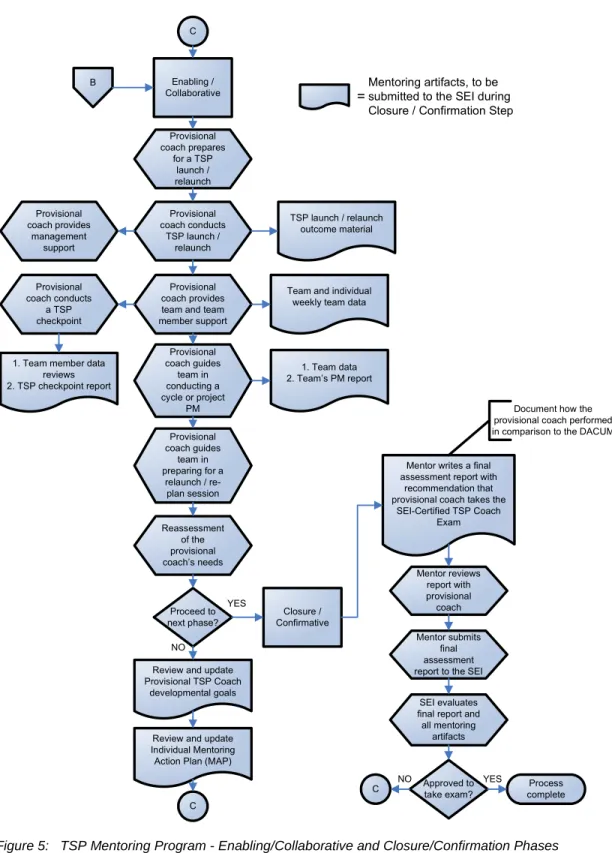
Figure 4 and Figure 5 outline the TSP mentoring phases. These phases are expansions of the mentoring relationship phases shown in Figure 2. Depending on the provisional coach’s developmental goals and the action plan developed by the mentor and provisional coach during the Preparation/Prescriptive phase, the next step in the developmental progression could be the Persuasive phase, the Enabling/Collaborative phase, or a combination of both.
During the Persuasive phase, there are many meetings throughout the TSP cycle that the mentor should attend. For these events, the mentor may attend in person or remotely via video
teleconference or similar means. It is important that the mentor take the role of a silent observer during these events, as it is the provisional coach’s job to coach the team, not the mentor’s job. The mentor must refrain from correcting or evaluating the provisional coach during these events. The mentor should hold any comments or recommendations until after the event or during a break. The mentor is present mainly to ensure that the provisional coach is successful. Therefore, the mentor should remain as invisible as possible to allow the provisional coach to learn and gain experience and to maintain credibility with the team being coached.
The mentoring artifacts and the TSP cycle events outlined in Figure 4 and Figure 5 are designed to guide the mentor and provisional coach through the many duties and skills expected of a certified coach, as outlined in Appendix B, the TSP Coach Job Analysis Report. As the mentor and provisional coach work their way through the TSP cycle events, they should use the questions in Appendix A to stimulate thinking and to help guide the interaction between them successfully. The mentor is not expected to be an expert in every subject area, but mentors are expected to use their network of resources to augment their own skill set. The mentor should also review and provide feedback to the provisional coach on all mentoring artifacts as they are produced, using forms LOE and MAE as appropriate. If mentors choose, they can create their own artifact-specific forms and checklist to use in place of the MAE for items such as weekly team meetings,
checkpoints, postmortems, etc. Any special forms must be submitted to the SEI as part of the Final Assessment Report (form FAR).
Figure 4: TSP Mentoring Program - Preparation/Prescriptive and Persuasive Phases Preparation / Prescriptive Persuasive Provisional TSP coach developmental goals Individual Mentoring Action Plan (MAP) Develop goals
and plan
TSP launch / relaunch outcome material
Team and individual weekly team data Mentor guides provisional coach through TSP launch / relaunch preparation Provisional coach conducts TSP launch / relaunch Provisional coach provides team and team
member support under mentor direct guidance Provisional coach conducts a TSP checkpoint 1. Team member data
reviews 2. TSP checkpoint report Provisional coach guides team in conducting a cycle or project PM under mentor direct guidance 1. Team data 2. Team’s PM report Provisional coach guides team in preparing for a relaunch / re-plan session under mentor direct guidance Proceed to next phase? Provisional coach provides management support under mentor direct guidance
Review and update provisional coach developmental goals
Review and update Individual Mentoring Action Plan (MAP)
Review and revise goals and plan A B A YES NO Mentor should attend meetings 1 and 9 at a minimum Mentor should attend at least
1 Management STATUS meeting Mentor should attend at least 1 weekly team meeting Mentor should attend team
review and management review of checkpoint report
Mentoring artifacts, to be submitted to the SEI during Closure / Confirmation Phase
Figure 5: TSP Mentoring Program - Enabling/Collaborative and Closure/Confirmation Phases B Enabling / Collaborative Closure / Confirmative TSP launch / relaunch outcome material
Team and individual weekly team data Provisional coach prepares for a TSP launch / relaunch Provisional coach conducts TSP launch / relaunch Provisional coach provides team and team member support Provisional
coach conducts a TSP checkpoint
1. Team member data reviews 2. TSP checkpoint report Provisional coach guides team in conducting a cycle or project PM 1. Team data 2. Team’s PM report Provisional coach guides team in preparing for a relaunch / re-plan session Proceed to next phase? Provisional coach provides management support
Review and update Provisional TSP Coach
developmental goals
Review and update Individual Mentoring Action Plan (MAP)
Reassessment of the provisional coach’s needs YES NO C C
Mentor writes a final assessment report with
recommendation that provisional coach takes the
SEI-Certified TSP Coach Exam Mentor reviews report with provisional coach Mentor submits final assessment report to the SEI
SEI evaluates final report and
all mentoring artifacts
Approved to
take exam? completeProcess
C NO YES
Document how the provisional coach performed in comparison to the DACUM
Mentoring artifacts, to be submitted to the SEI during Closure / Confirmation Step
5.2 Conducting Mentoring Sessions
The list below outlines suggestions that can help to ensure that the mentor and the provisional coach have productive mentoring sessions.
• The first meeting or conference call should be long enough to complete planning goals and expectations and scheduling needs. This meeting generally can be expected to take about two hours.
• Both the mentor and provisional coach should review this guide before their first meeting and use it as a reference for future meetings.
• The provisional coach should be ready to discuss the project status during the mentor meet-ing and should be able to easily access needed details. Mentormeet-ing artifacts should be readily available to both parties.
• Mitigation steps should be identified for any areas identified for improvement.
• The mentor should provide copies of all mentoring reports to the provisional coach. This includes a copy of the final assessment report.
• A date and time for the next mentoring session should be set before each meeting ends. It is recommended that the mentor and provisional coach spend at least 30 minutes each week re-viewing and updating their Mentoring Action Plan (form MAP).
5.3 Guidance for Mentors and Provisional Coaches
A mentor may be able to judge the provisional coach’s progress from reviewing only the mentoring artifacts, as outlined in Figure 4 and Figure 5. However, it is more likely that the mentor will require additional information to assess whether the provisional coach is preparing properly for his or her coaching work. This section discusses areas in which the mentor needs to ensure that the provisional coach is progressing in the development track. We have designated specific areas of tasking where a provisional coach should show competency of knowledge and skills to be a successful TSP coach.
Key Question: What should the mentor be asking/doing to ensure that the provisional coach can be successful?
Mentors should ask the questions that lead the provisional coach to function successfully in coaching their team and, more importantly, that will ensure that the provisional coach masters the skills needed to coach future projects once the mentoring relationship has concluded. For
example, when validating the required mentoring artifacts, the mentor should ask questions about how the information was obtained and what information might have been missed.
5.3.1 General Guidance for Answering Questions
Provisional coaches are very likely to ask lots of questions of the mentor. The mentor should use careful judgment about whether to answer the question immediately or lead the provisional coach
for the provisional coach to answer, or may ask other questions in lieu of providing an answer. Such questions could include the following:
• Why did you ask that question? • What do you think the options are? • Which option would you pick and why? • Why would you be nervous about that option?
After having a dialogue around those topics, if the original question is still unanswered, the mentor may provide a personal opinion or point the provisional coach to another person or resource. The mentor coach can also draw guidance from the information in the various appendices of this document.
• Appendix A contains questions that a mentor may ask of a provisional coach to determine knowledge and/or skill competency levels in the required topic areas.
• Appendix B is a TSP coach job-task analysis conducted in 2006 by the SEI and Ohio State University, and is drawn from the expertise of TSP professionals in government, academia, and industry. The resulting information was segmented into the following core areas in which it was deemed that TSP coaches must be competent: Sections C through G (listed be-low in bold font) are areas that should be of particular interest for potential SEI-Certified TSP Coaches and Mentor Coaches, as these are the areas in which they are expected to demonstrate mastery.
A. Prepare Organization for Initial TSP Usage B. Provide TSP Domain Training
C. Facilitate TSP Team Launch D. Guide Personal Process Usage E. Guide Team Process Usage F. Guide Management in TSP Usage G. Support Data Analysis and Usage H. Support Organizational TSP Infrastructure I. Perform Administrative Activities
J. Pursue Professional Development
Competence in all of these coaching task areas is important in the development of a TSP provisional coach. However, during the early training stages, it is critical to a new TSP coach’s success to understand and perform well in the specific task areas highlighted above (items C through G).
The TSP Coach Skills Analysis, which can be found in Appendix A of the Team Software Process (TSP) Coach Certification Guidebook (CMU/SEI-2013-SR-025), provides a mapping of the coaching levels to the same TSP Coach Job Analysis Report developed in 2006.
• Appendix C contains the relevant forms for the provisional qualification process. These forms must be completed, with the original sent to the SEI as part of the TSP coach mentoring program and associate coach program.
5.4 TSP Coach Mentoring Roadmap
In general, the mentoring process for TSP provisional coaches includes the five steps listed below.
1. Assigning mentors and provisional coaches. Mentors and provisional coaches are paired based on availability, location, and experience in the TSP environment. If necessary, the SEI will assist provisional coaches in locating suitable SEI-Certified TSP Mentor Coaches. The Provisional Coach Mentoring Program Application (see Section 6.2.1.1) is used in the assignment of mentors and provisional coaches.
2. Creating the Mentoring Action Plan (MAP). A successful mentorship outcome depends on setting goals, expectations, and timetables. The Mentoring Goals form (see Section 6.2.1.3) provides guidance to the mentor coach in outlining specific short- and long-term goals with the provisional coach. These goals are based on an individual assessment of the provisional coach’s needs (see Section 6.2.1.2) and are supported by an active mentoring partnership. Once the mentor and provisional coach have determined the mentorship goals, they can prepare the MAP (see Section 6.2.1.4). The MAP is the tangible output of the first meeting or conference call and records the timetable of events for reaching the identified goals, as well as the objectives and tasks associated with each event.
3. Following the MAP. The mentor is responsible for ensuring that the steps in the qualification track are completed according to the plan developed with the provisional coach.
4. Evaluating Progress. The questions listed in Appendix A provide an excellent tool for the mentor to use in evaluating and guiding a provisional coach’s progress. Just as TSP teams are advised to conduct weekly meetings, mentors and provisional coaches must regularly
communicate with each other and share progress and obstacles. Mentors and provisional coaches are advised to spend at least 30 minutes each week updating the MAP. The Mentoring Artifact Evaluation (see Section 6.2.2.1) and the TSP (Re)Launch Observation Evaluation (see Section 6.2.2.2) forms are also provided as a means for evaluating performance and providing feedback to the provisional coach.
5. Assessing performance. At the conclusion of the mentoring relationship, the mentor coach evaluates the provisional coach. The mentor coach completes the final assessment report (see Section 6.2.2.4) and submits it to the SEI for review and validation. The final report contains the information needed to verify that the provisional coach has successfully worked through the TSP cycle and is ready to take the TSP Coach Certification Exam and become an SEI-Certified TSP Coach.
Communication and Record Keeping
Several forms have been created to support the communication and record-keeping needs of the SEI-Certified TSP Coach Mentoring Program. The forms are located in Appendix C, with brief descriptions of each form provided in this section.
6.1 SEI-Certified TSP Associate Coach
6.1.1 Becoming an SEI-Certified TSP Associate Coach
The application process required to take the TSP Coach training course will also serve as the as-sociate coach’s application for the mentoring program. Once the coach training as been success-fully completed, the associate coach will go into the observation phase as described in Section 4.
6.1.2 Provisional Associate Coach Evaluation and Data Submission
6.1.2.1 TSP (Re)Launch Observation Evaluation (Form LOE)
The provisional associate coach’s observation phase requires that an SEI-Certified TSP Coach or Mentor Coach attend the provisional associate coach’s entire (re)launch as an observer. The observer coach should follow these guidelines when observing the provisional associate coach:
• The provisional associate coach conducts the (re)launch. • An observer evaluates the candidate’s performance. • The observer refrains from participating in the (re)launch.
• The observer promptly and privately discusses the provisional associate coach’s performance whenever the observer identifies problems.
During the observation, the observer evaluates the provisional associate coach’s performance using the (Re)Launch Observation Evaluation form. The provisional associate coach submits the (re)launch artifacts to the SEI using the TSP Data Submission form, via the SEI Partner Resource Center website (https://partner-resources.sei.cmu.edu/). All evaluation forms are submitted to the SEI as part of the associate coach’s final assessment report.
6.1.2.2 TSP Data Submission Form on the SEI Partner Resource Center
The TSP Data Submission form is used to submit all TSP cycle data to the SEI. It is used by all categories of coaches. A separate form must be used for each TSP cycle event. The form, along with the associated data, must be submitted to the SEI using the SEI Partner Resource Center website (https://partner-resources.sei.cmu.edu/). No emailed data submissions will be accepted due to Internet security restrictions.
6.1.2.3 TSP Associate Coach Skills Checklist
The TSP Associate Coach Skills Checklist is used by the observing SEI-Certified TSP Coach or Mentor Coach throughout the TSP cycle in order capture the provisional associate coach’s ob-served behavior or competencies and to provide feedback to the provisional associate coach.
The completed TSP Associate Coach Skill Checklist is submitted to the SEI as supporting docu-mentation to the TSP Associate Coach Final Assessment Report (form AFAR).
6.1.2.4 TSP Associate Coach Final Assessment Report – Form AFAR
When the provisional associate coach has worked through the entire TSP cycle at least once and the observer is satisfied with the provisional associate coach’s performance, the observer submits a final assessment report to the SEI with a recommendation for the provisional associate coach to become an SEI-Certified TSP Associate Coach. The SEI will review the final assessment report, validate the results, and, if all entry criteria have been fulfilled, grant certification. If the entry criteria were not met or the observing coach does not recommend the provisional associate coach for certification, the SEI will notify the provisional associate coach of any outstanding issues that must be remediated.
6.2 SEI-Certified TSP Coach
6.2.1 Becoming an SEI-Certified TSP Coach
6.2.1.1 Provisional Coach Mentoring Program Application – Form MPA
Before a provisional TSP coach can enter the SEI-Certified TSP Coach Mentoring Program, the candidate first must find an SEI-Certified TSP Mentor Coach to serve as a mentor. After securing a mentor, the provisional coach completes the Provisional Coach Developmental Needs Self-Assessment form and meets with the mentor coach to discuss developmental goals and create an individual mentoring action plan. The results of the initial meeting are captured in the Mentoring Goals and Mentoring Action Plan forms. The provisional coach then completes the Provisional Coach Mentoring Program Application form and submits it to the SEI for approval, along with the completed Provisional Coach Developmental Needs Self-Assessment, Mentoring Goals, and Mentoring Action Plan forms.
If a provisional coach applicant is unable to find an SEI-Certified TSP Mentor Coach, the applicant may ask the SEI to provide assistance in finding a suitable mentor. This is done by submitting a request to the SEI along with the Provisional Coach Mentoring Program Application. When a mentor is found, the provisional coach must complete the Provisional Coach
Developmental Needs Self-Assessment, Mentoring Goals, and Mentoring Action Plan and submit them with a revised Provisional Coach Mentoring Program Application.
6.2.1.2 Provisional Coach Developmental Needs Self-Assessment – Form DNSA
Coach Developmental Needs Self-Assessment is intended to facilitate this process. The
provisional coach should complete this assessment prior to the initial meeting with the mentor to provide a starting point for identifying developmental goals and creating an individual mentoring action plan. This form is submitted to the SEI as part of the Provisional Coach Mentoring Program Application.
6.2.1.3 Mentoring Goals – Form MG
One of the first steps in creating a mentoring relationship is to create mentoring goals. The Mentoring Goals form is used to document the provisional coach’s developmental goals that should be accomplished as a result of the mentoring relationship and that were agreed to by both the mentor and provisional coach. The goals and objectives should be in line with the provisional coach’s developmental needs and should be reviewed and updated as the provisional coach progresses through the TSP mentoring process. This form is submitted to the SEI as part of the Provisional Coach Mentoring Program Application.
6.2.1.4 Mentoring Action Plan – Form MAP
The Mentoring Action Plan (MAP) is prepared during the first meeting with the mentor coach. The MAP records the timetable of events and the objectives and tasks associated with each event. It is a dynamic document that is updated periodically to reflect reality. The mentor is responsible for ensuring that the steps in the qualification track (as outlined in Section 3.3) are completed according to the MAP. The original MAP is submitted to the SEI as part of the Provisional Coach Mentoring Program Application.
6.2.2 Provisional Coach Evaluation and Data Submission
6.2.2.1 Mentoring Artifact Evaluation – Form MAE
The Mentoring Artifact Evaluation form is used by the mentor to review and provide feedback to the provisional coach on all mentoring artifacts (as outlined in Figure 4 and Figure 5) during the provisional coach’s progress through the mentoring program. The mentor must provide feedback in a timely manner if the evaluation is to be effective. The evaluation forms are submitted to the SEI as part of the final assessment report.
6.2.2.2 TSP (Re)Launch Observation Evaluation (Form LOE)
The provisional coach’s developmental goals and MAP may require the mentor to attend the provisional coach’s (re)launch as an observer. It is recommended, but not required, that the mentor attend the provisional coach’s first (re)launch in its entirety. At the very least, the mentor should attend meetings 1 and 9. The mentor coach should follow the guidelines below when observing the provisional coach.
• The provisional coach conducts the (re)launch.
• The mentor coach observes and evaluates the candidate’s performance. • The mentor coach refrains from participating in the (re)launch.