0
A CUSTOMER-CENTRIC VIEW OF THE IMPORTANCE AND
VALUE OF CRM ELEMENTS
Master’s Thesis
Daniel-José Hänninen
Aalto University School of Business
Marketing
Aalto University, P.O. BOX 11000, 00076 AALTO www.aalto.fi
Abstract of master’s thesis
0
Author Daniel-José Hänninen
Title of thesis A Customer-Centric View of the Importance and Value of CRM Elements Degree Master of Science in Economics
Degree programme Marketing
Thesis advisor(s) Alexei Gloukhovtsev, Antti Sihvonen, Henrikki Tikkanen
Year of approval 2017 Number of pages 56 Language English
Abstract
The purpose of this study was to gain an understanding of what customers value in terms of the elements of customer relationship management, and how respondents can be grouped base on their answers. This was done by conducting a choice-based conjoint study, which was formulated based on a customer relationship management scale by Sin et al. (2005) on a proportional stratified sample of the customer base of Digia Plc, a large Finnish IT company. After the conjoint study, respondents were segmented through a k-means cluster analysis.
Based on the study, it is evident that customers place the largest relative importance on the attribute “Key Customer Focus” and gain the highest utility from industry specific configurations, although there are slight deviations of preferences in terms of different clusters. These findings are in line with previous customer-centric research in other fields. In addition, as customer assign at least a moderate level of importance to all attributes, this study supports existing CRM studies highlighting the importance of holistic CRM. Finally, the lowest level of importance gained by the attribute “CRM Organization” is not in line with existing literature and therefore demonstrates the importance of a customer-centric view.
This study offers a unique perspective into the Finnish information technology markets, as the one of the first customer-centric studies concerning CRM elements within a larger framework.
Aalto-yliopisto, PL 11000, 00076 AALTO www.aalto.fi
Maisterintutkinnon tutkielman tiivistelmä
0
Tekijä Daniel-José Hänninen
Työn nimi A Customer-Centric View of the Importance and Value of CRM Elements Tutkinto Kauppatieteen Maisteri
Koulutusohjelma Markkinointi
Työn ohjaaja(t) Alexei Gloukhovtsev, Antti Sihvonen, Henrikki Tikkanen
Hyväksymisvuosi 2017 Sivumäärä 56 Kieli Englanti
Tiivistelmä
Tämän tutkimuksen tarkoituksena oli selvittää, mitä eri asiakkuudenhallinnan elementtejä asiakkaat arvostavat ja kuinka asiakkaita voidaan ryhmitellä heidän arvostuksiensa perusteella. Tutkimus toteutettiin choice-based conjoint-menetelmää käyttäen ja se rakennettiin Sin et al. (2005) kehittämään skaalaan pohjautuen. Otoksena käytettiin painotettua ositettua otantaa Digia Oyj:n asiakastietokannasta. Conjoint-analyysin jälkeen vastaajat segmentoitiin k:n keskiarvon klusterointimenetelmällä.
Tutkimuksen perusteella on selvää, että asiakkaat pitävät tärkeimpänä attribuut-tia ”Asiakaskohtaisuus ratkaisuissa” ja saavat korkeimman utiliteetin tasosta ”Asiakkaalle tarjotaan mahdollisuutta toimialakohtaisiin konfiguraatioihin osana ratkaisuja”. Nämä tulokset ovat linjassa aiemmin julkaistujen asiakaskeskeisten tutkimusten kanssa eri toimialoilta. Tutkimuksesta selviää myös, että asiakkaat pitävät kaikkia asiakkuudenhallinnan attribuutteja vähintään kohtalaisen tärkeinä, mikä tukee nykykäsitystä asiakkuudenhallinnan kokonaisvaltaisuuden merkittävyydestä. Atribuuttia ”Organisaation asiakaslähtöisyys” vastaajat pitivät vähiten tärkeänä, joka tuloksena ei ole linjassa olemassa olevien tutkimusten kanssa ja joka osoittaa asiakaskeskeisen tutkimusnäkökulman tärkeyden.
Tämä tutkimus antaa ainutlaatuisen näkökulman suomalaiseen IT-toimialan asiakkaisiin yhtenä ensimmäisistä asiakaskeskeisistä asiakkudenhallinnan tutkimuksista.
0
Table of Contents
1. Introduction ... 1
1.1. Customer relationship management in strategic IT partnerships ... 1
1.2. Importance of subject and research gap ... 2
1.3. Review of the study and structure ... 4
2. Theoretical Background ... 5
2.1. From relationship marketing to customer relationship management ... 5
2.2. Personalized CRM ... 7
2.3. Implementation and implications of CRM processes ... 9
2.4. Pitfalls of CRM ... 10
2.5. Theoretical Framework ... 12
2.5.1. Key Customer Focus ... 12
2.5.2 CRM Organization ... 13 2.5.3. Knowledge Management ... 13 2.5.4. Technology-Based CRM ... 13 3. Methodology ... 15 3.1. Methodology ... 15 3.3. Sample ... 17 3.2. Study design ... 18
3.4. Adaptation of the scale ... 20
4. Results ... 23
4.1. Importances and utilities ... 23
4.2. Cluster analysis ... 26
4.2.1 Reliers of Industry Expertise ... 30
4.2.2. Appreciators of Balanced CRM ... 32
4.2.3. Valuers of Knowledge Management ... 33
5. Discussion ... 38
5.1. The importance of a holistic approach to CRM ... 38
5.2. There relevance of Key Customer Focus and Industry Specificness ... 39
5.3. Organizational CRM seen as least important ... 41
5.4. Clusters in line with previous theory ... 42
6. Managerial implications ... 44
6.1. Setting a base for customer-centric CRM ... 44
6.2. Gaining further understanding from different preferences ... 46
1 8. Conclusion ... 49 9. Sources ... 51 10. Appendix ... 56
1
1.
Introduction
This study will begin by reviewing the importance of customer relationship management in
strategic IT partnerships. This will be followed by a discussion on the importance of the researched subject as well as by pointing out the research gap in current literature. Finally, the first section will be wrapped up by presenting an overview of the study in general as well as a going through a brief review of the structure.
1.1. Customer relationship management in strategic IT partnerships
Aligning business strategy and information technology can be seen to positively influence profit, productivity and other important business key performance indicators (Tallon & Pinsonneault 2011). Due to this, the information technology of companies can be seen to gain an increasing amount of attention and its strategic importance continues to grow in present day companies (Kearns & Sabherwal 2006).
Naturally, when companies see the rising importance of IT, it also affects the way they regard related products and services as well as different types of suppliers. For IT suppliers this sets new expectations as to how relationships should be managed in order for customer needs to be fulfilled in adequate ways. It is evident that in order to function, these types of relationships require close collaboration between the customer and the supplier in addition to a well nurtured customer-supplier relationship for the cooperation to be as smooth as possible. Understandably, this can prove to be problematic due to resource prioritization and the hectic business
environment of today. Nevertheless, if IT is in fact regarded as strategic, also the providing suppliers have the possibility of being regarded as such by the customer.
A strategic supplier relationship can be defined as a long-term relationship, which is based on joint problem solving and mutual benefits through which both companies gain competitive advantage (McCutcheon & Stuart 2000). Compared to regular relationships these can be seen to differ for example in the following ways: they require both parties involved to perceive that they are gaining value, and instead of only exchanging payments for products and services, also systems and capabilities are shared and purchased (Monczka et al. 1998).
2 In addition, the positive relationship of strategic partnerships and strategic purchasing with
regards to firm performance has been proven in academia (Carr & Pearson 1999). In order for a strategic buyer-seller relationship to function to its fullest extent, the importance of inter-organizational trust can be seen as essential (Zaheer & Perrone 1998, Ellram 1990). Moreover, proper partner selection and evaluation must not be overlooked due to issues of trust and commitment as well as the required openness as a part of the relationship (Spekman 1988).
As it is evident that customers expect more and more from an IT supplier, it is vital to be able to understand just what it is that they value and regard as important in terms of being subjects of customer relationship management. When this is understood, the relationship can be truly taken to a level in which both perceive that they are gaining significant value.
1.2. Importance of subject and research gap
As discussed by Avery et al. (2014) in Harvard Business Review, customers expect companies to understand both what kinds of relationships customers want as well as how these relationships should be managed. Nevertheless, as the authors discuss this is very rarely understood. They refer to this as a lack of “relational intelligence”, in which companies lack understanding of the
relationship as well as ways to nurture it. According to the authors, this knowledge can be gathered by capturing data as well as by conducting surveys and executing interviews. As stated, strategic relationships are based on the idea of creating mutual value. Therefore it is important that companies understand both the nature of their customer relationships as well as the way the relationships should be managed. Many companies act based on assumptions of what customers want, but this can understandably be seen as dangerous. This study aims to generate the required knowledge to fill this gap of relational intelligence.
Customer relationship management, or CRM, can be seen as a widely studied subject during the past years (e.g. Reinartz et al 2004, Mithas et al. 2005, Boulding et al. 2005). Within this field, studies concerning the different elements and frameworks of CRM have been published (e.g. Payne & Frow 2005, Sin et al. 2005) as well as studies concerning the relationship of CRM and firm
3 performance, customer satisfaction, customer loyalty and customer retention (Chen & Popovich 2003, Rauyruen & Miller 2007). There is a consensus regarding the importance of CRM in general as well as regarding the strategic nature of the subject (e.g. Chen & Popovich 2003, Payne & Frow 2005, Ryals & Knox 2001). These studies have provided valuable information regarding CRM and its different elements as well as in terms of understanding the implications of adopting CRM processes. Nevertheless, all these studies have been conducted from the point-of-view of a company implementing CRM activities as opposed to adopting a customer-centric point-of-view, which can be seen as a clear shortcoming in current literature.
At the moment, there is a clear gap in academia regarding a customer-centric point-of-view of CRM studies in general as well as in terms of understanding the relation between CRM activities and customer attitudes towards them (Kim et al. 2012). Gaining a customer-centric point-of-view can be seen as extremely important and this obvious shortcoming in the field of CRM has been discussed by many (e.g. Avery et al. 2014, Kale 2004). Moreover as Kim et al (2012) discuss, as CRM activities are in fact targeted at customers, the lack of customer-centric views on the subject can be seen as surprising. When analyzing a subject with two obvious parties involved (the first one being the company executing CRM and the second one being the customer as the subject of CRM) it would seem foolish to neglect one of these. Due to the reasoning presented above it is natural that this field of study needs to be further examined.
Based on the prior research gap, this study will focus on the following question:
“What different elements of customer relationship management do companies value in an IT supplier and how can these companies be grouped based on their preferences?”
This study aims to fill this research gap by contributing a customer-centric view to the existing CRM literature by aiming to uncover customer attitudes and expectations towards different CRM elements. The results of this study offer an extremely important complimentary view to existing CRM literature which serves as an excellent starting point for future customer-centric CRM studies.
4
1.3. Review of the study and structure
This study was conducted as a choice-based conjoint study, assessing the importance and the utilities of the predefined attributes and levels of the scale presented by Sin et al. (2006), which depicts the various elements of CRM. Based on their answers, the respondents were grouped utilizing a k-means cluster analysis. The research was conducted in co-operation with Digia Plc, which is a large Finnish IT and software company. Digia Plc has over 1000 employees and is publicly listed in the Helsinki Stock Exchange. In order to complete this study, Digia Plc agreed to provide its contact base for the study.
The main finding of this study was that customers place the largest relative importance on the attribute “Key Customer Focus” and gain the highest utility from industry specific configurations. In terms of the different clusters, there is slight deviation among preferences, but also a certain level of similarity when compared to the aggregate level results. These results are generally in line with previous customer-centric studies in other fields. In addition, this study showed that CRM is seen by customers in a holistic way as all attributes gain at least a moderate level of importance, which supports existing CRM literature highlighting the importance of balanced and holistic CRM. Slightly surprisingly, customers saw the attribute “Organizational CRM” as the least important attribute out of the four. This finding is not in line with existing CRM studies, and proves the importance of gaining a customer-centric view on the subject.
As mentioned, in addition to the aggregate level, the obtained results were segmented through cluster analysis in order to understand how respondents could be grouped based on their
answers. Nevertheless, the focus of this study was not to provide a selection of different types of CRM models for different types segments, rather to review and set a foundation for understanding what customers value in terms of CRM activities and how theses valuations differ. Based on this knowledge, future studies can be conducted in order to understand how these preferences can be formulated into different types of CRM activities for different types of customer segments, as well as with regards to what these segments could possibly be. The prior themes are naturally out of the scope of this study, as they require the evaluation of much more than just customer
5 The research is structured in the following way: A theoretical overview of CRM is presented in section two. This is followed by selecting and presenting the theoretical model that served as the base for the study. Section three discusses the chosen method as well as reviews the way the study was designed. This is followed by reviewing the process and outcomes of adjusting the selected scale into a managerial context from a Finnish IT industry point-of-view. Section four focuses on presenting the results. It starts off by reviewing the conjoint importances and utilities, which is then followed by a k-means cluster analysis. After this, section five presents the
theoretical implications. The study will be then concluded by presenting the managerial
implications in section six as well as the limitations and possible future research in section seven. Finally, the study will be wrapped up with a brief conclusion in section eight.
2.
Theoretical Background
As mentioned, the theoretical base of this study relies on relevant literature regarding CRM, which will be used to set a background for the subject. The following section will aim to review the prominent literature around CRM in order to set a foundation for preparing, conduction, understanding and interpreting the study. After reviewing and discussing the most relevant themes, the scale chosen for the study will be presented and reviewed.
2.1. From relationship marketing to customer relationship management
Customer relationship management can be seen to be based on the ideology of relationship marketing (Ryals & Knox 2001). Relationship marketing was derived from on the ideology of dual value creation into an ideology emphasizing the importance of customer relationships (Boulding et al. (2005). Relationship marketing can be seen as a concept that emphasizes the importance of relationship and customer retention in creating a profitable and long lasting relationship (Ryals & Knox 2001) and it became popular as a term in the 1990’s (Gummerson 2004). On a general level, its success can be measured through a company’s profitability, and on a more concrete level,
6 though customer loyalty and word-of-mouth communication (Hennig-Thurau et al. 2002). As in the case of effective CRM (which will be covered later), also relationship marketing can be seen to have a positive effect on firm performance (Sin et al. 2002). When going further into the roots of this positive performance, it can be seen to be most influenced by relationship quality (Palmatier et. al 2006).
By the mid 1990’s, CRM began to emerge as a term and it gained significant popularity (Boulding et al. 2005). When compared to relationship marketing, CRM can be seen as the way relationship marketing strategies and values are implemented into everyday business for example in terms of managing, personalizing and reaching customers, as well as in terms of customizing offering (Gummersson 2004). Depending slightly on the viewpoint and the author, CRM has also been defined as the processes that set the foundation for ensuring that relationship-marketing activities can be implemented (Ryals & Knox 2001). The difference between these two viewpoints lies in the way CRM is defined. As is evident in the case of the two prior ways the role of CRM is defined in comparison to relationship marketing, the prior emphasizes CRM’s roles as a more abstract mindset that guides customer work, while the latter brings forth CRM as a more concrete set of processes and tools that enables an organization to implement relationship marketing activities. Regardless of the exact definition, it is evident that there is a strong link between relationship marketing and CRM. One foundation of this link is the fact that, as in the case of relationship marketing, CRM activities can also be seen to be based on the idea of dual value creation (Boulding et al. 2005). This will be used as one of the guiding principles when assessing CRM elements as a part of this study.
As can be seen from the prior example, even though CRM has been widely studied in recent years (e.g. Gummerson 2004, Chen & Popovich 2003), the definition of customer relationship
management is one that can nevertheless be defined as vague. Depending on the study and the field in which the study has been completed, CRM can refer to very different things. At one end of the spectrum, CRM can be regarded as merely an implementation of an IT system, while the other end sees it in a far more strategic and holistic way of managing customers and creating value through cross-organizational integration of processes (Payne & Frow 2005). As discussed previously, the way CRM is defined naturally affects the way it is positioned in academia with
7 regards to relationship marketing. In a managerial context, the way CRM is defined on the other hand naturally effects the entire company and the way customers are managed.
Regardless of the definition, the importance of technology is widely discussed in terms of CRM and it cannot be overlooked when assessing various definitions. One extreme sees technology as the driver and heart of CRM, while the other end sees it merely as a tool to support successful CRM initiatives (Ryals & Knox 2001). When properly implemented, CRM technology such as CRM applications can positively affect for example customer satisfaction and positively build customer knowledge (Mithas et. al 2005). On the other hand, the importance of technology should not be overemphasized; a technical implementation of a standalone CRM system will hardly deliver expected results, but it should be used to support various information management processes (Jayachandran et al. 2005).
Even though there are different definitions of CRM with varying emphasis on the role of
technology, the importance of understanding the depth, the cross functional and holistic nature as well as the strategic importance of CRM is generally speaking noted widely in the field of
marketing (e.g. Chen & Popovich 2003, Payne & Frow 2005, Ryals & Knox 2001). This is the
definition and base that will be used in this study due to the fact that it can be seen to adequately highlight the strategic nature of CRM, which is vital in the context of this study.
2.2. Personalized CRM
The need to personalize CRM activities is based on the fundamental fact of heterogeneity in customer behavior: different customers have different needs that have to be answered in
different ways (Boulding et al. 2005). In academia, there is a consensus that CRM activities should be focused and personalized in terms of different types of customers (e.g. Venkatesan et al. 2007 & Ryals & Knox 2001). Moreover, selecting and segmenting customers in order to create tailored CRM efforts as well as prioritizing these segments based on their value and profitability for the company can be seen as one of the most important facets of CRM (Parvatiyar & Sheth 2001).
8 When discussing customer segmentation, it is important to discuss just how far segmentation should be taken. In the modern world with sophisticated technological tools, moving towards fully personalized “segments-of-one” in CRM activities has also been discussed at one end of the spectrum (Dibb 2001). Nevertheless, the importance of tailoring CRM activities does not mean that all customer relationships should automatically be moved towards the creation of
individualized relationships; this can be seen as both time and money consuming, and requires a careful tradeoff analysis (Frow & Payne 2009). Then again, this discussion can once again be attributed to the difference in CRM definitions. If CRM is seen as an activity mostly happening around a CRM system, the idea of segments-of-one seems understandable due to available information and the possibility of process automation. On the other hand, if CRM is seen as strategic and holistic as is in the case of this study, it is completely unrealistic to aim for segments-of-one when taking into account resource, money and time constraints.
When adopting the prior strategic and holistic view of CRM, it is natural to segment customers into relevant groups and prioritize resources between these segments. When assessing the allocation of CRM resources, prioritizing should be done based on relationships that create the maximal mutual value (Parvatiyar & Sheth 2001). This again returns back to the idea of dual value creation, which can be seen to be the core of CRM (Boulding et al. 2005). When acting based on this idea, CRM activities are targeted where they belong.
Ways to segment customers based on required CRM activities are plentiful. Academia has plenty of studies reviewing different types of customer segments and assessing the needs of personalized CRM activities within these segments (e.g. Rigby et al. 2002, Karashnikov et al. 2009). For example, differently classified customers, such as key customers and regular customers, have been seen to require different types of CRM activities and resources (Homburg et al. 2002). Additionally, customers in different lifecycle stages have also been seen to require different types of CRM in order to adequately serve customer needs and in order to guide the customer though the different stages (Reinartz et al. 2004). Another way to segment customers in terms of CRM activities is to group them according to profitability (Rigby et al. 2002). Additionally, the
importance of taking segmentation a step further by digging into customer data and formulating tailored micro-segments based on customers’ needs and wants has also been highlighted (Ryals &
9 Knox 2001). There has also been interest with regards to understanding how companies in
different industries should be managed in terms of CRM activities (Karashnikov et al. 2009).
2.3.
Implementation and implications of CRM processes
Why can adopting a CRM process be seen as so important then? Adopting CRM initiatives can be proven to positively affect revenue, customer satisfaction and customer retention, as well as lowering operational costs (Chen & Popovich 2003). Additionally, CRM activities have been shown to highly affect other metrics such as customer loyalty (Rauyruen & Miller (2007). In addition, systematic CRM that is executed on a day-to-day basis facilitates consistent and high quality customer service. (Chen & Popovich 2003). In other words, it would seem evident that adopting CRM processes would be beneficial for companies on a general level.
Nevertheless, the link between adopting CRM processes and achieving expected business performance results is not as straight forward as one might think. Even though companies have been putting a large amount of resources into the implementation, the amount of failed CRM initiatives can be seen as significant, as has been discussed by many (Kim et al. 2012, Reinartz et 2004, Boulding et al. 2005, Kim & Kim 2009). The difference between the two, yet again, can be attributed to the difference between the ways CRM is understood. In order to ensure a successful implementation, more strategic elements need to be taken into account, as focusing solely on implementing CRM technology will not lead to the expected outcomes (Reinartz et al. 2004). In other words, seeing CRM in too narrow a manner will most likely prevent the company from achieving the possible positive effects described at the beginning of this chapter.
The success of implementing CRM initiatives can be seen to depend on two things 1) the existing processes of a company as well as 2) the pre-existing capabilities (Boulding et al. 2005). Naturally, different companies have different types of maturities in terms of adopting CRM processes, which understandably affect the gained results of this implementation. From a slightly different
perceptive, the study by Reinartz et al. (2004) shows that successful implementation requires realigning organizational aspects, such as incentives and customer oriented behavior, as well as a strong people-orientations as opposed to a tech-orientation. The importance of a strong people
10 orientation is also highlighted by others (eg. Shum et al. 2008), which highlights the importance of understanding how CRM initiatives affect the organization on a larger level. Nevertheless,
implementing CRM on a strategic level does not necessarily mean the need to make things
complicated: Boulding et al. (2005) for example state, that the basis of successful implementation does not in fact require sophisticated methods, but rather a strong understanding of customer knowledge in order to enable dual value creation. This anchors also the aspect of implementation back to the fundamental ideology of CRM.
After implementing CRM processes, it is natural that there is a need to measure performance. In order to holistically understand and measure CRM performance, companies need to start by identifying the core factors in adopting a CRM process as well as their inter-relationships (Kim & Kim 2009). Nevertheless, when shifting into a managerial environment there is a concern that measures regarding CRM performance are not widely enough used nor well enough understood (Payne & Frow 2005).
To meet this challenge, companies are offered various metrics which can be adopted based on their CRM maturity. On a basic level, a company can start off for example by setting up a
structured way to discover up-sell and cross-sell opportunities resulting from cross organizational CRM processes (Reinartz et al. 2004) or by measuring the metrics discusses at the beginning of this section such as customer satisfaction, customer loyalty or customer retention. Nevertheless, the aim should be to gain a deeper understanding though a more strategic set of measurements. On a more fundamental level, this could be done by following a structured CRM scorecard such as the one designed by Kim & Kim (2009) that consist of four organizational perspectives as well as their related KPI’s.
2.4. Pitfalls of CRM
Based on the prior description of CRM as well as its implementation and measurement, it is evident that the adoption of functioning CRM process needs to be well planned and carefully implemented in order for it to achieve its goals. As mentioned, if properly implemented both customers and companies benefit though mutual gained value. Nevertheless, if a customer is
11 promised a certain level of service, which is not delivered, negative feelings will naturally arise. Moreover, if companies do not manage certain aspects of CRM in a proper manner (e.g. customer are taken advantage of in the name of CRM), seriously damaged or even destroyed relationships may result (Frow et al. 2011).
As mentioned, one of the largest pitfalls can be seen to be linked to the improper implementation of CRM (Boulding et al. 2005, Schum et al. 2008). Implementing CRM without having a customer strategy and implementing CRM without having the organizational structure, processes and people restructured to fit the new mind set can be seen as the two most important pitfalls to avoid in adopting CRM processes (Rigby et al. 2002). These points are in line with previous
literature on the subject and underline the importance of careful planning and understanding the holistic nature of CRM.
After avoiding the pitfall of unsuccessful implementation, a company must focus on other key aspects of CRM. Issues such as customer privacy and trust, gathering only relevant information as well as the usage of customer information are vital to consider in terms of CRM (Boulding et al. (2005). As we live in an age of information abundancy, customers are increasingly careful
regarding their privacy. In addition to data and privacy related issues, certain behavioural aspects such as customer favouring, exploitation of different kinds, dishonesty and confusion are also behaviour models that can potentially destroy relationships (Frow et al. 2011). After setting up functioning CRM processes that are well implemented and are trustworthy in terms of data and privacy related issues, these behavioural aspects can be seen to rise in importance.
It is also worth noting, that it is not only the company executing CRM activities that can adopt such dark side behaviour: customer can also misuse CRM processes by for example taking advantage of service providers in different ways (Frow et al. 2011). Overall, all these points regarding the potential pitfalls highlight the importance of mutual trust; In order to truly create dual value a customer must be able to rely on a company acting and behaving with its best interest in mind. Additionally, a company must be able to trust customers not to take advantage of the relationship. If a high level of trust is not present in these relationships, CRM initiatives will very likely turn against themselves. This trust can be seen as the foundation of not only CRM initiatives, but the entire relationship: as discussed in Section 1, the basis of taking a buyer-seller relationship
12 towards a strategic nature requires a large level of inter-organisational trust (Zaheer et al. 1998, Ellram 1990).
2.5. Theoretical Framework
Different scales describing the elements of CRM have been developed during the past years by many authors (e.g. Sin et al. 2005, Wang & Feng 2012, Iriana & Buttle 2007, Coltman 2007) but as mentioned, this study utilized the scale by Sin et al. (2005) as the base of the conjoint attributes. Sin et al. (2005) state that until their study was published, no scale with a similar level on validity and comprehensibility had been published. In other words, their scale is a natural one to use when beginning to assess CRM from a customer point-of-view. Additionally, they base their definition of CRM on a strategic and holistic viewpoint, which is in line with the definition used in this study. Furthermore, this scale was described as serving as a good base to be used as a diagnostic tool for future, and therefore suits the purpose of utilizing it from customer-centric point-of-view.
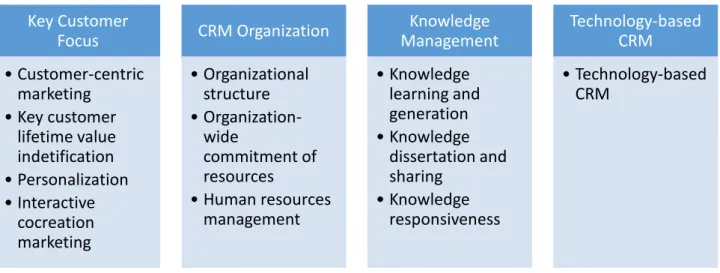
The four different elements of the scale (presented in table 1.) served as the base of the attributes and levels utilized in the choice-based conjoint study. The elements of the scale are presented below based on the descriptions of the authors and are supported by discussion in current CRM literature.
2.5.1. Key Customer Focus
Key customer focus refers in this case to focusing on providing added value to selected customers through personalization. This can be executed for example in the form of personalized marketing and products, joint new product development as well as building personalized relationships requiring a strong mentality of customer-centricity. On a general level, academia states that CRM activities need to be personalized between different types of customers (Venkatesan et al. 2007 & Ryals & Knox 2001) and that in fact personalization can be seen as one of the most important
13 areas of CRM (Parvatiyar & Sheth 2001). For instance, the study by Reinarz et al. (2004) shows that customers at different life-cycle stages require different type of CRM activities.
2.5.2 CRM Organization
CRM organization refers to the ideology of arranging the structure of the company, its processes, resources and personnel all around customer relationship management. This can be seen as the alternative to the traditional way of organizing the company from an “inside out” point-of-view requiring a holistic customer point-of-view. The importance of seeing CRM as encompassing the entire organization has been highlighted by many in order to ensure achieving expected results (e.g. Chen & Popovich 2003). Moreover, CRM processes have been said to more likely to affect firm performance in a positive way if the organization is aligned in an adequate way in terms of incentives and organizational schemes (Reinarz et al. 2004)
2.5.3. Knowledge Management
Knowledge management refers to the way in which knowledge is gathered, shared and applied in business. In more practical terms, this encompasses the way the company gathers information about customers needs and preferences and how it uses the information to improve their service and the relationship. This also encompasses the ways in which information is shared within the company. The importance of these information processes has been highlighted by e.g.
Jayachandran et al. (2005) who state that they are vital to consider when implementing effective CRM processes. Nevertheless, the gathering, utilizing and sharing of this knowledge can be seen to require the organisation to have a culture that supports effective knowledge management
(Stefanou et al. 2003).
2.5.4. Technology-Based CRM
Technology-based CRM refers to the process of gathering, utilizing and applying customer data as well as using IT to improve customer relationships. These can be used for example to provide better customer service, to automatically recommend new products/services or to set up various customer information systems displaying relevant information about the ongoing relationship. As
14 state in section 2.1, the role of technology in effective CRM has been widely discussed in
academia. When utilized properly, it can be seen to positively affect for example customer satisfaction and positively build customer knowledge (Mithas et. al 2005), but this importance should not be over emphasized in holistic CRM (Jayachandran et al. 2005).
Table 1. CRM scale by Sin et al. (2005) with a description of each element
Key Customer Focus • Customer-centric marketing • Key customer lifetime value indetification • Personalization • Interactive cocreation marketing CRM Organization • Organizational structure • Organization-wide commitment of resources • Human resources management Knowledge Management • Knowledge learning and generation • Knowledge dissertation and sharing • Knowledge responsiveness Technology-based CRM • Technology-based CRM
15
3.
Methodology
The following section will start by reviewing the choice-based conjoint method which was used in this study. Additionally, a walkthrough of the sampling method and sampling process will be provided in addition to a review of the study design. Finally, a brief outlook will be offered on the way the scale by Sin et al. (2005) was adopted into the context of the Finnish IT markets.
3.1. Methodology
Conjoint analysis can be described as a method that aims to uncover a respondent’s structure of preference within a certain set of choices, consisting of various attributes and their levels (Green and Srinivasan 1978). This structure can be further analyzed by reviewing outputs such as part worth values, degrees of fit and relative importances (Rao 2014, 79).
Since the 1970’s conjoint analysis has been seen as one of the most prominent ways of measuring trade-offs in terms of multi-attributed products and services (Green & Srinivasan 1990). On a general level, the idea is to present the respondents with two or more profiles consisting of different attributes and attribute levels, and they are asked to choose the profile that they prefer (Toubia et al 2004). In other words, the respondent choses the profile that maximizes his/her total utility. Since the method was first established, it has gained popularity due to the various fields that it can be applied in (Gustafson et al. 2007, 3). In the case of this study, CRM activities will be seen part of a service offered to a customer. In addition, one of the areas that conjoint studies can be applied in is market segmentation (Gustafson et al. 2007 page 3), which will also be utilized in this case. After conducting the study and obtaining the results of the valuation and preferences of the different attributes, the market will be segmented utilizing cluster analysis, which will be further described in section 4.2.
In terms of the conjoint analysis method, there are different ways through which data can be collected which all provide the researcher with different types of results. These methods include for example full-profile, partial profile and stated preference formats, which need to be assessed with regards to the managerial problem as well as the entity that is presented to the respondent (Houser & Rao 2004). From the prior list, the format of stated preferences is also known as
choice-16 based conjoint study. In the case of this study, this is the format of conjoint analysis that will be utilized. This format can be seen to offer several advantages: It involves realistic trade-off decisions, the part-worth utilities show impact on choice, and it offers flexibility in terms of attributes, levels and choice contexts (DeSarbo et al. 1995). Based on these reasons, this specific format was evaluated as the one selected for this study.
As opposed to asking respondents how they value different attributes on a more traditional Likert scale, the benefits of choice-based conjoint are apparent. If respondents were presented with a Likert scale of CRM attributes, they would naturally be prone to valuing all attributes to a certain level and thus resulting in misleadingly high scores. As mentioned, choice-based conjoint analysis forces the respondents to make trade-offs between different attributes and their levels. When respondents are forced to make such a trade-off, more in-depth and profound needs become present. In addition, making trade-offs is more realistic when comparing the study to the real world: companies are continuously forced to make complex decisions on where to invest and how to keep customer satisfied by doing the right things to nurture the relationships. This method therefore offers extremely valuable information for companies pondering how to target their limited CRM resources.
The design of the different attributes and levels can be seen as crucial in terms of designing a functioning conjoint study (Rao 2014, 43). Due to this, a significant amount of effort was put into making sure that they function as intended. As the scale by Sin et al. (2005) that was used defines the attributes in a generic manner, the main focus was on molding the wording of the attributes and defining the various levels, in a way that both reflect a certain level of managerial
understanding with regards to IT purchasing. The importance of “making the attributes actionable from a managerial point-of-view” has also been highlighted in academia (Rao 2014, 44). As will soon be discussed, this was done by reviewing the model by Sin et al. (2005) with executives from Digia Plc.
The end result of the choice-based conjoint analysis that was utilized in this study was a list of relative importances and a description of part worth utilities. Part worth utilities refer to the utilities of the different attribute levels presented in the study, which can be seen as
encompassing a very good predictive ability (Moore 1980). On a more general level, the utilities can be seen to describe the perceived benefit gained from each predefined level of an attribute.
17 The relative importance of an attribute on the other hand refers to the range of the part-worth utilities that are part of each given attribute (Rao 2014, 14). On a more general level, it can be described as the perceived importance respondents give each attribute when compared amongst each other. The relative importance of the different attributes is an extremely interesting measure and is one that will be utilized in a very central manner in this study in order to gain an
understanding with regards to attribute preferences in the selected CRM scale.
3.3. Sample
In terms of obtaining a sample, Digia Plc agreed to provide their customer database with contact information for the study. Digia Plc has a large database with an extensive amount of customer contacts within their CRM system, which was naturally utilized in close collaboration with Digia Plc and within the norms and laws set by the Finnish authorities. Customers were designed an
introductory email stating the background and aim of the study which included a mention of how the email addresses were obtained and on what basis they were used. If requested, the study group was prepared to send the contacts a link to the privacy policy statement of Digia Plc.
The sample itself was formulated by utilizing a proportional stratified sample of Digia Plc’s customer base. This sampling method was decided to be used in order to gain a representative sample of the population, due to the fact that the database had a significant amount of contacts that were very heterogeneous in terms of industries and companies. The basic idea of stratified sampling is to split the sample into non-overlapping subpopulations, then take a sample of each subpopulation and then combining them all into one stratified sample (Kothari p. 16 2004). Naturally, proportional stratified sampling refers to assigning different proportions to these subpopulations, which vary depending on the study.
The customer base that was used as the base of the sampling was defined to consist of all contacts that are linked to companies, which Digia Plc has invoiced within the year 2016. After this, the sampling process was continued by extracting all contacts who had opted out of email contacting or contacting in general. This procedure was the last stage of data preparation before the
18 The remaining contacts were then split based on their industry into the different subpopulations that were going to be used in the sampling. For sampling purposes, Digia Plc agreed to provide the weights of how much revenue each industry provided in relation to Digia Plc’s total revenue. These weights were used in order to define how large a proportion each subpopulation made up with regards to the total amount of the sample. This was calculated by assuming a sample size of 3000 contacts, and working out the necessary amount of contacts for each subpopulation. After working out the number required from each subpopulation, random sampling was utilized in Microsoft Excel to obtain the various subsamples. These were then combined into the master sample, which represented a proportional stratified sample of Digia Plc’s customer base with regards to different customer industries.
As mentioned, the list of contacts were approached by email. The mass sending was executed with Digia Plc’s mass marketing tools, and sent under the name of the researcher. Contacts were
informed of the background of the study and they were given the contact information of both the researcher and Digia Plc in case of any doubts. After sending the email with the invitation link, the aim was to obtain a 10% answer rate that was seen to represent a statistically large enough population. The study was open for two weeks exactly and contacts were sent a reminder after one week.
3.2. Study design
The study itself was designed in the following way. Before the respondents were presented the conjoint random tasks, they were provided with a short introduction stating the purpose and method of the study. In addition, the different attributes were presented in the introduction to further clarify the chosen method. Finally, due to the fact that price was not used as an element in this case, contrary to many other choice-based conjoint studies, respondents were guided to regard each conjoint CRM profile as having the same price. This was done in order to make sure that customers would not discard or accept levels based on a price that they would expect the level of service to have. The study was formulated in such a way, that after the brief introductory guideline, the respondents were presented with selected demographic questions, which were
19 then utilized to gain a deeper understanding of differences based on e.g. respondent’s
organizational levels, and the company revenue of the respondent. This was then followed by the main body of the questionnaire which consisted of the choice-based conjoint random tasks that were provided for the customers.
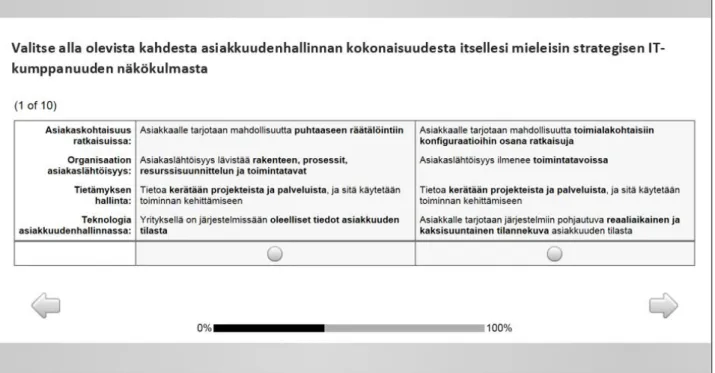
When designing the study, extra effort was put into making the study simple and understandable as well as into make sure that the visual appearance was minimalistic and clear. This was done to ensure that all respondents truly understood what they were doing and that as small a proportion as possible would exit the survey before completing it. Additionally, the visual elements were kept minimalistic in order to avoid leading the respondents in any way towards any specific choice. The final appearance can be seen in Figure 1.
Two weeks prior to the initiation of the actual study, a pilot study was conducted to make sure that the attributes, levels, the introductory guideline, as well as the visual layout was sufficiently clear. The pilot study was sent to 10 respondents who represented different stakeholders involved in the study. Feedback was requested on the instruction, layout, wording as well as the general understandability of the study. This feedback was used to design the final study. The study itself was designed using Sawtooths SSI WEB software.
20
3.4.
Adaptation of the scale
The attributes and levels of this study were designed based on the scale by Sin et al. (2005). Nevertheless, as the model by Sin et al. (2005) was constructed by interviewing business
executives, the original wording used to describe the attributes was designed from the point-of-view of an organization implementing CRM instead of a customer being the subject of various CRM activities. When designing the final levels based on the content of each attribute in the model, extra effort was put into making sure that each level was also natural from the point-of-view of a customer being the subject of CRM activities. The four attributes and the related levels utilized in the choice-based conjoint analysis were defined in an afternoon work shop with three executives from Digia Plc in order to make sure that the previously stated needs were met in an adequate manner.
21 The underlying guideline that was used when defining the levels was that they were realistic, actionable and that they encompass the possibility of a trade-off (Van der Pol & Ryan 1996). In addition, the aim was to define each level of the pre-described attribute in order to offer the respondent the possibility of highlighting as specifically as possible what they value and regard as important. The attributes as well as the levels were also translated into Finnish and molded into the context of a company evaluating IT services for example in terms of relevant jargon.
The attributes and different levels that were defined in the workshop with Digia Plc can be seen in Table 2. As mentioned, the three levels of each attribute presented Table 2. represent potential levels of customer relationship management that an IT supplier could potentially provide its customers. All in all, four attributes each offering three levels offer a possibility of a very large amount of different scenarios. This would understandably be unrealistic to put into a
questionnaire, so in order to create a plausible survey, Sawtooth SSI WEB was used to create 10 random tasks for each respondent, each consisting of 2 different profiles.
22 Tab le 2 . The fin a l a tt rib u tes an d levels b a sed on t h e model by S in et al. (2 0 05 )
23
4.
Results
This section will review the obtained results of the conjoint study. To begin with, the importances and utilities will be presented and analysed on an aggregate level. This will be followed by a cluster analysis in order to understand how customers can be grouped based on their preferences. The resulting clusters will be presented and named, which will then be followed by a brief analysis of their different preferences and the implications of these preferences.
4.1.
Importances and utilities
The following section will describe the results of the study on an aggregate level in terms of the relative importance of each attribute as well as the individual utility of each level. As mentioned, the relative importance describes how important customers regard each attribute as a part of the presented CRM scale. The utilities on the other hand, describe the perceived benefit of each individual level.
Table 3. offers an overview of the results. It starts by presenting each attribute as well as its relative importance. In order to gain a clear understanding of the results, the levels of each attribute as well as the corresponding utilities are presented in the same table. The utilities presented in this section are calculated with Sawtooth softwares Hierarchical Bayes (HB) estimation. The utilities in Table 3. are scaled by utilising zero-centred diffs scaling, which is the default utility scaling method used in Sawtooth SSI web. The final response rate was 6,37%.
24
Attributes Importances Levels Utilities
Key Customer Focus
38.59 % Customers are offered out-of-the-box solutions -16,31
Customers are offered the possibility of industry specific configurations as a part of the solutions
32,37
Customers are offered the possibility of fully tailored solutions -16,06 CRM
Organization
17.67 % Customer-centricity is present in daily procedures -27,17
Customer-centricity is present in daily procedures and in customer relationship management processes
10,67
Customer-centricity pierces through company structure, processes, resource planning and daily procedures
16,49 Knowledge
Management
21.75 % Knowledge is gathered from projects and services, and it is used to improve operations
-23,45
Knowledge is gathered from customer specific measures, and it is used to improve customer specific operations
-9,70
Knowledge it gathered, distributed and analysed holistically, which enables improving customers’ operations proactively
33,15
Technology-Based CRM
21.99 % The company has relevant information regarding its customers in its IT systems
-9,66
On a regular basis customers are provided with a report with information regarding their relationship, which is jointly reviewed
-4,70
Customers are offered a system-based, real-time and two-way snapshot all with relevant information regarding their relationship
14,36
As Table 3. presents, the single most important factor affecting preference over CRM models is the first attribute, “Key Customer Focus”. The respondents gave this attribute an importance of
38,59%, which is clearly higher than the following three, which are “Technology-based CRM” (21,99%), “Knowledge Management” (21,75%) and finally “CRM Organization” (17,67%). The second and third closest attributes are so close to one another, that there is no statistically significant difference between the two. The final attribute falls slightly behind the next two, although in a statistically significant manner.
Based on the importance’s it is clear, that as customers are reviewing potential suppliers, the most important factor that affects their CRM preferences is how well the solution satisfies the company and is “just right for us”. This can be seen as intuitive, since the reason customers embark on a joint CRM process is based on the initial decision of investing in some type of a solution.
Therefore, it is understandable that customers place a high value on making sure that the reason they have initiated the relationship is on a level that they are satisfied with, and that this level encompasses an adequate amount of personalization. Nevertheless, what is slightly surprising is Table 3. The relative importances and utilities of the attributes and levels
25 the fact that out of the most important attribute, the level that gained the highest utility score (32,37) was the level “Customers are offered the possibility of industry specific configurations as a part of the solutions”, which was initially positioned at the medium level. Then again, the level that was initially positioned at the highest level within this attribute “Customers are offered the possibility of fully tailored solutions”, received more or less the same utility score as the initially positioned lowest level “Customers are offered out-of-the-box solutions”. This is a very interesting finding, as one might think that as price was not a factor considered in this study (this was also explicitly highlighted in the survey), customers would want as much personalization as possible. Nevertheless, based on the results it is clear that customers value most highly industry specific configurations as a part of the solutions. This could be based on the fact that they perceive high levels of personalization as being rigid and time consuming, and that it is not necessary to “re-invent the wheel”. Another reason could be negative experiences of fully personalized solutions. The IT industry is full of horror stories of fully personalized solutions that were extremely
expensive, that took years to finish, and that keep falling apart due to their own complexity. Customer clearly trust that companies have a large amount of industry specific best practice knowledge, which they hope that the company would bring forth as a part of their CRM activities.
The next attribute “Technology-based CRM” with an importance of 21,99% offers no exceptional surprises. Understandably, customers regard a certain level of technology in CRM as important, but it is seen clearly less important than the most important attribute which was almost twice as important. Regarding this attribute, the initially positioned lowest level gained the lowest utility score (-9,66), the medium level gained the medium score (-4,7) while the highest level gained the highest score (14,36).
The following attribute, “Knowledge Management”, with an importance of 21,75% doesn’t offer any surprises either. Again, this is also regarded as important to a certain extent, but falls behind the most important attribute, which is regarded as almost twice as important. Similarly to the previous attribute, the levels of this attribute are also in line with the initial positions. The initially positioned low level gained the lowest utility score (-9,66), the medium level gained the medium score (-4,7), and the initially position high level the highest score (14,36).
The least important attribute “CRM Organization” with an importance of 17,67% can be seen as a slight surprise, as one might think that customers would place a larger value on
customer-26 centricity as the guiding principal from an organisational point-of-view. Nevertheless, one
possibility is that customers do truly value the idea of customer-centricity, but that they do not care about the organisational aspect as it is. In other words, if customers are happy with a supplier’s level of customer-centricity in general, they don’t care how the supplier has internally organised its organisation to support this customer-centricity, as long as it works. Of course is it is the company’s best interest to make its organization support CRM activities due to factors of efficiency. In addition, sooner or later customers will notice if the organization does not support these activities in an effective way. Other than that, the utility levels go as expected. The initially positioned lowest level gained the lowest utility score (-21.17), the medium level gained the medium score (10,67) and the initially highest positioned level gained the highest utility score (16,49).
4.2.
Cluster analysis
When analysing conjoint study results, there is a natural need to group the answers in different ways and move above the individual level, but still below the aggregate level results. On a certain level, it is interesting to understand how specific respondents have answered, but the first level that provides truly relevant information is the aggregate level. Nevertheless, as this is a cross industry study targeted at various sized companies and respondents with various roles, the aggregate level results will only reveal so much. In order to further interpret the results and to understand, how different types of respondents can be grouped based on their answers, this study relies on cluster analysis. In the field of marketing research, cluster analysis can be seen as a common tool through which different entities can be grouped in order to set a foundation for future research (Punj & Steward 1983). Additionally, clustering attribute importances in order to create subgroups can be seen as a useful method of analysis also in conjoint analysis (Rao 2014 page 79).
On a deeper level, cluster analysis, which can be split into hierarchical methods and relocation methods, refers to splitting of data into meaningful subgroups without necessarily having prior knowledge about what information these groups will contain or how many groups these will be
27 split into (Fraley & Raftery 1998). With regards to the relocation methods, K-means clustering can be seen as the most popular method due to it being simple and efficient as well as due to the empirical success it has gained (Jain 2010). K-Means clustering is based on the idea of reducing the within-group sums of squares (Fraley & Raftery 1998). Due to the previously listed advantages of k-means clustering, it was used in segmenting the aggregate level results in this study. The cluster analysis was conducted with IBM’s SPSS 23 software, while the output data was further refined with other relevant tools.
As the only attribute that stood out with regards to relative importance was “Key Customer Focus”, the aim of the cluster analysis was to discover more subtle preferences between different respondents. The cluster analysis was based on the four individual importance levels of each attribute, which were presented in the Table 3. A one-way MANOVA was used to test the
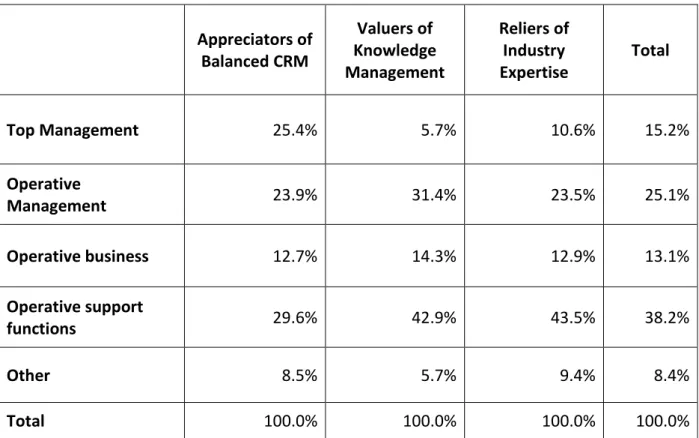
significance of the differences between each attribute importance. In terms of demographics, the company size of the respondents (Table 8.) as well as the organisational level of the respondents (Table 7.), were analysed and presented as a part of each cluster.
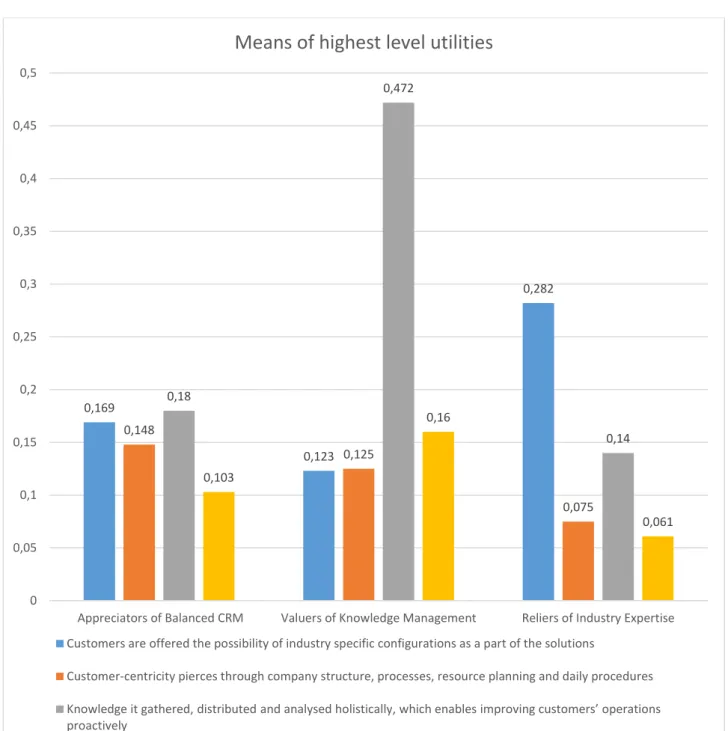
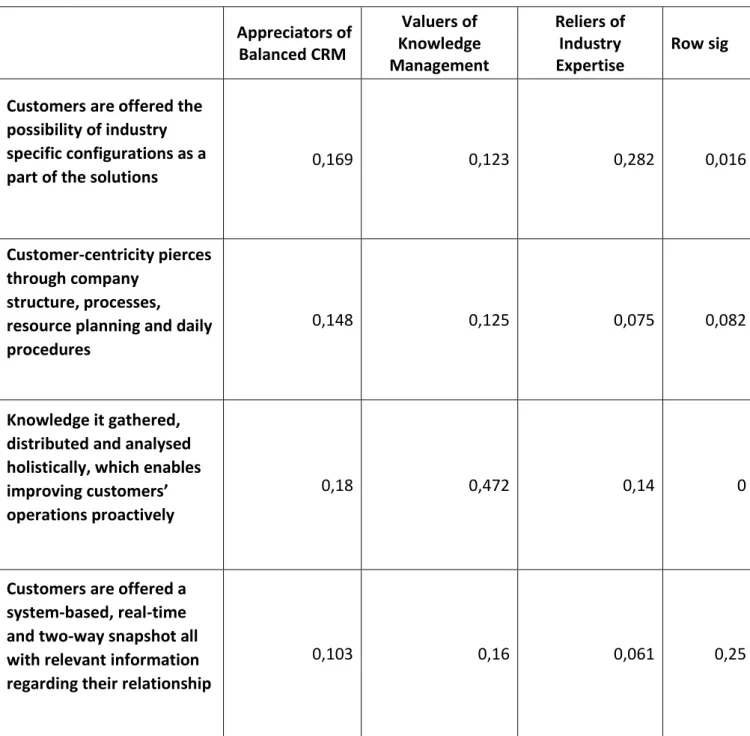
Finally, the mean each of each attribute level that gained the highest aggregate level utility score was calculated per cluster. In this analysis, the utility scales were normalized in order to make them comparable to one another by making the part worth vectors equal in Euclidian length. This was done by calculating the Euclidian norm of each row and dividing each part worth by the rows norm. Nevertheless, as can be seen from Table 10., only the means of the highest level utilities from the attributes “Key Customer Focus” and “Knowledge Management” were significantly different at a .05 level.
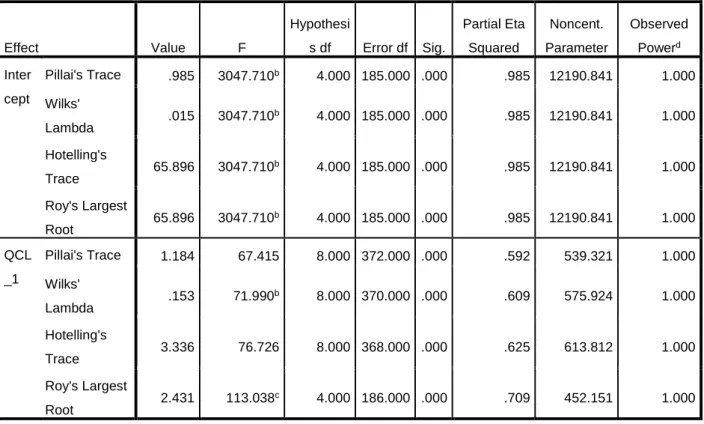
As a part of the cluster analysis process, two, three, four and five cluster solutions were tested and considered. Due to the sample size, it was evident that splitting the respondents into four clusters or more resulted in too small a clusters. Moreover, when analysing the differences between the two and three cluster results, it was clear the three cluster solution provided clearer and more interpretable results. Based on the prior reasoning as well as MANOVA testing, the final number of clusters in the k-means cluster analysis was selected as three. As can be seen from the one-way MANOVA test in Table 4., there was a statistically significant difference in attribute importances with regards to the different clusters, F = 71,990, p < .0005; Wilk's Λ = 0.153 partial η2 = .61.
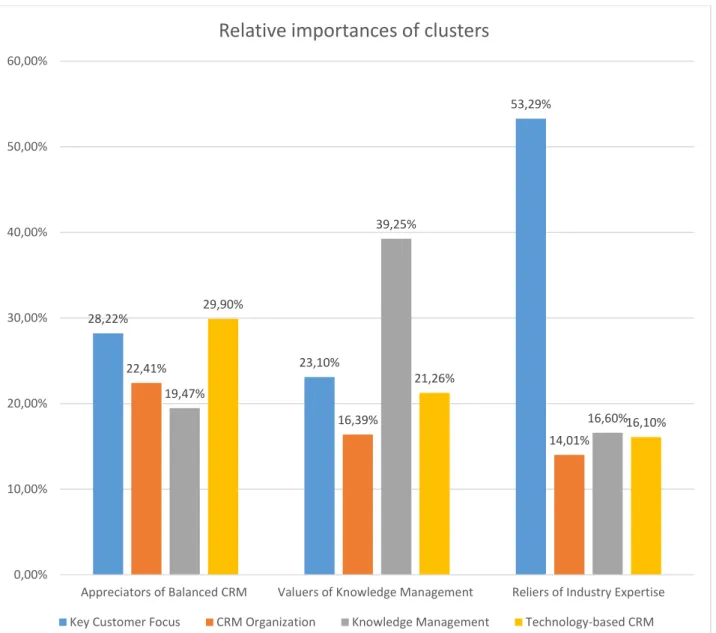
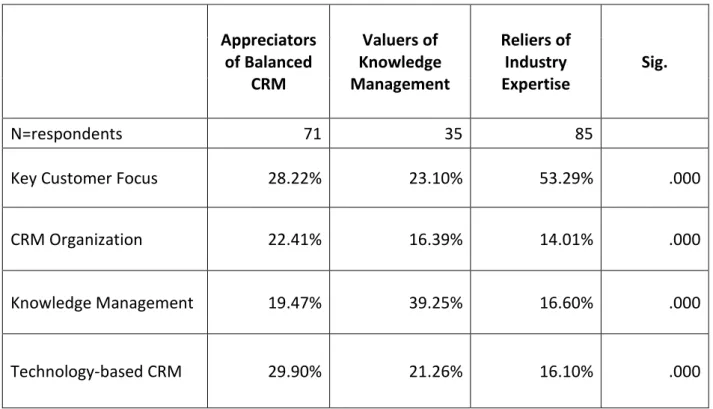
28 The results of the cluster analysis can be seen in the Table 5. The respondents were split into three clusters based on their preferences, and the final sizes were the following: Cluster 1 N=71, Cluster 2 N=35, Cluster 3 N=85. The following section will review and name each cluster as well as analyse each of them in a more profound way.
Multivariate Testsa Effect Value F Hypothesi s df Error df Sig. Partial Eta Squared Noncent. Parameter Observed Powerd Inter cept Pillai's Trace .985 3047.710b 4.000 185.000 .000 .985 12190.841 1.000 Wilks' Lambda .015 3047.710b 4.000 185.000 .000 .985 12190.841 1.000 Hotelling's Trace 65.896 3047.710 b 4.000 185.000 .000 .985 12190.841 1.000 Roy's Largest Root 65.896 3047.710 b 4.000 185.000 .000 .985 12190.841 1.000 QCL _1 Pillai's Trace 1.184 67.415 8.000 372.000 .000 .592 539.321 1.000 Wilks' Lambda .153 71.990 b 8.000 370.000 .000 .609 575.924 1.000 Hotelling's Trace 3.336 76.726 8.000 368.000 .000 .625 613.812 1.000 Roy's Largest Root 2.431 113.038 c 4.000 186.000 .000 .709 452.151 1.000 a. Design: Intercept + QCL_1 b. Exact statistic
c. The statistic is an upper bound on F that yields a lower bound on the significance level. d. Computed using alpha = .05
29 28,22% 23,10% 53,29% 22,41% 16,39% 14,01% 19,47% 39,25% 16,60% 29,90% 21,26% 16,10% 0,00% 10,00% 20,00% 30,00% 40,00% 50,00% 60,00%
Appreciators of Balanced CRM Valuers of Knowledge Management Reliers of Industry Expertise
Relative importances of clusters
Key Customer Focus CRM Organization Knowledge Management Technology-based CRM
30 Appreciators of Balanced CRM Valuers of Knowledge Management Reliers of Industry Expertise Sig. N=respondents 71 35 85
Key Customer Focus 28.22% 23.10% 53.29% .000
CRM Organization 22.41% 16.39% 14.01% .000
Knowledge Management 19.47% 39.25% 16.60% .000
Technology-based CRM 29.90% 21.26% 16.10% .000
4.2.1 Reliers of Industry Expertise
Cluster 3 represents the largest of all the cluster, with an n=85 respondents. This cluster places a very large importance on the attribute “Key Customer Focus”, resulting in a relative importance of 53,29%. This cluster on the other hand does not see the remaining three attributes “Knowledge Management” (16,60%), “Technology-based CRM” (16,10%) and “CRM Organization” (14,01%), as very important. When analysing the mean of the highest level utilities (Table 10.), it is evident that this cluster gains a very large level of utility from industry specific configurations as a part of the solutions. This cluster will be called “Reliers of Industry Expertise”
Respondents within this cluster see “Key Customer Focus” as the single most important attribute in terms of preferences over CRM models, which can be seen to overpower all other attributes in a fairly aggressive manner, and gain a large utility from industry specific configurations. These
31 companies seek adequately personalized relationships with partners with strong industry
expertise and a knowledge of best practice. They are fairly indifferent about other aspects of CRM as long as their partner provides them throughout their joint relationship with new trends and future directions within their industry. In this sense, they “outsource” a certain part of their daily actions by expecting their strategic supplier to tell them where the industry is going in terms of IT and digitalization. With these customers, companies must be careful to constantly bring forth their expertise and passion to understand where the industry is going. If this is neglected and a
competitor with these similar traits comes along, the company is in danger of vendor change. In addition to understanding industry trends, the company must naturally have a strong
understanding of the core processes of the industry. Merely understanding trends on a superficial level is not adequate in becoming a strategic IT partner for this segment.
The majority of the respondents (47,1%) represent companies that are classified as very high in terms of revenue (Table 8.), while the SME segment (28,2%) and the high segment (24,7%) fall behind. Additionally, the majority of the respondents can be seen as belonging to organisational support functions (Table 7.) with a percentage of 43,5%. Companies with a high level of revenue are understandably strongly inclined towards valuing best practices in industry specific solutions, as the adoption and implementation of different IT initiatives can be seen as very costly.
Companies with high levels of revenue are also often large and structurally complex in other ways, so having a partner that provides solutions that are adequately personalized and truly fit into the customer’s industry can save a large amount of money, time and effort. The high number of respondents in this cluster belonging to organisational support functions can be seen as
representing both people participating in and people planning the implementation of the solutions as in the case of IT personnel, business development personnel and finance among other
departments. In order to ensure a good implementation, these respondents place a high value on ready solutions that have already been implemented in other companies in their own industries.
32
4.2.2. Appreciators of Balanced CRM
Cluster 1 represents the second largest cluster of the sample with an n=71 respondents. On a general level, these respondents perceive the different attributes in a fairly equal manner, although slightly emphasizing the importance of the attributes “Technology-based CRM” (29,9%) and “Key Customer Focus” (28,22%). The remaining two attributes “CRM Organization” (22,41%) and “Knowledge Management” (19,47%) are regarded as less important. When observing the mean of the highest level utilities, this cluster can again be seen as fairly even without strong inclinations or disinclinations of any kind. This cluster will be called “Appreciators of Balanced CRM”
The preferences are not as clear with regards to this segment. All four attributes are between 19,5%-29,9% in terms of importances which implies that this cluster puts a larger value on a holistic model. This cluster seeks IT suppliers that are able to provide adequate levels of CRM services in all four areas and expects a company to maintain and develop all of the attributes to make sure that they are offered as good a CRM service as possible. Nevertheless, compared to other segments, this one is the only one that regards “Technology-based CRM” as the most important attribute. Thus it is evident, that these customers put a large value on having modern solutions to monitor their partnership, which might be a pre-requisite for trusting the company as a service provider; a company that nurtures and maintains their customer relationships with modern and digital tools must be competent also with the modern and digital IT solutions they provide. This cluster also values the importance of “Key Customer Focus” and gains a high utility from industry specific configurations as a part of the solutions, although neither is as strong as in the case of the cluster “Reliers of Industry Expertise” As a part of joint relationships, also customer of this cluster expect a certain level of industry expertise from IT suppliers.
In terms of company size, this cluster is far more equal than the others. Out of the 71 respondents 38% were from companies with a very high level of revenue, 31% from a high level and 31% from an SME level. Also different organisational levels were the most equally represented within this cluster (e.g. Support functions 29,6%, Top Management 25,4%, Operative management 23,9%).