NOWCASTING THUNDERSTORM HAZARDS FOR FLIGHT
OPERATIONS: THE CB WIMS APPROACH IN FLYSAFE
A. Tafferner*, C. Forster*, S. Sénési**, Y. Guillou**, P. Tabary**, P. Laroche,*** A. Delannoy***, B. Lunnon****, D. Turp****, T. Hauf*****, D. Markovic**** * German Aerospace Center, Institute of Atmospheric Physics, Wessling, Germany **Météo-France, Toulouse, ***ONERA, Paris, France, ****UKMet-Office, Exeter,
*****University of Hannover, Germany
Keywords: thunderstorm, nowcasting, weather information for pilots, FLYSAFE
Abstract
This paper describes the development of the thunderstorm weather information management system “CB WIMS” within the European Integrated Project FLYSAFE and presents results from applications in case studies over the terminal manoeuvring area of airport Paris Charles de Gaulle.
1 Introduction
An important piece of the ACARE (Advisory Council for Aeronautics in Europe) plan has been put in place early in 2005: the FLYSAFE Project (http://www.eu-flysafe.org/). FLYSAFE aims at defining and testing new tools and systems contributing to the safety of flights for all aircraft. It focuses on the development of new on-board systems and of the tools on the ground for feeding them with the information that they require. The project is structured upon the three “threats” which play a major role in aircraft accidents: collision with other aircraft, collision with terrain, adverse atmospheric conditions. For the latter, specialised ground based weather information management systems (WIMS) have been developed for the weather hazards icing, clear air turbulence, wake vortex turbulence and thunderstorms. These systems provide met data on the individual weather hazards over a defined area ranging from high resolution short-range on a local scale to long-range forecasts on a global scale.
All WIMS data are sent to a ground-based weather processor (GWP). By request from an
aircraft selected information about a weather hazard tailored to the respective flight corridor is passed through the GWP to the on-board Next Generation Integrated Surveillance System (NG-ISS). On the NG-ISS, a fusion not only with on-board weather data, but also with the other threats terrain and traffic is carried out in order to achieve a consolidated picture of the hazard situation. Finally, the situation is presented to the pilot by means of simple, easy to read graphics on a special display together with the possible solution on how to avoid the hazard.
For thunderstorms a so-called CB WIMS (Cb = Cumulonimbus) has been developed with involvement of partners from the German Aerospace Center (DLR), Météo-France (FMET), ONERA, the UK Met-Office (UKMET) and the University of Hannover (UNIHAN). This paper describes the implementation of the Cb WIMS, its successful application in case studies and its preparation for operational flight tests.
2 CB WIMS Development Strategy
Thunderstorms appear in various sizes, from small single convective cells to mesoscale convective complexes and thunderstorm lines with corresponding life times from a few minutes to several hours. The initiation, intensity, movement and life cycle of these severe weather features is difficult to predict. They not only depend on the large scale and daily meteorological variation, but are also influenced by local conditions like orography,
land use and soil moisture. Remote sensing with satellite, radar and lightning enables detection and monitoring of these features and provides detailed information on related weather attributes, as e.g. precipitation rate, hail occurrence, lightning and wind shear, which pose a hazard to aircraft operations. Presenting all this detailed information to a pilot would certainly not help him in decision making. Therefore, the strategy followed in the development of CB WIMS was not to describe thunderstorms to any observable detail, but to identify the hazards for aircraft in thunderstorm situations, to find corresponding thresholds for the specific hazard levels “moderate” and “severe”, and based on these, to define hazard objects which represent these hazard levels. The task of CB WIMS then is to detect and forecast these hazard objects on the very short term, e.g. for up to one hour in advance.
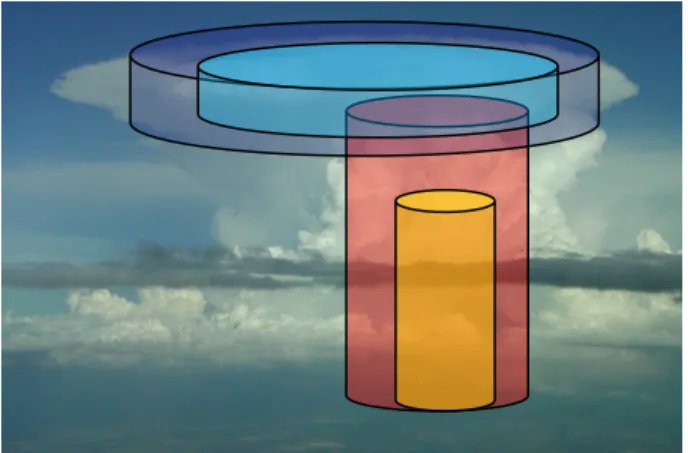
Fig. 1 renders a schematic depiction of such thunderstorm hazard objects. The object definition accounts for the different threats an aircraft is exposed when flying into a thunder-
Fig.1. Idealized thunderstorm bottom and top hazard objects represented as cylinders with photograph of a real thunderstorm in the back. For explanation see text. storm, either at low or high levels, i.e. during flight phases landing and take-off or en-route, respectively. According to that, the volumes have been given the names Cb top and Cb bottom and are depicted here as cylinders for simplicity. Cb top volumes cover the domain of the upper level thunderstorm cloud anvil at tropopause level with hazards convective turbulence and lightning. Cb bottom volumes cover the hazards wind shear, heavy rain, hail
and lightning prevailing at mid-tropospheric and near ground levels. In addition, volumes may be nested due to the prescription of two levels of severity. In practice, the volumes are not cylinders as depicted here, but are polygon surfaces with bottom and top as will be shown later.
3 CB WIMS Realization
The CB WIMS is part of the FLYSAFE ground segment. Based on meteorological input data, including remote sensing observations and numerical model data, the CB WIMS provides thunderstorm information on three different scales, i.e. areas. These scale sub-systems are based on meteorological expert systems developed by the CB WIMS partners FMET, DLR, ONERA and UKMET. The different scale products developed and provided by the CB WIMS partners are as follows.
(i) Local or TMA scale, where TMA stands for Terminal Manoeuvring Area of an airport, derived from systems developed at Météo France, DLR and ONERA
(ii) Continental scale derived from systems developed at Météo France, DLR and ONERA
(iii) Global scale provided by the UKMET-Office’ global forecast model
These scale products differ not only in terms of area covered, but also in spatial resolution and time between updates. Moving from global via continental to local scale, they provide increasingly more high-resolution forecasts and at a faster rate, while reducing the area covered. The resolution of the data bases used to generate the CB WIMS products increases in the same way. According to their designation, the global product covers (nearly) the whole earth surface, the continental product covers an area such as that of Central Europe, while the local (TMA) product is limited to roughly 300 km around an airport (Paris Charles de Gaulle in this case). These products are generated independently and are delivered to the FLYSAFE GWP in the form of thunderstorm bottom and top volumes. As mentioned above the volumes are designated with one of two severities, moderate and severe,
and are provided as objects with a number of attributes. These are:
• Area covered, as a polygon • confidence level
• hail occurrence flag • layer (top or bottom) • moving direction • moving speed
• gravity centre location • severity
• trend on area
• trend on vertical development • upper boundary
• lower boundary
As seen from the list, there appears also a confidence level which expresses the confidence the CB WIMS producer has in the validity of the product. It is a number between 0 and 5 (for lowest and highest confidence) and is based essentially on the availability of relevant input data to the CB WIMS and on forecast range.
All these parameters have been defined before the production of the CB WIMS and are based on the requirements resulting from a questionnaire presented to pilots within FLYSAFE. The CB WIMS output is formatted in an advanced XML/GML format which was also developed within the framework of FLYSAFE. In addition to the parameters listed the GML files contain also a “Status Weather Product” section containing a set of parameters describing mainly the origin and validity of the data available to the CB WIMS. This is the so-called meta-data section. It provides information on the product scale (local, regional, or global scale) including the coordinates of the coverage area. Time tags specify analysis time, issuing time, refresh time, validity and forecast times (up to one hour) of the product. The meta-data helps interpreting the CB WIMS output files and analyzing possible errors in the information transmission. Hence, areas of missing data can be correctly identified and communicated to the aircraft, for instance.
The real time operation of the CB WIMS and the data flow to the GWP and up to the cockpit will be tested in the summer 2008 flight test campaign. It is set up in a way that in case of a request by an aircraft the GWP selects the
product with the finest resolution and uploads relevant weather data only for the flight corridor of that particular aircraft. Here the flight corridor is a volume of air space surrounding the flying aircraft, with length about 120 nm ahead of the aircraft, about 240 nm wide and 40 nm in the back. The vertical range of the flight corridor extends from the ground up to flight level or higher.
3.1 TMA scale products a) CB bottom volumes
The TMA of Paris Charles de Gaulle (CDG) has been selected in FLYSAFE for testing local scale products. The area covers a square of approximately 300 km side length centered on the airport (ref. Fig. 2). A CB WIMS product for providing bottom volumes of thunderstorm hazards has been developed by FMET. In order to accomplish this task various developments had to be undertaken as follows.
A real-time processing of 3-dimensional radar data for five radars surrounding the Paris TMA has been set up. This enables to detect as accurately as possible the 3D structure of the storms. It provides information of maximum reflectivity for each column, echo top height, and vertically integrated liquid water content. This processing suite has been implemented at a refresh rate of 15 minutes, consistent with the 3D scanning strategy of these radars, and with corresponding spatial resolutions of 2 km in the horizontal and 500m in the vertical. Technically, the 3D fields are computed in a general processing suite which also includes Multiple-Doppler analyses [2], using a concept developed several years ago [3] in a research context and now applied in an operational environment. A downscaling technique has also been implemented in order to reach the required 1 km² x 5 minutes space-time resolution over the central part of the TMA by an optimal use of the frequently available new scans from the fast scanning Trappes radar. This 3D data is used in the CONO software [5] for better defining the echo top height and maximum reflectivity of objects. In addition, an alternate method for estimating the bottom object top height has been
developed which makes use of the cloud top height (CTTH) information of EUMETSAT’s Satellite Application Facility for Nowcasting [4]. The use of CTTH is only a fallback solution when 3D radar data are not available. Regarding hail occurrence a hydrometeor classification has been developed, which relies upon dual-polarization capabilities of the Trappes radar and advanced signal processing [10]. A real time processing suite has been set up for the (central) part of the TMA which is well covered by the necessary dual-polarization Trappes radar data. The computation of objects at two severity levels has been implemented, using reflectivity thresholds of 33 and 41 dBZ which were shown to best match the thunderstorm occurrences in METAR reports for towering Cumulus and Cumulonimbus, respectively. These values are in close agreement with a previous study [8]. Fig. 2 shows an example of bottom volumes over the TMA Paris for 4th July 2006 1455 UTC. Outlines of volumes over radar reflectivity are given in orange for severity 1 (moderate) and red for severity 2 (severe). Also indicated is the direction of movement of the thunderstorm cells.
Fig. 2. Radar reflectivity in shades of colour over the area of TMA Paris. Identified Cb bottom volumes encircled in orange (severity 1) and red (severity 2) contours at 4th July 2006 1455 UTC.
b) Cb top volumes
Top volumes are provided by DLR. For detecting thunderstorms from space the cloud tracker CB TRAM [11] is used which detects convective clouds in the three stages “initiation”, “rapid growth” and “mature” using a special three-channel combination of METEOSAT data. The Cb-TRAM algorithm uses three data channels from the METEOSAT 8 SEVERI instrument, i.e. the high resolution visible (HRV), the infra-red 10.8 μm (IR), and the infra-red 6.2 μm (water vapour, WV) channels which are available every 15 minutes via satellite communication from EUMETSAT. Over Central Europe the spatial resolution of the HRV channel is of about 1.5 km x 1.5 km and for IR and WV of 5 km x 5 km. In addition, ECMWF model forecast fields are used for calculating the height of the tropopause based on the current temperature at every image pixel.
The algorithms used in CB TRAM consist of four main procedures: extraction of the motion field, detection, tracking and nowcasting (short range forecasting). For nowcasts up to one hour, the future position and development
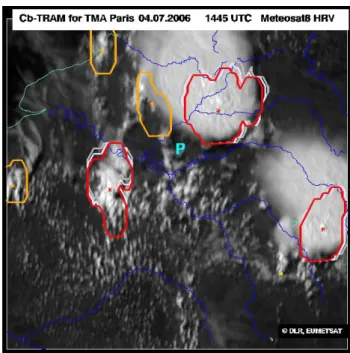
Fig. 3. Thunderstorm cells as seen in the METEOSAT high resolution visible channel within the TMA Paris overlaid with CB top contours for 4th July 2006 1445 UTC. Mature cells in red, rapidly growing in orange. Also shown are the nowcasts for 5 and 10 minutes ahead in time in white and grey contours.
of the hazard volumes is determined through extrapolation based on the past growth and movement.
Fig. 3 shows an example of detected thunderstorm top volumes at the same time instant as shown for the bottom volumes. For delivery to the GWP only volumes containing mature thunderstorm cells are selected, because growing cells have not reached tropopause level (yet) and therefore do not represent thunderstorm tops. Presently, CB TRAM is used for both the TMA and regional scales as the data source is the same for both areas. However, with the availability of METEOSAT rapid scan data with a refresh rate of 5 minutes after beginning of June 2008, these data will be used for the TMA product in future. The refresh rates for both Cb bottom and top volumes will then become equal for TMA.
Lightning data from the LINET network are used for CB top volumes to discriminate between severity levels moderate and severe, where at present ‘severe’ is used when at least one flash is observed within the volume during ten minutes. Another threshold might be used in future, e.g. prescribing a certain flash density, when enough cases have been investigated. The calculation of the position of CB top volumes takes into account the parallax error arising from the viewing angle of the METEOSAT satellite.
c) Lightning volumes
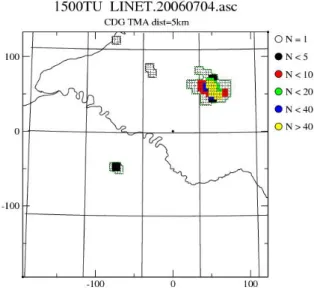
ONERA provides lightning volumes by using lightning data from the LINET network [1]. Two different kinds of lightning activity are determined: sparse activity and active cells. Active cells are flashes concentrated in a small area (∅ 10 km) with more than 1 flash per minute. To be attached to a cell a flash must occur at less than 3 km distance from this cell and less than 5 minutes after the last lightning added to the cell. Sparse activity is defined as an isolated flash that cannot be assigned to an active cell. Such an isolated flash is then surrounded by a box of 8 km x 8 km. If boxes of sparse activity overlap, they will be combined to a single area. Fig. 4 illustrates the detection
procedure. Active cells (coloured boxes) and sparse activity (hatched areas with grey contours) between 1450UTC and 1500UTC are shown. The colour code indicates the number of flashes collected within ten minutes. For example, for the two blue cells, the number of flashes is > 20 and < 40 during this period.
Fig. 4. Area of TMA Paris CDG with lightning objects at 1500 UTC.
3.2 Continental scale products
For detecting and nowcasting CB bottom volumes on a continental scale, FMET has set up a European radar composite real-time processing suite which extends the functionality of FMET’s operational radar compositing suite. It enlarges the spatial extent to encompass both Spain and Germany, and hence most part of western Europe, furthermore, it allows for explicitly describing the observation time for each pixel of the composite image (because data acquisition scheme is not uniform across European radars). The continental version takes advantage of the TMA echo top information where it is available. The method for estimating bottom object top height using cloud top height as described above (see TMA) has been implemented also for this scale. It is much useful at that scale because 3D radar data is generally not available.
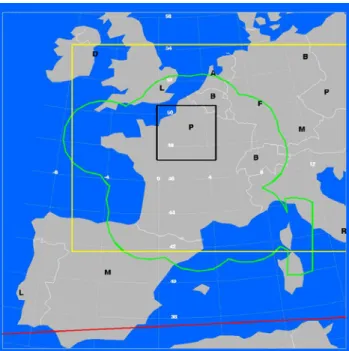
For first tests the area for the continental domain has been chosen as shown in Fig. 8. XML output files for bottom (FME), top (DLR) and lighting (ONERA) volumes are therefore delivered for the same domain.
3.3 Global scale product
UKMET has provided sample data for the CB WIMS global product based on output from the UKM Unified Model [9] for 11 case studies, starting in 2006. The sample data was provided for the times 00Z, 06Z, 12Z, 18Z. The sample data consists of two parts: Plots showing the extent of the CBs, the embedded CB top height (in km) and the embedded CB base (in km). Fig. 5 shows an example of CB top height for 28th July 2006.
Fig. 5. Global scale product produced from output of the UK Unified Model showing the height of CB tops in shades of colour for 20060728 12 UTC
The global scale product will be evaluated through comparison with the continental scale product and lighting data over Europe.
4 CB WIMS Pre-Operational Testing 4.1 CB WIMS website
A website shared by the CB WIMS partners has been set up during the product development. The website is hosted by DLR and serves as a
platform for data exchange and discussion purposes among the CB WIMS partners For testing purposes, 18 cases of thunderstorm passages over the TMA of Paris have been selected where both bottom and top volumes are compared to one-another and also with respect to lightning observations.
4.2 TMA products comparison
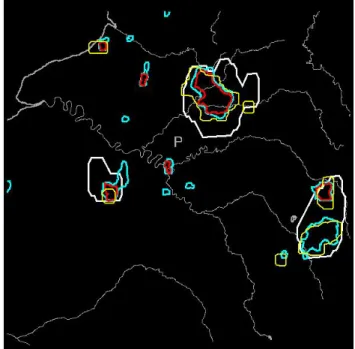
As an example of product comparison we present the situation on 4th July, 2006 when several thunderstorms appeared over the TMA Paris (cf. Figs. 2 and 3). Fig. 6 shows top volumes (white contours), bottom volumes in cyan and red for hazard levels ‘moderate’ and ‘severe’, and lighting objects (yellow). Overall, there is a fair agreement among these products which stem from three totally different data sources. The top volumes are somewhat larger than the bottom volumes as can be expected. Thunderstorm tops have usually a larger extent than the areas of severe precipitation and lightning. Apparent is also the good agreement between bottom and lighting volumes. Note that some small objects, i.e. in the north-western
Fig. 6. Area of TMA Paris with outlines of three different Cb objects: bottom volumes of type moderate (cyan) and severe (red), top volumes of type moderate (white) and lightning volumes (yellow). Grey lines mark rivers and the coastline. Location of airport Paris CDG is marked by “P”. For 4th July 2006 1455 UTC.
corner situated at the coast line, one further south-east and one at the western boundary of the domain are found within Cb top volumes of type ‘rapidly growing’ (cf. orange contours in Fig. 3). Obviously these cells have not yet generated mature thunderstorms with cloud tops reaching tropopause levels. Also some small objects (e.g. in the centre of the domain) remain without being detected by the cloud tracker Cb-TRAM at this time, only small convective clouds can be recognized at those locations.
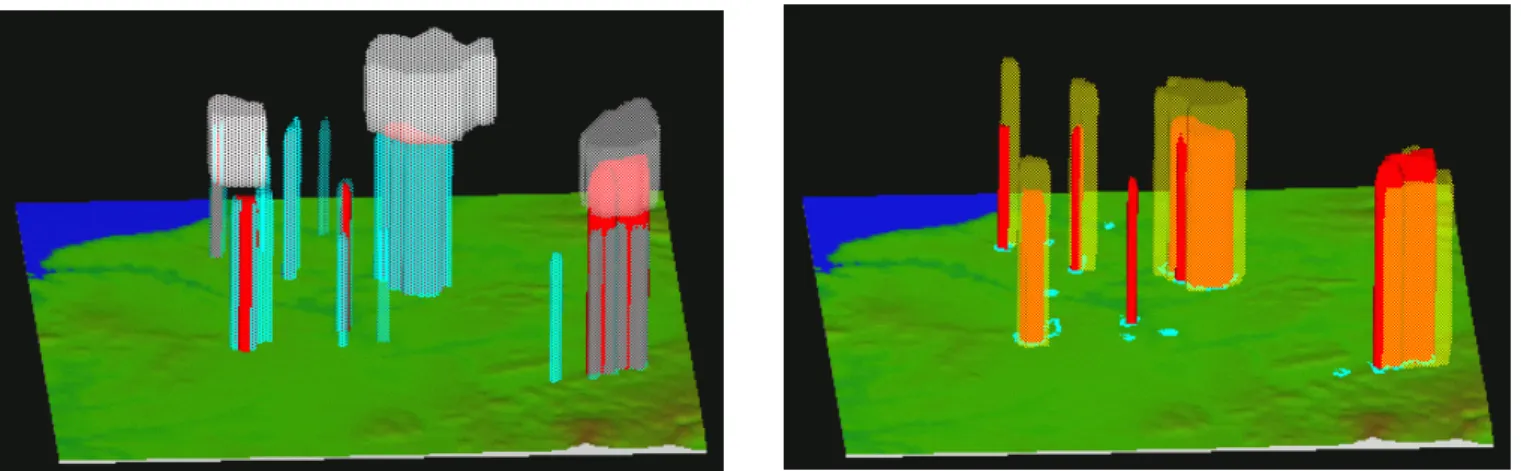
CB bottom volumes of hazard level moderate. Also shown are horizontal extensions of bottom volumes of type moderate marked by cyan contours. The height of the lightning volumes has been artificially set to 10 km because not enough LINET lightning sensors existed in that area at that time in order to enable the computation of the vertical extension of lightning strokes. The comparison with the figure on the left exhibits again the close relationship between CB bottom and lightning volumes. Lightning volumes can therefore be used as proxy for CB bottom volumes in places where radar data is not available, as e.g. in topography rich areas; deriving object speed for lightning objects is however not as reliable as what was checked from radar-based objects. A perspective view of this situation is
presented in Fig. 7. On the left Cb tops are shown in white positioned over bottom volumes marked as transparent surfaces in cyan for hazard level ‘moderate’ and in red for level ‘severe’. It can be seen that severe hazard volumes are nested within ones of type moderate in four cases. They also reach different height levels. Also bottom volumes reach vertically well into top volumes in two cases. However, in the case on the western side bottom and top volumes appear to be vertically separated. This stems from the fact that the lower boundary of top volumes is calculated as upper boundary minus 3000m. This crude estimate might in many cases misrepresent the real situation. In reality the underside of thunderstorm anvil clouds is not a flat surface, but often inclined vertically over a large distance. Also, there is no observational means to measure the height of these cloud undersides. Fig. 7 right shows the same situation except that here lightning volumes are displayed instead of
Overall, from the case studies the following conclusions could be drawn:
• There is a fair agreement between the Cb top and Cb bottom volumes. In most cases a top volume is detected in areas with high radar reflectivity where also bottom volumes, sometimes several, or much smaller, were detected.
• In cases of intense thunderstorms the top volumes appear to also mark the convective updraft regions quite well.
• The lightning observations exhibit strong fine scale variability in space and time. Lightning objects can, however, be used for marking areas with strong electric activity within the Cb top and bottom objects.
Fig. 7. CB objects in perspective view (facing north) over the TMA Paris at 1455 UTC 4th July 2006. Left: Cb bottom objects in transparent cyan (severity level moderate) and red (severe), Cb top objects in transparent white (level moderate). Right: As left figure but lightning volumes (yellow) instead of CB bottom volumes of level moderate and no top volumes. Also shown are contours (cyan) for bottom volumes of type moderate.
4.3 Continental scale evaluation
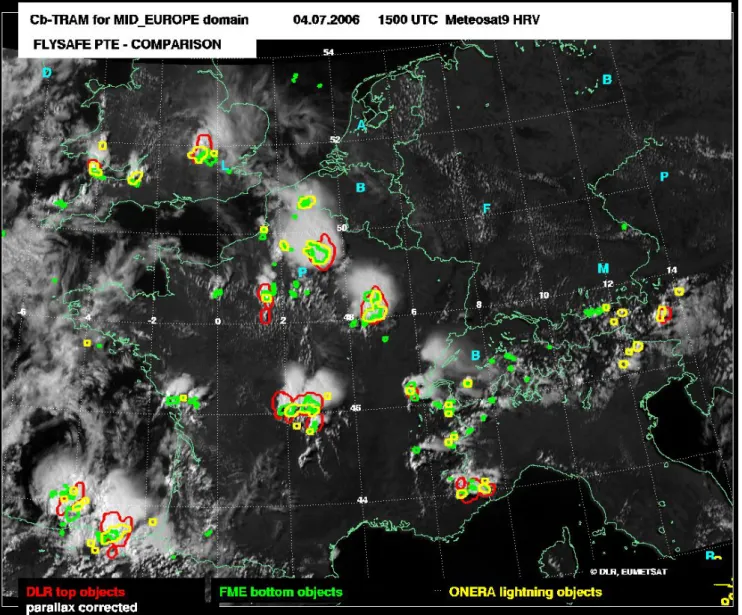
Fig. 8 shows an overlay of CB bottom and top volumes together with lightning objects for the continental scale area at about the same date and time as in the TMA comparison above (5 minutes later due to refresh rate of every 15 minutes). Again it can be seen that there is generally fair coherence among the different objects. Specifically, from the sole point of view of object occurrence, there is a high level of consistency between objects derived from radar data and those derived from lightning
data. Note that lighting observations over the eastern Alps between 12° and 14° east longitude are situated outside the European radar composite constructed by FMET (cf. Fig. 9) with correspondingly no Cb bottom objects in that region. In some cases, radar-derived objects are seen without a corresponding lightning-derived object. Of course, not every precipitating cloud which produces a signal above the threshold of 33 dBZ must necessarily produce lightning.
Fig. 8. Comparison of CB bottom (green; for both levels moderate and severe), CB top (red) and lightning objects (yellow) over the continental area for 4th July 2006 15 UTC.
5 Nowcasting
For operational use of CB WIMS products one must take into account the delay between analysis time and that time when the products are available to the user. This delay arises due to the time needed for taking measurements, data processing and distribution to the GWP and the aircraft. This delay necessitates the production of short range forecasts, generally understood as nowcasting, and resides basically on extrapolating the current state into the future taking into account past development. For details refer to [5][11] for CB bottom and top volumes, respectively. CB WIMS generates nowcasts for every 5 minutes during the first half hour past analysis time and for 45 and 60 minutes thereafter. The nowcasted objects hold the same attributes as listed in section 3 and are used within the NG-ISS onboard the aircraft for fusion with onboard enhanced weather radar measurements (Rockwell Collins MultiScanTM Automatic Weather Radar) at same validity time (ref. section 7). The combined information from ground and onboard systems is then displayed in easy to read graphics presenting the pilot a clear picture of the thunderstorm situation within his flight corridor. Nowcast products are also used for flight planning by a strategic decision support system which is also part of the FLYSAFE NG-ISS suggesting the optimal flight route due to the combined hazard information of terrain, traffic and weather.
In order to evaluate the quality of nowcasting products objective evaluation schemes have been developed which compare observed and forecast objects. While DLR has based the evaluations on standard skill scores [6], FME has followed a more advanced approach by allowing for some error in location or timing. This is still ongoing research and results will be published in the near future.
6 Research on Lightning Data and Aircraft Routing
UNIHAN has carried out a study on total lightning and flight characteristics during thunderstorm occurrences. The following aspects have been evaluated for five
thunderstorm days at Frankfurt airport by using lightning and aircraft position data:
• Flight characteristics from/to the airport • Operation efficiency in terms of punctuality • Aircraft distance to the lightning observation The study revealed that distances less than 1 km to a lightning stroke occur during approach and take-off whilst en-route the distance is larger than 1 km. For instance, on 29th May 2006 for 14 aircraft out of 15 flying below flight level 100 the distance was below 1 km [7]. These results will be contrasted to experiences gained throughout the FLYSAFE flight test campaign.
7 In-flight Real-Time Product Evaluation
The FLYSAFE summer campaign is scheduled for August 2008. During this campaign, two aircraft operated by SAFIRE (France) and NLR (Netherlands) will fly over the Paris area and over part of Central Europe thus covering both TMA and continental scales (cf. Fig. 9).
Fig. 9. Coverage areas of continental scale CB WIMS and of TMA Paris (black square). Coloured lines show the coverage of various data: FMET radar composite (green), lightning data as used by ONERA (yellow), MSG data for Cb-TRAM (DLR) in all the area north of the red line. While the SAFIRE’s aircraft will fly to evaluate WIMS products off-line the NLR aircraft will fly to evaluate on-board data fusion and the whole “weather chain” in real time, from WIMS
production to onboard data fusion. As regards to CB WIMS the flight tests have the following objectives:
• To compare onboard enhanced weather radar data with ground weather radar data • To evaluate enhanced weather radar output
to weather data fusion output
• To compare ground weather data before and after uploading
• To evaluate data fusionoutput
Results of these evaluations will be published presumably one year after the flight campaign.
4 Conclusions
The investigations exhibit that the representation of thunderstorms by relatively simple bottom and top volumes seems to render realistic coherent hazard areas for air traffic.
The real potential of the CB WIMS concept for aircraft safety lies in two aspects; first, the level of observation coverage and fusion that can be reached by a ground segment is significantly higher than what can be achieved on-board; this includes the fusion of lightning data, satellite rapid scan data in multiple spectral bands, advanced, polarimetric, C and S-band meteorological radar data and atmospheric state analyses; second, the upcoming capacity of the operational Weather Services in numerical prediction of thunderstorms for the next hour will definitely improve the quality of thunderstorm nowcasts at the time horizon of the FLYSAFE project Target Platform, namely 2015.
References
[1] Betz, H.-D., Schmidt, K., Oettinger, W. P., and Wirz, M.:Lightning detection with 3D-discrimination of intracloud and cloud-to-ground discharges, Geophys.
Res. Lett., 31, L11108, doi:10.1029/2004GL019821,
2004.
[2] Bousquet, O., P. Tabary and J. Parent-du-Châtelet. On the value of operationally synthesized multiple-Doppler wind fields, Geophysical Research Letters, vol. 34, l22813, doi:10.1029/2007gl030464, 2007. [3] Bousquet, O. and M. Chong. A Multiple-Doppler
Synthesis and Continuity Adjustment Technique
(MUSCAT) to Recover Wind Components from
Doppler Radar Measurements. Journal of
Atmospheric and Oceanic Technology, 15, No.
2, pp. 343–359, 1998.
[4] Derrien, M., Lavanant, L., and Gleau, H. L., 1988. Retrieval of the cloud top temperature of semi-transparent clouds with AVHRR. In Proceedings of the IRS'88, Lille, France, pp. 199-202.
[5] Hering, A, S. Sénési, P. Ambrosetti, and I. Bernard-Bouissières. Nowcasting thunderstorms in complex cases using radar data. WMO Symposium on
Nowcasting and Very Short Range Forecasting,
Toulouse, France, 2005.
[6] Kober, K. and Tafferner, A. Tracking and Nowcasting of convective cells using remote sensing data from radar and satellite. Subm. to Meteor. Z., 2008.
[7] Markovic, D. and Hauf., T. Study on total lightning and flight characteristics during thunderstorm occurrences. University of Hannover. Copy of paper available from the authors. 2008
[8] Rhoda, D.A., et al. Aircraft Encounters with Thunderstorms in En-route vs. Terminal Airspace above Memphis, Tennessee. Tenth Conference on
Aviation, Range, and Aerospace Meteorology, AMS,
Portland, Oregon, May 13-16, 2002.
[9] UK Met Office: A new Unified Model, NWP Gazette June 2002. This is available online at http://www.metoffice.gov.uk/research/nwp/publicatio ns/nwp_gazette/jun02/um.html
[10] Vulpiani, G., P. Tabary, J. Parent-du-Chatelet and Frank S. Marzano. Comparison of advanced radar polarimetric techniques for operational attenuation correction at C-band, J. Atmos. Oceanic Technol, , to appear, 2008.
[11] Zinner, T., Mannstein, H., Tafferner, A. Cb-TRAM: Tracking and monitoring severe convection from onset over rapid development to mature phase using
multi-channel Meteosat-8 SEVIRI data. Meteorol. Atmos. Phys.,
in print, 2008.
Copyright Statement
The authors confirm that they, and/or their company or institution, hold copyright on all of the original material included in their paper. They also confirm they have obtained permission, from the copyright holder of any third party material included in their paper, to publish it as part of their paper. The authors grant full permission for the publication and distribution of their paper as part of the ICAS2008 proceedings or as individual off-prints from the proceedings.