Competence Analysis in the Two-subject Study Program Computer Science
Irena Nančovska Šerbec and Jože Rugelj
Department for mathematics and computer science Faculty of Education, University of Ljubljana
Kardeljeva ploščad 14, 1000 Ljubljana, Slovenia
phone: +386 1 5892216
e-mail: [email protected], [email protected]
Abstract
We defined and analyzed a set of competences, which have to be achieved by graduates of the two-subject study program Computer Science at the Faculty of Education, future teachers of computer science in primary and secondary schools. Competences comprehend expert and didactic knowledge and skills from the subject field and pedagogical and psychological knowledge for teaching. We carried out an inquiry about the achieved level of these
competencies in the current program and about the desired level of the competencies in the modernised, “Bologna programs” among graduates of our current study program on computer science (“teachers”), their headmasters (“employers”), and teaching staff, professors and teaching assistants who teach in the program (“academicians”). By means of analyzes of the poll we found out some highly desired and relatively lowly achieved competences: “expertise and understanding of didactic particularity of computer science and informatics”, “application of special pedagogical knowledge in teaching pupils with special needs” and “theoretical and practical knowledge for effective integration of ICT into the field of education”.
Key words
competencies, study program, computer science teachers
1 Introduction
We analyzed the results of inquiry, by exploring the achievement and importance of selected set of nineteen competences. Competences have to be achieved by primary and secondary teachers of computer science.
Competences generally comprehend expert and didactic knowledge and skills from the subject field and pedagogical and psychological knowledge for teaching. They are defined (according to Gonzales, 2005) as dynamic combination of knowledge, understanding, skills and abilities. Competences are formed in various course units and assessed at different stages. Competences are related to five different parts: (1) personal; (2) development; (3)
professional; (4) social; (5) action. Personal part is related to determination, self-confidence, intelligence, initiative, responsibility, sincerity, confidence, communicativeness and other values of the teacher. Development part enables evolution of teaching and professional abilities of the teacher, leads the realization of the teaching process, enables the creative use of new findings related to the profession and allows recognition of the personal needs of the pupils. Professional part comprehends the pedagogical, psychological, philosophical and other knowledge needed for work in the classroom, and incorporates the creative use of time for realization of the subject-specific goals. Social part of the competences is related to the techniques of communication, interaction, involves knowledge about problems solving, motivation and organizing team work. Action part is related to the practical activities of the
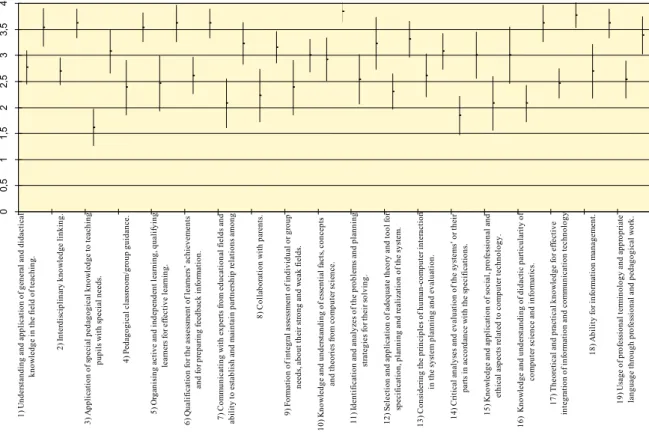
The set of nineteen competences (Figure 1), estimated by participants, was divided into (fist nine) (Tancig, 2004) generic competences and subject-specific competences (the rest ten) for the field of computer science (Rugelj, 2004). Generic competences were common for all teachers and they were selected form the common inquiry for all graduates from the Faculty of Education (Rugelj, 2004). The remaining ten competences are specific for the computer science teachers. Specific competences for the field of computer science are selected in accordance with the document called Computing Curricula (ACM, 2001). The document’s authors are representatives of well-known computer science organizations, such as IEEE Computer Society and Association of Computing Machinery (ACM). Computing Curricula document defines »the body of knowledge«, which should be mastered by the graduate students of computer science, describes the core of the graduate computer science programs, defines the teaching goals, suggests models of syllabus and describes the subjects inside them.
The web questionnaires were completed by graduates in our current study program on computer science (“teachers”), their headmasters (“employers”) and by teaching staff,
professors and assistants who teach in the computer science program (“academicians”). They assessed, on a scale from 1 to 4, achieved competences of our graduates and suggested, on a same scale, the level of desired competences for the graduates in our renovated study
programs (Theses, 2004).
1) Understanding and application of general and didactical knowledge in the field of
teaching.
2) Interdisciplinary knowledge linking.
3) Application of special pedagogical knowledge to teaching pupils with special needs.
4) Pedagogical classroom/group guidance.
5) Organising active and independent learning, qualifying learners for effective learning.
6) Qualification for the assessment of learners’ achievements and for preparing feedback
information.
7) Communicating with experts from educational fields and ability to establish and maintain
partnership relations among them.
8) Collaboration with parents.
9) Formation of integral assessment of individual or group needs, about their strong and
weak fields.
10)Knowledge and understanding of essential facts, concepts and theories from computer
science.
11)Identification and analyzes of the problems and planning strategies for their solving.
12)Selection and application of adequate theory and tool for specification, planning and
realization of the system.
13)Considering the principles of human-computer interaction in the system planning and
evaluation.
14)Critical analyses and evaluation of the systems’ or their parts in accordance with the
specifications.
15)Knowledge and application of social, professional and ethical aspects related to computer
technology.
16)Knowledge and understanding of didactic particularity of computer science and
informatics.
17)Theoretical and practical knowledge for effective integration of information and
18)Ability for information management.
19)Usage of professional terminology and appropriate language through professional and
pedagogical work.
Figure 1: List of competences for graduates - future primary and secondary school teachers of computer science.
We compared the results of analyses on the domain “Computer science” with the results of competence analyses on the faculty level, which included the results of inquiry on different study programs.
1.1 Purpose and goals
The purpose of competence analysis is to:
• Determine the current level of competence achievement and estimate the
differences between the desired and the achieved level.
• Consider the results of analysis in the design of new curricula in the framework
of the Bologna processes.
2 Methods
By analyzing the results of inquiry we wanted to overview the estimates of achieved and desired competences. We used descriptive statistical methods (Miller and Miller, 1999). We drew graphs of sorted estimations for each group of participants, “scatterplots” and graphs of sorted differences between desired and achieved level estimates (Rugelj, 2004).
2.1 Sample of respondents for the Two-subject Computer Science Program There were 29 participants (respondents) involved in the web inquiry. The number of participants was relatively small, although the inquiry was completed by almost all the graduates on the computer science program and almost all the teaching staff, professors and teaching assistants who teach in the computer science program.
AS the number of headmasters who responded to our invitation for participation in the poll was small and their responses were quite similar to responses from the teachers, we merged them with the teachers. Consequetly, the respondents can be divided into two main groups:
• 16 graduates of the study program Mathematics and computer science on the
Faculty of education and headmasters (55%), “teachers”,
• 13 professors and teaching assistants, »academicians« (45%).
2.2 Web inquiry
The web opinion poll contained a set of 19 competences (Figure 1) related to the future computer science teachers. Subject specific competences, related to field of computer science, were defined according to the ACM/IEEE document »Computing Curricula«, which was taking shape in the last 20 years under the leadership of the top experts from the world best computer science universities. General education and didactics competences were defined regarding to the results of the project Tuning (Gonzales and Wagenaar, 2004) and competence
analyses on the faculty level (Razdevšek Pučko, Rugelj, 2004).
Respondents estimated the achieved competences level in the current program and the desired competence level in the modernized “Bologna programs” among graduates of our current study program. They used marks from 1 to 4, to estimate the level of mastery or
amount of knowledge. Marks had the following meaning: 1 – nothing or almost nothing; 2 - low level; 3 – pretty high level; 4 – very high level.
2.3 Statistical methods
Competences had been assesses by the estimates average (arithmetic mean) of all respondents or of each single group (“teachers” and “academicians”).
We used the following graph types:
• Graph of estimates of the achieved and desired competences with confidence
intervals, (95% confidence level);
• Graphs of descending (sorted) estimates of achieved/desired level for each
respondent group (4 graphs);
• Graphs showing the descending (sorted) differences between desired and
achieved level (for each group of respondents and for all respondents, 3 graphs);
• “Scatterplot” showing the relationship between desired and achieved
competence levels (for all respondents).
3 Results
We started the competence analyzes with drawing graph of estimates of achieved and desired competences with confidence intervals on 95% confidence level (Figure 2).
0 0,5 1 1,5 2 2,5 3 3,5 4 1) U nde rs ta ndi ng a nd appli ca ti on of ge ne ra l a nd dida ctic al know le dge in the fi el d of teach in g. 2) In te rd is ci pli na ry know le dg e li nki ng. 3) A ppl ic ation of s pe ci al pe da gogi ca l know le dge to te ac hing pupil s w ith s pe cia l ne ed s. 4) P eda gogic al cl as sr oom /gr oup gui da nc e. 5) O rga nis ing a ct iv e a nd inde pe nde nt le ar ni ng, qua li fy ing lear ne rs fo r ef fect iv e l ea rn in g. 6) Q ua lif ic at ion fo r the a ss es sm ent of le ar ne rs ’ a ch ie ve m ent s and f or pr epa ri ng f ee dba ck inf or m at ion. 7) C om m unic at ing w it h expe rt s f rom e duc at iona l f ie lds a nd ab il it y to e st abl is h a nd m aint ain pa rt ne rs hi p re la ti ons a m ong 8) C oll abor ation w it h pa re nt s. 9) F or m at ion of inte gr al a ss es sm ent of indivi dua l or gr ou p ne eds , a bout the ir s tr ong a nd w ea k f ie lds . 10) K now le dge a nd unde rs ta nding of e ss enti al f ac ts , c onc ep ts an d t he or ies fr om co m pu ter s ci en ce. 11) Id en ti fi ca tion a nd a na lyz es of the pr oble m s a nd pla nning st ra teg ies fo r th ei r s ol vin g. 12) S ele ct ion a nd a ppl ic at ion of a de qua te th eo ry a nd tool fo r sp ec if ic ati on, pla nning a nd r ea liz at ion of th e s ys te m . 13) C ons ide ri ng the pr inc ipl es of hum an-com put er inte ra ct ion in the s ys te m pla nni ng a nd ev al ua tio n. 14) C riti ca l a na lys es a nd ev al ua ti on of th e sy st em s’ or the ir pa rt s i n acco rd an ce w ith th e sp ecif icat io ns . 15) K now le dge a nd a ppli ca tion of s oc ia l, pr of es si ona l a nd et hi ca l a spe ct s r el ate d to co m pute r te chnology. 16) K now le dge a nd unde rs ta nd ing of dida ct ic pa rt ic ul ar it y of co m pu te r s cien ce an d i nf or m at ics . 17) T he or et ic al a nd pr ac tic al know le dge for e ff ec ti ve in te gr at ion of inf or m at ion a nd co m m unic ati on te chnol ogy 18) A bili ty f or inf or m at ion m ana ge m ent. 19) U sa ge of pr of es si ona l te rm inol ogy a nd a ppr opr ia te la ngua ge thr oug h pr of es si on al a nd pe da gogi ca l w or k.
Figure 2: Estimations of achieved and desired competences (confidence intervals P>.95).
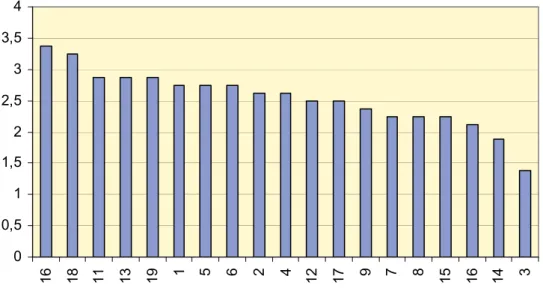
We compared the estimates of achieved competences for the both groups of respondents, “teachers” and “academicians”, (Figure 3). We found out that the group of “teachers” (Figure
3.a) gave the best marks the following competences: “1) understanding and application of general and didactical knowledge in the field of teaching” and “2) interdisciplinary
knowledge linking”. The same group gave the worst marks for the following competences: “7) communicating with experts from educational fields and ability to establish and maintain
partnership relations among them”, “14) critical analyses and evaluation of the systems’ or
their parts in accordance with the specifications”, “15) knowledge and application of
social, professional and ethical aspects related to computer technology” and “18) ability for information management”.
“Academicians” (Figure 3.b) gave the best marks for achievement of the following competences: “16) knowledge and understanding of didactic particularity of computer science
and informatics” and “18) ability for information management”. The same group gave the
worst marks for the following competence “3) application of special pedagogical
knowledge to teaching pupils with special needs”.
Estimations of achieved competences - "teachers"
0 0,5 1 1,5 2 2,5 3 3,5 4 1 2 6 9 17 8 16 13 3 4 5 11 12 16 19 7 14 15 18
Estimations of achieved competences - "academicians" 0 0,5 1 1,5 2 2,5 3 3,5 4 16 18 11 13 19 1 5 6 2 4 12 17 9 7 8 15 16 14 3
Figure 3: Estimations of achieved competences assessed by groups a) »teachers«, b) »academicians«.
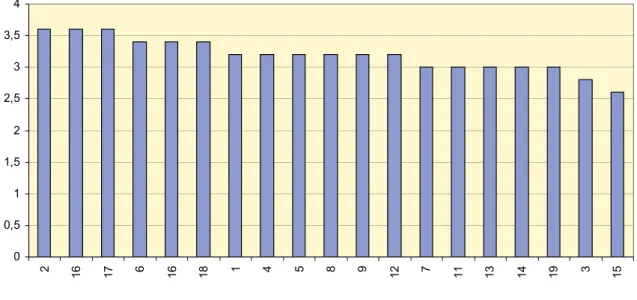
We compared the estimates of desired level of competence attainment for the both groups of respondents (Figure 4). We found out the group of »teachers« (Figure 4 a) stressed the importance of “2) interdisciplinary knowledge linking”, “16) knowledge and
understanding of didactic particularity of computer science and informatics” and “17) theoretical and practical knowledge for effective integration of information and
communication technology (ICT) into the field of education”. “Academicians” (Figure 4 b) stressed the meaning of “16) knowledge and understanding of didactic particularity of
computer science and informatics”, “5) organising active and independent learning, qualifying learners for effective learning” and “17) theoretical and practical knowledge for effective integration of information and communication technology (ICT) into the field of education”. They gave the minimum importance to “9) formation of integral assessment of individual or group needs, about their strong and weak fields”.
Estimations of desired competences - "teachers" 0 0,5 1 1,5 2 2,5 3 3,5 4 2 16 17 6 16 18 1 4 5 8 9 12 7 11 13 14 19 3 15
Estimations of desired competences - "academicians"
0 0,5 1 1,5 2 2,5 3 3,5 4 16 5 17 1 4 6 16 18 2 19 7 11 12 3 15 8 13 14 9
Figure 4: Estimations of desired competences assessed by groups a) »teachers«, b) »academicians«.
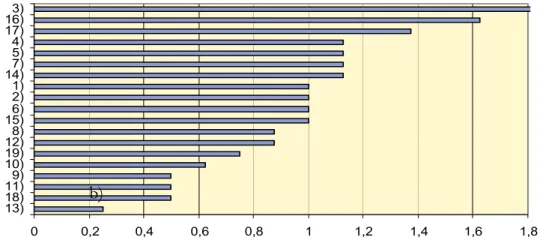
We compared the differences between the desired and achieved level estimates for the both respondent groups (Figure 5). We found that for “teachers” the difference was the biggest (Figure 5 a) for “18) ability for information management” and the smallest for “1) understanding and application of general and didactical knowledge in the field of teaching”. For “academicians” the difference was the biggest for “3) application of special pedagogical knowledge to teaching pupils with special needs” and the smallest for “13) considering the principles of human-computer interaction in the system planning and evaluation”.
a)
Figure 6 showing the differences between desired and achieved competence levels for the all respondents. The difference is the biggest for competence “16) knowledge and
understanding of didactic particularity of computer science and informatics” and it is the smallest for “13) considering the principles of human-computer interaction in the system planning and evaluation”.
Figure 7 is showing the “scatterplot” (StatSoft, 2002) for the selected competences, whose difference between desired and achieved level is bigger then 1
Difference between desired and achieved competences - "teachers" 0 0,2 0,4 0,6 0,8 1 1,2 1,4 1,6 1,8 18) 10) 16) 4) 5) 7) 12) 14) 17) 6) 8) 11) 19) 2) 13) 9) 13) 15) 1)
Difference between desired and achieved comptences - "academicians" 0 0,2 0,4 0,6 0,8 1 1,2 1,4 1,6 1,8 3) 16) 17) 4) 5) 7) 14) 1) 2) 6) 15) 8) 12) 19) 10) 9) 11) 18) 13)
Figure 5: Differences between desired and achieved competences assessed by groups a) »teachers«, b) »academicians«.
b) a)
0,00 0,20 0,40 0,60 0,80 1,00 1,20 1,40 1,60 1,80 16) 3) 17) 4) 5) 7) 14) 6) 12) 10) 2) 8) 15) 18) 19) 1) 11) 9) 13) Competence difference
16) Knowledge and understanding of didactic particularity of computer science and informatics. 1,54
3) Application of special pedagogical knowledge to teaching pupils with special needs. 1,46
17)
Theoretical and practical knowledge for effective integration of information and communication technology (ICT) into the field of
education. 1,31
4) Pedagogical classroom/group guidance. 1,15
5) Organizing active and independent learning, qualifying learners for effective learning. 1,15
7) Communicating with experts from educational fields and ability to establish and maintain partnership relations among them. 1,15
14) Critical analyses and evaluation of the systems’ or their parts in accordance with the specifications. 1,15
6) Qualification for the assessment of learners’ achievements and for preparing feedback information. 1,00
12) Selection and application of adequate theory and tool for specification, planning and realization of the system. 1,00
10) Knowledge and understanding of essential facts, concepts and
theories from computer science. 0,92
2) Interdisciplinary knowledge linking. 0,92
8) Collaboration with parents. 0,92
15) Knowledge and application of social, professional and ethical aspects
related to computer technology. 0,92
18) Ability for information management. 0,92
19) Usage of professional terminology and appropriate language through professional and pedagogical work. 0,85
11) Identification and analyzes of the problems and planning strategies for their solving. 0,69
9) Formation of integral assessment of individual or group needs, about their strong and weak fields. 0,62
13) Considering the principles of human-computer interaction in the system planning and evaluation. 0,46
Figure 6: Differences between desired and achieved competences assessed by all participants. 0 0,5 1 1,5 2 2,5 3 3,5 4 0 0,5 1 1,5 2 2,5 3 achieved d esi re d 3) 14) 16) 7) 4) 17) 5)
Competence achieved desired
differen ce
16) Knowledge and understanding of didactic particularity of computer science and informatics. 2,08 3,61 1,54
3) Application of special pedagogical knowledge to teaching pupils with special needs. 1,62 3,08 1,46
17) Theoretical and practical knowledge for effective integration of information and communication technology (ICT) into the
field of education. 2,46 3,77 1,31
4) Pedagogical classroom/group guidance. 2,46 3,61 1,15
5) Organizing active and independent learning, qualifying
learners for effective learning. 2,38 3,54 1,15
7)
Communicating with experts from educational fields and ability to establish and maintain partnership relations among
them. 2,08 3,23 1,15
14) Critical analyses and evaluation of the systems’ or their parts
in accordance with the specifications. 1,85 3 1,15
Figure 7: “Scatterplot” shows the relation between estimates of desired and achieved level for competences with the biggest difference (all respondents).
4 Discussion
Partnership between faculty and partners in practice - teachers and headmasters - played an important role in the competence analysis. We found out that the number of participants in the
poll was relatively small, although we actually invited all the graduates to participate in the poll and they responded to our invitation. Computer Science study program is running only for few years now and the number of graduates is small.. But information gained from the partners was quite useful for our work.
Figure 3 shows that the estimation of achieved competences for all three participating groups varies substantially. “Teachers” think general teaching competences are achieved better in comparison with specific competences, but “academicians” thing that specific computer science competences are achieved good enough.
Graph in the Figure 4 confirms that for all respondents the following competences are important: »knowledge and understanding of didactic particularity of computer science and informatics« and »theoretical and practical knowledge for effective integration of information and communication technology (ICT) into the field of education«.
We focused our attention on the competences, where achieved level was relatively low the desired level was relatively high (Figure 6 and Figure 7). “Scatterplot” (Figure 7) shows seven competences with the biggest difference between the desired and achieved level. Among them we expose the following competences: “expertise and understanding of didactic particularity of computer science and informatics” (highly desired), “application of special pedagogical knowledge in teaching pupils with special needs” (lowly achieved) and “theoretical and practical knowledge for effective integration of ICT into the field of education” (highly desired).
Abovementioned estimations of competences confirm that there was not enough emphasis on the didactic topics for teaching of computer science in the current study program, students were not adequately taught about the particularity of teaching pupils with special needs and they did not obtain enough applicative knowledge for integration of ICT in the education. We found out the competence “application of special pedagogical knowledge to teaching pupils with special needs” was relatively lowly estimated by all respondents on the level of the Faculty of Education (Rugelj, 2004). In general, the results of the competence analysis on the level of the faculty are to great extent in accordance with the results concerning study program Computer science.
We took into account the results of competence analysis in the design of new curricula in the framework of the Bologna processes. Abovementioned “critical” competences are appropriately “covered” and developed through different subject in the renewed computer science program.
References
Gonzales, J., Wagenaar, R. ed. (2005): Tuning Educational Structures in Europe II
(Universities' contribution to Bologna Process, Final Report – Phase 2). Bilbao: University of Deusto, University of Groningen.
The Joint Task Force on Computing Curricula (2001): IEEE Computer Society Association
for Computing Machinery, ACM, Computing Curricula 2001, Computer Science, —
Final Report —(December 15, 2001). URL:
http://www.computer.org/portal/cms_docs_ieeecs/ieeecs/education/cc2001/cc2001.pdf
Miller, I. and Miller, M. (1999): John's E. Freund's Mathematical Statistics. 6th Edition.
Prentice Hall.
Nančovska Šerbec, I., Rugelj, J. (2006): »Analiza pridobljenih in zaželenih kompetenc
študijskega programa Računalništvo« (»Analysis of the Achieved and Desired
Competencies in the Educational Program for Computer Science«), Prispevki k
Educational Studies Programmes). Ed.: S. Tancig and S. Devjak. Ljubljana: University of Ljubljana, Faculty of Education, pp. 78-91.
Razdevšek Pučko, C. (2004): Kompetence učiteljev. In the web page: Posodobitev študijskih
programov na PEF UL, URL: http://www.pef.uni-lj.si/strani/bologna/. Članki in
monografije,URL:
http://www.pef.uni-lj.si/strani/bologna/dokumenti/kompetence.pdf . visited 2006.
Rugelj, J. (2004): Poročilo o obdelavi rezultatov ankete o kompetencah diplomantov PeF UL
in Rezultati obdelave rezultatov ankete o kompetencah diplomantov PeF UL. In the web
page: Posodobitev študijskih programov na PEF UL, URL:
http://www.pef.uni-lj.si/strani/bologna/. Anketa o kompetencah diplomantov (2004),URLs:
http://www.pef.uni-lj.si/strani/bologna/dokumenti/rugelj-porocilo.pdf,
http://www.pef.uni-lj.si/strani/bologna/dokumenti/rugelj-rezultati.pdf. visited 2006.
Rugelj, J. (2004): Rezultati obdelave rezultatov ankete o kompetencah diplomantov po
oddelkih oziroma študijskih programih: Oddelek za matematiko in računalništvo. In the
web page: Posodobitev študijskih programov na PEF UL,URL:
http://www.pef.uni-lj.si/strani/bologna/. Anketa o kompetencah diplomantov (2004),URL:
http://www.pef.uni-lj.si/strani/bologna/dokumenti/anketa-ra.pdf . visited 2006.
Stančić, S. (2002): »Kompetenčni profil ″idealnega″ ravnatelja«, Sodobna pedagogika, 53, 1,
pp. 168–184.
StatSoft, Inc. (2002): Electronic Statistics Textbook. Tulsa: OK, StatSoft. URL:
http://www.statsoft.com/textbook/stathome.html. (visited: September 2004).
Tancig, S. (2004): Študijski programi, učni načrti: deskriptorji, kompetence in cilji. In the
web page: Posodobitev študijskih programov na PEF UL, URL:
http://www.pef.uni-lj.si/strani/bologna/. Fakultetni posvet o prenovi študijskih programov PeF
UL,Pedagoška fakulteta, 15. september 2004, URL:
http://www.pef.uni-lj.si/strani/bologna/dokumenti/tancig.pdf. visited 2006.
Teze za prenovo pedagoških študijskih programov (Theses on Renewal of Teachers’ Education in Slovenia – Recapitulation) (2004): URL: http://www.pef.uni-lj.si/strani/bologna/dokumenti/prenova-pedag-studijev.pdf. visited 2005.