Energy-efficient mobile web in a bundle
Le Wang
⇑, Jukka Manner
Aalto University, P.O. Box 13000, FI-00076 Aalto, Finland
a r t i c l e
i n f o
Article history:
Received 2 February 2013
Received in revised form 25 July 2013 Accepted 2 August 2013
Available online 13 August 2013 Keywords: Wireless networks Power consumption Web access Optimisation Bundling
a b s t r a c t
The mobile Internet that was a huge hype ten years ago is finally here. We have a wealth of mobile devices that allow us to enjoy and consume Internet content from any number of web sites and services. With faster processors and radio links, our use of the Internet and the traffic mobile users generate grows at a tremendous pace. In this development, we still have a huge challenge to tackle: energy efficiency. When ten years ago one would recharge his personal mobile device once a week, we now do that daily; Smart phones today are not able to carry enough energy to allow us several days of usage time. The focus on this paper is to present and analyse one solution to help us in our daily lives. We imple-ment and study a scheme where web content, a page, is delivered as a whole to a mobile device, instead of sending each individual object of the page separately. Combined with RRC state based header compression and selective content compression, our proposal allows the radio to keep in low power state for longer durations, and as a consequence brings huge energy savings. Download times also decrease, thus bringing increased Quality of Experience.
Ó2013 The Authors. Published by Elsevier B.V.
1. Introduction
With the advent of almost 6 billion mobile-cellular
sub-scriptions at the end of 2011[1], the inevitable trend of
post-PC era is already clearly visible. In the last decades, rarely have technical innovations changed everyday life as fast and profoundly as the pervasive use of mobile com-munications. With the advance of wireless communication technology and the emergence of mobile devices, global mobile data traffic grew 2.3-fold in 2011, which was eight times the size of the entire global Internet traffic in 2000,
and is expected to increase 18-fold by 2016[2]. The
ever-increasing demand for mobile connectivity and wireless services has lead to increased energy consumption and short battery life on mobile devices. A major technological challenge for mobile devices is to store a large amount of energy in batteries for increasingly complex mobile de-vices and yet still deliver reasonable size and weight. So long as batteries continue to be based on electrochemical processes, limitations of power density and limited life-time will be difficult to overcome, making it hard to cater for mobile devices with power-hungry features and adopt
mobile services further[3,4].
The reduction in energy consumption of mobile net-works is of great importance to continued adoption of mo-bile Internet services and sustainability of an acceptable Quality of Experience (QoE) for mobile Internet. This paper focuses on energy saving on mobile web access, which ac-counts for 10.11% of Internet web access worldwide in May
2012, a growth of 75.8% over last year[5]. The number is
even higher in Asia and Africa, where PC penetration is lower on average. Clearly, mobile devices have being rap-idly evolving as one of the primary choices of accessing web content. However, mobile web access faces several 1389-1286Ó2013 The Authors. Published by Elsevier B.V.
http://dx.doi.org/10.1016/j.comnet.2013.08.006 qq
This is an open-access article distributed under the terms of the Creative Commons Attribution-NonCommercial-ShareAlike License, which permits non-commercial use, distribution, and reproduction in any medium, provided the original author and source are credited.
⇑Corresponding author. Tel.: +358 440327066; fax: +358 947022474. E-mail address:le.wang@aalto.fi(L. Wang).
Computer Networks 57 (2013) 3581–3600
Contents lists available atScienceDirect
Computer Networks
j o u r n a l h o m e p a g e : w w w . e l s e v i e r . c o m / l o c a t e / c o m n e t
Open access under CC BY-NC-SA license.
issues regarding energy efficiency. Firstly, the fixed over-head of transmission of radio interfaces is significant once
they are in active mode[30]. Thus data should be sent in
quick bursts (compared to constant small transfers) to en-able a longer battery lifetime. Secondly, unlike wired
net-works, wireless networks take open air as the
transmission medium, which is subject to interferences, fading over the wireless channel and mobility of end de-vices. As a result, application layer performance in terms of goodput has been significantly reduced due to increased delay and rate variability. Least but not last, the power consumption of transmitting one bit over the air is over
1000 times than that of 32-bit CPU computation [29].
Hypertext Transfer Protocol (HTTP), as a verbose protocol to carry web traffic, introduces additional bytes into its communication resulting in additional energy cost.
Therefore, we undertake a detailed exploration of the effects of power consumption on HTTP traffic, propose and evaluate a proxy-based architecture for energy-effi-cient web access. In particular, we make the following contributions.
This work studies the characteristics of transmission in
wireless networks, namely Wireless Local Area Network (WLAN) network, and Universal Mobile Telecommuni-cations System (UMTS) network in terms of throughput and energy efficiency performance. The results present the energy consumption characteristics of browsing web content over the wireless networks, and also the
potential of improving the power consumption
efficiency.
An energy-efficient proxy is introduced between mobile
devices and web servers to improve energy efficiency of web access by optimising the web content delivery through the content bundling, header compression, and selective content compression.
The energy-efficient proxy was implemented on a
com-mercial smartphone and evaluated through experi-ments in both WLAN and 3G networks with thorough test cases. We concentrate on the improvement of the proxy-based solution compared to normal web access from several aspects, where we look into how data sub-scription plan, traffic delay, file content and Radio Resource Control (RRC) inactivity timers affect the power consumption. The results show significant energy consumption reduction of web access.
It is worth to mention that the solution provides energy saving opportunity not only for web browsing. HTML5 is a trending web technology that is being applied to a range of industries with a new method of content delivery. The emerging developments for HTML5 are changing the way to access content, and also boost the potential of energy
sav-ings by deploying our solution. For example, Pocket[27]as a
mobile application with over 4.5 million users helps people to save an interesting article or web page that users do not have time to view it right away but for reading it later on their mobile devices. Our solution optimises the download-ing of the content over wireless networks in an energy-effi-cient way for the type of services, which take HTTP traffic as a major carrier of interaction between clients and servers.
The remaining sections are organised as follows. We
start with reviewing prior work on the field in Section2
and provide sufficient background information for further
discussion in Section3. Then we present the architecture
and design of our system in Section4. Section5evaluates
the performance of the energy-efficient proxy and Section6
discusses related issues regarding the proxy and
summa-rise in Section7.
2. Related work
Energy consumption of network transmission on mo-bile devices has seen a large number of academic papers. Our work, in particular, focuses on applying a performance enhancing proxy to improve energy efficiency of web ac-cess relating to mainly three categories of work: research on analysing and improving TCP performance over wire-less links, research on optimising RRC state in UMTS net-works, and research on enhancing HTTP performance.
A lot of prior work has been conducted to enhance TCP performance with proxy over wireless links. Some studies focus on TCP throughput improvement and propose that TCP connections can be split using as pivot proxies nected to both wireless and wired links. End-to-end con-nections are partitioned into two portions so that the impact from the slow and lossy wireless link on the fixed
network can be minimised. I-TCP[6]is the very first work
in the area, M-TCP[7]uses a zero window ACK scheme to
schedule TCP data to provide better preserved end-to-end
transmission. Other similar studies can be found in [8–
11]. As energy issues have presented a significant barrier to continued adoption of mobile Internet services, many studies have been carried on using a proxy to improve
en-ergy efficiency over transmission. Cool-Tether [12] was
proposed to minimise energy consumption on mobile de-vices while they serve as Internet access gateways for other clients by employing gatherer, striper and a re-verse-infrastructure mode for WiFi. Network Connectivity
Proxy (NCP) [13] proposes a SOCKS-based proxy to
pre-serve existing TCP connections and UDP data flows for a mobile device when it goes to sleep so that the device can enter a low power consumption state and its full net-work presence is still maintained.
The RRC inactivity timers have also been widely studied in several previous work. The energy inefficiency of the
timers was analytically studied in [14,15] to determine
the optimal values of the inactivity timers. Then the timer
issues have been studied in [36,37,16]on
real-measure-ment basis. Researchers also proposed solutions to deal
with the issues. In[47], Tail Optimisation Protocol (TOP)
dynamically decides timeouts for the inactivity timers and utilises fast dormancy to eliminate the tail energy.
An-other solution TailTheft [17] prefetches and delays data
transfer to schedule a number of transmissions to the tail time (the period of high power state after the completion of a transmission) of the transmissions.
In comparison, our study utilises the principle of split TCP to optimise HTTP downloading over wireless links, and focuses on leveraging RLC buffer threshold to keep the mobile device in lower power consumption state.
Existing work has studied how to improve HTTP
perfor-mance. WebExpress [41]was proposed to improve
web-browsing performance over wireless links through caching,
differencing, and header reduction. GPRSWeb[26]
imple-ments CHK-based caching, parse-and-push functions, del-ta-encoding and utilises its own customised protocol between a client and a proxy to improve web-browsing
experience over GPRS links. In [18,19], HTTP is modified
to deliver the embedded web objects as a single bundle to a web browser without being explicitly requested. In
addition, Opera Mini[23]applied transcoding approaches
to reduce the traffic load instead of the power consump-tion, which requires frequent communications between the proxy and user clients. Thus, it consumes a lot of power. In summary, the solutions were designed for fast page downloading and do not focus on energy-efficiency of web browsing.
The studies of energy-efficient web browsing have also been reported in prior work. Power Aware Web Proxy
(PAWP) [20] is an architecture designed to schedule
incoming web traffic into intervals of high and no commu-nication so that WLAN interfaces can switch to a low power state after very short idle intervals. Another
ap-proach is reported in[43], which proposes an architecture
called Virtual-Machine based Proxy (VMP) to shift comput-ing from mobile devices to the proxy in 3G networks. The proxy transcodes dynamic web objects in order to save en-ergy of mobile devices. In comparison of the proxy-based solutions for energy-efficient web browsing, our solution utilises bundling and header compression to cater to the energy consumption characteristics of WLAN and 3G net-works. The selective compression applied is lossless com-pression, which does not alter original web content and still provides significant improvement of energy consump-tion along with other techniques. In addiconsump-tion, the soluconsump-tion does not require any modification on web browser and web servers, thus it can be deployed incrementally.
3. Transmission and energy issues over wireless networks
In the section, we start with TCP performance issues over wireless networks in Section 2.1. We then discuss en-ergy consumption issues of mobile devices and demon-strate power saving mechanism of WLAN and 3G networks in Section 2.2. Furthermore, their effects on HTTP traffic are discussed in Section 2.3.
3.1. TCP Issues over wireless networks
TCP performance issues manifest in various aspects as significant degradation of TCP throughput, under-utilisa-tion of link capacity, excessive interrupunder-utilisa-tion of data trans-missions, and energy-inefficiency of transmission. There are several reasons resulting in these problems:
High and variable latency: generally, wireless links suffer from severe error rates due to external interference, going out-of-range, or blocking of signal. WLAN networks pro-vide relatively smaller coverage area and higher system bandwidth, where the observed transmission and
propaga-tion delay is relatively smaller as well compared to 3G net-works. 3G networks exhibit spurious delay and additional jitter not only due to the lower bit rate or wider coverage range, but also because of packets buffering, interleaving, rate adaptation and retransmission in Radio Link Control-ler (RLC) layer, and allocation and de-allocation of network resources when RRC state transition happens. Based on more than half million of measurements gathered by
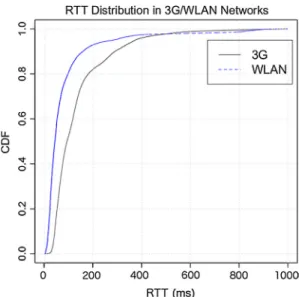
Nett-itutka[35] from nation wide user base, we find that the
average Round-Trip Time (RTT) is around 83.29 ms in WLAN networks and 150.76 ms in 3G networks (UMTS
and HSPA/HSPA+).Fig. 1shows the cumulative distribution
function of latencies of sending packets from mobile cli-ents to our server. 60% of the latencies are below 80 ms in WLAN and 150 ms in 3G networks. However, over 4% of the latencies can go beyond 500 ms in both networks. We also measured the jitter during TCP sessions. There
Fig. 1.CDF of network latencies.
Fig. 2.CDF of network latencies.
were nearly 30 thousand TCP sessions measured, during each of which the value of RTT was recorded every 50 ms. During certain TCP sessions, the standard deviations
are surprisingly high as seen inFig. 2, where the
cumula-tive distribution function of the sorted standard deviations of network latencies in ascending order is plotted.
Fluctuation of TCP throughput: With the large delay in wireless links, the connection stays longer in slow start state leading to longer TCP start process to fully utilise available link bandwidth. RTT inflation may also lead to high retransmission timer value, potential SYN timeout, higher recovery time, and mistaking wireless losses for
congestion, which all impact TCP performance[25,26,28].
Fig. 3demonstrates how RTT affects TCP goodput in WLAN and 3G networks based on the measurements collected from the Nettitutka database. The increase of RTT results in poor perceived TCP goodput in both networks. The blue solid line in each figure presents a borderline where 95% of measurement dots are within it.
3.2. Energy efficiency of transmission
WLAN and 3G radio interfaces of mobile devices present high association energy cost to the networks. We mea-sured the consumed power of one Nokia N9 by using Nokia Energy Profiler Compared to 330 mW operating power of screen with maximum brightness on the Nokia N9, the power of WLAN radio interface is around 310 mW when it stays in active mode without sending/receiving any data, and the operating power is above 1380 mW when sending/ receiving data at full-speed rates, which is around 12 Mbps on downlink and 5 Mbps on uplink. The operating power of 3G radio interface in active mode without sending/receiv-ing is around 1085 mW, and the operatsending/receiv-ing power increases to 1470 mW when data are transmitted through the interface.
The two radio technologies present radically different energy consumption characteristics due to the different network resource allocation/de-allocation mechanisms. Specifically, IEEE 802.11 standard defines that the 802.11 WLAN capable devices operate either in Continuously Ac-tive Mode (CAM) or Power Saving Mode (PSM). Compared
to CAM, the objective of the 802.11 PSM allows the mobile device to switch from the Active Mode to the Sleep Mode as soon as data transmission is completed. The mobile de-vice synchronises with the infrastructure such as Access Point (AP) by receiving periodical beacon frames every 100 ms or 200 ms. The mobile device suspends its radio activity after the period of inactivity, and then wakes up for buffered frames from the access point. If there is no incoming traffic, the mobile device is able to switch into low power consumption mode right after the beacon
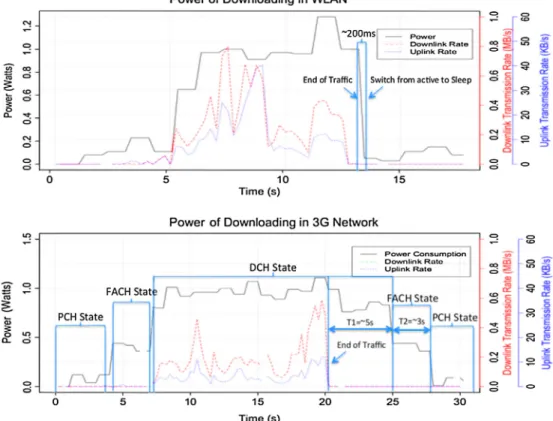
inter-val. In the upper plot ofFig. 4, the power consumption and
uplink/downlink rates of downloading a 2.5 MB file are shown. TCP handshaking triggered the N9 into active mode and the power consumption increased dramatically when the downloading started. The operating power then went down due to sleep mode in 200 ms after the end of the traffic.
Due to the scarceness of radio resources in 3G networks, RRC state machine is defined in the Third Generation
Part-nership Project (3GPP)[38]. It is more dedicated and
com-plex including IDLE state, Cell Paging Channel (Cell_PCH) state, Cell Forward Access Channel (Cell_FACH) state and Cell Dedicated Channel (Cell_DCH) state. Each state pre-sents different requirements of radio resources and level of operating power. There is no radio resource allocated for the mobile device in the IDLE state, even through the device monitors the broadcast messages from the Radio Network Controller (RNC). In the Cell_PCH state, the device monitors the paging control channel, and yet is still not able to have uplink activity. Packet Data Protocol (PDP) context is maintained so a session could be reconnected rapidly. In the Cell_FACH state, the device is assigned a common or shared transport channel but not a dedicated channel. Thus, this state is suitable for small or medium
amount of data[36,37]. In the Cell_DCH state, RRC
connec-tion is fully established and the device is assigned dedi-cated transport channels both downlink and uplink. The dedicated resources make the channels more suitable for large traffic volume such as audio/video streaming, file transfer and Web traffic with large objects. Since the re-sources associated with these states are different, each state also presents different operating power. As seen in
the lower plot ofFig. 4, the operating power of the Cell_-FACH state is around 489mW, roughly 50% of that in the Cell_DCH state, and the Cell_PCH state only consumes about 1–2% of the operating power of the Cell_DCH state. After the end of traffic, the 3G link exhibited a residual en-ergy cost. Compared to the operating power characteristic of WLAN, inactivity timers are introduced in UMTS as
shown inFig. 5. Timer T1, T2 and T3 control the durations
of staying at the Cell_DCH, the Cell_FACH and the Cell_PCH states, respectively. Mobile device is able to switch from the Cell_DCH state to the Cell_FACH state only after T1 times out, and from the Cell_FACH state to the Cell_PCH state after T2 times out. When T3 times out, the device falls back from the Cell_PCH to the IDLE state.
In the RRC state machine, the states promote when switching from lower power consumption states to higher power consumption states, and the states demote when
switching happens in the reverse direction. The state pro-motion is triggered either from the IDLE/Cell_PCH state to the Cell_FACH state once there is any transmission activ-ity or from the Cell_FACH state to the Cell_DCH state when the data volume exceeds the RLC buffer threshold, which is
controlled by network operators [36]. To explore the
threshold value in our measurement environment, we sent different-sized ping packets from the N9 and measured the
operating power. InFig. 6, the average power of sending
ping packets including the portion of energy tail, and its 95% confidence interval are shown. The power increases
Fig. 4.Power consumption states in WLAN and 3G networks.
Fig. 5.RRC states transitions.
95 Percent Confidence Interval of the Operating Power for Sending ICMP Packets
0.0 0.2 0.4 0 .6 0.8 0.0 0.2 0.4 0 .6 0.8
Size of Ping Packet (Bytes)
Power (Watts)
100 200 300 400 500 600 700 800 900 1000
Fig. 6.Operating power of sending ping packets.
significantly from around 400 mW to 700 mW when the size is over 400 bytes. Because the energy tail is included in our calculation, these two values of power are smaller than the operating power of the Cell_FACH and the Cell_DCH states. More specifically, the threshold value is reached when IP payload is 470 ± 12 bytes (8 bytes ICMP header + 462 bytes payload) in the network. Before state switching is done, signalling traffic is exchanged between the mobile device and the RNC for resources allocation
and de-allocation[39]. Since the allocation is more costly,
the promotion needs more control messages yielding a long latency that is around 1 s for the promotion from the IDLE/Cell_PCH state to the Cell_FACH state, and 0.5 s for the promotion from the Cell_FACH state to the Cell_DCH state. The state demotions are triggered by the inactivity timers, which are also determined by network operators in the RNC.
3.3. HTTP traffic over wireless networks
In addition to the limitations of wireless communica-tions in terms of throughput and energy efficiency, the HTTP protocol also presents inefficiencies:
As a verbose protocol, HTTP is coded in standard ASCII,
which increases the number of bytes transmitted over the air.
Due to the statelessness of HTTP protocol, HTTP relays
on cookies or Etags to keep states consistent between
web browser and server. According to RFC 2109 [40],
the size of one cookie could be up to 4096 bytes and it is normally around 700–800 bytes per HTTP request [43].
Simultaneous persistent connections in HTTP/1.1[31]
allows the TCP connections to keep open for the follow-ing requests without openfollow-ing new connections. HTTP pipelining offers the ability to pipeline requests for dif-ferent web objects in a single TCP connection. The tech-nologies eliminate the overhead from a single client [26]. However, modern websites are integrated with the third-party content, such as web analytics tools, social media plugins and embedded advertisements. TCP connections have to be set up between the mobile
device and multi-domains. Thus, associated TCP con-nection overhead, e.g. SYN, ACK packets, is still high, and TCP three-way handshake delay can be significant while establishing a TCP due to the high latency of wire-less links.
Fig. 7simply depicts the energy consumption perfor-mance when downloading a web page under different level of delay. As the delay increases by 200 ms, the energy con-sumption of loading a webpage increases 60.14% and 33.12% in average in the WLAN and 3G networks respectively.
4. System architecture and design
Guided by the findings revealed and the causes of poor energy consumption performance of web access in the
wireless environment in Section 2, we propose an
en-ergy-efficient proxy system to reduce the operating power of web access. We will first overview the architecture in
Section 3.1. Then the design of the key components and
its rationales are presented in Sections 3.2, 3.3 and 3.4
respectively.
4.1. Overview of components
The overall architecture of the energy-efficient proxy is
shown inFig. 8. The proxy is introduced between the
mo-bile devices and web servers to split HTTP traffic into two portions, one of which is normal HTTP traffic between the proxy and web servers, another operates over our Energy-Efficient Proxy (EEP) protocol to save energy consumed for web content delivery through a number of enhancements. The solution is designed to be generic and transparent be-tween the mobile devices and web servers, and also inde-pendent of web browsers. Thus, as part of installation, the web browser only needs to configure its HTTP proxy set-ting to route all HTTP requests to the device’ s localhost ad-dress, where the client side software is listening. Once any request is received, it is forwarded to the proxy in compact format. The system is designed and implemented to im-prove energy-efficient performance from the following aspects.
On one hand, we offload entire interactive web fetching from the mobile device to the web proxy. On the other hand, we allow the mobile device to enter low power consumption state till the proxy sends the bundled objects back instead of keeping the radio on until down-loading is finished. The solution simplifies the HTTP message exchange procedure between the mobile device and the web servers. Once our running software on the mobile device receives HTTP requests, it encap-sulates the requests into EEP packets and forwards them to the proxy. The proxy fetches all the web con-tent and sends all of the web objects in one bundle to the mobile device on behalf of the web browser. Instead of using HTTP, the EEP protocol is applied between the mobile device and the energy-efficient proxy. Further-more, we offload DNS resolution to the proxy in the wired network leading to faster lookup.
HTTP headers are compressed not only to fasten
trans-mission rate but also to keep mobile devices in lower power consumption state even when initial HTTP request is sent through 3G networks. Compared to WLAN, UMTS maintains an RRC state machine to man-age radio resources for each mobile device. There are three states, each of which allocates different amounts of radio resources, and presents different level of oper-ating power. Promotion from low power consumption state to high power consumption state is decided by the amount of data sent from mobile device to base sta-tion. Keeping the size of HTTP request under the promo-tion threshold is able to maintain the device in relative lower operating power even during the requesting procedure.
Carefully selecting compression on HTTP payload can
provide further energy saving when fulfilling certain conditions, which include considerations of link quality, computation load, file type and compression algorithms [32,33]. The proxy compresses the web objects selec-tively based on the compression ratio of compressing the objects and operating power of mobile devices required for decompressing during the web fetching.
The solution firstly utilises a single TCP connection to
effectively retrieve multiple web objects instead of mul-tiple TCP connections. Secondly, the TCP connection is split into wireless and wired portions. The improve-ment of transmission results in lower connection over-head, better utilisation of the wireless network bandwidth, and higher robustness against link vari-ances and agnostic to network heterogeneity.
Embodying the above motivated design principles, we designed and implemented the energy-efficient proxy. The whole system is mainly split into two parts, namely
Local Proxyresiding in the UE and acting as a web proxy
for the browser to communicate with the outside, and
Re-mote Proxyacting as a proxy between the UE and web
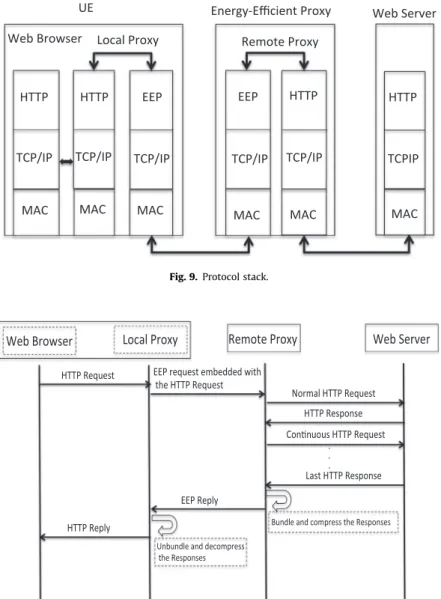
serv-ers as shown inFig. 9, where the detailed protocol stack is
illustrated. EEP protocol enables the local-remote commu-nication, where compression algorithms and levels can be specified, the knowledge of transmission medium (3G or WLAN) can be shared, and the payload data can be
inter-preted by both sides (detailed in Section4.3).
As seen inFig. 10, once a new HTTP request is generated
by the browser, it is then forwarded to the Local Proxy, where the URL of each HTTP is hashed as a 128-bit index using SHA-1. The hashed indexes are stored in the Local Proxy to map to the corresponding EEP reply, which con-sists of EEP header, the URL hash and compressed HTTP re-sponse. The Local Proxy compresses the request before capsulating it as EEP payload and sending it over the air.
After being received by the Remote Proxy, the EEP re-quests are examined and different actions are taken depending on the request types. If the type is for web ob-jects, the requests are then forwarded to a dedicated web engine after decompression. A webpage normally contains a number of web objects not only the HTML page. These eventually generate more than one HTTP request after parsing the HTML document. The web engine is able to build Document Object Model (DOM) tree based on the HTML document, and evaluate JavaScripts, which may gen-erate new requests for web objects. Therefore, all the web
Fig. 8.Architecture of energy-efficient proxy.
objects associated with the request can be fetched from web servers. When the HTTP response is received, the Re-mote Proxy compresses the response’s header, and the
payload selectively (detailed in Section 4.4). Since HTTP
is stateless, HTTP cookies and some other header fields are used to maintain certain consistency between the web browser and web servers. Thus, the HTTP response headers are also kept in EEP replies. After all the web ob-jects are downloaded, the Remote Proxy sends them back in sequence as a single bundle to the Local Proxy. Once the Local Proxy receives the EEP reply, it unbundles and decompresses the reply so that the original HTTP re-sponses including headers and payloads are reconstructed. There might be the case that HTTP responses requested by the web browser are missing from the reply due to the dif-ferences between the web browser in the UE and web en-gine in the Remote Proxy, or the requests generated by web engine related JavaScript codes. The web browser
can request for the missing content until the whole web-page is loaded.
4.2. Bundling
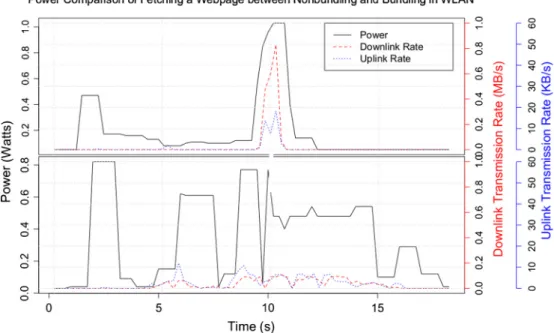
As discussed, persistent and pipelining HTTP still suffers from the issue when web objects are kept in multi-do-mains. By having bundling mechanism, both DNS resolving and HTTP fetching can be entirely offloaded from the mo-bile device to the Remote Proxy. Besides, bundling splits the TCP connections between the mobile device and web servers to optimise TCP behaviour over congested wireless links. The main benefit from the bundling mechanism is not only to keep the link utilised during the transmission and reduce overhead of maintaining multiple TCP connec-tions, but also to keep the mobile device in lower power consumption state during the period of web object
fetch-ing and bundlfetch-ing in the Remote Proxy. InFigs. 11 and 12,
Fig. 9.Protocol stack.
the operating power of fetching a webpage with size of 678 KB using bundling and unbundling mechanisms in WLAN and 3G is depicted. As shown, the download time reduces from 15 s to 9.5 s in WLAN network, and from 20 s to 17 s in 3G networks. After TCP connection setup and the EEP request is sent, the operating power of fetch-ing with bundlfetch-ing in WLAN drops immediately and keeps in lower power consumption state until the bundled reply is back. The total energy consumption reduces from 6.15 Joules to 2.69 Joules. In the case of fetching in 3G network, the difference is that the operating power declines only to the operating power of Cell_FACH state not Cell_PCH state, since the value of T2 timer was shorter than the time of
spending on bundling. Furthermore, the energy consump-tion is able to drop from 17.84 Joules to 14.36 Joules.
It is worth mentioning the fast dormancy here, which
was introduced to 3GPP Release 8[45,46]to offer the
pos-sibility for the UE to control the state changes actively rather than only being controlled by RNC. A Signalling Con-nection Release Indication (SCRI) message is explicitly sent to the network to indicate the desire of state demotion. With the fast dormancy, it is possible for the UE to enter Cell_FACH or Cell_PCH immediately after the EEP request is sent. This provides the potential to increase the energy savings offered by the EEP proxy. However, the feasibility of applying the fast dormancy for web traffic requires the
Fig. 11.The operating power of fetching a webpage with/without bundling in WLAN network.
Fig. 12.The operating power of fetching a webpage with/without bundling in 3G network (1 Mbps).
knowledge of the aggregated traffic of all applications to predict a long enough period for the changing to dormant mode. The accuracy of prediction is also often compro-mised since applications act independently and users in-puts introduce randomness. Some research has being
carried on studying the problems[47,48].
4.3. Header compression
HTTP header compression was already proposed in few
studies[26,43]and their main purpose of reducing the size
of header is to improve the serialisation latency to send quests, especially in low bandwidth networks, and also re-duce the size of replies. Based on the measurements we did
against Alexa top 100 websites[43], the average size of all
the HTTP requests for the HTML documents during first view (meaning visiting the website for the first time) is 395 bytes, and the average size during repeat view (mean-ing a return(mean-ing visit) is 602.17 bytes. The differences be-tween the two views are that some web objects may have been already cached in browser, and HTTP requests normally have cookies associated. After the header com-pression and EEP header added, the average size of EEP re-quests without cookies included is 296.84 bytes, and that of EEP requests with cookies included is 432.09 bytes. Compared with non-compressed headers, the average size of EEP headers in the both cases are reduced 28.2% and
24.9% respectively. InFig. 13, the cumulative distributions
of the size of the four types of headers are illustrated. The most important reason of integrating HTTP header compression in the system is that compressing the re-quests offers possibility of keeping the mobile device in an even lower power consumption state after sending the
new requests. As seen inFig. 14, a normal HTTP request
to ‘‘www.wikipedia.org’’ sent from the N9, and its operat-ing power went up to Cell_DCH state and then took 24.01 s to switch back to initial power consumption state. When the request was sent as an EEP request, the N9 only
switched to Cell_FACH state and was able to enter Cell_PCH state in 13.57 s. The size of the HTTP request including its cookie is 451 bytes and it reduces to 337 by-tes as a EEP request. The mobile device was kept in Cell_-FACH instead of Cell_DCH due to the size reduction, which grants the device the chance of staying in a relative lower power consumption state during the period between sending the request and starting to receive the bundled reply.
The triggering to different RRC states is decided by whether the size of requests reaches the buffer threshold. As it is size-depended, we show how much energy could be saved if header compression is applied over requesting
Alexa top 100 websites[44]inFig. 15. In average, the
en-ergy consumption of the requests without cookies in-cluded reduces 4.7%, and that of the requests with cookies included reduces 26.7%.
200 400 600 800 0.0 0 .2 0.4 0 .6 0.8 1.0
Header Size (Bytes)
CDF
HTTP Header
HTTP header including cookies EEP Header
EEP header including cookies
Fig. 13.CDF of the size of HTTP and EEP headers.
0 5 10 15 20 25 0.0 0 .2 0.4 0 .6 0.8 1 .0 1.2 Power (Watts) Time (Second) EEP Request HTTP Request
Fig. 14.The operating power of sending HTTP requests with/without HTTP header compression in 3G networks.
4 6 8 10 12 14 0.0 0.2 0.4 0.6 0 .8 1.0
Energy Consumption (Joules)
CDF
HTTP Header
HTTP header including cookies EEP Header
EEP header including cookies
Fig. 15.CDF of energy consumption for sending HTTP requests with/ without HTTP header compression in 3G network.
4.4. Selective compression
Nowadays, the size of screen for mobile devices tends to be increasingly bigger, given that the usage penetration of the mobile devices with bigger screen is higher than nor-mal ones in consuming the Internet content and services [24]. Besides, the market share of tablet is expected to reach a new high of 190 million shipment units with year-on-year growth of 48.7%, and will surpass desktop
PCs in 2013[21]. Based on these two facts, it might not
be necessary to wrap text and decrease image resolution
in original web content. Unlike.mobi[22]and Opera mini
[23], our solution applies loss-less compression to reduce the number of bit transmitted over the air, and keep con-tent unchanged when it reaches mobile users.
According to our previous study[32], there is a trade-off
between computation and transmission over wireless links when using compression to save energy on mobile devices. Compression squeezes the amount of bytes transmitted over the air to reduce transfer size and improve response time, but increase the energy consumption spending over compression/decompression. Thus, compression-enabled communication should take the type of transmitted data, bandwidth of wireless link and energy consumption of
compression/decompression into consideration. The
scheme to achieve the energy-efficient communications is called selective compression. The compression condition
is determined by two ratios. One isRthresholddefined as the
ratio of the energy consumption of receiving one bit to the energy consumption of decompressing one bit. The other is
R, which is defined as the ratio of the number of bits of
compressed data to that of deducted data (the delta be-tween compressed and uncompressed data). The
deriva-tion can be found in our previous study [42]. The ratio
Rthreshold is approximately constant and can be obtained
from measurements on given specific mobile device. Therefore, selective compression examines every received
object. IfRover this object is less thanRthreshold,
compres-sion is applied. Compared to selective comprescompres-sion, HTTP compression uses public domain compression algorithms to encode text-based files such as HTML, XML, JavaScript and CSS files, and other file formats like ICO and SVG files. Since transmitting one bit over the air is energy-costly, the selective compression is able to improve the energy saving further by carefully checking the web object.
5. System evaluation
To evaluate the system, the downloading time of tested webpages, and the energy consumption of fetching the webpages are used as metrics. In this section, we first
introduce the experimental setup and measured
perfor-mance metrics in Section5.1, and then the implementation
is briefly discussed in Section5.2. Experimental results are
given in Section5.3.
5.1. Experimental workload, testbed and measured performance metrics
Table 1shows the characteristics of our selected work-load. The solution tends to keep the original content as mush as possible, thus the selected webpages are not their
mobile versions. There are 4 webpages1 chosen, namely
‘‘ETSI reference web page ‘‘Copernicus’’[34]’’, and the front
pages of ‘‘www.ebay.com’’, ‘‘www.youtube.com’’ and
‘‘www.tumblr.com’’ presenting ‘‘Small’’, ‘‘Medium’’, ‘‘Large with more web objects’’ and ‘‘Large with less web objects’’ respectively. All the webpages were kept as original
We set up our experimental testbed as shown inFig. 16.
The Nokia N9 was used as a mobile client, in which we in-stalled the Local Proxy code, a customised web browser based on QWebkit enabling automative measurements, and the Nokia Energy Profiler to record the operating power and downlink/uplink speed. A DLink DIR-815 wire-less router was used for WLAN measurements. The router offers maximum 54 Mbps downlink throughput theoreti-cally and the N9 can achieve around 13 Mbps downlink speed and 5 Mbps uplink speed in practice. The Elisa Fin-land commercial 3G network was used for initial measure-ments and a Nokia Siemens Networks Flexi Multiradio BTS with 3GPP Release 6 specifications was used for evaluating the system, with which we were able to control the net-work parameters such as subscription rates and the values of inactivity timers. The Remote Proxy was installed on a Linux machine with the specification of 2.4 GHz Intel Core i3 CPU and 3.2 GB memory.
In the same machine, two virtual machines were cre-ated as middle boxes with netem installed to create delay and packet losses between the N9 and the proxy, and be-tween the proxy and a web server, where tested webpages were servered by an HTTP compression enabled Apache HTTP server Considering the real scenarios in WLAN net-works, wireless APs are located close to users’ mobile de-vices but the dede-vices suffer from the delay and packet loss over the links between the APs and web servers, which are sometimes located far away from each other. Thus, we introduced 150 ms delay in the netem box B during the measurements for the WLAN network, except the mea-surements of evaluating the performance over RTTs, where the delay varied. As analysed in Section 2.1, the spurious
1
Captured on April 12, 2012. Table 1
Measured webpages.
Wegpage Type Size # of CSS # of JavaScripts # of images Total # of web objects
Copernicus Small 254 KB 1 0 38 41
Ebay Medium 678 KB 3 3 37 45
Youtube Large 1 1.43 MB 2 3 84 92
Tumblr Large 2 1.2 MB 3 5 18 27
delay in 3G networks is mainly due to allocation/de-alloca-tion of network resources, buffering and bandwidth shar-ing among users. Since the testbed we had for evaluation in the 3G network did not have traffic load and the end-to-end delay was around 60 ms, we applied 350 ms delay in the netem box A during the measurements for the 3G network, except when the performance over RTTs was evaluated. It is prevalent to delegate static web content to Content Delivery Networks (CDNs) to get the content rapidly and reliably delivered to end-users. Therefore, there was only 15 ms delay introduced in netem box B.
We evaluate the performance of our solution mainly from perspectives of network quality, web content, proxy functionalities and models of mobile devices to explore how these metrics affect QoE of mobile Web access in terms of downloading time and consumed energy. The de-tailed metrics of measured performance are listed in Table 2.
5.2. Implementation
The system was implemented over Qt SDK version 4.8, which is a cross-platform application and UI framework. Qt APIs speed up the development of networking related functionalities and also provide QWebkit library giving the ability to parse web content easily. Since Qt provides high reusability of one code base for multiple platforms, the Local Proxy on the Nokia N9 and Remote Proxy on a Li-nux machine share part of the source code for the EEP
pro-tocol stack, the functionalities of compression/
decompression and HTTP connection. We also used Qt Quick, a CSS/JavaScript-like programming language for ra-pid UI creation, to implement a mobile application to dem-onstrate the system in term of downloading time and energy saving.
5.3. Results
In this section, we try to answer the following ques-tions: (1) How much can the proxy improve web access? (2) How much energy the proxy can save? (3) How web content, network delay and link speed affect the results? (4) How the inactivity timers affect the results in 3G network?
5.3.1. Network quality
This section presents the results of comparing the per-formance of downloading the medium-sized test webpage over different RTTs using the normal web browsing or using the proxy with bundling and selective compression
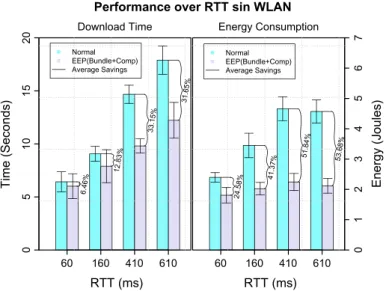
enabled.Figs. 17 and 18show the download time and
en-ergy consumption comparison in the WLAN and 3G net-works respectively. The average values are presented in bar charts and their 95% confidence intervals are also given to indicate the reliability of the measurements. In order to emphasise the improvements, the saving in percentage for both cases are marked next to the curly brackets.
We evaluated the proxy under four different network latencies, namely 60 ms, 160 ms, 410 ms and 610 ms, which were introduced to netem box B for WLAN and ne-tem box A for 3G. As seen in the figures in general, the sav-ings increase as the delay grows in both the networks. With the normal web browsing, the download time and energy consumption increase dramatically as expected. The time and energy consumption increase 178% and 90% in the WLAN network, and 116% and 109% in the 3G net-work respectively when the delay increases from 60 ms to 610 ms. Compared to the performance of using the nor-mal browser, the solution of using the proxy is resistant to the network delay resulting in only 17% more spent time and 43% extra energy consumption in the WLAN network. Even through the download time increases considerably when the delay rises in the case of using the proxy, the growth of energy consumption is contained in a small scale since the header compression and bundling give the mo-bile device the chance to remain in lower power consump-tion state.
Since the link speed in WLAN is typically not limited in APs in normal scenarios, we mainly focus on how link speed affects the performance of the proxy in the UMTS
network as demonstrated inFig. 19, where the proxy was
evaluated under two different subscription plans. As indi-cated, the solution of using the proxy gains more benefit over slow or congested wireless links. As the link speed
in-Fig. 16.Measurement setup.
Table 2
Measured performance metrics.
Network Quality/parameter Proxy functionalities Metrics
RTT (ms) Bundle
Throughput (Mb/s) Compression Packet Loss (%) Caching Inactivity timer (s)
Web content Device models
Size of page (B) Hardware # Of web objects Operating system
creases fivefold in the new subscription plan, the time and energy spent on downloading the bundle decrease result-ing in less savresult-ing correspondresult-ingly. We also evaluated how packet loss rate affect the performance of
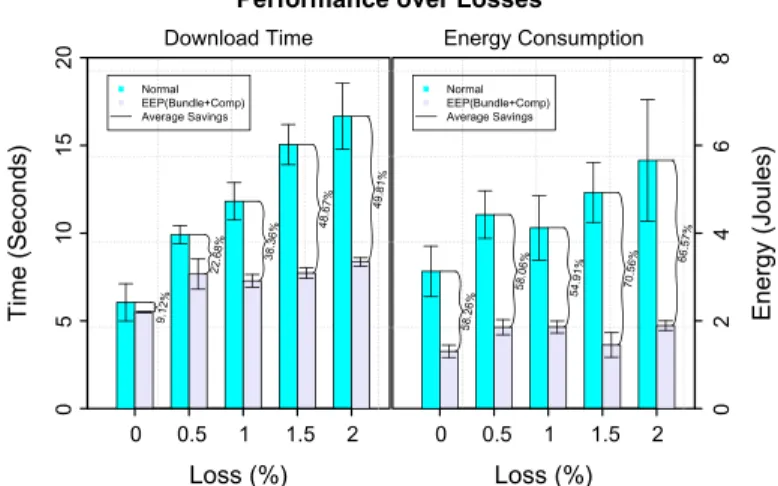
download-ing a webpage inFig. 20. As the packet loss rate grows from
0% to 2.0%, the time saving of using the proxy increases from 9.12% to nearly 50%. Given the measurement case, the energy can be saved over 58.26% when there is no packet loss, and increases to nearly 70.56% when the pack-et loss rate grows over 1.5%.
5.3.2. Inactivity timers
In order to improve battery life, the mobile device that has been in the higher power consumption states for a per-iod of time without sending or receiving any data can be
moved to the lower power consumption states. The period of time is decided by the inactivity timers, which are con-figurable in the RNC. We examined three different
combi-nations of T1 and T2 values as shown inFig. 23. Since the
timers do not affect download throughput and the behav-iour of the process, download time basically keeps con-stant when using the proxy thought all the value combinations. The energy savings are slightly decreased as the values of timers are increased. As observed in the measurements, the time spent on fetching and bundling is approximately 3.5 s. Considering the values of the tim-ers, the N9 was able to enter the lower power consumption after sending a request when T1 is less than 3.5 s in this particular test case. Thus, when T1 is 2 s and T2 is 1 s, the N9 can entirely enter Cell_PCH state but reside there 60 160 410 610 0 5 10 15 20 Time (Seconds) RTT (ms) Download Time 60 160 410 610 012 3 45 67 Energy (Joules) RTT (ms) Energy Consumption 6.46% 12.83% 33.15% 31.65% Normal EEP(Bundle+Comp) Average Savings 24.58% 41.37% 51.84% 53.68% Normal EEP(Bundle+Comp) Average Savings Performance over RTT sin WLAN
Fig. 17.Download time and energy consumption of Medium-sized webpage over different RTTs in WLAN. There is 0% packet loss rate introduced by the netem boxes. 11.86% 21.92% 20.63% 32.83% 60 160 410 610 0 5 10 15 20 Time (Seconds) Download Time Normal EEP(Bundle+Comp) Average Savings 5.12% 22.11% 32.31% 34.95% 60 160 410 610 05 10 15 20 Energy (Joules) RTT (ms) RTT (ms) Energy Consumption Normal EEP(Bundle+Comp) Average Savings Performance over RTTs in 3G
Fig. 18.Download time and energy consumption of Medium-sized webpage over different RTTs in 3G. There is 0% packet loss rate introduced by the netem boxes, and 15 ms delay introduced in netem box B. The subscription rate is 1Mbps, and the timers are 3 s and 2 s for T1 and T2.
for only half second. This explains why the differences of energy savings are minimal. This type of measurements was done when there was 15 ms delay introduced in ne-tem box B, which is the scenario that the web content is lo-cated in CDNs. However, there are still a large fraction websites running without supporting of CDNs. Then the delivery time of web content from these websites to the proxy could be longer and offer the N9 longer residency in the lower power consumption states.
5.3.3. Web objects
Figs. 21 and 22present the effect of the content of web-pages over the performance in the WLAN and 3G networks respectively. The number of bytes of the webpages decides the download time and energy consumption directly as comparing small-sized, medium-sized and large-sized webpages. Since the most of objects in small-sized page are images, the savings over this page is limited but the
proxy still can achieve 31.82% energy saving in the WLAN network and 28.56% energy savings in the 3G network. It is worth mentioning the comparison between Large 1 and Large 2 webpages. Both of the webpages are similar-sized, but the first one outnumbers the second one in terms of the number of web objects. The web browser in-stalled in the N9 was built based QWebkit, which limits the number of requests executed in parallel to 6 for one host/port combination, and no HTTP pipelining enabled. Thus the browser has to request the web objects more times over each connection resulting in longer download-ing. As seen in the figures, the download time of the Large 1 webpage is 33% and 30% more than that of Large 2 web-page in WLAN and 3G networks. The correspondent energy consumption is 52% and 51% more, respectively. Using the proxy, we are able to reduce the energy consumption of loading the Large 1 webpage down to 62.38% and 65.37% in each network. 20.63% 16.12% 1M 5M 02468 1 0 1 2 1 4 Time (Seconds) Rate (Byte/Second) Download Time 32.31% 11.86% 1M 5M 0 2 4 6 8 10 12 14 Energy (Joules) Rate (Byte/Second) Energy Consumption Normal EEP(Bundle+Comp) Average Savings Normal EEP(Bundle+Comp) Average Savings Performance over Subscription Rates in 3G
Fig. 19.Download time and energy consumption of Medium-sized webpage over subscription rates in 3G. There is 0% packet loss rate introduced by the netem boxes, 350 ms delay introduced in netem box A and 15 ms delay introduced in netem box B. The timers are 3 s and 2 s for T1 and T2.
9.12% 22.68% 38.36% 48.67% 49.81% 0 0.5 1 1.5 2 0 5 10 15 20 Loss (%) Download Time Normal EEP(Bundle+Comp) Average Savings 58.26% 58.06% 54.91% 70.56% 66.57% 0 0.5 1 1.5 2 0 24 68 Loss (%) Energy Consumption Normal EEP(Bundle+Comp) Average Savings Performance over Losses
Time (Seconds) Energy (Joules)
Fig. 20.Download time and energy consumption of Medium-sized webpage over different packet loss rates in WLAN. There is 150 ms delay introduced in netem box B.
5.3.4. Features
Figs. 24 and 25show the performance over the func-tionalities provided by the EEP proxy. As seen in the fig-ures, the medium-sized webpage was taken as an example to demonstrate the impacts from each scheme. As more energy saving schemes are applied to the proxy, the savings incrementally increase in general. As indicated in Section 4.3.1, the time saving becomes significant only when the network delay is over 400 ms in the 3G network. Compared to the WLAN network, the energy saving in the 3G network is also less significant when using bundling. Since the energy saving mechanisms in WLAN and 3G net-works behave differently, the percentages of the savings brought by bundling are different as well. In the 3G net-work, the time spent on fetching and bundling of the web-page by proxy is relatively too short to let the inactivity
timers expire resulting in that the N9 does not have the chance to enter Cell_PCH state or stay there longer enough after the proxy receives the request for the webpage. The selective compression is more meaningful when the web-page is transmitted over high-delayed and congested wire-less link, e.g. the 3G network with 350 ms delay and 1Mbps subscription rate. As to the caching, the benefit it brings is trivial since the cache mechanism provided by Qt always asks the web server to send the web object only if it has changed, when the proxy has the web object in its local cache. HTTP requests with a header field ‘‘If-Modified-Since’’ are sent for every cached web object. If the server tells the proxy that the web object has not changed since last fetching time, in this case, the server sends HTTP ‘‘304 Not Modified’’ reply containing only HTTP header without payload. Even though it reduces the amount of Small Large 1 0 5 10 15 20 Time (Seconds) Webpages Download Time Small Large 1 02 46 8 Energy (Joules) Webpages Energy Consumption 10.56% 40.85% 20.89% 26.28% Normal EEP(Bundle+Comp) Average Savings 31.82% 61.19% 37.62% 50.95% Normal EEP(Bundle+Comp) Average Savings Performance over Webpages in WLAN
Fig. 21.Download time and energy consumption of Medium-sized webpage over different webpages in WLAN. There is 0% packet loss rate introduced by the netem boxes, and 150 ms delay introduced in netem box B.
22.58% 20.63% 29.14% 25.31% Small Large 1 0 51 0 1 5 2 0 Time (Seconds) Webpages Download Time Normal EEP(Bundle+Comp) Average Savings 28.56% 32.31% 34.63% 21.26% Small Large 1 0 5 10 15 20 Energy (Joules) Webpages Energy Consumption Normal EEP(Bundle+Comp) Average Savings Performance over Webpages in 3G
Fig. 22. Download time and energy consumption of Medium-sized webpage over different webpages in 3G. There is 0% packet loss rate introduced by the netem boxes, 350 ms delay introduced in netem box A and 15 ms delay introduced in netem box B. The subscription rate is 1 Mbps, and the timers are 3 s and 2 s for T1 and T2.
transmitted data by not sending the web object in HTTP re-ply, it always involves a roundtrip delay between the ser-ver and proxy, which compromises the improvement offered by the cache.
5.3.5. Hardware and OS
To evaluate the effect of different hardware and operat-ing system, a more recent popular smart phone, the Sam-sung Galaxy SIII LTE, was compared to the Nokia N9. The
specifications of the two devices are listed inTable 3. Since
the original code of our Local Proxy was written in Qt and C++, we ported the code to the Android platform via
Nec-essitas[52], which adds a dynamic library and a Java
appli-cation wrapper to the original code. To our knowledge, there is no suitable software to provide accurate power measurement results on the Android platform, similar to what we can obtain from the Nokia Energy Profiler on
Meego platform. Thus, we used a power meter MAHEG HM8115-2 with a power socket HZ815 to measure the operating power of the Galaxy SIII. With the power socket, the power measurement of tested devices can be done with micro USB power cable connected to the phone on one side and plugged into the HZ815 on the other side. The comparison used the ETSI reference web page ‘‘Coper-nicus’’ in real WLAN and 3G networks.
As can be seen inFig. 26, the performance of the Galaxy
SIII is slightly better than that of the N9, which is under-standable, given that Galaxy SIII was released nearly one year later. More powerful CPU/GPU leads to faster execu-tion of JavaScript and page rendering. Moreover, a more re-cent radio chipset can potentially result in less operating power and faster download. In general, the EEP solution provides significant download time and energy savings on both modern mobile devices.
Fig. 23.Download time and energy consumption of Large 1 webpage over inactivity timers in 3G. There is 0% packet loss rate introduced by the netem boxes, 350 ms delay introduced in netem box A and 15 ms delay introduced in netem box B. The subscription rate is 1 Mbps.
35.03% 39.06% 48.32%
Normal Bundle Bundle+CompBundle+Comp+CacheNormal Bundle Bundle+CompBundle+Comp+Cache
02468 1 0 Time (Seconds) Download Time 55.54% 57.16% 63.01% 01 2 345 Energy (Joules) Download Energy
Performance over Features in WLAN
Fig. 24.Download time and energy consumption of Medium-sized webpage over different features in WLAN. There is 0% packet loss rate introduced by the netem boxes, and 150 ms delay introduced in netem box B.
6. Discussion
In this section, we present the other observed perfor-mance results, and discuss further optimisations and possi-ble improvements for the system.
6.1. CPU and memory
Compared to the normal web browsing, extra re-sources of the mobile device have to be assigned to the tasks of unbundling and decompression when using the 5.68% 20.63% 21.72% 0 2 46 8 10 12 14 15.87% 32.31% 34.68% 0 2 4 6 81 0 12 14
Performance over Features in 3G
Download Time Download Energy
Time (Seconds) Energy (Joules)
Normal Bundle Bundle+CompBundle+Comp+CacheNormal Bundle Bundle+CompBundle+Comp+Cache
Fig. 25.Download time and energy consumption of Medium-sized webpage over different features in 3G. There is 0% packet loss rate introduced by the netem boxes, 350 ms delay introduced in netem box A and 15 ms delay introduced in netem box B. The subscription rate is 1 Mbps, and the timers are 3 s and 2 s for T1 and T2.
Table 3
Comparison between Nokia N9 and Galaxy SIII.
Model OS Processor Memory Display Released date
N9 MeeGo R1.2 1G Cortex-A8 1 GB AMOLED 3.900 29.09.2011
Galaxy SIII Android 4.0.4 1.4G Cortex-A9 1 GB AMOLED Plus 4.800 29.05.2012
28.36% 32.56% N9 Galaxy SIII 0123456 Time (Seconds) Download Time Normal EEP(Bundle+Comp+Cache) Average Savings 33.80% 29.88% N9 Galaxy SIII 012345 Energy (Joules) WLAN Energy Consumption Normal EEP(Bundle+Comp+Cache) Average Savings 23.43% 25.69% N9 Galaxy SIII 02468 Time (Seconds) Download Time Normal EEP(Bundle+Comp+Cache) Average Savings 26.16% 30.72% N9 Galaxy SIII 0 2 4 6 8 10 12 Energy (Joules) 3G Energy Consumption Normal EEP(Bundle+Comp+Cache) Average Savings
Fig. 26.Download time and energy consumption of Nokia N9 and Samsung Galaxy SIII in WLAN and 3G networks.
proxy. As observed, the CPU usage of the normal web browsing is about 15.74% when fetching the medium-sized webpage. In case of having bundling and compres-sion enabled, the CPU usage increases to 19.17%. The memory usage only increases 2.22 MB when the proxy is in use, respectively. The CPU and memory usages vary across different webpages. The CPU usage increases among the four webpages are 21.56%, 7.21%, 17.91% and 9.15% respectively. Moreover, there is no substantial difference in memory usage, the range of which is within 2.8%.
6.2. Network traffic
The uplink and downlink network traffic through the mobile device were examined. To determine how much traffic can be reduced, we recorded the number of bytes that went through the 3G interface. The pool of tested webpages was selected from Alexa top 100 global sites and the webpages were determined by pareto distribution based on their ranks. There were 1000 requests for the cho-sen webpages cho-sent for each case. The EEP approach is ex-tremely efficient and causes 62.7% reduction in terms of the number of bytes sent out from the mobile device, since only one EEP request and TCP acks for downloading EEP plies are needed. For the downlink traffic, the amount re-duce 6% due to the compression. Overall, there is 11% traffic reduction for total number of bytes transmitted over the air. The traffic reduction relieves the network burden and especially alleviates the possibility of peak traffic dur-ing rush hour. Moreover, considerdur-ing the current cost of international roaming charges ranges are from $4.08 in Greece to $24.06 in Canada per megabyte of data, and
the average price of OECD is $9.27 in 2011[49], the proxy
is also helpful to reduce the expense of users spent on web service when being abroad.
One more thing worth discussing is the statistical properties of web traffic, especially Self-Similarity (SS) and Long-range Dependence (LRD), which are largely verified properties of Internet traffic, severely affecting network queuing performance. SS is the property show-ing an object’s appearance is unchanged regardless of the scale of time. When this property is observed at a wide range of time scales, it can exhibit LRD, meaning values of any instant are positively correlated with val-ues at all future instants. Since the bundling transfers traffic pattern into FTP-alike traffic, which shows a hea-vy-tailed distribution, the traffic would still maintain self-similar. But the aggregated file transfer can affect the degree of exhibited characteristics of self-similarity [50]. Moreover, the proxy would also change web traffic models, like ON/OFF model, where self-similar traffic can be built by multiplexing a large number of ON/ OFF sources that have ON and OFF period. Bundling would change ON times corresponding to the transmis-sion duration of individual web objects, since all the web objects arrive at the same time. However, if a HTTP request matches a bundle, the traffic can still be modelled with ON/OFF model with different ON and OFF periods.
6.3. Cookies
One of the reasons to design the system in such way is to keep all necessary information (cookies, ETag, etc.) embedded in HTTP headers delivered from web server to mobile client. The cookies are commonly used as the most important way to keep consistency of web services for remembering browsing histories and user login states. However, the way how the mobile device works with the proxy breaks the consistency of the cookies. After the EEP request is received by the proxy, the mobile device is not able to associate its cookies to the HTTP requests, which are sent from the proxy to the web server. Hence, the proxy needs maintaining databases to make sure that correct cookies for each particular web browser are associated with the HTTP requests. When the proxy receives HTTP re-sponses from the web server, it records all the cookies into the database associated with the browser it sent the HTTP request on the mobile device. When the proxy receives the EEP request, it appends the cookies to each HTTP request sent to the web browser. The databases are created per web browser basis, and which browser an EEP request is sent from can be identified by a hash index, which is the value of a string consisting a Local Proxy ID and browser’s name. Since only hashed values are stored in the proxy, the user information is kept anonymously. The Local Proxy also creates a database to ensure the reliability of the con-sistency. The database is always consistent with the data-base in the Remote Proxy, since it inherits same design principle. The Local Proxy crosschecks its own cookie data-base with the web browser’s cookie datadata-base. If there is any mismatching, two HTTP header fields defined as ‘‘CookieToAdd’’ and ‘‘CookieToDel’’ are used to notice the Remote Proxy which cookies should be added to the data-base and which cookies should be removed.
6.4. Deployment and scalability
In this paper, the EEP is deployed on a stand-alone proxy to provide energy-efficient and fast web content delivery for end devices. The proxy can be a service offered by an independent third party, or, for example, a telecom operator’s serving gateway could integrate the technology to provide the service for their customers. It can also be a solution for customer premises equipment or femtocells to serve home or corporate users. A further deployment scenario would be to integrate our technology directly into the content server; this way the energy efficient delivery of content can be offered by the content provider without a third party in the middle.
In order to provide an overview of the scalability of the solution, we performed a stress test of the EEP. The server machine where the EEP was installed, was equipped with Intel Xeon E5520 4-core, 2.27 GHz CPU, 3 GB memory and 320 GB SATA-II hard disk. We recorded CPU and mem-ory usage of the server while concurrent requests were coming to the proxy. The test clients were initialising mul-tiple connections to fetch the test page ‘‘Copernicus’’ through the proxy. When there were 500 connections and the concurrency of connections was 50, the consumed
memory was around 10 MB and CPU usage was around 12–15%.
When integrating the solution, device or service owners need to take the additional power consumption into ac-count. The power supply for the server is 200 W. However, we need to point out that the operating power highly de-pends on the use case and the underlying hardware. For example, a home router can serve less users that the server above, and the operating power of such device could be within 10–20 W. The operating power also varies dramat-ically depending on the architecture of hardware platform. For example, in the study of benchmarking two web server
architectures[51], a EnergyCore server was compared with
an Intel Core server. At full CPU utilisation, the EnergyCore server consumed only around 5 W and the Intel Xeon plat-form consumed over 100 W, while the difference in perfor-mance was only around 20%.
7. Conclusion
Our work has shown that delivery of web content is not optimal for mobile devices. To enable the system and radio interface to save power, we have to transmit data in quick bursts instead of a continuous bursty low bit rate stream. Since we use Internet services more and more from bat-tery-powered devices, the bundling concept we have pre-sented could have a huge impact in people’s lives. In the paper, we also analyzed and discussed how radio links and RRC inactivity timers affect energy consumption and content delivery time, demonstrating that significant sav-ings can still be achieved on careful adaption to the radio links and their power saving features and timers.
Our concepts could be well implemented directly into web servers in the future and the client side would be part of web browsers. Current implementation works with most web pages and services on the Internet. In order to cater to emerging web technologies and services, more work is required to make them work properly in our sys-tem. In the future, we will put more focus on qualitative analysis of battery lifetime improvements. Furthermore, with the increasing LTE coverage, we need to investigate how this new mobile technology affects the energy-sav-ings potential of our concepts.
Acknowledgements
The work was partly performed within the ECEWA Pro-ject, funded by the Finnish National Technology Agency Tekes and industry. The authors thank Tero Isotalo form Tampere University of Technology for providing valuable help.
References
[1] ICT Facts and Figures. <http://www.itu.int/ITU-D/ict/facts/2011/ material/ICTFactsFigures2011.pdf>.
[2] Cisco Visual Networking Index: Global Mobile Data Traffic Forecast Update, 2011–2016. <http://www.cisco.com/en/US/solutions/ collateral/ns341/ns525/ns537/ns7.05/ns827/white_paper_c11-520862.html>.
[3] Batteries for Portable ICT Devices. < http://www.itu.int/dms_pub/itu-t/oth/23/01/T230100000E0001PDFE.pdf>.
[4] M.V.J. Heikkinen, J.K. Nurminen, Consumer attitudes towards energy consumption of mobile phones and services, in: Vehicular Technology Conference (VTC 2010-Fall), 2010.
[5] StatCounter. < http://gs.statcounter.com/#mobile_vs_desktop-ww-monthly-201105-201205>.
[6]A. Bakre, B.R. Badrinath, I-TCP: Indirect TCP for mobile hosts, in: Proc. of the 15th IEEE International Conference on Distributed Computing Systems, Vancouver, BC, 1995, pp. 136–143.
[7]K. Brown, S. Singh, M-TCP: TCP for Mobile Cellular Networks, ACM Computer Communication Review (1997).
[8] K. Ratnam, I. Matta, W-TCP: an efficient transmission control protocol for networks with wireless links, in: Proc. IEEE ISCC, 1998. [9] Chakravorty, S. Katti, J. Crowcroft, I. Pratt, Flow aggregation for enhanced TCP over wide-area wireless, in Proc. IEEE INFOCOM, 2003. [10] M.C. Rosu, D. Rosu, An evaluation of TCP splice benefits in web proxy
servers, in Proc. ACM WWW, 2002.
[11] M. Tariq, A. Zeitoun, V. Valancius, N. Feamster, M. Ammar, Answering What-If Deployment and Configuration Questions with WISE, in Proc. ACM SIGCOMM, 2008.
[12] A. Misra, V. Navda, R. Ramjee, V.N. Padmanabhan, E.M. Belding, Cool-tether: energy efficient on-the-fly WiFi hot-spots using mobile phones, in Proc. CoNEXT, 2009.
[13] M. Jimeno, K, Christensen, A network connection proxy to enable hosts to sleep and save energy, in IEEE IPCCC, 2008.
[14] C.C. Lee, J.H. Yeh, J.C. Chen, Impact of inactivity timer on energy consumption in WCDMA and cdma2000, in Proc. IEEE WTS, 2004. [15]J.H. Yeh, J.C. Chen, C.C. Lee, Comparative analysis of energy-saving
techniques in 3GPP and 3GPP2 systems, IEEE Transactions on Vehicular Technology 58 (1) (2009).
[16] N. Balasubramanian, A. Balasubramanian, A. Venkataramani, Energy consumption in mobile phones: a measurement study and implications for network applications, in: Proc. of ACM SIGCOMM Internet Measurement Conference, 2009.
[17] H. Liu, Y. Zhang, Y. Zhou, TailTheft: leveraging the wasted time for saving energy in cellular communications TailEnder, in: Proc. MobiArch, 2011.
[18]A. Abhari, A. Serbinski, HTTP modification to reduce client latency, Electrical and Computer Engineering (2008).
[19]C-H. Chi, H. Wang, W. Ku, Proxy-cache aware object bundling for web access acceleration, Book Web Content Caching and Distribution (2004) 257–273.
[20] M.C. Rosu, C.M. Olsen, C. Narayanaswami, L. Luo, PAWP: a power aware web proxy for wireless LAN clients, in: 6th IEEE Workshop on Mobile Computing Systems and Applications, 2004.
[21] Worldwide Smart Connected Device Market Crossed 1 Billion Shipments in 2012, Apple Pulls Near Samsung in Fourth Quarter, According to IDC. <http://www.idc.com/ getdoc.jsp?containerId=prUS24037713#.UVNGAldVV8E>. [22] .mobi. <http://dotmobi.mobi/content/aboutmobi>. [23] Opera Mini. <http://www.opera.com/mobile/features/>.
[24] Shocker: Smartphone Users Like Bigger Screens, Market Share may Respond Accordingly. <http://www.engadget.com/2012/09/03/ shocker-smartphone-users-like-bigger-screens/>.
[25]G. Xylomenos, G. Polyzos, P. Mahonen, M. Saaranen, TCP performance issues over wireless links, IEEE Communications Magazine 39 (4) (2001).
[26]R. Chakravorty, A. Clark, I. Pratt, Optimizing web delivery over wireless links: design, implementation, and experiences, IEEE Journal on Selected Areas in Communications 23 (2) (2006). [27] Pocket.http://getpocket.com/.
[28] M.C. Chan, R. Ramjee, TCP/IP performance over 3G wireless links with rate and delay variation, in: Proc. the 8th Annual International Conference on Mobile Computing and Networking, 2002. [29]K.C. Barr, K. Asanovic, Energy-aware lossless data compression, ACM
Transactions on Computer Systems 24 (3) (2006) 205–291. [30] L. Wang, J. Manner, Energy consumption analysis of WLAN, 2G and
3G interfaces, in: Proc. of 2010 IEEE/ACM International Conference on Green Computing and Communications, 2010.
[31] RFC 2616 – Hypertext Transfer Protocol – HTTP/1.1. http:// www.faqs.org/rfcs/rfc2616.html.
[32] L. Wang, J. Manner, Evaluation of data compression for energy-aware communication in mobile networks, in: Proc. of International Conference on Cyber-Enabled Distributed Computing and Knowledge Discovery, 2009.
[33] R. Maddah, S. Sharafeddine, Energy-aware adaptive compression scheme for mobile-to-mobile communications, in: Proc. of IEEE 10th International Symposium on Spread Spectrum Techniques and Applications, 2008.