A GUIDE TO BUILDING
UNIVERSAL NETWORK
APPLIANCES
OEM network appliance
vendors can develop
new network appliances
faster based on a reliable
hardware platform
High performance systems have traditionally been associated with customized, proprietary hardware platforms. The rationale is that in order to provide high performance, a unique hardware design is required. For network appliances, this rationale might now be superseded by the rise of a new trend referred to in this paper as universal network appliances. A network appliance is a stand-alone, dedicated device or system that focuses on a particular networking task, such as network monitoring, network test and measurement, network optimization or network security. The traditional approach to building these systems has been to develop customized, proprietary hardware platforms. But, over the last few years, many vendors of network appliances have adopted a universal network appliance approach.
A universal network appliance can be defined as a generic hardware platform upon which a broad range of network appliances can be implemented in software. The hardware platform provides the bandwidth, processing power and fast input/output data management to allow very high performance network appliances to be implemented. Universal network appliances are based on commercial off-the-shelf components and therefore require no hardware development by the network appliance vendor.
Now, OEM network appliance vendors can develop new network appliances faster based on a reliable hardware platform with proven processing power and full throughput capacity. All that is required is the ability to integrate the off-the-shelf components and develop the application software that will define the specific features of the network appliance. The advantage of this approach is that it allows network appliance vendors to concentrate on the value-adding software features that define their network appliances, while also reducing time-to-market, resource usage and cost. Furthermore, these benefits can be achieved without the need to compromise on raw performance.
The approach also provides freedom of choice. OEM vendors can choose the PC server and accelerator for network monitoring and security that best meets their needs and fulfills the performance criteria.
The key components of a universal network appliance are: • Standard PC servers with underlying server CPU
processing and memory architecture • Intelligent network adapters
• Customer proprietary application software defining the specific functions of the network appliance
• High-speed storage solution for capture-to-disk that will allow intelligent indexing for fast retrieval of captured data This paper will look at each of these components in more detail.
THE GENERIC CHARACTERISTICS OF NETWORK APPLIANCES
Network appliances have certain generic characteristics that are common to a number of applications, be it a network security appliance or test and measurement system or network performance management system. These generic characteristics are:
• It is a stand-alone device dedicated to a particular application
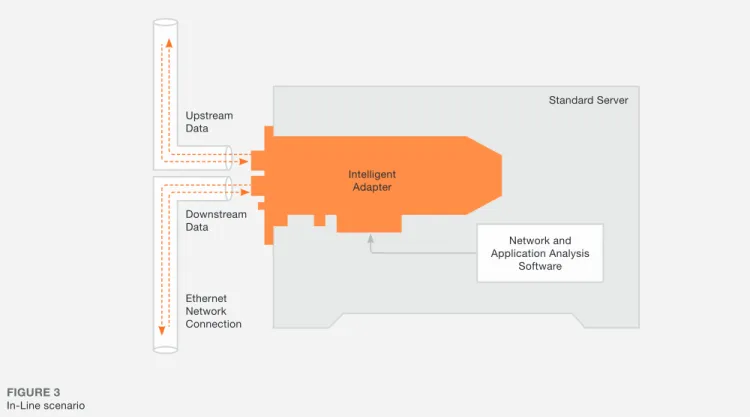
• It can either sit “out-of-line” (i.e. capturing or “sniffing” packets) or “in-line” (i.e. as part of the link both receiving and transmitting data) depending on the needs of the application
• It requires fast, high-speed data input/output with full throughput for all packets no matter the packet size • It requires sufficient processing power to process all
received packet data in real time, especially at high line-rates
• It requires efficient memory structures to ensure that there are minimal delays in accessing data
A GUIDE TO BUILDING
Network Performance Monitor Network Test and Measurement System Network Security System Lawful Intercept System Specific network appliances
OEM Vendor System Integration OEM Vendor Application Software Universal Network Appliance Standard PC server
(e.g. Dell, HP, Intel, IBM)
Accelerator (e.g. Napatech NT20E)
These generic characteristics also provide the main
requirements for a universal network appliance. With such a hardware platform, a number of applications can be defined in software to provide the application-specific functionality required. For example:
• Network monitoring systems capturing packets from router SPAN ports or “taps” to measure IP network performance • Network latency measurement systems used to measure at nanosecond accuracy the delay that packets experience through different parts of the network
• Network security appliances where the application-specific functionality could be intrusion detection and prevention functionality. It could also be a network probe providing captured packet data to a security event and information management system.
• Lawful intercept and cyber-warfare systems where security services need to monitor suspicious traffic
The list is not exhaustive, but provides a taste of the broad menu of network appliances that can be implemented.
TRADITIONAL NETWORK APPLIANCE DEVELOPMENT The traditional approach to building network appliances has been to use proprietary hardware design; in other words, to build the hardware platform on a customized, proprietary design. With this approach, one has full control over all components, which, it is argued, ensures that the system is optimized for high performance.
The cost of this approach is the time, resources and technical risk involved in developing a hardware platform. While there are no revolutionary techniques or technology involved, there are always technical risks related to integration issues, errors in design, incompatibilities, etc. These also translate into time costs, as software development must wait until the hardware is available before final development steps can be completed. Even though the manufacture and even the design of the hardware can be outsourced in order to reduce resources, these extra risks and time issues will be of the same magnitude with an added administrative burden in managing the external manufacturing provider.
FIGURE 1
Developing a new network appliance can take from 1 to 2 years and between $10m and $20m depending on the complexity and performance requirements of the product. Certification alone can take several months and has to be completed for every target sales market for the product where each certification can cost several thousand dollars. From a manufacturing perspective, sourcing, inventory and logistics add considerable overhead as well as risk. For example, lead times on key components have grown considerably during the recent recession (some up to 52 weeks). This means that products cannot be built, delaying sales and revenue. Forecasting has also been difficult, which can result in the wrong variant of a product being made leading to higher inventories and binding of critical cash flow in products that potentially cannot be sold. WHY PROPRIETARY DEVELOPMENT?
So why conduct such an effort? When does it make sense to build a proprietary solution rather than considering commercial off-the-shelf alternatives? There are five basic arguments: • Availability: the components and commercial products
required are not available; therefore it is necessary to develop the solution “from scratch”.
• Performance: components and commercial products exist, but they cannot meet the performance criteria required by the application.
• Core-competence: the company considers their core competence to be in hardware (i.e. “we do it better than anybody else”).
• Cost: Using in-house development to lower the per-unit cost or Bill-of-Materials (BOM), but at the expense of high initial investment in R&D
• Business model: Proprietary hardware is part of the business strategy.
AVAILABILITY
In new product segments with high-performance requirements, there can be challenges in meeting market demands with existing technology or off-the-shelf products; particularly if the existing technology or products were not designed with the new application to be addressed in mind. In such circumstances, there is no recourse but to invest in technology or platform development.
Nevertheless, such endeavors are not undertaken lightly, as the risks involved are high. New technology development is one of the highest risk activities that can be undertaken as one is literally “going where no man has gone before”. Exhilarating for engineers, but nauseating for investors! PERFORMANCE
In meeting high-performance requirements, there can be off-the-shelf components and products that can be used, but whose performance is not sufficient to meet market demands. It can, therefore, be necessary to develop part or all of the solution using customized, proprietary hardware. As mentioned earlier, this has traditionally been the case for many network appliances.
It should be noted that with respect to the universal network appliance approach, many network appliance vendors might have tried to use older standard PC servers together with server Network Interface Cards (NIC) only to find that the performance did not meet expectations. Therefore, proprietary platform or network adapter development were the only options available.
However, with the latest generation of servers and intelligent network adapters such as Napatech accelerators, we propose that this situation has changed. See “What is a universal network appliance?” below for a more in-depth discussion on this topic.
CORE COMPETENCE
Many engineering-led organizations take justifiable pride in their ability to provide high-performance solutions. However, such success can often lead to a “not invented here” attitude with arguments against sourcing of off-the-shelf products being based on the need to protect the company’s core competence.
Core competency arguments must take into account the fact that a core competence is only relevant in so far as it contributes significantly to meeting market needs. It is market needs that define the core competencies a company needs to have and not the other way around. It is therefore common that core competencies shift over time as in the case of network appliances today, where the focus is shifting from hardware to software. Differentiation for high-performance
network appliances now resides in the application software and usability of these products and no longer in the hardware on which these products are built.
COST
A low per-unit or Bill-of-Materials (BOM) cost provides a significant advantage either by allowing higher margins or the ability to meet lower price points. However, in order to achieve this, a significant investment needs to be made up-front in addition to a relatively large volume over which to allocate this initial investment. For low-cost, commoditized appliances sold to small businesses, this is a viable strategy. However, for high-performance systems, it is difficult to generate the volume necessary to support this approach. High performance network appliances address a relatively high-margin, low-volume market, which often is not compatible with the financial risk of in-house development. BUSINESS MODEL
The final argument for persevering with in-house custom hardware development is that it is part of the business model. This is an approach often seen in network equipment markets, where the hardware chassis is provided at low cost, but each plug-in module or interface card is thereafter provided at premium prices. Since the chassis is based on a proprietary design with proprietary interfaces, customers have little choice, but to purchase these expensive modules. However, each plug-in or interface module needs to provide significant value to justify investment.
As mentioned earlier, the key differentiating features of network appliances are now provided by the application software and user interface, which makes it difficult to justify such a business model for network appliances (at least based on hardware).
CAN IN-HOUSE NETWORK APPLIANCE HARDWARE DEVELOPMENT BE JUSTIFIED?
From the above discussion, it should be clear that while there might have been a historic basis for pursuing a strategy of in-house hardware development, recent developments can justify a re-assessment. The combination of a shift in competitive emphasis from hardware to software and the availability of a new generation of off-the-shelf products capable of meeting high-performance requirements should prompt network appliance vendors to consider an alternative approach that is better suited to the demands of the future. This alternative approach can be based on universal network appliance building blocks.
WHAT IS A UNIVERSAL NETWORK APPLIANCE?
A universal network appliance is a generic hardware system platform that can be used to implement a network appliance. It is based on commercial off-the-shelf products, but must meet the requirements set out in the “The generic
characteristics of network appliances” section.
For high performance applications, which need to operate in real time on 1 Gbps or 10 Gbps traffic, there are a number of challenges:
• The ability to process a large amount of data quickly • The ability to store data efficiently and in a manner that
allows data to be quickly accessed by processing resources when required and without significant delay • The ability to receive and transmit data quickly without
losing any data or causing delays.
• The ability to accurately time-stamp data for ordering of packets and measurement of latency
Not all applications will need to meet all these requirements, but they will need to meet at least one and often several. The goal is to develop a platform that can address all of these needs and can be used to develop any network appliance. The distinguishing factor should be the application software – in other words, the platform should provide the necessary processing power and input/output capabilities and not introduce bottlenecks, steal processing power from the application software or lose precious data. In short, the goal is to make a universal network appliance.
Today, such a universal network appliance is available and actively used. It is based on a standard PC server from companies such as HP, Dell, Intel, IBM and Cisco, which are based on the well known PCI bus architecture. The performance of standard servers has reached a point where processing power and the associated memory architecture can support high-performance applications requiring real-time processing of data at more than 10 Gbps.
An important and necessary component in the universal appliance is the Network Interface Card (NIC), otherwise known as a network adapter. This provides the network interfaces, which are typically Ethernet interfaces. For low line-rates, such as 100 Mbps and limited time-stamp precision requirements, a server NIC can often be used. However, for higher line-rates, a network adapter designed for real-time packet capture, analysis and transmission is essential.
Memory Up to 18 slots DDR3 memory Memory
Up to 42 lanes PCI Express® (36 lanes PCI Express® 2.0) Up to 25.6 GB/sec bandwidth per link
Intel® Xeon® 5500 Processor Intel® Xeon® 5500 Processor Intel® 5520 Chipset
STANDARD SERVER PLATFORMS
One of the advantages of the large PC market is that there is a constant development effort in new chips and architectures for both clients and servers. The dominance of vendors like Intel and AMD in the high-volume PC market provides a strong business case for continuous development effort. This has resulted in a constant improvement in PC server chipset performance culminating in the latest generation of chips and chipset architectures. As an example, let’s take a closer look at the Intel Nehalem architecture based on the Intel 5500 CPU.
According to Intel the Intel 5500 chip-set provides up to 2.25 times performance improvement compared to the previous Intel server chip-set (the Intel 5400). One of the innovations of the Nehalem architecture is a more efficient memory architecture, which is one of the reasons why Intel can achieve the performance improvement quoted. The integration of the memory controller into the CPU chip itself avoids the use of a shared front-side bus and external memory controller, as was the case with the Intel 5400 chip-set. The use of high speed DDR3 RAM and a three banked memory system provides memory bandwidth of more than 200 Gbps per CPU.
As memory access is often the limiting performance bottleneck of CPU processing, the introduction of a 3-6 times faster memory architecture combined with the introduction of a large layer 3 CPU cache and Symmetric Multi-Threading (SMT), referred to as Hyper Threading by Intel, have succeeded in addressing this bottleneck.
The introduction of Quick Paths (the high speed links between the CPUs and the Controller chip) and a new, very fast PCI Express controller solves two other performance bottlenecks so that data can now be transferred between network adapters and server memory, and between CPU cores, at rates of more than 200 Gbps.
From this short overview, it should be clear that the Nehalem architecture and equivalent chipsets have the processing resources and memory architecture to support even the most demanding real-time 10 Gbps applications, which is also demonstrated by Napatech and our OEM customers. What’s more, developments continue with even more processors being added to form 12-core, 32-core and even higher CPU-core configurations, all with Symmetric Multi-Threading (SMT) capabilities.
Now, all that remains is the data input-output mechanism.
FIGURE 2
Intel Nehalem architecture
Standard Server Network and Application Analysis Software Intelligent Adapter Upstream Data Downstream Data Ethernet Network Connection Tap NETWORK ADAPTERS
NICs are familiar to anyone with a PC server or client. These are the interface cards that provide Ethernet interfaces for connecting to the Local Area Network (LAN) or the Internet. This communication task is also what NICs were designed to perform, namely sending specific Ethernet frames1 to a specific destination denoted by the Ethernet Media Access Control (MAC) address. In these cases, the NIC need only concern itself with the Ethernet frames that are directly addressed to the MAC addresses associated with the ports on the NIC. All other traffic can be ignored.
NICs designed for server applications (server NICs) are optimally designed to handle large frames. The reason for this is that most server applications use the TCP protocol for transfer of data. TCP will seek to use as few and as large frames as possible to transfer data. Using large frames has the advantage for the server application that it reduces protocol overhead, which is directly proportional to the number of frames to be handled. In other words, larger frames means fewer frames with less overhead and more payload throughput.
NICS IN PACKET CAPTURE AND IN-LINE APPLICATIONS For passive packet capture network appliances (see Figure 3) the network appliance is not in control of which frames (size of frames and network load) that need to be processed. Even on a network with low network utilization, bursts of frames (large and small) at full line-rate will occur. Server NICs are unable to handle data at full line-rate, especially data with many small frames. When a burst occurs at full line-rate, not all received frames can be processed. Those Ethernet frames that cannot be processed are dropped indiscriminately regardless of whether they are critical or not. As zero packet loss is important for most packet capture applications, server NICs are simply not suitable for such network appliances. Active in-line network appliances (see Figure 4) have a limited control over which frames the appliance needs to handle. If the in-line network appliance is functioning as a network end-point, the appliance can perform flow control and in this way control the amount of data the appliance needs to handle. Unfortunately this is not the case for most in-line network appliances (e.g. an IPS device). Therefore, these network appliances face the same challenges as passive packet capture network appliances.
FIGURE 3
Passive capture scenario
Standard Server Network and Application Analysis Software Intelligent Adapter Upstream Data Downstream Data Ethernet Network Connection
For some in-line network appliances, a limited packet-loss can be accepted, especially for TCP traffic where end-to-end retransmission of non-time critical data (e.g. web and e-mail traffic). But for real-time traffic, like voice and video, packet loss and retransmission will greatly reduce the quality of the real-time experience. It is for these reasons that server NICs are unsuitable for in-line network appliances.
CHALLENGES OF 10G
There are four important challenges when moving to 10 Gbps: • Processing a large of amount of Ethernet frames and packets • High-precision time-stamping and accurate time
synchronization
• Capturing 10 Gbps data to disk in real time • Efficient traffic generation and transmission
PROCESSING LARGE AMOUNTS OF DATA
Moving to 10 Gbps from 1 Gbps means ten times more Ethernet frames. That means up to 15 million packets can be received every second per port. Most capture applications require two ports to monitor traffic in both directions, while in-line applications will require two duplex ports passing traffic in both directions. This leads to a total capture capacity
demand of 30 million packets. This leads to a lot of interrupts and not much work done by the CPU other than network data processing. In fact, as we will see below in Figure 6, up to 65% of the CPU’s processing resources can be used in handling data processing in a 10 Gbps case (one port). To ensure that the high-performance application in question is operating at maximum performance, the CPU network data processing load should be kept to an absolute minimum. This requires intelligence in the network adapters to off-load network data processing tasks from the CPU, while at the same time intelligently providing captured data to application software without burdening the CPU.
TIME STAMPING AND TIME SYNCHRONIZATION
Moving to 10 Gbps from 1 Gbps also means ten times more precision. Time-stamping and time-synchronization are critical functions for many applications. Indeed, this is the case for any monitoring or analysis application, which relies on accurate time information, such as time-ordering of packets, measurement of packet or message latency, detection of micro-bursts, anomalies etc.
FIGURE 3
FULL LINE-RATE TRANSMISSION
Finally, transmission of 10 Gbps data can also be a challenge. For in-line applications, network appliances must be
transparent to the end users of the connection and therefore need to re-transmit frames in the same manner as they were received at full line-rate. This means with the same timing, inter-frame gap and, in some cases, the same Ethernet CRC. The end-receiver of the frame cannot see that an in-line network appliance has analyzed the frame.
In network troubleshooting, captured packet traffic is often captured-to-disk for later analysis. In these cases, it is useful to replay captured traffic at full line-rate with exactly the same conditions as it was received. It can also be useful to manipulate the timing and inter-frame gap for forensic purposes.
Indeed traffic generation at 10 Gbps itself can be a challenge due to the sheer amount of data that needs to be generated (up to 15 million packets, as seen earlier).
ARE SERVER NICS SUITABLE FOR NETWORK APPLIANCES?
Server NICs are unsuitable for network appliances when: • Zero packet loss is important
• All available server CPU processing power is required to support network appliance application and not for network data handling
• Precise time-stamping and time-synchronization are required by the network appliance application • Precise transmission of network frames is required
Fortunately, there are intelligent network adapters that are suitable for use in standard PC servers that fulfill these requirements. These are accelerators for network management and security applications. Napatech NT20E 2 x 10 Gbps accelerator will be used as an example. ACCELERATORS FOR NETWORK MANAGEMENT AND SECURITY APPLICATIONS
The following graph compares NT20E with a standard server NIC with respect to throughput and CPU load performance at 10 Gbps.
The throughput performance shown is for Ethernet frames. It should be noted that there is a standard preamble, start delimiter and inter-frame gap between Ethernet frames that At 10 Gbps, a frame and its packet payload is received at
a port every 67 nanoseconds. This demands that the time-stamping function is capable of time-time-stamping packets well within this window (e.g. with a precision of 10 ns).
If packets are received on multiple ports or on multiple network appliances and need to be analyzed centrally, then there is also a need to ensure that the time-stamping accuracy between ports and network appliances is synchronized with high accuracy. This is not a trivial task and requires precise implementation.
Time-stamping can be performed in software using Network Time Protocol (NTP) for synchronization, but the accuracy of this approach is usually in the millisecond range or 1 million times worse than the nanosecond range required. To meet nanosecond requirements, the time-stamping needs to be performed as close to the receiving port as possible
in hardware. This obviously requires that the network adapter can support hardware time-stamping and preferably time synchronization to a number of time synchronization protocols, such as GPS, CDMA and IEEE1588/PTP. Server NICs do not implement stamping and time-synchronization as this is not required for communication purposes. These functions are only required for network monitoring, trouble-shooting and test & measurement network appliance applications.
10G CAPTURE-TO-DISK
For many capture applications, it is useful to record captured data for further analysis (e.g. for network forensic purposes or network testing). However, capturing data to disk at 10 Gbps is a considerable challenge, which requires network adapters capable of delivering data in real time, which allow intelligent indexing of data for fast retrieval. In fact, retrieval and replay of recorded data in real time is just as challenging as capturing data to disk. For useful network forensic and test applications, it must be possible to replay recorded data in real time with the same conditions as when the data was recorded. It can also be useful to manipulate the inter-frame gap between Ethernet frames for diagnostic purposes.
For more information on this topic, see Napatech’s white paper “A Guide to Building High Performance Capture and Replay Appliances”.
0 2 4 6 8 10 64 128 256 512 1024 1518 Max Throughput, Gbps
Ethernet Inter-Frame Overhead
Signalling rate including Ethernet Inter-Frame Overhead Napatech NT20E (operating at max. theoretical throughput) Typical Server NIC
0 14 28 42 56 70 64 128 256 512 1024 1518 CPU Load Napatech NT20E Typical Server NIC
reduces the effective throughput. Table 1 shows the theoretical throughput that should be expected for Ethernet frames at 10 Gbps:
TABLE 1
Max theoretical throughput for 10 Gbps Ethernet at different frame sizes with zero packet loss
Maximum Theoretical Throughput for 10G Ethernet (in bytes) Frame size 64 128 256 512 1,024 1,518
Gbps 7.6 8.6 9.3 9.6 9.8 9.9
The preamble, start delimiter and inter-frame gap typically account for 20 bytes. A 64-byte frame would thus require 84 bytes on the Ethernet corresponding to an Ethernet overhead of 23% leading to an effective throughput of 7.619 Gbps.
As can be seen, the accelerator is designed to provide maximum theoretical throughput regardless of frame size. This is not just a theoretical exercise either, as there are a number of important applications that use small frame sizes, such as voice over IP.
A typical server NIC, on the other hand, struggles to keep up as frame sizes are reduced. This is due to the design of server NICs and drivers where data is transferred frame-by-frame from the NIC to server memory. This operation is performed by the NIC driver and the operating system before they are delivered to the network appliance application itself. Napatech accelerators are designed using the complete opposite approach where the accelerator delivers Ethernet frames directly to the network appliance application bypassing the driver and operating system. This has the effect of accelerating the network appliance application, as it is no longer restricted by the delays incurred in copying frames between the NIC, driver and operating system. As can be seen in Figure 6 the benefit of this approach is very significant.
The result is less than 1% CPU load when just capturing packets and less than 5% load when both capturing and transmitting packets. This delivers a lot of processing power back to the network appliance application leading to several orders of magnitude acceleration.
FIGURE 5
Zero loss throughput for different frame sizes (in bytes)
10 Gbps throughput performance of server NIC and Napatech accelerator
FIGURE 6
CPU load at max throughput for different frame sizes (in bytes)
Another way of comparing these results is to look at Packet Per Second throughput or the number of packets that can be delivered by an accelerator.
As Figure 7 shows, typical server NICs struggle to cope with the amount of Ethernet frames (and their IP packet payload) with less than 1 million frames throughput supported. However, the requirement is for 14.8 million packets corresponding to a full 10 Gbps Ethernet frame throughput, which is only met using intelligent network adapters such as Napatech accelerators.
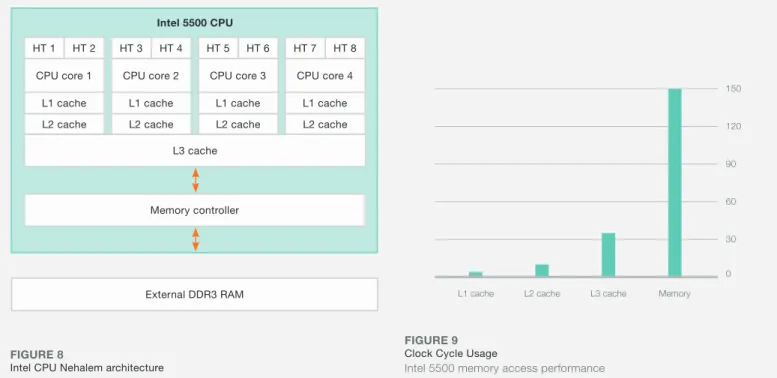
INTELLIGENT FLOW IDENTIFICATION AND DISTRIBUTION Modern CPU architectures are based on multiple cores and SMT, which enables much higher performance using parallel processing (see Figure 8). Individual CPU cores are only getting slightly faster, but there are more of them. Multi-threaded operating systems and application development make sure that applications can take optimal advantage of the new multi-core architectures available in modern servers. But what about data input/output?
For network monitoring and analysis applications, the ability to provide exactly the right data to the right application running on the right CPU core is critical. It ensures that the load is balanced either equally or intelligently across available processing resources allowing multi-threaded applications to execute optimally, in real time.
To achieve this, there are two distinct steps: 1. Intelligent flow identification
2. Intelligent flow distribution
INTELLIGENT FLOW IDENTIFICATION
A flow is defined as a series of packet data that share common characteristics. The definition of these
characteristics and the flow depends on the application. In the case of Napatech, layer 2 to 4 header information is used to define a number of different flows. The process steps are as follows:
• Each incoming Ethernet frame is decoded to uncover Ethernet frame header, IP header, TCP and UDP header information
• Tunneling protocol header information can also be used, such as SCTP, GTP or GRE
• Encapsulation information can also be used, such as multiple MPLS labels and VLAN tags
• All of the above information can be used to create a 2, 3 or 5-tuple hash-key
• This hash-key is then used to identify the flow in later processing
All of this information is available together with the Ethernet frame for the network appliance software to allow quick identification of the flow and fast access to layer 2 to 4 information.
Other intelligent features, such as conditional dynamic frame slicing, de-duplication and filtering are also included to allow the user to control what kind of information is presented and how it is presented in real time using on-the-fly re-configuration facilities.
INTELLIGENT FLOW DISTRIBUTION
Using flow information , it is possible to configure which flows are processed by which CPU cores. In the case of Napatech accelerators, flows can be distributed to up to 32 CPU cores. This is significant, as it holds the key to acceleration of network appliances.
By load balancing data handling we ensure that all CPU cores are used optimally and that more of the data to be processed resides in the CPU cache (see Figure 9) resulting in faster performance and lower latency.
FIGURE 7
Ethernet Frames Per Second Throughput (in bytes)
Ethernet frames per second for different Ethernet frame sizes
0 3,000 6,000 9,000 12,000 15,000 64 128 256 512 1024 1518
Frames per Second (in 1,000)
Napatech NT20E Typical Server NIC
L3 cache Memory controller External DDR3 RAM Intel 5500 CPU HT 1 CPU core 1 L1 cache L2 cache HT 2 HT 3 CPU core 2 L1 cache L2 cache HT 4 HT 5 CPU core 3 L1 cache L2 cache HT 6 HT 7 CPU core 4 L1 cache L2 cache HT 8 0 30 60 90 120 150 CPU Cycles Memory L3 cache L2 cache L1 cache
EFFICIENT FRAME BUFFERING AND CACHE OPTIMIZATION
In order to achieve very high server CPU performance, the CPU memory cache must be used optimally. Figure 9 shows the time it takes the server CPU to access memory showing the various levels (L1, L2, L3) of the CPU cache memory as well as the server’s DDR3 RAM memory. The graph shows that it takes the CPU 150 clock cycles to access the server DDR3 RAM memory. This means that the CPU is halted (not executing instructions) for 150 CPU cycles and as the CPU can execute 3 instructions per cycle, this in turn means that 450 instructions that could be executed are not.
The Hyper Threading (HT) functionality of Nehalem CPUs can help this problem. Using Hyper Threading, one HT CPU core can execute instructions for other HT CPU cores, if this HT core has the data available to execute the instructions. The Intel 5500 has 4 CPU cores, which become 8 when using HT (see Figure 8). The four physical cores each have private L1 and L2 caches but can share their L3 caches and DDR3 memory. This means that CPU cores 1 and 2 can access their own L1/L2 cache at the same time (same CPU clock cycle), but if they need to access the L3 cache or DDR3 memory, then they must contend for this and wait until the other CPU core’s instructions are completed. This makes
it even more important that data needed for instructions is available in L1 or L2 cache memory so that all available CPU cores are able to execute instructions independently of each other and without delay.
One of the mechanisms provided by CPU manufacturers for efficient data management that we can take advantage of is pre-fetching of data. Pre-fetching is based on the assumption that when an application accesses memory needed for a particular instruction or operation, then the next available data in memory is also needed by the same application. The CPU is effectively pre-fetching data from memory that it assumes will be needed by the application.
This has the result that the application can read the following memory locations from the L1/L2 CPU cache and does not need to read from “slower” DDR3 memory. This is often a good strategy because:
• DDR3 memory is so called burst memory, which means that the first access to memory takes a long time (~150 clock cycles) but that following accesses are fast (~3 clock cycles per access)
• Applications (especially networking applications) are often reading forward in memory. For example, network data in a received frame is analyzed level for level which is allocated
FIGURE 8
Intel CPU Nehalem architecture
FIGURE 9
Clock Cycle Usage
Ethernet Frame CPU cache Other Data Ethernet Frame Other Data Ethernet Frame Few cache hits leads to slower CPU processing RAM Memory Pr e-Fetch Pr e-Fetch Pr e-Fetch Ethernet Frame CPU cache
Ethernet Frame Data
Ethernet Frame Other Data Other Data High cache hit-rate leads to fast CPU processing RAM Memory Pr e-Fetch
NAPATECH INTELLIGENT MEMORY MANAGEMENT Let’s take a look at how Napatech accelerators make optimal use of CPU caching compared to traditional NICs. Traditional NICs allocate the buffers used to store received data in memory on a one buffer per frame basis. This means that these buffers are seldom adjacently located in memory. This concept is illustrated in Figure 10. As can be seen, on the first access to a particular frame, the data has not been pre-fetched by the CPU and “slower” DDR3 memory must be used. The CPU will attempt to pre-fetch the rest of the frame so it can use faster CPU cache memory. For the individual Ethernet frame, this will work. However, the CPU will continue to pre-fetch after the frame is finished, which is most likely not relevant as this other data is residual data from previous use of the memory space. This will waste some memory bandwidth and place “garbage data” in the CPU cache memory reducing the CPU cache hit-rate.
Napatech accelerators use another buffering strategy that allocates a number of large (e.g. 4MB) memory buffers and places as many frames back-to-back in each buffer as possible (see Figure 11). Using this implementation the first access to a frame in a buffer has not been pre-fetched but all the following accesses to frames are pre-fetched and therefore in the CPU cache. As hundreds or even thousands of frames can be placed in a buffer, a very high CPU cache performance can be achieved leading to application acceleration.
As can be seen, captured frames are located sequentially in a single memory buffer, which is perfect for network monitoring and analysis applications, which need to process all frames. As can be seen a high level of data pre-fetching can be used leading to very efficient and intelligent use of memory resources.
FIGURE 10
Standard Server NIC frame buffers and CPU Pre-fetching
Frame buffering and pre-fetching by traditional NICs
FIGURE 11
Napatech Memory Buffering and Pre-fetching
Universal network appliances provide the ideal platform for innovative network appliance vendors who realize that the hardware platform provides the raw performance while the network appliance application and associated software development provides the value-adding features that keep customers coming back.
COMPANY PROFILE
Napatech is the world leader in accelerating network management and security applications. As data volume and complexity grow, the performance of these applications needs to stay ahead of the speed of networks in order to do their jobs. We make this possible, for even the most demanding financial, telecom, corporate and government networks.
Now and in the future, we enable our customers’ applications to run faster than the networks they need to manage and protect.
Napatech. FASTER THAN THE FUTURE
EMBRACING THE UNIVERSAL NETWORK APPLIANCE From the foregoing examination, it can be seen that universal network appliances based on standard PC servers and accelerators provide:
• Superior processing power with a strong roadmap to even higher processing capabilities
• Efficient memory management capable of supporting real-time processing at very high line-rates
• Full throughput data input/output in real time at high line-rates without losing any data
• Support for a variety of operating systems (e.g. Windows, Linux, FreeBSD) to suit the application programming environment
By using commercial off-the-shelf products with broad applications and large volumes, one is ensured of competitive prices, a strong roadmap and continuous improvement. HP, Dell, Cisco, IBM and other server vendors will continue to push the envelope developing faster and more powerful servers. Equally, Intel and AMD will continue to serve these customers with powerful CPU chipsets.
EUROPE, MIDDLE EAST AND AFRICA Napatech A/S Copenhagen, Denmark Tel. +45 4596 1500 [email protected] www.napatech.com NORTH AMERICA Napatech Inc. Boston, Massachusetts Mountain View, California Washington D.C. Tel. +1 888 318 8288 [email protected] www.napatech.com SOUTH AMERICA Napatech São Paulo, Brazil Tel. +55 11 2127 0782 [email protected] www.napatech.com APAC Napatech Japan K.K. Tokyo, Japan Tel. +81 3 5326 3374 Napatech Korea Seoul, South Korea Tel. +82 2 6001 3545 [email protected] www.napatech.com