ARTICLE
doi:10.1038/nature11252Comprehensive molecular characterization
of human colon and rectal cancer
The Cancer Genome Atlas Network*
To characterize somatic alterations in colorectal carcinoma, we conducted a genome-scale analysis of 276 samples, analysing exome sequence, DNA copy number, promoter methylation and messenger RNA and microRNA expression. A subset of these samples (97) underwent low-depth-of-coverage whole-genome sequencing. In total, 16% of colorectal carcinomas were found to be hypermutated: three-quarters of these had the expected high microsatellite instability, usually with hypermethylation and MLH1 silencing, and one-quarter had somatic mismatch-repair gene and polymerasee(POLE) mutations. Excluding the hypermutated cancers, colon and rectum cancers were found to have considerably similar patterns of genomic alteration. Twenty-four genes were significantly mutated, and in addition to the expectedAPC,TP53,SMAD4,PIK3CAandKRASmutations, we found frequent mutations inARID1A,SOX9andFAM123B.Recurrent copy-number alterations include potentially drug-targetable amplifications ofERBB2and newly discovered amplification ofIGF2. Recurrent chromosomal translocations include the fusion ofNAV2
and WNT pathway memberTCF7L1. Integrative analyses suggest new markers for aggressive colorectal carcinoma and an important role forMYC-directed transcriptional activation and repression.
The Cancer Genome Atlas project plans to profile genomic changes in 20 different cancer types and has so far published results on two cancer types1,2. We now present results from multidimensional analyses of human colorectal carcinoma (CRC).
CRC is an important contributor to cancer mortality and morbidity. The distinction between the colon and the rectum is largely anatomical, but it has both surgical and radiotherapeutic management implications and it may have an impact on prognosis. Most investigators divide CRC biologically into those with microsatellite instability (MSI; located primarily in the right colon and frequently associated with the CpG island methylator phenotype (CIMP) and hyper-mutation) and those that are microsatellite stable but chromosomally unstable.
A rich history of investigations (for a review see ref. 3) has uncovered several critical genes and pathways important in the initiation and progression of CRC (ref. 3). These include the WNT, RAS2MAPK, PI3K, TGF-b, P53 and DNA mismatch-repair pathways. Large-scale sequencing analyses4–6have identified numerous recurrently mutated genes and a recurrent chromosomal translocation. Despite this back-ground, we have not had a fully integrated view of the genetic and genomic changes and their significance for colorectal tumorigenesis. Further insight into these changes may enable deeper understanding of the pathophysiology of CRC and may identify potential therapeutic targets.
Results
Tumour and normal pairs were analysed by different platforms. The specific numbers of samples analysed by each platform are shown in Supplementary Table 1.
Exome-sequence analysis
To define the mutational spectrum, we performed exome capture DNA sequencing on 224 tumour and normal pairs (all mutations are listed in Supplementary Table 2). Sequencing achieved.20-fold coverage of at least 80% of targeted exons. The somatic mutation rates varied considerably among the samples. Some had mutation rates of
,1 per 106bases, whereas a few had mutations rates of.100 per 106. We separated cases (84%) with a mutation rate of,8.24 per 106 (median number of non-silent mutations, 58) and those with muta-tion rates of.12 per 106(median number of total mutations, 728), which we designated as hypermutated (Fig. 1).
To assess the basis for the considerably different mutation rates, we evaluated MSI7and mutations in the DNA mismatch-repair pathway8–10 genesMLH1,MLH3,MSH2,MSH3,MSH6andPMS2. Among the 30 hypermutated tumours with a complete data set, 23 (77%) had high levels of MSI (MSI-H). Included in this group were 19 tumours with MLH1 methylation, 17 of which had CIMP. By comparison, the remaining seven hypermutated tumours, including the six with the highest mutation rates, lacked MSI-H, CIMP or MLH1 methylation but usually had somatic mutations in one or more mismatch-repair genes or POLE aberrations seen rarely in the non-hypermutated tumours (Fig. 1).
Gene mutations
Overall, we identified 32 somatic recurrently mutated genes (defined by MutSig11 and manual curation) in the hypermutated and non-hypermutated cancers (Fig. 1b). After removal of non-expressed genes, there were 15 and 17 in the hypermutated and non-hypermutated cancers, respectively (Fig. 1b; for a complete list see Supplementary Table 3). Among the non-hypermutated tumours, the eight most fre-quently mutated genes wereAPC,TP53, KRAS, PIK3CA, FBXW7,
SMAD4, TCF7L2and NRAS. As expected, the mutatedKRAS and
NRASgenes usually had oncogenic codon 12 and 13 or codon 61 mutations, whereas the remaining genes had inactivating mutations.
CTNNB1,SMAD2,FAM123B(also known asWTX) andSOX9were
also mutated frequently.FAM123Bis an X-linked negative regulator of WNT signalling12, and virtually all of its mutations were loss of func-tion. Mutations inSOX9, a gene important for cell differentiation in the intestinal stem cell niche13,14, have not been associated previously with human cancer, but all nine mutated alleles in the non-hypermutated CRCs were frameshift or nonsense mutations. Tumour-suppressor
genesATMandARID1Aalso had a disproportionately high number of frameshift or nonsense mutations.ARID1Amutations have recently been reported in CRC and many other cancers15,16.
In the hypermutated tumours,ACVR2A,APC,TGFBR2,MSH3,
MSH6, SLC9A9 and TCF7L2 were frequent targets of mutation
(Fig. 1b), along with mostly BRAF(V600E) mutations. However, two genes that were frequently mutated in the non-hypermutated
cancers were significantly less frequently mutated in hypermutated tumours:TP53(60 versus 20%,P,0.0001) andAPC(81% versus 51%, P50.0023; both Fisher’s exact test). Other genes, including TGFBR2, were mutated recurrently in the hypermutated cancers, but not in the non-hypermutated samples. These findings indicate that hypermutated and non-hypermutated tumours progress through different sequences of genetic events.
As expected, hypermutated tumours with MLH1 silencing and MSI-H showed additional differences in the mutational profile. When we specifically examined 28 genes with long mononucleotide repeats in their coding sequences, we found that the rate of frameshift mutation was 3.6-fold higher than the rate of such mutations in hypermutated tumours without MLH1 silencing and 50-fold higher than that in non-hypermethylated tumours (Supplementary Table 2).
Mutation rate and methylation patterns
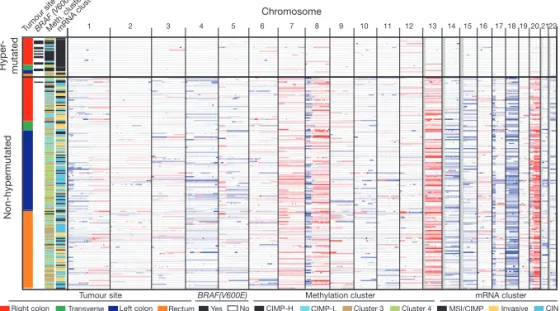
As mentioned above, patients with colon and rectal tumours are managed differently17, and epidemiology also highlights differences between the two17. An initial integrative analysis of MSI status, somatic copy-number alterations (SCNAs), CIMP status and gene-expression profiles of 132 colonic and 62 rectal tumours enabled us to examine possible biological differences between tumours in the two locations. Among the non-hypermutated tumours, however, the overall patterns of changes in copy number, CIMP, mRNA and miRNA were indistinguishable between colon and rectal carcinomas (Fig. 2). On the basis of this result, we merged the two for all subsequent analyses.
Unsupervised clustering of the promoter DNA methylation profiles of 236 colorectal tumours identified four subgroups (Sup-plementary Fig. 1 and Sup(Sup-plementary Methods). Two of the clusters contained tumours with elevated rates of methylation and were classified as CIMP high and CIMP low, as previously described18. The two non-CIMP clusters were predominantly from tumours that were non-hypermutated and derived from different anatomic loca-tions. mRNA expression profiles separated the colorectal tumours into three distinct clusters (Supplementary Fig. 2). One significantly overlapped with CIMP-high tumours (P53310212) and was enriched with hypermutated tumours, and the other two clusters did not correspond with any group in the methylation data. Analysis of miRNA expression by unsupervised clustering (Supplemen-tary Fig. 3) identified no clear distinctions between rectal cancers and non-hypermethylated colon cancers.
BRAF (V600E)
Tumour site mRNA clusterMeth. cluster1 2 3 4 5 6 7 8 9 10 11 12 13 14 15 16 17 18 19 20 2122
Hyper
-mutated
Non-hypermutated
Right colon Transverse Left colon Rectum Yes No CIMP-H CIMP-L Cluster 3 Cluster 4 MSI/CIMP Invasive CIN
Tumour site BRAF(V600E) Methylation cluster mRNA cluster
Chromosome
Figure 2|Integrative analysis of genomic changes in 195 CRCs.
Hypermutated tumours have near-diploid genomes and are highly enriched for hypermethylation, CIMP expression phenotype andBRAF(V600E)mutations. Non-hypermutated tumours originating from different sites are virtually
indistinguishable from each other on the basis of their copy-number alteration patterns, DNA methylation or gene-expression patterns. Copy-number changes of the 22 autosomes are shown in shades of red for copy-number gains and shades of blue for copy-number losses.
0.1 1 10 100 500
Tumour site MSI status CIMP status MLH1 silencing
Mutation
rate (mutations per 10
6 bases)
Non-silent
Silent Hypermutated Non-hypermutated
Hypermutated tumours Non-hypermutated tumours
a
MSH2 MSH3 MSH6 MLH1 MLH3
PMS2
Epigenetic silencing
Missense/nonsense mutation Frameshift mutation
b
POLE
M
utation frequency (%)
20
40
60
80
ACVR2AAPCTGFBR2BRAFMSH3MSH6MYO1BTCF7L2CASP8CDC27FZD3MIER3TCERG1MAP7PTPN12 APCTP53KRASTTNPIK3CAFBXW7SMAD4NRASTCF7L2 FAM123BSMAD2CTNNB1KIAA1804SO
X9 ACVR1BGPC6EDNRB
63%
51% 51%
46%
40% 40%
31% 31% 29% 29% 29% 29% 29% 26% 26%
81%
60%
43%
31%
18%
11% 10% 9% 9% 7% 6%
5% 4% 4% 4% 4% 3%
0
Chromosomal and sub-chromosomal changes
In total, 257 tumours were profiled for SCNAs with Affymetrix SNP 6.0 arrays. Of these tumours, 97 were also analysed by low-depth-of-coverage (low-pass) whole-genome sequencing. As expected, the hypermutated tumours had far fewer SCNAs (Fig. 2). No difference was found between microsatellite-stable and -unstable hypermutated tumours (Supplementary Fig. 4). We used the GISTIC algorithm19to identify probable gene targets of focal alterations. There were several previously well-defined arm-level changes, including gains of 1q, 7p and q, 8p and q, 12q, 13q, 19q, and 20p and q (ref. 6). (Supplementary Fig. 4 and Supplementary Table 4). Significantly deleted chromosome arms were 18p and q (includingSMAD4) in 66% of the tumours and 17p and q (includingTP53) in 56%. Other significantly deleted chro-mosome arms were 1p, 4q, 5q, 8p, 14q, 15q, 20p and 22q.
We identified 28 recurrent deletion peaks (Supplementary Fig. 4 and Supplementary Table 4), including the genesFHIT, RBFOX1 and WWOXwith large genomic footprints located in potentially fragile sites of the genome, in near-diploid hypermutated tumours. Other focal deletions involved tumour-suppressor genes such asSMAD4, APC, PTEN and SMAD3. A significant focal deletion of 10p25.2 spanned four genes, includingTCF7L2, which was also frequently mutated in our data set. A gene fusion between adjacent genes VTI1A andTCF7L2 through an interstitial deletion was found in 3% of CRCs and is required for survival of CRC cells bearing the translocation4.
There were 17 regions of significant focal amplification (Supplemen-tary Table 4). Some of these were superimposed on broad gains of chromosome arms, and included a peak at 13q12.13 near the peptidase-coding gene USP12 and at ,500 kb distal to the CRC
candidate oncogeneCDK8; an adjacent peak at 13q12; a peak contain-ing KLF5at 13q22.1; and a peak at 20q13.12 adjacent to HNF4A. Peaks on chromosome 8 included 8p12 (which contains the histone methyl-transferase-coding geneWHSC1L1, adjacent toFGFR1) and 8q24 (which containsMYC). An amplicon at 17q21.1, found in 4% of the tumours, contains seven genes, including the tyrosine kinase ERBB2.ERBB2amplifications have been described in colon, breast and gastro–oesophageal tumours, and breast and gastric cancers bear-ing these amplifications have been treated effectively with the anti-ERBB2 antibody trastuzumab20–22.
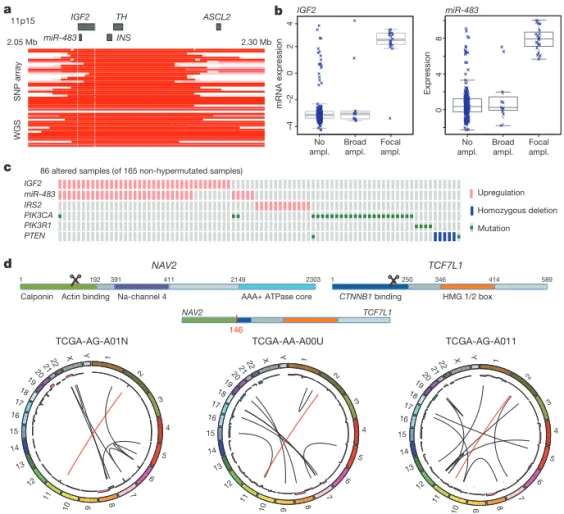
One of the most common focal amplifications, found in 7% of the tumours, is the gain of a 100–150-kb region of the chromosome arm 11p15.5. It contains genes encoding insulin (INS), insulin-like growth factor 2 (IGF2) and tyrosine hydroxylase (TH), as well asmiR-483, which is embedded withinIGF2(Fig. 3a). We found elevated expres-sion of IGF2 and miR-483 but not of INS and TH (Fig. 3b, c). Immediately adjacent to the amplified region isASCL2, a transcrip-tion factor active in specifying intestinal stem-cell fate23. Although ASCL2has been implicated as a target of amplification in CRC23–25, it was consistently outside the region of amplification and its expres-sion was not correlated with copy-number changes. These observa-tions suggest thatIGF2and miR-483 are candidate functional targets of 11p15.5 amplification. IGF2 overexpression through loss of imprinting has been implicated in the promotion of CRC26, 27. MiR-483 may also have a role in CRC pathogenesis28.
A subset of tumours withoutIGF2amplification (15%) also had considerably higher levels of IGF2gene expression (as much as a 100-fold increase), an effect not attributable to methylation changes at theIGF2promoter. To assess the context ofIGF2amplification/
048
a b
No ampl.
Broad ampl.
Focal ampl.
No ampl.
Broad ampl.
Focal ampl.
c
–4
–2
0
2
4
d
IGF2 TH ASCL2
SNP array
WGS
11p15
2.05 Mb 2.30 Mb
mRNA expression
Expression
TCF7L1 NAV2
CTNNB1 binding
1 250 346 414 589
HMG 1/2 box
1 192
Calponin Actin binding Na-channel 4
391 411 2149 2303
AAA+ ATPase core
IGF2 miR-483
miR-483 INS
IGF2
IRS2 PIK3CA PIK3R1 PTEN miR-483
86 altered samples (of 165 non-hypermutated samples)
Upregulation Homozygous deletion Mutation
TCGA-AG-A011
1 2
3
4
5
6
7 8
9
10 11 12
13
14
15
16 17
18 1920
2122 X
Y
TCGA-AA-A00U
1 2
3
4
5
6
7 8
9
10 11 12
13
14
15
16 17
18 19
2021
22 X Y
TCGA-AG-A01N
1 2
3
4
5
6
7 8
9
10 11 12
13
14
15
16 17
18 19
2021
22 X Y
146
NAV2 TCF7L1
Figure 3|Copy-number changes and structural aberrations in CRC. a, Focal amplification of 11p15.5. Segmented DNA copy-number data from single-nucleotide polymorphism (SNP) arrays and low-pass whole-genome sequencing (WGS) are shown. Each row represents a patient; amplified regions are shown in red.b, Correlation of expression levels with copy-number changes forIGF2andmiR-483.c,IGF2amplification and overexpression are mutually
exclusive of alterations in PI3K signalling-related genes.d, RecurrentNAV2–
TCF7L2fusions. The structure of the two genes, locations of the breakpoints leading to the translocation and circular representations of all rearrangements in tumours with a fusion are shown. Red line lines represent theNAV2–TCF7L2
overexpression, we systematically searched for mutually exclusive genomic events using the MEMo method29. We found a pattern of near exclusivity (corrected P,0.01) of IGF2 overexpression with genomic events known to activate the PI3K pathway (mutations of
PIK3CA and PIK3R1 or deletion/mutation of PTEN; Fig. 3c and
Supplementary Table 5). TheIRS2gene, encoding a protein linking IGF1R (the receptor for IGF2) with PI3K, is on chromosome 13, which is frequently gained in CRC. The cases with the highestIRS2expression were mutually exclusive of the cases with IGF2 overexpression (P50.04) and also lacked mutations in the PI3K pathway (P50.0001; Fig. 3c). These results strongly suggest that the IGF2– IGF1R–IRS2 axis signals to PI3K in CRC and imply that therapeutic targeting of the pathway could act to block PI3K activity in this subset of patients.
Translocations
To identify new chromosomal translocations, we performed low-pass, paired-end, whole-genome sequencing on 97 tumours with matched normal samples. In each case we achieved sequence coverage of ,3–4-fold and a corresponding physical coverage of 7.5–10-fold. Despite the low genome coverage, we detected 250 candidate interchromosomal translocation events (range, 0–10 per tumour). Among these events, 212 had one or both breakpoints in an intergenic region, whereas the remaining 38 juxtaposed coding regions of two genes in putative fusion events, of which 18 were predicted to code for in-frame events (Supplementary Table 6). We found three separate cases in which the first two exons of theNAV2gene on chromosome 11 are joined with the 39coding portion ofTCF7L1on chromosome 2 (Supplementary Fig. 5).TCF7L1encodes TCF3, a member of the TCF/LEF class of transcription factors that heterodimerize with nuclearb-catenin to enableb-catenin-mediated transcriptional regu-lation. Intriguingly, in all three cases, the predicted structure of the NAV2–TCF7L1 fusion protein lacks the TCF3 b-catenin-binding domain. This translocation is similar to another recurrent transloca-tion identified in CRC, a fusion in which the amino terminus of VTI1A is joined to TCF4, which is encoded byTCF7L2, a homologue ofTCF7L1that is deleted or mutated in 12% of non-hypermutated tumours4. We also observed 21 cases of translocation involving TTC28located on chromosome 22 (Supplementary Table 6). In all
cases the fusions predict inactivation ofTTC28, which has been iden-tified as a target of P53 and an inhibitor of tumour cell growth30. Eleven of the 19 (58%) gene–gene translocations were validated by obtaining PCR products or, in some cases, sequencing the junction fragments (Supplementary Fig. 5).
Altered pathways in CRC
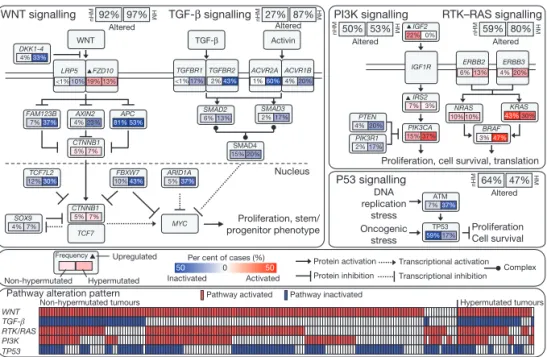
Integrated analysis of mutations, copy number and mRNA expression changes in 195 tumours with complete data enriched our understand-ing of how some well-defined pathways are deregulated. We grouped samples by hypermutation status and identified recurrent alterations in the WNT, MAPK, PI3K, TGF-b and p53 pathways (Fig. 4, Supplementary Fig. 6 and Supplementary Table 1).
We found that the WNT signalling pathway was altered in 93% of all tumours, including biallelic inactivation ofAPC(Supplementary Table 7) or activating mutations ofCTNNB1in,80% of cases. There were also mutations inSOX9and mutations and deletions inTCF7L2, as well as the DKK family members andAXIN2,FBXW7 (Supplemen-tary Fig. 7),ARID1AandFAM123B(the latter is a negative regulator of WNT–b-catenin signalling12found mutated in Wilms’ tumour31). A few mutations in FAM123B have previously been described in CRC32. SOX9 has been suggested to have a role in cancer, but no mutations have previously been described. The WNT receptor frizzled (FZD10) was overexpressed in,17% of samples, in some instances at levels of 1003normal. Altogether, we found 16 different altered WNT pathway genes, confirming the importance of this pathway in CRC. Interestingly, many of these alterations were found in tumours that harbour APC mutations, suggesting that multiple lesions affecting the WNT signalling pathway confer selective advantage. Genetic alterations in the PI3K and RAS–MAPK pathways are common in CRC. In addition toIGF2andIRS2overexpression, we found mutually exclusive mutations inPIK3R1andPIK3CAas well as deletions inPTENin 2%, 15% and 4% of non-hypermutated tumours, respectively. We found that 55% of non-hypermutated tumours have alterations in KRAS,NRAS orBRAF, with a significant pattern of mutual exclusivity (Supplementary Fig. 6 and Supplementary Table 1). We also evaluated mutations in the erythroblastic leukemia viral oncogene homolog (ERBB) family of receptors because of the trans-lational relevance of such mutations. Mutations or amplifications in
Proliferation, stem/ progenitor phenotype Nucleus
APC 81% 53% FZD10
19% 13%
FBXW7
10%43% FAM123B
7%37%
TCF7L2
12%30%
ARID1A
5%37% AXIN2
4% 23%
SOX9
4% 7%
CTNNB1
5% 7%
CTNNB1
5% 7%
MYC LRP5
WNT
TCF7
WNT signalling
Per cent of cases (%) Inactivated
0
50 50
Activated
Frequency
Non-hypermutated Hypermutated Upregulated
TGF-β signalling
TGF-β Activin
TGFBR1
<1% 17%
TGFBR2
2%43% ACVR2A
1%60% ACVR1B
4% 20%
SMAD2
6% 13%
SMAD3
2% 17%
SMAD4 15% 20%
Proliferation, cell survival, translation
IGF2
22% 0%
IGF1R
IRS2
7% 3%
ERBB2
6% 13%
ERBB3
4% 20%
PIK3CA
15% 37%
PIK3R1
2% 17%
PTEN
4% 20%
NRAS
10% 10%
KRAS 43%30%
BRAF
3%47%
DNA replication
stress Oncogenic
stress
Proliferation Cell survival ATM
7%37%
TP53
59%17% PI3K signalling
P53 signalling
Protein activation Protein inhibition
Transcriptional activation Transcriptional inhibition
Complex
<1% 10%
DKK1-4
4%33%
Altered
92% 97%
Altered
27% 87%
Altered
50% 53%
Altered
64% 47%
RTK–RAS signalling
Altered
59% 80%
nHM
HM
nHM
HM
nHM
HM
nHM
HM
nHM
HM
WNT
TP53 RTK/RAS PI3K TGF-β
Hypermutated tumours Non-hypermutated tumours
Pathway alteration pattern Pathway activated Pathway inactivated
Figure 4|Diversity and frequency of genetic changes leading to deregulation of signalling pathways in CRC. Non-hypermutated (nHM;
n5165) and hypermutated (HM;n530) samples with complete data were analysed separately. Alterations are defined by somatic mutations, homozygous deletions, high-level focal amplifications, and, in some cases, by significant
one of the four ERBB family genes are present in 22 out of 165 (13%) non-hypermutated and 16 out of 30 (53%) hypermutated cases. Some of the mutations are listed in the COSMIC database33, suggesting a functional role. Intriguingly, recurrent ERBB2(V842I)
and ERBB3(V104M) mutations were found in four and two
non-hypermutated cases, respectively. Mutations and focal amplifications ofERBB2(Supplementary Fig. 6) should be evaluated as predictors of response to agents that target those receptors. We observed co-occurrence of alterations involving the RAS and PI3K pathways in one-third of tumours (Fig. 4;P50.039, Fisher’s exact test). These results indicate that simultaneous inhibition of the RAS and PI3K pathways may be required to achieve therapeutic benefit.
The TGF-bsignalling pathway is known to be deregulated in CRC and other cancers34. We found genomic alterations in TGFBR1,
TGFBR2,ACVR2A,ACVR1B,SMAD2,SMAD3andSMAD4in 27%
of the non-hypermutated and 87% of the hypermutated tumours. We also evaluated the p53 pathway, finding alterations inTP53in 59% of non-hypermutated cases (mostly biallelic; Supplementary Table 8) and alterations in ATM, a kinase that phosphorylates and activates P53 after DNA damage, in 7%. Alterations in these two genes showed a trend towards mutual exclusivity (P50.016) (Fig. 4, Supplementary Fig. 6 and Supplementary Table 1).
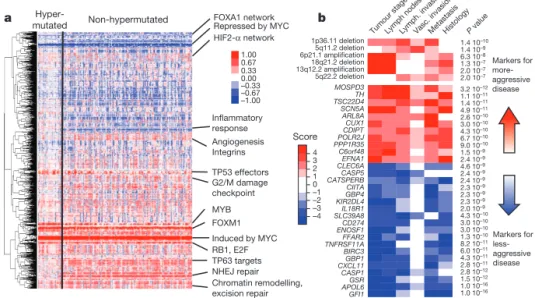
We integrated copy number, gene expression, methylation and pathway data using the PARADIGM software platform35. The analysis showed a number of new characteristics of CRC (Fig. 5a). For example, despite the diversity in anatomical origin or mutation levels, nearly 100% of these tumours have changes in MYC transcrip-tional targets, both those promoted by and those inhibited by MYC. These findings are consistent with patterns deduced from genetic alterations (Fig. 4) and suggest an important role for MYCin CRC. The analysis also identified several gene networks altered across all tumour samples and those with differential alterations in hypermutated versus non-hypermutated samples (Supplementary Table 7, Supplemen-tary Data on the Cancer Genome Atlas publication webpage).
Because most of the tumours used in this study were derived from a prospective collection, survival data are not available. However, the tumours can be classified as aggressive or non-aggressive on the basis
of tumour stage, lymph node status, distant metastasis and vascular invasion at the time of surgery. We found numerous molecular signatures associated with tumour aggressiveness, a subset of which is shown in Fig. 5b. They include specific focal amplifications and deletions, and altered gene-expression levels, including those of SCN5A(ref. 36), a reported regulator of colon cancer invasion (see Supplementary Tables 10 and 11 for a full list). Association with tumour aggressiveness is also observed in altered expression of miRNAs and specific somatic mutations (APC, TP53, PIK3CA,
BRAFandFBXW7; Supplementary Fig. 8b). Mutations inFBXW7
(38 cases) and distant metastasis (32 cases) never co-occurred (P50.0019). Interestingly, a number of genomic regions have multiple molecular associations with tumour aggressiveness that manifest as clinically related genomic hotspots. Examples of this are the region 20q13.12, which includes a focal amplification and multiple genes correlating with tumour aggression, and the region 22q12.3, contain-ingAPOL6(ref. 37) (Supplementary Figures 8 and 9).
Discussion
This comprehensive integrative analysis of 224 colorectal tumour and normal pairs provides a number of insights into the biology of CRC and identifies potential therapeutic targets. To identify possible bio-logical differences in colon and rectum tumours, we found, in the non-hypermutated tumours irrespective of their anatomical origin, the same type of copy number, expression profile, DNA methylation and miRNA changes. Over 94% had a mutation in one or more members of the WNT signalling pathway, predominantly inAPC. However, there were some differences between tumours from the right colon and all other sites. Hypermethylation was more common in the right colon, and three-quarters of hypermutated samples came from the same site, although not all of them had MSI (Fig. 2). Why most of the hypermutated samples came from the right colon and why there are two classes of tumours at this site is not known. The origins of the colon from embryonic midgut and hindgut may provide an explanation. As the survival rate of patients with high MSI-related cancers is better and these cancers are hypermutated, mutation rate may be a better prognostic indicator.
a FOXA1 network b
Repressed by MYC
Angiogenesis Integrins
TP53 effectors G2/M damage checkpoint
MYB
Induced by MYC RB1, E2F
NHEJ repair Chromatin remodelling, excision repair
Hyper-mutated Non-hypermutated
FOXM1
TP63 targets
HIF2-α network
Inflammatory response
GFI1 APOL6GSR CASP1 CXCL11GBP1 BIRC3 TNFRSF11AFFAR2 ENOSF1CD274 SLC39A8IL18R1 KIR2DL4GBP4 CIITA CATSPERBCASP5 CLEC6AEFNA1 C6orf48 PPP1R35POLR2J CDIPTCUX1 ARL8A SCN5A TSC22D4TH
MOSPD3 3.2 10–12
1.1 10–11
1.4 10–11
4.9 10–11
2.6 10–10
3.0 10–10
4.3 10–10
6.7 10–10
9.0 10–10
1.5 10–9
2.4 10–9
4.6 10–9
2.4 10–9
2.4 10–9
2.3 10–9
2.3 10–9
2.3 10–9
2.0 10–9
4.3 10–10
3.0 10–10
3.0 10–10
1.3 10–10
8.2 10–11
6.0 10–11
4.3 10–11
2.8 10–11
2.8 10–12
1.5 10–12
1.0 10–16
1.0 10–16
5q22.2 deletion 13q12.2 amplification18q21.2 deletion 6p21.1 amplification5q11.2 deletion
1p36.11 deletion 1.4 10–10
1.4 10–9
6.3 10–8
1.3 10–7
2.0 10–7
2.0 10–7
Tumo ur stage
Lymph. invasionMeta stasis
Histology Lymph nodesVasc P value
. invasion
Markers for more- aggressive disease
Markers for less- aggressive disease 1
4 3 2 0 –1 –2 –3 –4
Score
1.00 0.67 0.33 0.00 –0.33 –0.67 –1.00
Figure 5|Integrative analyses of multiple data sets. a, Clustering of genes and pathways affected in colon and rectum tumours deduced by PARADIGM analysis. Blue denotes under-expressed relative to normal and red denotes overexpressed relative to normal. Some of the pathways deduced by this method are shown on the right. NHEJ, non-homologous end joining.b, Gene-expression signatures and SCNAs associated with tumour aggression. Molecular signatures (rows) that show a statistically significant association with tumour aggressiveness according to selected clinical assays (columns) are shown in colour, with red indicating markers of tumour aggressiveness and
blue indicating the markers of less-aggressive tumours. Significance is based on the combinedPvalue from the weighted Fisher’s method, corrected for multiple testing. Colour intensity and score is in accordance with the strength of an individual clinical–molecular association, and is proportional to log10(P),
wherePis thePvalue for that association. To limit the vertical extent of the figure, gene-expression signatures are restricted to a combinedPvalue of
P,1029and SCNAs toP,1027, and features are shown only if they are also
Whole-exome sequencing and integrative analysis of genomic data provided further insights into the pathways that are dysregulated in CRC. We found that 93% of non-hypermutated and 97% of hyper-mutated cases had a deregulated WNT signalling pathway. New find-ings included recurrent mutations inFAM123B,ARID1AandSOX9 and very high levels of overexpression of the WNT ligand receptor
gene FZD10. To our knowledge, SOX9 has not previously been
described as frequently mutated in any human cancer.SOX9is tran-scriptionally repressed by WNT signalling, and the SOX9 protein has been shown to facilitate b-catenin degradation38. ARID1A is fre-quently mutated in gynaecological cancers and has been shown to suppress MYC transcription39. Activation of WNT signalling and inactivation of the TGF-bsignalling pathway are known to result in activation of MYC. Our mutational and integrative analyses emphasize the critical role of MYC in CRC. We also compared our results with other large-scale analyses6and found many similarities and few differ-ences in mutated genes (Supplementary Table 3).
Our integrated analysis revealed a diverse set of changes in TCF/ LEF-encoding genes, suggesting additional roles for TCF/LEF factors in CRC beyond being passive partners forb-catenin.
Our data suggest a number of therapeutic approaches to CRC. Included are WNT-signalling inhibitors and small-moleculeb-catenin inhibitors, which are showing initial promise40–42. We find that several proteins in the RTK–RAS and PI3K pathways, including IGF2, IGFR, ERBB2, ERBB3, MEK, AKT and MTOR could be targets for inhibition.
Our analyses show that non-hypermutated adenocarcinomas of the colon and rectum are not distinguishable at the genomic level. However, tumours from the right/ascending colon were more likely to be hypermethylated and to have elevated mutation rates than were other CRCs. As has been recognized previously, activation of the WNT signalling pathway and inactivation of the TGF-bsignalling pathway, resulting in increased activity of MYC, are nearly ubiquitous events in CRC. Genomic aberrations frequently target the MAPK and PI3K pathways but less frequently target receptor tyrosine kinases. In conclusion, the data presented here provide a useful resource for understanding this deadly disease and identifying possibilities for treating it in a targeted way.
METHODS SUMMARY
Tumour and normal samples were processed by either of two biospecimen core resources, and aliquots of purified nucleic acids were shipped to the genome characterization and sequencing centres (Supplementary Methods). The bio-specimen core resources provided sample sets in several different batches. To assess any batch effects we examined the mRNA expression, miRNA expression and DNA methylation data sets using a combination of cluster analysis, enhanced principal component analysis and analysis of variance (Supplementary Methods). Although some differences among batches were detected, we did not correct them computationally because the differences were generally modest and because some of them may reflect biological phenomena (Supplementary Methods).
We used Affymetrix SNP 6.0 microarrays to detect copy-number alterations. A subset of samples was subjected to low-pass (2–53) whole-genome sequencing (Illumina HiSeq), in part for detection of SCNA and chromosomal transloca-tions43,44. Gene-expression profiles were generated using Agilent microarrays and
RNA-Seq. DNA methylation data were obtained using Illumina Infinium (HumanMethylation27) arrays. DNA sequencing of coding regions was per-formed by exome capture followed by sequencing on the SOLiD or Illumina HiSeq platforms. Details of the analytical methods used are described in Supplementary Methods.
All of the primary sequence files are deposited in dbGap and all other data are deposited at the Data Coordinating Center (DCC) for public access (http:// cancergenome.nih.gov/). Data matrices and supporting data can be found at http://tcga-data.nci.nih.gov/docs/publications/coadread_2012/. The data can also be explored through the ISB Regulome Explorer (http://explorer.cancerregulome. org/), Next Generation Clustered Heat Maps (http://bioinformatics.mdanderson. org/main/TCGA/Supplements/NGCHM-CRC) and the cBio Cancer Genomics Portal (http://cbioportal.org). Descriptions of the data can be found at https:// wiki.nci.nih.gov/x/j5dXAg and in Supplementary Methods.
Received 15 November 2011; accepted 22 May 2012.
1. The Cancer Genome Atlas Research Network. Comprehensive genomic
characterization defines human glioblastoma genes and core pathways.Nature
455,1061–1068 (2008).
2. The Cancer Genome Atlas Research Network. Integrated genomic analyses of
ovarian carcinoma.Nature474,609–615 (2011).
3. Fearon, E. R. Molecular genetics of colorectal cancer.Annu. Rev. Pathol.6,479–507 (2011).
4. Bass, A. J.et al.Genomic sequencing of colorectal adenocarcinomas identifies a recurrentVTI1A–TCF7L2fusion.Nature Genet.43,964–968 (2011).
5. Sjoblom, T.et al.The consensus coding sequences of human breast and colorectal
cancers.Science314,268–274 (2006).
6. Wood, L. D.et al.The genomic landscapes of human breast and colorectal cancers.
Science318,1108–1113 (2007).
7. Umar, A.et al.Revised Bethesda guidelines for hereditary nonpolyposis colorectal cancer (Lynch syndrome) and microsatellite instability.J. Natl Cancer Inst.96,
261–268 (2004).
8. Aaltonen, L. A.et al.Clues to the pathogenesis of familial colorectal cancer. 260, Science812–816 (1993).
9. Ionov, Y., Peinado, M. A., Malkhosyan, S., Shibata, D. & Perucho, M. Ubiquitous somatic mutations in simple repeated sequences reveal a new mechanism for
colonic carcinogenesis.Nature363,558–561 (1993).
10. Parsons, R.et al.Hypermutability and mismatch repair deficiency in RER1
tumor cells.Cell75,1227–1236 (1993).
11. Dooley, A. L.et al.Nuclear factor I/B is an oncogene in small cell lung cancer.Genes
Dev.25,1470–1475 (2011).
12. Major, M. B.et al.Wilms tumor suppressor WTX negatively regulates WNT/b
-catenin signaling.Science316,1043–1046 (2007).
13. Mori-Akiyama, Y.et al.SOX9 is required for the differentiation of paneth cells in the intestinal epithelium.Gastroenterology133,539–546 (2007).
14. Bastide, P.et al.Sox9 regulates cell proliferation and is required for Paneth cell differentiation in the intestinal epithelium.J. Cell Biol.178,635–648 (2007). 15. Jones, S.et al.Somatic mutations in the chromatin remodeling geneARID1Aoccur
in several tumor types.Hum. Mutat.33,100–103 (2012).
16. Wilson, B. G. & Roberts, C. W.SWI/SNFnucleosome remodellers and cancer.Nat. Rev. Cancer11,481–492 (2011).
17. Minsky, B. D. Unique considerations in the patient with rectal cancer.Semin. Oncol.
38,542–551 (2011).
18. Hinoue, T.et al.Genome-scale analysis of aberrant DNA methylation in colorectal
cancer.Genome Res.22,271–282 (2012).
19. Beroukhim, R.et al.Assessing the significance of chromosomal aberrations in cancer: methodology and application to glioma.Proc. Natl Acad. Sci. USA104,
20007–20012 (2007).
20. Camps, J.et al.Integrative genomics reveals mechanisms of copy number
alterations responsible for transcriptional deregulation in colorectal cancer.Genes Chromosom. Cancer48,1002–1017 (2009).
21. Varley, J. M., Swallow, J. E., Brammar, W. J., Whittaker, J. L. & Walker, R. A. Alterations to eitherc-erbB-2(neu) orc-mycproto-oncogenes in breast carcinomas correlate
with poor short-term prognosis.Oncogene1,423–430 (1987).
22. Yokota, J.et al.Amplification ofc-erbB-2 oncogene in human adenocarcinomasin vivo. Lancet327,765–767 (1986).
23. van der Flier, L. G.et al.Transcription factor achaete scute-like 2 controls intestinal stem cell fate.Cell136,903–912 (2009).
24. Jubb, A. M., Hoeflich, K. P., Haverty, P. M., Wang, J. & Koeppen, H. Ascl2 and 11p15.5 amplification in colorectal cancer.Gut60,1606–1607 (2011). 25. Stange, D. E.et al.Expression of anASCL2related stem cell signature andIGF2in
colorectal cancer liver metastases with 11p15.5 gain.Gut59,1236–1244 (2010). 26. Cui, H.et al.Loss ofIGF2imprinting: a potential marker of colorectal cancer risk.
Science299,1753–1755 (2003).
27. Nakagawa, H.et al.Loss of imprinting of the insulin-like growth factor II gene occurs by biallelic methylation in a core region ofH19-associated CTCF-binding sites in colorectal cancer.Proc. Natl Acad. Sci. USA98,591–596 (2001).
28. Veronese, A.et al.Oncogenic role ofmiR-483-3pat theIGF2/483locus.Cancer Res.
70,3140–3149 (2010).
29. Ciriello, G., Cerami, E., Sander, C. & Schultz, N. Mutual exclusivity analysis identifies
oncogenic network modules.Genome Res.22,398–406 (2012).
30. Brady, C. A.et al.Distinct p53 transcriptional programs dictate acute DNA-damage
responses and tumor suppression.Cell145,571–583 (2011).
31. Rivera, M. N.et al.An X chromosome gene,WTX, is commonly inactivated in Wilms
tumor.Science315,642–645 (2007).
32. Scheel, S. K.et al.Mutations in the WTX-gene are found in some high-grade microsatellite instable (MSI-H) colorectal cancers.BMC Cancer10,413 (2010). 33. Forbes, S. A.et al.The catalogue of somatic mutations in cancer (COSMIC).Curr.
Protoc. Hum. Genet.Ch. 10, Unit 10.11 (2008).
34. Massague´, J., Blain, S. W. & Lo, R. S. TGFbsignaling in growth control, cancer, and heritable disorders.Cell103,295–309 (2000).
35. Vaske, C. J.et al.Inference of patient-specific pathway activities from
multi-dimensional cancer genomics data using PARADIGM.Bioinformatics26,
i237–i245 (2010).
36. House, C. D.et al.Voltage-gated Na1
channelSCN5Ais a key regulator of a gene transcriptional network that controls colon cancer invasion.Cancer Res.70,
6957–6967 (2010).
38. Topol, L., Chen, W., Song, H., Day, T. F. & Yang, Y. Sox9 inhibits Wnt signaling by promotingb-catenin phosphorylation in the nucleus.J. Biol. Chem.284,
3323–3333 (2009).
39. Nagl, N. G. Jr, Zweitzig, D. R., Thimmapaya, B., Beck, G. R. Jr & Moran, E. Thec-myc
gene is a direct target of mammalian SWI/SNF-related complexes during differentiation-associated cell cycle arrest.Cancer Res.66,1289–1293 (2006). 40. Chen, B.et al.Small molecule-mediated disruption of Wnt-dependent signaling in
tissue regeneration and cancer.Nat. Chem. Biol.5,100–107 (2009).
41. Ewan, K.et al.A useful approach to identify novel small-molecule inhibitors of
Wnt-dependent transcription.Cancer Res.70,5963–5973 (2010).
42. Sack, U.et al.S100A4-induced cell motility and metastasis is restricted by the Wnt/b-catenin pathway inhibitor calcimycin in colon cancer cells.Mol. Biol. Cell22,
3344–3354 (2011).
43. Chen, K.et al.BreakDancer: an algorithm for high-resolution mapping of genomic structural variation.Nature Methods6,677–681 (2009).
44. Xi, R.et al.Copy number variation detection in whole-genome sequencing data using the Bayesian information criterion.Proc. Natl Acad. Sci. USA108,
E1128–E1136 (2011).
Supplementary Informationis linked to the online version of the paper at www.nature.com/nature.
AcknowledgementsThis work was supported by the following grants from the National Institutes of Health: U24CA143799, U24CA143835, U24CA143840, U24CA143843, U24CA143845, U24CA143848, U24CA143858, U24CA143866, U24CA143867, U24CA143882, U24CA143883, U24CA144025, U54HG003067, U54HG003079 and U54HG003273.
Author ContributionsThe Cancer Genome Atlas research network contributed collectively to this study. Biospecimens were provided by the tissue source sites and processed by the Biospecimen Core Resource. Data generation and analyses were performed by the genome-sequencing centers, cancer genome-characterization centers and genome data analysis centers. All data were released through the Data Coordinating Center. Project activities were coordinated by the National Cancer Institute and National Human Genome Research Institute project teams. Project leaders were R.K. and D.A.W. Writing team, T.A., A.J.B., T.A.C., L.D., A.H., S.R.H., R.K., P.W.L., M.M., N.S., I.S., J.M.S., J.T., V.T. and D.A.W.; mutations, M.S.L., L.R.T., D.A.W. and G.G.; copy-number and structural aberrations, A.H.R., A.J.B., A.H. and P.-C.C.; DNA methylation, T.H.; expression, J.T.A.; miRNA, G.R., A.C.; pathways, C.J.C., L.D., T.G., S.N., J.D.R., C.S., N.S., J.M.S. and V.T.
Author InformationdbGaP accession numbers have been provided in Supplementary Table 1. The authors declare no competing financial interests. Reprints and permissions information is available at www.nature.com/reprints. Readers are welcome to comment on the online version of this article at www.nature.com/nature. This paper is distributed under the terms of the Creative Commons
Attribution-Non-Commercial-Share Alike licence, and is freely available to all readers at www.nature.com/nature. Correspondence and requests for materials should be addressed to R.K. ([email protected]).
Genome Sequencing Center Baylor College of MedicineDonna M. Muzny1 , Matthew N. Bainbridge1, Kyle Chang1, Huyen H. Dinh1, Jennifer A. Drummond1, Gerald Fowler1, Christie L. Kovar1, Lora R. Lewis1, Margaret B. Morgan1, Irene F. Newsham1, Jeffrey G. Reid1, Jireh Santibanez1, Eve Shinbrot1, Lisa R. Trevino1, Yuan-Qing Wu1, Min Wang1, Preethi Gunaratne1,2, Lawrence A. Donehower1,3, Chad J. Creighton1,3, David A. Wheeler1, Richard A. Gibbs1;Genome Sequencing Center Broad InstituteMichael S. Lawrence4, Douglas Voet4, Rui Jing4, Kristian Cibulskis5, Andrey Sivachenko3, Petar Stojanov4, Aaron McKenna4, Eric S. Lander4,6,7, Stacey Gabriel8, Gad Getz4;Genome
Sequencing Center Washington University in St LouisLi Ding9,10, Robert S. Fulton9, Daniel C. Koboldt9, Todd Wylie9, Jason Walker9, David J. Dooling9,10, Lucinda Fulton9, Kim D. Delehaunty9, Catrina C. Fronick9, Ryan Demeter9, Elaine R. Mardis9–11, Richard
K. Wilson9–11;Genome Characterization Center BC Cancer AgencyAndy Chu12,
Hye-Jung E. Chun12, Andrew J. Mungall12, Erin Pleasance12, A. Gordon Robertson12, Dominik Stoll12, Miruna Balasundaram12, Inanc Birol12, Yaron S. N. Butterfield12, Eric Chuah12, Robin J. N. Coope12, Noreen Dhalla12, Ranabir Guin12, Carrie Hirst12, Martin Hirst12, Robert A. Holt12, Darlene Lee12, Haiyan I. Li12, Michael Mayo12, Richard A. Moore12, Jacqueline E. Schein12, Jared R. Slobodan12, Angela Tam12, Nina Thiessen12, Richard Varhol12, Thomas Zeng12, Yongjun Zhao12, Steven J. M. Jones12, Marco A. Marra12;Genome-Characterization Center Broad InstituteAdam J. Bass4,13, Alex H. Ramos4,13, Gordon Saksena4, Andrew D. Cherniack4, Stephen E. Schumacher4,13, Barbara Tabak4,13, Scott L. Carter4,13, Nam H. Pho4, Huy Nguyen4, Robert C. Onofrio4, Andrew Crenshaw4, Kristin Ardlie4, Rameen Beroukhim4,13, Wendy Winckler4, Gad
Getz4, Matthew Meyerson4,13,14;Genome-Characterization Center Brigham and
Women’s Hospital and Harvard Medical SchoolAlexei Protopopov15, Juinhua Zhang15, Angela Hadjipanayis16,17, Eunjung Lee17,18, Ruibin Xi18, Lixing Yang18, Xiaojia Ren15, Hailei Zhang15, Narayanan Sathiamoorthy19, Sachet Shukla15, Peng-Chieh Chen16,17, Psalm Haseley17,18, Yonghong Xiao15, Semin Lee18, Jonathan Seidman16, Lynda Chin4,15,20, Peter J. Park17–19, Raju Kucherlapati16,17;
Genome-Characterization Center University of North Carolina, Chapel HillJ. Todd Auman21,22, Katherine A. Hoadley23–25, Ying Du25, Matthew D. Wilkerson25, Yan Shi25, Christina Liquori25, Shaowu Meng25, Ling Li25, Yidi J. Turman25, Michael D. Topal24,25, Donghui Tan26, Scot Waring25, Elizabeth Buda25, Jesse Walsh25, Corbin D. Jones27, Piotr A. Mieczkowski23, Darshan Singh28, Junyuan Wu25, Anisha Gulabani25, Peter Dolina25, Tom Bodenheimer25, Alan P. Hoyle25, Janae V. Simons25, Matthew Soloway25, Lisle E. Mose24, Stuart R. Jefferys24, Saianand Balu25, Brian D. O’Connor25,
Jan F. Prins28, Derek Y. Chiang23,25, D. Neil Hayes25,29, Charles M. Perou23–25;
Genome-Characterization Centers University of Southern California and Johns Hopkins UniversityToshinori Hinoue30, Daniel J. Weisenberger30, Dennis T. Maglinte30, Fei Pan30, Benjamin P. Berman30, David J. Van Den Berg30, Hui Shen30, Timothy Triche Jr30, Stephen B. Baylin31, Peter W. Laird30;Genome Data Analysis
Center Broad InstituteGad Getz4, Michael Noble4, Doug Voet4, Gordon Saksena4, Nils Gehlenborg4,18, Daniel DiCara4, Juinhua Zhang4,15, Hailei Zhang4,15, Chang-Jiun Wu4,15, Spring Yingchun Liu4,15, Sachet Shukla4,15, Michael S. Lawrence4, Lihua Zhou4, Andrey Sivachenko4, Pei Lin4, Petar Stojanov4, Rui Jing4, Richard W. Park18, Marc-Danie Nazaire4, Jim Robinson4, Helga Thorvaldsdottir4, Jill Mesirov4, Peter J.
Park17–19, Lynda Chin4,15,20;Genome Data Analysis Center Institute for Systems
BiologyVesteinn Thorsson32, Sheila M. Reynolds32, Brady Bernard32, Richard Kreisberg32, Jake Lin32, Lisa Iype32, Ryan Bressler32, Timo Erkkila¨32, Madhumati Gundapuneni32, Yuexin Liu33, Adam Norberg32, Tom Robinson32, Da Yang33, Wei Zhang33, Ilya Shmulevich32;Genome Data Analysis Center Memorial
Sloan-Kettering Cancer CenterJorma J. de Ronde34,35, Nikolaus Schultz34, Ethan Cerami34, Giovanni Ciriello34, Arthur P. Goldberg34, Benjamin Gross34, Anders Jacobsen34, Jianjiong Gao34, Bogumil Kaczkowski34, Rileen Sinha34, B. Arman Aksoy34, Yevgeniy Antipin34, Boris Reva34, Ronglai Shen36, Barry S. Taylor34, Timothy A. Chan37, Marc Ladanyi38, Chris Sander34;Genome Data Analysis Center University
of Texas MD Anderson Cancer CenterRehan Akbani39, Nianxiang Zhang39, Bradley M. Broom39, Tod Casasent39, Anna Unruh39, Chris Wakefield39, Stanley R. Hamilton33, R. Craig Cason33, Keith A. Baggerly39, John N. Weinstein39,40;Genome Data Analysis
Centers, University of California, Santa Cruz and the Buck InstituteDavid Haussler41,42, Christopher C. Benz43, Joshua M. Stuart41, Stephen C. Benz41, J. Zachary Sanborn41, Charles J. Vaske41, Jingchun Zhu41, Christopher Szeto41, Gary K. Scott43, Christina Yau43, Sam Ng41, Ted Goldstein41, Kyle Ellrott41, Eric Collisson44, Aaron E. Cozen41, Daniel Zerbino41, Christopher Wilks41, Brian Craft41, Paul
Spellman45;Biospecimen Core Resource International Genomics Consortium
Robert Penny46, Troy Shelton46, Martha Hatfield46, Scott Morris46, Peggy Yena46, Candace Shelton46, Mark Sherman46, Joseph Paulauskis46;Nationwide Children’s
Hospital Biospecimen Core ResourceJulie M. Gastier-Foster47–49, Jay Bowen47, Nilsa C. Ramirez47,48, Aaron Black47, Robert Pyatt47,48, Lisa Wise47, Peter White47,49;Tissue
source sites and disease working groupMonica Bertagnolli50, Jen Brown51, Timothy A. Chan52, Gerald C. Chu53, Christine Czerwinski51, Fred Denstman54, Rajiv Dhir55, Arnulf Do¨rner56, Charles S. Fuchs57,58, Jose G. Guillem59, Mary Iacocca51, Hartmut Juhl60, Andrew Kaufman52, Bernard Kohl III61, Xuan Van Le61, Maria C. Mariano62, Elizabeth N. Medina62, Michael Meyers63, Garrett M. Nash59, Phillip B. Paty59, Nicholas Petrelli54, Brenda Rabeno51, William G. Richards64, David Solit66, Pat Swanson51, Larissa Temple52, Joel E. Tepper65, Richard Thorp61, Efsevia Vakiani62, Martin R. Weiser59, Joseph E. Willis67, Gary Witkin51, Zhaoshi Zeng59, Michael J. Zinner63, Carsten Zornig68;Data-Coordination CenterMark A. Jensen69, Robert Sfeir69, Ari B. Kahn69, Anna L. Chu69, Prachi Kothiyal69, Zhining Wang69, Eric E. Snyder69, Joan Pontius69, Todd D. Pihl69, Brenda Ayala69, Mark Backus69, Jessica Walton69, Jon Whitmore69, Julien Baboud69, Dominique L. Berton69, Matthew C. Nicholls69, Deepak Srinivasan69, Rohini Raman69, Stanley Girshik69, Peter A. Kigonya69, Shelley Alonso69, Rashmi N. Sanbhadti69, Sean P. Barletta69, John M. Greene69, David A. Pot69;Project
Team National Cancer InstituteKenna R. Mills Shaw70, Laura A. L. Dillon70, Ken Buetow71, Tanja Davidsen71, John A. Demchok70, Greg Eley72, Martin Ferguson73, Peter Fielding70, Carl Schaefer71, Margi Sheth70and Liming Yang70;Project Team
National Human Genome Research InstituteMark S. Guyer74, Bradley A. Ozenberger74, Jacqueline D. Palchik74, Jane Peterson74, Heidi J. Sofia74& Elizabeth Thomson74.
1
Human Genome Sequencing Center, Baylor College of Medicine, Houston, Texas 77030, USA.2
Department of Biology and Biochemistry, University of Houston, Houston, Texas 77204, USA.3
Dan L. Duncan Cancer Center, Human Genome Sequencing Center, Baylor College of Medicine, Houston, Texas 77030, USA.4
The Eli and Edythe L. Broad Institute of Massachusetts Institute of Technology and Harvard University, Cambridge,
Massachusetts 02142, USA.5
Medical Sequencing Analysis and Informatics, The Eli and Edythe L. Broad Institute of Massachusetts Institute of Technology and Harvard University, Cambridge, Massachusetts 02142, USA.6
Department of Biology, Massachusetts Institute of Technology, Cambridge, Massachusetts 02142, USA. 7
Department of Systems Biology, Harvard University, Boston, Massachusetts 02115, USA.8
Genetic Analysis Platform, The Eli and Edythe L. Broad Institute of Massachusetts Institute of Technology and Harvard University, Cambridge, Massachusetts 02142, USA. 9
The Genome Institute, Washington University School of Medicine, St Louis, Missouri
63108 USA.10
Department of Genetics, Washington University School of Medicine, St Louis, Missouri 63108, USA.11
Siteman Cancer Center, Washington University School of Medicine, St Louis, Missouri 63108, USA.12
Canada’s Michael Smith Genome Sciences Centre, BC Cancer Agency, Vancouver, British Columbia V5Z 1L3, Canada.13
Department of Medical Oncology, Dana-Farber Cancer Institute, Boston, Massachusetts 02115, USA. 14
Department of Pathology, Harvard Medical School, Boston, Massachusetts 02115, USA. 15
Belfer Institute for Applied Cancer Science, Department of Medical Oncology, Dana-Farber Cancer Institute, Boston, Massachusetts 02115, USA.16
Department of Genetics, Harvard Medical School, Boston, Massachusetts 02115, USA.17
Division of Genetics, Brigham and Women’s Hospital, Boston, Massachusetts 02115, USA.18The Center for Biomedical Informatics, Harvard Medical School, Boston, Massachusetts
02115, USA.19
Informatics Program, Children’s Hospital, Boston, Massachusetts 02115, USA.20
Department of Dermatology, Harvard Medical School, Boston, Massachusetts 02115, USA.21
Eshelman School of Pharmacy, University of North Carolina at Chapel Hill, Chapel Hill, North Carolina 27599, USA.22
Institute for Pharmacogenetics and Individualized Therapy, University of North Carolina at Chapel Hill, Chapel Hill, North Carolina 27599, USA.23
Department of Genetics, University of North Carolina at Chapel Hill, Chapel Hill, North Carolina 27599, USA.24