Prefeasibility Report For
The Common Biomedical Waste Treatment Facility
at Jhilmil Industrial Area,
North Delhi District Shahdara,
Delhi-110095
Submitted
To
Ministry of Environment, Forest &
Climate Change (MoEFCC)
BY,
M/S.Medicare Environmental Management Pvt. Ltd.
403, 4th floor, BPTP Park centra,
Sector-30, NH-8,
1 | P a g e
Contents
1. EXECUTIVE SUMMARY ... 3
2. INTRODUCTION OF THE PROJECT/ BACKGROUND INFORMATION ... 4
3. IDENTIFICATION OF PROJECT AND PROJECT PROPONENT ... 5
3.1 Identification of Project ... 5
3.2 Project Proponent ... 5
4. BRIEF DESCRIPTION OF NATURE OF THE PROJECT ... 6
5. NEED FOR THE PROJECT AND ITS IMPORTANCE TO THE COUNTRY AND STATE. ... 6
6. DEMAND –SUPPLY GAP ... 7
7. EMPLOYMENT GENERATION (DIRECT & INDIRECT) ... 7
8. 7 PROJECT DESCRIPTION ... 8
8.1 Type of Project ... 8
8.2 Location of the Site ... 8
8.3 Details of Alternate Sites ... 9
8.4 Size and Magnitude of Project ... 9
9. PROJECT DESCRIPTION WITH PROCESS DETAILS ... 9
9.1 Components of Integrated Bio-Medical Waste Management ... 9
9.2 Process Description ... 10
9.3 Treatment Technology ... 11
9.4 Collection and Transportation of Bio medical Waste ... 18
9.5 Resource optimization/Recycling and reuse ... 18
9.6 Availability of water its source, Energy/Power requirement and source ... 18
9.7 Quantity of waste to be generated (liquid and solid) and scheme for their Management / disposal ... 18
10. SITE ANALYSIS ... 19
10.1 Connectivity ... 19
10.2 Land Form, Land use and Land ownership ... 19
10.3 Topography ... 19
10.4 Existing Land Use pattern... 19
10.5 Existing Infrastructure ... 20
2 | P a g e
10.7 Soil Classification ... 20
11. INFRASTRUCTURE ... 21
11.1 Industrial area (processing area) ... 21
11.2 Residential Area (Non processing) ... 21
11.3 Green Belt ... 21
11.4 Social Infrastructure ... 21
11.5 Solid Waste Management ... 22
11.6 Power Requirement & Supply/source ... 22
12. REHABILITATION AND RESETTLEMENT (R & R) PLAN ... 22
13. PROJECT SCHEDULE & COST ESTIMATES ... 22
3 | P a g e
1.
EXECUTIVE SUMMARY
A Common Bio-medical Waste Treatment Facility (CBWTF) to be setup by Medicare Environmental Management Pvt Ltd, where bio-medical waste, generated from a number of healthcare units, are suitably treating to reduce adverse effects that this waste may pose. The Bio-medical Waste (Management& Handling) Rules, provides an option to the Bio-medical waste generators to get the biomedical waste treated and disposed at the Common Biomedical Waste Treatment Facility.
The treatment facility project includes the following:
Establishment of an Integrated Common Bio-medical Waste Treatment
facility including the Incinerator, autoclave, shredder, air pollution control system and effluent treatment unit.
Collection of Segregated Biomedical waste, transportation, storage,
treatment and disposal in accordance to the Bio medical Waste Management and Handling Rules 1998 as amended therein.
Compliances with statutory and environmental norms.
Developed concise waste management principles.
Introduced a continuing waste management education program for all
staff to increase awareness of Occupational Health & Safety issues and waste minimization principles.
Adopted policies and procedures to minimize the environmental impacts
of waste treatment and disposal.
Reporting to regulatory authorities as needed.
Sl.no Parameters Description
1 Identification of
project Project falls under Category activity7(da)as per EIA Notification dated14th “A” Projects of
September, 2006 and its subsequent
amendments dated 1st December 2009 and 4th April, 2011, under Common hazardous waste treatment, storage and disposal facilities (TSDFs).
2 Project Proponent M/s. Medicare Environmental Management Pvt.
3 Brief description
of nature of the project
Biomedical waste is generated from all healthcare institutions; nursing homes, clinics, dispensaries,
veterinary institutions, animal houses,
pathological laboratories, blood banks etc.
A Common Bio-medical Waste Treatment Facility is a set up where bio-medical waste, generated from a number of healthcare units, is suitably treated as per the prescribed procedure & norms
4 | P a g e
laid down in the regulation.
Proposed project of setting up of the Common Bio- medical Waste Treatment Facility at Jhilmil Industrial Area, Delhi. The extent of proposed project is 0.24 Acre land.
Salient Features of the Project
4 Proposed plant
capacity
The project is aimed to cater to maximum of 15,000
beds - @ 0.330 kg/day/bed = 5 TPD
5 Total Plot Area 0.24Acre
Location Location of Site is at Jhilmil Industrial Area,
Shahdara, Delhi. Site is located at 1. 28°40'28.12"N 77°18'38.43"E 2. 28°40'28.16"N 77°18'40.75"E 3. 28°40'27.68"N 77°18'40.81"E 4. 28°40'27.62"N 77°18'38.42"E Elevation is 210 meters above MSL.
6 Water
requirement Water requirement for the proposed CBWTF project is 22KLD.
7 Source of water Water requirement will be met through bore well
submersible pump set and Delhi Jal Board.
8 Wastewater Waste water generated from the treatment of
Biomedical waste during autoclaving, washing of floors, etc. is 18 KLD and it shall be treated in effluent treatment plant.
9 Man Power During Construction phase, the labors and
workers will be hired from nearby villages. Total 37 persons are required for plant operations including officers, skilled and unskilled workers.
10 Electricity/
Power requirement DG set of 100 KVA is Established for the project and lines will be taken from the authorized electricity board (BSES Yamuna Power Limited.)
11 Total Project Cost Project cost is Rs. 3Cr
2.
INTRODUCTION OF THE PROJECT/ BACKGROUND
INFORMATION
The concern about disposal of infectious waste generated by the hospitals is increasing rapidly due to the fear of the spread of viruses such as Acquired Immune Deficiency Syndrome (AIDS) and Hepatitis B. This waste (bio-medical waste generated from health care establishments) presents a high risk of
5 | P a g e
causing potential damage to the human health and the environment by way of spreading. To prevent the spread of such infectious waste that finds its genesis in bio-medical waste (from hospitals, clinics, laboratories, dispensaries etc.) a scientific approach is required. From the beginning it is essential that professionally trained personnel should handle the waste.
Keeping in view the difficulties faced by private Hospitals, Nursing Homes and Clinics that cannot make their own arrangements due to high cost involved in Treatment facilities, there was need for centralized system for treatment. Later on, in September 2003, the Central Pollution Control Board had made the guidelines for “Common bio-Medical Waste Treatment Facility” in order to discourage the individual incineration facility by health care establishments and strengthening CBWTF system.
It is roughly estimated that about 1.3 to 2.0 kg/bed/day of total solid waste are generated from health care institutions of which 15 to 20% are infectious biomedical waste.
The proposed facility is 0.24 acre of land of Biomedical Waste Treatment Facility at Jhilmil Industrial Area, Delhi.
3.
IDENTIFICATION OF PROJECT AND PROJECT PROPONENT
3.1 Identification of Project
The Proposed project of Bio-Medical Waste Treatment Facility falls under
Category A, schedule7(da) as per the EIA notification 14th Sep, 2006 and subsequent amendments dated 1st December, 2009 & 4th April, 2011. The setting up of CBWTF attracts the recent directions of National Green Tribunal
dated 28th November, 2013 making Environmental Clearance from MoEFCC
mandatory.
3.2 Project Proponent
Mr. Sanjay Prakash Garg
Cell : +91- 9971693775
M/s. Medicare Environmental Management Pvt. Ltd 403, 4th floor, BPTP Park centra,
Sector-30, NH-8,
6 | P a g e
4.
BRIEF DESCRIPTION OF NATURE OF THE PROJECT
A Common Bio-medical Waste Treatment Facility (CBWTF) is a setup where bio-medical waste, generated from a number of healthcare units, is suitably treated to reduce adverse effects that this waste may pose. The treated waste may finally be sent for disposal in a secured landfill or for recycling purposes. Proposed project of setting up of the Common Bio-medical Waste Treatment Facility includes Incinerator, Autoclave, Shredder, Storage, air pollution control system and Effluent Treatment Facility.
5.
NEED FOR THE PROJECT AND ITS IMPORTANCE TO THE
COUNTRY AND STATE
Bio medical facility plays an important role to curb the infectious diseases that spreads from the hospital waste without proper treatment. The concern about disposal of infectious wastes generated by the hospitals is increasing rapidly due to the fear of the spread of viruses such as Acquired Immune Deficiency Syndrome (AIDS) and Hepatitis B. These wastes (bio-medical wastes generated from health care establishments) present a high risk of causing potential damage to the human health and the environment by way of spreading. To prevent the spread of such infectious wastes that finds its genesis in bio-medical wastes (from hospitals, clinics, laboratories, dispensaries etc.) a scientific approach is required. It is essential that professionally trained personnel should handle the wastes and that the wastes should be disposed scientifically.
Under Govt. of NCT of Delhi, only Four Hospitals are having Incinerators and 9 hospitals are having Autoclaves and Shredders for Scientific Management of Bio-Medical Waste. Bio-Medical Waste from these Hospitals, where such facilities are not available are segregated and transported in special van to the centralized waste treatment facility. Under Biomedical Waste (Management & Handling) Rules 1998, all health care institutions are required to handle biomedical waste in a specified manner.
Major Private Hospitals have made their own arrangements for treatment and disposal of bio- medical wastes, however, the smaller nursing homes, clinics and other similar institutions which do not have or can afford such facilities need alternate modalities and arrangements to dispose their wastes, in accordance with the Rules.
Keeping in view the difficulties faced by private Hospitals, Nursing Homes and Clinics that cannot make their own arrangements due to high cost involved in Treatment facilities, there was need for centralized system for treatment. Later on, in September 2003, the Central Pollution Control Board had made the guidelines for “Common bio-Medical Waste Treatment Facility” in order to
7 | P a g e
discourage the individual incineration facility by health care establishments and strengthening CBWTF system
To redress this problem and provide the health care establishments with a solution to their waste disposal dilemma, Medicare Environmental
Management Pvt. Ltd has taken initiative and set up and is operating 15 Common Treatment Facility in different cities of India
In need of professional attention for effective management to contain costs on the one hand and enhance efficiencies on the other, M/S Medicare
Environmental Management Pvt. Ltd is proposing Expression of Interest for Development of Integrated Bio-Medical Waste Management Facilities for waste generated in Delhi.
6.
DEMAND –SUPPLY GAP
In Delhi, there are 72 hospitals under govt. sector, 604 registered nursing homes and 936 dispensaries. In addition to this there are about 1550
unregistered establishments with different names like Nursing Homes, Medical Centres, Dental Hospitals, MTP centres etc. About 40000 hospital beds are available in the public and private sector in Delhi. With increasing number of hospitals and nursing homes in Delhi, this number may go up even higher. All these establishments in the process of providing health care, generate health care waste.
These Health Care Institutions are inclusive of Allopathy, ISM and
Homeopathy. There are 30 Hospitals under Government of Delhi. Total no of beds in hospitals under Government of NCT of Delhi are about 7704.
Medicare Environmental Management Pvt Ltd has proposed to put up the CBWTF for waste generated in Delhi. Jhilmil Industrial Area was identified in shahdara, Delhi to cover the districts within Delhi from this facility, having 15,000 beds approx. and 1200 HCE approx. within the range of 150 km radius. This is supported by the fact that currently there is no proper treatment facility with sufficient infrastructure for the scientific treatment of Healthcare Waste in the region.
7.
EMPLOYMENT GENERATION (DIRECT & INDIRECT)
During Construction phase the labors and workers are hired from nearby villages. Number of persons hired for the existing facility is below.
8 | P a g e
Table No. 1. Manpower Required
Sl.
No. Manpower/Profile person No of
1 Unit head 1 2 Marketing executive 8 3 Plant operator 4 4 Accountant 1 5 HR 1 6 Fleet operator 1 7 Store operator 1 8 Workers 6 9 Vehicle-driver 6 10 Vehicle-helper 4 11 Security 1 12 Housekeeping 1 Total 35
8.
PROJECT DESCRIPTION
8.1 Type of ProjectA Common Bio-medical Waste Treatment Facility (CBWTF) is required for the treatment of the biomedical waste generated from a number of healthcare units to reduce adverse effects that this waste may pose.
Proposed project of setting up of the Common Bio-medical Waste Treatment Facility includes Incinerator, Autoclave, Shredder, Storage, air pollution control system and Effluent Treatment Plant.
8.2 Location of the Site
Railway line:
Jhilmil Metro Railway Station- 0.17 Km in NE direction
Roadways:
Road ways: The site is well connected by road ways, SH-57.
Airways:
The closest air terminal is the Indira Gandhi International Airport
9 | P a g e
8.3 Details of Alternate Sites
The proposed projects have no alternative site. As the site is identified to cover good range of medical facilities in the major cities of state.
8.4 Size and Magnitude of Project
The facility is in 0.24 Acre land. The total cost of the project is Rs.3 Cr. The following are the equipment’s to be installed in the plant.
Table No. 2. Equipments Sl.
No. Equipment Installed Capacity Number
1 Incinerator 5 Ton per day 1
2 Autoclave 1.7 Ton per day 1
3 Shredder 3.3 Tons 1
4 Effluent Treatment Plant - 1
9.
PROJECT DESCRIPTION WITH PROCESS DETAILS
9.1 Components of Integrated Bio-Medical Waste Management
An integrated waste management system for bio-medical waste must look into various stages of the process. These key components can be broadly classified into the following:
Waste Segregation: Waste segregation will reduce the load of bio-medical waste from about 2kgs/bed-day to about 0.2kgs/bed-day and this also minimize the environmental impacts associated with further processing. Waste will have to be segregated into domestic refuse, hazardous waste and infectious waste separately.
Further the infectious waste will have to be segregated into plastics, metals, and other infectious waste generated. Segregation is done effectively if performed at source. CPCB has issued clear guidelines for colour coded segregation.
Waste Collection and Transport: Facility / unit have to ensure that there are no environmental or human health impacts while collecting & transporting Bio-Medical waste.
Treatment/ Storage/ Disposal: Treatment/ Storage and disposal of the waste have various options available.
Waste treatment can be effectively performed by two operations running parallel to each other:
10 | P a g e
A Disinfecting Unit
A Disinfecting unit is one that will effectively kill all the microorganisms. Autoclaving, Microwaving, Hydroclaving and Chemical disinfection processes are the most prevalent technologies used for disinfection of pathogens from the bio-medical waste.
Autoclave used for the purpose of bio-medical waste management is expected to be dedicated for the purpose and is expected to operate under standards specified by CPCB. Medical Waste shall not be considered treated unless the time, temperature and pressure indicated in the standards are reached (for eg. 1210 C, 15 psi for 1 hour for normal autoclave)
Microwave and Hydroclave disinfection units are similar in application to that of an autoclave. Microwave technology cannot be applied for cytotoxins, hazardous or radioactive waste, contaminated animal carcasses, body parts and large metal items. Microwave should completely and consistently kill the bacteria and other microorganisms.
Chemical disinfection is a process of disinfection wherein chemical disinfectants like chlorine and its derivatives or their disinfectants are used in a closed process to attain complete killing of the pathogens.
A Destruction Unit
A Destruction unit is one that will completely destroy the waste into safe end products. High temperature incinerators are used to achieve this. Incineration is a process by which combustible materials are burnt, producing combustion gases and non-combustible residue and ash. The combustible gases are vented into the air after treatment through air pollution control devices. Ash and other non-combustible residue remain after the destruction/ incineration process is disposed off securely into a landfill site.
Waste Storage
Waste Storage is an applicable option for effective storage of certain hazardous waste like mercury and cytotoxins that do not have a cost-effective treatment technology as yet. Waste Disposal is primary performed by deep burial of waste into secure landfills.
Waste disposal
Waste disposal is an option which remains to exist irrespective of the treatment options, in case of disinfection waste material post-disinfection needs to be land filled and in case of incineration the non-combustible residue and ash needs to be disposed off into a landfill and thus landfill remains to be an integral part of an integrated bio-medical waste management facility.
9.2 Process Description
M/s Medicare Environmental Management Pvt. Ltd. Proposed to establish an Common Bio-medical Waste Treatment Facility includes Incinerator, Autoclave, Shredder and Effluent Treatment Plant.
11 | P a g e
9.3 Treatment Technology
Incineration
This is a high temperature thermal process employing combustion of the waste under controlled condition for converting it into inert material and gases. Incinerators can be oil fired or electrically powered or a combination of both. Broadly, three types of incinerators are used for biomedical waste: multiple hearth type, rotary kiln and controlled air types. All the types have primary and secondary combustion chambers to ensure optimal combustion. These are refractory lined.
In the multiple hearth incinerators, solid phase combustion takes place in the primary chamber whereas the secondary chamber is for gas phase combustion. These are referred to as excess air incinerators because excess air is present in both the chambers.
Thus the waste is incinerated in two stages i.e. the primary chamber and the secondary combustion chamber which are positioned adjacent to each other. The flue gases then passes through the high pressure drop Venturi Scrubber, droplet separator and are let out to atmosphere via ID fan and chimney. The Primary Combustion Chamber operates under near pyrolytic condition where the waste are decomposed & all volatiles are released. The substrate remaining gets converted into sterile ash. The volatiles released from the Primary Combustion Chamber are then completely burnt in the Secondary Combustion Chamber under high temperature & excess air.
Air Pollution Control Device (APCD)
The incinerator system will be equipped with Venturi Scrubber system. Quenching system will also be incorporated in the incineration system to avoid reformation of dioxin and furan. The Alkaline High Pressure Venturi Scrubber will be followed by a packed bed column with impregnated carbon for the adsorption of volatile organic compounds. The clean gases are let out into the environment. The scrubbed water shall be collected into a sump, where the water is neutralized, and then sent into a cooling tower from where the water is recirculated into the scrubber after cleaning them of their particulates by way of pressure sand filter and activated carbon filter. The system is thus a zero discharge system in terms of water discharges and is pollution free.
Autoclave
The primary purpose of autoclave is to sterilize / dis-infect the waste with steam.
Microorganisms which contribute to infection do not survive beyond 80o C. However, as a precaution MoEF has stipulated a temperature of 121o C with 15psi pressure to ensure distribution of temperature. At this temperature and
12 | P a g e
pressure, microorganisms are completely destroyed and thus render the wastes infection free. Decontamination is the reduction of contamination to a level where it is no longer a hazard to people or the environment.
MEDICARE intends to establish an autoclave with above principle. To ensure safety and quality control, all bio-hazardous materials and items contaminated with potentially infectious agents should be decontaminated before use or disposal. Such items include, but are not limited to: culture media, surgical instruments, laboratory equipment, glassware, and biomedical waste including sharps.
Shredder
Shredding is a process by which waste are de-shaped or cut into smaller pieces so as to make the waste unrecognizable. Shredder has non- corrosive sharp blades capable for shredding of plastic waste, sharps, bottles, needles, tubing’s, and other general waste. The low speed two shaft systems is effective for shredding hard and solid waste.
MEDICARE intends to establish a Shredder, thus rendering the waste free from infection. The segregated materials shall then be shredded completing the process of dis-infection and ensuring non-recycling of the waste materials for medical/ food grade purposes.
Waste Treatment and Disposal Scheme
Depending on the category/nature of the waste the following treatment and disposal method are employed according to Bio-Medical Waste (Management & Handling) Rules, 1998.
Categories Waste Type Treatment/Disposal Methods
Category No. 1 Human Anatomical Waste
(human tissue, organs, body parts)
Incineration
Category No. 2 Animal Waste
(animal tissues, organs, body parts, carcasses, bleeding parts, fluid, blood and experimental animals used in research, waste generated by veterinary
hospitals/colleges, discharges
from hospitals, animals
houses)
Incineration
Category No. 3 Microbiology
13 | P a g e
Waste and other laboratory waste (waste from clinical
samples, pathology,
bio-chemistry, hematology, blood bank, laboratory, cultures, stocks or specimens of micro-organisms , live or attenuated vaccines, human and animal cell cultures used in
research and infectious
agents from research and industrial laboratories, waste from production of biological, toxins and devices used for transfer of cultures)
Autoclaving/microwaving
followed by
mutilation/shredding and after treatment final
disposal in secured
landfill or disposal of recyclable (plastics or glasses) waste through registered or authorized recyclers.
Category No. 4 Waste Sharps
(Needles, glass syringes or syringes with fixed needles, scalpels, blades, glass, etc. that may cause puncture and cuts. This includes both used and unused sharps)
Disinfection by chemical Treatment or destruction of needle and tip cutters
autoclaving/microwaving followed by mutilation/shredding
and after treatment final disposal in secured landfill or designated concrete waste sharp pits
Category No. 5 Discarded Medicineand
Cytotoxic Drugs
(Waste comprising of
outdated, contaminated and discarded medicines)
Disposal in secured
landfill or Incineration
Category No. 6 Solid Waste
(Items contaminated with and body fluids including cotton, dressings, solid plaster casts, linen, beddings, and other materials contaminated with blood.)
Incineration
Category No. 7 Infectious Solid Waste
(Waste generated from
disposable items other than the waste sharps such as tubing’s, hand gloves, saline
bottles with IV tubes,
Disinfection by chemical treatment or Autoclaving followed by shredding and after treatment final
disposal in through
14 | P a g e
catheters, intravenous sets,
etc.) recyclers
Category No. 8 Liquid Waste
(Waste generated from
laboratory & Washing,
Cleaning, housekeeping and disinfecting activities).
Disinfections by
chemical treatment and discharge into drain.
Category No. 9 Incineration Ash
(ash from incineration of any bio medical waste)
Disposal in landfill
Category No. 10 Chemical Waste
(Chemicalsused in production of biological, chemicals used in disinfection, insecticides etc.)
Chemical treatment and discharge into drains meeting the norms of Biomedical Rules and solids disposed in secured landfill
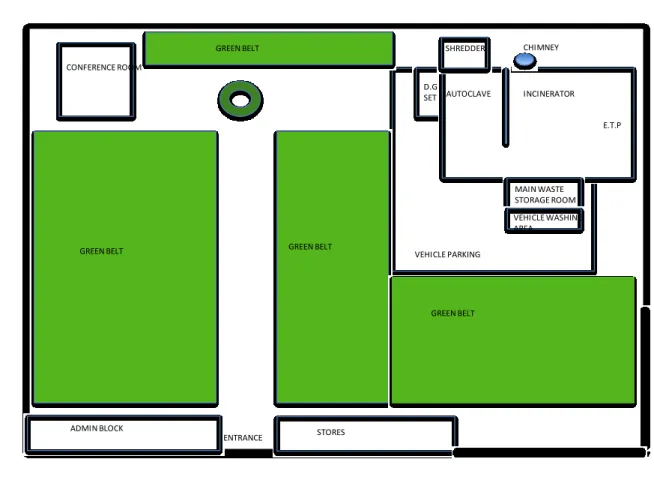
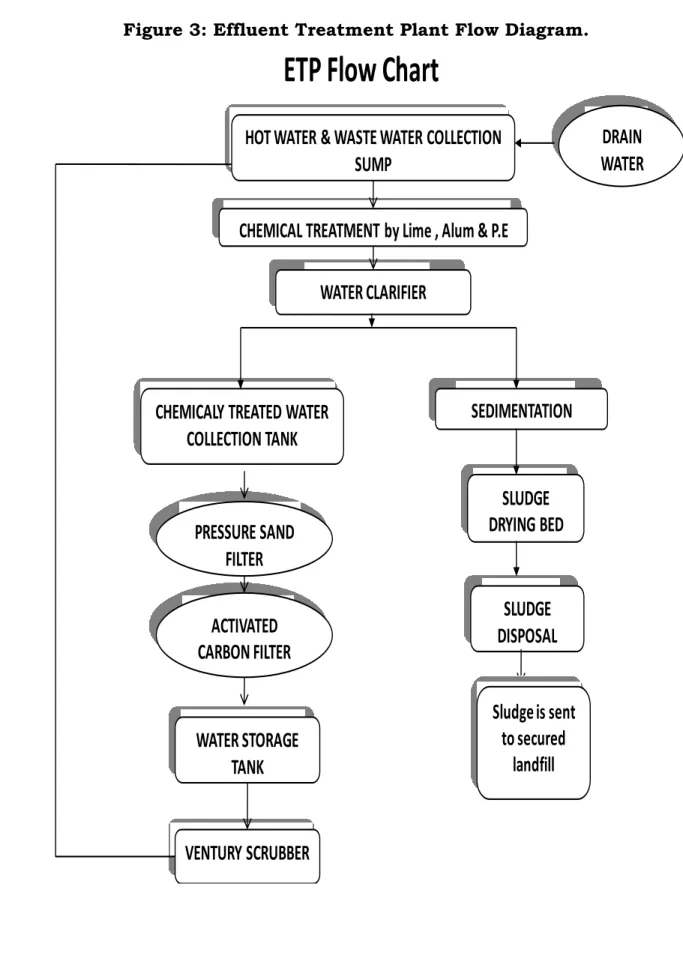
Medicare proposes that, ash, residue from high temperature incineration and other material residues from the process shall be collected into containers and shall be disposed into a secure landfill. The Process Flow Chart, Conceptual Layout plan and ETP flow diagram for the proposed CBWTF is given below in Figure 1, 2 and 3.
Figure 1: Flow diagram for Common Bio-medical Waste Management Facility.
15 | P a g e
VEHICLES DESPATCHED TO DESIGNATED ROUTES IN MORNING,WITH BINS FOR COLLECTION OF WASTE FROM HCE’S AS PER ROUTE CHART
SEGREGATED WASTE COLLECTION IN NON CHLORINATED COLOUR
CODED BAGS
VEHICLES RETURNS TO PLANT AFTER COMPLETION OF ROUTE
STORAGE OF BAGS FOR INCINERATION , AUTOCLAVING
•YELLOW BAGS FOR INCINERATION
•BLUE /RED BAGS FOR AUTOCLAVING/SHREDDER/CHEMICAL TREATMENT
AUTOCLAVING AT 121 / 135 DEGREE
INCINERATION AT 800 +/-50 DEG C IN PRIMARY CHAMBER &
1050 +/-50 DEG C IN SECONDARY CHAMBER
SHREDDER
AUTOCLAVED GLASS, PLASTIC, RUBBER MATERIALS SHREDDED
SHREDDED MATERIALS SENT TO
RECYCLER ETP
AIR POLLUTION CONTROL DEVICE
16 | P a g e
Figure 2: Conceptual & Surface plan
INCINERATOR AUTOCLAVE MAIN WASTE STORAGE ROOM D.G SET SHREDDER CONFERENCE ROOM
ADMIN BLOCK STORES
VEHICLE PARKING
E.T.P
GREEN BELT GREEN BELT GREEN BELT GREEN BELT CHIMNEY VEHICLE WASHING AREA ENTRANCE
S.No. Particulars Area in Sqm
1 Factory Shed 300 2 Security Room 25 3 Admin Room 75 4 Store Room 75 5 Toilets 25 6 Green Belt 300
7 Pathways, Roads & Culverts 125
8 ETP 75
Figure 3: Effluent Treatment Plant Flow Diagram.
HOT WATER & WASTE WATER COLLECTION
SUMP
DRAIN
WATER
CHEMICAL TREATMENT by Lime , Alum & P.E
WATER CLARIFIER
CHEMICALY TREATED WATER
COLLECTION TANK
SEDIMENTATION
PRESSURE SAND
FILTER
ACTIVATED
CARBON FILTER
WATER STORAGE
TANK
VENTURY SCRUBBER
SLUDGE
DRYING BED
SLUDGE
DISPOSAL
ETP Flow Chart
Sludge is sent
to secured
9.4 Collection and Transportation of Bio medical Waste
Biomedical Waste segregated in color coded containers as per Biomedical Waste Management and Handling Rules shall be collected from various Health Care Facilities located in the 150Kms radius (Covering 15,000 beds) The collected waste shall be transported in specially designed closed vehicle to the CBWTF for treatment and disposal.
M/s Medicare Environmental Management Pvt Ltd is intending to have closed vehicles for the Collection & transportation of bio-medical waste to CBWTF. Transportation of the wastes shall also be the responsibility of MEMPL. The proposed vehicles shall be dedicated for the purpose and shall adopt the conditions specified in the BMW (Management & Handling) Rules-1998.
9.5 Resource optimization / Recycling and reuse
The entire wastewater collected at the Hot water Sump shall after treatment in ETP will be used for floor washing and gardening / green belt. The treated effluent recycled for the use in scrubber will not be treated with hypochlorite solution. The plastic waste after disinfection & shredding shall be given to registered recyclers.
9.6 Availability of water its source, Energy / Power requirement and source
Water Requirement for the proposed facility is 22KLD and waste water generation would be around 18KLD. Water requirement for the project will be met through bore wells and Delhi Jal Board.
80KW power is required for the proposed plant. Power requirement will be sourced from existing line (BSES Yamuna Power Limited). In case of power failure, D.G. set will be used.
9.7 Quantity of waste to be generated (liquid and solid) and scheme for their Management / disposal
The Treated effluent shall meet the discharge standards laid down by MoEFCC / DPCC for disposal / reuse.
The water recovered during treatment in ETP will be used for floor washing and gardening / Green belt.
The solid waste generation during wastewater treatment & treatment of common Bio-medical waste will be disposed to Secured landfill.
10.
SITE ANALYSIS
10.1 Connectivity
Railway line:
Jhilmil metro station- 0.17 Km in NE direction
Roadways:
Road ways: The site is well connected by road ways, SH-57.
Airways:
The closest air terminal is the Indira Gandhi International Airport
Airport, located at a distance of 23 Kms from the Proposed site in the SW
Direction.
10.2 Land Form, Land use and Land ownership
The Common Bio-medical waste management facility is at Jhilmil Industrial Area, Shahdara, which is developed by DDA.
M/s Medicare Environmental Management Private Limited (MEMPL) Proposed to establish a facility at B/35, GT Road, Jhilmil Industrial Area, Shahdara, Delhi 110095
The project Proposed land is Leased to M/s MEMPL formerly (M/s Sembramky) from the .
10.3 Topography
New Delhi is a municipality and district in Delhi which serves as the capital and seat of government of India. In addition, it also serves as the seat of Government of Delhi.
With a total area of 42.7 km2, New Delhi forms a small part of the Delhi metropolitan area. Because the city is located on the Indo-Gangetic Plain, there is little difference in elevation across the city. New Delhi and surrounding areas were once a part of the Aravalli Range; all that is left of those mountains is the Delhi Ridge, which is also called the Lungs of Delhi. While New Delhi lies on the floodplains of the Yamuna River, it is essentially a landlocked city. East of the river is the urban area of Shahdara. New Delhi falls under the seismic zone-IV, making it vulnerable to earthquakes
10.4 Existing Land Use pattern
The land falls in the Jhilmil Industrial area. The Plot layout of the land is given in Figure no. 4.
10.5 Existing Infrastructure
The Proposed Facility is at Shahdara district of Delhi and all required infrastructures like human settlement, schools, hospitals, healthcare centers, fire brigade, public transport, etc. are available.
10.6 Climate data from secondary sources
The climate of New Delhi is a monsoon-influenced humid subtropical climate with high variation between summer and winter in terms of both temperature and rainfall. The temperature varies from 46 °C in summers to around 0 °C (32 °F) in winters. The area's version of a humid subtropical climate is
noticeably different from many other cities with this climate classification in that it features long and very hot summers, relatively dry and mild winters, a monsoonal period, and dust storms. Summers are long, extending from early April to October, with the monsoon season occurring in the middle of the summer. Winter starts in November and peaks in January. The annual mean temperature is around 25 °C; monthly daily mean temperatures range from approximately 14 to 34 °C. New Delhi's highest temperature ever recorded is 49.1 °C while the lowest temperature ever recorded is −3.2 °C . Those for Delhi metropolis stand at 49.9 °C and −3.2 °C respectively. The average annual rainfall is 784 millimeters , most of which is during the monsoons in July and August
10.7 Soil Classification Geomorphology
The Delhi Supergroup comprises quartzite, gritty quartzite, arkosic grit with thin intercalations of micaceous schist. The micaceous schist occasionally contains crystals of garnet, andalusite and staurolite. The rocks of Delhi Supergroup are intruded by pegmatite and quartz veins
Soil
Delhi lies in the Indo-Gangetic Geosyncline, a down wrap of Himalayan foreland of variable depth that is converted into flat plain by rigorous sedimentation. Gangetic Geosyncline has shown considerable amounts of
flexure and dislocation at the northern end, which is bounded by the Himalayan Frontal Thrust on the north. The floor of the Gangetic trough (without all the sediments) shows corrugated inequalities and buried
ridges (shelf faults). The Naraina-Patel Road section and the Yamuna River - bed section, extending till NOIDA and Faridabad they are on alluvial soil upto 200 m deep. These regions face a very grave problem of soil
liquefaction during an earthquake. Moreover, earthquakes are amplified by alluvial soils. The Ridge is comparatively safe as it has a rocky base.
11.
INFRASTRUCTURE
11.1 Industrial area (processing area) The Proposed components of the CBWTF are: Admin Building
Incineration Shed
Sterilization Room
Store Room
Workshop/Vehicle washing bay
ETP civil structure
Pannel Room
D.G Set Room
Wash Room
Waste Storage Area
Parking
Guard House
11.2 Residential Area (Non processing)
The employees will make their own arrangements for their housing & allied amenities in nearby area. There is no need for any additional facilities.
11.3 Green Belt
Green belt will be developed according to CPCB/DPCC guidelines. Plants of the various species in the plant and peripheral areas.
Schools, Colleges, Hospitals &Healthcare Centers, Shops & Bazaars, Community Centers, etc. are all available in nearby villages and towns.
11.5 Solid Waste Management
Solid waste generated during the Biomedical waste treatment process and wastewater treatment process is mainly ash and sludge which is generated depending upon the hydraulic load. Sludge is disposed in secured landfill. The disinfected plastic waste sending for recycling to registered recycler.
11.6 Power Requirement & Supply/source
Supply source – BSES Yamuna Power Limited Distribution, In case of power failure D.G. Set can be used (100 KVA capacity).
12.
REHABILITATION AND RESETTLEMENT (R & R) PLAN
No, Rehabilitation and Resettlement (R & R) Plan required.
13.
PROJECT SCHEDULE & COST ESTIMATES
The plant is Proposed all facilities and project component with state of art infrastructure. The components Proposed at the plant are following all the Criteria that are mentioned in the Guidelines.
The breakup of project cost
S.NO ITEM COST
ESTIMATE(INR)
1.0 Land (This will be consider under working capital ) 5,00,000
On monthly Rent Basis
2.0 BUILDING & INFRASTRUCTURE
Administrative Building & other civil work 1,00,00,000
Approach Road and Pathways Treatment & Storage Shed
ETP(Civil) 20,00,000
Green Belt Development 5,00,000
Total 1,25,00,000
3.0 MACHINERY & EQUIPMENT
Incinerator 80,00,000 APCS system Autoclave 40,00,000 Shredder
Online Monitoring Systems
Miscellaneous Works 5,00,000
Total 1,25,00,000
4.0 BMW COLLECTION VEHICLE 34,00,000
5.0 Furniture & Fixture 5,00,000
The Total Cost for proposed project is Rs.3 Cr.
14.
CONCLUSION (FINAL RECOMMENDATIONS)
The CBWTF project of treatment of bio-medical waste, generated from a number of healthcare units is to reduce adverse effects that this waste may pose. The concept of CBWTF within a radius of 150 Kms catering to15,000 beds has been introduced by the MoEFCC as a part of Biomedical Waste Management and Handling Rules 1998 as amended thereafter to prevent proliferation of treatment equipment area. It also reduces pressure on regulatory agencies for compliance monitoring. By operating the treatment equipment at CBWTF to its full capacity, the cost of treatment per kilogram gets significantly reduced.
Figure No.4. Site Layout in Jhilmil Industrial Area, Delhi.