Cogill J (2008). Primary teachers’ interactive whiteboard practice across one year: changes in pedagogy
1
and influencing factors. EdD thesis King’s College University of London. Available at www.juliecogill.comCHAPTER 5
ANALYSIS: WHITEBOARD PEDAGOGICAL PRACTICE, TEACHER KNOWLEDGE AND
CHANGE
From the previous chapter several major themes emerged from the data that I will use for analysis in relation to the two major research questions of this thesis:
1. Do teachers change the way they teach during one year of interactive whiteboard use and if so how?
2. What are the factors that may influence whiteboard pedagogy?
The purpose of this chapter is to address the first research question pertaining to teachers’ individual practice and I will address the second question concerning teachers’ whole school learning issues in chapter 6.
5.1 Perspectives on change in pedagogical practice
The analytical themes relating to pedagogy in the previous chapter were categorised under
Teaching, Children’s learning, Resources and Whiteboard use (Table 4.4). Table 5.1 shows the first three themes and the corresponding macro codes from Appendix 4.5. Rather than have a separate whiteboard category I have integrated the codes associated with ‘Whiteboard use’ into these themes as I consider the whiteboard runs as a thread through the analysis.
Pedagogical
practice
Autumn
Spring
Summer
Teaching
Planning, Preparation Efficiency, Sharing Organisation Quality, Structured system, methods, Proud , Creative, Learning Planning, preparation Efficiency, Regular, Everyday use Quality, Positive, Negative, Integration, Interaction, Change Exploring, Planning, Preparation Control, Exploring Teaching Differently, Management, Discussion, Interactivity Teacher as key, Tool Effective, Skills,Resources
Appropriate resourcesCreative resources Visual, Numeracy, Finding, Internet Using, adapting resources, Choosing, Creating resources, Whiteboard tools, Interactive, Integrating Favourite, Variety of Exploring, Effective Flexible, Tool, Adapting, Lit and numeracy, Regular, Fun, Enjoyment, Visual
Children’s
learning
As learners, Ability Motivation, As teachers, Questioning, Thinking Ability, Confidence Motivation Children learning, using Successful, Fun, Reflections on learning Motivation, Sharing the learning, Discussion, Ability, As teachers, Theatre, Too much Table 5.1: Themes and macro codes from my analysis relating to pedagogical practiceMy aim, using these themes and macro codes is to probe those aspects of pedagogical practice and teacher knowledge: Pedagogical Knowledge (PK), Content Knowledge (CK) and Pedagogical Content Knowledge (PCK) from my literature review (chapter 2) that may have changed as a consequence of whiteboard use across one year
The way teachers teach however is never clearly defined. There are both strong links and fuzzy areas between these three types of knowledge which I will return to from time-to-time in the ensuing sections.
Cogill J (2008). Primary teachers’ interactive whiteboard practice across one year: changes in pedagogy
2
and influencing factors. EdD thesis King’s College University of London. Available at www.juliecogill.com 5.2 Change in Pedagogical Knowledge (PK) and related practiceShulman (1987) regards general pedagogical knowledge as the broad principles and strategies of classroom management and organisation that appear to transcend subject matter. With this definition in mind I have drawn on the themes and macro codes from my analysis (Table 5.1) to examine change in PK. Some macro codes stand out as particularly significant and sub-themes in themselves; for example ‘Lesson planning and preparation’ ‘Classroom management’ and
‘Children’s learning’ were emphasised by teachers each term and affected them in their everyday whiteboard practice, regardless of subject content. Consequently I will use these three sub-themes together with the corresponding macro codes to analyse PK (Table 5.2).
Sub-themes
Lesson planningand preparation Classroom management Children’s learning independent of subject matter
Macro codes
Planning,Preparation, Efficiency, Sharing Efficiency, Regular, Everyday use, Control, Teaching differently As learners, As teachers, Thinking, sharing learning, Questioning, Discussion, Reflecting on learning, Ability
Table 5.2: Sub-themes and macro codes for analysis of PK 5.2.1 Lesson planning and preparation
Almost all the teachers taking part in the research felt that using the whiteboard had improved their lesson planning and preparation. For the most part although preparation time had initially increased, with the development of their own ICT and planning skills, preparation later became much more efficient. Carole from Nolan exemplifies these views:
I think it took me a long time initially now I’m very quick at preparing things, I can snap shot things, and I can scan things very quickly … and then bring it up on the whiteboard.
One exception to the view that preparation time decreased came from Paul (Nolan) who by the end of the Summer term still thought lesson preparation took longer, at the same time however he acknowledged that this was in part due to his interest in the task. Delia at Nolan remarked that she was sometimes spending too much of her time looking for resources on the net but was also learning herself. ‘I typed in fairy tales and it was all up there so it’s a little bit for me as well as teaching the children’. By the end of the year she had managed to limit the time she spent searching for resources.
There was also considerable sharing of lesson plans at Nolan which included joint preparation as well as just swapping lessons. For some teachers at the school this extended to discussing
pedagogical implications both during and subsequent to joint planning. When discussing advice for a student teacher new to the whiteboard Heather (Nolan) commented:
They would need to think about how they’re going to use the board in their lessons; using the partner that they’re working with, to work in tandem, because I think it’s much easier and beneficial if you work together and you get a lot more from the learning than if you’re planning independently of each other.
Heather (Nolan) and her year group colleague were also assessing how children had reacted to their jointly planned lessons.
Even when the work’s been done we’ll swap over, see how we annotated it, just simply see how our children compared, as well.
Cogill J (2008). Primary teachers’ interactive whiteboard practice across one year: changes in pedagogy
3
and influencing factors. EdD thesis King’s College University of London. Available at www.juliecogill.com At West although planning and preparation had changed, the emphasis was on efficiency rather than pedagogy. Alan commented:Well my preparation that has changed my teaching. I mean being able to set things up, so
just during the day I can turn to a page rather than writing it out on the spot. He also felt that even with no access to a whiteboard his preparation and planning had improved
since his teaching tended to be better prepared. Other teachers at West similarly noted the
advantage of preparing lessons in advance. Though there was evidence at West of some sharing of pre-prepared lessons these lessons were created independently rather than as a shared experience.
Well Janet and I share, and I’d like to share resources more ‘cos I think we could get a lot more out of it. If I’m planning something for humanities I might put some things up for other people and Janet for science so I’d like to instigate a bit more of that I think it would be
useful. (Rebecca)
During my pilot study I had observed instances of over-planning during lesson observations, so that on some occasions children were expected to listen for too long. I experienced no over-planning during observations for this RBT.
5.2.2 Classroom management
Many of the efficiencies the whiteboard affords in classroom management have already been
considered in ‘Planning and preparation’ above and the purpose of this short section is to add further evidence. The whiteboard was additionally helping teachers to organise their teaching by facilitating relevant and pertinent discussion of content displayed on the board; enabling movement between pages without the problem of erasing earlier discussion points and the facility to recap by saving previous work from the board.
Because you’re a lot more organised with having it all up on the board it’s more of a
discussion, interactive type teaching than it would be if you had to write on the board at the
same time. (Anne, West)
Rebecca at West described how she was using the whiteboard to help classroom management by capturing children’s attention early in the lesson:
I usually have something up on the whiteboard… a poem when they come into the lesson, something up there for them to focus on and then we go straight into reading that poem. Anne also at West commented on behaviour management:
I wouldn’t say it makes it easier, but it’s definitely better for the children because it’s all written up there and you don’t have your back turned towards them to be writing on the board. Delia noted a related but different issue: she had initially felt that she was spending a lot of time with her back to the children while writing but by the Spring Term she felt she was managing the
technology so that having her ‘back to children’ no longer remained a concern. 5.2.3 Children’s learning independent of subject matter
The analysis of children’s learning proved to be particularly complex as I attempted to differentiate between PK and PCK. This was further exacerbated by the context of this research, ie primary schools, since all participants taught across the curriculum. In order to distinguish between these two areas of knowledge I have analysed those issues that pertain to particular subjects under PCK and placed general concepts under the heading of PK.
At Nolan apart from Paul teachers had already adapted to teaching the National Strategy for Numeracy and the school did not follow the Literacy Strategy. Consequently whole class teaching
Cogill J (2008). Primary teachers’ interactive whiteboard practice across one year: changes in pedagogy
4
and influencing factors. EdD thesis King’s College University of London. Available at www.juliecogill.com was already integrated into the classroom practice of the school. Paul was not accustomed to whole class teaching. Nevertheless he noted several benefits and was utilising the board to fosterchildren’s reflective skills and help them appreciate their own self-knowledge. And to stand back and look at what they’ve done and self-correct, and I
think they come away quite rewarded, you know; to see them say ‘Oh, OK’, and others are adjusting their thinking as well and it brings the class together I think.
He added the potential to boost children’s self-confidence:
I mean the children can also become a bit of a teacher perhaps. They feel they’ve got more of an opportunity to take part and become more empowered… I view it as a tool to be shared and for children to use it as well, so it’s not just me being important with board, it’s all of us…What you really want to convey is knowledge and skills to the child leaving yourself to
the side of it all. (Paul)
Heather (Nolan) empathised with Paul’s views on joint ownership; ‘they feel that it’s their board and not just my board’. Carole also at Nolan made two interesting remarks on children’s learning that aptly demonstrate not only her enthusiasm but also some reservation that the whiteboard is not the only solution to good teaching:
OK you could have scanned something in and had it on 16 computers but then you can’t actually see if they’re focused. By putting it up on the whiteboard you can have them close to you and pull them in and engage them and make them be involved far more.
In contrast she stated:
So it’s another teaching tool, just as paired discussion which I use a lot is another teaching tool, sitting girl boy, it’s just different strategies. .. I think it’s like anything it’s a good tool if it’s used properly in a variety of ways. Keep the interest going – not using it in the same way all the time.
Carole reported how she often displayed children’s own work to enable learning in a whole class situation: to report back on a science investigation, to view other children’s work and to show their annotations for example of a poem so that they could explain to the class what they had done. Two other teachers at Nolan: Heather and Jill echoed Carole’s views.
At West, teachers started out from quite a different perspective. They had all been used to teaching children individually using a research based focus, a problem solving focus or group work. Their initial enthusiasm for the whiteboard to enable children’s learning tended to dwindle through the year, perhaps partly as a result of the quite rigid structure of the Literacy and Numeracy Strategies. Alan, despite describing the whiteboard as the best teaching toy he had ever used, exemplifies the situation. He did not feel that the board resulted in much effect on children’s learning and felt it inhibited his teaching style:
Standing in front of the class and talking the whole time. I’m finding I’m doing it a lot here. And I’d rather not, but that seems to be the way the system works.
By the Summer Term he had become more disillusioned
I don’t think it helps to share the learning much more than anything else. I mean if I didn’t have it, I’d be sending kids up to the board to demonstrate things; so it probably gives them a bit more to play with once they get up there.
Cogill J (2008). Primary teachers’ interactive whiteboard practice across one year: changes in pedagogy
5
and influencing factors. EdD thesis King’s College University of London. Available at www.juliecogill.com I felt however that Alan appeared to make little attempt to adjust his teaching or use the board to enhance his own way of teaching and rather thought of it as a ‘great gismo’ (his words) to play with. Similarly Sophie who never quite got to grips with the technology felt that the whiteboard and the way she was expected to teach inhibited children’s learning. She spoke of the loss of group work yet unlike Alan realised that she wasn’t making the most of the board in her teaching.They’re probably not given that much chance to work as a group… but on the other hand there’s a big version in front of all of them then you can all discuss it. But I guess we’ll need to combine both somehow…when they have the chance to write on it, they’re suddenly very interested. But I don’t see it much different to giving them chalk.
In yet a further statement on children’s learning giving both positive and negative views she stated: I guess there’s more ways of teaching the same thing, presenting it. Sometimes I think it’s got away from the practical side and more to the pen and paper. You tend to rely on what’s on the board.
Sophie raises three interesting issues in these statements in relation to children’s learning: the whiteboard presents more ways of teaching the same thing which was echoed by several teachers; it may detract from the use of practical materials which was similarly expressed by others and may create a lack of flexibility in teaching through ‘tending to rely on what’s on the board’. In contrast Rebecca at West was sometimes using the board in a creative way through whole class shared learning which was reflected in the lessons I observed her teaching.
I’ll type it up and we’ll talk about what words we might change or how we might change the order or what would look right on the next line, so we’re doing shared writing basically which is good fun. Then we can see the finished product and we can read it and they’ve all done it together.
However Rebecca regretted the lack of opportunity to use the board for children to demonstrate their own work and share the teaching and learning as a whole class.
It would be really, really ideal if the children could do a PowerPoint presentation of their own… to show the rest of the class. But, you know there isn’t quite simply the room in the curriculum for that. It seems to be more do this, do this, and it’s lots of little blocks that don’t meld together very well I feel.
In the Summer term despite having tried to integrate the board and adapt it to her own teaching style to help children’s learning she seemed to feel she was running against the tide and was expected to use whole class teaching in preference to group work. Anne and Janet two other teachers at West Primary expressed the same views as Rebecca though they had also experienced some frustration as their boards had suffered breakdowns during the year. John on the other hand, the sixth teacher at West certainly endorsed the board for its potential to add interest to teaching and learning. He also felt that the whiteboard had reawakened his interest in analysing teaching and that as far as possible he was using all the resources available to reach children’s learning. In this respect I feel his outlook was similar to that of Paul at Nolan, though the lessons I observed John teaching did not support his interview comments to the same extent. John was also aware that children were listening rather than engaging in their own work for at least one third of their learning day which genuinely concerned him.
The ability to integrate use of the board with teachers’ own philosophies on how children learn varied from teacher to teacher. At West I felt that only Rebecca had really thought about how the board suited her own teaching style and adopted appropriate practice to help children learn. At Nolan
Cogill J (2008). Primary teachers’ interactive whiteboard practice across one year: changes in pedagogy
6
and influencing factors. EdD thesis King’s College University of London. Available at www.juliecogill.com awareness of how to integrate use of the board was widespread along with an understanding that the whiteboard alone was not going to transform children’s learning.5.2.4 Summary of effects on Pedagogical Knowledge
So it can be seen that over the course of one year, use of the whiteboard for teaching and learning affected teachers’ PK in several ways. Of significance on the positive side was:
• Teachers became more enthusiastic about planning their lessons and searching for
resources that enhance children’s learning. For the most part time spent on lesson planning initially increased but tended to settle down as teachers realised that they needed to restrict Internet search time.
• Teachers found the board gave then ‘more time to teach’ as they were able to prepare lessons in advance.
• The whiteboard enabled teachers to share lesson plans more easily. While for some teachers this was just to ease their workload, others were sharing the planning and using this facility to consider children’s learning and as a result their own pedagogy.
• Some teachers were using the board to encourage children to reflect and think about their learning and employing different ways of explaining concepts to enable children’s
understanding
• The facility to save pages enabled teachers to recap and retain work for use on another occasion
• The board facilitates the potential to show and amend children’s work so that they can learn from their own experiences.
• When used at its best the whiteboard became a means to instigate whole class collaborative work sometimes enabling children to become involved in the process of teaching.
• The board helps classroom management as it captures children’s attention and frees teachers from time spent writing on the board when children may be unoccupied. This freedom may also enable more focused discussion for better learning.
Some teachers were engaging children in interactive learning. Children were learning through thinking, reflecting and rethinking their ideas, working collaboratively and from time to time even becoming part of the teaching process.
Negative effects were also conveyed:
• The whiteboard imposes whole class teaching which may result in children’s becoming passive learners
• Whole class teaching may result in a loss of group work if teachers spend too long on their own exposition delaying the stage at which children engage in their own work.
• Virtual resources may suggest to teachers that practical work is no longer required since it is so easy to demonstrate using images on the board.
• If used in the same way all the time then like any resource the whiteboard may quickly becomes routine and boring and children take it for granted.
Teachers in this study expressed both positive and negative effects in using a whiteboard. What is interesting perhaps is that the teachers with good practice were conscious of the potential hazards of over-using the whiteboard.
5.3 Change in Content knowledge (CK)
Content knowledge refers to the knowledge that teachers have of the subject matter they are teaching (Shulman 1987). Using this definition as a basis I intend to subsume Curriculum
knowledge within CK given the primary school context of this study. Following the introduction of the Literacy and Numeracy Strategies, curriculum and content have been very closely linked and at the time this study was undertaken the strategies were highly influential on pedagogical practice in
Cogill J (2008). Primary teachers’ interactive whiteboard practice across one year: changes in pedagogy
7
and influencing factors. EdD thesis King’s College University of London. Available at www.juliecogill.com primary classrooms. Equally as primary teachers teach across all subjects, it is not my intention to delve into particular aspects of subject knowledge but rather to deal with more general issues which may reflect change in CK. I have already explained in section 2.2.3 why, within the primary school context, I regard it as important to consider CK as a separate entity from PCK.‘Resources’ appears as a major analytical theme in Table 5.1. Within this, as well as the ‘Variety’ of resources available, for example the Internet, teachers’ spoke of ‘Appropriate’, ‘Exploring’ and ‘Integrating ’ resources especially in the first two terms. Later teachers were more reflective on their use of resources using terms such as ‘Effective’, ‘Favourite’, ‘Fun’ and ‘Interactive’. Consequently I have chosen to focus my discussion on two sub-themes: teachers’ selection of resources and their reflections on use
5.3.1 Teachers’ selection of resources for whiteboard use
In the Autumn term teachers hardly mentioned any use of specific software resources. By Spring the range of resources being used had developed rapidly. Most teachers were using the Internet to access images to help children’s understanding and stimulate interest as well as the software tools available on the board itself. At this stage most teachers had found some favourite software
resources. Perhaps surprisingly this aspect of development in their whiteboard practice did not appear to have changed significantly when I spoke to them in the Summer. I found that many of the resources they cited in the Spring as being ‘enjoyable’ were similar to those they spoke of in the Summer as being ‘particularly useful’.
At Nolan teachers were keen on finding and using new learning software and felt it made their planning more interesting:
Yeah because for me it’s interesting looking for things I can easily get from the internet or programs and prepare them and put them on ready to go, I think it’s very rewarding, I
wouldn’t really be without it. (Paul)
Carole emphasised the need for relevance in selecting different resources:
You can go and find some already prepared lessons that are interesting and exciting and meet the needs that you actually want not just ‘oh there’s a site’ but this is actually what I want to do.
And Delia noted how much she would miss the range of resources available with the whiteboard if it were no longer accessible. Other teachers at Nolan were similarly using a range of interactive learning software as well as the Internet to stimulate their own teaching and children’s learning. In contrast at West, Rebecca and John mentioned the use of interactive learning resources
considerably more than the other four teachers. By the Spring Term Rebecca was enjoying using websites, film clips and software to ‘tie in with what you’re doing and capture children’s imagination’. Alan did not mention using any interactive software and was only selecting images from the Internet and employing the board’s own software tools:
A lot of the problems with planning normally is hunting down the resources. So with the whiteboard being the main resource there’s not a lot more to do… And I normally just copy
and paste it straight off the net. (Alan)
Sophie at West similarly used little software throughout the year though when she did she felt that both she and the children enjoyed the experience. In a similar way to Alan it appears that in general it was not within her repertoire of lesson planning, to search for interactive content.
5.3.2 Teachers’ reflections on use of resources
The aim of examining teachers’ reflections on whiteboard resources is to discern to what extent such resources may have changed their view of subject content and subsequently their CK. Most teachers
Cogill J (2008). Primary teachers’ interactive whiteboard practice across one year: changes in pedagogy
8
and influencing factors. EdD thesis King’s College University of London. Available at www.juliecogill.com noted the potential of the whiteboard to demonstrate some concepts more effectively and that resources provide ‘more ways of teaching the same thing’.
Paul at Nolan expressed his views on how the board had enabled him to change his delivery of lessons across all subjects.
Well you can use the whiteboard for every subject. That’s how powerful it is because it’s really just conveying the information you want the pupils to learn about and getting it, delivering it to them in the quickest most effective and efficient way possible.
Jill also at Nolan noted the potential for making links across subjects
I want teaching to be different from the way I was taught. I want it to be much more interactive, dynamic, interesting, relevant to the outside world. And there’s lots of cross-curricular links, so they can see the links between different subjects and how all that fits together which I think is important.
Sophie at West however commented that while software was readily available, owing to the lack of other learning resources teaching was sometimes more difficult. Similarly Rebecca was keen not to lose the more traditional ways of learning, reflecting a view mentioned by teachers from both schools on the need to maintain a balance between the whiteboard and other teaching resources. Two teachers, Janet and Rebecca at West especially valued the ’power’ of the whiteboard to bring the outside world into the classroom.
And if the children come up with a question instead of saying ‘Oh I don’t know the answer’, you can say ‘Here it is; What can we type in?’ and give them the research skills as you’re doing it. You know, ‘Where are we going to go and find this?’, ‘Is this relevant?’ (Janet)
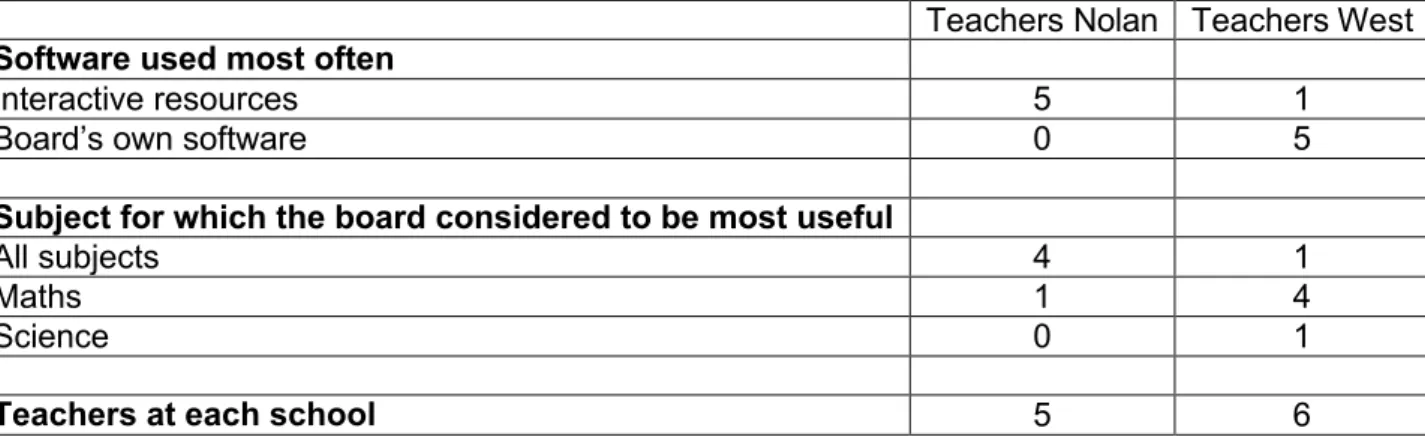
At the end of the Summer Term I asked teachers specifically which software they used most often and for which subject the board was most useful. Table 5.3 illustrates the contrast between the schools suggesting that interactive resources were used more widely across more subjects at Nolan.
Teachers Nolan Teachers West Software used most often
Interactive resources 5 1
Board’s own software 0 5
Subject for which the board considered to be most useful
All subjects 4 1
Maths 1 4
Science 0 1
Teachers at each school 5 6
Table 5.3:The use of software resources
Although I observed the whiteboard being used interactively in several other contexts, the only occasions I observed commercial software used in an ‘interactive way’ was limited to maths through programs on place value, fractions and innovative diagnostic use of a multiple choice maths website. In all cases the interactivity depended on the teachers’ questioning skills.
5.3.3 Summary of effects on Content Knowledge
Some of the teachers taking part in this research were using a range of software and enjoying learning themselves through the use of new resources. These also provided them with access to a wider variety of subject content. Some teachers were more reflective on the content of the software
Cogill J (2008). Primary teachers’ interactive whiteboard practice across one year: changes in pedagogy
9
and influencing factors. EdD thesis King’s College University of London. Available at www.juliecogill.com they were employing, and experimenting with various techniques to put across subject knowledge. Visual resources in particular were felt to be especially supportive when explaining certain concepts. Several teachers were using the Internet when their own subject knowledge was lacking, to respond spontaneously to children’s questions in the classroom. However two teachers at West questioned the amount of funding for ICT resources over and above other mainstream learning materials. Any evidence of change in CK following whiteboard use is difficult to pull together without exploring teachers' prior knowledge within each subject area. Consequently, although this analysis is not rigorous with respect to specialised subject knowledge, in accordance with McNamara (1991) and Cox et al (2003) it does suggest that for some teachers, the whiteboard with accompanying software influences teachers’ CK. Using the whiteboard effectively requires teachers to both chooseappropriate resources and reflect on their effectiveness. Not surprisingly these issues link strongly to my next discussion on change in PCK.
5.4 Change in Pedagogical Content Knowledge (PCK)
PCK is the knowledge of how to teach within a particular subject area (Shulman 1986). Shulman (1987) suggests that PCK identifies ‘the distinctive bodies of knowledge for teaching’ and how teachers take into account the diverse abilities of their learners to present material. I consider all my analytical themes relating to pedagogy: ‘Teaching’ ‘Resources’ and ‘Children’s learning’ are
relevant to teachers’ change in PCK. My teachers’ spoke of the whiteboard enabling them to: • ‘Teach differently’, enabling more ‘Questioning’, ‘Prediction’ and ‘Discussion’
• ‘Change children’s learning’ through ‘Interactive’ and ‘Visual’ resources
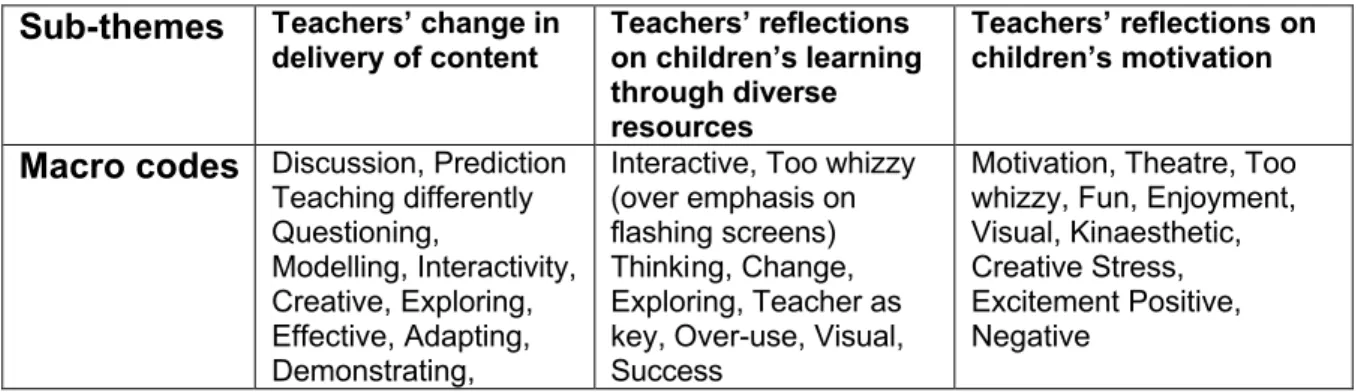
• Affect ‘Children’s motivation’ through providing ‘Fun’, ‘Excitement’ and ‘Enjoyment’. Equally they considered some negative effects such as, teaching becoming too ‘whizzy’ (over emphasis on flashing screens) or ‘over-use’ of the whiteboard which may adversely affect children’s learning especially if resources are inappropriate. As a result the sub-themes I will use to analyse PCK, together with the corresponding macro codes are:
Sub-themes
Teachers’ change indelivery of content Teachers’ reflections on children’s learning through diverse resources
Teachers’ reflections on children’s motivation
Macro codes
Discussion, Prediction Teaching differently Questioning, Modelling, Interactivity, Creative, Exploring, Effective, Adapting, Demonstrating,Interactive, Too whizzy (over emphasis on flashing screens) Thinking, Change, Exploring, Teacher as key, Over-use, Visual, Success
Motivation, Theatre, Too whizzy, Fun, Enjoyment, Visual, Kinaesthetic, Creative Stress, Excitement Positive, Negative
Table 5.4: Sub-themes and macro codes for analysis of PCK 5.4.1 Teachers’ change in delivery of content
Most of the relevant comments came from Nolan. Carole especially spoke of integrating her previous approaches to teaching with the whiteboard:
I’ve been here quite a few years now so my resources are all built up but it’s now actually taking that and thinking them into the whiteboard either to take the paper away and make it into the whiteboard or fitting the 2 things together.
She similarly felt that there were some features of the board that made teaching easier
I think I probably use modelling more ‘cos it’s easier to flag it up all the time... You can also scan children’s work in and use those as models, so that I can say ‘This is what I’m looking
Cogill J (2008). Primary teachers’ interactive whiteboard practice across one year: changes in pedagogy
10
and influencing factors. EdD thesis King’s College University of London. Available at www.juliecogill.com Paul was using the ‘blind’ tool which covers up parts of the screen to teach differently.And again the blind you just draw it down a bit at a time. Then there’s only a little bit of information …If they see everything bang up there, it’s too much so you can just give it to them bite-size. Again it’s all playing into their waiting hands [both laugh].
Paul was using the tool not only in literacy to show a limited amount of text but also in art. He had shown children a small part of the sky from Van Gogh’s Cornfield and asked them to predict what was represented, examine the colours and paint in detail just that aspect of the painting. In this way, he was using the spotlight tool to stimulate interest and foster children’s prediction skills. He was really enjoying accessing a range of resources to think about how to change his teaching across different subjects. Delia considered that maths resources had affected and improved the way she was teaching some topics:
I love teaching maths, and I’m actually enjoying using the whiteboard but I kind of resisted this resource first of all because I knew I wanted to do it this way, my way.
Several teachers spoke of how the whiteboard changed content delivery in giving more time for discussion, since teachers were less busy writing themselves but Paul was using this facility for a particular purpose:
I think that I can get children automatically engaged who would be very quiet, and I go purposely for those to get them to speak, to get them to think, to get them to take part in something.
Not all Nolan teachers were as innovative across all subjects. Heather for example regarded music, art and to some extent English as less affected by whiteboard access. Nor were all views from Nolan positive. Delia spoke adversely of using the whiteboard in the context of differentiation.
Obviously there’s no differentiation. So you have to be very careful not to baffle those who are less able. And that’s why I think it would be a danger to go straight to the computer and then take everything from that, rather than the other way round.
Change in content delivery at West tended to focus on the use of resources or images for children’s learning rather than interactive software. Only John, Sophie and Rebecca reflected on how
resources might change their teaching. John was quite explicit and felt that using ICT made him ‘more excited and interested in exploring his teaching’. Sophie noted the potential for different ways of teaching and more ‘joined up teaching’. While Rebecca commented that since having the
whiteboard she was more likely to demonstrate skills and concepts since some software resources made this much easier. Alan, as did teachers from both schools spoke of the efficiency the board affords in the delivery of content
It probably affects the speed at which you can work because things are more prepared the kids don’t have to wait for me to do it; So, yeah, the speed in which they learn, or at least the speed in which the lesson takes place. I think that improves.
5.4.2 Teachers’ reflections on children’s learning through diverse resources
Whenever I asked teachers in this study about their own learning they almost inevitably responded by discussing technical whiteboard issues or children’s learning rather than their own. As a result it is not so surprising that a major part of this discussion on PCK concerns how teachers felt the board was affecting children in their classrooms.
Maths was by far the most mentioned subject across both schools in relation to benefits of the whiteboard. Maths use was heavily dependent on both external software and the easy access to grid lines, number squares and 2D and 3D shapes available through the board. Nevertheless teachers
Cogill J (2008). Primary teachers’ interactive whiteboard practice across one year: changes in pedagogy
11
and influencing factors. EdD thesis King’s College University of London. Available at www.juliecogill.com reflections on children’s learning tended to focus on software resources. Following a lesson on numeracy Delia (Nolan) commented on the visual aspects that the board adds to children’s understanding. On another occasion, her enthusiasm for how the board enhanced their learning shone through.They could never have done that on paper. I know that those children … cannot write thousands on paper … But it all made sense to them somehow visually. And I was thrilled to bits with that because we’ve only done that up to a hundred before.
Heather also from Nolan felt that the whiteboard had changed both her teaching and helped children’s learning in maths and science.
It has changed the way I teach maths because I use resources so much more. It gives them a chance not just to listen to me, they can actually see things on the board and I think that helps them.
We’ve been doing things with the body and there are sites where you can see the heart pumping, and they can actually see it happening. That was a big impact for them because you can’t just explain it, and then they have the noises that come with it, all the sounds. Both schools had a reasonable supply of software for teachers to use via a network as well as Internet access to online resources. Delia (Nolan) felt that use of a range of resources definitely enabled her to help children’s understanding.
I just think that as a teacher, it really gives me another dimension; it helps me, yeah really explain things …I can always pretty much find something that will have an extra explanation to what I’m trying to get across. And I think the children can grasp things slightly quicker. Delia and Carole (Nolan) also emphasised the learning possibilities enabled through visual resources, both to complement their teaching and visibly engage children. While Paul welcomed resources that enhanced children’s interactive learning and his views were exemplified in practice when I observed him teaching.
I think I’m able to teach much more quickly and efficiently and effectively with the whiteboard because it’s powerfully interactive and the children are engaged much more quickly.
At West, Rebecca and John enthused about particular software they had used.
They were very involved, there were several different games, they were really excited and interested. It was probably half and hour they were sitting and they were totally immersed. It
was great. (Rebecca)
I like the educational games because some of them are quite good fun and you know you’ve got good learning content and good thinking skills, and understanding. (John) 5.4.3 Teachers’ reflections on children’s motivation
All participants noted that the whiteboard motivates children through the potential to show attractive visual material. Rebecca from West cited a particularly pertinent example:
And it was all bright and really good pictures and a lot of humour in it as well so they were very interactive and they were really involved in the humour. … Normally it’s little
photocopied sheets where you circle around the problem (laughs) so it was much, much more exciting.
Cogill J (2008). Primary teachers’ interactive whiteboard practice across one year: changes in pedagogy
12
and influencing factors. EdD thesis King’s College University of London. Available at www.juliecogill.com What I am really aiming to tease out in this section however are the more subtle ways in which the whiteboard may motivate children and some of the potential hazards in using the whiteboard only as a motivator. Paul from Nolan spoke of using resources on the board which ‘crisp children’s attention span’.And it’s the unfamiliar which captures their attention… It’s to capture their attention which is when learning can take place. So you’re seizing the moment and that’s what you can do very quickly.
I recall observing Paul and the whole class perk up during one lesson when it was their time to share the board and they gave the activity their complete attention even though they had been listening for some time by this stage. Delia though speaking very positively about the motivating aspects of the board did not ignore potential disadvantages. In observing a student using the board she noted:
The children couldn’t focus any more, it was too much of the same thing, there wasn’t much evidence of anything being done, which isn’t always a bad thing. But I think you need to be aware … that with the whiteboard, the children may switch off, you don’t know what they know and what they don’t know…
I think sometimes although its good and its visual, sometimes the interactive side of it’s a little bit slow, a bit laboured; so children are moving something around on the board whereas you might have had a discussion going on instead … so you’ve got children just sitting there, whereas they might be waiting to answer your question or talk back. (Delia) Delia makes valid points. I have observed a number of whiteboard lessons, not only in the context of this research, in which children have been using the board without a great deal of purpose,
sometimes with the rest of the class uninterested in what was happening. In response to this negative view however, Carole from Nolan pointed out the ‘cool’ aspect of the whiteboard.
Yes it gives them incentive to come up and be involved, especially when they can move things around or play about with it a bit - makes it fun, learning should be fun.
Rebecca at West, equally enjoyed children experiencing the ‘sense of theatre’ the whiteboard may create, a term first used by Davison and Pratt (2003).
Yes they absolutely loved it. Really, really loved it. It was all bright and it had the sound of a ticking clock adding to the stress and excitement, building their thoughts (laughs) and they couldn’t wait to have their go.
Nevertheless she did voice reservation in that the whiteboard’s motivating powers depend on how it is being used.
I haven’t noticed them really being absolutely captivated, you know, just unable to take their eyes off the PowerPoint presentation or something like that. (Rebecca)
Sophie from West added another problem in using the board to motivate indiscriminately:
It probably can stimulate them, because we can use different coloured text. But sometimes it detracts from them learning … When the word ‘boy’ turned green, that was all a child was thinking of, I’m sure of it.
Cogill J (2008). Primary teachers’ interactive whiteboard practice across one year: changes in pedagogy
13
and influencing factors. EdD thesis King’s College University of London. Available at www.juliecogill.com It’s a good gimmick too. Gimmick’s probably the wrong word because it really devalues it, but it is flashy, and it does make, it exciting. So I like to use the flashiness of it as much as I can.In response, Carole points out that the motivating aspects of the whiteboard should be kept in the context of children’s needs.
It is not the only learning tool and it’s very easy to be flash on a whiteboard but it isn’t necessary. That won’t necessarily help the children’s learning, you’ve got to actually think about what you’re trying to achieve and the best way that that would be achieved.
5.4.4 Summary of effects on Pedagogical Content Knowledge
Teachers were adapting their own resources, sometimes collected over several years to use with whiteboard so that the technology changed aspects of their teaching. The whiteboard tools provided a means to teach some concepts in different ways and enabled more focused discussion. The interactive whiteboard may motivate primary school children if it is being used with a good teacher and appropriate resources. Such resources not only stimulate but they are also relevant so that children enjoy learning. The whiteboard offers further potential to:
• enable greater understanding through software resources so that children grasp concepts faster especially in maths
• capture children’s attention through visualisation and animation
• capture children’s attention through motivating resources in such a way that is ‘timely for learning to occur’
• involve children directly as they themselves work at the whiteboard which may creates a sense of theatre in the classroom.
What is apparent however is that good teachers not only recognise the potential of the whiteboard for children’s learning but equally recognise potential negative effects:
• teacher exposition at the board may become overlong resulting in children becoming bored and ceasing to participate in the learning
• the focus on whole class teaching may result in lack of differentiation to cater for different learners’ needs
• the whiteboard is not necessarily engaging if a teacher’s presentation is dull
• children may be passive and uninterested while other pupils are at the front of the class manipulating images
• children may be motivated only by the flashy features that appear on the board rather than by any learning aspects of the resource
• a teacher may employ the boards resources for their own motivation rather than for children’s learning
• there is need to recognise that the whiteboard is not the only learning tool and what matters is relevance to children’s learning at any particular time.
Evidence from this study suggests that the whiteboard was positively influencing some teachers’ PCK but that teachers’ were equally aware of negative aspects if the board is used inappropriately for children’s learning.
Differentiating between PCK CK and PK has been a challenge in categorising teachers’ views throughout this analysis. However I considered it worthwhile to attempt analysis across PK, CK and PCK as I hope to instil a theoretical perspective with regard to interactive whiteboard practice and teacher knowledge which necessitated me pursuing each knowledge base as distinctly as possible. 5.5 Discussion on change in pedagogy and links to practice
Cogill J (2008). Primary teachers’ interactive whiteboard practice across one year: changes in pedagogy
14
and influencing factors. EdD thesis King’s College University of London. Available at www.juliecogill.com Teachers taking part in this study did not consider that the whiteboard changed the way they teach.I think I’ve adapted my way of teaching to absorb the whiteboard, not vice versa.
(Delia, Nolan)
I just think children get access to a lot more, like for example the Internet, so they get to see more But I wouldn’t say we worked any differently. (Anne, West)
It’s improved some of the things I did or enables you to save brainstorms and bring them up whereas with an ordinary board you’ve to write it up again. So in that aspect it changes teaching but I think my overall teaching is still the same. (Carole, Nolan) However, my analysis of PK CK and PCK and conclusions suggest that in some cases the
interactive whiteboard does change teachers’ knowledge and their pedagogical practice. What I now wish to consider is how this change is reflected in day-to-day elements of interactive whiteboard practice.
Hodgkinson-Williams (2006) broaches the issue of ‘What is understood by integrating ICT into the curriculum?’ While I do not wish to dwell on the use of ICT per se within this thesis, I nevertheless consider that there are valuable thoughts to be gleaned from Hodgkinson-Williams’ analysis which are relevant to changes in pedagogy as a consequence of whiteboard use. She proposes that it is necessary to differentiate between ‘re-presentational’ and ‘generative’ use of ICT, terms attributed to Hokanson and Hooper (2000). Re-presentational use is described as the re-presentation or
reproduction of information whereas generative use is explained as the having the ‘capability to generate thought’. This distinction appears to fit well not only with my own views on changing pedagogical practice but also with those expressed by McCormick and Scrimshaw (2001) on how ICT may create a change in such practice. They consider that teachers’ existing practice in using ICT may alter by becoming more efficient or effective, extended in some new way or transformed from their earlier practices.
I will now consider whether the teachers taking part in this study provide evidence for change in pedagogy using the literature of Hodkinson-Willams (2006) and McCormick and Scrimshaw (2001). To what extent were teachers using the whiteboard in a re-presentational way or a generative way and did practice become more efficient, effective, extended or transformed?
5.5.1 Teachers’ change of pedagogy in practice
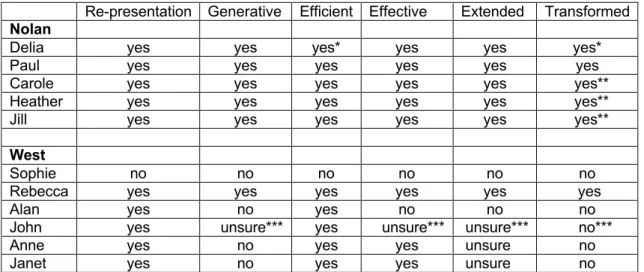
Table 5.5 shows how I consider each teacher progressed in their pedagogy through the year. I have purposely divided the categories of ‘Efficient’ and ‘Effective’ (McCormick and Scrimshaw, 2001) as I consider that they are not synonymous in the whiteboard context. A teacher may be working
efficiently for themselves but not necessarily effectively for children’s learning. However individual cases where I considered change was effective as well as efficient have been noted. Similarly what is meant by ’transformed’ requires further clarification which I will discuss towards the end of this section.
Cogill J (2008). Primary teachers’ interactive whiteboard practice across one year: changes in pedagogy
15
and influencing factors. EdD thesis King’s College University of London. Available at www.juliecogill.comRe-presentation Generative Efficient Effective Extended Transformed Nolan
Delia yes yes yes* yes yes yes*
Paul yes yes yes yes yes yes
Carole yes yes yes yes yes yes**
Heather yes yes yes yes yes yes**
Jill yes yes yes yes yes yes**
West
Sophie no no no no no no
Rebecca yes yes yes yes yes yes
Alan yes no yes no no no
John yes unsure*** yes unsure*** unsure*** no***
Anne yes no yes yes unsure no
Janet yes no yes yes unsure no
Table 5.5: Change in teachers’ pedagogy arising from whiteboard practice Reflections on Table 5.5
* Delia had spent a lot of time searching for resources over the year but had got to grips with managing this time. In other respects her practice was ‘transforming’ in so far as some of her views on teaching and learning had changed.
** Carole, Heather and Jill at Nolan were already excellent practitioners at the start of the research so were transferring this to the whiteboard. It was enhancing their already outstanding pedagogical practice through access to a far wider range of resources.
*** The way John spoke suggested that his practice was transforming but this was difficult to support in the lessons I observed him teaching.
There was also some evidence to suggest the reawakening of teachers’ interest in pedagogy which I suggest links closely with ‘transforming practice’. Paul (Nolan) and John (West) suggested such reawakening the most explicitly, while for Delia, Carole, Heather and Jill (Nolan) and Rebecca (West) it was implicit from their enthusiasm.
In this analysis the terms ‘transformed’ and ‘transforming’ have been loosely applied so far. It could be argued that teachers’ practice can never be ‘transformed’ in so far as a learning teacher is always transforming through responding to changes in circumstance. What I mean by ‘transforming’ in this context is that particular teachers were changing their conceptions of teaching and learning to some degree through their use of the interactive whiteboard. The exact degree of change is extremely difficult to quantify for each particular teacher and beyond the scope of this research. It may be that only individual teachers themselves can start to analyse the extent of change in their own conceptual understanding of teaching and learning.
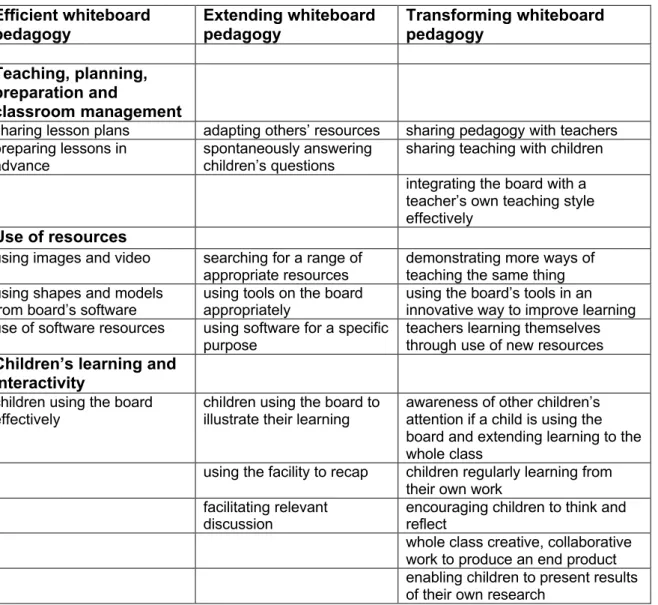
Through examining the case studies of teachers in this study I present a range of whiteboard teaching behaviours that may represent change in pedagogical practice and associated teacher knowledge (Table 5.6). I am not suggesting that these characteristics are comprehensive, nor do I consider them easily assessed. So much rests on the individual teacher, the context in which they are teaching, teachers’ beliefs in how children learn and a teacher’s individual learning disposition. Of equal importance is the way a teacher interacts with children in his or her class during the process of learning. Nevertheless by moving backwards and forwards between the practice of
Cogill J (2008). Primary teachers’ interactive whiteboard practice across one year: changes in pedagogy
16
and influencing factors. EdD thesis King’s College University of London. Available at www.juliecogill.com teachers in this study and their change in PK, CK and PCK I have produced Table 5.6 which I consider provides a starting point for further research and analysis.Efficient whiteboard pedagogy Extending whiteboard pedagogy Transforming whiteboard pedagogy Teaching, planning, preparation and classroom management
sharing lesson plans adapting others’ resources sharing pedagogy with teachers preparing lessons in
advance
spontaneously answering children’s questions
sharing teaching with children integrating the board with a teacher’s own teaching style effectively
Use of resources
using images and video searching for a range of
appropriate resources demonstrating more ways of teaching the same thing using shapes and models
from board’s software using tools on the board appropriately using the board’s tools in an innovative way to improve learning use of software resources using software for a specific
purpose teachers learning themselves through use of new resources Children’s learning and
interactivity
children using the board
effectively children using the board to illustrate their learning awareness of other children’s attention if a child is using the board and extending learning to the whole class
using the facility to recap children regularly learning from their own work
facilitating relevant
discussion encouraging children to think and reflect whole class creative, collaborative work to produce an end product enabling children to present results of their own research
Table 5.6: Whiteboard teaching behaviours that may present a change in pedagogical practice and a teacher’s knowledge
This chapter concerns the analysis of themes, drawn from evidence, which suggest influences on pedagogical knowledge and practical implications for teachers’ interactive whiteboard practice in the primary classroom. I consider that six of my teachers: Carole, Heather, Jill, Paul, Delia and Rebecca in becoming accomplished whiteboard practitioners were transforming their pedagogy by adjusting their conceptions of teaching and learning. However not all views were positive. Participants at West were concerned about the ’front of class’ style teaching that the whiteboard was felt to demand which did not fit comfortably with their beliefs in how children learn. Disaffection was similarly influenced by national policy, its interpretation in their school community and perhaps personal dispositions to learning. It is the effects of the school community on teachers’ learning in the school context together with the personal disposition of one teacher that I intend to examine in detail in the next chapter.