The Relationship between Knowledge and Attitude of Managers
with Preparedness of Healthcare Centers in Rey Health Network
against Earthquake Risk - 2013
Mohammad Asadzadeh1, Aidin Aryankhesal* 2,3, Hesam Seyedin 2, 3, Javad Babaei4
1 - Master student of Healthcare services Management, School of management and information, Iran University of Medical Sciences. ( Email:[email protected])
2 –Health Management and Economics Research Center, Iran University of Medical Sciences
3 - Assistant Professor of Health services Management, Department of Health Services Management, School of Health Management and Information Sciences, Iran University of Medical Sciences
4- PhD student of the health in disasters and emergencies, Department of Health, Tehran University of medical sciences * Corresponding author, correspond to: School of Health Management and Information Sciences, Iran University of Medical
Sciences, Tehran, Iran, No 6, Rashid Yasemi st., Vali-e-asr Ave., Tehran-Iran. P.code:1995614111. Email: [email protected]
Abstract
Introduction: Despite advances in science and technology, still some natural hazards such as earthquakes cannot be predicted accurately. However, with appropriate knowledge, accurate planning and necessary predictions, we can decrease the mortality and financial losses of such disasters. Therefore, attitude and preparedness of Healthcare managers toward earthquake can have an important role in improving the preparedness. Hence in this study the knowledge and attitude of Rey health network managers and the preparedness of Healthcare centers covered by these managers and the relationship between them were investigated.
Research methods: This study was a cross-sectional descriptive analytical study. The sample population was Healthcare administrators at Rey health network. Data were gathered by a questionnaire that designed in three types (knowledge assessment, attitudes study, and preparedness of centers) and its validity and reliability have been verified. Date analysis was based on correlation analysis and descriptive statistics, assisted by SPSS.
Results: Managers‟ mean score of knowledge was 14.2 (out of 33), with a standard deviation of 5.5. The maximum and minimum scores were 23 and 1, respectively. The results showed the unpreparedness of Healthcare centers and mean score was 40.2% totally based on responses of these centers‟ managers. Most managers generally believed that earthquake was a very possible hazard in Rey.
Conclusions: Considering that managers‟ knowledge was rather low, preparedness among centers was low as well. According to the low knowledge and unsuitable preparedness, more theoretical and practical training and maneuvers were necessary to be held for managers about earthquake preparedness.
Introduction
Throughout the history, humans have always had to grapple with natural disasters (1). Earthquakes are among the most important and most destructive disasters. Earthquake is the phenomenon of wave propagation due to release lots of energy due to quick propagation in earth's crust or in the upper mantle in a short time.
There is evidence show that the earthquake events in world are increasing. According to world statistics, between years 1000 and 1800, i.e. during 800 years, only 21 earthquakes with high magnitude have been occurred, while between years 1800 and 1900, i.e. during 100 years, 18 earthquakes with high magnitude, and 50 years later, between years 1900 and 1950, 30 big earthquakes have been occurred. it means that roughly during 50 years, the number of earthquakes has been greater than their numbers in 850 years before. Between years 1900 to 1991, 123 earthquakes have been occurred in the world, which almost, is six times over the past century. Due to this sharp increase in the number of earthquakes, many scientists found that the world is entering to a new era of its life (2) therefore promotion of knowledge, attitude and preparedness, are essential to mitigate their effects.
Because Iran is located on an earthquake belt line Alps–Himalayas, it is considered as an earthquake-prone country in the world. Throughout the history, several earthquakes have occurred in different parts of Iran and cause heavy and non-repairable human and financial losses and damages. Earthquakes sometimes fade a city from the geographical map, in a way that only its name is left. As well as by inflicting heavy losses, they have influenced the life and daily activities for a long time (5).
Among the earthquake -prone cities in Iran, is Tehran metropolis (3). In Tehran, considering the historical evidences and numerous major and minor faults during the past 2000 years, more than 20 earthquakes with magnitude of more than 6.5 on the Richter scale have occurred in this area. On the other hand, Tehran had a very rapid development during the past 150 years from a small village to a mega city. This increasing trend in the development process creates many opportunities for its citizens, but its uncontrolled growth, leads to creating Non-homogeneous tissues and population density on its surface and eventually has created a variety of vulnerabilities (4). This point is also reminds us the importance of managers‟ knowledge of various aspects of earthquake risk, appearing the right attitude in them and developing the preparation programs.
Among these studies, we can refer to the study of Hodjat on assessing the Jahrom hospitals‟ preparedness and a scientist research who examined the preparedness state of the selected hospitals. In the first study, the preparedness of admission, transfer and evacuation units is estimated as poor and the preparedness of emergency, personnel and management, is estimated as average (10, 11). Another study that examined the capabilities and limitations of crisis management in two hospitals of Khorramabad in 2007, shown that 100% of examined persons are agreed with the presence of crisis committee, but only 66.7% of them, were members of the committee and about 66% of them, were aware of their responsibility during the crisis, and 41.6% of them, said that they have instruction about crisis. In none of the hospitals, there was not any preparedness and
operational plan before (capabilities). All of these studies have examined the hospitals‟ preparedness. In addition, we can refer to a study by Arab, et al. conducted in 2007. In that study entitled "A study on the executive managers' knowledge and performance, and their hospitals preparedness against earthquake events and their relationships ", the level of Executive awareness and preparedness of hospitals and the level of preparedness of the hospital covered by their management against the earthquake was very low (5). In another study conducted by Mohabbati in 2003 entitled as “the study of Tehran university of medical sciences hospitals managers' knowledge, attitude and practice about earthquake risk” indicates that the level of executive awareness and preparedness of the hospitals of Tehran university of medical sciences towards the planning guide of Hospital to deal with earthquake, was at an average and poor level and by increasing the awareness, their preparedness has been improved (1).
The results of Macquarrie, et al. findings in a research entitled as “the study of Shiraz University of medical sciences hospitals preparedness level in the light of disaster management in Tehran” in 2007 in Shiraz University of Medical Sciences, showed that 55.5% of matrons and 77.5% of the research community, had passed the crisis management course. Only 50% of the hospitals in research community, have learned the necessary training about the rapid depletion of patients in crisis and emergency situations and in 11.1% of the hospitals in the research community, there was a Safety Committee (6). In another study by Ghanbary et al. entitles “Nursing Education Program on Nurses‟ Preparedness for Responding to Probable Natural disasters”, it is recommended that in order to create and maintain the Nursing personnel preparedness, training and implementing the preparedness plans to deal with disasters, are included in among the training topics of these peoples ( 7).
Also, Seyedin, et al. in a study on planning to deal with disasters conducted in 2011, have come to the conclusion that in order to improve disasters‟ management system, it is necessary to take measures such as Re-engineering in order to design the disasters‟ management system, preparation activities, developing standards and protocols, staff training and regular exercises (8) Hosseini Shokooh, et al. in a study entitled “Preparedness of the hospitals of Iran University of medical sciences and health services to earthquake” in 2008, concluded that the level of these hospitals‟ preparedness is low and holding the training programs is highly effective on preparedness level (9). Rashidi et al. also in a study in 2012 in Tehran, showed that Tehran has high potential to earthquakes and according to the law of reversibility and repetition of natural disasters, the probability of earthquakes is very high and to somewhat is predictable and vulnerable and critical areas precisely occupied by the lower strata of the society (10).
In a study by Paul D. Biddinger, et al. in 2010 entitled as “Public Health Emergency Preparedness Exercises: Lessons Learned” showed that since 2005, 35 Healthcare maneuvers with the participation of 218 cities and 5892 employees have been done. Of these maneuvers, 27maneuvers were on-desk maneuvers (discussing oriented), four were task maneuvers (process oriented) and three were full-scale training exercises and 2maneuvers. These maneuvers resulted in enhancement of coordination and cooperation between sections, understanding the role of other organizations, clarifying the roles and responsibilities, assessing the agencies‟
relations and evaluation of executive programs and practices and personnel training with each other. This study shows that a key component of health preparedness is holding maneuvers, exercises and evaluation them (11).
Yorganci and Yaman in a study entitled as “Preparedness of Primary Healthcare Centers for Critical Emergency Situations in Southwest Turkey” in 2001 among 21 primary Healthcare centers, shows that the equipments, drugs, and requirements of emergencies, are available in 90.5% centers and in other centers, were stored in some lockers. This study shows that primary Healthcare centers have less preparedness to provide rescue services and more training programs should be considered for them (12). A study by Ahmad Phuady , et al. to assess the preparedness of Healthcare centers, six months after the earthquake in southern Sumatra in Indonesia, and three months after the training sessions for Healthcare staff, showed that the number and quality of health personnel, were still much less than ideal. Less than half of the considered centers had emergency facilities and only one of them, considered the necessity of fire station management and Triage units and transportation facilities were limited. Standard operation procedures and policies to deal with the disasters were not available in none of the Healthcare centers. In reviews conducted by the research team, a study, which considers the preparedness of Healthcare centers in Iran, was not found. Therefore, by considering the importance of this issue, the present study examines the relationship between knowledge and attitude of Healthcare centers‟ managers of Rey health network and their preparedness. This research attempts to discover the current situation of this part of Healthcare centers and provides some suitable ways to promote or improve the situation.
Research methods
This research was a cross-sectional descriptive-analytical study. This investigation was began with a questionnaire developed by researchers in three fields to assess the managers‟ knowledge and attitude as well as preparedness level of Healthcare centers, considering available resources in the country, including the preparation checklist of Healthcare centers, instruction for developing and implementing the preparation plan of Healthcare centers against disasters and national program of the public health response operation to disasters and emergencies (7-9).
The developed questionnaire consisted of four sections: individual data (age, sex, education level, work experience, etc.) with 9 questions, knowledge assessing with 33 questions and attitude assessing with 18 questions using Likert method (totally agree, agree, no opinion, disagree, and totally disagree) and preparedness assessing with 40 questions with three options. For knowledge-assessing questions, for each correct answer, score1 was considered, but preparedness questions were considered in three categories: good, average and poor and to import them in SPSS, scores 2, 1 and 0 were considered for good, average and poor categories, respectively.
After that, the validity of questionnaire was examined. This work was done by sending out the questionnaires to 10 PhD students in field of health in disasters and their opinions were considered in the questionnaire. To examine the reliability, the questions have been sent to 10 experts of Rey health network and they were asked to
answer them regardless of the side issues. The results of their initial responses were gathered and again after two weeks, the same questionnaires were sent to the same persons and their responses were collected again. After that, the results of their responses were studied through a Cronbach's alpha method. The results of Cronbach's alpha test, indicated that the developed questionnaire has the needed reliability (Cronbach's alpha= 0.789).
After the questionnaire was designed, research license was asked from Rey health network. This work was done by sending a letter from the president of department through the system. Department‟s letter was referred to the education units and crisis room through the president. By coordination with these units, it was decided that the questionnaire distributed in monthly meeting of centers‟ managers to complete and deliver them in same meeting. To avoid the bias regards to the knowledge of the managers from researcher as well as to bring further importance to this issue, coordination was taken with Rey health network crisis expert that he personally proceeded to distribute and collect the questionnaires in the mentioned meeting. To attract the trust of participants in the study, a letter concerning that information is completely confidential and is solely for the purpose of the study, was prepared and attached to the questionnaire. After collecting letters‟ answer from managers, data were categorized and the scores of each manager in terms of knowledge, attitude and preparedness were determined. After that, data were imported to the computer (SPSS) and data analysis was done by using non-parametric statistical tests for independent groups, Kruskal-Wallis test and Spearman correlation test.
In this study, because all managers were selected for the study, no particular sampling method was used. Indeed, the study population was equal to the number of samples in the study.
According to this study, the manager of Healthcare center was one that had the network administration official notification responsible for Healthcare center. Based on current trends in Iran Healthcare system, usually, doctors are responsible for the health centers, but there are cases where someone other than doctors has this responsibility.
Research findings:
Totally, 22 managers of Healthcare centers including all officials of Healthcare centers of Rey health network participated in the study. Three persons were male (13.6%), 16 were female (72.7%) and 13.6% did not specified their sex in the questionnaire. Participants in the study were classified into four age groups. Two of them (9.1%) were between 20 to 30 years, 10 (45.5%) were between 30 to 40 years, 8 (36.4%) were between 40 and 50 years, 1(4.5 %) were over 50 years old. One person (4.5%) did not complete this part of the questionnaire. The data indicate that most managers of Rey health network, were young or middle-aged and it was expected that they have high energy, knowledge and preparedness.
In this study, participants' education was also studied. The results showed that most managers have Doctoral degree, i.e. almost 60 % of managers have Doctoral and almost 32 % of them have Bachelor's degree. In other
words, nearly 91% of the managers participated in the study, have bachelor‟s degree and higher. Details of the education of the participants in the study are shown in Table 1.
Table 1: Distribution of absolute and relative frequency of managers participated in the study of “The relationship between managers‟ knowledge and attitude with preparedness of Healthcare centers in Reyhealth network against earthquakes risk”
Education degree Frequency
Numbers % Associate 1 4.5 Bachelor 7 31.8 Doctoral 13 59.1 No reply 1 4.5 Total 22 100
Field of Study of 11 persons (50%) of the participants were Medical, six (27.3%) were midwifery, 2 (9.1%) were Healthcare expert. Three persons (13.6%) did not complete this part of the questionnaire. Available data show that most managers of Rey health centers are physicians and this number includes 50% of the study group and after that, midwives constitute the most frequent group (27.3%).
Examining the participants in terms of the type of study, showed that 7persons (31.8%) were in contract of family physician, 11 (50%)were in formal employment, 1(4.5%) was contractual and 1 (4.5%) was in contract. Two persons (9%) did not complete this part of the questionnaire. According to the findings, most of the managers were in formal employment, including 50 % of managers who participated in the study. After that, the highest percent of employees were in contract of family physician including 31.8% of the managers.
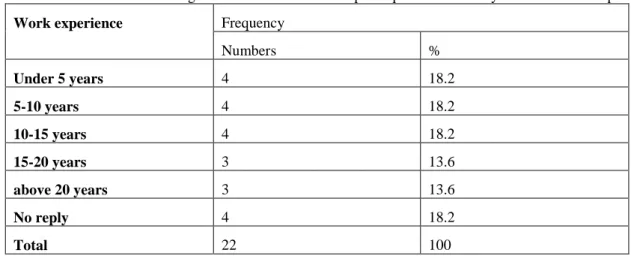
The participants in the study were divided into 5 groups in terms of working experience and the details of which are shown in Table 2. Most managers of Rey health centers (over 54 %) had working experience less than 15 years.
Table 2: distribution of managers of Healthcare network participated in the study based on work experience
Work experience Frequency
Numbers % Under 5 years 4 18.2 5-10 years 4 18.2 10-15 years 4 18.2 15-20 years 3 13.6 above 20 years 3 13.6 No reply 4 18.2 Total 22 100
Nearly half of managers participated in crisis management workshops held in the Rey health network, and2persons (9%) did not complete this part.
In terms of building age, building age of most of the Healthcare centers were between 10 and 20 years (12 centers, 54.5%), 6 Healthcare centers (9.1%) between 10 and 20 years, two of the above-mentioned centers were 30 years old. One center (4.5%) had less than 5 years old. One manager did not respond to this question.
Knowledge status of managers of Healthcare Centers
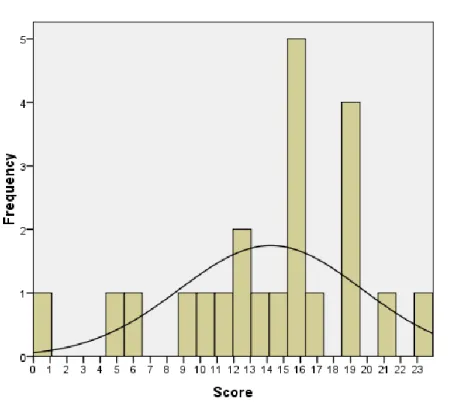
The managers‟ knowledge assessing section included 33 questions that most of them were designed from instruction of developing and implementing the preparation plan for Healthcare centers against disasters (13). For each question, one score was considered. Mean score of knowledge for Managers of Healthcare centers was 14.23 (out of 33), with a standard deviation of 5.47. The maximum and minimum scores were 23 and 1, respectively. In other words, mean score of knowledge for these persons, was about 43%, which is a very low score for managers. The distribution of scores is shown in Figure 1.
Figure 1: Histogram distribution of knowledge scores regarding earthquake risk by managers of Rey health network.
Generally, a significant relation between knowledge of Healthcare centers „managers and their attitude regarding earthquake risk were observed. Just in question 14 (designing a person as responsible for the crisis in centers is sufficient and does not require further actions) and question 18 (it is better to use environmental health unit and only after the earthquake). A significant relationship between respondents' knowledge and their attitude was observed as follows:
In question 14, as knowledge score was greater, the respondent opinion has been more negative to this question. It means that as knowledge was more, manager opposed more with this question (p = 0.023, r = 0.482, Spearman correlation test).
In question 18, as knowledge score was greater, the respondent opinion has been more negative to this question. It means that as knowledge was more, he/she opposed more (p = 0.012, r = 0.526, Spearman correlation test).
Preparedness of the Healthcare centers was evaluated with 40 questions. Although the managers were asked to declare the preparedness of their center with answer to these questions, the data show the lack of preparedness of health centers (Figure 2). Based on the managers‟ responses, totally, mean scores of preparedness was 40.17% with a standard deviation of 23.13 as good, 28.16% with a standard deviation of 7.14% as average and 33.11% with a standard deviation of 17.39% as poor. By this measure, the preparedness of Healthcare centers is about 40%, which is lower than the expected level.
Figure 2: Distribution of preparedness scores of Rey Healthcare centers against earthquake risk.
The relationship between managers’ knowledge and preparedness of their centers:
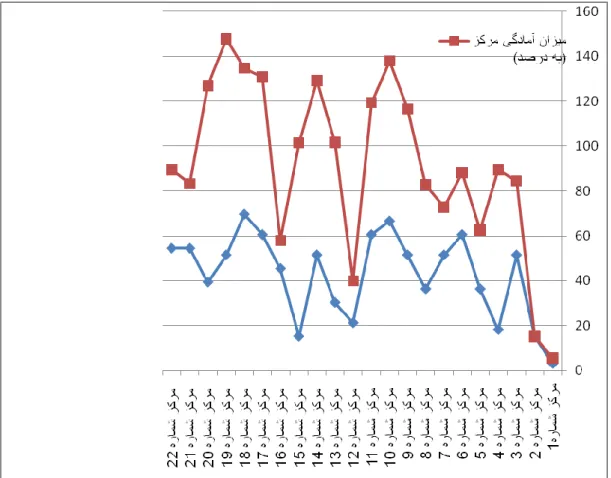
The relationship between knowledge of Healthcare centers managers with preparedness of the centers is shown in Figure 2. The relationship between managers‟ knowledge and preparedness of the centers is significant (p = 0.022, r = 0.486).
Comparison of the relationship between these two variables, show some interesting points. For example, mangers of center No. 1 and 2, both had knowledge score regarding the earthquake and the preparedness of these two centers was poor. There were also centers, which knowledge scores were near to their preparedness score. Center No. 11 with the knowledge score of 60.6 and preparedness score of 58.75 and center No. 18 with the knowledge score of 69.7 and preparedness score of65 and center No. 12 with the knowledge score of 21.2 and preparedness score of18.75, were in such centers.
In some cases, despite high knowledge level of the managers, the preparedness of the center was low. In some cases, the opposite case is also interesting. However, there is a statistically significant relationship.
Figure 2: Comparison of preparedness of Rey health centers against the earthquake risk with the knowledge of the same center‟s manager.
Discussions:
According to importance of the knowledge and attitude of managers and preparedness of Healthcare centers against disasters such as earthquakes, this study examines the knowledge and attitude of managers of Healthcare centers and preparedness of their Healthcare centers in Rey health network.
In total, 22 persons from managers of Healthcare centers participated in the study (all managers of the health centers). Mean score of knowledge for managers of Healthcare centers was 23/14 (maximum possible score is 33) (43%) with a standard deviation of 5.47. The maximum score was 23 and the minimum one was 1. A significant relation between knowledge and attitude of managers of health centers regarding earthquakes was not observed. Mean scores of preparedness was 40.17% with a standard deviation of 23.13 as good, 28.16% with a standard deviation of 7.14% as average and 33.11% with a standard deviation of 17.39% as poor. By this measure, the preparedness of Healthcare centers is about 40%, which is lower than the expected level.
During a disaster, due to the extensive damages, large extents of demands for health services are caused. Although health -care facilities may be damaged, but in any condition, they should also have the ability to provide health services. Therefore, in these situations, there is no possibility for preparing a lot of needs and plans. We can only run programs that before, we did thick about it and requirements needed to deliver them, were provided. Therefore, in this respect, we can conclude that providing Healthcare services and organizing human resources based on previous planning and proper management at the time of disasters as well as providing the proper and sufficient equipments, requires that the managers of this sector (Healthcare) have preparedness and proper knowledge and attitude. According to Sundes, at the time of a disaster, 750 people are injured per one death (14), and if 750 people also are injured mentally, health and medical needs of the injured population will be several thousand times of usual, and if these centers do not have necessary preparedness and leading managers with proper knowledge and attitude, providing Healthcare services will be highly expose to faulty and multiple ring.
According to these findings, it seems that in general, managers had a good attitude, although there were some leaders among them who had a particular attitude. Results of this study are consistent with Mohabbati‟s research that examined the attitude of hospital managers and showed that the attitude of executive managers of Tehran University of Medical Sciences (14) is at a good level. Also as the findings relating to the preparation shows, Healthcare centers „preparedness was 40.17% with a standard deviation of 23.13 as good, 28.16% with a standard deviation of 7.14% as average and 33.11% with a standard deviation of 17.39% as poor. By this measure, the preparedness of Healthcare centers is about 40%, which is lower than the expected level. Now, the question is why the preparedness of the Healthcare center is low? Perhaps one of the causes of low preparedness of the centers is due to low knowledge of managers and the significance of the relationship between managers‟ knowledge and centers‟ preparedness verified this issue. However, in this regard, the reason maybe is insufficient training sessions or low quality of these sessions and next reason is low preparedness regarding lack of adequate management from managers‟ staff including regular monitoring and evaluation, non-appropriated funds and facilities. To demonstrate this, it is sufficient to compare crisis unit in the network with family health unit. Does for manager, family health is as important as network crisis room? The third reason is related to manager, individually and him/her performance and management. Some managers even do not willing to sit in training sessions and upgrade their information, and conversely, some others, do this action spontaneously. The final reason is related to the lack of proper planning at the level of ministerial managers. Although those centers which are very old and center‟s building is being demolished, this part of the preparedness is out of the ability of the center‟s manager and even middle managers. However, this part of the study almost is in one direction and is comparable with other studies that have been conducted in hospitals. For example, according to a research by Hodjat, et al. entitled as “study of the preparedness of Jahrom‟s Medical Sciences hospitals”, it is showed that preparedness level of research units in terms of admissions, transfer and depletion with score of 38.32% is poor and in terms of the emergency traffic, communications, human resources and management, with scores of 48.20, 52.14, 43.8, 48.17%respectively is average (10).
It seems that there is not a significant difference between preparedness statuses of these centers compared to the hospitals. Also, according to the findings of a scientist (in a study entitled as evaluation of preparedness statuses of selected hospitals), in general, relative mean of preparedness to deal with crisis at selected hospitals is estimated at 54.5%. Based on the considered criteria in this study, hospitals had an average preparedness level (15) and the present findings are consistent with the aforementioned study.
For the relationship between knowledge and attitude scores of respondents, only in two cases a significant relationship was observed between them. To expect a good preparedness from a center, manager of the center should have a good performance and good performance also demands high knowledge. On the other hand, merely having high knowledge, does not always lead to good performance. For managers, having the proper attitude and along with, having perseverance is with essential. In this study, although the relationship between knowledge and attitude statistically significant only for questions No. 14 and 18, but in general, this relationship is observable. This research is consistent with a study about the managers of the hospitals of Tehran University of Medical Sciences made compatible.
There was a significant relationship between managers‟ knowledge centers‟ preparedness (p = 0.022, r = 0.486). Based on these findings, by increasing the managers‟ knowledge, centers‟ preparedness is also increased and this is not far from expectation. Managers, who have better information about earthquakes and disasters, can better equip their own centers to planning or run actions to lowering. Of course, several other studies that have been carried out regarding the hospitals and evaluated the relationship between managers and their preparedness shows, this fact. From those researches, we can refer to a research by Arab et al. entitled as “A study on the executive managers' knowledge and performance, and their hospitals preparedness against earthquake events and their relationships at public hospitals”. Based on the findings of this research, knowledge level of executive managers of the hospitals against earthquake was 47.52%, their overall performance was 59.69% and the overall preparedness of the hospitals, averagelywas49.54%.In addition, a direct connection was shown in relationship between managers‟ knowledge, him/her performance and preparedness of hospital covered by him/her, but the statistical relationship was significant only between manager‟s knowledge and performance (5).
According to the low-level knowledge of the managers, therefore, this defect must be resolved before any action. To resolve it, three plans including long-term, medium-term and short-term are recommended:
A - Short-term plan:
It is recommended that all managers including managers of centers‟ or hospitals‟ or any other concentrated and coordinated units, would be certified after regular courses on a national level in a particular system that is the principal trustee and expertise for this work. For example, "health departments in disasters and emergencies in medical universities”, and this system, declares that it is necessary for all managers to have that certification.
Unlike most of the questions were provided from the instructions of Healthcare centers, but managers are not able to answer well. This can have some reasons:
1. The relevant instructions have not been distributed in Healthcare centers.
2. The relevant instructions have been distributed in centers but there are not available for any possible reason. It is possible that although instruction is available at the center, but it is not available for manager. Actually, one of the main reasons is inappropriate storage location and maintenance of the instructions that make it impossible or difficult to access them.
3. It is possible that the instruction is at the center as well as is available for manager. But the reasons is the lack of attention of the manager to this issue
If each of the above reasons was the case, it is upgradable with the following recommendations:
1. For each centre, a crisis clear-book should be provided and all letters and instructions related to the crisis should be placed in it. This work, in order to ensure that, should be done by network staff. 2. Also a ring binder should be provided for centres‟ programs and placed all forms relevant to the crisis
that centres must complete them or hold meetings and review them in it
3. Coordination meetings should be held for Healthcare centres in network, once every 3 months, and in these meetings, in addition to training managers to update their information by providing new information, necessary coordination should be taken.
4. Experts should examine all centres in terms of preparedness, once every 6 months. This work is probably not possible due to crisis staff shortage in network, so to perform this monitoring, it is recommended to get help from the other units, respectively.
C) Long-term plan:
To solve the root of this issue, it is suggested that for students in all fields, including medical and non-medical, in all universities all over the country, at least two courses titled "health management in disasters and emergencies“ can be assigned for them. It is evident that today‟s students, become tomorrow's managers. This action in addition to increases their knowledge, improves their attitudes to these important issues. In addition, it is recommended that some specialized courses (as needed) on crisis management be considered for all management students (in various fields of management).
It is proposed to solve the root for both medical and non-medical students in all disciplines throughout the country and at least two courses of all universities' health management in disasters and emergencies "should be. Obviously, today's students become tomorrow's leaders. These operations while increasing their awareness of these important issues will improve their attitude. It is also offered that a special course (as needed) of crisis management should be considered for all the students (in various fields of management).
As derived by investigation of the preparedness questions (question No. 25) centers are in the low level of preparedness in terms of facilities, therefore it is recommended that special credit should be assigned for equipping Healthcare centers to deal with disasters, especially earthquake.
With a brief look at question No. 4 (After last evaluation of non-structural risk, to what extent, risk level has been decreased due to non-structural factors?) indicates the unpreparedness of the centers in this regards. While this particular case, while it is of particular importance, it is upgradable with less costs and activities. To do this, it is recommended that Healthcare networks provide a technical team and send it to individual Healthcare centers and to fix and secure their equipments.
Based on the findings of preparedness of the centers (question No. 3), the structural risk and vulnerability, has not decreased, roughly and generally, it can be said that the preparedness of the centers in this regard, is at very low level. To overcome this problem, it is proposed that all buildings of health centers, should be checked in terms of resistivity, and their defects should be eliminated and for centers with old or low-resistant buildings, it is recommended that parts of the centers which usually are kept in an unsuitable form, be assigned to private sectors to reconstruction them. In order to more promotion of the preparedness of the centers, all personnel in their centers could participate in operational maneuver at least once a year. This maneuver can be held nationwide, in order to control the preparedness of the centers.
In order to improve and modify the attitude of managers, they should be sent to the earthquake-struck areas to visit them and make reports. This action, even years after the earthquake in the areas, can be effective.
Acknowledgements:
This article (partly)has been extracted from the thesis entitled "The relationship between knowledge and attitude with preparedness of Healthcare centers in Rey health network against earthquakes‟ risk", for MSc degree, contract No. 52 in5/5/2013,IUMS / SHMIS, which is conducted with support of Iran University of Medical Sciences and Health Services.
References:
1. Mohabbati F. the study of Tehran university of medical sciences hospitals managers ' knowledge, attitude and practice about earthquake risk in 2003: hospital earthquake plan guideline. 2005.
2. Motaharinia M. Age of devastating earthquakes. Portable Comprehensive Human Sciences Institute for Humanities and Cultural Studies. 2012:28-31.
3. Jahangiri K, Azin SA, Mohammad K, Rahimi FA. Factors Affecting Tehran Residents' Preparedness against Earthquake in 2007.Hakim Journal. 2010;3(13):p155
4. Jahangiri K, Tabibi SJ. Strategic planning: mitigation of economic impact on natural disasters. Journal of Payesh.2006; 5(4):281-28.
5. Arab M, Zeraati H, Haghighi FA, Ravangard R. A study on the executive managers' knowledge and performance, and their hospitals preparedness against earthquake events and their relationships at public hospitals Journal of Health Administration. 2005; 11(34):14 - 9.
6. Kovary H, Moslehi S, Panahi M. the study of Shiraz university of medical sciences hospitals preparedness level in the light of disaster management in Tehran, Iran. Crisis management in disasters. 2006; 3(2):24-6.
7. Ghanbari V, Maddah SS, Khankeh HR, Karimloo M, Ardalan A. Nursing Education Program on Nurses‟ Preparedness for Responding to Probable Natural disasters. Iranian Journalof Nursing. 2001; 24(73):18-5.
8. Seyedin SH, Sohrabizadeh S, Zaboli R. Coping with disaster planning: Effective approach for disaster risk reduction in Iran Healthcare organizations. Journal of Rescue & Relief.2010; 4(2):11-8.
9. Hosseini Shokoh SM, Arab M, Rahimi A, Rashidian A, Sadr N. Preparedness of the hospitals of Iran University of medical sciences and health services to earthquake. Journal Health of School and Research Institute of Health.2008; 6(4-3):61-77.
10. Rashidi M, Ramsht MH, Seif A, Gharib H. Crisis management in the adjusted damage from an earthquake in Tehran. Journal of Rescue.2011; 3(2):47-0.
11. Biddinger PD, Elena S, Massin-Short SB, Preston J, Michael AS. Public Health Emergency Preparedness Exercises: Lessons Learned. Public Health Reports.2010; 125(5):10-105.
12. Yorganci M, Yaman H. Preparedness of Primary Healthcare Centers for Critical Emergency Situations in Southwest Turkey. Prehospital Disast Med. 2008; 23 (4): 342–5.
13. Ardalan A. Disaster Planning Guideline in Primary Healthcare Centers Disaster Management & Risk Reduction Unit. October 2011:1-20.
14. Sundnes K. Health disaster management guidelines for evaluation and research in the Utstein style. Executive summary task force on quality control of disaster management. Prehospital Disaster Med. 1999; 14(2):51-44.
15. Daneshmandi M , Amiri H , Vahedi M , Farshi M , Saghafi , Zigheymat. Assessing 16. level of Preparedness for disaster in
hospitals of a selected medical sciences university. Journal of Military Medicine. 2009; 12 (3):167-71.