A Dissertation by
ILIE GABRIEL TANASE
Submitted to the Office of Graduate Studies of Texas A&M University
in partial fulfillment of the requirements for the degree of DOCTOR OF PHILOSOPHY
December 2010
A Dissertation by
ILIE GABRIEL TANASE
Submitted to the Office of Graduate Studies of Texas A&M University
in partial fulfillment of the requirements for the degree of DOCTOR OF PHILOSOPHY
Approved by:
Co-Chairs of Committee, Lawrence Rauchwerger Nancy M. Amato Committee Members, Jennifer Welch
Marvin Adams Head of Department, Valerie E. Taylor
December 2010
ABSTRACT
The STAPL Parallel Container Framework. (December 2010) Ilie Gabriel Tanase, B.S., Polytechnic University Bucharest, Romania;
M.S., Polytechnic University of Bucharest, Romania Co–Chairs of Advisory Committee: Dr. Lawrence Rauchwerger
Dr. Nancy M. Amato
The Standard Template Adaptive Parallel Library (stapl) is a parallel pro-gramming infrastructure that extends C++ with support for parallelism. stapl pro-vides a run-time system, a collection of distributed data structures (pContainers) and parallel algorithms (pAlgorithms), and a generic methodology for extending them to provide customized functionality.
Parallel containers are data structures addressing issues related to data parti-tioning, distribution, communication, synchronization, load balancing, and thread safety. This dissertation presents the STAPL Parallel Container Framework (PCF), which is designed to facilitate the development of generic parallel containers. We introduce a set of concepts and a methodology for assembling a pContainer from existing sequential or parallel containers without requiring the programmer to deal with concurrency or data distribution issues. The stapl PCFprovides a large num-ber of basic data parallel structures (e.g., pArray,pList,pVector,pMatrix,pGraph, pMap, pSet). Thestapl PCFis distinguished from existing work by offering a class hierarchy and a composition mechanism which allows users to extend and customize the current container base for improved application expressivity and performance.
We evaluate the performance of thestapl pContainerson various parallel ma-chines including a massively parallel CRAY XT4 system and an IBM P5-575 cluster. We show that the pContainer methods, genericpAlgorithms, and different
applica-tions, all provide good scalability on more than 104
To my wife, Aniela who is always by my side
ACKNOWLEDGMENTS
First of all I would like to thank my advisors, Dr. Lawrence Rauchwerger and Dr. Nancy Amato, for their continuous support and encouragement throughout my PhD studies. It has been a long and difficult road with numerous challenges. However together we managed to overcome them no matter how difficult they seemed to be initially. Throughout the years I have learned from them the importance of the high level discussions on why is our research relevant, what distinguishes us from previous and other similar projects and what is the general direction we want to stir our project. As a fresh graduate student I remember being always eager to get things done as soon as possible. From them I have learned that the implementation is not necessarily the most important part. A careful design and documentation that can be discussed and argued for, is more important than the implementation itself. The skills they thought me helped me throughout my PhD studies and hopefully I passed some of this knowledge to the undergraduate and graduate students that I mentored. I would like to thank my committee members, Dr. Marvin Adams and Dr. Jennifer Welch, who have been of great help with both their comments and creative ideas. With Dr. Adams I interacted while developing a large scale parallel transport application that involved a large number of people from different area of expertise like Computer Science, Nuclear Engineering and Math. I learned from him the importance of providing the right layers of abstractions so that Nuclear Engineering students not familiar with parallel programming can still write efficient programs. From Dr. Jennifer Welch I learned the importance of formally specifying a distributed system behavior so that there is no ambiguity for users when interacting with such a system. Throughout the graduate school I had the opportunity to interact with a large number of colleagues that all have contributed in one way or another to my education
as a scientist. First I would like to thank all my stapl colleagues: Alin Jula, Ping An, Paul Thomas, Silvius Rus, Chidambareswaran Raman, Tao Huang, Paul Thomas, Steven Saunders, William McLendon, Lidia Smith, Timmie Smith, Nathan Thomas, Xiabing Xu, Antal Buss, Adam Fidel, Ioannis Papadopoulos, Shuai Ye, Harshvardhan, Mani Zandifar, Jeremy Vu, Olga Pearce, Tarun Jain, Shishir Sharma. For Mauro Bianco, postdoc in our group, special thanks as he carefully read my design documents and help me clarify the aspects that were not well explained. Special thanks to all my colleagues that were next to me during the long nights we spent in the office while working on papers before deadlines. I will never forget those times.
As part of a large research group I also had the opportunity to interact with students in various areas of research. By getting involved with their work on motion planning, protein folding and particle transport, and listening to their needs in terms of data structure support I greatly improved the usability of my work as presented in this thesis. I would like to thank Shawna Thomas, Lydia Tapia, Sam Ade Jacobs, Roger Pearce, Jae Chang, Teresa Bailey and Alex Maslowski. Also I would like to thank you Anna Tikhonova, Jessie Berlin and Anthony Nowak, undergraduate students that I had the opportunity to mentor throughout the years.
For my late master thesis advisor, Irina Athanasiu, I have only words of gratitude. She first introduced me to the world of research and gave me the opportunity to teach as a teaching assistant at the Polytechnic University of Bucharest, Romania. As a fresh graduate student I still remember the emotions I had while teaching colleagues that were only one year younger than me. Irina first mentioned to me that I can enroll in a PhD program abroad and she recommended me Texas A&M University and Dr. Lawrence Rauchwerger. Thank you, Irina!
Finally a big thank you to all my family for their help and support. Aniela, my wife, has been always by my side supporting me in the difficult times and sharing
with me the numerous happy moments we had throughout graduate school. Thank you to my children, David and Daria, for their always joyful mood. They were always the highlight of my day when coming home tired from school after long debugging sessions. Thank you to my father and my late mother for their constant guidance during my first years of school. I am grateful to them for helping me realize at a very young age the importance and the joy of learning. I am trying to pass on to my kids the values they taught me throughout the years.
TABLE OF CONTENTS
CHAPTER Page
I INTRODUCTION. . . 1
A. Outline . . . 3
II RELATED WORK . . . 5
III STAPL OVERVIEW . . . 10
A. STAPL pView Concept . . . 13
B. Runtime System . . . 18
IV PARALLEL CONTAINER . . . 21
A. pContainer Requirements . . . 21
B. pContainer Definition . . . 23
1. Set Theory Definitions . . . 24
2. pContainer Domain . . . 26
3. Ordered Domain . . . 26
4. Partition . . . 29
5. Ordered Partition of Total Ordered Domains . . . 30
C. pContainer Composability . . . 32
V PARALLEL CONTAINER FRAMEWORK . . . 37
A. pContainer Framework Design . . . 38
B. pContainer Interfaces . . . 39
C. Shared Object View Implementation . . . 42
1. Base Container Interface . . . 46
2. Location Manager Interface . . . 48
3. Domain Interface . . . 49
4. Partition Interface . . . 51
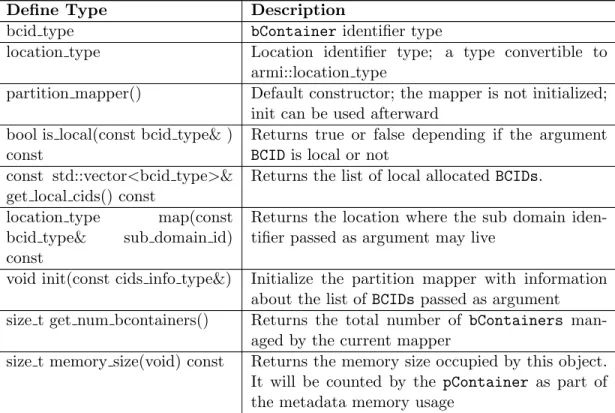
5. Partition Mapper Interface . . . 54
6. Data Distribution Manager . . . 55
D. Specification for pContainer Framework Concepts . . . 59
1. pContainer Base . . . 59
2. Static pContainer . . . 62
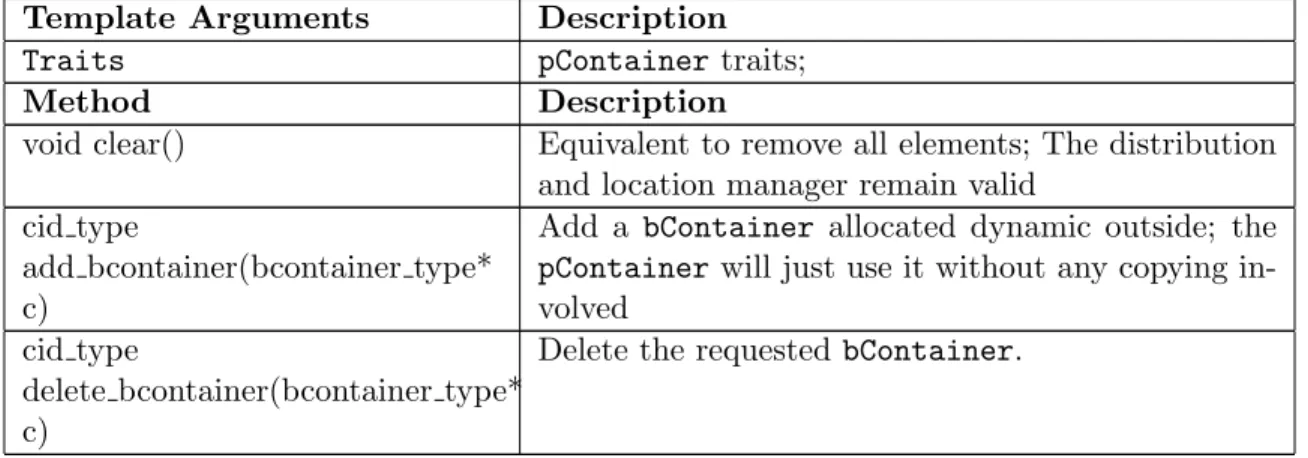
3. Dynamic pContainer . . . 63
CHAPTER Page
5. Associative pContainer . . . 67
6. Relational pContainer . . . 68
7. Sequence pContainer . . . 70
E. Integrating all Concepts using pArray Example . . . 71
F. pContainers Implemented in the Framework . . . 74
G. pContainer Support for Redistribution . . . 77
1. Data Marshaling . . . 79
H. pContainer Customization using Traits . . . 80
VI THREAD SAFETY . . . 83
A. pContainer Thread Safety Design . . . 84
B. Data Distribution Manager . . . 85
C. Thread Safety Manager . . . 86
D. Partition Locking Specification . . . 88
E. pArray and pMatrix . . . 89
F. pList . . . 90
G. Associative pContainers . . . 90
H. pGraph . . . 91
VII MEMORY CONSISTENCY MODEL . . . 92
A. pContainer Interfaces . . . 93
B. Completion Guarantees . . . 95
C. Memory Consistency Conditions . . . 98
1. pContainer Default Memory Consistency Model . . . . 98
D. Memory Consistency Example . . . 102
E. Other Memory Consistency Models . . . 103
1. The Default pContainer MCM is not Sequentially Consistent . . . 103
2. The Default pContainer MCM is not Processor Consistent . . . 105
3. Modifying the Default pContainer MCM . . . 105
F. pContainer Method: Developer Side . . . 107
G. Consistency of Other pContainer Methods . . . 110
H. Enforcing Synchronization Points Automatically . . . 111
VIII PCONTAINER PERFORMANCE EVALUATION . . . 113
A. Experimental Setup . . . 113
CHAPTER Page
C. Evaluation of Generic Algorithms . . . 115
D. Specific Applications . . . 115
IX THE STAPL PARRAY . . . 116
A. Example . . . 117
B. The pArray Specification . . . 118
C. pArray Partitions . . . 119
D. pArray Customization . . . 120
E. Performance Evaluation . . . 121
1. Methods . . . 122
2. Algorithms . . . 128
F. Memory Consumption Study . . . 130
X THE STAPL PLIST . . . 133
A. pList Example . . . 134
B. pList Specification . . . 134
C. pList Design and Implementation . . . 136
D. Performance Evaluation . . . 140
E. pList Method Evaluation . . . 141
F. pAlgorithm Comparison . . . 142
G. Comparison of Dynamic Data Structures in STAPL . . . . 144
H. Application using pList: Euler Tour . . . 145
XI THE STAPL PGRAPH . . . 149
A. pGraph Example . . . 150
B. pGraph Concepts and Interfaces . . . 151
C. pGraph Class Hierarchy . . . 153
D. pGraph Design and Implementation . . . 157
E. pGraph pViews . . . 159
F. Performance Evaluation . . . 161
1. pGraph Methods Evaluation . . . 161
2. Evaluation of Address Translation Mechanisms . . . . 164
3. pGraph Algorithms . . . 167
4. Page Rank . . . 172
XII ASSOCIATIVE PCONTAINERS . . . 173
A. Associative pContainer Specification . . . 174
CHAPTER Page
C. Performance Evaluation . . . 179
1. MapReduce . . . 179
2. Generic Algorithms . . . 180
XIII PCONTAINER COMPOSITION EVALUATION . . . 182
XIV CONCLUSION AND FUTURE WORK. . . 186
REFERENCES . . . 189
LIST OF TABLES
TABLE Page
I Comparison with related projects. . . 8
II staplpViews and corresponding operations. . . . . 16
III Base container interface. . . 47
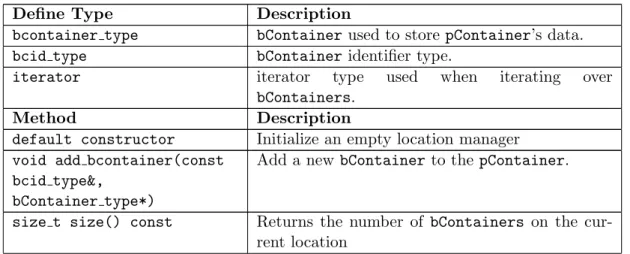
IV Location manager interface. . . 48
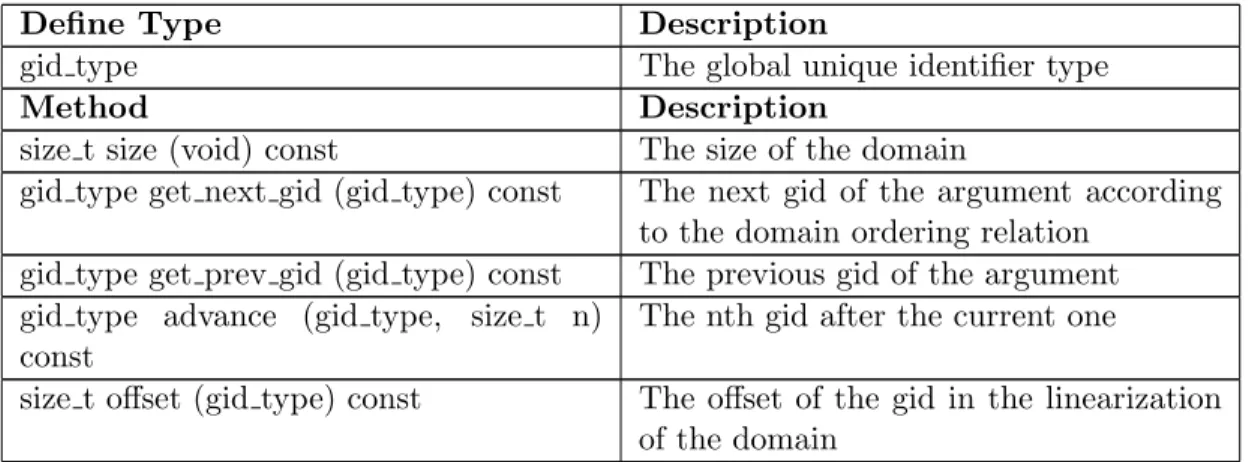
V Ordered domain interface. . . 50
VI Finite ordered domain interface.. . . 51
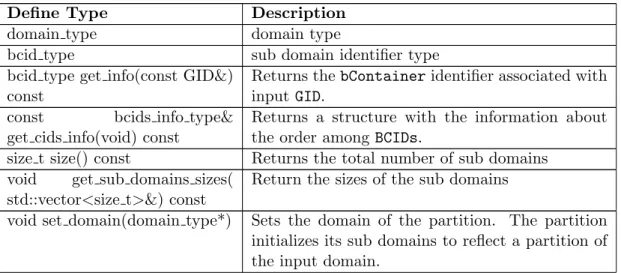
VII Partition base interface. . . 52
VIII Ordered partition interface. . . 53
IX Partition mapper interface. . . 54
X Data distribution manager interface. . . 58
XI Base pContainer interface. . . 60
XII StaticpContainer interface. . . 62
XIII DynamicpContainer interface. . . 63
XIV Indexed pContainer interface. . . 64
XV Indexed partition interface. . . 65
XVI Associative pContainer interface. . . 67
XVII Relational pContainer interface. . . 68
XVIII SequencepContainer interface. . . 70
XIX pArray interface. . . 118
TABLE Page
XXI pArray traits. . . 120
XXII pArray memory consumption. . . 130
XXIII Theoretical memory usage for pArray. . . 131
XXIV pList interface. . . 135
XXV Vertex reference interface. . . 152
XXVI Edge reference interface. . . 153
XXVII pGraph interface. . . 155
LIST OF FIGURES
FIGURE Page
1 STAPL overview. . . 11
2 Overlap pView example. . . 17
3 ComposedpArray of pArrays. . . 33
4 ComposedpContainers.. . . 34
5 PCF design. . . . . 38
6 Shared object view.. . . 43
7 pContainer address resolution. . . 45
8 The invoke method of the data distribution manager. . . 56
9 The pContainer indexed method implementation. . . 65
10 Example of pContainer deployment on two locations. . . 71
11 Pseudocode of pArray set() method. . . 73
12 pContainersinheritance. . . 74
13 Redistribution for two given partitions. . . 78
14 Marshaling interfaces. . . 80
15 pContainer template arguments. . . 81
16 pGraph customization. . . 82
17 Genericinvoke method implementation with locking statements. . . 87
18 User, pContainer, run time system interaction. . . 93
19 STAPL program execution. . . 94
FIGURE Page
21 Asynchronous methods ordering. . . 101
22 Relaxed completion order: (a) Operations on differentpContainer elements receive their acknowledgments out of order (b) Dekker’s mutual exclusion. . . 104
23 Processor consistency counter example. . . 106
24 Kernel used to evaluate the performance ofpContainer methods. . . 114
25 Derivation chain for pArray. . . 116
26 pArray example. . . 117
27 pArray constructor execution time for various input sizes on (a) CRAY4 and (b)P5-cluster. . . . . 121
28 CRAY4: pArray local method invocations for various container sizes. 123 29 CRAY4: pArray methods for various input sizes. . . . . 124
30 CRAY4: pArray methods set element, get elementand split phase get element. . . 125
31 pArray methods for various percentage of remote invocations. . . 126
32 CRAY4: pArraylocal and remote method invocations for various container sizes. . . 127
33 Execution times for generic algorithms on CRAY4 for a pArray with 20M elements per processor. . . 129
34 CRAY4: pArray memory usage study. . . . . 132
35 Derivation chain for pList. . . 133
36 pList example. . . 135
37 Different partitions and mappings for pList.. . . 138
FIGURE Page
39 Execution times forpList methods. . . 141
40 Execution times for p for each, p generate, p accumulate al-gorithms onCRAY4 for pArray and pList. . . . . 142
41 P5-cluster: Weak scaling for p for each allocating processes on the same nodes when possible (curve a) or in different nodes (curve b). . . 143
42 ComparisonpList andpVectordynamic data structures using a mix of 10M operations (read/write/insert/delete). . . 144
43 Weak scaling of Euler Tour algorithm. . . 147
44 Execution times for Euler Tour and its applications using a tree made by a single binary tree with 500k or 1M subtrees per processor. 148 45 pGraph example. . . 150
46 Graph hierarchy of concepts. . . 154
47 pGraph pViewsexample. . . 159
48 pGraph pViews: (a) pGraph partitioned pView, (b) region pview, (c) inner pview and (d) boundary pview. . . 160
49 CRAY4: Evaluation of static and dynamicpGraphmethods while using the SSCA2 graph generator. . . 162
50 P5-cluster: Evaluation of static and dynamic pGraph methods while using the SSCA2 graph generator. . . 163
51 Find sources in a directed pGraph using static, dynamic with for-warding and dynamic with no forfor-warding partitions. . . 165
52 Comparison of variouspGraph partitions. . . 166
53 CRAY4: Execution times for differentpGraph algorithms. . . . . 168
54 CRAY4: pGraph algorithms. . . . . 169
FIGURE Page 56 Page rank for two different input meshes: 1500x1500 and 15x150000. 172 57 Associative pContainer: (a) derivation from the framework base
classes (b) associativepContainers internal hierarchy. . . 174 58 Value based partition for sorted associative pContainers. . . 177 59 MapReduce used to count the number of occurrences of every
word in Simple English Wikipedia website (1.5GB). . . 179 60 CRAY4: Scalability for generic algorithms when using associative
pContainers. . . 181 61 Example of pContainer composition and nested pAlgorithm
in-vocation. . . 183 62 Comparison ofpArray<pArray<>>(pa < pa >),plist<pArray<>>
(plist < pa >) andpMatrixon computing the minimum value for
CHAPTER I
INTRODUCTION
Parallel programming is becoming mainstream due to the increased availability of multiprocessor and multicore architectures and the need to solve larger and more complex problems. The Standard Template Adaptive Parallel Library (stapl) [16, 4, 67, 5, 68, 52, 63, 67, 65, 64, 15, 13, 66] is being developed to help programmers address the difficulties of parallel programming. stapl is a parallel C++ library with functionality similar to stl, the ISO adopted C++ Standard Template Library [49]. stl is a collection of basic algorithms, containers and iterators that can be used as high-level building blocks for sequential applications. Similar to stl, stapl provides a collection of parallel algorithms (pAlgorithms), parallel and distributed containers (pContainers) [63, 65, 64, 15, 66], andpViewsto abstract the data access in pContainers. stapl provides the building blocks for writing parallel programs and the mechanisms (glue) to put them together in large programs. An essential building block for such a generic library is its data structures. Sequential libraries such as STL [49], BGL [30], and MTL [28], provide the user with a collection of data structures and algorithms that simplifies the application development process. Similarly, stapl provides the Parallel Container Framework (PCF) to facilitate the development of pContainers which are parallel and concurrent data structures.
pContainers are containers that are distributed across a parallel machine and accessed concurrently. A large number of parallel data structures have been proposed in the literature. They are often complex data structures, addressing issues related to data partitioning, distribution, communication, synchronization, load balancing,
and thread safety. The complexity of building such structures for every parallel pro-gram is one of the main impediments to parallel propro-gram development. To alleviate this problem we have developed the STAPL Parallel Container Framework (PCF). It consists of a collection of elementary pContainers and methods to specialize, or compose them into pContainers of arbitrary complexity. Thus, instead of building their distributed containers from scratch in an ad-hoc fashion, programmers can use inheritance to derive new specialized containers and composition to generate complex data structures. Moreover, the PCF provides the mechanisms to enable any con-tainer, sequential or parallel, to be used in a distributed fashion without requiring the programmer to deal with concurrency mechanisms such as data distribution or thread safety. Furthermore, when composed, these containers carry over, at every level, their “interesting” features for parallelism.
The stapl PCFpresented in this thesis makes several novel contributions. • Modular design: Provides a set of classes and rules for using them to build new
pContainers and customize existing ones.
• Composition: Supports composition of pContainers that allows the recursive development of complex pContainersthat support nested parallelism.
• Interoperability: Provides mechanisms to generate a wrapper for any data struc-ture, sequential or parallel, enabling it to be used in a distributed, concurrent environment.
• Library: It provides a library of basic pContainer constructed using the PCF as initial building blocks.
Some important properties of pContainers supported by the PCF are noted below.
Shared object view. Each pContainer instance is globally addressable. This supports ease of use, relieving the programmer from managing and dealing with the distribution explicitly, unless desired.
Arbitrary degree and level of parallelism. For pContainers to provide scalable performance on shared and/or distributed memory systems they must sup-port an arbitrary, tunable degree of parallelism, e.g., number of threads. Moreover, given the importance of hierarchical (nested) parallelism for current and foreseeable architectures, it is important for composed pContainers to allow concurrent access to each level of their hierarchy.
Instance-specific customization. The pContainers in the PCF can be dy-namic and irregular and can adapt (or be adapted by the user) to their environment. The PCF facilitates the design of pContainers that support advanced customiza-tions so that they can be easily adapted to different parallel applicacustomiza-tions or even different computation phases of the same application. For example, a pContainer can dynamically change its data distribution or adjust its thread safety policy to op-timize the access pattern of the algorithms accessing the elements. Alternatively, the user can request certain policies and implementations which can override the provided defaults or adaptive selections.
Portions of this dissertation have been published in the following papers [63, 65, 15, 64, 13, 68].
A. Outline
The dissertation is outlined as follows. In Chapter II we present related work. In Chapter III we provide an overview of stapl discussing the main modules of the library and emphasizing the ones that the pContainers will interact directly with:
parallel view (pView) and run time system (RTS). Chapter IV introduces the notion of a parallel container as a parallel and distributed data structure describing the required functionality that it needs to provide to improve parallel programming productivity. Chapter V provides a detailed description of the Parallel Container Framework and of the individual modules that make up a parallel container. Chapter V, Section E shows an example of staplpContainerimplemented using the framework describing how all modules introduced in Chapter V interact to provide the overall functionality of a parallel array (pArray) data structure.
Chapter V , Section D introduces the basepContainersprovided by the frame-work. Chapter VI discusses the thread safety support provided by default by allstapl pContainers and introduces the interfaces that advanced users need to customize in order to implement custom thread safety policies. Chapter VII describes the memory consistency model provided by the pContainersand specifies how additional models can be implemented.
Starting with Chapter VIII we describe individual pContainers implemented using the PCF and an evaluation of their performance. We describe their derivation relation from the classes of the framework, their interfaces and show experimental results or both pContainer methods and pAlgorithms. Chapter VIII introduces the general methodology used to evaluate the pContainer methods and application performance. Chapter IX discusses thepArray, Chapter X thepList, Chapter XI the pGraph and Chapter XII associative pContainers. Experimental results evaluating the pContainer composition are included in Chapter XIII. We conclude with some final remarks in Chapter XIV.
CHAPTER II
RELATED WORK
There is a large body of work in the area of parallel and distributed data structures with projects aiming at shared memory architectures, distributed memory architec-tures or both. Parallel programming languages [19, 18, 17, 70] typically provide built in arrays and provide minimal guidance to the user on how to develop their own specific parallel data structures. staplpContainersare generic data structures and this characteristic is shared by a number of existing projects such as PSTL [39], tbb [37], and POOMA [53].
There are several parallel libraries that have similar goals to STAPL. Some of the libraries provide application specific data structures that are fine tuned for certain applications. While they achieve high efficiency, lack of generality makes them hard to use in different applications. A large amount of effort has been put into regular data structures, like arrays and matrices, to make them suitable for parallel programming. Irregular data structures, like graph, tree, etc., are not widely studied for this purpose. PSTL (Parallel Standard Template Library) [39, 40] explores the same underly-ing philosophy as STAPL, which is to extend the C++ STL for parallel programmunderly-ing. PSTL emphasizes regular data structures, such as vector, multidimensional array, etc., which are more suited for scientific computation. The underlying runtime system pro-vides support for explicit shared memory operations, such as put and get. The data distribution mechanism allows for regular distribution (block distribution) and the containers are treated as place holders for data accessed by stand alone parallel algo-rithms. PSTL project is unfortunately not maintained anymore. The Amelia Vector Template Library (AVTL) [59], provides a parallel vector data structure, which can be distributed in an uniform fashion. STAPL is different that both PSTL and AVTL,
providing a larger variety of data structures integrated uniformly in a framework. Hierarchically Tiled Arrays (HTA) [8, 9] is introduced as a useful programming paradigm where the user writes programs in a single threaded fashion and the data structure takes care of parallelization in a transparent manner. HTA is a parallel data container whose data is partitioned in tiles and can be distributed across dif-ferent computation servers. Operations on the data are dispatched to the servers owning the data. The most representative characteristic of an HTA is the support for hierarchical partitioning and indexing. Through a flexible indexing scheme for its tiles and elements HTAs allows communication to be expressed as array assign-ments. Hierarchical data structures can provide more flexibility to the user to express its algorithms, can be used to improve data locality (e.g., tiling[45]), and to express nested parallelism[10]. Some of the HTA concepts have been adopted in STAPL, like providing hierarchical views of the data available in pContainers.
POOMA[53] is a C++ library designed to provide a flexible environment for data parallel programming of scientific applications. POOMA provides a collection of parallel data types together with a set of algorithms geared specifically toward scientific applications. STAPL shares similar goals with POOMA. Code developed using POOMA is intended to be portable, efficient, allows rapid application devel-opment by reusing existing components. The data structures provided by POOMA are referred to as ”Global Data Types”. They are similar to stapl pContainers but they are oriented toward scientific computing. POOMA provides n-dimensional arrays, vector and matrix classes. stapl’spContainerinfrastructure is more generic providing a larger variety of data structures like graphs, list, hash maps.
Multiphase Specifically Shared Array (MSA) [21] is proposed as a data structure that allows the users to benefit from having a distributed data structure with shared memory interface. MSA is an important data structure developed using Charm++
language[41]. To improve the performance of accessing the elements of the MSA the authors optimize for three access patterns that are common in many algorithms: read only, write many and accumulate. The authors emphasize that while a read write mode would be more general it is often hard to guarantee memory consistency without performance loss. The access modes can be interchanged at certain points in the program (synchronization points).
There has been significant research in the field of parallel and concurrent data structures. Much work has focused on providing efficient locking mechanisms and methodologies for transforming existing sequential data structures into concurrent data structures [20, 24, 26, 33, 34]. Valois [69] was one of the first to present a non-blocking singly-linked list data structure by using Compare&Swap (CAS) synchro-nization primitives rather than locks. The basic idea is to use auxiliary nodes between each ordinary node to solve the concurrency issues. Subsequent work [31, 48, 27, 51] proposes different concurrent list implementations for shared memory architectures, emphasizing the benefits on non-blocking implementations in comparison with lock based solutions. Investigations of concurrent hash tables [24, 26, 48] and search trees (the most common internal representation for maps and sets) [43, 47] explore effi-cient storage schemes, different lock implementations, and different locking strategies (e.g., critical sections, non-blocking, wait-free [33]), especially in the context of shared memory architectures. In contrast, the stapl pContainersare designed to be used in both shared and distributed memory environments and addresses the additional complexity required to manage the data distribution. Ideas pioneered in these papers can be integrated in our framework for efficient concurrent access on a shared memory location.
UPC[25], Titanium[70], Chapel[17] and X10[18] are several other languages that are part of the large family of Partitioned Global Address Space (PGAS) languages.
They all provide minimal support for parallel data structures in the form of regular arrays. Dynamic data structures like graphs, maps, hash maps are often user respon-sability with no explicit support from the language. All these languages recognizes the importance of allowing users to customize the data distribution and they provide appropriate support for parallel arrays. In [22] it is mentioned that Chapel intends to provide support for distributions for dynamic data structures, a feature that is supported in our framework.
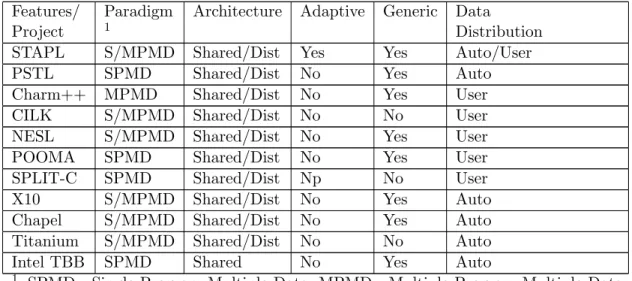
Table I.: Comparison with related projects. Features/ Paradigm Architecture Adaptive Generic Data Project 1
Distribution STAPL S/MPMD Shared/Dist Yes Yes Auto/User
PSTL SPMD Shared/Dist No Yes Auto
Charm++ MPMD Shared/Dist No Yes User CILK S/MPMD Shared/Dist No No User NESL S/MPMD Shared/Dist No Yes User POOMA SPMD Shared/Dist No Yes User SPLIT-C SPMD Shared/Dist Np No User X10 S/MPMD Shared/Dist No Yes Auto Chapel S/MPMD Shared/Dist No Yes Auto Titanium S/MPMD Shared/Dist No No Auto
Intel TBB SPMD Shared No Yes Auto
1
SPMD - Single Program Multiple Data, MPMD - Multiple Program Multiple Data
The stapl PCF differs from the other languages and libraries by focusing on developing a generic infrastructure that will efficiently provide a shared memory ab-straction for pContainers. The framework automates, in a very configurable way, aspects relating to data distribution and thread safety. We emphasize on interoper-ability with other languages and libraries [15], and we use a compositional approach
where existing data structures (sequential or concurrent, e.g., tbbcontainers) can be used as building blocks for implementing parallel containers. We include in Table I a comparison between STAPL and a number of other projects according to a number of criteria. While all the libraries above share a common goal, to make parallel pro-gramming easier,staplpContainerdistinguish itself by placing emphasis ongeneral (regular and irregular) data structures (vector, list, graph, hash, etc), flexible mecha-nisms to specify data distribution, ashared object view programming paradigm with
CHAPTER III
STAPL OVERVIEW
stapl [16, 4, 67, 5, 68, 52] is a framework for parallel code development in C++. Its core is a library of C++ components with interfaces similar to the (sequential) ISO C++ standard library [49]. stapl offers to the parallel system programmer a shared object view of the data space. The objects are distributed across the memory hierarchy which can be shared and/or distributed address spaces. Internal stapl mechanisms assure an automatic translation from one space to another, presenting a unified address space to the less experienced user. For more experienced users, the local/remote distinction of accesses can be exposed and performance enhanced for a specific application or application domain. To exploit large hierarchical systems, such as BlueGene [50], Cray XT5 [56],stapl allows for (recursive) nested parallelism.
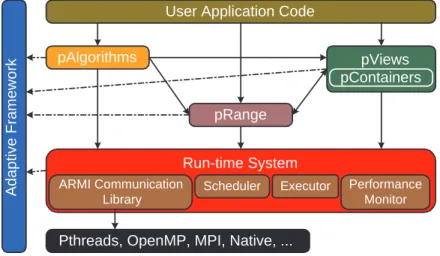
The staplinfrastructure consists of platform independent and platform depen-dent components that are revealed to the programmer at an appropriate level of detail through a hierarchy of abstract interfaces (see Figure 1). The platform independent components include the core parallel library, and an abstract interface to the commu-nication library and run-time system. The corestapllibrary consists ofpAlgorithms (parallel algorithms) andpContainers (distributed data structures) [66]. Important aspects of all stapl components are extendability and composability. For example, users can extend and specializestaplpContainers(using inheritance) and/or com-pose them. For example, stapl users can employ pContainers of pContainers in pAlgorithmswhich may themselves callpAlgorithms.
pContainers, the distributed counterpart ofstlcontainers, are thread-safe, con-current objects, i.e., shared objects that provide parallel methods that can be invoked concurrently. They are composable and extensible by users via inheritance.
Cur-User Application Code
pAlgorithms pViews
pRange
Run-time System
Pthreads, OpenMP, MPI, Native, ...
Adaptive Framework Scheduler Executor Performance
Monitor ARMI Communication
Library
pContainers
Fig. 1. STAPL overview.
rently, staplprovides counterparts of all stl containers (e.g., pArray[63], pVector, pList[65], pMap[64], etc.), and pContainers that do not have stl equivalents: par-allel matrix (pMatrix [15]) and parallel graph (pGraph). pContainers provide two kinds of methods to access their data: methods which are semantically equivalent to their sequential counterpart and methods which are specific to parallel computations. For example, staplprovides aninsert async method that can return control to the caller before its execution completes. While apContainer’s data may be distributed, pContainers offer the programmer a shared object view, i.e., they are shared data structures with a global address space. This is provided by an internal object transla-tion mechanism which can transparently locate both local and remote elements. The physical distribution of a pContainer data can be assigned automatically by stapl or can be user-specified.
A pAlgorithm is the parallel equivalent of an stl algorithm. stapl currently includes a large collection of parallel algorithms, including parallel counterparts ofstl
algorithms, pAlgorithms for important parallel algorithmic techniques (e.g., prefix sums [38], the Euler tour technique [38]), and some for use withstapl extensions to stl (i.e., graph algorithms for the pGraph). Analogous to stl algorithms that use
iterators,staplpAlgorithmsare written in terms ofpViews[13, 14]. Briefly,pViews allow the same pContainer to present multiple interfaces to its users, e.g., enabling the same pMatrix to be ‘viewed’ (or used) as a row-major or column-major matrix or even as linearized vector.
pAlgorithmsare represented bypRanges. Briefly, apRangeis a graph whose ver-tices are tasks and the edges the dependencies, if any, between them. A task includes bothwork (represented by what we callworkfunctions) anddata (frompContainers, generically accessed throughpViews). The executor, itself a distributed shared ob-ject, is responsible for the parallel execution of computations represented bypRanges; as tasks complete, theexecutorupdates dependencies, identifies tasks that are ready for execution, and works with the scheduler to determine which tasks to execute. Nested parallelism can be created by invoking apAlgorithm from within a task.
The platform dependent stapl components are mainly contained in the stapl runtime system (RTS) [54, 55, 57, 58], which provides the API to the OS and several important functions. The RTS includes the communication abstractions that are used by the higher level staplcomponents.
In the following two sections we provide more details regarding thestaplpView concept and the runtime system because they are required to properly describe pContainer functionality.
A. STAPL pView Concept
Decoupling of data structures and algorithms is a common practice in generic pro-gramming. stl, the C++ Standard Template Library, obtains this abstraction by usingiterators, which provide a generic interface for algorithms to access data which is stored in containers. This mechanism enables the same algorithm to operate on multiple containers. In stl, different containers support various types of iterators that provide appropriate functionality for the data structure, and algorithms can specify which types of iterators they can use. The major capability provided by the iterator is a mechanism to traverse the data of a container.
The stapl pView [13, 14] generalizes the iterator concept by providing an ab-stract data type (ADT) for the data it represents. While an iterator corresponds to a single element, a pView corresponds to a collection of elements. Also, while an itera-tor primarily provides a traversal mechanism, pViews provide a variety of operations as defined by the ADT. For example, all stapl pViews support size() operations that provide the number of elements represented by the pView. A stapl pView can provide operations to return new pViews. For example, apMatrixsupports access to rows, columns, and blocks of its elements through row, column and blocked pViews, respectively.
A primary objective of thepViewsis that they are designed to enable parallelism. In particular, each ADT supported bystaplprovides random access to collections of its elements. The size of these collections can be dynamically controlled and typically depends on the desired degree of parallelism. For example, thepList pView provides concurrent access to segments of the list, where the number of segments could be set to match the number of parallel processes. The pView provides random access to a partitioned data space. This capability is essential for the scalability of stapl
programs. To mitigate the potential loss of locality incurred by the flexibility of the random access capability, pViews provide, to the degree possible, a remapping mechanism of a user specified pView to the collection’s physical distribution (known as the nativepView).
In this section, we first introduce the pView concept and then explain how it can be generalized for the parallel and distributed environment of stapl. A pView is a class that defines an abstract data type (ADT) for the collection of elements it represents. As an ADT, apViewprovidesoperationsto be performed on the collection, such as read, write, insert, and delete.
pViewshavereference semantics, meaning that apView does not own the actual elements of the collection but simply references to them. The collection is typically stored in apContainerto which thepViewrefers; this allows apViewto be a relatively light weight object as compared to a container. However, the collection could also be anotherpView, or an arbitrary object that provides a container interface. With this flexibility, the user can define pViews over pViews, and also pViews that generate values dynamically, read them from a file, etc.
All the operations of a pView must be routed to the underlying collection. To support this, a mapping is needed from elements of the pView to elements of the underlying collection. This is done by assigning a unique identifier to each pView element (assigned by the pView itself); the elements of the collection must also have unique identifiers. Then, the pView specifies a mapping function from the pView’s
domain(the union of the identifiers of thepView’s elements) to the collection’s domain (the union of the identifiers of the collection’s elements).
More formally, apView V is a tuple
whereC represents the underlying collection, Ddefines the domain ofV,F represents the mapping function from V’s domain to the collection’s domain, andC is the set of operations provided by V.
To support parallel use, the C and D components of the pView can be par-titioned so that they can be used in parallel. Also, most generally, the mapping function F and the operations O can be different for each component of the parti-tion. That is, C = {c0, c1, . . . , cn−1}, D = {d0, d1, . . . , dn−1}, F = {f0, f1, . . . , fn−1}, and O ={o0, o1, . . . , on−1}. This is a very general definition and not all components are necessarily unique. For example, the mapping functions fi and the operations oi
may often be the same for all 0≤i < n. The tuples (ci, di, fi, oi) are called the base views(bViews) of thepView V. The pViewsupports parallelism by enabling random access to itsbViews, which can then be used in parallel bypAlgorithms.
Note that we can generate a variety of pViews by selecting appropriate compo-nents of the tuple. For instance, it becomes straightforward to define apView over a subset of elements of a collection, e.g., a pView of a block of a pMatrix or a pView containing only the even elements of an array. As another example, pViews can be implemented that transform one operation into another. This is analogous to back-inserter iterators in stl, where a write operation is transformed into a push back invocation in a container.
Example. A common concept in generic programming is a one-dimensional array of size n supporting random access. The pView corresponding to this will have an integer domain D = [0, n) and operations O including the random access read and write operators. ThispViewcan be applied to any container by providing a mapping functionF from the domainD = [0, n) to the desired identifiers of the container. If the container provides the operations, then they can be inherited using the mechanisms
Table II. stapl pViews and corresponding operations. tranform pview implements an overridden read operation that returns the value produced by a user specified function, the other operations depends on thepView the transform pViewis applied to. insert anyrefers to the special operations provided by stapl pContainersthat insert elements in unspecified positions.
re ad w ri te [ ] beg in /e n d in se rt /e ra se in se rt an y fi n d array 1d pview X X X X array 1d ro pview X X X static list pview X X
list pview X X X X X matrix pview X X X graph pview X X X X X strided 1D pview X X X X transform pview O - -balanced pview X X X overlap pview X X X native pview X X X
provided in the basepView instapl. If new behavior is needed, then the developer can implement it explicitly.
Table II shows an initial list ofpViewsavailable in stapl. Some special cases of pViews are particularly useful in the context of parallel programming. For instance the single-element partition, where the domain of the collection is split into single elements and all mapping functions are identity functions. This is the default partition adopted bystapl when calling a pAlgorithm to express maximum parallelism.
Other pViews that can be defined include the balanced pView where the data is split into a given number of chunks, and the native pView, where the partitioner
Overlap pView ofA[0,10] For c= 2, l = 2, and r = 1, ith element is A[c·i, c·i+ 4]
elements of the overlap pView: A[0,4],A[2,6],A[4,8], A[6,10]
Fig. 2. Overlap pView example. The input is the pContainer A[0,10].
takes information directly from the underlying container and provides bViews that are aligned with the pContainer distribution. This turns out to be very useful in the context ofstapl. AnotherpView heavily used in staplis the overlap pView, in which one element of the pView overlaps another element. This pView is naturally suited for specifying many algorithms, such as adjacent differences, string matching, etc. As an example, we can define an overlap pView for a one-dimensional array A[0, n−1] using three parameters,c(core size),l (left overlap), andr(right overlap), so that theith element of the overlap pView vo[i] is A[c·i, c·i+l+c+r−1]. See
example in Figure 2.
The native pView is a pView whose partitioned domain D matches the data partition of the underlying collection, allowing references to its data to be local. The
balanced pView partitions the data set into a user specified number of pieces. This pViewcan be used to balance the amount of work in a parallel computation. Ifstapl algorithms can use balanced or nativepViews, then performance is greatly enhanced. All stapl pContainers provide native pViews that have the same interface as
the pContainer. For example, pArray provides array 1d pview, pList provides p list pview, pVector provides p vector pview, pGraph provides p graph pview, simple associative pContainers provide p set pview, pair associative pContainers providep map pviewandpMatrixprovidesarray 2d pview. AdditionalpViewswith certain ADT can be defined on top of existing data structures. For example apGraph pViewcan be defined on top of a pArray of list of edges as shown in [14].
B. Runtime System
The staplruntime system (RTS) [54, 55, 57, 58] is the only platform specific compo-nent of the library that needs to be ported to each target architecture. It provides a communication and synchronization library (ARMI), an executor, and aschedulerof the tasks of the pRanges. The RTS is not intended to be used directly by the stapl user or library developer.
The RTS provides locations as an abstraction of processing elements in a sys-tem. A location is a component of a parallel machine that has a contiguous address space and has associated execution capabilities (e.g., threads). Different locations can communicate exclusively through ARMI, the Adaptive Remote Method Invo-cation library, which represents the communiInvo-cation layer of the RTS. Special types of objects, called p objects, implement the basic concept of a shared object. The representative of a p object in each location has to register with the RTS to en-able Remote Method Invocations (RMIs) between the representative objects. This is the reason why all the parallel objects in stapl inherit from the base p object class. RMIs enable the exchange of data between locations and the transfer of the computation from one location to another.
The former execute a method on a registered object in a remote location without waiting for its termination, while the latter block waiting for the termination of the invoked method. A mechanism is provided to asynchronously execute methods that return values to the caller. As parallel machine sizes reach processor counts into the millions, it becomes essential for algorithms to be implemented using only asyn-chronous RMIs. Instapl, these operations implement computation migration, which allows scalability for very large numbers of processors. We also provide sync rmis for completeness, but their use is discouraged. The RTS guarantees that requests from a location to another location are executed in order of invocation at the source location.
The RTS provides RMI versions of common aggregate operations. These prim-itives come in two flavors: one-sided, in which a single requesting location invokes the execution of a method in all others, eventually receiving a result back, and col-lective, in which all locations participate in the execution of the operation. All the RMI operations, point-to-point, single-sided, and collective, are defined within com-munication groups, thus enabling nested parallelism. Collective operations have the same semantics as the traditional MPI collective operations. The provided operations include broadcast, reduce, and fence. The fence operation, called rmi fence, when completed, guarantees that no pending RMIs are still executing in the group where it is called. This is essential for guaranteeing correctness of phases of computations that have to be completed before the next one can start.
The RTS provides some optimizations to use bandwidth and reduce overhead. The major techniques used are aggregation, that packs multiple requests to a given location into a single message, andcombining, that supports the repetitive execution of the same method in a given location without incurring a large overhead for object construction and function calls. Memory management and the number of messages
aggregated are managed by the RTS adaptively according to the application needs. Another RTS component, the executor, has the role of executing task graphs corresponding to pAlgorithms. The executor identifies sets of independent tasks to be executed, and schedules them according to the customizable scheduler module. From its perspective, the executor treats incoming RMI requests and algorithmic tasks as RTS tasks. Tasks can be assigned to execution threads and they are considered independent.
CHAPTER IV
PARALLEL CONTAINER
Data structures are essential building blocks of any generic programming library. Sequential libraries like STL [49], Leda[44], BGL [60], and MTL [61, 28], provide to the user a collection of data structures and algorithms. For simple regular data structures such as arrays, vectors, and lists, the implementation may be relatively straightforward. More complicated data structures such as matrices (MTL) or graphs (BGL) require the developer to consider a modular design with different functional units that allows customization of different aspects of the data structure to improve the performance of the algorithms. For example, the users of a matrix may want dense or sparse storage and the layout in memory to be row or column oriented.
In a multiprocessor environment, the complexity of a data structure increases due to a number of challenges which are not present in sequential computing. For example, there are issues related to data management such as partitioning, distribu-tion, communicadistribu-tion, synchronizadistribu-tion, load balancing, and thread safety that have to be considered. To minimize the user’s effort in dealing with all these factors, we have developed the STAPL Parallel Container Framework (PCF) which consists of a set of formally defined concepts and a methodology for developing generic parallel containers starting from sequential, STL-like containers. Users, by implementing the appropriate interfaces, can assemble with minimal effort a data structure that will provide methods to build and access a distributed collection of elements.
A. pContainer Requirements
Design requirements of the stapl pContainersdeveloped within the PCF include: scalable performance, a clearly specified memory consistency model, a shared object
view, thread safety, composition, and adaptivity.
• Scalable performance. pContainers must provide scalable performance on shared and/or distributed memory systems. The performance of thepContainer methods must achieve the best known parallel complexity. This is obtained by efficient algorithms coupled with non-replicated, distributed data structures that allow a degree of concurrent access proportional to the degree of desired parallelism, e.g., the number of threads.
• Thread safety and memory consistency model. When needed, thepContainer must be able to provide thread safe behavior and it must respect a well spec-ified memory consistency model as discussed in Chapter VI and Chapter VII, respectively. When a level of apContaineris distributed across shared memory where multiple threads can access and modify it, the PCF must ensure thread safety.
• Shared object view. Each pContainer instance is globally addressable, i.e., it provides a shared memory address space (Chapter V, Section C). Individual pContainer elements can be accessed from any computation thread indepen-dent of their physical location. This supports ease of programming, allowing programmers to ignore the distributed aspects of the container if they so desire. • Composition. The capability to composepContainers(i.e., buildpContainers
of pContainers) provides a natural way to express and exploit nested paral-lelism while preserving locality. NewpContainerscan be created by composing existing pContainers, e.g., a pVector of pLists, which would be one way to implement an adjacency list representation of a graph. This feature is not sup-ported by other general purpose parallel libraries. pContainer composition is
discussed in Section C.
• Adaptivity. A design requirement of the stapl pContainer is that it can easily be adapted to the data, the computation and the system. For example, different storage options can be used for dense or sparse matrices or graphs or the data distribution may be modified during program execution if access patterns change.
B. pContainer Definition
A stapl pContainer is a distributed data structure that holds a finite collection of
elements C, each with a unique global identifier (GID), their associated storage S, and an interface O(methods or operations) that can be applied to the collection. The interface O specifies an Abstract Data Type (ADT), and typically includes methods to read, write, insert or delete elements and methods that are specific to the individual container (e.g., splice for a pList orout degree for apGraph vertex).
ThepContainer also includes meta information supporting data distribution: a
domain D, that is the union of the GIDs of the container’s elements, and a mapping F from the container’s domain to the storage. To support parallel use in a distributed setting, the collectionC and the domainDare partitioned in a manner that is aligned with the storage of the container’s elements. The sets C, D and S are isomorphic. For each element of the collection C there is a unique GID in the domain D and a unique memory storage in S.
Definition 1. A pContainer is defined as:
pC def= (C,D,F,O,S) (4.1) The tuple (C,D,F,O) is known as the native pView of the pContainer. As
in-troduced in Chapter III, Section A and described in more detail in [14],staplpViews generalize the iterator concept and enable parallelism by providing random access to collections of their elements. In pViews, the partition of D can be dynamically con-trolled and depends on the needs of the algorithm (e.g., a column-based partition of a pMatrix for an algorithm that processes the matrix by columns) and the desired degree of parallelism (e.g., one partition for each core). The native pView associated with a pContainer is a special view in which the partitioned domain D is aligned with the distribution of the container’s data. Performance is enhanced for algorithms that can use native pViews.
We formally introduce now the concepts that were briefly introduced in this section: Global Identifier (GID), Domain, and Partition. Since data structures are collections of elements we start first by introducing some elementary theory about sets and then properly introduce the PCF concepts used to implement a distributed collection of elements.
1. Set Theory Definitions
We often refer in this document to the notion of a collection of elements or identifiers and discuss different properties associated with them. In this section we introduce the notions of set and ordered set to facilitate subsequent discussions about containers. Definition 2. A set is a collection S, of distinct objects {e0, e1, ..., ei...}, which are called the elements of S. If e is an element (or member) of S, we writee ∈S.
For example, we can define sets of integer numbers SI ={2,7,5}, strings Ss =
{′ Red′ ,′ Blue′ ,′ Black′ }or memory addresses SA={0xa0,0xa4,0xa8}.
Definition 3. For a given typeT, theuniverse of typeT (U niverse(T)) denotes the maximal set of distinct elements that are of type T.
Definition 4. The cardinality |S| of a set S is the number of elements of S. If the cardinality of a set is finite, then we call it a finite set. If the cardinality is infinite, then we call it an infinite set. We use {} or φ to denote an empty set, and its cardinality is zero.
We introduce the notion of relations between elements of a set to express ordering and traversals of the elements of a set:
Definition 5. A set of elements S, is called a partial ordered set if there is a binary relation R defined on it that is reflexive (∀a ∈ R, aRa), antisymmetric (if aRb and bRa then a = b) and transitive (if aRb and bRc then aRc). If the relation R is antisymmetric, transitive and total (∀a, b∈S, aRb or bRa), than it is a total ordered set.
For example, for Si = {2,7,5}, we can define a total ordered set by associating
correspondingly the≤relation on integer numbers. ForSs={”Red”,”Blue”,”Black”}
we can define a total order relation using lexicographical compare for strings. For a finite total ordered set we can define the following useful notions:
Definition 6. The first, last, next, prev element and unique enumeration (lineariza-tion) imposed by a total order relation, R, on a finite set S, are defined as follows:
1. The first element of the set, f irst : S → S, f irst(S) = x, such that ∀z ∈ S, xRz
2. The last element of the set,last :S →S, last(S) = y, such that∀z ∈S, zRy 3. The next element of an element,next: S →S, next(x) = y, such that xRy and
there is no other z ∈S, xRz and xRy
4. The previous element of an element,prev: S →S, prev(x) = y, such that xRy and there is no other z ∈S, yRz and zRx
5. A unique enumeration (linearization) imposed by R. Starting from the first element e0 there is a unique enumeration e0 R e1 R...R en−1 that contains all elements in S.
Linearizations are used to specify various traversals of the elements in a set. As described in the following sections linearizations will be used by a pContainer to specify various traversals of its elements.
2. pContainer Domain
For eachpContainer element there is a unique identifier or GIDassociated with it. Definition 7. A domain is a set of GIDs.
ThroughoutPCFwe use various types of domains with different properties that we properly introduce here. For a static container, the number of elements is fixed at the construction time. For dynamic containers, the number of elements, in general, is bounded only by the amount of available storage, and so in principle can be infinite. We distinguish then, for dynamic pContainers, the pContainer’s domain which is the universe of all GIDsthat will identify its elements and the pContainer’s domain instancewhich is the set ofGIDsthat identifies the current elements of the pContainer. Hence, the dynamicpContainerdomain is infinite while the domain instance is always a finite domain.
3. Ordered Domain
The domain as defined in Section 2 does not specify any requirement on the order of theGIDs it contains. To specify an order we introduce the notion ofordered domain. Definition 8. A domain with a binary relation R on its elements that is reflexive, antisymmetric and transitive is called a partial ordered domain. If the relation R is
antisymmetric, transitive and total than we have atotal ordered domain. We will use the notationOD def= (D, R) to represent an ordered domain.
In this document, whenever we refer to ordered domains they are total ordered domains, unless otherwise specified. An often used relation is the total order ≤ on integers. For example for a domainD={2,1,3}we can have (D,≤) ={1≤2≤3} as an ordered domain. An ordered pContainer domain is often used in the PCF to specify how the pContainer’s data is organized in memory and to specify a linear traversal order for the elements.
Example of Domains used bypContainers
The domain is an important concept that users and developers can interact with while using the PCF. Different pContainers require specific domains and specific implementations to guarantee certain properties, such as the time to perform an operation. In the following, we describe the domains that are provided and used by our framework:
Finite Domains:
1. An enumeration of individual elements. Examples: D={1,3,2} orD={a, c, b}
Enumerations are considered unordered. A straightforward order can be implied for these domains, by considering the order in which they are specified. Other orders such as ≤ or ≥are possible;
2. Range: a sub-domain of a bigger domain. We will represent a range by a first element, a last element and a next operator that allows us to enumerate all its GIDs.
Examples: 1DRange = { [0..2),≤} = {0,1} as a sub-domain of the integers domain.
2DRange = [(0,0),(2,2)). A 2DRange can be ordered row-wise or column-wise to obtain a total ordered domain. 2dRange row = {(0,0),(0,1),(1,0),(1,1)} and 2dRange column ={(0,0),(1,0),(0,1),(1,1)}
Infinite Domains:
1. Open ordered domains for associative containers, {([key1, key2), lexicographicalcompare(≤s)}
Example: Strings domain defined on a set of characters, between ”a” and ”c”, {[”a”,”c”), lexicographical order)}, contains an infinity of elements
(e.g., {”a”,”aa” , ”aaa”,”ab”,”aba”, ...}).
Domains defined as compositions of existing domains: 1. Cartesian products over ordered domains,
OrderedD = ( [(D1,≤1),(D2,≤2)], R = lexicographical order based on ≤1,≤2 ).
Example: OrderedD= ( [(0..10,≤),(0..10,≤)], sR =lexicographical
order over integer pairs. The gids are pairs (i, j) and (i, j)≤(p, q) if i < p or if i== pand j ≤q
2. Set operations on exiting ordered domains, OD3 = OD1 op OD2 where op = {∩, ∪,−} and the restrictions that OD1 and OD2 are defined over the same type of GIDs. If OD1 and OD2 are ordered according to the same relation R, then OD3 is also ordered according to R.
3. Filtered domain:
Ex: D= (([0..10],≤), f =every second element) defines every second element in the enumeration of the original domain according to ≤.
For the ordered domains we mentioned that the lastgidis not part of the domain. This last element is a convention (e.g., predefined value type) that has the property that all other elements of the domain are in relation with it. For integral types this value is predefined by our framework but for other gid types the users will have to define the last element as part of the domain interface.
4. Partition
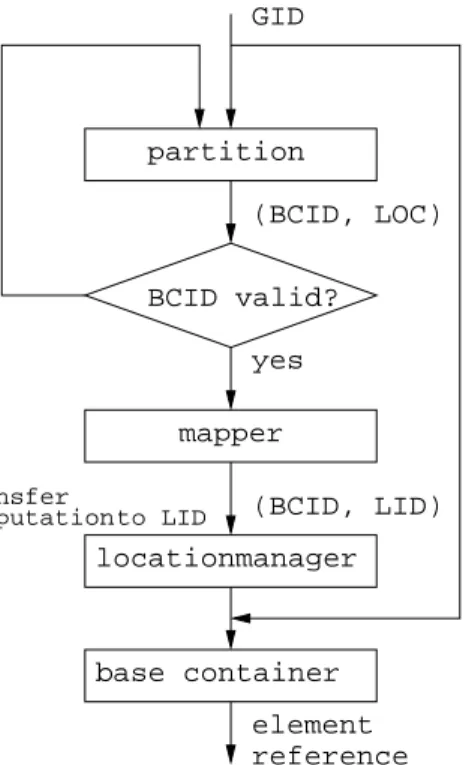
The pContainer manages a distributed storage where individual locations store a subset of its elements. The pContainer uses a partition to group its elements in individual units of storage. The partition specifies a decomposition of a domain into sub-domains and how to map an individual GID to the sub-domain that contains it. Later, in Chapter V, Section C.4, we will describe additional functionality that partitions provide.
Definition 9. A partition P = {D0, D1, .., Dn−1} of a domain D is a collection of sub-domains ofD, such that:
1. D =D0∪D1∪...∪Dn−1 (the union of the elements of all sub-domains is the set of elements of the original domain)
2. Di∩Dj =∅,∀ i, j, 0<=i, j < n, i6=j (sub-domains are disjoint)
3. Thesub-domain set,{D0, D1, .., Dn−1}is ordered by the relation≤over domain indices (D0 ≤D1 ≤, ..,≤Dn−1).
Partition properties (interface):
2. Specify the cardinality of the sub-domain set (e.g., how many sub-domains the partition defines).
3. Given an element, identify the sub-domain to which it is associated. 5. Ordered Partition of Total Ordered Domains
For a stapl pContainer that is the parallel equivalent of a stl container we need to support a total order among its elements in order to provide a linearization of its data. For this reason we describe in this section the notion of an ordered partition
that is used by thepContainer to provide a linearization of its data.
Definition 10. A partition of a total ordered domainOD(D, R),P ={(D0, R), ..., (Dn−1, R)}is anOrdered Partition (OP)if∀Di ∈P, (Di, R) are total ordered domains and there is a relationRD across the domains of P, such that, ∀x, y ∈D and x R y
then either:
1. x and y belong to the same sub-domain Di and xRy OR
2. x and y belong to different sub-domains Di and Dj respectively, and DiRDDj
We are using the notation (P, R, RD) to denote an ordered partition. An ordered
partition of a total ordered domain preserves the order among elements from the domain to the sub-domains.
Definition 11. Given a totally ordered domain OD ≡ (D, R) we define the split
as a blocked partition P = {D0, ..., Dn−1} of D such that D0 contains the first |D0| elements from D according to R,D1 the next|D1| elements from D, etc.
The split is a blocking of the unique enumeration of a total ordered domain and it is an important way of defining a partition that preserves the relation be-tween elements in the original domain. For example, for the totally ordered domain
([0,10),≤) we can haveP ={D0 = ([0,5),≤), D1 = ([5,10),≤)} andRD ≡D0 ≤D1 as a possible split.
A split of a total ordered domain and the relationRD ≡D0 ≤...≤Dn−1 induces an ordered partition. The split can be seen as a top-down procedure of specifying an ordered partition for an ordered domain. Next we show how to specify an ordered domain corresponding to a set of ordered domains.
Lemma 1. Given a set of ordered domainsP ={(D0, R), ...,(Dn−1, R)}, and a total relation across the domains,RD, then P and RD defines an ordered partition of the
total ordered domain OD(D,R), where D=Si=0..n−1Di and R is defined as: 1. ifx and y belong to the same domain Di then xRy ≡xRy
2. ifx and y belong to different domains Di and Dj then xRy ≡DiRDDj
The proof for Lemma 1 is immediate from the definition of the ordered domains. To exemplify how Lemma 1 is useful let us consider two totally ordered domains D0 = {”Red”,”Blue”}, R0 = ”Red” ≤ ”Blue” and D1 = {”Black”,”W hite”}, R1 = ”Black”≤ ”W hite” and RD =D1 ≤ D0. Then {(D0, R0),(D1, R1)}, RD is an ordered partition of the totally ordered domain
D = {”Red”,”Blue”,”Black”,”W hite”}, R = ”Red” ≤ ”Blue” ≤ ”Black” ≤ ”W hite”
C. pContainer Composability
There are many common data structures that are naturally described as compositions of existing structures. For example, apVectorofpLists provides a natural adjacency list representation of a graph. To enable the construction and use of such data structures, we require that the composition of pContainers be a pContainer, i.e., that pContainersare closed under composition.
An important feature of composedpContainersis that they support hierarchical parallelism in a natural way – each level of the nested parallel constructs can work on a corresponding level of the pContainer hierarchy. If well matched by the machine hierarchy, this can preserve existing locality and improve scalability.
In this section, we examine the properties of the composedpContainer, and ana-lyze the relations between thepContainersthat are composed and the final composed pContainer. As a simple example, consider apArrayofpArrays. The following code is used to declare the composedpArray and correspondingly resize each of the nested pArraysto obtain the hierarchy depicted in Figure 3 :
p_array<p_array<int,...>,...> pApA(3);
pApA[0].resize(2); pApA[1].resize(3); pApA[2].resize(4);
The composed data structure obtained using composition can be thought of as a single data structure whose domain, interface, storage, etc., are compositions of the corresponding modules at the two levels of the hierarchy. For example, the domains of the nested pArraysdepicted in Figure 3 are D10 ={0,1},D11 ={0,1,2} and D12 = {0,1,2,3} and the domain of the outerpArray isD0 ={0,1,2}. The composed data structure however can be viewed as a data structure by itself where the domain con-sists of the following GIDs: Dcomposed = {(0,0),(0,1),(1,0),(1,1),(1,2),(2,0),(2,1),