Open Research Online
The Open University’s repository of research publications
and other research outputs
The Semantic Web MIDI Tape: An Interface for
Interlinking MIDI and Context Metadata
Conference or Workshop Item
How to cite:
Mero˜
no-Pe˜
nuela, Albert; de Valk, Reinier; Daga, Enrico; Daquino, Marilena and Kent-Muller, Anna (2018).
The Semantic Web MIDI Tape: An Interface for Interlinking MIDI and Context Metadata. In: 1st International
Workshop on Semantic Applications for Audio and Music (SAAM) held in conjunction with ISWC 2018., 9 Oct 2018,
Monterey, California, USA, ACM.
For guidance on citations see FAQs.
c
2018 The Authors
Version: Accepted Manuscript
Link(s) to article on publisher’s website:
http://dx.doi.org/doi:10.1145/3243907.3243909
http://saam.semanticaudio.ac.uk/
Copyright and Moral Rights for the articles on this site are retained by the individual authors and/or other copyright
owners. For more information on Open Research Online’s data policy on reuse of materials please consult the policies
page.
The Semantic Web MIDI Tape: An Interface for Interlinking
MIDI and Context Metadata
Albert Meroño-Peñuela
Dept. of Computer Science, Vrije Universiteit Amsterdam
Amsterdam, the Netherlands [email protected]
Reinier de Valk
Jukedeck Ltd. London, United Kingdom
Enrico Daga
Knowledge Media Institute, The Open University Milton Keynes, United Kingdom
Marilena Daquino
Dept. of Classical Philology and Italian Studies, University of Bologna
Bologna, Italy [email protected]
Anna Kent-Muller
Dept. of Music, University of Southampton, Southampton, United Kingdom
ABSTRACT
The Linked Data paradigm has been used to publish a large number of musical datasets and ontologies on the Semantic Web, such as MusicBrainz, AcousticBrainz, and the Music Ontology. Recently, the MIDI Linked Data Cloud has been added to these datasets, rep-resenting more than 300,000 pieces in MIDI format as Linked Data, opening up the possibility for linking�ne-grained symbolic mu-sic representations to existing mumu-sic metadata databases. Despite the dataset making MIDI resources available in Web data standard formats such as RDF and SPARQL, the important issue of�nding meaningful links between these MIDI resources and relevant con-textual metadata in other datasets remains. A fundamental barrier for the provision and generation of such links is the di�culty that users have at adding new MIDI performance data and metadata to the platform. In this paper, we propose theSemantic Web MIDI Tape, a set of tools and associated interface for interacting with the MIDI Linked Data Cloud by enabling users to record, enrich, and retrieve MIDI performance data and related metadata in native Web data standards. The goal of such interactions is to�nd meaningful links between published MIDI resources and their relevant contextual metadata. We evaluate the Semantic Web MIDI Tape in various use cases involving user-contributed content, MIDI similarity query-ing, and entity recognition methods, and discuss their potential for
�nding links between MIDI resources and metadata.
KEYWORDS
MIDI, Linked Data, score enrichment, metadata, MIR
ACM Reference Format:
Albert Meroño-Peñuela, Reinier de Valk, Enrico Daga, Marilena Daquino, and Anna Kent-Muller. 2018. The Semantic Web MIDI Tape: An Interface for Interlinking MIDI and Context Metadata. InProceedings of Workshop on Permission to make digital or hard copies of part or all of this work for personal or classroom use is granted without fee provided that copies are not made or distributed for pro�t or commercial advantage and that copies bear this notice and the full citation on the�rst page. Copyrights for third-party components of this work must be honored. For all other uses, contact the owner/author(s).
SAAM 2018, October 2018, Monterey, CA, USA
©2018 Copyright held by the owner/author(s). ACM ISBN 123-4567-24-567/08/06. https://doi.org/10.475/123_4
Semantic Applications for Audio and Music (SAAM 2018).ACM, New York, NY, USA, Article 4, 9 pages. https://doi.org/10.475/123_4
1 INTRODUCTION
Symbolic music representations express fundamental information for musicians and musicologists. Musicians, apart from using it for performing, may use it to look for similar performances of the same piece, while musicologists may seek for style similarities be-tween artists. The MIDI format, a symbolic music representation, is widely used by musicians, amateurs and professionals alike, and music information retrieval (MIR) researchers because of its� ex-ibility. For example, MIDI�les are easy to produce by playing a MIDI instrument, and generated content can be manipulated by controlling parameters such as pitch and duration, as well as by changing instrument and rearranging or recomposing the various tracks. Moreover, MIDI�les are much smaller than audio�les; thus, vast collections are easier to be stored and reused. Many MIDI datasets are publicly available online for MIR tasks, such as the Lakh MIDI dataset [20]; the Essen Folksong collection, searchable with ThemeFinder;1and the user-generated Reddit collection.2
However, music notation alone is not always su�cient to answer more sophisticated questions, e.g., Which pieces reference the same topic? Which pieces are related to a speci�c cultural resource, such as the soundtrack of a movie? Which pieces are from the same geographical region? In order to answer these and other questions, music notation needs to be interlinked with contextual informa-tion. Unfortunately, current datasets generally lack good quality descriptive metadata (e.g., provenance, artist, genre, topic, similar pieces, alternative notations, etc.), making retrieval challenging.
Recently, many music metadata datasets have been published on the Semantic Web, following the Linked Data principles to ad-dress meaningful relations between music and context information [4].3Nonetheless, semantically interlinking the MIDI datasets with contextual information, and between themselves, is not a trivial task. Recently, the MIDI Linked Data Cloud [17] has been proposed as a hub of semantic MIDI data, publishing an RDF representation
1http://essen.theme�nder.org/ 2https://tinyurl.com/y7t6l6yt/
3See the cataloguemusoW: Musical data on the webfor a comprehensive list of music-related resources available on the web: http://musow.kmi.open.ac.uk/.
SAAM 2018, October 2018, Monterey, CA, USA A. Meroño-Peñuela et al. of the contents of 300,000 MIDI�les from the Web. Due to this
representation, the MIDI data is ready to be enriched with con-textual information and linked to music metadata. However, the usability of the dataset is currently hampered by several issues: (1) the MIDI�les collected include little metadata; (2) there is no method to identify di�erent versions of the same piece (i.e., to rep-resent musical similarity in the MIDI Linked Data Cloud); and (3) including user-generated content, e.g., contributed metadata, but also original MIDI performances, is di�cult.
In this paper, we address these issues by proposing the
Seman-tic Web MIDI Tape, an interface and set of tools for users to play,
record, enrich, and retrieve MIDI performances in native Linked Data standards. Our goal is to use these user interactions in order to create two di�erent kinds of meaningful links: those between published MIDI resources (such as similar song versions, common notes, motifs, etc.), and those connecting MIDI resources to their relevant contextual metadata (such as a song’s interpreter, author, year of publication, etc.). To bootstrap these links, we propose a
�rst approach leveraging theShapeHmelodic similarity algorithm [24], to generate the MIDI-to-MIDI links; and DBpedia Spotlight [3], to generate the MIDI-metadata links. Therefore, we combine the user provided data with these methods in order to provide users with relevant and extended query answers, and to enrich the MIDI Linked Data platform. The Semantic Web MIDI Tape leverages the MIDI Linked Data Cloud, enriching the RDF representation of MIDI events with links to external data sources, and underlining the im-portance of notation data and metadata. Therefore, we mix bene�ts derived from using MIDI data, and we exploit linking to the Linked Data Cloud so as to (1) enhance the expressivity of music data at scale, and (2) enable knowledge discovery in the symbolic music domain. The Semantic Web MIDI Tape allows users to interact—in a bottom-up fashion—with their MIDI instrument, convert their performance data into RDF, and upload it to the MIDI Linked Data Cloud. Then, the platform lets users listen to their performances again, and retrieve MIDI performances related to theirs, based on their MIDI similarity and contextual information.
More speci�cally, the contributions of this paper are:
•an updated description of the MIDI Linked Data Cloud dataset,
with two important additions based on MIDI similarity and entities recognised in the metadata (Section 3);
•a description of the Semantic Web MIDI Tape, an interface
for writing and reading MIDI performance information and associated metadata natively in RDF (Section 4);
•an experiment to evaluate the e�ectiveness of mixed
meta-data annotations and musical information in RDF for various MIR tasks. We leverage existing named entity recognition algorithms on the metadata side, and MIDI similarity algo-rithms on the music notation side (Section 5).
The remainder of the paper is organised as follows. In Section 2 we survey related work on integration and interlinking of musical notation and metadata, and MIDI similarity measures. In Section 3 we describe the MIDI Linked Data Cloud and two important exten-sions based on MIDI similarity and named entity recognition. In Section 4 we describe the Semantic Web MIDI Tape interface, and in Section 5 we provide a preliminary evaluation based on two use
cases. Finally, in Section 6 we discuss our�ndings and present our conclusions.
2 RELATED WORK
2.1 Integration and interlinking
Up until now, a large number of music-related datasets have been published as Linked Open Data, where there is a strong emphasis on making music metadata explicit. Linked Data can be applied to describe cataloguing metadata, as exempli�ed by LinkedBrainz [7] and DoReMus [14]. Emerging�elds such as semantic audio combine (audio) analysis techniques and Semantic Web technologies in order to associate provenance metadata with content-based analyses [1, 2].
Although music-speci�c datasets exist, and descriptive metadata is available to link contents to context, there is a lack of methods for the analysis and the integration of digitised symbolic notation [4]. The chord symbol service [6] provides RDF descriptions from com-pact chord labels, but does not include any information on the pieces or scores that can be related to such chords. In the Répertoire Inter-national des Sources Musicales (RISM) [10] portal, users can search scores by entering a melody—but the search is restricted to mono-phonicincipits, i.e., beginnings, of the scores.4The Music Score Portal [9] addresses music score discovery and recommendation by exploiting links to the Linked Open Data cloud.5However, links reference only authors and contributors of the scores, and users cannot contribute to enrich the knowledge base with new meta-data. The Music Encoding and Linked Data (MELD) framework [30] applies Linked Data to express user-generated annotations on the musical structure.
2.2 MIDI similarity measures
Because of the enormous increase of music in digital form over the past decades, the computational modelling of music similarity has become an increasingly important research topic within the
�eld of MIR. Recently, modelling music similarity has been called a “crucial need” [29] for researchers, librarians and archivists, in-dustry, and consumers. Music similarity plays a large role in MIR tasks as divergent as content-based querying, music classi�cation, music recommendation, or digital rights management and plagia-rism detection [15, 29]. The similarity modelling task is di�erent in the audio domain, which focuses on recorded sound, and where the input query is an audio signal [12, 15, 27], than in the sym-bolic domain, which deals with scores, encodings, and texts, and where the input query is some textual encoding (including MIDI) of the music [8, 23]. For this paper, we have restricted ourselves to the use of models ofmelodicsimilarity [28]. With respect to such models, three approaches have been proposed [19]: those based on the computation ofindex terms, those based onsequence
matching techniques, and those based ongeometric methods, which
can cope with polyphonic scores. Examples of the latter are the algorithms that are part ofMelodyShape,6a Java library and tool
for modelling melodic similarity [24, 26]. One of these algorithms,
ShapeH, has consistently obtained the best results [25] in the last
4https://opac.rism.info/metaopac/start.do?View=rism 5http://linkeddata.uni-muenster.de/musicportal/web/ 6https://github.com/julian-urbano/MelodyShape/
Resource Link
MIDI Linked Data Cloud
dataset http://purl.org/midi-ld Portal page https://midi-ld.github.io/
midi2rdf-as-a-Service http://purl.org/midi-ld/midi2rdf MIDI Vocabulary namespace http://purl.org/midi-ld/midi#<pre�xmidi> MIDI Resource namespace http://purl.org/midi-ld/<pre�xmidi-r> MIDI Notes namespace http://purl.org/midi-ld/notes/<pre�xmidi-note> MIDI Programs namespace http://purl.org/midi-ld/programs/<pre�xmidi-prog> MIDI Chords namespace http://purl.org/midi-ld/chords/<pre�xmidi-chord> MIDI Pieces namespace http://purl.org/midi-ld/piece/<pre�xmidi-p> GitHub organisation & code https://github.com/midi-ld/
Dataset generation code https://github.com/midi-ld/midi2rdf/ Documentation and tutorials https://github.com/midi-ld/documentation/ Soure MIDI collections https://github.com/midi-ld/sources/ Sample SPARQL queries https://github.com/midi-ld/queries/ VoID description http://purl.org/midi-ld/void Full dump downloads http://midi-ld.amp.ops.labs.vu.nl/ SPARQL endopint http://virtuoso-midi.amp.ops.labs.vu.nl/sparql/ API http://grlc.io/api/midi-ld/queries/
Figshare https://�gshare.com/articles/The_MIDI_Linked_Data_ Cloud/4990415
Zenodo https://zenodo.org/record/579603#.WRluUXV97MU/ Datahub https://datahub.io/dataset/the-midi-linked-data-cloud/
Table 1: Links to key resources of the MIDI Linked Data Cloud dataset.
few iterations (2010-2015) of the Music Information Retrieval Eval-uation eXchange (MIREX) Symbolic Melodic Similarity evalEval-uation task,7and is therefore used for this paper (see Section 3.1 and Section 5.2.2).
3 THE MIDI LINKED DATA CLOUD
The MIDI Linked Data Cloud [17] is a linked dataset of 308,443 MIDI�les gathered from the Web and converted into 10,215,557,355 RDF triples. In what follows, we provide a summary of the dataset,8 and we describe two important additions to it.
The MIDI Linked Data Cloud is published at http://purl.org/midi-ld, and provides access to the community, documentation, source code, and dataset. All relevant dataset links and namespaces are shown in Table 1. A GitHub organisation hosts all project reposi-tories, including documentation and tutorials, source MIDI collec-tions, and the dataset generation source code. The MIDI Linked Data Cloud dataset results from applying this source code to the source MIDI collections, and adding the resources described in this section, as well as the extensions described in Section 3.1. All MIDI Linked Data is accessible as a full dump download, both through a SPARQL endpoint and through an API (see Section 4.2).
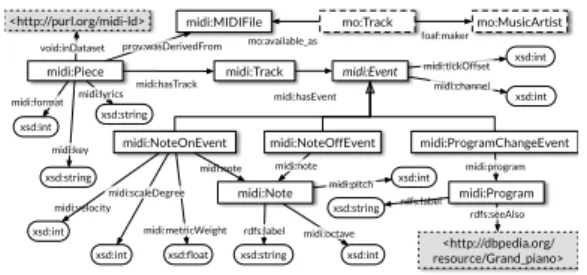
The MIDI Linked Data Cloud is generated usingmidi2rdf[16]. This tool reads MIDI events from a MIDI�le, and generates an equivalent representation in RDF by mapping the events onto the lightweight MIDI ontology shown in Figure 1. The top MIDI container ismidi:Piece, which contains all MIDI data organised
inmidi:Tracks, each containing a number ofmidi:Events. A
midi:Eventis an abstract class around all possible musical events
in MIDI, for example those that dictate to start playing a note
(midi:NoteOnEvent), to stop playing it (midi:NoteOffEvent), or
to change the instrument (midi:ProgramChangeEvent). Speci�c
events have their own attributes (e.g., amidi:NoteOnEventhas a
7See http://www.music-ir.org/mirex/wiki/2016:Symbolic_Melodic_Similarity (task) and http://www.music-ir.org/mirex/wiki/2015:Symbolic_Melodic_Similarity_Results (latest results).
8A complete technical description and download links to the latest version can be found at https://midi-ld.github.io/.
midi:MIDIFile mo:Track
mo:available_as
midi:Piece midi:Track midi:Event
mo:MusicArtist foaf:maker midi:hasTrack midi:hasEvent xsd:int midi:tickOffset midi:NoteOffEvent midi:NoteOnEvent midi:Note midi:velocity midi:ProgramChangeEvent xsd:int midi:note prov:wasDerivedFrom midi:channel midi:Program xsd:int midi:note xsd:int xsd:string xsd:int rdfs:label midi:octave midi:pitch midi:program xsd:string rdfs:label <http://dbpedia.org/ resource/Grand_piano> rdfs:seeAlso xsd:float xsd:int midi:metricWeight midi:scaleDegree xsd:int xsd:string midi:format midi:key xsd:string midi:lyrics <http://purl.org/midi-ld> void:inDataset
Figure 1: Excerpt of the MIDI ontology: pieces, tracks, events, and their attributes.
1 midi -p: cb87a5bb1a44fa72e10d519605a117c4 a midi : Piece ;
2 midi : format 1 ;
3 midi : key E minor ;
4 midi : hasTrack midi -p: cb87a5b / track00 ,
5 midi -p: cb87a5b / track01 , ... .
6 midi -p: cb87a5b / track01 a midi : Track ;
7 midi : hasEvent midi -p: cb87a5b / track01 / event0000 ,
8 midi -p: cb87a5b / track01 / event0001 , ... .
9 midi -p: cb87a5b / track01 / event0006 a midi : NoteOnEvent ;
10 midi : channel 9 ;
11 midi : note midi - note :36 ;
12 midi : scaleDegree 6 ;
13 midi : tick 0 ;
14 midi : velocity 115 ;
15 midi : metricWeight 1.0 .
Listing 1: Excerpt of Black Sabbath’s War Pigs as MIDI Linked Data, with long hashes and track and event URIs shortened.
pitch and a velocity, i.e., loudness), but all events have amidi:tick,
�xing them temporally within the track. Instances ofmidi:Track
are linked to the original�le they were derived from (an instance
ofmidi:MIDIFile) throughprov:wasDerivedFrom. To enable
in-teroperability and reuse with other datasets, as well as future exten-sions, we link the classmo:Trackof the Music Ontology [22] to the
classmidi:MIDIFilethrough the propertymo:available_as. An
excerpt of a MIDI�le, in Turtle format, is shown in Listing 1. IRIs
ofmidi:Pieceinstances have the formmidi-r:piece/<hash>/,
where<hash>is the uniqueMD5hash of the original MIDI�le.
In-stances ofmidi:Trackandmidi:Eventhave IRIs that have the
formmidi-r:piece/<hash>/track<tid>andmidi-r:piece/<ha sh>/track<tid>/event<eid>, where<tid>and<eid>are their respective IDs.
Aside from the mapping of MIDI datasets onto RDF, the MIDI Linked Data Cloud contains three additional sets of MIDI resources (see Table 1) that provide a rich description of MIDInotes(pitches),
programs(instruments), andchords(simultaneous notes)—all of
which in MIDI are expressed simply as integers. MIDI Linked Data notes link to their type (midi:Note), label (e.g.,C), octave (e.g.,4),
and their original MIDI pitch value (e.g.,60). MIDI Linked Data
programs link to their type (midi:Program), label (e.g.,Acoustic
Grand Piano), and their relevant instrument resource in DBpedia
(e.g., http://dbpedia.org/resource/Grand_piano). The links to corre-sponding DBpedia instruments have been added manually by an expert. All tracks link to resources inmidi-noteandmidi-prog.
IRIs in themidi-chordnamespace are linked to instances of the
midi:Chordclass. The chord resources (see Table 1) describe a
SAAM 2018, October 2018, Monterey, CA, USA A. Meroño-Peñuela et al. the number of pitch classes the chord contains, and one or more
intervals, measured in semitones from the chord’s root note. The resulting Linked Data is enriched with additional features that are not contained in the original MIDI�les:provenance, inte-gratedlyrics, andkey-scale-metricinformation. To generate prove-nance, the extractedmidi:Piecesare linked to the�les they were
generated from, the conversion activity that used them, and the agent (midi2rdf) associated with such activity. 8,391 MIDI�les contain lyrics split into individual syllables, to be used mainly in karaoke software. Using themidi:lyricsproperty, these
sylla-bles are joined into an integrated literal as to facilitate lyrics-based search. Finally, the music analysis librarymusic219is used to
fur-ther enrich the data: a piece’skeyis either extracted directly from the MIDI�le, or, if this information is not provided, detected au-tomatically using, e.g., the Krumhansl-Schmuckler algorithm [13]; every note event is represented as thescale degreein that key; and for every note event themetric weight(i.e., position in the bar) is extracted, or, if no metric information is provided, detected (see Listing 1).
3.1 Dataset additions
In order to improve its quality and usability, in this work we extend the MIDI Linked Data Cloud with two additional subsets of data: a MIDI similarity subset and a named entity recognition over MIDI metadata subset.
3.1.1 MIDI similarity.We use theShapeHmelodic similarity
algorithm that is part of theMelodyShapetoolbox (see Section 2)
to search for MIDI�les that are similar to a query. This algorithm relies on a geometric model that encodes melodies as curves in the pitch-time space, and then computes the similarity between two melodies using a sequence alignment algorithm. The similarity of the melodies is determined by the similarity of the shape of the curves. The algorithm, which takes as input a query MIDI
�le and compares it with a corpus of MIDI�les, can cope with polyphony. This means that it can process multi-track MIDI�les, both at the query side and at the corpus side—but all individual tracks of these�les need to be monophonic, that is, they cannot contain note overlap. The large majority of the�les in the MIDI Linked Data Cloud, however, does not meet this criterion: piano or drum tracks, for example, are almost without exception non-monophonic. Furthermore, numerous tracks are unintentionally non-monophonic, most likely due to sloppy data entering (e.g., because of keys of a MIDI keyboard having been released too late) or bad quantisation: in such cases, the o�set time of the left note of a pair of adjacent notes is (slightly) larger than the onset time of the right note. In order for the algorithm to be able to process a�le, both in the case of intentional and unintentional non-monophony, preprocessing is necessary. For this paper, we restricted ourselves to using only monophonic queries; see Section 5.2.2.
Thus, in order to obtain MIDI�les containing only monophonic tracks, we preprocessed the data by means of a script that uses
pretty_midi, a Python module for creating, manipulating and
analysing MIDI�les [21].10Our script takes a MIDI�le as input, and, for each track in the�le, traverses all the notes in this track. In
9http://web.mit.edu/music21/
10https://github.com/reinierdevalk/MIDI-LD/
1 mysongbook_midi / Hard , Heavy / Black_Sabbath / Black Sabbath \
2 - War Pigs (3). midi
3 mysongbook_midi / Pop , Rock / Beatles / Beatles ( The ) - Hey Jude (2). midi
4 mysongbook_midi /TV , Movie , Games / TV_And_Movie_Theme_Songs / Unknown \
5 ( TV ) - X - Files Theme . midi
Listing 2: File names very often contain useful information about the context of the MIDI piece.
pretty_midi, a track can be represented as a list of notes, ordered
by onset time. The script checks for each note whether it overlaps with a note with a higher list index. If this is the case, there are two scenarios: either the overlap is consideredsigni�cant, in which case it is assumed that the note simultaneity is intended, i.e., that both notes are part of a chord, or the overlap is consideredinsigni�cant, in which case it is assumed that the simultaneity isnotintended. Signi�cance is determined by the amount of note overlap and can be parameterised: if the overlap is greater than1/nthe duration of the left note, it is considered signi�cant. We found a value of n=2to yield good results. In the case of signi�cant note overlap,
then, the track is simply removed from the MIDI�le; in the case of insigni�cant note overlap, quantisation is applied by setting the left note’s o�set to the right note’s onset.11
MelodyShapecan be run as a command line tool. With the
fol-lowing command, the 2015 version of theShapeHalgorithm is used
to search the MIDI�les in thedata/directory for the ten�les (the
number of�les retrieved is controlled by the-koption) melodically most similar to the queryquery.mid:12
$ java -jar melodyshape-1.4.jar -q query.mid -c data/ -a 2015-shapeh -k 10
When executed, this command returns ten�le names, each of them followed by the similarity score assigned by the algorithm to the�le by that name (a concrete example can be seen in Table 3 below).
The output of the matching process is passed to a script that transforms this information into RDF statements.13In particular, MIDI�les are identi�ed as individuals of the classmidi:Piece
(see also Section 3), and�les found to be similar are linked through
skos:closeMatch. This statement is rei�ed and identi�ed by a hash
derived from the URIs of the two MIDI�les. The rei�ed statement is further annotated with themidi:MelodyShapeScoreproperty,
which records the value of the similarity score as axsd:float
value. At the moment, only relations between MIDI�les whose similarity score is greater than 0.6 are converted into RDF.
3.1.2 Named entity recognition.MIDI�les included in the data-set come from various collections on the Web. These�les contain very limited contextual information. Nevertheless, the�le name can include valuable information, as can be seen in the examples in Listing 2. We chose to exploit this information by relying on a named entity recognition tool, DBpedia Spotlight [3]. Our approach takes the�le names from the MIDI Linked Data Cloud, removes any non-alphanumeric characters (such as directory separators),
11Admittedly, this approach is somewhat crude: even if a track contains only one chord, it is removed. As a consequence, some�les havealltheir tracks removed (see also Section 5.2.2). A more sophisticated approach is left for future work. 12See https://github.com/julian-urbano/MelodyShape/releases/ for a detailed user manual describing the usage of the command line tool.
and considers the remaining words as a string to be annotated with DBpedia entities. The returned entities are then associated with the Linked Data URI of the MIDI piece using thedc:subject
predicate.14The generated RDF can be accessed at http://virtuoso-midi.amp.ops.labs.vu.nl/sparql/ under the named graph http://purl. org/midi-ld/spotlight/, and contains 1,894,282 new triples, of which 856,623 aredc:subjectlinks from 197,126 unique MIDI pieces
(61.93% of the total) to 25,667 di�erent DBpedia entities. Table 2 shows the top 15 entity types identi�ed.
#Matches DBpedia entity
124247 http://dbpedia.org/resource/TopicalConcept http://dbpedia.org/resource/MusicGenre http://dbpedia.org/resource/Genre 56488 http://dbpedia.org/resource/Agent 47901 http://schema.org/MusicGroup 40590 http://schema.org/Organization http://dbpedia.org/resource/Organisation 37408 http://dbpedia.org/resource/Band 24222 http://schema.org/CreativeWork http://dbpedia.org/resource/Work 15898 http://xmlns.com/foaf/0.1/Person http://schema.org/Person http://dbpedia.org/resource/Person 15620 http://dbpedia.org/resource/MusicalWork 10651 http://dbpedia.org/resource/Artist 10493 http://dbpedia.org/resource/MusicalArtist
Table 2: Top 15 entity types identi�ed.
The process is entirely automatic, and although a large quantity of entities have been correctly identi�ed, we are aware of inaccu-racies in the data (for example, many�les have been associated to the entityLife_Model_Decoy, or toElectronic_Dance_Music).
Overall, the quality of data could be improved by�ltering out en-tities that are not of speci�c safe types (Genre,Band, etc.), or by employing human supervision.
4 THE SEMANTIC WEB MIDI TAPE
TheSemantic Web MIDI Tape15is a set of tools and associated API
that o�er a read/write interface to the MIDI Linked Data Cloud, allowing users to play their MIDI instruments and stream their performance in native RDF form, record their performance in the Linked Open Data cloud, and then retrieve this recording.16 Con-cretely, with the Semantic Web MIDI Tape, users can:
(1) broadcast a performance as a stream of RDF triples using a MIDI instrument;
(2) record a performance as a MIDI Linked Data RDF graph, add associated metadata to this performance, and add metadata and curate annotations of existing MIDI Linked Data entities; (3) integrate a MIDI Linked Data RDF graph into the existing
MIDI Linked Data Cloud dataset; (4) retrieve the RDF graph of a performance;
(5) play a retrieved RDF graph of a performance through any standard MIDI synthesizer.
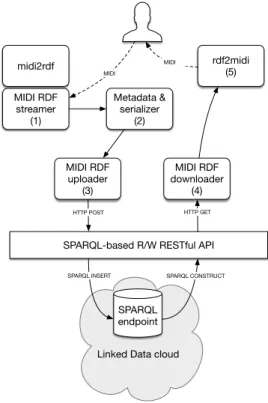
Figure 2 shows how these activities�t in the architecture of the system. (1) and (2) are provided by the Semantic Web MIDI Tape
14https://github.com/enridaga/midi-ld-tags/ 15https://github.com/midi-ld/semweb-midi-tape/
16If no endpoint is speci�ed, we assume it to be the MIDI Linked Data Cloud SPARQL endpoint.
Linked Data cloud SPARQL endpoint MIDI RDF streamer (1) Metadata & serializer (2) MIDI RDF uploader (3) MIDI RDF downloader (4) rdf2midi (5) midi2rdf
SPARQL-based R/W RESTful API
HTTP POST HTTP GET
SPARQL INSERT SPARQL CONSTRUCT MIDI
MIDI
Figure 2: Architecture of the Semantic Web MIDI Tape. Dot-ted lines depict data�ow in native MIDI format; continuous lines represent RDF or SPARQL data transfer through HTTP or the system shell.
tools (Section 4.1), (3) and (4) are provided as small clients that inter-act with the MIDI Linked Data API (Section 4.2), and (5) is provided by themidi2rdfsuite of converters and algorithms [16]—more concretely,rdf2midi, which converts Linked Data representations of MIDI data back to synthesizer-ready MIDI�les.
4.1 MIDI Tape tools
We provide a set of open source tools to add and retrieve MIDI Linked Data and metadata to the MIDI Linked Data Cloud. These are intended to cover the work�ow shown in Figure 2.17Although there de�nitely is a role for software agents to use these tools, especially the API, this goes beyond the scope of this paper. The set consists of the following tools:
•swmiditp-stream. Produces a stream of RDF triples that
represent MIDI data as it is played by the user through a MIDI input device (physical or virtual). When the user� n-ishes their MIDI RDF performance, they can choose to attach relevant metadata to it, and serialise the corresponding RDF graph (Figure 2, steps (1) and (2)). Themidi2rdfpackage is
used to map MIDI events to a lightweight MIDI ontology;
17See https://github.com/midi-ld/semweb-midi-tape/ for source code , install instruc-tions, and examples.
SAAM 2018, October 2018, Monterey, CA, USA A. Meroño-Peñuela et al.
•swmiditp-upload. Uploads MIDI RDF N-triples�les to the
MIDI Linked Data Cloud triplestore (Figure 2, step (3)).The user can browse the Linked Data representation of the up-loaded MIDI performance and its associated metadata;18
•swmiditp-download. Downloads MIDI RDF N-triples that
represent a MIDI performance identi�ed by its URI (Figure 2, step (4));
•rdf2midi. We use therdf2midialgorithm to convert the
downloaded MIDI Linked Data into a standard MIDI�le that can be played by most synthesizers (Figure 2, step (5)). The metadata collection in step (2) consists of asking the user for a number of URIs that identify entities that are relevant to the generated MIDI RDF performance. Concretely, we gather URIs to implement relevant subsets of the Music Ontology. The MIDI per-formance, identi�ed by its URI, is an instance ofmo:Performance.
More precisely, this performance is amo:performance_ofsome
mo:Composition, which in turn is an individual realisation, or
ex-pression,19of somemo:MusicalWork—which may or may not be original. Importantly, such a musical work has amo:composerof
typemo:MusicArtistthat is also provided by the user; if the user
entered a non-original, pre-existing piece (in popular music cul-ture referred to as acover), this would be this piece’s original cre-ator. Finally, we add a statement that the MIDI performance has
amo:performerthat is of typemo:MusicArtist, i.e., a URI that
identi�es the user as such.
4.2 MIDI Linked Data API
The MIDI Linked Data API is the default entry point to access any MIDI resource in the MIDI Linked Data Cloud. It is implemented as agrlc[18] Linked Data API, and powered by publicly shared,
community maintained SPARQL queries.20The full documentation and call names of the MIDI Linked Data API are available at http: //grlc.io/api/midi-ld/queries/.
For the Semantic Web MIDI Tape, this API has been extended with the two following routes:
•POST :insert_pattern?g=uri2&data=lit1. Inserts the MIDI
RDF graph contained inlit1under the named graphuri2. This operation is implemented with a SPARQLINSERT DATA
query;
•GET :pattern_graph?pattern=uri1. Returns the complete
graph of all RDF statements associated with the MIDI
identi-�ed by the URIuri1. This operation is implemented with a SPARQLCONSTRUCTquery.
These operations are used by the toolsswmiditp-uploadand
swmiditp-downloadin steps (3) and (4), respectively (see
Sec-tion 4.1 and Figure 2). The SPARQL endpoint against which they are executed can be customised in the underlying SPARQL queries.21 In order to enable their functioning,grlchas been extended with
support forCONSTRUCTandINSERTqueries.
18See, e.g., http://purl.org/midi-ld/pattern/49cb8dce-31e1-4e50-a2e2-244872535531. 19http://musicontology.com/speci�cation/#term-MusicalWork
20https://github.com/midi-ld/queries/
21See example at https://github.com/midi-ld/queries/.
5 USE CASES
We perform a use case-based evaluation of the Semantic Web MIDI Tape. The goal of this evaluation is to show that the joint notation and metadata capabilities of the Semantic Web MIDI Tape enable a rich interaction between users and the Web in at least two scenarios: a data cleaning, annotation, and enrichment scenario; and a MIR scenario. The�rst scenario shows how to contribute to the MIDI LD Cloud by means of the Semantic Web MIDI tape and discover similar music contents and information, in a Shazam22fashion. The second scenario addresses typical scholars’ needs and more sophisticated musicians’ needs. For example, a scholar can retrieve and group performances by topic (e.g., all the performances related to Liverpool) and see the distribution of the latter; musicians and DJs can group performances by both topic and music characteristics (e.g., songs about Romeo and Juliet having the same tempo) for reusing music samples or remixing purposes.
In this preliminary evaluation we do not yet tackle the problem of scalability derived from similarity matching, and we apply the aforementioned method only to a subset of the MIDI Linked Data Cloud. Hence, the retrieval of performances and related metadata is currently limited to that subset.
5.1 Use Case 1: contributing
This use case showcases the basic functionality of the Semantic Web MIDI Tape by enabling the user to add new MIDI RDF performance data, accompanied by rich metadata descriptions, to the cloud. In this use case, data submitted by the user has two components: a
notationcomponent, which describes musical events of the user’s
performance as MIDI Linked Data triples; and ametadata compo-nent, which annotates the notation component with relevant links to external music metadata datasets (see Section 4.1).
The use case starts with a user ready to play a performance on a MIDI instrument. The user executesswmiditp-stream(see
Section 4.1), is prompted a list of detected input MIDI devices, and chooses the one to be played:
$ python swmiditp-stream.py > myperformance.nt Detected MIDI input devices:
[0] Midi Through:Midi Through Port-0 14:0 [1] VMini:VMini MIDI 1 20:0
[2] VMini:VMini MIDI 2 20:1 1
Interaction menus are shown viastderr, making output
redi-rects become valid RDF N-Triples�les. At this point, the user plays the performance, and the stream of triples is stored in a�le (or, alternatively, shown on screen if no output redirect is used). To end the performance, the user pressesCtrl-C.
The system subsequently provides http://purl.org/midi-ld/pattern/ 604115f5-45ad-4135-be35-0281193103ed as the URI to the generated MIDI RDFmo:Performancethat identi�es it in the http://purl.org/
midi-ld/ dataspace. The system then prompts for a set of additional URIs, pointing to essential metadata, to describe the performance:
•the URIs of the musical work and composition performed
(e.g., https://musicbrainz.org/work/eac0d507-46ed-3ed7-80d5-e4ac31719221/ or http://dbpedia.org/resource/Hey_Jude);
1 PREFIX prov : < http :// www . w3 . org / ns / prov #>
2 PREFIX mid : < http :// purl . org / midi - ld / midi #>
3 PREFIX dct : < http :// purl . org / dc / terms />
4 PREFIX dbpedia : < http :// dbpedia . org / resource />
5 SELECT ( count (? pattern ) as ?c) ? genre
6 WHERE {
7 ? pattern dct : subject ? genre .
8 ? genre a dbpedia : MusicGenre
9 } GROUP BY ? genre ORDER BY DESC (? c)
Listing 3: SPARQL query for analysing the distribution of genres in the dataset.
•the URI of the composer of the work performed (e.g., http:
//dbpedia.org/resource/The_Beatles);
•the URI that identi�es the user as the artist that performed
the work (e.g., http://example.org/foaf.rdf).
The user provides these URIs, and the system links them to the performance MIDI Linked Data (see Section 4.1). The PROV provenance model [5] is used to create a subgraph of provenance information containing activities, agents, and the start and end of creation timestamps. Finally, the user uploads the generated RDF graph to the cloud, optionally specifying in the�rst parameter a named graph:
$ ./swmiditp-upload.sh <urn:graph:midi-ld> myperformance.nt
Depending on the graph size, within seconds after this, both per-formance notation and metadata become available, de-referenceable and browsable at the previously given MIDI performance URI.23
We follow a postprocessing strategy within our platform in which we employ the user-contributed data to add external links and improve the quality of the MIDI Linked Data Cloud. This strat-egy makes use of the MIDI similarity linksskos:closeMatch
(gen-erated as described in Section 3.1) to propagate the user-contributed metadata to other MIDI�les that are similar to the user-contributed MIDI performance.24In this way, we use both input metadata and symbolic music similarity to generate links to external mu-sic datasets, we increase the amount of context for a given mumu-sical work, and we improve the quality of the MIDI Linked Data Cloud.
If no similar MIDI�les are found in the cloud, we assume that the user has made a novel contribution. In this case, we bootstrap the piece’s metadata with the attached metadata, and store it for further retrieval or expansion.
5.2 Use Case 2: querying
To demonstrate the increase in usability of the MIDI Linked Data Cloud we consider two types of querying that were not possible before the dataset was extended with DBpedia links and similarity measures:querying contextual informationandquerying by playing. 5.2.1 �erying contextual information.Here, the objective is to retrieve musical content related to speci�c entities. For example, it is now possible to show the music genres most frequently represented in the dataset among the ones identi�ed by DBpedia Spotlight (see query in Listing 3). Linking the MIDI data e�ectively integrates the dataset in the Linked Data Cloud, allowing to use potentially in�nite metadata exploiting the content of remote SPARQL endpoints. For
23http://purl.org/midi-ld/pattern/604115f5-45ad-4135-be35-0281193103ed 24To avoid scalability issues we do not materialise this propagation, and only reuse a MIDI�le’s metadata by following MIDI similarity links to it.
1 PREFIX dct : < http :// purl . org / dc / terms />
2 PREFIX dbo : < http :// dbpedia . org / ontology />
3 PREFIX dbr : < http :// dbpedia . org / resource />
4 SELECT ? pattern ? subject WHERE {
5 ? pattern dct : subject ? subject
6 {{
7 SELECT ? subject
8 WHERE {
9 SERVICE < http :// dbpedia . org / sparql > {
10 ? subject dbo : hometown dbr : Liverpool
11 }}
12 }}}
Listing 4: SPARQL query to search for content related to en-tities whose hometown is Liverpool.
1 PREFIX midi : < http :// purl . org / midi - ld / midi #>
2 PREFIX dc : < http :// purl . org / dc / terms />
3 PREFIX dbr : < http :// dbpedia . org / resource />
4 SELECT ? pattern WHERE {
5 ? pattern a midi : Pattern .
6 ? pattern dc : subject dbr : Romeo_and_Juliet .
7 ? pattern midi : hasTrack ? track .
8 ? track midi : hasEvent ? event .
9 ? event midi : numerator 4 .
10 ? event midi : denominator 4 .
11 }
Listing 5: SPARQL query for MIDI�les that referenceRomeo and Julietin common time.
example, we can search for the MIDI�les related to entities whose hometown is Liverpool (Listing 4).
Finally, we can integrate musical content and metadata in the same query. For example, the SPARQL query in Listing 5 looks up all MIDI�les that reference the topicRomeo and Julietin common time (i.e., a4
4time signature), e�ectively enabling querying that combines notation data and metadata. The query retrieves two results: the soundtrack from a popular movie, and the Dire Straits song.25
5.2.2 �erying by playing.In the second proposed type of query-ing, the objective is to retrieve MIDI�les that are similar to a given MIDI query—either a�le created ad hoc using a MIDI device, or a pre-existing�le. No context information is provided by the user. The query returns (1) all MIDI�les satisfying a certain similarity threshold, and (2), if available, for each�le the contextual infor-mation it is annotated with, and, by extension, the�les related— linked—to it. This type of querying again demonstrates the bene�ts of representing symbolic music formats as Linked Data.
Serving as a proof-of-concept, we set up a simple experiment in which we used theShapeHmelodic similarity algorithm in the way
described in Section 3.1 to query a small subset of the MIDI Linked Data Cloud. The subset was randomly selected and originally con-tained 1531 MIDI renditions of rock songs by 83 di�erent artists. From this initial set, 68 MIDI�les had to be omitted because they were found to be corrupt, i.e., could not be parsed bypretty_midi,
and 152 further�les were removed during the data preprocessing process (see Section 3.1) as each of these�les contains, for one reason or another, signi�cant note overlap inallof its individual tracks. This pruning resulted in a test set of 1311 MIDI�les, each of them containing exclusively monophonic tracks. Using tran-scriptions of�ve randomly selected Beatles songs, all of which we know to be contained in the test set, we then created�ve query
25See http://purl.org/midi-ld/pattern/13fa17dc74232f7cb710a4d8d9f796b2 and http: //purl.org/midi-ld/pattern/7a08a4b1efd5�7afd6c1066b4a8dd94.
SAAM 2018, October 2018, Monterey, CA, USA A. Meroño-Peñuela et al.
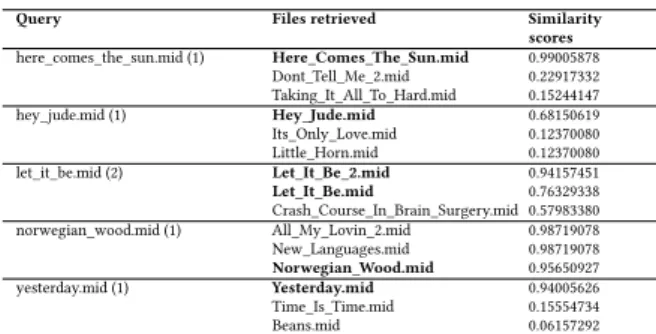
�les, each consisting of the�rst four bars of the vocal melody of a song (note that the query can be any melodic line in a piece; from a user’s perspective, however, the vocal melody seems a logical choice).26To account for tonal variability during data entry, each query�le was transposed two, four and six semitones up as well as down—resulting in a total of 35 query�les. Table 3 shows, for each query, the three�les found to be most similar by the algorithm, as well as the similarity score per retrieved�le. Note that only the untransposed queries are listed: transposition was found to have no e�ect whatsoever, always yielding the exact same results as when using the untransposed�le.
Query Files retrieved Similarity
scores here_comes_the_sun.mid (1) Here_Comes_The_Sun.mid 0.99005878 Dont_Tell_Me_2.mid 0.22917332 Taking_It_All_To_Hard.mid 0.15244147 hey_jude.mid (1) Hey_Jude.mid 0.68150619 Its_Only_Love.mid 0.12370080 Little_Horn.mid 0.12370080 let_it_be.mid (2) Let_It_Be_2.mid 0.94157451 Let_It_Be.mid 0.76329338 Crash_Course_In_Brain_Surgery.mid 0.57983380 norwegian_wood.mid (1) All_My_Lovin_2.mid 0.98719078 New_Languages.mid 0.98719078 Norwegian_Wood.mid 0.95650927 yesterday.mid (1) Yesterday.mid 0.94005626 Time_Is_Time.mid 0.15554734 Beans.mid 0.06157292
Table 3: Querying by playing: MIDI queries, top three�les retrieved, and corresponding similarity scores. Numbers in parentheses indicate a query’s number of target�le(s) (printed in bold) in the test set.
As the table shows, for queries 1-3 and 5, the target�le (or�les) receive the highest (or two highest) similarity scores. Only in the case of query 4, the target�le receives the third highest similarity score (which, at 0.96, is still quite high). A possible reason for this mismatch is the fact that the preprocessing at times results in very scarce and fragmented MIDI�les (in the case of query 4, for example, the�le that receives the highest score contains no more than three notes)—which may throw the similarity algorithm o�.
The triples generated from the matching process (see Section 3.1.1) are sent to the MIDI Linked Data Cloud. Similar MIDI�les and re-lated similarity scores can be retrieved by querying for
skos:close-Matchvalues. Moreover, similar MIDI�les’ related metadata
gener-ated by the named entity recognition tool (see Section 3.1.2) can be retrieved as well by looking for (optional)dc:subjectvalues.
The experiment shows that querying by playing yields promis-ing results—but this type of querypromis-ing will have to be tested more systematically in order to properly assess its accuracy and usability. One of the issues to be addressed is the determination of an appro-priate threshold value, below which similarity is deemed to end, for the similarity score. For this paper, this value was experimentally set to 0.6 (see Section 3.1.1).
6 DISCUSSION AND CONCLUSION
In this paper, we address di�culties at generating missing links from a large linked dataset representing symbolic music notation,
26The scores, all for voice, guitar, and piano (and with Musicnotes.com IDs MN0104281, MN0053744, MN0053244, MN0053764, and MN0053784) were retrieved from https: //www.musicnotes.com/sheetmusic/index/artists/Beatles-The/default.asp.
the MIDI Linked Data Cloud, to related entities in other linked music metadata datasets. Finding these links is hard due to three funda-mental issues: (1) the lack of explicit statements about MIDI music similarity; (2) the absence of named entities referred in MIDI meta-data; and (3) the di�culty for users to contribute user-generated content to the platform, as well as to query it. To address these issues, we propose,�rst, two extensions to the MIDI Linked Data Cloud—using MIDI similarity measures, and using state-of-the-art named entity recognition algorithms—, and second, the Semantic Web MIDI Tape, an interface for streaming, writing and reading MIDI content and related metadata in the MIDI Linked Data Cloud in native RDF. To evaluate the system, we describe two use cases in which the proposed solutions are applied: (1) to contribute perfor-mance data and metadata generated through a user’s MIDI input device to the MIDI Linked Data Cloud, which we use to enrich the dataset itself; and (2) to query the dataset based on symbolic notation and metadata. In these use cases we gather evidence that overcoming the identi�ed di�culties on usability, linkage, and con-tributed content is to a large extent possible. Rather than solving the MIDI Linked Data-metadata interlinking problem, we propose a modular infrastructure to address it, focusing on the user. By representing MIDI information as Linked Data, user annotations can point to globally and uniquely identi�able MIDI events, making a combined retrieval with contextual metadata trivial in SPARQL. Many aspects remain open for improvement in future work. First, the automatic approach for named entity recognition is error-prone, and should be combined with human supervision. We currently generate links to DBpedia entities usingdct:subject. More so-phisticated approaches might include heuristics trying to identify the roles of such entities, for example exploiting their types (e.g.,
aMusicGroupmust be the author). The combination of musical
data and its semantics in the same knowledge base opens novel possibilities for researching the relation between musical content and associated context at scale. We plan to leverage text metadata events within MIDI�les to further enrich MIDI named entity recog-nition. Second, we plan to address the scalability of generating MIDI similarity and named entity recognition links. Third, we plan to use platform-independent Web-enabled clients, adding to the described command line tools, and investigating issues around distributed content generation and user disagreement in metadata.
In the longer run, we aim to set a precedent for interacting and connecting with a variety of Linked Data, and eventually across music notation formats, such as MIDI, **kern, MusicXML, and MEI. In the musicology domain there is a shared interest in relying on higher-level notations, yet there is currently no single standard for the encoding of musical data. This project states that all areas of musicology require access to (digital) musical data, and that musicol-ogy should collaboratively aim to achieve cross-format interactions, enabling an analysis across symbolic and audio data. We envisage this as a Big Musicology project, a concept derived from that of
Big Science[11], in which the ethos of collaboration is embraced.
Hence, we aim for a real, Web-enabled linkage of music notation across formats, o�ering the user to apply them as appropriate, and to�nd almost their least common denominator. The aims are to overcome interoperability issues among formats, to avoid loss of information in data conversion, and to enable the user to discover new and unexpected information.
REFERENCES
[1] Sean Bechhofer, Kevin Page, David M. Weigl, György Fazekas, and Thomas Wilmering. 2017. Linked Data publication of live music archives and analyses. InThe Semantic Web—ISWC 2017: 16th International Semantic Web Conference, Claudia d’Amato et al. (Eds.). Vol. 2. Springer, Cham, 29–37.
[2] Tim Crawford, Ben Fields, David Lewis, and Kevin Page. 2014. Explorations in Linked Data practice for early music corpora. InProceedings of the IEEE/ACM Joint Conference on Digital Libraries, London, UK. 309–312.
[3] Joachim Daiber, Max Jakob, Chris Hokamp, and Pablo N. Mendes. 2013. Improving e�ciency and accuracy in multilingual entity extraction. InProceedings of the 9th International Conference on Semantic Systems, Graz, Austria. 121–124. [4] Marilena Daquino, Enrico Daga, Mathieu d’Aquin, Aldo Gangemi, Simon Holland,
Robin Laney, Albert Mero no Peñuela, and Paul Mulholland. 2017. Characterizing the landscape of musical data on the Web: State of the art and challenges. In
Proceedings of the 2nd Workshop on Humanities in the Semantic Web, Vienna, Austria.
[5] Paul Groth and Luc Moreau. 2013.PROV-overview: An overview of the PROV family of documents. Technical Report. World Wide Web Consortium. [6] Christopher Harte, Mark Sandler, Samer Abdallah, and Emilia Gómez. 2005.
Sym-bolic representation of musical chords: A proposed syntax for text annotations. InProceedings of the 6th International Society for Music Information Retrieval Conference, London, UK. 66–71.
[7] Kurt Jacobson, Simon Dixon, and Mark Sandler. 2010. LinkedBrainz: Providing the MusicBrainz next generation schema as Linked Data. InProc. of the 11th Inter-national Society for Music Information Retrieval Conference, Utrecht, Netherlands,
Late-Breaking/Demo session.
[8] Berit Janssen, Peter van Kranenburg, and Anja Volk. 2017. Finding occurrences of melodic segments in folk songs employing symbolic similarity measures.Journal of New Music Research46, 2 (2017), 118–134.
[9] Jim Jones, Diego de Siqueira Braga, Kleber Tertuliano, and Tomi Kauppinen. 2017. MusicOWL: The music score ontology. InProceedings of the IEEE/WIC/ACM International Conference on Web Intelligence, Leipzig, Germany. 1222–1229. [10] Klaus Keil. 2014. Répertoire International des Sources Musicales (RISM).Fontes
Artis Musicae61, 4 (2014), 373–376.
[11] Anna Kent-Muller. 2017. Big Musicology: A framework for transformation. In
Proceedings of the 4th International Digital Libraries for Musicology Workshop. [12] Peter Knees and Markus Schedl. 2016.Music similarity and retrieval: An
introduc-tion to audio- and web-based strategies. Springer, Berlin.
[13] Carol L. Krumhansl. 1990.Cognitive foundations of musical pitch. Oxford Univer-sity Press, New York.
[14] Pasquale Lisena, Raphaël Troncy, Konstantin Todorov, and Manel Achichi. 2017. Modeling the complexity of music metadata in semantic graphs for exploration and discovery. InProceedings of the 4th International Digital Libraries for Musicol-ogy Workshop. 17–24.
[15] Brian McFee, Luke Barrington, and Gert Lanckriet. 2012. Learning content similarity for music recommendation.IEEE Transactions on Audio, Speech, and Language Processing20, 8 (2012), 2207–2218.
[16] Albert Meroño-Peñuela and Rinke Hoekstra. 2016. The Song Remains the Same: Lossless conversion and streaming of MIDI to RDF and Back. InThe Semantic Web: ESWC 2016 satellite events, Harald Sack et al. (Eds.). Springer, Cham, 194–199. [17] Albert Merońo-Peńuela, Rinke Hoekstra, Aldo Gangemi, Peter Bloem, Reinier de
Valk, Bas Stringer, Berit Janssen, Victor de Boer, Alo Allik, Stefan Schlobach, and Kevin Page. 2017. The MIDI Linked Data Cloud. InThe Semantic Web—ISWC 2017: 16th International Semantic Web Conference, Claudia d’Amato et al. (Eds.). Vol. 2. Springer, Cham, 156–164.
[18] Albert Meroño-Peñuela and Rinke Hoekstra. 2017. Automatic query-centric API for routine access to Linked Data. InThe Semantic Web—ISWC 2017: 16th International Semantic Web Conference, Claudia d’Amato et al. (Eds.). Vol. 2. Springer, Cham, 334–339.
[19] Nicola Orio. 2006. Music retrieval: A tutorial and review.Foundations and Trends in Information Retrieval1, 1 (2006), 1–90.
[20] Colin Ra�el. 2016.Learning-based methods for comparing sequences, with appli-cations to audio-to-MIDI alignment and matching. Ph.D. Dissertation. Columbia University.
[21] Colin Ra�el and Daniel P. W. Ellis. 2014. Intuitive analysis, creation and ma-nipulation of MIDI data withpretty_midi. InProceedings of the 15th Interna-tional Society for Music Information Retrieval Conference, Taipei, Taiwan, Late-Breaking/Demo session.
[22] Yves Raimond, Samer Abdallah, Mark Sandler, and Frederick Giasson. 2007. The Music Ontology. InProceedings of the 8th International Society for Music Information Retrieval Conference, Vienna, Austria. 417–422.
[23] Alan Smaill, Geraint Wiggins, and Mitch Harris. 1993. Hierarchical music rep-resentation for composition and analysis.Computers and the Humanities27, 1 (1993), 7–17.
[24] Julián Urbano. 2014. MelodyShape at MIREX 2014 Symbolic Melodic Similarity. InProceedings of the 15th International Society for Music Information Retrieval Conference, Taipei, Taiwan,Music Information Retrieval Evaluation eXchange.
[25] Julián Urbano. 2015. MelodyShape at MIREX 2015 Symbolic Melodic Similarity. InProceedings of the 16th International Society for Music Information Retrieval Conference, Málaga, Spain,Music Information Retrieval Evaluation eXchange. [26] Julián Urbano, Juan Lloréns, Jorge Morato, and Sonia Sánchez-Cuadrado. 2011.
Melodic similarity through shape similarity. InExploring music contents: 7th international symposium, CMMR 2010, S. Ystad, M. Aramaki, R. Kronland-Martinet, and K. Jensen (Eds.). Springer, Berlin, 338–355.
[27] Julián Urbano, Markus Schedl, and Xavier Serra. 2013. Evaluation in music information retrieval. Journal of Intelligent Information Systems41, 3 (2013), 345–369.
[28] Valerio Velardo, Mauro Vallati, and Steven Jan. 2016. Symbolic melodic similarity: State of the art and future challenges.Computer Music Journal40, 2 (2016), 70–83. [29] Anja Volk, Elaine Chew, Elizabeth Hellmuth Margulis, and Christina
Anagnos-topolou. 2016. Music similarity: Concepts, cognition and computation.Journal of New Music Research45, 3 (2016), 207–209.
[30] David M. Weigl and Kevin R. Page. 2017. A framework for distributed semantic annotation of musical score: “Take it to the bridge!”. InProceedings of the 17th International Society for Music Information Retrieval Conference, Suzhou, China. 221–228.