DraftRFP for SDC Cloud Enablement and DR enablement DDepartment of Information Technology
TABLE OF CONTENTS
Index
M.P. State Electronic Development Corporation Limited (MPSEDC)
47-A, Arera Hills,
IInd Floor, State IT Center
Bhopal [M.P.] – 462011
Hello - +91 755 2518500, 602
Request for Proposal
For
Appointment of an Agency for Setting up and Maintenance Support of
Cloud Enablement Infrastructure
In
State Data Centres
Section I - Executive Summary ... 8
Section II - Invitation to Bid ... 13
2.1 Issuer ... 13
2.2 Issuer and Address for Bid Submission & Correspondence... 13
2.3 About The RFP Document ... 13
2.4 Key Events & Dates ... 14
2.5 Procurement of RFP Document ... 14
2.6 Pre Bid Conference ... 14
2.7 Amendment of RFP Document ... 15
2.8 Deadline for submission of Proposal ... 15
Section III – Eligibility Criteria ... 18
Section IV – Scope of Work ... 23
4.1 Scope of Work for SDC Cloud Enablement ... 23
4.2 Supply, Installation, Testing & Commissioning, Training and Support for SDC Cloud Enablement Infrastructure ... 24
4.3 Operation and Maintenance ... 28
Section V – Service Level Agreement... 35
5.1 Definitions ... 36
5.2 Planned Downtime ... 37
5.3 Service Levels ... 38
5.4 Penalties ... 49
5.5 Annexure for existing SLA with the Data Centre Operator: ... 49
Section VI – Functional Requirement Specification ... 51
6.1 General Requirements ... 51
6.2 FRS for Cloud enablement ... 52
6.3 Specification for Server ... 63
RFP for Cloud Enablement
MPSEDC GI Cloud Enablement
7.1 Procedure for Submission of Bids ... 67
7.2 Clarification on Tender Document ... 69
7.3 Language of Bids ... 69
7.4 Documents Comprising the Bids ... 69
7.5 Bid Prices ... 70
7.6 Firm Prices ... 71
7.7 Bid Currencies ... 71
7.8 Bid Security (Earnest Money Deposit) ... 71
7.9 Bid Validity Period ... 72
7.10 Withdrawal of Bids ... 72
7.11 Opening of Bids ... 72
7.12 Evaluation of Pre Qualification and Technical Bid ... 72
7.13 Evaluation of Pre Qualification Bid ... 72
7.14 Evaluation of Technical Bid... 73
7.15 Criteria for Evaluation of Bids ... 73
7.16 Evaluation of Financial Bids ... 74
7.17 Rectification of Errors ... 74
7.18 Contacting the State Implementation Agency ... 74
7.19 Notification of Award ... 75
7.20 Failure to Abide by the Agreement ... 75
7.21 Bank Guarantee for Contract Performance ... 75
7.22 Rejection Criteria ... 75
7.23 Concessions permissible under statutes ... 76
7.24 Income Tax Liability ... 77
Section VIII – General Condition of Contract ... 79
1) Definitions ... 79
2) Interpretation ... 80
4) Scope of Work / Contract ... 83
5) Duration of the Contract ... 83
6) Contract Performance Guarantee ... 83
7) Implementation Agency’s Obligations... 83
8) Implementation Agency’s Team ... 84
9) Statutory Requirements... 86
10) Contract Administration ... 86
11) Right of Monitoring, Inspection and Periodic Audit ... 86
12) State’s Obligations ... 87 13) Information Security... 87 14) Ownership of Equipment ... 88 15) Risk Management ... 88 16) Indemnity ... 88 17) Confidentiality... 88
18) Term and Extension of the Contract ... 89
19) Prices ... 89 20) Change Orders/Alteration/Variation ... 89 21) Change Order ... 90 22) Suspension of Work ... 91 23) Completion of Contract ... 92 24) Payment Schedule ... 92
25) Events of Default by the Implementation Agency ... 93
26) Consequences in Event of Default... 94
27) Termination of Contract ... 94
28) Consequences of Termination ... 95
29) Penalty ... 95
30) Force Majeure... 95
RFP for Cloud Enablement
MPSEDC GI Cloud Enablement
32) Dispute Resolution ... 96
33) Conflict of Interest ... 97
34) Severance... 97
35) Governing Language ... 97
36) “No Claim” Certificate ... 98
37) Publicity... 98 38) General ... 98 39) Response to RFP ... 99 40) Modification ... 100 41) Application ... 100 42) IT Act 2000 ... 100
Section IX: Format for Response to the tender: Pre-Qualification Bid ... 102
Format 1 – Pre-Qualification Bid Letter ... 102
Format 2 - General Information about the Bidder ... 104
Format 3 - Declaration Regarding Clean Track Record ... 105
Format 4 – Declaration of Acceptance of Terms & Conditions in the RFP... 106
Section X - Format for Response to Tender: Technical Bid ... 108
Format 1 – Technical Bid Letter ... 108
Format 2 – Technical Solution ... 110
Format 3 – Schedules for Technical Evaluation Criteria ... 111
Format 4 – Specifications of the Components ... 118
Format 5: Performa for No Deviation Declaration ... 119
Format 6 – Project Experience ... 120
Section XI - Format for Response to Tender: Commercial Bid ... 122
Format 1 – Commercial Bid Letter ... 122
Format 2 - Summary of Cost Components... 124
Section XII - Annexure ... 129
Annexure - I: Bidding Document Acknowledgement Form... 129
Annexure – II: Proforma of Bank Guarantee towards Performance Security ... 130
Annexure – III: Format for Manufacturer Authorization Form ... 133
RFP for Cloud Enablement
MPSEDC GI Cloud Enablement
E
E
x
x
e
e
c
c
u
u
t
t
i
i
v
v
e
e
S
S
u
u
m
m
m
m
a
a
r
r
y
y
Section I - Executive Summary
Under the National e-Governance Plan (NeGP), it is envisioned to “make all Government services accessible to the common man in his locality, through common service delivery outlets and ensure efficiency, transparency & reliability of such services at affordable costs to realize the basic needs of the common man”.
In order to make this vision a reality, the Government of India (GoI) recognized the potential of Information and Communication Technology (ICT) for rapid and all round development in general and transforming governance in particular. Initially there were islands of ICT initiatives at the National, State, district, and even block level. The learning’s by way of both the challenges and opportunities faced during the development and implementation of such initiatives contributed to refining the overall eGovernance strategy. One of the key learning’s that emerged was an urgent need to develop the core and other supporting infrastructure for sustaining e- Governance initiatives across the country.
The National e-Governance Plan (NeGP) has identified multiple mission mode projects along with various e-Governance initiatives at the State level to provide increased number of services electronically. The State Data Centers are being implemented to provide common IT infrastructure to host these planned e-Governance initiatives / applications. State Data Centers are one of the three infrastructure pillars structured by the NeGP to facilitate web-enabled Anytime, Anywhere access. State Data Centers are conceptualized with the objective of providing a common enabling infrastructure to the States to cater to their e-governance applications hosting requirements of the entire state governments and its departments. State Data Centre has been identified as one of the core infrastructure components to consolidate services, applications and infrastructure to provide efficient electronic delivery of G2G, G2C and G2B services. It will enable various State departments to host their services / applications on a common infrastructure leading to ease of integration and efficient management, ensuring that computing resources and the support connectivity infrastructure (SWAN/NICNET) is adequately and optimally used.
The State Data Centres (SDC) being established in the States/ UTs shall provide better operations & management control; minimize overall cost of Data Management, IT Management and Deployment through use of common infrastructure, which broadly includes:
i. Compute Infrastructure: To cater to the needs of application hosting at the State, an initial compute infrastructure consisting of web, application and database servers with different flavors of OS & database software’s has been provisioned in the SDC.
RFP for Cloud Enablement
MPSEDC GI Cloud Enablement
ii. Storage Infrastructure: Centralized storage with flexible and secure configuration shall be available in the SDC including backup facilities. The same shall be leveraged by different line departments for their data storage requirements in shared manner. Currently, the states have adequately provisioned for 5 years storage requirement.
iii. Network and Security Infrastructure: Core network infrastructure that is a requirement of every Data Centre has been provided for every SDC and designed with sufficient capacity to meet the basic needs of the State Data Centre.
Substantial progress has been made in the SDC project. 21 SDCs have been operationalized and it is expected that most of the SDCs shall be operational by end of 2014. SDCs have been equipped with infrastructure which will enable State /UT departments with seamless, highly reliable/robust, shared and secured infrastructure with scalable capacity.
.
However, for a project of this nature it is prudent to assess the need for integrating latest but matured technology advancements to make them future proof for optimal utilization, better management and monitoring.
To address issues typically faced by different departments at the State, such as long IT infrastructure procurement cycles, underutilization of resources, need for dynamic scalability, appropriate disaster recovery of applications and data and for simplifying IT infrastructure provisioning & availability to line departments to cloud based service delivery in accelerated manner, to start with, it would be required to leverage the benefits of Cloud enabled services in State Data Centre.
It is in this context, that the SDC components have been analyzed with respect to following areas:
Cloud Enablement
Server Virtualization
Self Service provisioning
Automation, Orchestration and Monitoring
After having analyzed the infrastructure at present provisioned in the SDC’s and technology advancements DeitY has thus initiated the process for implementing a Cloud based Service Delivery Model in each SDC, so that the SDC IT Infrastructure can be shared amongst multiple departments. Thus making the SDC as a Private Cloud operated for State and to be managed by a third party.
Following are the important characteristics of a well managed cloud based service delivery model:
i. On-demand self-service
- Line Departments can unilaterally provision computing capabilities
- Capabilities are available over the network
- Accessed through standard mechanisms
iii. Resource pooling
- Computing resources are pooled to serve multiple Line
Departments
- Location independence
iv. Rapid elasticity
- Capabilities can be rapidly and elastically provisioned
- Create a cascading effect of improved efficiency in increasing the number of services to be offered by various departments due to on demand availability of infrastructure. Departments can concentrate on their core competencies of providing related services and rely on the SDAs to deliver the required infrastructure.
v. Measured service
- Resource usage can be monitored, controlled, and report
- Create an IT governance mechanism within States as they leverage
common / Shared Platforms to speed up the process of service delivery.
This document is a Request for Proposal (RFP) for Bidders to quote for the Supply, Installation, Configuration, Testing, Training and Support of components for Cloud Enablement in State Data Centres (SDC). The successful Bidder shall do the Supply, Installation, Configuration, Testing, Training & Support and do FAT as per the specifications and the specified scope of work.
Post FAT completion, the Operations & Maintenance would be done by the selected SI for a period of 2 months from the start of the O&M date. Thereafter, either the existing DCO or the selected SI would undertake the O&M. The decisions would lie with the MPSEDC for the same. In case the existing DCO is selected, it shall have to adhere to the existing terms & conditions of this RFP before award of work. The DCO would be given the right to refuse, in case it is not willing to undertake this activity. In this scenario, where the existing DCO refuses or State selects the selected Cloud SI in the first place, the O&M work would be awarded to the SI for the project period. In either of the cases (existing DCO undertaking the O&M or the selected SI), the O&M rates would be the same as discovered in this bid, quoted under the OPEX head of the financial bid of the selected bidder.
O & M Project period: The Contract shall remain valid for a period of 5 year from the date of Final acceptance of the Cloud Enablement components by the State subject to condition mentioned in the clause 7.16 of the RFP.
RFP for Cloud Enablement
MPSEDC GI Cloud Enablement
Since the bid is expected to consist of both CAPEX and OPEX components, the bid is liable to be rejected if the total CAPEX quoted under the bid exceeds 60% of the total project value as quoted under the bid. While the OPEX required to be quoted shall be for a period of 5 years of operations, the State may require extension of the support for an additional period of 2 years at the same annual rates as mentioned in the financial bid.
For all purposes in the document, the term “Data Centre Cloud Operator (DCCO)” will be referred to as the entity responsible for the Operations & Maintenance of the SDC Cloud environment for the entire project period.
I
I
n
n
v
v
i
i
t
t
a
a
t
t
i
i
o
o
n
n
t
t
o
o
B
B
i
i
d
d
RFP for Cloud Enablement
MPSEDC GI Cloud Enablement
Section II - Invitation to Bid
The invitation to Bid is for “Supply, Installation, Configuration, Testing, Training and Support and Final Acceptance Test for the Components of the State Data Centres for Cloud Enablement” that are being procured through this RFP, for the duration of the project as mentioned in Section I.
The Bidders are advised to study the tender document carefully. Submission of Bids shall be deemed to have been done after careful study and examination of the tender document with full understanding of its implications. This section provides general information about the Issuer, M.P. State Electronics Development Corporation Limited (MPSEDC), Bhopal, important dates and addresses and the overall eligibility criteria for the Bidders.
2.1Issuer
State Nodal Agency would herein after refer as SIA invites proposals for “Supply, Installation, Configuration, and Support for the Components of the State Data Centres Cloud Enablement as per the scope of the Bid”.
2.2Issuer and Address for Bid Submission & Correspondence
State Nodal Officer – Sh. L.K. Tiwari, Addl. Chief General Manager M.P. State Electronics Development Corporation Limited (MPSEDC), 47-A, Arera Hills, IInd Floor, State IT Center, Bhopal – 462011
Madhya Pradesh
E-Mail: [email protected]
2.3About The RFP Document
The Request for Proposal (RFP) document for SDC Cloud Enablement project consists of different sections:
Section I – Executive Summary Section II – Invitation to Bid Section III – Eligibility Criteria Section IV – Scope of Work
Section V – Service Level Agreement
Section VI - Functional Requirement Specifications Section VII – Instruction to the Bidder
Section VIII – General condition of Contract
Section IX – Format for Response to Tender – Pre Qualification Bid Section X – Format for Response to Tender – Technical Bid
Section XI – Format for Response to Tender – Commercial Bid Section XII – Annexure
Annexure I – Bidding document acknowledgement form
Annexure III- Performa for MAF
Annexure IV – Abbreviations
2.4Key Events & Dates
Event Target Date
Tender Document Fee Rs. 10,000/- (Ten Thousand Only)
Tender Processing Fee Rs. 250/- + Service Tax
Notice Inviting Tender 13.01.2014
EMD ( Earnest Money Deposit ) Rupees Three Lacs (In the form of
Demand Draft) Last date to send in requests for
clarifications on the tender
document
20.01.2014 till 11:00 AM
Date and Time for Pre- Bid Conference
21.01.2014 at 11:00 AM Response to Pre-Bid Clarifications
/ Corrigendum
28.01.2014
Last date for submission of Bids 04.02.2014 till 04:00 PM
Submission of EMD (Offline) 05.02.2014 to 07.02.2014 till 03:00 PM
Opening of Pre qualification Bids 07.02.2014 at 3:30 PM
Opening of Technical Bids 13.02.2014 at 11:00 AM
Presentation on technical Bid by technically qualified Bidders
18.02.2014 to 28.02.2014
Opening of commercial Bids 25.02.2014
Note: This Tender Document is not transferable. 2.5Procurement of RFP Document
Interested eligible bidders may obtain the tender document online from e-Procurement
Portal (https://www.mpeproc.gov.in/) & can be freely viewed from
http://www.mpsedc.com. The EMD is to be submitted offline (as per the date and time indicated under section 2.4 above.) at M.P. State Electronics Development Corporation Limited (MPSEDC), 47-A, Arera Hills, IInd Floor, State IT Center, Bhopal – 462011 Madhya Pradesh.
2.6Pre Bid Conference
The State shall organize a Pre Bid Conference on the scheduled date and time at the M.P. State Electronics Development Corporation Limited (MPSEDC), 47-A, Arera
RFP for Cloud Enablement
MPSEDC GI Cloud Enablement
incorporate any changes in the RFP based on acceptable suggestions received during the interactive Pre Bid Conference. The decision of the State regarding acceptability of any suggestion shall be final and shall not be called upon to question under any circumstances. The prospective Bidders shall submit their questions in writing, no later than the date and time indicated under section 2.4 above. It may not be possible at the Pre Bid Conference to answer questions which are received late. However, prospective Bidders are free to raise their queries during the meeting and responses / corrigendum will be conveyed to all the prospective Bidders (by way of hosting amendments/ clarifications on the website i.e. at www.mpsedc.com in accordance with the respective clauses of the RFP within 1 week of completion of the Pre Bid Conference and no participant would be intimated individually about the response of the State. The prospective participants would have to inform the State in advance on the mail id mentioned in Section 2.8 for attending the pre-Bid conference.
2.7Amendment of RFP Document
At any time before the deadline for submission of Bids, the State may, for any reason, whether at own initiative or in response to a clarification requested by a prospective Bidder, modify the Bidding document by amendment. All the amendments made in
the document would be published on the website www.mpsedc.com. The Bidders are
also advised to visit the aforementioned website on regular basis for checking necessary updates. The State also reserves the right to amend the dates mentioned in clause 2.4 of this Bid document. The bidders would be given a period of at least 5 working days for submissions of bids after any such change in the RFP.
2.8Deadline for submission of Proposal
Proposals for SDC Cloud Enablement should be submitted online, EMD and technical document, if any to be submitted physically (Except Price bid) after successful submission of bid online. Please Note: Physically price bid will not be considered at all.
EMD and technical documents, if any must be received at the address specified below not later than dates specified in Section 2.4 of this volume.
State Nodal Officer – Sh. L.K. Tiwari, Addl. Chief General Manager M.P. State Electronics Development Corporation Limited (MPSEDC), 47-A, Arera Hills, IInd Floor, State IT Center, Bhopal – 462011
Madhya Pradesh
E-Mail: [email protected]
Any proposal received by the State after the deadline for submission of proposals mentioned in Section 2.4 above will be rejected and returned unopened to the Bidder. MPSEDC shall not be responsible for any postal delay or non-receipt/ non-delivery of
the documents. No further correspondence on the subject will be entertained after the expiry of the dates mentioned in Section 2.4.
RFP for Cloud Enablement
MPSEDC GI Cloud Enablement
E
E
l
l
i
i
g
g
i
i
b
b
i
i
l
l
i
i
t
t
y
y
C
C
r
r
i
i
t
t
e
e
r
r
i
i
a
a
Section III – Eligibility Criteria
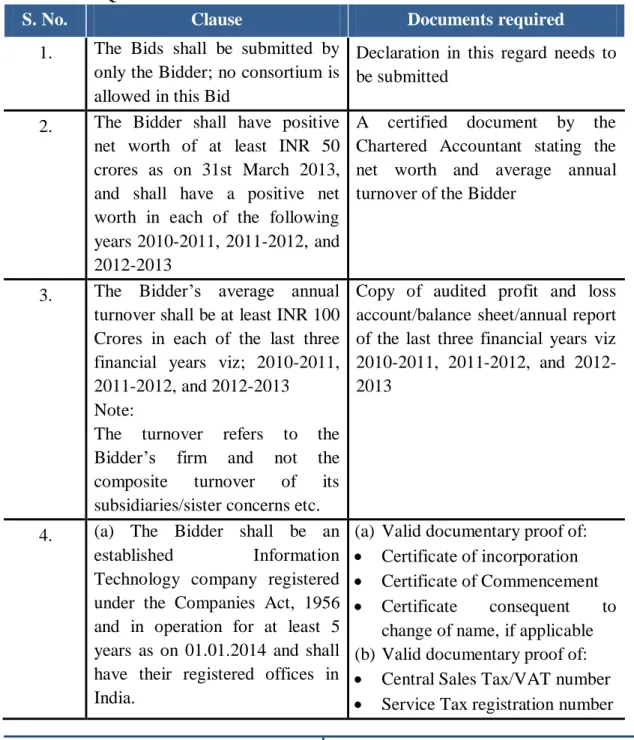
The Bidder must possess the requisite experience, strength and capabilities in providing the services necessary to meet the requirements as described in the RFP document. Keeping in view the complexity & volume of the work involved, the following criteria are prescribed as Pre-Qualification Criteria for Bidder interested in undertaking the project. The Bidder must also possess the Technical know-how and the Financial wherewithal that would be required to successfully provide the Cloud Solution and required support services sought by the State. The Bids must be complete in all respect and shall cover the entire scope of work as stipulated in the tender document. The invitation to Bid is open to all Bidders who qualify the eligibility criteria as given below:
Table 1: Pre-Qualification Criteria
S. No. Clause Documents required
1. The Bids shall be submitted by
only the Bidder; no consortium is allowed in this Bid
Declaration in this regard needs to be submitted
2. The Bidder shall have positive
net worth of at least INR 50 crores as on 31st March 2013, and shall have a positive net worth in each of the following years 2010-2011, 2011-2012, and 2012-2013
A certified document by the Chartered Accountant stating the net worth and average annual turnover of the Bidder
3. The Bidder’s average annual
turnover shall be at least INR 100 Crores in each of the last three financial years viz; 2010-2011, 2011-2012, and 2012-2013 Note:
The turnover refers to the
Bidder’s firm and not the
composite turnover of its
subsidiaries/sister concerns etc.
Copy of audited profit and loss account/balance sheet/annual report of the last three financial years viz 2010-2011, 2011-2012, and 2012-2013
4. (a) The Bidder shall be an
established Information
Technology company registered under the Companies Act, 1956 and in operation for at least 5 years as on 01.01.2014 and shall have their registered offices in India.
(a) Valid documentary proof of: Certificate of incorporation
Certificate of Commencement
Certificate consequent to
change of name, if applicable (b) Valid documentary proof of:
Central Sales Tax/VAT number
RFP for Cloud Enablement
MPSEDC GI Cloud Enablement
S. No. Clause Documents required
(b) The company must be
registered with appropriate
authorities for all applicable statutory duties/taxes
Income Tax registration/PAN
number
Income Tax returns for the
Financial years 2010-2011,
2011-2012, and 2012-2013
5. Bidder shall have experience of
supply, installation,
commissioning and annual
maintenance services for IT Infrastructure projects and shall have been in the business for a period exceeding three years as on 01.01.2014
1. Work Orders confirming year
and area of activity
2. Memorandum and Articles of
Associations
3. Relevant legal documentation
confirming the
acquisition/merger, if any
6. The Bidder must have ISO
9001:2000 certification for
system integration or sale, design and development, testing and implementation of Data Center products and solutions
Valid Copy of the Certification stating the location and the scope of the certification
7. a) The Bidder must have on its
roll at least 100 Technically
qualified professionals with
combination in the following
fields (system integration,
Virtualization and experience in
implementing the Cloud
Solution) as on 01.01.2014
Certificate from Bidder’s HR
Department for the number of Technically qualified professionals employed by the company with their skill set
8. The Bidder must have
implemented/ commissioned at least one Cloud Implementation in Data Centre in India as on 01.01.2014
(Cloud Implementation for
providing Cloud based services in their own Data Centre or on to the customer Data Centre shall be considered)
(a) Work Orders confirming year
and area of activity
(b) Valid Work Order and
Certificate from the Client in
case implementation/
commissioning in Client Data Centre
OR
(a) Declaration from the Company
Secretary confirming the Cloud Implementation in their own Data Centre for providing services to the customers
S. No. Clause Documents required
(b) Client certificate confirming the cloud services they are getting from the Bidders Data Centre
9. The Bidder shall furnish, as part of its Bid, an Earnest Money Deposit (EMD) of Rs. 3,00,000 (Three Lacs Only) in the form of a DD in the favor of M.P. State
Electronics Development
Corporation Limited (MPSEDC), Payable at Bhopal. No Bank Guarantee would be entertained for the same.
The EMD shall be denominated in Indian Rupees.
10. The Bidder shall not be under a Declaration of Ineligibility for corrupt or fraudulent practices or blacklisted with any of the
Central / State Government
agencies.
Declaration in this regard by the authorized signatory of the Bidder
11. The Bidder shall submit valid
letter from all the OEMs
confirming the following:
Authorization for Bidder
Confirm that the products
quoted are not “end of life or end of sale products” as on Bid Submission date. If in case the support for the product quoted has been stopped/ withdrawn till the time of delivery of equipment, the same will be changed with the superior product at no extra cost
Undertake that the support
including spares, patches,
upgrades for the quoted
products shall be available for the period of 5 years from the date of acceptance.
Relevant documentary evidences like Authorization letters
(MAF (Manufacturers
Authorization Form) from all
Vendors whose products are being quoted by the Bidder need to be attached in the proposal)
RFP for Cloud Enablement
MPSEDC GI Cloud Enablement
S. No. Clause Documents required
12. The Bidder shall provide an
undertaking that they or their allied agencies/ Subsidiaries are not working as a Consultant / TPA in the SDC in the State where the Bidder is bidding
Declaration in this regard by the authorized signatory of the Bidder
The Bidder has to ensure that while submission of the Bids, all the pages of the Bids are signed by the competent authority / authorized signatory and also all the pages are numbered and properly indexed. If any of the Bids is found to be without proper signature, page numbers and index, it will be liable for rejection.
Section - IV
S
Department of Information Technology SDC Cloud Enablement
Section IV – Scope of Work
4.1Scope of Work for SDC Cloud Enablement
State Data Centres have been equipped with infrastructure which will enable State /UT departments with seamless, highly reliable/robust, shared and secured infrastructure with scalable capacity. For better and optimal utilization of the compute infrastructure and utilizing the same infrastructure amongst multiple applications, adoption of Cloud technology components across all SDCs is required. This technology will also drive consolidation of IT resources resulting in power savings which will be a significant step towards adopting green technologies.
To address issues typically faced by different departments at the State, such as long IT infrastructure procurement cycles, underutilization of resources, need for dynamic Scalability, appropriate disaster recovery of applications and data, and for simplifying IT infrastructure provisioning & availability to the line departments, cloud based service delivery is needed to be leveraged in the SDCs.
These Cloud solution requirements would include all the necessary components/ modules which are necessary to provide Infrastructure-as-a-Service to various line departments within the State as a Private Cloud to start with and have the capability of moving gradually to other delivery models like Platform-as-a-Service and Software-as-a-Service.
After having analyzed the infrastructure presently provisioned in the SDCs and technology advancements required to make them Cloud enabled, following have been considered:
1. Cloud Enablement Infrastructure
a. Server Virtualization Software with required security capabilities
b. Cloud Enablement components
i. Self Service provisioning
ii. Automation & Orchestration
iii. Capacity Management
iv. Life Cycle Management
v. Catalogue and directory Maintenance
vi. Monitoring and Reporting
vii. Helpdesk
The following are steps for Cloud Implementation:
Help foster a Private cloud based environment on limited set of servers to begin with while retaining traditional Data Centre hosting models. This will
enable the State to get exposure/confidence in building various levels of services that can be broadly classified into following categories:
a. Infrastructure as a Service (IaaS) b. Platform as a Service (PaaS) c. Software as a Service (SaaS)
The services can be initiated with basic Compute Services (CPU, RAM, Storage, OS, and database) to the departments on demand basis along with a test and development environment. Once States develop confidence/maturity in operating cloud enabled environment, gradual migration of existing infrastructure and applications can happen on cloud.
While the Cloud solution is focused primarily on Infrastructure-as-a-Service, other services such as Platform-as-a-Service, Software-as-a-Service (SaaS) to be deployed by the State, are complementary and/or deployed on top of the basic Infrastructure-as-a-Service (IaaS) services and would be based on the maturity of the State.
The solution should be capable of enabling automatic scale-up and scale-down of services hosted in the cloud based on user demand or other factors, shall ease infrastructure management, should be agnostic to the underlying hardware, storage, network, operating system, and hypervisor and should support open format for virtual machine images. The solution needs to provide the ability for end customers to automatically provision the services via a Web Portal, provide metering and billing to provide service assurance for maintenance & operations activities performed by State teams. Detailed user level or user group level auditing, monitoring, metering, accounting, quota and show-back information is essential for building a platform. Detailed FRS is given in Section VI.
The State is looking for a solution approach and architecture based design principles from market leading cloud solution providers in providing a low-cost solution enabled through factors such as using commodity hardware and efficient operations to ensure a cost-effective, scalable, efficient e-Governance platform. The architecture needs to be scalable to meet future demand and provide sufficient levels of security and interoperability so that customers (internal and external) are comfortable having critical infrastructure hosted in a safe environment.
4.2Supply, Installation, Testing & Commissioning, Training and Support for SDC Cloud Enablement Infrastructure
The minimum specified scope of work to be undertaken by the Selected SI for Supply, Installation, Commissioning, Testing, Training, Knowledge transfer and Support for SDC Cloud Enablement Infrastructure is mentioned below:
a) Finalize the deployment architecture/layout with the State Designated Agency/ State Implementation Agency
RFP for Cloud Enablement
MPSEDC GI Cloud Enablement
b) Procurement, Supply, Installation & Commissioning of all the components & sub components including all necessary hardware & software as per the proposed solution. The Bidder has to ensure that the solution shall work as desired and the bidder is also responsible to supply and install any other components that is inadvertently missed out but required for the overall solution to work, without adding any line item in the Bill of Material.
c) The Bidder shall be responsible for ensuring implementation of the proposed solution with existing infrastructure and solutions present in the SDC and optimal functioning of all the components post installation. This implementation shall comply with all the functionalities stated in the Functional Requirement Specifications (FRS) and conform to the agreed deployment/implementation architecture. It shall be noted that any customization / API development that is carried out by the Bidder for such implementation will have to be supported (error correction, patch management) for the same duration of support applicable for the overall solution. The Bidder shall ensure that the Cloud solution is able to permit utilization of the existing security device like, firewall, IPS such that entire functionality of these devices can be used to monitor security features and provide alerts, alarms, reports, proactive actions on virtual environment similar to those provided in physical environment. For any further queries, the Bidder can also post queries in the pre-bid meeting. The bidder has to ensure that all the components listed below shall work with the virtual machines as they were working with the existing infrastructure:
S No. Existing SDC Module Make & Model Sub-Modules
1. IPS/ IDS, Firewall
HP/A-F1000-E, Fortigate/ FGT620B, Radware/ DefensePro 2016-NL-Q
Nil 2.
SAN Storage Management Software / Controller
Data Ontap 8.1.2p3/
NETAPP- V3270 Nil
3. Backup Solution
HP-HPDP 6.20, eml
103e Base Library Nil
4. Antivirus , HIPS
Symantec -Symantec
endpoint protection
manager 12.1.2015.2015 , HIPS- Symantec critical
system protection 5.2.9 Nil
Quantity/ Number
5. Racks (Available in Number) 40 U
6. Power per Rack available 02 [32 Amp. - 5KVA or 63 Amp. - 9KVA]
8. Blade Enclosures & Servers
02 (24 bl460c G7 blade & 08 bl460c G8 blade server.)
9. Rack Servers & similar types
05 DL 580 G7, 04 DL 560 G8 & 02 Rx7640 integrity servers.
d) The State will appoint a 3-4 member specialized team from the existing DCO,
Composite Team and State SIA/DIT to be associated with the Selected Bidder team, so that full hand holding of the entire solution shall be done from the beginning, up to FAT completion and subsequent O&M period of first 2 months.
e) The necessary server, operating system, database and any other required Licenses for Cloud Solution etc shall be provisioned by the SI on its own and cost of the same would be built-in in the cost of the proposed solution. No separate line item(s) shall be entertained. The solution would be required to cater to the entire Data Centre infrastructure for which limited licenses for Cloud Management would be procured as part of this RFP. Licenses for Cloud Management of additional infrastructure, as applicable, would be procured in the future.
f) Comprehensive training during the implementation phase shall be the key to successful Operations and Maintenance; hence the Bidder is required to undertake robust training for at least 10 representatives from the State, Composite Team and DCO. The training documents, including Operating Manuals, Standard Operating Procedures (SOP) for the proposed Cloud solution shall be prepared and shared by the bidder with the State. The successful bidder is free to propose the training plan. However at a minimum, the plan shall include the following:
SDC Cloud Enablement Training Schedule
S. No. Training Description A IT Training
1. Overview of Components Installed
2. Server Virtualization
3. Adherence and Compliance
4. Overview of Migration from stand-alone Applications to the Virtualized
Environment 5.
Overview of Cloud Management and Monitoring Modules 6. Services that can be leveraged through SDC Private Cloud 7.
Service Provisioning Portal, Orchestration, Automation etc.
8. Customization of Service Catalogue and Directory to able to add more services
RFP for Cloud Enablement
MPSEDC GI Cloud Enablement
B SLA
1. Overview of SLA Monitoring & Management
C Others
1. Overview of Service Provisioning, security adherence etc. 2. Do's and Don’ts
3.
Any other points/topics (for e.g., Open Format, Interoperability, consolidation, virtualization etc.)
The above plan is only indicative; the final training plan shall be finalized between the SI and the State.
g) A training workshop needs to be arranged by the Bidder for hands-on training. This workshop shall be for 2 weeks and will be delivered by people certified in Cloud and Virtualization
h) 1 week training would be prior to the FAT and 1 week after the FAT completion
i) The State, prior to the initiation of the O&M phase, shall undertake a detailed Final Acceptance Test (FAT) process, which will include:
Component wise Acceptance
Overall Solution Acceptance
The deliverables for FAT would include, but not limit to, the following:
FAT document (including Plan, procedures, and report)
Standard Operating Procedures (SOP)
Exit Management Plan
SLA Measurement Methodology
Training material for Training Phase II
The final deliverables for the project would be decided after discussions with the State.
j) It is mandated that cloud OEM representatives shall verify for satisfactory deployment of their components by the selected SI. Cost for the same shall be inbuilt as part of the bid and no extra payment / billing request shall be entertained in this regard during the project period.
FAT completion would only be considered after at least one application (to be decided during cloud implementation), identified by the State has been put on the proposed cloud environment after testing all the solution capabilities as part of the FAT parameters.
k) Prior to deployment of the solution, the Bidder shall convey to the State all the requirements to be fulfilled by the State for ensuring smooth operations. The requirements may include:
i. Rack Space requirements in the available ‘U’ racks
ii. Power requirements
iv. Planned downtime requirements, if any
(The Bidder shall ensure that the planned downtime is during non-peak hours and on weekends, so that the downtime has minimum effect on the existing operations of SDC)
l) The successful Bidder shall ensure that the project documents are maintained
as per existing State policies.
m) During the entire project period, the successful Bidder shall comply with the SLAs provided under this RFP
n) All complaints shall be logged in the proposed Cloud Help Desk and the data
shall be used to comply with the SLA compliance
o) The call and escalation that would be for the support period shall be properly recorded in the proposed Cloud helpdesk system
p) The Bidder shall ensure that the products quoted are not “end of life” during the entire project tenure. If in case the support for the product quoted has been stopped/ withdrawn till the time of delivery of equipment, the same will be changed with the superior product at no extra cost. The support including spares, patches, and upgrades for the quoted products shall be available for the entire period of the Project without any additional cost to the State.
q) The prices would be discovered in two parts:
CAPEX (which shall include the Supply, Installation, Testing, Training and FAT)
OPEX (This shall include the O&M, support and subscription cost for the period of the project, as mentioned in the RFP)
For clarity on the distribution between CAPEX and OPEX, and O&M clarity, the bidder may refer to Section I.
4.3 Operation and Maintenance
The scope of work for the Operations Phase is categorized below: Basic Services
Facilitate hosting of departmental applications on Cloud and in Virtualized Environment at the SDC:
o Provision of Virtual Machines based on the requirement of the user department.
o Maintaining catalogue and templates in the self service provisioning portal
o Ensuring Connectivity of servers to the LAN and SAN Storage
o Ensuring required configuration for maintaining virtual IP and switch where the virtual machines do the communication
RFP for Cloud Enablement
MPSEDC GI Cloud Enablement
Proactive and reactive maintenance, repair and replacement of defective components installed through this RFP, at the SDC. The cost for repair and replacement shall be borne by the bidder.
Any component that is reported to be faulty / non-functional on a given date
shall be either fully repaired or replaced by temporary substitute (of equivalent configuration) within the time frame agreed upon in the Service Level Agreement (SLA).
SI shall maintain records of the maintenance of the basic infrastructure and shall maintain a logbook on-site that may be inspected by the State at any time.
Server Monitoring, Administration & Management Services
Backup & Restore Services of Virtual Machines
Preventive Maintenance Services
Corrective Maintenance Services
MIS Reports
Help Desk Services
The help desk service will serve as a single point of contact for all incidents and service requests at the SDC. The service will provide a Single Point of Contact (SPOC) and also escalation / closure of incidents for the user departments whose infrastructure is hosted at the data center. The activities related to Cloud shall include the following:
Solution should comprise of a completely automated system of raising issues
on a portal through web / intranet, call logging, ticket generation, sending alerts on email and escalation to the cloud administrators and end users
Provide Help Desk facility during agreed service period window for reporting
user department incidents / issues / problems with the IT infrastructure. Provide necessary channels for reporting issues to the help desk.
The Help desk shall log user calls related to Cloud Solution and assign an incident/ call ID number. Severity shall be assigned to each call as per the SLAs.
Creation of knowledge base on frequently asked questions to assist user departments in resolving basic issues themselves
Track each incident / call to resolution Provide feedback to callers.
Analyze the call statistics
Creation of knowledge base on frequently asked questions to aid users.
Continuous monitoring of the physical as well as the IT infrastructure at the SDC to ensure availability as per agreed SLAs.
Escalate the calls, to the appropriate levels, if necessary as per the escalation matrix agreed between the SI and the user department. The escalation matrix shall be developed by the SI in discussion with the SIA.
Coordinate with respective vendors for closure of calls.
Analyze the incident / call statistics and provide monthly reports including but not limited to:
o Type of incidents / calls logged
o Incidents / calls resolved
o Incidents / calls open Server Monitoring, Administration The activities shall include:
Configuration of server parameters, operating systems administration and tuning.
Operating system administration, including but not limited to management of
users, processes, resource contention, preventive maintenance and management of updates & patches to ensure that the system is properly updated.
Re-installation in the event of system crash/failures.
Maintenance of a log of the performance monitoring of servers including but
not limited to monitoring CPU, disk space, memory utilization, I/O utilization, etc.
Event log analysis generated in all the sub systems including but not limited to servers, operating systems, applications, etc. Ensuring that the logs are backed up and truncated at regular intervals.
RFP for Cloud Enablement
MPSEDC GI Cloud Enablement
Periodic health check of the systems, troubleshooting problems, analyzing and
implementing rectification measures.
Ensuring the upkeep of existing systems that would be reused and also incorporate necessary changes for new applications if any during the tenure of the contract.
Identification, diagnosis and resolution of problem areas pertaining to the SDC Cloud infrastructure and application and maintenance of assured SLA levels. Prepare, Design, implement and maintain standard operating procedures for
maintenance of the Cloud infrastructure based on the State’s policies. Backup and Restore Services
The SI shall be using the existing backup solution, policies and procedures that is available at SDC. The activities shall include, but not limited to:
Backup of operating system, Virtual Machines and application as per
stipulated policies at the SDC.
Monitoring and enhancement of the performance of scheduled backups,
schedule regular testing of backups and ensure adherence to related retention policies.
Real-time monitoring, log maintenance and reporting of backup status on a regular basis. Prompt problem resolution in case of failures in the backup processes.
MIS Reports
SI shall submit the reports on a regular basis in a mutually decided format. The SI shall workout the formats for the MIS reports and get these approved by the State within a month of being awarded the contract. The following is only an indicative list of MIS reports that may be submitted to the State:
a. Daily reports
o Summary of issues / complaints logged at the Help Desk
o Summary of resolved, unresolved and escalated issues / complaints
o Summary of resolved, unresolved and escalated issues / complaints to vendors.
o Log of backup and restoration undertaken.
o Summary of systems rebooted.
o Summary of issues / complaints logged with the OEMs.
o Summary of changes undertaken in the Data Centre including major
changes like configuration changes, patch upgrades, etc. and minor changes like log truncation, volume expansion, user creation, user password reset, etc.
o Hypervisor patch update status of all servers including the Virtual Machines running on in
c. Monthly reports
o Component wise server as well as Virtual machines availability and resource utilization
o Consolidated SLA / (non)- conformance report.
o Summary of component wise uptime.
o Log of preventive / scheduled maintenance undertaken
o Log of break-fix maintenance undertaken
o All relevant reports required for calculation of SLAs d. Quarterly Reports
o Consolidated component-wise availability and resource utilization.
o All relevant reports required for calculation of SLAs
The MIS reports shall be in-line with the SLAs and the same shall be scrutinized by the TPA.
Note: The Selected bidder will also provide any other report requested by the SIA/TPA
Roles and Responsibilities
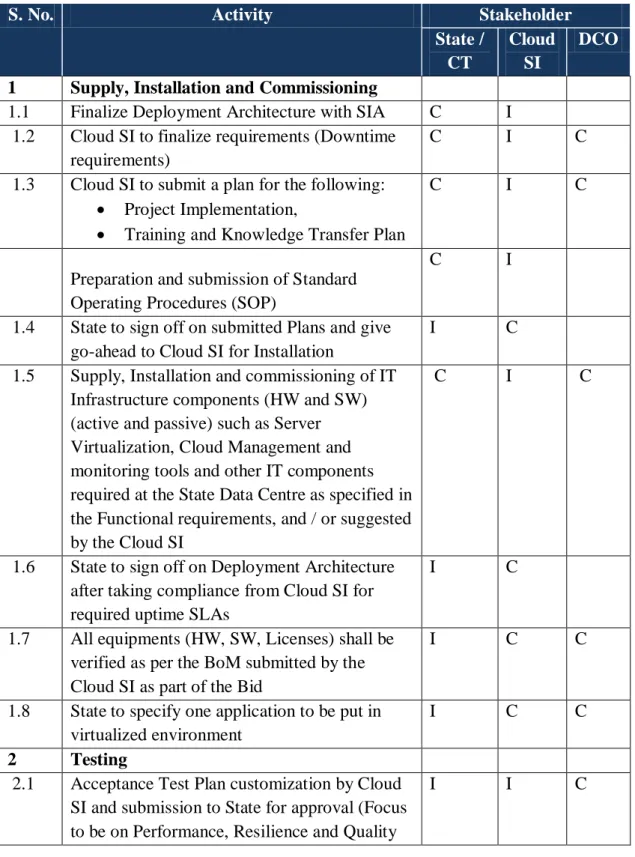
The roles of the stakeholders shall change over a period of time as the project will evolve from design to implementation and enter the operations phase. With this background, stakeholders’ responsibilities and illustrative organizational structure for the design & implementation phase and operational phase is given below:
State State Implementation Agency and/ or Composite Team
Cloud SI System Integrator/ Bidder
DCO Data Centre Operator
RFP for Cloud Enablement
MPSEDC GI Cloud Enablement
A- Advise C- Coordinate I- Implement
The table below summarizes the Roles and Responsibilities of stakeholders involved in the project:
Table 2: Summary of Roles and Responsibilities of stakeholders
S. No. Activity Stakeholder
State / CT
Cloud SI
DCO
1 Supply, Installation and Commissioning
1.1 Finalize Deployment Architecture with SIA C I
1.2 Cloud SI to finalize requirements (Downtime
requirements)
C I C
1.3 Cloud SI to submit a plan for the following:
Project Implementation,
Training and Knowledge Transfer Plan
C I C
Preparation and submission of Standard Operating Procedures (SOP)
C I
1.4 State to sign off on submitted Plans and give go-ahead to Cloud SI for Installation
I C
1.5 Supply, Installation and commissioning of IT
Infrastructure components (HW and SW) (active and passive) such as Server Virtualization, Cloud Management and monitoring tools and other IT components required at the State Data Centre as specified in the Functional requirements, and / or suggested by the Cloud SI
C I C
1.6 State to sign off on Deployment Architecture
after taking compliance from Cloud SI for required uptime SLAs
I C
1.7 All equipments (HW, SW, Licenses) shall be
verified as per the BoM submitted by the Cloud SI as part of the Bid
I C C
1.8 State to specify one application to be put in virtualized environment
I C C
2 Testing
2.1 Acceptance Test Plan customization by Cloud
SI and submission to State for approval (Focus to be on Performance, Resilience and Quality
S. No. Activity Stakeholder State / CT Cloud SI DCO of solution)
2.2 Provide SW, HW, and Licenses required for
testing installed Cloud Solution
I
3 Final Acceptance Test
3.1 Cloud SI to demonstrate all the services / features / functionalities as mentioned in the FRS and defined in the Scope of Work and subsequently in the agreement, as part of the FAT
C I C
3.2 State to verify the functionalities and sign-off on FAT completion
I C C
4 Training
4.1 State to identify the representatives from CT, DCO, User Department, SeMT and SIA
I
4.2 Training to be provided by the Bidder as per
the training requirements mentioned in the RFP
C I C
5 Operations and Maintenance
5.1 Support for all the components (upgrades,
updates, call, escalation, response time , resolution time )
C I C
5.2 Maintaining the helpdesk for Cloud
components
I C
5.3 Support during the Operations phase for any
error correction or version Updations
I C
5.4 Provisioning of new VM deletion, Updations,
P to V Conversion etc.
C I C
The Bidder is advised to prepare their integration and passive components requirement based on the table above.
Department of Information Technology SDC Cloud Enablement
S
S
e
e
r
r
v
v
i
i
c
c
e
e
L
L
e
e
v
v
e
e
l
l
A
A
g
g
r
r
e
e
e
e
m
m
e
e
n
n
t
t
Section V – Service Level Agreement
The purpose of this Service Level Agreement (hereinafter referred to as SLA) is to clearly define the levels of service which shall be expected from the Cloud Solution provider (hereinafter referred to as SI) towards the State during the implementation and its subsequent support for the project period.
5.1Definitions
For the purpose of this SLA, the definitions and terms as specified in the contract along with the following terms shall have the meanings set forth below:
1. “Incident” refers to any event / abnormalities in the functioning of the Cloud Enablement components in State Data Centre / specified services that may lead to disruption in normal operations of the Cloud based services
2. “Support" shall mean the 24x7 support which shall handle patch updates, upgrades Fault Reporting, Trouble Ticketing, and resolution of related enquiries during this contract. Interactive remote diagnostic support shall also be there, allowing technical support engineers to troubleshoot an incident securely through a browser-based remote control feature.
3. Availability shall mean the time for which the services offered are available for conducting operations from the equipment / solution hosted on Cloud. Availability percentage is measured as Availability %age = {(Agreed Service Time – Down Time)/ (Agreed Service time)}*(100%)
4. Scheduled Maintenance Time / Scheduled downtime shall mean the time that the System is not in service due to a scheduled work. Scheduled maintenance time is planned downtime with the prior permission of the designated SDC operator.
5. Scheduled operation time means the scheduled operating hours of the System for the month. All scheduled maintenance time on the system would be deducted from the total operation time for the month to give the scheduled operation time. The total operation time for the systems and applications
hosted on cloud will be 24x7x365. Downtime means accumulated time during
which the System is totally inoperable within the Scheduled Operation Time but outside the scheduled maintenance time.
6. Subsystem Downtime shall mean the downtime observed in major components of the cloud infrastructure. E.g. in Cloud Network or Virtualization Layer or Storage, Virtual Operating Systems etc. will be the major components in cloud solution. The amount (%) that the sub-system
contributes to the mission of the Total System Total System Downtime shall
be defined as the sum of the downtimes of each functional sub-system in as much as that sub-system contributes to the mission of the Total System. The average downtime of the all subsystems will be calculated by following formula:
RFP for Cloud Enablement
MPSEDC GI Cloud Enablement
Subsystem Downtime= (Downtime Subsystem A + Downtime Subsystem B + Downtime Subsystem N) / Total Subsystems.
7. “Response time” is defined as the time between receipt of the incident by support team and its logging / generation of ticket on the system
8. “Resolution Time” shall mean the time taken (after the incident has been reported to the support team) till resolution. The severity parameters have been defined below:
The severity would be as follows:
a. Critical: In case more than 1 physical servers are down threatening business continuity (VMs on the physical server are not accessible and not working and Multiple Clients are affected) which is attributable to the Cloud Solution implemented by the SI, it shall be considered as a Critical incident.
b. High: In case 1 physical server is down causing high impact on business operations (VMs on physical server are not accessible/not working (few clients are affected) which is attributable to the cloud solution implemented by SI.
c. Medium: In case an essential functionality of the Cloud solution (like VM availability) becomes unavailable in the Live SDC environment which is not actually hampering the live services of the Cloud but may impact the services if not attended immediately will be termed as medium.
d. Low: The incidents would be termed as low, which does not have any
significant impact on the Cloud service delivery (little or no impact on business entity), eg:
i. A minor problem or question that does not affect the software
function,
ii. An error in software product Documentation that has no
significant effect on operations; or
iii. A suggestion for new features or software product
enhancement.
5.2Planned Downtime
Planned downtime shall mean any time when the Cloud based services from the State Data Centre are unavailable because of Urgent Maintenance activities and any other scheduled maintenance or upgrade activities that may or may not be periodic. The planned downtime must be notified to the State at least 48 hours in advance.
Urgent Maintenance activities are maintenance activities required by application or systems that cannot be postponed until the next available or convenient maintenance window, and may include but not limited to restarting applications, rebooting servers, applying patches or fixes, reconfiguring, reloading data etc.
5.3Service Levels
This SLA document provides for minimum level of services required as per contractual obligations based on performance indicators and measurements thereof. The SI shall ensure provisioning of all required services, while monitoring the performance of the same, to effectively comply with the performance levels mentioned below. The services provided by the SI shall be reviewed by the State, which will:
Regularly check performance of the SI against this SLA
Discuss escalated problems, new issues and matters still outstanding for resolution Review statistics related to rectification of outstanding faults and agreed changes
Obtain suggestions for changes to improve the service levels
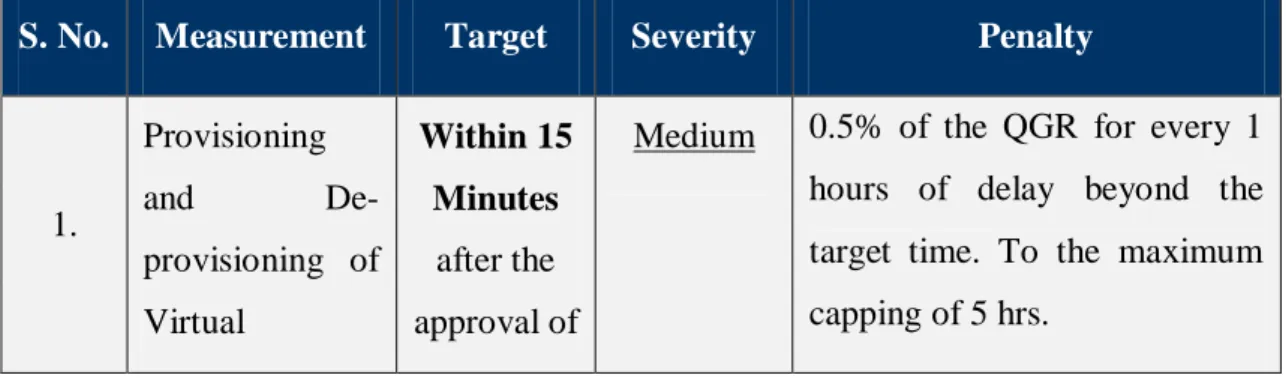
The SLAs have been logically segregated in the following categories: 1. Implementation Service Related Levels
2. Helpdesk Service Related Levels
3. Compliance and Reporting Service Levels 4. IT Infrastructure Related Service Levels 5. Cloud Services Related Service Levels
The targets shown in the following tables are mapped with the requirements specified for Cloud Enablement components for State Data Centre, as a part of support for the Cloud infrastructure; it is the responsibility of the SI to maintain the same SLAs with the OEM for their support and maintenance which can be extended to the State. Implementation service levels
Table 1: Implementation Service Levels
S. No. Service Category Target Penalty
1. Team Mobilization, Preparation of Project Plan, Kick-off meeting etc.
One week from
the date of
release of
Letter of Intent (LoI)
After 1 week of release of LoI if the Team is not deployed by the SI > Letter of Warning
RFP for Cloud Enablement
MPSEDC GI Cloud Enablement
2. Supply, Installation and Commissioning 12 weeks from the date of signing of contract
Penalties will be applicable after 12 weeks, if the work is still not completed. (Work completion shall be considered on the date of submission of all documents, and submission of all applicable reports as mentioned in the Contract)
A penalty of 1% per week for first two weeks, 2% per week for every subsequent week subject to a maximum of 10%. Penalty will be computed on the final CAPEX value of contract between State and SI. 3. Final Acceptance Test (FAT) 2 weeks from the commencement completion of commissioning
Penalties applicable after 2 weeks
from the completion of
commissioning. (Work
completion shall be considered on the date of submission of all documents, and submission of all applicable reports as mentioned in the Contract)
A penalty of 1% per week for first two weeks, 2% per week for every subsequent week subject to a maximum of 100%. Penalty will be computed on the final
CAPEX value of contract
between State and SI.
System Integration Services include, but not limit to, the following:
Team Mobilization for the commencement of the work
Before the initialization of the work a complete schedule will be provided by the
Bidder to the State as the Project Plan
Weekly track report would be given to the State by end of every week for acknowledgement and review
Delivery of all the Equipment(s) and Software on time which are part of Scope of
Work
Installation report needs to be checked and passed by the State
All the documents, manuals & CDs need to be made available to the State
Licenses, Service Support documents will be checked and cleared by the State
Component-wise installation, commissioning & testing schedule shall be made available to the State, by which periodic tracking of all the components can be done
Quality control document for installation and commissioning shall be prepared by
SI and verified by the State before installation kickoff
Complete Load testing of all the equipments as per the equipment Data Sheet would be done by SI in presence of appointed concerned authority of the State Final Acceptance Test (FAT) of the Cloud Enablement components as a whole
which will also include running at least 1 application in the virtual environment at the SDC
Training schedule to be submitted two weeks prior to the start of Training and approved by the State after signing the contract
Handover of the solution to the State, operating and maintaining it for a period of 2 months from the date of O&M start date as declared by the State
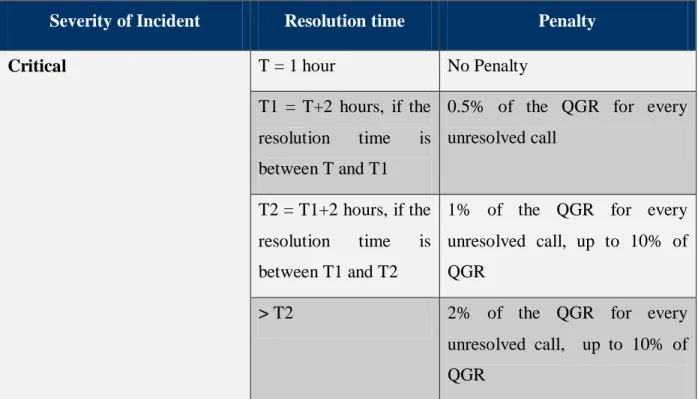
Help Desk Services Levels
Time in which a complaint / query is resolved after it has been responded to by the IT service management.
Table 2: Help Desk Services related SLA
Severity of Incident Resolution time Penalty
Critical T = 1 hour No Penalty
T1 = T+2 hours, if the
resolution time is
between T and T1
0.5% of the QGR for every unresolved call
T2 = T1+2 hours, if the
resolution time is
between T1 and T2
1% of the QGR for every unresolved call, up to 10% of QGR
> T2 2% of the QGR for every
unresolved call, up to 10% of QGR
RFP for Cloud Enablement
MPSEDC GI Cloud Enablement
High T3 = T + 0.5 hours No Penalty
T4 = T3 + 2.5 hours, if the resolution time is between T3 and T4
0.5% of the QGR for every unresolved call, up to 10% of QGR
T5 = T4+ 2.5 hours If the resolution time is between T5 and T4
1% of the QGR for every unresolved call, up to 10% of QGR
> T5 2% of the QGR for every
unresolved call, up to 10% of QGR
Medium ≤ 2 hours from time of incident logged.
No Penalty
> 2 hours and ≤ 4 hours 0.1% of the QGR for every unresolved call, up to 10% of QGR
> 4 hours 0.5% of the QGR for every
unresolved call, up to 10% of QGR
Low 1 day from the time of
incident logged at the help desk
No penalty
> 1 day and ≤ 10 days 0.5% of the QGR for every unresolved call, up to 10% of QGR
> 10 days 1% of the QGR for every
unresolved call, up to 10% of QGR