Singapore Management University
Singapore Management University
Institutional Knowledge at Singapore Management University
Institutional Knowledge at Singapore Management University
Research Collection School Of Information
Systems
School of Information Systems
8-2019
Knowledge base question answering with topic units
Knowledge base question answering with topic units
Yunshi LAN
Singapore Management University, [email protected]
Shuohang WANG
Singapore Management University, [email protected]
Jing JIANG
Singapore Management University, [email protected]
Follow this and additional works at: https://ink.library.smu.edu.sg/sis_research Part of the Artificial Intelligence and Robotics Commons
Citation
Citation
LAN, Yunshi; WANG, Shuohang; and JIANG, Jing. Knowledge base question answering with topic units. (2019). Proceedings of the Twenty-Eighth International Joint Conference on Artificial Intelligence. 5046-5052. Research Collection School Of Information Systems.
Available at:
Available at: https://ink.library.smu.edu.sg/sis_research/4440
This Conference Proceeding Article is brought to you for free and open access by the School of Information Systems at Institutional Knowledge at Singapore Management University. It has been accepted for inclusion in Research Collection School Of Information Systems by an authorized administrator of Institutional Knowledge at Singapore Management University. For more information, please email [email protected].
Knowledge Base Question Answering with Topic Units
Yunshi Lan
,
Shuohang Wang
and
Jing Jiang
School of Information System, Singapore Management University
{
yslan.2015, shwang.2014
}
@phdis.smu.edu.sg, [email protected]
Abstract
Knowledge base question answering (KBQA) is an important task in natural language processing. Ex-isting methods for KBQA usually start with en-tity linking, which considers mostly named entities found in a question as the starting points in the KB to search for answers to the question. However, relying only on entity linking to look for answer candidates may not be sufficient. In this paper, we propose to perform topic unit linking where topic units cover a wider range of units of a KB. We use a generation-and-scoring approach to gradually fine the set of topic units. Furthermore, we use re-inforcement learning to jointly learn the parameters for topic unit linking and answer candidate rank-ing in an end-to-end manner. Experiments on three commonly used benchmark datasets show that our method consistently works well and outperforms the previous state of the art on two datasets.
1
Introduction
Knowledge base question answering (KBQA) is an impor-tant task in NLP that has many real-world applications such as in search engines and decision support systems. It has at-tracted much attention in recent years [Cai and Yates, 2013; Kwiatkowskiet al., 2013; Bordeset al., 2014; Donget al., 2015; Yih et al., 2015; Xu et al., 2016; Yu et al., 2017; Petrochuk and Zettlemoyer, 2018]. The task is defined as finding the answer to a factoid question using facts stored in a knowledge base (KB).
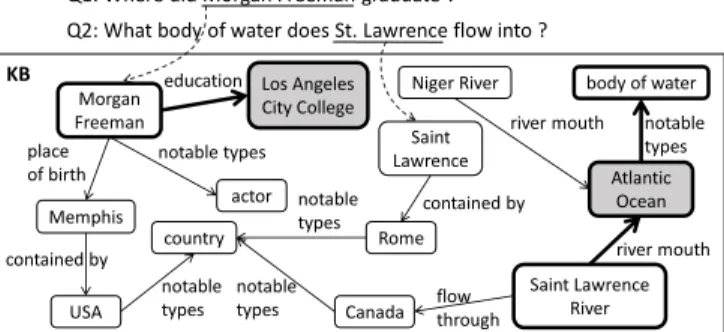
Most existing methods for KBQA use a pipelined ap-proach: First, given a questionq, anentity linkingstep is used to find KB entities mentioned inq. These entities are often referred to astopic entities. Next, relations or relation paths in the KB linked to the topic entities are ranked such that the best relation or relation path matchingqis selected as the one that leads to the answer entities. For example, given the ques-tion Q1 shown in Figure 1, an entity linking tool may link the phrase “Morgan Freeman” in the question to the entity “Mor-gan Freeman” in the KB. Then starting from this topic entity, a number of different relation paths are considered such as (Morgan Freeman, education), (Morgan Freeman, place of birth) and (Morgan Freeman, place of birth, contained by).
Q1: Where did Morgan Freeman graduate ? Q2: What body of water does St. Lawrence flow into ?
Morgan Freeman Los Angeles City College actor Memphis USA Saint Lawrence Rome country Canada
Niger River body of water
Atlantic Ocean Saint Lawrence River education place of birth notable types contained by notable types notable types notable
types flowthrough
river mouth river mouth notable
types contained by
KB
Figure 1: Two example questions and how they can be answered by a KB. The questions are linked totopic entitiesby imaginary lines. The shaded entities are the correct answers to the questions. The paths in bold are correct relation paths towards the questions.
Ideally, we want the path (Morgan Freeman, education) to be ranked the first with respect to the question so that the correct answer at the end of this path can be extracted.
Although a plethora of methods has been proposed for KBQA, most work focuses on the relation path ranking step. For entity linking, many methods rely entirely on existing entity linking tools [Xu et al., 2016; Dong et al., 2017; Haoet al., 2017], which generally use traditional rule-based methods to perform named entity recognition and linking. There are at least two limitations with this approach. First, oftentimes an entity mention in a question is ambiguous and an entity linking tool may not link it to the correct entity in the KB. Take the question Q2 in Figure 1 for example. An entity linking tool is more likely to mistakenly link the en-tity mention “St. Lawrence” to the enen-tity “Saint Lawrence” in the KB, which is far away from the correct answer entity “Atlantic Ocean.” On the other hand, the question in Figure 1 shows that words that are not part of a named entity, such as “body”, “water” and “flow”, can also be linked to relevant entities and relations in the KB such as “body of water” and “flow through” that can help find the correct answer entity. The second limitation with a pipeline approach is that the entity linking step cannot be trained using the final KBQA results. Again, let us look at the Q2 in Figure 1. If both “Saint Lawrence” and “Saint Lawrence River” are recognized as topic entities, an entity linking module developed outside of the KBQA system would not be able to know which one
is more relevant to the question. However, if we could train a topic entity ranking function using the ground truth answer to the question, we may learn that with “water” and “flow” appearing in the question, “Saint Lawrence River” should be ranked higher than “Saint Lawrence” as a topic entity.
In this paper, we address the two limitations above by re-placing the standard topic entity linking module with a novel topic unit generation-and-scoring module. Our topic units include not only named entities but also other KB units such as entities containing common nouns (e.g., “body of water”) and relation types (e.g., “flow through,” “river mouth”). By flexibly considering a wide range of topic units, we can in-crease the chance of the correct answer being connected to one of the topic units. However, we do not want to consider too many topic units for the subsequent relation path ranking step as this would incur high computational costs. We there-fore propose to identify topic units in two steps: a genera-tion step and a scoring step. First, in a topic unit generagenera-tion step, we use heuristics with low computational costs (e.g., n-gram matching with an inverted index) to identify an initial set of topic units that has a high coverage. Subsequently, in a topic unit scoring step, we use a neural network-based scor-ing function to rank the initial topic units and select a small number of them that are highly relevant to the question. We then only consider relation paths derived from this small set of topic units. Our method is trained in an end-to-end manner using reinforcement learning such that the ranking function in the topic unit scoring step can be learned without knowing the ground truth topic units.
We evaluate our method on three benchmark datasets: We-bQuestionsSP, ComplexWebQuestions and SimpleQuestions. We find that our method can clearly outperform the state of the art on two datasets, especially on ComplexWebQuestions where the improvement is substantial. It also performs com-petitively on the third dataset. Further analyses also show that considering a wide range of topic units is crucial to the per-formance improvement.
2
Related Work
A general solution to KBQA is a pipeline approach, where the question is first linked to some topic entities in the KB by an existing entity linking tool [Yao and Durme, 2014; Bordes et al., 2015; Dong et al., 2017; Hao et al., 2017] and then relation paths connected to the topic entities in the KB are retrieved and ranked by various ranking mod-els, including semantic parsing based models [Berantet al., 2013; Yih et al., 2015; Yih et al., 2016] and embedding based models [Bordes et al., 2014; Bordes et al., 2015; Dong et al., 2017; Sun et al., 2018]. The top-ranked re-lation path will then be used to answer the question. Al-though these methods have worked well on KBQA, there are limitations of this pipeline approach using an external entity linking tool [Shen et al., 2015; Lample et al., 2016; Maiet al., 2018], as we have pointed out in Section 1.
There has been some work attempting to address the limi-tations pointed out. Yuet al.(2017) re-rank the topic entities using their associated relations. Xuet al.(2016) jointly train entity linking and path ranking through entity descriptions.
However, these studies still only consider named entities as topic entities rather than linking a question to other kinds of KB units. In contrast, we consider a wide range of KB units during our topic unit linking step. Zhanget al. (2017) in-tegrate entity linking and relation path ranking into an end-to-end model. However, their topic entity linking module considers all candidate topic entities without using a scor-ing function to rank and fiter them, and as a result, it is hard to scale up their method to large knowledge bases. In con-trast, we take a topic unit generation-and-scoring approach, using heuristics for generating topic units and a neural net-work model for fine-grained scoring. Similar to [Zhanget al., 2017], We also use reinforcement learning to jointly train the entire system.
3
Method
3.1
Task Setup
We first formally define the KBQA task. A KB (knowl-edge base) consists of a set of entities E (e.g., Mor-gan Freeman), a set of relation types1 R (e.g., place
of birth) and a set of relation triplets (h, r, t) (e.g., (Morgan Freeman,place of birth,Memphis), whereh∈ Eis the head entity, t ∈ E is the tail entity, and r ∈ R is a di-rected relation betweenhandt. The triplets(h, r, t)are facts or knowledge contained in the KB. A KB can also be seen as aknowledge graphwhose nodes are the entities and edges are the relations. We assume that each entity or relation type has a textual description, which is a sequence of words.
We defineKB units(denoted asU) to be the union of the entities and the relation types, i.e., U = E ∪ R. Given a questionq, the task of KBQA (knowledge base question an-swering) is to find a set of entities inE that are answers toq. It is assumed that a set of questions together with their correct answers in the KB is given for training.
3.2
Method Overview
Like many existing methods for KBQA, our method follows the general approach of first linking the words in the ques-tion to some parts of the KB as starting points for search and then following the edges of the knowledge graph to look for answer entities whose relation path best matches the ques-tion. Different from previous methods, instead of confining the first linking step to only named entities in the question, we consider a wider range of KB units to be linked to the ques-tion. We also propose a generation-and-scoring strategy such that we can gradually refine the linked KB units.
Specifically, we divide our method into the following three steps: (1) Topic unit generation. In this step, our goal is to identify all KB units that are likely mentioned in the ques-tion. We want to achieve high coverage without incurring any heavy computation. So in this step we rely mostly on existing entity linking tools as well as string matching, pre-computed corpus statistics and pre-constructed inverted index. The out-put of this step is an initial set of topic units for a given ques-tion. (2) Topic unit scoring. In this second step, we want
1
Since sometimesrelationsmay refer to relation triplets, to avoid confusion, here we use the termrelation type.
Q: What body of water does St Lawrence flow into ? • Saint Lawrence • river mouth • body of water • Saint Lawrence River …… Atlantic Ocean Topic Unit Generation
KB initial topic units𝑈ഥ𝑞 ranked topic units𝑈𝑞 candidate relation paths𝐶𝑞
Topic Unit Scoring • Saint Lawrence River • river mouth • body of water • • • …… Saint Lawrence River Atlantic Ocean river mouth Saint
Lawrence Riverflow throughCanada Niger River Atlantic Ocean river mouth Candidate Relation Path
Identification
Relation Path Ranking
answer
Figure 2: An overview of the various steps of our method.
to refine the topic units obtained in the first step by select-ing the top ones based on a sophisticated rankselect-ing function learned from the training data. The output of this step is a much smaller subset of the initial topic units. (3) Relation path ranking. Given the topic units selected in the previous step, we can derive a set of relation paths where each path starts from a topic unit and contains one or multiple hops of relations. We then use a neural network-based scoring func-tion to rank these relafunc-tion paths. Finally, we pick the entities connected to the top-ranked relation path as the answers to the question.
Our main contributions lie in the first two steps. We regard the third step as a standard procedure to complete the entire KBQA system. The three steps are illustrated in Figure 2. In the rest of this section we present the details of each step and describe how we use reinforcement learning to train the entire method in an end-to-end manner.
3.3
Topic Unit Generation
The goal of topic unit generation is to identify all KB units that are possibly mentioned in the question. For named en-tities appearing in the question, we rely on existing entity linking tools to recognize and link them. Here we mainly describe how we identify other KB units possibly mentioned in the question.
A straightforward solution would be to identify those KB units whose textual descriptions contain one of the words in the question. However, exact word matching is too restrictive. Here we use two strategies to relax the matching conditions. One is to allow character-leveln-gram matching. Another is to expand the question with additional words that are highly related to some original question words.
Specifically, we do the following to identify topic units that are not named entities:
1. We build an inverted index to map each unique character n-gram (wheren > 4) and each unique word found in the descriptions of all KB units to the corresponding KB units. This allows us to quickly link a charactern-gram or a word found in a question to the KB units contain it. 2. Next, we link the question to some highly correlated words based on statistics obtained from the training data. E.g., the word “flow” appearing in the question in Fig-ure 2 could be linked to the word “river” in a relation path, which would help us link “flow” from a question to relation types such as “river mouth” in the KB. To achieve this, for those training questions whose topic en-tities can be identified by existing entity linking tools,
we find the relation paths between the topic entities and the ground truth answer entities. We thus obtain a set of (question, relation path) pairs. We then compute the pointwise mutual information (PMI) between each pair of a question word and a relation path word. Note that although the relation paths used here are not always cor-rect, most of them are still relevant to the question, and therefore the mutual information computed can still in-dicate strongly correlated words.
3. Given a questionq, we first use an entity linking tool to identify named entities inq. Then we remove the linked named entities and stop words inq. For the remaining question words, we use the pre-computed PMI values to find other words highly correlated with one of the ques-tion words (using a PMI threshold of 1) and add these additional words to the question.
4. Finally, we find those KB units linked to all the charac-tern-grams and the words inside the expanded question, based on the inverted index built earlier. This is our ini-tial set of topic units for question q, which we denote withUq¯ .
3.4
Topic Unit Scoring
The topic unit generating step aims to increase coverage but usually returns a large set of topic units. In the topic unit scoring step, we use a scoring function to derive a distribu-tion over the topic units identified from the previous step with respect to the question.
The probability function is based on a standard linear feed-forward neural network as follows:
s(u, q) = w|1fu+b1,
p(u|q) = P exp(s(u, q)) u0∈Uq¯ exp(s(u0, q))
, (1)
whereu∈ Uq¯ ,fu is a feature vector associated withu, and
w1andb1are parameters to be learned.
The feature vectorfuis the concatenation of four vectors:
fu = fusemantic⊕f character u ⊕f category u ⊕f link u . • fsemantic
u is the output of a neural network-based sequence
matching model [Seoet al., 2017] that measures the se-mantic relatedness between the topic unituand the ques-tion q. Here the topic unit u is a represented by the embedding vectors of the words in the textual descrip-tion of u, denoted as (u1,u2, . . . ,u|u|), and q is also
represented by the embedding vectors of its sequence of words, (q1,q2, . . . ,q|q|). The sequence matching
model first uses the attention mechanism to obtain at-tention weightsaij as follows:
αij = w|2(qi⊕uj⊕(qiuj)), aij = exp(αij) P|q| k=1exp(αkj) .
Then for each wordujin the topic unitu, we obtain an
attention-weighted version of the question as follows:
˜ qj = |q| X i=1 aijqi.
Finally, we match each unit wordujwith its
correspond-ing question representation˜qj, and aggregate the
match-ing results to obtain the vectorfusemantic:
fsemantic u = w|3 |u| X j=1 (˜qj⊕uj). Essentially fsemantic
u is a 1-dimensional vector that
en-codes the knowledge about how well unit u matches questionqusing the attention-based sequence matching model. Herew2andw3are parameters to be learned. • fucharacteris a 1-dimensional vector that measures the
per-centage of characters inuthat are also found inq.
• fcategoryu is a 3-dimensional one-hot vector indicating the category of the topic unitu, i.e., whether it is a named entity recognized by the entity linking tool, an entity that is a common noun, or a relation type.
• flinku is a 1-dimensional vector, which contains the entity linking score returned by the entity linking tool ifuis a named entity and0otherwise.
Based on Eqn. (1), we can rank the topic units inU¯q and
pick the top-Kto form a new setUqfor the next step.
3.5
Relation Path Ranking
Given the set Uq, in the relation path ranking step we first identify candidate relation paths that are connected to some u∈ Uqand then rank these relation paths based on how well they match the question. Note that this step is not the focus of our work and we omit some of the implementation details. To identify the candidate relation paths, for eachu∈ Uqwe
extract a set of relation paths. Ifuis an entity, we take those relation paths starting fromuand containing one or two rela-tions. Ifuitself is a relation type, we take all relation paths in the KB with one or two relations where at least one of the relations isu. When a unitugives us more than 500 rela-tion paths, we use character-level overlap with the quesrela-tion qto rank these relation paths and take only the top 500. In the end, we take the union of all the extracted relation paths from allu∈ Uq. Let us useCqto denote this set of candidate
relation paths.
Next, we would like to obtain a distribution over the paths insideCq. We again use a standard linear feed-forward neural network for this:
s(c, q) = w4|fc+b4,
p(c|q) = P exp(s(c, q))
c0∈Cqexp(s(c0, q))
, (2)
wherec∈ Cq,w4andb4are parameters to be learned, and
fc = fclink⊕fcsemantic⊕fcpattern⊕fcanswer.
The four feature vectors are defined as follows:
• For a candidate pathc, we consider all its components that are topic units insideUq and defineflink
c to be a
1-dimensional vector containing the sum of the probabili-ties of these units as computed by Eqn. (1).
• fsemantic
c is based on a previous work on KBQA [Yihet
al., 2015]. It is the output of a sequence matching model that matches the question sequence with the relation path sequence, where the relation path sequence contains the words from the descriptions of the components of the relation paths and a CNN network with a max-pooling layer is used to encode each sequence into a vector be-fore the dot product of the two vectors is computed to measure their similarity.
• fcpattern is also based on some existing work on
KBQA [Dong et al., 2015]. It also uses the same se-quence matching model [Yih et al., 2015] to measure the similarity between the question and a relation path, but entities in the question and the relation path are re-placed by placeholders. E.g., “where did Morgan Free-man graduate” becomes (where, did,hei, graduate).
• Since previous work [Xu et al., 2016] has shown that contexts in the KB of candidate answer entities are use-ful for KBQA, here we adopt this idea to definefanswer
c .
For the relation pathc, we collect those entities linked to the answer entities that characterize them. E.g., from the answer entity “Jamie Dornan” we can collect entities “person” and “actor,” which are linked to “Jamie Dor-nan” in the KB. We call these answer contexts. We then use another CNN network to match the question pattern with these answer contexts to derivefanswer
c .
3.6
End-to-End Learning
The model parameters we need to learn include those used in the scoring function at the topic unit scoring step (which we denote asθ1) and those in the scoring function at the relation
path ranking step (which we denote asθ2). Although these
are two separate steps, we jointly learn the parameters in an end-to-end manner. (See Algorithm 1.)
We define the overall loss function as follows. For each re-lation path, we treat the set of the connected tail entities as the predicted answer. Given a training questionqand its ground truth answers, we can compute the F1 score of each relation pathc ∈ Cq. We normalize these F1 scores over all paths and treat it as an empirical distribution overCq, which we
Algorithm 1Model training
1: Input:KB, training questionsQand their answers
2: Output:(θ1, θ2)
3: Initialize: (θ1, θ2) ← pre-trained models (see
Sec-tion 3.7)
4: foreachq∈ Qdo
5: Identify the initial setU¯q according to Section 3.3
6: SampleKtopic unitsUˆqaccording topθ1(u|q)
7: Use the topic unitsUˆqto identify relation pathsCq
8: Rank the relation paths usingpθ2(c|q)and pick the
top one to extract the answers
9: Compute the rewardr( ˆUq)based on the F1 score of the answers
10: Updateθ1 through the policy gradient according to
Eqn. (4)
11: Updateθ2through the gradient of the loss according
to Eqn. (3)
the predicted distributionp(c|q)from Eqn. (2) to measure the loss onq, and we sum over all the training questions in our training setQas the total loss:
L(θ1, θ2,Q) = − X q∈Q X c∈Cq ˆ p(c|q) logp(c|q) ˆ p(c|q). (3) Because at the topic unit scoring step we pick the top-K topic units, which is a discrete choice, the loss function above is not differentiable over θ1. We thus adopt reinforcement
learning and use policy gradient to learnθ1[Williams, 1992].
Specifically, letr( ˆUq)denote the reward of selecting a set of K topic unitsUqˆ ⊂ Uq¯ as the final topic units, the gradient forθ1is
∇θ1J(θ1) = E[r( ¯Uq)· ∇θ1logpθ1(u|q)]. (4)
For the rewardr( ¯Uq), we use the final F1 score of the ex-tracted answers whenUq¯ is selected. We use the sampling method to estimate the expected reward. To updateθ2, we fix
θ1and use the loss function shown in Eqn. (3).
3.7
Implementation Details
We use S-MART [Yang and Chang, 2015] as our entity link-ing tool. We leverage 300-dimensional GloVe [Pennlink-ington et al., 2014] word embeddings at the topic unit scoring step and the relation path ranking step. We use Adam optimizer with an initial learning rate of 0.001. All hidden vectors are 200-dimensional. All hyper-parameters are turned on the de-velopment data. During training of reinforcement learning, to initialize θ1, we distantly train the model with surrogate
labels of the topic units by checking whether the unit has a relation path leading to the correct answer. To initializeθ2,
we train a baseline using only topic entities returned by our entity linking tool. We setKto be 3.
4
Experiments
4.1
Datasets
We evaluate our KBQA method on three benchmark datasets.
WebQuestionsSP (WQSP): This is a dataset that has been widely used for KBQA [Yihet al., 2016]. It contains 2848 training questions, 250 development questions and 1639 test questions. ComplexWebQuestions (CWQ): This dataset was introduced by Talmor and Berant [2018] with the inten-tion to create more complex quesinten-tions from the WebQues-tionsSQ dataset. Questions in this dataset often involve re-lation paths with more than one rere-lations. CWQ contains 27K, 3K and 3K questions for training, development and test, respectively. SimpleQuestions (SQ): This is another popu-larly used KBQA dataset, introduced by Bordeset al.[2015]. Questions in this dataset can be answered by single-hop re-lation paths. SQ contains 76K, 11K and 21K for training, development and test, respectively.
For WQSP and CWQ, the knowledge base used is the en-tire Freebase. For SQ, the knowledge base used is a subset of Freebase that comes with the SQ dataset, which is called “FB2M.” To measure the performance, we follow the stan-dard evaluation metric for each dataset. We use hits@1 and F1 scores for WQSP and CWQ, and accuracy for SQ2.
4.2
Main Results
First, we would like to check whether our ideas to consider a wide range of KB units for topic unit linking and to use the generation-and-scoring strategy work. We use ablation exper-iments to do the comparison. In Table 2,FullModelrefers to our full model that first links a question to a wide range of KB units and then uses the topic unit scoring function to select a small set of topic units for the subsequent relation path rank-ing.NEOnlyrefers to a degenerate version of the full model where during the topic unit generation step we only consider named entities, i.e., we only use the topic entities returned by the entity linking tool. However, the topic unit scoring step is still retained and trained using reinforcement learning.BL refers to a baseline version of our method where only named entities are considered as topic units (same as inNEOnly) and there is no scoring and selection of these topic entities.
From Table 2 we have the following findings: (1) FullModel consistently works better than NEOnly on all three datasets, verifying the effectiveness of including a wide range of KB units as topic units in the topic unit generation step. Note that since bothFullModelandNEOnlyhave the topic unit scoring step, their performance difference is not due to the neural network-based ranking function. (2)NEOnly consistently works better thanBLon all three datasets, show-ing that even with only named entities as topic units, it is still beneficial to use the neural network-based ranking function to select the top topic units for the subsequent relation path ranking. (3) The improvement ofNEOnlyoverBLis not as large as the improvement ofFullModeloverNEOnly, sug-gesting that the idea of using a wide range of KB units for topic unit linking is more important.
4.3
Comparison with Existing Methods
Next, we compare our method with the state-of-the-art (SOTA) performance on each of the three datasets.
2
For hits@1, we used the official evaluation script at https: //www.tau-nlp.org/compwebq. For F1, we retrieved the ground truth via SPARQL queries and measured by ourselves.
Method WQSP CWQ SQ Our FullModel 68.2/ 67.9 39.3/36.5 80.3 SOTA -/69.0 34.2/- 78.1 HR-BiLSTM - / - - / - 77.0 GRAFT-Net 67.8 / 62.8 - / - -HR-BiLSTM† 62.9 / 62.3 33.3 / 31.2 77.6 GRAFT-Net† 67.8 / 62.5 30.1 / 26.0 -(a) WQSP CWQ SQ
avg size ofU¯q FullModel 24.5 22.6 194.0
NEOnly 2.9 9.8 163.6 topic unit recall FullModel 97.3% 83.1% 97.8% NEOnly 93.3% 78.4% 96.7% answer recall FullModel 93.4% 52.0% 97.7% NEOnly 89.5% 48.0% 96.6% (b) Feature WQSP all features 67.9 withoutfsemantic 61.5 (-6.4) withoutfcharacter 65.9 (-2.0) withoutfcategory 66.1 (-1.8) withoutflink 64.9 (-3.0) (c)
Table 1: (a) Comparison with existing methods. The top section shows the performance of our full model. The middle section shows previously reported performance. The last section shows the performance of two existing methods reimplemented by us. (b) Coverage ofU¯q.
(c) F1 scores on WQSP when different feature configurations are used in Eqn. (1).
Method WQSP CWQ SQ
FullModel 68.2/67.9 39.3/36.5 80.3 NEOnly 64.8/64.0 38.4/34.0 78.2
BL 63.6/62.8 36.3/33.8 77.9
Table 2: The main experiment results. The metrics used are the commonly-used ones for each dataset. For WQSP and CWQ the metrics are hits@1/F1. For SQ the metrics are accuracy.
NSM [Chen Liang, 2017], SPLITQA [Talmor and Berant, 2018] and BiLSTM-CRF [Petrochuk and Zettlemoyer, 2018] achieve the state of the art on WQSP, CWQ and SQ, respec-tively. We show their originally reported results in Table 1a. Besides, we also consider two recent methods that have been shown to generally work well for KBQA: HR-BiLSTM [Yu et al., 2017] and GRAFT-Net [Sunet al., 2018]. We reimple-mented these two methods and report both our results and the originally reported results of these two methods.
From Table 1a we can see the following: (1) Our full model outperforms the previous state of the art on CWQ and SQ. On WQSP, in terms of hits@1, our model also achieves the state of the art, while in terms of F1, our model still performs com-petitively although not as good as NSM. (2) Previous state-of-the-art methods NSM, SPLITQA and BiLSTM-CRF were each tested on a single dataset. It is unclear whether they could perform consistently well on different datasets. Our full model is shown to consistently work well on three datasets.
4.4
Further Analyses
Coverage ofUq¯ . We would like to check if the initial set of topic unitsUq¯ as returned by our method indeed has a higher coverage than traditional entity linking. We therefore com-pareFullModelandNEOnlyin three aspects. We first look at the average size ofUq¯ . We then look attopic unit recallof
¯
Uq. This is defined as the percentage of questions for which ¯
Uq contains at least one of the KB units found in the ground truth relation paths (which are provided in the datasets but not used for training in our method). We also look atanswer re-callofU¯q, which is defined as the percentage of questions for
which one of the relation paths derived fromU¯q leads to the
correct answer. We show the numbers in Table 1b. We can see that indeed FullModel gives a larger size ofU¯qin general
and can increase the topic unit recall and answer recall.
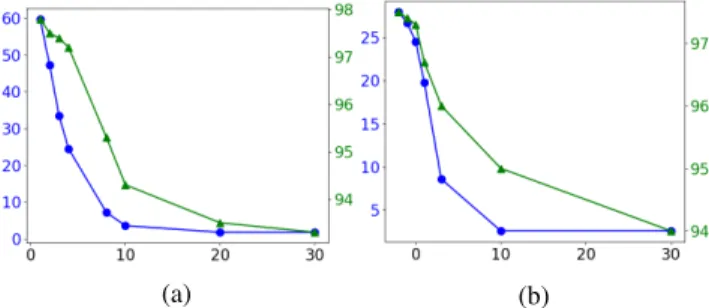
(a) (b)
Figure 3: Performance on WQSP test in terms of avg size ofU¯q
(in blue) and topic unit recall (in green) when (a)n-gram threshold ranges from 0 to 30 and PMI threshold is 1. (b)n-gram threshold is 4 and PMI threshold ranges from -2 to 30.
Configurations of Topic Unit Generation. In the topic unit generation step, we defined some thresholds, namely, n-gram threshold and PMI threshold. Figure 3 shows that with increasingn-gram and PMI thresholds, both average size of
¯
Uq and topic unit recall decrease. To obtain scalable topic units without too much decrease of topic unit recall, we set n-gram and PMI thresholds as 4 and 1, respectively.
Features for Topic Unit Scoring. Recall that in the topic unit scoring step our scoring function uses four feature vec-tors. In Table 1c we show the performance in terms of F1 on the WQSP dataset when we use the full model and when we remove each of the feature vectors. We can see that if we remove any of the feature vectors, the performance drops. In particular, the performance decreases the most when the featurefsemanticis removed, showing the importance of
mea-suring the semantic relevance of a topic unit to the question.
5
Conclusions
In this paper we propose method that uses topic units for KBQA, which allows us to leverage more information of the questions. We show that our method can achieve either the state of the art or competitive results on benchmark datasets.
Acknowledgements
This research is supported by the National Research Foun-dation, Prime Minister’s Office, Singapore under its Interna-tional Research Centres in Singapore Funding Initiative.
References
[Berantet al., 2013] Jonathan Berant, Andrew Chou, Roy Frostig, and Percy Liang. Semantic parsing on freebase from question-answer pairs. In Proceedings of EMNLP, pages 1533–1544, 2013.
[Bordeset al., 2014] Antoine Bordes, Sumit Chopra, and Ja-son Weston. Question answering with subgraph embed-dings. InProceedings of EMNLP, pages 615–620, 2014. [Bordeset al., 2015] Antoine Bordes, Nicolas Usunier,
Sumit Chopra, and Jason Weston. Large-scale simple question answering with memory networks. In arXiv preprint, 2015.
[Cai and Yates, 2013] Qingqing Cai and Alexander Yates. Large-scale semantic parsing via schema matching and lexicon extension. InProceedings of ACL, pages 423–433, 2013.
[Chen Liang, 2017] Quoc Le Kenneth D. Forbus Ni Lao Chen Liang, Jonathan Berant†. Neural symbolic ma-chines: Learning semantic parsers on freebase with weak supervision. InProceedings of ACL, pages 23–33, 2017. [Donget al., 2015] Li Dong, Furu Wei, Ming Zhou, and
Ke Xu. Question answering over freebase with multi-column convolutional neural networks. InProceedings of ACL-IJCNLP, pages 260–269, 2015.
[Donget al., 2017] Li Dong, Jonathan Mallinson, Siva Reddy, and Mirella Lapata. Learning to paraphrase for question answering. In Proceedings of EMNLP, pages 875–886, 2017.
[Haoet al., 2017] Yanchao Hao, Yuanzhe Zhang, Kang Liu, Shizhu He, Zhiyuan Liu, hua Wu, and Jun Zhao. An end-to-end model for question answering over knowledge base with cross-attention combining global knowledge. In Pro-ceedings of ACL, pages 221–231, 2017.
[Kwiatkowskiet al., 2013] Tom Kwiatkowski, Eunsol Choi, Yoav Artzi, and Luke Zettlemoyer. Scaling semantic parsers with on-th-fly ontology matching. InProceedings of EMNLP, pages 1545–1556, 2013.
[Lampleet al., 2016] Guillaume Lample, Miguel Balles-teros, Sandeep Subramanian, Kazuya Kawakami, and Chris Dyer. Neural architectures for named entity recog-nition. In Proceedings of NAACL-HLT, pages 260–270, 2016.
[Maiet al., 2018] Khai Mai, Thai-Hoang Pham, Minh Trung Nguyen, Tuan Duc Nguyen, Danushka Bollegala, Ryohei Sasano, and Satoshi Sekine. An empirical study on fine-grained named entity recognition. InProceedings of COL-ING, pages 711–722, 2018.
[Penningtonet al., 2014] Jeffrey Pennington, Richard Socher, and Christopher D. Manning. Glove: Global vectors for word representation. In Proceedings of EMNLP, pages 1532–1543, 2014.
[Petrochuk and Zettlemoyer, 2018] Michael Petrochuk and Luke Zettlemoyer. Simple questions nearly solved: a new upperbound and baseline approach. In Proceedings of EMNLP, pages 554–558, 2018.
[Seoet al., 2017] Minjoon Seo, Aniruddha Kembhavi, Ali Farhadi, and Hannaneh Hajishirzi. Bidirectional attention flow for machine comprehension. InProceedings of ICLR, 2017.
[Shenet al., 2015] Wei Shen, Jianyong Wang, and Jiawei Han. Entity linking with a knowledge base: Issues, tech-niques, and solutions.IEEE TKDE, 27(2):443–460, 2015. [Sunet al., 2018] Haitian Sun, Bhuwan Dhingra, Manzil Zaheer, Kathryn Mazaitis, Ruslan Salakhutdinov, and William W. Cohen. Open domain question answering us-ing early fusion of knowledge bases and text. In Proceed-ings of EMNLP, pages 4231–4242, 2018.
[Talmor and Berant, 2018] Alon Talmor and Jonathan Be-rant. The web as a knowledge-base for answering com-plex questions. InProceedings of NAACL, pages 641–651, 2018.
[Williams, 1992] Ronald J. Williams. Simple statistical gra-dient following algorithms for connectionist reinforcement learning.Machine Learning, pages 8:229–256, 1992. [Xuet al., 2016] Kun Xu, Siva Reddy, Yansong Feng,
Song-fang Huang, and Dongyan Zhao. Question answering on freebase via relation extraction and textual evidence. In Proceedings of ACL, pages 2326–2336, 2016.
[Yang and Chang, 2015] Yi Yang and Ming-Wei Chang. S-mart: Novel tree-based structured learning algorithms ap-plied to tweet entity linking. In Proceedings of ACL-IJCNLP, pages 504–513, 2015.
[Yao and Durme, 2014] Xuchen Yao and Benjamin Van Durme. Information extraction over structured data: Ques-tion answering with freebase. In Proceedings of ACL, pages 956–966, 2014.
[Yihet al., 2015] Wen-tau Yih, Ming-Wei Chang, Xiaodong He, and Jianfeng Gao. Semantic parsing via staged query graph generation: Question answering with knowledge base. InProceedings of ACL-IJCNLP, pages 1321–1331, 2015.
[Yihet al., 2016] Wen-tau Yih, Matthew Richardson, Christopher Meek, Ming-Wei Chang, and Jina Suh. The value of semantic parse labeling for knowledge base question answering. In Proceedings of ACL, pages 201–206, 2016.
[Yuet al., 2017] Mo Yu, Wenpeng Yin, Kazi Saidul Hasan, Cicero Nogueira dos Santos, Bing Xiang, and Bowen Zhou. Improved neural relation detection for knowledge base question answering. InProceedings of ACL, pages 571–581, 2017.
[Zhanget al., 2017] Yuyu Zhang, Hanjun Dai, Zornitsa Kozareva, Alexander J. Smola, and Le Song. Variational reasoning for question answering with knowledge graph. InProceedings of AAAI, pages 6069–6076, 2017.