comment
reviews
reports
deposited research
interactions
information
refereed research
Research
Development of an optimized interaction-mating protocol for
large-scale yeast two-hybrid analyses
Tim-Robert Soellick and Joachim F Uhrig
Address: Max-Planck-Institut für Züchtungsforschung, Carl-von-Linné-Weg, D-50829 Köln, Germany.
Correspondence: Joachim F Uhrig. E-mail: [email protected]
Abstract
Background: Protein-protein interactions have decisive roles in almost all aspects of the structural and functional organization of cells. But in spite of the increasing amount of complete genome sequence data, the ability to predict protein function from sequences alone is limited. Therefore comprehensive analysis of protein-protein interactions, as derived from the yeast two-hybrid mating system, will yield valuable information for functional biology on a proteomic scale.
Results:We have developed an optimized interaction mating protocol for the yeast two-hybrid system, which gives increased mating efficiencies. This significantly reduces the effort and cost of cDNA library screening and allows multiple parallel approaches. Improved preincubation conditions before mating, and optimal cell densities and cell ratios enable almost quantitative mating of the yeast cells carrying the cDNA library. We have proved the applicability of this technology using 20 bait proteins to screen an Arabidopsis thalianacDNA library, in spite of bait-dependent variations in mating efficiency.
Conclusions:The improved yeast two-hybrid interaction-mating protocol presented here allows the multiple parallel screening of cDNA libraries. It can be carried out without specialized equipment and has the potential to be standardized and automated.
Published: 15 November 2001
GenomeBiology2001, 2(12):research0052.1–0052.7
The electronic version of this article is the complete one and can be found online at http://genomebiology.com/2001/2/12/research/0052 © 2001 Soellick and Uhrig, licensee BioMed Central Ltd
(Print ISSN 1465-6906; Online ISSN 1465-6914)
Received: 27 June 2001 Revised: 5 October 2001 Accepted: 12 October 2001
Background
In the past few years, genome projects have produced an overwhelming amount of sequence data; however, reliable functional predictions for the encoded proteins are limited to those genes with clear homologs in the databases. As this is the case for only about half of the predicted open reading frames (ORFs), even in the genomes of Escherichia colior
Saccharomyces cerevisiae, there is an increasing need to develop broadly applicable technologies to assign functions to the encoded proteins. Apart from the systematic phenotypic characterization of knockout mutants, only a few ways of determining the function of a protein are accessible using multi-parallel or large-scale analytical techniques. Steady-state levels of transcripts, for example, can be assessed on a
whole-genome basis by expression profiling, protein levels and post-translational modifications can be quantified by two-dimensional PAGE in combination with mass spectro-graphic techniques (MALDI-TOF) and the multi-parallel analysis of metabolite accumulation can be determined by metabolic profiling [1-3]. As proteins function exclusively by means of interaction with other molecules, a particularly important characteristic of a protein is the transient or stable formation of protein complexes. The systematic and compre-hensive analysis of protein-protein interactions will provide valuable information for understanding protein functions.
currently the only one that is well-established enough to be suitable for genome-wide screenings [6,7]. In this system a ‘bait’ protein is expressed as a fusion to the Gal4 DNA-binding domain and is coexpressed in yeast with a library of cDNA fused to the activation domain of Gal4 (the ‘prey’). Alternatively, the DNA-binding moiety of the ‘bait’ protein can originate from the E. coliLexA repressor protein [8,9]. A productive interaction between the bait fusion protein and an interacting partner protein results in expression of a reporter gene. This method has been used in two large-scale projects to systematically examine interactions in all possi-ble combinations between the approximately 6,000 proteins encoded by the S. cerevisiaegenome [10,11]. The resulting large interaction networks provide information not only about possible protein complexes, signaling chains or meta-bolic pathways, suggesting functions for yet unannotated proteins [12,13], but can also be used for evolutionary studies and for identifying essential genes [14]. However, the fact that only a small number of interactions were found consistently in both projects shows that the experimental set-up has not been saturating [15]. These projects depended on the fact that all predicted ORFs of the yeast genome were directly available for PCR amplification and cloning and could be used as full-length constructs. For higher eukary-otes, the cloning of a complete ‘ORFeome’ is even more com-plicated. ORFeome projects in connection with large-scale two-hybrid approaches have recently been started [16,17]. However, at present the proteome-wide systematic analysis of all proteins of eukaryotic model organisms such as Ara-bidopsis thaliana is not possible. Therefore the use of genomic or cDNA libraries to screen for interacting partners of a protein is mandatory. Additionally, because of the inclu-sion of truncated proteins, the library approach may offer the possibility of directly assessing interacting protein domains [18,19].
Screening a cDNA library with the yeast two-hybrid system is laborious and time consuming. For large-scale and multi-parallel screenings, current protocols are limited, and approaches using arrays and automated systems are expen-sive and not affordable for most laboratories. Here we present an improved interaction-mating screening protocol with a significantly increased efficiency. The total cell numbers needed to obtain sufficient double transformants to ensure complete coverage of the library is reduced, and effort and cost are minimized.
Results and discussion
Screening a cDNA library for interacting partners using the yeast two-hybrid system requires investigation of a sufficient number of doubly transformed cells, a number dependent on the complexity of the cDNA library. As a rule of thumb, it is sensible to obtain at least five times more doubly trans-formed yeast cells than the total number of independent clones in the cDNA library being screened [20,21]. The total
number of yeast cells used is the main factor determining the culture volumes, agar plates and hands-on time required. Therefore, an efficient method of obtaining doubly-trans-formed cells is particularly important. In the experiments reported here we compared different methods and devel-oped an improved mating procedure suitable for large-scale yeast two-hybrid screening. We aimed at the development of a standardizable protocol for obtaining a minimum of 5 x 10⁶
double transformants, a number sufficient to cover the com-plexity of most cDNA libraries.
Comparison of standard protocols: double transformation versus mating
Yeast strain PJ69-4A propagating plasmid pTS195.1 was successively transformed with different amounts of vector pCL1 using a standard transformation procedure [22]. Transformation efficiencies ranged between 0.01% (0.12g DNA per 108 cells) and 0.1% (52g DNA per 108 cells,
Figure 1). Extrapolation of the data revealed saturation at approximately 0.11%.
[image:2.609.314.556.495.635.2]As a standard mating protocol we used a method from [23], suitable for yeast two-hybrid library screenings, a further development of the original interaction-mating procedure described in [24]. Mating of two haploid yeast strains of opposite mating type, each harboring one of the respective plasmids, results in the formation of doubly transformed diploid zygotes. A major advantage of this approach is the possibility of using frozen aliquots of yeast cells carrying the cDNA library; hence transformation of the whole library in every single screening experiment becomes unnecessary. Yeast strain YTS1 (MAT,) was transformed with plasmid pCL1, propagated overnight in liquid medium and frozen in
Figure 1
Successive transformation of yeast strain PJ69-4A. Yeast strain PJ69-4A was transformed with vector pTS195.1, raised in liquid selective medium lacking uracil (SD-U) and then successively transformed with plasmid pCL1. Numbers of doubly transformed cells were monitored by propagating aliquots on selective medium lacking leucine and uracil (SD-LU) and efficiency in terms of doubly transformed cells versus all cells was calculated.
0.12 0.10 0.08 0.06 0.04 0.02 0.00
0 1
Efficiency (%)
2 3
Amount of DNA (µg)
comment
reviews
reports
deposited research
interactions
information
refereed research
aliquots. A melted aliquot of YTS1/pCL1 was combined with a freshly raised culture of PJ69-4A/pTS195.1 (MATa) and then subjected to the standard mating procedure. Because the main focus of our experiments was reduction of the total cell number in our assays, we calculated mating efficiencies as the ratio of zygotes versus total cell number (viable and nonviable MAT, cells from the frozen culture plus MATa
cells). The mating efficiency of the standard method was found to be 2.8% on average. In terms of the usual way of quantifying mating (the ratio of zygotes versus viable MAT, cells) this corresponds to a value of 12.2% in accordance with values of around 10% reported in the literature [23,25,26].
Green fluorescent protein as a mating reporter for short-term monitoring of mating efficiencies
To enable short-term quantification of mating efficiencies we set up a model system using green fluorescent protein (GFP) as a reporter. Expression of the yeast-enhanced green fluo-rescent protein (yEGFP [27]) from plasmid pTS195.1 was controlled by the Gal1 promoter and was therefore dependent on the coexpression of the Gal4 protein from plasmid pCL1. Using the yeast strains YTS1 (MAT,) and PJ69-4A (MATa), transformed with pCL1 and pTS195.1, respectively, and the standard mating procedure for producing doubly trans-formed zygotes, GFP fluorescence was detectable in dumb-bell-shaped and in budding three-part zygotes as early as 4 hours after setting up the mating mixture (Figure 2). Both the fluorescence of a mating mixture measured in a fluorescence reader and the number of fluorescent zygotes counted in a hemocytometer were found to be linearly correlated with the
actual mating efficiency as determined by growth selection of zygotes. This system was thus suitable for quickly assess-ing matassess-ing efficiencies and was used thereafter to evaluate experimental conditions.
Optimizing mating conditions
Apart from mating on filters, as in the standard mating pro-cedure [23,28], other approaches have been described to yield optimal mating efficiencies and/or the maximum number of zygotes. These protocols aim at synchronizing the yeast cultures to maximize mating ability and/or enriching zygotes in the suspension by chemically induced cell arrest and zonal centrifugation [29,30]. Additionally, preincuba-tion on specific media before mating has been shown to increase the mating competence of yeast cells [31-35]. We tested the applicability of these procedures to our frozen/thawed yeast cultures, as the use of frozen cells is one major benefit of the interaction-mating procedure with respect to library screening. GFP fluorescence in the result-ing cell suspension was measured as a marker for zygote for-mation and improvements were confirmed by counting cells and propagating aliquots on SD-LU medium to calculated the exact mating efficiency.
Neither enrichment of mating-competent cells by zonal cen-trifugation nor the use of chemically synchronized cells signifi-cantly improved mating efficiencies in our experimental set-up. However, preincubation of the two yeast strains in low pH medium before mating turned out to significantly increase mating efficiency. Preincubation of a mixture of a mid-log-phase culture of PJ69-4A/pTS195.1 and a melted aliquot of YTS1/pCL1 at high cell density (108cells/ml) in YCM medium
(pH 3.5) for 105 minutes, a subsequent washing step and incu-bation on a filter on agar plates (YCM, pH 4.5) for another 4.5 hours gave an average mating rate of 10%.
Optimizing the cell ratio between the two yeast strains
An optimal cell ratio of freshly grown MATaversus MAT,
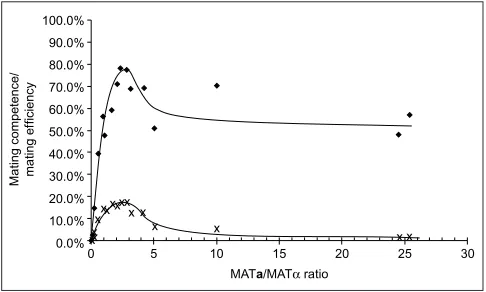
[image:3.609.54.298.448.665.2]cells of 1:1 has been reported for most mating protocols [32,36]. Because of freezing and thawing, however, the inter-action-mating mixture is a heterogeneous cell suspension composed of viable and nonviable cells. Therefore, non-equivalent quantities of the two strains have been suggested to optimize mating [26]. On the basis of the improved mating protocol described above, we systematically investi-gated the effects of cell ratio on mating efficiency. Varying amounts of freshly raised PJ69-4A/pTS195.1 cells from 0.1-to 25-fold excess over YTS1/pCL1 cells were tested. The ratio between the yeast strains (MATa:MAT, ratio) was calcu-lated as the number of uracil prototrophic cells versus leucine prototrophic cells, thus representing the proportion of viable cells in the assay. Mating efficiency was assessed by the numbers of zygotes versus total cell number (including nonviable cells). Mating efficiencies were found to be strongly dependent on the MATa:MAT,ratio, showing an
Figure 2
optimum at a ratio of 2.5:1, leading to a maximum mating efficiency of 17% (Figure 3). As a measure of mating compe-tence of the frozen/thawed YTS1/pCL1 cells we calculated the ratio of zygotes versus viable leucine prototrophic cells. For optimal MATa:MAT, ratio of 2.5:1, up to 80% of the viable MAT, cells have formed zygotes (Figure 3). This almost quantitative mating is of particular importance for the screening of cDNA libraries, where a complete coverage of the clones present in the library is necessary to ensure a nonbiased experimental set-up. Table 1 summarizes the results with respect to the number of cells needed to obtain 5 x 10⁶double transformants.
Application of the optimized protocol to screening cDNA libraries
The mating conditions found to be optimal for the model system were applied to the screening of a ‘real’ two-hybrid cDNA library of A. thalianausing a set of ‘real’ bait proteins. The cDNA library (> 106 independent clones) was
trans-formed into Y187 (MAT,), colonies were propagated, pooled and stored at -70°C. The fraction of viable cells in melted aliquots was determined as 39%.
Twenty library screenings have been carried out using 15 pro-teins from A. thaliana and five proteins from Nicotiana tabacum as baits. The bait proteins included small Ras-like GTPases, kinases and several proteins of unknown function. The efficiency of the optimized mating protocol made it possi-ble to set up a standard screening protocol with the potential to cover the expected bait-dependent variation in mating effi-ciencies. We used a mating mixture containing 6 x 10⁸cells in
total, composed of 50% bait cells, 20% viable library cells and 30% nonviable cells, corresponding to a MATa:MAT,
ratio of 2.5:1. Aliquots of the mated cells were propagated onto selective medium to determine mating efficiencies, and 108 cells were plated onto a single 500 cm2 agar plate to
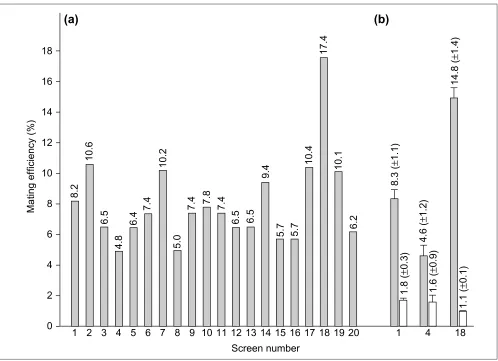
select for interacting clones promoting Leu/Trp/His pro-totrophic growth. The protocol allowed us to process up to 20 screenings in parallel with standard laboratory equip-ment. Mating efficiencies were bait dependent and ranged between 4.8% and 17.3%, indicating a general applicability of the method (Figure 4a). In only one case was our aim of 5 x 10⁶zygotes (corresponding to a mating efficiency of 5%,
see above) not achieved. A direct comparison of the effi-ciency of the optimized protocol versus the standard proto-col was done by repeating screenings 1, 4 and 18 using both protocols in parallel. Mating efficiencies using the optimized protocol were found to be greater by factors of 5, 3 and 13, respectively (Figure 4b).
The mean mating efficiency of about 8% in these 20 experi-ments is somewhat lower than the optimal mating efficien-cies using the model system, but is clearly sufficient to be used in the standardized screening protocol described, obviating the need to adjust conditions to every individual bait protein.
The improved pretreatment and mating conditions prepare the cells optimally for mating, as can be seen by the fact that the experiment with the most efficient bait protein (Figure 4a, screen 18) resulted in almost quantitative mating; more than 85% of the viable library cells have formed zygotes.
Conclusions
[image:4.609.314.555.117.251.2]The main factor that determines the amount of material, costs and effort required to perform a yeast two-hybrid cDNA screening is the total number of yeast cells needed to
Figure 3
Mating efficiency and mating competence is dependent on the ratio of the two yeast strains. Melted aliquots of YTS1/pCL1 were combined with varying numbers of freshly raised PJ69-4A/pTS195.1 cells and treated according to the protocol with preincubation at low pH and high cell density. Consistency of the final cell suspension was determined by propagating aliquots onto selective medium and counting cell numbers in a hemocytometer. Filled diamonds, mating competence, estimated as the percentage of zygotes per viable MAT,cells. crosses, mating efficiency, estimated as the percentage of zygotes per total cell number.
100.0%
90.0% 80.0%
70.0%
60.0%
50.0% 40.0%
30.0%
20.0% 10.0%
0.0%
0 5 10
Ma
ting competence/
ma
ting ef
ficiency
15 MATa/MATα ratio
[image:4.609.56.299.465.611.2]20 25 30
Table 1
Summary of the different protocols
Method Efficiency (%) Total cell number required for 5 x 10⁶doubly
transformed cells or zygotes Successive double 0.11 4.5 x 10⁹
transformation
Mating of yeast strains 2.8 1.8 x 10⁸
Mating using low pH media 10 5.0 x 10⁷
and high cell density
Enhanced mating using 17 2.9 x 10⁷
optimized bait:prey ratio
The efficiency of obtaining doubly transformed cells or zygotes, and the total cell number needed to gain 5 x 10⁶doubly transformed cells or
obtain a sufficient number of double transformants express-ing the respective fusion proteins. We have developed an optimized interaction-mating protocol with significantly increased mating efficiency which, because of the substan-tially reduced cell numbers, is applicable for large-scale two-hybrid screening. The protocol enabled us to set up a standardized screening procedure suitable for a wide variety of baits. This standard protocol is suitable for multi-parallel yeast two-hybrid screenings without the need for specialized
laboratory equipment and at relatively low cost and effort. The method also offers the possibility of further develop-ment. The reduced volume enables the replacement of growth selection on agar plates in a two-hybrid screen by selection in liquid in standard microtiter plates (J.F. Uhrig, unpublished results). This could be the basis for automating this screening procedure to facilitate the high-throughput applications needed to analyze genome-wide protein inter-action networks of higher eukaryotes.
comment
reviews
reports
deposited research
interactions
information
[image:5.609.56.554.84.445.2]refereed research
Figure 4
The optimized interaction-mating protocol for screening a cDNA library of A. thaliana. (a)Multi-parallel yeast two-hybrid screens were carried out using the optimized method with yeast cells preincubated at low pH and high cell density. Mating efficiency in terms of numbers of zygotes versus total cell number was determined for every single screening by propagating aliquots of the mating mixture on SD-LW medium and counting cells in a hemocytometer. (b)Comparison of library screenings using the optimized protocol (grey columns) or the standard protocol (white columns), respectively. Mean values of three parallel experiments are shown. The bait proteins were (followed by GenBank accession numbers): (1) Rho-like GTP-binding protein (G15V), AAC78242; (2) Rho-like GTP-binding protein (T20N), AAC78242; (3) Rac-like protein (G60V), AAB68394; (4) Rac-like protein (T65N), AAB68394; (5) Rac GTP-binding protein Arac10, AAC63014; (6) putative
serine/threonine protein kinase, AAF27020; (7) putative protein kinase, AAD29828; (8) Pto kinase interactor-like protein, CAB89391; (9) receptor protein kinase, BAB01743; (10) nonphototropic hypocotyl 1-like, AAC27293; (11) nonphototropic hypocotyl 1, AAC01753; (12) N. tabacum nonphototropic hypocotyl 1-like_1a, unpublished; (13) N. tabacum nonphototropic hypocotyl 1-like_1b, unpublished; (14) N. tabacum nonphototropic hypocotyl 1-like_2, unpublished; (15) FH protein
interacting protein FIP2, AAF14550; (16) N. tabacum FH protein interacting protein FIP2, unpublished; (17) N. tabacum jacalin-like protein, unpublished; (18) unknown protein, AAF13095; (19) unknown protein, BAA96996; (20) putative LEA (late embryogenesis abundant) protein, AAC23428. If not otherwise specified, proteins originate from A. thaliana.
18
16
14
12
10
8
6
4
2
1 2 3 4 5 6 7 8 9 10 11 12 13 14
Screen number
Ma
ting ef
ficiency (%)
15 16 17 18 19 20
1
4
18
0
8.2
10.6
6.5
4.8
6.4
7.4
10.2
5.0
7.4
7.4
6.5
6.5
9.4
5.7
5.7
10.4
17.4
10.1
6.2
8.3 (
±
1.1)
1.8 (
±
0.3)
4.6 (
±
1.2)
1.6 (
±
0.9)
14.8 (
±
1.4)
1.1 (
±
0.1)
7.8
Materials and methods
Yeast strains, plasmids and medium
Yeast strains PJ69-4A [37] and Y187 [38] were maintained using standard conditions [39]. A MAT, strain which is deleted in the URA3gene was obtained by streaking out an overnight culture of Y187 onto YPAD medium containing 0.05% 5-fluoroorotic acid (TRC, Canada). Several colonies were picked and examined for uracil auxotrophy while main-taining the other markers of yeast strain Y187. The resulting yeast strain with the desired genomic markers was called YTS1 (MAT,, ura3-52, his3-200, ade2-101, trp1-901, leu2-3, 112, gal4, met-, gal80). Plasmid pCL1 [4] encodes the
full-length, wild-type Gal4 protein under control of the ADH promotor and was obtained from Clontech. Vector pTS195.1 provides the yeast-enhanced green fluorescent protein (yEGFP [27], GenBank accession number U73901) under control of the GAL1 promotor and was cloned as follows: yEGFP was amplified by PCR using primers YGFP-1 (5? -GAGAGAAAGCTTGGATCCATGTCTAAAGGTGAAGAAT-TATTC-3?) and YGFP-1 reverse (5? -GAGAGACTCGAGAA-TTCTTATTTGTACAATTCATCCATAC-3?) and cloned as a
HindIII/XhoI fragment into vector pCUG1, a derivative of pRS316 (GenBank U03442) containing an EcoRI/HindIII fragment from pBM272 (GenBank U03497) carrying the
GAL1/GAL10promoter. Plasmid pCUG1 is a gift from Philip James (University of Wisconsin, Madison, USA). The con-struct pCUG1-yEGFP was cut with KpnI and XbaI and the fragment containing the GAL1/GAL10promoter and yEGFP
was ligated into the same sites of plasmid YEplac195 ([40]; GenBank X75459) to obtain pTS195.1. Yeast full media and selective drop-out media were prepared using standard recipes [39].
Successive double transformation
Transformation of plasmid or library DNA into yeast was done according to the LiAc transformation method [22,41].
Standard mating procedure
Yeast strain YTS1 transformed with pCL1 was raised in liquid medium lacking leucine (SD-L medium) and was frozen in aliquots as a 25% glycerol stock at -70°C. For mating, a melted aliquot of approximately 7 x 10⁷cells was
pooled with a threefold excess of a freshly raised culture of PJ69-4A propagating pTS195.1. This mixture was distrib-uted onto a YPAD plate (140 mm diameter) and set on 30°C for 4.5 h. Cells were washed off the plate with 1 M sorbitol, sonicated, counted in a hemocytometer (Fuchs-Rosenthal-chamber) and titrated onto the appropriate drop-out media.
Analysis of GFP fluorescence
GFP fluorescence was investigated by fluorescence microscopy using fluorescein isothiocyanate (FITC) filters (485/510 nm, excitation/emission) and by fluorescence measurements in microtiter plates (Dynatech Microfluor) using a Fluoroscan II fluorescence reader (Labsystems Oy, Helsinki, Finland; excitation 485 nm, half-width 14 nm,
transmission > 50%; emission 510 nm, half-width 11 nm, transmission 40%).
Mating after preincubation at low pH and high cell density
This protocol focused on stimulation of a/,-factor expres-sion and optimized cell-cell contact during mating. The two yeast strains were mixed in the desired cell ratios, resus-pended in YCM (1% yeast extract, 1% bactopeptone, 2% dex-trose) at pH 3.5 and a cell density of 108cells/ml and shaken
for 105 min at 30°C. The cells were then diluted 1:100 in sterile water and cell clumps were resolved by sonification. The cells were then treated as follows.
Model system YTS1/pCL1 and PJ69-4A/pTS195.1
Diluted cells (45 ml) were spotted onto a 25 mm membrane filter (0.452m; Sartorius/PALL Gelman Lab) using a filter funnel with an effective filtration area of 2.5 cm2, resulting
in a cell density of 1.8 x 10⁷cells/cm2. The membrane was
transferred to an agar plate (YCM, pH 4.5) and incubated for 4.5 h at 30°C. The filters were placed in a 50 ml Falcon tube, superposed with 1 M sorbitol and cells were dispersed by 3-4 short intervals of sonification. Cells were collected by cen-trifugation, resuspended in an appropriate volume and aliquots were then propagated on selective medium.
Library screening
236 ml of the diluted mixture of the two strains (correspond-ing to 2.36 x 10⁸cells, see above) were transferred onto a
47 mm membrane filter (0.45 µm; PALL Gelman Lab.) using a 500 ml filter funnel (PALL Gelman Lab.; effective filtration area: 13.1 cm2) and incubated for 4.5 h at 30°C on YCM
(pH 4.5) solid medium. After cells had been collected and resolved by sonification, the cell titer was determined. 108cells were spread onto one 500 cm2plate (Genetix) with
selective media lacking leucine, tryptophan and histidine and supplemented with 3 mM 3-AT (SD-LWH3 medium) and incubated up to 7 days at 30°C.
Preservation of a Gal4 activation domain fused library in yeast strain Y187
For screening cDNA libraries, yeast strain Y187 was trans-formed with the activation domain fused cDNA library from
A. thaliana in plasmid pACT2 [42], plated onto SD-L medium and incubated for 2-3 days. Colonies were collected from the plates using 1 M sorbitol, pooled, sonicated and stored in aliquots after addition of 1 vol 50% glycerol. A thawed aliquot was propagated on SD-L medium and cells counted in a hemocytometer to determine the survival rate of leucine prototrophic cells.
Acknowledgements
Baltimore, USA) donated the gene for yEGFP. Plasmid pCUG1 was obtained from Philip James (University of Wisconsin, Madison, USA) and the Gal4 activation domain fused cDNA library of A. thaliana is a gift from Klaus Salchert and Csaba Koncz (MPI Cologne, Germany). The yeast two-hybrid screen using LEA as a bait (screen number 20) was carried out by Ilona Zimmermann during her PhD studies in our lab. This work was sup-ported by the Bundesministerium für Wirtschaft und Technologie (BMWi).
References
1. Trethewey RN: Gene discovery via metabolic profiling.Curr Opin Biotechnol 2001, 12:135-138.
2. Pandey A, Mann M: Proteomics to study genes and genomes. Nature 2000, 405:837-846.
3. Celis JE, Kruhoffer M, Gromova I, Frederiksen C, Ostergaard M, Thykjaer T, Gromov P, Yu J, Palsdottir H, Magnusson N, et al.: Gene expression profiling: monitoring transcription and transla-tion products using DNA microarrays and proteomics.FEBS Lett 2000, 480:2-16.
4. Fields S, Song O: A novel genetic system to detect protein-protein interactions.Nature 1989, 340:245-246.
5. Bartel PL, Fields S: Analyzing protein-protein interactions using two-hybrid system.Methods Enzymol 1995, 254:241-263. 6. Legrain P, Selig L: Genome-wide protein interaction maps
using two-hybrid systems.FEBS Lett 2000, 480:32-36.
7. Uetz P, Hughes RE: Systematic and large-scale two-hybrid screens.Curr Opin Microbiol 2000, 3:303-308.
8. Fashena SJ, Serebriiskii IG, Golemis EA: LexA-based two-hybrid systems.Methods Enzymol 2000, 328:14-26.
9. Gyuris J, Golemis E, Chertkov H, Brent R: Cdi1, a human G1 and S phase protein phosphatase that associates with Cdk2.Cell 1993, 75:791-803.
10. Ito T, Tashiro K, Muta S, Ozawa R, Chiba T, Nishizawa M, Yamamoto K, Kuhara S, Sakaki Y: Toward a protein-protein interaction map of the budding yeast: A comprehensive system to examine two-hybrid interactions in all possible combinations between the yeast proteins.Proc Natl Acad Sci USA 2000, 97:1143-1147.
11. Uetz P, Giot L, Cagney G, Mansfield TA, Judson RS, Knight JR, Lock-shon D, Narayan V, Srinivasan M, Pochart P, et al.: A comprehen-sive analysis of protein-protein interactions in Saccharomyces
cerevisiae.Nature 2000, 403:623-627.
12. Schwikowski B, Uetz P, Fields S: A network of protein-protein interactions in yeast.Nat Biotechnol 2000, 18:1257-1261. 13. Ito T, Chiba T, Ozawa R, Yoshida M, Hattori M, Sakaki Y: A
com-prehensive two-hybrid analysis to explore the yeast protein interactome.Proc Natl Acad Sci USA 2001, 98:4569-4574. 14. Hasty J, Collins JJ: Protein interactions: unspinning the web.
Nature 2001, 411:30-31.
15. Hazbun TR, Fields S: Networking proteins in yeast.Proc Natl Acad Sci USA 2001, 98:4277-4278.
16. Walhout AJ, Temple GF, Brasch MA, Hartley JL, Lorson MA, van den Heuvel S, Vidal M: GATEWAY recombinational cloning: appli-cation to the cloning of large numbers of open reading frames or ORFeomes.Methods Enzymol2000, 328:575-592. 17. Walhout AJ, Sordella R, Lu X, Hartley JL, Temple GF, Brasch MA,
Thierry-Mieg N, Vidal M: Protein interaction mapping in C.
elegansusing proteins involved in vulval development.Science
2000, 287:116-122.
18. Flajolet M, Rotondo G, Daviet L, Bergametti F, Inchauspe G, Tiollais P, Transy C, Legrain P: A genomic approach of the hepatitis C virus generates a protein interaction map. Gene 2000,
242:369-379.
19. Rain JC, Selig L, De Reuse H, Battaglia V, Reverdy C, Simon S, Lenzen G, Petel F, Wojcik J, Schachter V, et al.: The protein-protein interaction map of Helicobacter pylori. Nature 2001,
409:211-215.
20. Moore DD: Overview of recombinant DNA libraries. In Current Protocols in Molecular Biology.Edited by Ausubel FM, Brent R, Kingston RE, Moore DD, Seidman JG, Smith JA, Struhl K. New York: John Wiley & Sons; 1993, 5.1.1-5.1.3.
21. Sambrook J, Russel D: Molecular Cloning: A Laboratory Manual.Cold Spring Harbor, New York: Cold Spring Harbor Laboratory; 2000. 22. Gietz RD, Schiestl RH: Transforming yeast with DNA.Methods
Mol Cell Biol 1995, 5:255-269.
23. Fromont-Racine M, Rain JC, Legrain P: Toward a functional analysis of the yeast genome through exhaustive two-hybrid screens.Nat Genet 1997, 16:277-282.
24. Finley RL Jr, Brent R: Interaction mating reveals binary and ternary connections between Drosophila cell cycle regula-tors.Proc Natl Acad Sci USA 1994, 91:12980-12984.
25. Performing a hunt by interaction mating
[http://cmmg.biosci.wayne.edu/finlab/Matinghunt.htm]
26. Kolonin MG, Zhong J, Finley RL: Interaction mating methods in two-hybrid systems.Methods Enzymol 2000, 328:26-46.
27. Cormack BP, Bertram G, Egerton M, Gow NA, Falkow S, Brown AJ:
Yeast-enhanced green fluorescent protein (yEGFP) - a reporter of gene expression in Candida albicans. Microbiology 1997, 143:303-311.
28. Reid BJ, Hartwell LH: Regulation of mating in the cell cycle of
Saccharomyces cerevisiae.J Cell Biol 1977, 75:355-365.
29. Halvorson HO, Carter BLA, Tauro P: Use of synchronous cul-tures of yeast to study gene position.Methods Enzymol 1971,
21:462-470.
30. Sena EP, Radin DN, Welch J, Fogel S: Synchronous mating in yeasts.Methods Cell Biol 1975, 11:71-88.
31. Rogers D, Bussey H: Fidelity of conjugation in Saccharomyces
cerevisiae.Mol Gen Genet 1978, 162:173-182.
32. Bilinski T, Litwinska J, Zuk J, Gajewski W: Synchronization of zygote production in Saccharomyces cerevisiae.J Gen Microbiol 1973, 79:285-292.
33. Sena EP, Radin DN, Fogel S: Synchronous mating in yeast.Proc Natl Acad Sci USA 1973, 70:1373-1377.
34. Mitchison JM, Vincent WS: Preparation of synchronous cell cul-tures by sedimentation.Nature 1965, 205:987-989.
35. Bedard DP, Li AW, Singer RA, Johnston GC: Mating ability during chemically induced G1 arrest of cells of the yeast
Saccha-romyces cerevisiae.J Bacteriol 1984, 160:1196-1198.
36. Sprague GF Jr: Assay of yeast mating reaction.Methods Enzymol 1991, 194:77-93.
37. James P, Halladay J, Craig EA: Genomic libraries and a host strain designed for highly efficient two-hybrid selection in yeast.Genetics 1996, 144:1425-1436.
38. Harper JW, Adami GR, Wei N, Keyomarsi K, Elledge SJ: The p21 Cdk-interacting protein Cip1 is a potent inhibitor of G1 cyclin-dependent kinases.Cell 1993, 75:805-816.
39. Ausubel FM, Brent R, Kingston RE, Moore DD, Seidman JG, Smith JA, Struhl K (Eds): Current Protocols in Molecular Biology.New York: John Wiley & Sons; 1993.
40. Gietz RD, Sugino A: New yeast-Escherichia colishuttle vectors constructed with in vitro mutagenized yeast genes lacking six-base pair restriction sites.Gene 1988, 74:527-534.
41. The LiAc TRAFO Method Page [http://www.umanitoba.ca/ academic/faculties/medicine/biochem/gietz/method.html]
42. Nemeth K, Salchert K, Putnoky P, Bhalerao R, Koncz-Kalman Z, Stankovic-Stangeland B, Bako L, Mathur J, Okresz L, Stabel S, et al.:
Pleiotropic control of glucose and hormone responses by PRL1, a nuclear WD protein, in Arabidopsis.Genes Dev 1998,
12:3059-3073.
comment
reviews
reports
deposited research
interactions
information