U.S.
Dep.rtmeat of JPdiee
National Institute of
Justice
Technology
Assessment
Program
NIJ Standard-0319.00
Metallic Window Foil
for Intrusion
Alarm
Systems
Technology Assessment
Program
NIJ
Standard
for
Metallic Window Foil
for Intrusion Alarm Systems
A Voluntary National Standard Promulgated
by
the
National Institute of Justice.
AUGUST
1980
U.S. DEPARTMENT
OF
JUSTICE
-. -. - . ... - .
US. DEPARTMENT
OF
JUSTICE
Nattonol
Institute
of
JusticeACKNOWLEDGMENTS
Thia rundud ram formulated by the b w Enforwment Stmduds L b o n m v or the National Buruu o f Stmbrds under the direction of J m b
I. Dumood and L a w r e n o t K. E l i a ~ n . aucccrsivt Chiefa of USL. Tecbniul m r c h w u parformed by Gcrud N. Stenbakken of the NBS Elstroeyetems Diviaion.
NIJ STANDARD
FOR
METALLIC WINDOW FOIL FOR
INTRUSION ALARM SYSTEMS
CONTENTS
Foreword
...
...
1
.
Putpose and Scope...
.
2 Classification 3.
Definitions...
...
.
4 Requirements 4.1 Electrical Resistance...
;...
4.2 Foil Breakage...
...
.
5 Test Methods...
5.1 Teat Sample 5.2 Test Equipment...
...
5.3 Electrical Resistana
Test.
Following a Congressional mandate* to develop new and improved techniques, systems, and equipment to
strengthen law enforcement and criminal justice. the National Institute of Law Enforcement and Criminal ~ u s t i k , now
the National Institute of Justice (NU), established the Law Enforcement Standards Laboratory (LESL) at the National Bureau of Standards. LESL's function is to conduct research that will assist law enforcement and criminal justice agencies in the selection and procurement of quality equipment.
In response to priorities established by
NU.
LESL is: (1) Subjecting existing equipment to laboratory testingand evaluation and (2) conducting research leading to the development of several series of documents, including
national voluntary equipment standards, user guides, and technical reports.
This document, NU-STD-0319.00, Metallic Window Foil for Intrusion Alarm Systems, is a law enforcement equipment standard developed by LESL and approved and issued by NIJ. Additional standards as well as other documents are being issued under the LESL program in the areas of protective equipment, communications equipment, security systems, weapons, emergency equipment, investigative aids, vehicles and clothing.
This equipment standard is a technical document consisting of performance and other requirements together with a description of test methods. Equipment which can meet these requirements is of superior quality and is suited to the needs of law enforcement agencies. Purchasers can use the test methods described in this standard to determine firsthand whether a particular equipment item meets the requirements of the standard, or they may have the tests conducted on their behalf by a qualified testing laboratory. Law enforcement personnel may also reference this standard in purchase documents and requue that any equipment offered for purchase meet its requirements and that this compliance be either guaranteed by the vendor or attested to by an independent testing laboratory.
The necessarily technical nature of this
N U
standard, and its special focus as a procurement aid, make it oflimited use to those who seek general guidance concerning metallic window foil for intrusion alarm systems. The User
Guide Series is designed to fill that need. We plan to issue guides to various items of law enforcement equipment as
soon as possible, within the constraints of available funding and the overall
N U
program.The user guides being issued are highly readable and tutorial in nature in contrast to the standards, which are
highly technical and intended for laboratory use by technical personnel. The guides provide, in non-technical
language, information for purchasing agents and other interested persons concerning the capabilities of equipment
currently available. They may then select equipment appropriate to the performance required by their agency.
NU standards are subjected to continuing review..
*
Technical comments and recommended revisions are invitedfrom all interested parties. Suggestions should be addressed to the Program Manager for Standards, National Institute
of Justice, U.S. Department of Justice, Washington, DC 20531.
Lester D. Shubin
Program Manager for Standards National Institute of Justice
'Section 402(b) of the Omnibus Crime Control and Safe Streets Act o f 1968. as amended.
"Prior to citing this standard. or any other NU equipment standard. in a contract document the user should verify that the most recent edition i s
NIJ STANDARD
FOR
METALLIC WINDOW
FOIL FOR
INTRUSION ALARM
SYSTEMS
1.
PURPOSE AND SCOPE
'The purpose of this standard is to establish performance requirements and methods of test for metallic window foil used in intrusion alarm systems as a sensor to detect the breakage of glass. This standard applies only to metallic foil for use o n glazing materials consisting solely of glass.
2. CLASSIFICATION
Metallic window foils covered by this standard are classified into two types.
2.1 Type
I
Metallic window foil that is pre-coated with adhesive.
2.2
TypeII
Metallic window foil that is not precoated with adhesive.
3.
DEFINITIONS
None
4.
REQUIREMENTS
4.1 Electrical Resistance
When tested in accordance with paragraph 5.3, the resistance of a 10-meter (33-foot) length of metallic window foil shall not exceed 12.5 ohms.
4.2
Foil Breakage
When metallic window foil is tested in accordance with paragraph 5.4, a minimum of 1 7 of 2 0 test specimens shall exhibit an open circuit resistance equal to o r greater than 100 k R after the test panels have been broken.
5.
TEST METHODS
5.1
Test Sample
T h e test sample shall consist of a t least 15 m (50 ft) of metallic window foil.
5.2
Test Equipment
5.2.1 Glass Panels
between 0.520 and 0.545 cm (0.205 and 0.215 in) as determined by measurements near the edge of the panel at the approximate midpoint of each of the four sides.
5.22 Glass Cutter
The glass cutter shall make a cut mark that shows no chipping of the glass surface.
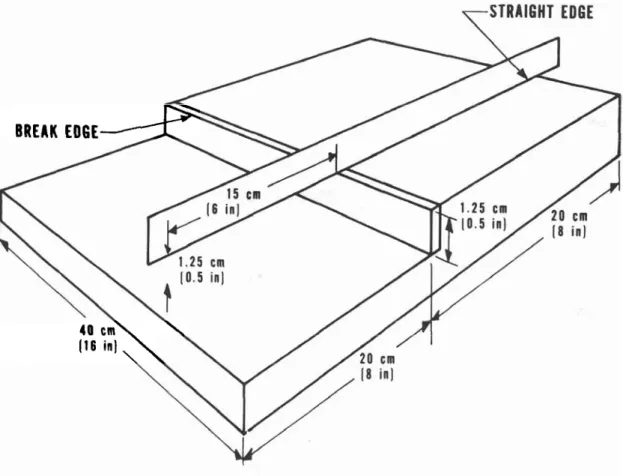
The break fixture, shown in figure 1, shall consist of two flat platforms, each approximately 20 by 40 cm (8 by
16 in), mounted on a common base approximately
44
by 40 cm (16 by 16 in) square. One platform shall be1.25-10.05 cm (0.53~ 0.02 in) higher than the other. The inside end of the higher platform shall be made of metal,
such as aluminum or steel. The top edge of the metal end, which shall be square and not rounded, forms the break
edge of the fixture. The remaining parts of the fixture can be made of any convenient material such as wood, metal,
plastic, etc. The surfaces of the two levels of the break fixture shall be sufficiently parallel that a straight edge placed
anywhere on the upper surface, perpendicular to and extending beyond the break edge, as ahown in figure 1, shall be
1.25f 0.05 cm (0.50f 0.02 in) above the lower surface at a distance of 15 cm (6 in) from the break edge.
FIGURE 1. Break fixture.
5.2.4 Ohmmeter
The ohmmeter or ohmmeters shall measure resistances between 10 and 15 R and between 100
kR
and 1.0M n
with a maximum uncertainty of *6 percent.
5.2.5 Adhesive
The varnish or other adhesive used to adhere type I1 metallic window foil to the test panels shall comply with
5.3
Electrical Resistance TestUse the ohmmeter to measure the resistance of a 10-m (33-ft) length of metallic foil. In making this test, be sure
that the test probes of the ohmmeter are in good electrical contact with the metallic foil and that adhesive or any
protective coatings do not interfere with the measurement. . I .
.
5.4
Foil
Breakage Test - ..,- . . . , , .5.4.1 Sample Preparation
.,.. L ...
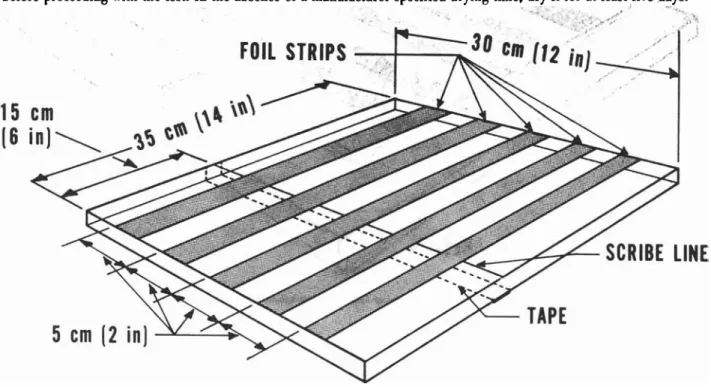
Use the glass cutter to scribe a cut line across the 30cm (12-in) width of each glass test to'be used.
Normally, eight panels should be prepared for each sample of metallic foil that is to be evaluated. The scribe line
should be distinct, continuous, and show no evidence of chipping of the glass surface. The scribe line should be parallel to and 1 5 . 0 f 0.2 cm (6.0k0.1 in) from one end of the glass test panel, as shown in figure 2.
Thoroughly clean both sides of each scribed glass panel with a mild soap solution and completely rinse it with
clean water. Then clean each panel with methanol applied with a lint-free cloth and dry it with another lint-free cloth. *
-
Use caution throughout the cleaning process to prevent oil from fingers or other sources from getting onto the glass. Apply a 30-cm (12-in) I'ength of 2 c m (3/4in) wide cellulose acetate pressure-sensitive adhesive tape to the
bottom of each glass test panel directly beneath end centered on the scribe line as shown in figure 2. The tape will
keep the two parts of the test panel from moving after the glass has been broken.
Follow the manufacturer's instructions and apply five strips of metallic foil on 5 c m (2-in) centers perpendicular to the scribe line and on the same side of the glass test panel. Apply metallic foil to the remaining test panels in the same manner. Store the test panels in the laboratory for the period of drying time recommended by the manufacturer
before proceeding with the teat. In the absence of a manufacturer-specified drying time, dry it for at least five days.
FIGURE 2. Position of tape and foil strips on glass panel.
5.4.2 Breaking Procedure
Breaking plate glass can be dangerous, so proper eye and hand protection should be worn during the breaking operation. Place one of the prepared test panels on the top level of the break fixture, foil side up, with the 15-cm (6- in) side of the test panel extending out from the break edge, as shown in figure 3. Position the test panel so that the scribe line is directly above and aligned with the break edge. Hold the supported portion of the glass panel against
r
SCRIBE LIME
. - -20
ern
b
l8
-7/
B R E M
FIXTURE
P C
FIGURE 3. Position of glass plate on k a k fixtun.
-
FOll
GLASS
PLATE
~ U R E 4. Position of hands during braking of glass.
glass panel with the other hand. placed as at area B of %ure 4. This action should result in s
An
bruk .Iong the scribe line. Remove your hands from the test panel carefully so that the two pans of the glass panel do not move further.Check that the two parts are in the proper position; ir.. with no hand p r m u r e on the glass pnel. h e fMlly s u ~ p o n e d pan should rest flat on the upper platform and the other pan should be supponed by the tape at the break cdge of the fixture and along the opposite edge by the lower platform of the fixture.
Examine the gh.9 test panel to be s u n there is a good clean b r u k across at h ta portion of the p e l . Then
should be only a single break line and it should follow the original scribe line. Only t h w foil strips that cross a good
clan break should be tested electrically.
Thus,
fewer than five foil atrips may be evaluated for each test p e l that is broken.Use m ohmmeter meeting the requiremento of paragraph 5.2.4 to measure the electrical resistance of each foil
strip across the break, making contrct with the test probes at points within 1 cm (0.5 in) of a c h end of the test atrip.
Continue to evaluate individual foil stripe until at least 20 have been tested. If all of the foil strips on
each
glasstest panel cross a clean break, a total of four gLss test p.nele should be broken and the resistance of each strip
measured. If some strips do not crolur a clean break, bruk additional panela until