Model Reduction and Simulation of Nonlinear
Circuits via Tensor Decomposition
Haotian Liu,
Student Member, IEEE,
Luca Daniel,
Member, IEEE,
and Ngai Wong,
Member, IEEE
Abstract—Model order reduction of nonlinear circuits (espe-cially highly nonlinear circuits), has always been a theoretically and numerically challenging task. In this paper we utilize tensors (namely, a higher order generalization of matrices) to develop a tensor-based nonlinear model order reduction (TNMOR) algo-rithm for the efficient simulation of nonlinear circuits. Unlike existing nonlinear model order reduction methods, in TNMOR high-order nonlinearities are captured using tensors, followed by decomposition and reduction to a compact tensor-based reduced-order model. Therefore, TNMOR completely avoids the dense reduced-order system matrices, which in turn allows faster simulation and a smaller memory requirement if relatively low-rank approximations of these tensors exist. Numerical experi-ments on transient and periodic steady-state analyses confirm the superior accuracy and efficiency of TNMOR, particularly in highly nonlinear scenarios.
Keywords—Tensor, nonlinear model order reduction, reduced-order model
I. INTRODUCTION
T
HE complexity and reliability of modern VLSI chips rely heavily on the effective simulation and verification of circuits during the design phase. In particular, mixed-signal and radio-frequency (RF) modules are critical and often hard to analyze due to their intrinsic nonlinearities and their large problem sizes. Consequently, nonlinear model order reduction becomes necessary in the electronic design automation flow. The goal of nonlinear model order reduction is to find a reduced-order model that simulates fast and yet still captures the input-output behavior of the original system accurately.Compared to the mature model order reduction methods in linear time-invariant systems [1]–[4], nonlinear model order reduction is much more challenging. Several projection-based methods have been developed in the last decade. In [5], [6], the nonlinear system is expanded into a series of cascaded linear subsystems, whereby the outputs from the low-order subsystems serve as inputs to the higher-order ones. Then, existing projection-based linear model order reduction meth-ods, e.g., [1], [3], can be applied to these linear subsystems recursively. We refer to the method in [5], [6] as the “s-tandard projection” approach. Nonetheless, in this method, the dimension of the resulting reduced-order model grows
H. Liu and N. Wong are with the Department of Electrical and Electronic Engineering, The University of Hong Kong, Hong Kong SAR (email:{htliu, nwong}@eee.hku.hk).
L. Daniel is with the Department of Electrical Engineering and Computer Science, Massachusetts Institute of Technology, Cambridge, MA 02139, USA (email: [email protected]).
exponentially with respect to the orders of the subsystems. Moreover, to reduce the size of Arnoldi starting vectors, lower order projection subspaces are used to approximate the column spaces of the higher order system matrices. Consequently, approximation errors in lower order subspaces can easily propagate and accumulate in higher order subsystems.
To tackle this accuracy issue, a more compact nonlinear model order reduction scheme, called NORM, is proposed in [7] where each explicit moment of high-order Volterra transfer functions is matched. For weakly nonlinear circuits, NORM exhibits an extraordinary improvement in accuracy over the standard projection approach since lower order ap-proximations are completely skipped. The resulting reduced-order model tends to be more compact as the sizes of lower order reduced subsystems will not carry forward to higher order ones. However, this approach still needs to build the reduced but dense system matrices whose dimensions grow exponentially as the order increases. This limits the practicality of NORM as simulation of small but dense problems is sometimes even slower than simulating the large but sparse original system.
To overcome the curse of dimensionality, rather than treating the exponentially growing system matrices as 2-dimensional matrices, their nature should be recognized. To this end, tensors, as high dimensional generalization of matrices, can be utilized. In recent years, there has been a strong trend toward the investigation of tensors and their low-rank approxi-mation [8]–[13], due to their high dimensional nature ideal for complex problem characterization and their efficient compact representation ideal for large scale data analyses. Therefore, it is natural to characterize circuit nonlinearities by tensors whereby the tensor structure can be exploited to reduce the original nonlinear system.
In this paper, we propose a tensbased nonlinear model or-der reduction (TNMOR) scheme for typical circuits with a few nonlinear components. The work is a variation of the Volterra series-based projection methods [5]–[7]. The nonlinear system is modeled by a truncated Volterra series up to a certain high order. However, in the proposed method, the higher order system matrices are modeled by high-order tensors, so that the high dimensional data can be approximated by the sum of only a few outer products of vectors via the canonical tensor decomposition [8], [12], [14]. Next, the projection spaces are generated by matching the moments of each subsystem, in terms of those decomposed vectors. Finally, the reduced-order model is represented in the canonical tensor decomposition form, where the sparsity of the high dimensional system
Copyright c⃝2015 IEEE. Personal use of this material is permitted.
matrices is preserved after TNMOR.
The main contribution of this work is that unlike previous approaches, simulation of the TNMOR-produced reduced-order model completely avoids the overhead of solving high-order dense system matrices. This truly allows the simulation to exploit the acceleration brought about by nonlinear model order reduction. We remark that the utilization of TNMOR depends on the existence of low-rank approximations of these high-order tensors, which are generally available for circuits with a few nonlinear components. Moreover, the size of the reduced-order model depends only on the tensor rank and the order of moments being matched for each system matrix. In other words, it will not grow exponentially as the order of subsystems increases, which enables nonlinear model order reduction of highly nonlinear circuits not amenable before.
The paper is organized as follows. Section II reviews the backgrounds of Volterra series, existing nonlinear model order reduction approaches, as well as tensors and tensor decomposi-tion. After that, Section III presents the tensor-based modeling of nonlinear systems. The proposed TNMOR is described in Section IV and simulation of the TNMOR-reduced model is discussed in Section V. Numerical examples are given in Section VI. Finally, Section VII draws the conclusion.
II. BACKGROUND AND RELATED WORK
A. Volterra subsystems
We consider a nonlinear multi-input multi-output (MIMO) time-invariant circuit modeled by the differential-algebraic equation (DAE)
d
dt[q(x(t))] +f(x(t)) =Bu(t), y(t) =L
Tx(t), (1)
where x ∈ Rn and u ∈ Rl are the state and input vec-tors, respectively; q(·)andf(·)are the nonlinear capacitance and conductance functions extracted from the modified nodal analysis (MNA); B andL are the input and output matrices, respectively. The nonlinear system can be expanded under a perturbation around its equilibrium point x0 by the Taylor
expansion
d
dt[C1x+C2(x⊗x) +C3(x⊗x⊗x) +· · ·] +G1x
+G2(x⊗x) +G3(x⊗x⊗x) +· · ·=Bu, (2)
where ⊗ denotes the Kronecker product and we will use the shorthand x⃝3 = x ⊗x ⊗ x etc. for the Kronecker powers throughout the paper. The conductance and capacitance matrices are given by
Gi= 1 i! ∂if ∂xi x=x0 ∈Rn×ni , Ci= 1 i! ∂iq ∂xi x=x0 ∈Rn×ni . (3)
By Volterra theory and variational analysis [15], [16], the solution x to (2) is approximated with the Volterra series
x(t) =x1(t) +x2(t) +x3(t) +· · ·, wherexi(t)is the response
to each of the following Volterra subsystems
d dt[C1x1] +G1x1=Bu, (4a) d dt[C1x2] +G1x2=− d dt [ C2x1⃝2 ] −G2x1⃝2, (4b) d dt[C1x3] +G1x3=− d dt [ C3x1⃝3 +C2(xi1⊗xi2)3 ] −G3x1⃝3 −G2(xi1⊗xi2)3, (4c) d dt[C1x4] +G1x4=− d dt [ C4x1⃝4 +C3(xi1⊗xi2⊗xi3)4 +C2(xi1⊗xi2)4 ] −G4x1⃝4−G3(xi1⊗xi2⊗xi3)4−G2(xi1⊗xi2)4, (4d)
and so on, where (xi1⊗xi2)3 = x1 ⊗ x2 + x2 ⊗ x1,
(xi1⊗xi2⊗xi3)4=x1⊗x1⊗x2+x1⊗x2⊗x1+x2⊗x1⊗x1
and more generally(xi1⊗ · · · ⊗xin)k =
∑
i1+···+in=kxi1⊗ · · · ⊗xin, i1, . . . , in ∈ Z
+, where Z+ denotes the set of
positive integers.
B. Existing projection-based nonlinear model order reduction methods
To reduce the original system (2), the standard projection approach [5], [6] treats (4) as a series of MIMO linear systems, with the right hand side of each equation serving as its actual “input”. Then, the projection-based linear model order reduction approach, e.g., [1], is applied.
Suppose up to k1th-order (viz. from 0th tok1th) moments
of x1 in (4a) are matched by a Krylov subspace projector
x1 ≈ Vk1x˜1, the number of columns of Vk1 is (k1+ 1)l.
After that, (4b) is recast into a concatenated, stacked descriptor system andVk1 is used to approximate its input by assuming
x1⃝2 ≈(Vk1x˜1) 2 ⃝=V k1 2 ⃝x˜ 1⃝2, [ C1 −I 0 0 ] [ ˙ x2 ˙ x2e ] + [ G1 0 0 I ] [ x2 x2e ] =− [ G2 C2 ] x1⃝2 ≈ − [ G2Vk1 2 ⃝ C2Vk1 2 ⃝ ] ˜ x1⃝2. (5)
Consequently, the multiple Krylov starting vectors of (5) become − [ G2Vk1 2 ⃝ C2Vk1 2 ⃝ ] instead of − [ G2 C2 ] , therefore the dimensionality of the input is reduced to(k1+ 1)2l2fromn2.
If up tok2th order moments ofx2are preserved, (4b) can be
reduced by another projectionx2≈Vk2x˜2 to a smaller linear
system with(k2+ 1)(k1+ 1)2l2inputs. Similarly, higher order
projectorsVk3, Vk4, etc. are obtained by iteratively reducing
the remaining subsystems in (4).
Suppose we have N linear subsystems in (4) and k =
k1 =k2=· · · =kN order of moments are matched in each
subsystem, the standard projection approach will result in a reduced-order model with sizeO(k2N−1lN). Thus, in practical
circuit reduction examples, k1, k2, etc. should be relatively
small (otherwise the size of the reduced system may even exceed n quickly), which could hamper the accuracy of the reduced-order model.
Instead of regarding (4) as a set of linear equations, NOR-M [7] derives frequency-domain high-order nonlinear Volterra
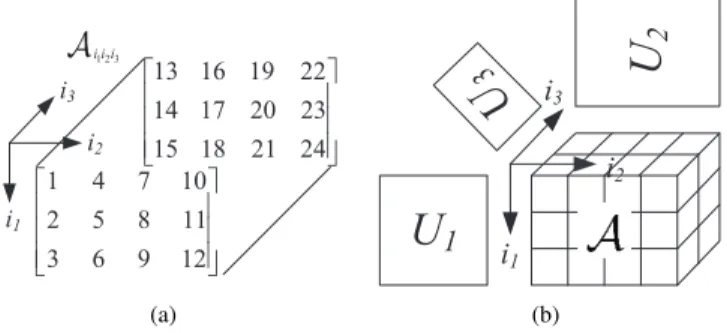
i1 i2 i3 1 4 7 10 2 5 8 11 3 6 9 12 é ù ê ú ê ú ê ú ë û 13 16 19 22 14 17 20 23 15 18 21 24 é ù ê ú ê ú ê ú ë û 1 2 3 i i i (a)
U
1U
2U
3 i1 i2 i3 (b) Fig. 1. (a) A tensorA ∈R3×4×2. (b) Illustration ofA×1U1×2U2×3U3.
transfer functionsH2(s1, s2),H3(s1, s2, s3), etc. associated to
the subsystems in (4). These transfer functions are expanded into multivariate polynomials of s1, s2, . . .such that the
coef-ficients (moments) can be explicitly matched. In NORM, the size of anNth-order reduced-order model is inO(kN+1lN)if
k=k1=· · ·=kN1.
In both aforementioned methods, the final step consists of replacing the original nonlinear system (2) by a smaller system via the transformations
˜
x=VTx, B˜ =VTB, L˜=VTL,
˜
Gi=VTGi(V⃝i), C˜i=VTCi(V⃝i ),
(6)
where i = 1, . . . , N and V = orth[Vk1, Vk2, Vk3, . . .] is the
orthogonal projector. Supposeqis the size of the reduced state,
˜
GiandC˜iwill be dense matrices withO(qi+1)entries, despite
the sparsity of Gi andCi. To store these dense matrices, the
memory space required grows exponentially.
C. Tensors and tensor decomposition
Some tensor basics are reviewed here, while more tensor properties and decompositions can be found in [9].
1) Tensors: Adth-order tensor is ad-way array defined by2
A ∈Rn1×n2×···×nd. (7)
For example, Fig. 1(a) depicts a 3rd-order 3×4×2 tensor. In particular, scalars, vectors and matrices can be regarded as 0th-order, 1st-order and 2nd-order tensors, respectively.
Matricization is a process that unfolds or flattens a tensor into a 2nd-order matrix. The k-mode matricization is aligning each kth-direction “vector fiber” to be the columns of the matrix. For example a 3rd-ordern1×n2×n3tensorAcan be
1-mode matricized into ann1×n2n3matrixA(1)as illustrated
in Fig. 2.
2) Tensor-matrix product: The k-mode product of a tensor
A ∈Rn1×···×nk×···×nd with a matrix U ∈Rpk×nk results in
a new tensor A ×kU ∈ Rn1×···×nk−1×pk×nk+1×···×nd given
by (A ×kU)j1···jk−1mkjk+1···jd= nk ∑ jk=1 Aj1···jk···jdUmkjk. (8) 1The complexity refers to the single-point expansion algorithm of NORM.
The multi-point version of NORM would have a lower complexity.
2We denote tensors by calligraphic letters, e.g.,AandG.
n2 n3 n2 n2 n2 A(1) n 3n2 n1 n1
Fig. 2. 1-mode matricization of a 3rd-order tensor.
A conceptual explanation of k-mode product is to multiply each kth-direction “vector fiber” in A by the matrix U. An illustration of the multiplication to a 3rd-order tensor is shown in Fig. 1(b).
The “Khatri-Rao product” is the “matching columnwise” Kronecker product. The Khatri-Rao product of matrices A= [a1, a2, . . . , ak]∈Rn1×k andB= [b1, b2, . . . , bk]∈Rn2×k is
defined byA⊙B= [a1⊗b1, a2⊗b2, . . . , ak⊗bk]∈Rn1n2×k.
If A andB are column vectors, A⊙B =A⊗B. And ifA andB are row vectors,A⊙B becomes the Hadamard product (viz. element-by-element product) of the two rows.
3) Rank-1 tensors and canonical decomposition: A rank-1 tensor of dimensiondcan be written as the outer product of dvectors
A=a(1)◦a(2)◦ · · · ◦a(d), a(k)∈Rnk, (9)
where ◦ denotes the outer product. Its element Ai1i2···id =
a(1)i 1 a (2) i2 · · ·a (d) id , where a (k)
ik is theikth entry of vectora(k).
The CANDECOMP/PARAFAC (CP) decomposition3 [8], [9], [14], [17] approximates a tensor A by a finite sum of rank-1 tensors, which can be written by
A ≈ R ∑ r=1 a(1)r ◦a (2) r ◦ · · · ◦a (d) r , a (k) r ∈R nk, (10)
where R ∈ Z+. Concisely, using the factor matrices
A(k) , [a(k) 1 , a (k) 2 , . . . , a (k) R ] ∈ R
nk×R, the right-hand side
of the CP (10) can be expressed by the notation A ≈
[[A(1), . . . ,A(d)]]. Moreover, it is worth mentioning that the
k-mode matricization of A could be reconstructed by these factor matrices
A(k)≈A(k)(A(d)⊙ · · · ⊙A(k+1)⊙A(k−1)⊙ · · · ⊙A(1))T. (11) The rank of the tensorA, rank(A), is the minimum value of R in the exact decomposition (10). A rank-R approximation of a 3rd-order tensor is shown in Fig. 3.
Several methods have been developed to compute the CP decomposition, for example, the alternating least squares (AL-S) [8], [17] (as well as many of its derivatives) or the optimization methods such as CPOPT [11]. Most of them solve the optimization problem of minimizing the Frobenius norm
3CANDECOMP (canonical decomposition) by Carroll and Chang [8] and
PARAFAC (parallel factors) by Harshman [17]. They are found independently in history, but the underlying algorithms are the same.
(1) 1 a (1) 2 a (1) R a (2) 1 a (2) 2 a (2) R a (3) 1 a (3) 2 a aR(3)
Fig. 3. A CP decomposition of a 3rd-order tensor.
of the difference between the original tensor and its rank-R approximation minf(A(1), . . . ,A(d)), 1 2 A −[[A(1), . . . ,A(d)]] 2 F. (12) The ALS algorithm iteratively optimizes one factor matrixA(i)
at a time, by holding all other factors fixed and solving the linear least square problem
min
A(i)f(A
(1), . . . ,A(d)) (13)
for the updated A(i). Alternatively, CPOPT calculates the gradient of the objective functionf in (12) and uses the generic nonlinear conjugate gradient method to optimize (12). For both ALS and CPOPT, the rankRshould be prescribed and is fixed during the computation. It is reported in [11] that the computa-tional complexities for both ALS and CPOPT to approximate an Nth-order tensor A ∈ Rn1×···×nN are O(N QR) per
iteration, whereQ=∏Ni=1ni. It is also mentioned in [11] that
ALS is several times faster than CPOPT in general. However CPOPT shows an “essentially perfect” accuracy compared with ALS. A review of different CP methods also can be found in [9].
III. TENSOR-FORM MODELING OF NONLINEAR SYSTEMS
To begin with, we give an equivalent tensor-based modeling of the nonlinear system (2). Recall the definitions of Gi and
Ci in (3), it is readily found that these coefficient matrices are
respectively 1-mode matricizations of (i+ 1)th-order tensors
Gi andCi,
Gi, Ci∈R i+1
z }| {
n× · · · ×n, (14) where the elements(Gi)j0j1···ji and(Ci)j0j1···jiare coefficients
of theΠi
k=1xjk term inGi andCi, respectively. For instance,
G2 is an n×n2 matrix while G2 is a 3rd-order n×n×n
tensor, i.e., G2 is the 1-mode matricization of G2.
According to Proposition 3.7 in [13], the Kronecker matrix products in (2) can be represented by the tensor mode multi-plication viaGi(x⃝i) =Gi×2xT×3xT· · ·×ixT×i+1xT and
Ci(x⃝i) =Ci×2xT ×3xT· · · ×ixT×i+1xT. Therefore, (2) is equivalent to d dt [ C1×2xT+C2×2xT×3xT+C3×2xT×3xT×4xT+· · · ] +G1×2xT+G2×2xT×3xT+G3×2xT×3xT×4xT+· · ·=Bu. (15)
The key to the tensor-form modeling is to pre-decompose these high dimensional tensors via CP. In practical circuit systems, in spite of the growing dimensionality, high-order nonlinear coefficientsGiandCi (GiandCi) are almost always
sparse. Therefore it is advantageous to make a rank-R CP approximation of Gi or Ci for a relatively small R. In other
words, we can use a few rank-1 tensors to expressGi andCi
by Gi≈[[G (1) i , . . . ,G (i+1) i ]] = rg,i ∑ r=1 g(1)i,r ◦ · · · ◦g(i,ri+1), Ci≈[[C (1) i , . . . ,C (i+1) i ]] = rc,i ∑ r=1 c(1)i,r ◦ · · · ◦c(i,ri+1), (16)
wherei= 2, . . . , N,rg,iandrc,iare the tensor ranks ofGiand
Ci, respectively, g (k) i,r, c (k) i,r ∈ R n,G(k) i = [g (k) i,1, . . . , g (k) i,rg,i] ∈ Rn×rg,i and C(k) i = [c (k) i,1, . . . , c (k) i,rc,i] ∈ R n×rc,i, for k = 1, . . . , i+ 1. It should be noticed that different permutations of indices can result in the same polynomial term. For ex-ample, termx1x2 can be represented by any combination of
αx1x2+(1−α)x2x1. Therefore, the high-order tensors are not
unique for a specific nonlinear system and the consequent low-rank approximations (16) could be very different. Nonetheless, we use the tensors with minimum nonzero entries in our implementation, as they tend to be sparser such that lower rank approximations are usually available.
Using the CP structure (16), the original nonlinear sys-tem (15) can be approximated by absorbing tensor products of xinto the factor matrices
d dt [ C1×2xT+ [[C(1)2 , x TC(2) 2 , x TC(3) 2 ]] +[[C(1)3 , xTC(2)3 , xTC(3)3 , xTC(4)3 ]] +· · ·]+G1×2xT + [[G(1)2 , xTG(2)2 , xTG(3)2 ]]+[[G3(1), xTG(2)3 , xTG(3)3 , xTG(4)3 ]]+· · · =Bu. (17)
Applying (11), the 1-mode matricization of (17) is simply
d dt [ C1x+C(1)2 ( xTC(3)2 ⊙xTC(2)2 )T +C(1)3 ( xTC(4)3 ⊙xTC(3)3 ⊙xTC(2) 3 )T +· · · ] +G1x+G(1)2 ( xTG(3) 2 ⊙xTG (2) 2 )T +G(1)3 (xTG(4)3 ⊙xTG(3)3 ⊙xTG(2)3 )T+· · ·=Bu, (18)
and its corresponding 1-mode matricized Volterra subsystems are given by d dt[C1x1] +G1x1=Bu, (19a) d dt[C1x2] +G1x2=− d dt [ C(1)2 (xT1C (3) 2 ⊙x T 1C (2) 2 )T] −G(1)2 (xT1G (3) 2 ⊙x T 1G (2) 2 )T , (19b) d dt[C1x3] +G1x3=− d dt [ C(1)3 (xT1C (4) 3 ⊙x T 1C (3) 3 ⊙x T 1C (2) 3 )T +C(1)2 (xT i1C (3) 2 ⊙xTi2C (2) 2 )T 3 ] −G(1)3 (xT1G (4) 3 ⊙x T 1G (3) 3 ⊙x T 1G (2) 3 )T −G(1)2 (xT i1G (3) 2 ⊙xTi2G (2) 2 )T 3, (19c) and so on.
IV. TNMOR
Without loss of generality, we start from (18) and (19) to derive TNMOR. It can be observed that (19) is a series of linear systems where x1 is solved by the first equation with
inputu,x2is the solution to the second linear system with the
input dependent on x1, and similarlyx3 is solved in the third
system with its input dependent on x1 andx2.
Similar to [1], [5]–[7], the frequency-domain transfer func-tion of (19a) is given by
H1(s) = (sG−11C1+I)−1G1−1B,(−sA1+I)−1B1. (20)
To match up to k1th-order moments of (20), its
projec-tion space Vk1 is the Krylov subspace of Kk1+1(A1, B1) if
H1(s) is expanded around the origin, where Km(A, p) =
span{p, Ap, . . . , Am−1p}. The Krylov subspace can be
effi-ciently calculated by the block Arnoldi iteration [1]. The 2nd-order subsystem (19b) can be recast into
[ C1 −I 0 0 ] [ ˙ x2 ˙ x2e ] + [ G1 0 0 I ] [ x2 x2e ] =− [ G(1)2 0 0 C(1)2 ] [( xT1G (3) 2 ⊙x T 1G (2) 2 )T ( xT 1C (3) 2 ⊙xT1C (2) 2 )T ] , (21)
Consequently, (21) could be treated as a linear system with rg,2+rc,2inputs and its transfer function reads
H2(s) = ( s [ G−11C1 −G−11 0 0 ] +I )−1[ −G−11G(1)2 0 0 −C(1)2 ] ,(−sA2+I)−1B2. (22)
Supposek2th-order moments ofH2(s)are matched, its Krylov
subspace is obtained by Kk2+1(A2, B2). Thus, we have Vk2
to be the first nrows of Kk2+1(A2, B2)(noticing H2(s) is a
2n×1 vector).
For the 3rd-order subsystem (19c), similarly, it could be represented by another linear system
[ C1 −I 0 0 ] [ ˙ x3 ˙ x3e ] + [ G1 0 0 I ] [ x3 x3e ] =− [ G(1)3 0 G(1)2 0 0 C(1)3 0 C(1)2 ] ( xT 1G (4) 3 ⊙xT1G (3) 3 ⊙xT1G (2) 3 )T ( xT1C (4) 3 ⊙xT1C (3) 3 ⊙xT1C (2) 3 )T ( xT i1G (3) 2 ⊙xTi2G (2) 2 )T 3 ( xT i1C (3) 2 ⊙xTi2C (2) 2 )T 3 (23) with rg,3+rc,3+rg,2+rc,2 inputs. Moreover, the 3rd-order
transfer function is given by
H3(s) = ( s [ G−11C1 −G−11 0 0 ] +I )−1 · [ −G−11G(1)3 0 −G−11G(1)2 0 0 −C(1)3 0 −C(1)2 ] ,(−sA2+I)−1[B3 B2]. (24)
Consequently, the Krylov subspace of the 3rd-order subsys-tem should be Kk3+1(A2,[B3 B2]) = Kk3+1(A2, B3) ∪
Kk3+1(A2, B2), if the number of moments being matched
is k3. However, it is readily seen that if k3 ≤ k2, we have Kk3+1(A2, B2) ⊆ Kk2+1(A2, B2). Since Kk2+1(A2, B2) has
already been obtained from H2(s), Kk3+1(A2, B2) does not
need to be recomputed. Therefore, onlyKk3+1(A2, B3)should
be counted at this stage and we denote its firstn rows to be Vk3.
Higher order linear transfer functions can be obtained in a similar way. Theith-order projector Vki is the firstnrows of
Kki+1(A2, Bi), where Bi = [ −G−11G(1)i 0 0 −C(1)i ] .
The reducing projector for the nonlinear system is the orthogonal basis of all Vkis, denoted by V =
orth([Vk1, Vk2, . . .]). The size of an Nth-order reduced-order
model is inO(k1l+k2(rg,2+rc,2) +k3(rg,3+rc,3) +· · ·+
kN(rg,N +rc,N)) = O(N kr), where k =max{k1, . . . , kN}
and r = max{l, rg,2 +rc,2, . . . , rg,N +rc,N}. Comparing
with O(k2N−1lN) in the standard projection approach and
O(kN+1lN) in NORM, a slimmer reduced-order model can
be achieved if low-rank CP of the tensors are available. Finally, the tensor-based reduced-order model is given by the following projection
˜ x=VTx, B˜ =VTB, L˜ =VTL, ˜ Gi= [[ ˜G (1) i , . . . ,G˜ (i+1) i ]] = [[V TG(1) i , . . . , V TG(i+1) i ]], ˜ Ci= [[ ˜C (1) i , . . . ,C˜ (i+1) i ]] = [[V TC(1) i , . . . , V TC(i+1) i ]], ˜ G1=VTG1V, C˜1=VTC1V, i= 2, . . . , N, (25)
which looks similar to (6) except for the tensor CP structure. By utilizing this structure, only the G˜(ik) and C˜(ik) matrices need to be stored, and simulation of the reduced-order model can be significantly speeded up as will be seen in the next section, as long as low-rank CP approximations ofGi andCi
are available. Algorithm 1 summarizes the TNMOR assuming a DC expansion point.
The computational complexity of TNMOR is dominated by the CP decompositions of Ci andGi. Any CP method can be
used to extract the rank-1 factors. We use CPOPT to compute the CP in TNMOR. Although CPOPT is not as remarkably fast as ALS, we find in practice that CPOPT can always achieve a better accuracy under the same rank. The computational cost for CPOPT to optimize a rank-rg,N approximation of
GN is inO(N nN+1rg,N)per iteration. By contrast, the costs
for NORM and the standard projection method to calculate the Krylov starting vectors for an Nth-order subsystem are inO(kNn2N)andO(k3N2lN2nN), respectively. It should be noticed that the CP decompositions only need to be done once and the resulting reduced CP structure can be used in different on-going simulations.
Another key issue is how to heuristically prescribe/estimate the rank for each tensor. It is readily found that accurate low-rank CP approximations of the high dimensional tensors is critical to the proposed method. Although it will be shown in Section V that the size of the reduced-order model and the time complexity for its simulation are proportional to the tensor ranks rGs and rCs, the efficiency of the proposed
Algorithm 1 TNMOR Algorithm Input: N, Gi, Ci, B, L, ki, kN ≤kN−1≤ · · · ≤k1 Output: G1, C1,G˜i,C˜i,B,˜ L, i˜ = 2, . . . , N 1: fori= 2 toN do 2: G˜i=Gi; C˜i=Ci; 3: [[G(1)i , . . . ,Gi(i+1)]] =CP( ˜Gi); 4: [[C(1)i , . . . ,Gi(i+1)]] =CP( ˜Ci); 5: end for 6: A1=−G−11C1; B1=G−11B; 7: Vk1 =Kk1+1(A1, B1); 8: fori= 2 toN do 9: A2= [ G−11C1 −G−11 0 0 ] ;Bi= [ −G−11G(1)i 0 0 −C(1)i ] ; 10: Vki=Kki+1(A2, Bi); 11: end for 12: V =orth([Vk1, Vk2, . . . , VkN]); 13: G˜1=VTG1V; C˜1=VTC1V;B˜=VTB;L˜=VTL; 14: fori= 2 toN do 15: G˜i= [[VTG (1) i , . . . , VTG (i+1) i ]]; 16: C˜i= [[VTC (1) i , . . . , V TC(i+1) i ]]; 17: end for
model will be compromised if large ranks are required to approximate the tensors. Unfortunately, unlike matrices, there are no feasible algorithms to determine the rank of a specific tensor; actually it is an NP-hard problem [18]. Nonetheless, a loose upper bound on the maximum rank of a sparse tensor is the number of its nonzero entries. Furthermore, in practical circuit examples, we find that m2 tom3 would be a possible rank to approximate a sparse tensor with m nonzero elements. As shown by examples in Section VI, this empirical rank works well for systems with fewer thanO(n)nonlinear components. Meanwhile, there is a significant amount of analog and RF circuits with a few (usually inO(1)) transistors, for instance, amplifiers and mixers, which would potentially admit low-rank tensor approximations. For systems with more thanO(n)
nonlinearities, such as ring oscillators or most discretized nonlinear partial differential equations, however, no reduction can be achieved by TNMOR if any of the tensor ranks exceeds n. It should be remarked that such systems may still be reduced by NORM, if relatively low order of moments is matched.
V. SIMULATION OF THE REDUCED-ORDER MODEL
Here we show that whenever low-rank tensor approxima-tions of Gi and Ci exist, TNMOR can help to accelerate
simulation and avoids the exponential growth of the memory requirement, versus the reduced but dense models generated by the standard projection method or NORM. We describe the time complexity by means of the two key processes in circuit simulation, namely, function evaluation and calculation of the Jacobian matrices. For the ease of illustration, we assume the conductance matrix C1 = I and all higher order
Ci = 0, i = 2, . . . , N. Extension to general cases is
straightforward.
A. Function evaluation
Rewrite (2) for the reduced-order model
f(˜x),x˙˜=−G˜1x˜−G˜2x˜⃝2 −G˜3˜x⃝3 − · · ·+ ˜Bu, (26)
wheref(˜x)is the function to be evaluated in the simulation. Using the reduced-order model in (25), the equivalent 1-mode matricization of (26) is f(˜x) =−G˜1˜x−G˜ (1) 2 ( ˜ xTG˜(3)2 ⊙x˜TG˜(2)2 )T −G˜(1) 3 ( ˜ xTG˜(4)3 ⊙x˜TG˜(3)3 ⊙x˜TG˜(2)3 )T − · · ·+ ˜Bu. (27) It should be noticed that all x˜TG˜(ik) and x˜TC˜(ik) are row vectors, therefore ⊙ corresponds to the element-by-element multiplication between matrices. If up to the Nth-order non-linearity is included and the size of the reduced-order model isq, the time complexity for evaluating (27) is in O(N2qr
g)
whererg =max{rg,2, . . . , rg,N}, while it is inO(qN+2)for
the model (6) used in the standard projection approach and NORM.
B. Jacobian matrix
Consider the Jacobian matrix of f(˜x) which is often used in time-domain simulation
Jf(˜x),−G˜1−G˜2(˜x⊗I+I⊗x˜)
−G˜3(˜x⊗x˜⊗I+ ˜x⊗I⊗x˜+I⊗x˜⊗x˜)− · · · . (28)
Its equivalent 1-mode matricization is given by
Jf(˜x) =−G˜1−G˜(1)2 ( ˜ xTG˜(3)2 ⊙G˜(2)2 + ˜G(3)2 ⊙x˜TG˜(2)2 )T −G˜(1) 3 ( ˜ xTG˜(4)3 ⊙˜xTG˜(3)3 ⊙G˜(2)3 + ˜xTG˜(4)3 ⊙G˜(3)3 ⊙x˜TG˜(2)3 + ˜G(4)3 ⊙x˜TG˜(3)3 ⊙x˜TG˜(2)3 )T− · · ·. (29)
The complexity for the standard projection method or NORM to calculate (28) is in O(N qN+2). For the tensor
formula-tion, the complexity for evaluating (29) is further reduced to O(N q(N+q)rg).
C. Space complexity
In our proposed method, the amount of memory space for the reduced-order model is determined by the factor matrices in (25), which should be in O(N qr), wherer=max{rg,2+
rc,2, . . . , rg,N +rc,N}. For the existing standard projection
approach and NORM, the storage consumption is dominated by the matricesG˜N andC˜N whose numbers of elements are
inO(qN+1).
VI. NUMERICAL EXAMPLES
In this section, TNMOR is demonstrated and compared with the standard projection approach and NORM. All experiments are implemented in MATLAB on a desktop with an Intel i5 [email protected] CPU and 16GB RAM. To fairly present the results, all time-domain transient analyses are solved by the trapezoid discretization with fixed step sizes. In the simulations
Vlo+
Vlo-Vrf+
Vrf-Vif+
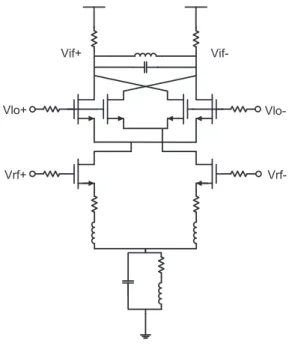
Vif-Fig. 4. A double-balanced mixer.
TABLE I. SIZES OF THE REDUCED-ORDER MODELS(ROM)ANDCPU TIMES OF REDUCTION FOR THE MIXER(SMALL SIGNAL)
Method k1 k2 k3 CPU time size of ROM
standard projection [5], [6] 1 1 — 0.09s 52
NORM [7] 2 2 — 0.56s 30
TNMOR 2 2 0 4.5s 39
TABLE II. CPUTIMES AND ERRORS OF TRANSIENT SIMULATIONS FOR THE MIXER(SMALL SIGNAL)
Transient full model standard NORM [7] TNMOR projection [5], [6]
size 93 52 30 39
CPU time 39s 2200s 270s 17s
speedup — — — 3.2x
error — 3.98% 3.24% 1.24%
TABLE III. CPUTIMES AND ERRORS OF PERIODIC STEADY-STATE SIMULATIONS FOR THE MIXER(SMALL SIGNAL)
Periodic steady
full model standard NORM [7] TNMOR state projection [5], [6]
size 93 52 30 39
CPU time 67s 4900s 410s 21s
speedup — — — 3.2x
error — 0.93% 0.71% 0.38%
of the original system, the reduced-order models of the stan-dard projection and NORM approaches, (26) and (28) are used to evaluate the functions and Jacobian matrices, while (27) and (29) are used for the tensor-based model. The CP in TNMOR is computed by the CPOPT algorithm provided in the MATLAB Tensor Toolbox [11], [12], [19].
A. A double-balanced mixer
First, we study a double-balanced mixer circuit in Fig. 4 [20], where Vrf(= Vrf+−Vrf-) and Vlo(= Vlo+−Vlo-)
are the RF and local oscillator (LO) inputs, respectively. We assume Vrf and Vlo are both sinusoidal and their frequencies are 2GHz and 200MHz, respectively. Vif+ and Vif- are the intermediate-frequency (IF) outputs. The sizenof the original system is 93. Firstly, we assume a relatively smallVloswing so that the nonlinear system can be approximated by its 3rd-order Taylor expansion d dt[C1x] +G1x+G2x 2 ⃝+G 3x⃝3 =Bu, (30)
where the numbers of nonzero elements inG2 andG3 are 16
and 30, respectively.
Then, the standard projection approach, NORM and TN-MOR are applied to (30). It should be noticed that all methods are expanded at the frequencies 2GHz and 200MHz. The size of the reduced-order model, the order of the moments ki
matched in each subsystem, and the CPU times for each model order reduction method are listed in Table I. It can be noticed that due to the curse of dimensionality, the standard projection approach generates a larger (and denser) reduced-order model but fewer orders of moments are persevered. TNMOR takes 1.3s to optimize a best rank-6 (rg,2 = 6) approximation of G2 with the error ∥
˜ G2−G2∥F
∥G2∥F = 4.2×10
−4, and 3.1s for a best
rank-9 (rg,3= 9) approximation ofG3with an error1.2×10−4.
A transient simulation from 0 toT = 25ns with a∆t= 5ps step size is performed on each reduced-order model. The runtimes and overall errors of different methods are summa-rized in Table II. The overall error is defined as the relative error between the vector ofVif+ at subsequent timesteps V =
[Vif+(0), Vif+(∆t), . . . , Vif+(T)]T of the reduced-order models and the corresponding vector computed with the full model, i.e., ∥V−Vf ull∥2
∥Vf ull∥2 . The first 7.5ns of the transient waveforms of
Vif+ and their relative errors are plotted in Figs. 5(a) and 5(b), respectively.
Next, the periodic steady-state analyses of different models are achieved by a shooting Newton method-based periodic steady-state simulator. The CPU times and the overall errors of the frequency responses between 0 to 4GHz are listed in Table III. The relative errors of the frequency responses are plotted in Fig. 5(c).
It is shown in Tables II and III that although TNMOR gener-ates a larger reduced-order model than NORM (39 versus 30), its transient and periodic steady-state analyses are faster due to the efficient algorithm of function and Jacobian evaluations. In contrast, simulations of the dense reduced-order models generated by NORM and the standard projection approach are much slower than the original large but sparse system, indicating that these methods are impractical for strongly nonlinear systems (3rd-order nonlinearity in this example). This is mainly because though both (26) and (28) have been used in the simulations, the Kronecker powers in (26) and (28) of the original system never have to be explicitly computed due to the sparsity of the original Gi andCi matrices. Moreover,
comparing to NORM, the proposed method provides a com-petitive accuracy as can be seen in Fig. 5.
Practically, mixers are often modeled by periodic time-varying systems due to the existence of large Vlo signals [5]–
0 1 2 3 4 5 6 7 x 10⁻⁹ −0.5 0 0.5 1 time (s) Vif (V) Full TNMOR NORM SP (a) 0 1 2 3 4 5 6 7 x 10⁻⁹ 10−6 10−4 10−2 100 time (s) |V−V full |/|V full | TNMOR NORM SP (b) 0 0.5 1 1.5 2 2.5 3 3.5 4 x 10⁹ 10−5 100 frequency (Hz) |f−f full |/|f full | SP TNMOR NORM (c)
Fig. 5. (a) Transient waveforms of the full model and reduced-order models. (b) Relative errors of the transient simulations. (c) Relative errors of the periodic steady-state simulations. (SP is the acronym for “standard projection” [5], [6].)
[7], [21]. Fortunately, TNMOR can be easily extended to periodic time-varying systems as well. Following [5]–[7], suppose all higher orderCi=0, all the system matrices in (19)
become Tlo-periodic where Tlo is the period of Vlo. Next, a uniform backward-Euler discretization over sampling points
[t1, t2, . . . , tM] where ti = Mi Tlo is applied on each linear
time-varying system in (19), resulting a set of LTV systems with transfer functions Hˆi(s)
[ ˆJ1+sCˆ1] ˆHi(s) = ˆBi, (31) where ˆ Hi(s) = [ HT i (t1, s)HiT(t2, s) . . . HiT(tM, s) ]T , ˆ B1= [ BT(t 1)BT(t2) . . . BT(tM) ]T , ˆ G1= G1(t1) G1(t2) . .. G1(tM) , (32) 1 2 3 4 5 6 7 8 9 10 −75 −70 −65 −60 −55 −50 RF amplitude (mV) IM3 (dBm) Full TNMOR NORM SP
Fig. 6. IM3 of the full model and reduced-order models. (SP is the acronym for “standard projection” [5], [6].)
TABLE IV. SIZES OF THE REDUCED-ORDER MODELS ANDCPUTIMES OF REDUCTION FOR THE MIXER(LARGE SIGNAL)
Method k1 k2 k3 CPU time size of ROM
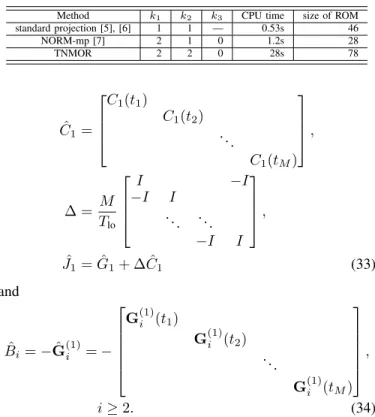
standard projection [5], [6] 1 1 — 0.53s 46 NORM-mp [7] 2 1 0 1.2s 28 TNMOR 2 2 0 28s 78 ˆ C1= C1(t1) C1(t2) . .. C1(tM) , ∆ = M Tlo I −I −I I . .. ... −I I , ˆ J1= ˆG1+ ∆ ˆC1 (33) and ˆ Bi=−Gˆ (1) i =− G(1)i (t1) G(1)i (t2) . .. G(1)i (tM) , i≥2. (34)
We omit the detailed derivation as it is straightforward. Simi-larly, the projector is obtained by collocating the moments of each order subsystem in (31). It should be noticed that the factor matrices at each sampling point can be computed indi-vidually via CP decompositions. Therefore the computational complexity is proportional toM.
Next, we reformulate the mixer by a 3rd-order nonlinear time-varying system under a large signalVlo. The 930-variable system is expanded around M = 10 operating points. This time, TNMOR, multi-point NORM (NORM-mp) and the s-tandard projection method are expanded at 2GHz. The sizes of reduced-order models and CPU times are listed in Table IV. The CPU time of TNMOR is mainly spent on sequential CP decompositions, which could be further reduced if multi-core parallelization is enabled.
These reduced-order models are simulated for 3rd-order intermodulation tests. The LO and RF frequencies are fixed
TABLE V. CPUTIMES OFIM3TESTS FOR THE MIXER (LARGE SIGNAL)
Transient full model standard NORM [7] TNMOR projection [5], [6]
size 930 46 28 78
CPU time 146±8s 120±12s 22±2s 15±2s
speedup — 1.2x 6.6x 9.7x
TABLE VI. SIZES OF THE REDUCED-ORDER MODELS ANDCPUTIMES OF REDUCTION FOR THE BIOCHEMICAL SYSTEM
Method k1 k2 k3 CPU time size of ROM
standard projection [5], [6] 1 0 — 0.02s 39
NORM [7] 2 1 0 1.2s 45
TNMOR 2 2 0 11s 39
while we sweep the amplitude of the sinusoidal RF input from 1mV to 10mV. Fig. 6 shows the 3rd-order intermodulation product (IM3) results of the original system and reduced-order models. The CPU times are summarized in Table V, where they are written as a ±b where a is the average value and b is the sample standard deviation. From Fig. 6, good agreement can be observed for the reduced-order models generated by NORM-mp and TNMOR. NORM-mp achieves a smaller size because it only preserves the values of nonlinear transfer functions at specific points, which is particularly useful for matching high-order distortions. Meanwhile, TNMOR still demonstrates comparable accuracy and better efficiency due to the benefit of the tensor framework.
B. A biochemical reaction system
The second example is a sparse biochemical reaction system model adapted from [22]. The system is generated by a random 2nd-order polynomial system with a 1+1x function
d dtx+G1x+G2x 2 ⃝+e 1 10 1 +x1 =Bu, (35) where G1 ∈ R200×200, G2 ∈ R200×200 2 , B ∈ R200×3 and
e1 ∈R200×1 = [1,0, . . . ,0]T. It should be noticed that both
G1 and B are dense random matrices and the eigenvalues of
G1 are randomly distributed on (0,3] so that the nonlinear
system is stable at the origin. G2 is a sparse random matrix
with 48 nonzero entries. 1+1x
1 is expended by the Taylor series 1
1+x1 ≈1−x1+x 2
1−x31and we control the inputs to guarantee |x|<1 during the simulations.
The three nonlinear model order reduction approaches are applied on the 3rd-order polynomial system to generate the reduced-order models. We match the moments at the origin in all approaches. The sizes of the reduced-order models, the orders of the moments in each subsystem and the CPU times for the reduction have been listed in Table VI. TNMOR optimizes a rank-20 (rg,2 = 20) approximation of G2 in 11s
with a relative error 0.03. The unique nonzero element in G3
is −10x3
1, therefore its CP can be obtained immediately with
the rank rg,3= 1.
We feed these reduced-order models by 10 sets of sinusoidal inputs for transient simulations with the same time period and the same step size. These sinusoidal inputs are under different
TABLE VII. CPUTIMES AND ERRORS OF TRANSIENT SIMULATIONS FOR THE BIOCHEMICAL SYSTEM
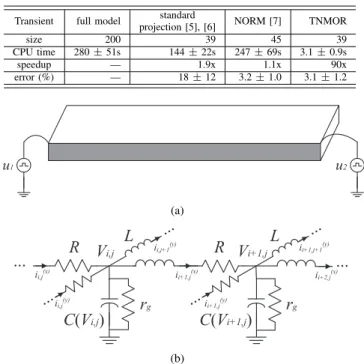
Transient full model standard NORM [7] TNMOR projection [5], [6] size 200 39 45 39 CPU time 280±51s 144±22s 247±69s 3.1±0.9s speedup — 1.9x 1.1x 90x error (%) — 18±12 3.2±1.0 3.1±1.2 u1 u2 (a)
C
(
V
i,j)
C
(
V
i+1,j)
r
gR
...
...
...
...
...
...
R
r
gL
L
V
i,jV
i+1,j ii+1,j(x) ii,j(x) ii+2,j(x)ii,j(y) ii+1,j(y)
ii,j+1(y) ii+1,j+1(y)
(b)
Fig. 7. (a) A nonlinear transmission line. (b) Model of the nonlinear transmission line.
frequencies. The CPU times and errors have been summarized in Table VII. The CPU times further confirm that for sparse systems, TNMOR can utilize the sparsity while the structure cannot be kept in NORM or the standard projection approach.
C. A 2-D pulse-narrowing transmission line
It is reported in [23] that linear lossy transmission line would cause the wave dispersion effect of the input pulse which could be avoided if certain nonlinear capacitors are introduced. We consider a nonlinear pulse-narrowing transmission line shown in Fig. 7(a) [23], [24]. There are two pulse inputs injected at the two corners of the transmission line. We are interested in the voltage at the center of the shaded edge. The length and width of the transmission line are 20cm and 10cm, respectively. It is uniformly partitioned into a 20×10 grid, with each node shown by the lumped circuit in Fig. 7(b). The nodes at the shaded edge of the transmission line are characterized by the nonlinear state equationC0V˙i,j= (i
(x) i,j+i (y) i,j−i (x) i+1,j−i (y) i,j+1− Vi,j/rg)(1 + ∑∞ N=1(bVi,j)N) whereC0 = 1µF,rg = 10KΩ
andb=−0.9, while the nonlinear coefficientb= 0elsewhere. In Fig. 7(b),L= 1µH andR= 0.1Ω.
Using MNA, we end up with a system with 570 state variables. First, we approximate the original system by the 3rd-order Taylor expansion, i.e., up to G3. There are 78 nonzero
elements in each order Gi, i = 1,2, . . . In this case, all the
moments are matched at the origin as well. Again, the sizes of the reduced-order models, the orders of the moments in each subsystem and the CPU times for the reduction are listed in Table VIII. Due to the exponential growth of the size of
TABLE VIII. SIZES OF THE REDUCED-ORDER MODELS ANDCPU TIMES OF REDUCTION FOR THE TRANSMISSION LINE
Method k1 k2 k3 CPU time size of ROM
standard projection [5], [6] 2 0 — 2.6s 40
NORM [7] 4 2 2 139s 42
TNMOR 4 2 2 7.6s 46
TABLE IX. CPUTIMES AND ERRORS OF TRANSIENT SIMULATIONS FOR THE TRANSMISSION LINE
Transient full model standard NORM [7] TNMOR projection [5], [6]
size 570 40 42 46
CPU time 58s 440s 149s 8.5s
speedup — — — 6.8x
error — 45.3% 0.15% 0.012%
the projector, to get a reduced-order model fewer than 60 states, only the 0th-order moments (DC term) of the 2nd-order subsystem and none of the 3rd-order could be matched when using the standard projection approach. TNMOR takes 2.8s and 3.5s to optimize the best rank-16 (rg,2 = rg,3 = 16)
matches of G2 and G3, respectively. In this case, the CP
decompositions are exact and the errors of CP are 0.
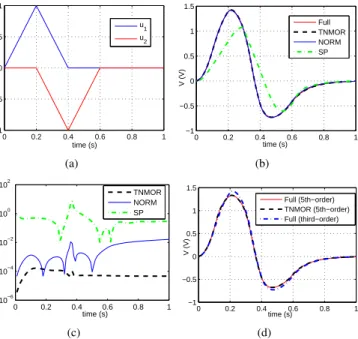
Then, a transient analysis with the pulse inputs shown in Fig. 8(a) is tested on each reduced-order model. The step size
∆t is chosen to be 1ms. The CPU times for the reduced-order models and the overall errors are summarized in Table IX with the resulting waveforms and the relative errors plotted in Figs. 8(b) and 8(c), respectively. It can be seen that to achieve a good accuracy (error < 0.1%), the standard projection approach and NORM may result in a reduced-order model which is even slower than the original one. On the other hand, TNMOR can reduce the order while still preserving the sparsity.
Finally, we raise the order of the Taylor expansion to C5
and G5 to match the highly nonlinear behavior. The standard
projection approach and NORM would result in a dense matrix
˜
G5withq6elements whereqis the size of the reduced system.
The reduced-order model is usually impractical to use if an acceptable accuracy is desired. MATLAB failed to construct the matricesG˜4andG˜5even if the projector up to the 3rd-order
subsystem is used while the moments of the 4th- and 5th-order subsystems are ignored. Meanwhile, it takes 16s (rg,4=
rg,5= 16) in total for TNMOR to obtain a 52-state
reduced-order model and another 21s for the transient simulation of the reduced-order model. The transient waveforms of the 5th-order full model and the reduced-5th-order model are shown in Fig. 8(d), contrasting with the one of the 3rd-order full model.
VII. CONCLUSION
In this paper, a tensor-based nonlinear model order reduction scheme called TNMOR is proposed. The high-order nonlin-earities in the system are characterized by high dimensional tensors such that these nonlinearities can be represented by just a few vectors obtained from the canonical tensor decom-position. Projection-based model order reduction is employed on these vectors to generate a compact reduced-order model under the tensor framework. The key feature of TNMOR
0 0.2 0.4 0.6 0.8 1 −1 −0.5 0 0.5 1 time (s) U (V) u 1 u2 (a) 0 0.2 0.4 0.6 0.8 1 −1 −0.5 0 0.5 1 1.5 time (s) V (V) Full TNMOR NORM SP (b) 0 0.2 0.4 0.6 0.8 1 10−6 10−4 10−2 100 102 time (s) |V−V full |/|V full | TNMOR NORM SP (c) 0 0.2 0.4 0.6 0.8 1 −1 −0.5 0 0.5 1 1.5 time (s) V (V) Full (5th−order) TNMOR (5th−order) Full (third−order) (d)
Fig. 8. (a) Pulse inputs to the transmission line. (b) Transient waveforms of the full model and reduced-order models. (c) Relative errors of the transient simulations. (d) Transient waveforms of the 5th-order model and the 3rd-order model. (SP is the acronym for “standard projection” [5], [6].)
is that it preserves the inherent sparsity through low-rank tensors, thereby easing memory requirement and speeding up computation via exploitation of data structures. Examples have been shown to demonstrate the efficiency of TNMOR over existing nonlinear model order reduction algorithms.
ACKNOWLEDGEMENT
This work was supported in part by the Hong Kong Research Grants Council under General Research Fund (GRF) Projects 718213E and 17208514, the University Research Committee of The University of Hong Kong, and the MIT-China MISTI program. The authors are also thankful to Prof. Ivan Oseledets of Skoltech and Mr. Zheng Zhang of MIT for their valuable comments and advice.
REFERENCES
[1] A. Odabasioglu, M. Celik, and L. Pileggi, “Prima: passive reduced-order interconnect macromodeling algorithm,”Computer-Aided Design
of Integrated Circuits and Systems, IEEE Transactions on, vol. 17, no. 8,
pp. 645–654, Aug 1998.
[2] J. Phillips, L. Daniel, and L. Silveira, “Guaranteed passive balancing transformations for model order reduction,”Computer-Aided Design of
Integrated Circuits and Systems, IEEE Transactions on, vol. 22, no. 8,
pp. 1027–1041, Aug 2003.
[3] P. Feldmann and R. Freund, “Efficient linear circuit analysis by pade approximation via the lanczos process,” Computer-Aided Design of
Integrated Circuits and Systems, IEEE Transactions on, vol. 14, no. 5,
pp. 639–649, May 1995.
[4] B. Bond and L. Daniel, “Guaranteed stable projection-based model reduction for indefinite and unstable linear systems,” inComputer-Aided
Design, 2008. ICCAD 2008. IEEE/ACM International Conference on,
[5] J. Phillips, “Automated extraction of nonlinear circuit macromodels,”
inCustom Integrated Circuits Conference, 2000. CICC. Proceedings of
the IEEE 2000, 2000, pp. 451–454.
[6] J. Roychowdhury, “Reduced-order modeling of time-varying systems,”
Circuits and Systems II: Analog and Digital Signal Processing, IEEE
Transactions on, vol. 46, no. 10, pp. 1273–1288, Oct 1999.
[7] P. Li and L. Pileggi, “Compact reduced-order modeling of weakly nonlinear analog and RF circuits,”IEEE Trans. Comput.-Aided Design
Integr. Circuits Syst., vol. 23, no. 2, pp. 184–203, Feb. 2005.
[8] J. Carroll and J.-J. Chang, “Analysis of individual differences in mul-tidimensional scaling via an n-way generalization of “Eckart-Young” decomposition,”Psychometrika, vol. 35, no. 3, pp. 283–319, 1970. [9] T. Kolda and B. Bader, “Tensor decompositions and applications,”SIAM
Review, vol. 51, no. 3, pp. 455–500, 2009.
[10] I. Oseledets, “Tensor-train decomposition,”SIAM Journal on Scientific
Computing, vol. 33, no. 5, pp. 2295–2317, 2011.
[11] E. Acar, D. M. Dunlavy, and T. G. Kolda, “A scalable optimiza-tion approach for fitting canonical tensor decomposioptimiza-tions,”Journal of
Chemometrics, vol. 25, no. 2, pp. 67–86, February 2011.
[12] B. W. Bader and T. G. Kolda, “Efficient MATLAB computations with sparse and factored tensors,”SIAM Journal on Scientific Computing, vol. 30, no. 1, pp. 205–231, December 2007.
[13] T. G. Kolda, “Multilinear operators for higher-order decompositions,” Sandia National Laboratories, Tech. Rep. SAND2006-2081, April 2006. [Online]. Available: http://www.osti.gov/scitech/biblio/923081 [14] B. W. Bader and T. G. Kolda, “Algorithm 862: MATLAB tensor classes
for fast algorithm prototyping,” ACM Transactions on Mathematical
Software, vol. 32, no. 4, pp. 635–653, December 2006.
[15] W. Rugh,Nonlinear System Theory – The Volterra-Wiener Approach. Baltimore, MD: Johns Hopkins Univ. Press, 1981.
[16] E. Bedrosian and S. O. Rice, “The output properties of Volterra systems (nonlinear systems with memory) driven by harmonic and Gaussian inputs,”Proc. IEE, vol. 59, no. 12, pp. 1688–1707, Dec. 1971. [17] R. A. Harshman, “Foundations of the PARAFAC procedure: Models
and conditions for an “explanatory” multi-modal factor analysis,”UCLA
Working Papers in Phonetics, vol. 16, no. 1, p. 84, 1970.
[18] J. H˚astad, “Tensor rank is NP-complete,”J. Algorithms, vol. 11, no. 4, pp. 644–654, Dec. 1990.
[19] B. W. Bader, T. G. Kolda et al., “MATLAB Tensor Toolbox Version 2.5,” Available online, January 2012. [Online]. Available: http://www.sandia.gov/∼tgkolda/TensorToolbox/
[20] W. Dong and P. Li, “A parallel harmonic-balance approach to steady-state and envelope-following simulation of driven and autonomous circuits,”Computer-Aided Design of Integrated Circuits and Systems,
IEEE Transactions on, vol. 28, no. 4, pp. 490–501, April 2009.
[21] R. Telichevesky, K. Kundert, and J. White, “Efficient AC and noise analysis of two-tone RF circuits,” in Design Automation Conference
Proceedings 1996, 33rd, Jun 1996, pp. 292–297.
[22] C. Gu, “QLMOR: a projection-based nonlinear model order reduction approach using quadratic-linear representation of nonlinear systems,”
IEEE Trans. Comput.-Aided Design Integr. Circuits Syst., vol. 30, no. 9,
pp. 1307–1320, Sep. 2011.
[23] E. Afshari and A. Hajimiri, “Nonlinear transmission lines for pulse shaping in silicon,”Solid-State Circuits, IEEE Journal of, vol. 40, no. 3, pp. 744–752, 2005.
[24] B. N. Bond, “Stability-preserving model reduction for linear and non-linear systems arising in analog circuit applications,” Ph.D. dissertation, Massachusetts Institute of Technology, Feb. 2010.
Haotian Liu(S’11) received the B.S. degree in
mi-croelectronic engineering from Tsinghua University, Beijing, China, in 2010, and the Ph.D. degree in electronic engineering from the University of Hong Kong, Hong Kong, in 2014. He is currently a Post-doctoral Fellow with the Department of Electrical and Electronic Engineering, the University of Hong Kong.
In 2014, he was a visiting scholar with the Massachusetts Institute of Technology (MIT), Cam-bridge, MA. His research interests include numerical simulation methods for very-large-scale integration (VLSI) circuits, model order reduction, parallel computation and control theory.
Luca Daniel (S’98–M’03) received the Ph.D.
de-gree in electrical engineering from the University of California, Berkeley, in 2003. He is currently a Full Professor in the Electrical Engineering and Computer Science Department of the Massachusetts Institute of Technology (MIT). Industry experiences include HP Research Labs, Palo Alto (1998) and Cadence Berkeley Labs (2001). His current research interests include integral equation solvers, uncertainty quan-tification and parameterized model order reduction, applied to RF circuits, silicon photonics, MEMs, Magnetic Resonance Imaging scanners, and the human cardiovascular system.
Prof. Daniel was the recipient of the 1999 IEEE Trans. on Power Electronics best paper award; the 2003 best PhD thesis awards from the Electrical Engineering and the Applied Math departments at UC Berkeley; the 2003 ACM Outstanding Ph.D. Dissertation Award in Electronic Design Automation; the 2009 IBM Corporation Faculty Award; the 2010 IEEE Early Career Award in Electronic Design Automation; the 2014 IEEE Trans. On Computer Aided Design best paper award; and seven best paper awards in conferences.
Ngai Wong(S’98–M’02) received his B.Eng. and
Ph.D. degrees in electrical and electronic engineering from the University of Hong Kong, Hong Kong, in 1999 and 2003, respectively.
He was a visiting scholar with Purdue University, West Lafayette, IN, in 2003. He is currently an As-sociate Professor with the Department of Electrical and Electronic Engineering, the University of Hong Kong. His current research interests include linear and nonlinear circuit modeling and simulation, mod-el order reduction, passivity test and enforcement, and tensor-based numerical algorithms in electronic design automation.