of peer-reviewed research and commentary in the population sciences published by the Max Planck Institute for Demographic Research Doberaner Strasse 114 · D-18057 Rostock · GERMANY www.demographic-research.org
DEMOGRAPHIC RESEARCH
VOLUME 7, ARTICLE 2, PAGES 15-48
PUBLISHED 04 JULY 2002
www.demographic-research.org/Volumes/Vol7/2/
DOI: 10.4054/DemRes.2002.7.2
Research Article
Time-squeeze, partner effect or
self-selection?
An investigation into the positive effect of
women's education on second birth risks in West
Germany
Michaela Kreyenfeld
1 Introduction 16
2 Theoretical considerations 17
3 Data and method 23
3.1 Selection of the sample 23
3.2 Description of the variables 24
3.3 Analytical procedure 26
4 Results 26
4.1 Plain model 26
4.2 Time-squeeze hypothesis 27
4.3 The partner effect hypothesis 32
4.4 The self-selection hypothesis 35
4.5 Summary of empirical results 37
5 Conclusions 38
6 Acknowledgements 40
Research Article
Time-Squeeze, Partner Effect or Self-Selection?
An Investigation into the Positive Effect of Women’s Education on
Second Birth Risks in West Germany
Michaela Kreyenfeld 1
Abstract
This paper investigates the role of women’s education in the transition to the second child using data from the 1997 German micro-census. We begin our analysis with a simple model, which shows a positive effect of woman’s education on the transition rate to the second child for West German women. We argue that this effect is most likely confounded by various factors. Firstly, we assume that there is a time-squeeze effect, which increases the transition rate to the second child for more highly educated women. Secondly, titled as the partner hypothesis, we argue that more highly educated women often live with more highly educated partners who have the earning potential to afford a large family. Thirdly, titled as the selection hypothesis, we argue that the positive effect of women’s education can be attributed to a selection effect, i.e. family-oriented college graduates are more likely to select themselves into the group of women at risk of second birth. The empirical investigations particularly support the second and third hypotheses. After controlling for the partner’s characteristics and including unobserved heterogeneity factors, the positive effect of female education becomes strongly negative.
1 Max Planck Institute for Demographic Research, Doberaner Str. 114, 18057 Rostock, Germany.
Telephone: +49-381-2081-136. Fax: +49-381-2081-436. Email: [email protected]. The
1. Introduction
In the economic theory of fertility, considerable attention has been paid to the role of women’s employment in fertility (e.g., Becker 1993, Oppenheimer 1994). A major assumption that is made −frequently labeled as the “male chauvinist approach”− is that the woman in the household gives up work on the labor market in order to take care of the children. This might be the result of intra-family bargaining, which assigns the childcare responsibilities to the person with the lowest market wage (e.g., Ott 1992), or it might just as well be an indicator of the persistence of traditional gender roles. However that may be, assuming that the care for children is considered a woman’s responsibility and assuming further that rearing children and employment are incompatible, high female wages should increase the opportunity costs of childrearing and suppress fertility. Assuming further that a woman’s educational attainment is a valid indicator for her work orientation, her wage and her labor market chances, one would expect a negative correlation between female education and fertility.
In recent years, however, an increasing number of studies have reported a positive effect of women’s education on the transition rate to higher order births. These studies primarily use data from Scandinavian countries (B. Hoem 1996, Hoem and Hoem 1989, Kravdal 1992, Oláh 1996), but similar findings have also been reported for western European countries such as Austria and West Germany (e.g., Hoem et al. 2001). In particular, for the West German context, there are the studies by Huinink (1989, 1995, 2001) which address the role of women’s educational attainment for the transition to the second child. Using data from the German Life History Survey, Huinink (1989, 1995) finds that women with an Abitur (German high school degree) encounter a higher second birth risk than women with only a Realschulabschluss (intermediate school degree). In a more recent publication, Huinink (2001) uses data from the Family and Fertility Survey and cross-tabulates the completed family size by women’s educational level for various European countries. For West Germany, he finds a high percentage of childless women among the college graduates, but also a high percentage of women with two or more children.
independence has contributed to the past downward trend in fertility (see e.g., Brewster and Rindfuss 2000: 271), such an interpretation suggests an upward trend for the future. The pivotal assumption, which the “income effect hypothesis” implicitly relies on, is that childrearing and employment can be made compatible and that women are able to return to work after childbirth. Women must be able to bring an employment career in synch with childrearing. This assumption may be plausible for Scandinavian countries, where full-time day care is readily available, but it is not very convincing for West Germany (Note 1). The West German institutional framework is frequently cited as the prototype of the “male breadwinner model” (e.g. Esping-Andersen 1999). Public daycare is scarce and there are only limited chances to arrange daycare by relying on private modes of care. Against this background, it is puzzling that an “income effect” of women’s education would foster childbearing.
The primary goal of this paper is to investigate alternative hypotheses that might explain a positive effect of women’s education on the transition rate to the second child. Woman’s education is measured in this paper by a set of three binary variables, which indicate whether the respondent has a college degree (Universitätsabschluss,
Fachhochschulabschluss), a vocational degree (Ausbildungsabschluss,
Fachschulabschluss) or no higher educational degree whatsoever. The remainder of this
paper is structured as follows. In Part 2, we discuss the institutional constraints for mothers participating in the labor market in Germany. We furthermore discuss a “time-squeeze”, a “partner effect” and a “selection hypothesis” as possible explanations for the unexpected positive effect of women’s education on second birth risks. Part 3 presents the data set and describes the empirical procedure. Part 4 comprises the empirical analysis and Part 5 consists of our concluding remarks.
2. Theoretical Considerations
In cross-national comparisons, the German welfare state is often characterized as fostering the traditional “male breadwinner model” (e.g., Gauthier 1996: 155, Gornick et al. 1998, Sundström 1999). There are various institutional regulations that have made researchers arrive at such a conclusion. For example, the system of income splitting
(Ehegattensplitting) allows married couples to file their taxes jointly, i.e. the man and
In theory, this system is neutral towards gender roles and it does not necessarily force the woman to withdraw from the labor market after childbirth. In practice, however, it is primarily the woman who gives up employment to raise children. For example, parental leave is almost exclusively (in 98 percent of all cases) taken by women (Engelbrech 1997). Furthermore, due to a lack of children’s day care, women’s ability to combine childrearing and employment are limited. The provision rate of public day care for children ages 0-3 is a mere three percent, while for children ages 7-10 it is only six percent. For pre-school children (ages 4-6), there is a broad coverage of part-time care, but the provision rate of places in full-time care is only 16 percent (Statistisches Bundesamt 2001). The opportunities to find private daycare arrangements
(Tagespflege) are scarce, too. High market barriers of entry, wooly quality regulations
and high tariff wages for childcare employees are presumably major obstacles that have prevented a functioning private market for care from evolving (for details, see e.g., Kreyenfeld and Hank 2000).
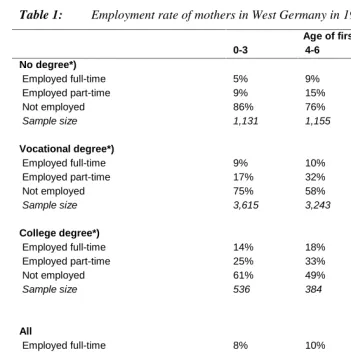
Since childcare opportunities are scarce, women are often confined to –at least temporarily– withdrawing from the labor market when they have children. Table 1 exemplifies this issue by displaying the employment rates of West German mothers by the age of the first child (Note 2). When the first child is between 3 and 6 years old, only around 10 percent of the West German women are employed full-time (for a
ORQJLWXGLQDODQDO\VLVVHHHJ'UREQLþ.XU]7KHUHLVVRPHYDULDWLRQLQWKH
Table 1: Employment rate of mothers in West Germany in 1997
Age of first child
0-3 4-6 7-10
No degree*)
Employed full-time 5% 9% 8%
Employed part-time 9% 15% 21%
Not employed 86% 76% 71%
Sample size 1,131 1,155 1,349
Vocational degree*)
Employed full-time 9% 10% 11%
Employed part-time 17% 32% 41%
Not employed 75% 58% 48%
Sample size 3,615 3,243 3,439
College degree*)
Employed full-time 14% 18% 21%
Employed part-time 25% 33% 34%
Not employed 61% 49% 45%
Sample size 536 384 288
All
Employed full-time 8% 10% 10%
Employed part-time 15% 27% 35%
Not employed 73% 61% 53%
In education 3% 2% 2%
Sample size 5,452 4,884 5,173
Notes: (1) Population: women of the birth cohorts 1961-1980 whose youngest child is age 0-10 in 1997 (2) *) Respondents who are in education are omitted
(3) Employed full-time is defined as working 35 or more hours per week. Employed part-time is defined as working 1-35 hours per week.
Source: Mikrozensus 1997
by having a first child, they simultaneously opt out of the labor market. If they decide for the “career track”, they will ultimately remain childless. Since more highly educated women generally encounter better career opportunities, they should be more likely to belong to the latter category.
Figure 1 gives support for the view on West German fertility. It shows the survival curves for the transition to the first child by final educational attainment for the birth cohort 1961-1963 (which will also be used for the subsequent analysis). While 25 percent of the women without a college degree are still childless at age 35, this applies to almost 50 percent among the college graduates.
The intriguing question is how the West German institutional framework shapes second birth patterns. As noted above, studies from other countries report a positive effect of women’s college education on the transition rate to higher order births. One plausible explanation for such a pattern is an income effect. More highly educated women earn higher wages and they are therefore better able to afford a larger family. Another explanation for this pattern could relate to work accelerated childbearing (Ní Bhrolcháin 1986a, 1986b). It might simply be sensible for work-oriented women to space their births close together. This allows them to swiftly resume employment, which reduces childcare related employment interruptions, minimizes both forgone earnings and risks of a devaluation of human capital (Taniguchi 1999). While this argumentation is plausible for countries where childrearing and employment is compatible, it is not convincing against the background of the West German institutional framework.
Figure 1: Transition to the first child by final educational attainment of the woman (survival curve)
Population: German nationals of the birth cohort 1961-1963 who are living in West Germany Source: Mikrozensus 1997 (own estimates)
Figure 2: Transition to the second child by final educational attainment of the woman (survival curve)
Population: German nationals of the birth cohort 1961-1963 who are living in West Germany and who have at least one child Source: Mikrozensus 1997 (own estimates)
0% 25% 50% 75% 100%
16 18 20 22 24 26 28 30 32 34
Age of Woman
no degree vocational degree college degree
0% 25% 50% 75% 100%
0 1 2 3 4 5 6 7 8 9 10
In the following, we more closely investigate three aspects which might contribute to this positive effect of women’s college education on second birth risks (Note 3):
1. College educated women are usually older when they have their first child than other women. It usually requires a longer period of time to receive a college degree than is the case for receiving a vocational training certificate. Since participation in the educational system is not easily compatible with raising children, college graduates generally postpone parenthood until they reach mature ages (see e.g., Blossfeld and Huinink 1991). For example, in our data set (see below), the average age at first birth for women with a vocational certificate is 25.7, while for college graduates it is 28.1. Having a first child later in one’s life involves having less time at one’s disposal before reaching the biological limits of fertility. Such a time-squeeze could increase the transition rate to the second child.
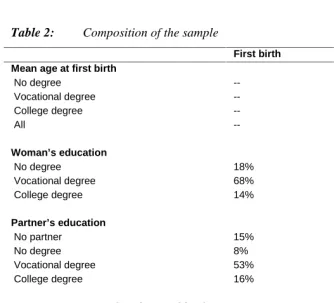
2. The second aspect refers to “educational homogamy”, which is relatively common in Germany. (For a detailed discussion, see Wirth 2000.) For example, 60 percent of all women in our sample live with a partner with the same educational level, whereas only 27 percent are “heterogamous couples” and 13 percent do not live with a partner at all (see Table 2). Educational homogamy can be very important if one investigates the role of women’s education in fertility. In a “male breadwinner regime” like the (West) German one, the male’s employment situation and income level should be crucial for fertility decisions. Couples would be likely to postpone parenthood until the man has established a secure position in the labor market, and they should only opt for a second or third child if they see the man’s earnings as sufficiently high to support a larger family. Assuming that education is a valid indicator for the “earning potential” of individuals, women who have college-educated partners should encounter higher transition rates to second or third births. If there is a high degree of educational homogamy and one fails to control for the partner’s characteristics, one might get biased results. The effect of a woman’s college education might then be confounded with a partner effect.
such a decision. In other words, the positive effect of women’s college education might be far from “real”, but merely attributable to self-selection.
In the following, we investigate these aspects. For this analysis, we are using data from the scientific-use file of the 1997 German micro-census. Let us first describe the data set.
3. Data and Method
3.1 Selection of the Sample
The German micro-census (hereafter referred to as Mikrozensus) is a one-percent sample of the population residing in Germany and it covers standard socio-demographic characteristics such as age, nationality, region of residence, educational attainment, etc. (For details, see e.g., Emmerling and Riede 1997, Schimpl-Neimanns 1998.) The scientific-use file of the Mikrozensus is a 70 percent sample of the original Mikrozensus and therefore a 0.7 percent sample of the population residing in Germany. The major advantage of the Mikrozensus is that it is a highly reliable and representative data set, and that it provides a large number of cases. The entire Mikrozensus for the year 1997 contains roughly 500,000 respondents.
Before we discuss the selection of the data set, it is important to draw attention to some shortcomings of the Mikrozensus. Its major drawback in regards to the analysis of demographic events is that it does not provide the “fertility history” of the respondents. The date of birth and the parity of the children can only be inferred from the number and age of the children who live in the household at the time of the interview. Fortunately, comparisons with other data sets show that this is only a minor problem for the birth cohorts born after 1960. However, for older cohorts, the percentage of children who have already moved out of the parental home increases rapidly (Kreyenfeld and Huinink 2001) (Note 4). For this reason, we restrict our analysis to the birth cohorts born in 1961 or later. We furthermore omit from our analysis the cohorts born later than 1963 because we must concentrate on respondents who have a first child. All in all, this leaves us with the birth cohorts 1961-1963, who were between the ages of 34 and 36 at the time of the interview (in 1997). This obviously does not allow us to investigate any cohort effects, but it provides us with a very homogenous sample.
are the following: We restrict the analysis to respondents in private households, i.e. we omit respondents who primarily live in institutions (such as mental asylums). We also exclude all cases where a birth occurred before age 17. Furthermore, we exclude cases with missing information on the educational attainment of the woman or her partner. Finally, we omit women for whom a first and a second birth were recorded in the same calendar year. We do not have any information on the month of birth at our disposal, so we must assume that such children are twins (Note 5). We omit them from the multivariate analysis since it is not possible to calculate a positive duration for them. The remaining sample for the analysis of second births comprises 6,026 women who gave birth to 4,035 second children (see Table 2).
3.2 Description of the Variables
The key independent variables for our multivariate analysis are the educational levels of the female respondent and her partner. We use the highest educational level received at the time of interview. One could argue that it would have been more advantageous to use education as a time-variant covariate (J. Hoem 1996, Hoem et al. 2001: 252). However, for the analysis of second birth it is relatively trouble-free to use the highest educational level, since most respondents have completed their studies before the first child is born, respectively before being at risk of second birth. As said before, we make a distinction between respondents with a college degree (Universitätsabschluss,
Fachhochschulabschluss), a vocational degree (Ausbildungsabschluss,
Fachschulabschluss) and respondents with neither a college nor a vocational degree.
We labeled the latter category “no degree”. It is worth noting that we do not consider people with a primary or secondary school degree as a separate group. This means that we might have classified some respondents into the category “no degree” even if they received an “Abitur”. The main reason we proceeded this way is that in the German labor market, vocational training certificates as well as college degrees play more significant roles for the allocation of workers to jobs than secondary school degrees do. Therefore, they better indicate career opportunities, earning potential, unemployment risks, etc. (see e.g., Müller and Shavit 1998).
only 10 percent with partners without any degree. The remaining 13 percent do not have partners at the time of interview (Note 6). For some parts of the analysis, we combine the woman’s education with her partner’s. This is why the table also reports the combination of the woman’s and her partner’s education.
Table 2: Composition of the sample
First birth Second birth
Mean age at first birth
No degree -- 23.69
Vocational degree -- 25.69
College degree -- 28.06
All -- 25.55
Woman’s education
No degree 18% 19%
Vocational degree 68% 71%
College degree 14% 10%
Partner’s education
No partner 15% 14%
No degree 8% 9%
Vocational degree 53% 61%
College degree 16% 17%
Woman & partner’s education combined
No partner 23% 14%
Educational homogamy 54% 60%
Woman with higher education 8% 6%
Partner with higher education 24% 20%
Number of cases
Sample size 8,530 6,026
Number of births 6,026 4,035
Notes: Population: Women of the cohorts 1961-1963. Cases with missing information on the woman’s or her partner’s education level were omitted.
3.3 Analytical Procedure
As we have said before, we hypothesize that the model used for the empirical analysis of the role of women’s education in second birth risks is easily subject to misspecification. We briefly discussed three aspects which could confound this relationship: (1) a time-squeeze, (2) a partner effect and (3) self-selection. In the following, we investigate, one after the other, the three issues sketched above. We estimate several event-history models. In all models, the duration since the birth of the first child is used as the baseline hazard.
When h(t) is the hazard of occurrence at time t, β1 the baseline hazard, X the (time-constant) covariates, and β2 a vector of corresponding parameters, the equation to be estimated has the following general mathematical form
ln h(t)=β1(t)+β2X (1)
The baseline log-hazard is a piecewise-linear spline (also known as a generalized Gompertz function). The parameters are estimated using the software aML (Version 1.04). This software has a variety of virtues which will become apparent in the subsequent analysis. First, aML allows inserting continuous covariates (in our case the woman’s age at first birth) as a piecewise linear function. A linear spline is a flexible form of representing the effect of a continuous independent variable. Such a variable is basically “cut” into several segments. For each segment, the log-hazard of the independent variable is assumed to be linear. However, across segments, the parameters (which appear as slopes of the spline function) can be different. (For details, see Lillard and Panis 2000: 46.) In order to interpret the slope coefficients, it is easiest to visualize them in a graph (see below). Apart from using a log baseline and one or more covariates represented as a linear spline, aML also allows us to control for unobserved heterogeneity. This aspect will be of particular importance when investigating the “selection hypothesis”.
4. Results
4.1 Plain Model
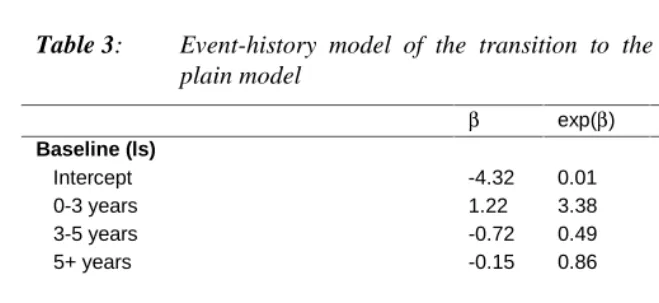
any degree, it increases the relative second birth risks by 17 percent. This is basically the results we would have expected based on the survival curves (see Figure 2) and based on previous studies on the role of women’s educational attainment on second birth risks in West Germany (see Huinink 1989, 1995) (Note 7).
Table 3: Event-history model of the transition to the second child, Model (0): plain model
β exp(β) t
Baseline (ls)
Intercept -4.32 0.01 -40.18 ***
0-3 years 1.22 3.38 27.97 ***
3-5 years -0.72 0.49 -20.55 ***
5+ years -0.15 0.86 -8.57 ***
Woman’s education
No degree -0.06 0.94 -1.49
Vocational degree 0 1
College degree 0.10 1.10 1.80 *
Log Likelihood -8,009
Notes: (1) Method: event-history model (generalized Gompertz) (2) time variable: age of first child
(3)***: p ≤ 0.01 **: 0.01≤ p ≤ 0.05 *: 0.05≤ p ≤0.10 Source: Mikrozensus 1997 (own estimates)
4.2 Time-Squeeze Hypothesis
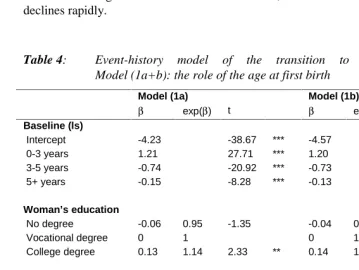
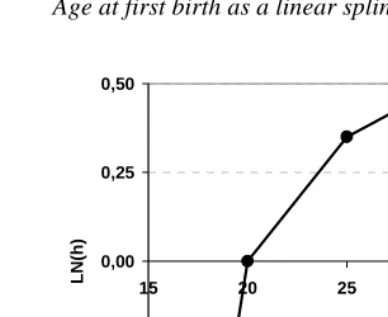
As can be seen from Figure 3, the two kinds of specifications provide fairly similar results concerning the role of a woman’s age at first birth in second birth risks. Women who had their first child as teenagers have relatively low transition rates to the second child. If one ignores this group of women, the relationship between the age at first birth and the transition rate to the second child is basically negative. There is no significant difference between women who had their first child between the ages of 21 and 25 and those who were between the ages of 26 and 30 at this event. However, when the woman was older than age 30 at the birth of her first child, the transition rate to the second child declines rapidly.
Table 4: Event-history model of the transition to the second child, Model (1a+b): the role of the age at first birth
Model (1a) Model (1b)
β exp(β) t β exp(β) t
Baseline (ls)
Intercept -4.23 -38.67 *** -4.57 -34.14 ***
0-3 years 1.21 27.71 *** 1.20 27.49 ***
3-5 years -0.74 -20.92 *** -0.73 -20.63 ***
5+ years -0.15 -8.28 *** -0.13 -7.11 ***
Woman’s education
No degree -0.06 0.95 -1.35 -0.04 0.96 -0.95
Vocational degree 0 1 0 1
College degree 0.13 1.14 2.33 ** 0.14 1.15 2.58 ***
Age at first birth
17-20 -0.10 0.90 -2.08 ** 0.35 ls 0.98
21-25 0 1 0.07 ls 3.23 ***
26-30 -0.03 0.97 -0.86 0.03 ls 2.55 ***
31-35 -0.41 0.66 -5.24 *** -0.15 ls -8.98 ***
Log Likelihood -7,993 -7,949
Notes: (1) Method: event-history model (generalized Gompertz) (2) time variable: age of first child
(3) ***: p ≤ 0.01 **: 0.01≤ p ≤ 0.05 *: 0.05≤ p ≤0.10 (4) ls= linear spline
Figure 3: Second birth risks by age at first birth
Panel 1: Age at first birth as a linear spline
Panel 2: Age at first birth as a categorical variable
Notes: For the estimates, see Table 4. Source: Mikrozensus 1997 (own estimates)
-0,50 -0,25 0,00 0,25 0,50
15 20 25 30 35
Age at First Birth
LN
(h)
0,00 0,25 0,50 0,75 1,00
17-20 20-25 25-30 30-35 Age at First Birth
R
e
lative R
Our primary motivation for inserting the age at first birth was to investigate whether the effect of women’s college education is confounded by the relatively late age at first birth for college educated women. After controlling for the age at first birth, we expected that the positive effect of women’s college education would disappear. However, as can be seen from Table 4, after adding the age at first birth to the model, the positive effect of a woman’s college education becomes highly significant and increases even slightly (compared to the model reported in Table 3).
However, by just inserting the age at first birth as a (multiplicative) covariate might conceal interaction effects between women’s education and the age at first birth. A late age at first birth might generally have a depressing effect on the transition to the second child. This does not necessarily rule out that college graduates, who usually have a first child later in their lives, accelerate childbearing. In order to investigate the interaction between the age at first birth and the educational level, we proceed in a similar way as was suggested by previous studies (particularly by B. Hoem 1996).
Interaction between age at first birth and educational attainment
In our next step, we employ an interaction of the woman’s educational attainment with the categorical variable for the age at first birth. For women who gave birth to a first child as teenagers, we do not allow the variable to vary by educational attainment. There are simply too few teenage births to college educated women to allow for such an interaction. The interaction effects of this model are displayed in Table 5.
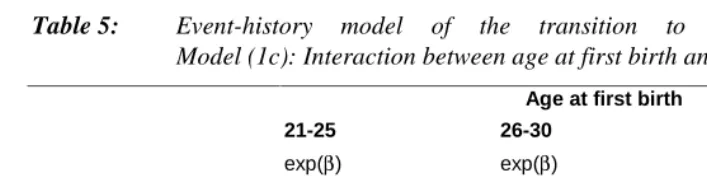
There are two ways of reading the table. Firstly, one can compare the relative risks along the rows. In other words, one fixes the educational level in order to investigate whether a late age at first birth operates differently for the various educational categories. For all educational groups, there is a negative gradient of age at first birth on the transition to the second child. For the college graduates, however, this effect is less strong than for the other groups.
unchanged; women’s education positively affects second birth risks, irrespective of the age at first birth.
Table 5: Event-history model of the transition to the second child, Model (1c): Interaction between age at first birth and education
Age at first birth
21-25 26-30 31-35
exp(β) exp(β) exp(β)
Woman’s education
No degree 0.94 0.85 0.45
Vocational degree 1 0.95 0.64
College degree 0.93 1.20 0.89
Notes: For the full model (without interaction effects) see Model 1a.
From our analysis so far, one could conclude that the relatively late age at first birth does not contribute to the positive effect of women’s college education on second birth risks in West Germany. Neither do our investigations reveal any substantial interaction effects between women’s educational attainment and the age at first birth. However, our “standard interaction procedure” might not fully take into account the connection between age at first birth and educational attainment in a satisfying manner. The main argument in this context is that the distribution of the age at first birth differs strongly by educational levels. Related to this, a late age at childbirth is defined in a completely different manner for college graduates than for others. “What is completely normal childbearing behavior for one educational group is quite unusual in another” (B. Hoem 1996: 337). In order to take into account that the age at first birth has a different meaning for the various educational categories, one should take into account the distribution of the ages at first birth by educational level.
the age at first birth on third birth risks which confounded the effect of women’s education (B. Hoem 1996, Hoem et al. 2001). However, for West Germany we do not find evidence for such an effect.
Table 6: Event-history model of the transition to the second child, Model (1d): Interaction between relative age at first birth and education
Age at first birth
Below average Above average
exp(β) Exp(β)
Woman’s education
No degree 0.93 0.90
Vocational degree 1 0.94
College degree 0.99 1.21
Notes: For the full model (without interaction effects) see Model 1a.
4.3 The Partner Effect Hypothesis
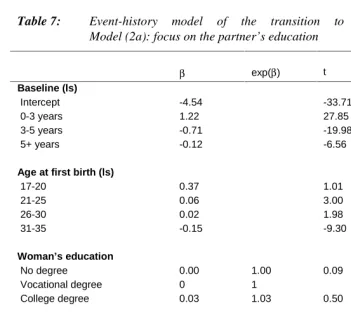
Table 7: Event-history model of the transition to the second child, Model (2a): focus on the partner’s education
β exp(β) t
Baseline (ls)
Intercept -4.54 -33.71 ***
0-3 years 1.22 27.85 ***
3-5 years -0.71 -19.98 ***
5+ years -0.12 -6.56 ***
Age at first birth (ls)
17-20 0.37 1.01
21-25 0.06 3.00 ***
26-30 0.02 1.98 **
31-35 -0.15 -9.30 ***
Woman’s education
No degree 0.00 1.00 0.09
Vocational degree 0 1
College degree 0.03 1.03 0.50
Partner’s education
No partner -0.64 0.53 -11.86 ***
No degree -0.02 0.98 -0.34
Vocational degree 0 1
College degree 0.27 1.30 5.66 ***
Log Likelihood -7,840
Notes: (1) Method: event-history model (generalized Gompertz) (2) time variable: age of first child
(3) ***: p ≤ 0.01 **: 0.01≤ p ≤ 0.05 *: 0.05≤ p ≤0.10 (4) ls= linear spline
The woman and the partner’s educational attainment combined
In a further step, we employ an interaction between the woman’s and the partner’s educational levels (see Table 9). The combination “both vocational degree” serves as the reference category. If it was solely the partner’s education which mattered in the decision to have a second child, couples where the male partner has a college degree should have a particularly high second birth risk. If only the woman has a college degree, second birth risks should be rather low. The empirical analysis partially supports this hypothesis. If only the male has a college degree, second birth risks increase by roughly 30 percent (compared to the reference group of homogamous couples with vocational degrees). If only the woman has a college degree, second birth risks are slightly lower than for the reference category. However, “homogamous couples” with college degrees encounter a relative second birth risk of 34 percent (compared to the reference group). Obviously, in such cases it is not possible to separate the impact of the woman and her partner’s educational attainment on the risks of having a second child. Here, it would be important to take into account other employment indicators (such as labor market income or labor market status). Unfortunately, data restrictions preclude us from investigating the role of the partner’s employment situation any further.
Table 8: Event-history model of the transition to the second child, Model (2b): combined effect of the woman and the partner’s education
Woman’s education
No degree Vocational degree College degree
exp(β) exp(β) exp(β)
Partner’s education
No degree 0.99 0.95 0.96
Vocational degree 0.95 1 0.99
College degree 1.37 1.27 1.34
4.4 The Self-Selection Hypothesis
In a last step, we address the question of whether the positive effect of female educational attainment can be attributed to self-selection. Above, we argued that in an institutional framework where childrearing and employment is not compatible, women are basically confined to choose between a continuous employment career and motherhood. Women who choose to set up a family in such an institutional context should either have low employment ambitions or a high family orientation. This “self-selection” might bias the effect of college education on second birth risks.
In order to investigate this issue, we proceed in a manner suggested by Kravdal (2001). He estimates the transition to the first, second and third child within a joint model and adds a common unobserved heterogeneity factor. Similar to Kravdal (2001), we estimate first and second birth probabilities within a joint model and we insert a common unobserved heterogeneity factor to the model. In contrast to the study by Kravdal, however, we do not use event-history techniques for all birth parities. Instead, we simply estimate the probability of having a first child in a probit model; the transition to the second child is, however, estimated in an event-history model.
Below, we report the underlying functional relationship. The decision to have a first child is determined by
y P y if
if first
childless child
= =
( ) 1
0 (2)
For the probit equation, Z represents the independent variables that influence the decision to have a first child, α1 represents the intercept and α2 the parameters. For the transition to the second child, h(t) is the hazard of occurrence at time t, β1 is the baseline hazard, X are the covariates and β2 the respective parameters. The symbol σ represents the unobserved heterogeneity factor that is the same for both birth parities. σ is supposed to be normally distributed with mean 0 and a variance of σ2.
y = α1+α2Z+ σ (3)
ln h(t) = β 1+β2X+ σ
The model without unobserved heterogenity (Model 3a in Table 2) provides basically the same results as Model 2 (see above). It shows that the partner’s educational attainment has a positive effect on second birth risks, while woman’s college education plays no role in the transition to the second child.
Table 9: Simultaneous estimation of probability of having a first child and the transition to the second child (Model 3a+b)
Model (3a) Model (3b)
β exp(β) t β exp(β) t
Probit model (first birth)
Intercept 0.89 2.44 39.40 *** 1.68 5.35 7.02 ***
Woman’s education
No degree 0.13 1.14 3.09 *** 0.24 1.27 2.81 ***
Vocational degree 0 1 0 1
College degree -0.54 0.59 -11.22 *** -1.00 0.37 -6.07 ***
Partner’s education
No Partner -1.06 0.35 -29.19 *** -1.98 0.14 -7.09 *** No degree -0.17 0.84 -2.82 *** -0.32 0.73 -2.60 ***
Vocational degree 0 1 0 1
College degree 0.05 1.05 1.11 0.10 1.10 1.09
Hazard model (second birth) Baseline (ls)
Intercept -4.54 -33.69 *** -6.68 -10.16 ***
0-3 years 1.22 27.87 *** 1.78 9.47 ***
3-5 years -0.71 -20.01 *** -0.40 -4.97 ***
5+ years -0.12 -6.55 *** -0.07 -3.08 ***
Woman’s education
No degree 0.00 1.00 0.09 0.09 1.09 1.16
Vocational degree 0 1 0 1
College degree 0.03 1.03 0.53 -0.29 0.74 -2.21 **
Partner’s education
No partner -0.64 0.53 -11.82 *** -1.74 0.18 -6.11 *** No degree -0.02 0.98 -0.34 -0.14 0.87 -1.29
Vocational degree 0 1 0 1
College degree 0.27 1.31 5.68 *** 0.47 1.60 4.73 ***
Age at first birth (ls)
17-20 0.37 1.02 0.28 0.59
21-25 0.06 2.97 *** 0.09 3.01 ***
26-30 0.02 1.99 ** 0.04 2.55 ***
31-35 -0.15 -9.30 *** -0.20 -8.74 ***
Sigma -- 1.60***
Log Likelihood -12,399 -12,383
Notes: (1) Method: simultaneous estimation of a probit model (estimating the probability to have a first child at the time of interview) and an event-history model (generalized Gompertz; time variable: age of first child).
(2) ***: p ≤ 0.01 **: 0.01≤ p ≤ 0.05 *: 0.05≤ p ≤0.10 (3) ls= linear spline
(2001). The unobserved heterogeneity component is positive and significantly different from zero. This means that there are unobserved respondent-specific characteristics which affect fertility decisions. Omitting this unobserved heterogenity component has important consequences. Most importantly, it biases the role of women’s college education upward. The interpretation we suggest in this context is that “family-prone” college graduates select themselves into the sample of women at risk of first birth. This “family-proneness” also fosters their transition to the second child.
4.5 Summary of Empirical Results
Table 10: Summary of results
Woman’s education Partner’s education
β exp(β) t β exp(β) t
Model (0)
No degree -0.06 0.94 -1.49
Vocational degree 0 1
College degree 0.10 1.10 1.80 *
Model (1a)
No degree -0.06 0.95 -1.35
Vocational degree 0 1
College degree 0.13 1.14 2.33 **
Model (2a)
No degree 0.00 1.00 0.09 -0.02 0.98 -0.34
Vocational degree 0 1 0 1
College degree 0.03 1.03 0.50 0.27 1.30 5.66 ***
Model (3a)
No degree 0.09 1.09 1.16 -0.14 0.87 -1.29
Vocational degree 0 1 0 1
College degree -0.29 0.74 -2.21 ** 0.47 1.60 4.73 ***
Notes: Model (0): No other controlling variables
Model (1a): The only other controlling variable is the age at first birth.
Model (2a): The other controlling variables are the age at first birth and the educational level of the partner. Model (3a): Results of the simultaneous estimation of the probability to be childless and the transition to the second
child including unobserved heterogeneity (for the full model, see above). Source: Mikrozensus 1997 (own estimates)
5. Conclusions
characteristics. Third, we hypothesized that more family-oriented college graduates are more likely to select themselves into the group of women at risk of second birth. In the empirical analysis, we estimated several event-history models for the transition to the second child. Our results can be summarized as follows.
•
There is ambiguous evidence for the “time-squeeze hypothesis”. As a first step, we applied models similar to those that were employed to investigate the transition to higher parity births in Sweden, Norway and Austria (B. Hoem 1996, Hoem et al. 2001, Kravdal 1992). Contrary to these studies which showed that the age at first birth confounds the effect of women’s education on the transition to the second and third child, we did not find consistent support for this hypothesis for the West German case.•
The role of the partner’s educational attainment turned out to play a significant role in the transition to the second child in West Germany. Furthermore, after controlling for the partner’s educational attainment, the effect of the woman’s education becomes insignificant. This finding complies with the expectation that in the institutional context of West Germany, the employment situation of the male “breadwinner” is crucial for the decision to have a larger family. Furthermore, the results also suggest that it is of vital importance to take into account the partner’s characteristics. Failing to account for them upwardly biases the coefficients for female educational attainment.•
Apart from a strong confounding effect of the partner’s characteristics, we also found support for the “selection hypothesis”. After controlling for unobserved heterogeneity factors, the positive impact of women’s college education becomes significantly negative. Our interpretation of this finding is that a “family-proneness” selects women into the sample who are at risk of second births. This self-selection biases the effect of college education on the transition to the second child.6. Acknowledgements
I would particularly like to thank Johannes Huinink. I profited greatly from various discussions we had on this topic. Comments on an earlier version of the paper by
Arnstein Aassve, Pau Baizan, Øystein Kravdal, Vladimira Kantorova and two reviewers of Demographic Research are gratefully acknowledged. I am indebted to Jan Hoem
who encouraged me to write this paper. For language editing, I would like to thank
Jenae Tharaldson.
Changes
On October 14th 2002, per request of the author, the following changes were made:
1. On page 18, the sentences "Table 1 exemplifies this issue by displaying the employment rates of West German mothers by the age of the youngest child (Note 2). When the youngest child is between 3 and 6 years old…"
were changed to:
"Table 1 exemplifies this issue by displaying the employment rates of West German mothers by the age of the first child (Note 2). When the first child is between 3 and 6 years old…
2. On page 19, the table head "Age of youngest child"
was changed to
References
Becker, G.S. (1993). A Treatise on the Family. Enlarged edition. Cambridge (Massachusetts). Harvard University Press.
Blossfeld, H.P., Huinink, J. (1991). “Human capital investment or norms of role transition? How women’s schooling and career affect the process of family formation.” American Journal of Sociology 97(1). 143-168.
Brewster, K.L., Rindfuss, R.R. (2000). “Fertility and women’s employment in industrialized nations.” Annual Review of Sociology 26: 271-296.
'UREQLþ6³7KHHIIHFWVRIFKLOGUHQRQPDUULHGDQGORQHPRWKHU¶VHPSOR\PHQW
in the United States and (West) Germany.” European Sociological Review 16(2). 137-157.
Emmerling, D., Riede T. (1997). “Vierzig Jahre Mikrozensus.” Wirtschaft und Statistik 3: 160-174.
Engelbrech, G. (1997). “Erziehungsurlaub – und was dann? Die Situation von Frauen bei ihrer Rückkehr auf den Arbeitsmarkt: ein Ost/ West-Vergleich.” IAB
Nürnberg. Kurzbericht (8).
Esping-Andersen, G. (1999). Social Foundations of Postindustrial Economies. Oxford. Gauthier, A.H. (1996). The State and the Family. A Comparative Analysis of Family
Policies in Industrialized Countries. Oxford.
Gornick, J.C., Meyers, M.K., Ross, K.E. (1998). “Public policies and the employment of mothers: a cross national study.” Social Science Quarterly 79(1). 35-54 Hoem, B. (1996). “The social meaning of the age at second birth for third-birth fertility:
A methodological note on the need to sometimes respecify an intermediate variable.” Yearbook of Population Research in Finland 33: 333-339.
Hoem, B., Hoem, J. M. (1989). “The impact of women’s employment on second and third births in modern Sweden.” Population Studies 43: 47-67.
Hoem, J. M., Prskawetz, A., Neyer, G. (2001). “Autonomy or conservative adjustment? The effect of public policies and educational attainment on third births in Austria.” Population Studies 55: 249-261.
Huinink, J. (1989). “Das Zweite Kind. Sind wir auf dem Weg zur Ein-Kind-Familie?”
Zeitschrift für Soziologie 18: 192-207.
Huinink, J. (1995). Warum noch Familie? Zur Attraktivität von Partnerschaft und
Elternschaft in unserer Gesellschaft. Frankfurt/Main.
Huinink, J. (2001). “The macro-micro-link in demography-explanations of demographic changes.” Paper presented at the Euresco Conference ‘The Second Demographic Transition in Europe’ in Bad Herrenalb (Germany). June 23-28, 2001.
Kravdal, Ø. (1992). “The emergence of a positive relation between education and third birth rates in Norway with supportive evidence from the United States.”
Population Studies 46(3). 459-475.
Kravdal, Ø. (2001). “The high fertility of college educated women in Norway. An artefact of the separate modeling of each parity transition.” Demographic
Research 5(6). 187-216.
Kreyenfeld, M., Huinink J. (2002). “Der Übergang zum ersten und zweiten Kind. Ein Vergleich zwischen Mikrozensus und Familiensurvey.” In: Marbach, J., Bien, W. (eds.). Elternschaft und Geschlecht – Wandel und Entwicklung familialer
Lebensformen in Deutschland. Opladen (forthcoming).
Kreyenfeld, M. (2001). Employment and Fertility- East Germany in the 1990s. Dissertation. Rostock University.
Kreyenfeld, M., Hank, K. (2000). “Does the availability of childcare influence the employment of mothers? Findings from western Germany.” Population
Research and Policy Review 19(4). 317-337.
Kurz, K. (1998). Das Erwerbsverhalten von Frauen in der intensiven Familienphase
ein Vergleich zwischen Müttern in der Bundesrepublik Deutschland und den USA. Opladen.
Lillard, L. A., Panis, C.W.A. (2000). aML Multilevel Multiprocess Statistical Software,
Release 1.0. EconWare. Los Angeles, California.
Müller, W., Shavit, Y. (1998). “The institutional embeddedness of the stratification process: a comparative study of qualifications and occupations in thirteen countries.” In: Shavit, Y., Müller, W. (eds.). From School to Work. A
Comparative Study of Educational Qualifications and Occupational Destinations. Oxford: 1–48.
Nì Bhrolcháin, M. (1986a). “The interpretation and role of work-associated accelerated childbearing in post-war Britain.” European Journal of Population 2: 135-154. Ní Bhrolcháin, M. (1986b). “Women’s paid work and the timing of births.” European
Journal of Population 2: 43-70.
Ní Bhrolcháin, M. (1988). “The contraceptive confidence idea: an empirical investigation.” Population Studies 42(2). 205-225.
Oláh, L. (1996). “The impact of public policies on the second birth rates in Sweden: a gender perspective.” Stockholm University. mimeo.
Oppenheimer, V.K. (1994). “Women’s rising employment and the future of the family in industrial societies.” Population and Development Review 20(2). 293-342. Ott, N. (1992). Intrafamily Bargaining and Household Decisions. Berlin.
Rindfuss, R.R., Morgan, P.S., Offutt, K. (1996). “Education and the changing age pattern of American fertility: 1963-1989.” Demography 33(3). 277-290.
Schimpl-Neimanns, B. (1998). “Analysemöglichkeiten des Mikrozensus.”
ZUMA-Nachrichten 22(42). 91-122.
Statistisches Bundesamt (1999). Demographische Standards. Eine gemeinsame
Empfehlung des Arbeitskreises Deutscher Markt- und Sozialforschungsinstitute, der Arbeitsgemeinschaft Sozialwissenschaftlicher Institute und des Statistischen Bundesamts. Wiesbaden.
Statistisches Bundesamt (2001). Sozialleistungen. Tageseinrichtungen für Kinder 1998. Fachserie 13, Reihe 6.3.1. Stuttgart.
Sundström, E. (1999). “Should mothers work? Age and attitudes in Germany, Italy and Sweden.” International Journal of Social Welfare 8: 193-205.
Taniguchi, H. (1999). “The timing of childbearing and women’s wages.” Journal of
Marriage and the Family 61(4). 1008-1019.
Appendix
Testing the Proportionality Assumption
The survival curves (see Figure 2) show that college graduates have a second child more quickly compared to their non-college educated peers, but that they nevertheless encounter a fairly similar progression ratio to the second child. In order to address this issue in the event history model, we employ an interaction of the woman’s educational level and the baseline hazard, i.e. the age of the first child. Table A1 displays the results and Figure 4 plots the estimated baseline hazards for women with a vocational degree and for women with a college degree respectively. The figure reveals that the hazard rates for college graduates are higher when the first child is below age three. When the first child is older than age three, though, the hazard rate for women with a vocational training certificate is the same. Although such a model more accurately models the baseline hazard, it is rather complex and makes it cumbersome to add additional interaction effects, which is why we did not use this model for the subsequent analysis.
Table A1: Event-history model of the transition to the second child, Model: interaction between the baseline and education
Woman’s education
No degree Vocational degree College degree
β β β
Baseline (ls)
Intercept -9.31 -9.23 -9.24
0-2 years 4.36 4.36 4.46
2-3 years -1.16 -0.51 -1.11
3-5 years 0.08 -0.33 -0.24
5+ years -0.29 -0.21 -0.19
Notes: (1) For the full model (without interaction effects) see Model 0.
Figure A1: Baseline hazard by educational attainment
Notes: For the estimates, see Table A1. Source: Mikrozensus 1997 (own estimates)
-3 -2 -1 0
0 1 2 3 4 5 6
Age of First Child
LN(h)
College Degree
Notes
1. We restrict our analysis to the western states of Germany, i.e. the territories of the former Federal Republic of Germany (hereafter referred to as “West Germany”). We do not take the eastern states of Germany (“Neue Länder”) into account. Although East Germans were subject to a similar tax and transfer system in the 1990s, there were still important differences in the institutional constraints and this would have required a separate analysis (see e.g., Kreyenfeld 2001).
2. We distinguish between not employed, part-time employed (defined as working less than 35 hours) and full-time employed (working more than 35 hours). We follow here a definition given by the Statistisches Bundesamt (1999).
3. There are further features, which we are unable to address in our analysis. For example, there might be differences in the use of contraceptive methods by educational level. On the one hand, it seems plausible that the use of more efficient contraceptive techniques should have a depressing effect on fertility. Ní Bhrolcháin (1988) shows, however, that better control over fertility can also have an accelerating effect on the spacing of children.
4. It is not possible to distinguish biological children from stepchildren (see also Kreyenfeld and Huinink 2001).
5. We are using a “whole-year time scale”, i.e. the spacing of the children is measured by the difference between the year of first and of second birth. Related to this, we censor the cases at the end of 1996. The interviews were conducted in April, 1997, and we therefore do not have a full last year at our disposal.
6. One could argue that women are only at risk of a second birth if they have a partner. Therefore, one should censor the cases when respondents experienced the breakup of a partnership. However, the partner’s characteristics only relate to the date of the interview and we are unable to locate the date of union disruption. We control for the presence of a partner at the time of interview, however, we do not interpret this variable in any substantial manner.
8. Note that the coefficient for college educated women who had their first child at the ages 31-35 is negative. However, this is compared to the reference category, i.e. women with a vocational degree who had their first child at the ages 21-25. Compared to women with a vocational degree who had their first child at the ages 31-35 the coefficient is positive, first birth risks for college graduates increases here by 40 percent (0.89/0.64=1.39).