Contents lists available atSciVerse ScienceDirect
Artificial Intelligence
www.elsevier.com/locate/artintLearning multilingual named entity recognition from Wikipedia
Joel Nothman
a,
b,
∗
, Nicky Ringland
a, Will Radford
a,
b, Tara Murphy
a, James R. Curran
a,
b aSchool of Information Technologies, University of Sydney, NSW 2006, AustraliabCapital Markets CRC, 55 Harrington Street, NSW 2000, Australia
a r t i c l e
i n f o
a b s t r a c t
Article history:
Received 9 November 2010
Received in revised form 8 March 2012 Accepted 11 March 2012
Available online 13 March 2012 Keywords:
Named entity recognition Information extraction Wikipedia
Semi-structured resources Annotated corpora Semi-supervised learning
We automatically create enormous, free and multilingualsilver-standardtraining annota-tions for named entity recognition (ner) by exploiting the text and structure of Wikipedia. Most ner systems rely on statistical models of annotated data to identify and classify names of people, locations and organisations in text. This dependence on expensive annotation is the knowledge bottleneck our work overcomes.
We first classify each Wikipedia article into named entity (ne) types, training and evaluating on 7200 manually-labelled Wikipedia articles across nine languages. Our cross-lingual approach achieves up to 95% accuracy.
We transform the links between articles into ne annotations by projecting the target article’s classifications onto the anchor text. This approach yields reasonable annotations, but does not immediately compete with existing gold-standard data. By inferring additional links and heuristically tweaking the Wikipedia corpora, we better align our automatic annotations to gold standards.
We annotate millions of words in nine languages, evaluating English, German, Spanish, Dutch and Russian Wikipedia-trained models against conll shared task data and other gold-standard corpora. Our approach outperforms other approaches to automatic ne annotation (Richman and Schone, 2008[61], Mika et al., 2008[46]) competes with gold-standard training when tested on an evaluation corpus from a different source; and performs 10% better than newswire-trained models on manually-annotated Wikipedia text.
©2012 Elsevier B.V. All rights reserved.
1. Introduction
Named entity recognition (ner) is the information extraction task of identifying and classifying mentions of people,
organisations, locations and other named entities (nes) within text. It is a core component in many natural language
pro-cessing (nlp) applications, including question answering, summarisation, and machine translation.
Manually annotated newswire has played a defining role inner, starting with the Message Understanding Conference
(muc) 6 and 7 evaluations[14]and continuing with the Conference on Natural Language Learning (conll) shared tasks[76,
77]held in Spanish, Dutch, German and English. More recently, thebbnPronoun Coreference and Entity Type Corpus[84]
added detailedneannotations to the Penn Treebank[41].
With a substantial amount of annotated data and a strong evaluation methodology in place, the focus of research in this area has almost entirely been on developing language-independent systems that learn statistical models forner. The
competing systems extract terms and patterns indicative of particular netypes, making use of many types of contextual,
orthographic, linguistic and external evidence.
*
Corresponding author at: School of Information Technologies, University of Sydney, NSW 2006, Australia. E-mail address:[email protected](J. Nothman).0004-3702/$ – see front matter ©2012 Elsevier B.V. All rights reserved. http://dx.doi.org/10.1016/j.artint.2012.03.006
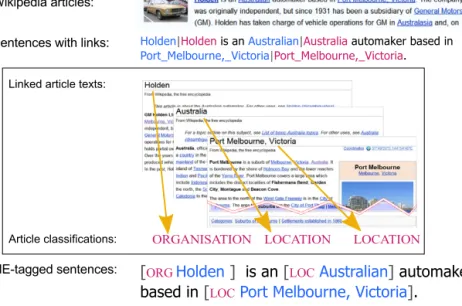
Fig. 1.Deriving training sentences from Wikipedia text: sentences are extracted from articles; links to other articles are then translated tonecategories.
Unfortunately, the need for time-consuming and expensive expert annotation hinders the creation of high-performance
ne recognisers for most languages and domains. This data dependence has impeded the adaptation orporting of existing nersystems to new domains such as scientific or biomedical text, e.g. [52]. The adaptation penalty is still apparent even
when the samenetypes are used in text from similar domains[16].
Differing conventions on entity types and boundaries complicate evaluation, as one model may give reasonable results that do not exactly match the test corpus. Even withinconllthere is substantial variability: nationalities are tagged asmisc
in Dutch, German and English, but not in Spanish. Without fine-tuning types and boundaries for each corpus individually, which requires language-specific knowledge, systems that produce different but equally valid results will be penalised.
We process Wikipedia1—a free, enormous, multilingual online encyclopaedia—to createneannotated corpora. Wikipedia
is constantly being extended and maintained by thousands of users and currently includes over 3.6 million articles in English alone. When terms or names are first mentioned in a Wikipedia article they are often linked to the corresponding article. Our method transforms these links intoneannotations.
In Fig.1, a passage aboutHolden, an Australian automobile manufacturer, links bothAustralianandPort Melbourne, Victoria to their respective Wikipedia articles. The content of these linked articles suggest they are both locations. The two mentions can then be automatically annotated with the correspondingnetype (loc). Millions of sentences may be annotated like this
to create enormous silver-standardcorpora—lower quality than manually-annotated gold standards, but suitable for training supervisednersystems for many more languages and domains.
We exploit the text, document structure and meta-data of Wikipedia, including the titles, links, categories, templates, infoboxes and disambiguation data. We utilise the inter-language links to project article classifications into other languages, enabling us to developnecorpora for eight non-English languages. Our approach can arguably be seen as the most intensive
use of Wikipedia’s structured and unstructured information to date.
1.1. Contributions
This paper collects together our work on: transforming Wikipedia into netraining data[55]; analysing and evaluating
corpora used forner training [56]; classifying articles in English [75] and German Wikipedia [62]; and evaluating on a
gold-standard Wikipedianer corpus [5]. In this paper, we extend our previous work to a largely language-independent
approach across nine of the largest Wikipedias (by number of articles): English, German, French, Polish, Italian, Spanish, Dutch, Portuguese and Russian.
We have developed a system for extractingnedata from Wikipedia that performs the following steps:
1. Classifies each Wikipedia article into an entity type;
2. Projects the classifications across languages using inter-language links; 3. Extracts article text with outgoing links;
4. Labels each link according to its target article’s entity type; 5. Maps our fine-grained entity ontology into the targetnescheme;
6. Adjusts the entity boundaries to match the targetnescheme;
7. Selects portions for inclusion in a corpus.
Using this process, free, enormousne-annotated corpora may be engineered for various applications across many languages.
We have developed a hierarchical classification scheme for named entities, extending on thebbnscheme[11], and have
manually labelled over 4800 English Wikipedia pages. We use inter-language links to project these labels into the eight other languages. To evaluate the accuracy of this method we label an additional 200–870 pages in the other eight languages using native or university-level fluent speakers.2
Our logistic regression classifier for Wikipedia articles uses both textual and document structure features, and achieves a state-of-the-art accuracy of 95% (coarse-grained) when evaluating on popular articles.
We train the C&C tagger [18] on our Wikipedia-derived silver-standard and compare the performance with systems trained on newswire text in English, German, Dutch, Spanish and Russian. While our Wikipedia models do not outper-form gold-standard systems on test data from the same corpus, they peroutper-form as well as gold models on non-corresponding test sets. Moreover, our models achieve comparable performance in all languages.
Evaluations on silver-standard test corpora suggest our automatic annotations are as predictable as manual annotations, and—where comparable—are better than those produced by Richman and Schone[61].
We have created our own “Wikipedia gold” corpus (wikigold) by manually annotating 39,000 words of English Wikipedia
with coarse-grainedne tags. Corroborating our results on newswire, our silver-standard English Wikipedia model
outper-forms gold-standard models onwikigoldby 10% F-score, in contrast to Mika et al.[46] whose automatic training did not
exceed gold performance on Wikipedia.
We begin by reviewing Wikipedia’s utilisation forner, for language models and for multilingualnlp in the following
section. In Section3we describe our Wikipedia processing framework and characteristics of the Wikipedia data, and then proceed to evaluate new methods for classifying articles across nine Wikipedia languages in Section 4. This classification provides distant supervision to our corpus derivation process, which is refined to suit the target evaluation corpora as de-tailed in Section5. We introduce our evaluation methodology in Section6, providing results and discussion in the following sections, which together indicate Wikipedia’s versatility for creating high-performancenertraining data in many languages. 2. Background
Named entity recognition (ner), as first defined by the Message Understanding Conferences (muc) in the 1990s, sets out
to identify and classify proper-noun mentions of predefined entity types in text. For example, in
[PERParis Hilton] visited the [LOCParis] [ORGHilton]
the wordParisis a personal name, a location, and an attribute of a hotel or organisation. Resolving these ambiguities makes
nera challenging semantic processing task. Approaches tonerare surveyed in[48].
Part of the challenge is developingnersystems across different domains and languages, first evaluated in the
Multilin-gual Entity Task[44]. Theconll ner shared tasks[76,77]focused on language-independent machine-learning approaches
to identifying persons (per), locations (loc), organisations (org) and other miscellaneous entities (misc), such as events,
artworks and nationalities, in English, German, Dutch and Spanish. Our work compares using these and other manually-annotated corpora against harnessing the knowledge contained in Wikipedia.
2.1. External knowledge and named entity recognition
World knowledge is often incorporated intonersystems usinggazetteers: categorised lists of names or common words.
While extensive gazetteers of names in each entity type may be extracted automatically from the web [22] or from
Wikipedia [79], Mikheev et al. [47] and others have shown that relying on large gazetteers for ner does not
necessar-ily correspond to increased nerperformance: such lists can never be exhaustive of all naming variations, nor free from
ambiguity. Experimentally, Mikheev et al.[47] showed that reducing a 25,000-term gazetteer to 9000 gave only a small performance loss, while carefully selecting 42 entries resulted in a dramatic improvement.
Kazama and Torisawa [31]report an F-score increase of 3% by including many Wikipedia-derived gazetteer features in theirnersystem, although deriving gazetteers by clustering words in unstructured text yielded higher gains[32]. A
state-of-the-art Englishconllentity recogniser[59]similarly incorporates 16 Wikipedia-derived gazetteers. Unfortunately, gazetteers
do not provide the crucial contextual evidence available in annotated corpora.
2.2. Semi-supervision and low-effort annotation
nerapproaches seeking to overcome costly corpus annotation include automatic creation of silver-standard corpora and
semi-supervised methods.
Prior to Wikipedia’s prominence, An et al. [3]createdneannotations by collecting sentences from the web containing
gazetteered entities, producing a 1.8 million word Korean corpus that gave similar results to manually-annotated data. Urbansky et al.[81] similarly describe a system to learn nerfrom fragmentary training instances on the web. In their
evaluation on Englishconll-03data, they achieve an F-score 27% lower (absolute difference with theMucEvalmetric) with
automatic training than the same system trained onconlltraining data. Nadeau et al.[49]performneron themuc-7corpus with minimal supervision—a short list of names for each netype—performing 16% lower than a state-of-the-art system in
themuc-7 evaluation. Like gazetteer methods, these approaches benefit from being largely robust to new and fine-grained entity types.
Other semi-supervised approaches improve performance by incorporating knowledge from unlabelled text in a super-visednersystem, through: highly-predictive features from related tasks[4]; selected output of a supervised system[86,87,
37]; jointly modelling labelled and unlabelled[74] or partially-labelled [25]language; or induced word class features[32, 59].
Given a high-performance nersystem, phrase-aligned corpora and machine translation may enable the transference of neknowledge from well-resourced languages to others[89,64,69,39,28,21].
Another alternative to expensive corpus annotation is to use crowdsourced annotation decisions, which Voyer et al.
[82]and Lawson et al.[35] find successful forner; Laws et al.[34] show that crowdsourced annotation efficiency can be
improved through active learning.
Unlike these approaches, our method harnesses the complete, native sentences with partial annotation provided by Wikipedia authors.
2.3. Learning Wikipedia’s language
While solutions tonerand related tasks, e.g.nelinking[12,17,45]and document classification[29,66]rely on Wikipedia
as a large source of world knowledge, fewer applications exploit both its text and structured features. Wu and Weld[88]
learn the relationship between information in Wikipedia’s infoboxes and the associated article text, and use it to extract similar types of information from the web. Biadsy et al. [7] exploit the sentence ordering in Wikipedia’s articles about people, harnessing it for biographical summarisation.
Wikipedia’s potential as a source of silver-standardneannotations has been recognised by[61,46,55]and others.
Richman and Schone [61] and Nothman et al.[55] classify Wikipedia’s articles into netypes and label each outgoing
link with the target article type. This approach does not label a sufficient portion of Wikipedia’s sentences, since only first mentions are typically linked in Wikipedia, so both develop methods of annotating additional mentions within the same article.
Richman and Schone [61]createnermodels for six languages, evaluated against the automatically-derived annotations
of Wikipedia and on manually-annotated Spanish, French and Ukrainian newswire. Their evaluation uses Automatic Content Extraction entity types[36], as well asmuc-style[15]numerical and temporal annotations that are largely not derived from
Wikipedia. Their results with a Spanish corpus built from over 50,000 Wikipedia articles are comparable to 20,000–40,000 words of gold-standard training data.
In[55]we produce silver-standardconllannotations from English Wikipedia, and show that Wikipedia training can
per-form better on manually-annotated news text than a gold-standard model trained on a different news source. We also show that our Wikipedia-trained model outperforms newswire models on a manually-annotated corpus of Wikipedia text[5].
Mika et al.[46]use infobox information, rather than outgoing links, to derive theirneannotations. They treat the infobox
summary as a list of key-value pairs, e.g. valuesNicole KidmanandKatie Holmesfor thespousekey in theTom Cruiseinfobox, and their system finds instances of each value in the article’s text, and labels it with the corresponding key.
They learn associations between ne types and infobox keys by tagging English Wikipedia text with a conll-trained ner system. This mapping is then used to project ne types onto the labelled instances which are used as nertraining
data. They perform a manual evaluation on Wikipedia, with each sentence’s annotations judged acceptable or unacceptable, avoiding the complications of automaticnerevaluation (see Section6.2). They find that a Wikipedia-trained model does not
outperformconlltraining, but combining automatic and gold-standard annotations in training exceeds the gold-standard
model alone.
Fernandes and Brefeld [25]similarly use Wikipedia links with automaticnetags as training data, but use a perceptron
model specialised for partial annotations to augment conlltraining, producing a small but significant increase in
perfor-mance.
2.4. Multilingual processing in Wikipedia
Wikipedia is a valuable resource for multilingual nlp with over 100,000 articles in each of 37 languages, and inter-language linksassociating articles on the same topic across languages. Wentland et al.[85]refine these links into a resource for named entity translation, while other work integrates language-internal data and external resources such as WordNet to produce multilingual concept networks[50,51,43]. Richman and Schone[61]and Fernandes and Brefeld [25]use inter-language links to transfer English article classifications to other inter-languages.
Approaches to cross-lingual information retrieval, e.g.[58,67], or question answering[26] have mapped a query or doc-ument to a set of Wikipedia articles, and use inter-language links to translate the query. Attempts to automatically align sentences from inter-language linked articles have not given strong results [1], probably because each Wikipedia language is developed largely independently; Filatova[27] suggests exploiting this asymmetry for selecting information in summari-sation. Adar et al.[2] and Bouma et al. [10] translate information between infoboxes in language-linked articles, finding discrepancies and filling in missing values. Thus nlp is able to both improve Wikipedia and to harness its content and
structure.
3. Processing Wikipedia
Wikipedia’s articles are written using MediaWiki markup,3 a markup language developed for use in Wikipedia. The raw markup is available in frequentxmldatabase snapshots. We parse the MediaWiki markup, filter noisy non-sentential text
(e.g. table cells and embeddedhtml), split the text into sentences, and tokenise it.
MediaWiki allows nestabletemplates to be included with substitutable arguments. Wikipedia makes heavy use of tem-plates for generating specialised formats, e.g. dates and geographic coordinates, and larger document structures, e.g. tables of contents and information boxes. We recursively expand all templates in each article and parse the markup using
mwlib
,4 a Python library for parsing MediaWiki markup. We extract structured features and text from the parse tree, as fol-lows.3.1. Structured features
We extract each article’s section headings, category labels, inter-language links, and the names and arguments of included templates. We also extract every outgoing link with its anchor text, resolving any redirects.
Further processing is required fordisambiguation pages, Wikipedia pages that list the various referents of an ambiguous name. The structure of these pages is regular, but not always consistent. Candidate referents are organised in lists by entity type, with links to the corresponding articles. We extract these links when they appear zero or one word(s) after the list item marker. We apply this process to any page labelled with a descendant of the English WikipediaDisambiguation pages category or an inter-language equivalent.
We then use information from cross-referenced articles to build reverse indices of incoming links, disambiguation links, and redirects for each article.
3.2. Unstructured text
All the paragraph nodes extracted by
mwlib
are considered body text, thus excluding lists and tables. Descending the parse tree under paragraphs, we extract all text nodes except those within references, images, math, indented portions, or material marked byhtmlclasses likenoprint
. We split paragraph nodes into sentences using Punkt[33], an unsupervised, language-independent algorithm. Our Punkt parameters are learnt from at least 10 million words of Wikipedia text in each language.Tokenisation is then performed in the parse tree, enabling token offsets to be recorded for various markup features, particularly outgoing links. We slightly modify our Penn Treebank-style tokeniser to handle French and Italian clitics, and non-English punctuation. In Russian, we treat hyphens as separate tokens to match our evaluation corpus.
3.3. Wikipedia in nine languages
We use the English Wikipedia snapshot from 30 July, 2010, and the subsequent snapshot for the other eight languages,5
together constituting the ten largest Wikipedias excluding Japanese (to avoid word segmentation). The languages, snapshot dates and statistics are shown in Table 1. English Wikipedia at 3.4 million articles is about six times larger than Russian, our smallest Wikipedia. All of the languages have at least 100 million words—comparable in size to the British National Corpus[9].
These statistics also highlight disparities in language and editorial approach. For instance, German has substantially fewer, and Russian substantially more, category pages per article; the reverse is true for disambiguation pages, with one for every 9.8 articles in German.
Table2shows mean and median statistics for selected structured and text content in Wikipedia articles. English articles include substantially more categories, incoming and outgoing links on average than other languages, which together with its size highlights its greater development and diversity of contributors than other Wikipedias.
3 http://www.mediawiki.org/wiki/Markup_spec. 4 http://code.pediapress.com.
Table 1
Summary of Wikipedias used in our analysis. Columns show the total number of articles, how many of them are disambiguation pages, the number of category pages (though not all contain articles), and the number of body text tokens.
Wiki Language Snapshot Articles Disamb. Categ. Tokens
en English 2010-07-30 3 398 404 200 113 605 912 1 205 569 685 de German 2010-08-15 1 123 266 114 404 89 890 389 974 559 fr French 2010-08-02 980 773 61 678 150 920 293 287 033 it Italian 2010-08-10 723 722 45 253 106 902 211 519 924 pl Polish 2010-08-03 721 720 40 203 69 744 126 654 300 es Spanish 2010-08-06 632 400 27 400 119 421 254 787 200 nl Dutch 2010-08-04 617 469 37 447 53 242 123 047 016 pt Portuguese 2010-08-04 598 446 21 065 94 117 120 137 554 ru Russian 2010-08-10 572 625 44 153 140 270 156 527 612 Table 2
Mean and median feature counts per article for selected Wikipedias. Feature
Language en de es nl ru
Mean Med. Mean Med. Mean Med. Mean Med. Mean Med.
Incoming links 67.9 11 38.4 8 36.2 5 41.0 7 46.18 6 Outgoing links 73.8 30 43.3 24 41.2 29 46.8 23 55.6 29 Redirects 1.2 0 0.7 0 1.8 1 0.4 0 1.2 0 Categories 5.6 4 3.5 3 2.8 2 2.0 2 4.3 3 Templates 7.9 4 3.6 2 3.7 2 5.0 2 8.3 4 Tokens 354.8 135 347.2 196 402.9 177 199.3 95 273.4 111 Sentences 14.8 6 17.6 10 14.8 7 10.6 5 14.5 7 Paragraphs 5.3 3 6.0 4 6.2 3 3.9 3 5.6 3
4. Classifying Wikipedia articles
We first classify Wikipedia’s articles into a fixed set of entity types, which can then label links to those articles. Since classification errors transfer into ournermodels, high accuracy is essential. To facilitate this, we reimplement three
classifi-cation approaches from the literature, extending our state-of-the-art method to nine languages, including novel multilingual features (Section4.2). We use two article sampling approaches to create collections of manually-classified Wikipedia articles (Section4.3); Section4.4considers the projection of this data to other Wikipedia versions and languages.
4.1. Background
Wikipedia’s category hierarchy is afolksonomy[71], making it unsuitable for many semantic applications. Suchanek et al.
[72]class each Wikipedia category as eitherconceptual—Holdenis aMotor vehicle company;relational—Holdenwasestablished
in 1856;thematic—Holdenhas themeHolden; oradministrative—Date of birth missing. Non-conceptual categories may include
articles of many different types. For example, products (Apple III), fictional characters (Yoda) and facilities (Cairns Tropical Zoo) are all members of the1980 introductionscategory. Infoboxes are strongly correlated to entity type, but only have high coverage onlocandperarticles.
Since Wikipedia does not have a direct source of entity types, there has been interest in mapping articles to existing ontologies such as WordNet[63,73,57]and Cyc[42], or classifying them into coarser schemes using heuristics[80,6,61]and semi-supervised[83,19,55]or fully supervised modelling approaches[6,19,75,78].
4.2. Article classification approaches
We compare a baseline heuristic, a semi-supervised and a fully-supervised monolingual classification approach from the literature. We then provide three ways to extend the latter approach to multiple languages.
4.2.1. Classification with category keyword heuristics
Richman and Schone [61] produced a set of key phrases from English Wikipedia category names that correspond to
per,loc,organd other entity types (but notmiscor non-entities). When classifying, each article’s categories are matched
against the phrases, backing off to parents and grandparents of those categories, until support for a particular type exceeds a threshold. If the threshold is not met, the article’s type remains unknown. Each key phrase votes with a manually set weight[60].
For example,Queanbeyanhas categoriesCities in New South Wales,Populated places established in 1838,Queanbeyanand
Australian Aboriginal placenames. The key phraseCitiesmight vote for typeloc, but the other categories do not match any
Table 3
Examples and quantity of category keywords for each coarse-grained type.
netype Keyword example Quantity
loc Rivers of,Towns 30
org Organizations,musical groups 27
per Living People,Year of birth 36
misc Television series,discographies 27
non Years,Wikipedia 18
dab Disambiguation 3
Queanbeyancategory has parent categoriesCities in New South WalesandCategories named after populated places in Australia,
soCitiesagain votes forQueanbeyanas aloc.
We attempt to replicate Richman and Schone[61], but the key phrases were unavailable and many of the details were underspecified, so our replica is approximate. For instance, in the case of a tie between types, we randomly choose a type, and we use a support threshold of one to discourage unknowns.
We have created our own list of key phrases, starting with their published examples and adding phrases from large type-homogeneous categories, if the other categories matching those phrases are also type-homogeneous. We have also added phrases for matchingmisc, non-entities (non), disambiguation pages (dab). Table3shows some examples of the 141 keywords, with
the full list inAppendix A.
4.2.2. Classification with keyword bootstrapping
In [55] we developed a semi-supervised approach to classify English Wikipedia articles with relatively few labelled instances.6A small number of structural features are extracted from each article. Iteratively, confident mappings from feature
tonetype are inferred from classified articles, and the classifier is again applied to all of Wikipedia. Over three iterations
(empirically selected), the mapped feature space grows, and the proportion of unknown articles decreases. The following features are used in bootstrapping:
•
Plural category heads: Suchanek et al. [72]suggest that categories with plural head nouns are usually conceptual, such ascities,placesandplacenames—but notQueanbeyan—in theQueanbeyanexample above. We extract head unigrams and collocated bigrams.•
Definition noun: Since many of Wikipedia’s articles begin with a definition, we extract the head unigram or bigram following a copula, if any, from the first sentence, following[31].An article is assigned the type most supported by its features, remaining unknown in a tie. Specialised heuristics identify non-entity articles (non and dab), including the capitalisation of incoming anchor text and title keyword matching for
disambiguation and list pages.
4.2.3. Classification as text categorisation with structured features
The approaches above, along with many in the literature, have relied on the precision of Wikipedia’s structured features. However, the most successful have used statistical models of its body text[19], which may also be more readily ported to new languages.
In[75], we compare Naïve Bayes (nb) and Support Vector Machines (svm) for classifying Wikipedia articles using
bag-of-words and structured features. Here we use the
liblinear
[23]in the logistic regression with L2 regularisation mode. Dakka and Cucerzan[19] suggest that most humans will be able to classify an article after reading its first paragraph. We therefore use the words of the first paragraph, first sentence and title as separate feature groups. In addition, we use template names, and the contents ofinfobox,sidebarandtaxobox templates. These templates often contain a condensed set of important facts relating to the article, and so are powerful additions to the bag-of-words representation of an article.Monolingual classification Having projected our gold-standard classifications to nine other languages via inter-language links, we train monolingual article classifiers for each language.
Multilingual classification Each topic is likely to have different coverage in different Wikipedias. We therefore present two methods for combining the knowledge found in equivalent articles in multiple languages:
voted We learn monolingual classifiers for each language, and classify an article as the most popular vote of its
inter-language equivalents, backing off to English (our best-performing monolingual model) in a tie.
uber We merge the feature spaces of language-linked articles across the nine languages, prefixing each feature name
with the language it came from. We model this extended feature space, and classify each article using features from it and its cross-lingual equivalents.
4.3. Annotating gold-standard classifications
We use manual classifications of Wikipedia pages as indirect supervision fornerand to evaluate our classifiers. However,
it is unclear how best to sample articles. Random sampling produces more challenging instances for evaluation, but we found it under-samples entity types that have few instances but are essential to ner, such as countries[55]. Selecting only
popular articles provides advantages for multilingual processing, and should assist with classifying the entities most frequent in text. We therefore present two sets of labelled articles,popularandrandom. Both are available for download.7
4.3.1. popularlabelled corpus
As previously presented [75,62], we produced a corpus of approximately 2300 English Wikipedia articles (March 2009 snapshot), including the 1000 most frequently-accessed pages of August 20088 and otherwise the pages with most
incom-ing links. We required that each article include inter-language links to all ten largest language Wikipedias. This favoured typically longer, high-quality articles and about popular and useful subjects. It also largely avoided stubs and automatically-generated pages[62].
Each article was double-annotated with a single fine-grained type. We extended the hierarchical scheme frombbn[11],
allowing us to usebbnin laternerevaluations. However, Sekine’s[68]scheme would have been equally suitable. In order to
get an estimate of inter-annotator agreement, about 1000 articles were annotated independently, achieving 97.5% agreement, calculated over a finer type schema than used in the experiments below (agreement on coarse-grainednetypes was 99.5%).
Subsequently, annotation was periodically paused to resolve conflicts.
4.3.2. randomlabelled corpus
The articles in popular are not representative of Wikipedia’s long tail of obscure articles, stubs, and
automatically-generated pages. We therefore annotated a random sample of Wikipedia’s articles to more accurately reflect its make-up: 2500 in English, 850 in German, and 200 in each of the seven other languages. We annotated a few extra articles to allow for MediaWiki extraction errors.
Each article was classified by at least two annotators, of whom at least one was a native speaker or had university-level language skills in the appropriate language.randompresented many more edge cases for classification thanpopular,
making its annotation more time consuming. Nonetheless, all discrepancies were resolved at thenetype granularity used
in the present work.
The annotation followed the method we developed in[75]: annotators were able to add fine-grained types to the hierar-chy as required, leading to very fine distinctions;suburb,admin districtandstateare all subtypes ofloc:gpe. This resulted
in 154 types, which were grouped together to create 62 very fine-grained types, 19 fine-grained types and 6 coarse-grained types. Of the original 154 categories, 67 map tonon, 29 toloc, 14 toorg, 4 toper, and 37 tomisc. Table4gives examples
frompopularandrandom; the mappings are available for download.9
For languages where two fluent speakers were not available, we used Google Translate10 to assist in classification decisions. This approach makes subtle, very fine-grained distinctions difficult. For example, the German word Gemeinde translates totown,borough, orparishdepending on use, each of which may belong in a differentlocsubtype.
In other cases, the extremely fine granularity created annotation disputes. For example, annotators disagreed on whether
Manhattan, an island borough of New York City, should be classified as its own independent city/town, a suburb, or an
island. The annotators resolved their disagreements and annotation guidelines were updated continuously.
Table 5 compares the final sizes of popular andrandom samples, and their distributions over coarse-grained entity
types. Within English Wikipedia,popularcontains far morelocandnonarticles, andrandomis skewed more towardper
andmisc. Therandomtype distribution varies greatly between languages; however, for most, the sample size is small. 4.4. Projecting data between Wikipedia versions
Wikipedia articles are referred to by title, which does not ensure accurate linking since articles may be renamed over time. Our data maps Wikipedia titles from 2008–10 Wikipedia snapshots tonetypes, and we need to transfer these types
to newer Wikipedia snapshots, and across inter-language links.
Sorg and Ciniano[70]analysed the coverage of inter-language links between English and German Wikipedias from Octo-ber 2007: 46% of German pages linked to English, and 14% of English pages had German links. Of the links present, around
7 Fromhttp://schwa.org/resources.
8 According to the Wikipedia proxy logs fromhttp://dammit.lt/wikistats. 9 Fromhttp://schwa.org/resources.
Table 4
Fine-grainednetypes with examples frompopularandrandomcollections.
Fine-grainednetype popularexample randomexample
Location(loc):
Town/City Bangkok Terese, California
GPE Aceh Castel di Judica
Facility Beijing National Stadium Urashuku Station
Other Great Wall of China Bressay
Organisation(org):
Band Blink-182 Transitional (band)
Corporation Atari Logitech
Other Interpol Manchester A’s
Person(per):
Person John F. Kennedy Peter McConnell
Other Yoda Bold Reason
Other(misc):
Event 2008 South Ossetia war 2006 J&S Cup
norp Hungarian People Norts
WorkOfArt Entourage (TV series) Man of the Hour
Product AK-47 Bugatti Type 53
Miscellaneous Capoeira World Habitat Awards
Non-Entity(non):
Life Capsicum Platysilurus
Substance DNA Mango oil
Other Blitzkrieg Canadian units
Disambiguation(dab) California (disambiguation) Lip (disambiguation)
Table 5
Gold-standard classification statistics per corpus: size; percentage of articles with inter-language links to any/English Wikipedia; distribution of coarse entity types, disambiguation pages (dab) and non-entities (non).
Corpus No. of
articles
% inter-lang Coarse type distribution (%)
Any en loc org per misc non dab
popular English 2322 100 – 28 11 11 16 30 4 random English 2531 46 – 20 10 26 18 16 10 random German 872 57 49 19 11 33 13 12 12 random Spanish 203 58 51 28 10 19 19 20 4 random French 210 61 54 22 5 25 20 20 8 random Italian 203 71 64 30 4 23 19 18 6 random Dutch 286 73 63 34 9 17 15 17 8 random Polish 210 68 60 36 4 30 13 11 6 random Portuguese 202 72 66 38 6 17 15 19 5 random Russian 223 62 51 30 8 26 14 13 9
95% were bijective, i.e. linking fromento itsdeequivalent, and back to the sameenpage. Table5gives the proportion of
each language’s articles with inter-language links. In[62] we checked the integrity of a sample of English–German links, and found very few were erroneous.11Confusion between an entity article and a disambiguation page of the same title are
a common source of error.
We assume thatnetype is maintained across an inter-language link and for an article with the same name in different
snapshots of Wikipedia. We do not manually check this, instead applying a naive approach: look up the title, following any redirects; if no such page exists, or the target is a section (not a full article), remove the instance.
For example,enYodalinks to theYodasection ofdeStar Wars Characters, and so is discarded inde. In some cases, two
different articles link to the same title in another language, which is especially problematic when their types differ;Gulf
Coast Wing(org) andAviation(non) both appear inpopular, but both link toAviationin other languages.
Changes over time are handled similarly:Angleseynow redirects toIsle of Anglesey, but the projected type is still valid.
Death (band)now redirects to the subsectionMusicofDeath (disambiguation), and so is discarded.
In the present work, we do not project acrossrandomlanguage links for classification.
11 Bijective links may still have errors, since editors may insert language links without ensuring that the target page exists, or before it is created. The titles may be translations, but the articles on different topics (commonly one is a disambiguation page and the other not). Further, bots exist to check for or ensure bijectivity.
Table 6
Coarse and fine-grained results overpopularfor multilingual text categorisation. textcat
classifier
Coarse-grained Fine-grained
Precision Recall F-score Precision Recall F-score
English 94.6 94.6 94.6 89.9 89.7 89.8 German 94.1 93.9 94.0 89.7 88.6 89.2 Spanish 93.9 93.7 93.8 88.6 87.9 88.2 French 93.9 93.7 93.8 89.8 88.7 89.3 Italian 93.9 93.7 93.8 89.6 88.7 89.2 Dutch 94.0 93.8 93.9 89.1 88.1 88.6 Polish 93.1 92.7 92.9 88.9 87.7 88.3 Portuguese 93.2 93.0 93.1 88.5 87.1 87.8 Russian 93.6 93.3 93.5 88.0 87.1 87.6 voted 94.9 94.8 94.9 89.9 88.9 89.4 uber 94.9 94.8 94.8 89.9 89.3 89.6 Table 7
Coarse-grained EnglishtextcatclassificationF-score when training and testing over different datasets.
Train Test popular random pop+rand
popular 94.6 75.1 83.5
random 91.7 90.4 90.7
pop+rand 95.5 90.7 93.1
Table 8
English coarse-grained classificationF-score overpop+rand.
netype keyword bootstrap textcat voted uber
loc 57.8 89.7 96.8 96.6 96.5 org 58.1 84.1 87.5 87.3 86.4 per 86.7 97.0 97.2 97.5 97.2 misc 45.9 80.7 87.5 87.8 86.8 non 45.3 83.1 91.7 91.6 92.0 dab 80.8 77.4 94.5 93.9 94.3 Total 64.6 87.0 93.1 93.1 92.9
4.5. Results and discussion
We report 10-fold cross-validated precision, recall and F-score, evaluating over: language; classification approach; use of
popular,randomor their combination; and fine (18 types) vs coarse (6) entity types.
The results in Table 6 extend Tardif et al.’s [75] approach to 9 languages, relying on popular’s full complement of
inter-language links. The high coarse-grained performance (94.6%) on English is similar to that previously reported on an older snapshot of Wikipedia; other languages’ monolingual classifiers perform less than 2% worse, proving this approach is effective independent of language.votedanduberresults are almost identical, and only differ marginally from the English
monolingual result, but are often better than other monolingual results. Fine-grained F-scores are 4–6% lower than the coarse equivalents.
Although results on popular are promising in all languages, it is not clear how this applies to Wikipedia’s long tail.
To explore this, we consider every train-test combination of popular,randomand their union (pop
+
rand), withcoarse-grained English results shown in Table 7.popular alone is very poor training forrandom, achieving only 75%, while top
performance on random is about 5% lower than onpopular. Independent of the test corpus, performance is best when
trained withpop
+
rand.This result may be surprising when evaluating on popular, given how much noise may be introduced by random.
However, the combined dataset is about twice as large, and consists of both the longer, better-edited pages with richer features from popular and the variety of random. We selectpop
+
rand for the remaining experiments, given its highperformance and its relative suitability forner.
Table8compares the coarse-grained performance of the three approaches.textcatsignificantly outperforms the boot-strap approach and the keyword baseline, and has the most uniform distribution of performance over types. keyword
performs particularly poorly on the most diverse types, misc andnon, though Richman and Schone [61] did not develop
classifiers for these types.bootstrapperformance is close totextcatonperandorg, but is greatly exceeded onloc,non
anddab. Overall, per, locand dabare easiest to classify, while org and misc are the hardest, a trend which continues
Table 9
Coarse-grained classificationF-score for monolingualtextcatoverpop+rand.
netype English German Spanish French Italian Dutch Polish Portuguese Russian
loc 96.8 96.9 97.8 97.8 97.4 97.7 97.6 98.1 97.8 org 87.5 87.4 88.0 89.0 90.2 89.5 91.1 89.9 89.3 per 97.2 97.5 95.3 95.5 97.8 96.0 94.4 94.0 96.3 misc 87.5 83.5 86.0 86.2 85.3 84.5 84.0 83.8 84.9 non 91.7 91.5 92.7 93.0 92.5 92.1 91.2 91.7 92.0 dab 94.5 95.7 97.7 92.2 93.5 92.6 95.6 94.9 93.2 Total 93.1 92.8 93.4 93.4 93.5 93.0 92.8 92.9 93.2 Table 10
Fine-grainedtextcatclassificationF-score for five monolingual models,votedanduber(evaluating for English), overpop+rand. Count is the total number of gold instances of each type, though fewer are available in each language
netype Count English German Spanish Dutch Russian voted uber
loc:Town/City 568 94.7 96.4 95.4 95.8 95.8 95.2 95.4 loc:GPE 345 86.9 89.9 88.3 89.8 89.9 88.0 87.7 Facility 141 79.9 71.8 31.2 61.5 37.0 76.7 79.3 loc:Other 134 82.9 73.7 55.3 55.4 78.7 82.5 82.9 org:Band 101 93.8 97.1 98.0 98.8 98.7 94.4 92.2 org:Corporation 158 87.4 87.3 92.0 87.7 91.0 88.1 87.7 org:Other 218 76.5 64.2 64.9 59.3 55.5 75.4 74.9 per:Person 871 97.1 99.4 96.9 96.0 97.6 97.6 96.4 per:Other 66 61.1 54.3 69.2 66.7 64.9 64.2 58.8 Event 138 80.6 77.9 68.5 71.0 75.3 77.3 78.1 norp 32 41.9 37.0 56.0 51.9 0.0 35.9 41.9 WorkOfArt 359 89.3 86.3 87.8 87.7 91.5 89.0 87.9 Product 228 87.6 84.8 89.2 87.4 83.9 87.1 86.8 Miscellaneous 65 50.5 5.0 24.4 37.2 29.3 43.7 50.0 Non-entity:Life 276 95.0 94.0 93.8 92.3 93.7 94.6 95.0 Non-entity:Substance 111 73.2 70.7 70.1 73.3 69.9 67.1 74.4 Non-entity 711 83.7 81.5 82.6 81.5 80.7 81.1 83.4 dab 321 94.6 95.2 98.2 92.6 93.8 93.7 94.3 Total 4843 88.7 88.4 87.6 87.4 87.4 88.3 88.4
In Table 10 we show fine-grained classification results in five languages,12 voted and uber. Performance is low for
types which have few training instances, are diverse, and lack defining article structure (such as infoboxes, categories, or geographical coordinates).Non-entityacts as the default type due to its diversity and high frequency: for every classifier,
instances of each other type are misclassified as Non-Entity, including Bugatti Type 53 (Product), British Japan Consular
Service(org:Other),Battle of Pistoria(Event) andThe Star-Spangled Banner(WorkOfArt).norp13is difficult to identify in
all classifiers, and in Russsian allnorparticles are classified asNon-entity.
Entities which function as multiple types challenge our single-label classifiers. While thePopeyeandJames Bondarticles specify that they are about fictional characters (per:Other), they also discuss the related media franchises, so both are
incorrectly classifiedWorkOfArt. Similarly,Facilityarticles are often confused withlocandorgtypes.
Some misclassifications arise from debatable down-mappings of our annotation types. For instance, we group disam-biguation and list pages together asdab, but many list pages include additional content that makes them more similar to nonthan the largely-fixed structure ofdabpages.
Other mistakes are due to our naive approach to modifications of Wikipedia (see Section4.4);Eaglesnow is a redirect to the animalEagle, whereas when the page was annotated, it described the band,The Eagles.
Our overall results for fine-grained classification of English Wikipedia articles compare favourably to Tkatchenko et al.
[78]who report approximately 75% accuracy over randomly-sampled articles labelled with 18 types; we attain 85% accuracy for cross-validation onrandom.
12 We use these languages for
nerevaluation due to available gold-standard corpora.
13 norpis a term used bybbn[11]to refer to national, organisational, religious, or political affiliations in an adjectival form. We use it for nationalities and other non-organisational named groups of people, which are generally consideredmiscinconll ner.
4.6. Summary
We have developed accurate coarse- and fine-grained Wikipedia article classifiers for nine languages. These have been evaluated on both a high-qualitypopulargold standard and a noisier but more representativerandomgold standard. We
find that the combination of popularandrandomtraining data produces the best results. This combined data set trains
ourubermultilingual text-categorisation approach, allowing us to classify all Wikipedia articles and label links to them as netags.
5. Designing a training corpus
Under the broad definition of ner, our basic approach to creating a Wikipedia-derived ne-annotated corpus described
in Section1produces reasonable annotations. However, in order to automatically produce a corpus comparable to existing gold standards, heuristic selection and further refinement of the annotations is required.
While both gold-standard corpora and Wikipedia have some inconsistencies in their markup [56], the former are gen-erally created with strict annotation guidelines, by a small number of annotators, and for the precise purpose of ner. Not
surprisingly, Wikipedia’s link spans and targets often do not directly correspond to theneannotation scheme of a particular
evaluation corpus. Through a set of heuristics, we design Wikipedia corpora that better approximate existing gold standards. In this section, we describe methods we apply to reduce the differences between Wikipedia and gold-standard ner
corpora, beginning with an overview of our approach to identifying these differences.
5.1. Comparingnercorpora
In [56]we describe three approaches for identifying inconsistencies within and between corpora with phrasal annota-tions:
N-gram tag variation: search for internal variations, where the same text span with different tags but identical context appears multiple times in the corpus, as proposed by Dickinson and Meurers[20].
Type frequency: compare the entity type distribution across corpora, by extracting all entity mentions, representing them by their orthography orpos-tag sequences, and comparing aggregates over each type.
Tag sequence confusion: as a simple confusion matrix cannot be applied to phrasal tagging, analyse confusion between the type of each predicted entity and the corresponding gold-standard tag sequence (which may include entity and non-entity portions), and between each gold-standard entity and the corresponding predicted tag sequence. We apply these methods systematically to derive an annotated corpus from English Wikipedia, by comparing toconll
andbbngold-standard annotations. Aware of key issues from our work in English, we mostly use direct inspection to apply
similar methods in other languages. This analysis was performed by the authors (native English speakers) with contributions from volunteers familiar with the Cyrillic alphabet; a second-language speaker of German with some Dutch knowledge; and a native speaker of Spanish.
5.2. Selection approach
We include portions of articles in our training corpus using criteria based onconfidencethat we have correctly identified all entities within that portion, and on itsutilityfor learningner. The size and redundancy of Wikipedia’s content allows us
to discard large portions of the available data. We consider the following baseline criteria:
Confidence: all capitalised words are linked to articles of known entity type.
Utility: at least one entity is marked.
This confidence criterion was designed for general-domain nerin English where capitalisation usually corresponds closely
tones.
In prior work, we applied our baseline criteria to each sentence in Wikipedia. We now consider two additional ap-proaches: (a) upon identifying a token which fails the criteria, remove the containing parenthesised expression, or the whole sentence if not in parentheses; (b) do not require whole sentences, instead selecting the longest confident fragment of some utility from each sentence, following [46]. Often Wikipedia’s parenthesised expressions contain glosses into other languages and other noisy material, removed by (a). Using sentence fragments slightly reduced ournerperformance, while
parenthesis removal improved performance and is used below.
Our confidence criterion is overly restrictive since: it extracts a low proportion of sentences per article; it is biased towards short sentences; and each entity mention is often linked only on its first appearance in an article, so we are more likely to include fully-qualified names than shorter referential forms (surnames, acronyms, etc.) found later in the article. Many conventionally capitalised words, which do not correspond to entities, still cause problems and are discussed below.
Table 11
A summary of conventional capitalisation applying, as a (breakable) rule, in our evaluation languages. Y=yes, capitalised; N=not capitalised; S=sometimes; –=used infrequently outside of entities, so largely irrelevant.
Capitalised? English German Spanish Dutch Russian
Most entities Y Y Y Y Y
Sentence initial Y Y Y Y Y
Common nouns N Y N N N
Days and months Y S N N N
Personal titles Y Y Y S N
Acronyms Y S Y S Y
Roman numerals – – – Y Y
Adjectival entities Y N N S N
5.3. Inferring additional links
In order to increase our coverage of Wikipedia sentences, our system infers additional links. Since Wikipedia style dic-tates that only the first mention of an entity should be linked in each article, we try to identify other mentions of that entity in the same article. We begin by compiling a list of aliases for each article. Then for any article in which we are attempting to infer links, we produce a trie containing the aliases of the current article and all outgoing links. We attempt to find the longest matching string within the trie, starting at each unlinked token in an article, and assign its entity type to the matching text. Aliases for an articleA include:
Type 1 The title ofAand those of redirects14to A(with expressions following a comma or within parentheses removed); Type 2 Titles (and redirect titles) of disambiguation pages linking to A, enabling, e.g.:AMPas an alias for AMP Limited
andAmpere, andHowardan alias forHoward DeanandJohn Howard;
Type 3 The anchor text of all links whose target is A.
We vary the level of inference (e.g. level 2 consists of types 1 and 2) below. The following exceptions help avoid over-generation and noisy links:
•
aliases matching a list of stop-words fromnltk[38];•
aliases whose link boundaries would be adjusted (Section5.6); and•
aliases which are the concatenation of another alias with lowercase words (e.g.Australianis a better match thanAus-tralian people, though both are redirect aliases forAustralia).
Although it introduces many spurious links due to noisy data sources and ambiguity, this additional link inference allows for more variation in how ourne-annotated corpus refers to an entity.
5.4. Anomalous capitalisation
Non-entity links which are capitalised and all-lowercase entity links may be problematic asneannotations. They often
result from mis-classification, or to a link including anein its title, e.g.Greek alphabetorJim Crow laws, in which case it would be incorrect to leave the reference untagged. Lowercase entity links result from common noun phrase references, e.g.
inIn the Ukraine, anarchists fought in the civil war . . ., the anchorcivil warlinks toRussian Civil War. Text containing capitalised
nonlinks (except in German) or lowercase entity links is discarded, except for entities like gzipthat Wikipedia explicitly marks as a lowercase title.
5.5. Conventional capitalisation
European orthographic systems that distinguish alphabet case do so in different contexts, as summarised according to our analysis in Table11. As an exception to our confidence criterion, we attempt to identify non-entity capitalised words for inclusion in our corpus.
Sentence initial If a word which begins a sentence or follows some punctuation (semicolon, left-quote, etc.) is capitalised and unlinked, we consider it safe for inclusion if it is linked to a non-entity (non) article, or is found on a list of commonly
lowercase words. For each language, this list consists of frequent sentence starters from our sentence boundary detection models [33], and a list of words which occurred at least 50 times lowercase, and at least 50 times sentence-initially, in 100,000 Wikipedia articles.
Common nouns In German, all nouns are capitalised, presenting a challenge for our confidence criterion. We compile a list of common nouns using dict.cc, a collaboratively-constructed German–English dictionary. We utilise its translation database15to ignore German unigrams that have only lowercase glosses. Of 251,846 such German entries, we found 230,489
had only lowercase translations, while 17,538 had only capitalised translations.
Germanconllfrequently mentions the German currency, theMark, which is not identified as a common noun because it
is identical to a personal name. We use a list of currency names from German Wikipedia and label them as common nouns when the prior two tokens contain a cardinal. We also mark the wordIin English, assuming it is the personal pronoun.
Days and months English and German month and day names are marked for inclusion.
Personal titles Personal titles (e.g. Dr., Brig. Gen.,Prime Minister-elect) are conventionally capitalised in English and other languages, but are non-entities in conll-style ner (although some are included in bbn). Titles are sometimes linked in
Wikipedia, but allowing a link text like U.S. Presidentas a non-entity would leave the entity U.S. unlabelled. Titles often appear immediately beforepermentions, so the most frequent instances can be compiled into a list of known titles.
In English, these are manually filtered—removing loc ororg mentions—and supplemented with abbreviated titles
ex-tracted frombbn, producing a list of 384 base forms, 11 prefixes (e.g.Vice) and 3 suffixes (e.g.-elect). Using this gazetteer, titles are identified and stripped of erroneous netags. In German, we extracted 203 base titles from Wikipedia, with 5
morphological suffixes and 1 prefix.
Acronyms Our initial approach to acronyms—including all unlinked uppercase words—degraded performance, but we found that including all-uppercase words linked to non-entity articles was successful.
Roman numerals Russian and Spanish make extensive use of capitalised Roman numerals. We identify them with a regular expression and include them in our corpus when unlinked.
Adjectival forms In English, the adjectival forms of entities, such as nationalities or religions e.g.AmericanorIslamic, are capitalised. Bothconllandbbn(see Section6.1) annotate them asmisc. In Wikipedia, nationalities often link tolocarticles.
For English, German, Dutch and Russian, we compile a list of nationalities from Wikipedia words that our postagger
marks as an adjective, and morphological variants to handle cases likeAmericans.16Each link matching this list is relabelled misc. In German and Russian (and Dutch to a lesser extent), where adjectival forms are lowercase, but nominal forms of
nationalities are capitalised, we include the lowercase forms in our corpus when linked, and remove sentences where they appear unlinked.
5.6. Adjusting link boundaries
We unlink certain strings when found at the end of link text: parenthesised expressions; text following a comma forloc, organdper; possessive’sin English; or other punctuation. For example,[LOCSydney, Australia]is adjusted to[LOCSydney],
Australia, and may become[LOCSydney], [LOCAustralia]after link inference to matchconllandbbnannotations.
5.7. Miscellaneous changes
State abbreviations A gold standard may use stylistic forms which are rare in Wikipedia. For instance, the Wall Street Journal (bbn) uses US state abbreviations, while Wikipedia nearly always refers to states in full. We boostbbnperformance
by merely substituting a random selection of US state names in Wikipedia with their abbreviations.
Removing rare cases Personal title abbreviations (e.g. Mr.) are rare in Wikipedia compared to newswire text, so their ap-pearance in entity names can lead to frequent tagging errors. In order to ensure against learning and over-generating these rare entity cases, we explicitly remove English sentences containing title abbreviations appearing in non-perentities such as
movie titles. We also exclude personal names containingof, which are much more common in English Wikipedia’s historical content than in newswire.
Our initial Wikipedia models evaluated on Germanconllgenerated long, spuriousmiscentities containing punctuation.
We therefore excludemiscentities containing quotation marks and other punctuation from German.
Truncated conjunctions For German and Dutch prefix coordinations like[LOCUnder-] und [LOCOber-Lais], we ensure the first prefix is tagged identically to the coordinated term, which is more likely to have an inferred link.
15 Fromhttp://www1.dict.cc/translation_file_request.php, accessed 2010-10-21.
16 While this requires highly language-dependent resources, it is entirely reasonable to consider another entity scheme in whichAmericansis markedloc, as our default automatic annotation approach would label it. We require this more language-intensive approach only because we need to match an existing scheme.
Table 12
Gold standard entity-annotated corpora. Themisccolumn indicates whether the corpus annotates all entities marked inconllasmisc.
Language Corpus Text Number of tokens misc
train dev test
English conll-03 Reuters 1996 203 621 51 362 46 435 Yes
bbn wsj1998 901 894 142 218 129 654 Yes
wikigold Wikipedia 2008 39 007 Yes
German conll-03 Frankfurter Rundschau 1992 206 931 51 444 51 943 Yes
europarl EuroParl 1996 89 708 20 697 Yes
Dutch conll-02 De Morgen 2000 199 069 36 908 67 473 Yes
Spanish conll-02 EFE 2000 264 715 52 923 51 533 Yes
Russian abh Various news 459 125 58 751 58 250 No
Fixing tokenisation While Penn Treebank and conlltokenisation consider hyphenated terms (e.g.Sydney-based) as single tokens, it is rare to infer links to hyphenated terms. We therefore split hyphenated terms into separate tokens before link inference in English, and rejoin them prior to training a model, excluding the sentence if the constituent entity types differ. This approach does not readily apply to languages like German, where hyphenation represents compound nouns like
Anne-Frank-Schule. For Russian, we treat the hyphen as a separate token since the evaluation data contains a number of
hyphens between entities of different types.
6. Evaluation
To evaluate our automatically-annotated corpora, we train the C&C tagger17 (a) with Wikipedia data; (b) with hand-annotated training data; and (c) with both combined, comparing the tagging results of each nermodel on gold-standard
test data.
We apply out-of-the-box theC&CMaximum Entropynertagger with default orthographic, contextual, in-document and
personal name gazetteer features[18]in English. In other languages, we replaced this gazetteer with names extracted from Wikipedia articles listing of common names in various languages, and also supplemented this with first and last names from Wikipedia articles of that language that our classification model identified aspermore than 100 times.C&Coptimises the Maximum Entropy task using Generalised Iterative Scaling over 200 iterations, with smoothing parameter
σ
=
√
2.The text is tagged using the Penn Treebank-trainedC&Cpostagger for English, and TreeTagger[65]with default
param-eters for German, Dutch and Spanish, and “small tagset”18parameters for Russian.nertags are universally represented in iob1as used inconll-03corpora.
Our experiments use 3.5 million tokens of Wikipedia-derived training data.19 Although much greater quantities are available, we are limited by the time and memory required to train a model. To conserve space, we only report results in languages where gold-standard corpora are available.
6.1. Evaluation corpora
Our primary evaluation uses conll 2002–3 shared tasknerannotations on English, German, Dutch and Spanish news
text. In addition, we use other newswire corpora available for purchase—Englishbbnfrom theldcand Russian from Appen
Butler Hill (abh)20; a European Parliament transcript[24]; and a collection of Wikipedia pages with gold-standard ne
an-notations. Where standard train (train), development (dev) and final evaluation (test) divisions are not provided, we have
split the corpora, resulting in the sizes shown in Table12.
We mapbbnandabhannotations toconllentity types (per,loc,org,misc). There are many stylistic and genre
differ-ences between the source texts and their annotation. For example, the Englishconllcorpus formats headlines in all-caps,
and includes non-sentential data such as tables of sports scores. We now describe each corpus and its preprocessing. Theconll nershared tasks [76,77]evaluated machine learning approaches to multilingualner, on Spanish and Dutch
(2002) and German and English (2003). The entity types are common but each language has an idiosyncratic annotation and genre. For instance, Spanish marks no lowercase adjectival nationalities and includes 192 instances where surrounding quotes are included in the entity annotation; Dutch annotates asperthe initials of photographers; and English has lots of
financial and sports data in tables.
17 http://schwa.org/candc.
18 The default Russian TreeTagger tagset has 717 entries, including detailed morphology. SinceC&Conly usesposas a discrete feature, coarse tags are more appropriate.
19 Nothman[54]reported performance over training corpora from 0.25 to 6.5 million tokens (Section 7.2), finding it plateaued at around 3–4 million
tokens.
The bbn Pronoun Coreference and Entity Type Corpus[84] annotates the entire Penn Treebank corpus with 105
fine-grained tags[11]: 54 corresponding to conllentities; 21 for numerical and time data; and 30 common noun types. We
map bbntags toconllequivalents, removing extra tags.21 We use sections 03–21 fortrain, 00–02 fordevand 22–24 for test.
Appen Butler Hill (abh) has produced approximately 500,000 tokens ofne-annotated data in a number of languages. We
use their Russian (RUS_NER001) corpus, consisting of news reports from various sources.abh’sneannotations divideconll’s locinto locations, geopolitical entities and facilities, markconll miscentities only when they are nationalities or religions
(though religious organisations may beorginconll), and mark titles and quantities left unannotated inconll. Because not
all misc entities are marked, we evaluate on abhwithout misc. Of the 1869 articles in the Russian abh corpus, we used
0001–1489 astrain, 1490–1679 as dev, and 1680–1869 astest. We apply the sentence boundary detector and tokeniser
used on our Russian Wikipedia data.
Faruqui and Padó (europarl[24]) present an out-of-domain evaluation for aconll-trained Germannersystem on the
first two German Europarl session transcripts, with conll-style annotation. We used the larger transcript as dev and the
other as finaltest.
For an in-domain evaluation, we use ourconll-style Wikipedia corpus (wikigold[5]). 149 articles from a 2008 snapshot
of English Wikipedia were annotated by three annotators, achieving a Fleiss’ Kappa of 0.83 on ne tokens only, and 0.92
overall. We ensure that none of our English Wikipedia training corpora use the articles included inwikigold.
For each evaluation language we also hold out just over 100,000 tokens of silver-standard Wikipedia annotations, derived using the same method as our training data, but from different Wikipedia articles. We use this to evaluate how predictable our Wikipedia-derived data is in comparison to gold-standard corpora.
6.2. Evaluatingnerperformance
Establishing a sensible evaluation metric for neris challenging[48]. Both the span and type of an entity may be
mis-matched, and the severity of an error depends on the specific instance being evaluated.
muc [14] awards equal score for matching an entity’s type when at least one boundary is correct, and text, where
an entity’s boundaries are matched correctly, irrespective of classification.22 This equal weighting is unrealistic, as some
boundary errors are highly significant, while others are arbitrary (for example, the inclusion of punctuation,Mr.orthe).
conllonly awardsExactphrasal matches—requiring correct type and text—providing a lower-bound measure ofner
per-formance. Manning[40]argues that this style of evaluation favours systems that leave entities with ambiguous boundaries untagged, since boundary errors incur false positives and false negatives simultaneously.
We present our results using micro-averaged F-score for both metrics, for comparability to theconllshared task
litera-ture and theMucEvalresults reported by Richman and Schone[61]. 6.3. Statistical significance of results
For each pair of systems (trained on different corpora), we consider the null hypothesis that their F-scores differ only by chance. We apply approximate randomisation[53], in which we randomly keep or swap the outputs of the two systems for each sentence, and reevaluate the difference between the resulting pseudo-systems’ Exactoverall F-scores. If the
dif-ference between F-scores is greater than the original in less than 50 of 9999 such trials (i.e.p
0.
005), we reject the null hypothesis and consider the results significantly different.7. Results
7.1. Wikipedia-derived training corpora
For each evaluation language we classify all articles with anubermodel in each language trained onpop
+
rand, and seta hand-picked threshold of 0.5 on
liblinear
’s confidence, below which we consider an article’s classification unknown (unk). This threshold gives reasonable coverage in all entity types, but exploits Wikipedia’s redundancy by discarding entitieswith doubtful classifications. In English we retain classifications (asnetypes ornon) for 96% of all articles after applying
this threshold.
We produce five training corpora, each of around 3.5M tokens, for each target language:
•
wiki-base applies ne types to links, and uses our basic utility and confidence criteria, loosened to allow capitalisedsentence starters and German common nouns.
21 We map:loc:=fac∪gpe∪location;org:=organization;per:=person;misc:= event∪language∪law∪norp∪product∪work_of_art.
22 The muc scorer maximises F-score over the possible mappings between gold and predicted entity mentions. Each of {type,text} for mapped
mention pairs is marked as correct (C) or incorrect (I). Those which cannot be mapped are consideredspurious(S) predictions, or gold mentions
missing (M) in prediction. Then P:= |C|
|C|+|I|+|S| and R:= |C|+||CI|+|| M| [13]. Note that when evaluating performance for a particular entity type t, I:=(goldtmentions mapped to predictions¬t). As a result, per-type precision fails to account for false positives with the same span as a gold men-tion.