Exact and heuristic algorithms for network
alignment using graph edit distance models
Thesis for obtaining the title of Doctor of Natural Science
of the Faculty of Natural Science and Technology I of Saarland University
by
Rashid Ibragimov, M.Sc. Saarbrücken August, 2014
Day of Colloquium Feb. 5, 2015
Dean of the Faculty Prof. Dr. Markus Bläser Chair of the Committee Prof. Dr. Volkhard Helms First reviewer Prof. Dr. Jan Baumbach Second reviewer Prof. Dr. Jiong Guo Third reviewer Prof. Dr. Raimund Seidel Academic Assistant Dr. Marc Hellmuth
Zusammenfassung
In dieser Arbeit werden theoretische und praktische Aspekte der Anwendung des GED(Graph Edit Distance)-Modells auf PPI (Protein-Protein-Interaktions)-Netzwerke untersucht. Hierbei werden werden ausschließlich topologische Infor-mationen von Graphen verwendet. In zweiten Teil werden einige theoretische Eigenschaften des Modells untersucht, formuliert als drei verschiedene Problem-stellungen. Im dritten Teil werden drei Heuristiken zur approximativen Lösung des PPI-Netzwerk-Alignmentproblems präsentiert, basierend auf einem GED-Modell, dass die Anzahl gelöschter und neu eingefügter Kanten auswertet. Es folgen Zusammenfassungen der wichtigsten Kapitel dieser Arbeit.
Baumüberdeckung mit Sterngraphen (CTS). In Kapitel 3 werden die Komplexitätsgrenzen einer der einfachsten Formulierungen der GED – Baum-Editierdistanz mit Einfügen und Löschen von Kanten (Tree Edit Distance with edge Insertions and Deletions, TED-ID) untersucht. Dabei wird ein spezieller Fall betrachtet und als CTS umformuliert. CTS untersucht ob es möglich ist, gegeben ein Baum und eine Menge Sterngraphen, so Kanten zu den Sterngra-phen hinzuzufügen, dass der resultierende Graph isomorph zum Baum ist. Das wichtigste Ergebnis von Kapitel 3 ist der Beweis der NP-Schwere von CTS. Aus diesem Beweis folgt, dass auch TED-ID NP-Schwer ist, selbst wenn der Durchmesser der Eingabebäume auf maximal zehn begrenzt ist. Wir beweisen außerdem, dass CTS in polynomieller Zeit lösbar ist, wenn der größte Stern nicht größer als eine Konstante kist.
Nachbarschaftserhaltende Zuordnung (NPM) auf Bäumen.In Kapitel 4 wird NPM, eine neue Generalisierung des Graphisomorphismusproblems einge-führt. Die Eingabe von NPM umfasst zwei Graphen und drei Ganzzahlen, l, d und k. Das Problem besteht darin, den ersten Graphen ohne höchstensk Kan-ten (diese werden IsolationskanKan-ten genannt) auf den zweiKan-ten abzubilden. Mittels der Parameterlunddwird für jeden betrachteten Knotenvdes ersten Graphen spezifiziert welche Nachbarn vonv(innerhalb einer Umgebung der Größel) auch im zweiten Graphen nah genug beim Bild vonv liegen müssen (innerhalb einer
Umgebung der Größed). Für NPM wird angenommen, dass Graphen mit einer kleineren Isolationsmenge sich ähnlicher sind, da weniger Editierungsoperatio-nen benötigt werden um diese ineinander umzuwandeln. Das Hauptergebnis der Untersuchung von NPM auf Bäumen betrifft dessen Komplexität. Während be-stimmte Werte für l, dund k eine Berechnung in polynomieller Zeit erlauben, führen andere zu einem NP-schwerem Problem. Interessanterweise ist NPM auf Bäumen sogar dann NP-schwer, wenn die Abbildung den ersten Baum in den zweiten “quetscht”, das heißt für die Fälle dass d > l und l ≥ 3. Obwohl alle Beweise der NP-Schwere in dieser Arbeit auf Reduktionen des selben Problems (3-Partition) basieren, ist der Schlüssel jedes Beweises das Verständnis der Struktur der zu konstruierenden Bäume in Abhängigkeit der Eingabeparameter. Kompaktheitserhaltende Zuordnung (CPM) auf Bäumen.In Kapitel 5 wird CPM, eine weitere Generalisierung des Graphisomorphismusproblems, be-trachtet. Die Eingabe von CPM besteht aus zwei Graphen und zwei Ganzzahlen l und d, wobeil die gleiche Bedeutung hat wie in NPM. Der Parameter d ent-spricht dem “Gesamtfehler” der erlaubt ist wenn Nachbarn eines Knotensv im ersten Graphen auf den zweiten abgebildet werden: Gegeben die SummeLv der
Distanzen zwischenv und dessen nächsten Nachbarn, sowie die SummeL0 v der
Distanzen zwischen den Bildern vonvund den Bildern der nächsten Nachbarn, untersucht CPM ob es eine eins-zu-eins-Abbildung zwischen beiden Graphen gibt, sodass für jeden Knoten v gilt:L0v−Lv ≤d. Einerseits beschränkt CPM
die Formulierung von NPM mit k= 0 und lockert sie andererseits: Im Gegen-satz zu NPM ist es möglich, dass einige Kanten weiter entfernt als dabgebildet werden, aber die meisten Kanten sind näher beisammen. Es wird erwartet, dass zwei Graphen ähnlicher zueinander sind je kleiner der Wert d für eine Lösung von CPM gewählt werden kann. In Kapitel 5 wird CPM auf Bäumen untersucht und eine Gegensätzlichkeit der Komplexität von CPM bezüglich verschiedener Werte von lunddpäsentiert.
Netzwerkalignment mittels BCO.Für praktische Anwendung sind effizien-te Heuristiken vonnöeffizien-ten, die eine optimale Lösung aproximieren können, ins-besondere da die Berechnung der Graph-Editierdistanz (GED) NP-schwer ist. In Kapitel 8 wird die erste Heuristik dieser Arbeit, NABEECO, beschrieben. NABEECO approximiert die GED mit Hilfe einer nachgeahmten Bienenkolo-nie, die den Suchraum durchwandert und die Lösung dadurch verfeinert. Wir demonstrieren die Leistungsfähigkeit von NABEECO anhand echter Protein-Protein-Interaktionsdaten. Trotz guter Ergebnisse ist die aktuelle Implementie-rung nicht effizient genug in der Vermeidung lokaler Minima. Sie schafft zum Beispiel den Selbstalignment-Test nicht, sondern erreicht für die meisten Einga-begraphen nur etwa 85% der Optimallösung.
5 Netzwerkalignment durch evolutionären Algorithmus (EA). In Kapi-tel 9 wird GEDEVO beschrieben, ein neuer Algorithmus zur Lösung des Ali-gnmentproblems für Paare von Netzwerken. GEDEVO nutzt einen evolutionären Algorithmus um die GED zu optimieren. Die wichtigsten Vorteile dieses Ansat-zes sind seine Einfachheit und Flexibilität. Wir führen elementare evolutionäre Operationen auf einer Abbildung aus. Dank des GED-Modells können diese von allen möglichen relevanten Daten zusätzlich unterstützt werden. Zu den Nach-teilen von GEDEVO gehören lange Laufzeiten und hoher Speicherbedarf. Auf echten Daten wird demonstriert, dass dieser Ansatz vergleichbar ist mit anderen aktuellen Methoden zum Netzwerkalignment und diese sogar oft übertrifft, ob-wohl nur topologische Informationen verwendet werden. Außerdem wird gezeigt, dass unser Ansatz ein perfektes Selbstalignment findet, ganz im Gegensatz zu anderen Methoden. Diesen Test zu bestehen sollte eine Mindestvoraussetzung für jeden Netzwerkalignmentalgorithmus sein.
Mehrfach-Metzwerkalignment durch evolutionären Algorithmus.In Ka-pitel 10 wird GEDEVO-M, eine Heuristik zum Alignment mehrerer Netzwerke beschrieben. Dafür wird die gesamte GED über mehrere Netzwerke als Opti-mierungskriterium definiert und der evolutionäre Algorithmus aus Kapitel 9 an-gewendet. Entsprechend werden die evolutionären Operatoren von GEDEVO erweitert und die Methode sowohl mit eukaryotischen als auch mit bakteriellen PPI-Netzwerken getestet, ebenfalls unter alleiniger Verwendung von topologi-schen Informationen. Wir zeigen außerdem, dass GEDEVO-M den Selbstalign-ment-Test besteht, indem es mehrere identische Kopien eines Netzwerks perfekt aligniert. Die Laufzeit hängt jedoch von der Anzahl der Eingabenetzwerke ab: Mit wachsender Anzahl von Netzwerken wächst der Suchraum exponentiell und somit auch die von GEDEVO-M benötigte Zeit, mehrere identische Kopien eines Netzwerks zu alignieren. Um die Methode besser auf größere Netzwerke anwen-den zu können, sollte die zur Laufzeit benötigte Zeit verbessert weranwen-den, zum Beispiel durch die Begrenzung des Suchraums mit Hilfe zusätzlicher relevanter biologischer Daten.
Abstract
In the thesis we aim to study theoretical and practical questions of applying the graph edit distance (GED) model to the protein-protein interaction network alignment problem using topological information of graphs only. In Part II we explore some theoretical aspects of the model formulated as three different prob-lems; Part III presents three heuristics for the PPI network alignment problem based on a GED model that counts the number of deleted and inserted edges. In the following we summarize the major contribution of the work.
Covering Tree with Stars (CTS). In Chapter 3 we study the complexity border of one of the simplest formulations of the Graph Edit Distance problem – Tree Edit Distance with edge Insertions and Deletions (TED-ID). Here, we consider a special case of the problem and reformulate it as CTS. CTS asks if, given a tree and a set of stars, we can connect the input stars by adding edges between them such that the resulting tree is isomorphic to the input tree. The main result of Chapter 3 is the proof that CTS is NP-hard. From the proof it also follows that TED-ID is also NP-hard, even if the diameter of the input trees is bounded by 10. We also show that for CTS with the size of the largest star being bounded by a constantkthe problem becomes polynomial-time solvable. Neighborhood-Preserving Mapping (NPM) on trees. In Chapter 4 we introduce a new generalization of the graph isomorphism problem, called NPM. The input of NPM consists of two graphs and three integers l, d and k. The problem asks if the first graph without at most k vertices, called isolation ver-tices, can be mapped to the second graph. Using parameters l andd, for each mapped vertex v in the first graph we specify which neighbors of v (vertices within distance l from v) have to be mapped close enough (within distanced) to the image of v in the second graph. In NPM, the graphs with smaller size of the isolation set are thought to be more similar as less edit operations are required. We study NPM on trees and as the major result of the chapter we present a dichotomy of classical complexity of NPM on trees with respect to different values of l, d and k. Interestingly, NPM on trees is NP-hard even if
the mapping forces the first tree to “squeeze” into the second, i.e. ford > land l ≥3. Despite the fact that all NP-hardness proofs in this thesis are based on reductions from the same problem (3-Partition), the key of every proof is the understanding of the structure of the trees to construct depending on the input parameters.
Compactness-Preserving Mapping (CPM) on trees. In Chapter 5 we consider another generalization of the graph isomorphism problem, called CPM. The input of CPM consists of two graphs and two integerslandd. The meaning of the parameter lis the same as in NPM. The parameter dcorresponds to the total “error” that is allowed when close neighbors of a vertexvin the first graph are mapped to the second graph: Given the sumLv of distances betweenvand
its close neighbors, and the sumL0
vof distances between the image ofvand the
images of the close neighbors of v, CPM asks if there is a one-to-one mapping between the graphs such that for every v, L0
v−Lv ≤ d. From one side CPM
constrains NPM formulation with k = 0 and relaxes it from another side: In contrast to NPM it is possible that some vertices are mapped at distance greater than d, but most of the vertices have to be closer to each other. Two graphs are thought to be more similar if there is a mapping as solution for CPM with a smaller value ofd. In Chapter 5 we study CPM on trees and present a dichotomy of classical complexity of CPM with respect to different values ofl andd. Network Alignment with Bee Colony Optimization. From a practical side, despite the fact that computing GED is NP-hard, efficient heuristics are required that are able to approximate an optimal solution. In Chapter 8 we describe the first heuristic presented in the thesis, called NABEECO. Approxi-mating GED, NABEECO adopts an artificial bee colony strategy to traverse the search space and refine its solutions. We demonstrate the performance of NABEECO on a set of real protein-protein interaction data. Despite the relatively good performance of the strategy, its current implementation is not efficient enough in escaping local minima. For example it failed to pass the self-alignment test, resulting in about 85% of the optimal solution on most input graphs.
Network Alignment with Evolutionary Algorithm. In Chapter 9 we present a novel algorithm, called GEDEVO, for the pairwise network alignment problem. GEDEVO aims to optimize GED by exploiting an evolutionary strat-egy. The main advantages of the approach are its simplicity and flexibility: We perform elementary evolutionary operations on a mapping, which are guided by any relevant data that can be incorporated thanks to the GED model. Among its disadvantages are high running times and memory consumption. On a set of real data sets we demonstrate that our approach is comparable to and often
9 outperforms the current tools for Network Alignment using topological informa-tion only. We show that, in contrast to other tools, our approach is also able to find a perfect alignment on a self-alignment test, which should be a requirement for any network alignment tool.
Multiple-Network Alignment with Evolutionary Algorithm. In Chap-ter 10 we present a heuristic, called GEDEVO-M, for the multiple network alignment problem. Here, we define the total graph edit distance on multiple networks as an optimization criterion and apply the evolutionary strategy pre-sented in Chapter 9. Correspondingly, we extend the evolutionary operators of GEDEVO and evaluate the approach in two settings by aligning two sets of eu-karyotic and bacterial PPI networks using topological information only. We also show that GEDEVO-M is able to pass a self-alignment test where it perfectly aligns several copies of a network. However, the running time here depends on the number of input networks. Since with a growing number of input networks the search space grows exponentially, the time required by GEDEVO-M to align multiple copies of the same network also raises exponentially. For the further exploitation of the method on bigger networks, the execution time should be improved by, for example, constraining search space using relevant biological data.
Preface
This thesis summarizes the work that I have done since April 2011 on approach-ing the network alignment problem usapproach-ing the graph edit distance (GED) models. The work was done within the scope of a collaboration effort between two re-search groups “Efficient Algorithms for Hard Problems” and “Computational Systems Biology” lead by Jiong Guo and Jan Baumbach, respectively. The the-sis conthe-sists of three parts: a common introduction, and two parts that present our findings on theoretical aspects of different models of Network Alignment and practical results on applying the GED model to Network Alignment using graph topology information only.
The initial idea of applying the graph edit distance model to biological net-work analysis was proposed by my scientific advisors. At the beginning of my studies I came across the protein-protein interaction (PPI) network align-ment problem where the graph edit distance model has an intuitive interpre-tation. Here, due to evolutionary conservation, PPI networks of more closely related species should have more aligned interactions (matched edges between the graphs).
On practical side, the network alignment problem required a practical soft-ware tool that is able to work with real-world data. Since the problem is known to be NP-hard, one of the priorities was to find an efficient heuristic that would have made it practically tractable. I started experimenting with heuristics that combine multiple approaches such as graph edit distance models, greedy strate-gies, and A∗based search. However, despite all my efforts, all the methods I tried
had one inherent problem – they did not provide reasonable scalability and hence were practically unusable for larger networks. At some point I came up with the idea of randomizing the search process by applying evolutionary and other nature inspired strategies to the problem. Even though similar approaches had been tried before in the pattern recognition area, previous works lacked efficient traversal of the search space on more general graphs (including PPI networks). With my input and constant supervision together with Maximilian Malek and Jan Martens we developed two tools, called GEDEVO and NABEECO, that ex-ploit evolutionary and bee colony optimization strategies to approximate GED in the context of the PPI network alignment. NABEECO and GEDEVO with
their comparison results to current network alignment tools were presented at the
Genetic and Evolutionary Computation Conference (GECCO’13) and German
Conference on Bioinformatics (GCB’13), respectively. Next, I substantially
ex-tended GEDEVO’s code, including redeveloping evolutionary operators, to make it work on multiple networks. The resulting paper on multiple network align-ment was presented at the Genetic and Evolutionary Computation Conference
(GECCO’14).
Besides the practical aspects, it was also interesting to know if an efficient exact algorithm can be derived and where the border of the NP-hardness is. It was clear that as consequence of the the subforest isomorphism problem, the general Tree Edit Distance problem with edge Insertions and edge Deletions (TED-ID) is NP-hard. Jiong suggested to consider Covering Tree with Stars (CTS)that was derived from TED-ID. In close collaboration with Jiong, we first derived a polynomial-time algorithm for CTS with fixed size of the largest star. Though, it took me longer time to prove that CTS is NP-hard, even if the diameter of the input tree is bounded by 10. I presented our finding on CTS at
the International Computing and Combinatorics Conference (COCOON’13).
In parallel to CTS I worked on another theoretical problem. I formulated Neighborhood-Preserving Mapping (NPM)that on one side can be seen as a graph edit distance model (isolation set) and on the other side relaxes edge-to-edge correspondence, generally required in problems on graphs. Together with Jiong we considered NPM between trees. Here, I came up with all proofs and algorithms, except the NP-hardness proofs of NPM for the casesk >0 and l > d≥1, whose NP-hardness were proven by Jiong. I presented our findings at theAlgorithms and Data Structures Symposium 2013 (WADS’13).
Having finished with NPM, I proposed another problem that was called Compactness-Preserving Mapping (CPM). Similarly to NPM on trees, it is easy to show the equivalence of CPM on trees and the tree isomorphism prob-lem for their unrelaxed cases. However, it was interesting to know where the relaxation switches the problem to NP-hard cases. Relatively fast I came up with general ideas for tree structures in the NP-hardness proofs for CPM on trees, except the casel = 2 and d= 2. I first was able to derive NP-hardness proofs for l = 2 and d= 6, and then l = 2 andd = 4. However, most of the proofs and algorithms turned out to be technically more involving than in NPM, and it took me several months to write them up. In the algorithm for the case l = 1 andd= 1 of CPM, we did not know if it is NP-hard to resolve the con-figuration in the second phase of the algorithm. Interestingly, I recognized that this step can be considered as a case of the Constrained WeightedP2-Packing on Bipartite Graphs problem, that was casually mentioned at a talk of Qilong Feng at COCOON’13. The final results on CPM were presented at the25th Annual
Acknowledgments
My studies were funded and supported by the International Max Planck Re-search School for Computer Science (IMPRS), the Cluster of Excellence “Multi-modal Computing and Interaction” (MMCI), the Saarbrücken Graduate School of Computer Science, and the Center for Bioinformatics. I would like to express my appreciation and thanks to my supervisors Jan Baumbach and Jiong Guo for giving me a chance to pursue PhD studies and for advising me and keeping an eye on my progress and development in the field of algorithm theory and bioin-formatics. I would like to take the opportunity to thank Prof. Volkhard Helms for being the chair of my defence and Dr. Marc Hellmuth for taking the role of the scientific assistant. I am very thankful to Prof. Raimund Seidel, who kindly agreed to be the third reviewer of my thesis. I am also very grateful to all the people from administrative staff that maintain such a wonderful environment for scientific studies, in particular, Jennifer Gerling, Sabine Nermerich, Mona Linn, Stephanie Jörg, Polina Quaranta, Dr. Michelle Carnell, and the members of the IT help desk. I thank all the colleagues from our group, including Peng, Richy, Josch, Anne-Christin, Nic, Chris, Max, Maha, and Jan, for their helpful discussions, sharing input, and feedback. My special thanks are to Maximilian Malek and Sanjar Karaev for proofreading my thesis, and Gulnaz Mullayanova and my parents for supporting me throughout the studies.
Contents
Page
Part I
Introduction
19
1. Introduction 21
1.1 Motivation . . . 21
1.2 Graph Edit Distance . . . 22
1.3 Structure of Thesis . . . 23
1.4 Publications . . . 24
Part II
Topological Models of Network Alignment
25
2. Background and Related Work 27 2.1 Tree Modification Problems . . . 272.2 Related Work . . . 29
2.3 Preliminaries . . . 32
3. Covering Tree with Stars 35 3.1 NP-Completeness Results . . . 36
3.2 CTS with Bounded Distinct Stars . . . 41
4. Neighborhood-Preserving Mapping on Trees 47 4.1 NPM on Trees withk= 0 . . . 48
4.1.1 NP-Hardness Results . . . 48
Casel < d,d >1,k= 0 . . . 48
Casel≥d,d≥3,k= 0 . . . 49
4.1.2 Polynomial-Time Solvable Cases . . . 51
Casel= 2,d= 2,k= 0 . . . 52
4.2 NPM on Trees withk >0 . . . 56
4.2.1 Two Input Trees . . . 57
4.2.2 l=d= 1,k >0, and a Tree and a Path as Input . . . . 59
5. Compactness-Preserving Mapping on Trees 67
5.1 NP-Hardness Results . . . 68
5.1.1 Casel= 1,d≥2 . . . 68
5.1.2 Casel= 2,d≥2 . . . 74
5.1.3 Casel≥3,d≥0 . . . 79
5.2 Polynomial-Time Solvable Cases . . . 86
5.2.1 Casel= 1,d= 0 . . . 86
5.2.2 Casel= 2, d= 0 . . . 86
5.2.3 Casel= 1, d= 1 . . . 88
5.2.4 Casel= 2,d= 1 . . . 93
5.3 ILP Formulation of CPM with Isolation Set . . . 95
6. Discussions and Outlook 97
Part III
Heuristics for Network Alignment Using Graph
Edit Distance Models
101
7. Background and Related Work 103 7.1 Introduction . . . 1037.2 Pairwise Network Alignment . . . 104
7.3 Multiple Network Alignment . . . 107
8. Network Alignment with Bee Colony Optimization Strategy 109 8.1 Problem definition . . . 109
8.2 Data . . . 113
8.3 Methods . . . 113
8.3.1 Initialization Step . . . 114
8.3.2 Solution Gathering Step . . . 114
8.3.3 Termination Step . . . 115
8.4 Evaluation . . . 116
9. Evolutionary Algorithm for Network Alignment 119 9.1 Methods . . . 119
9.1.1 Initial Population Generation and Evaluation of an Indi-vidual . . . 120
9.1.2 Offspring generation . . . 120
9.1.3 Termination and Running Time . . . 121
9.2 Evaluation . . . 122
10.Evolutionary Algorithm for Multiple Network Alignment 127 10.1 Problem definition . . . 127
Contents 17
10.3 Data . . . 132 10.4 Evaluation . . . 132
11.Discussions and Outlook 135
Part I
1
Introduction
1.1 Motivation
With the invention of the high throughput methods for detection of interactions between proteins a great amount of data has become available to the scientific community. At the web site of the National Center for Biotechnology Informa-tion we find registered sequencing projects for>1500 eukaryotes,>8500 prokary-otes, and >3000 viruses with>8 000 000 gene sequences in total [1]. However, the genes’ function is often unclear and most-widely deduced from similarities to the sequences of genes with known functions. Consequently, there is still a lack of fundamental knowledge about crucial genetic programs, the interplay of genes and their products (the proteins), their biochemical regulations and their evolu-tionary appearance. Very little is known about such processes as cell regulation, reproduction, differentiation, and motility in response to changing internal and external conditions. Many problems in understanding these issues have to do with networks that model the interplay of all kinds of biological entities [2]. Most widely known are transcriptional gene regulatory networks and protein-protein interaction (PPI) networks. More than 150 million binary interaction evidences from protein-protein interactions that are stored on more than 28 globally dis-tributed servers and can be accessed through PSICQUIC [3] may serve as an example for the ongoing “data explosion”.
Comparing biological networks, particularly protein-protein interaction net-works from different organisms, has proven very useful for inferring biological function, besides relying on DNA sequence similarity alone [4, 5]. Several prob-lems have been formulated to analyze and compare PPI networks: network motif discovery, protein clustering, network query, and network alignment [6, 7]. In particular, Network Alignment aims to find a node-to-node correspondence between two (or more) biological networks to identify evolutionarily and func-tionally conserved parts between the input networks. A quality criterion of a mapping usually reflects topological aspects and biological aspects, such as the
number of matched interactions induced by a mapping of the nodes from two networks, or a similarity of the biological sequences underlying the nodes.
We can distinguish the following main features of the currently available biological networks:
• The biological networks can be modeled as various types of graphs: vertex/ edge-weighted or unweighted, directed or undirected, labeled or unlabeled. For example, PPI networks that are usually modeled as unweighted graphs, can also be represented as edge-weighted graphs by adding confidence val-ues for interactions.
• The reconstructed networks are incomplete and noisy. It is estimated in yeast, which is one of the best studied organisms, only 50% of all interac-tions are known; for human this number corresponds to only 10% [8]. On the other hand some interactions that were detected are invalid.
• Besides the topological information that can be derived from the net-works themselves, additional biological data from various sources requires a proper integration. For example, many network alignment tools integrate all-to-all pairwise BLAST scores or BLAST E-values from protein sequence comparisons [9]. Such values are helpful in building a proper protein-to-protein correspondence, but relying on them alone is not sufficient and can even be misleading (see for example [10]).
Taking these properties of biological networks into account, the graph edit distance model appears to be a promising approach that addresses these issues, given there exists an efficient and reliable algorithm approximating it.
1.2 Graph Edit Distance
Given two graphs, the graph edit distance (GED) is defined as the sequence of edit operations that transforms one graph to another and that has minimal editing cost. Introduced in [11], GED can be seen as a natural generalization of the string edit distance and tree edit distance to general graphs. GED re-quires defining a set of edit operations and the corresponding cost function. The edit operation may include deletion/insertion/substitution of edges and vertices. Substituting one vertex from the first graph with a vertex from the other graph should reflect how dissimilar these two vertices are. Thus, for proper costs of edit operations, it can be shown that GED satisfies the properties to be a metric. In contrast to the exact “isomorphism” definitions when comparing graphs, GED is flexible, error-tolerant and allows modeling networks of any nature. Unfortu-nately, computing an optimal editing cost for even simplest definitions of GED is NP-hard and can be done with exact methods for relatively small graphs only.
Structure of Thesis 23
Till now, GED has been mainly exploited for classification and clustering of graphs in the context of the field of pattern recognition. The editing cost of GED there serves as a metric between graphs. Many heuristics have been proposed to approximate the cost of GED. The methods vary from relaxations of integer linear programs and spectral decomposition to artificial neural networks and simulated annealing. In contrast to relatively small (with normally up to 100 nodes end edges) networks in the pattern recognition field, biological networks often have thousands of nodes and edges. Therefore, applying GED still remains challenging and development of efficient heuristics is required.
1.3 Structure of Thesis
The thesis is divided into three parts. The current “introductory” part provides a motivation for applying the graph edit distance model to network data in bioinformatics. The other two parts present the studies that are of two sides. First, since the general formulation of GED is NP-hard, we aim to identify the complexity border for some of its simplest versions. Second, since GED comes as a general approach to compare graphs, including relatively large biological networks of various types, the development of efficient heuristics is required. Correspondingly, the second “theoretical” part introduces three problems related to GED and studies them when the input graphs restricted to trees, and in the third “practical” part we present heuristics for protein-protein interaction network alignment.
Part II starts with an overview of the results related to GED to highlight the difficulty of the problem and introduces necessary notations (Chapter 2). Chapter 3 studies one of the simplest formulations of GED with edge insertions and deletions on trees (TED-ID) and a related to it the Covering Tree with Stars problem (CTS).
In Chapters 4 and 5 we introduce two new problems, NPM and CPM, that extend the notion of edge preservation, that is common for many classical prob-lems on graphs, such as the graph isomorphism problem. We study how the problem complexity changes depending on the degree of relaxation of the edge preservation. The last chapter of Part III discusses the results and indicates fur-ther interesting problems. The findings of Chapters 3, 4, and 5 were presented in [12] (and the journal version [13]), [14], and [15], respectively.
Part III starts with an overview of the methods and tools for Network Align-ment. Then, in Chapters 8 and 9, we present two nature inspired heuristics for the pairwise global network alignment problem using topological information only. We develop two fairly general tools for Network Alignment (NABEECO and GEDEVO) that exploit a bee colony optimization strategy and evolutionary computation to align networks. Using a graph edit distance model that counts
the number of deleted and inserted edges, we compare our methods to other tools for Network Alignment. In Chapter 10 we extend the definition of the pairwise global network alignment problem to multiple networks. Here, using GEDEVO’s strategy, we aim to minimize the sum of pairwise graph edit distances. The last chapter of Part III indicates the possible extensions of the proposed approaches and gives some further directions for studies in the filed of network alignment. The results described in Chapters 8, 9, and 10 were presented in [16], [17], and [18], respectively.
1.4 Publications
Ibragimov, R., Malek, M., Baumbach, J., Guo, J.: Multiple graph edit dis-tance – simultaneous topological alignment of multiple protein-protein interac-tion networks with an evoluinterac-tionary algorithm. In: Genetic and Evoluinterac-tionary Computation Conference, GECCO 2014, ACM (2014) 277–283
Baumbach, J., Guo, J., Ibragimov, R.: Compactness-preserving mapping on trees. In: Combinatorial Pattern Matching - 25th Annual Symposium, CPM 2014. Volume 8486 of LNCS., Springer (2014) 162–171
Baumbach, J., Guo, J., Ibragimov, R.: Covering tree with stars. In: Comput-ing and Combinatorics, 19th International Conference, COCOON 2013. Volume 7936 of LNCS., Springer (2013) 373–384 (journal version: Journal of Combina-torial Optimization 29(1), (2015) 141–152)
Ibragimov, R., Malek, M., Guo, J., Baumbach, J.: GEDEVO: an evolutionary graph edit distance algorithm for biological network alignment. In: German Conference on Bioinformatics 2013, GCB 2013. Volume 34 of OASICS., Schloss Dagstuhl - Leibniz-Zentrum für Informatik (2013) 68–79
Ibragimov, R., Martens, J., Guo, J., Baumbach, J.: NABEECO: biological net-work alignment with bee colony optimization algorithm. In: Genetic and Evo-lutionary Computation Conference, GECCO 2013, ACM (2013) 43–44
Baumbach, J., Guo, J., Ibragimov, R.: Neighborhood-preserving mapping be-tween trees. In: Algorithms and Data Structures - 13th International Sympo-sium, WADS 2013. Volume 8037 of LNCS., Springer (2013) 427–438
Part II
Topological Models of
Network Alignment
2
Background and Related
Work
2.1 Tree Modification Problems
Graphs are one of the most common representations of objects and relations between them in many fields: computational biology, computational chemistry, computer vision, pattern recognition, etc. The natural need to analyze and compare such objects has stimulated the development of various indicators that reflect differences of vertices and edges and also differences in their topologies. In many applications, two graphsG1andG2are thought to be equal only if their topologies are identical. In this context, the cost in the Graph Edit Distance problem (GED) is one of the most common measures for the graphs, which has been extensively used in graph matching in particular [19]. The general definition of GED is as follows. Given two graphs, GED asks to compute a
sequence of the edit operations that transforms one graph into another and that
has the minimalediting costover all possible such sequences. Depending on the
application, theset of edit operationsmay include relabeling, deletion, insertion,
contraction of edges and relabeling, deletion, insertion, or splitting of vertices. The cost function that maps edit operations and their arguments to nonnegative numbers is also application-specific and may, for example, depend on whether the graphs are labeled, weighted, directed, etc. The cost of an edit operation corresponds to the amount of distortion induced by the operation. Irrespective of the exact problem-specific definition of GED, the main concept behind it is that the more similar two graphs are, the closer they will be in the problem space, and the lower is the cost of the optimal edit sequence.
In one of the simplest formulations of GED, the set of edit operations contains only deletion and insertion of edges with the input graphs having the same number of vertices. Here, the evidence for the cost of the edit distance can be computed from the corresponding one-to-one mapping between the vertices
application of GED is limited by its complexity since computing the edit distance between two graphs is not easier than the subgraph isomorphism problem, which is known to be NP-complete [20].
In this part of the thesis we explore some theoretical borders of complexity for three different problems related to Graph Edit Distance. We will require both input graphs to be trees since in this case many graph problems become easier. First, we consider a variation of GED with edge insertions and edge deletions as edit operations on trees (Chapter 3). Further, we relax the notion of “edge preservation” that is commonly used in graph problems: An edge is preserved if the images of two adjacent vertices in the first graph are also adjacent in the second graph. We define two new generalizations of the graph isomorphism problem where we require that for any pair of neighboring vertices their images also remain to some extent close to each other in the second graph (Chapters 4-5).
In Chapter 3 we aim to explore the complexity border of Graph Edit Dis-tance and study the Tree Edit DisDis-tance problem with edge Insertions and edge Deletions (TED-ID). We formulate a special case of this problem as Cover-ing Tree with Stars (CTS) that is defined as follows. Given a tree T and a set S of stars, CTS asks if it is possible to connect the stars inS by adding edges between them such that the resulting tree is isomorphic to T. We prove that in the general setting, CST is NP-complete, which implies that TED-ID is also NP-hard, even when both input trees have diameters bounded by 10. We also show that, when the number of distinct stars is bounded by a constant k, CTS can be solved in polynomial time, by presenting a dynamic programming algorithm running inO(|V(T)|2
·k· |V(S)|2k) time.
The study presented in Chapter 4 is motivated by the following idea. In Network Alignment, if subnetworks in two networks are conserved, then the neighborhoods of the corresponding nodes are also conserved. We formalize this idea by introducing a variation of the graph isomorphism problem, where, given two graphsG1 = (V1, E1) and G2= (V2, E2) and three integers l,d, andk, we seek for an isolation set D ⊆V1 and a one-to-one mapping f : V1 →V2, such that |D| ≤kand for every vertexv ∈V1\D and every vertex u∈Nl
G1(v)\D
we have f(u)∈Nd
G2(f(v)). Here, for a graph Gand a vertexv, we useN
i G(v)
to denote the set of vertices that have distance at mostitov inG. We call this problem Neighborhood-Preserving Mapping (NPM). The main result of Chapter 4 is a complete dichotomy of the classical complexity of NPM on trees with respect to different values ofl, d, andk. Additionally, we present an integer linear program formulation of NPM and two dynamic programming algorithms for the cases of NPM when one of the input trees is a path.
In Chapter 5 we partially constrain the formulation of NPM and consider another variation of the graph isomorphism problem. Given two graphs G1 =
Related Work 29
(V1, E1) andG2 = (V2, E2) and two integersl and d, we seek for a one-to-one mapping f : V1 → V2, such that for every v ∈V1, it holds that L0
v−Lv ≤d, where Lv :=Pu∈Nl G1(v) distG1(v, u), L 0 v := P u∈Nl G1(v)
distG2(f(v), f(u)) , and
Ni
G(v) denotes the set of vertices which have distance at mostitov in a graph
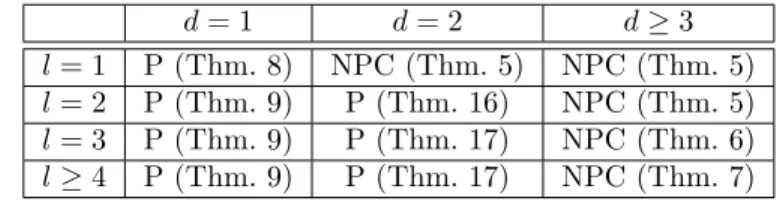
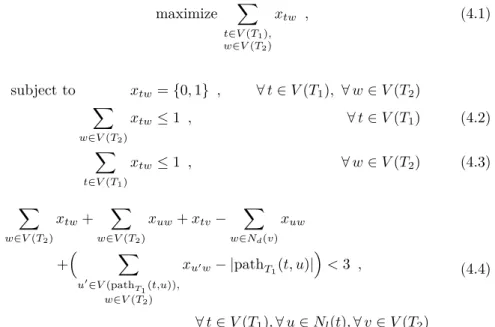
G. We call this problem Compactness-Preserving Mapping (CPM). We study CPM with input graphs being trees and present a dichotomy of classical complexity with respect to different values of l and d. CPM on trees can be solved in polynomial time only if l ≤ 2 and d ≤ 1. Additionally, we present an integer linear program formulation for an optimization version of CPM that, for the given parameters l and d, minimizes the sizek of the isolation set; the isolation set here is defined in the same way as in NPM.
Next we provide a brief overview of the related work and introduce the nec-essary notation and definition that will be used throughout Part II.
2.2 Related Work
Graph Edit Distance is closely related to several graph problems and their vari-ations, namely Subgraph Isomorphism, Maximum Common Subgraph, graph modification problems, and Graph Packing.
Graph Edit Distance. First, to give an intuition about the difficulty of GED consider one of its simplest, yet realistic cases: The input graphs are unlabeled and undirected, and the set of edit operations includes deletion and insertion of edges and vertices with unit cost per operation. Here, if the cost of GED is 0 (i.e. no vertex or edge insertions or deletions are required), then the input graphs are isomorphic. However, there is no known polynomial time algorithm for Graph Isomorphism (it is not known to be in P or NP-complete yet). The best known algorithm for Graph Isomorphism requiresO(2√n·logn) time [21].
IfG1is a subgraph ofG2, then the corresponding cost of GED has the lowest value over all possible input graphs with the same number of vertices and edges; the cost here equals to (|V2|−|V1|)+(|E2|−|E1|), which corresponds to inserting |V2| − |V1| vertices and |E2| − |E1| edges. However, Subgraph Isomorphism is NP-hard [20].
Exact algorithms for GED, such as based on A* [22] or its integer linear program formulations [23, 24] currently cannot be applied to graphs with larger number of veritces (> 100). However, even guaranteed approximate solutions can be helpful in many problems, e.g. clustering of graphs. A lower bound for the cost of GED can be obtained in polynomial time by relaxation of its integer linear program formulation. In [25], another method to obtain a lower bound for the cost was proposed: The approximation is computed by resolving a bi-partite graph matching (in O(n3) time) that is built using pairwise distances
between vertices of the input graphs. These distances are computed from the differences between corresponding vertices and the lowest possible differences between the incident edges (stars). As a starting point for studying approxima-bility of GED may serve a so-called Graph Transformation (GT) problem, that given two graphs and an integerk, asks if the first graph can be made isomorphic to the second graph by relocating (inserting and deleting) ofkedges. In [26] it was proved that the optimization version of GT with respect tokis APX-hard, meaning that for GT there exists a polynomial-time approximation algorithm with a performance guarantee bounded by a constant factor of the optimum, and no polynomial-time approximation scheme exists (unless P=NP). Due to the hardness of GED, many heuristics based on a wide range of techniques were proposed for practical applications (see for example [19] and [27]). We review some of the methods with applications to Network Alignment in Chapter 7. Subgraph Isomorphism. Subgraph Isomorphism, which can be considered as a special case of GED, remains NP-hard even if the first graph is a tree and the other graph has treewidth of two [28]. Even parameterization of the prob-lem by different values (such as maximum degree, number of vertices, number of connected components, treewidth, pathwidth, genus, etc.) leaves little hope for real-world data [29] due to high running times. A number of optimization versions of Graph Isomorphism were considered in [30] (see also [31]). In partic-ular, it was shown that for the problem that maximizes the number of matched vertex pairs and for any constantα <1, there is anα-approximation algorithm running in timenO(logn/(1−α)4). Another closely related to GED problem is the Maximum Common Subgraph problem (MCS) which, given two graphs, asks to find subsets E0
1 ⊆ E1 and E20 ⊆ E2, such that two graphs G01 = (V1, E1)0 andG0
2= (V2, E02) are isomorphic and |E1|0 is maximal. Indeed, the equivalence between MCS and GED with a specific cost function was shown in [32].
Clearly, on top of these results it can be seen that GED is even more com-plicated than Subgraph Isomorphism.
Subtree Isomorphism. In contrast to general graphs, isomorphism problems on trees are known to be polynomial-time solvable. Given (unrooted) trees T1 andT2, Subtree Isomorphism asks to find a subtree ofT2 which is isomorphic to T1or decide that there is no such subtree. One of the first algorithms solving the problem requires O(n5/2) time [33] (see also [34]), where n is the size of input trees. The running time was improved to O(n5/2/logn) in [35]. In the case of Tree Isomorphism the problem can be solved in linear time [36]. In contrast to Subtree Isomorphism, the related Subforest Isomorphism problem that, given a forestF and a treeT, asks whetherF is isomorphic toT, was shown to be NP-hard [20]. Moreover, in Chapter 3 we show that the problem remains NP-NP-hard
Related Work 31
even if the forest is a collection of stars and the height of the tree is bounded by 10.
Tree Edit Distance. Similar to Graph Edit Distance, the Tree Edit Distance problem between trees T1 and T2 is defined a sequence of edit operations that transforms T1 into T2 and has the lowest editing cost. A number of studies were focused on rooted labeled ordered and unordered trees with a set of edit operations that includes relabeling, deleting and inserting of edges and vertices. A rooted tree is ordered if there is a linear order among siblings of every vertex. Here, the operations of deletion and insertion do not decompose the tree into a forest, but preserve the hierarchy. That is, if a vertex v is deleted, then the children of v become the children of the parent ofv instead ofv. Oppositely, a vertexv is inserted as a child of a vertexuwith (consecutive) subset of children of u; these children become the children of v. The ordered version was first shown to be solvable in O(n5) time [37], wheren is the number of vertices in the input trees. The running time was consecutively improved toO(n4) in [38], then to O(n3logn) in [39], and finally to O(n3) in [40]. The latter running time was also shown to be worst-case optimal for the decomposition strategy algorithms. A more refined algorithm was presented and evaluated in [41]. For unordered trees the problem becomes NP-hard [42] and MAX SNP-hard [43], which means that no polynomial-time approximation scheme exists for the prob-lem (unless P=NP). Further results on the tree edit distance probprob-lem, includ-ing parameterization and approximation algorithms, can be found for example in [44, 45, 46, 47, 48, 49, 50].
Graph Modification Problems. Another set of problems related to GED in-cludes graph modification problems. Here “modifications” may include such op-erations as edge/vertex deletion or insertion, and the aim is to convert the input graph into a graph that satisfies a certain property with the minimum number of modifications. The property of the resulting graph can be transitivity, com-pleteness, acyclicity, planarity, etc. Unfortunately, for many such properties the corresponding problems are NP-hard: A general result for edge/vertex deletion problems was presented in [51, 52]. A summary of results for edge modification problems can be found in [53] and [54].
Graph Packing and Graph Covering. Another class of problems closely related to GED consists of so-called packing problems. Given a graph G and a graph H, the H-packing problem asks to find a subset G0 of edge-disjoint
subgraphs of G, such that each element of G0 is isomorphic to H and
G0 has
maximum cardinality. Another related problem is called H-covering, which, given a graph Gand a set of graphsH, covers the vertices of Gby a minimum number of copies of graphs from H, such that every vertex of G is covered
exactly once. In [55] it was proven that theH-packing packing (as well as the H-covering problem) is NP-complete even ifH is a graph with three connected vertices. Note, the classical matching problem, i.e., whenH is a path of length one, the problem is solvable in polynomial time [56, 57]. Different versions of the covering problem where all graphs are rooted trees were studied in [58].
2.3 Preliminaries
In the following we provide notations and definitions used throughout Part II. Graphs. We consider only simple undirected graphs without self-loop. Given a graph G, we use V(G) and E(G) to denote the vertex and edge sets of G, respectively. The number of vertices in a graphGis denoted by|G|or|V(G)|.
We call a graphP = (V(P), E(P)) a path if there is a permutation of the
vertices i1, . . . , i|V(P)|, such that (vik−1, vik)∈E(P), fork= 2, . . . ,|V(P)|, and
|E(P)|= |V(P)| −1 (thelength of the path). The vertices of degree 1 in the
path are called theend-vertices. A path in graphGis a subgraph ofGwhich is a path. By pathG(v, u) we denote a shortest path connecting verticesv and u
in a graph G.
The (direct)neighborhoodof a vertexvin a graphG, denoted byNG(v), is the
set of vertices which are adjacent tov. Thedegreeofvis|NG(v)|. We useNG[v]
to denoteNG(v)∪{v}. ThedistancedistG(u, v) between two verticesu, v∈V(G)
is the length of the shortest path between u and v in G. The diameter of a
graph G is defined as the maximal distance between two vertices in G. For any integer i > 1, we call the set of vertices that have distance at mosti to v
thei-neighborhood of v, denoted byNi
G(v). Theexact i-neighborhoodNˆ i G(v) of
vertex v∈Gis a set of vertices that have the distance of exactlyi tov inG.
A forest is a graph without cycles, while a tree is a connected forest. The
degree-one vertices of a tree are called the leaves, and the others are the internal vertices. A subtree is a connected subgraph of a tree. Arooted tree T is a tree with one vertex designated to be the root of T. Given a rooted tree T, T(v) denotes the subtree consisting of a vertex v ∈ V(T) and all its descendants in T. For vertices uand v of an unrooted treeT, the subtreeT(u) with T rooted at v is denoted by T(u, v). A star is a tree with at most one internal vertex.
This internal vertex is then called thecenter of this star. The size of a starS is the number of edges inS. A singleton is an isolated vertex.
The graphP2is a path of length two. AP2-packing of sizeqin a graphGis a collection ofqvertex-disjointP2’s in G.
Given two graphsG and G0 and an injective mapping f : V(G0)
→ V(G), called a subisomorphism, such that for all (v1, v2) ∈ E(G0), (f(v1), f(v2)) ∈
Preliminaries 33 covered iff−1(v)
6
=∅. The graphGiscoveredwith the graphG0 if the mapping
f is bijective. Aninduced subgraph of a graphGis a graphG0= (V0, E0), with
V(G0)⊆V(G) and E(G0) = {(v, u) :v, u∈V(G0)} ∩E(G). GraphsGand G0
are isomorphic if there exists a one-to-one mapping f : V(G) → V(G0), such
that (u, v)∈E(G) iff (f(u), f(v))∈E(G0).
Complexity. We use the standard “big-Oh” notation to denote the asymptotic upper bound for the running time of algorithms.
Ifg(n) is the worst running time of an algorithm with an input of sizenand f(n) is a function such that there exist constants c >0 and n0 >0 satisfying g(n)≤c·f(n) for alln≥n0, then we writeg(n) =O(f(n)).
The NP-hardness of problems considered in the thesis is proven by reductions from the following problem:
3-Partition
Input: A multisetAof 3nintegersa1, . . . , a3n and an integerB.
Question: CanAbe partitioned intonsubsets such that each subset contains exactly three integers and the sum of the integers in each subset isB?
In [20] it was shown that3-Partitionremains NP-hard even when every integer in Ais bounded by a polynomial inn.
3
Covering Tree with Stars
Restricting general graph in Graph Edit Distance to trees branched in investi-gating variations of the tree edit distance problem. In this chapter we aim at exploring the complexity of computing the edit distance between trees with the edit operations affecting only the edges, namely, deleting and inserting edges:
Tree Edit Distance with Edge Insertion and Deletion (TED-ID) Input: TreesT1 andT2, a non-negative integerd.
Question: Can we modifyT1by adding or deleting at mostdedges in it such that the resulting tree is isomorphic toT2?
TED-ID is partially motivated by alignment of backbone trees extracted from protein-protein interaction networks of different species. Here, large continuous regions of aligned subtrees can serve as strong indication for biologically mean-ingful node-to-node correspondence, easing at the same time matching of the other, not matched, nodes of the networks.
Given a solution for TED-ID, we can perform the edit operations in the order of first deleting edges from the first tree, resulting in a forest, and then inserting other edges to connect the forest. Thus, the problem of transforming a given forest to a given tree by deleting zero edges and adding a number of edges can be considered as a separate phase of the tree edit distance problem. We observe that, the NP-completeness of the subforest isomorphism problem [20] implies that this edge addition problem is NP-complete. By a simple reduction from 3-Partition [20], we can even prove the NP-hardness for the forest being a collection of paths.
Motivated by these NP-hardness results, we consider another restriction on the components of the forest, that is, all components being stars, and intend to find a boundary of the complexity for the tree edit distance problem:
Covering Tree with Stars (CTS) Input: A collection of starsS and a treeT.
Question: Can we connect the stars inS by adding edges between them such that the resulting tree is isomorphic toT?
One can consider CTS as using the stars to cover the vertices of the tree. We use |S| to denote the number of stars inS and k the number of distinct stars in S. Moreover, let V(S) and V(T) be the set of the vertices in the stars ofS and T, respectively. Clearly, we can assume |V(S)| = |V(T)|. Moreover, the number of edges added to the stars is exactly|S|−1. CTS can also be formulated as a matching problem betweenS and T. Here, one is seeking for a one-to-one mapping f from V(S) toV(T) such that f “preserves” the edges inS, that is, ifu, v∈V(S) are adjacent, thenf(u) andf(v) must be adjacent. We obtain a classification of the complexity of CTS with respect to the numberkof distinct stars inS: CTS can be solved in polynomial time, ifkis bounded by a constant; otherwise, this problem is NP-complete. The latter is shown by a reduction from 3-Partition. As a corollary of this NP-complete result, we show that TED-ID remains NP-hard, even when both trees have bounded diameters. CTS resembles the subgraph packing problem, which, given graphs G and H, asks to find the maximum number of vertex-disjoint subgraphs in Geach of which is isomorphic to H. However, the problem is NP-hard for any H with more than two vertices [55]. My contribution here is the NP-hardness proof for CTS and the polynomial time algorithm for CTS when the size of the largest star is bounded by a constant.
3.1 NP-Completeness Results
We first show that the edge addition problem to transform a forest to a tree is NP-hard even for a forest being a collection of paths. Then we show the NP-hardness of the general setting of Covering Tree with Stars (CTS), that is, there are unbounded many distinct stars in S. As a corollary of this hardness, we prove that TED-ID is NP-hard, even when both trees have bounded diameters.
Theorem 1. Given a collection of paths F and a treeT, transformingF toT
by edge additions is NP-hard.
Proof. To prove the NP-hardness, we reduce from the3-Partitionproblem.
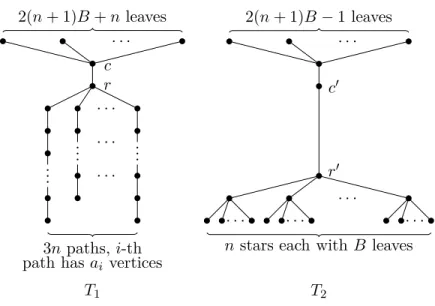
Given an instance (A, B), the corresponding collectionFconsists of 3npaths of lengthai−1 fori= 1, . . . ,3n. Every path corresponds to one distinct element
ofA. There is also one additional pathpof length 2B. The corresponding tree T is composed ofn+ 2 paths of lengthB−1 connected withn+ 2 edges to one additional vertexr; for each of these paths, there is an edge betweenrand one of its end-vertices.
To connect all 3n+ 1 paths fromF by 3n edge additions, we are forced to map the middle vertex of pathpto vertexrin the tree. The other vertices ofp have to be mapped to two paths of lengthB−1 inT. It is not hard to see that
NP-Completeness Results 37
the remaining 3n paths from F can be mapped to unmapped vertices in T, if and only if there is a 3-partition of set A.
Theorem 2. CTS is NP-complete.
Proof. Clearly, CTS is in NP, since we can guess|S| −1 edges between the stars
in S in polynomial time and the isomorphism testing between two trees can be done in polynomial time [59]. We reduce again from3-Partition.
Given an instance (A, B), we can safely assume that 0 ≤ ai < B for
eachi= 1, . . . ,3n. We construct an instance (S, T) of CTS in the following way. First,Sconsists of five subcollections of stars. The first one has only one “large” star, denoted asSL, which hasn4·B+nleaves. The second subcollectionS2 con-tains 3nstars, one-to-one corresponding to the integers inA. For each integerai
withi= 1, . . . ,3n, we add a star withn3
·B+aimany leaves toS2. The third
subcollection S3 contains 2B·n stars. More precisely, for eachi= 1, . . . , n, we create a collectionS3, which contains 2Bi stars, each havingM
i :=n2·B+imany
leaves. We set S3=Sni=1S3. Moreover, we create for eachi i= 1, . . . , na collec-tionSi
4withB·Mistars, each havingNi:=n·B+ileaves, and setS4:=S
n i=1S
i
4. Finally, the last subcollection S5 consists ofP
n
i=1(n·2B·Mi·Ni) many
“sin-gletons”.
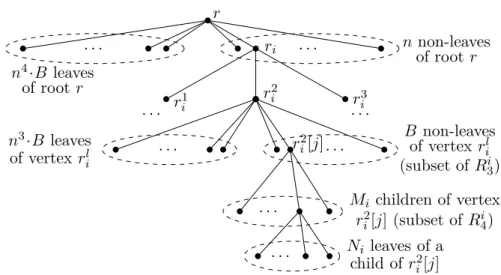
Next, we construct the treeT. To ease the description, we describeTas a tree rooted at a vertexr, which hasn4
·B many leaves as children (see also Fig. 3.1 for the depiction of tree T). In addition, rhasnchildren r1, . . . , rn, which are
the roots ofnsubtrees, denoted asT1, . . . , Tn. LetR1 be the set ofr’s children.
For eachi= 1, . . . , n, the vertexrihas three childrenrilwithl= 1,2,3. LetR2
be set containing all 3nchildren of the non-leaf vertices inR1. Each vertexrl i∈
R2 has n3
·B leaves as children. In addition, rl
i has other B children ril[j]
withj = 1, . . . , B, at which the subtreesTl
i[j] are rooted. Let Ri3 be the set of the non-leaf children rl
i[j] of r l
i for alll = 1,2,3. Clearly, |R i 3| = 3B. We set R3:=Sn i=1R i 3. Finally, in eachTl
i[j],rli[j] hasMi =n2·B+i many children,
each of which has again Ni =n·B+i many leaves as children. The set Ri4 contains all children of the vertices in Ri3, that is,
|Ri
4| = 3B ·Mi. We set
R4:=Sn
i=1R
i
4. This completes the construction ofT.
Since every integer and thusB are bounded by a polynomial ofn, the con-struction of (S, T) clearly needs polynomial time. Next, we prove that (A, B) is a yes-instance iff (S, T) is a yes-instance.
“=⇒”: Let A1, . . . , An be a partition of A with |Ai| = 3 and Pa∈Aia = B
for each i= 1, . . . , n. A mappingf betweenV(S) andV(T) can be derived as follows. First, map the center of the large star SL to the root rof T and SL’s
leaves to the children of r. Then, for each i = 1, . . . , n, let Ai = {a1i, a
2
i, a
3
i}.
For each l = 1,2,3, we map the center of the star S in S2, which corresponds to al
. . .
. . .
n
4·
B
leaves
of root
r
n
non-leaves
of root
r
. . .
. . .
. . .
. . .
n
3·
B
leaves
of vertex
r
ilB
non-leaves
of vertex
r
li(subset of
R
i3)
. . .
M
ichildren of vertex
r
2i[
j
] (subset of
R
i4)
. . .
N
ileaves of a
child of
r
i2[
j
]
r
r
ir
i1r
i2r
3ir
i2[
j
]
Fig. 3.1: The treeT of CTS corresponding to an instance of3-Partitionin the proof of Thm. 2
subtree Ti. Moreover, n3·B many leaves of S are mapped to the n3·B leaf
children of rl
i. The remaining ali leaves of S are then mapped to the non-leaf
children of rl
i. Note that r l
i has now B−a l
i unmapped children and r
1 i, r 2 i, r 3 i
have together 2B unmapped children. Let E be the set of unmapped children of r1
i, r2i, ri3 and D:=Ri3\E. Clearly, E ⊆ Ri3. Now, we map the centers of the stars in Si
3 to the vertices in E. Since each of the vertices in E has exactly Mi = n2·B +i many children, the leaves of the stars in S3i can be mapped to the children of the vertices in E. By this way, all stars in S3 can be mapped to the tree. Note that each of the children of the vertices in E hasNi =n·B+i leaves as children, which are still unmapped. Now consider
the stars inS4. Recall that|Si
4|=B·Miand each star inS4i hasNileaves. Note
that the vertices inDare mapped to the leaves of the stars inSi
2and each vertex inD hasMimany children, each of which has againn·B+ileaves as children.
By|D|=B, we can conclude that the stars inSi
4can be mapped to the subtrees rooted at the children of the vertices in D. Finally, recall that, in the above analysis, each of the children of the vertices inE hasNi:=n·B+iunmapped
leaves as children. Thus, in each subtreeTithere are exactly 2B·Mi·Ni many
unmapped leaves. Summing up over all Ti’s, the singletons in S5 can then be mapped. Since we always map the leaves of a star together with its center, the mapping clearly satisfies the edge-preserving condition.
NP-Completeness Results 39
“⇐=”: Letf be a mapping fromV(S) toV(T). In order to prove this direction, we need the following claims. The first three claims follow directly from the degrees of the root and the vertices inR2 andR3.
Claim 2.1: The center of the large star SL has to be mapped to the root r
ofT, and the leaves ofSL one-to-one to the vertices inR1.
Claim 2.2: The centers of the stars in S2 have to be mapped one-to-one to the vertices in R2.
Claim 2.3: The centers of the stars inS3 have to be mapped to the vertices in R3.
By Claim 2.2, the stars inS2 and thus the integers inA are partitioned by the mapping f into n subsets, denoted by A1, . . . , An, such that |Ai|= 3 for
all i= 1, . . . , n. It remains to prove thatP
a∈Aia=B for alli = 1, . . . , n. To
this end, we need the following claim, which is true, since a star inS2 has more leaves than the number of leaf children of a vertex in R2 and mapping a leaf in T to a singleton is never better than mapping it to a leaf of a star inS. Claim 2.4: If (S, T) is a yes-instance, then there is a mapping such that the leaf children of the vertices inR2are all mapped to the leaves of the stars inS2. According to Claims 2.3 and 2.4, 2nB vertices inR3 have to be mapped to the centers of the stars in S3 and the remaining vertices have to be mapped to the leaves of the stars in S2. Since we can w.l.o.g. assumeP
a∈Aa=nB, the
following claim holds.
Claim 2.5: The centers of the stars inS4 have to be mapped to the vertices in R4.
In order to prove P
a∈Aia = B for all i = 1, . . . , n, we apply a backward
induction fromi=ntoi= 1. Fori=n, letAn={a1n, a2n, a3n}and letSn1, Sn2, S3n
denote the three stars in S2, which correspond to the integers inAn and whose
roots are mapped to r1
n, r2n, rn3, respectively. By Claim 2.4, totally
P3
j=1a
j n
leaves of the starsS1
n, Sn2, Sn3have to be mapped to the vertices inRn3. Moreover, Claim 2.3 and the fact that the stars inSn
3 have more leaves than all other stars in S3j with j < nimply that the centers of the stars in S3n have to be mapped to the vertices in Rn 3. With|S n 3|= 2B and |R n 3|= 3B, we know P3 j=1a j n≤B.
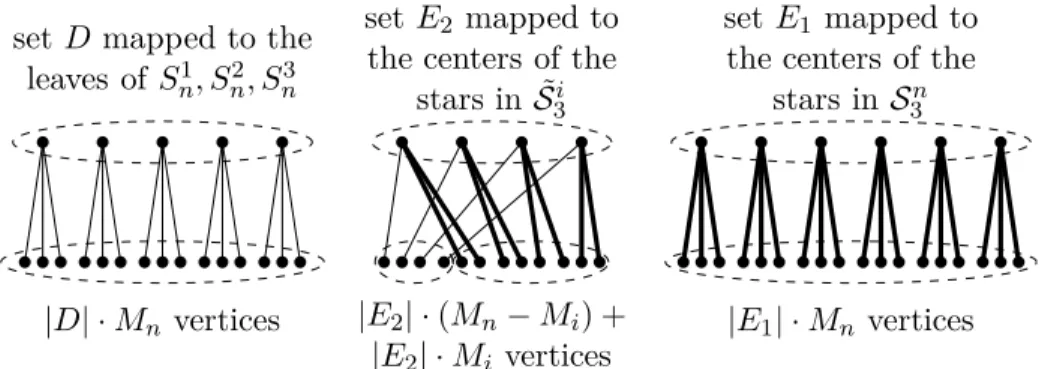
LetDbe the set of vertices inRn
3 which are mapped to the leaves ofS1n, S2n, Sn3,
E1be the set of vertices inRn
3 that are mapped to the centers of the stars inS3n, and E2 := Rn
3 \(D∪E1) (see Fig. 3.2). Clearly, |D| =
P3
j=1a
j
n and |E2| =
B − |D|. If E2 6=∅, then the vertices from E2 can be mapped to the centers of other stars. However, by Claims 2.3 and 2.4, all E2-vertices have to be mapped to the centers of some stars fromSn−1
j=1 S j 3, sinceP a∈Aa=nB implies that P3 j=1a j
i > B for some i < n. Now, consider the stars in S n
4. Since all vertices in S1
n∪Sn2∪Sn3 are mapped and the stars inS4n have more leaves than the degrees of the vertices in Rj4 with j < n, the centers of these stars can only be mapped to the vertices in Rn