ISSN: 2319-8753
I
nternational
J
ournal of
I
nnovative
R
esearch in
S
cience,
E
ngineering and
T
echnology
(An ISO 3297: 2007 Certified Organization)
Vol. 3, Issue 7, July 2014
Improving the Efficiency of Multiple Effect
Evaporator to Treat Effluent from a
Pharmaceutical Industry
Sachinkumar Salakki
1, M A Lourdu Antony Raj
2, Jagadish H Patil
3, Vikas Shetty
4P.G.Student, Department of Chemical Engineering, R.V.College of Engineering, Bangalore, Karnataka, India 1 Professor, Department of Chemical Engineering, R.V.College of Engineering, Bangalore, Karnataka, India 2 Associate Professor, Department of Chemical Engineering, R.V.College of Engineering, Bangalore, Karnataka, India 3
Process Engineer, Department of Process Engineering, Cipl Ltd, Virgonagar, Bangalore, Karnataka, India 4
ABSTRACT: Disposal of effluent from pharmaceutical industry is an increasing problem in India and worldwide. The bulk drug manufacturing process involves usage of more organic and inorganic salts, which is becoming major part of high chemical oxygen demand and total dissolved solids. Evaporation and cooling are the common techniques used to extract available salts and reusable water. The pharmaceutical industry of the study uses multiple effect falling and forced circulation evaporator to achieve zero liquid discharge process for pharmaceutical effluent. Reverse osmosis reject is conveyed to multiple effect falling film evaporator to separate salt and reusable water. This study aims to diagnose the ills of the multiple effect evaporator to improve the efficiency and energy consumption. Diagnosis involves vacuum testing and hydro testing. The former tests revealed leakages in various parts of the multiple effect evaporator. The leakages were arrested and high pressure cleaning along with chemical cleaning was performed to remove the scaling in the evaporator. This improved the efficiency of the multiple effect evaporator significantly resulting in reduction of chemical oxygen demand and total dissolved solids by 91.5% and 96% respectively. This also achieved reduction in energy consumption by 40% reducing the overall live steam consumption from 0.55 to 0.32 kg/kg of effluent treatment.
KEYWORDS: Multiple effect evaporator, Vacuum test, Hydro test, High pressure cleaning, Steam consumption
I. INTRODUCTION
Drugs and pharmaceutical manufacturing industry plays a key-role to the society as a whole. The foundation of modern Indian drugs and pharmaceutical industry in the country was laid in the beginning of twentieth century. Today, India is manufacturing a larger quantity of diversified pharmaceutical compounds. The drugs and pharmaceutical manufacturing industry has come into the picture as one of the leading industries in the country. About 82 percent of the total bulk drugs requirement is indigenously manufactured and the rest are imported. Although the production of pharmaceuticals in massive quantities has been ongoing for many decades already, it was only in the past decade that scientific studies worldwide have increasingly examined associated effluent generation and their respective impact [1]. The industry is characterized by a diversity of products, processes, plant sizes, as well as wastewater quantity and quality. In fact, the pharmaceutical industry represents a range of industries with operations and processes as diverse as its products. Hence, it is almost impossible to describe a typical pharmaceutical effluent because of such diversity [2]. The ongoing global process of urbanization and population growth has increased the demand for clean water, leading to an increase in the volume of effluent to be treated [3]. An added dimension to it is diversity of process operations, raw materials input and characteristics of wastewater generated from the industry. This is further compounded by the frequent changes in processes and products necessitated by fluctuating market conditions [4].
ISSN: 2319-8753
I
nternational
J
ournal of
I
nnovative
R
esearch in
S
cience,
E
ngineering and
T
echnology
(An ISO 3297: 2007 Certified Organization)
Vol. 3, Issue 7, July 2014
pharmaceutical effluent can cause toxic effect to biological life if discharged to surface water [5]. The quality of such effluent can be analysed by their physico-chemical analysis [6], [7]. Monitoring of the environmental parameters of the effluent would allow having, at any time, a precise idea on performance evaluation of effluent treatment plant and if necessary, appropriate measures may be undertaken to prevent adverse impact on environment. The obtained results were very much useful in identification and rectification of operational and maintenance problems and it can be also utilized to establish methods for improved pharmaceutical industry and plant waste minimization strategies. Effluent treatment is a very important step to change these conditions and to achieve a sustainable situation. Indian government has an awareness of this and limits for water effluent quality exist [8]. Unfortunately, this regulation is not closely supervised and a lot of places do not follow the regulations.
Evaporation is an operation used to remove a liquid from solution, suspension or emulsion by boiling off some of the liquid. It is a thermal separation or thermal concentration process. Evaporation is one that starts with a liquid product and ends up with more concentrated one [9]. Forced circulation evaporation is used if boiling of the product on the heating surfaces is to be avoided due to the fouling characteristics of the product, or to avoid crystallization. The circulation liquid is heated when it flow through the heat exchanger and then partially evaporated when the pressure is reduced in the separator, cooling the liquid to the boiling temperature corresponding to this pressure. Forced circulation evaporators normally used for liquid which prone to fouling, scaling, and crystallizing or those which are inversely soluble or while concentrating thermally degradable materials. According to present ETP, different serial units such as pre-treatment units, post treatment units, Multiple Effect falling film and forced circulation Evaporator (MEE) has been in operation to separate salt and reusable water. Feed supply of three effect evaporator (two falling film and one forced circulation) is the reject stream from reverse osmosis [10].
The objective of this work is evaluation of pollution parameters of effluent from MEE in pharmaceutical industry and measure the performance of the MEE in effluent treatment unit. The work focuses on diagnosing the ills of the MEE to improve the efficiency and energy consumption. Diagnosis involves leakage detection in MEE by vacuum testing and hydro testing followed by high pressure cleaning along with chemical cleaning to remove the scaling in the evaporator which will improve the efficiency of the MEE.
II. LITERATURE SURVEY
Pharmaceutical effluents are waste generated by pharmaceutical industry during the process of drugs manufacturing [11]. In India, pharmaceutical industry is one of the major industry casing water pollution. Poorly treated wastewater with high levels of pollutants caused by poor design, operation or treatment systems creates major environmental problems when discharged to surface water or land [6]. Sumitkumar Patel et. al. evaluated performance of an effluent treatment plant of a textile industry by analyzing different parameters, most of all the parameters were above the permissible limits of respective pollution contol board [7]. Multiple effect evaporation plays a key role in effective separation of salt and water from effluent. G.Mugaishudeen et. al. optimized different operating parameters of multiple effect evaporator for the effective separation of salt and water. W.O.S. Doherty mentioned the negative impact of scale on evaporators and discusses the frequently used chemicals for cleaning evaporators [12]. DC Walthew et. al. mentioned the effect of sodium hydroxide and acid cleaning to remove scales in evaporators [13].
III. MATERIALS AND METHODS
A. Sampling and Analysis
The reliability of the results of analysis of effluent samples depends upon the proper collection of a true representative sample from a large volume of effluent. Grab samples of feed to MEE and condensate from MEE were collected every day for a week. The samples after collection were transported to the laboratory in a preserved condition, to ensure fair and accurate conditions. Samples were analysed for COD, TDS and pH in accordance with the procedure laid down in Standard Methods for the Examination of Water and Wastewater [14].
B. High Pressure Cleaning of MEE
ISSN: 2319-8753
I
nternational
J
ournal of
I
nnovative
R
esearch in
S
cience,
E
ngineering and
T
echnology
(An ISO 3297: 2007 Certified Organization)
Vol. 3, Issue 7, July 2014
C. Vacuum Test and Hydro Test
Vacuum and hydro tests test was carried out to find the leakages in the system. Results obtained from these tests confirmed that leakage in the MEE system.
D. Cleaning In Place (Chemical Cleaning)
Chemical cleaning is carried out to remove scales in the tubes of MEE on daily basis. The sequential steps involved in chemical cleaning for MEE are shown Figure 1[15], [16].
Rinse with hot condensate for 1 hour
Recirculation with 6% caustic soda (NaOH) at 900C to attain pH more than 10.5 for 3 hours
Flush with hot condensate water for 1 hour
Recirculation with 6% nitric acid (HNO3) at 90 0
C to attain 2 pH for 3 hours
Rinse with hot condensate water for 1 hour
Rinse with domestic water
Fig. 1. Steps Involved in Chemical Cleaning for MEE .
E. Working Operation of MEE
Reject from reverse osmosis system is stored in balance tank and pumped to the falling film evaporators (first and second effects) through the tubes of the first calendria, where heat is added. The vapour from first falling film effect is separated and sends to the second falling film effect in order boil the effluent and so as to third forced circulation effect. The liquor in a forced circulation evaporator is pumped through the tubes of third effect to decrease tube scaling or salting when precipitates are formed during evaporation. Three circulation pumps keep the crystal slurry in homogeneous suspension throughout the cycle and heat exchanger is located on the discharge side of the circulating pump. The heated liquid then flows into the vapour space, where flash evaporation occurs, giving some super saturation.
The vapour leaving from the last effect is condensed in the condenser and the supersaturated liquid flows down the down flow tube and then up through the bed of fluidized and agitated crystals, which are growing in size. The leaving saturated liquid will be transferred to second and third effect by means of transfer pump, finally goes back as a recycle stream to the heater, where it is joined by the entering fluid. The larger crystals (salts) settle out and with mother liquid are withdrawn as product from the last effect evaporator. Sufficient slurry height (submergence) is maintained in the main body of the forced circulation and at the top of the heat exchanger to prevent local boiling on the tube surface. This is necessary to preclude salt precipitation on the tangential inlet and tubes so a high circulation rate is provided for adequate tube velocity to achieve good heat transfer.
III. RESULTS AND DISCUSSION
A. Evaluation of Performance of MEE
ISSN: 2319-8753
I
nternational
J
ournal of
I
nnovative
R
esearch in
S
cience,
E
ngineering and
T
echnology
(An ISO 3297: 2007 Certified Organization)
Vol. 3, Issue 7, July 2014
TABLE I
ANALYSIS OF MEE FEED AND CONDENSATE WATER.
Content Feed Condensate Condensate (design)
COD 2000 ppm 430 ppm 250 ppm
TDS 20000 ppm 3600 ppm 2100 ppm
pH 9-10 8-9 7-8
From Table I the underperformance of MEE is evident as the values of COD, TDS and pH in condensate are much higher than the design values specified. The poor performance of MEE is attributed to formation of hard scale and possible leakages in the tubes of MEE.
B. Efficiency Improvement of MEE
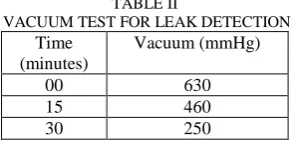
In order to increase the efficiency, hard scales were removed by high pressure jet cleaning at 150 bar along with chemical cleaning. Further to detect the possible leakages vacuum test was carried out and the results of the test are presented in Table II. It can be seen from the table that, vacuum exceeded maximum permissible limit which is 30 mmHg in 1 hour, hence vacuum leakage was confirmed in the system.
TABLE II
VACUUM TEST FOR LEAK DETECTION
Time (minutes)
Vacuum (mmHg)
00 630
15 460
30 250
Table III presents the hydro test results. From the results, it is observed that, the pressure exceeded maximum permissible limit for hydro test which is 0.05 kg/cm2 in 1 hour and leakages were observed in second falling film and third forced circulation evaporation.
TABLE III
HYDRO TEST FOR LEAK DETECTION
Time (minutes)
Pressure (kg/cm2)
00 2.000
30 1.975
60 1.900
Necessary actions were undertaken to arrest the leakages in the tubes of MEE. Vacuum test was redone to ensure no leakages. The results of the test are given in Table IV. Results indicate that, vacuum was maintaining within the permissible limit after 60 minutes, hence leakages arrested was confirmed in the MEE system.
TABLE IV
VACUUM TEST FOR LEAK DETECTION
Time (minutes)
Vacuum (mmHg)
00 630
15 615
30 605
C. Efficiency of MEE after Rectification
ISSN: 2319-8753
I
nternational
J
ournal of
I
nnovative
R
esearch in
S
cience,
E
ngineering and
T
echnology
(An ISO 3297: 2007 Certified Organization)
Vol. 3, Issue 7, July 2014
TABLE V
ANALYSIS OF MEE FEED AND CONDENSATE WATER AFTER RECTIFICATION
Content Feed Condensate Condensate (design) % Efficiency
COD 2000 ppm 170 ppm 250 ppm 91.5
TDS 20000 ppm 800 ppm 2100 ppm 96.0
pH 9-10 7-8 7-8 -
From Table V the values of COD, TDS and pH in condensate are well below than the design values specified. Hence, diagnosis of ills and rectification of MEE by removing hard scales and arresting leakages are key improvements that lifted the performance of MEE to limit the values of COD, TDS and pH within designed parameters. This improved the efficiency of the multiple effect evaporator significantly resulting in reduction of chemical oxygen demand and total dissolved solids by 91.5% and 96% respectively. This also achieved reduction in energy consumption by 40% reducing the overall live steam consumption from 0.55 to 0.32 kg/kg of effluent treatment.
IV. CONCLUSION
The present study was carried out to treat the effluent from a pharmaceutical industry using MEE, which are suitable for concentrating pharmaceutical effluent comprising of high COD and TDS. The major physico-chemical parameters COD, TDS and pH were analysed for the feed and condensate of the MEE. Characterisation of condensate from the MEE showed COD and TDS as 430 ppm and 3600 ppm respectively. As per the design specification the condensate should have COD and TDS values below 250 ppm and 2100 ppm respectively. This showed the under performance of the MEE. Performance of the MEE was improved by arresting the leakages and removing the scale formed by high pressure and chemical cleaning processes. This improved the performance of MEE significantly effecting in reduction of COD, TDS and pH which were as per the design operating parameters enabling zero liquid discharge and energy consumption as by 91.5, 96 and 40% respectively.
REFERENCES
[1] EleonoraDeschamps, Olivia Vasconcelos, Lisete Lange, Claudio Luis Donnici, Merces Coelho da Silva and Juliana Aparecida Sales,
“Management of effluents and waste from pharmaceutical industry in Minas Gerais, Brazil”, Brazilian Journal of Pharmaceutical Sciences, Vol. 48, No. 4, Oct/Dec. 2012
[2] Mehta. G, Prabhu. S. M and Kantawala. D, “Industrial wastewater treatment–The Indian experience”, J. Indian Assoc. Environ. Management,
22, pp. 276–287, 1995.
[3] Bolong. N, Ismail. A. A. F, Salimb. M. R and Matsuura. T, “A review of the effects of emerging contaminants in wastewater and options for
their removal”, Desalination, V. 239, pp. 229-246, 2009.
[4] “Minimal national standards pharmaceutical manufacturing and formulation industry”, Central pollution control board, New Delhi-110019.
Comprehensive industry document series :coinds/29/1988-89.
[5] G. Mugaishudeen, A.S. Periasamy Manikandan and T. Ravi Kannan, “ Experimental Study of Triple Effect Forced Circulation Evaporator at
Perundurai Common Effluent Treatment Plant”, J. Acad. Indus. Res.Vol.1, pp.753-757, 2013.
[6] NV. SrikanthVuppala, Ch. Suneetha and V. Saritha, “Study on treatment process of effluent in Bulk drug industry”, International Journal of
Research in Pharmaceutical and Biomedical Sciences, Vol. 3, pp. 1095-1102, 2012.
[7] Sumitkumar Patel, Dr. AnitaRajor, Dr. Bharat P.Jain and Payal Patel, “Performance Evaluation of Effluent Treatment Plant of Textile Wet Processing Industry: A Case Study of Narol Textile Cluster, Ahmedabad, Gujarat”, International Journal of Engineering Science and Innovative Technology, Vol. 2, pp. 290-296, 2013.
[8] B. Meenakshipriya, Dr. K.Saravanan, R. Shanmugam and S.Sathiyavathi, “ Study of pH System in Common Effluent Treatment Plant”,
Modern Applied Science, Vol. 2, No. 4. pp. 113-121, 2008.
[9] Kim. D, “A review of desalting process techniques and economic analysis of the recovery of salts from retentates” Desalination, Vol. 270, pp.
1-8, 2011.
[10] Farahbod. F, DariushMowla. M. R and JafariNas, “Experimental study of forced circulation evaporator in zero discharge desalination
process”, Desalination, Vol. 285, pp. 352-358, 2012.
[11] Idris. M. A, Kolo. B. G, Garba. S. T and Ismail. M. A. “Physico-chemical analysis of Pharmaceutical Effluent and Surface Water of River
Gorax in Minna, Niger State, Nigeria” Bulletin of Environment, Pharmacology and Life Sciences, Vol. 2 [3], pp. 45-49, Feb. 2013.
[12] W. O. S. Doherty, “Chemical cleaning of sugar mill evaporators”, Proc. Aust. Soc. Sugar Cane Technol, 22, pp. 341-346, 2000.
[13] DC Walthew, R Whitelaw and R Mohabir, “Chemical cleaning of evaporator”, Proc S Afr Sug Technol Ass, 71, 1997.
[14] APHA, AWWA, WEF, “Standard Methods for the Examination of Water and Wastewater”, American Public Health Association, 21 ed.,
Washington, D.C., USA, 2005.
[15] Rackemann, Darryn W and Doherty, William O.S. and East, Chris P. Development of descriptor tools for the characterization of Australian
sugar mill evaporator scale. In: Proceedings of the 27th International Society of Sugar Cane Technologists Congress, 7-11 March 2010,
Veracruz, Mexico.
[16] P. Brabazon. D, Taylor, “Heat recovery and cleaning in-place system for falling film evaporators”, Commission of the European
ISSN: 2319-8753
I
nternational
J
ournal of
I
nnovative
R
esearch in
S
cience,
E
ngineering and
T
echnology
(An ISO 3297: 2007 Certified Organization)
Vol. 3, Issue 7, July 2014
BIOGRAPHY
Mr. Sachinkumar Salakki is pursuing M. Tech Chemical Engineering in R. V. College of Engineering, Bangalore under Visvesvaraya Technological University, Belgaum.
Dr. Jagadish H Patil. He obtained BE in Chemical Engineering with III rank to the KUD, India in 1998. Completed M.Tech in CPD from KREC Surathkal in 2000. Completed PhD from VTU, Belgaum in 2013.Major research areas include Biomethanation of Organic waste and Biofuels. He is Associate Professor, department of Chemical Engineering, RVCE, Bangalore. He has 22 International journal publications and 12 International conference presentations. He has delivered talk at IIT Guwahati and many other places on his area of interest. Dr.Jagadish H Patil is Life Member of Indian Institute of Chemical Engineers and member of Indian Society for Technical Education. He is Editorial board member for many International journals and societies.
Dr. MALourdu AntonyRaj. Born in Murugathuranpatty, Tamilnadu, India on Nov. 03, 1956. Obtained Bachelor degree in Chemical Engineering from Annamalai University, Chidambaram, India in 1979. Completed M.Tech in Chemical Reaction Engineering from IIT Madras in 1981. Completed PhD from Bangalore University in 2003. Major research areas include Reaction Engineering, Transfer operations and Modeling. He latter joined R V College of Engineering, Bangalore as Professor and HOD of Chemical Engineering from 2004 to 2010 and currently is Dean, students affairs at R V College of Engineering. He has 31 years of teaching and 16 years research experience. He has more than 20 National and International journal publications and has 18 National and International conference publications..