Identification of EU funding
sources for the regional heating
and cooling sector
External study performed by
PNO Consultants
for the Joint Research Centre
Roel van der Veen
Esmee Kooijman
This is an external study report made for the Joint Research Centre (JRC), the European Commission’s science and knowledge service. It aims to provide evidence-based scientific support to the European policymaking process. The scientific output expressed does not imply a policy position of the European Commission. Neither the European Commission nor any person acting on behalf of the Commission is responsible for the use that might be made of this publication.
Contact information Name: J. Carlsson
Address: European Commission, DG JRC, Westerduinweg 3, 1755 LE Petten, the Netherlands Email: [email protected] Tel.: +31-224-565341 JRC Science Hub https://ec.europa.eu/jrc JRC115765 EUR 29663 EN
PDF ISBN 978-92-76-00163-8 ISSN 1831-9424 doi:10.2760/994541 Luxembourg: Publications Office of the European Union, 2019
© European Union, 2019
Reuse is authorised provided the source is acknowledged. The reuse policy of European Commission documents is regulated by Decision 2011/833/EU (OJ L 330, 14.12.2011, p. 39).
For any use or reproduction of photos or other material that is not under the EU copyright, permission must be sought directly from the copyright holders.
How to cite this report: Van der Veen, R.S., Kooijman, E.D., Identification of EU funding sources for the regional heating and cooling sector, EUR29663 EN, Publications Office of the European Union, Luxembourg, 2019, ISBN 978-92-76-00163-8, doi:10.2760/994541, JRC115765
All images © European Union 2019
Identification of EU funding sources for the regional heating and cooling sector
This report provides an overview of relevant EU funding sources for projects aimed at improving energy efficiency and deploying renewable energy in the heating and cooling sector, and to support innovation and job creation at regional level in the same sector.
The study covers European funding sources for the current programming period (2014-2020). Where possible, an outlook will be provided for the period beyond 2020 (2021-2027). The overview will focus on public funding, both grants and other financial instruments such as soft loans and guarantees.
Contents
List of abbreviations and definitions ... 6
1 Executive Summary ... 9 2 Introduction ... 10 2.1 Objective ... 10 2.2 Scope ... 11 2.3 Reading guide ... 12 3 Context ... 13 3.1 EU funding ... 13
3.1.1 Climate action budget ... 13
3.1.2 Jointly managed funds ... 14
3.1.3 Centrally managed funds ... 17
3.2 European Funding Sources after 2020 ... 19
3.2.1 EU Funding Programmes ... 20 3.2.2 InvestEU Programme ... 21 3.3 EU subsidies in practice ... 23 3.3.1 Success rates ... 23 3.3.2 Required efforts ... 23 3.3.3 Cooperation ... 23 3.3.4 Administration ... 24 4 EU grants ... 25
4.1 European Structural and Investment Funds ... 25
4.1.1 Cohesion Fund (CF) ... 25
4.1.2 European Regional Development Fund (ERDF) ... 26
4.1.3 European Social Fund (ESF) ... 26
4.1.4 European Agricultural Fund for Rural Development (EAFRD) ... 26
4.1.5 European Maritime and Fisheries Fund (EMFF) ... 27
4.2 Horizon 2020 and Horizon Europe ... 27
4.2.1 SME instrument ... 32
4.2.2 Fast Track to Innovation (FTI) ... 35
4.2.3 Future and Emerging Technologies (FET) Open ... 38
4.2.4 European Institute of Innovation and Technology (EIT) ... 41
4.3 LIFE ... 41
4.4 INTERREG: European Territorial Co-operation (ETC) ... 45
4.5 Connecting Europe Facility (CEF) ... 50
4.6 Project Development Assistance (PDA) ... 53
4.6.2 Horizon 2020 Topic LC-SC3-EE-11-2018-2019-2020 (PDA) ... 57
4.7 URBACT III ... 59
4.8 Urban Innovative Actions (UIA) ... 61
4.9 NER300/Innovation Fund ... 64
4.10 EUREKA ... 67
4.11 Eurostars ... 70
5 EU Innovative Financial Instruments ... 74
5.1 LIFE Private Finance for Energy Efficiency (PF4EE) ... 74
5.2 European Fund for Strategic Investments (EFSI) ... 77
5.3 Smart Finance for Smart Buildings ... 79
5.4 European Energy Efficiency Fund ... 79
5.5 European Investment Fund ... 79
5.5.1 InnovFin ... 80
5.5.2 COSME ... 80
5.6 EBRD financing – SEFF/GEFF ... 81
5.7 Technical Assistance ... 81
5.7.1 JASPERS ... 81
5.7.2 JESSICA ... 82
5.7.3 Energy Efficiency Financial Institutions Group (EEFIG) ... 83
5.8 Green Bonds ... 84
5.9 Energy Performance Contracting (EPC) ... 84
6 Combining (EU) funding sources in the heating and cooling sector ... 86
6.1 Opportunities for combining EU funding ... 86
6.1.1 Covering all TRL levels... 86
6.1.2 Covering all activities ... 87
6.1.3 Covering the different types of finance ... 87
6.2 Limitations to combining EU funding ... 88
6.2.1 Non-cumulation rule ... 88
6.2.2 State aid ... 89
6.3 Flagship projects ... 90
6.3.1 RE-FIT: Retrofitting buildings for energy efficiency measures ... 90
6.3.2 Integrated energy system of the city Mórahalom ... 92
6.3.3 Concentrated Solar Power in Cyprus ... 94
7 Conclusions ... 97
8 References ... 99
List of figures ... 105
List of tables ... 105
Annex A: Definitions and criteria applied for R&D&I funding under EU policies and laws ... 106
List of abbreviations and definitions
AC Associated Countries
bn Billion
CC Candidate Countries
CCS Carbon Capture and Storage
CEF Connecting Europe Facility
CF Cohesion Fund
CHP Combined Heat and Power (or cogeneration)
COSME Competitiveness of Enterprises and Small and Medium-sized Enterprises
CSA Coordination and Support Actions
DG Directorate General
EC European Commission
EAFRD European Agricultural Fund for Rural Development
EASME Executive Agency for Small and Medium-sized Enterprises
EBRD European Bank for Reconstruction and Development
EE Energy Efficiency
EEPR European Energy Programme for Recovery
EFSI European Fund for Strategic Investments
EFTA European Free Trade Association
EIAH European Investment Advisory Hub
EIB European Investment Bank
EIC European Innovation Council
EIT
European Institute of Innovation and TechnologyEMFF European Maritime and Fishery Fund
EP European Parliament
EPC Energy Performance Contracting
ERC European Research Council
ERDF European Regional Development Fund
ES Energy System
ESCO Energy Service Company
ESF European Social Fund
ESI Funds European Structural and Investment Funds
ETC European Territorial Co-operation
ETS Emissions Trading Scheme
EU European Union
FET Open Future and Emerging Technologies Open
FP7
7th Framework Programme for Research and Technological DevelopmentFTI Fast Track to Innovation
GEFF Green Economy Finance Facilities
GLA Greater London Authority
H2020 Horizon 2020
HVAC Heating, Ventilation and Air Conditioning
IA Innovation Action
IB Intermediate Bodies
ICT Information and Communication Technology
INEA Innovation & Networks Executive Agency
JASPERS Joint Assistance to Support Projects in European Regions
JESSICA Joint European Support for Sustainable Investment in City Areas
JRC Joint Research Centre
LIFE PF4EE LIFE Private Finance for Energy Efficiency
M Million
MA Managing Authority
MFF Multiannual Finance Framework
MS Member State(s)
NCP National Contact Point
NER New Entrant’s Reserve
NGO Non-Governmental Organizations
OCT Overseas Countries and Territories
OP Operational Programme
PDA Project Development Assistance
PDU Programme Delivery Unit
PM Particulate Matter
PV Photovoltaic
R&D Research and Development
RES Renewable Energy Source
RIA Research and Innovation Action
S3PE Smart Specialisation Platform on Energy
SCC Smart Cities and Communities
SF Structural Funds
SFSB Smart Finance for Smart Buildings
SME Small and Medium-sized Enterprises
STE Solar Thermal Energy
TA Technical Assistance
TC Territorial Cooperation
TRL Technology Readiness Level
Disclaimer
This report contains information on EU funding sources. All information in this report has been researched and compiled with utmost diligence of EU funding experts.
Nevertheless there is no guarantee that the presented information captures all types of funding for regional heating and cooling projects as well as errors and mistakes cannot be totally excluded, given that various sources sometimes contradict each other.
1
Executive Summary
This report provides an overview of relevant EU funding sources for projects aimed at improving energy efficiency and deploying renewable energy in the heating and cooling sector, and to support innovation and job creation at regional level in the same sector.
This study covers European funding sources for the current programming period (2014-2020). Where possible, an outlook will be provided for the period beyond 2020 (2021-2027). The overview will focus on public funding, both grants and other financial instruments such as soft loans and guarantees.
EU funding for heating and cooling projects is channelled both through the five European Structural and Investment Funds (ESIF) and through dedicated EU grants and financial instruments. The bulk of ESIF funding under the Cohesion Policy is concentrated on less developed European countries and regions, whereas the other EU funding sources are typically open to applicants in all Member States. Many EU funding instruments require cross border cooperation, but there are also EU instruments that allow for a single applicant.
Some of the EU funding sources in this report are well-known and established, others are less popular. Typically, the more popular programmes also have lower winning chances. It may therefore pay off to look at alternatives. Moreover, preparing an EU funding project can be complex and time consuming. A review of several surveys on the subject revealed that experience of drafting project applications is one of the major differences between successful and unsuccessful applicants.
For highly innovative projects, it is often needed to maximise the utilisation of public funds in order to close the business case. The many EU funding sources cover different project activities, different phases in the technology development (TRL levels) and increasingly also the different types of finance (e.g. equity, debt) that are required to fund a project. This offers opportunities to combine EU funding.
One option is to use several instruments for the various phases of project development (e.g. research, pilot, demonstration). Another possibility is to cover each activity with a different instrument, for instance by applying for a Project Development Assistance (PDA) grant to cover the project development and applying for a LIFE subsidy (the EU’s funding instrument for the environment and climate action) to cover the implementation of the project. Increasingly, EU grants can also be combined with EU debt financing, provided by one of the EU innovative financial instruments. However, there are some limitiations to combining public funding sources (e.g. non-cumulation and state aid regulations). Although it is the primary responsibility of the managing authorities to verify compliance with the regulations, there are several cases where this did not happen correctly, sometimes with the consequence that beneficiaries had to repay (part of) the funding.
2
Introduction
Heating and cooling in buildings and industry accounts for approximately half of the EU’s final energy consumption. When considering EU households, almost 80 % of total final energy use is used for heating and hot water. While cooling is a small share of total energy use, demand from households and businesses is increasing during the summer months. This trend is also linked to climate change and temperature rises.1
Some 85 % of heating and cooling is still generated from fossil fuels and in order to reach the EU’s climate and energy goals2, the heating and cooling sector must strongly reduce its energy consumption and its use of fossil fuels. The European Commission (EC) has targeted policies towards a more efficient and decarbonised heating and cooling sector, such as the Energy Efficiency Directive3, the EU Strategy on Heating and Cooling4 and the proposed revision of the Renewable Energy Directive5.
For this reason, heating and cooling is one of the areas of the smart specialisation platform on energy (S3PE)6, where Member States and regions receive support for uptake of European funding. The goal of S3PE is to better align regional activities through the identification of technologies and innovative solutions that contribute to the EU energy policy priorities. The platform supports with regions to analyse current priorities and policies and to identify good practises and roadmaps for bottom-up transregional cooperation. This platform is managed by the European Commission’s Joint Research Centre (JRC), and promoted by DG REGIO and DG ENER.
Heating and cooling is a broad subject. Cutting the energy consumed by heating and cooling in buildings and industry can be achieved through scaling up the use of advanced construction and design techniques and high-performance insulation materials when renovating buildings. Moreover, energy use can also be reduced by providing better information and control of energy use with intelligent thermostats. Energy can also be saved by upgrading heating and cooling equipment such as boilers to the latest, most efficient technologies. Other renewable heating and cooling technologies such as biomass boilers and solar heating systems reduce the use of fossil fuels. In industry, energy for heating and cooling can be saved with energy-efficient technologies such as combined heat and power units which produce both heat and electricity, and via energy
management solutions and technologies.1
2.1
Objective
The objective of this study is to inform regions how they can better access European funding sources for projects aimed at improving energy efficiency and deploying
1 European Commission (2018). Heating and Cooling. Retrieved on 28 September 2018 at
ec.europa.eu/energy/en/topics/energy-efficiency/heating-and-cooling.
2 European Commission (2015). Energy Union Factsheet. MEMO/15/4485. Brussels, 25 February 2015.
3 European Union (2012), Directive 2012/27/EU of the European Parliament and of the Council of 25 October 2012 on energy
efficiency, amending Directives 2009/125/EC and 2010/30/EU and repealing Directives 2004/8/EC and 2006/32/EC. Official Journal of the European Union, L315/1, 14.11.2012.
4 European Commission (2016). Communication from the Commission to the European Parliament, the Council, the European
Economic and Social Committee and the Committee of the Regions. An EU strategy on Heating and Cooling. COM(2016) 51 final, Brussels, 16.2.2016.
5 European Commission (2016). Proposal for a Directive of the European Parliament and of the Council on the promotion of the
use of energy from renewable sources (recast). COM/2016/0767 final - 2016/0382 (COD), Brussels, 30.11.2016.
6 European Commission, Joint Research Centre (2018) Energy and the Smart Specialisation Platform on Energy (S3PEnergy) via
renewable energy in the heating and cooling sector, and to support innovation and job creation at regional level in the same sector.
2.2
Scope
The scope of this report is to present the available EU funding sources suitable for regions which want to develop projects in the heating and cooling domain. Programs are presented and provide details about amount of funding available and its requirements.
Funding sources and time periods
This study will cover European funding sources for the current programming period (2014-2020). Where possible, an outlook will be provided for the period beyond 2020 (2021-2027). The overview will focus on public funding, both grants and other financial instruments such as soft loans and guarantees.
Activities to be funded
There are various ways to reduce energy demand in the heating and cooling sector. For instance by improving the building envelope, or by employing more efficient energy conversion technologies. More indirectly, innovation in the heating and cooling sector can also accelerate the transition to more efficient energy system. The employment benefits that are associated with the energy transition will also be addressed in this study.
The scope of activities that will be considered in this analysis of EU funding sources for the heating and cooling sector specifically includes, but is not limited to:
District heating and cooling. Efficient district heating and cooling means a district heating or cooling system using at least 50 % renewable energy, 50 % waste heat, 75 % cogenerated heat or 50 % of a combination of such energy and heat7; Renewable heat and cooling sources, e.g. geothermal, solar, biomass, heat
pumps;
House renovation;
Support R&I on energy efficiency in heating and cooling to public and private organisations;
Support local SMEs.
Technology Readiness Levels (TRL)
This study will cover funding opportunities for measures to improve energy efficiency and deploy renewable energy in the heating and cooling sector in different technology maturity
levels.
These are typically indicated by the so called Technology Readiness Levels (TRL)8:
7 Eurostat (2017) Reporting instructions for completing the district heating and district cooling template for data reporting
TRL 1 – basic principles observed TRL 2 – technology concept formulated TRL 3 – experimental proof of concept TRL 4 – technology validated in lab
TRL 5 – technology validated in relevant environment (industrially relevant environment in the case of key enabling technologies)
TRL 6 – technology demonstrated in relevant environment (industrially relevant environment in the case of key enabling technologies)
TRL 7 – system prototype demonstration in operational environment TRL 8 – system complete and qualified
TRL 9 – actual system proven in operational environment (competitive manufacturing in the case of key enabling technologies; or in space)
More background on the interpretation of TRL levels in various EU programmes can be found in Annex A.
2.3
Reading guide
An executive summary of this report can be found in chapter 1.
Chapter 2 sets the scene by providing the objective and scope of this study.
In chapter 3 of this report a high-level overview of EU funding sources is given, which provides the framework for the next chapters.
In chapter 4 the EU grants related energy efficiency and heating and cooling, as well as research and innovation and support to SMEs, are discussed in detail.
In chapter 5 the EU innovative financial instruments (e.g. loans and guarantees) related to energy efficiency and heating and cooling, as well as research and innovation and support to SMEs, are discussed in detail.
Chapter 6 explains the regulatory framework and the possibility to combine different EU funding sources.
Chapter 7 contains some concluding remarks.
8 European Commission (2017). Horizon 2020 Work Programme 2018-2020. General Annexes. European Commission Decision C(2017)7124 of 27 October 2017.
3
Context
3.1
EU funding
This chapter provides background information on the various EU funding instruments and explains how the various instruments originated and relate to eachother. This knowledge is not required per se to apply for each of the instruments but will help to understand their context and to interpret their priorities.
3.1.1
Climate action budget
The transition to clean energy is one of the key priorities of the EU and requires enormous investments in the years to come. For this reason, large sums of public funding are directed to this challenge. To respond to investment needs related to climate change, the EU has decided that at least 20 % of its budget for 2014-2020 – as much as EUR 200 billion over the whole period − should be spent on climate change-related actions. To achieve this result, climate action is integrated into all major EU spending programmes, in particular regional development and the Cohesion Fund, energy, transport, research and innovation, the Common Agricultural Policy as well as the EU’s development policy9.
In 2017 the amount was more than EUR 31 billion, 20.3 % of the total budget. This brings the total cumulative amount for climate mainstreaming by the end of 2017 to more than EUR 100 billion.
Figure 1 EU funding channeled to climate action (2014-2017). All amounts in the chart are in EUR million.9
This budget is channelled through various EU funding sources. Some of the instruments are specifically directed at energy investments, but many are more general instruments, aimed at for instance innovation or economic development.
Funding instruments
EU funding is often provided in the form of subsidies, but the EU increasingly also offers soft loans or other innovative financial instruments to stimulate its policies.
9 European Commission (2018). Report from the Commission to the European Parliament, the Council and the Court of Auditors
Subsidies are the most common form of EU funding for energy efficiency, renewable energy and innovation. EU energy subsidies are mostly funded from the structural investment funds (ESIF), Horizon 2020, LIFE and NER300/ETS Innovation Fund.
Innovative financial instruments, often tailored to the dynamics of energy investments, offer promising solutions to the challenge of financing the energy transition. Soft loans, for example, are an increasingly popular instrument for the EU to (co)finance energy investments. These loans are mostly directly or indirectly provided by a public bank (e.g. EIB) or an intermediary, offering favourable terms and accepting higher risk than commercial financers.
Funds management
There are two main types of EU funding112: funds which are managed centrally and
directly by the European Commission, e.g. for research; and funds whose management is shared between the EU and the Member States, e.g. the Structural Funds and the Cohesion Fund. The EU entrusts management of the latter to the Member States. The bulk of EU spending involves funds which come under shared management by the EU Member States.
3.1.2
Jointly managed funds
European structural and investment funds (ESI Funds)
Over half of EU funding (EUR 450 billion for the period 2014-2020) is channelled through the five European structural and investment funds (ESI Funds). They are jointly managed by the European Commission and the EU countries.
For funds in 'shared management', the Commission currently entrusts the Member States with implementing programmes at national level. Member States then allocate these funds to end recipients (e.g. companies, farmers, municipalities, etc.). The Member State has primary responsibility for setting up a management and control system which complies with the requirements of the Regulations, the Commission plays a supervisory role.
Due to this ‘fragmented’ management structure, general statements regarding the accessability of the EU structural funds are hard to make. Priorities and eligibility criteria differ per country and even per region. Each country and region distributes the funds in accordance with their own political agenda, within the framework set by the EC. This report can therefore only provide information in general terms. Applicants are advised to consult their local authorities for the eligibility criteria of ERDF and CF funds in their region.
The five European Structural and Investment Funds (ESI Funds) are10:
10 European Union (2013). Regulation (EU) No 1303/2013 of the European Parliament and of the Council of 17 December 2013
laying down common provisions on the European Regional Development Fund, the European Social Fund, the Cohesion Fund, the European Agricultural Fund for Rural Development and the European Maritime and Fisheries Fund and laying down general provisions on the European Regional Development Fund, the European Social Fund, the Cohesion Fund and the European Maritime and Fisheries Fund and repealing Council Regulation (EC) No 1083/2006.
The European Regional Development Fund (ERDF)11 promotes balanced economic development in the different regions of the EU. The budget is EUR 183.3 billion for the period 2014-2020.
The European Social Fund (ESF)12 supports employment-related projects throughout Europe and invests in Europe’s human capital. The budget is EUR 507.4 million for the period 2014-2020.
The Cohesion Fund (CF)13 funds transport and environment projects in countries where the gross national income (GNI) per inhabitant is less than 90 % of the EU average. In 2014-2020, these countries are Bulgaria, Croatia, Cyprus, the Czech Republic, Estonia, Greece, Hungary, Latvia, Lithuania, Malta, Poland, Portugal, Romania, Slovakia and Slovenia.
The European Agricultural Fund for Rural Development (EAFRD)14 focuses on resolving the particular challenges facing EU's rural areas. The budget is EUR 607.3 million for the period 2014-2020.
The European Maritime and Fisheries Fund (EMFF)15 helps fishermen to adopt sustainable fishing practices and coastal communities to diversify their economies, improving quality of life along European coasts.
Of these funds, the European Regional Development Fund (ERDF) and the Cohesion Fund (CF) are the most relevant funds for energy financing.
The ESI Funds support actions and activities under the Cohesion Policy16. Cohesion policy is the policy behind the hundreds of thousands of projects all over Europe that receive funding from the European Regional Development Fund (ERDF), the European Social Fund (ESF) and the Cohesion Fund. The bulk of Cohesion Policy funding is concentrated on less developed European countries and regions in order to help them to catch up and to reduce the economic, social and territorial disparities that still exist in the EU. In particular, this policy provides the necessary investment framework and strategy to meet the agreed growth goals under the Europe 2020 Strategy.
3.1.2.1 Classification per region
Moreover, under the Cohesion Policy, a classification of development for regions is used in ERDF, ESF and CF. This classification determines the amount of funding percentage or funding priorities, and is as follows12:
11 European Commission (2018). European Regional Development Fund. Retrieved on 21 September 2018 at
ec.europa.eu/regional_policy/en/funding/erdf/ .
12 European Commission (2018). European Social Fund. Retrieved on 13 September 2018 at ec.europa.eu/regional_policy/
en/funding/social-fund/.
13 European Commission (2018). Cohesion Fund. Retrieved on 10 September 2018 at ec.europa.eu/regional_policy/
en/funding/cohesion-fund/.
112 European Commission (2018). Glossary. Shared management. Retrieved on 7 December 2018 at ec.europa.eu/
regional_policy/en/policy/what/glossary/s/shared-management
14 European Commission (2018). European Agricultural Fund for Rural Development. Retrieved on 10 September 2018 at
ec.europa.eu/regional_policy/en/policy/EAFRD.
15 European Commission (2018). European Maritime and Fisheries Fund. Retrieved on 13 September 2018 at
ec.europa.eu/regional_policy/en/policy/EMFF.
more developed regions, with a GDP/capita of 90 % or higher than EU-27 average;
transition regions, with a GDP/capita between 75 and 90 % of EU-27 average; less developed regions, with a GDP/capita of 75 % or lower than EU-27 average.
An overview of the classification for structural funds per region can be found on the EC’s website17.
3.1.2.2 Thematic objectives
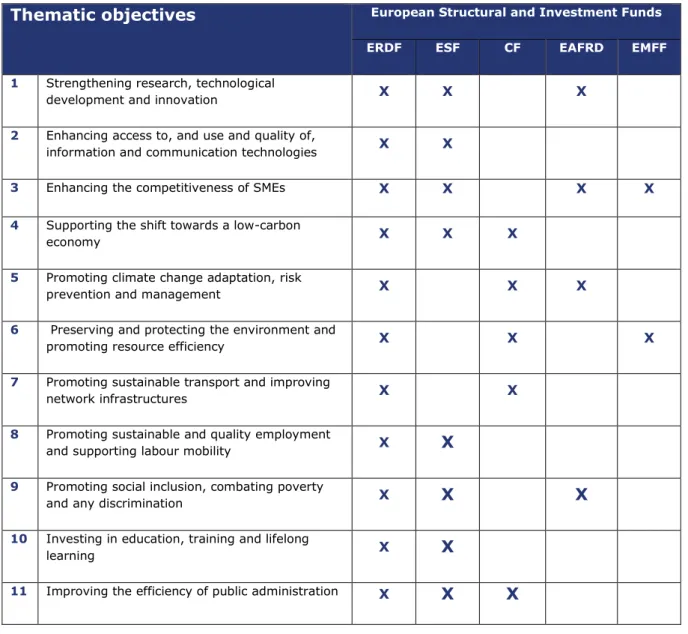
There are 11 thematic objectives defined within the Cohesion Policy to which ESI Funds contribute (table 1). Main priorities are indicated in bold.
Table 1 Overview of 11 thematic objectives within the EU Cohesion Policy and the corresponding ESI Funds18
Thematic objectives
European Structural and Investment FundsERDF ESF CF EAFRD EMFF
1 Strengthening research, technological
development and innovation X X X
2 Enhancing access to, and use and quality of,
information and communication technologies X X
3 Enhancing the competitiveness of SMEs X X X X 4 Supporting the shift towards a low-carbon
economy X X X
5 Promoting climate change adaptation, risk
prevention and management X X X
6 Preserving and protecting the environment and
promoting resource efficiency X X X
7 Promoting sustainable transport and improving
network infrastructures X X
8 Promoting sustainable and quality employment
and supporting labour mobility X
X
9 Promoting social inclusion, combating poverty
and any discrimination X
X
X
10 Investing in education, training and lifelong
learning X
X
11 Improving the efficiency of public administration X
X
X
17 European Commission (2018). Regional Policy. Is my region covered? Retrieved on 21 September 2018 at
ec.europa.eu/regional_policy/index.cfm/en/policy/how/is-my-region-covered/
18 European Commission (2018). Regional Policy. Priorities for 2014-2020. Retrieved on 21 September 2018 at
3.1.2.3 ESI Funds for Energy
ESI Funds play an essential role in promoting innovation in the field of energy, developing ICT applications in the field of energy, supporting SMEs and boosting the shift towards a low-carbon economy. In this regard, energy efficiency investments, particularly on the energy efficiency of buildings and businesses play a key role. Higher energy efficiency will lead to lower energy bills, better living and working conditions, local jobs and more competitive businesses. Renewable energy and smart distribution grids, smart energy transmission and storage infrastructure and decarbonisation of the transport sector are also supported under ESI Funds.19
Support for energy efficiency implementation and research and innovation under ESI Funding Programmes:
EUR 13.3 billion and EUR 3.4 billion under ERDF and CF for supporting energy efficiency measures in public and residential buildings and in companies respectively;
EUR 2.6 billion under ERDF for research and innovation and adoption of low-carbon technologies;
EUR 870 million and EUR 438 million under EAFRD for energy efficiency measures in rural development and innovative projects related to energy efficiency, renewable energy, climate and the environment respectively;
The different funding opportunities under ESI Funds / ERDF that are specifically relevant for regional heating & cooling projects in the EU are:
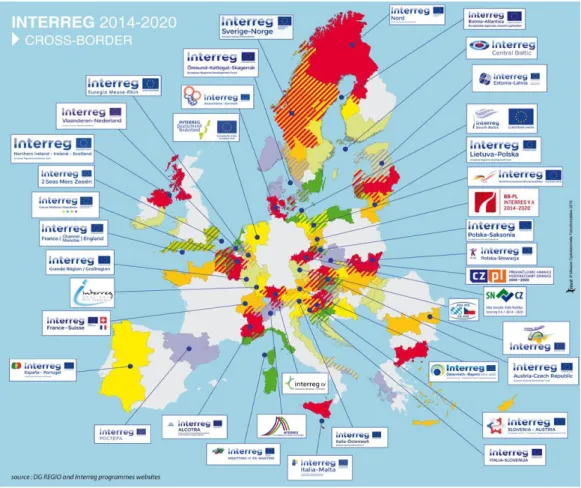
INTERREG: European Territorial Co-operation (ETC)
o Cross-border (INTERREG A) o Transnational (INTERREG B) o Interregional (INTERREG C)
URBACT III
Urban Innovative Actions (UIA)
3.1.3
Centrally managed funds
In addition to the jointly managed funds, large sums are available to support research, development and innovation through centrally managed EU funding programmes and financial instruments. A significant share of this funding is directed towards the energy transition. The bulk of EU financial support for support of research, development and innovation is channeled through the Horizon 2020 programme (see also figure 1). Together with smaller Sectoral R&D programmes, these are estimated to provide
19 European Commission (2015). Contribution of the European Structural and Investment Funds to the 10 Commission Priorities
EUR 120 billion to directly support research, development and innovation activities over the period 2014 – 2020.20
The Europe 2020 Strategy includes thematic funding programmes that are divided over its three priorities: Smart Growth, Sustainable Growth and Inclusive Growth.
Under ‘Smart Growth’ one of the sub goals is to strengthen and further develop the role of EU instruments to support innovation, particularly for Small and Medium Enterprises (SMEs).
Under ‘Sustainable Growth’ sub goals are to improve the business environment, especially for SMEs, including improving affordable access to finance, as well as to help decouple economic growth from the use of resources, support the shift towards a low carbon economy, increase the use of renewable energy sources and promote energy efficiency. In addition, the implementation of the Energy Efficiency Action Plan at Member State level includes a programme in resource efficiency (supporting SMEs as well as households) by making use of structural and other funds to leverage new financing through existing highly successful models of innovative investment schemes.
EU funding programmes
The main funding opportunities under EU funding programmes that are specifically relevant for regional heating & cooling projects in the EU are listed below. In the next chapters these funding instruments are discussed in more detail.
Horizon 2020
o Calls under: WP10 Secure, Clean and Efficient Energy o Innovation in SMEs
EUROSTARS
SME instrument
Fast Track to Innovation (FTI)
Future and Emerging Technologies (FET) Open LIFE
o Specific calls under: Environment – Climate Change – Energy o Specific calls under: Climate Action – Climate Change Mitigation Connecting Europe Facility (CEF) – Energy
Innovative financial instruments
Innovative financial instruments are a way of deploying EU budgetary resources, and are complementary to grants or subsidies. Financial instruments provide support for investments by way of loans, guarantees, equity and other risk-bearing mechanisms,
20 European Parliamentary Research Service (2015). Overview of EU funds for research and innovation. Briefing, September
possibly combined with technical support, interest rate subsidies or guarantee fee subsidies.
Moreover, financial instruments help to mobilise additional public or private co-investments in order to address market failures in line with Europe 2020 and cohesion policy priorities. Their delivery structures entail additional expertise and know-how, which helps to increase the efficiency and effectiveness of public resource allocation. These instruments provide a variety of incentives to better performance, including greater financial discipline at the level of supported projects.
Building on the implementation experiences with financial instruments in past cohesion policy cycles and reflecting the importance attached to them in the multiannual financial framework 2014-2020, the legislative and policy framework for 2014-2020 encourages further expansion and strengthening the use of financial instruments in the new programming period as a more efficient and sustainable alternative to complement traditional grant-based financing21.
The different financial instruments that are specifically relevant for regional heating & cooling projects in the EU are listed below. In the next chapters these funding instruments are discussed in more detail.
3.1.3.1 Energy-related financial instruments
LIFE Private Finance for Energy Efficiency instruments (PF4EE)
Joint European Support for Sustainable Investment in City Areas (JESSICA) Smart Finance for Smart Buildings
European Energy Efficiency Fund EBRD financing - GEFFs and SEFFs Green Bonds
3.1.3.2 General financial instruments for project implementation, R&I and SME support
European Fund for Strategic Investments (EFSI)
Joint Assistance to Support Projects in European Regions (JASPERS) European Investment Fund
InnovFin SME Guarantee Facility & Equity
COSME Loan Guarantee Facility & Equity Facility for Growth
3.2
European Funding Sources after 2020
In May 2018, the Commission published its legislative package comprising proposals for a post-2020 multiannual financial framework (MFF). This MFF also contains the plans and budgets for the EU funding programmes that are discussed in this report. Any comments
21 European Commission (2018). Regional Policy – Financial Management. Retrieved on 22 September 2018 at
in this report that are made on the post 2020 period, are thus preliminary and may be subject to change.
Formally, the MFF is approved by a unanimous decision of the Council of Ministers and the Parliament has to give its consent. At the time of writing (late 2018) this has not happened yet. It is scheduled for 9 May 2019 during the Sibiu Summit.
The new budget will enter into force in January 2021 for a period of 7 years, until 2027. For the next EU budget period from 2021-2027, the Cohesion Policy and the EU's main investment policy will be modernised.22
Roughly, funding of the different aspects of the energy transition under the next MFF will be covered by the following instruments:
Capacity building and policy support: LIFE/Clean Energy Transition R&I and technology development: Horizon Europe
Direct support towards clean energy investments: ESIF/ERDF Mobilising private investments through de-risking: InvestEU
3.2.1
EU Funding Programmes
With a budget of EUR 373 billion for this period, the future Cohesion Policy will contribute to bridge gaps between and within Member States. Although Cohesion policy will see cuts, one of its five key objective areas will channels funds for a “clean and fair energy transition” to local and regional authorities. The new policy will focus on five investment priorities23, consisting of:
Smarter Europe, through innovation, digitisation, economic transformation and support to small and medium-sized businesses
a Greener, carbon free Europe, implementing the Paris Agreement and
investing in energy transition, renewables and the fight against climate change a more Connected Europe, with strategic transport and digital networks
a more Social Europe, delivering on the European Pillar of Social Rights and supporting quality employment, education, skills, social inclusion and equal access to healthcare
an Europe closer to citizens, by supporting locally-led development strategies and sustainable urban development across the EU.
Between 65-85 % of the European Regional Development Fund and Cohesion Fund budget will go towards supporting innovation, SMEs, digital technologies and industrial modernisation, as well as towards delivering on the Paris Agreement by investing in the energy transition and the circular economy.22 Moreover, the Cohesion Policy will continue
investing in all regions, but will focus more on supporting locally-led development strategies and empower local authorities in the management of funds. The aim for the future Cohesion Policy is to be a more simplified and flexible framework with fewer and clearer rules.
22 European Commission (2018). EU budget: Regional Development and Cohesion Policy beyond 2020. Press Release. Strasbourg, 29 May 2018.
3.2.2
InvestEU Programme
Based on the public consultation for the next MFF and the mid-term evaluations of the EU centrally-managed financial instruments and the EFSI, the Commission proposed the creation of the InvestEU Programme, a single EU investment support mechanism for internal action for the 2021-2027 MFF.
The program will consist of the InvestEU Fund, in which public and private investments are mobilized through guarantees from EU budget, an advisory hub and a portal, in which beneficiariers are provided with technical advice and in which projects and investors are brought together.
The InvestEU programme24 will further boost investment, innovation and job creation in
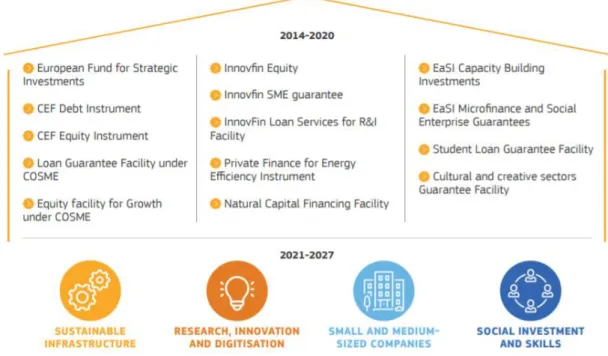
the EU in the period 2021-2027. The focus areas are Sustainable Infrastructure, Research, Innovation and Digitisation, Social Investment and Skills and Small and Medium-sized Companies. The programme will simplify and streamline investment support in the EU by bringing together several financial instruments from the Investment Plan for Europe from the period 2014-2020 (figure 2).
The InvestEU Fund would be the successor programme to the EFSI and the current centrally managed financial instruments (excluding external action financial instruments). The InvestEU Advisory would be the successor mechanism to the EIAH and current centrally managed technical assistance initiatives. The InvestEU Portal is the successor of the European Investment Project Portal.
The InvestEU program will have a budget of EUR 15.2 billion for the period of 2021-2027, resulting in EUR 38 billion in guarantees.
Figure 2Financing programmes in the period 2014-2020 that will be part of the InvestEU programme in 2021-2027. 31
3.3
EU subsidies in practice
As an addition to the factual information in this chapter, this section addresses some concerns that potential applicants associate with EU funding.
3.3.1
Success rates
This report provides a fairly complete overview of relevant EU funding sources for (innovative) heating and cooling projects. Some of these funding sources are well-known and established, others are less popular. Typically, the more popular programmes also have lower success rates. It may therefore pay off to consider alternatives.
Horizon 2020 for instance, is the most established and popular EU subsidy programme. It is the most versatile programme with the largest budget. At the same time the popularity has put substantial pressure on the success rates, which are around 15 % on average (of course these success rates differ per call). For the SME instrument, success rates are
even slimmer, at around 8 % for phase 1 and around 5 % for phase 2.25 Success rates
for less popular programmes can be more encouraging. The overall success rates for Eurostars in the last evaluation round was for instance 25 %26 and success rates of 50 %
can be seen in the INTERREG programmes27.
3.3.2
Required efforts
Preparing an EU funding project and writing the application requires a substantial effort. For Horizon 2020 for instance, this may take around 200-400 hours. Key is to involve
someone with experience in such processes. A meta-analysis of several surveys28 among
applicants of EU funding programmes revealed that the experience of drafting project applications is one of the major differences between successful and unsuccessful applicants.
3.3.3
Cooperation
Many EU funding instruments require cross border cooperation. This allows applicants to benefit from expertise abroad and to expand their EU network. At the same time it can be a barrier for application. In the latter case, it is good to know that there are also EU instruments that allow for a single applicant. Examples are the SME instrument, the PDA instruments or the LIFE programme (although for the latter programme, cooperation will increase an applicant’s chances).
25 EU Startups (2018). Are you a smart innovator and eligible to receive EU funding? Retrieved on 20 September 2018 at
eu-startups.com/2018/07/are-you-a-smart-innovator-and-eligible-to-receive-eu-funding/
26 EUROSTARS (2018) Eurostars-2 cut-off 8 funding results: 102 projects worth € 157 M approved. Retrieved on 23 October
2018 at eurostars-eureka.eu/content/eurostars-2-cut-8-funding-results-102-projects-worth-%E2%82%AC-157-m-approved
27 INTERREG North Sea Region (2018). Funding available for new projects. Retrieved on 5 October 2018 at
northsearegion.eu/about-the-programme/programme-news/funding-available-for-new-projects/
28 Surveys reviewed: Spok R. (2010), How the EU Structural funds are perceived by both successful and unsuccessful
applicants? (survey results), EUROPEUM Institute for European Policy; Ministry of Finance Latvia (2009), Centralised EU Funds (European Social Fund, European Regional Development Fund, Cohesion Fund), Final Beneficiaries, Satisfaction Survey, Latvijas Fakti, Dec. 2009; ECORYS (2011), Evaluation of the South East Europe Programme 2007-2013, First Evaluation Report – Draft, Client: VÁTI Hungarian Public Nonprofit Company on Regional Development and Town Planning, Rotterdam, 4 April 2011., INTERACT (2010), Study towards programme evaluation, Operational aspects of cross-programme cooperation in Central and South-Eastern Europe, Support mutual learning, Final Report, Interact cross-programme, June 2010.
3.3.4
Administration
Administrative requirements of EU projects are demanding, although they have been simplified over the past years. For the application phase, the required efforts are largest for the first application. For subsequent applications, organisations already have some of their forms registered with the EC and may have other forms more readily available in their administration. Project administration in the implementation phase will be much easier with a proper administration process in place at the start of the project. The biggest issues are typically encountered when insufficient administration leads to EC requests after project closure, requiring beneficiaries to dig in their archives for information that may not have been recorded in the first place.
4
EU grants
The EU awards grants to organisations and, occasionally, individuals, to help them carry out projects that further its policies. In most cases, EU funding does not cover 100 % of the project finance. Rather, grants are a form of complementary financing, and the beneficiary organisation will also put up a percentage of the funding for their project. The European Commission advertises grant opportunities through calls for proposals.
4.1
European Structural and Investment Funds
As aforementioned in chapter 3, there are five European structural and investment funds that together cover the bulk of energy financing, namely:
European Regional Development Fund (ERDF) Cohesion Fund (CF)
European Social Fund (ESF)
European Agricultural Fund for Rural Development (EAFRD) European Maritime and Fisheries Fund (EMFF)
Of these funds, the ERDF and the CF are by far the most relevant funds for energy financing. Moreover, several EU funding programmes are funded throught the ERDF, such as INTERREG, URBACT III and Urban Innovative Action.
Although the structural funds are the most important source of funding for heating and cooling projects, particularly in less developed regions, general statements regarding their accessibility are hard to make. These funds are managed jointly by the EU and the EU countries (see 3.1.2 Jointly managed funds), so priorities and eligibility criteria differ per country and even per region. Each country and region distributes the funds in accordance with their own political agenda, within the framework set by the EC. This limits the possibilities to elaborate in this report on the terms and conditions of the structural funds with respect to heating and cooling projects. This report can therefore only provide information in general terms. Applicants are advised to consult their local authorities for the eligibility criteria of ERDF and CF funds in their region.
4.1.1
Cohesion Fund (CF)
The Cohesion Fund (CF)14 funds transport and environment projects in countries where
the gross national income (GNI) per inhabitant is less than 90 % of the EU average. The Cohesion Fund supports projects in the following areas:
Supporting the shift towards a low-carbon economy;
Promoting climate change adaptation, risk prevention and management; Preserving and protecting the environment and promoting resource efficiency; Promoting sustainable transport and improving network infrastructures.
This includes regional energy efficiency projects. In 2014-2020, eligible countries for this support are: Bulgaria, Croatia, Cyprus, the Czech Republic, Estonia, Greece, Hungary, Latvia, Lithuania, Malta, Poland, Portugal, Romania, Slovakia and Slovenia.
4.1.2
European Regional Development Fund (ERDF)
The ERDF allocates budget to EU Member States and is one of the main financial instruments of the Cohesion Policy. ERDF’s purpose is to contribute to reduce disparities between levels of development of EU regions.
The main focus areas are innovation and research, the digital agenda, support for SMEs and the low-carbon economy (table 1). The resources allocated to these priorities differ per category of region12:
In more developed regions, at least 80 % of funds must focus on at least two of these priorities, and at least 20 % to low-carbon economy projects;
In transition regions, this focus is for 60 % of the funds, and at least 15 % to low-carbon economy projects;
This is 50 % in less developed regions, and at least 12 % to low-carbon economy projects.
Beneficiaries can apply for ERDF funding through the managing authority in their Member State.
4.1.3
European Social Fund (ESF)
The European Social Fund is the EU’s main tool for promoting employment and social inclusion. The ESF priorities are 1) to boost the adaptability of workers with new skills, and enterprises with new ways of working, and 2) to improve the access to employment for everyone. Its relevance for energy efficiency projects lies therefore mainly in training and skills development for employment in this sector. Each Member State, in partnership with the EC, has agreed on one or more Operational Programmes for ESF funding for the period 2014-2020. Beneficiaries can apply for project funding from ESF through the managing authority in their country79.
4.1.4
European Agricultural Fund for Rural Development (EAFRD)
The European Agricultural Fund for Rural Development focuses on increasing the competitiveness of European agriculture and forestry, improving environmental management and improving social and economic living conditions in rural areas.
One of the six priorities for the agricultural fund set by the EU in the period 2014-2020 is the promotion of resource efficiency and support for the shift towards a low-carbon and climate-resilient economy in the agriculture, food and forestry sectors. This could also include energy efficiency projects in rural areas.
4.1.5
European Maritime and Fisheries Fund (EMFF)
The EMFF is the Union fund that will support the objectives of the Common Fisheries Policy (CFP), the growth of a sustainable blue economy and the European Union's international commitments in the field of ocean governance.
As under the 2014-2020 period, the EMFF will support innovative investments from private stakeholders in the whole value chain of the fisheries sector and in aquaculture. It will also support projects that foster the growth of a sustainable blue economy, including energy efficiency in the sector’s infrastructure.
4.2
Horizon 2020 and Horizon Europe
1. Target areas
Horizon 2020 is the financial instrument implementing the Innovation Union29, a Europe 2020 flagship initiative
aimed at securing Europe's global competitiveness. The goal is to ensure Europe produces world-class science,
removes barriers to innovation and makes it easier for the public and private sectors to work together in delivering innovation. The program offers research institutes, companies and governments the chance to get financing for the development and demonstration of innovations. The three Horizon 2020 research priorities are:
1. Tackling Societal Challenges
Health, demographic change and wellbeing;
Food security, sustainable agriculture and forestry, marine and maritime and inland water research;
Secure, clean and efficient energy; Smart, green and integrated transport;
Climate action, environment, resource efficiency and raw materials; Inclusive, innovative and reflective societies;
Secure societies.
2. Industrial Leadership ICT;
Nanotechnologies, advanced materials and production; Space;
Access to risk finance; Innovation in SMEs.
3. Excellent Science:
29 European Commission (2018). Innovation Union. Retrieved on 17 October 2018 at
European Research Council (ERC);
Future and Emerging Technologies (FET); Marie Skłodowska-Curie;
Research Infrastructures.
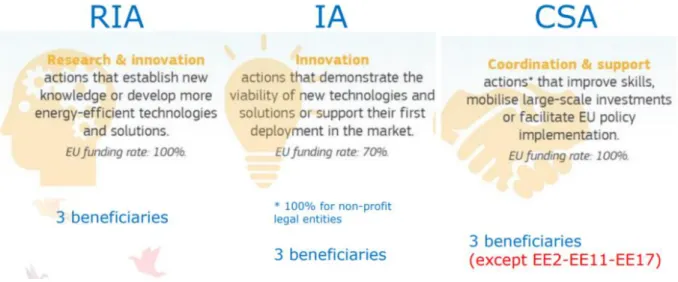
Horizon 2020 supports both projects at the beginning of the innovation chain that are mainly focused on research, so-called Research and Innovation Actions (RIAs), as well as projects closer to the market, so-called Innovation Actions (IAs), in which prototypes are demonstrated. Moreover, Coordination and Support Actions (CSA) are supported, in which projects under research priorities are supported that focus on standardization, dissemination, awareness raising and communication, networking, coordination or support services activities, or policy dialogues and mutual learning exercises and studies.
Figure 3 Energy efficiency (SC3, NMBP- EeB & SPIRE) Calls 2018 & 2019.30
In addition, in 2017 the European Innovation Council pilot (EIC pilot) was as part of the Horizon 2020 Work programme 2018-2020. This pilot brings together the SME Instrument, the Fast Track to Innovation (FTI), Future and Emerging Technologies (FET), Open and Horizon Prizes, in order to provide a 'one stop shop' for funding of innovators/innovations in the EU. 37 More information on this can be found in 4.2.2 –
4.2.3.
2. Type of funding
The type of funding is usually reimbursement of cost grants, in which either the actual costs, unit costs and flat-rate costs are funded or a lump sum grant is awarded. There are are no budget restrictions, unless specified in the call. This is the case for both RIA, IA and CSA grants.
3. Conditions for using the instrument
30 European Commission – DG Energy (2018). Horizon 2020 Work Programme for Research & Innovation 2018-2020.
Applicant requirements
For most Horizon 2020 calls, a project consortium needs contain at least a minimum of three beneficiaries from three different EU Member States or H2020 associated countries. In recent Horizon 2020 Work Programmes, some calls require only one beneficiary from an EU Member State or H2020 associated country. For all project types additional beneficiaries/linked third parties from any country are usually allowed as well depending on the call requirements.
Co-funding percentage and other financial requirements
The funding percentage for RIA is 100 % of eligible costs (unless the call provides exceptionally for another rate). For IA this percentage is 70 % (100 % for non-profit organisations) of eligible costs (unless the call provides exceptionally for another rate), and thus co-funding is required. For CSA the funding percentage is 100%.
Project size
Grants vary roughly between EUR 2 and 20 million per call, depending on the type of project.
Eligible costs
Eligible costs are defined per call, but usually consist of: • direct personnel costs;
• direct costs of subcontracting;
• direct costs of providing financial support to third parties (if applicable); • other direct costs;
• indirect costs;
• specific cost categories (if option applies).
For lump sum grants eligible costs are the costs for the action (direct and indirect costs).
Technology Readiness Levels (1-9), if applicable
Technology Readiness Levels vary per H2020 call. Depending on the specific purpose of the call, projects in pre-commercial development, demonstration and market uptake could apply. However, the project needs to be innovative and have specific impact. Research and Innovation Actions (RIAs) aim at TRL levels of 3-6.
Innovative Actions (IAs) aim at TRL levels of 5-7.
4. Relevance for the heating and cooling sector
The calls that are relevant for the subject of this report can be found under a number of themes. Next to implementation, in some call topics also research and innovation and support to SMEs is included. The most relevant calls for 2018-2020 can be found in
particular under the theme Secure, clean and efficient energy.31 Some relevant calls
(non-exhaustive) will be mentioned below:
31 European Commission (2018). Horizon 2020 – Work Programme 2018-2020. 10. Secure, clean and efficient energy. Decision C(2018)4708 of 24 July 2018.
EE - Energy Efficiency
Buildings represent a large share of the energy used in the EU (40 %) and energy efficiency measures, including heating and cooling, are important technologies for the decarbonisation of the EU building stock by 2050.
Call topics:
LC-SC3-EE-1-2018-2019-2020: Decarbonisation of the EU building stock: innovative approaches and affordable solutions changing the market for buildings renovation.
LC-SC3-EE-2-2018-2019: Integrated home renovation services.
LC-SC3-EE-4-2019-2020: Upgrading smartness of existing buildings through innovations for legacy equipment.
LC-SC3-EE-6-2018-2019-2020: Business case for industrial waste heat/cold recovery.
LC-SC3-EE-13-2018-2019-2020: Enabling next-generation of smart energy services valorising energy efficiency and flexibility at demand-side as energy resource.
LC-SC3-EE-16-2018-2019-2020: Supporting public authorities to implement the Energy Union.
LC-SC3-EE-17-2019: European City Facility - European cities as key innovation hubs to unlock finance for energy efficiency (Smart Financing for Smart Buildings)
RES – Global Leadership in Renewables
This area supports activities across the full innovation chain, from identifying breakthrough technologies to supporting the entire portfolio of renewable energy technologies at laboratory scale, dedicating support to validation in relevant environment of most promising technologies, finally supporting market up take introduction with collaborative and not purely technological activities. 27
Call topics:
LC-SC3-RES-4-2018: Renewable energy system integrated at the building scale. LC-SC3-RES-5-2018: Increased performance of technologies for local heating and
cooling solutions.
LC-SC3-RES-8-2019: Combining Renewable Technologies for a Renewable District Heating and/or Cooling System.
ES – Smart Citizen-centred energy system
This area puts the citizen in the centre of the EU's energy system and supports actions are needed to support the best implementation of the EU's energy policy package "Clean Energy for all Europeans".
Call topics:
LC-SC3-ES-3-2018-2020: Integrated local energy systems (Energy islands)
LC-SC3-ES-7-2018: Pan-European Forum for R&I on Smart Grids, Flexibility and Local Energy Networks
LC-SC3-ES-9-2019: ERA-NET Co-Fund Enhanced cooperation in Digitalisation of Energy Systems and Networks
SCC - Smart Cities and Communities
To achieve the necessary energy transition in cities, it is essential to increase energy systems integration and to push energy performance levels significantly beyond the levels of current EU building codes and to realize the deployment of Positive Energy Districts.
Call topic:
LC-SC3-SCC-1-2018-2019-2020: Smart Cities and Communities
5. Application deadline
Horizon2020 deadlines differ per call and can be found in the Work Programme.31
6. Managing authority
The H2020 Programme is funded by the European Commission and is managed mainly by the Innovation and Networks Executive Agency (INEA).
7. Budget
In total, the European Commission has made EUR 80 billion available for the H2020 programme from 2014-2020.
8. Programming period
Horizon 2020 funding period is from 2014-2020. After this period, Horizon Europe will run from 2021-2027. For Horizon Europe, EUR 100 billion will be made available for the period 2021-2027.
This programme will focus on creating more impact, but will have similar research priorities, defined in three pillars: Open Science, Global Challenges and Industrial
Competitiveness and Open Innovation. 32
The Open Science pillar (EUR 25.8 billion) will support frontier research projects through the European Research Council, funds fellowships and exchanges for researchers through Marie Skłodowska-Curie Actions, and invests in world-class research infrastructures.
The Global Challenges and Industrial Competiveness pillar (EUR 52.7 billion) will directly support research and innovation relating to societal challenges, reinforces technological and industrial capacities, and sets EU-wide missions to tackle some of our biggest problems. Climate, Energy and Mobility will one of the clusters under this pillar and focuses on renewable energy systems and grids, as well as supply, storage and buildings and industrial facilities in energy transition.
The Open Innovation pillar (EUR 13.5 billion) aims to make Europe a frontrunner in market-creating innovation via the European Innovation Council by developing the overall European innovation landscape and fostering the integration of business, research, higher education and entrepreneurship.
9. More information
The official webpage for the Horizon 2020 programme is: ec.europa.eu/horizon2020. All projects funded under Horizon 2020 (and preceding programmes) can be found in the
CORDIS database: cordis.europa.eu/projects/home_en.html. The database includes a
search function that allows for instance to search for projects in the heating and cooling sector.
National Contact Points (NCPs)
The network of National Contact Points (NCPs) is the main structure to provide guidance, practical information and assistance on all aspects of participation in Horizon 2020. NCPs are also established in many non-EU and non-associated countries ("third countries").
NCPs are national structures established and financed by governments of the 28 EU member states and the states associated to the framework programme. NCPs give personalised support on the spot and in applicants' own languages. The NCP systems can vary from one country to another from highly centralised to decentralised networks, and a number of very different actors, from ministries to universities, research centres and special agencies to private consulting companies.
As the NCPs are national structures, the type and level of services offered may differ from country to country. In general, the following basic services are available in accordance with the NCP Guiding Principles doc agreed by all countries:
Guidance on choosing relevant H2020 topics and types of action Advice on administrative procedures and contractual issues Training and assistance on proposal writing
Distribution of documentation (forms, guidelines, manuals etc.) Assistance in partner search
4.2.1
SME instrument
1. Target areas
The SME instrument offers Europe's brightest and boldest entrepreneurs the chance to step forward and request funding for breakthrough ideas with the potential to create entirely new markets or revolutionise existing ones. It supports ground-breaking innovative ideas for products, services or processes that are ready to conquer global markets. There are no predefined topics for the SME instrument, only the most excellent and impactful ideas receive support.
As part of the EIC pilot, Horizon 2020 funds high-potential innovation developed by SMEs through the SME instrument. The programmme supports close-to-market activities, with the aim to give a strong boost to breakthrough innovation with a market-creating potential. Highly innovative SMEs with a clear commercial ambition and a potential for high growth and internationalisation are the prime target.