Working PaPer SerieS
no 1167 / aPriL 2010
MacroeconoMic
ForecaSting
and StructuraL
change
W O R K I N G PA P E R S E R I E S
N O 1167 / A P R I L 2 010
In 2010 all ECB publications feature a motif taken from the €500 banknote.
MACROECONOMIC FORECASTING
AND STRUCTURAL CHANGE
1by Antonello D’Agostino
2, Luca Gambetti
3and Domenico Giannone
4NOTE: This Working Paper should not be reported as representing the views of the European Central Bank (ECB). The views expressed are those of the authors and do not necessarily reflect those of the ECB.
© European Central Bank, 2010 Address
Kaiserstrasse 29
60311 Frankfurt am Main, Germany
Postal address
Postfach 16 03 19
60066 Frankfurt am Main, Germany
Telephone +49 69 1344 0 Internet http://www.ecb.europa.eu Fax +49 69 1344 6000
All rights reserved.
Any reproduction, publication and reprint in the form of a different publication, whether printed or produced electronically, in whole or in part, is
Abstract 4
Non-technical summary 5
1 Introduction 7
2 The time-varying vector autoregressive model 10
2.1 Forecasts 11
2.2 Priors specifi cation 12
3 Real-time forecasting 13
3.1 Data 13
3.2 How much time variation? 14
3.3 Other forecasting models 15
3.4 Forecast evaluation 16
4 Results 16
5 Conclusions 19
References 20
Appendix 22
Tables and fi gures 26
Abstract
The aim of this paper is to assess whether explicitly modeling structural change increases the ac-curacy of macroeconomic forecasts. We produce real time out-of-sample forecasts for inflation, the unemployment rate and the interest rate using a Time-Varying Coefficients VAR with Stochastic Volatility (TV-VAR) for the US. The model generates accurate predictions for the three variables. In particular for inflation the TV-VAR outperforms, in terms of mean square forecast error, all the competing models: fixed coefficients VARs, Time-Varying ARs and the na¨ıve random walk model. These results are also shown to hold over the most recent period in which it has been hard to forecast inflation.
JEL classification: C32, E37, E47.
Keywords: Forecasting, Inflation, Stochastic Volatility, Time Varying Vector Autoregres-sion.
Non technical summary
The aim of this paper is to assess whether explicitly modelling structural change increases the accuracy of macroeconomic forecasts. In principle, allowing for structural changes may improve the forecast performance for at least two reasons. First, it allows capturing and exploiting changes in macroeconomic relationships. Second, empirical models that allow for structural changes can correctly detect and forecast changes in the long run dynamics, like the decline in trend inflation and unemployment observed since the mid 80s; however, a richer model structure can worsen the forecasting performance. A higher number of parameters increases the estimation errors, which in turn can affect the forecast accuracy. The model we use in this paper is sufficiently general and flexible. We allow for both changes in the coefficients and in the volatility. In particular, we use the Time-Varying Coefficients VAR with Stochastic Volatility (TV-VAR). The model allows for a) changes in the predictable component (time-varying coefficients), which can be due to variations in the structural dynamic interrelations among macroeconomic variables; and b) changes in the unpredictable component (stochastic volatility), that is, variations in the size and correlation among forecast errors, which can be due to changes in the size of exogenous shocks or their impact on macroeconomic variables.
We forecast three macroeconomic variables for the US economy: the unemployment rate, inflation and a short term interest rate. We aim to mimic as close as possible the conditions faced by a forecaster in real-time. We use “real-time data” to compute predictions based only on the data that were available at the time the forecasts are made. The accuracy of the predictions (the mean square forecast errors) of the TV-VAR is compared to the accuracy of other standard forecasting models: fixed coefficients VARs (estimated recursively or with rolling window), Time-Varying ARs and the naive random walk model.
Our findings show that the TV-VAR is the only model which systematically delivers accurate forecasts for the three variables. Inflation predictions at long horizons produced by the TV-VAR are much more accurate than those obtained with any other model. These results hold for the Great Moderation period (after mid 1980's). This is particularly
Forecasting evaluation has important implications even if the ultimate goal is not forecasting. It is a powerful validation procedure which is particularly important for very flexible and general models such as the TV-VAR. In general, introducing complexity in the model to better describe the data does not necessary enhance real-time forecasting performances. The benefit from more flexibility might be limited if the more flexibility captures also non prominent features of the data. If model complexity is introduced with a proliferation of parameters, instabilities due to estimation uncertainty might completely offset the gains obtained by limiting model miss-specification. Our results indicate that the TV-VAR model is a very powerful tool for real-time forecasting since it incorporates in a flexible but parsimonious manner the prominent features of a time-varying economy.
1
Introduction
The US economy has undergone many structural changes during the post-WWII period. Long run trends in many macro variables have changed. Average unemployment and infla-tion were particularly high during the 70s and low in the last decades (see Staiger, Stock, and Watson, 2001). Business cycle fluctuations have moderated substantially in the last twenty years and the volatility of output growth has reduced sharply. This latter phe-nomenon is typically referred to as the ”Great Moderation” (Stock and Watson, 2004). Also the dynamics of inflation have changed drastically: after the mid 80s inflation has become more stable and less persistent (see Cogley and Sargent, 2001).1
In addition to these series-specific changes many important changes in the relationships between macroeconomic variables have been documented. For instance, some authors have argued that the Phillips curve is no longer a good characterization of the joint dynamics of inflation and unemployment. Such a claim is partly based on the result that the predictive content of unemployment for inflation has vanished since the mid 80s (Atkeson and Ohanian, 2001; Roberts, 2006; Stock and Watson, 2008a).2 The same period has seen significant changes in the conduct of macroeconomic policy. For example, according to many observers, monetary policy has become much more transparent and aggressive against inflation since the early 80s (Clarida, Gali, and Gertler, 2000).
In this paper we address the following question: can the accuracy of macroeconomic forecasts be improved by explicitly modeling structural change? The answer to this question is far from trivial. On the one hand, clearly, if the economy has changed, a forecasting model that can account for such changes would be better suited and should deliver better forecasts. On the other hand, however, a richer model structure implying a higher number of parameters should increase the estimation errors and reduce the forecast accuracy.
The relevance of modeling time variation was originally stressed by Doan, Litterman,
1Changes in persistence are still debated, for instance Pivetta and Reis (2007) find that the changes are not significant.
2More generally, the ability to exploit macroeconomic linkages for predicting inflation and real activity seems to have declined remarkably since the mid-1980s, see (D’Agostino, Giannone, and Surico, 2006) and Rossi and Sekhposyan (2008).
and Sims (1984), but surprisingly there are only a few studies aiming at exploring the issue systematically (see Stock and Watson (1996), Canova (2007), Clark and McCracken (2007), Stock and Watson (2007)). These studies use different models and forecasting periods but they all share a common feature: they focus on the time variation in the coefficients but do not allow for changes in volatility. The only exception is Stock and Watson (2007) who, however, do not have lagged dynamics in their forecasting equation.
We forecast three macroeconomic variables for the US economy, the unemployment rate, inflation and a short term interest rate, using a Time-Varying Coefficients VAR with Stochastic Volatility (TV-VAR henceforth) as specified by Primiceri (2005). The model is very flexible. In particular it allows for a) changes in the predictable component (time-varying coefficients), which can be due to variations in the structural dynamic interrelations among macroeconomic variables; and b) changes in the unpredictable component (stochastic volatility), that is, variations in the size and correlation among forecast errors, which can be due to changes in the size of exogenous shocks or their impact on macroeconomic variables.3 In the forecasting exercise we aim at mimicking as close as possible the conditions faced by a forecaster in real-time. We use “real-time data” to compute predictions based only on the data that were available at the time the forecasts are made. We forecast up to 3 years ahead. This longer horizon has been chosen to fill the gap with the existing literature, which has mainly focused on the shorter horizons up to one year.4 Long run persistent components can play a crucial role in explaining longer horizon dynamics, while their contribution in explaining short run movements in the variables can be negligible.
The accuracy of the predictions (the mean square forecast errors) of the TV-VAR are compared to the predictions based on other standard forecasting models: fixed coefficients VARs (estimated recursively or with rolling window), Time-Varying ARs and the na¨ıve random walk model.
The assessment of the forecasting performance of econometric models has become
stan-3Allowing for the two sources of change is also important in the light of the ongoing debate about the relative importance of changes in the predictable and unpredictable components in the Great Moderation (Giannone, Lenza, and Reichlin, 2008).
dard in macroeconomics, even if the ultimate goal is not forecasting. Forecasting evaluation can be seen as a validation procedure which is particularly important for very flexible and general models. In general, introducing complexity in the model to better describe the data does not necessary enhance real-time forecasting performances. The benefit from more flex-ibility might be limited if the more flexflex-ibility captures also non prominent features of the data. If model complexity is introduced with a proliferation of parameters, instabilities due to estimation uncertainty might completely offset the gains obtained by limiting model miss-specification. Out-of-sample forecasting evaluations represent hence an important device to evaluate the ability of capturing prominent features of the data within a parsimonious mod-els. In addition, the out-of-sample exercise will also provide indications on some subjective choices that are required for the estimation of the TV-VAR model, such as the setting of the prior beliefs on the relative amount of time variations in the coefficients.
In addition, the paper studies another core aspect of the TV-VAR model which has not been tackled by the previous literature; the effect of explosive roots on the forecast accuracy. In particular, we compare the predictive ability of the model in two cases: in the first one the explosive paths (draws which make instable the system) are excluded, while in the second one such restriction is not imposed and all draws are used to compute the forecasts. The presence of explosive paths could have relevant effects especially over the longer horizon forecasts.5
Our main findings show that the TV-VAR is the only model which systematically de-livers accurate forecasts for the three variables. For inflation the forecasts generated by the TV-VAR are much more accurate than those obtained with any other model. For unem-ployment, the forecasting accuracy of the TV-VAR model is very similar to that of the fixed coefficient VAR, while forecasts for the interest rate are comparable to those obtained with the Time-Varying AR. These results hold for different sub-samples. In particular, they are also confirmed over the Great Moderation period, a period in which forecasting models are often found to have difficulties in outperforming simple na¨ıve models in forecasting many macroeconomic variables especially inflation. Results suggest that, on the one hand time
5Clark and McCracken (2007) found that the time-varying VAR performs particularly badly over the ten year horizon. This might be due to the presence of explosive roots.
varying models are “quicker” in recognizing structural changes in the permanent compo-nents of inflation and interest rate, and, on the other hand, that short term relationships among macroeconomic variables carry out important information, once structural changes are properly taken into account.
The rest of the paper is organized as follows, section 2 describes the TV-VAR model; section 3 explains the forecasting exercise; section 4 presents the results and section 5 concludes.
2
The Time-Varying Vector Autoregressive Model
Letyt= (πt, U Rt, IRt) whereπtis the inflation rate,U Rt the unemployment rate andIRt
a short term interest rate. We assume thatytadmits the following time varying coefficients VAR representation:
yt=A0,t+A1,tyt−1+...+Ap,tyt−p+εt (1)
where A0,t contains time-varying intercepts, Ai,t are matrices of time-varying coefficients,
i = 1, ..., p and εt is a Gaussian white noise with zero mean and time-varying covariance
matrix Σt. LetAt= [A0,t, A1,t..., Ap,t], andθt=vec(At),wherevec(·) is the column stacking operator. Conditional on such an assumption, we postulate the following law of motion for
θt:
θt=θt−1+ωt (2)
whereωt is a Gaussian white noise with zero mean and covariance Ω. We let Σt=FtDtFt, whereFtis lower triangular, with ones on the main diagonal, andDta diagonal matrix. Let
σt be the vector of the diagonal elements ofDt1/2 andφi,t,i= 1, ..., n−1 the column vector formed by the non-zero and non-one elements of the (i+ 1)-th row ofFt−1. We assume that the standard deviations,σt, evolve as geometric random walks. The simultaneous relations
φit in each equation of the VAR are assumed to evolve as independent random walks.
logσt= logσt−1+ξt (3)
where ξt and ψi,t are Gaussian white noises with zero mean and covariance matrix Ξ and Ψi, respectively. Let φt= [φ1,t, . . . , φn−1,t], ψt= [ψ1,t, . . . , ψn−1,t], and Ψ be the covariance matrix ofψt. We assume thatψi,t is independent of ψj,t, for j=i, and that ξt,ψt, ωt, εt
are mutually uncorrelated at all leads and lags.6
2.1 Forecasts
Equation (1) has the following companion form
yt=μt+Atyt−1+t
whereyt= [yt...yt−p+1],t= [εt0...0] andμt= [A0,t0...0] arenp×1 vectors and
At=
At
In(p−1) 0n(p−1),n
whereAt= [A1,t...Ap,t] is ann×npmatrix, In(p−1) is ann(p−1)×n(p−1) identity matrix and 0n(p−1),n is an(p−1)×nmatrix of zeros. Let ˆμtand ˆAt denote the median of the joint posterior distribution ofμt At (see appendix for the details). The one-step ahead forecast is
ˆ
yt+1|t= ˆμt+ ˆAtyt (5)
A technical issue arises when we generate multi-step expectations; we have to evaluate the future path of drifting parameters. We follow the literature and treat those parameters as if they had remained constant at the current level.7 As a consequence, forecasts at time
t+hare computed iteratively:
ˆ yt+h|t= ˆμt+ ˆAtyˆt+h−1 = h j=1 ˆ Aj−1 t μˆt+ ˆAhtyt (6)
6In principle, one could make ε
t and ωt correlated. However, it is well known that such model can be
equivalently represented with a setup where shocks are mutually uncorrelated butεt is serially correlated. Since our measurement equation is a VAR, such a flexibility is unnecessary here.
2.2 Priors specification
The model is estimated using Bayesian methods. While the details of the estimation are accurately described in the Appendix, in this section we briefly discuss the specification of our priors. Following Primiceri (2005), we make the following assumptions for the priors densities. First, the coefficients of the covariances of the log volatilities and the hyperpa-rameters are assumed to be independent of each other. The priors for the initial states θ0,
φ0 and logσ are assumed to be normally distributed. The priors for the hyperparameters, Ω, Ξ and Ψ are assumed to be distributed as independent inverse-Wishart. More precisely, we have the following priors:
• Time varying coefficients: P(θ0) =N(ˆθ,Vˆθ) and P(Ω) =IW(Ω−01, ρ1);
• Stochastic Volatilities: P(logσ0) =N(log ˆσ, In) and P(Ψi) =IW(Ψ−0i1, ρ3i);
• Simultaneous relations: P(φi0) =N( ˆφi,Vˆφi) andP(Ξ) =IW(Ξ−01, ρ2);
where the scale matrices are parameterized as follows Ω−01 =λ1ρ1Vˆθ, Ψ0i =λ3iρ3iVˆφi and Ξ0 = λ2ρ2In. The hyper-parameters are calibrated using a time invariant recursive VAR estimated using a sub-sample consisting of the first T0 observations.8 For the initial states
θ0and the contemporaneous relationsφi0, we set the means, ˆθand ˆφi, and the variances, ˆVθ
and ˆVφi, to be the maximum likelihood point estimates and four times its variance. For the initial states of the log volatilities, logσ0, the mean of the distribution is chosen to be the logarithm of the point estimates of the standard errors of the residuals of the estimated time invariant VAR. The degrees of freedom for the covariance matrix of the drifting coefficient’s innovations are set to be equal toT0, the size of the initial-sample. The degrees of freedom for the priors on the covariance of the stochastic volatilities’ innovations, are set to be equal to the minimum necessary for insuring the prior is proper. In particular, ρ1 and ρ2 are equal to the number of rows Ξ−01 and Ψ−0i1 plus one respectively. The parameters λi are very important since they control the degree of time variations in the unobserved states. The smaller such parameters are, the smoother and smaller are the changes in coefficients. The empirical literature has set the prior to be rather conservative in terms of the amount
8T
of time variations. The exact parameterizations used will be discussed in the empirical section.
3
Real-time forecasting
Our objective is to predict the h-period ahead unemployment rate U Rt+h, the interest rateIRt+h and the annualized price inflationπht+h = 400h log(PPt+h
t ), where Pt+h is the GDP
deflator at timet+h and 400h is the normalization term.
3.1 Data
Prices are measured by the GDP deflator and the interest rate is measured by the three month treasury bills. We use real time data forPtandU Rt,9 while the three month interest rate series is not subject to revisions.10 Since unemployment and interest rate series are available at monthly frequency, we follow Cogley and Sargent (2001, 2005) and Cogley, Primiceri, and Sargent (2008) and convert them into quarterly series by taking the value at the mid-month of the quarter forU Rtand the value at the first month of the quarter forIRt. We use quarterly vintages from 1969:Q4 to 2007:Q4. Vintages can differ since new data on the most recent period are released, but also because old data get revised. As a convention we date a vintage as the last quarter for which all data are available. For each vintage the sample starts in 1948:Q1.11 For the GDP deflator we compute the annualized quarterly inflation rate, πt= 400 log( Pt
Pt−1). We perform an out-of-sample simulation exercise.12 The
procedure consists of generating the forecasts by using the same information that would have been available to the econometrician who had produced the forecasts in real time. The simulation exercise begins in 1969:Q4 and, for such a vintage, parameters are estimated
9The data are available on the Federal Reserve Bank of Philadelphia website at:
http://www.phil.frb.org/econ/forecast/reaindex.html.
10The series is available on the FRED dataset of the Federal Reserve Bank of St. Louis (mnemonics TB3MS), at: http://research.stlouisfed.org/fred2/series/TB3MS
11The vintages have a different time length, for example the sample span for the first vintage is 1948:Q1-1969:Q4, while the sample span for the last available vintage is 1948:Q1-2007:Q4.
12Data for the same period can differ across vintages because of revisions; for notational simplicity we drop the indication of the vintage.
using the sample 1948:Q1 to 1969:Q4. The model is estimated with two lags. We compute the forecasts up to 12 quarters ahead outside the estimation window, from 1970:Q1 to 1972:Q4, and the results are stored.13 Then, we move one quarter ahead and re-estimate the model using the data in vintage 1970:Q1. Forecasts from 1970:Q2 to 1973:Q1 are again computed and stored. This procedure is then repeated using all the available vintages. Predictions are compared with ex-post realized data vintages. Since data are continuously revised at each quarter, several vintages are available. Following Romer and Romer (2000), predictions are compared with the figures published after the next two subsequent quarters. These figures are conceptually similar to the series being predicted in real time since they do not incorporate rebenchmarking and other definitional changes. In addition, these figures are based on a relatively complete set of data available to the statistical offices. Qualitative results are confirmed if we compare with final data.
Two important aspects of the TV-VAR specification are worth noting. The first one concerns the setting of λi, the parameter which fixes the tightness of the variance of the coefficients . In general, the literature has been quite conservative; very little time variation has been used in practice to set this parameter. The second aspect concerns the inclusion (or exclusion) of explosive draws from the analysis. That is, whether to keep or discard draws whose (VAR polynomial) roots lie inside the unit circle. We report results for the most conservative priors of Primiceri (2005) (λ1 = (0.01)2, λ2 = (0.1)2 and λ3 = (0.01)2) and discard the explosive draws. However, we also run some robustness checks to understand the sensitivity of the model to alternative specifications. In a first simulation, we set more stringent priors, while in a second simulation we keep the explosive draws.
3.2 How much time variation?
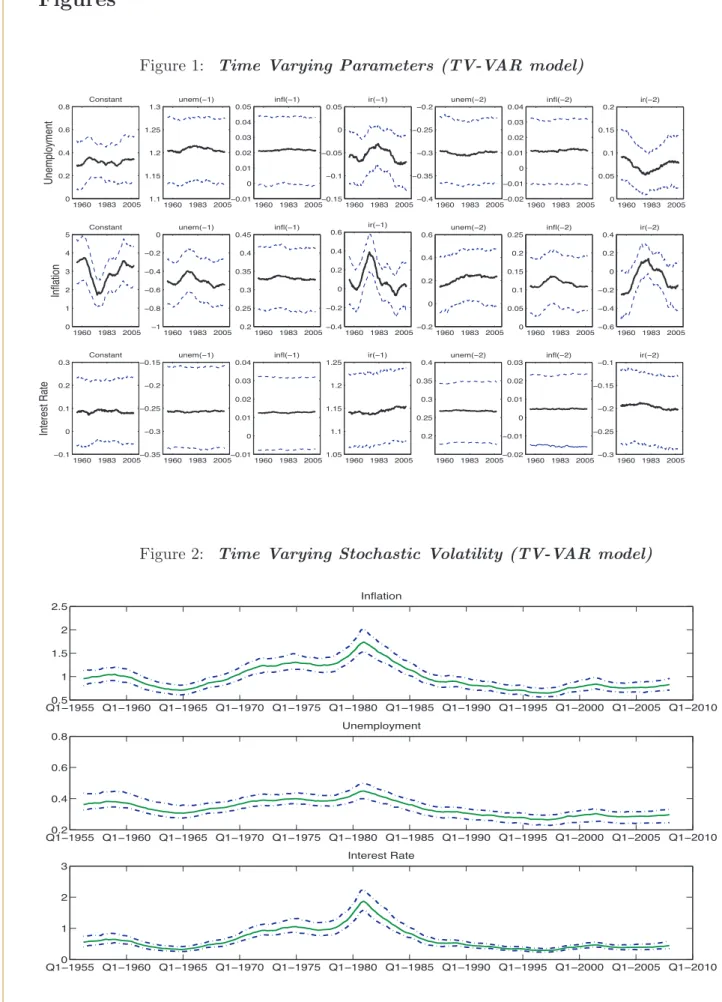
In order to understand if time variation is an important characteristic of the dataset, we estimate the TV-VAR model over the all sample and plot the estimated parameters and the standard deviation of the residuals (with the confidence bands) over time.
Figure 1 in Appendix shows the evolution of the coefficients over the sample. Many
13In the simulation exercise forecasts for horizon h= 1 correspond to nowcast, given that in real time data are available only up to the previous quarter.
of them display constant patterns, while about four parameters are characterized by re-markable fluctuations over time. Figure 2 shows evolution of the standard deviation of the residuals. All the volatilities exhibit accentuate time variation over the sample. The figure also shows that, concomitant with the great moderation period (middle 1980s), there is a sharp drop in the volatility of the residuals.
All in all these results show that time variation is an important features of the data. Modeling such feature in both coefficients and variance is crucial for an accurate estimation and a correct interpretation of the results.
3.3 Other forecasting models
We compare the forecast obtained with the TV-VAR with those obtained using different standard forecasting models. First, we consider Time Varying Autoregressions (TV-AR) for each for the three series. We will keep the same specification and prior beliefs used for the TV-VAR. Second, we also consider univariate (AR) and multivariate (VAR) forecasts produced using fixed coefficient models. For sake of comparability, all the models are estimated with two lags. The models are estimated either recursively (REC), i.e. using all the data available at the time the forecast are made or using a rolling (ROL) window, i.e using the most recent ten years of data available at the time the forecast are made. The estimation over a rolling window is a very simple device to take time variation into account. The forecasts computed recursively and with rolling windows (on the VAR and AR models) will be denoted by VAR-REC, VAR-ROL, AR-REC, and AR-ROL respectively. Notice that the models predict quarterly inflation, therefore the forecasts for the h− quarter inflation
πh
t+h are computed by cumulating the firsth forecasts of the first entries (which correspond
toπt) of the forecasted vector ˆyt+h|t, that is ˆπh
t+h|t= h1
h
i=1πˆt+i|t.
We will also compute no-change forecasts which are used as a benchmark. According to this na¨ıve model, unemployment and interest rate nexth−quarter ahead are predicted to be equal to the value observed in the current quarter. In the case of inflation we use a different benchmark. Atkeson and Ohanian (2001) showed that, since 1984, structural models of US inflation have been outperformed by a na¨ıve forecasts based on the average rate of inflation over the current and previous three quarters. This is essentially a ”no
change” forecast for annual inflation:
ˆ
πth,ao+h|t=π4t = 1
4(πt+πt−1+πt−2+πt−3) (7)
3.4 Forecast evaluation
Forecast accuracy is evaluated by means of the Mean Square Forecast Error (MSFE). The MSFE is a measure of the average forecast accuracy over the out-of-sample window. In the empirical exercise we use two samples to evaluate forecasting accuracy. The full sample, 1970 :Q1−2007 :Q4 and the sample 1985 :Q1−2007 :Q4. This latter period corresponds to the great moderation period. To facilitate the comparison between various models, the results are reported in terms of relative MSFE statistics, that is the ratio between the MSFE of a particular model to the MSFE of the na¨ıve model, used as the benchmark. When the relative MSFE is less than one, forecasts produced with a given non-benchmark model are, on average, more accurate that those produced with the benchmark model. For example, a value of 0.8 indicates that the model under consideration improves upon the benchmark by 20%.
4
Results
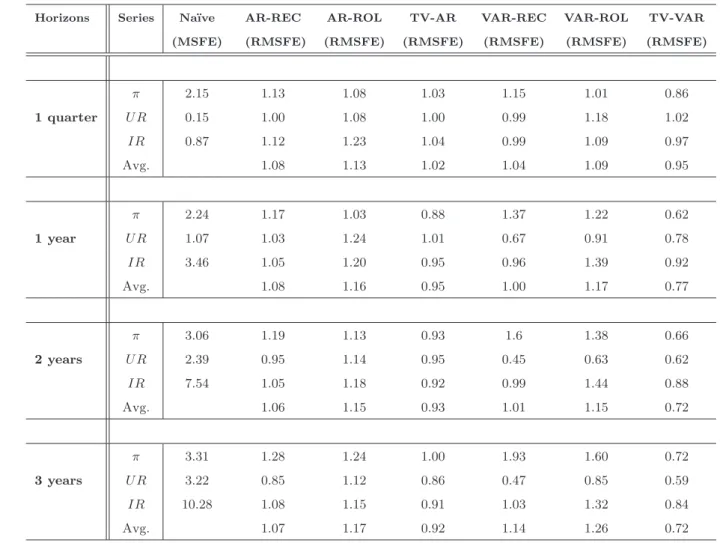
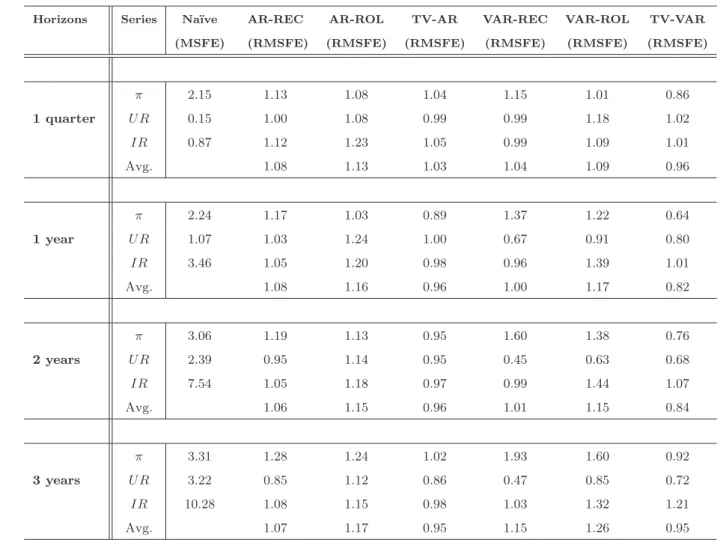
This section discusses the main findings of the forecasting exercise. Table 2 summarizes the results of the real time forecast evaluation, over the whole sample, for the three variables (inflation rate πt, unemployment rate U Rt and the interest rateIRt), and for the forecast horizons of one quarter, one year, two years and three years ahead. For the benchmark na¨ıve models we report the MSFE, while for the remaining models we report the MSFE relative to that of the na¨ıve model (RMSFE). The overall performance of each model is summarized, at each horizon, by averaging over the three variables.
Overall the TV-VAR produces very accurate forecasts for all the variables and, on average, performs better than any other model considered. In particular it outperforms the na¨ıve benchmark for all the variables at all horizons with gains ranging from 5 to 28 percent.
The best relative performances of the TV-VAR model is obtained for inflation. For this variable, the TV-VAR model produces the best forecast with an average (over the horizons) improvements of about 30% relative to the benchmark. A relative good performance is also observed for the TV-AR with improvements of about 10% at horizons of 1 and 2 years. The other time invariant specifications, univariate and multivariate, fail to improve upon the benchmark in terms of forecasting accuracy.
For interest rates, the varying parameter univariate and multivariate models perform similarly and they both improve upon constant parameter models. The advantage of the time-varying over constant parameter models is less clear cut for unemployment and interest rate. For unemployment, especially at long horizons, all models display good forecasting performances relative to the ”na¨ıve”benchmark. Notice, however, that the TV-VAR per-forms well for all horizons.
In conclusion, the TV-VAR model is the only one which does well systematically across variables and horizons.
These findings show that time varying models are quicker than fixed parameters spec-ifications to recognize structural changes in the permanent components of inflation and interest rate. They also suggest that interrelationships among macroeconomic variables carry out important information for forecasting, especially for unemployment and inflation, given that the accuracy of the multivariate time varying specification is always better than that of the univariate counterparts.
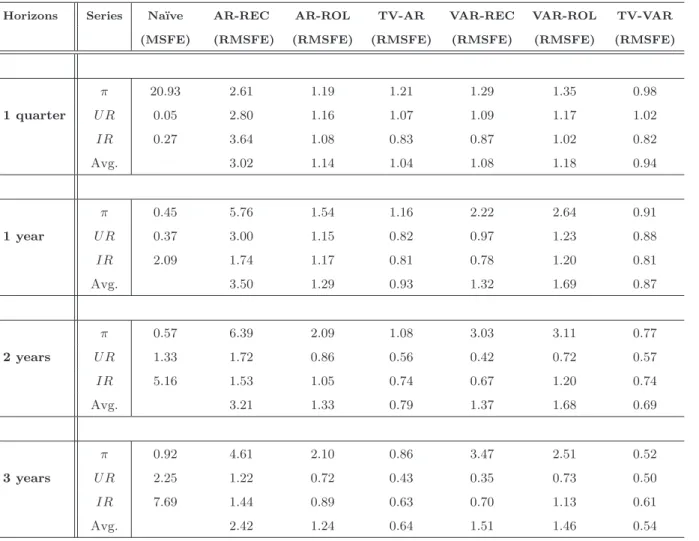
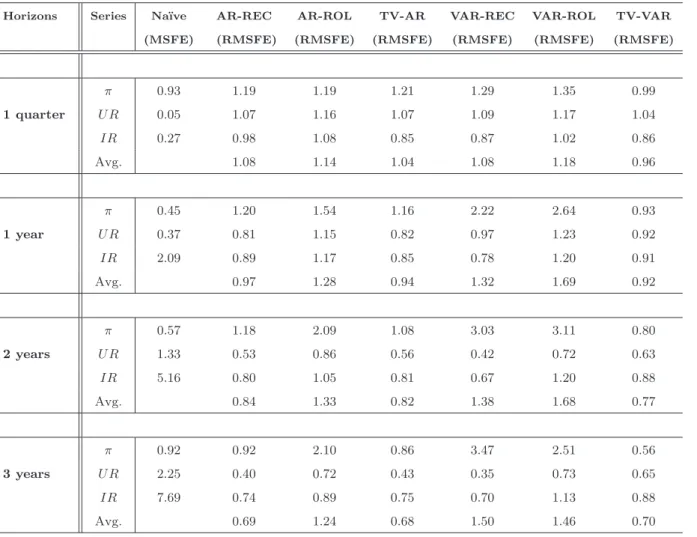
Table 3 shows the results for the “Great Moderation” period. Such a period is of par-ticular interest because it has been shown that it is extremely difficult to produce forecasts which are more accurate than those obtained with simple na¨ıve random walk models; how-ever, also in this period, most of the earlier findings are confirmed. First, the TV-VAR model generates the most accurate forecasts for all the variables. Second, the TV-VAR is again the model producing the best forecast for inflation with an average improvement (over the horizons) of about 30% on the random walk. In particular, the model performs very well for long run inflation forecasts, the improvement at the 3 years horizon is almost double that of the full sample, it is now about 52%; therefore the predictability of inflation can be reestablished once we account for structural changes. This is in line with Cogley,
Primiceri, and Sargent (2008) and Stock and Watson (2008b) who point out that the death of the Phillips curve is an artifact due to the neglected inflation trends and non-linearities. Third, forecasts of the interest rate obtained with the time varying models are more accu-rate than those in the previous sample. This might reflect the increased importance of the systematic predictable component of monetary policy in the last two decades. Finally, time varying methods also display more accurate forecasts, relative to the previous sample, for the unemployment rate series, over the longer horizons.
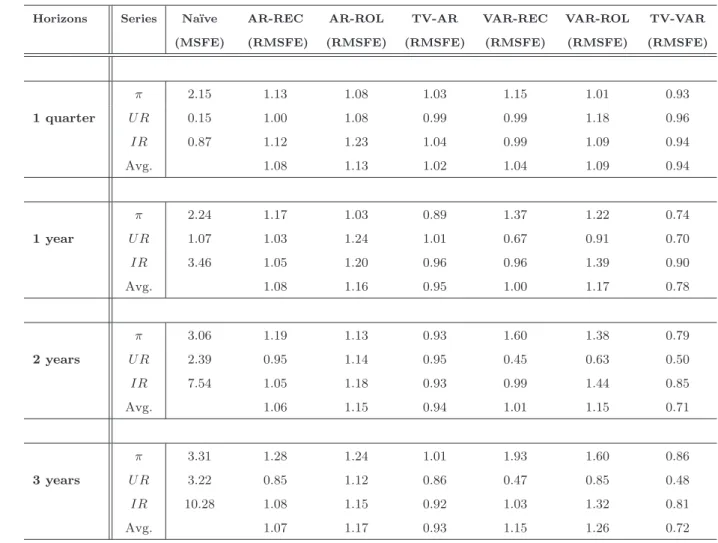
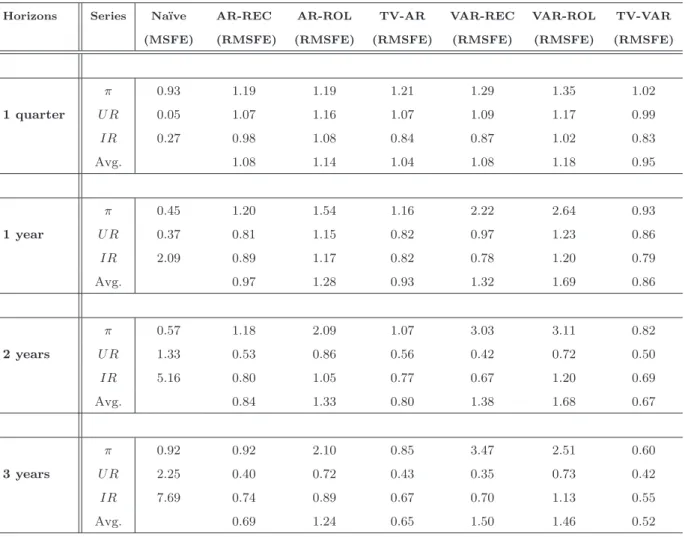
Finally, Tables 4-7 report the results of two different forecast simulations over the two samples. In the first one we use a more stringent priors specification to generate the fore-casts. By more stringent we mean that we assume ana priori smaller degree of variation in all the coefficients. Results are comparable, in terms of accuracy, with those obtained with the previous specification. The general message is that forecasts are particularly accurate when we attribute low probabilities of structural change. In the second simulation, we keep the explosive draws generated in the Gibb sampler algorithm. In this case the accuracy of the forecasts deteriorates for all the variables and in particular for the unemployment rate and interest rate. Similar result have been found by Clark and McCracken (2007) for longer term forecasts. This result, we believe, is especially interesting since there is no clear con-sensus about whether explosive draws should be discarded or not. Our results indicate that adjusting estimates to discard explosive roots is needed to improve out-of-sample forecast accuracy.
Figure 3 in Appendix shows the forecasts, obtained with and without the explosive roots, for the three variables at three years horizon. The main differences between the forecasts are on the first part of the sample until mid 1980s. Forecasts which include explosive draws are more volatile (this is true for inflation and interest rate). This is due to higher persistence of the series during those years, as consequence there is a higher probability to draw explosive roots and as consequence long-term forecasts tend to deviate from the unconditional mean. After the mid 1980s the forecasts generated with and without explosive roots display similar patterns.
5
Conclusions
The US economy has changed substantially during the post-WWII period. This paper tries to assess whether explicitly modeling these changes can improve the forecasting accuracy of key macroeconomic time series.
We produce real time out-of sample forecasts for inflation, the unemployment rate and a short term interest rate using time-varying coefficients VAR with stochastic volatility and we compare its forecasting performance to that of other standard models. Our findings show that the TV-VAR is the only model which systematically delivers accurate forecasts for the three variables. For inflation, the forecasts generated by the TV-VAR are much more accurate than those obtained with any other model. These results hold for the Great Moderation period (after mid 1980’s). This is particularly interesting since previous studies found that over this sample forecasting models have considerable difficulty in outperforming simple na¨ıve models in predicting many macroeconomic variables, in particular inflation.
We draw two main conclusions. First, taking into account structural economic change is important for forecasting. Second, the TV-VAR model is a very powerful tool for real-time forecasting since it incorporate in a flexible but parsimonious manner the prominent features of a time-varying economy.
This is a first step in the investigation of how structural change can be explicitly modeled for improving macroeconomic forecasting. We have assessed the accuracy of point forecasts. The assessment of real-time accuracy of density forecasts is an interesting road for future research since, as pointed out by Cogley, Morozov, and Sargent (2005), the TV-VAR model is well suited to characterizing also forecasting uncertainty, in particular for inflation in a situation in which monetary policy and the economy are subject to ongoing changes.
References
Atkeson, A., and L. E. Ohanian (2001): “Are Phillips Curves Useful for Forecasting
Inflation?,” Quarterly Review, pp. 2–11.
Canova, F. (2007): “G-7 Inflation Forecasts: Random Walk, Phillips Curve Or What
Else?,” Macroeconomic Dynamics, 11(01), 1–30.
Carter, C. K., and R.Kohn (1994): “On Gibbs Sampling for State Space Models,”
Biometrika, 81, 541–553.
Clarida, R., J. Gali, andM. Gertler(2000): “Monetary Policy Rules And
Macroeco-nomic Stability: Evidence And Some Theory,” Quarterly Journal of Economics, 115(1), 147–180.
Clark, T. E., and M. W. McCracken(2007): “Forecasting with small macroeconomic
VARs in the presence of instabilities,” Discussion paper.
Cogley, T., S. Morozov,and T. J. Sargent(2005): “Bayesian fan charts for U.K.
in-flation: Forecasting and sources of uncertainty in an evolving monetary system,” Journal of Economic Dynamics and Control, 29(11), 1893–1925.
Cogley, T., G. E. Primiceri, and T. J. Sargent (2008): “Inflation-Gap Persistence
in the U.S.,” NBER Working Paper 13749, NBER.
Cogley, T.,andT. J. Sargent(2001): “Evolving Post WWII U.S. Inflation Dynamics,”
inMacroeconomics Annual, pp. 331–373. MIT Press.
(2005): “Drifts and Volatilities: Monetary Policies and Outcomes in the Post WWII US,” Review of Economic Dynamics, 8, 262–302.
D’Agostino, A., D. Giannone,andP. Surico(2006): “(Un)Predictability and
Macroe-conomic Stability,” Working Paper Series 605, European Central Bank.
Doan, T., R. Litterman, andC. A. Sims(1984): “Forecasting and Conditional
Giannone, D., M. Lenza, andL. Reichlin(2008): “Explaining The Great Moderation:
It Is Not The Shocks,” Journal of the European Economic Association, 6(2-3), 621 – 633.
Pivetta, F., and R. Reis (2007): “The Persistence of Inflation in the United States,”
Journal of Economic Dynamics and Control, 31, No.4, 1326–1358.
Primiceri, G. E.(2005): “Time Varying Structural Vector Autoregressions and Monetary
Policy,” Review of Economic Studies, 72, 821–852.
Roberts, J. M. (2006): “Monetary Policy and Inflation Dynamics,”ijcb, 2(3), 193–230. Romer, David, H.,and C. Romer(2000): “Federal Reserve Information and the
Behav-ior of Interest Rates,” American Economic Review, 90, 429 – 457.
Rossi, B.,andT. Sekhposyan(2008): “as models forecasting performance for US output
growth and inflation changed over time, and when?,” Manuscript, Duke University.
Sbordone, A. M., and T. Cogley(2008): “Trend Inflation and Inflation Persistence in
the New Keynesian Phillips Curve,”American Economic Review, forthcoming.
Staiger, D., J. H. Stock, and M. W. Watson (2001): “Prices, Wages, and the U.S.
NAIRU in the 1990s,” in In The Roaring Nineties: Can Full Employment Be Sustained?, ed. by A. B. Krueger, andR. M. Solow. Russell Sage Foundation.
Stock, J. H.,andM. W. Watson(1996): “Evidence on Structural Instability in
Macroe-conomic Time Series Relations,”Journal of Business & Economic Statistics, 14(1), 11–30.
Stock, J. H.,andM. W. Watson(2004): “Has the Business Cycle Changed and Why?,”
inNBER Macroeconomics Annual 2003, ed. by M. Gertler,andK. Rogoff. MIT Press.
(2007): “Why Has U.S. Inflation Become Harder to Forecast?,”Journal of Money, Credit and Banking, 39, No.1.
(2008a): “Phillips Curve Inflation Forecasts,” NBER Working Paper 14322, NBER.
(2008b): “Phillips Curve Inflation Forecasts,” NBER Working Paper 2005-42, 14322.
Appendix
Estimation is done using Bayesian methods. To draw from the joint posterior distribution of model parameters we use a Gibbs sampling algorithm along the lines described in Primiceri (2005). The basic idea of the algorithm is to draw sets of coefficients from known condi-tional posterior distributions. The algorithm is initialized at some values and, under some regularity conditions, the draws converge to a draw from the joint posterior after a burn in period. Letz be (q×1) vector, we denote zT the sequence [z
1, ..., zT]. Each repetition is
composed of the following steps:
1. p(σT|xT, θT, φT,Ω,Ξ,Ψ, sT) 2. p(sT|xT, θT, σT, φT,Ω,Ξ,Ψ)14 3. p(φT|xT, θT, σT,Ω,Ξ,Ψ, sT) 4. p(θT|xT, σT, φT,Ω,Ξ,Ψ, sT) 5. p(Ω|xT, θT, σT, φT,Ξ,Ψ, sT) 6. p(Ξ|xT, θT, σT, φT,Ω,Ψ, sT) 7. p(Ψ|xT, θT, σT, φT,Ω,Ξ, sT)
Gibbs sampling algorithm
• Step 1: sample fromp(σT|yT, θT, φT,Ω,Ξ,Ψ, sT)
To drawσT we use the algorithm of Kim, Shephard and Chibb (KSC) (1998). Consider the system of equationsy∗t ≡Ft−1(yt−Xtθt) =Dt1/2ut, whereut∼N(0, I),Xt= (In⊗xt), and xt = [1n, yt−1...yt−p]. Conditional on yT, θT, and φT, yt∗ is observable. Squaring and taking the logarithm, we obtain
y∗∗t = 2rt+υt (8)
rt=rt−1+ξt (9)
whereyi,t∗∗= log((yi,t∗ )2+ 0.001) - the constant (0.001) is added to make estimation more ro-bust -υi,t = log(u2i,t) andrt= logσi,t. Since, the innovation in (8) is distributed as logχ2(1), we use, following KSC, a mixture of 7 normal densities with component probabilities qj, means mj −1.2704, and variances v2j (j=1,...,7) to transform the system in a Gaussian one, where{qj, mj, vj2}are chosen to match the moments of the logχ2(1) distribution. The values are:
Table 1: Parameters Specification
j qj mj v2j 1.0000 0.0073 -10.1300 5.7960 2.0000 0.1056 -3.9728 2.6137 3.0000 0.0000 -8.5669 5.1795 4.0000 0.0440 2.7779 0.1674 5.0000 0.3400 0.6194 0.6401 6.0000 0.2457 1.7952 0.3402 7.0000 0.2575 -1.0882 1.2626
Let sT = [s1, ..., sT] be a matrix of indicators selecting the member of the mixture to
be used for each element of υt at each point in time. Conditional on sT, (υi,t|s
i,t = j) ∼
N(mj −1.2704, vj2). Therefore we can use the algorithm of Carter and R.Kohn (1994) to draw rt (t=1,...,T) from N(rt|t+1, Rt|t+1), where rt|t+1 = E(rt|rt+1, yt, θT, φT,Ω,Ξ,Ψ, sT,)
andRt|t+1=V ar(rt|rt+1, yt, θT, φT,Ω,Ξ,Ψ, sT).
• Step 2: sample fromp(sT|yT, θT, σT, φT,Ω,Ξ,Ψ)
Conditional on y∗∗i,t and rT, we independently sample each s
i,t from the discrete density
defined byP r(si,t=j|y∗∗i,t, ri,t)∝fN(yi,t∗∗|2ri,t+mj−1.2704, vj2), wherefN(y|μ, σ2) denotes a normal density with meanμand varianceσ2.
• Step 3: sample fromp(φT|yT, θT, σT,Ω,Ξ,Ψ, sT)
Consider again the system of equationsFt−1(yt−Xtθt) =Ft−1yˆt=Dt1/2ut. Conditional onθT, ˆy is observable. SinceF−1 is lower triangular with ones in the main diagonal, each
equation in the above system can be written as
ˆ
y1,t = σ1,tu1,t (10)
ˆ
yi,t = −yˆ[1,i−1],tφi,t+σi,tui,t i= 2, ..., n (11)
whereσi,t andui,t are theith elements of σt and ut respectively, ˆy[1,i−1],t = [ˆy1,t, ...,yˆi−1,t]. Under the block diagonality of Ψ, the algorithm of Carter and R.Kohn (1994) can be applied equation by equation, obtaining draws for φi,t from a N(φi,t|t+1,Φi,t|t+1), where
φi,t|t+1 =E(φi,t|φi,t+1, yt, θT, σT,Ω,Ξ,Ψ) and Φ
i,t|t+1 =V ar(φi,t|φi,t+1, yt, θT, σT,Ω,Ξ,Ψ). • Step 4: sample from p(θT|yT, σT, φT,Ω,Ξ,Ψ, sT)
Conditional on all other parameters and the observables we have
yt=Xtθt+εt (12)
θt=θt−1+ωt (13)
Draws forθtcan be obtained from aN(θt|t+1, Pt|t+1), whereθt|t+1 =E(θt|θt+1, yT, σT, φT,Ω,Ξ,Ψ) andPt|t+1=V ar(θt|θt+1, yT, σT, φT,Ω,Ξ,Ψ) are obtained with the algorithm of Carter and
R.Kohn (1994).
• Step 5: sample from p(Ω|yT, θT, σT, φT,Ξ,Ψ, sT)
Conditional on the other coefficients and the data, Ω has an Inverse-Wishart posterior density with scale matrix Ω−11 = (Ω0 +Tt=1Δθt(Δθt))−1 and degrees of freedom dfΩ1 =
dfΩ0+T, where Ω−01 is the prior scale matrix,dfΩ0 are the prior degrees of freedom andT is length of the sample use for estimation. To draw a realization for Ω makedfΩ1 independent drawszi(i=1,...,dfΩ1) fromN(0,Ω1−1) and compute Ω = (dfi=1Ω1zizi)−1 (see Gelman et. al., 1995).
• Step 6: sample from p(Ξi,i|yT, θT, σT, φT,Ω,Ψ, sT)
Conditional the other coefficients and the data, Ξ has an Inverse-Wishart posterior density with scale matrix Ξ−11 = (Ξ0 +Tt=1Δ logσt(Δ logσt))−1 and degrees of freedom
dfΞ1 =dfΞ0 +T where Ξ−01 is the prior scale matrix anddfΞ0 the prior degrees of freedom. Draws are obtained as in step 5.
Conditional on the other coefficients and the data, Ψi has an Inverse-Wishart posterior density with scale matrix Ψ−i,11 = (Ψi,0 +Tt=1Δφi,t(Δφi,t))−1 and degrees of freedom
dfΨi,1 = dfΨi,0 +T where Ψ−i,01 is the prior scale matrix and dfΨi,0 the prior degrees of freedom. Draws are obtained as in step 5 for alli.
In the first estimation (the first out-of-sample forecast iteration), we make 12000 repeti-tions discarding the first 10000 and collecting one out of five draws. In the other estimarepeti-tions, we initialize the coefficients with the medians obtained in the previous estimation, and we make 2500 repetitions discarding the first 500 and collecting one out of five draws.
Table 2: Forecasting Accuracy over the sample: 1970-2007
Horizons Series Na¨ıve AR-REC AR-ROL TV-AR VAR-REC VAR-ROL TV-VAR (MSFE) (RMSFE) (RMSFE) (RMSFE) (RMSFE) (RMSFE) (RMSFE)
π 2.15 1.13 1.08 1.03 1.15 1.01 0.86 1 quarter UR 0.15 1.00 1.08 1.00 0.99 1.18 1.02 IR 0.87 1.12 1.23 1.04 0.99 1.09 0.97 Avg. 1.08 1.13 1.02 1.04 1.09 0.95 π 2.24 1.17 1.03 0.88 1.37 1.22 0.62 1 year UR 1.07 1.03 1.24 1.01 0.67 0.91 0.78 IR 3.46 1.05 1.20 0.95 0.96 1.39 0.92 Avg. 1.08 1.16 0.95 1.00 1.17 0.77 π 3.06 1.19 1.13 0.93 1.6 1.38 0.66 2 years UR 2.39 0.95 1.14 0.95 0.45 0.63 0.62 IR 7.54 1.05 1.18 0.92 0.99 1.44 0.88 Avg. 1.06 1.15 0.93 1.01 1.15 0.72 π 3.31 1.28 1.24 1.00 1.93 1.60 0.72 3 years UR 3.22 0.85 1.12 0.86 0.47 0.85 0.59 IR 10.28 1.08 1.15 0.91 1.03 1.32 0.84 Avg. 1.07 1.17 0.92 1.14 1.26 0.72
First column, horizons; second column, series; third column MSFE of na¨ıve models; other columns, relative MSFE, that is, ratio of the MSFE of a particular model to the MSFE of the na¨ıve model. For each horizon is also reported the average of the relative MSFE across variables (Avg.).
Table 3: Forecasting Accuracy over the sample: 1985-2007
Horizons Series Na¨ıve AR-REC AR-ROL TV-AR VAR-REC VAR-ROL TV-VAR (MSFE) (RMSFE) (RMSFE) (RMSFE) (RMSFE) (RMSFE) (RMSFE)
π 20.93 2.61 1.19 1.21 1.29 1.35 0.98 1 quarter UR 0.05 2.80 1.16 1.07 1.09 1.17 1.02 IR 0.27 3.64 1.08 0.83 0.87 1.02 0.82 Avg. 3.02 1.14 1.04 1.08 1.18 0.94 π 0.45 5.76 1.54 1.16 2.22 2.64 0.91 1 year UR 0.37 3.00 1.15 0.82 0.97 1.23 0.88 IR 2.09 1.74 1.17 0.81 0.78 1.20 0.81 Avg. 3.50 1.29 0.93 1.32 1.69 0.87 π 0.57 6.39 2.09 1.08 3.03 3.11 0.77 2 years UR 1.33 1.72 0.86 0.56 0.42 0.72 0.57 IR 5.16 1.53 1.05 0.74 0.67 1.20 0.74 Avg. 3.21 1.33 0.79 1.37 1.68 0.69 π 0.92 4.61 2.10 0.86 3.47 2.51 0.52 3 years UR 2.25 1.22 0.72 0.43 0.35 0.73 0.50 IR 7.69 1.44 0.89 0.63 0.70 1.13 0.61 Avg. 2.42 1.24 0.64 1.51 1.46 0.54
First column, horizons; second column, series; third column MSFE of na¨ıve models; other columns, relative MSFE, that is, ratio of the MSFE of a particular model to the MSFE of the na¨ıve model. For each horizon is also reported the average of the relative MSFE across variables (Avg.).
Table 4: Forecasting Accuracy over the sample: 1970-2007 (More Stringent Priors)
Horizons Series Na¨ıve AR-REC AR-ROL TV-AR VAR-REC VAR-ROL TV-VAR (MSFE) (RMSFE) (RMSFE) (RMSFE) (RMSFE) (RMSFE) (RMSFE)
π 2.15 1.13 1.08 1.03 1.15 1.01 0.93 1 quarter UR 0.15 1.00 1.08 0.99 0.99 1.18 0.96 IR 0.87 1.12 1.23 1.04 0.99 1.09 0.94 Avg. 1.08 1.13 1.02 1.04 1.09 0.94 π 2.24 1.17 1.03 0.89 1.37 1.22 0.74 1 year UR 1.07 1.03 1.24 1.01 0.67 0.91 0.70 IR 3.46 1.05 1.20 0.96 0.96 1.39 0.90 Avg. 1.08 1.16 0.95 1.00 1.17 0.78 π 3.06 1.19 1.13 0.93 1.60 1.38 0.79 2 years UR 2.39 0.95 1.14 0.95 0.45 0.63 0.50 IR 7.54 1.05 1.18 0.93 0.99 1.44 0.85 Avg. 1.06 1.15 0.94 1.01 1.15 0.71 π 3.31 1.28 1.24 1.01 1.93 1.60 0.86 3 years UR 3.22 0.85 1.12 0.86 0.47 0.85 0.48 IR 10.28 1.08 1.15 0.92 1.03 1.32 0.81 Avg. 1.07 1.17 0.93 1.15 1.26 0.72
First column, horizons; second column, series; third column MSFE of na¨ıve models; other columns, relative MSFE, that is, ratio of the MSFE of a particular model to the MSFE of the na¨ıve model. For each horizon is also reported the average of the relative MSFE across variables (Avg.). In this estimation we setλ1= 0.00001, λ2= 0.001andλ3= 0.00001.
Table 5: Forecasting Accuracy over the sample: 1985-2007 (More Stringent Priors)
Horizons Series Na¨ıve AR-REC AR-ROL TV-AR VAR-REC VAR-ROL TV-VAR (MSFE) (RMSFE) (RMSFE) (RMSFE) (RMSFE) (RMSFE) (RMSFE)
π 0.93 1.19 1.19 1.21 1.29 1.35 1.02 1 quarter UR 0.05 1.07 1.16 1.07 1.09 1.17 0.99 IR 0.27 0.98 1.08 0.84 0.87 1.02 0.83 Avg. 1.08 1.14 1.04 1.08 1.18 0.95 π 0.45 1.20 1.54 1.16 2.22 2.64 0.93 1 year UR 0.37 0.81 1.15 0.82 0.97 1.23 0.86 IR 2.09 0.89 1.17 0.82 0.78 1.20 0.79 Avg. 0.97 1.28 0.93 1.32 1.69 0.86 π 0.57 1.18 2.09 1.07 3.03 3.11 0.82 2 years UR 1.33 0.53 0.86 0.56 0.42 0.72 0.50 IR 5.16 0.80 1.05 0.77 0.67 1.20 0.69 Avg. 0.84 1.33 0.80 1.38 1.68 0.67 π 0.92 0.92 2.10 0.85 3.47 2.51 0.60 3 years UR 2.25 0.40 0.72 0.43 0.35 0.73 0.42 IR 7.69 0.74 0.89 0.67 0.70 1.13 0.55 Avg. 0.69 1.24 0.65 1.50 1.46 0.52
First column, horizons; second column, series; third column MSFE of na¨ıve models; other columns, relative MSFE, that is, ratio of the MSFE of a particular model to the MSFE of the na¨ıve model. For each horizon is also reported the average of the relative MSFE across variables (Avg.). In this estimation we setλ1= 0.00001,λ2= 0.001and λ3= 0.00001.
Table 6: Forecasting Accuracy over the sample: 1970-2007 (with Explosive Draws)
Horizons Series Na¨ıve AR-REC AR-ROL TV-AR VAR-REC VAR-ROL TV-VAR (MSFE) (RMSFE) (RMSFE) (RMSFE) (RMSFE) (RMSFE) (RMSFE)
π 2.15 1.13 1.08 1.04 1.15 1.01 0.86 1 quarter UR 0.15 1.00 1.08 0.99 0.99 1.18 1.02 IR 0.87 1.12 1.23 1.05 0.99 1.09 1.01 Avg. 1.08 1.13 1.03 1.04 1.09 0.96 π 2.24 1.17 1.03 0.89 1.37 1.22 0.64 1 year UR 1.07 1.03 1.24 1.00 0.67 0.91 0.80 IR 3.46 1.05 1.20 0.98 0.96 1.39 1.01 Avg. 1.08 1.16 0.96 1.00 1.17 0.82 π 3.06 1.19 1.13 0.95 1.60 1.38 0.76 2 years UR 2.39 0.95 1.14 0.95 0.45 0.63 0.68 IR 7.54 1.05 1.18 0.97 0.99 1.44 1.07 Avg. 1.06 1.15 0.96 1.01 1.15 0.84 π 3.31 1.28 1.24 1.02 1.93 1.60 0.92 3 years UR 3.22 0.85 1.12 0.86 0.47 0.85 0.72 IR 10.28 1.08 1.15 0.98 1.03 1.32 1.21 Avg. 1.07 1.17 0.95 1.15 1.26 0.95
First column, horizons; second column, series; third column MSFE of na¨ıve models; other columns, relative MSFE, that is, ratio of the MSFE of a particular model to the MSFE of the na¨ıve model. For each horizon is also reported the average of the relative MSFE across variables (Avg.).
Table 7: Forecasting Accuracy over the sample: 1985-2007 (with Explosive Draws)
Horizons Series Na¨ıve AR-REC AR-ROL TV-AR VAR-REC VAR-ROL TV-VAR (MSFE) (RMSFE) (RMSFE) (RMSFE) (RMSFE) (RMSFE) (RMSFE)
π 0.93 1.19 1.19 1.21 1.29 1.35 0.99 1 quarter UR 0.05 1.07 1.16 1.07 1.09 1.17 1.04 IR 0.27 0.98 1.08 0.85 0.87 1.02 0.86 Avg. 1.08 1.14 1.04 1.08 1.18 0.96 π 0.45 1.20 1.54 1.16 2.22 2.64 0.93 1 year UR 0.37 0.81 1.15 0.82 0.97 1.23 0.92 IR 2.09 0.89 1.17 0.85 0.78 1.20 0.91 Avg. 0.97 1.28 0.94 1.32 1.69 0.92 π 0.57 1.18 2.09 1.08 3.03 3.11 0.80 2 years UR 1.33 0.53 0.86 0.56 0.42 0.72 0.63 IR 5.16 0.80 1.05 0.81 0.67 1.20 0.88 Avg. 0.84 1.33 0.82 1.38 1.68 0.77 π 0.92 0.92 2.10 0.86 3.47 2.51 0.56 3 years UR 2.25 0.40 0.72 0.43 0.35 0.73 0.65 IR 7.69 0.74 0.89 0.75 0.70 1.13 0.88 Avg. 0.69 1.24 0.68 1.50 1.46 0.70
First column, horizons; second column, series; third column MSFE of na¨ıve models; other columns, relative MSFE, that is, ratio of the MSFE of a particular model to the MSFE of the na¨ıve model. For each horizon is also reported the average of the relative MSFE across variables (Avg.).
Figure 1: Time Varying Parameters (TV-VAR model) 1960 1983 2005 0 0.2 0.4 0.6 0.8 Unemployment Constant 1960 1983 2005 1.1 1.15 1.2 1.25 1.3 unem(−1) 1960 1983 2005 −0.01 0 0.01 0.02 0.03 0.04 0.05 infl(−1) 1960 1983 2005 −0.15 −0.1 −0.05 0 0.05 ir(−1) 1960 1983 2005 −0.4 −0.35 −0.3 −0.25 −0.2 unem(−2) 1960 1983 2005 −0.02 −0.01 0 0.01 0.02 0.03 0.04 infl(−2) 1960 1983 2005 0 0.05 0.1 0.15 0.2 ir(−2) 1960 1983 2005 0 1 2 3 4 5 Inflation Constant 1960 1983 2005 −1 −0.8 −0.6 −0.4 −0.2 0 unem(−1) 1960 1983 2005 0.2 0.25 0.3 0.35 0.4 0.45 infl(−1) 1960 1983 2005 −0.4 −0.2 0 0.2 0.4 0.6 ir(−1) 1960 1983 2005 −0.2 0 0.2 0.4 0.6 unem(−2) 1960 1983 2005 0 0.05 0.1 0.15 0.2 0.25 infl(−2) 1960 1983 2005 −0.6 −0.4 −0.2 0 0.2 0.4 ir(−2) 1960 1983 2005 −0.1 0 0.1 0.2 0.3 Interest Rate Constant 1960 1983 2005 −0.35 −0.3 −0.25 −0.2 −0.15 unem(−1) 1960 1983 2005 −0.01 0 0.01 0.02 0.03 0.04 infl(−1) 1960 1983 2005 1.05 1.1 1.15 1.2 1.25 ir(−1) 1960 1983 2005 0.2 0.25 0.3 0.35 0.4 unem(−2) 1960 1983 2005 −0.02 −0.01 0 0.01 0.02 0.03 infl(−2) 1960 1983 2005 −0.3 −0.25 −0.2 −0.15 −0.1 ir(−2)
Figure 2: Time Varying Stochastic Volatility (TV-VAR model)
Q10.5−1955 Q1−1960 Q1−1965 Q1−1970 Q1−1975 Q1−1980 Q1−1985 Q1−1990 Q1−1995 Q1−2000 Q1−2005 Q1−2010 1 1.5 2 2.5 Inflation Q10.2−1955 Q1−1960 Q1−1965 Q1−1970 Q1−1975 Q1−1980 Q1−1985 Q1−1990 Q1−1995 Q1−2000 Q1−2005 Q1−2010 0.4 0.6 0.8 Unemployment 2 3 Interest Rate
FiguresSS
Figure 3: Three Years Ahead Forecast Q10−1970 Q1−1975 Q1−1980 Q1−1985 Q1−1990 Q1−1995 Q1−2000 Q1−2005 Q1−2010 5 10 15 Q10−1970 Q1−1975 Q1−1980 Q1−1985 Q1−1990 Q1−1995 Q1−2000 Q1−2005 Q1−2010 5 10 15 Unemployment Q10−1970 Q1−1975 Q1−1980 Q1−1985 Q1−1990 Q1−1995 Q1−2000 Q1−2005 Q1−2010 5 10 15 20 Interest Rate True Values Explosive Roots Stable Roots