Bayesian Inference for Duplication–Mutation
with Complementarity Network Models
AJAY JASRA,1ADAM PERSING,2ALEXANDROS BESKOS,2 KARI HEINE,2and MARIA DE IORIO2
ABSTRACT
We observe an undirected graph
G
without multiple edges and self-loops, which is to
rep-resent a protein–protein interaction (PPI) network. We assume that
G
evolved under the
duplication–mutation with complementarity (DMC) model from a seed graph,
G
0, and we
also observe the binary forest
G
that represents the duplication history of
G
. A posterior
density for the DMC model parameters is established, and we outline a sampling strategy by
which one can perform Bayesian inference; that sampling strategy employs a particle
marginal Metropolis–Hastings (PMMH) algorithm. We test our methodology on numerical
examples to demonstrate a high accuracy and precision in the inference of the DMC model’s
mutation and homodimerization parameters.
Key words:
duplication–mutation with complementarity (DMC) model, particle marginal
Metropolis–Hastings (PMMH), protein–protein interaction (PPI) network, sequential Monte
Carlo (SMC).
1. INTRODUCTION
A
s a result of breakthroughs in biotechnologyand high-throughput experiments thousands of regulatory and protein–protein interactions have been revealed, and genome-wide protein–protein in-teraction (PPI) data are now available. Protein–protein inin-teractions are one of the most important components of biological networks, as they are fundamental to the functioning of cells. To gain a better understanding of why these interactions take place, it is necessary to view them from an evolutionary perspective. The evolutionary history of PPI networks can help answer many questions about how present-day networks have evolved and provide valuable insight into molecular mechanisms of network growth (Kreimer et al., 2008; Pereira-Leal et al., 2007). However, inferring network evolution history is a statistical and computational challenging problem as PPI networks of extant organisms provide only snapshots in time of the network evolution. There has been recent work on reconstructing ancestral interactions (e.g., Dutkowski and Tiuryn, 2007; Gibson and Goldberg, 2009; Patro et al., 2012). The main growth mechanism of PPI network is gene duplication and divergence (mutations) (Wagner, 2001); all proteins in a family evolve from a common ancestor through gene duplications and mutations, and the protein network reflects the entire history of the1
Department of Statistics & Applied Probability, National University of Singapore, Singapore, Singapore. 2
Department of Statistical Science, University College London, London, United Kingdom.
#The Authors 2015; Published by Mary Ann Liebert, Inc. This Open Access article is distributed under the terms of the Creative Commons License (http://creativecommons.org/licenses/by/4.0), which permits unrestricted use, dis-tribution, and reproduction in any medium, provided the original work is properly credited.
Volume 22, Number 11, 2015 Mary Ann Liebert, Inc. Pp. 1025–1033
DOI: 10.1089/cmb.2015.0072
genome evolution (Vazquez et al., 2003). In this article we follow Li et al. (2013), and we develop com-putational methods to infer the growth history and the parameters under the given model incorporating not only the topology of observed networks, but also the duplication history of the proteins contained in the networks. In their article, Li et al. (2013) propose a maximum likelihood approach. The authors establish a neat representation of the likelihood function, and it is this representation that is used in this article. The duplication history of the proteins can be inferred independently by phylogenetic analysis (Patro et al., 2012; Pinney et al., 2007).
The approach we adopt here is first to obtain a numerically stable estimate of the likelihood function, under fixed parameters; this is achieved via the sequential Monte Carlo (SMC) method (see Doucet et al., 2000, and Gordon et al., 1993). This approach can then be used to infer the parameters of the model, from a Bayesian perspective, as well as the growth history, via a Markov chain Monte Carlo (MCMC) method. To the best of our knowledge, this has not been considered in the literature, although related ideas have appeared for simpler models in Wang et al. (2014). Our computational strategy not only improves on likelihood estimation in comparison to Li et al. (2013), but also provides a natural setup to perform posterior inference on the parameters of interest.
This article is structured as follows. In section 2, we detail the model and associated computational method for statistical inference. In section 3, our numerical results are presented. In section 4, the article is concluded with some discussion of future work.
2. MODEL AND METHODS
We follow similar notation and exposition as in Li et al. (2013) to introduce the protein–protein inter-action network, its duplication history, and the duplication–mutation with complementarity (DMC) model (Vazquez et al., 2003). In particular, the notions of adjacency and duplication are made concrete there. We also introduce the associated Bayesian inference problem with which this work is primarily concerned (i.e., that of inferring the parameters of the DMC model). We then describe a particle marginal Metropolis– Hastings (PMMH) algorithm (Andrieu et al., 2010) that can be used to perform such inference.
2.1. PPI network and DMC model
Consider an undirected graph G without multiple edges and self-loops, where the nodes represent proteins and the edges represent interactions between those proteins. Such a graph is called a PPI network, and as in Li et al. (2013), we denote the vertex set byV(G), the edge set byE(G), and the number of nodes inGbyjV(G)j. All nodes that are adjacent to a nodev(not includingvitself ) comprise the neighborhood of v, and that neighborhood is denoted byNG(v).
We assume that G evolved from a seed graph G0 via a series of duplication, mutation, and
homo-dimerization steps under a DMC model. Under the DMC model, at each time stept, the graphGtevolves fromGt-1by the following processes in order:
1. The anchor nodeutis chosen uniformly at random fromV(Gt-1), and a duplicate nodevtis added to Gt-1 and connected to every member of NGt-1(ut). This is the duplication step, and it yields an
intermediary graph denotedGt-1. 2. For eachw2NG
t-1(ut), we uniformly choose one of the two edges inf(ut‚w)‚(vt‚w)g E(G t-1)at
random and delete it with probability (1-p). This is the mutation step, and the parameter p is henceforth referred to as the mutation parameter.
3. The anchor nodeutand the duplicate nodevt are connected with probabilitypcto finally obtainGt. This is the homodimerization step, and the parameterpcis henceforth known as the homodimerization parameter.
The DMC model is Markovian, and we denote the transition density at timet(which encompasses the three aforementioned steps) bypM(GtjGt-1), whereM:=(p‚pc). If we assign to a seed graph some prior
density pM(G0), then the density of the observed graphGwill be
pM(G)= X HnfGng pM(G0) Yn t=1 pM(GtjGt-1) " # ‚ (1)
where G=Gn‚n=jV(G)j-jV(G0)j, andH=(G0‚G1‚. . .‚Gn=G)denotes the collection of growth
histo-ries. In this work, a seed graph will always be the graph consisting of two connected nodes; thus, jV(G0)j=2 andpM(G0)=1. Note that we are summing over all possible growth histories by whichGcan
evolve from a seed graph. Also note that a growth historyHinduces a unique sequence of duplicate nodes, h(H)=(v1‚. . .‚vn)(Li et al., 2013).
2.2. Bayesian inference
In practice, one will not have access to the parameters (p,pc), and they must be inferred givenG. Thus, in the Bayesian setting, our objective is to consider the posterior density
p(M jG)/p(M)pM(G)‚ (2)
wherep(M)is some proper prior for (p,pc) that we assume can easily be computed (at least pointwise up to a normalizing constant).
The total number of growth histories grows exponentially with n(Li et al., 2013), and so any compu-tations involving (1), and thus (2) [e.g., the evaluation ofpM(G)], could potentially become very expensive.
In the following sections, we reformulate the inference problem in the same manner as in Li et al. (2013) to alleviate this issue.
2.3. Duplication history
As in Li et al. (2013), letGbe a binary forest, that is, a collection of rooted binary trees. The authors of Li et al. (2013) describe a scheme that encodes the duplication history of a growth historyHwithin a series of duplication forests,(G0‚G1‚. . .‚Gn), where each forestGtcorresponds to a graphGt. We describe that scheme here.
Consider a trivial forest G0, whose only two isolated trees each consist of a single node. Each of those
isolated nodes will correspond to a node within the seed graphG0. To buildG1fromG0, one replaces an
anchor nodeu1fromG0with a subtree,fu1‚v1g, consisting of two leaves (v1is the duplicate node including G1 but not G0). This process continues until one builds the series of forests (G0‚G1‚. . .‚Gn=G) to
correspond to H.
As highlighted in Li et al. (2013), the duplication forestG(corresponding toG) is uniquely determined by H and a list of anchor nodes,p=(u1‚. . .‚vn). The important thing to emphasize here is that given
the duplication forest G and G, one now only needs to infer the duplication nodes sequence h(H)=(v1‚v2‚. . .‚vn)to reconstruct the complete growth history H. For instance, at the first step
back-ward, knowledge ofGn=Gtogether withvnuniquely identifies the anchor nodeun, thus one can reconstruct Gn-1andGn-1; this is then repeated for the remaining backward steps. Thus, givenh(H), one can construct
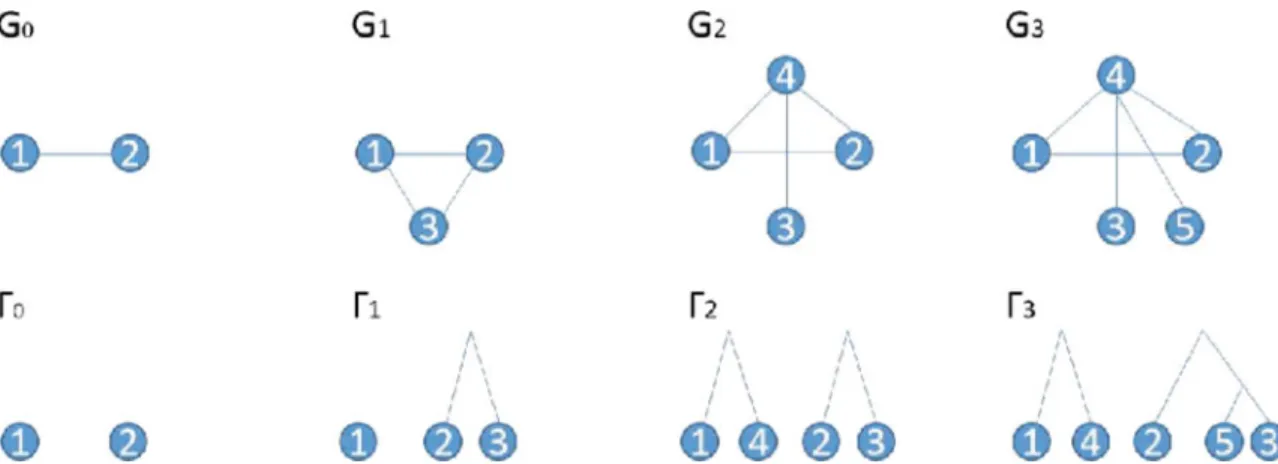
the growth history Hbackward-in-time using the backward operators defined in section 2.4 of Li et al. (2013), which constructsGt-1,Gt-1deterministically given (Gt,Gt,vt), fort=n‚n-1‚. . .‚ 1. An example of a growth history is given in Figure 1.
FIG. 1. An example growth history for a network together with the corresponding history of the duplication forest. In this example, (u1,u2,u3)=(2, 1, 3) and (v1,v2,v3)=(3, 4, 5).
2.4. Bayesian inference given the duplication history
Now suppose that in addition toG, a practitioner is givenGcorresponding toG. Our new objective—and the primary inference problem with which this work is concerned—is to consider the posterior density p(MjG‚G). Notice that we have the joint distribution:
p(M‚fG‚Gg‚h)=p(M)pM(Gh0‚Gh0)
Yn
t=1
pM(Ght‚Ght jGht-1‚Ght-1)
where h=(v1‚. . .‚vn) is a sequence of duplication nodes compatible with the observed G, G, and
Gh 0‚G
h
0‚. . .‚Ghn‚G h
n the corresponding reconstructed history. We are thus interested in the parameter
posterior: p(M jG‚G)/p(M)pM(G‚G)‚ pM(G‚G)= X hjG‚G pM(Gh0‚G h 0) Yn t=1 pM(Ght‚G h tjG h t-1‚G h t-1) " # ‚ (3)
The densitypM(G0‚G0)is typically a trivial term that can be ignored in practice. As the duplication forest Glimits the number of allowable anchor-and-duplicate node pairs, one can see that the number of possible growth histories is reduced.
2.5. Methods
We will now present an SMC algorithm that can sample the latent growth histories from the DMC model given the fixed parametersM:=(p‚ pc). We then show that this algorithm can be employed within a PMMH algorithm, as in Andrieu et al. (2010), to sample from the posterior (3) and infer M (and evenhjG,G).
An SMC algorithm simulates a collection ofNsamples (or, particles) sequentially along the indextvia importance sampling and resampling techniques to approximate a sequence of probability distributions of increasing state-space, which are known pointwise up to their normalizing constants. In this work, we use the SMC methodology to sample from the posterior distribution of the latent duplication history:
pM(h jG‚G)/pM(Gh0‚Gh0)
Yn
t=1
pM(Ght‚Ght jGht-1‚Ght-1)
backward along the indextvia Algorithm 1 in the Appendix. The technique provides an unbiased estimate of the normalizing constant (Theorem 7.4.2 of Del Moral, 2004),pM(G‚G):
^ pM(G‚G)= Y n-1 t=0 1 N XN i=1 Wti ‚ (4) where each Wi
t is an unnormalized importance weight computed in Algorithm 1. Note that under
as-sumptions on the model, ifN>cnfor somec<N, then the relative variance of the estimate isO(n/N) (see Ce´rou et al., 2011). It is remarked that, as in Wang et al. (2014), one could also use the discrete particle filter (Fearnhead, 1998), with a possible improvement over the SMC method detailed in Algorithm 1 (see Wang et al., 2014, for some details).
This SMC can be employed within a PMMH algorithm to target the posterior ofMin (3). One can think of the deduced method as an MCMC algorithm running on the marginal M-space, but with the SMC unbiased estimate p^M(G‚G) replacing the unknown likelihood ^pM(G‚G). More analytically, we can
consider all random variables involved in the method and write down the equilibrium distribution in the enlarged state space, withM-marginal the target posteriorpM(G‚G). Following Andrieu et al. (2010) and
letting/it denote a sample (Gt,Gt) at timet, the extended equilibrium distribution is written as:
pN l‚M‚a11::Nn-1‚/10::Nn-1 jG‚G =p M‚/ l 0:n-1jG‚G Nn CM(a11::Nn-1‚/ 1:N 0:n-1) qM(v al n-1 n ) Qnt=-11w al t t qM(v al t-1 t ) ‚ (5)
whereCMis the probability of all the variables associated to Algorithm 1, withajk‚l2 f1‚:::‚Ngand the
/’s being the simulated variables at each step of Algorithm 1.
A PMMH algorithm (see Algorithm 2) samples from (5), and one can remove the auxiliary variables from the samples to obtain draws for the parameters from (3). Furthermore, one could even save the sampled growth histories with particle index l to obtain draws from the joint posterior p(M‚hjG‚G). However, in this work, we are primarily interested in the inference of M.
3. RESULTS
The variance of the estimate (4) plays a crucial role in the performance of Algorithm 2, as (4) is used to compute the acceptance probability within the PMMH algorithm. Thus, we first tested the variability of (4) as computed by Algorithm 1 to understand how the variance changes withjV(G)j. We then ran Algorithm 2 to sample from the posterior (3) and inferMfor a given pair of observations (G,G). We present the details of those experiments below.
3.1. Variance of
p
^
M(
G
‚
G
)
We simulated a graph G and a forest G from the DMC model with the parameters set as (p=0.7, pc=0.7), wherejV(G)j=40. We saved each pair (Gt,Gt) for 1£t£40, and we ran Algorithm 1 50 times per pair (with N=jV(Gt)j* 5) to compute 50 unbiased estimates of pM(Gt‚Gt)for 1£t£40. In the top of
Appendix Figure A1 in Appendix A, we plot the relative variance of the estimate (or, the variance divided by the square of the expected value) per each value ofjV(Gt)j. We repeated the experiment two more times, withN=jV(Gt)j* 10 andN=jV(Gt)j* 20, and the associated output is also presented in Appendix Figure A1. As remarked above, ifN>cnfor somec<N, then the relative variance of^pM(Gt‚Gt)isO(n=N). Appendix
Figure A1 confirms that the variance increases linearly, and that increasing the value ofNwithjV(G)j(at least linearly) will help to control the variance. However, the plots show that the relative variance is still high, which means thatNwill have to be large to ensure satisfactory performance of the PMMH in practice.
3.2. Parameter inference
We separately simulated a graphGand a forestGfrom the DMC model with the parameters again set as (p=0.7, pc=0.7), and we set jV(G)j=15. Given only (G,G), we inferred (p, pc) with each parameter having a uniform prior on the interval [0.1, 0.9]. We set the number of particles within Algorithm 1 to be N=2,000, and we ran the PMMH algorithm to obtain 10,000 samples from the extended target.
Appendix Figure A2 in Appendix A illustrates good mixing of the PMMH algorithm and accurate inference of the parameters (p, pc). The trace plots show that the algorithm is not sticky, and the auto-correlation functions give evidence to an approximate independence between samples. The posterior densities are also interesting, in that they are clearly different from the uniform priors, and they show that the PMMH algorithm spends a majority of the computational time sampling the true parameter values.
4. DISCUSSION
We have introduced a Bayesian inferential framework for the DMC model, where, as in Li et al. (2013), one assumes the pair (G,G) is observed and the parameters (p,pc) are unknown. We then described how an SMC algorithm can be used to simulate growth histories and ultimately be employed within PMMH to target the posterior distribution of the parameters (3), thereby opening up the possibility of performing Bayesian inference on the DMC model.
Numerical tests demonstrated that Algorithm 1 can have a high variability whenjV(G)jis large andNis not sufficiently high, and this limits the scope of the inference problem, which can be tackled using the complete Algorithm 2. However, the proposals used in the example experiments within Algorithms 1 and 2 are naive, as the method simply chooses a candidate duplicate nodevi
t at random from all permitted nodes
given the currentGi t,G
i
t. It is reasonable to assume that more sophisticated proposal densities could reduce
the variance of the SMC and/or improve the mixing of the PMMH, thereby allowing one to perform inference when jV(Gt)jis large andNis smaller. This could be explored in a future work.
5. APPENDIX A
APPENDIX FIG. A1. All plots illustrate the relative variance ofp^M(Gt‚Gt), perjV(Gt)jon the horizontal axis; the
relative variance is the variance divided by the square of the expected value. In the top plot, the number of SMC particles used to compute each^pM(Gt‚Gt)isjV(Gt)j* 5. In the middle and bottom plots, that number isjV(Gt)j* 10 and jV(Gt)j* 20, respectively. Recall that the seed graph,G0, has two nodes, and note that we did not computep^M(G0‚G0)
APPENDIX FIG. A2. Plots associated withpandpcare at left and right respectively. The top figures are trace plots,
with PMMH iteration running along the horizontal axes and parameter value running along the verticals. The middle figures are plots of the autocorrelation functions (with lag running along the horizontal axes), and at the bottom we present the parameter posterior densities.
6. APPENDIX B: ALGORITHM SUMMARIES
Algorithm 1 Sequential Monte Carlo (SMC)Step 0: Input an observed graphG=Gnand a corresponding observed forestG=Gn, whereGis not a seed graph.
Step 1: Sett=n. Fori2 f1‚. . .‚Ng, sample a subtree with two nodes uniformly at random fromGit, and choose one of the two nodes uniformly as the proposed duplicate nodevi
t(thus the other will be the anchor node). Using the
backward operators defined in [10, section 2.4], construct each(Gi t-1‚G
i
t-1)from the subtrees and(Git‚G i t). For
i2 f1‚. . .‚Ng, compute the unnormalized weight
Wit-1=pM(G i t‚G i tjGit-1‚G i t-1) qM(vit) ‚
whereqMis the density of the proposal mechanism used to samplefui tg.
Step 2: IffG1:N
t-1gare not seed graphs, then sett=t-1 and continue to Step 3. Otherwise, the algorithm terminates. Step 3: Fori2 f1‚. . .‚Ng, sampleai
t2 f1‚. . .‚Ngfrom a discrete distribution on {1,.,N} withj
th
probability wjtfW
j
t. The samplefa1t:Ngare the indices of the resampled particles. Set all normalized weights equal toN -1.
Step 4: Fori2 f1‚. . .‚Ng, sample a subtree with two nodes uniformly at random from the resampled forestGait
t , and
select uniformly one of the two nodes as the proposed duplicate nodevi
t. Construct(Git-1‚G i t-1)fromvit‚(G ai t t‚G ai t t).
Fori2 f1‚. . .‚Ng, compute the unnormalized weight
Wit-1=pM(G ai t t ‚G ai t t jGit-1‚G i t-1) qM(vit) : Return to Step 2.
Algorithm 2 Particle Marginal Metropolis—Hastings (PMMH)
Step 0: Setr=0. SampleM(r)~
p(). All remaining random variables can be sampled from their full conditionals defined by the target (5):
- Sample/0(r:n)‚ 1-:1N‚a1(r:)n‚ 1-:1N~CM(r)()via Algorithm 1.
- Choose a particle indexl(r)/W(r)‚l(r) 0 .
Finally, calculatep^M(r)(G‚G)via (4).
Step 1: Setr=r+1. SampleM~q( jM). All remaining random variables can be sampled from their full conditionals defined by the target (5):
- Sample/0:‚ 1n-:N1‚a1‚ 1:n-:N1~CM()via Algorithm 1.
- Choose a particle indexl/W0‚l.
Finally, calculatep^M(G‚G)via (4).
Step 2: With acceptance probability
1^ p^M(G‚G)q(MjM ) ^ pM(r-1)(G‚G)q(MjM) ‚ set(l(r)‚M(r)‚/(r)‚ 1:N 0:n-1‚a (r)‚ 1:N 1:n-1)=(l ‚M‚/‚ 1:N 0:n-1‚a ‚ 1:N 1:n-1). Otherwise, set (l(r)‚M(r)‚/(r)‚ 1:N 0:n-1‚a (r)‚ 1:N 1:n-1)=(l (r-1)‚M(r-1)‚/(r-1)‚ 1:N 0:n-1 ‚a (r-1)‚ 1:N 1:n-1 ).
Return to the beginning of Step 1.
ACKNOWLEDGMENTS
This research was funded by the EPSRC grant ‘‘Advanced Stochastic Computation for Inference from Tree, Graph and Network Models’’ (Ref: EP/K01501X/1). A.J. was additionally supported by a Singapore
Ministry of Education Academic Research Fund Tier 1 grant (R-155-000-156-112) and is also affiliated with the Risk Management Institute and the Centre for Quantitative Finance at the National University of Singapore.
AUTHOR DISCLOSURE STATEMENT
The authors declare that no competing financial interests exist.REFERENCES
Andrieu, C., Doucet, A., and Holenstein, R. 2010. Particle Markov chain Monte Carlo methods.J. R. Stat. Soc. B. 72, 269–342.
Ce´rou, F., Del Moral, P., and Guyader, A. 2011. A non-asymptotic variance theorem for unnormalized Feynman-Kac particle models.Ann. Inst. Henri Poincare. 47, 629–649.
Del Moral, P. 2004. Feynman-Kac Formulae: Genealogical and Interacting Particle Systems with Applications. Springer, New York.
Doucet, A., Godsill, S., and Andrieu, C. 2000. On sequential Monte Carlo sampling methods for Bayesian filtering.
Stat. Comput.10, 197–208.
Dutkowski, J., and Tiuryn, J. 2007. Identification of functional modules from conserved ancestral protein–protein interactions.Bioinformatics. 23, i149–i158.
Fearnhead, P. 1998. Sequential Monte Carlo methods in filter theory [D.Phil. thesis]. University of Oxford, Oxford. Gibson, T.A., and Goldberg, D.S. 2009. Reverse engineering the evolution of protein interaction networks.Pac. Symp.
Biocomput.14, 190–202.
Gordon, N.J., Salmond, D.J., and Smith, A.F.M. 1993. Novel approach to nonlinear/non-Gaussian Bayesian state estimation.IEE Proc. F.140, 107–113.
Kreimer, A., Borenstein, E., Gophna, U., and Ruppin, E. 2008. The evolution of modularity in bacterial metabolic networks.Proc. Natl. Acad. Sci. USA.105, 6976–6981.
Li, S., Choi, K.P., Wu, T., and Zhang, L. 2013. Maximum likelihood inference of the evolutionary history of a PPI network from the duplication history of its proteins.IEEE/ACM Trans. Comput. Biol. Bioinform.10, 1412–1421. Patro, R., Sefer, E., Malin, J., et al. 2012. Parsimonious reconstruction of network evolution. Algorithms Mol. Biol.
7, 25.
Pereira-Leal, J.B., Levy, E.D., Kamp, C., and Teichmann, S.A. 2007. Evolution of protein complexes by duplication of homomeric interactions.Genome Biol.8, R51.
Pinney, J., Amoutzias, G., Rattray, M., and Robertson, D. 2007. Reconstruction of ancestral protein interaction net-works for the bZIP transcription factors.Proc. Natl. Acad. Sci. USA.104, 20449–20453.
Vazquez, A., Flammini, A., Maritan, A., and Vespignani, A. 2003. Modeling of protein interaction networks. Com-PlexUs. 1, 38–44.
Wagner, A. 2001. The yeast protein interaction network evolves rapidly and contains few redundent duplicate genes.
Mol. Biol. Evol.18, 1283–1292.
Wang, J., Jasra, A., and De Iorio, M. 2014. Computational methods for a class of network models.J. Comp. Biol. 21, 141–161.
Address correspondence to: Dr. Ajay Jasra Department of Statistics & Applied Probability National University of Singapore 6 Science Drive 2 Singapore 117546 Singapore E-mail:[email protected]