Domain-Driven Model Inference Applied To Web Applications
A. Sébastien Salva
1, B. William Durand
21
LIMOS - UMR CNRS 6158, Auvergne University, France
2LIMOS - UMR CNRS 6158, Blaise Pascal University, France
Abstract—Model inference methods are attracting increased attention from industrials and researchers since they can be used to generate models for software comprehension, for test case generation, or for helping devise a complete model (or documentation). In this context, this paper presents an original inference model approach which recovers models from Web application HTTP traces. This approach combines formal model inference with domain-driven expert systems. Our framework, whose purpose is to simulate this human behaviour, is composed of inference rules, translating the domain expert knowledge, organised into layers. Each yields partial IOSTSs (Input Output Symbolic Transition System), which become more and more abstract and intelligible.
Keywords:Model inference, formal model, IOSTS, rule-based system
1. Introduction and Contribution
In the Industry, legacy applications are often problematic as they are hard to maintain, poorly documented, and usually not covered by tests. When it comes to this situation, there is a high risk of introducing a bug, and options left to developers are weak. The only way to ensure stability while fixing a bug is to learn how the application behaves.
A first classic solution is to express these behaviours with formal models, for instance Input/Output Symbolic Transition Systems (IOSTS) [3]. Such models are particularly interesting to automatically generate test suites using Model- based testing techniques. But, the complete model writing is often an heavy task, and is error prone; hence the need for model inference approaches.
Model inference is a relatively recent research field aim-ing at recoveraim-ing the application behaviours captured by a model. Zong et al. [9] proposed to infer specifications from API documentations to check whether implementations match them. Such specifications do not reflect the implementation behaviours though. In [6], specifications, which are extremely detailed, show the method calls observed from a related set of objects. Some works [4], [5], [1], [8] proposed to derive models by automatically testing an application. These are often based upon crawling techniques, which can produce either basic models or too detailed models. In both cases, it is not suitable for test case generation. For instance, Memon et al. [4] initially presented GUITAR, a tool for scanning desktop applications which produces event flow graphs and trees showing the GUI execution behaviours. The generated models are quite simple and many false event sequences have to be weeded out later. Mesbah et al. [5] proposed the tool Crawljax specialised in
AJAX applications, which produces state machine models that are too complex and unreadable.
In this paper, we leverage model inference techniques in order to obtain a model from an existing application, running in a production environment. We decided to record incoming and outgoing data (traces) by monitoring applications, rather than crawling the entire application to prevent the limitations described above. Our proposal takes another direction to infer models. We do not suppose that the application being analysed is event-driven but at least yields traces. It emerges from the following idea: a domain expert, which is able to conceive specifications, is also able to diagnose the behaviour of the corresponding implementation by reading and interpreting its execution traces. His knowledge can be formalised and ex-ploited to automatically infer models. Our approach is based upon this notion of domain knowledge, implemented with an expert system which includes inference rules. The originality of our approach also resides in the incremental production of sev-eral models, expressing the behaviour of the same application at different abstraction layers. This approach can be applied on any application producing traces, i.e. not only event-driven applications.
Below, we describe the architecture of our model inference framework. Then, we recall some definitions on the IOSTS for-malism used throughout the paper in Section 3. We concretely describe and define this framework in the context of Web applications in Section 4. We give some experimentation results in Section 5. Conclusions are drawn in Section 6 together with directions for further research and improvements.
2. Architecture of our framework
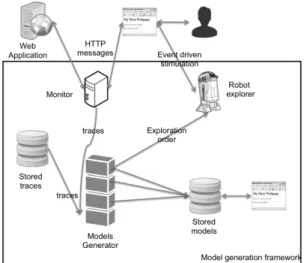
Our framework is divided into several modules as depicted
in Figure 1. The Models generator is the centrepiece of the
framework. It takes traces as inputs, which can be sent by a Monitorcollecting them on the fly. But it is worth mentioning that the traces can also be sent by any tool or even any user, as far as they comply to a chosen standard format. The Models generator is based upon an expert system, which is an artificial intelligence engine emulating acts of a domain expert by inferring a set of rules representing the expert knowledge. This knowledge is organised into a hierarchy with several layers. Each gathers a set of inference rules written with a first order predicate logic. Typically, each layer creates two IOSTSs (except the first one), and the higher the layer is, the more abstract the IOSTSs become. These models are then successively stored and can be later analysed by experts, verification tools, etc. This number of layers is not strictly
Fig. 1: Model generation framework
bounded even though it is manifest that it must be finite. The domain knowledge encapsulated in the expert system can be used to cover trace sets coming from several applications of the same category thanks to generic rules. But, rules can also be specialised and refined for a given application in order to yield more precise models, easing application comprehension. Our approach allows to take a predefined set of traces collected from any kind of applications producing traces. For event-driven applications, traces could be produced using au-tomatic testing techniques. We provide a Robot explorer which will not be presented here because of lack of room. It generates traces and find new application states in an efficient manner using strategies, that are expressed with inferences rules as well, tackling the issue related to the amount of traces needed to decently cover an application.
Our proposal is both flexible and scalable. It does not produce one model but several ones, depending on the number of layers of the Models generator, which is not limited and may evolve in accordance to the application type. Each model, expressing the application behaviours at a different level of abstraction, can be used to ease the writing of complete formal models, to apply verification techniques, to check the satisfiability of properties, to automatically generate functional test cases, etc.
In the following, we detail the different framework parts in the context of Web applications, except for the Monitor, which is here a classical proxy.
3. Model Definition and Notations
We consider the Input/Output Symbolic Transition System (IOSTS) formalism [3] for describing the functional behaviour of systems or applications. An IOSTS is a kind of automata model which is extended with two sets of variables, internal variable to store data, and parameters to enrich the actions. Transitions carry actions, guards, and assignments over vari-ables. The action set is separated with inputs beginning with ? to express actions expected by the system, and with outputs
beginning with ! to express actions produced by the system. An IOSTS does not have states but locations.
Definition 1 (IOSTS) An IOSTSSis a tuple< L, l0, V, V0, I,Λ,→>, where:
• Lis the finite set of locations,l0 the initial location,
• V is the finite set of internal variables, I is the finite set of parameters. We denote Dv the domain in which a
variablev takes values. The assignment of values of a set of variables Y ⊆V ∪I is denoted by valuations where a valuation is a function v : Y → D. v∅ denotes the
empty valuation.DY stands for the valuation set over the
variable setY. The internal variables are initialised with the assignmentV0onV, which is assumed to be unique,
• Λ is the finite set of symbolic actions a(p), with p = (p1, ..., pk) a finite list of parameters in Ik(k∈N).pis
assumed unique.Λ = ΛI∪ΛO∪ {!δ}:ΛI represents the
set of input actions, (ΛO) the set of output actions,
• →is the finite transition set. A transition(li, lj, a(p),
G, A), from the location li ∈ L to lj ∈ L, denoted
li
a(p),G,A
−−−−−−→ljis labelled by: an actiona(p)∈Λ, a guard
Gover (p∪V ∪T(p∪V))which restricts the firing of the transition.T(p∪V)is a set of functions that return boolean values only (a.k.a. predicates) over p∪V, an assignment function A which updates internal variables. Ais of the form(x:=Ax)x∈V, whereAxis an expression
overV ∪p∪T(p∪V).
An IOSTS is also associated with an IOLTS (Input/Out-put Labelled Transition System) to formulate its semantics. Intuitively, IOLTS semantics correspond to valued automata without symbolic variables, which are often infinite: IOLTS states are labelled by internal variable valuations while tran-sitions are labelled by actions and parameter valuations. The
semantics of an IOSTS S =< L, l0, V, V0, I,Λ,→> is the
IOLTS JSK =< Q, q0,Σ,→> composed of valued states in
Q=L×DV, q0= (l0, V0) which is the initial one, Σwhich
is the set of valued symbols, and → which is the transition
relation. The IOLTS semantics definition of can be found in
[3]. In short, for an IOSTS transition l1 −a−−−−−(p),G,A→ l2, we
obtain an IOLTS transition(l1, v) −−−−→a(p),θ (l2, v0) withv a set of valuations over the internal variable set, if there exists a
parameter valuation set θ such that the guard G evaluates to
true with v∪θ. Once the transition is executed, the internal
variables are assigned with v0 derived from the assignment
A(v∪θ). Runs and traces of an IOSTS can now be defined
from its semantics.
Definition 2 (Runs and traces) For an IOSTS S = < L, l0, V, V0, I,Λ,→>, interpreted by its IOLTS semantics
JSK =< Q, q0,Σ,→>, a run of S, q0α0q1...qn−1αn−1qn is
a sequence of termsqiαiqi+1withαi∈Σa valued action and
qi, qi+1 two states of Q. Run(S) = Run(JSK) is the set of runs found inJSK.
It follows that a trace of a runris defined as the projection projΣ(r)on actions. T racesF(S) =T racesF(JSK)is the set
of traces of all runs finished by states inF×DV.
4. Model inference
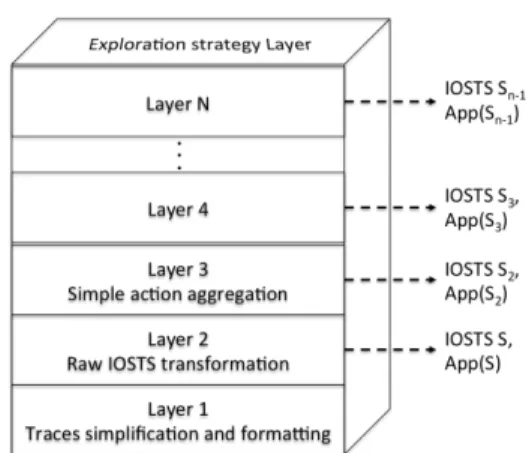
Fig. 2: Models generator layers
The Models generator is mainly composed of a rule-based system, adopting a forward chaining. Such a system separates the knowledge base from the reasoning: the former is expressed with data a.k.a. facts and the latter is realised with inference rules that are applied on the facts. Our Models generator initially takes traces as an initial knowledge base and owns inference rules organised into layers for trying to match the human expert behaviour. These layers are depicted in Figure 2. Usually, when a human expert has to read traces of an application, he often filters them out to only keep those that are relevant to him. This step is done by the first layer whose role is to format the received raw traces into sequences of valued actions, and to delete those considered as unnecessary.
The resulting structured trace set, denoted ST, is then given
to the next layer. This process is incrementally done, i.e. every time new traces are given to the Models generator, these are formatted and filtered before being given to Layer 2. The remaining layers yield two IOSTSs each: the first one
Si(i ≥ 1) has a tree structure derived from the traces. The
second IOSTS, denoted App(Si), is an approximation which
captures more behaviours thanSi. Both IOSTSs are minimised
with a bisimulation minimisation technique. The role of Layer 2 is to carry out a first IOSTS transformation from the structured traces. The obtained IOSTSs are not re-generated each time new traces are received but are completed on the fly. The next layers 3 to N (with N a finite integer) are composed of rules that emulate the ability of a human expert to simplify transitions, to analyse the transition syntax for deducing its meaning in connection with the application, and to construct more abstract actions that aggregate a set of initial ones. Theses deductions are often not done in one step. This is why the Models generator supports a finite but not defined number of
layers. Each of these layersi takes the IOSTSSi−1 given by
the direct lower layer. This IOSTS, which represents the current base of facts, is analysed by the rules to infer another IOSTS whose expressiveness is more abstract than the previous one.
The lowest layers (at least Layer 3) are composed of generic rules that can be reused on several applications of the same type. In contrast, the highest layers own the most precise rules that may be dedicated to one specific application.
In the following, and for readability purpose, we chose to
represent inference rules using this format:When conditions on
facts Then actions on facts(format borrowed from the Drools
inference engine1). Independently on the application type, the
Layers 2 to N handle the following fact types:Locationwhich
represents an IOSTS location, andTransition, which represents
an IOSTS transition, composed of two Locations Linit, Lfinal, and two data collections Guard and Assign. Now, it is manifest that the inference of models has to be done in a finite time and in a deterministic way. To reach that purpose, we formulate the following hypotheses on the inference rules:
1) (finite complexity): a rule can only be applied a limited number of times on the same knowledge base,
2) (soundness): the inference rules are Modus Ponens, 3) (no implicit knowledge elimination): after the application
of a rule rexpressed by the relation r:Ti →Ti+1(i≥
2), with Ti a Transition base, for all transition t =
(ln, lm, a(p), G, A)extracted from Ti+1, ln is reachable
froml0.
In the following, we detail these layers in the context of Web applications while giving some rule examples.
4.1 Layer 1: Trace filtering
Traces of Web applications are based upon the HTTP pro-tocol, conceived in such a way that each HTTP request is followed by only one HTTP response. Consequently, the traces, given to Layer 1, are sequences of couples (HTTP request, HTTP response). This layer begins formatting these couples so that these might be analysed in a more convenient way.
For a couple (HTTP request, HTTP response), we extract the following information: the HTTP verb, the target URI, the request content which is a collection of data (headers, content), and the response content which is the collection (HTTP status, headers, response content). An header may also be a collection of data or may be null. Contents are texts e.g., HTML texts. Since we wish translating such traces into IOSTSs, we turn
these textual items into a structured valued action (a(p), θ)
with a the HTTP verb and θ a valuation over the variable
set p = {U RI, request, response}. This is captured by the following proposition:
Definition 3 (Structured HTTP Traces) Let t=req1, resp1, ..., reqn, respn be a raw HTTP trace composed of an
alternate sequence of HTTP requestreqi and HTTP response
respi. The structured HTTP trace σ of t is the sequence (a1(p), θ1)...(an(p), θn)where:
• ai is the HTTP verb used to make the request inreqi, • pis the parameter set{U RI, request, response}, • θi is a valuation p→Dp which assigns a value to each
variables ofp.θis deduced from the values extracted from reqi andrespi.
The resulting trace set derived from raw HTTP traces is denotedST.
Now, the structured traces can be filtered. Given a main request performed by a user, many other sub-requests are also sent by a browser in order to fetch images, CSS and JavaScript files. Generally speaking, these do not enlighten a peculiar functional behaviour of the application. This is why we propose to add rules in Layer 1 to filter these sub-requests out from the traces. Such sub-requests can be identified by different ways, e.g., by focussing on the file extension found at the end of the URI, or on the Content-Type value of the request headers. Consequently, we created a set of rules, constituted of conditions on the HTTP content found in an action, that remove valued actions when the condition is met.
After the instantiation of the Layer 1 rules, we obtain a
formatted and filtered trace setSTcomposed of valued actions.
Now, we are ready to extract the first IOSTSs.
Completeness, soundness, complexity: HTTP traces are sequences of valued actions modelled with positive facts. Typi-cally, they form Horn clauses. Furthermore, inference rules are Modus Ponens (soundness hypothesis). Consequently, Layer 1 is sound and complete. Keeping in mind the (finite complexity)
hypothesis, its complexity is proportional to Om(k+ 1) with
mthe valued action number andkthe rule number. (at worst,
every action is coveredk+ 1 times).
4.2 Layer 2: transformation of the traces into
IOSTSs
Intuitively, the IOSTS transformation relies upon the IOLTS semantics transformation that is achieved in a backward man-ner. Two IOSTSs are built: the former, structured as a tree, represents the original traces modelled with an IOSTS formal-ism. The latter is an over approximation of the former. These IOSTSs are generated by performing the following steps: 1. the associated runs are computed from the structured traces by injecting states between valued actions,
2. the first IOSTS denotedS1 is derived from these runs and
minimised,
3. a second IOSTS, denoted App(S1), is obtained from S1
by merging some of its locations, and by also applying a minimisation technique.
These steps are detailed below:
4.2.1 Traces to runs
Given a trace σ, a run r is firstly derived by constructing
and injecting states on the right and left sides of each valued
action ofσ. Keeping in mind the IOLTS semantics definition,
a state shall be modelled by the couple ((U RI, k), v∅) with
v∅ the empty valuation. (U RI, k) is a couple composed of a
URI and of an integer(k≥0). Typically, a couple (U RI, k)
shall be a location of the future IOSTS. Since we wish to preserve the sequential order of the actions found in the traces, when a URI previously encountered is once more detected, the resulting state is composed of the URI accompanied with an integer, which is incremented to yield a new and unique state.
Due to lack of room, the algorithm translating the structured traces into a run set is not provided in this paper but can be found in [7].
4.2.2 IOSTS generation
The first IOSTS S1 is derived from the run set SR. It
corresponds to a tree composed of paths, each expressing one trace starting from the same initial location.
Definition 4 Given a run set SR, the IOSTSS1 is called the IOSTS tree ofSRand corresponds to the tuple < LS1, l0S1, VS1, V0S1, IS1,ΛS1,→S1>such that:
• LS1 ={li | ∃r∈SR,(li, v∅)is a state found in r},
• l0S1 is the initial location such that ∀r ∈ SR, r starts with(l0S1, v∅),
• VS1=∅,V0S1 =v∅,
• ΛS1 ={ai(p)| ∃r∈SR,(ai(p), θi)is a valued action in
r},
• →S1 is defined by the following inference rule applied on every elementr∈SR: si(ai(p), θi)si+1 is a term of r, si= (li, v∅), si+1= (li+1, v∅), Gi= ^ (xi=vi)∈θi xi==vi ` li ai(p),Gi,(x:=x)x∈V −−−−−−−−−−−−−→S1 li+1
From an IOSTS treeS1, an over-approximation IOSTS can
now be straightforwardly deduced by merging together all the
locations of the form(U RI, k)k≥0into a single location (URI).
This possibly cyclic IOSTS usually expresses more behaviours and should be strongly reduced in term of location size. But this is also an approximation in the sense that new action sequences, which do not exist into the initial traces, may appear. This model may be particularly interesting to help establish a complete model or to increase the coverage of specific testing methods e.g., security testing, since more behaviours are represented. In contrast, it is manifest that a conformance testing method must not take this model as a reference to generate test cases.
Definition 5 LetS1be an IOSTS tree of SR. The approxima-tion ofS1, denotedApp(S1), is the IOSTS< LApp, l0App,
VApp, V0App, IApp,ΛApp,→App>such that: • LApp={(U RI)|(U RI, k)∈LS1, k≥0},
• l0App=l0S1,VApp =VS1,V0App=V0S1,ΛApp = ΛS1,
• →App= {(U RIm) a(p),G,A −−−−−−→ (U RIn) | (U RIm, k) a(p),G,A −−−−−−→ (U RIn, l) ∈→S1} ∪ {l0App a(p),G,A −−−−−−→ (U RIn) | l0S1 a(p),G,A −−−−−−→ (U RIn, l) ∈→S1} ∪ {(U RIm) a(p),G,A −−−−−−→ l0App | (U RIm, k) a(p),G,A −−−−−−→l0S1 ∈→S1}(k≥0, l≥0). 4.2.3 IOSTS minimisation
Both IOSTSs are reduced in term of location size by applying a bisimulation minimisation technique which still preserves
the functional behaviours expressed in the original model. Intuitively, this minimisation constructs the state sets (blocks) that are bisimilar equivalent. Two states are said bisimilar
equivalent, denoted q ∼ q0 iff they simulate each other and
go to states from where they can simulate each other again. A bisimulation minimisation algorithm can be found in [2].
Completeness, soundness, complexity: Layer 2 takes any structured trace set obtained from HTTP traces. If the trace
set is empty then the resulting IOSTSS1 has a single location
l0. A structured trace set is translated into an IOSTS in finite time: every valued action of a trace is covered once to construct states, then every run is lifted to the level of one IOSTS path starting from the initial location. Afterwards, the IOSTS is minimised with the algorithm presented in [2]. Its complexity is
proportional toO(mlog(m+ 1))withmthe number of valued
actions. The soundness of Layer 2 is based upon the notion of
traces: an IOSTS S1 and its approximation are composed of
transition sequences derived from runs in SR, itself obtained
from the structured trace set ST. As defined, the behaviours
encoded inST andS1 are equivalent since (ordered) runs are
transformed into ordered IOSTS sequences. On the other hand,
the approximation ofS1shares the behaviours found inS1 and
ST but also describes new behaviours. This is captured by the
following Proposition:
Proposition 6 Let ST be a trace set and SR be is corre-sponding run set. If S1 is the IOSTS tree of SR, we have T races(S1) =ST andT races(App(S1))⊇ST.
The proof is this proposition is Given in [7]. For sake of readability, we do not provide the rules of Layer 2, which match the above definitions and algorithms. Instead, we illustrate an IOSTS generation example below:
Example 4.1
We take as example a trace obtained from the Github Web
site 2 after having executed the following actions: login with
an existing account, choose an existing project, and logout. These few actions already produced a large set of requests and responses. The trace filtering from this example returns the following structured traces where the request and response parts are concealed for readability:
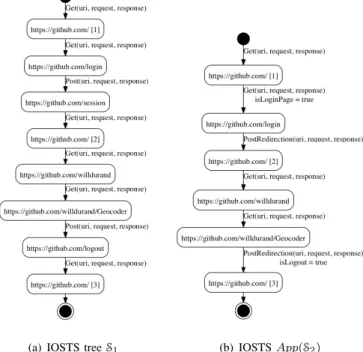
GET ( h t t p s : / / g i t h u b . com / ) GET ( h t t p s : / / g i t h u b . com / l o g i n ) POST ( h t t p s : / / g i t h u b . com / s e s s i o n ) GET ( h t t p s : / / g i t h u b . com / ) GET ( h t t p s : / / g i t h u b . com / w i l l d u r a n d ) GET ( h t t p s : / / g i t h u b . com / w i l l d u r a n d / G e o c o d e r ) POST ( h t t p s : / / g i t h u b . com / l o g o u t ) GET ( h t t p s : / / g i t h u b . com / )
After having applied rules of Layer 2, we obtain the IOSTS of Figure 3(a). Locations are labelled by the URI found in the request plus an integer to keep the tree structure of the initial traces. Actions are composed of the HTTP verb enriched with the variables URI, request, and response. This IOSTS exactly reflects the trace behaviour but is still difficult to interpret. More abstract actions shall be deduced by the next layers.
2https://github.com/
(a) IOSTS treeS1 (b) IOSTSApp(S2) Fig. 3: Approximation models
4.3 Layers 3-N: IOSTS Abstraction
As stated earlier, the rules of the upper layers analyse the transitions of the current IOSTS for trying to enrich its
semantics while reducing its size. Given an IOSTS S1, every
next layer carries out the following steps:
1. apply the rules of the layer and infer a new knowledge base
(new IOSTSSi,i≥2),
2. derive App(Si) and apply a bisimulation minimisation on
both,
3. store the two IOSTSs.
Without loss of generality, we now restrict the rule structure to keep a link between the generated IOSTSs. Thereby, every
rule of Layeri(i≥3) either enriches the sense of the actions
(transition per transition) or aggregates transition sequences into one unique new transition to make the obtained IOSTSs
more abstract. It results in an IOSTSSiexclusively composed
by some locations of the first IOSTSS1. Consequently, for a
transition or path ofSi, we can still retrieve the concrete path
ofS1. This is captured by the following proposition:
Proposition 7 Let S1 be the first IOSTS generated from the structured trace set ST. The IOSTS Si(i > 1) produced by
Layerihas a location setLSi such thatLSi ⊆LS1.
Completeness, soundness, complexity:the knowledge base is exclusively constituted by (positive) Transition facts that have an Horn form. The rules of these layers are Modus Ponens (soundness hypothesis). Therefore, these inference rules are sound and complete. Furthermore, a behaviour encoded in an
IOSTSSicannot be lost inSi. With regards to the (no implicit
knowledge elimination) hypothesis and to Proposition 7, the
together into a new transition. The application of these layers ends in a finite time ((finite complexity) hypothesis) and the
complexity of each is proportional to Om(k) with m the
transition number andk the rule number.
In the following, we detail two layers specialised for Web applications:
4.3.1 Layer 3
As stated above, Layer 3 corresponds to a set of generic rules that can be applied on a large set of applications belonging to the same category. This layer has two roles:
• the enrichment of the meaning captured in transitions. In
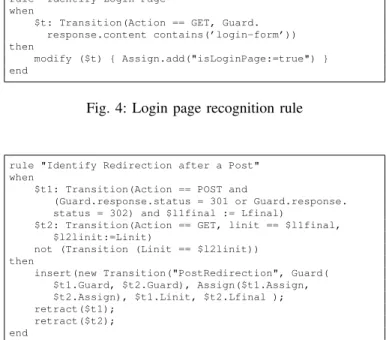
this step, we have chosen to mark the transitions with new internal variables. These shall help deduce more abstract actions in the upper layers. For example, the rule depicted in Figure 4 aims at recognising the receipt of a login page: if the response content, which is received after a
request sent with theGET method, contains a login form,
then this transition is marked as a "login page" with the assignment on the variable isLoginPage,
• the generic aggregation of some successive transitions.
Here, some transitions (two or more) are analysed in the conditional part of the rule. When the rule condition is met then the successive transitions are replaced by one transition carrying a new action. The rule of Figure 5 corresponds to a simple transition aggregation, introducing
a newP ostRedirection action.
rule "Identify Login Page" when
$t: Transition(Action == GET, Guard. response.content contains(’login-form’)) then
modify ($t) { Assign.add("isLoginPage:=true") } end
Fig. 4: Login page recognition rule
rule "Identify Redirection after a Post" when
$t1: Transition(Action == POST and
(Guard.response.status = 301 or Guard.response. status = 302) and $l1final := Lfinal)
$t2: Transition(Action == GET, linit == $l1final, $l2linit:=Linit)
not (Transition (Linit == $l2linit)) then
insert(new Transition("PostRedirection", Guard( $t1.Guard, $t2.Guard), Assign($t1.Assign, $t2.Assign), $t1.Linit, $t2.Lfinal ); retract($t1);
retract($t2); end
Fig. 5: Redirection recognition rule
Example 4.2 When we apply these rules on the IOSTS example of Figure 3(a), we obtain a new IOSTS, illustrated in Figure 3(b), which has 6 transitions instead of 9 initially. However, it does not reflect clearly the initial scenario yet.
Rules deducing more abstract actions are required. These are found in the next layer.
4.3.2 Layer 4
This layer allows to infer a more abstract model composed of more expressive actions. Its rules may have different forms:
• they can be applied on a single transition. In this case, the
rule replaces the transition action to add more sense,
• the rules can also aggregate several successive transitions
up to complete paths into one transition labelled by a more abstract action. For instance, the rule illustrated in Figure 6 recognises a user authentication thanks to the variable "isLoginPage" added by Layer 3.
rule "Identify Authentication" when
$t1: Transition(Action == GET,
Assign contains "isLoginPage:= true", $t1final:=Lfinal)
$t2: Transition(Action == PostRedirection, Linit == $t1lfinal, $t2linit:=Linit) not (Transition (Linit == $t2linit)) then
insert(new Transition("Authentication",
Guard($t1.Guard,$t2.Guard), Assign($t1.Assign, $t2.Assign), $t1.Linit, $t2.Lfinal );
retract($t1); retract($t2); end
Fig. 6: Authentication recognition rule
Other rules can also be application-specific, so that these bring specific new knowledge to the model. For instance, the GitHub Web application has a dedicated URL grammar (a.k.a. routing system). GitHub users own a profile page that is
avail-able at: https : //github.com/username where username
is the nickname of the user. However, some items are reserved
e.g.,eduandexplore. The rule given in Figure 7 is based upon
this structure and produces a new actionShowprof ileoffering
more sense. We did the same for projects as well, introducing aShowprojectaction.
rule "GitHub profile pages" when
$t: Transition(action == GET, ( Guard.uri matches "/[a-zA-Z0-9]+$", Guard.uri not in [ "/edu", "/explore" ])) then
modify ($t) (SetAction("Showprofile")); end
Fig. 7: User profile recognition rule
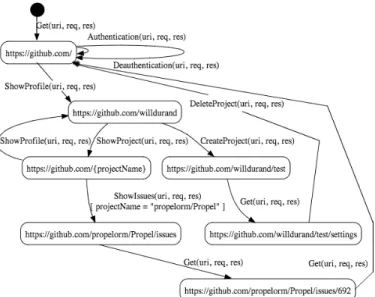
Example 4.3 The application of the previous rules leads to the final IOSTS depicted in Figure 8, owning actions that have a precise meaning, and now clearly describing the application behaviour.
Fig. 8: IOSTS App(S3)obtained from Layer 4
5. Experimentation
The framework presented earlier has been implemented in
a prototype tool calledAutofunk(Automatic Functional model
inference). A user interacts with Autofunk through a Web inter-face and either gives a URL or a file containing traces formatted with the HTTP Archive (HAR) format, the defacto standard for describing HTTP traces, used by various HTTP related tools (many HTTP monitoring tools, and Web browsers such as Mozilla Firefox and Google Chrome). The JBoss Drools Expert tool has been chosen to implement the rule-based system. Such an engine leverages Oriented Object Programming in the rule statements and takes knowledge bases given as Java objects (Location, Transition, GET, POST objects in this work).
From the Github Web site, we recorded a trace set composed of 840 HTTP requests / responses. Then, we applied Autofunk on them with a Models generator composed of 5 layers gather-ing 18 rules whose 3 are specialised to Github. After the trace filtering (Layer 1), we obtain a first IOSTS tree composed of 28 transitions. The next 4 layers automatically infer a last IOSTS
tree S4 composed of 13 transitions whose 7 have a clear and
intelligible meaning. Its approximationApp(S4)is illustrated in
Figure 9. Most of its actions have a precise meaning reflecting the user interactions while the trace recording. Now, one can easily deduce that the user created, chose, deleted some projets and read the issues of others.
6. Conclusion
This paper presents an original approach combining model inference and expert systems to derive IOSTSs models. Our proposal yields several models, reflecting different levels of abstractions of the same application with the use of inference rules that capture the knowledge of an expert. Our approach can be applied on all applications that are able to produce traces.
We applied our framework on Web applications as a premise. In the future, we intend to apply it on industrial systems to ease their diagnostics. But this kind of system brings several issues not yet addressed in the model inference area. For instance,
Fig. 9: IOSTS App(S4)obtained from the Github Web site
industrial systems may include asynchronous actions and timed properties. At the moment, our solution does not yet support this kind of properties. Furthermore, writing rules may be as tough as writing models in some cases. This is why we are working on a human interface which helps design rules from a trace set example. We also plan to add a test case generation module for regression testing.
References
[1] V. Dallmeier, M. Burger, T. Orth, and A. Zeller. Webmate: a tool for testing web 2.0 applications. InProceedings of the Workshop on JavaScript Tools, JSTools ’12, pages 11–15, New York, NY, USA, 2012. ACM.
[2] J.-C. Fernandez. An implementation of an efficient algorithm for bisimu-lation equivalence.Science of Computer Programming, 13:13–219, 1989. [3] L. Frantzen, J. Tretmans, and T. Willemse. Test Generation Based on Symbolic Specifications. In J. Grabowski and B. Nielsen, editors,FATES 2004, number 3395 in Lecture Notes in Computer Science, pages 1–15. Springer, 2005.
[4] A. Memon, I. Banerjee, and A. Nagarajan. Gui ripping: Reverse engineer-ing of graphical user interfaces for testengineer-ing. InProceedings of the 10th Working Conference on Reverse Engineering, WCRE ’03, pages 260–, Washington, DC, USA, 2003. IEEE Computer Society.
[5] A. Mesbah, A. van Deursen, and S. Lenselink. Crawling Ajax-based web applications through dynamic analysis of user interface state changes.ACM Transactions on the Web (TWEB), 6(1):3:1–3:30, 2012.
[6] M. Pradel and T. R. Gross. Automatic generation of object usage specifications from large method traces. In Proceedings of the 2009 IEEE/ACM International Conference on Automated Software Engineering, ASE ’09, pages 371–382, Washington, DC, USA, 2009. IEEE Computer Society.
[7] S. Salva and W. Durand. Model inference combining expert systems and formal models. Technical report, LIMOS, http://sebastien.salva.free.fr/RR-14-04.pdf, 2014. LIMOS Research report RR-14-04.
[8] W. Yang, M. R. Prasad, and T. Xie. A grey-box approach for automated gui-model generation of mobile applications. InProceedings of the 16th international conference on Fundamental Approaches to Software Engi-neering, FASE’13, pages 250–265, Berlin, Heidelberg, 2013. Springer-Verlag.
[9] H. Zhong, L. Zhang, T. Xie, and H. Mei. Inferring specifications for resources from natural language api documentation. Autom. Softw. Eng., 18(3-4):227–261, 2011.