Efficient, Context-Sensitive Detection
of Real-World Semantic Attacks
∗
Michael D. Bond
Varun Srivastava
Kathryn S. McKinley
Vitaly Shmatikov
Department of Computer Science
The University of Texas at Austin
{mikebond,varun,mckinley,shmat}@cs.utexas.edu
ABSTRACT
Software developers are increasingly choosing memory-safe lan-guages. As a result, semantic vulnerabilities—omitted security checks, misconfigured security policies, and other software design errors—are supplanting memory-corruption exploits as the primary cause of security violations. Semantic attacks are difficult to de-tect because they violateprogramsemantics, rather thanlanguage semantics. This paper presents PECAN, a new dynamic anomaly detector. PECAN identifies unusual program behavior using his-tory sensitivity and depth-limited context sensitivity. Prior work on context-sensitive anomaly detection relied on stack-walking, which incurs overheads of 50% to over 200%. By contrast, the aver-age overhead of PECAN is 5%, which is low enough for practi-cal deployment. We evaluate PECANon four representative real-world attacksfrom security vulnerability reports. These attacks exploit subtle bugs in Java applications and libraries, using legal program executions that nevertheless violate programmers’ expec-tations. Anomaly detection must balance precision and sensitivity: high sensitivity leads to many benign behaviors appearing anoma-lous (false positives), while low sensitivity may miss attacks. With application-specific tuning, PECANefficiently tracks depth-limited context and history and reports few false positives.
1.
INTRODUCTION
With the increasing popularity of memory-safe languages such as Java, C#, JavaScript, and Ruby, semantic vulnerabilities are over-taking memory corruption bugs as the primary cause of security violations in software applications [25]. Exploitable semantic bugs include accidental omission of access-control checks, unintentional exposure of security-sensitive methods to untrusted code, miscon-figuration of security policies, and other security-logic errors.
Detecting attacks that target semantic vulnerabilities is a diffi-∗
This work is supported by NSF SHF-0910818, NSF CSR-0917191, NSF CCF-0811524, NSF 0719966, NSF CNS-0746888, NSF CNS-0905602, and the “Collaborative Policies and Assured Information Sharing” MURI. Any opinions, findings, and conclusions expressed herein are the authors’ and do not necessar-ily reflect those of the sponsors.
Permission to make digital or hard copies of all or part of this work for personal or classroom use is granted without fee provided that copies are not made or distributed for profit or commercial advantage and that copies bear this notice and the full citation on the first page. To copy otherwise, to republish, to post on servers or to redistribute to lists, requires prior specific permission and/or a fee.
PLAS’10 Toronto, Canada
Copyright 2010 ACM 978-1-60558-827-8 ...$10.00.
cult task. Unlike memory-corruption exploits, semantic attacks do not rely on a violation of the underlying programming language semantics, nor, typically, do they inject malicious code.
To understand and characterize semantic security exploits, we examined hundreds of reports in the National Vulnerability Data-base and reproduced four representative attacks. Detection of these and similar attacks requires both context sensitivity and history sen-sitivity. Static analysis-based intrusion detection methods, which ensure that the program’s dynamic behavior conforms to the stati-cally inferred control flow graph and memory access patterns [1, 3, 8, 14, 33], are ineffective against semantic attacks because the ma-licious code paths and memory accesses arealready present in the original code. Static and dynamic taint-tracking can detect injec-tion attacks on Web applicainjec-tions [5, 23, 27, 35], but cannot detect semantic attacks, e.g., when a malicious Java applet exploits a sen-sitive method that is mistakenly left accessible by a misconfigured security policy. Prior dynamic techniques for detecting anomalous contexts are either too imprecise, or too inefficient, or both. (A de-tailed comparison with related work can be found in Section 3 is and summarized in Table 1.)
Dynamic anomaly detection recognizesunusualrather than ille-gal code paths, thus practical implementations face two major chal-lenges: precisionand efficiency. Detailed analysis of real-world exploits shows that detecting semantic attacks requires context sen-sitivity, i.e., the defense must consider a method’s calling context when making the security decision. Furthermore, some attacks re-quire history sensitivity in order to detect whether or not certain calls, such as mandatory security checks, have occurred. Simplistic approaches such as blindly increasing the size of the context and/or history can dramatically increase the number of false positives (re-porting anomalies when there is no actual attack) when monitoring legitimate executions.
The second challenge isefficiency. Naïve solutions for context sensitivity, such as direct stack inspection, result in prohibitive per-formance overheads of 100% or more, precluding their deployment in production applications. Efficient context sensitivity is espe-cially challenging for modern, object-oriented languages, which exercise millions of distinct calling contexts [7]. Prior work on probabilistic calling context(PCC) tracks calling context efficiently for the purpose of detecting anomalous context-sensitive behav-ior [7]. However, PCC tracks onlyfull(infinite depth) context sen-sitivity, which, as we show, incurs many false positives.
Inspired by real-world semantic attacks, this paper presents the design and implementation of a dynamic anomaly detector for Java called PECAN(Precise, Efficient, Context-sensitive ANomaly de-tection). PECANuses training runs to compile the list of typical contexts and histories, and then monitors execution in production runs to find anomalies. We chose Java because of its popularity,
but our approach applies to other memory-safe languages. To effi-cient trackdepth-limitedcontext and history at the sites of security-sensitive calls, PECANextends prior work on PCC [7].
We evaluate PECAN’s performance and effectiveness on standard benchmarks, as well as on four real-world exploits that have been fixed, but are representative of several important categories of se-mantic security vulnerabilities. We show that context sensitivity is essential for detecting semantic attacks. Although the tension be-tween false positives and negatives remains a challenge, we show that there exists a PECANconfiguration (with the context depth of 3 and history length of 1) that detects all of our sample exploits while reporting few false positives. Further exploration and application-specific tuning would be necessary for real deployments. The aver-age performance overhead of PECANis 5%.
To the best of our knowledge, PECANis the first system that pro-vides context sensitivity of arbitrary depth and history in a practi-cally efficient manner. We emphasize that there is aqualitative dif-ference between a precise and efficient dynamic defense that can be feasibly deployed in a production system and techniques that may be of academic interest, but impose prohibitive run-time over-heads and/or result in an overwhelming number of false positives when monitoring complex applications and libraries. In contrast to previous techniques for context-sensitive anomaly detection, which were evaluated only on artificial attacks, we evaluate PECAN on real-world exploits and use this evaluation to guide our design de-cisions.
2.
REPRESENTATIVE EXPLOITS
To better understand which types of semantic vulnerabilities actu-ally occur in managed code, we combed through hundreds of re-ports in the National Vulnerability Database,1 tried to reproduce around twenty exploits, and successfully reproduced four in our ex-perimental environment. This section surveys these four exploits, which illustrate common categories of semantic vulnerabilities and motivate our approach. Section 5 explains each exploit in more detail.
Three of the four exploits,SlashPath,LiveConnect, and Oper-aPolicy, are applets that take advantage of misconfigured security policies or bugs in the Java libraries. The fourth exploit, called XSLT, represents insufficient checking of untrusted code in which XML executable code is not sandboxed.
SlashPath. The first vulnerability is a bug in the Sun Java Virtual Machine 1.3.2 It permits a malicious applet to circumvent the se-curity manager by providing a class path with “/” instead of “.”. We identify the general category that each exploit represents. This exploit is representative of the “mistakenly omitted security check” category. A conventional history-based anomaly detector would notdetect this attack because there are legitimate call sequences— for example, when the class is loaded from the root package—in which the security check is not performed. Therefore, it is im-possible to differentiate between legitimate and malicious behavior simply by asking whether the execution history contains a check-Permissioncall. Furthermore, detection must take place inside the Java API libraries and not just at the boundary between the ap-plet and the libraries.
LiveConnect. This vulnerability represents a common bug class, where untrusted code executes in the wrong security context (e.g., outside the normal Java sandbox). The particular bug we reproduce is in the Java 2 Runtime Environment 1.4, which permits a mali-1
http://nvd.nist.gov/ 2
http://www.securityfocus.com/bid/8879/info
cious applet to load unsafe classes and execute arbitrary code via the reflection API.3 This exploit is representative of the “sensitive methods mistakenly exposed to untrusted code” category. XSLT.This vulnerability is a bug in the Sun Java System Portal Server 7.0, which allows untrusted code contained in a malicious XSLT stylesheet to bypass the standard security checks.4 This ex-ploit is representative of the “untrusted code executed in the wrong security context” category. It is fundamentally context-dependent, requiring a non-trivial context-sensitive defense. This exploit is also interesting because the vulnerable application is a recursive XML parser, and the depth of recursion depends on the structure of the input. This structure makes it infeasible to enumerate all valid contexts during training, presenting a challenge for any context-sensitive attack detection method.
To the best of our knowledge, none of the context-sensitive ano-maly detection systems in the literature have been evaluated on re-cursive applications such asXSLT. While model-based techniques can handle recursive calls [14, 33], these techniques cannot detect any of the exploits we consider in this paper because, by design, they are only capable of detecting statically infeasible calls (e.g., those caused by code injection). We solve the problem by using depth-limitedcontext sensitivity, which is still precise enough to detect the attack.
OperaPolicy. This vulnerability is a bug in the custom security manager of the Opera Web browser version 7.24, which permits untrusted applets to elevate their privileges.5 This exploit is repre-sentative of the “misconfigured security policy” category.
Summary. WhileOperaPolicyand LiveConnect do not require context or history sensitivity, SlashPathand XSLTneed context sensitivity to be detected, andSlashPathalso needs history. Al-though these exact exploits are now fixed, they represent a general class of security errors. As we show below, prior approaches do not detect these attacks or are too inefficient for practical deployment, thus motivating our approach.
3.
RELATED WORK
Much of the prior work on run-time detection of maliciously be-having applications focused on memory-corruption exploits. These attacks subvertlanguage semanticsfor programs implemented in memory-unsafe languages such as C and C++. In contrast, this paper focuses on attacks that exploitprogram semanticsand thus subvert programs implemented in memory-safe languages such as Java.
Table 1 summarizes the differences between PECANand the re-lated work on detecting security anomales. Column 2 (Only Lan-guage Semantics) shows that much of the related work only fo-cuses on illegal program paths. While some prior work combines context and history (columns 3–4), the performance overheads are prohibitive (columns 5–6). No related work except the approaches by Inoue and Forrest [20, 21] has been evaluated on real-world se-mantic attacks.
Our approach is based on anomaly detection. The training phase constructs a model of correct application behavior and then dur-ing production executions the system detects deviations from this model. Anomalies have proven broadly useful for finding semantic
3 http://cve.mitre.org/cgi-bin/cvename.cgi? name=CVE-2004-1029 4 http://cve.mitre.org/cgi-bin/cvename.cgi? name=CVE-2007-3716 5http://www.securityfocus.com/archive/1/ 381634
Only Language Program Semantics Overhead Real-World
Attack Detection Semantics History Context Sensitive ≥100% <10% Exploits
Statically infeasible paths [1, 3, 8, 14, 33]
X
X
∗System call history [12, 17, 31]
X
X
Memory-safe anomaly detection [20, 21]
X
†X
X
Dynamic context sensitivity [11, 19, 28, 36]
X
X
X
PECAN
X
X
X
X
Table 1: Comparison ofPECANwith previous anomaly detectors. *Some but not all static analysis-based approaches incur less than 10% run-time overhead. †Inoue and Forrest infer Java security policies, which are inherently context sensitive because the Java security model uses stack inspection [21].
errors [9, 16]. For example, DIDUCE establishes and records dy-namic invariants such as variable values, variable inequalities, and branch directions [16]. This work shows that anomalous paths and values often reveal security violations in programs.
Memory-unsafe languages. Forrest et al. observed that system-call histories associated with security violations often appear anoma-lous with respect to correct executions. They developed a history-sensitive,context-insensitiveanomaly detector that operates at the level of system calls [12, 17]. Sekar et al. next showed how to learn a finite state automaton (FSA), which provides a compact repre-sentation of system-call histories [31]. Because these approaches target memory-unsafe languages, monitoring must be performed beyond the reach of injected malicious code and requires system-call interposition. The latter imposes overheads between 100% and 250% [29, 31].
For some vulnerabilities analyzed here (e.g., SlashPath, Sec-tion 5.2), this simple method would miss the attack because ma-licious and benign behavior cannot be differentiated on the basis of system-call history alone. Context-insensitive detection methods can be evaded by “mimicry attacks” [34], in which the malicious code executes the same sequence of calls as the correct application. Much work combines static analysis with anomaly detection in order to accurately detect execution of infeasible control paths [1, 3, 8, 33]. Because the statically computed control-flow graph over-approximates the set of feasible paths, this approach suffers from false negatives, which can be reduced by adding context sensitivity, e.g., using the Dyck model [14], or Dyck with stack-walking [10]. A combination of static and dynamic analysis can find infeasi-ble code paths [38]. On the other hand, Kruegel et al. present a mimicry attack against context-sensitive anomaly detection that uses adversarial static analysis of the vulnerable application to con-struct a fake call stack and then return control back to the injected code [24]. This entire line of research focuses on memory-unsafe languages. By contrast, semantic attacks on Java code do not in-volve execution of any paths that are not already present in the original code, so techniques for detecting execution of infeasible paths are not useful.
Dynamic context sensitivity.Feng et al. and others observed that context sensitivity is essential for improving precision of anomaly detection [11, 19, 28, 36, 37]. Feng et al. record the calling con-text at each system call and compare successive histories of length two. They prune any stack context that the two successive system calls have in common and store the context differences, which re-sults in more precise detection than using just history [11]. Perfor-mance overhead is reported in milliseconds per system call, mak-ing it difficult to determine the penalty on realistic benchmarks, but the mechanism fundamentally depends on system-call interposition and walking the stack, both of which are prohibitively expensive in
production systems. The overhead of system call interposition can exceed 100% [29, 31], and as we show in Figure 1, the overhead of walking the stack depends on the application and can be very high, too. Xu et al. introducewaypoints, which make the stack more vis-ible to the monitor, but reduce efficiency [36]. Zhuang et al. effi-ciently find anomalous interprocedural paths, which include calling context, but their approach requires new hardware [37]. It appears very challenging to extend these techniques to object-oriented lan-guages like Java, with many small methods and virtual methods, while achieving practical efficiency.
The Java security model is context sensitive: it inspects the exe-cution stack to determine whether an operation is permissible [26]. Inoue and Forrest automatically infer Java security policies based on training [20, 21]. Abadi and Fournet propose access control based on history rather than on stack inspection [2]. PECAN is also sensitive to context and history, but instead of relying on se-curity checks inserted by programmers, it infers sese-curity policies from observing dynamic program behavior.
Our approach. Our work differs substantially from prior work on context-sensitive anomaly detection. (1) We target an entirely different class of attacks than most of the prior work, focusing on semantic attacks that exploit existing code paths as opposed to memory-corruption attacks that introduce new code paths. (2) Our approach provides an efficient implementation of continuously available context of configurable depth that requires neither walk-ing the stack, nor special hardware, and has a demonstrated over-head of 2-9% on realistic applications. (3) We evaluate our ap-proach on real-world semantic attacks taken from the National Vul-nerability Database, as opposed to artificially constructed memory-corruption exploits.
4.
CONTEXT- AND HISTORY-SENSITIVE
DETECTION OF SEMANTIC ATTACKS
We now describe the design and implementation of PECAN. Our approach uses the standard two-stage paradigm for dynamic ano-maly detection. First, we train PECANto learn normal behaviors. Then during deployment, PECANmonitors the code to detect exe-cution of unusual behaviors, i.e., those not observed during train-ing.We assume thattrainingis sufficiently thorough to exercise all normal behaviors and thus reduce the false positive rate. Training can be easily “piggybacked” onto standard quality assurance test-ing, which executes the program with comprehensive test inputs. The tools for systematic, exhaustive testing of legitimate code paths are now widely available [15, 22, 30].
PECAN’sdeploymentphase observes program behavior and re-ports history/context combinations that it did not observe during training. PECANmay be configured to terminate the application
when anomalous behavior is detected, or to write a warning to a log. Developers can examine the report to decide whether the ano-maly represents an attack or a false positive, i.e., legitimate but previously unobserved behavior. Developers can add the latter to the training set to avoid future false positives.
The critical design issue for any anomaly detection system is the four-way tradeoff between (i) granularity of monitoring, i.e., which method invocations to monitor and how often, (ii) efficiency and scalability, (iii) false positive rate, and (iv) comprehensiveness of training. Frequent monitoring of many methods, with context and history sensitivity, yields more precise and timely detection of anomalies, but it imposes larger performance overheads, making it more likely that the system will generate a false positive due to valid behavior that was not observed during training. Finer granu-larity requires much more comprehensive training.
4.1
Security Calls
To limit the number of false positives and restrict the amount of in-formation that the system must maintain, PECANrestricts its atten-tion to methods that can potentially throw a java.lang.Security-Exception, which we refer to assecurity calls. Security calls are important because they can affect the system outside the JVM, e.g., I/O and system calls. Similarly, prior work on anomaly-based in-trusion detection for memory-unsafe languages typically tracks be-havior at the level of system calls [17].
We consider two types of security calls: (1) calls to methods that perform security-sensitive actions such as I/O and system calls, and (2) calls to methods in Java’sSecurityManagerthat check if the application is allowed to perform some security-sensitive action. Programs typically make the call of the second type prior to the first. Applications use theSecurityManagerclass to implement their own security policies. This flexible model leaves applications that need special security policies open to bugs of omission and misconfiguration. For example, the developer can forget a corner case and omit a needed check in a new policy. This bug can go undetected during testing, leaving the application vulnerable. Dy-namic anomaly detection is the last line of defense in this case.
In our experience, limiting monitoring to security calls provides a good balance between efficiency and precision, while ensuring a low false positive rate. Because these methods are an inherent part of the application’s security policy, the context and history of their behavior are indicative of security violations, as confirmed by our experiments.
4.2
Context Sensitivity
Dynamic calling contextis the sequence of active call sites that lead to a program location. Depending on context, the same call may be malicious or benign. Context is a critical element of pro-gram behavior for propro-grams written in modern, object-oriented lan-guages, which tend to have small methods and use virtual method dispatch [7]. Obtaining context is expensive if it is needed more than rarely [11,28,36,37]. In prior work, Bond and McKinley intro-duceprobabilistic calling context(PCC), which continuously com-putes aPCC valuethat represents the current calling context [7]. It uses thePCC functionto compute the next PCC value at a call site, from the current valueVand the current call site IDcs:
f(V,cs)≡3×V +cs
To detect anomalous context-sensitive behavior, clients check, at program locations of interest, whether a PCC value observed in de-ployment was also observed during training. For PECAN, the pro-gram locations of interest are security calls. We use PCC and ex-tend it in two ways. First, we apply PCC to a real client
(anomaly-based intrusion detection) and evaluate its performance and effec-tiveness. Second, we introduce a variant of PCC calledk-PCCthat supports depth-limited context sensitivity.
4.3
Depth-Limited Context Sensitivity
While the PCC function from prior work represents an infinite-depth calling context [7], it is challenging to design a function that produces values that represent only a fraction of context, particu-larly so that each call site in the depth-limited context affects many bits of the value (to reduce the potential for conflicts between sim-ilar contexts). The difficulty arises because, at each call site, the function needs to “eliminate” thekth call site from the calling con-text value so that the value represents only the topkcall sites on the stack. We propose an approach calledk-limited probabilistic calling context (k-PCC), and we introduce thek-PCC functionas follows:
f(V,cs)≡2dbits/ke×V +cs
The function takes two inputs: the k-PCC value,V, and an iden-tifier for the call site at which the function is computed, cs. In our implementation, both of these inputs are 32-bit values. On the right-hand side,bitsis the size of the k-PCC value (32), andkis context depth. For example, ifk= 3,
f(V,cs)≡211×V +cs
This function shifts the current k-PCC value 11 bits to the left and then adds the call site value. Bits affected by call sites lower on the stack are pushed off the end of the value, thus only the topkcall sites affect the PCC value. Note that the function is only suitable fork≤bits.
We modify the dynamic, just-in-time (JIT) compiler in the JVM to insert instrumentation at each call site that computes the next k-PCC value from the current k-k-PCC value and the current call site ID. At security calls only, PECANalso checks whether the k-PCC value is anomalous. The following example shows the tation added by the compiler to a method that, prior to instrumen-tation, makes calls at the three labeled call sites.
void applicationMethod() { int tmp = V; / / s a v e c u r r e n t k−PCC ... V = f(tmp, cs_1); / / compute k−PCC /∗ c s _ 1 : ∗/ foo(); ... V = f(tmp, cs_2); / / compute k−PCC check(V); / / c h e c k k−PCC /∗ c s _ 2 : ∗/ SecurityManager.checkPermission(...); ... V = f(tmp, cs_3); / / compute k−PCC check(V); / / c h e c k k−PCC /∗ c s _ 3 : ∗/ readFile(...); ... }
Thecheck()method looks up the k-PCC value in a global hash table.
void check(int V) {
if (!table.contains(V)) { table.add(V); if (deployed) { context = walkStack(); reportAnomaly(context); } } }
If the value is anomalous, then the resulting context is guaranteed to be anomalous. In training mode, PECANsimply adds the new k-PCC value to the table. In deployed mode, it reports the new context, which it obtains (after detection) by walking the stack, as anomalous.
A disadvantage of the k-PCC function is that only the top call site affects all bits in the k-PCC value. For example, withk= 3, the top call site affects all 32 bits of the PCC value, the second call site affects 21 bits, and the third call site affects only 10 bits. Thus the chance of a conflict may increase because another call site only needs to share the third call site’s 10 lowest bits for a conflict to occur. This pitfall is mitigated by the fact that for a conflict to occur, this call site must be capable of calling the second call site and causing it to invoke the top call site. In practice, we find that k-PCC is sufficient for accurately recognizing anomalies associated with real attacks. Future work could evaluate k-PCC’s conflict rate for all program calling contexts, as in the original PCC work [7].
4.4
History Sensitivity
Program history is also an essential ingredient of accurate ano-maly detection [12, 17, 31]. For example, Java API methods often call a security check method, such as SecurityManager.check-Permission(), prior to a security call that performs some poten-tially dangerous action, e.g., reading a file. If the file read occurs without a priorSecurityManagercheck, this anomaly represents a possible attack. Remember that there are two types of security calls: (1) calls toSecurityManagermethods that check whether an action is permitted and (2) calls that actually perform some po-tentially dangerous task. To reduce the number of histories and mit-igate false positives, PECANonly considers the program’s history of calls toSecurityManager, because correctly executing these checks is critical to enforcing security policies.
PECAN naturally combines history and context sensitivity by combining prior k-PCC values forSecurityManagercalls with the current k-PCC value. Each thread uses a variable that maintains theSecurityManagercall history, if any. Thecheck()method hashes this value together with the current k-PCC valueV to ob-tain a new valueH. Whenevercheck()is called by a Security-Managercall, which occurs at some, but not all security calls, it updatesH to include this latestSecurityManagercall. We have found that, as with context sensitivity, using unlimited history pro-vides too much sensitivity, resulting in many false positives. Thus, PECANuses only the k-PCC value from the most recent security call and combines it with the current k-PCC value (using a variant of the original PCC function,5×Vprev+Vcurrent), which we refer
to as history of level 1.
In the rest of the paper, we refer to k-limited probabilistic context with history as thek-PCH value.
4.5
Component Granularity
Modern software is usually assembled from independently devel-oped components. PECANtraining and monitoring may be applied to a subset of the components. For example, an application devel-oper may configure PECANto instrument only the application that she is implementing, and in the deployment stage only monitor for anomalies in that application, as opposed to the Java libraries. Sim-ilarly, an implementor of a library routine may only be interested in anomalous executions inside the code he is responsible for, as opposed to the entire context from the application to the library. This decision makes sense especially for general-purpose libraries such as the Java API. Otherwise, each call to the library by a new application would appear anomalous.
When PECANis applied to libraries only, it resets history before
each application→library call. Note that PECANdoes not instru-ment these calls because the call sites are inside the application, not the libraries. This approach helps avoid mimicry attacks. For example, consider a library method that omits a necessary security check. A malicious applet may try to avoid detection by calling this check itself, prior to exploiting the vulnerable method.
4.6
Implementation
We implemented PECANin Jikes RVM 2.9.2, a research Java Vir-tual Machine [4].6 Jikes RVM is a research tool, but its perfor-mance compares well with commercial VMs.7 Our performance measurements are thus relative to an excellent baseline. We have made our implementation of PECANpublicly available on the Jikes RVM Research Archive.8
Like other VMs, Jikes RVM uses just-in-time compilation to pro-duce machine code for each method at run time. When a method executes for the first time, a baseline compiler quickly generates machine code directly from bytecode. If a method executes many times and becomeshot, the VM recompiles it with an optimizing compiler at successively higher optimization levels. We modify both compilers to insert instrumentation that (1) maintains the k-PCH value and (2) records (in training) or checks (in deployment) the k-PCH value at security calls.
5.
EVALUATION
This section analyzes PECAN’s performance and ability to detect attacks. First, we measure PECAN’s performance and compare the overhead of using k-PCH values to walking the stack. We then evaluate PECAN’s ability to detect real-world semantic exploits. Finally, we perform leave-one-out cross-validation on benign pro-grams to evaluate PECAN’s false positive rate.
5.1
Performance
PECANadds overhead to applications because it inserts instrumen-tation to track the k-PCH value and check it at security calls. This section shows that using k-PCH for context sensitivity has consis-tently low overhead across all benchmarks, whereas walking the stack at each security call sometimes adds very high overhead.
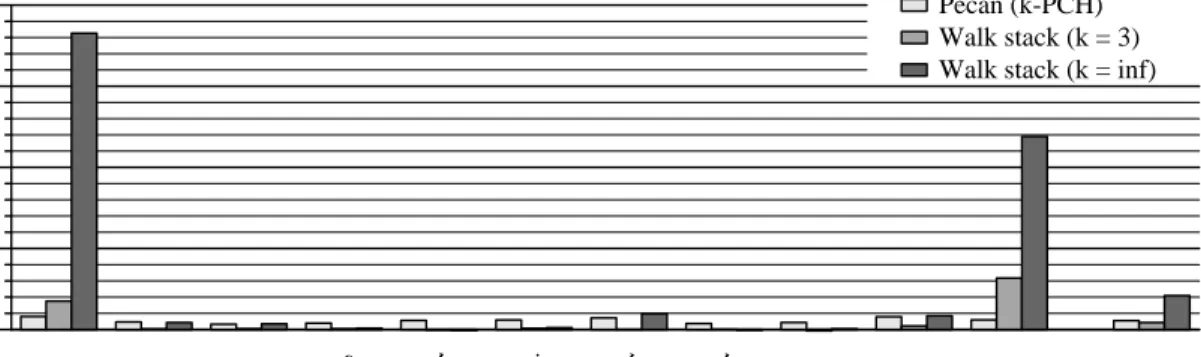
Figure 1 shows the normalized execution time of our approach for the DaCapo benchmarks and fixed-workload version of SPEC-jbb2000 calledpseudojbb[6, 32]. Each bar is the median of three trials. We use an execution methodology calledreplay compilation to reduce nondeterminism due to timer-based sampling [13,18]. We exclude thebloatbenchmark since its performance is erratic even with replay compilation.
Each bar is the overhead compared with the execution time on unmodified Jikes RVM.9
Pecanis the overhead of continuously maintaining k-PCH values and checking them at security calls. Pe-canadds 5% on average and at most 9%. We have found that almost all of this overhead comes from maintaining the k-PCH value; less than a tenth of the overhead comes from checking the k-PCH value at security calls. The experiments usek = 3, but the overhead is the same for larger values ofkup tok=∞.
TheWalk stackconfigurations show the overhead of walking the stack when context is needed, rather than keeping track of context
6
http://www.jikesrvm.org
7http://jikesrvm.anu.edu.au/performance/ 2009-07/
8http://www.jikesrvm.org/Research+Archive 9Overheads are negative (shown as zero overhead in Figure 1) in a few cases because of architectural effects, e.g., instrumentation per-turbs code layout, which can affect caching performance for better or worse.
antlr chart eclipse fop hsqldb jython luindex lusearch pmd xalan pseudojbb geomean 0 50 100 150 200
Overhead (%)
Pecan (k-PCH) Walk stack (k = 3) Walk stack (k = inf)Figure 1: Application execution time overhead of maintaining the k-PCH value and querying it at calls toSecurityException methods, compared with walking the stack.
continuously with k-PCH. These configurations walk the top three call sites and all call sites on the stack, respectively. We note that walking the stack is semantically equivalent to k-PCH, but not per-formance equivalent! Stacwalking is deterministic, whereas k-PCH has a small probability of a numeric collision. In practice, the two techniques should report the same vulnerabilities. The stack-walking configurations have low overhead for most programs, but for two programs (antlrandpseudojbb) they add very high over-head. Walking the entire stack is very expensive for these pro-grams, but, admittedly, full context sensitivity produces too many false positives in practice, as we show in Section 5.3. For context sensitivity with depth 3, overheads are lower, but as high as 18% and 31% forantlrandpseudojbb, which have relatively frequent security calls. Programs with more frequent security calls will in-cur higher overheads. In short, stack-walking does not scale well to higher levels of context sensitivity, nor to more frequent secu-rity checks. In contrast, k-PCH’s overhead scales well with these factors.
5.2
Detecting Real Attacks
This section evaluates PECAN’s ability to detect semantic attacks. For each of the exploits, we train the system using a benign in-put that leads to functionality that is similar to the exploit but not malicious. For example, SlashPathloads a class in a malicious way. To train PECAN, we load a class in a benign way. We then execute the exploits in the trained system and observe whether PE
-CANreports anomalous behavior. Our experiments explore several combinations of granularity, context, and history sensitivity. How-ever, they are not comprehensive, and a production system would likely need application-specific training to appropriately configure the parameters of context sensitivity and history sensitivity.
Thegranularity of PECAN’s checks is important for avoiding both false positives and false negatives. As discussed previously, PECAN checks the k-PCH value only at security calls. The first three exploits,SlashPath,LiveConnect, andOperaPolicy, are ap-plets that take advantage of misconfigured security policies or bugs in the Java libraries. To detect these classes of vulnerabilities, we restrict instrumentation to the libraries because exploits trigger ano-malies in the library code. Furthermore, it does not make sense to check for anomalies in the applets because each applet has different code, which may not even be known in advance, and will generate many false positives. The fourth exploit,XSLT, takes advantage of a semantic bug in a specific application. To detect this class of vulnerabilities, we perform monitoring inside that application.
De-velopers would need to make similar decisions.
Finally, we experiment with different levels ofcontext sensitiv-ity. By default, PECANuses context sensitivity of depth 3. We compare it to lower levels of context sensitivity: 0, which uses the callee method as the program location, and 1, which uses the caller method as the program location. We also compare to full (infinite) context sensitivity. We experiment with two levels of history sen-sitivity: 0 (none) and 1 (includes the previousSecurityManager call). Deeper context sensitivity leads to a richer set of behaviors and thus more false positives, but is required for detection of some attacks (e.g.,SlashPath). Additional history sensitivity beyond 1 is likely to result in many false positives, but this paper does not ex-plore this direction because history level of 1 is sufficient to detect all of our sample attacks. We have, however, verified that the Slash-Pathvulnerability cannot be detected with history alone: even with infinite history, detection requires context sensitivity.
The rest of this section refers to configurations of PECAN us-ing the notationCkHh, wherekis the context depth andhis the
amount of history used. Our recommended configuration, bolded in the tables, isC3H1, which detects all of our sample attacks while producing few false positives.
We now present the details of the four vulnerabilities and eval-uate PECAN’s ability to detect them. Two exploits,SlashPathand XSLT, need context sensitivity to be detected;SlashPathalso needs history. The other two exploits do not need context or history sen-sitivity.
SlashPath.TheSlashPathvulnerability is representative of a com-mon mistake in the implementation of security managers, where the enforcement mechanism forgets to perform a mandatory secu-rity check. The vulnerability exploits the fact that Sun JVM 1.3 does not correctly check whether it is okay to load a class or not if that class’s package name is delimited with slashes (e.g.,sun/ applet/AppletClassLoader) instead of dots (e.g., sun. applet.AppletClassLoader).10
The vulnerability occurs because of a mismatch between two pieces of code. The code that potentially performs a security check assumes that class names are delimited only with dots, while the code that actually loads the class allows names to be delimited with dots or slashes. We found that this vulnerability is also present in the system class loader in Jikes RVM. The code in Figure 2 shows a simplified version of the vulnerable class loader. Note that the call tocheckPackageAccess()does not occur if the class name
10
No history 1-level history
k Config Anoms. (All) Config Anoms. (All)
0 C0H0 0 (35) C0H1 0 (59)
1 C1H0 0 (54) C1H1 1 (90)
3 C3H0 0 (110) C3H1 2 (145)
∞ C∞H0 0 (194) C∞H1 2 (222)
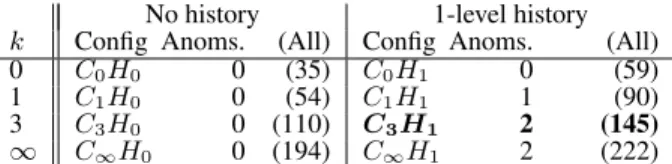
Table 2: Intrusion detection results forSlashPath. Detection requires both context sensitivity and history.
Class loadClass(String name,
boolean resolve) {
int lastDot = name.lastIndexOf(’.’);
if (lastDot != -1)
String pkg = name.substring(0, lastDot); SecurityManager.checkPackageAccess(pkg); }
return super.loadClass(name, resolve); }
Figure 2: VulnerableloadClass()method from Jikes RVM’s system class loader.
is delimited with slashes instead of dots.
Our exploit code is an applet that loads a class in a package that applets should not be able to access. We execute this applet with a custom-defined security manager that allows all operations. This setup makes sense because one important application of PECANis to detect malicious behavior allowed by a faulty security manager or security policy. Our training code models benign behavior by loading a class whose package name is delimited with dots and also a class without a package name (no dots or slashes). Table 2 shows results for executing theSlashPathattack in a system monitored by PECAN. Each row is a configuration with varying levels of context and history sensitivity. The cells show the number of anomalous behaviors associated with the attack and, in parentheses, the total number of behaviors observed during training.
Table 2 shows that context and history sensitivity are required for PECANto detect theSlashPathattack. Sometimes the number of anomalies is greater than 1 because the attack behavior results in anomalous k-PCH values at multiple security calls. In general, Ta-bles 2–5 can be interpreted as follows. IfAnoms.is 0, the PECAN
configuration cannot detect the attack; otherwise, the PECAN con-figuration detects the attack. Detection is contingent on the training set and could potentially fail if the training set were such that the malicious call(s) would no longer appear anomalous.
We also implemented a mimicryattack that calls Security-Manager.checkPackageAccess()immediately prior to attempt-ing to load a class name delimited with slashes (not shown). This attack would defeat naïve history-based detection, but PECAN de-tects it because PECANresets history on each applet→library call (Section 4.5).
XSLT.This vulnerability represents a common class of bugs, where untrusted code mistakenly executes in the wrong security context (e.g., outside the normal Java sandbox). EXtensible Stylesheet Language (XSL) documents specify XSL Transformations (XSLT) to perform on XML documents. XSLT processing may use XSL documents to generate Java code that the host JVM then executes. Typically this code is sandboxed, but in a specific context, XSLT may be “tricked” into executing arbitrary code without security checks. The following is an excerpt from the vulnerability report:11
11http://cve.mitre.org/cgi-bin/cvename.cgi? name=CVE-2007-3716
k Config Anoms. (All)
0 C0H1 0 (20)
1 C1H1 0 (40)
3 C3H1 2 (42)
∞ C∞H1 222 (1573)
Table 3: Intrusion detection results forXSLT. Detection re-quires context sensitivity.SecurityManagerhistory is not rel-evant sincePECANprofiles only the application, which does not makeSecurityManagercalls.
No history 1-level history
k Config Anoms. (All) Config Anoms. (All)
0 C0H0 6 (6) C0H1 6 (6)
1 C1H0 6 (6) C1H1 6 (6)
3 C3H0 6 (6) C3H1 6 (6)
∞ C∞H0 6 (6) C∞H1 6 (6)
Table 4: Intrusion detection results forLiveConnect. Detection does not require context or history sensitivity.
The Java XML Digital Signature implementation in Sun JDK and JRE 6 before Update 2 does not properly process XSLT stylesheets in XSLT transforms in XML signatures, which allows context-dependent attackers to execute arbitrary code via a crafted stylesheet.
To reproduce this exploit in our Jikes RVM-based experimental setup, we use the Xalan XML parsing library, which comes with Sun JVM. Based on more details from the report quoted above, we wrote an XSL file with embedded code in theselectattribute of thexsl:variabletag. If a user gives this XSL file as an input for parsing an XML command, the JVM executes the em-bedded code on the client machine. The emem-bedded code can then perform arbitrary illegal actions, such as accessing local data on the machine.
Table 3 shows that context sensitivity is essential for detecting the attack. We do not show various levels of history because the XSLT application does not directly call anySecurityManager methods. PECANonly instruments the application for this exploit, since it is a standalone application and not an applet. The results do not depend on the amount of history sensitivity.
Context is essential because executing arbitrary security-sensi-tive methods from the context of parsing XSL files is semanti-cally incorrect, but it is reasonable for the XSLT application to call security-sensitive methods in some other context (e.g., to load local configuration files). Our training set calls security-sensitive meth-ods outside the context of XSL parsing, which demonstrates the need for context sensitivity.
LiveConnect.This vulnerability involves gaining access to security-sensitive methods that are not normally available to untrusted code. A design error in a web browser feature called LiveConnect mis-takenly allows Java and JavaScript code to communicate with one another on a web page, i.e., a Java applet accesses JavaScript ob-jects illegally, and JavaScript code illegally accesses Java runtime libraries.12 A malicious applet can then use a JavaScript object to determine the user’s browser and obtain a reference to a class sun.plugin.liveconnect.SecureInvocation. The applet can use this class to disable the current security manager.
To reproduceLiveConnect, we use exploit code provided by an-other security researcher [39]. The vulnerability occurs in Sun’s browser plugin, so PECAN instruments only the plugin, not the 12http://cve.mitre.org/cgi-bin/cvename.cgi?
No history 1-level history
k Config Anoms. (All) Config Anoms. (All)
0 C0H0 3 (3) C0H1 3 (3)
1 C1H0 4 (4) C1H1 4 (4)
3 C3H0 5 (5) C3H1 5 (5)
∞ C∞H0 6 (6) C∞H1 6 (6)
Table 5: Intrusion detection results forOperaPolicy. Detection does not require context or history sensitivity.
other Java libraries. We could configure PECANto instrument all libraries, although this would result in additional anomalous behav-iors.
Table 4 shows the anomalies reported by PECAN for different amounts of context sensitivity and history. PECANdetects anoma-lous behavior regardless of the amounts of context or history. The reason is that the exploit relies on calling a method that should not be accessible to applets, so a benign applet will not call it. Thus, calling this method always triggers an anomaly, even without con-text or history sensitivity. A more thorough training set or a poten-tial mimicry attack might increase the precision needed to detect this exploit.
OperaPolicy. This vulnerability is representative of logic errors and misconfiguration in custom security policies. The Opera 7.54 web browser specifies its own Java security policy for applets. The default policyOpera.policyallows unprivileged applets access to internal packages:13
grant {
permission java.lang.RuntimePermission "accessClassInPackage.sun.*"; };
Our test exploit uses thegetBootstrapClassPath()method of thesun.misc.Launcherclass to obtain private URLs and access core JVM library classes of thesun.*package.
We reproduce the exploit in Jikes RVM with a security manager that allows all behaviors. Table 5 shows that PECAN detects the attack at all levels of context and history sensitivity. Similar to Live-Connect, this exploit calls a method that should not be accessible. This call looks anomalous regardless of the amount of context or history sensitivity, so any PECANconfiguration detects it.
5.3
Evaluating False Positives with Benign
Programs
The prior results showed how well PECAN detects semantic ex-ploits, i.e., how well it avoids false negatives. Now we estimate PECAN’s false positive rate by evaluating it onbenignapplications, since any anomalies must be false positives. We use two classes of programs: applets, which are similar to the first three vulnerabili-ties, and XSL inputs, which are similar to theXSLTexploit.
We useleave-one-out cross-validationto measure false positives fairly. For each ofnprograms, PECANtrains on the othern−1 programs.
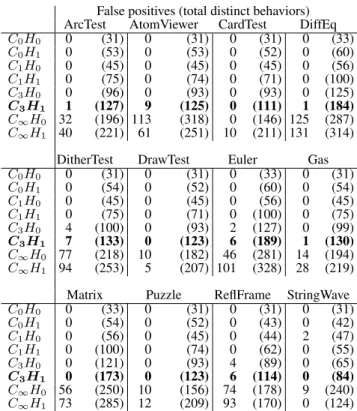
Table 6 shows the number of false positives (anomalous k-PCH values) using leave-one-out cross-validation for 12 sample applets obtained quickly via Google search. The methodology of training on one set of applets and deploying on a different applet is rea-sonable because PECANprofiles only the libraries called by the applets, not the applets themselves (Section 4.5). The number in parentheses is the total number of distinct k-PCH values. For higher 13http://www.securityfocus.com/archive/1/
381634
False positives (total distinct behaviors) ArcTest AtomViewer CardTest DiffEq
C0H0 0 (31) 0 (31) 0 (31) 0 (33) C0H1 0 (53) 0 (53) 0 (52) 0 (60) C1H0 0 (45) 0 (45) 0 (45) 0 (56) C1H1 0 (75) 0 (74) 0 (71) 0 (100) C3H0 0 (96) 0 (93) 0 (93) 0 (125) C3H1 1 (127) 9 (125) 0 (111) 1 (184) C∞H0 32 (196) 113 (318) 0 (146) 125 (287) C∞H1 40 (221) 61 (251) 10 (211) 131 (314) DitherTest DrawTest Euler Gas
C0H0 0 (31) 0 (31) 0 (33) 0 (31) C0H1 0 (54) 0 (52) 0 (60) 0 (54) C1H0 0 (45) 0 (45) 0 (56) 0 (45) C1H1 0 (75) 0 (71) 0 (100) 0 (75) C3H0 4 (100) 0 (93) 2 (127) 0 (99) C3H1 7 (133) 0 (123) 6 (189) 1 (130) C∞H0 77 (218) 10 (182) 46 (281) 14 (194) C∞H1 94 (253) 5 (207) 101 (328) 28 (219) Matrix Puzzle ReflFrame StringWave
C0H0 0 (33) 0 (31) 0 (31) 0 (31) C0H1 0 (54) 0 (52) 0 (43) 0 (42) C1H0 0 (56) 0 (45) 0 (44) 2 (47) C1H1 0 (100) 0 (74) 0 (62) 0 (55) C3H0 0 (121) 0 (93) 4 (89) 0 (65) C3H1 0 (173) 0 (123) 6 (114) 0 (84) C∞H0 56 (250) 10 (156) 74 (178) 9 (240) C∞H1 73 (285) 12 (209) 93 (170) 0 (124)
Table 6: Leave-one-out cross-validation for 12 non-vulnerable applets. Even though there is relatively little training compared with expected industrial efforts, false positive rates are low for theC3H1PECANconfiguration.
levels of context and history sensitivity, there are many more false positives. This highlights the advantage of using depth-limited (rather than infinite) context sensitivity.
For our recommended configuration,C3H1, the number of false positives is always less than 10 and often equal to 0. For the four applets with more than one false positive, the number of anoma-lousbehaviorsis fewer than the number of false positives because a single anomalous execution path often executes several security calls. AtomViewer,DitherTest,Euler, andReflFrameexecute just 1, 3, 3, and 2 distinct anomalous behaviors. Even if the false pos-itive rate shown forC3H1is too high for production use, standard industrial testing will be much more comprehensive than the lim-ited test programs that we use here, further reducing the number of false positives (Section 4).
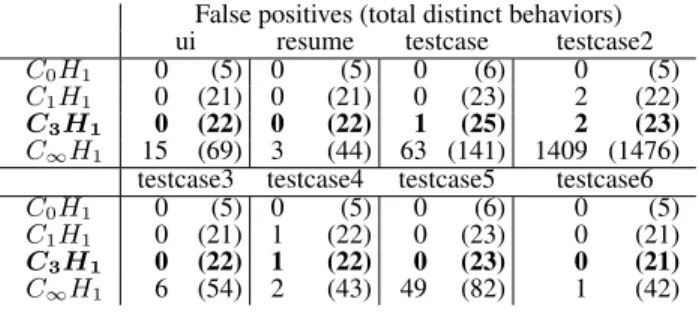
Table 7 shows false positives using leave-one-out cross-valida-tion when XSLT is executed on eight XSL inputs found by a quick Google search. History sensitivity is omitted because XSLT does not callSecurityManagermethods directly, so results are not af-fected by history sensitivity (Section 5.2). The number of false positives is low: 0 in most cases and 2 at most. The false positive rate could be even lower with a more comprehensive test suite.
Additional evaluation is needed, but even these results indicate that developers may need to configure PECANfor a given appli-cation by setting the right levels of context sensitivity and history sensitivity. Because different applications have different security requirements and implementations, requiring developers to config-ure an anomaly detector in such a manner does not seem unreason-able.
False positives (total distinct behaviors) ui resume testcase testcase2
C0H1 0 (5) 0 (5) 0 (6) 0 (5)
C1H1 0 (21) 0 (21) 0 (23) 2 (22)
C3H1 0 (22) 0 (22) 1 (25) 2 (23)
C∞H1 15 (69) 3 (44) 63 (141) 1409 (1476) testcase3 testcase4 testcase5 testcase6
C0H1 0 (5) 0 (5) 0 (6) 0 (5)
C1H1 0 (21) 1 (22) 0 (23) 0 (21)
C3H1 0 (22) 1 (22) 0 (23) 0 (21)
C∞H1 6 (54) 2 (43) 49 (82) 1 (42)
Table 7: Leave-one-out cross-validation for eight non-vulnerable XSLT inputs. TheC3H1PECANconfiguration
gen-erates few false positives.SecurityManagerhistory is not rel-evant sincePECANprofiles only the application, which does not makeSecurityManagercalls.
6.
SUMMARY
Semantic attacks on programs implemented in memory-safe lan-guages are hard to detect because they violate informal coding rules rather than the semantics of the programming language. Anomaly detection can help, but many existing methods suffer from poor precision and performance. PECANis a novel anomaly detection system for Java with probabilistic, depth-limited context sensitiv-ity, history sensitivsensitiv-ity, and low performance overhead.
We evaluate PECAN on four real-world exploits and with vari-ous levels of context and history sensitivity. Context and history sensitivity are both important, but limiting them is key to keep-ing the number of false positives low. While the tension between false negatives and false positives remains challenging, PECAN’s demonstrated ability to detect attacks precisely, accurately, and effi-ciently on real-world programs makes a compelling case for its use in deployed systems. These initial results are promising, but fur-ther evaluation is needed. For production use, application-specific configuration would likely be required, but we believe developers would be willing to invest this effort in order to increase the secu-rity of critical applications.
Acknowledgments
We would like to thank Elton Pinto for help with finding and repro-ducing semantic exploits; Brad Hill, Marc Schonefeld, and Dino Dai Zovi for providing exploit code; Graham Baker for porting PCC to Jikes RVM 2.9.2; Chris Ryder for PCC bug fixes; Sam Guyer for helpful discussions; and Bert Maher, Wei Le, and the anonymous reviewers for valuable feedback on the text.
7.
REFERENCES
[1] M. Abadi, M. Budiu, U. Erlingsson, and J. Ligatti. Control-Flow Integrity. InACM Conference on Computer and Communications Security, pages 340–353, 2005. [2] M. Abadi and C. Fournet. Access Control based on
Execution History. InNetwork and Distributed Systems Security Symposium, pages 107–121, 2003.
[3] P. Akritidis, C. Cadar, C. Raiciu, M. Costa, and M. Castro. Preventing Memory Error Exploits with WIT. InIEEE Symposium on Security and Privacy, pages 263–277, 2008. [4] B. Alpern, C. R. Attanasio, J. J. Barton, M. G. Burke,
P. Cheng, J.-D. Choi, A. Cocchi, S. J. Fink, D. Grove, M. Hind, S. F. Hummel, D. Lieber, V. Litvinov, M. Mergen, T. Ngo, J. R. Russell, V. Sarkar, M. J. Serrano, J. Shepherd, S. Smith, V. C. Sreedhar, H. Srinivasan, and J. Whaley. The
Jalapeño Virtual Machine.IBM Systems Journal, 39(1):211–238, 2000.
[5] P. Bisht, P. Madhusudan, and V. N. Venkatakrishnan. CANDID: Dynamic Candidate Evaluations for Automatic Prevention of SQL Injection Attacks.ACM Trans. Inf. Syst. Secur., 13(2):1–39, 2010.
[6] S. M. Blackburn, R. Garner, C. Hoffman, A. M. Khan, K. S. McKinley, R. Bentzur, A. Diwan, D. Feinberg, D. Frampton, S. Z. Guyer, M. Hirzel, A. Hosking, M. Jump, H. Lee, J. E. B. Moss, A. Phansalkar, D. Stefanovi´c, T. VanDrunen, D. von Dincklage, and B. Wiedermann. The DaCapo Benchmarks: Java Benchmarking Development and Analysis. InACM Conference on Object-Oriented
Programming, Systems, Languages, and Applications, pages 169–190, 2006.
[7] M. D. Bond and K. S. McKinley. Probabilistic Calling Context. InACM Conference on Object-Oriented
Programming, Systems, Languages, and Applications, pages 97–112, 2007.
[8] U. Erlingsson, M. Abadi, M. Vrable, M. Budiu, and G. Necula. XFI: Software Guards for System Address Spaces. InUSENIX Symposium on Operating Systems Design and Implementation, pages 75–88, 2006. [9] M. D. Ernst, J. H. Perkins, P. J. Guo, S. McCamant,
C. Pacheco, M. S. Tschantz, and C. Xiao. The Daikon System for Dynamic Detection of Likely Invariants.Science of Computer Programming, 69(1–3):35–45, 2007.
[10] H. H. Feng, J. T. Giffin, Y. Huang, S. Jha, W. Lee, and B. P. Miller. Formalizing Sensitivity in Static Analysis for Intrusion Detection. InIEEE Symposium on Security and Privacy, pages 194–208, 2004.
[11] H. H. Feng, O. M. Kolesnikov, P. Fogla, W. Lee, and W. Gong. Anomaly Detection Using Call Stack Information. InIEEE Symposium on Security and Privacy, pages 62–75, 2003.
[12] S. Forrest, S. A. Hofmeyr, A. Somayaji, and T. A. Longstaff. A Sense of Self for Unix Processes. InIEEE Symposium on Security and Privacy, pages 120–128, 1996.
[13] A. Georges, L. Eeckhout, and D. Buytaert. Java Performance Evaluation through Rigorous Replay Compilation. InACM Conference on Object-Oriented Programming, Systems, Languages, and Applications, pages 367–384, 2008. [14] J. Giffin, S. Jha, and B. Miller. Efficient Context-Sensitive
Intrusion Detection. InNetwork and Distributed Systems Security Symposium, 2004.
[15] P. Godefroid, N. Klarlund, and K. Sen. DART: Directed Automated Random Testing. InACM Conference on Programming Language Design and Implementation, pages 213–223, 2005.
[16] S. Hangal and M. S. Lam. Tracking Down Software Bugs Using Automatic Anomaly Detection. InACM International Conference on Software Engineering, pages 291–301, 2002. [17] S. A. Hofmeyr, S. Forrest, and A. Somayaji. Intrusion
Detection Using Sequences of System Calls.J. Comput. Secur., 6(3):151–180, 1998.
[18] X. Huang, S. M. Blackburn, K. S. McKinley, J. E. B. Moss, Z. Wang, and P. Cheng. The Garbage Collection Advantage: Improving Program Locality. InACM Conference on Object-Oriented Programming, Systems, Languages, and Applications, pages 69–80, 2004.
[19] H. Inoue.Anomaly Detection in Dynamic Execution Environments. PhD thesis, University of New Mexico, 2005.
[20] H. Inoue and S. Forrest. Anomaly Intrusion Detection in Dynamic Execution Environments. InWorkshop on New Security Paradigms, pages 52–60, 2002.
[21] H. Inoue and S. Forrest. Inferring Java Security Policies Through Dynamic Sandboxing. InInternational Conference on Programming Languages and Compilers, pages 151–157, 2005.
[22] K. Jayaraman, D. Harvison, V. Ganesh, and A. Kiezun. A Concolic Whitebox Fuzzer for Java. InNASA Formal Methods Workshop, pages 121–125, 2009.
[23] N. Jovanovic, C. Kruegel, and E. Kirda. Pixy: A Static Analysis Tool for Detecting Web Application Vulnerabilities. InIEEE Symposium on Security and Privacy, pages
258–263, 2006.
[24] C. Kruegel, E. Kirda, D. Mutz, W. Robertson, and G. Vigna. Automating Mimicry Attacks Using Static Binary Analysis. InUSENIX Security Symposium, pages 11–11, 2005. [25] Z. Li, L. Tan, X. Wang, S. Lu, Y. Zhou, and C. Zhai. Have
Things Changed Now?: An Empirical Study of Bug Characteristics in Modern Open Source Software. In Workshop on Architectural and System Support for Improving Software Dependability, pages 25–33, 2006. [26] T. Lindholm and F. Yellin.The Java Virtual Machine
Specification (2nd Edition). Prentice Hall PTR, 1999. [27] B. Livshits and M. Lam. Finding Security Vulnerabilities in
Java Applications with Static Analysis. InUSENIX Security Symposium, pages 271–286, 2005.
[28] D. Mutz, W. Robertson, G. Vigna, and R. Kemmerer. Exploiting Execution Context for the Detection of Anomalous System Calls. InInternational Symposium on Recent Advances in Intrusion Detection, pages 1–20, 2007. [29] N. Provos. Improving Host Security with System Call
Policies. InUSENIX Security Symposium, pages 257–271,
2003.
[30] V. Roubtsov. EMMA: A free Java code coverage tool. [31] R. Sekar, M. Bendre, D. Dhurjati, and P. Bollineni. A Fast
Automaton-based Method for Detecting Anomalous Program Behaviors. InIEEE Symposium on Security and Privacy, pages 144–155, 2001.
[32] Standard Performance Evaluation Corporation.
SPECjbb2000 Documentation, release 1.01 edition, 2001. [33] D. Wagner and D. Dean. Intrusion Detection via Static
Analysis. InIEEE Symposium on Security and Privacy, pages 156–168, 2001.
[34] D. Wagner and P. Soto. Mimicry Attacks on Host-Based Intrusion Detection Systems. InACM Conference on Computer and Communications Security, pages 255–264, 2002.
[35] G. Wassermann and Z. Su. Sound and Precise Analysis of Web Applications for Injection Vulnerabilities. InACM Conference on Programming Language Design and Implementation, pages 32–41, 2007.
[36] H. Xu, W. Du, and S. J. Chapin. Context Sensitive Anomaly Monitoring of Process Control Flow to Detect Mimicry Attacks and Impossible Paths. InInternational Symposium on Recent Advances in Intrusion Detection, pages 21–38, 2004.
[37] T. Zhang, X. Zhuang, S. Pande, and W. Lee. Anomalous Path Detection with Hardware Support. InInternational
Conference on Compilers, Architectures and Synthesis for Embedded Systems, pages 43–54, 2005.
[38] X. Zhuang, T. Zhang, and S. Pande. Using Branch Correlation to Identify Infeasible Paths for Anomaly Detection. InIEEE/ACM International Symposium on Microarchitecture, pages 113–122, 2006.