DOI 10.1007/s00607-012-0199-7
A novel robust on-line protocol for load-balancing
in structured peer-to-peer systems
George Tsatsanifos · Vasilis Samoladas
Received: 16 November 2011 / Accepted: 9 June 2012 / Published online: 13 July 2012 © Springer-Verlag 2012
Abstract In this paper, we revisit the problem of load-balancing structured peer-to-peer systems with on-line protocols. Load-balancing is of major significance for large-scale decentralized networks in terms of enhanced scalability and perfor-mance. The main incentives behind balancing schemes are under-utilization of band-width and computer resources. Therefore, our methods focus mainly on task-skew. Specifically, we address the problem with on-line protocols on the basis of migra-tion and enhanced availability. In particular, the cornerstones of our methods are the notions of virtual nodes, replication and multiple realities, combined altogether with allocation techniques based on balls-in-bins games. The rationale of our dynamic protocol to depend exclusively on peer load distribution preserves intact the struc-tural properties and search efficiency of the overlay used as an indexing infrastructure, while preserving the semantic information of the data (e.g., range partitioned network). We also propose an effective load-aware mechanism to facilitate robust operations that counteract against contingent churn failures. Finally, our work is complemented with extensive experiments using both real and synthetic data sets.
Keywords Load-balancing· Structured peer-to-peer systems · Distributed hash-tables·Multiple realities·Virtual nodes·Replication·Range queries
Mathematics Subject Classification 68M10·68M12·68M14 G. Tsatsanifos (
B
)Knowledge and Database Systems Laboratory, School of Electrical and Computer Engineering, National Technical University of Athens, Athens, Greece e-mail: [email protected]
V. Samoladas
Software Technology and Network Applications Laboratory, Electronic and Computer Engineering Department, Technical University of Crete, Chania, Greece e-mail: [email protected]
1 Introduction
Load-balancing has never been an easy problem for computer science. It is a challeng-ing open problem with theoretical aspects directly related to well-known NP-complete problems (partition, makespan) and combinatorial optimization issues, as well. These problems are approached through approximation due to their complex nature. The main incentives behind balancing schemes are under-utilization of bandwidth and computer resources. Besides, load-balancing is a real problem with practical exten-sions on many system parameters, pertaining to optimal resource utilization, through-put, and response time. Additionally, load imbalances may cause severe impediments, such as bottlenecks and congestion, which are critical to an effective network oper-ation. Moreover, dynamically changing popularities of data items and skewed query patterns in peer-to-peer systems may cause some of the peers to become bottlenecks, thereby resulting in severe load imbalance and consequently increased response times. In this paper, we revisit the problem of load-balancing structured peer-to-peer systems [33,40–42,47]. In principle, structured peer-to-peer systems are large-scale decentralized networks that employ a global consistent protocol that addresses the fol-lowing aspects: (i) a partitioning protocol of the key-space, such as a multi-dimensional interval, so that each peer is responsible for a specified key-space partition. Then, a peer responsible for a particular key-space partition should store all (key,value) pairs that correspond to its zone, (ii) a graph embedding among these partitions (peers) which guarantees the existence of at least one path from any peer to all others, (iii) a routing protocol that enables message forwarding in such a way that a query spanning a specific part of the interval will reach all peers whose zones overlap with the query in a number of hops smaller than the diameter of the graph, and (iv) a fault-tolerance mechanism that ensures that all the above hold as peers join, leave and fail arbitrarily. Notably, the sheer size of peer-to-peer systems and the inherent dynamism of the envi-ronment pose significant challenges to load-balancing. Moreover, the main difficulty in supporting complex queries in a peer-to-peer system, such as range search, while providing load balancing is that the order of elements within the data structure must be preserved. Our intention is to develop a realistic balancing paradigm, which can be used on top of any DHT overlay, to mitigate load imbalance effects, and thereby, enhance performance and scalability. Our methods are focused mainly on task-skew. We address this multifaceted problem with rigorous protocols based on replication and migration, reducing the problem to a balls-and-bins game by facing hosts as bins and virtual nodes as balls.
The contributions of this paper are multifold. In the first part of this work, we study rudimentary balancing techniques, namely multiple realities, virtual nodes and repli-cation over specific performance evaluation metrics. By scrutinizing each method in isolation, we draw valuable conclusions on how they can interoperate with each other, and augment them by applying each a balls-in-bins model. In the latter part of our work, we present a balancing protocol that compromises the tradeoffs between the options of migration and replication, dynamically adjusts the number of replicas and virtual nodes, and adapts their allocation to peers in response to network changes. Our protocol combines desired characteristics from each technique, though, from a new point of view that takes seriously balls-in-bins games into consideration. In effect, this
means that some parts of the network might use the virtual nodes technique, while some nodes of the overlay might be replicated by many hosts in the network at the same time. More importantly, our scheme can be applied on top of any overlay with-out damaging its properties (e.g., processing complex queries), regardless indexing scheme, dimensionality degree. This is a salient characteristic of this work, since most of the prior relevant works in the literature have concentrated on topology re-organi-zation efforts that rely on transferring data between adjacent nodes, and thus, making their balancing objectives infeasible for distributed multi-dimensional data structures. To the best of our knowledge, our protocol is the first to unify these techniques into a single protocol for structured peer-to-peer systems. Moreover, by taking advantage the structural properties of our scheme, we are in position of augmenting our work with an effective load-aware mechanism to ensure resiliency against contingent churn failures. Besides, fault-tolerance is an indispensable constituent of a complete solu-tion for large-scale decentralized networks, where peers join, leave and fail arbitrarily. Finally, our experimental evaluation demonstrates that our proposed techniques are indeed effective in improving the system performance significantly.
The remainder of this paper is organized as follows. Section2augments rudimen-tary balancing algorithms. In Sect.3 we describe our dynamic balancing protocol. Section4discusses an augmented fault-tolerance mechanism. Section5presents thor-ough experiments and evaluates our work. Section6reviews relevant literature. Last, Sect.7summarizes and concludes our work.
2 Balanced allocations from a new perspective
In this section, we augment existing rudimentary balancing techniques with algorithms that enhance performance. More specifically, we reduce the problem to a balls-in-bins game by facing peers as bins and virtual nodes as balls. In particular, we apply the balls-in-bins model to the following techniques:
– Maintaining multiple, independent coordinate spaces with each node being assigned a different zone in each coordinate space.
– Associating keys with virtual nodes and mapping multiple virtual nodes to hosts. – Replicating popular nodes into many hosts, sharing this way hotspots’ load. We now delineate some terminology conventions we have made for distinguishing certain notions we use. We define as a node the entity responsible for some part of the key space of the overlay, which was assigned according to the overlay protocols. As far as this work is concerned, nodes and peers are two distinct notions. Hence-forth, peers serve as node containers. A peer’s task is to deliver incoming messages to the appropriate comprised nodes and forward all their outgoing messages to their destination. Additionally, a peer may enact a request via any of its congregated nodes. In retrospect, most of the prior works in balancing use a straightforward approach for random and arbitrary assignment of balls to bins, requiring no knowledge about balls, bins, their structure and their loads. On the other hand, our contribution involves the design of iterative allocation schemes based exclusively on local knowledge that exploit balls-in-bins games with minimum makespan scheduling approximate solu-tions [10,25,37]. To elaborate, assume that there has already been made some sort
of assignment of nodes to peers. Balancing takes place among the nodes of a neigh-borhood, where a peer’s neighborhood corresponds to the union peer-set of all peers containing nodes from the routing tables of the peer’s comprised nodes.
For each iteration a random peer from an unbalanced peer-set is picked, and all nodes from linked peers are reassigned successively to the bins of that specific peer-set, starting from the heaviest node and assigning it to the lightest peer of the peer-set. In essence, our methods constitute infinite processes, as they are repeated sequentially, and we stop when no significant changes take place in the structure and a convergence criterion has been met.
2.1 Virtual nodes
The purpose of the virtual nodes technique is the even allocation of keys to nodes, by associating keys with virtual nodes, and mapping multiple virtual nodes (with unre-lated identifiers) to each peer. In essence, n hosts allocate the m = g×n nodes of
the overlay, where g > 1, and thus, this method results in assigning many nodes to a single peer; unlike alternative balancing methods that exploit enhanced availabil-ity. Intuitively, it offers a tantalizing opportunity for balancing peers’ data-load by providing a more uniform coverage of the identifier space. This does not affect the worst-case path length. However, the maintenance cost for a peer congregating many nodes (e.g., updating routing tables) increases readily. Furthermore, the virtual nodes technique can be applied to any load function and type of skewness, enhancing this way flexibility and functionality. Besides, what load consists of is problem specific. More importantly, the virtual nodes technique is devoid of data-redundancy, as a peer may contain many nodes but each node can be hosted in one peer exclusively (many-to-one scheme).
Specifically, the maximum load of the busiest peer equals the sum of the loads of all its comprised nodes, and thus, can never be less than the load of the busiest node. This, naturally, constitutes a barrier for this method regarding task-load fairness which can be faced with the virtual nodes method. However, if we opt for iteratively splitting the heaviest node until an assignment of nodes to peers can be found until some criterion is met, we cannot be sure about the outcome of such operation as beyond some point, too much fragmentation has negative consequences. We also note that the increased maintenance cost, arising from comprising a large number of virtual nodes, involves an additional communication cost that has the opposite result, and could have been avoided otherwise. As a result, if there are too many virtual nodes compared to the number of peers, then max task-load might increase instead of improve, as we will show next in our evaluation part. Thereby, we can intuitively understand that there is some “golden” ratio for the number of virtual nodes in terms of the available peers.
2.1.1 Analysis of the centralized scheme
In this section we are in search for a compact and instructive bound on the maximum peer load for the centralized greedy allocation of nodes to peers. Let m the number of peers and n the number of virtual nodes with n=g×m. In addition, let Q be the total
number of queries issued by all nodes of the overlay. We assume in our example that all queries are either lookup or range queries and therefore each requires O(log2n) hops and messages for most of the overlay structures in the literature, e.g. Chord [42], P-Grid [4], VBI-Tree [27], BATON [26], MIDAS [43], Pastry [41], Tapestry [47], and many others. Hence, a total of Q log2n messages at most is forwarded throughout
the overlay until all queries are resolved. Now, letμj the load of virtual node j . In
our case load corresponds to the number of requests that node j receives (task-load). Hence, we have for the average load that,
μmean= 1 n n j=1 μj ≤ 1 gmQ log2gm (1)
Let Mi the total load of peer i , which equals to the sum of the loads of all comprised
nodes in peer i, Mi =j∈iμj. Let p the heaviest peer produced by the algorithm,
and letvbe the index of the last virtual node assigned to this peer. Next, let Mp\vbe
the load of peer p before virtual nodevgets assigned to peer p. Since the algorithm assigns a job to the least loaded peer at the time, it follows that all peers have loads greater than Mp\v. This implies that,
Mp\v= 1 m n j=1 j=v μj Mp\v ≤ 1 m(Q log2gm−μv)
Moreover, the heaviest peer’s load is at most Mp = Mp\v + μv, whereμv
corre-sponds to the load of the lightest virtual node being the last node being assigned to a peer from a sorted list,μv≤μj,∀j . Then, we are in position of coming up with an
upper bound for Mpafter the greedy assignment of virtual nodes to peers. Henceforth,
we will refer to the upper bound for the load of the heaviest peer as Mmax. Note thatg we regard Mmaxg as a continuous function of g, with g≥ 1, and therefore we are in search for the g-value(s) that minimize Mmax. More specifically, we provide a tightg example according to which the worst case scenario for the heaviest peer is shown, as for any other allocation of virtual nodes Mpintakes a lighter load. Therefore, we
want to find the g-values such that, gopt=argmaxgM g
max. Hence, when replacing and summing Eqs.1and2we have that,
Mmaxg = 1
mQ log2gm+ m−1
m μmin (2)
More importantly, theμminfactor introduces skewness which affects Mmaxg and the
g-values where it is minimized. In particular, we letσ signify how many times the average node’s load is greater than the lightest node.
μmin=μmean
σ ≤
1
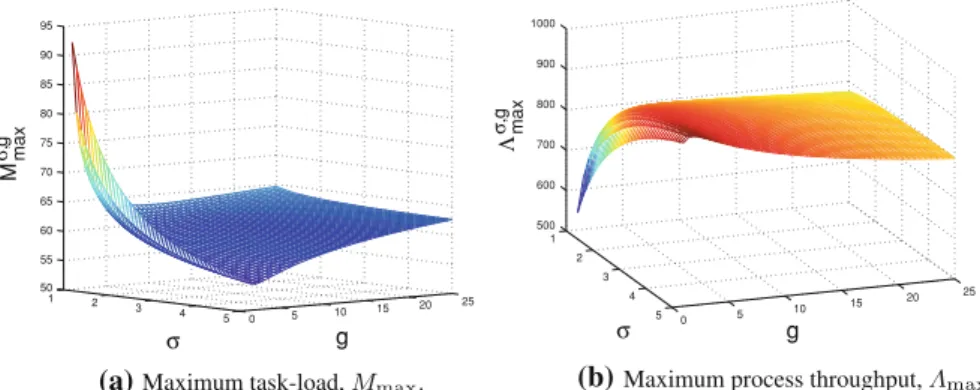
1 2 3 4 5 0 5 10 15 20 25 50 55 60 65 70 75 80 85 90 95 g σ M max σ, g 1 2 3 4 5 0 5 10 15 20 25 500 600 700 800 900 1000 g σ Λmax σ, g (a) (b)
Fig. 1 Performance upper bounds in terms of the virtual nodes to peers ratio g for 10K peers, 50K queries,
and varying task-load skewnessσ Therefore, Eq.2now becomes
Mmaxσ,g = Q mlog2gm 1+m−1 σgm (4)
From Eq.4it follows that Mmaxσ,g is a function of bothσand g. Now we are in position of finding the optimum configuration for g. In effect, these are the values in Fig.1a that minimize Mmaxσ,g for fixed skewnessσ and a fixed number of peers m.
Quite notably, hitherto approaches evaluate imbalances by the maximum number of virtual nodes congregated into a single peer, whereas our analysis takes also into consideration the load of the comprised nodes. Furthermore, by establishing an analy-sis regarding the maximum load of the heaviest peer in a peer-to-peer network, we can predict the maximum possible process throughput in the network, as proposed in [14]. This is an importance performance metric which quantifies the resilience of a peer-to-peer network to contention by concurrent searches. More formally, assume that each peer can process at most one message per unit of time. If the queries from the workload arrive (stochastically) at a rate ofqueries per unit of time, each query with equal probability, then messages to peer i will arrive at a rate of Mi
Q messages per unit of
time. Assuming that peer i is not overloaded (messages do not arrive faster than it can process them) we have < MQ
i. Then, maximum process throughputmaxis defined as the maximum value ofso that no peer is unduly loadedmax= maxQ
iMi. Consequently, whenexceedsmaxthe overlay is burdened with requests it can no longer process and thus the network becomes unstable, performance impairs, and some portion of the queries that cannot be processed are possibly lost. Figure1b depicts the maximum process throughput for the same configuration. Most importantly, the
g-values where Mmaxσ,g is minimized, naturally, coincide with the values that maximize
max. Moreover, Mmaxalso depends on query-load Q, whereas, which expresses the maximum possible number of queries that can be processed per time unit, is nor-malized and can be compared with the corresponding maximum process throughput from other overlays for different workloads even.
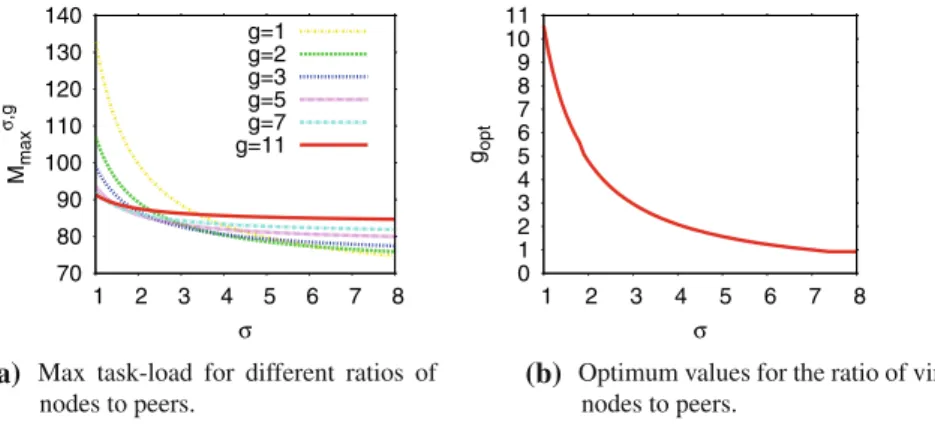
70 80 90 100 110 120 130 140 1 2 3 4 5 6 7 8 Mmax σ ,g σ g=1 g=2 g=3 g=5 g=7 g=11 0 1 2 3 4 5 6 7 8 9 10 11 1 2 3 4 5 6 7 8 gopt σ (a) (b)
Fig. 2 Mmaxand the g-values where it is minimized for 10K peers, 50K queries, and varying task-load
skewnessσ
Then, the optimal g-values can be found by solving the equation dgd Mmaxσ,g =0 in terms of g. Hence, we need first to differentiate Eq.4which leads to,
d dgM σ,g max= Q m ln 2 σmg+(m−1)(1−ln mg) σmg2 (5)
Due to its form, we solve the equation dgd Mmaxσ,g = 0 that returns the optimal con-figuration using a well known numerical analysis method, namely Newton’s method, according to which we start from an arbitrary solution which we improve sequentially. Hence, starting from an initial value g(0), we have for the k+1th iteration,
g(k+1) =g(k)− d dgM σ,g(k) max d2 dg2Mσ, g(k) max (6)
Then, by differentiating Eq.5we take that,
d2 dg2Mσ, g max= − Q m ln 2 σmg+3(m−1)−2(m−1)ln mg σmg3 (7)
Hence, it follows that,
g(k+1)=g(k)+g(k) σmg
(k)+(m−1)(1−ln mg(k))
σmg(k)+3(m−1)−2(m−1)ln mg(k) (8)
We choose to terminate this iterative procedure when|g(k+1)−g(k)|< , where→0, which converges in just a few iterations. In Fig.2a we present Mmaxin terms of vary-ing skewnessσ for different g-values. To elaborate, Fig.2a suggests for each value of the skewness factor the configuration for g which is below all others as the fittest. Succinctly, Fig.2b provides an insight of how to optimize performance and minimize
the load of the heaviest peer in a network and also maximize process throughput, as
goptdesignates what the optimum configuration is for varying skewness. As a result,
goptconstitutes the maximal meaningful values for g, as configurations beyond gopt, apart from being sub-optimal in terms of performance, but also include additional costs for purposes like maintenance, updating routing tables, etc. Nonetheless, for higher g-values still high-levels of fairness are achieved. Besides, load-balancing is a multi-faceted problem, and above all, performance is its most conspicuous aspect. We reckon that this is a remarkable new result which sheds new light on load-balanc-ing for peer-to-peer systems. Specifically, it had been obscured by hitherto approaches that focused on the maximum number of virtual nodes into a single peer by assuming that virtual nodes have equal loads. It now becomes obvious that an increased number of virtual nodes cannot necessarily guarantee stellar performance. A final note regards extremely skewed load distributions in the overlay, where increasing the number of virtual nodes with respect to the available peers does not seem to improve Mmax. In fact, with increased skewnessσ, we observe that goptdiminishes.
2.1.2 Analysis of the LBB algorithm
Our local allocation scheme which exploits the virtual nodes technique, is limited to peer knowledge about the overlay. Algorithm1constitutes the balancing process which has been triggered by peer x, either to insert a new peer y, or because x has traced its being overloaded compared to its neighbors, and therefore, invokes a balanc-ing procedure among all peers in i ’s routbalanc-ing table (for the latter case though, we omit line1from Algorithm1). Peer x is aware of the loads of its neighboring peers and their
Algorithm 1 joinLBB1: the LBB algorithm that exploits virtual nodes
1: T←getAverageNeighborhoodLoad()
2:nph ← createMinPriorityPeerHeapFromUnderLoadedPeers(T)
3:nph.add(n) // take into account the new peer n as well
4: while notnph.isEmpty()do
5: p←nph.pop()
6: Gp← |T−p.getLoad()|
7: xph ← createMaxPriorityPeerHeapFromOverloadedPeers(T)
8: while notxph.isEmpty()do
9: q←xph.pop()
10: Gq← |q.getLoad()−T|
11: while q.getNodesNr()>1 do 12: u←argminv∈q|v.getLoad()−Gp|
13: if|Gp−v.getLoad()|<Gpand|Gq−v.getLoad()|<Gqthen
14: p.add(v) 15: q.remove(v) 16: Gp← |Gp−v.getLoad()| 17: Gq← |Gq−v.getLoad()| 18: else 19: break 20: end if 21: end while 22: end while 23: end while
comprised virtual nodes and therefore is able to compute the average neighborhood load T (line1). Next, x creates a max priority heap with all neighboring peers whose loads exceed T (line1), and a min priority heap with all neighboring peers with loads less than T (line1). Additionally, if peer x was contacted by a new peer y that wants to participate in the network, then y will also be included in the underloaded peers’ heap as well (line1) with load equal to zero, otherwise this line is omitted. Now, for each of the underloaded peers (line1), starting from the lightest, we find the node that fits best its load gap from T (line1) from the heaviest peer with more than one virtual nodes (lines1,1), which is then moved from the heavy to the light peer (lines1,1). Load-gap values are updated (lines1,1) and we repeat until the load-gaps of the light and the heavy peers do not improve anymore, and then we proceed with the next underloaded peer from the heap. On the other hand, Algorithm2presents the balancing process triggered by departing peer p, which assigns sequentially its nodes, starting from the lightest, to its lightest linked peer.
We will now establish a similar analysis for a tight example regarding the LBB Algorithm in order to establish a necessary upper bound Mmaxfor task-load for the most loaded peer. Again, we have m peers and n virtual nodes. Initially, we assume that peers contain for connectivity purposes just one virtual node with load equal to
, whereis a arbitrarily small quantity; except for one peer that is responsible for
g ×m virtual nodes, and as a result, it is duly loaded. We note that each peer has
information for at least log m other peers. Therefore, the overloaded peer has to share its load with all associated peers. These are the peers that its virtual nodes’ links are hosted. In turn, these peers will attempt to balance their load with their own associated peers, and so on. Hence, an hierarchy is formed, according to which the overloaded peer is on top. In particular, peers at level j are j hops away from the overloaded peer. More formally, we assume a functionφjwhich returns the minimum number of newly inserted peers at depth j of the hierarchy. Then,φ0 =1 andφ1 corresponds to the number of distinct peer entries in the routing table of the overloaded peer. In particular, for trie-structured overlays, like P-Grid [4] and MIDAS [43], we have for our example thatφj =2j(log m− j)−2j+j .
Algorithm 2 departLBB1: the LBB algorithm that exploits virtual nodes
1:xnh ← createMaxPriorityNodeHeapFromLocalNodes()
2:nph ← createMinPriorityPeerHeapFromLinkedPeers()
3: while notxnh.isEmpty()do
4: u←xnh.pop()
5: if notnph.isEmpty()then
6: q←nph.pop() 7: q.add(v) 8: p.remove(v) 9: nph.push(q) 10: end if 11: end while
We will now establish a case study for Mmaxand how it diminishes according to the virtual nodes paradigm for a single-point bottleneck example. This procedure can be described by a series of phases, where each phase corresponds to an effort for each
peer of the hierarchy, starting from the top, to balance its load with its direct neighbors that correspond to the lower level. More importantly, we will investigate how load disseminates from a single hotspot to the rest of the network. In particular, since Mmax is expressed as a sum of two parts, namely Mpandμv, as in Eq.2, we will first study
the course of Mip,j for each level j of the hierarchy in phase i under the assumption
of fractional peer-load. Then, on top of Mip,j we will add the appropriate node load
quantityμvin order to complete our worst case analysis.
Initially, at phase 0 the overloaded peer’s load equals to the total load of the overlay, say M0p,0, while all other loads are very small, with→0. At phase 1, each peer-load
at level 1 now equals to Mp1,1← Mp0,0φ0+φ0φ1, since part of the overloaded peer’s load
is shed to itsφ1direct neighbors, and thus, now M1p,0 ← M1p,1. Next, each of the φ1previously encountered peers will contribute approximately φφ2
1 new peers each, and thus, each peer will invoke a balancing procedure among φ2
φ1 +1 peers and their congregated nodes. As a result, each peer at level 2 will be responsible for nodes that correspond to load equal to Mp1,2 ← Mp1,1φ1φ+1φ2 = M0p,0φ0+φ0φ1φ1+φ1φ2, and then we
have that M1p,1← M1p,2. Likewise, we find how load disseminates from a single
hot-spot to the remaining levels according to the formula M1p,j ← j−1
k←0M 0,0
p φk+φφkk+1.
Hence, this first phase ends when some part of the load of the peer at the top of the pyramid reaches the peers at the bottom. Next, at phase 2 we will repeat the same procedure. From now on however, at each balancing procedure the loads that were assigned to the previous phase will have to be included, as well. Hence, the peer’s load at level 1 equals to M2p,1 ← φ0
M1p,0+φ1M1p,1
φ0+φ1 , and then, we set M 2,0
p ← M2p,1.
Next, each peer’s load at level 2 will now be equal to M2p,2 ← φ1
M2p,1+φ2M1p,2
φ1+φ2 . Gen-erally, following the dynamic programming principles, we have for layer j at phase i that Mip,j = φj−1
Mip,j−1+φjMip−1,j
φj−1+φj . In other words, load gradually flows at each phase from the top layers to the lower levels of the hierarchy that are more distant from the overloaded peers, until fairness is achieved among the different levels. Then, it is not hard to show that after a finite number of phases i, Mip,jconverges for all depths j to
the same Mpquantity. Nonetheless, on top of Mpone cannot addμmin, as we did in
Eq.2, since one cannot be certain about the position/level of the heaviest peer due to the numerous independent balancing operations all over the hierarchy. Hence, the load of the node assigned last cannot be predicted. However, at all cases we know that it is ≤μmean, and thus, it follows that Mmaxg =Mp+μmean, which is essentially greater
or equal than the corresponding bound for the centralized approach. As expected the centralized assignment of virtual nodes to peers dominates the distributed algorithm, and therefore, it will be used as a measure of optimality which can indicate whether a greedy distributed allocation can ever be just as good.
2.2 Redundant overlays
The principle of this technique is to maintain multiple, independent coordinate spaces, with each node in the system being assigned a different zone in each coordinate space.
Data tuples are being replicated in every reality, enhancing this way, data availabil-ity and fault-tolerance. For the parallel universes technique we want all peers to be burdened with equal loads due to their participation in all redundant overlays, since balancing is our main concern before latency. To attain our objectives, we force peers to enact their queries only in one of the realities, selected randomly and independently. In particular, we consider for our scheme the case where n peers participate in the net-work in all g parallel overlays, where each consists of g×m nodes. Therefore, in order
to balance, we reassign the nodes from all realities of a selected peer’s nodes’ overlay vicinities (links) in such a way that all peers acquire nodes with approximately the same summing loads. Even though the query task-load is immensely reduced, data insertions and deletions still have to be applied to all realities, otherwise the system is inconsistent, in that identical requests in different realities would yield different results. However, this scheme comes at a cost of a fixed replication factor. In effect, along with overweight areas of space, the underweight ones are replicated as well.
In retrospect, the balancing scheme that was endorsed in the CAN paper [40], namely the multiple realities paradigm, also leverages redundant overlays from a completely different point of view, though. This method aims at reducing latency instead by invoking queries simultaneously in all realities and get the fastest answer. When a peer simultaneously “broadcasts” its request to all realities, the fastest answer is returned to the user, and thus latency ameliorates. Hence, when a lookup query is enacted simultaneously in all g realities, it requires g times more messages to be resolved. No other consideration has been made, other than creating and maintaining redundant overlays.
Algorithm 3 joinLBB2: the LBB algorithm that exploits multiple realities
1: for j←1 torealitiesNrdo
2: T1→j←getAverageNeighborhoodLoad(1→j)
3: nph ← createMinPriorityPeerHeapFromUnderLoadedPeers(T1→j)
4: nph.add(n) // take into account the new peer n as well
5: while notnph.isEmpty()do
6: p←nph.pop()
7: Gp← |T1→j−p.getLoad(1→j)|
8: xph ← createMaxPriorityPeerHeapFromOverloadedPeers(T1→j)
9: while notxph.isEmpty()do
10: q←xph.pop()
11: Gq← |q.getLoad(1→j)−T1→j|
12: while q.getNodesNr(j)>1 do 13: u←argminv∈q|v.getLoad()−Gp|
14: if|Gp−v.getLoad()|<Gpand|Gq−v.getLoad()|<Gqthen
15: p.add(v,j) 16: q.remove(v,j) 17: Gp← |Gp−v.getLoad()| 18: Gq← |Gq−v.getLoad()| 19: else 20: break 21: end if 22: end while 23: end while 24: end while 25: end for
Algorithm 4 departLBB2: the LBB algorithm that exploits multiple realities
1: for j←1 torealitiesNrdo
2: xnh ← createMaxPriorityNodeHeapFromLocalNodes(j)
3: nph ← createMinPriorityPeerHeapFromLinkedPeers(j)
4: while notxnh.isEmpty()do
5: u←xnh.pop()
6: if notnph.isEmpty()then
7: q←nph.pop() 8: q.add(v,j) 9: p.remove(v,j) 10: nph.push(q) 11: end if 12: end while 13: end for
More specifically, our local allocation method, LBB, enhances our parallel uni-verses scheme and assigns the nodes of the currently heaviest peer and its associated peers to the lightest peer among that peer-set, with respect to their summing load in all previous realities. In Algorithm3, variable T1→j stands the average peer load in
the neighborhood in the first j universes. The data-redundancy introduced in both schemes is fixed and equal to the number of realities g.
2.3 Replication schemes
The replication technique aims at alleviating bottlenecks, by imposing additional data-redundancy, and distributing load of hotspots among more than one hosts, enhancing high availability and fault tolerance. Obviously, this method aims exclu-sively at task-skew. Our approach, instead of replicating single popular data tuples, focuses on how we can replicate nodes, manage them efficiently, and preserve con-sistency among all replicas of an overlay node. When replicating hotspots, only a portion of the original node’s traffic reaches each copy, and as a result heavy nodes are alleviated. According to our paradigm, we replicate nodes responsible for popular areas to as many hosts is needed, so that there is no task-skew among hosts. Hence, replication factor varies from node to node, with respect to their load. This approach resembles very much the virtual nodes technique in reverse, though. Instead of making a peer responsible for many unrelated parts of the key space, we make a popular area available through many peers. This is an extremely flexible and effective solution as we assign hosts to nodes in such a way that overlay load imbalances render obsolete (one-to-many).
A natural question is raised regarding the redundancy imposed and the involved costs. We measure this by the cardinality of the most replicated overlay node. More for-mally, letμmaxthe load of the most loaded node of the overlay, withμmax=σμmean, where σ ≥ 1. Then, the maximum replication factor, denoted asρmax, is equal to
μmax
Mmean, where Mmeanstands for the average peer load and constitutes the target load where the balancing procedure should converge for all peers. Again, we assume that there are n overlay nodes that are hosted by m peers in total, with m=g×n. Hence,
ρmax= μmax nμmean m = σ μmean n mμmean =σm n = σg, (9)
which declares the expected association between redundancy and skewness.Further-more, our local allocation scheme that exploits replication relies exclusively on a peer’s limited knowledge about the network. At each iteration of the LBB, we select a random peer and we redistribute all linked peers to the associated nodes. More specifically, let node u that forwards a message tow. Then, in order to distribute load among all replicas ofw,u would have to deliver it to any arbitraryw’s replica. Hence, u needs to know in advance allw’s replicas, in order to be in position of selecting any of them. Such an approach requires a new replica ofw to notify all associated nodes about its availability. Likewise, when a replica departs, it updates the routing tables of all associated nodes. Albeit no additional hops and messages are required for lookups, insertions cause an additional linear cost corresponding to updating all relevant repli-cas. However, these overheads can be kept low, since we can achieve our major goals with a relatively small number of replicas.
Algorithm 5 joinLBB3: the LBB algorithm that exploits replication
1: q←getMaxLoadedLinkedPeer()
2: for all u∈q do
3: p.add (u)
4: end for
Algorithm 6 departLBB3: the LBB algorithm that exploits replication
1: for all u∈p do
2: if u.getReplFactor()>1 then
3: u.destroyReplica()
4: else
5: u.departFromOverlay() // merged with sibling
6: end if
7: end for
2.4 Discussion
The thorough study of the aforementioned balancing techniques and their intrinsic characteristics allows us to discover the tradeoffs between different methods, orthog-onal to each other, and go one step further by pinpointing some emerging questions when it comes to on-line load-balancing. How much data-redundancy do we really need? How many virtual nodes should correspond to each peer? What if the load distribution changes over time? How can we dynamically adjust the number of rep-licas, either through creating new ones, or eliminating others, in response to net-work changes as peers join, leave, and fail arbitrarily? These key questions are in the core of the load-balancing problem we try to tackle in this paper. Moreover, the greatest challenge here is that these important questions have to be addressed all
at the same time by a single, flexible and robust on-line protocol. As a result, our former meticulous study provides us with the tools to conjure up an on-line bal-ancing protocol that enables peers to congregate more than one nodes at any given time. However, these nodes are not necessarily unique, in other words, they might serve as replicas for heavily loaded virtual nodes. More importantly, this combina-tion of techniques becomes most effective in conjunccombina-tion with our parallel universes scheme.
3 The multi-bin protocol for on-line load-balancing
This section is dedicated to bringing together the aforementioned balancing methods and combine them in such a way that their effect is maximized as the overlay adapts to dynamic changes of the network topology. Thereby, we add a whole new dimension as techniques orthogonal to each other are able to work in a rather complementary fashion, operating at two different levels, affecting both the amount of traffic that the bottlenecks intake, and provide a chance for precise load adjustment through a migration-based protocol.
To elaborate, assume that there has already been made some sort of assignment of nodes to peers. Balancing takes place among the nodes of a neighborhood, where a peer’s neighborhood corresponds to the union peer-set of all peers containing nodes from the routing tables of the peer’s comprised nodes. The rationale of our protocol to depend exclusively on peer load distribution, complements and preserves intact all desired overlay properties and characteristics as it does not intervene in overlay opera-tions. In effect, data indexing, overlay operation and query processing are completely undertaken by the overlay as a whole. Our protocol operates on top of the overlay, in the entity responsible for managing, transferring, replicating and caching the congregated nodes. Besides, the load-balancing mechanism should not compromise the structural properties and thus the efficiency of the overlay network, while preserving semantic information of the data (e.g., range-partitioned networks, lexicographic ordering to enable range searches, etc.). More importantly, we upheld all restrictions concern-ing cardinality, as a peer may contain many nodes and a node might be replicated in many peers in the same time, for the shake of fair load distribution. Additionally, the Multi-Bin protocol pursues primarily high levels of fairness and tries to minimize the consumed bandwidth.
In principle, we augment peer joins and departures with some additional balancing steps that are shown in Algorithms7and8. Even though it can be argued that some overhead is introduced, the alternatives to our migration/replication based on-line pro-tocol demand frequent topology reorganization, introduce significant communication and maintenance costs as apart from moving around individual keys they also need to update peers’ routing tables. To elaborate, consider an overlay of n virtual nodes. This systemic parameter is fixed. When a peer wants to join the network, it has to allocate at least one overlay node dispatched from some other peer. Similarly, a peer has to dislodge its nodes when it wants to depart, either by assigning them to other peers, or destroying them, if they are already replicated somewhere else in the network. Therefore, it is not possible for data to be lost in the process of balancing.
Algorithm 7 MBjoin: the multi-bin join procedure
1: for j←1 torealitiesNrdo
2: T1→j←getAverageNeighborhoodLoad(1→j)
3: Gp←T
4: xph ← createMaxPriorityPeerHeapFromOverloadedPeers(T1→j)
5: while notxph.isEmpty()do
6: q←xph.pop()
7: Gq← |q.getLoad(1→j)−T1→j|
8: u←argminv∈q|v.getLoad()−Gp|
9: if|Gp−v.getLoad()|<Gpand|Gq−v.getLoad()|<Gqthen
10: p.add(v,j) 11: if q.getNodesNr()>1 then 12: q.remove(v) 13: end if 14: Gp←Gp−v.getReplFactor()v.getLoad() 15: Gq←Gq−v.getReplFactor()v.getLoad() 16: else 17: break 18: end if 19: end while 20: end for
Algorithm 8 MBdepart: the multi-bin departing procedure
1: for j←1 torealitiesNrdo
2: xnh ← createMaxPriorityNodeHeapFromLocalNodes(j)
3: nph ← createMinPriorityPeerHeapFromLinkedPeers(j)
4: while notxnh.isEmpty()do
5: u←xnh.pop()
6: if u.getReplFactor()>1 then
7: continue
8: end if
9: if notnph.isEmpty()then
10: q←nph.pop() 11: q.add(v,j) 12: p.remove(v,j) 13: nph.push(q) 14: end if 15: end while 16: end for 3.1 Peer joins
Algorithm7constitutes the procedure that is executed when a new peer p wants to join the network. Then, p has to contact an already participating peer b. Now, b initiates a balancing procedure for each reality (line 1), and as a result nodes from b’s routing table are conveyed to p greedily from the heaviest to the lightest until p reaches target load T1→j which stands for the average load among the associated peers (line 2), in a best-fit effort (line 8) from the heaviest known peer. However, this probing part of the
procedure can be omitted, if peers opt for hiding additional information about their congregated nodes, their load and status, in normal traffic (piggy-backing). Addition-ally, a new replica of a node is created in p, when the heaviest peer known to b contains
only one node for that reality (lines 10, 11). Note that the new peer is the only peer receiving nodes while the heavy peers in b’s routing table grasp the opportunity to dispatch some of their nodes (line 12).
3.2 Peer departures
We will now describe Algorithm8, the balancing operation that a peer that departs appropriately executes. Analogously to the former procedure, the departing peer p is the sole peer making virtual nodes available by dissolving itself. In turn, peer p’s heaviest node is assigned successively to the lightest peer in p’s routing table. All p’s nodes that are not unique are lost at p’s departure by not being assigned anywhere. Naturally, the process is repeated for all realities.
3.3 Adaptive balancing
We also investigate the case where load distribution changes as no peers join or depart. We endorse a simple mechanism for treating such scenarios. Peers can naturally detect imbalances in their own neighborhood by hiding additional information about con-gregated nodes in normal traffic, their load and status (piggy-backing). Specifically, whenever a peer h detects that it is the heaviest peer in the neighborhood and its load exceeds c times the load of the lightest peer in the neighborhood, then peer h runs Algorithm9, which is the adaptive version of the aforementioned algorithms that accompany peer joins and departures.
Algorithm 9 MBadapt: the multi-bin adaptive balancing procedure
1: for j←1 torealitiesNrdo
2: T1→j←getAverageNeighborhoodLoad(1→j)
3: nph ← createMinPriorityPeerHeapFromUnderLoadedPeers(T1→j)
4: while notnph.isEmpty()do
5: p←nph.pop()
6: Gp← |T1→j−p.getLoad(1→j)|
7: xph ← createMaxPriorityPeerHeapFromOverloadedPeers(T1→j)
8: while notxph.isEmpty()do
9: q←xph.pop()
10: Gq← |q.getLoad(1→j)−T1→j|
11: u←argminv∈q|v.getLoad()−Gp|
12: if|Gp−v.getLoad()|<Gpand|Gq−v.getLoad()|<Gqthen
13: p.add(v,j) 14: if q.getNodesNr()>1 then 15: q.remove(v) 16: end if 17: Gp←Gp−v.getReplFactor()v.getLoad() 18: Gq←Gq−v.getReplFactor()v.getLoad() 19: else 20: break 21: end if 22: end while 23: end while 24: end for
4 Fault-tolerance
In terms of fault-tolerance, we endorse a specialized load-aware mechanism to facil-itate robust operations that counteract against contingent churn failures for network stability and consistency. More specifically, we adopt a simple strategy that requires the smallest possible redundancy degree. In particular, taking advantage of the struc-ture of our scheme, we maintain for each overlay node a cached replica, which can otherwise described as hidden from the overlay network, in a sense that a cached replica does not respond to any requests or issues new queries. In essence, all cached nodes are replicas that do not participate in the overlay network, but instead, they remain reserved for case of emergency, such as failures. In addition, cached notes do not contribute to any balancing efforts. Instead, a cached node’s tasks are limited to monitoring the state of the overlay nodes it replicates, in order to know when it will have to take action and start serving as a surrogate node in the overlay, and of course, being kept up-to-date. Even for the case where more than one replicas correspond to a single overlay node, just one of these will serve as a back-up node, without responding to ongoing traffic. Hence, according to our scheme, peers also serve as containers for cached nodes, as well. This is a radically different approach than the prevailing tech-niques for similar purposes that accompany indexing infrastructures like CAN, where the owner of the data is responsible for re-inserting periodically its tuples in the index [40], and thus, leading to a communication overhead that it could have been avoided otherwise.
4.1 Cached nodes updates
In order to preserve consistency between a cached node and the original node, all changes that take place in the original node should also be applied to the associated cache as well. Hence, each overlay node is responsible for notifying its cached replica about all the changes that take place in its area of responsibility by simply forwarding certain update requests. In effect, operations that cause changes either to a node’s key space or connectivity would require an additional hop to be also mirrored to the cached node.
Furthermore, a cached node has no established links, other than with the orig-inal node it replicates, and keeps updated connectivity information of the node it copies, e.g. routing table records. This kind of information is of major significance, since such an incident occurs, each one of the failed nodes’ cached replica becomes automatically part of the overlay by undertaking all responsibilities of their corre-sponding failed node. We note that the cached replica will be activated only when
all replicas that participate in the overlay have failed. Normally the replicas would
fail one by one and only the last one will eventually trigger the cached node to be activated. Naturally, this can be easily detected and traced by catching the appropriate TCP socket exception, or by incorporating a time-out mechanism. In other words, if a cached node detects that none of the original nodes is linked anymore and all communication fails, then it takes its place in the overlay by replacing the failed node.
4.2 Cached nodes creation
Let node u, hosted in peer p, that wants to obtain a new cached nodew. This might be the case for numerous reasons. For example, node u might have been part of a larger nodev that was split to expand the overlay network. In addition, node u might also be the result of two nodes that were merged in order to form a single node. In any case, node u will issue a request for the creation of its cached rep-lica to the least loaded peer (in terms of data-load) it knows from its routing table. Naturally, all peers provide a caching service. Additionally, any overlay node is in position of destroying its cached replica whenever it wants to, or create a new one in another host. Typical examples where we would need to destroy a cached node is when this node is either split or merged with another node, where in both cases we will need to create new replicas for the resulting node(s). Moreover, when a normal replica of a specific node is created according to our balancing protocol, then the new replica shares the same cached node with the original overlay node. If a peer p is requested to host a cached node u of a node that it already hosts, then p forwards in turn the request to the least loaded container it knows, since u has no cached node. On the other hand, when peer p that already contains a cached replica of u is assigned responsibility of u itself, for example due to a balancing operation, it destroys the local cache, fulfills the request and finally forwards in turn the cache construction request to the least loaded peer it knows. Otherwise, when a peer is requested to con-struct a node that it already hosts or its cached replica, then that request is simply ignored.
4.3 Counteracting failures
In this section, we examine the sequence of operations and actions to be under-taken upon the detection of a crashed node. Initially, a cached nodewis linked to the node u it replicates. If that communication fails, thenw might try to re-estab-lish it, in order to assert node u’s failure. If the outcome of this effort proves to be vain, then nodew will become part of the overlay by replacing u and activat-ing the links with the nodes in its routactivat-ing table and sendactivat-ing notifications to the nodes that u was linked with before it crashed, in order to inform them about the change and provide service. Hence, the surrogate node w is now ready to partic-ipate in the overlay network. Nevertheless, node w will first try to leave properly the overlay according to the departure protocol, for example by being merged with its sibling. If this is not possible, then we keep node w as is. In that case, we will need to create a cached node for node w in another peer, as we described in Sect.4.2.
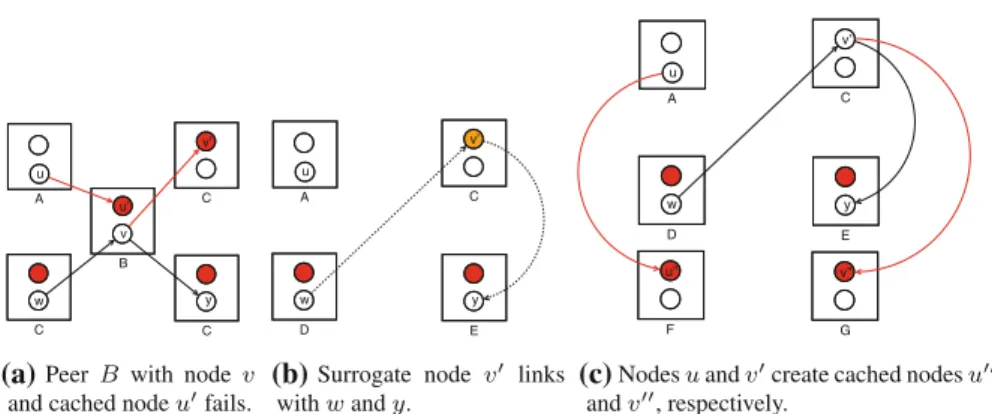
In Fig. 3, we visualize this mechanism with a typical example for reconstruct-ing lost overlay nodes and cached replicas due to a crashed peer. Figure3a depicts all cached replicas with red fill. Then, as illustrated in Fig. 3b, peer B fails, and as a result, overlay nodev and cached node u that replicates node u are lost. The dotted edges represent the procedure taking place for surrogate nodev to establish communication with the overlay nodes whose records finds in its routing table, and
A C B C C u v v’ w y u’ A C u v’ y w D E A C u v’ w y E D F G v’’ u’’ (a) (b) (c)
Fig. 3 Handling a typical peer failure example appropriately
consequently, become itself part of the overlay by replacing lost nodev. Figure3c depicts peers F and G and their newly created cached replicas u andv of over-lay nodes’ u andv respectively, that will also serve as surrogates in case of churn failure.
Furthermore, if the cached node that failed served more than one overlay nodes, then each of them will try to create a new cached node of itself. However, only the first one will succeed in doing so. The rest of the requests will be ignored essentially, without any problem or inconsistency as all replicas will try to cre-ate a cached replica into the same peer due to its light load, as we discussed in Sect.4.2.
5 Experimental evaluation
In order to assess our methods and evaluate their performance, we performed extensive experiments with workloads of varying dimensionality and skewness.
5.1 Setting
Our experimental evaluation consists of two major parts. In the first part, different allo-cations for rigorous balancing techniques are compared, whilst the latter part consists of dynamic simulations. We are especially interested in how our paradigm performs compared to other types of allocation. Therefore, we compare our methods with a greedy centralized allocation for each technique and as a means to investigate the potential of this approach. More specifically, as an optimality measure, we make use of a heuristic, greedy allocation based on global knowledge, according to which each time the heaviest ball is assigned to the globally lightest bin; whereas our methods rely exclusively on peer knowledge. Albeit on-line, the aforementioned allocation type is not realistic as each peer has only partial knowledge of the network, substantially small but functional.
In the latter part of this section we evaluate our dynamic protocol. More specifi-cally, we study the course of specific metrics over dynamic simulations in order to draw useful conclusions about effectiveness and performance. The virtual overlays used in our experiments consist of 10K nodes in all cases. We discern three main consecutive simulation stages:
– Growing stage, a new peer is added to the network in each cycle. We initialize a network of 1,250 peers and add one peer at each cycle, using a randomly selected bootstrap peer, until the network consists of 80K peers.
– Steady stage takes the same number of cycles, each introducing a peer join fol-lowed by a departure. We select arbitrarily where peers join, and departing peers, as well.
– Shrinking stage, a random peer at each cycle is removed until the network reaches its initial size.
In all experiments, we evaluate our balancing protocols in conjunction with the MIDAS-RDF framework [43,44] that serves as a distributed RDF repository, and the PGrid-Z [14] overlay, which incorporates a Z-curve into P-Grid to support multidi-mensional range search. We assume that all peers have identical network capabilities. We also assume that all requests, regardless how they are processed (whether are answered locally or simply forwarded), are modeled with the same service demand. These conventions were made in order to ensure that our experiments will not be affected by the distributions of those parameters. We also assume that the load on a virtual node is stable (or can otherwise predicted) over the timescale it takes for the load balancing algorithm to operate. Hence, the load of a peer can be calculated by summing the loads of the comprised nodes, and thus, a peer’s load is also stable. Concerning baselines, we place against our own scheme a competitor that leverages topology reor-ganization principles, for instance [20]. Recall that this family of protocols includes two main types of operations to mitigate load imbalances, namely neighbor adjust, to transfer data between adjacent nodes, and reorder, to hand over data to neighbor and split load of some other distant overloaded node. More importantly, this strategy does not require any additional redundancy.
5.2 Metrics
We evaluate our methods by various metrics, mostly to contention related. Latency is the maximum distance in terms of hops from the initial peer to any peer reached during search. Albeit, maximum process throughput,max, may be criticized as being too pessimistic, as it only depends on the single most loaded peer, it can be argued that just one overloaded peer will indeed cause trouble for the rest of the network in practice, as being a bottleneck will affect network delay and drop requests in a struggling effort to cope with overwhelming traffic. We are also interested in task-load fairness. Specifi-cally, we consider a peer’s task-load as the number of queries it receives, and thereby, must either forward or process locally. In particular, we use Jain’s fairness index [28] to measure task-skew, as it is applicable to any number of peers, it is independent of scale, and it is continuous in[0,1], where a totally fair system should have a fairness
of 1. This fairness index is expressed in the form, F I = (Ni=1xi)2/(n
N
i=1xi2),
where xistands for peer’s i load, with xi ≥0∀i .
Moreover, an important cost arises from redundancy and enhanced availability, which is imposed by all techniques with the exception of virtual nodes. We consider successful a method that is capable of exploiting available data-redundancy in order to enhance performance. Therefore, we measure redundancy from the most replicated node. In addition, the maximum number of comprised nodes in a single peer is also a important metric, as a peer that contains many nodes has to deal with high data load and maintenance cost. Last but not least, we also examine the communication cost in terms of exchanged data tuples, and withal, required bandwidth.
5.3 Data sets
For the purposes of this work, we make use of spatial data sets describing roads and rivers of Greece, taken from the R-tree portal [2], using a piecewise linear approxi-mation, and a data set containing the locations of towns and villages in Greece. The final data set consist of 100K tuples. Each query set consists of 10K range queries, as this type of search is considered important for applications and is also very resource consuming. In addition, we define three cluster-centers corresponding to the largest cities of Greece: Athens, Thessaloniki and Patras; and all clusters follow complex normal distributions. Skewed query sets consist of queries generated from a cluster chosen with probability proportional to the population of each town. The query con-struction process for all query sets is totally synthetic. We pick one point from the data set, we displace it by a random amount and we create a square query around this point until it evaluates to 50 tuples. Moreover, we created synthetic data sets of variable dimensionality to study the impact of dimensionality. Query sets consist of range queries and query centers are randomly chosen as query bounds are expanded over all dimensions starting from that point until query evaluates to 50 points.
Furthermore, we evaluate range queries with a real data set of approximately 11.2M triples. The DBLP data set [1] is available in XML format and contains a large num-ber of bibliographic descriptions on major computer science journals and proceedings, more than half a million articles and several thousand links to home pages of computer scientists. For our evaluation, we use an RDF converted data set from XML of the Proximity DBLP database. Specifically, the data in this data set were derived from a snapshot of the bibliography in 2006. In fact, only seven distinct predicates appear in the outlandish percentage of 72% of our triples. We evaluate MIDAS-RDF with the most frequent types of queries that are used by inference methods that implement the W3C RDFS entailment rules [3]. In particular, with rangeXZ we denote query sets consisted of queries with fixed predicate and varying subject and object. With rangeZ query sets of range queries with fixed subject and predicate and varying object. Unlike the previous data sets, RDF triple pattern queries, like the ones examined here, are non-selective queries. As a result, more peers are detained as part of the answer pro-cess, and the need for a rigorous and effective balancing scheme is even more crucial. These query sets consist of approximately 50K queries.
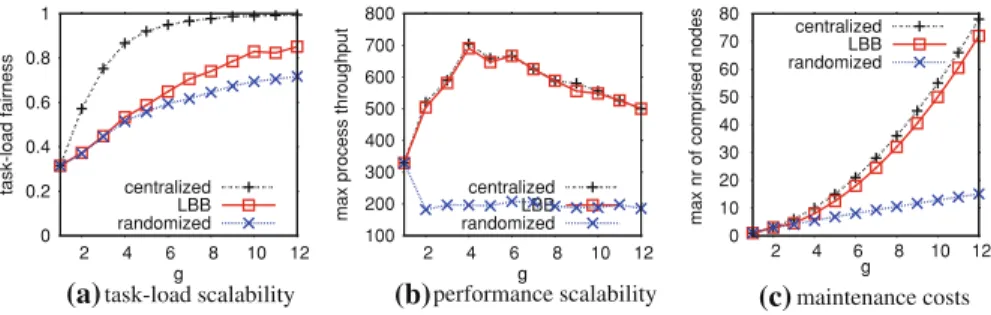
0 0.2 0.4 0.6 0.8 1 2 4 6 8 10 12 task-load fairness g centralized LBB randomized 100 200 300 400 500 600 700 800 2 4 6 8 10 12
max process throughput
g centralized LBB randomized 0 10 20 30 40 50 60 70 80 2 4 6 8 10 12
max nr of comprised nodes
g centralized
LBB randomized
(a) (b) (c)
Fig. 4 Virtual nodes schemes for spatial workloads and network size = 10K
5.4 Results
In this section, we study and evaluate our methods for various values of the system parameters, depending on the method studied on each occasion, and we draw useful conclusions from their behavior of the selected metrics. For the static part of our exper-iments, we examine the effect of the key parameter g which corresponds to either (i) the number of virtual overlay nodes to the overall peers for the virtual nodes scheme, or (ii) the number of peers to the number of the overlay nodes for the replication bal-ancing scheme, or (iii) the number of realities used. On the whole, there is a significant benefit from using our methods instead of using the straightforward naive approach, denoted as randomized. Figures4,5, and6illustrates the effectiveness of our methods compared to allocations based on global overlay knowledge (centralized), denoted as centralized, which perform only slightly better compared to our schemes that rely exclusively on peers’ partial knowledge about the overlay.
Regarding the virtual nodes technique, maximum process throughput shows a con-cave behavior in Fig.4b, as predicted in Sect.2.1. An explanation to this behavior can be found to the combination of two phenomena. For low g values, where fragmentation is insignificant, fairness beneficial effects are dominant, and thus,maxameliorates. However, it diminishes as routes become longer for even higher g values. Therefore, this method is unsuitable for very large networks, as performance would deteriorate instead of improve. Thus, given an overlay of specific size, there are certain values of
g that amelioratemax. In effect, this technique provides a network of size n with the throughput of an overlay of size m, a property that can be graphically interpreted as a transposition in themaxgraph, as messages are routed throughout the larger over-lay. In addition, congregating numerous nodes increases maintenance costs. We note that apart from keeping multiple routing tables, peers are burdened with maintenance tasks, such as detecting failures. Moreover, latency and precision are affected due to the method’s direct interaction with the overlay size. In particular, latency increases with
g as larger overlays result in longer message routes. On the other hand, skewness helps
precision because the query clusters were imported in dense areas of the key-space, and thus, when peers join the network by selecting a key with equal probability (data balanced), they tend to populate densely those areas as well. In practice, precision increases with g, as the overlay nodes become responsible for smaller areas, while our queries have fixed size, and thus, less irrelevant nodes become reached. In effect, this
0 0.2 0.4 0.6 0.8 1 2 4 6 8 10 12 task-load fairness g centralized LBB randomized 300 400 500 600 700 800 900 1000 1100 2 4 6 8 10 12
max process throughput
g centralized LBB randomized 50 100 150 200 250 300 350 2 4 6 8 10 12
max process throughput
g centralized
LBB randomized
(a) (b) (c)
Fig. 5 Redundant overlay schemes for spatial workloads and network size = 10K
0 0.2 0.4 0.6 0.8 1 2 4 6 8 10 12 task-load fairness g centralized LBB randomized 0 2000 4000 6000 8000 10000 12000 14000 16000 2 4 6 8 10 12
max process throughput
g centralized LBB randomized 0 5 10 15 20 25 30 35 40 45 2 4 6 8 10 12
max replication factor
g centralized
LBB randomized
(a) (b) (c)
Fig. 6 Replication schemes for spatial workloads and overlay size = 10K
method imparts the overlay with max process throughput, precision and latency from larger overlays with respect to g. Concerning the randomized assignment of nodes to peers, we adopt a naive straightforward strategy for each node to be assigned to any peer with equal probability. For the centralized allocation scheme, the heaviest node is assigned greedily to the globally lightest peer at the time. Clearly, as Fig.4b depicts, our approach outperforms randomized assignments as it provides 3.5 times bettermax. More importantly, centralized allocations are less that 5 % more efficient than our scheme for all configurations and g values.
In Fig.5b, our parallel universes technique outperforms the multiple realities tech-nique in terms of maximum process throughput as it grows with the number of realities
g, while multiple realities max process throughput deteriorates in Fig.5c. Moreover, we compared our paradigm with different allocation methods. Regarding the straight-forward randomized allocation, we assume for each reality that nodes are assigned to peers arbitrarily. For the centralized allocation we consider again a method that is run for each reality requiring global knowledge. More specifically, we assign a heaviest node to the lightest peer with respect to a peer’s summing load in all realities preceding the one being examined. In addition, task-load fairness index ameliorates (Fig.5a) regardless dimensionality or skewness.
For replication, the greater the redundancy, the less traffic bottlenecks intake. Thereby, imbalances are blunted as overloaded peers are alleviated. Naturally, max-imum redundancy increases linearly with g until fairness is achieved, and withal, it reaches an upper bound beyond which there is no further benefit. In addition, the invariant latency can be explained as routing takes place along the overlay and not
0 1000 2000 3000 4000 5000 6000 0 50K 100K 150K 200K
max process throughput
cycles realities=3 realities=2 realities=1 reorganize 0 20 40 60 80 100 120 0 50K 100K 150K 200K
max process throughput
cycles realities=3 realities=2 realities=1 reorganize 0 10 20 30 40 50 60 70 80 0 50K 100K 150K 200K
max process throughput
cycles realities=3 realities=2 realities=1 reorganize 0 500 1000 1500 2000 0 50K 100K 150K 200K
max process throughput
cycles dims=2 dims=4 dims=8
(a) (b) (c) (d)
Fig. 7 Maximum process throughput for various workloads
0.75 0.8 0.85 0.9 0.95 1 0 50K 100K 150K 200K task-load fairness cycles realities=3 realities=2 realities=1 reorganize 0.75 0.8 0.85 0.9 0.95 1 0 50K 100K 150K 200K task-load fairness cycles realities=3 realities=2 realities=1 reorganize 0.7 0.75 0.8 0.85 0.9 0.95 1 0 50K 100K 150K 200K task-load fairness cycles realities=3 realities=2 realities=1 reorganize 0.7 0.75 0.8 0.85 0.9 0.95 1 0 50K 100K 150K 200K task-load fairness cycles dims=8 dims=4 dims=2 (a) (b) (c) (d)
Fig. 8 Task-load fairness for various workloads
0 10 20 30 40 50 60 70 0 50K 100K 150K 200K
max comprised nodes
cycles realities=3 realities=2 realities=1 0 10 20 30 40 50 60 70 80 0 50K 100K 150K 200K
max comprised nodes
cycles realities=3 realities=2 realities=1 50 100 150 200 250 300 0 50K 100K 150K 200K
max comprised nodes
cycles realities=3 realities=2 realities=1 0 5 10 15 20 25 0 50K 100K 150K 200K
max comprised nodes
cycles dims=8 dims=4 dims=2
(a) (b) (c) (d)
Fig. 9 Maximum comprised nodes in a single peer for various workloads
the actual network. Concerning competitor schemes, for the straightforward random-ized allocation, each host replicates a randomly selected node with equal probability. The centralized allocation is an algorithm that requires global knowledge about all nodes and their loads, and each time it replicates the heaviest node to an available host. Figure6b shows that there are immense benefits of using our method instead of the corresponding randomized allocation. It also reveals that this is the most effective technique in terms of max process throughput, as it selectively replicates only hot-spots. More notably, we repeated our experiments for different overlay and network sizes to receive very similar results.
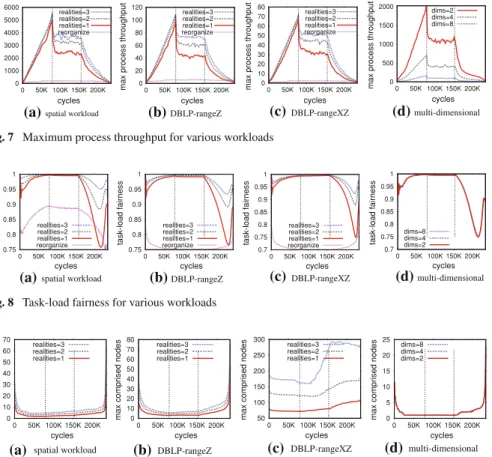
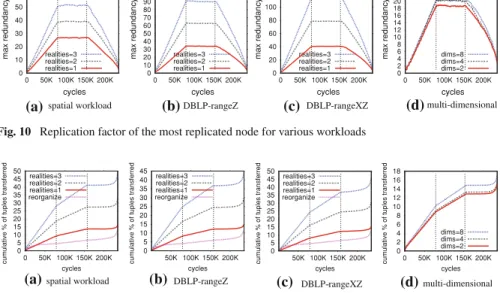
For the rest of this section, we focus on the results from our dynamic simulations where the network is subjected to extreme changes regarding its size for all phases (Figs.7,8,9,10,11). We note that latency depends on the fixed size of the virtual network topology, regardless the number of actual hosts that have joined the network. Specifically, for both the distributed indexing schemes that we evaluate here, namely PGrid-Z and MIDAS-RDF, it is logarithmic with respect to the overlay size. In Fig.7, maximum process throughput shows for all configurations an abrupt slope at the end of the growing phase.