Katariina Raij
LEARNING BY DEVELOPING
LAUREA PUBLICATIONSA
•58
ISSN 1458-7211 ISBN 951-799-110-XThis article examines the various stages of the Learning by Developing process adopted by Laurea University of Applied Sciences. The article is based on ongoing research.
The Learning by Developing model is based on a development project that is genuinely rooted in the world of work, which aims to produce new practices and demands collaboration between lecturers, students and experts from the world of work in order to progress.
At a university of applied sciences, it is essential that the creation of new knowledge and understanding also become explicit as skills in doing. The institution aims to develop the kinds of competence that transcend the traditional dichotomy between the vocational and the scientifi c. Graduates possess competence in professional doing and scientifi c knowing, where the scientifi c describes, explains and justifi es the professional and allows for the generation of new expertise. Thus, universities of applied sciences can be seen as higher education institutions that produce added value.
Author of this article Katariina Raij, PhD (Educ.), is Director of Well Life Center, Laurea University of Applied Sciences.
Laurea Publications
A•58
Learning by Developing
Copyright © author
and Laurea University of Applied Sciences ISSN 1458-7211
Edita Prima Oy, Helsinki 2007 ISBN 951-799-111-8
Content
FOREWORD 5 ORIGIN OF THE LEARNING BY DEVELOPING CONCEPT 7 PRAXIS-BASED LEARNING 10 LEARNING BY DEVELOPING RESEARCH PHASES 16 STAGES OF LEARNING BY DEVELOPING 20 REASONING 25 REFERENCES 28
Foreword
This article examines the various stages of the Learning by Developing process adopted by Laurea University of Applied Sciences. The article is based on ongoing research.
Learning by Developing bears clear resemblances to conceptions of learning based on pragmatic theories of knowledge but it also seems to have its own special characteristics.
The Learning by Developing action model is based on a development project that is genuinely rooted in the world of work, which aims to produce new practices and competences and demands collaboration between lecturers, students and experts from the world of work in order to progress. At a university of applied sciences, it is essential that the creation of new knowledge and understanding also become explicit as skills in doing. The professionally oriented university of applied sciences aims to develop the kinds of competence that transcend the traditional dichotomy between the vocational and the scientific. Graduates possess competence in professional doing and scientific knowing, where the scientific describes, explains and justifies the professional and allows for the generation of new expertise. Being based on an authentic development project, Learning by developing as an action model, also outlines the nature of research at a university of applied sciences. Thus, universities of applied sciences can be seen as higher education institutions that produce added value
Espoo 2006
Katariina Raij
Director of Well Life Center
Origin of the Learning by Developing concept
An analysis of the tasks defined in the Polytechnics Act (351/2003) reveals a challenge for developing a learning process suited to the context of a university of applied sciences. The tasks described in the law include: higher education that responds to the world of work and its development needs, and is based on research and artistic principles; applied research and development work that fos-ters regional development and takes into account the industrial structure of the area; and support for individual professional growth. According to these tasks, universities of applied sciences are closely linked to the world of work and there-fore rooted in praxis. Scientific demands are related to instruction as well as to research that develops the world of work and supports regional development. Demands for professionalism are evident in the idea of professional expertise based on the world of work and its development needs, and in the requirement for individual professional growth.
The concept of professionalism can be seen in the light of knowledge classifica-tions related to the ancient craftsmanship tradiclassifica-tions described by Aristotle and Plato (cf. e.g. Hintikka 1969, pp. 24–25;1974, p. 47). ‘Maker’s knowledge’ is knowledge about how to do things, which is transmitted through modelling and often through collaboration. ‘User’s knowledge’ is knowledge of how and for what purpose a product is used. ‘Creator’s knowledge’ is the creative and inno-vative knowledge of a developer. Even at the time, the last two kinds of know-ledge were considered to be more valuable, due to their creative elements. The scientific tradition looks at the significance of research-based information – ‘true beliefs’ – in relation to various ontological, epistemological and methodo-logical solutions. The nature of reality, assumptions and the purpose of use of the information produced place each study in a specific context. At universities of applied sciences, research focuses on developing workplace competence and the geographical region, within the context of professionalism. From this point of view, the nature of research-based knowledge is pragmatic. As a well-known pragmatist, Dewey (e.g. 1915, p. 80) emphasises the close links between school and life in his conclusions. According to him, school is part of life, not for life, and learning takes place most favourably through models and applications that have genuine foundations in life (‘learning by doing’). Dewey’s central concepts of ex-perience, value, action and knowledge (e.g. 1934, pp. 34–59; 1963) can also be found in the context of a university of applied sciences (cf. Raij 2003, pp. 50– 51).
A university of applied sciences can be seen as being part of a surrounding re-gion and the world of work – rather than existing for it. The scientific demands placed on it as a higher education institution implies the need for evidence-based data, applied studies and research-evidence-based development of the world of work, leading to the generation of new expertise. From this perspective, the use of pragmatic knowledge theory in research and development at a university of applied sciences means that R&D work involves the knowledge in practice, of practice and for practice as describing, explaining and new knowledge building forms of knowledge.
When it transcends the dichotomy between the scientific and the vocational, a university of applied sciences produces competence that involves makers, user’s and creator’s knowledge as well as descriptive, explanatory and creative research-based knowledge. This is consistent with my earlier research conclu-sions regarding competence. Professional competence is founded on research-based knowledge, understanding the professional context, skills in doing and the ability to manage various workplace situations, all integrated into one entity. This entity is constructed out of the orientations of the professionals, the customers (= user), the work processes and the researchers. Expertise is formed out of the in-tegration of knowledge, understanding and skills in doing, such that solutions can be found independently to various situations in the workplace (cf. Raij 2000, pp. 100–117; 2003, pp. 48–52). This bears some parallels to Bereiter and Scar-damalia’s (1993) flexible knowledge and Hatano and Inagaki’s (1992, pp. 115– 133) adaptive expertise, although the ability to manage situations also includes an element of skills in doing. A university of applied sciences aims to produce experts who can develop their own work as members of a work community by finding new solutions; and who can apply and make use of research data in or-der to describe and explain workplace competence and generate new expertise. This identifies the concepts of ‘development’ and ‘developer of one’s own work’ as some of the challenges set for graduates.
Growth towards learning by developing is a process consisting of three recog-nisable phases at Laurea. The integration of the University of Applied Sciences’ Three Tasks implies the need to reconcile research and development, regional development and pedagogy. Laurea set out to respond to this challenge, first from the lecturers’ perspective, by seeking an answer in pure pedagogy to how instruction could be developed in order to integrate the three tasks. Integration was seen as essential in order for the entire teaching staff to be able to partici-pate in research and development as well as regional development. The first phase could be described as the project-based instruction phase.
Project-based instruction is centred on a development project derived from working life. The development project is turned into a learning environment for knowledge, skills, values and experiences. Instruction is linked to partnerships with employ-ers, and lecturers are seen as pedagogues, regional developers and research-ers. The development project brings lecturers, students and professionals to-gether into collaboration, and students are seen as partners who acquire and improve their competence tools. The framework of action research in profes-sional higher education context begins to find its form (cf. Raij 2003).
In the second phase, the importance of the research and development task is emphasised, opening a new perspective for project-based instruction.
Progres-sive inquiry learning as described by Hakkarainen, Lonka and Lipponen
(2004), is applied in developmental projects. The applying research is seen to be linked to a university of applied sciences. The elements of progressive inquiry learning are introduced into the development project (cf. Application for Centre of Excellence in Education, 2005; Fränti & Pirinen 2005), supporting the stu-dent’s growth into an investigative developer and challenging Laurea to build new kinds of learning environments. The second phase is successful, resulting in Laurea being appointed a centre of excellence in education for 2005 – 2006. The third phase consists of using Laurea’s own research to identify the stages of
Learning by Developing as a learning and development project process. The
research focuses on working life development projects which are seen as learn-ing environments. The aim is to identify and develop the processes related to the progress of learning and projects, with the help of elements arising from the con-text of the University of Applied Sciences. The University of Applied Sciences is seen to fulfil a significant social role and the added value it generates becomes realised when the institution can attain a position as an investigative and influ-encing developer in its own region. On the third phase also the interest to iden-tify and describe the role of professional research increases. The successful pro-ject processes imply researchers to be active participants and innovators and the interest of knowledge is found to be new creating by nature.
Praxis-based learning
To create a background for learning by developing, it is worth looking briefly at the development of learning theories and descriptions that are in line with the pragmatic research model, in which learning proceeds as a progressive cycle. Dewey’s visions regarding schools and learning (e.g. 1915; 1963), based on the pragmatic theory of knowledge, can also be found within the context of the uni-versity of applied sciences’ tasks. It is assumed that the sources of theory lie in the practical world. The idea of the close links between school and life means that learning has to be connected to real-life situations (= learning by doing). Dewey’s conception of learning (e.g. 1915, p. 80; 1934, pp. 35-59; 1963, ch. 2– 3) emphasises the significance of human social relations, experience and inter-action. Learning consists of restructuring and building experiences, handling new situations and acting in a purposeful way. Experience is aesthetic, emo-tional and transferable. It contains skill and understanding. An educaemo-tional ex-perience expands our ability to exex-perience things, our analytical skills and our values. The effect of experience transfer takes place as the integration of action, cognition and values. Instruction focuses on creating a new vision. The founda-tions for Dewey’s reflective learning lie in using experimentation to solve prob-lems encountered in established procedures. As concrete doing is obstructed, a thought process initiates, leading to the identification of a problem. Examining and analysing the situation involves recognising social and material conditions, as well as the tools and resources that can lead to the supposed solution to the problem. A working hypothesis is formulated and its tenability is tested through deduction. Deduction is characterised by thought experiments, which lead to ad-justments of the working hypothesis. Thus adjusted, the hypothesis is tested in practice by affecting the environment. The validity of the hypothesis can be proven through material and functional testing. Optimally, this leads to the prob-lem being solved and to the creation of intellectual meanings that can be made use of in new problem-solving situations.
Experiential learning, based on humanistic psychology, emphasises the signifi-cance of direct experience and reflection. The model developed by Kolb (1984) is probably the most widely known. Kolb’s cycle is based on direct and concrete experiences, observations and reflection on these. The process evolves to build-ing a theory-in-use and testbuild-ing its implementation in a new situation. Learnbuild-ing is seen as a four-cycle sequence. According to Miettinen (1998, 54 – 72) the con-cepts of experience and reflection in Kolb’s model, however, differ from Dewey’s concepts in reflective learning just as the stages of the learning processes. It
does not involve building hypotheses from concepts on base for observation but rather involves unprejudiced commitment to new experiences and the ability to derive new concepts from them. The learning process as described by Kolb is individual. Knowledge management within an organisation through sharing and reflection is related to community learning (cf. Nonaka and Takeuchi (1995). This model emphasises sharing knowledge, communal reflection and the or-ganisation of conceptual knowledge. Sharing also transmits tacit knowledge through the progress of community learning.
Problem-based learning, founded on cognitive psychology, has its starting points either in working life events (e.g. Schmidt 1983, pp. 11–16), or in events which are possible in real life and whose solutions are not an end in themselves (e.g. Norman & Schmidt 1992, pp. 557–565). The process for finding the solution produces the desired competence for students. By examining problems, the stu-dents also obtain theoretical knowledge. According to Cowdroy (!994) problem-based learning responds to the demands for competence of today’s knowledge society, which imply the need for data processing, communication, interaction and problem-solving skills. The stages of problem-based learning identified by Schmidt (1983, pp. 11–16) are applied, for instance, at the Faculty of Medicine of the University of Helsinki (cf. Hakkarainen, Lonka & Lipponen 2004). Problem-based learning starts from a case, presented by the lecturer, which students cannot solve directly based on their existing knowledge. At the first stage, they identify and define the concepts related to the case. Then they define the prob-lem and brainstorm questions requiring investigation. The students then build a theory-in-use on the basis of their existing knowledge and set their own learning objectives. These objectives serve to direct independent study in order to deepen competence. Students strive to find a structured and well-founded solu-tion that either explains the problem or describes the phenomenon on the basis of what they have learnt. Their learning process is evaluated in relation to the objectives set initially.
According to the learning by expanding model, based on Engeström’s activity theory (e.g. 1987; 2001, pp. 129–152), learning springs from a cultural and his-torical viewpoint according to which intelligent action consists of activity systems constructed out of social practices. The activity system refers to historically ad-vanced institutions such as school or science. It is essential that operations are object-oriented and that actions are transmitted through the use of culturally and historically advanced intellectual action. Any dysfunctions, problems and con-flicts arising in social customs reflect concon-flicts between different activity systems. The learning by expanding model explains change processes in communal
ac-tivity and, particularly, the kind of learning that generates new practices. On the other hand, the transfer between individuals of culture-based information can also be seen as individual learning. The starting point lies in questioning and analysing existing practices. This allows us to identify problems and find new models for solving them. The found models are evaluated, tested and developed further in practice. The aim is to develop operations and transfer the new ways of working to new situations and activity systems.
According to my earlier findings (Raij 2000, pp. 83–126; 2003, pp. 42–57), learn-ing within the context of a university of applied sciences progresses through a bi-lateral relationship with different types of knowledge. Research-based know-ledge, knowledge embedded in skills and abilities, ethical knowledge and experi-ential knowledge are integrated in the individual’s and the community’s learning process through sharing and collaborative action. To a certain extent, the ledge embedded in skills and abilities, ethical knowledge and experiential know-ledge contain the maker’s, user’s and creator’s knowknow-ledge of the vocational tradi-tion, but as an integrated whole they go beyond these. Research-based and ethical knowledge, when founded on values agreed by the whole community, help to justify choices and provide explanations and openings for innovations. The orientations of the professionals, operating processes, clients and re-searchers, identified as competence orientations, create the perspectives from which the workplace competence at hand should be evaluated and analysed. The identified components of expertise are research based knowing, under-standing of the workplace context, skills in doing and the ability to manage situa-tions encountered in the workplace.
Collecting knowledge and dealing with it lead to knowing. Understanding is pro-moted by reflecting on and sharing experiences and interpreting various kinds of messages. The ability to do grows through participation in different activities, ob-servation, rationalising and independent activities. The ability to manage situa-tions grows from problem-solving skills, self-management and an investigative approach.
Hakkarainen, Lonka and Lipponen (1999; 2004) have developed a theory of progressive inquiry learning, starting from problem-based learning and combin-ing Bereiter and Scardamalia’s (e.g. 1993; 2002a) views of the differences be-tween individual learning and communal knowledge-building with Engeström’s (e.g. 1987) views on learning by expanding. Engeström’s views emphasise the importance of transferring culture-based knowledge and of the kind of learning that generates new practices for the community. In developing new ways of thinking about the relationships between the mind and knowledge-building,
Bereiter (e.g. 2002a) distinguishes, on the one hand, learning as a process that changes the individual’s internal knowledge structures; and, on the other hand, knowledge-building as a process that deepens the community’s competence and generates new ideas and thoughts. The idea of knowledge-building is in-cluded for instance in the concepts of the information society, the learning or-ganisation and information management. According to a comparison carried out by Hakkarainen et al. (2004), Bereiter’s model concerns knowledge-building that takes place by solving knowledge problems through consciously working to cre-ate new knowledge objects. Engeström’s model is characterised by itemising and overcoming the conflicts between activity systems as part of a new creative learning process.
The starting point for a model built out of progressive inquiry learning processes is creating a contextand anchoring instructionto previous experiences and con-cepts. The chosen topic must be sufficiently complex and multidimensional. Problem-setting is used to direct the generation of new knowledge. This involves not only processing information but also carrying out various experiments and testing ideas. Generating knowledge and explanations means creating the stu-dents’ working theorieson the studied phenomena, in the form of assumptions, hypotheses, explanations, interpretations or models. Constructive critical evalua-tion focuses on the progress and objectives of the research process and on de-veloping the working theories. It leads to acquiring deeper knowledgeand speci-fying the problems. The aim of the learning project is to acquire and generate new knowledge, leading to new understanding and deeper knowledge. Self-managed research work includes gradually increasing the complexity of working theories, finding new explanation models and concepts, and acquiring new knowledge from written sources or by conducting experiments and studies. The idea of sharing expertise in inquiry learning involves the assumption that the de-velopment of knowledge is a shared responsibility of the whole learning commu-nity. As the authors conclude, all parts of the process can be shared among the members of the learning community. Progressive inquiry learning (Hakkarainen et al. 2004) strives to build a bridge between individual learning and communal knowledge-building through an interactive process. The authors note that the ob-ject of learning can be, for example, understanding and explaining a scientific phenomenon or designing and creating a concrete product. However, progres-sive inquiry learning tends to focus on solving conceptual or information prob-lems related to knowledge and understanding, while practical experiences take a conceptualising role when they are tested in practice in order to create ‘concep-tual artifacts’ (cf. Bereiter).
Of the theories described above, all except Kolb’s immediate experience are problem-based. In Dewey’s reflective learning (e.g. 1899, pp. 39–40), the start-ing point is a concrete problem found in an established procedure or a material obstruction to doing something. The conflicts in activity systems described by Engeström are similar to this, but his model progresses towards reforming work procedures in a more target-oriented way. Bereiter’s model (2002a) solves knowledge problems, whereas the condition chosen for inquiry learning as de-scribed by Hakkarainen et al. (2004) is the complexity and multidimensionality of the chosen topic.
Dewey’s model is more appropriate to the elementary school system and its ob-jective is the individual’s learning within the school/home continuum. The pre-mise of Kolb’s four-cycle model lies in an experience. It does not, however, explain how observation is possible and from where generalization and abstraction of concepts arise. According to Miettinen (1998, pp. 54–72), the starting point for acquiring experiential data related to investigative learning is always a hypothe-sis, and observation is not possible without a concept and hypotheses built on it. In Kolb’s model the aim is the individual’s experience-based learning, but it does not explain how observation is possible and where the abstraction and generali-sation of concepts arise.
Engeström focuses on community learning whose aim is a reform of activity sys-tems. Engeström’s model only refers to individual learning in the context of cul-ture-based knowledge being transferred and conveyed. Bereiter and Scar-damalia (1993; 2002a) offer a new perspective to learning in that they distin-guish the processes that modify an individual’s knowledge structures from knowledge-building processes that deepen a community’s competence. Hak-karainen et al. have expanded the concept of progressive inquiry learning by ad-vancing from problem-based learning and striving to combine individual learning and communal knowledge-building. Progressive inquiry learning explains the multidimensional and multilevel problem-solving process by stressing know-ledge- and understanding-based solutions to conceptual information-related problems. The types of knowledge identified in my earlier study (Raij 2000, pp. 39–42; 2003, pp. 43–47) – research-based knowledge, knowledge embedded in skills and abilities, value knowledge and experiential knowledge – are closely re-lated to Dewey’s concepts (knowledge, action, value, experience), when placed in the context of a university of applied sciences. The components of profes-sional competence emphasise the presence not only of knowledge-based and conscious competence, but also the ability to handle concrete tasks and objects. The combination of these elements facilitates the discovery of new solutions in
various workplace situations. This is also linked to solving information-related problems and problems caused by conflicts in activity systems.
Learning by Developing research phases
The next section describes the progress of research that takes place in the con-text of a university of applied sciences. The objective of the study is to examine how learning, the generation of new knowledge and, consequently, the deve-lopment of the world of work progress when the starting point lies in a develop-ment project for the world of work. The progress is inductive; the stages of the processes at hand are classified with the help of elements found in the research materials, after which the classification is compared to existing theories.
The research material for identifying the stages of learning by developing was gathered in 2004 and 2005 through interviews with Laurea lecturers (N=6). The subjects all had experience of development projects, two of them in the field of business, two in service management and two in welfare. Materials were also gathered through participatory observation methods, by attending seminars (N=2) examining the progress of development projects. The participants (N=25) were attending a PD course on innovative teaching. Further materials came from the evaluations of two development projects, which involved lecturers (N=4), students (N=8) and expert professionals from the world of work (N=6). In the in-terviews, lecturers were asked to describe their conceptions regarding the pro-gress of development projects through collaboration between lecturers, students and professionals. A conception is defined here as an experience with a given meaning. The research method was phenomenographic, which means that the conceptions held by participants in the development projects were mapped. Phenomenography is not interested in the essence of a phenomenon, but in the conceptions that people hold of it. It was originally developed for studies on learning and it emphasises the learner’s experience, understanding, conceptu-alisation and analysis of learning assignments in a specific context. The per-spectives of ‘what’ and ’how’, used in relation to a specific cultural context, ex-plain the construction of different conceptions. What we see depends on how we look at it (e.g. Marton & Säljö 1976, 4–11; 1984, 35–56; Marton 1995, 166–180; Uljens 1989; 1993, 134 – 146.
In terms of philosophy of science, phenomenography assumes that reality exists independently of human consciousness (cf. realism), but that the significance and purpose of reality only exist as perceived by people (cf. constructivism) (Ul-jens 1993, 134–146). This reflects the conclusion drawn by Heikkinen, Huttunen, Niglas and Tynjälä (2005, 340–343) regarding the fact that ontological realism and epistemological constructivism need not be exclusive of each other. Cri-tiques of phenomenography (e.g. Säljö 1994, 71–80) regarding the
trustworthi-ness of human conceptions related to unknown things and the purely linguistic classification of words have been avoided by selecting people with relevant ex-perience for the interviews and observations. The presence of the researcher in these situations was natural. The gathering of conceptions was considered to be important, because the conceptions direct human actions to a large extent. An-other influential factor was my prior experience of the opportunities for using the materials produced by the method (cf. Raij 2000).
In the interviews, lecturers were asked to describe the progress of development projects carried out in collaboration between lecturers, students and profession-als. The starting point was the ideation of a research and development project and its sources of information; after this the discussion progressed through the stages of the project as it was described by each interviewee. The experience and information gained through the process by those participating in the re-search was made use of by systematically collecting information on conceptions that have changed through observations made. The interviews also took into ac-count the lecturers’ ideas regarding best practices, i.e. how they would change or modify the next research and development project they participate in. The in-terviews were 1.5–2 hours long.
The lecturers (N=25) participating in seminars for the PD course on innovative pedagogy described the processes related to the progress of their own deve-lopment projects, as well as their own learning processes. These descriptions were turned into observations whose reliability was checked by the researcher asking questions and making summaries. The descriptions helped to strengthen the identified stages of learning by developing. Finally, participation in two de-velopment projects involving lecturers (N=4), students (N=8) and professionals (N=6) facilitated further systematic gathering of information. Again, reliability was checked by the researcher asking questions and making summaries.
The analysis of the research material followed a phenomenographic classifica-tion, which allowed the stages of learning by developing to be discerned from the different conceptions and their relationships. The classification was created by the researcher out of the building blocks formed by the research subjects’ conceptions. The material was processed inductively, according to the phe-nomenographic method, rather than being directed by previous research (cf. Marton 1988; Uljens 1988). The stages identified were then tested and evalu-ated by four lecturers with experience of development projects, as well as two external experts. Certain modifications were made as a result. Finally, the stages were tested as part of Laurea’s PD course in innovative pedagogy, and
they have been successfully applied when creating the learning by developing model.
Picture 2: Developers and researchers.
When classifying the stages of learning by developing, the participants’ concep-tions regarding completed and ongoing development projects were taken into account, in addition to their experience-based opinions regarding what develop-ment projects require and how the process could be improved. The stages of development projects could be identified from these conceptions and described as mutually supportive dialogues. The stages described form a progressive cycle in which the stages alternate but progress towards their objective as a process that produces learning and pushes the development project forward. Before their final presentation, the results were compared to the components of learning and the methods leading to them (cf. Raij 2003, pp. 83–126). The described stages formed a testing platform for development projects included in the PD course.
The final reliability of the stages was confirmed through this process. The learn-ing process and the development project process are also interlinked so that the learning environment built around the development project facilitates the individ-ual’s learning, community learning and the creation of new knowledge. It in-volves the describing knowledge in practice, explaining knowledge of practice and creative knowledge for practice.
Stages of Learning by Developing
The following section presents the stages of learning by developing according to the classification made from the research material. It includes adjustments pro-posed by external experts (N=2). The starting point lies in recognising the
phenomenon behind the development project – i.e. the whole of which the
pro-ject forms part. The development propro-ject focuses on developing the world of work. According to the respondents, the basis may be in a conflict-related prob-lem or in the desire to reform and find innovations; the latter basis arose in de-scriptions of how things could be. The aim may be 1) creating, refining and com-mercialising a new product; 2) developing and renewing operating processes; 3) developing new operating models; or 4) developing a new working culture. Development projects rooted in the world of work involve lecturers, students and experts from the sector. The development project can be seen as the learning environment which implies that the necessary tools for the project to progress must be made available. From these conceptions the concept of workshop as a part of a learning environment has been identified. The roles of the lecturer are recognised as those of the researcher, the developer who pushes the project forward and the facilitator in the use of tools. Students are seen as developers who participate in the progress of the development project while acquiring new tools and also developing their own competence. The professionals can be seen as either participating developers or, when conceptions change, as researchers. Together, they are all responsible for the development project and the related research.
The first tools are linked to collecting knowledge. Collaboration between the lec-turers, students and professionals begins as the knowledge is processed and
awarded significance in relation to the development project and to earlier
ex-periences. The development project is delimited and defined, and the as-sumed processes that are to take place within it are described. The process descriptions allow students to build personal study plans by looking at what they have learnt previously and identifying the competence targets that they must meet in the development project in order to work as partners in it, as well as the competence outcomes that they want to achieve through the project. In the context of the university of applied sciences, competence targets are related to individuals’ and the community’s knowledge, understanding, skills in doing and the ability to handle situations that come up, which requires problem-solving skills, self-management and an investigative approach (Raij 2000, 83–126; 2003, 43–52). The learners acquire new tools in workshops belonging to the
learning environment, where some of the lecturers act as facilitators. The work-shops are important in terms of the transfer and dispersion of culture-based knowledge. The tools are either concepts (cf. Dewey 1938) that facilitate know-ledge processing, knowknow-ledge-building and the observation needed for profes-sional competence; or abilities related to carrying out workplace tasks, which fa-cilitate concrete action.
Participation is increasingly possible as new tools are acquired. Learning by
developing relates to actions carried out together. By doing together problem based skills are developed and new knowledge is created. The development project process contains continuous evaluations of one’s own learning, of
what has been learnt together, of the progress and effectiveness of the
project and of the generation of new knowledge. This is done by sharing
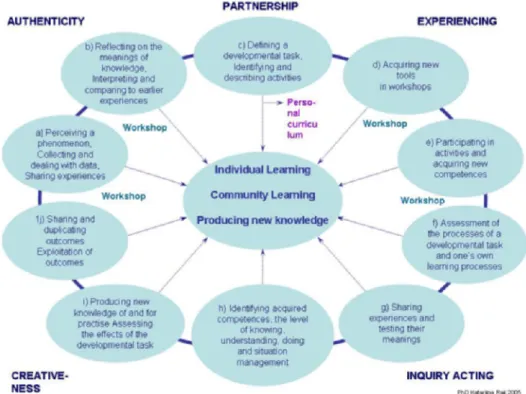
ex-periences and testing their significance. The acquired competence is identified as knowledge-related, skill-related, value-related or experiential (cf. Raij 2003, 43–47). The aim of each development project is to achieve change. The deve-lopment project ends as results are shared in the form of research reports and, depending on the nature of the partnership with the world of work, possibly also through their commercialisation; but the learning process continues, offering a new competence base for the learners to participate as individuals or communi-ties in new development projects (Figure1)
Figure 1: Stages of Learning by Developing
The stages of learning by developing are based on authenticity, partnership, ex-periencing, creativity and an investigative approach. The descriptions provided by participants also facilitated the identification of the elements on which devel-opment projects are based as a project process and a learning process.
Au-thenticity is realised in that the learning process is based on a genuine
devel-opment project carried out for the world of work, which corresponds to the areas in which the students wish to become experts. According to respondents, the idea for the project can come from an employer, a lecturer or a student, or it can be created together. It can be based on an existing problem or it can aim to re-form practices and find innovations.
Partnership and the process of building it were seen as challenging and
signific-ant by all respondents. It refers to collaboration, competence-sharing and learn-ing together. It also means sharlearn-ing and agreelearn-ing on different roles. The roles identified are that of the researcher, the developer and the facilitator in the use of tools. Students are seen as partners and developers who also are responsible
for their own learning. According to the changing conceptions of respondents the role of working life partners changes from the resource of an idea for a devel-opment project to a participative developer and a researcher. Another major as-pect of partnership was causing participants to commit to and assume responsi-bility for the development project in a written project agreement. This was em-phasised in conceptions that had changed through experience. Recognising a shared value base is also important when building partnerships.
Experiencing emphasises the active and responsible role that each participant
must assume for his or her own learning, as well as participation in shared activ-ities and learning. Experiences are gathered and shared. They arise as the pro-cess progresses and solutions are found. Shared reflection on experiences and a search for significance promote understanding of the knowledge included in workplace competence and the recognition of new knowledge. The importance of experiencing arises particularly in relation to evaluation and knowledge-building.
The investigative approach refers to a research-based and critical way of
working, the application of research-based information and scientific studies. The investigative approach is closely tied to the development project. The learn-ing of the individual and the community is proven through investigation, as are the effectiveness and results of the development project. The significance of in-vestigation in the role and responsibility of the researcher arose particularly in situations where participants were describing their conceptions on what the process should ideally be like and how responsibilities should be shared. The in-vestigative approach is linked to the research and development task of the uni-versity of applied sciences.
Creativity is seen as a resource for the development project. The motivation for
the project is a collectively observed need for change; there is a desire for some-thing new, but no certain knowledge of where it will lead. The development pro-ject allows for the use of creativity, as everyone is on a journey somewhere. One of the destinations is creativity. This reflects the significance of the ‘what’ and ‘how’ perspectives of the phenomenographic method as explanations of con-cepts. What we see depends on how we look at it (cf. Uljens 1988).
Toward an innovative, developing pedagogue
When studying the conceptions of respondents in relation to the role of a lecturer four orientations could be identified. The concept of an orientation, in this con-text, is defined as a way of perceiving a phenomenon in a special way from a
re-projects from the point of view of study units, some from the students’ learning, some from the lecturer’s job and some from the progress of the development project. Those who see it from the perspective of study units consider how the development project will fit the study units they are responsible for. Those who see it from the perspective of the students classify and make criteria for suitable students to participate in the development project. Those whose perspective is that of the lecturer’s job consider whether they have sufficient resources for par-ticipating in the project. Those whose orientation is the development project itself participate in order to find new solutions and methods, as well as new opportun-ities for the student. This last kind of participant has the most creativity, and this is what most respondents want to aim for once certain obstacles have been re-moved. The experiential nature of projects creates new knowledge and in-creases its participants’ self-confidence as they meet new challenges. Creativity is channelled towards renewal and reform, which is realised in new products, operating models or working cultures. The orientations described above have similarities with my earlier research findings (cf. Raij 2000) where students four different orientations were identified as actor’s, processes’, client’s and investig-ator’s orientations.
Reasoning
The stages of learning by developing have been described according to the con-ceptions of participants in this study. The development project derived from working life forms a learning environment. The stages of learning by developing include the concept of experiential learning in the individual’s learning process – similar to Dewey’s idea of reflective experience – in which competence capital is acquired through the participants’ experiences. The transfer of culture-based knowledge between individuals and the processes related to individual know-ledge-building are facilitated by processing knowledge related to the develop-ment project and its processes, providing it with meanings, reflecting on and finding significance in experiences, and identifying new explanations. Commun-ity learning takes place through sharing, reflection and the building of new con-ceptual knowledge.
The starting point for learning by developing is praxis-based, as it is related to a genuine development project for an employer. Its aims are to create new pro-ducts, operating models and working cultures. In its target-orientedness and its aim to reform the workplace, it is parallel to the idea of learning by expanding, based on Engeström’s activity theory. The objectives of a development project are change, the development of new tools and the reorganisation of social prac-tices and constructs in completely new ways (cf. Engeström 2001, pp. 129–152). The transfer and dispersion of culture-based knowledge are considered to be significant, and in learning by developing they can take place in the workshops included in the learning environment. The community formed by lecturers, stu-dents and professionals learns through the progress of the development project and the changes this causes.
Similarities can be identified between the learning by developing model de-scribed here and the concept of progressive inquiry learning created by Hak-karainen et al. (2004). Progressive inquiry learning combines an idea of creative learning based on Engeström’s activity theory and Bereiter’s shared knowledge-building. The stages of inquiry learning can to a certain extent also be recog-nised in the stages of learning by developing, but as the latter is anchored in the context of the university of applied sciences, it also takes into account processes leading to professional competence. These include solving conceptual problems and problems related to knowledge and understanding (Hakkarainen et al. 2004), but also growth into a professionally competent expert. According to the authors, progressive inquiry learning very successfully aims for change –
con-well as for the development of general skills in critical thinking (Hakkarainen et al. 2004). These are also important objectives at a university of applied sci-ences, but insufficient on their own. Professionalism also demands collaboration in order to achieve the competence required by the working culture, which mani-fests itself as knowledge (collecting knowledge and dealing with it)), understand-ing (reflectunderstand-ing on, sharunderstand-ing and interpretunderstand-ing experiences), skills in dounderstand-ing (participa-tion in different work stages) and the ability to handle situa(participa-tions (problem-solving, self-management and an investigative and critical approach to work) (Raij 2003, 42–58).
The starting points also differ somewhat. Learning by developing integrates the three tasks given to universities of applied sciences: research and development, regional development and pedagogy. The university of applied sciences, as a part of its operating environment, influences the region; this influence is facili-tated and realised through the research and development task. The integration of the pedagogical task into these aspects has led to the development of teach-ing, lectureship and learning environments, so that they lead to the production of competent graduates as well as to development work that includes research and is influential in the operating environment. The development project is rooted in the world of work, and its progress requires partnerships, responsible collabora-tion and joint accollabora-tion. Learning by developing contains the knowledge included in workplace competence, the knowledge that explains it, and, through the aims of the development project, also new knowledge and expertise. It changes indi-viduals and knowledge constructs, and develops competence so that the know-ledge contained in skills and abilities becomes explicit as skills in doing. The community learns through the progress of the development project’s processes. The objective is reform and participants work together towards this shared ob-jective by investigating, evaluating achievements and progress levels, and ac-quiring knowledge-based and skill-based competence together. This allows for implementation of the desired reform. As a third dimension, the creation of new knowledge can be seen in the manner of Bereiter and Scardamalia (e.g. 1993) as separate from learning, when in this context it refers to new knowledge pro-duced for the working environment in order to be applied to different functions and systems. The characteristics of learning by developing can be summarised as follows:
1) The starting point is a genuine development project derived from working life. It can be problem-based, seeking to find a solution; or innovation-based, seeking to find reform by overlapping different areas of competence.
2) Learning by developing is based on authentic partnerships between lec-turers, students and experts from the sector.
3) It includes the components and knowledge types of professional compe-tence.
4) The development project is seen as a learning environment that involves knowledge included in the workplace (knowledge in practice), knowledge acquired about it through research (knowledge of practice), and new know-ledge produced for the workplace (knowknow-ledge for practice). These can also be presented as descriptive, explanatory and creative knowledge.
5) Learning by developing facilitates collaboration between different experts acting as researchers, developers and facilitators of tools.
6) It forms a platform for demonstrating the students’ competence. 7) Learning by developing results in learning for individuals and the com-munity, the generation of new knowledge, and innovations in the form of new products, productisation, operating models or working cultures. Learning by developing also presents challenging new study objects for re-searchers. A future, separate study will be focused specifically on students’ opin-ions regarding the development of competence, the learning environment, the changing roles of lecturers and the roles of partners from the world of work as developers of their own work. Experiences encourage to continue the develop-ment of Learning by Developing toward a learning theory in a professional higher education context.
References
Bereiter, C. 2002a. Education and Mind in the Knowledge. Hillsdale, NJ: Erl-baum.
Bereiter, C. & Scardamalia, M. 1993. Surpassing Ourselves: An Inquiry into the Nature and Implications of Expertise. Chicago: Open Court.
Cowdroy, R.M. 1994. Concepts, Constructs and Insights: the Essence of Prob-lem-Based Learning. In S.E. Chen, R.M. Cowdroy, A.J. Kingsland & M.J. Ost-wald (Eds.): Reflections on Problem-Based Learning. Sydney, Australia: PBL Network.
Dewey, J. 1899. The School and Society. Chicago: University of Chicago Press. Dewey, J. 1934. Art as Experience. New York: Minton, Balch & Co.
Dewey, J. 1963 (1938). Experience and Education. New York: Collier Books. Engeström. Y. 1987. Learning by Expanding. Helsinki: Orienta-Konsultit.
Engeström, Y. 1999a. Innovative Learning in Work Teams: Analysing Cycles of Knowledge Creation in Practice. In Y. Engeström, R. Miettinen & R.-L. Punamäki (Eds.): Perspectives on Activity Theory (pp. 377-404). USA: Cambridge Univer-sity Press.
Engeström, Y. 2001. Expansive Learning at Work: toward an Activity Theoretical Reconceptualization. Journal of Education and Work, Vol 14 (1), pp. 129-152. Fränti, M. & Pirinen, R. 2005. Tutkiva oppiminen integratiivisissa oppimisympä-ristöissä, BarLaurea ja Redlabs. Laurea-ammattikorkeakoulun julkaisusarja B 10. Helsinki: Edita Prima.
Hakkarainen, K., Lonka, K & Lipponen, L. 2004. Tutkiva oppiminen. Porvoo: WSOY.
Hatano,G. & Inagi, K. 1992. Desituating Cognition through the Construction of Conceptual Knowledge. In P. Light & G. Butterworth (Eds.), Context and Cogni-tion: Ways of Knowing and Learning, pp.115-133. New York: Harvester.
Heikkinen, L.T., Huttunen, R., Niglas, K. & Tynjälä, P. 2006. Kartta kasvatustie-teen maastosta. Kasvatus 36 (5), pp. 340-354.
Hintikka, J. 1969. Tieto on valtaa. Porvoo: WSOY.
Hintikka, J. 1974. Knowledge and the Known. Dordrecht, Holland: D. Reidel Publishing Company.
Marton, F., Hounsell, D.J. & Entwistle, N.J. 1984. (Eds.): The Experience of Learning. Edinburgh: Scottish Academic Press.
Marton, F. & Säljö, R. 1976. On Qualitative Differences in Learning: 1. Process and Outcome. British Journal of Education Psychology 46, pp. 4-11.
Marton, F. & Säljö, R. 1984. Approaches to Learning. In F. Marton, D.J. Hounsell & N.J. Entwistle (Eds.): The Experience of Learning, pp. 35-569. Edinburgh: Scottish Academic Press.
Marton, F. 1995. Fenomenografien i Fokus. Nordisk Pedagogik 3 (15): pp. 166-180.
Miettinen, R. 2000. The Concept of Experiential Learning and John Dewey’s Theory of Reflective Thought and Action” International Journal of Lifelong Edu-cation 19 (1), pp. 54-72.
Nonaka, I. & Takeuchi, H. 1995. The Knowledge-Creating Company. New York: Oxford University Press.
Norman, G.R. & Schmidt, H.G. 1992. The Psychological Basis of Problem Based Learning: a Review of the Evidence. Academic Medicine 67, pp. 557-565. Norman, G. & Schmidt, H. 2000. Effectiveness of Problem Based Learning Cur-ricula: Theory Practice and Paper Darts”. Medical Education 34, pp. 721-728. Polytechnics Act (351/2003)
Raij, K. 2000. Toward a Profession. Clinical Learning in a Hospital Environment as Described by Student Nurses. University of Helsinki: Department of Educati-on. Research Report 166.
Raij, K. 2003. Osaamisen tuottaminen ammattikorkeakoulun päämääränä. In H. Kotila (Ed.): Ammattikorkeakoulupedagogiikka, pp. 42-58.
Rauste von Wright, M. & von Wright, J. 1996. Oppiminen ja koulutus. Helsinki: WSOY.
Schmidt, H.G. 1983. Problem-Based Learning: Rationale and Description. Medi-cal Education 17 (1), pp. 11-16.
Säljö, R. 1994. Minding Action. Conceiving of the World versus Participating in Cultural Practices. Nordisk Pedagogik 2, pp 71-80.
Uljens, M. 1989. Fenomenografi. Lund: Studentlitteratur.
Uljens, M. 1993. The Essence and Existence of Phenomenography. Nordisk Pedagogik pp. 134-146.
Katariina Raij
LEARNING BY DEVELOPING
LAUREA PUBLICATIONSA
•58
This article examines the various stages of the Learning by Developing process adopted by Laurea University of Applied Sciences. The article is based on ongoing research.
The Learning by Developing model is based on a development project that is genuinely rooted in the world of work, which aims to produce new practices and demands collaboration between lecturers, students and experts from the world of work in order to progress.
At a university of applied sciences, it is essential that the creation of new knowledge and understanding also become explicit as skills in doing. The institution aims to develop the kinds of competence that transcend the traditional dichotomy between the vocational and the scientifi c. Graduates possess competence in professional doing and scientifi c knowing, where the scientifi c describes, explains and justifi es the professional and allows for the generation of new expertise. Thus, universities of applied sciences can be seen as higher education institutions that produce added value.
Author of this article Katariina Raij, PhD (Educ.), is Director of Well Life Center, Laurea University of Applied Sciences.
ISBN 951-799-111-8 ISSN 1458-7211