FAIRNESS COMPARISONS OF MATCHING
RULES
Pooya Ghasvareh A thesis in The Department of EconomicsPresented in Partial Fulfillment of the Requirements For the Degree of
Doctor of Philosophy (Economics) Concordia University
Montr´eal, Qu´ebec, Canada
Spetember 2019 c
CONCORDIA UNIVERSITY SCHOOL OF GRADUATE STUDIES
This is to certify that the thesis prepared
By: Pooya Ghasvareh
Entitled: Fairness Comparisons of Matching Rules
and submitted in partial fulfillment of the requirements for the degree of
Doctor Of Philosophy (Economics)
complies with the regulations of the University and meets the accepted standards with respect to originality and quality.
Signed by the final examining committee:
Chair Dr. Amy Swiffen External Examiner Dr. Vikram Manjunath External to Program Dr. Jamal Bentahar Examiner Dr. Effrosyni Diamantoudi Examiner Dr. Huan Xie Thesis Supervisor Dr. Szilvia Papai Approved by Dr. Christian Sigouin,Graduate Program Director
October 31, 2019
Dr. Andre Roy, Dean Faculty of Arts and Science
Abstract
F
F
Fa
aaiiirrrn
n
neeessssss C
C
Co
oom
m
mp
p
pa
aarrriiissso
oon
n
nsss o
oofff M
M
Ma
aatttccch
h
hiiin
n
ng
gg R
R
Ru
u
ullleeesss
P P
Pooooooyyyaaa GGGhhhaaasssvvvaaarrreeehhh,,, PPPhhh...DDD... C
C
Cooonnncccooorrrdddiiiaaa UUnUnniiivvveeerrrsssiiitttyyy,,, 222000111999
This thesis consists of three studies in matching theory and market design. Its main focus is to compare matching rules according to normative criteria, primarily fairness, when objects have priorities over agents.
In the first study we analyze one-to-one matching and prove that in general we cannot find a strategy-proof and Pareto-efficient mechanism which stands out uniquely in terms of fairness when using fundamental criteria for profile-by-profile comparison. In particular, despite suggestions to the contrary in the literature, the Top Trading Cycles (TTC) mechanism is not more fair than all other mechanisms in this class. We also show that while the TTC is not dominated, if the priority profile is strongly cyclic then there is not much scope for TTC to dominate other matching rules in this class.
In the second study, which focuses on many-to-on matching, I provide a direct proof that Ergin’s cycle (Ergin, 2002) is stronger than Kesten’s cycle (Kesten, 2006), due to different scarcity conditions for the quotas on objects. I also prove that when there is a Kesten cycle there is no strategy-proof and Pareto-efficient mechanism which uniquely stands out in terms
of the fairness criteria. Moreover, I use simulations to show that as the number of Kesten cycles increases, there are more fairness violations and fewer preference profiles at which the TTC mechanism is fair.
The third study compares three competing many-to-one matching mech-anisms that are strategy-proof and Pareto-efficient but not fair, namely the TTC, Equitable Top Trading Cycles (ETTC) and Clinch and Trade (CT) mechanisms. Although one would expect that ETTC and CT are more fair than the TTC, I demonstrate the opposite for specific preference profiles and compare the aggregate number of fairness violations using simulations. I find that ETTC tends to have fewer priority violations in the aggregate than the other two mechanisms across both different quota distributions and varying correlations of preferences. Finally, I show that all three mech-anisms become more efficient when the commonly most preferred object has the highest quota, and demonstrate that the more unequal the quota distribution, the more fair and efficient the three mechanisms become.
Acknowledgments
I would like to express my profound gratitude to my supervisor, Dr. Szilvia P´apai. She goes above and beyond, and her insightful comments have helped me through the process of the thesis writing and finding a job. She was always available and helped me to improve and refine my thesis.
Besides my advisor, I would like to thank the rest of my thesis committee for spending their precious time on reviewing this work and attending the defence: Dr. Vikram Manjunath, Dr. Jamal Bentahar, Dr. Effrosyni Diamantoudi, Dr. Huan Xie and Dr. Amy Swiffen.
I would also like to thank my first Graduate Program Director, Dr. Ef-frosyni Diamantoudi, who has supported me on several occasions, especially in the job market, and Dr. Huan Xie, for reading one of the chapters a few months before the defence and giving me constructive comments.
There are many friends who were very supportive during my cancer treat-ment and during the years when I was not yet diagnosed but was suffer-ing from shortage of breath: Ehsan Fazel, Hanif Rashtian, Alireza Omid-ian, Paria Agharabi, Shahab Tasharrofi, Hanieh Edalati, Ali Abolghasemi, Nasim Tavassoli, Kamran Afzali, Sanaz Souri, Amirhossein Barzinpour, Noemie Cabau, Widad Achargui, Liang Wang, Olha Hnatyshyn, Tokunbo
Aromiwura, Babak Afshar, Ehsan Jafari, Bahman Bakhtiari, Mina Shahta-heri, Golnaz Davalloo, Dilek Sayedahmed, Cyrille Nsengiyumva, Benjamin Treitz and Jean Hans Garcon. I am very thankful to them for their advice, sympathy and company which helped me keep a positive attitude during the fight against cancer. My sister, Pooneh, was very helpful during some tough times that I had faced. She left her job and came to Montreal for many days to help me.
I also want to extend my gratitude to the passionate staff who were help-ing me in the department and answerhelp-ing my countless questions. Among them: Mrs. Elise Melancon, who is still dealing with graduate students, and Mrs. Lucy Gilson and Mrs. Lise Gosselin, both retired, who were always available for us. The new secretarial team that has been settled in the department was also very helpful on many occasions. I want to thank Mrs. Melissa Faisal and Mrs. Sandra Topisirovic who were always helpful and kind.
And finally, and most importantly, I would like to thank my beloved spouse, Ghodsi Madani, for standing by me and helping me during this lengthy procedure of studying and the defence, and for all her support during chemotherapy. She has been beside me for more than twelve years and I wouldn’t be here without her help and support.
Contribution of Authors
Chapter 2 of the thesis, Fairness Comparisons of Strategy-Proof and Efficient Matching Rules, is a joint work with my supervisor, Dr. Szilvia P´apai.
Contents
List of Figures xi
List of Tables xii
1 Introduction 1
1.1 Matching Theory . . . 1
1.2 Two Prominent Matching Mechanisms: DA and TTC . . . . 5
1.3 Objectives and Motivation . . . 7
1.4 The Role of Simulations . . . 11
1.5 Summary of the Results . . . 12
2 Fairness Comparisons of Strategy-Proof and Efficient
Matching Rules 17
2.1 Introduction . . . 17
2.2 Definitions and Axioms . . . 20
2.4 Fairness Criteria and Comparisons . . . 25
2.5 JE-Domination for the TTC Rule . . . 28
2.6 JE-Domination for Modified TTC Rules . . . 31
2.7 Fairness Comparisons with Strong Cycles . . . 39
2.8 Conclusion . . . 45
3 Fairness Comparisons with Multiple Quotas 48 3.1 Introduction . . . 48
3.2 Model . . . 51
3.3 Matching Rules . . . 52
3.3.1 Serial Dictatorships . . . 53
3.3.2 Top Trading Cycles . . . 53
3.4 Ergin versus Kesten cycles . . . 54
3.5 Fairness Comparisons in Many-to-One Matching . . . 58
3.6 Simulations . . . 63
3.7 Conclusion . . . 69
4 Competing School Choice Mechanisms 70 4.1 Introduction . . . 70
4.2 Model . . . 76
4.2.1 Normative Criteria . . . 76
4.2.3 Gini Coefficient . . . 78
4.3 Competing Mechanisms . . . 81
4.3.1 TTC Mechanism . . . 81
4.3.2 FC&T and C&T Mechanisms . . . 82
4.3.3 ETTC Mechanism . . . 83 4.4 No Superior Mechanism . . . 84 4.4.1 TTC vs. ETTC . . . 85 4.4.2 TTC vs. C&T/FC&T . . . 85 4.4.3 ETTC vs. C&T/FC&T . . . 85 4.5 Simulations . . . 90 4.5.1 TTC Simulations . . . 91
4.5.2 FC&T and C&T Simulations . . . 92
4.5.3 ETTC Simulation . . . 92
4.6 Efficiency . . . 93
List of Figures
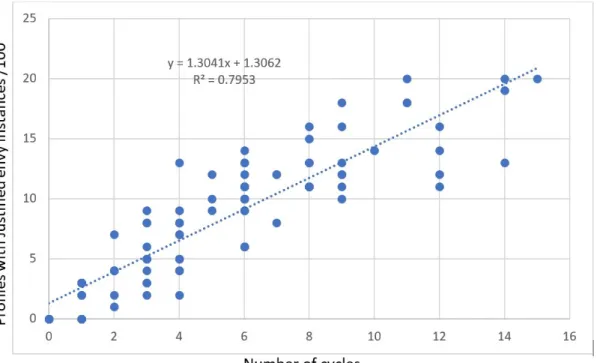
1 Preference profiles for which the TTC is fair vs. the number of Kesten cycles . . . 67
2 Aggregate JE-instances in the TTC vs. the number of Kesten cycles . . . 68
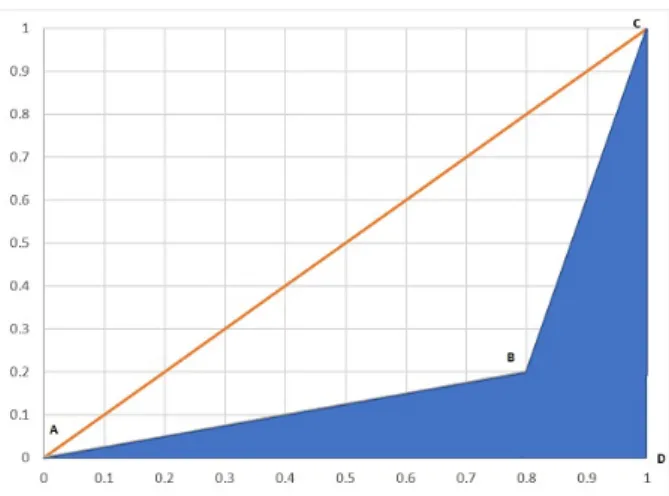
3 Gini coefficient . . . 80
List of Tables
1 Incompatibility of Fairness and Pareto-efficiency . . . 8
2 Three cases for intermediate transformation . . . 34
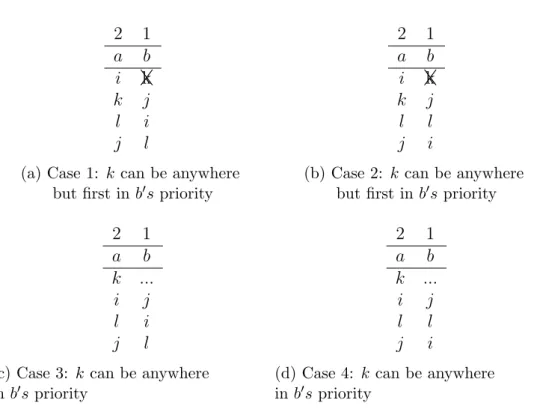
3 Four possible priority tables when qa= 2 and qb = 1 . . . 59
4 Two possible priority tables whenqa = 1 andqb = 2 . . . 60
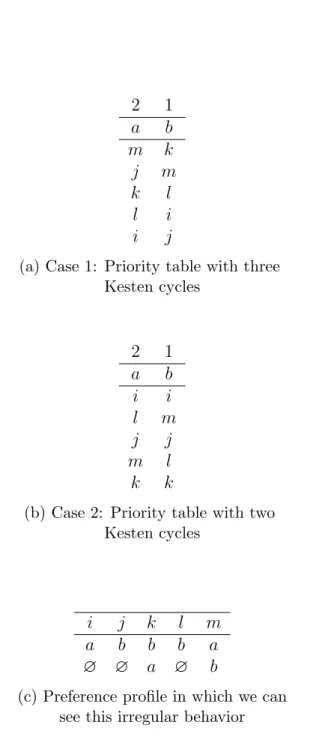
5 An example that shows that simulation is needed to see the relation between the number of cycles and JE-instances . . . 66
6 Confidence interval and reliability test for Figure 1 . . . 67
7 Confidence interval and reliability test for Figure 2 . . . 67
8 A profile at which ETTC has more justified envy than TTC 86 9 A profile at which C&T/FC&T has more justify envy than TTC . . . 87
10 A profile at which C&T/FC&T has more justified envy than ETTC . . . 88
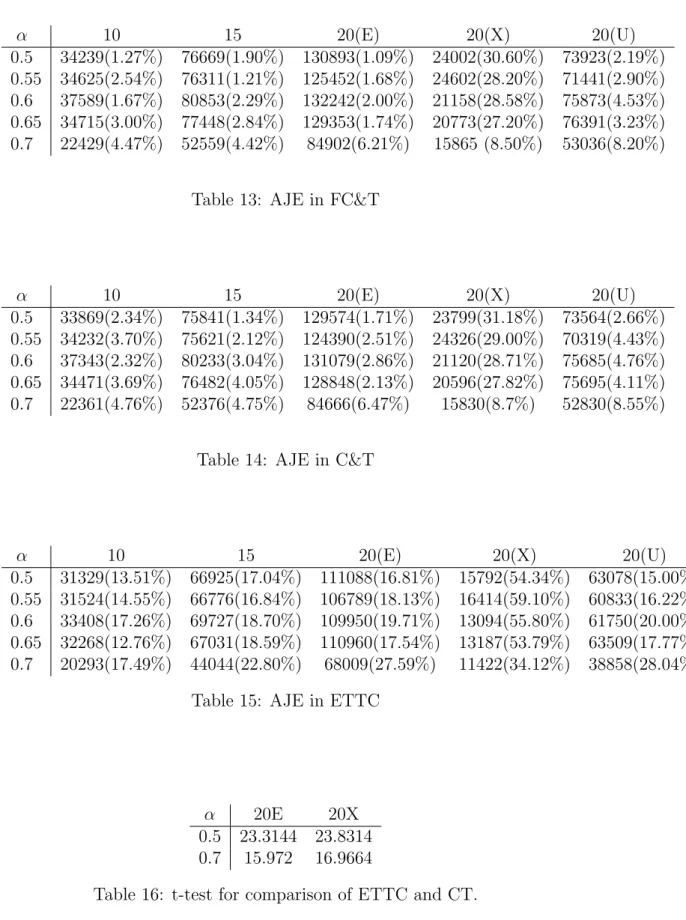
11 A profile at which ETTC has more justified envy than C&T/FC&T 89 12 AJE in TTC . . . 92
14 AJE in C&T . . . 99
15 AJE in ETTC . . . 99
16 t-test for comparison of ETTC and CT. . . 99
17 Equal quota environment (E) with different correlations . . . 100
18 Unequal quota environment (U) with different correlations. . 101
19 Extreme quota environment (X) with different correlations. . 102
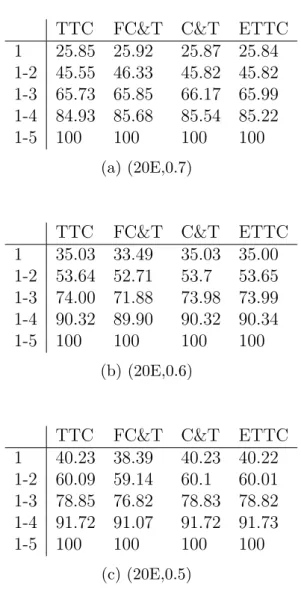
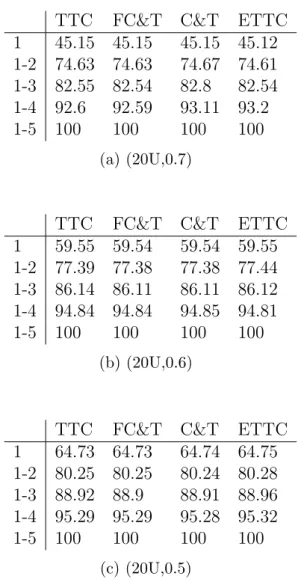
20 Comparing efficiency for different quota configurations . . . 103
21 Linear regression of ETTC with different Gini coefficients (Adj R-squared =0.7409) . . . 104
22 Linear regression of TTC with different Gini coefficients (Adj R-squared = 0.9787) . . . 104
23 Linear regression of CT with different Gini coefficients (Adj R-squared = 0.9237) . . . 105
24 AJE in TTC: case where more seats are given to low-ranked schools (shown by prime) vs. high-ranked schools . . . 107
25 AJE in C&T: case where more seats are given to low-ranked schools (shown by prime) vs. high-ranked schools . . . 107
26 AJE in ETTC: case where more seats are given to low-ranked schools (shown by prime) vs. high-ranked schools . . . 107
Chapter 1
Introduction
1.1
Matching Theory
Matching theory provides a new way to study supply and demand in some markets. Thinness of the market, fairness, and truth-telling are problems in markets where participants’ identity matters. All of these have been addressed by matching theory, which studies centralized markets where participants submit their preferences to the market designer who decides how to match the two sides of the market.
There are different types of matching models. There is one-sided match-ing (which nonetheless has two sides) in which on one side of the market are agents and on the other side are objects, where the latter are always in-divisible items. For example, professors are matched to offices, or students to schools. Objects have priorities which may be imposed by law. For example, neighborhood schools may have to prioritize students who live
nearby. Agents are typically human beings who have different information and different tastes, which forms their preferences over the objects. There is also two-sided matching in which on both sides of the market there are agents, such as medical students and hospitals with residence positions.
Matching theory studies requirements of efficiency, fairness and incen-tives, in order to lay the foundations for the more practical analyses of market design, which seek to improve the matching outcomes in real-world matching markets. Normative and incentive criteria are defined specifi-cally for matching markets, and the formal definitions may differ from the way we think of these concepts in everyday life. Examples of unfairness in real life are numerous; for instance, cronyism or lobbying, or any sort of favoritism are considered unfair, and more generally inequality without a basis is deemed unfair. In matching the definition of fairness is very specific, and in our context where objects have priorities over agents is based on the specified formal model. Namely, it is considered unfair if an agent is assigned an object which another agent with a higher priority for this object envies, given the allocation of the higher-priority agent. This is called justified envy, as opposed to envy that is not justified based on the priorities, and fairness calls for eliminating all instances of justified envy for all different configurations of priorities and preferences.
In the two-sided model where both sides have agents, justified envy is identical to having two agents on the two different sides of the market mutu-ally like each other compared to their matches, and the two agents are said
to form a blocking pair. When all such blocking pairs are absent for arbi-trary priorities and preferences, the matching is considered stable.1 Thus,
depending on the interpretation and applications of the model (whether one-sided or two-sided) fairness and stability are closely related concepts and are identical in terms of the formal definitions.
Pareto-efficiency considers optimizing the allocation of all agents in the market in the following sense: if the allocation made by a rule is Pareto-efficient, then the only way we can improve the allocation of one agent is at the cost of making another agent worse off. Therefore, Pareto-efficiency ensures that agents’ welfare in terms of their preference rankings cannot be further increased without harming at least one agent. This concept is used widely in economics, and it may be different from efficiency concepts used elsewhere in a broader sense or in other contexts. We also use a different measure of efficiency in this thesis in addition to Pareto-efficiency, where we consider the ranking of the allocations received by agents.
In order to provide the correct incentives to agents, a matching rule is often required to satisfystrategy-proofness,a notion which guarantees that individuals have no incentive in the matching procedure to misrepresent their preferences to the market designer, as they cannot obtain a better allocation by doing so. This is a demanding concept, and less demanding incentive constraints may also be studied, along with concepts that are unrelated to strategy-proofness but address other aspects of incentives. One example of strategic behavior without manipulating reported preferences is when agents try to show that they are more competent than they are in
1
Stability is also closely related to the core, which is the central solution concept in cooperative game theory. See more on this in Roth and Sotomayor (1990 [35]).
reality, in order to get higher rankings in priority orderings. Ruling out this kind of strategic behavior is logically unrelated to strategy-proofness. In this thesis, we will focus on strategy-proofness when considering incentives. It is important to point out that strategy-proofnessdoes not aim to ensure that preferences are reported truthfully merely for its own sake. A more far-reaching implication of strategy-proofness, given that the normative properties of matching rules (such as fairness and efficiency) are applied to the reported preferences, is that without truthful reporting we essentially lose the normative properties as well (or at least lose account of them), in addition to subjecting agents to risky outcomes and forcing them to make strategic calculations.
Market design, building primarily on matching theory and using the ad-ditional tools of laboratory experiments, simulations and empirical analysis as applicable, has been developed mainly since the 1990’s. Its growing suc-cess led to awarding the Noble prize in 2012 to Alvin E. Roth and Lloyd S. Shapley for the theory of stable matching and the practice of market design. Despite the brief history of market design, it has touched the lives of many people in positive ways and has been widely used for many real-world allocation problems. Applications of matching theory range from job market assignments (such as medical residents who need to be matched to hospitals) to kidney allocation and refugee matching (e.g., [33], [34], [18]), among many other potential applications.
1.2
Two Prominent Matching Mechanisms:
DA and TTC
There are two important matching mechanisms (also called matching rules) that have been introduced and widely studied: Deferred Acceptance (DA) and Top Trading Cycles (TTC). We present descriptions of these mecha-nisms here in a one-to-one one-sided matching model where objects have strict priorities over agents and agents have strict preferences over objects. Strict priorities and preferences mean that indifferences are not allowed, and thus if there is a choice of two agents then the higher-priority agent for each object is unambiguously defined, and if there are two objects then for each agent one is preferred to the other one (but not the other way around).
Steps for the DA rule (Gale and Sapley, 1962 [14]):
• Each agent proposes to their most preferred object.
• Each object keeps only the highest priority proposing agent tenta-tively and rejects the rest.
• All rejected agents propose to their next preferred object and the process is repeated iteratively.
• The algorithm ends when all agents are either matched or prefer to stay unmatched.
• Each object forms a pair with its highest priority agent who is in the market.
• Each agent points to the pair with their most preferred object (which may be their own pair).
• Since there is a finite number of agents, there is going to be at least one cycle formed by pointing agents which, if the corresponding trade is carried out, improves the allocation of the involved agents (or leaves the allocation unchanged if an agent points to their own pair).
• Agents are permanently matched to the objects according to the cy-cles.
• Matched agents and objects are removed from the market and the process is repeated iteratively.
• The algorithm ends when all agents are either matched or prefer to stay unmatched.
The DA and TTC mechanisms are well-studied because they possess notable attributes. First, both the DA and TTC are strategy-proof in the one-sided matching model. Therefore, if any of the agents misreports their ranking, there is no way for them to get a better allocation. In addition, both of these rules has a property that does not hold for the other one. The DA is fair ([14]) which means, as already explained, that if an agent gets matched to an object then there is no other agent who has higher priority for the object and prefers this object to their current allocation. However, the DA is not Pareto-efficient, although it has been shown that the DA
allocation Pareto-dominates all other fair allocations ([14]). On the other hand, the TTC is Pareto-efficient ([37], [29]) for the agents, which means that agents cannot get a better allocation unless at least one agent is made worse off. However, the TTC is not fair.
1.3
Objectives and Motivation
In this thesis we study the TTC and alternative rules to the TTC which are strategy-proof and Pareto-efficient but not fair, both in one-to-one and many-to-one matching models. One of the main aims of this thesis is to find matching rules that perform relatively better than others by having fewer justified envy instances of assignments when taking into account the priorities of the objects.
Gale and Shapley (1962 [14]) and Balinski and S¨onmez (1999 [7]) demon-strate that it is not possible to have an outcome that is both Pareto-efficient and fair at each priority and preference profile. To see this, consider the preferences and priorities provided in Table 1(a)-(b). It is easy to verify that the unique fair allocation is the one given in Table 1(c). However, this allocation is not Pareto-efficient, since it is Pareto-dominated by the allocation displayed in Table 1(d).
This is a classic example to show the incompatibility of fairness and efficiency in a simple matching market, and it clearly demonstrates that this is a pervasive feature of such markets. This explains the interest in both the DA and TTC mechanisms, since there is no matching mechanism
a b c
i j j
k i i
j k k
(a) Objects’ Priorities
i j k b a a a b b c c c (b) Agents’ Preferences objects a b c agents i j k (c) Unique fair allocation
objects a b c
agents j i k
(d) Pareto-dominating allocation
which is both fair and efficient in one-sided matching models. This funda-mental incompatibility has inspired a substantial literature using various approaches to reconcile the properties of fairness and efficiency in some sat-isfying manner, and to understand and potentially alleviate the trade-offs involved.
Among these efforts, Heo (2019 [17]) restricts the preference domain and identifies restrictions that allow for both fairness and efficiency. More importantly for our analysis, Ergin (2002 [13]) and Kesten (2006 [21]) focus on restrictions on a priority table. Other papers try to weaken the notion of fairness or efficiency to allow a matching rule to satisfy both properties simultaneously without having to resort to restricting either preferences or priorities. Weakening the notion of fairness is especially popular and has created a large recent literature (see, for example, Alcalde and Romero-Medina (2017 [4]), Cantala and P´apai (2014 [8]), Morrill (2015 [27]), and Kloosterman and Troyan (2016 [23]), among others).
Another strand of the literature is primarily looking for alternative mech-anisms that satisfy some weaker criteria than the original incompatible properties. For example, Kesten (2010 [22]) proposes a mechanism that is meant to improve stability compared to the TTC, based on consenting agents who allow for priority violations in order to improve the efficiency of the DA outcome. While this rule, called EADAM, maintains the efficiency of TTC, it is not strategy-proof. For many-to-one problems known asschool choice, Morrill(2013 [26]) and Hakimov and Kesten (2014 [15]) introduce different matching rules that remain Pareto-efficient and strategy-proof, just like the TTC, but try to improve upon TTC by having fewer justified
envy instances at some priority and preference profiles, but as we will show in Chapter 4, they can create more justified envy instances than TTC at some profiles, so the theoretical profile-by-profile comparison remains am-biguous.
As already discussed, strategy-proofness is not just an incentive prop-erty to assure truth-telling itself. The main reason to insist on strategy-proofness is that if a designer does not know the true rankings of agents who are participating in the market, then it is not possible to make sure that fairness and efficiency truly hold. In this thesis, our primary criteria for matching rules are efficiency and strategy-proofness, and we ask that if we maintain these two important properties of matching rules, is it possible to find a rule (or rules) that always perform better, in terms of fairness, than others, taking into account all different markets, or at least perform better on the whole? Thus, our studies fit into the literature analyzing the incom-patibility of fairness and efficiency, and uses fairness comparison criteria to identify matching rules that are most suitable to reduce the fundamental trade-off between fairness and efficiency when efficiency takes precedence over fairness, while ensuring proper incentives and thus truthfully reported preferences.
There are different fairness criteria that can be used for comparison. Abdulkadiro˘glu et al. (2017 [3]) introduce the notion ofjustified envy min-imality. A matching rule is justified envy minimal if the set of justified envy instances cannot be weakly decreased in an inclusion sense by another rule, considering each priority and preference profile. Chen and Kesten (2017
[9]) use a different concept, which simply compares whether a profile con-tains a justified envy instance or not, and uses this criterion for comparison profile-by-profile. We call this criterionJE-domination,and this is the cen-tral concept studied in Chapter 2.
1.4
The Role of Simulations
Simulation is used as a complementary tool to our analytical methods, since some properties are not theoretically true for all possible profiles, but they are statistically significant. Some instances may happen in matching mechanisms which are rare or can be considered exceptions. Also, conjec-tures can be verified through simulations and properties that are found via simulations may result in a theoretical insight.
A case in point is Ashlagi et al. (2011 [5][6]) who ran simulations on kidney exchange to show how we should organize the chain of donors to obtain more efficient allocations. Roth and Peranson (1999 [33]) used sim-ulations in school choice to see the effect of manipulation by agents in a large market. Dur et al. (2018 [10]) carried out simulations to compare the DA rule to an improved version of the mechanism that was used in Boston. Their simulations suggested that the Secure Boston mechanism Pareto-dominates the DA when the DA is not efficient, and it often over-laps with the DA when the DA is efficient. Miralles (2009 [25]) also ran simulations and proved that the Boston mechanism outperforms the DA when comparing the welfare of the two mechanisms. Morrill (2013 [26]) used simulations to show that Clinch and Trade (CT) and another variant
of the TTC called Prioritized Top Trading Cycles (PTC), have fewer unfair instances than the TTC on average.
In Chapters 3 and 4 of this thesis we test different properties of matching rules in cases where analytical comparisons are not possible. In Chapter 3 simulations are used to show that more cycles in the priority profile lead to more fairness violations on average when considering different preferences for the agents. In Chapter 4, simulations are carried out to compare al-ternative matching mechanisms for the school choice model and see which one has a relative advantage over its rivals according to various normative criteria regarding fairness and efficiency.
1.5
Summary of the Results
This thesis consists of three studies in matching theory and market design. Its main focus is to compare matching rules according to normative criteria, primarily fairness, when objects have priorities over agents, in addition to agents having preferences over objects.
In the first study (Chapter 2), we analyze one-to-one matching, for which the two definitions of cycles in priority profiles introduced by Ergin (2002 [13]) and Kesten (2006 [21]) are identical. The fairness comparison criteria, calledJE-domination (where JE stands for justified envy) andcardinal JE-domination that we focus on in this chapter are based on profile-by-profile comparisons. Given a fixed priority profile, a rule f JE-dominates another rule g at this priority profile if at each preference profile where g is fair
f is also fair, and if there is at least one more preference profile at which
f is fair and g is not. The alternative notion, cardinal JE-domination, compares the number of justified envy instances of two matching rules. We say that rule f cardinally JE-dominates rule g at a fixed priority profile if there is no preference profile where f has more justified envy instances than g and there is at least one preference profile at which f has strictly fewer justified envy instances than g. We use these two straightforward criteria to compare strategy-proof and efficient matching rules. As we will show in Chapter 2, there is no unique rule that performs best at all possible preference profiles when the priority profile has at least one Ergin/Kesten cycle. Namely, we prove that when there is a cycle in the market, we cannot find a mechanism which is strategy-proof and Pareto-efficient and has weakly fewer preference profiles at which the allocation is fair than any other strategy-proof and Pareto-efficient mechanism, when the comparison is made profile by profile. This means that there is no unique rule at cyclic priority profiles which JE-dominates all other strategy-proof and efficient rules, and a similar result applies to cardinal JE-domination.
Gale and Shapley (1962 [14]) proves that there is a unique mechanism, the DA, that is fair and Pareto-dominates all other fair mechanisms (i.e., weakly Pareto-dominates all fair outcomes at each priority and preference profile). Some recent papers such as Morrill (2015) [27] and Abdulkadiroˇglu et al. (2017 [3]) suggest that the TTC is more fair than any other mech-anism that is strategy-proof and Pareto-efficient. Many papers have tried to reconcile Pareto-efficiency and fairness by either weakening the notion of fairness (e.g., Alcalde and Romero-Medina, 2017 [4]; Cantala and P´apai, 2014 [8]; Kloosterman and Troyan, 2016 [23]) or by restricting the priority
profile (Ergin, 2002 [13]; Kesten, 2006 [21]). We show that while the TTC cannot be dominated in terms of fairness violations at all preference profiles among strategy-proof and Pareto-efficient mechanisms, if the priority pro-file is strongly cyclic then there is not much scope for the TTC to dominate other strategy-proof and Pareto-efficient matching rules.
In the second study (Chapter 3), we take a closer look at definitions that have been introduced by Ergin (2002 [13]) and Kesten (2006 [21]) in a many-to-one matching model. Given that this study focuses on multiple copies of objects, the scarcity conditions are important and the two defini-tions of cycles are no longer identical. We show, using a direct proof, that an Ergin cycle is stronger than a Kesten cycle when objects have quotas. Moreover, we also prove that when there is a Kesten cycle, which is the weaker definition of cycles, there is no strategy-proof and Pareto-efficient mechanism which has weakly fewer fairness violations (called justified envy instances) at all possible preference profiles compared to other strategy-proof and Pareto-efficient mechanisms. In the last part of Chapter 3 the matching prescribed by the TTC mechanism using different priority profiles is compared while we count the number of Kesten cycles in the priorities. It is shown that, as a general pattern, as the number of Kesten cycles in-creases, there are more justified envy instances and fewer preference profiles at which the mechanism produces fair allocations.
The third study (Chapter 4), which consists of multiple parts, explores three competing mechanisms for matching markets with multiple quotas, all of which are strategy-proof and Pareto-efficient but not fair. The TTC
mechanism as a baseline is compared to the Equitable Top Trading Cy-cles mechanism (henceforth ETTC), and the Clinch and Trade mechanism (henceforth CT), as two alternative mechanisms, which were introduced as variations of TTC by Hakimov and Kesten (2018 [15]) and Morill (2015 [28]), respectively.
First, knowing that mechanisms that are efficient cannot be fair at all preference profiles, we compare these mechanisms that have been intro-duced in the literature for many-to-one matching in terms of fairness. Al-though one would expect that these two recently proposed strategy-proof and Pareto-efficient mechanisms are fairer than the TTC, I demonstrate that some preference profiles give the opposite result. Given that these alternative mechanisms are not always better in terms of fewer justified envy instances, I compare the aggregate number of justified envy instances using simulations, in order to see which mechanism has fewer justified envy instances than the others. The aggregate number is simply the sum of all justified envy instances in the selected priority and preference profiles.
Since all the alternative mechanisms that we study in this chapter are the same when the quota of all objects is equal to one, we compare the mechanisms when the the quota of at least one of the objects is greater than one. In order to be able to compare the inequality of different distri-butions of quotas over objects, we use the Gini coefficient. This coefficient is usually applied to the distribution of wealth, but we use it as a measure of inequality for distributions of quotas in matching (e.g., distributions of school seats across schools).
our simulation model: namely, the preference profiles of agents are not completely random. They are a combination of a given common ranking and individual rankings over objects. We assume that there is a correlation between the common ranking and the individual preferences. The common ranking can be interpreted as common information for all the individuals, while individual rankings represent each individual’s taste for the different objects. We carry out the analysis with different distributions of quotas and different correlations of preferences and show, among other things, that ETTC tends to have fewer aggregate justified envy instances than the other two rules.
Furthermore, by applying a new measure of efficiency, we show that each of the three mechanisms is more efficient when the most preferred object in the common ranking has a higher quota in general. Considering different distributions of quotas, we find that the more unequal the distribution, the less justified envy instances are observed in the market, and at the same time the more likely it becomes that agents are matched to objects that are ranked highly by them.
In sum, this thesis shows that in one-to-one matching there is no guaran-tee that that the TTC mechanism is the most fair mechanism when using some fundamental and straightforward criteria for comparison. Moreover, in many-to-one matching (i.e., with multiple quotas) the mechanisms can-not be compared easily analytically, especially when different quota distri-butions are considered. Therefore, for these cases simulations are used to compare mechanisms.
Chapter 2
Fairness Comparisons of
Strategy-Proof and Efficient
Matching Rules
2.1
Introduction
We study a one-to-one matching model where agents have strict prefer-ences over objects and objects have strict priorities over agents. Our main question is which strategy-proof and efficient matching rules are the most fair? Can we compare these rules based on justified envy?
The set of strategyproof and efficient matching rules in this model has not been characterized yet. P´apai (2000 [29]) characterizes a large class of matching rules, called Hierarchical Exchange rules, using strategy-proofness,
efficiency, nonbossiness (agents cannot affect other agents’ allocations with-out affecting their own allocation), and reallocation-proofness (agents can-not manipulate the outcome successfully by reporting untruthful prefer-ences and swapping their assigned objects afterwards). This class is a gen-eralization of Gale’s Top Trading Cycles (TTC) rule (Shapley and Scarf, 1962 [37]) and allows for an arbitrary priority profile that may change en-dogenously with the preference profile as the rounds of trading proceeds, based on prior assignments. Pycia and ¨Unver (2017 [30]) characterize a superset of these rules, called Trading Cycles rules, by strategy-proofness, efficiency, and nonbossiness. Trading Cycles rules allow for so-called bro-kers under restricted circumstances, where a broker is an agent who can trade her object but cannot take it herself. We study the even larger family of rules which are strategy-proof and efficient but may be bossy.
We examine two natural criteria that allow for comparing matching rules in terms of justified envy. We say that a rule JE-dominates another one if the first rule has no justified envy at any preference profile where the second one has no justified envy, and there is at least one additional pref-erence profile at which the dominating rule has no justified envy, while the dominated one has. Furthermore, a rule cardinally JE-dominates another one if the number of justified envy instances are either the same or lower at each preference profile for the dominating rule, with at least one profile with a strictly lower number of justified envy instances.
It is well known that the Deferred Acceptance (DA) rule of Gale and Shapley (1962 [14]) is fair (in the sense that it has no justified envy) in this
model but not efficient, while the TTC rule is efficient but not fair. Further-more, we know that the DA outcome is the most efficient fair matching at each preference profile, in the strong sense that it Pareto-dominates every other fair matching. By symmetry, one might conjecture that the major competitor to DA, the Top Trading Cycle (TTC) rule, is the most fair (i.e., has least justified envy) among efficient rules. Along these lines, Morrill (2015 [27]) demonstrates that the TTC rule is the unique strategy-proof, efficient and just matching rule, where the axiom of justness weakens the notion of fairness to accommodate the trading of objects. Furthermore, Abdulkadiroˇglu et al. (2017 [3]) shows that the TTC rule is justified-envy minimal among strategy-proof and efficient matching rules, in terms of an inclusion relation with respect to blocking pairs. However, the TTC rule is not the only matching rule with this property. Finally, although less closely related to our setting, there are also some arguments in favor of TTC on the basis of fairness when there is uncertainty: Harless (2015 [16]) shows that among ex-post efficient, strategy-proof, and nonbossy rules, TTC rules Lorenz dominate non-TTC rules.
We argue and demonstrate that when the object priorities are not acyclic (Ergin, 2002 [13]; Kesten, 2006 [21]) the TTC rule does not stand out as the unique most fair strategy-proof and efficient matching rule, contrary to the indications in the literature. Specifically, we show that with respect to either JE-domination or cardinal JE-domination there is no unique strate-gyproof and efficient rule that dominates all other such rules for arbitrary cyclic priorities. We further explore JE-domination among the class of Modified TTC rules, which are TTC rules that use a priority profile other
than the “true” priority profile. The Modified TTC rules are also strategy-proof and efficient, and we prove that when the priorities are strongly cyclic (a strengthening of the classical cyclic condition) the TTC rule JE-dominates a Modified TTC rule only under rather restrictive conditions on the true priority profile.
2.2
Definitions and Axioms
There is a set of m objects M and a set of n agents N. Each agent is allocated at most one object and each object is assigned to at most one agent, based on the preferences of the agents and the priorities of the objects. Each object a ∈ M has a strict priority ranking πa of agents. Each agent i ∈ N has a strict preference ordering Pi over objects. Strict preference relations are denoted by Pi and weak preference relations are denoted by Ri. Given that preferences are strict, aRib means that either
aPib or a =b, that is, since indifference is not allowed if a is only weakly preferred to b but not strictly, then objects a and b are identical. Objects may be unacceptable to agents, and we denote the assignment of an agent who remains unassigned by 0. We also use the notation Pi ∈ (a, b) to indicate that Pi ranksa first andb second, while Pj = (a,0) indicates that
j’s only acceptable object is a. Similarly, Pi = (0) means that there is no acceptable object for agenti. We will use similar notation for priorities πa. Apreference profile P = (P1, . . . , Pn) specifies the strict preferences of each agent in a particular market. A priority profile π= (πa1, . . . , πam) specifies the strict priority ordering of each object. Let Π denote the set of priority
profiles.
Amatching µis a mapping from the set of agentsN to the set of objects
M such that each agent is assigned to at most one object, and each object is assigned to at most one agent. Thus, if agent i is assigned object a
then µ(i) =a. A matching rule f assigns a matching to each priority and preference profile (π, P). When the priorities are fixed and unambiguous, we may simply write f(P) to indicate the matching at preference profile
P. Agenti’s assignment in f(P) is denoted by fi(P).
A matching rule f is strategy-proof if, for all preference profiles P, there is no agent i ∈ N and P′
i such that fi(P ′
i, P−i)Pifi(P). If there is
such an agent, then agenti canmanipulate at profileP viaP′
i.
Strategy-proofness is a standard, although demanding, incentive requirement in matching design, and thus we will require all matching rules that we analyze in this study to satisfy it.
A matching rulef isnonbossyif, for all preference profilesP, there is no agent i ∈N and P′
i such that fi(P ′
i, P−i) = fi(P) and f(Pi′, P−i) 6=f(P).
If there is such an agent, then agent i isbossy at profile P, since she can change somebody else’s assignment without changing her own. We will not require nonbossiness in this study, but will use this property of rules in our proofs, since for example the TTC rule is nonbossy.
Another basic property of matching rules is Pareto-efficiency, or efficiency for short. A matching µ is individually rational if for all i ∈N, µiRi0. A matching µ is efficient if it is not Pareto-dominated. That is, there is no matching ν such that, for all agents i∈N, νiRiµi and νjPjµj for some
j ∈N. We assume that agents can always be left unassigned, and thus an efficient matching is individually rational. A matching rule f is efficient
if, for all preference profiles P, f(P) is efficient.
Finally, we introduce the central notions in this study on fairness which are also standard, based on the justified envy of agents with respect to their priority rankings for objects. Given a fixed priority profile π, a matchingµ
hasjustified envyat preference profileP if there exist agentsi, j ∈N and object a ∈ M such that aPifi(P), iπaj, and fj(P) = a. We will also use the terminology that (i, a, j) is a justified envy instance, or JE instance
for short.1 A matching rule f is fair if f(P) has no justified envy at any
preference profile P. We will say thatg has JE at P (with respect to π) if
g(P) has at least one justified envy instance at P, and thatg is JE-free at
P if g(P) has no justified envy instance at P (with respect toπ).
2.3
Preliminaries
Here is a brief informal description of the TTC rule with inheritance of the objects for a given priority profile π. For a formal definition see the Fixed Endowment Hierarchical Exchange rules in P´apai (2000 [29]), and for a more succinct description of the ownership rights (i.e., endowments) see Pycia and ¨Unver (2017 [30]). The only, fairly straightforward, mod-ification we make to previous definitions is that we allow agents to have unacceptable objects, and thus we remove agents from the market when all
1
Note that in the one-to-one matching model that we study in this chapter the number of JE instances corresponds to the number of blocking pairs. This would no longer be the case in a many-to-one model, where an object has multiple copies which can be assigned to different agents.
their acceptable objects have already been assigned to other agents.2
• In each round each object is endowed to the agent who has the highest priority for the object among the agents who are still in the market.
• Each agent points to the agent who is endowed with the object that is most preferred by the agent among all the objects that are still unassigned. Agents may point to themselves.
• Since there is a finite number of agents, there is at least one cycle (i.e., a top trading cycle). Assign to each agent in each top trading cycle the object that the agent most prefers (that is, the object that the agent is pointing for). These assignment are final.
• Remove each assigned agent and object from the market, and remove each agent who has no acceptable objects left in the market.
• Update the endowments by endowing each object to the highest-priority agent who is still in the market. This is the “inheritance” of objects that are left behind by agents who leave the market in this round.
• Repeat this process in the remaining market until no more assign-ments can be made.
Given a permutation of the agents, theSerial Dictatorshiprule assigns each agent her favorite object among the remaining objects, when they select their assignments in the order of the given permutation. Note that
2
Pycia and ¨Unver (2016 [31]) explore this modification, what they call the existence of an outside option, in some detail.
if the fixed priority profile is homogeneous (has the same priority ordering for all objects), then the TTC rule is simply the Serial Dictatorship with the permutation of the agents that corresponds to the common priority ordering of the objects.
The TTC rule is strategy-proof and efficient (P´apai, 2000 [29]). Given an arbitrary priority profile, the TTC rule is not fair at all preference profiles. In fact, fairness and efficiency cannot be reconciled for an arbitrary priority profile, since there may be preference profiles for which a fair and efficient matching does not exist (Roth, 1982 [32]). When restricting the priority profile, fairness and efficiency can only be satisfied simultaneously if the priority profile is acyclic (Ergin, 2002 [13]; Kesten, 2006 [21]).
In a one-to-one matching model, which is the focus of this chapter, a priority profile isacyclicaccording to Ergin (2002 [13]) if there is no cycle for two objects a, b ∈ M such that there are three agents i, j, l ∈ N with
lπajπaiandiπbl. This turns out to be equivalent to the acyclicity condition defined by Kesten (2006 [21]), which also stipulates in addition that iπbj. Given the symmetry between objects a and b in these definitions, it is straightforward to verify that the two conditions are the same (see details in the appendix).3 Moreover, when the priority profile is acyclic, the TTC
and DA rules are equivalent in the sense that both yield the same matching at each preference profile.
Since acyclicity of a priority profile is central to our results, we will state
3
The two acyclicity conditions however differ from each other when objects have multiple copies or a quota, that is, in a many-to-one model. When defining the acyclicity of a priority profile, both Ergin (2002 [13]) and Kesten (2006 [21]) also specify ascarcity
condition in addition to theloop condition to define a cycle. These scarcity conditions are trivially satisfied when the quota for each object is one, as assumed in this chapter.
the definition here formally.
Definition 1. A priority profileπ has acycle if there exist agentsi, j, l ∈
N and objectsa, b∈M such thatlπajπai, iπbl and iπbj. A priority profile is cyclicif it has a cycle, and it is acyclicif it does not have a cycle.
2.4
Fairness Criteria and Comparisons
Our first result demonstrates that none of the strategy-proof and efficient matching rules stands out uniquely in terms of a profile-by-profile fairness comparison when the priority profile is cyclic.
Theorem 1. Let n, m≥3 and fix a priority profile π which is cyclic. Let matching rule f be strategy-proof and efficient. Then there exists another strategy-proof and efficient matching rule g and a preference profile P such that f has justified envy at P with respect to π and g does not.
Proof. Since π is cyclic, there exist objectsa, b∈M and agents a, b, c∈N
such that iπalπaj and jπbi. Assume, without loss of generality, that jπbl. Consider a profile P such that Pi, Pj, Pl ∈ (a, b) and for all other agents
k(k ∈ N \ {i, j, l}), Pk ∈ (k). If f(i,j,l)(P) 6= (a, b,0), where this notation
means that igets a, j gets b andl gets 0, then letg be the TTC rule based onπ. Theng is strategy-proof and efficient and it selects (a, b,0) atP, that is, g(i,j,l)(P) = (a, b,0). Hence, g is JE-free at P. Given that f is efficient,
it assigns both a and b at P. If fi(P) = a then fl(P) = b by efficiency. Furthermore, (j, b, l) is a JE instance forf atP. Iffi(P)6=athen efficiency implies that either fj(P) = a orfl(P) =a . Thus, either (i, a, j) or (i, a, l)
is a JE instance for f at P. Therefore, if f(i,j,l)(P) 6= (a, b,0) then the
statement follows for f, given the TTC rule based on π.
Next, assume that f(i,j,l)(P) = (a, b,0). Let Pi′ ∈ (b, a), and consider
the profile P′
= (P′
i, P−i). Note that fi(P ′
) 6= a by efficiency, and thus, givenfi(P) =a, strategy-proofness implies thatfi(P′) =b. Then efficiency
implies that f(i,j,l)(P′)∈ {(b, a,0),(b,0, a)}.
Case 1: f(i,j,l)(P′) = (b, a,0)
Let ˆπ be such that iπalˆ πajˆ and iπbˆ lπbjˆ . Let g be the TTC rule based on ˆπ. For simplicity, we can assume that g is the Serial Dictatorship with permutation (i, l, j). Thus, g is strategy-proof and efficient.
Let P′′
j ∈ (a, b, c), where c ∈ M. Consider the profile P ′′
= (P′′ j , P
′ −j).
Then g(i,j,l)(P′′) = (b, c, a). Hence, g is JE-free at P′′ with respect to π. However, note that since fj(P′
) = a, strategy-proofness implies that
fj(P′′) =a. This means that (l, a, j) is a JE instance for f at P′′ with
re-spect toπ. Thus, the statement follows forf, given the Serial Dictatorship
g with permutation (i, l, j) and profileP′′
.
Case 2: f(i,j,l)(P′
) = (b,0, a)
Let ¯Pj ∈(b, a) and consider the profile ¯P = ( ¯Pj, P′
−j). Since fb(P
′) = 0,
strategy-proofness implies that fbP¯ = 0. Then by efficiency f(i,j,l)( ¯P) =
(b,0, a). Now let g be the TTC rule based on π. Then g is strategy-proof and efficient and g(i,j,l)( ¯P) = (a, b,0). Note that g is JE-free at ¯P with respect to π. However, (j, b, i) is a JE instance forf at ¯P with respect to
profile ¯P.
Since the statement is proved for both cases, the proof is complete.
Corollary 2. Let n, m≥3 and fix a priority profile π which is cyclic. Let matching rule f be strategy-proof and efficient. Then there exists another strategy-proof and efficient matching rule g and a preference profile P such that f has more JE instances at P with respect to π than g.
Corollary 2 follows immediately from Theorem 1.
Next we introduce the key definitions of this paper, the criteria which will allow us to evaluate and compare matching rules based on their fairness.
Definition 2. A rule f is JE-dominated if there exists another rule
g which is JE-free at all preference profiles where f is JE-free, and g is JE-free at least at one preference profile where f has JE. Then we will say that g JE-dominates f.
Definition 3. A rule f is cardinally JE-dominated if there exists another ruleg which has at most as many JE instances at each preference profile asf, and it has fewer JE instances than f at least at one preference profile. Then we will say that g cardinally JE-dominates f.
We note that, although closely related, there is no logical implication between JE-domination and cardinal JE-domination, which can be easily verified. JE-domination was first proposed by Chen and Kesten (2017 [9]).
Corollary 3. Let n, m ≥ 3. If π is cyclic then there is no unique strat-egyproof and efficient rule which JE-dominates all other stratstrat-egyproof and efficient rules.
Corollary 4. Let n, m≥3. If π is cyclic then there is no unique strategy-proof and efficient rule which cardinally JE-dominates all strategy-strategy-proof and efficient rules.
Corollaries 3 and 4 are straightforward implications of Theorem 1, using our new terminology.
2.5
JE-Domination for the TTC Rule
Given the priority profile π ∈Π, we will denote the TTC rule based on π
by TTC(π) and the DA rule based onπ by DA(π).
Proposition 1. If π is acyclic, the unique strategyproof and efficient rule which both JE-dominates and cardinally JE-dominates all other strate-gyproof and efficient rules is the TTC(π) =DA(π) rule.
Proof. It is well-known and easy to verify that the TTC and DA rules are equivalent if π is acyclic (Kesten, 2006 [21]), and therefore this rule is strategy-proof, efficient and fair. Moreover, the efficient and fair out-come chosen by this rule is the unique efficient and fair outout-come at each preference profile. Suppose, to the contrary, that there is another efficient and fair outcome at some preference profile. Then neither outcome Pareto-dominates the other, since both are efficient. However, this contradicts the fact that the DA outcome is the agent-optimal fair outcome and thus it Pareto-dominates all other fair outcomes (Gale and Shapley, 1962 [14]). Therefore, the TTC rule based onπ(or, equivalently, the DA rule based on
and it follows that any other efficient rule chooses an outcome at some preference profile which is not fair.
As Corollaries 3 and 4 indicate, Proposition 1 cannot be extended to priority profiles that are not acyclic. We now provide a simple example to demonstrate that, given a cyclic priority profile π, the TTC(π) rule neither JE-dominates nor cardinally JE-dominates all other strategy-proof and efficient rules.
Example 1. Let π be as follows: πa ∈ (j, i, l) and for all b ∈ M \ {a}, πb ∈ (i, l, j). Let f be the TTC rule based on π, and let g be the Serial Dictatorship based on agent permutation (i, l, j, ...). Note that both rules are strategy-proof and efficient. Consider the preferences below, and assume that all other agents have no acceptable objects.
Pi Pj Pl
a b b
0 0 0
Then the TTC rule f based on π yields fi(P) = a, fj(P) = b and f
has a JE instance (l, b, j). However, the Serial Dictatorship g results in
gi(P) = a,gl(P) = b, and g is JE-free atP.
Next we show that the TTC rule is not JE-dominated by any other strategy-proof and efficient rule, given an arbitrary priority profile ¯π.
Theorem 5. Let π¯ ∈ Π be a given priority profile. The TTC(¯π) rule is not JE-dominated by any other strategy-proof and efficient rule.
Proof. Letg be the TTC(¯π) rule, given an arbitrary priority profile ¯π ∈Π. Suppose, by contradiction, that there exists a strategy-proof and efficient rule f that JE-dominates g. Then there exists P such that g(P) has JE and f(P) is JE-free. Since f(P) is efficient and JE-free, f(P) = DA(P). Furthermore, g(P) = TTC(P)6=DA(P).
Sinceg(P) = TTC(P) has JE, there existi, l∈N who trade at P in the TTC procedure and there exists j ∈ N \ {i, l} who has justified envy at
g(P) for one of the objects, saya∈M, traded byiandl. This implies that ifiand l tradea, b∈M in the TTC procedure atP, theniπaj¯ πal¯ andlπbi¯ ,
lπbj¯ , (j, a, l) is a JE instance at g(P), gi(P) = b, gl(P) = a, Pi ∈ (b, . . .) and Pl ∈(a, . . .). Moreover, note that since g(P) has JE,gj(P) =c, where
aPjc and eitherc∈M orc= 0.
LetPi ∈(b, a,0) , Ple ∈(b, a,0), Pie ∈(a, b,0) and Pl∈(a, b,0). Suppose fi(Pi, Pl, Pj) = 0. Then, by strategy-proofness, fi(Pi, Pe l, Pj) = 0. How-ever, gi(Pi, Pe l, Pj) = a and since the TTC rule is JE-free at (Pi, Pe l, Pj),
g(Pi, Pe l, Pj) = f(Pi, Pe l, Pj), which is contradiction. Thus, fi(Pi, Pl, Pj)6= 0. A similar argument forj shows thatfl(Pi, Pl, Pj)6= 0.
Therefore,iandlare assigned byfobjectsaandbin total at (Pi, Pl, Pj), and thus efficiency implies that fi(Pi, Pl, Pj) = b and fl(Pi, Pl, Pj) = a. Then, by strategy-proofness, fi(Pl, P−l) = b. Suppose fl(Pl, P−l) = a. Then, by strategy-proofness,fl(P) = awould hold. We will show that this is a contradiction.
Suppose thatfl(P) =a. Then given thatf(P) is JE-free and jπal, there existsd∈M\ {a}such that dPjaand fj(P) =d. If d=b, then fi(P)6=b.
Then, by strategy-proofness,fi(Pi, P−i)6=b.
Suppose thatfi(Pi, P−i)=6 a. Thenfi(Pi, P−i) = 0 . Thus, by
strategy-proofness, fi(Pi, P−ie ) = 0. However , gi(Pi, P−ie ) = a, and since the TTC rule is JE-free at (Pi, P−ie ),g(Pie, P−i) =f(Pi, P−ie ), which is a contradiction. Thus,fi(Pi, P−i) = a. But thenfl(Pi, P−i)6=aand thus strategy-proofness implies that fl(Pi, Pl, Pj) 6= a which is a contradiction. Hence, d 6= b. However, this implies that matching (b, a, d) Pareto-dominates g(i,l,j) = (b, a, c), given that aPjc and thus dPjc. This is a contradiction, since the TTC rule is efficient. Therefore, fl(P) 6= a which contradicts our prior assumption.
Thus,fl(Pl, P−l)6=a. Hence, sincefi(Pl, P−l)6=b, we havefl(Pl, P−l) = 0. Then, by strategy-proofness, fl(Pl, P−e l) = 0. However, gl(Pl, P−e l) = b,
and since the TTC rule is JE-free at (Pl, P−e l),g(Pl, P−e l) =f(Pl, P−e l), which
is a contradiction.
Note that Proposition 1 implies that only the DA rule and rules that co-incide with the DA rule for acyclic priority profiles are not JE-dominated by strategy-proof and efficient matching rules for any given arbitrary pri-ority profile, since the DA is fair for all pripri-ority profiles, and it is efficient for acyclic priority profiles.
2.6
JE-Domination for Modified TTC Rules
Since the characterization of all strategy-proof and efficient matching rules in the one-to-one model with priorities is an open problem, we will focus
on the set of Modified TTC rules, which is a large class of well-studied matching rules (a subset of the Fixed Endowment Hierarchical Exchange rules of P´apai (2000 [29])) that are both strategy-proof and efficient. Let ¯
π ∈ Π be a given fixed priority profile. Then a Modified TTC rule
is a TTC rule using priority profile π ∈ Π \ {π¯}, denoted by TTC(π), which does not use the given fixed priorities that we may refer to as the “true” priorities, but relies on some ”modified” priorities as the basis for the TTC. This class of rules includes all Serial Dictatorships with different agent permutations, among many other rules.
First we provide a necessary condition for TTC(¯π) to JE-dominate a Modified TTC rule, where ¯πis the “true” priority profile, and then we give a complete characterization of JE-domination by the TTC rule within this class of rules. Finally, we use these results to show that for strongly cyclic priority profiles, to be defined later, such JE-domination is not possible.
The intuition is straightforward for the necessity condition presented below. If TTC(¯π) JE-dominates TTC(π) then either the “true” priority profile ¯π is acyclic, or if it is cyclic then for each cycle the “intermediate”
agent (j) for an object, the agent whose priority is between the owner and recipient of an object, cannot be ranked higher than the two traders of the object, that is, both the owner (l) and the recipient (i).
Proposition 2. Let the priority profile beπ¯ ∈Π. If TTC(¯π)JE-dominates TTC(π) for some π ∈ Π\ {π¯} then for each cycle given by lπaj¯ πai,¯ iπbl,¯
iπbj, we have either¯ lπaj or iπaj.
JE-dominates TTC(π). Let f denote TTC(¯π) and let g denote TTC(π). Suppose that there is a cycle in ¯π, given bylπaj¯ πai¯ ,iπbl¯ ,iπbj¯ , and suppose that jπal and jπai. Let P be as follows: Pi = (a,0), Pj = (a,0), Pl = (b,0) and for all h∈ N \ {i, j, l}, Ph = (0). Theni and l trade at P in TTC(¯π) and fi(P) = a, fl(P) = b, while fj(P) = 0. However, gj(P) = a. Then (j, a, i) is a JE instance at f(P). Moreover, since gl(P) = b and gi(P) = 0, by the efficiency of TTC, g(P) is JE-free. This is a contradiction.
Next we are going to present a characterization of JE-domination within this class of rules. Let ¯π ∈ Π be the priority profile and let a cycle in ¯π
be given by lπaj¯ πai¯ , iπbl¯ , and iπbj¯ . As before, we call j an intermediate
agent for objecta in this cycle, and we call the specific ways of modifying
π defined below intermediate transformation, as it is centered on the role of the intermediate agent who could potentially have justified envy.
Definition 4. Priority profileπ ∈Π is anintermediate transformation
of π if for each cycle in π (as specified above) one of the following three cases holds:
case (i): lπai, lπaj, iπbj , iπbl
case(ii): iπaj , iπal
case (iii): lπaiπaj, lπbi, lπbj
To understand this definition, note that sincej is an intermediate agent for objecta, (j, a, i) is a JE instance if iis assigned to a. There are exactly three ways for i to be assigned to a if both agents i and j want object a
Pi Pl Pj
a b a
(a) preference profile
πa πb
l i
i j j l
(b)case (i): itradesb fora
πa πb
i ... j l ...
(c)case (ii): itakes a
πa πb
l l
i i j
j
(d) case (iii): iinheritsa
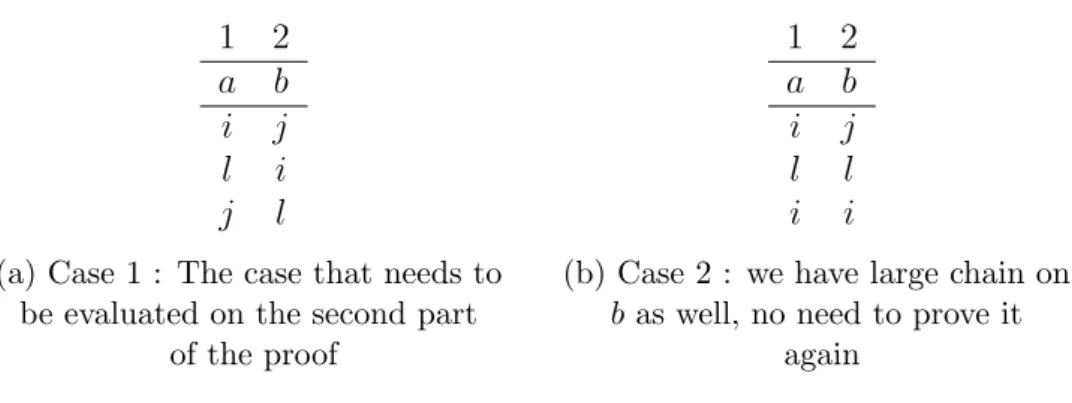
Table 2: Three cases for intermediate transformation
in Table 2), and these three ways correspond to the three cases in the definition, as illustrated by Table 2.
In the following we will consider the partitioning of each priority profile
π ∈Π, which is a partition of the “rows” of the priority profile when object priorities are listed vertically in a priority table, and each member of the partition consists of on or more consecutive rows in the table. That is, the priority profile is partitioned by consecutive rank numbers. Specifically, each agent belongs to exactly one member of this partition such that the agent only has priorities in this member of the partition. The partition that we are interested in is the finest partition of π which satisfies the above condition for each agent. We will refer to members of this uniquely defined finest partition as thecomponents of π. Thesize of a component is given by the number of the agents in the component, which is simply the number of the rows in the priority table that correspond to the component. Thus, for example, each Serial Dictatorship has n components of size 1. It is also clear that acyclic priority profiles have components of size 1 and 2 only, while any cyclic priority profile has at least one size 3 component.
Now we are ready to prove the characterization of TTC JE-domination in the class of Modified TTC rules.
Theorem 6. Let the priority profile beπ∈Π. For allπ ∈Π\{π},T T C(π)
JE-dominates T T C(π) if and only if π is an intermediate transformation of π.
Note that ifπis acyclic then the conditions for intermediate transforma-tion are vacuously satisfied due to the lack of cycles, and thus all priority profiles are intermediate transformations of π. Therefore, one implication of this characterization is that all Modified TTC rules are JE-dominated by the TTC (other than TTC itself) if the priority profile has no cycles, and thus Theorem 6 partially implies Proposition 1.
Proof.
Claim 1: If π is an intermediate transformation of π then TTC(π) JE-dominates TTC(π).
Proof: Letπbe an intermediate transformation ofπ. Suppose that TTC(π) does not JE-dominate TTC(π). Then there exists P ∈ P such that TTC(π, P) has JE and TTC(π, P) is JE-free. Since TTC(π, P) has JE, there exist a, b∈ M and i, j, l ∈ N such that lπajπai, iπbl, iπbj, aPib and
bPla,iand l will tradea andb atP and aPjfjT T C(π, P). Thus, (j, a, i) is a
JE instance for TTC(π) at P. The strategy-proofness and nonbossiness of TTC implies that without loss of generality we can assume that Pi = (a),
Pl = (b) and Pj = (a, fT T C
that the JE instance occurs occurs in the highest-ranked size 3 component inπ for which such P exists.
Since the JE-free assignments are unique for all agents in the compo-nents before reaching the component containing {i, j, l}, their assignments are the same at TTC(π, P) and TTC(π, p). Moreover, if {i, j, l} is not in the first component, then by our assumption there is no JE-instance includ-ing the agents in higher components at TTC(π, P), and since the JE-free assignments are unique, these agents get the same assignments at both TTC(π, P) and TTC(π, P). Repeating these arguments as many times as necessary, given the component structure of π, we can conclude that a
and b are not yet assigned at TTC(π, P) when we get to the component containing {i, j, l}, given that fT T C
i (π, P) = a and flT T C(π, P) = b.
Now we can consider the three cases in the definition of intermediate transformation, given that π is an intermediate transformation ofπ.
case (i): lπai, lπaj, iπbj , iπbl.
In this caseiand l tradea andb at TTC(π, P), and thus (j, a, i) is a JE instance at TTC(π, P)
case (ii): iπaj , iπal.
SincePi = (a) and iranksa first inπa among the remaining agents,i is assigneda at TTC(π, P), and thus (j, a, i) is a JE instance at TTC(π, P)
case (iii): lπaiπaj, lπbi,lπbj
assigned b at TTC(π, P). Therefore, a is inherited by i from l, and since
Pi = (a), i is assigned a at TTC(π, P). Thus, (j, a, i) is a JE instance at TTC(π, P).
We have shown that TTC(π, P) has JE in all three cases, which is a contradiction. Hence, TTC(π) JE-dominates TTC(π).
Claim 2: If TTC(π) JE-dominates TTC(π) then π is an intermediate transformation of π.
Proof: Assume thatT T C(π) JE-dominates TTC(π). Suppose thatπis not an intermediate transformation of π, then there is a component of π for which there exists a cycle with a, b∈ M and i, j, l ∈ N such that lπajπai, iπbl, iπbj and none of the three cases in the definition of intermediate transformation holds for this cycle in π. Let P be such that Pi = (a),
Pl = (b) and Pj = (a), and for all other agents k ∈ \{i, j, j}, Pk = (0). Theniandltradeaandbat TTC(π, P), and thus (j, a, i) is a JE instance at TTC(π, P). Therefore, since TTC(π) JE-dominates TTC(π), TTC(π, P) also has JE. This implies thatj is not assignedaat TTC(π, P), since thenl
is assignedbat TTC(π, P) by Pareto-efficiency of the TTC, and TTC(π, P) would be JE-free, a contradiction.
If jπai and jπal then j is assigned a at TTC(π, P). Therefore, j is not ranked first by πa among {i, l, j}, and since i is not ranked first by πa
among {i, l, j}, given case (ii) it must be the case that l is ranked first by
πa among {i, l, j}, that is, lπai and lπaj.
Sinceiis not ranked first byπbamong{i, l, j}, given case (i), andlis not ranked first by πb among {i, l, j}, given case (iii), it must be the case that
j is ranked first by πb among {i, l, j}, that is, jπbi and jπbl. This implies that l and j trade a and b and thus j is assigned a at TTC(π, P).
Case 2: lπajπai
Sincei is not ranked first byπb among {i, l, j}, given case (i), eitherl or
j is ranked first by πb among {i, l, j}. If lπbi and lπbj then l is assignedb
and j inherits a, and therefore j is assigned a at TTC(π, P). If jπbi and
jπbl then l and j tradea and b, so j is again assigned a at TTC(π, P).
This shows that in each case j is assigned a at TTC(π, P) and we have reached a contradiction. Therefore, π is an intermediate transformation of π.
The relevance of the above results, the necessity condition in Proposi-tion 2 and the characterizaProposi-tion given in Theorem 6, is that in the presence of cycles in the priority profile, which are likely to occur in large num-bers unless there is a reason for priorities to be nearly identical across objects, the TTC rule JE-dominates a Modified TTC rule only if the spec-ified conditions are met by the modspec-ified priority table, which makes such JE-domination quite restricted. We will provide another result in this di-rection which will further illuminate the issue in the next section. This next theorem builds on the previous two results and provides more intu-ition about the restrictions and the limited nature of JE-domination of Modified TTC rules by the TTC rule.
2.7
Fairness Comparisons with Strong
Cy-cles
Now we will explore JE-domination when the priority profile is not only cyclic but has some strong cycles as well. A strongly cycle consists of four agents and three objects which form a double 4-cycle in the priority profile. A 4-cycle consists of a pair of priority orderings of four agents for two objects such that, given the priority ranking of the four agents for one object, the other object has the exact reverse priority ordering of the four agents. For a ∈ M, let the reverse of πa be denoted by ˆπa. If there are only for agents then a 4-cycle is given by πa and πb such that
πb = ˆπa. Furthermore, a double 4-cycle is given by πa, πb and πc such that
πb =πc = ˆπa. A general definition is provided below.
Definition 5. A priority profile π has a strong cycle if it has a double 4-cycle. Namely, there are agentsh, i, j, l ∈N and objects a, b, c∈M such that lπajπaiπah, hπbiπbjπbl and hπciπcjπcl.
Note that a strong cycle in the priority profile implies that it is cyclic, but not necessarily the other way around. In particular, if the largest component of a priority profile is of size 3 then the priority profile is cyclic but does not have a strong cycle. If at least one component of a priority profile is at least of size 4 then it is cyclic, and it may also contain a strong cycle. However, no matter how large each component is, it is not guaranteed that the priority profile has strong cycles.
in general, JE-dominate Modified TTC rules. Although Theorem 6 is a characterization, we cannot easily infer from it the scope of the restrictions it places on JE-domination by the TTC. The next theorem sheds more light on these restrictions, as it shows that if the TTC rule were to JE-dominate a Modified TTC rule then the priorities involved in each strong cycle would have to be the same in the priority profile of the Modified TTC as the true priorities. We remark that for our purposes 4-cycles are as large as needed to establish our result, and no further generalization of cycles is required. This indicates that with a relatively small sized cycle, assuming that we have just two objects with exact reversals in priorities and thus have a strong cycle, we can already obtain a result that shows clearly that JE-domination by the TTC is rather limited.
We will use the following definition. Two priority profilesπ, π′ ∈Π arein agreement over a component, cycle, or strong cycle in π if the priorities for all involved objects are the same over all the involved agents in π′
as inπ.
Theorem 7. Let the priority profile be π ∈ Π. For all π ∈ Π, T T C(π)
JE-dominatesT T C(π)only if they are in agreement over each strong cycle.
The proof of the theorem makes use of both Proposition 2 and Theorem 6.
Proof. Let the priority profile π ∈Π have a strong cycle with h, i, j, l∈M
anda, b, c∈M such thatlπajπaiπah,hπbiπbjπblandhπciπcjπcl. Letπ ∈Π such that TTC(π) JE-dominates TTC(π). We will show that then π and
π are in agreement over this strong cycle.