VALIDATION AND IMPLEMENTATION OF HEPATITIS B VIRAL LOAD DETECTION WITH
QUANTITATIVE REAL
1
Shiva V Murarka,
1Khushbu R Patel,
1
Department of Molecular Genetics, Supratech
2
Ex-Director, School of Sciences, Gujarat University, Ahmedabad, India
3Department of Medicine, Lahey Hospital and Medical Center, Massachussetts, USA
4
Department of Pediatrics, Nassau University Medical Center, New York, USA
ARTICLE INFO ABSTRACT
Hepatitis B viral (HBV) load monitoring is mainly important for the patients suffering from liver related diseases. Several techniques have been established to identify the viral load in the patients such as serological tests and various types of PCR.
implementation of cost
use of Quantstudio 3D digital PCR for the preparation of in technology more cost
sensitivity, precision, reproducibility while at the same time we also compared with the digital PCR (dPCR) for its accuracy. The sensitivity of digital PCR (dPCR) is better
absolute quantification. RT
competent with dPCR, though the latter is better in a way that no standards or controls are required for quantification.
Copyright©2017, Shiva V Murarka et al. This is an open access article distributed under the Creative Commons Att use, distribution, and reproduction in any medium, provided the original work is properly cited.
INTRODUCTION
Hepatitis B virus (HBV) is a small and partially double stranded enveloped DNA virus type and is a leading cause of liver-related deaths. Persistent HBV replication indicates an independent risk factor for liver cirrhosis and hepatocellular carcinoma (HCC) (Ganem and Prince, 2004).
million have persistent and chronic infection while nearly 2 billion people are infected by HBV worldwide (Yim and Lok, 2006). HBV DNA viral load detection is required for the proper management of the chronic Hepatitis B patients for which efficient, reliable and sensitive molecular tests are required to detect the hepatitis B viral load.
diagnosis of HBV infection is routinely performed with serological tests and quantitative real-time PCR (qPCR) (Ide
al., 2003). However, false-negative results are major issues due to the PCR inhibition or low viral load in the specimen as well as HBsAg variation. Hepatitis B viral load measurement is critical in the patients whose HBsAg may be negative during
*Corresponding author:1,2Mandava V Rao,
1Department of Molecular Genetics, Supratech Micropath Laboratory and
Research Institute, Ahmedabad, India
2
Ex-Director, School of Sciences, Gujarat University, Ahmedabad, India.
ISSN: 0975-833X
Article History:
Received 23rd March, 2017
Received in revised form 29th April, 2017
Accepted 04th May, 2017 Published online 20th June,2017
Citation: Shiva V Murarka, Khushbu R Patel, Parth S Shah, Nidhi D Shah, Bhavini S Shah and Mandava V Rao, implementation of hepatitis b viral load detection with quantitative real
Key words:
HBV, Taqman, Viral Load, Digital PCR, Real-time PCR
RESEARCH ARTICLE
VALIDATION AND IMPLEMENTATION OF HEPATITIS B VIRAL LOAD DETECTION WITH
QUANTITATIVE REAL-TIME PCR
Khushbu R Patel,
1,3Parth S Shah,
1,4Nidhi D Shah,
and *
,1,2Mandava V Rao
Department of Molecular Genetics, Supratech Micropath Laboratory and Research Institute, Ahmedabad, India
Director, School of Sciences, Gujarat University, Ahmedabad, India
Department of Medicine, Lahey Hospital and Medical Center, Massachussetts, USA
Department of Pediatrics, Nassau University Medical Center, New York, USA
ABSTRACT
Hepatitis B viral (HBV) load monitoring is mainly important for the patients suffering from liver related diseases. Several techniques have been established to identify the viral load in the patients such as serological tests and various types of PCR. In this cohort we describe the validation and implementation of cost-effective quantitative real-time PCR for Hepatitis B viral load detection. The use of Quantstudio 3D digital PCR for the preparation of in
technology more cost-effective and sensitive. The real-time HBV assay was validated for its linearity, sensitivity, precision, reproducibility while at the same time we also compared with the digital PCR (dPCR) for its accuracy. The sensitivity of digital PCR (dPCR) is better
absolute quantification. RT-PCR is used in all laboratories with Taqman chemistry which is almost competent with dPCR, though the latter is better in a way that no standards or controls are required for quantification.
is an open access article distributed under the Creative Commons Attribution License, which use, distribution, and reproduction in any medium, provided the original work is properly cited.
small and partially double-stranded enveloped DNA virus type and is a leading cause of
related deaths. Persistent HBV replication indicates an independent risk factor for liver cirrhosis and hepatocellular carcinoma (HCC) (Ganem and Prince, 2004). More than 350 million have persistent and chronic infection while nearly 2 billion people are infected by HBV worldwide (Yim and Lok, HBV DNA viral load detection is required for the proper management of the chronic Hepatitis B patients for cient, reliable and sensitive molecular tests are required to detect the hepatitis B viral load. Currently, the diagnosis of HBV infection is routinely performed with time PCR (qPCR) (Ide et
negative results are major issues due to the PCR inhibition or low viral load in the specimen as well Hepatitis B viral load measurement is critical in the patients whose HBsAg may be negative during
Department of Molecular Genetics, Supratech Micropath Laboratory and
Director, School of Sciences, Gujarat University, Ahmedabad, India.
the acute phase of infection i.e. window period (Datta 2007) as well as in the patients, who often have very low viral load (<200IU/ml) (Raimondo et al
techniques have been developed and validated for the diagnosis and management of HBV infection in the clinical diagnosis setting. Real-time PCR technology based on Taqman Chemistry (Mackay et al., 2002; Arya
which has been evaluated to quantitate HBV DNA with wider dynamic range, higher sensitivity and accurate quantification than serological tests (Abe et al
et al., 2001; Shyamala et al., 2004; Sum
also increasingly used as a powerful diagnostic tool for infectious disease identification than serological tests.
PCR has the potential to highly accurately qu
concentration of nucleic acids in a sample, to a much greater extent than traditional quantitative PCR, through counting individual DNA molecules (Lindh and Hannoun, 2005) Beside its research abilities, dPCR could serve as a standard tool in nucleic acid quantification especially in the field of viral diagnostics (Vogelstein and Kinzler, 1999).
we have tried to validate a real
hepatitis B viral load detection which is sensitive and effective
International Journal of Current Research
Vol. 9, Issue, 06, pp.52058-52062, June, 2017
Shiva V Murarka, Khushbu R Patel, Parth S Shah, Nidhi D Shah, Bhavini S Shah and Mandava V Rao, implementation of hepatitis b viral load detection with quantitative real-time PCR”, International Journal of Current Research
VALIDATION AND IMPLEMENTATION OF HEPATITIS B VIRAL LOAD DETECTION WITH
Nidhi D Shah,
1Bhavini S Shah
Micropath Laboratory and Research Institute, Ahmedabad, India
Director, School of Sciences, Gujarat University, Ahmedabad, India
Department of Medicine, Lahey Hospital and Medical Center, Massachussetts, USA
Department of Pediatrics, Nassau University Medical Center, New York, USA
Hepatitis B viral (HBV) load monitoring is mainly important for the patients suffering from liver related diseases. Several techniques have been established to identify the viral load in the patients such his cohort we describe the validation and time PCR for Hepatitis B viral load detection. The use of Quantstudio 3D digital PCR for the preparation of in-house standards also makes the time HBV assay was validated for its linearity, sensitivity, precision, reproducibility while at the same time we also compared with the digital PCR (dPCR) for its accuracy. The sensitivity of digital PCR (dPCR) is better than RT-PCR due to its PCR is used in all laboratories with Taqman chemistry which is almost competent with dPCR, though the latter is better in a way that no standards or controls are required for
ribution License, which permits unrestricted
the acute phase of infection i.e. window period (Datta et al., 2007) as well as in the patients, who often have very low viral
et al., 2008). Several molecular
techniques have been developed and validated for the diagnosis and management of HBV infection in the clinical time PCR technology based on Taqman ., 2002; Arya et al., 2005) is one which has been evaluated to quantitate HBV DNA with wider dynamic range, higher sensitivity and accurate quantification
et al., 1999; Pas et al., 2000; Chen
., 2004; Sum et al., 2004) and is also increasingly used as a powerful diagnostic tool for infectious disease identification than serological tests. Digital PCR has the potential to highly accurately quantify the concentration of nucleic acids in a sample, to a much greater extent than traditional quantitative PCR, through counting individual DNA molecules (Lindh and Hannoun, 2005). Beside its research abilities, dPCR could serve as a standard cleic acid quantification especially in the field of (Vogelstein and Kinzler, 1999). In this study, we have tried to validate a real-time PCR system for the hepatitis B viral load detection which is sensitive and effective
INTERNATIONAL JOURNAL OF CURRENT RESEARCH
Shiva V Murarka, Khushbu R Patel, Parth S Shah, Nidhi D Shah, Bhavini S Shah and Mandava V Rao, 2017.“Validation and
in the clinical setting and also compared it with Quantstudio 3D digital PCR system.
MATERIALS AND METHODS
Clinical specimen
In this study, we included 82 positive as well as 24 sero-negative samples for the validation of HBV real-time PCR detection. They were asked to fill consent forms before blood collection. This project was supported/approved by Gujarat University, Human Ethical Committee (GUHEC-001/2015) for investigation.
DNA extraction
DNA was extracted manually from 200ul of plasma using the QIAamp DNA mini kit (Qiagen, Germany) according to the manufacturer’s instructions and eluted in 50ul nuclease free water. The DNA was stored in -80°C till further use for all samples.
Real-time PCR
Amplification was performed in 20ul reaction mixture containing: 1X Roche ROX Universal PCR Master Mix, 1ul of HBV Taqman assay (Pa03453405_s1; Applied Biosystems) and 2ul of extracted DNA. As an internal control, we used the Taqman Exogenous Internal Positive Control Reagents kit with 1X IPC Mix (Primers and Taqman probe labeled with VIC) and 1X IPC DNA. All reagents were obtained from Applied Biosystems (Foster City, CA, USA) and cycled according to following instructions: 95°C for 10min, followed by 45 two-step cycles of 95°C for 15sec and 60°C for 60sec and a final extension at 37°C for 30sec. The HBV viral load was measured as the IU/ml of DNA (Roche Light Cycler 96 real-time PCR system).
Quantstudio 3D Digital PCR
The viral DNA samples were loaded onto the chips using the Quantstudio 3D Digital PCR chip loader in a mixture consisting of 2X Quantstudio 3D Digital PCR master mix and 20X HBV Taqman assay (Pa_03453405) as mentioned in the digital PCR protocol by Thermofisher. The chips were sealed and loaded onto a Proflex 2x flat PCR system (Thermo Fisher Scientific) and cycled according to following instructions: 96°C for 10 min, followed by 39 cycles of 60°C for 2 min and 98°C for 30 sec and a final extension at 60°C for 2 min. The chip images were determined on Quantstudio 3D PCR instrument and further analyzed using Quantstudio 3D analysis suite cloud software. The HBV viral load was measured as the copy numbers per microliter of DNA sample. The final results were expressed in IU/ml as discussed in the above section. The validity of each chip run on digital PCR was determined by preset metrics set by the manufacture in the QuantStudio 3D analysis suite.
Preparation of standard on Digital PCR
Commercially available HBV standard panel (AcroMetrix Corp., Benicia, CA) were used to generate our in-house plasma standard that was validated on Quantstudio 3D digital PCR. The levels of plasma HBV DNA viral load were determined
using standards that were calculated with Quantstudio 3D digital PCR, which is the most accurate technique.
Performance of real-time PCR
The standard curve was prepared by serially diluting the standard in a negative plasma covering 8-Log10 dynamic
linearity over the range of 7 x 10⁸ to 7 x 101 IU/ml and were tested in duplicate along with the negative controls. Intra-assay and intra-assay variation was determined by testing the reproducibility of three HBV sero-positive samples with viral load of 2 Log10, 2.87 Log10 and 3 Log10IU/ml, in eight
replicates, in a single run for three days. Reproducibility was decided by calculating the coefficient of variation (CV%). For Clinical specificity, we tested the HBVReal-time PCR assay against 24 HBV sero-negative samples, 82 HBV sero-positive samples, as well as for the samples positive for HIV1, HCV, CMV, HPV, JC, BK, HSV, TB, VZV, Parvo and EBV respectively. Comparison of HBV real-time PCR assay and Quantstudio 3D Digital PCR system was performed in 9 HBV sero-positive plasma samples with a viral load ranging from Log10 2-6 IU/ml of HBV concentration.
Statistical Analysis
Validation of qPCR was analyzed by scatter and linear regression. For reproducibility analyses, viral loads were summarized by means of standard deviations(SD) and coefficient of variation(CV).Scatter plots were performed to assess the agreement between the real time PCR and Digital PCR. Statistical significance was set at p<0.05.
RESULTS
The linear dynamic range of the HBV real-time PCR assay was assessed using an 8-log10 dilution series. The assay was shown
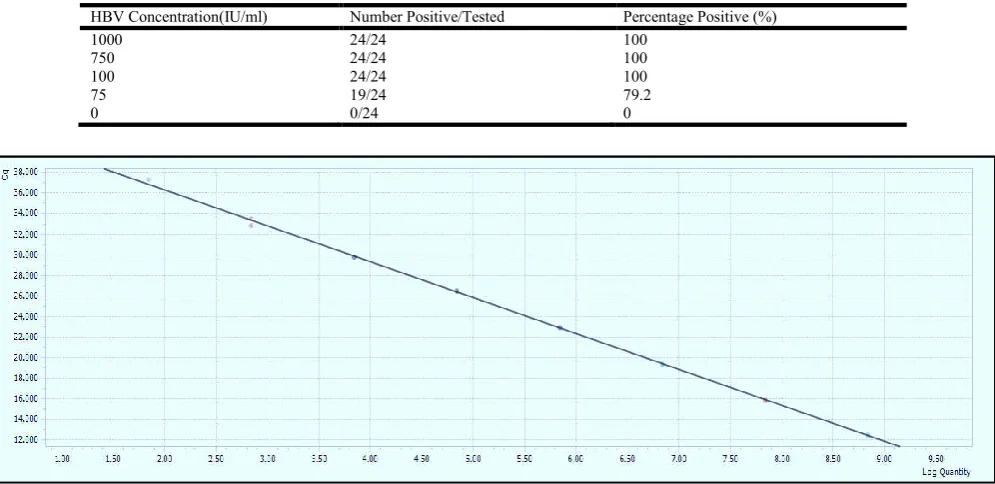
to be linear over the entire range of 5 × 101 to 5 × 10⁸ IU/ml. A typical standard curve amplification plot and linear regression analysis of these data are shown in Fig. 1A and B. The regression analysis yielded a R2 of 1.0 and a y-intercept value of 43.30. The slope of 3.5041 closely approximates the theoretical maximum amplification efficiency of 100% ( 3.32 slope) with an error rate of 0.22. Clinical specificity was determined using 24 HBV negative samples and 82 sero-positive samples. All of these sero-sero-positives were sero-positives covering from 3Log10IU/ml to around 10Lg10IU/ml of HBV
concentration while the sero-negative samples were negative for HBV DNA by our real-time PCR assay, resulting in a clinical specificity of 100%. Further, HBV real-time PCR assay showed no cross-reactivity with the samples of HIV1, HCV, CMV, HPV, JC, BK, HSV, TB, VZV, Parvo and EBV respectively. To evaluate assay reproducibility, three independent experiments were performed, in which each of the dilution levels was tested in eight replicates for 3 days. The mean intra-assay precision was less than 3% for all the 3 samples for 3 days. The CV of inter-assay variation was also very low, around 1.13%, 1.97%, 1.53% for 3Log10, 2.87 Log10
and 2 Log10 IU/ml respectively (Tables 1 and 2). The clinical
Table 1. Intra-assay variability of the real-time PCR for hepatitis B viral load detection
HBV Concentration (Log10IU/ml)
Intra-assay reproducibilitya
Average Ct SD CV%
Intra-day (Day-1), n=8
3.00 32.78 0.14 0.41
2.87 33.91 0.88 2.61
2.00 34.13 0.57 1.68
Intra-day (Day-2), n=8
3.00 32.95 0.46 1.38
2.87 34.13 0.45 1.31
2.00 34.12 0.31 0.91
Intra-day (Day-3), n=8
3.00 32.97 0.53 1.61
2.87 33.57 0.67 1.98
2.00 34.71 0.69 1.99
[image:3.595.89.503.260.322.2]a Ct value is the average Ct value of 8 replicates/sample in a single run in a single day.
Table 2. Inter-assay variability of the real-time PCR for hepatitis B viral load detection
HBV Concentration (IU/ml) Inter-assay reproducibility
b
Average Ct SD CV%
Inter-day, n=24
3.00 32.89 0.37 1.13
2.87 33.87 0.67 1.97
2.00 34.32 0.53 1.53
[image:3.595.51.549.364.606.2]b Ct value is the average Ct value of 8 replicates/sample in a single run for 3 days.
Table 3. Real-time PCR performance for hepatitis B viral load detection by probit analysis
HBV Concentration(IU/ml) Number Positive/Tested Percentage Positive (%)
1000 24/24 100
750 24/24 100
100 24/24 100
75 19/24 79.2
[image:3.595.71.530.646.770.2]0 0/24 0
Figure 1A. Real-time PCR assay standards curve showing linearity over 8-Log10 dynamic range over the range of 7 x 10⁸ to 7 x 101
IU/ml tested in duplicate
Figure 1B. Real-time PCR assay amplification plot showing linearity over 8-Log10 dynamic range over the range of 7 x 10⁸ to 7 x 101
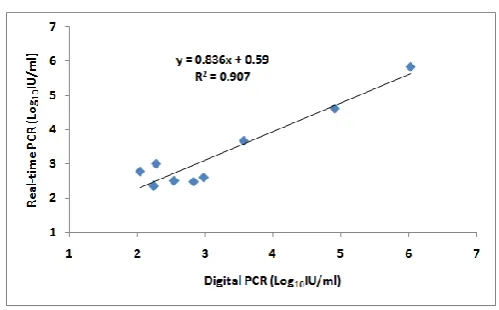
Figure 2. Comparision of hepatitis B real-time PCR with the Digital PCR
The HBV concentration of 75 IU/ml was detected about 79.2% of the times by HBV real-time PCR assay system (Table-3). To further check the accuracy of our HBV assay, 9 sero-positive samples with a viral load ranging from 2 log10 to 6
log10 IU/ml were assessed by both the methods i.e. HBV
real-time PCR assay and Quant studio 3D digital PCR system. The regression analysis revealed a good linear relationship (R2=0.907). The log difference between the two assays was less than 1.0 and r=0.95 (Figure-2).
DISCUSSION
In this study we report the effective validation and implementation of an HBV real-time PCR assay with the use of digital PCR method. This assay has clinical sensitivity at 100 IU/ml using initial sample volume of 200ul, at least an 8 log10 linear dynamic range without the need for specimen
dilution, as well as good clinical reproducibility. Quantitative HBV DNA measurements for specimens with viral load assay showed excellent correlation with Digital PCR results (r=0.907). Further, the use of internal control in our assay will further improve the quality as the probability of false negative will be ruled out to much greater extent which can be due to the presence of PCR inhibitors. Digital PCR can be used to prepare in-house standards and for the absolute quantification with higher sensitivity. There are reports of droplet digital PCR for hepatitis B viral load detection in FFPE tissue (Huang et al., 2015) as well as in plasma samples (Laure et al., 2014; Tang et al., 2016). Viral load detection in the patients is very critical in monitoring the patients during all the phases of infection and treatment. Several kits are commercially available both IVD as well as FDA approved; however their high cost is a barrier for the patients. Henceforth it is required to develop and validate an affordable technology as well as at the same time it should be equally sensitive which can be observed in this study. A review on global guidelines and modified cut-off levels for HBV has been published that showed the viral load requirement for the diagnosis and treatment at 2000IU/ml (Sethy and Goenka, 2009). Several research papers have been published for Hepatitis B viral load quantification using in-house real time quantitative PCR (Ghosh et al., 2016) but it is crucial to make the technology cheaper as well as equally effective. As the standards are required to be run with every batch in diagnostic setting to calculate actual viral load of the patient, which actually add up the cost, the preparation of in-house standards using digital PCR will be of great help to make the test cheaper and at the same time sensitive in future (Parth et al., 2017).
Various technologies and commercially available kits have come up for hepatitis B viral load detection but Real-time PCR quantification than serological tests is usually recommended because of its sensitivity, reproducibility and broad dynamic range over other technologies. An in-house validated HBV real-time PCR assay can serve not only as a sensitive assay with 79.2% (75IU/ml), but also cost-effective for the patients who are required to test their viral load several times during treatment and follow-up schedules. Further in-house standards preparation for real-time PCR using the Quantstudio 3D digital PCR system will further decrease the cost of the test as there would be no need for the commercially available standards.
Acknowledgements
We gratefully express our thanks to the SupratechMicropath staff for their technical help. Authors of the paper SM, KP and PS contributed equally to this work. No conflict of interest reported by authors.
REFERENCES
Abe, A., Inoue, K., Tanaka, T., Kato, J., Kajiyama, N., Kawaguchi, R., Tanaka, S., Yoshiba, M. and Kohara, M. 1999. Quantitation of hepatitis B virus genomic DNA by real-time detection PCR. J ClinMicrobiol., 37,2899-2903.
Arya, M., Shergill, I.S., Williamson, M., Gommersall, L., Arya, N. and Patel, H.R. 2005. Basic principles of real-time quantitative PCR. Expert Rev MolDiagn, 5,209-219. Chen, R.W., Piiparinen, H., Seppanen, M., Koskela, P., Sarna,
S. andLappalainen, M. 2001. Real-time PCR for detection and quantitation of hepatitis B virus DNA. J Med Virol.,
65,250-256.
Datta, S., Banerjee, A., Chandra, P.K., Chakraborty, S., Basu, S.K. andChakravarty, R. 2007. Detection of a premature stop codon in the surface gene of hepatitis B virus from an HBsAg and antiHBc negative blood donor. J ClinVirol.,
40, 255–258.
Ganem, D. and Prince, A.M. 2004. Hepatitis B virus infection: natural history and clinical consequences. N Engl J Med.,
350,1118–1129.
Ghosh, S., Sow, A., Guillot, C., Jeng, A., Ndow, G., Njie, R., Toure, S., Diop, M., Mboup, S., Kane, C.T., Lemoine, M., Thursz, M., Zoulim, F., Mendy, M. and Chemin, I. 2016. Implementation of an in-house quantitative real-time polymerase chain reaction method for Hepatitis B virus quantification in West African countries. JViralHep., 0,1-8. Huang, J.T., Liu, Y.J., Wang, J., Xu, Z.G., Yang, Y., Shen, F., Liu, X.H., Zhou, X. and Liu, S.M. 2015. Next generation digital PCR measurement of hepatitis B virus copy number in formalin-fixed paraffin-embedded hepatocellular carcinoma tissue. ClinChem., 61(1), 290-296.
Ide, T., Kumashiro, R., Koga, Y., Tanaka, E., Hino, T., Hisam ochi, A., Murashima, S., Ogata, K., Tanaka, K., Kuwahara, R. and Sata, M. 2003. A real-time quantitative polymerase chain reaction method for hepatitis B virus in patients with chronic hepatitis B treated with lamivudine. Am J
Gastroenterol., 98, 2048–2051.
Laure, B., Syria, L., Nathalie, D., Catherine, J., Vincent, T.andAnnabelle, S.D. 2014. Could Droplet Digital PCR Be Used Instead of Real-Time PCR for Quantitative Detection of the Hepatitis B Virus Genome in Plasma? J
Lindh, M. andHannoun, C. 2005. Dynamic range and reproducibility of hepatitis B virus (HBV) DNA detection and quantification by CobasTaqman HBV, a real-time semiautomated assay. J ClinMicrobiol., 43, 4251-4254. Mackay, I.M., Arden,K.E. and Nitsche, A. 2002. Real-time
PCR in virology. Nuc Acids Res., 30,1292-1305.
Parth, S., Shiva, M., Nidhi, S., Bhavini, S. and Mandava, R. 2017. Comparative detection of hepatitis B viral load using chip based Quantstudio 3D digital PCR and COBAS Taqman real-time PCR system. Int J ApplBiol Pharm., 8 (2), In Press.
Pas, S.D., Fries, E., De Man, R.A., Osterhaus, A.D. and Niesters, H.G. 2000. Development of a quantitative real-time detection assay for hepatitis B virus DNA and comparison with two commercial assays. J ClinMicrobiol.,
38,2897-2901.
Raimondo, G., Navarra, G., Mondello, S., Costantino, L., Colloredo, G., Cucinotta, E., Di Vita, G., Scisca, C., Squadrito, G. and Pollicino, T. 2008. Occult hepatitis B virus in liver tissue of individuals without hepatic disease. J
Hepatol., 48, 743–746.
Sethy, P.K. and Goenka, M.K. 2009. Comparison of different hepatitis B guidelines. Hep B Annual., 6, 55-79.
Shyamala, V., Arcangel, P., Cottrell, J., Coit, D., Medina-Selby, A., McCoin, C., Madriaga, D., Chien, D. and Phelps, B. 2004. Assessment of the target-capture PCR hepatitis B virus (HBV) DNA quantitative assay and comparison with commercial HBV DNA quantitative assays. J ClinMicrobiol., 42,5199-5204.
Sum, S.S., Wong, D.K., Yuen, M.F., Yuan, H.J., Yu, J., Lai, C.L., Ho, D. and Zhang, L. 2004. Real-time PCR assay using molecular beacon for quantitation of hepatitis B virus DNA. J ClinMicrobiol., 42,3438-3440.
Tang, H., Cai, Q., Li, H. and Hu, P. 2016. Comparison of droplet digital PCR to real-time PCR for quantification of hepatitis B virus DNA. BiosciBiotechnol
Biochem., 16, 1-6.
Vogelstein, B. and Kinzler, K.W. 1999. Digital PCR.
ProcNatlAcadSci USA, 96, 9236-9241.
Yim, H.J. and Lok, A.S. 2006. Natural history of chronic hepatitis B virus infection: what we knew in 1981 and what we know in 2005. Hepatology, 43, S173-S181.