DROWSINESS DETECTION FOR DRIVER
ASSISTANCE
By
EYOSIYAS TADESSE
Bachelor of Science in Electrical Engineering
Jimma University
Jimma, Ethiopia
2010
Submitted to the Faculty of the
Graduate College of the
Oklahoma State University
in partial fulfillment of
the requirements for
the Degree of
MASTER OF SCIENCE
ii
DROWSINESS DETECTION FOR DRIVER
ASSISTANCE
Thesis Approved: Dr. Weihua Sheng Thesis Adviser Dr. Guoliang Fan Dr. Damon Chandler .iii
Name: EYOSIYAS TADESSE
Date of Degree: DECEMBER, 2013
Title of Study: DROWSINESS DETECTION FOR DRIVER ASSISTANCE
Major Field: ELECTRICAL ENGINEERING
Abstract: This thesis presents a noninvasive approach to detect drowsiness of drivers
using behavioral and vehicle based measuring techniques. The system accepts stream of
driver’s images from a camera and steering wheel movement from G-27 Logitech racing
wheel system. It first describes a standalone implementation of the behavioral based
drowsiness detection method. The method accepts the input images and analyzes the
facial expressions of the driver through sets of processing stages. In order to improve the
reliability of the system, we also proposed a comprehensive approach of combining the
facial expression analysis with a steering wheel data analysis in decision level as well as
feature level integration. We also presented a new approach of modeling the temporal
information of facial expressions of drowsiness using HMM. Each proposed approach
has been implemented in a simulated driving setup. The detection performance of each
method is evaluated through experiments and its parameter settings were optimized.
Finally we present a case study which discusses the practicality of our system in a
small-scaled intelligent transportation system where it switches the driving mechanism between
manual and autonomous control depending on the state of the driver.
iv
TABLE OF CONTENTS
Chapter
Page
I. INTRODUCTION ...1
1.1.Motivations ...1
1.2.Challenges ...2
1.3.Contributions ...3
II. RELATED WORK ...6
2.1.Vehicle Based Measuring Techniques ...6
2.2.Physiological Measuring Techniques ...8
2.3.Behavioral Measuring Techniques ...9
2.4.Hybrid Systems ...12
III.. DROWSINESS DETECTION BASED ON FACIAL EXPRESSION ...14
3.1.Face Detection and Tracking ...15
3.2.Feature Extraction ...18
3.3.Feature Selection ...18
3.4.Classification...20
IV.DROWSINESS DETECTION THROUGH INTEGRATION OF FACIAL
EXPRESSION AND STEERING WHEEL MOVEMENT ...24
4.1.Steering Wheel Data Analysis ...24
4.2.Overall Approach ...26
4.3.Decision Level Integration ...27
4.4.Feature Level Integration ...29
V.DROWSINESS DETECTION THROUGH HMM-BASED DYNAMIC MODELING
...31
5.1.Hidden Markov Models ...32
5.2.Feature Discretization ...33
v
Chapter
Page
VI. EXPERIMENTS AND RESULTS ...37
6.1.Experimental Setup ...37
6.2.Experimental Procedures ...39
6.2.1
Facial Expression Based Drowsiness Detection ...39
6.2.2
Integration Based Drowsiness Detection ...41
6.2.3
HMM Based Drowsiness Detection...42
6.3.Experimental Results ...43
6.3.1
Facial Expression vs. Integration Based Drowsiness Detection ....43
6.3.2
Single Frame vs. HMM Based Drowsiness Detection...50
7
APPLICATION OF DROWSINESS DETECTION IN DRIVER ASSISTANT
SYSTEMS...55
7.1.Small-scaled ITS Testbed ...55
7.2.Manual to Autonomous Switching Control ...58
8
CONCLUSIONS AND FUTURE WORK ...60
8.1.Conclusion ...60
8.2.Future Work ...61
8.3.Further Research Opportunities ...62
vi
LIST OF TABLES
Table
Page
1.
Adaboost Algorithm...20
2.
Confusion matrices for decision level integration ...47
3.
Maximum classification accuracy for facial expression vs. integrated approaches
...49
4.
Maximum classification accuracy for single frame vs. HMM based approaches
vii
LIST OF FIGURES
Figure
Page
1.
The system diagram of drowsiness detection using facial expression ...15
2.
Procedures of localizing the face region ...16
3.
Face Detection and Tracking ...17
4.
Classification Decision for N feature vectors using Adaboost ...21
5.
Classification Decision for N feature vectors using SVM ...23
6.
Steering wheel data with time increment of50ms. ...25
7.
Steering Wheel data analysis ...26
8.
Overall System Diagram ...27
9.
Decision Level Integration ...28
10.
Feature Level Integration ...29
11.
Feature Discretization using K-means and EM clustering ...34
12.
The system diagram of drowsiness detection using HMM dynamic modeling
...36
13.
Experimental Setup ...37
14.
Driver view in the SimuRide software...38
15.
User Interface of Drowsiness Detection System ...39
16.
Gabor filter bank with 2 scales and 4 orientations ...40
17.
Classification accuracy for averaging threshold computation ...44
18.
Classification accuracy for searching maximum threshold computation ...45
19.
Classification Accuracy for Steering Wheel Data Analysis ...46
20.
Classification accuracy for decision level integration ...47
21.
Classification accuracy for feature level integration ...49
22.
Classification accuracy for single frame based drowsiness detection ...51
23.
Classification accuracy for 2 hidden states ...52
24.
Classification accuracy for 4 hidden states ...52
25.
Classification accuracy for 8 hidden states ...53
26.
Classification accuracy for 12 hidden states ...53
27.
Classification accuracy for 16 hidden states ...53
28.
Classification accuracy for 20 hidden states ...53
29.
Overview of the ITS testbed ...56
30.
Hardware setup of manual driving ...57
31.
Manual/Autonomous switching experimental setup ...58
1
CHAPTER I
INTRODUCTION
1.1.
Motivations
Drowsiness is one of the main causes of severe traffic accidents occurring in our daily life. According to the US National Highway Traffic Safety Administration, approximately 100,000 crashes occur in US each year due to drivers’ drowsiness resulting in an estimated 1,550 deaths, 71,000 injuries and $12.5 billion losses [1]. Another report [2] states that the US government and businesses spend an estimated $60.4 billion per year on accidents related to drowsy driving and it also costs the consumer about $16.4 billion in terms of property damages, health claims, lost time and productivity due to drowsy driving. In 2010, the National Sleep Foundation (NSF) reported that 54% adult drivers had driven a vehicle while feeling drowsy and 28% had actually fallen asleep[3]. The German Road Safety Council (DVR) claims that one in four highway traffic fatalities are a result of momentary driver drowsiness [4].
The tremendous casualties, injuries and property damages caused by drowsiness call for a notable initiative in developing an effective system that can detect drowsiness and take proper measures before accidents could occur. The U.S. Department of Transportation has also progressed in the making of intelligent vehicles in an effort to prevent such accidents [2]. With the increasing interest towards intelligent transportation systems, the development of robust and practical drowsiness detection system is a crucial step. Many researches are being conducted with the aim .
2
of finding drowsiness detection techniques that are not only affordable for public use but also capable of real-time detection with appreciable accuracy.
Motor companies like Toyota, Ford, Mercedes-Benz and others are also currently employing car safety technologies to prevent accidents from happening when the driver is getting drowsy. This trend is expected to make the cars smarter and significantly reduce the accidents caused by drowsiness of drivers. Adhering to these endeavors, our research is motivated by the statistical significance of accidents due to drowsiness and provides an improved and systematic approach to drowsiness detection.
1.2.
Challenges
While the ongoing researches have shown promising advancements, there are still core challenges yet to be addressed. They have used behavioral or physiological changes of the driver and sensing the various responses of the vehicle to the driver’s actions as ways of detecting drowsiness. While each method has its own merits and attributes, it also has drawbacks that pose a challenge in making it practical and efficient.
Behavioral measures pertain to the visual information of the driver and are highly affected by the lighting condition, the quality of the measuring device and other external factors. Physiological changes include variation of pulse rate, brain waves or electric signals of body muscles. While such measures could potentially give accurate indication of fatigue, they are highly affected by artifacts. Vehicle based measures such as vehicle speed, steering activity and lane deviation are highly affected by external factors and are unreliable to effectively detect drowsiness of drivers. One obvious possibility to remedy this issue is to improve the measuring devices and processing methods which many researchers have been trying to deal with. Another possible method is not only improving the measuring methods but also combining them in a complementary way to increase their reliability as a unit on which only little has been done.
3
Another main challenge is in setting a criterion as to how to define the critical events of interest when accepting the input data. For vehicle based measures, for example, these events may include steering movements with little or no corrections and frequent macro corrections (both could indicate drowsiness). In behavioral measures, such events that could indicate drowsiness could include muscle movements in the detected face as whole, the eyes region or the mouth region. Another subtle challenge that goes hand in hand with defining the input parameters is specifying the optimum time window to state the drowsiness of the driver as early as a critical event has been detected. This can only be evaluated through experimentation and there exists an unavoidable tradeoff between speed and accuracy of prediction. On one hand, if the time window is too short, the system may be merely detecting “noise,” and may therefore generate excessive number of false positives. On the other hand, if the time window is too long, the system may be too slow to be of any practical use.
In our thesis, we have proposed a novel approach of drowsiness detection and addressed the different challenges through sensor integration, parameter optimization, feature selection and modeling.
1.3.
Contributions
Our main objective is to come up with noninvasive, cost effective and efficient drowsiness detection system that can easily be implemented in driver monitoring systems of actual vehicles. We have primarily implemented behavioral based drowsiness detection method through facial expression recognition. Many of the previous research works and commercially available behavioral measuring methods mainly focus on eye closure and not on other facial expressions. While notable results can be achieved through the analysis of eye closure, including other facial motions and behavioral changes could give more reliability to the system which our research focuses on.
4
In an effort to further increase the reliability of the behavioral based drowsiness detection system, we integrated it with a vehicle based analysis of steering wheel movement in independent as well as comprehensive approaches. Many of the previous works have mainly focused on developing a drowsiness detection method using one of the two approaches and not so much has been done on their integration. Our thesis presents a systematic approach of developing an integrated
drowsiness detection algorithm, implementing it and assessing its effectiveness in various virtual driving scenarios. We explore different ways of integration and input processing techniques and optimize the different system parameters to maximize the accuracy and speed of detection. By accepting stream of images of the driver’s facial movements and the car controller data including the steering wheel activity, the system can determine the status of the driver as drowsy or non-drowsy.
We have also proposed a new method of modeling the dynamics of facial expressions of a driver during drowsy and non-drowsy episodes. The facial expression based drowsiness detection method initially proposed uses a single frame based static classifier which does not consider the temporal information of the sequences of frames. This method uses dynamic classifier to model the temporal information of the sequences of frames and gives decision according to the transition of facial expression in the sequences of frames.
The system gives decision in real time and hence can easily be integrated with car safety systems to alarm the driver, undertake safety measures or switch between manual and autonomous driving. We first implemented the algorithm in a simulated driving setup and evaluated its
performance through experimental results. Later, we implemented the system as client application connected to a server equipped with indoor localization and racing wheel system. The server is connected to RC cars that can be controlled manually using the racing wheel system as well as autonomously by generating commands from the server based on a designed trajectory. Our system gives a real-time decision of the state of the driver to the server and the server will switch
5
the control between manual and autonomous driving according to the decision. The experimental results from the implementation are satisfactory and have shown the practicality of our system. The remainder of this thesis is organized as follows:
Chapter II. Presents a comprehensive review on various literatures of previous and current works on drowsiness detection, relevant findings and successful methodologies that have been implemented in drowsiness detection systems.
Chapter III. Describes the overall approach and the algorithm procedures of behavioral based drowsiness detection system through facial expression recognition.
Chapter IV. Presents steering wheel analysis based drowsiness detection system and the integration of the facial expression recognition with steering wheel data analysis in decision level as well as feature level for an improved and more reliable drowsiness detection system.
Chapter V. Gives a detailed explanation of Hidden Markov Models and drowsiness detection using HMM based dynamic modeling.
Chapter VI. Describes the experimental setup and the experimental results for each of the methods proposed, evaluated their classification accuracies and compared their performances.
Chapter VII. Presents a case study of the application of the system in an intelligent transportation test-bed.
Chapter VIII. Summarizes the work that has been done in this research and provides a projection of what could be done in the future to improve the system.
6
CHAPTER II
RELATED WORK
The end applications of many of the researches that have been done on drowsiness detection are mainly focused on car safety systems and monitoring of driver’s state of fatigue. These driver assistant systems have been implemented through different sensors that indicate the driver’s behavioral or physiological change while driving or the change in measure of the various responses of the vehicle. In recent years, researchers have conducted experiments and implemented various techniques in order to determine drowsiness of drivers in real-time scenarios[5]. These techniques can be categorized in to four major groups:
1. Vehicle based measuring techniques 2. Physiological measuring techniques 3. Behavioral measuring techniques 4. Hybrid techniques
2.1.
Vehicle based measuring techniques
Real time drowsiness detection has been implemented using different detection techniques analyzing various types of input data. In this approach, the driver’s drowsiness is measured through analyzing the different controller signals of the vehicle such as steering wheel movement, the pressure from the gas and brake pedal, speed of the vehicle, change in shift lever and the
7
deviation from lane position [6, 7]. The measured data is constantly monitored and any data variation that crosses a specified threshold indicates a significantly increased probability that the driver is drowsy. The measurements of these signals are obtained from sensors attached to the vehicle. These measurements are generally taken in controlled environments with a simulated driving setup because conducting such experiments in real life scenarios is unsafe and could lead to accidents.
Among the vehicle-based metrics that have been used to determine drowsiness, steering wheel movement has been widely shown by researchers to give better detection capability [6, 8-10]. The steering angle is constantly measured by a sensor and the change in angle movement is monitored if it is within or exceeds the specified threshold. In normal driving, the driver makes many small adjustments of steering wheel (between 1 – 5 degrees) to keep position within the lane and few large adjustments (between 6 – 10 degrees) during lane change or at a road curvature[6]. When the driver is drowsy, on the other hand, the driver anticipates making lane adjustments by making many large steering wheel movements and less small adjustments. This leads to a significant and unpredictable variation in steering wheel movement which can be analyzed to determine the state of the driver.Steering wheel movement has been adopted by major car companies such as Nissan and Renault to detect fatigue [11]. However, it works in very limited situations because it is more dependent on the geometric characteristics of the road than the kinetic characteristics of the vehicle.
The other vehicle based metrics have similar limitations as steering wheel movement in
accurately detecting the drowsiness of the driver. The measured data from these metrics does not fully differentiate between normal and drowsy driving as it depends on the nature of the road, the traffic and the vehicle. Moreover, the deviation in normal driving analyzed from the vehicle based measurements may not necessarily be caused by drowsy driving. Similar measurements could be read from a driver with a lack of experience or other driving impediments unrelated to
8
drowsiness. Generally, drowsy driving is bound to show certain signal variations in the vehicle based measurements that can easily be analyzed and detected, however, the detection of such variations in measurements may not necessarily come as result of drowsiness. This makes vehicle-based measurements poor predictors of performance deter because of drowsiness.
2.2.
Physiological measuring techniques
The second approach makes use of the measurement of physiological activities of the human body such as brain wave (Electroencephalogram - EEG), heart rate (Electrocardiogram – ECG), electric signals from muscle cells (Electromyogram – EMG) or eye movement
(Electrooculography – EOG) [12-14]. The electrodes are attached to the specific parts of the body according to the measuring technique and the electric signal is measured and analyzed to
determine the drowsiness state of the driver.
Physiological signals are weak and can easily be distorted with noise. To minimize the noise, researchers have used different techniques to preprocess the raw data. Patel et al. [15] used band pass filters and thresholding to remove noise from the input ECG data in the low and high frequencies. After preprocessing stage, the output data is analyzed in frequency domain by using Fast Fourier Transforms (FFT) and important features are extracted for classification. Fu-Chang et al. [16] performed similar experiments on EEG data to determine drowsiness of a driver. They used Independent Component Analysis (ICA) to segregate and localize mixed EEG data to distinct brain activities. From the preprocessed data, features are extracted in frequency domain using FFT and classified using a Self-organizing Neural Fuzzy Inference Network. Hu and Zheng [17] also implemented drowsiness detection system by making use of EOG data. They initially identified the eye blinks from the recorded EOG data and extracted the eye lid movement parameters as features to be classified using Support Vector Machines (SVM).
9
The main attribute of physiological measuring techniques is that they are able to determine the decrease in level of alertness ahead of time before the actual drowsiness episode starts. Humans do not naturally get drowsy in an instant and there is gradual decrease in response or activity of the various body parts which eventually lead to drowsiness. For example, in EEG analysis, the change in signal power at the alpha range (8 – 12Hz) and indicates early sign of drowsiness [6]. Physiological measuring techniques can measure such changes at the early stages and the person can be alerted or the proper safety measure can be taken before accidents could occur. The measured signals are also reliable to detect drowsiness as their correlation with the alertness of the driver is quite accurate and they are usually independent of the external factors such as the nature of the road, the type of vehicle or the traffic. Hence, they have a more accurate drowsiness detection capability than vehicle based and behavioral measuring techniques. However, the main limitations behind these techniques are:
They are not practical for everyday use as it would require the driver to always wear the sensing devices which causes discomfort.
Physiological signals are generally very weak and can easily be contaminated by artifacts that are caused by muscle movements of different body parts.
They need intricate hardware systems to sense, amplify and preprocess the signal for analysis. The hardware cost of such systems is too high to be used commercially.
2.3.
Behavioral measuring techniques
The third approach makes use of computer vision techniques to detect the changes in driver’s behavior such as facial expressions, head movements, eye closure or constant blinking and yawning [18]. These and other changes in patterns of behavior of a driver are manifested when the person is feeling drowsy. Behavioral measuring techniques take the visual information of the driver in real time, process the information and determine the state of the driver based on the level of presence of the changes in the driver’s behavior.
10
Among the computer vision-based approaches, researchers have mainly focused on the analysis of blinks and the percent of closure (PERCLOS) of the driver’s eyes to determine the drowsiness of the driver [19-22]. According to the study by the Federal Highway Administration, PERCLOS had been found to be the most reliable measure of drowsiness among many other measuring techniques [23]. Initially, stream of images of the driver are obtained from video sources such as webcam, digital video camera or infrared camera. The next step is preprocessing the images to detect the face and eyes of the driver. The output from the preprocessing stage will be used to extract certain features needed to determine the changes in behavior of the driver. Li et al. [24] performed successive image filtering techniques such as image subtraction, morphologically closed operations and binarization, and finally counted the number of pixels around the eyes region to detect eye closure. Liu et al. [21] extracted simple features from the temporal difference of consecutive image frames and used them to analyze the rules of eyelid movement during drowsiness. Garcia et al. [25] have also presented a non-intrusive approach to drowsiness
detection. They used an IR illumination system and a high resolution camera to accept a stream of images and perform face and eye detection. They applied filters on the eyes region and performed horizontal and vertical projections of the pixel values of the detected eye area. The vertical projection corresponds to the eye height which is used to evaluate the PERCLOS. Zutao and Jiashu [22] initially performed face and eye detection and tracked the eye pupils using non-linear Kalman and mean-shift tracking. They also performed vertical and horizontal projections of the pixels around the eyes region. Since the eye ball color is much darker than the surrounding, they calculated the pixel values in the vertical projection to determine the percentage of eyelid closure. Flores et al. [26] computed the binary, gradient and logarithm image of eyes region, obtained random samples around the region and used an elliptic shape to represent the eyes. They then used an SVM classifier [27, 28] to decide whether the eyes are closed or not.
11
One of the main factors affecting the performance of PERCLOS based systems is the ambient lighting condition. Using a webcam could be appropriate in day time or when there is sufficient light to clearly see the eyes of the driver but could perform poorly when there is limited lighting condition. On the other hand, a camera with infrared technology might work well during the night but perform poorly in the daylight since the retinal reflections of infra-red cannot be obtained in the presence of ambient sun light reflections [16]. Moreover, mere analysis of eye closure may not be enough to predict drowsiness as the driver may not necessarily close his eyes throughout the drowsy episodes especially during the early stages. A drowsy driver usually does not go to deep sleep immediately rather alternates between nodding off and opening his eyes. The opening of the eyes in such transitions can empirically be misinterpreted as being awake if eye closure is the only parameter being analyzed. Hence, in recent years, some researchers are considering other facial movements in addition to eye closure such as eyebrow raise[29], yawning[30] and head or eye position orientation[31, 32].
In developing facial expression based drowsiness detection systems, the initial and profound task is identifying and representing facial behaviors systematically. Gu and Ji were among the first to present the idea of recognizing facial behaviors, such as facial expressions, orientation and gaze in a systematic approach [33]. These facial expressions were represented by single or a
combination of individual muscle movements called action units. These action units have been carefully coded with a unified description method of expression called Facial Action Coding System (FACS) [34]. They adopted a dynamic Bayesian Network in order to capture the spatio-temporal representation of the facial expressions and detect fatigue. Vural et al. [18] employed machine learning methods to analyze facial movements during drowsy episodes. These facial motions include blinking, yawn motions, eye-gaze, eyebrow raise and other movements that are represented by action units of FACS[35]. They trained SVM classifiers for each action units with a training dataset which is coded by certified FACS coders. Finally, they employed and compared
12
Adaboost and multinomial ridge regression to classify the action unit outputs and predict drowsiness.
Many of the researches on behavior based drowsiness detection system used frame based
classification techniques that give decision based on the spatial features extracted from one input image frame. While this is essentially sufficient for some scenarios where there is definite separation of behavioral changes during drowsy and non-drowsy episodes, it lacks efficiency in situations where there is non-uniform change in transition between drowsy and non-drowsy episodes which actually is the case in most real life scenarios. Moreover, analysis of image sequences gives more accurate description of facial expressions and frame based classification approaches do not utilize all the information available in image sequences. The dynamic Bayesian network in Gu and Ji’s work consists of a first-order HMM along with the Bayesian network to capture the temporal dynamics of the facial movements during drowsiness across consequent frames in a specific period of time[33]. Yin et al. [36] have also implemented dynamic
drowsiness detection system using multi-scale Gabor features from image sequences. To account for the temporal aspect of human fatigue, they applied Local Binary Pattern (LBP) operators to the multi-scale image sequences and divided them into region sequences. They computed the histogram of each LBP region sequences and concatenated them as dynamic features. By applying Adaboost weak learning algorithm [37], they selected the most important features and constructed a strong cascaded classifier to detect fatigue. Generally, there is still a challenge in extracting dynamic features of facial expressions for drowsiness detection and there have only been few researches done on this area thus far.
2.4.
Hybrid Systems
All the measuring techniques discussed have their own advantages and limitations. Vehicle-based measures are nonintrusive but lack reliability. Physiological methods are reliable and accurate but are intrusive. Behavioral methods are more reliable than vehicle based measures but are affected
13
by the ambient light. Hence it is wise to fuse the information from different measuring techniques in a comprehensive manner that makes the best use of their advantages. However, there are only few existing works on drowsiness detection by fusing different measuring techniques. Among the pioneer researches conducted, the idea of integrating vehicle based and behavioral detection methods was presented in the Advanced Driver Fatigue Research project report by A.
Eskandarian et al. [38] for the U.S. Department of Transportation. They preprocessed and formed vectors using 15 seconds of steering wheel data. They also implemented eye tracking to record the pupils’ diameter and formed a vector of eye closure data of 15 seconds. Then they
concatenated the two vectors and trained an Artificial Neural Network (ANN) to determine the state of the driver. Cheng et al. [39] also combined behavioral measures and vehicle based measures and concluded that the reliability and accuracy of the hybrid method was significantly higher than those using single sensors.
14
CHAPTER III
DROWSINESS DETECTION BASED ON FACIAL EXPRESSION
RECOGNITION
Inspired by the previous researches of behavioral measuring techniques, we developed a real time drowsiness detection system that incorporates facial expression changes instead of only eye closure. It makes use of a computer vision approach to track the face of the user through time and detect the facial motion and appearance changes occurring during drowsiness.
When a driver gradually feels drowsy, he/she manifests various behavioral changes that can be analyzed and regarded to attest that the person is feeling drowsy. The behavioral changes can include frequent blinking, prolonged eye closure, head tilting to a certain direction, eyebrow rising in an effort to keep the eyes wide awake and seldom occurrences of jaw drop and yawning. Our primary objective is to come with essential features that can clearly show these behavioral changes on the face of the driver from a set of training videos recorded during drowsy and non-drowsy episodes. We used data-driven feature selection technique to isolate the most important features clustered around the face region manifesting the behavioral changes. We chose a classification method that can analyze the cluster of selected features in real time and classify them with appreciable confidence.
In this thesis, we addressed the optimization of the different parameters and settings of the functional blocks of the system. We started with considering different regions of interest of the
15
driver’s visual information that we can use to extract and cluster the essential features for
classification. We proceeded to choosing different ways of setting the threshold to select features that classify the training images with the minimum error. We also used different classification methods and optimized their parameters for better classification accuracy.
Face Detection
and Tracking
Feature
Extraction
Feature
Selection
Classification
Input
Image
Result
Figure 1. . The system diagram of drowsiness detection using facial expression.
The general block diagram of the system is shown in Figure 1. It accepts streams of input images from a camera in front of the driver at a rate of 15 frames per second. It uses OpenCV’s library to accept each frame and store it in an image structure that can easily be used for further processing [40]. The stream of image frames then goes through four main image processing stages:
Face detection and tracking Feature extraction
Feature selection Classification
3.1.
Face Detection and tracking
In this stage, we automatically identify the location and size of the face of the user in the captured image frame. We similarly perform face detection on the sequences of incoming frames and use an effective tracking algorithm to locate the face and record its changes in position over time. The recorded face locations will later be used to select the face region and extract essential features for further processing.
16
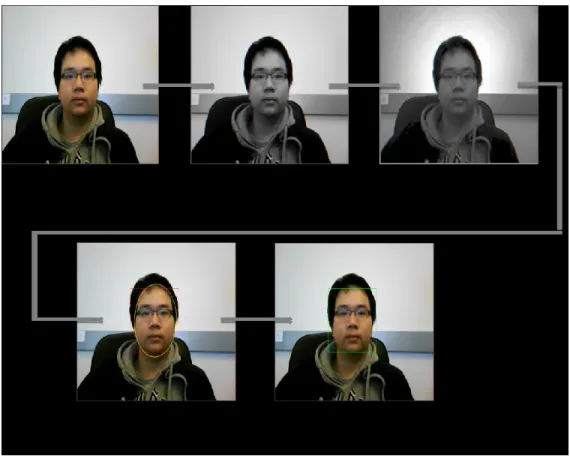
Figure 2. Procedures of localizing the face region
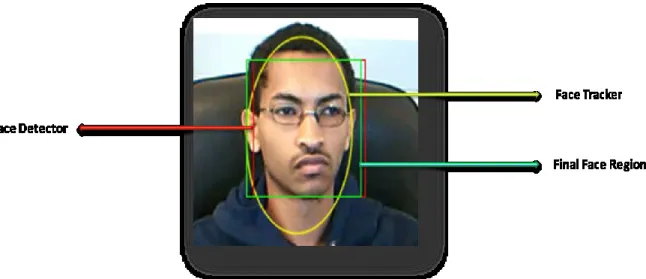
The procedures for localizing the face region from the input image are shown in Figure 2. Originally, depending upon the light intensity of the environment, the captured image from the camera may have a very small range of contrast between the driver’s face and the background. Once the grayscale of the image is obtained, the system normalizes the brightness level and increases the contrast of the image through histogram equalization. Next, it uses Viola-Jones robust real time face detection algorithm [41] implemented in OpenCV to detect the face of the user. Among the various techniques which have been proposed for face detection, this algorithm is better suited for real time face interactive applications because of its low false positive rates and low computational complexity. According to our experiment, however, using the face detector alone is not reliable to effectively localize the face when the driver’s head rotates to a certain angle or suddenly moves to a certain direction which frequently happens when the driver is drowsy. Hence we implemented Camshift tracking algorithm [42, 43] to track the face of the
17
driver under different circumstances where the face detector fails to detect. The final face region is determined according to the outputs from both face detector and tracker.
In Camshift tracking, we initially perform face detection and use the color information of the detected face region as a template for the tracking of consecutive frames accepted from then on. It first creates the color histogram of the detected face and calculates the probability that each pixel belongs to the face region (face probability) based on the histogram. It recalculates the face probability of each pixel for the new sequences of frames and estimates the face location that covers the area with the highest concentration of pixels with high face probabilities.
When the next frame is captured, we perform face detection and Camshift tracking in separate threads. This is because Camshift generally looks for a region having the same color makeup as the detected face and it may include the neck and other unnecessary regions having similar color makeup as the face region. Therefore, the region tracked from the Camshift will be adjusted according to the size of the final face region from the previous frame and the size of the detected face from the face detector if the face is detected as shown in Figure 3. The final face region is then passed to the next processing stage to extract features.
18
3.2.
Feature extraction
The grayscale of the input image is passed to Matlab engine along with the locations of the detected face. We have used two approaches of using the input image for feature extraction:
Crop the detected face of the user
Crop the region where the eyes are most likely located
The input image is reshaped to a fixed size and its Gabor features are extracted through Gabor Wavelet Decomposition [44, 45]. We preferred Gabor wavelet features for detection because they can represent changes in surface textures such as wrinkles, bulges and changes in feature shapes and they are relatively more robust to illumination changes and random head movement.
3.3.
Feature Selection – Adaboost weak learning Algorithm
The facial features from the Gabor decomposition are too many to be used for classification in their entirety and hold a lot of redundant information. Hence we used the Adaboost weak learning Algorithm [46] to select the most important features for classification.
Adaptive boosting is an algorithm for constructing a “strong” classifier as linear combination of “weak” classifiers
h
j
x
.
T j j jx
h
x
f
1)
(
(1)Where, j is calculated fromthe training error j of the
j
thweak classifier as: j j j
ln 1 2 1 (2)19
The weak classifier used here is a simple threshold function
h
j
x
consisting of only one feature
x
f
j [47].
otherwise p x f p if x hj j j j j 1 1
(3)where
j is a threshold andp
j is a parity to indicate the direction of the inequality.We compute the threshold value in two different ways:
Averaging: It can be computed as the average of the mean value of the positive
samples and the mean value of the negative samples on the
j
th feature response:
m p l n n n j p p j j f x y l y x f m 1 1 1 | 1 1 | 1 2 1
(4) Searching-maximum: We can also choose a threshold among the
j
th feature of all the samples that maximizes separation between the classes:
S T S S T S
j maxargmin ,
(5)
Where S+ is the number of positive samples below threshold, S- is the number of negative samples below threshold, T+ is the total number of positive samples and T- is the total number of negative samples.
20
Algorithm
: Adaboost (Schapire and Singer, 1999)
Input:
N training samples with labels
,
with
positive
and
negative
samples
Initialize:
the weights of training samples :
Do for
1.
Normalize all weights
2.
For each feature
, train a weak classifier
with error
3.
Choose
with the lowest error
4.
Update the weights:
where
and
is a normalization
constant
Output:
Final strong classifier
Table 1. Adaboost Algorithm
3.4.
Classification
At this stage, the selected features from the Adaboost are classified to a state of either drowsy or non-drowsy by using different classification methods. The cascaded linear classifier built from the weak classifiers selected in the Adaboost feature selection can be used as one classification method. We have also chosen Support Vector Machines (SVM) as another classifier as it has been successfully used in a wide variety of data classification and pattern recognition applications [48]. We evaluated the classification accuracies of each method and compared their results for the different feature extraction and selection parameters. Each classification method gives an output
21
for the set of selected features extracted from a single frame. However, when giving a final decision of the state of the driver, we consider a set of such classification outputs from sequence of frames of predetermined window size. This helps make the system more robust and reliable.
i. Adaboost
We linearly combine the weak classifiers working on each selected feature to get a strong classifier and obtain the classification output H
x as follows:
T j j jh
x
sign
x
H
1)
(
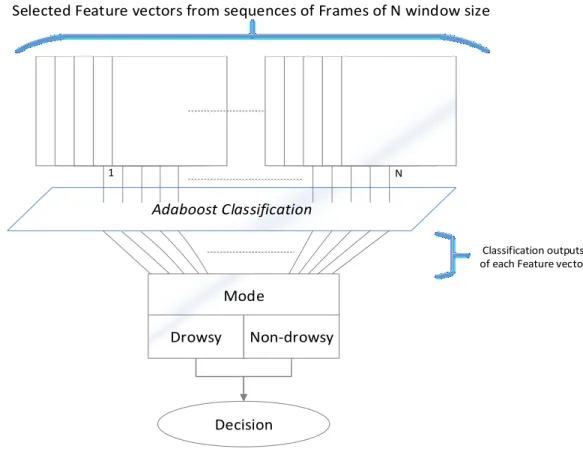
(6)For a final decision, we calculate the mode of the classification outputs of sequences of frames and declare the state of the driver based on the majority of the outputs as shown in Figure 4.
Mode
Drowsy Non-drowsy
Decision
Selected Feature vectors from sequences of Frames of N window size
Adaboost Classification
Classification outputs of each Feature vector N
1
22 ii. Support Vector Machines (SVM)
We are essentially dealing with a two-class classification problem (drowsy or non-drowsy). We chose SVM as it is generically used for binary classification problems and has attributes that make it a perfect fit to our problem.
SVM does not depend on the dimensionality of the input space It is less prone to over-fitting
It always gives an optimum global solution during training.
We feed the selected features to the SVM for nonlinear classification by using Radial Basis Function (RBF) kernel method [49]which proved to have a gain in performance over the linear combination of the Adaboost weak classifiers. The RBF kernel maps the training feature vectors nonlinearly in to a high-dimensional feature space. In this space, an optimal separating hyper-plane is constructed by the support vectors corresponding to the centers of the RBF kernels in the input space.
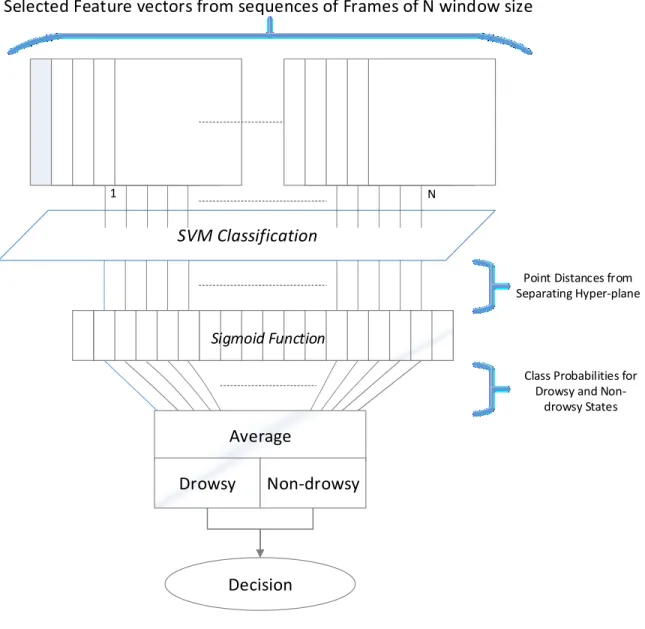
When giving the final decision of the state of the driver based on sequences of frames, for each classification output, we first calculated the point distance from the separating hyper-plane. Next we used sigmoid function to convert the distance to a class probability as shown in Figure 5.
(7)
Where d is the point distance from separating hyper-plane
The output obtained from the sigmoid function ranges from 0.5 to 1 because its input is distance which is positive. The output will be assigned as a class probability for the class output of the SVM for each feature vector. The class probability for the complement class of each feature vector will then be the sigmoid output subtracted to one. For example, if a given feature vector is
23
classified as drowsy by the SVM classifier, then we first obtain the class probability for drowsy
d
P
from the sigmoid output of the calculated point distance. The class probability for the non-drowsyP
n of the feature vector then becomesP
n
1
P
d. Then, for a final decision, we calculate the average of both drowsy and non-drowsy class probabilities for sequences of such feature vectors and declare the class with the larger average as the state of the driver.Average
Drowsy
Non-drowsy
Decision
Selected Feature vectors from sequences of Frames of N window size
SVM Classification
Point Distances from Separating Hyper-plane
Sigmoid Function
Class Probabilities for Drowsy and
Non-drowsy States N
1
24
CHAPTER IV
DROWSINESS DETECTION THROUGH INTEGRATION OF FACIAL
EXPRESSION AND STEERING WHEEL MOVEMENT
In this chapter, we include steering wheel movement as an additional input to the facial
expression based drowsiness detection method. While the detecting facial expressions of drivers could give appreciable results in most cases, there are certain situations where the ambient light could deteriorate the quality of input images, there could be certain occlusions covering part of the face or the proposed algorithm could fail to correctly detect the state of the driver. By adding steering wheel data analysis to the proposed algorithm, we increase the system’s reliability as it can properly respond in these situations. Steering wheel data analysis is independent of the ambient light, face occlusions or the limitations of the facial expression detection algorithm. Moreover, it has been shown that there is a good correlation between the steering wheel movement and the drop in the state of vigilance while driving [8, 9].
4.1.
Steering Wheel Data Analysis
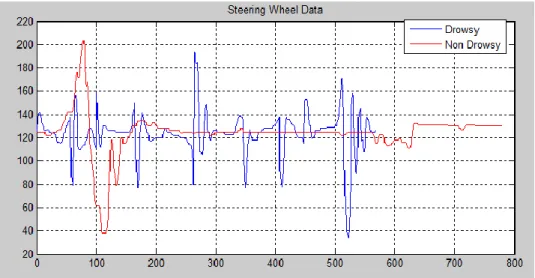
In an alert state, the driver tends to make small adjustments to the steering wheel angle and hence there will only be small variation. When the driver is in a drowsy state, the way he/she drives becomes unpredictable, resulting in a large change in trajectory, for example, zigzag driving and there will be a larger amplitude of movement to keep the vehicle in the center of the lane. In Figure 6, we plotted the steering wheel data with respect to time of one subject while driving in
25
drowsy and non-drowsy states. We collected 27sec duration of steering wheel data while the driver is drowsy and 39sec duration of steering wheel data while the driver is non-drowsy. It shows that the steering wheel angles during drowsiness randomly change in large magnitudes as the time evolves. There are only small variations of steering wheel angles for non-drowsy condition. Even if there are large magnitude changes, they are not as spiked as in the case of the drowsy conditions. The steering wheel angle ranges from 0 to 250 and the wheel is neutral at 125.
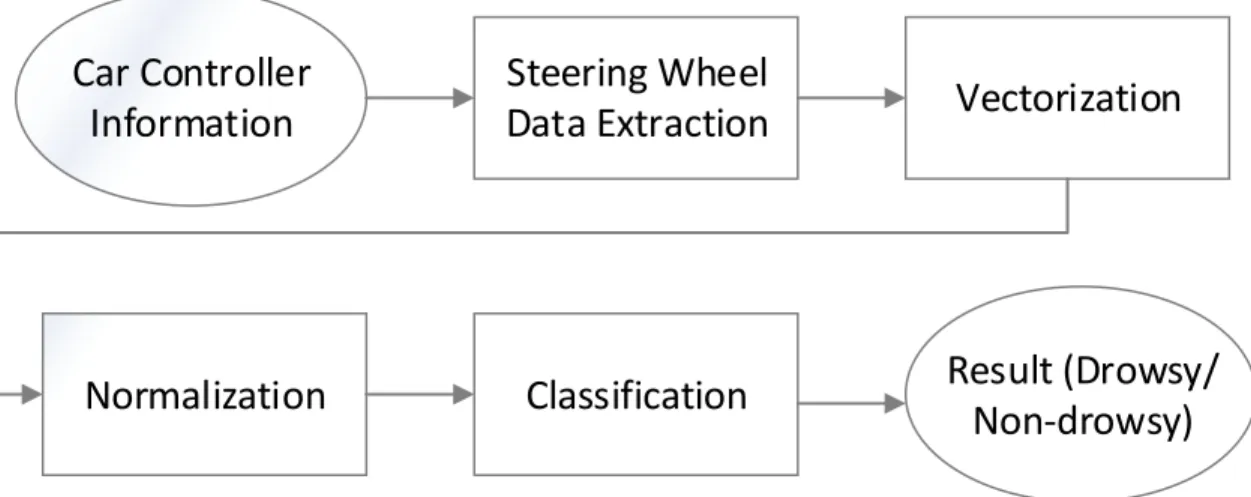
Figure 6. Steering wheel data with time increment of 50ms. The unit of Y axis is degree. Figure 7 shows the standalone implementation of steering wheel data analysis. The system accepts the steering wheel data along with the entire car controller information at a rate of 15 packets per second and extracts the steering wheel data to a set of feature vectors for processing. As mentioned above, the steering wheel angle obtained ranges from 0 to 250 with a neutral state at 125. In order to change it to an angular measurement that ranges from -90 to 90 with a neutral state of 0, we used a normalization equation:
(8)
Where, is the normalized steering feature vector and is the input steering feature vector
26
After vectorization, the training set of feature vectors is used to build an SVM classifier model that categorizes incoming data to either drowsy or non-drowsy. During the real time testing, the steering wheel data is populated in a dynamic vector and passed to the SVM classifier.
Vectorization
Steering Wheel
Data Extraction
Normalization
Classification
Car Controller
Information
Result (Drowsy/
Non-drowsy)
Figure 7. . Steering Wheel data analysisUsing steering wheel movement to detect drowsiness has its advantages as it performs better in certain situations where the computer vision approach does not. However, as a standalone
drowsiness detection approach, it is also unreliable as it can be influenced by outside factors such as nature of the road, the vehicle, the traffic and the driver’s way of driving. Hence, in this chapter, we propose optimum ways of integrating the two methods so they can complement one another.
4.2.
Overall Approach
We proposed a system which implements the two well known non-invasive approaches: drowsiness detection based on facial expression and steering wheel movement, in both
independent as well as comprehensive approaches. With the ultimate goal of finding a practical and unobtrusive method of detecting drowsiness of a driver, the steering wheel data analysis or the computer vision approach alone may not be sufficient to accurately determine the state of the driver, especially under different circumstances and different behavioral manifestations of the
27
driver. Hence integrating the two sources of information will increase the detection reliability of the system and deal with situations where a single source may not give sufficient results.
Feature Level Integration Extracted Facial
features
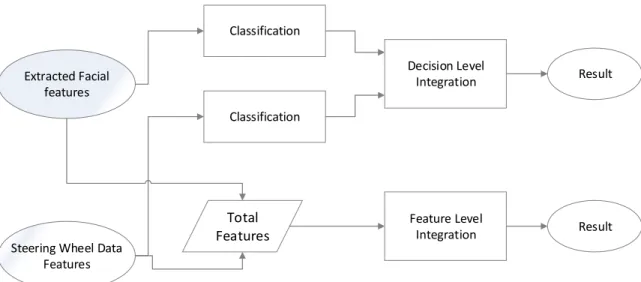
Steering Wheel Data Features Result Decision Level Integration Classification Classification Result Total Features
Figure 8. Overall System Diagram
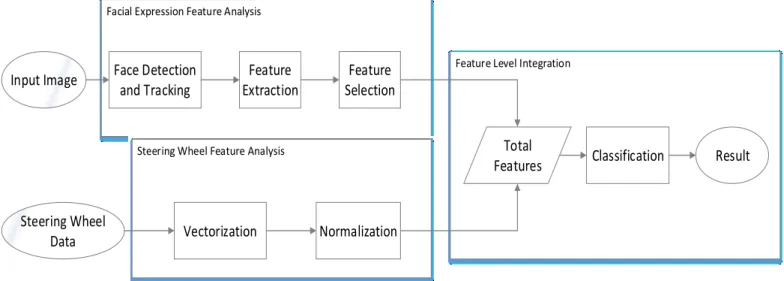
The overall system diagram is shown in Figure 8. There are two main inputs to the system: the stream of driver’s images and the stream of steering wheel data. The stream of images passes through processing the following stages: face detection, feature extraction, feature selection and classification. The steering wheel data pass through the feature extraction and classification stage. As for integration of these two sources of information, the final output can be obtained through data fusion at either decision level or feature level.
4.3.
Decision Level Integration
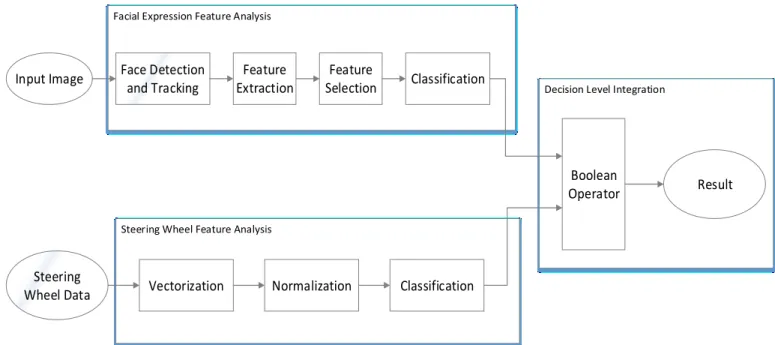
One easy way of integration is at decision level where the outputs from both systems are combined using simple Boolean algebra. The final decision of the state of the user is given by calculating the mode of the classification results of sequences of images.
28 Feature Selection Face Detection and Tracking Feature Extraction Input Image
Vectorization Normalization Classification Steering Wheel Data Result Classification Boolean Operator
Figure 9. Decision Level Integration
This method is illustrated in Figure 9, either disjunctive or conjunctive logic can be used. Disjunctive Operation: (9)
Conjunctive Operation: (10)
However, this method may not necessarily enhance the performance of the detection because of the following two main reasons:
The limitation of any of the two systems can easily be transferred to the overall output of the system. For example, if a disjunctive operator is used and one of the two systems gives an output of false positive then the overall output will also be false positive irrespective of the output of the other system.
The combination doesn’t reflect the correlation of the two inputs during drowsy and non-drowsy episodes. For example, when a driver is feeling non-drowsy, not only can it be seen through the person’s facial expression but also in the way the person drives where he/she steers unpredictably in an attempt to keep the vehicle in the right path. If we can manage
29
to incorporate such variations in the steering wheel data along with the change in facial patterns as complementary inputs to one another, we can empirically get better detection outputs which is not so for this case.
4.4.
Feature Level Integration
Another method of integration is to combine the two sources of data at feature level using an SVM classifier. By using feature extraction and selection methods, we get a single vector of the most important features from the input image and then append the steering wheel data features to that vector, which can be input to the SVM classifier as shown in Figure 10.
Feature Selection Total Features Classification Face Detection and Tracking Vectorization Normalization Feature Extraction Input Image Steering Wheel Data Result
Figure 10. Feature Level Integration For N-sized facial features and M-sized steering wheel features , we have the concatenated feature vector as follows:
U (11)
In the same way as the decision level integration, the system gives final decision of the state of the driver for sequences of total feature vectors. But in this case, it first calculates the point to separating hyper-plane distance of each total feature vector in the sequence. It uses sigmoid function to convert the distances to drowsy and non-drowsy class probabilities. Finally, for a final
30
decision, it calculates the average of both class probabilities and declares the class with the larger average as the state of the driver.
31
CHAPTER V
DROWSINESS DETECTION THROUGH HMM-BASED DYNAMIC
MODELING
In the facial expression based drowsiness detection method proposed previously, it performs classification on frame by frame basis even if the final decision is given for a sequence of frames. The main limitation in this approach is that it does not consider the temporal sequence of the frames when it declares the state. This is because it either calculates the mode of the classification of each frame or the average of the class probabilities of each frame. The position of the frames in the sequence can be interchanged in different possible ways and the system would still give us the same final decision.
According to a psychological research [50], analyzing facial motions through sequences of frames is crucial in recognizing facial expressions. It also shows that humans are better at recognizing facial expressions from sequences of frames than individual frames. This is because facial expressions have a unique dynamic pattern of behavioral changes that can easily be recognized in time. Consequently, more researches have started to be conducted with a particular focus on modeling dynamic features to recognize facial expressions, and Hidden Markov Models has been the most widely used method in modeling the temporal dynamics [51-54] . Basing our work in these and other researches, we have proposed a method to model the dynamics of facial expressions of drowsiness in the same way as the general facial expressions have been modeled in recognition of human emotions.
32
In this chapter, we implement dynamic modeling approach to make use of the temporal sequences of frames to recognize the driver’s expression. We model the dynamics of the driver’s drowsiness by utilizing all the information available in the image sequences. We also optimize the modeling parameters and the dynamic features that capture the temporal pattern of the facial expressions indicating drowsiness.
5.1.
Hidden Markov Models
Hidden Markov Models have been widely used for various dynamic classification problems and statistical modeling. The main attribute of HMM is that it characterizes an input non stationary signal as a parametric random process and the parameters can be determined or estimated in a probabilistic manner. HMM is modeled to have a set of unobservable stochastic processes (hidden states) that produce a sequence of observations. It uses the transition probabilities between the hidden states and learns the conditional probabilities of the observations given the state of the model.
Hence, an HMM model
can be parameterized by the set of values of the hidden sates and observation symbols, the initial state probabilities, the state transition probabilities and the observation state probabilities [55].
S,K,
,A,B
(12)
s
s
N
S
:
1
: are the values of the hidden states
k kM
K: 1 : are the values of the observation symbols
p
iP
q
s
j
j
N
:
1,
1
: are the initial state probabilities.
a
P
q
s
q
s
i
j
N
33
b
P
o
k
q
s
i
N
j
M
B
ij:
t
j|
t
i,
1
,
1
: are the state observation probabilities.t
t
o
q
&
: are the hidden state and observation symbol at time t.In modeling an HMM, there are two main problems that need to be addressed:
Inference:
We need to determine the probability that a given observation sequenceT
o o o
O 1 2 is produced from a HMM parameterized by
. This is a classificationproblem as we will compute the probability that a given sequence of feature vectors, which is represented by observation symbols, is produced from either the drowsy or non-drowsy HMM. We choose the model which best matches the observation sequence and hence classify the sequence as either drowsy or non-drowsy state.
Fitting:
We need to choose a HMM that represents a sequence of past observations well. This is a learning problem as we adjust the model parameters
,A,B
by training both models with training image sequences.5.2.
Feature Discretization
The HMM model described above is trained by a sequence of training observations and once the model parameters are optimized, it gives a probability of how likely a given sequence of
observations is produced by the model. While the observation sequences in HMM are essentially discrete symbols, the input signal of our system is a multidimensional feature vector extracted from the detected face of the driver.Hence, we use the two well-known unsupervised clustering techniques: K-means and Expectation Maximization (EM), to quantize the multidimensional continuous feature vectors to discrete symbols as shown in Figure 11.
34
Figure 11. Feature Discretization using K-means and EM clustering
We first use K-mean clustering to cluster the N feature vectors (training data) to sequences of observation symbols. The cluster centroids are randomly initialized at first and then it iteratively adjusts their positions such that the point-to-centroid distance is a minimum. We perform K-mean clustering for T number of times as shown in Figure 11 and we use a new set of initial cluster centroid positions for each time. During each run, the sequence of continuous vectors is
represented by their closest centroid indices as sequence of observation symbols. Hence, we have T sequences of observation symbols corresponding to the T runs. Among the runs, we select the one with the best sequence of symbols having the smallest within-cluster sums of point-to-centroid distances. We use the sequence of observations as initializations for the EM clustering which is better than initialization through random sampling. This is because both K-mean and EM converge to the local optimum and, hence, are sensitive to the initialization. By running the K-mean multiple times and choosing the best one to initialize EM, we minimize the random convergence that may or may not be global optimum.
35
The main limitation of K-means is that it fails to optimally cluster features having non-isotropic distributions. The facial feature vectors, in our case, are multidimensional continuous values that can best be modeled statistically through Multivariate Gaussian Distributions. Hence we used EM clustering which uses Gaussian mixture models to optimize the cluster centroids. After having the observation symbols, we adopted two HMM models for both drowsy and non drowsy facial expression detections.
5.3.
Drowsiness Detection Using HMM models
Drowsiness is a cognitive state created through series of changes of behavioral patterns occurring through time. Such changes of facial expressions during drowsiness can be modeled just as many researchers have been modeling facial expressions to recognize human emotions. The main challenge in modeling drowsy behavioral patterns is that they have random transitions as opposed to the universal facial expressions of emotions like happy, anger, fear, sadness and surprise that have a well-defined transition going from neutral to apex. Expressions during drowsiness include, but are not limited to, frequent blinking, prolonged eye closure and sudden opening of the eyes followed by eye brow raise in an attempt to keep the eyes open, yawning, nodding and gradual head tilting to certain direction. This poses difficulty in learning the models as it includes wide variety of behavioral patterns to be considered for both drowsy and non-drowsy scenarios. In modeling the HMM for drowsy expressions, we constructed a specific model that encompasses the various transitions of expressions manifested during drowsiness. For non-drowsy expressions, a general HMM model was constructed to account for all the behavioral changes outside the drowsy expressions.
36
Feature Discretization Facial Feature vectors from
Adaboost Result HMM for drowsy expression HMM for non drowsy expression
Figure 12. The system diagram of drowsiness detection using HMM dynamic modeling The block diagram of the system is shown in Figure 12. The Gabor features selected through Adaboost are quantized to discrete observation symbols by using K-means and EM clustering. We used the same centroids to cluster the drowsy and non-drowsy image sequences and trained both models with their respective observation sequences. During training, we used Viterbi algorithm to estimate the state transition and state-to-observation probabilities of the HMMs. During testing, a given sequence of selected Gabor feature vectors are fed to both models and classified by calculating the probability of the sequences for each model.
37
CHAPTER VI
EXPERIMENTS AND RESULTS
In this chapter, we present the overall setup of our experiment, the procedures we have taken when conducting the experiment of each drowsiness detection method and, finally, the experimental results, comparisons and discussions.
6.1.
Experimental Setup
Figure 13. Experimental Setup
The overall experimental setup is shown in Figure 13.To experiment and evaluate our proposed approach, we have set up a Logitech Communicate QuickCam STX webcam as a source of input images for the facial expression based drowsiness detection system. We placed it in front of the driver at a distance optimum enough to have a full visual of the driver’s face. It captures stream
38
of images of 320×240 pixels at rate of 30 frames per second. We have also setup a G27 Logitech racing wheel system [56] as a source of the driver’s steering wheel movement for the experiment of the integrated drowsiness detection system.
In an effort to simulate the actual driving scenarios, we have used the driving simulation software Simuride [57] which is preconfigured to be easily used with the Logitech G27 racing wheel system. The software gives a visual display of the actual traffic scenes along with the car dashboard as shown in Figure 14. By using Simuride, we made the users drive in different scenarios in both drowsy and non-drowsy conditions and collected training and testing data for the analysis and evaluation of our approach.
Figure 14. Driver view in the SimuRide software.
The user interface of the application is shown in Figure 15. It shows the stream of input images of the driver from the webcam. The outputs from the face detector and Camshift tracker along with the final face region are drawn on each input image and all the information of the face region such as location and size are stated on the side. The car controller information from the vehicle including the steering wheel, gas, brake and gear are also displayed. The driver’s state after processing of sequences of frames is also stated.
39
Figure 15. User Interface of Drowsiness Detection System
6.2.
Experimental Procedures
In this section, we present the step by step procedure we have taken to conduct the experiments for each drowsiness detection method we proposed.
6.2.1.
Facial Expression Based Drowsiness Detection
We initially collected video data of subjects for cases of both drowsy and non-drowsy scenarios of five subjects. After collecting the videos, we reviewed the entire span on frame by frame basis and edited out unwanted sections that lead to misrepresentations of the scenario. For example, there could be a part where the driver could be wide awake when collecting a video for a drowsy episode or the driver could be yawning and getting sleepy when collecting a video for non-drowsy episode.
40
During the training stage, we selected 2/3 of the image frames of the labeled video data recorded from each subject for both drowsy and non-drowsy scenarios. The remaining 1/3 of the image frames of the labeled video data were used for testing.
For each input image, the face locations are first determined from the face detection and tracking stage. During feature extraction, the located face region is normalized to
different matrix sizes depending on the choice of region of interest. If the detected face is the region of interest, the face region of each image frame is normalized to a matrix of 100×100 and if the cropped eye region from the detected face is the region of interest, the eye region is normalized to a matrix of 200×80.
The Gabor wavelet decomposition is implemented with a 2 scales and 4 orientations filter bank which is the minimum, yet optimum, combination for our system which performs the detection in real-time.
Figure 16. Gabor filter bank with 2 scales and 4 orientations.
For the case of using the detected face as the input, each input image generates a feature matrix of size 100×(100×2×4) =80000 of total features. On the other hand, when using the cropped eye region as the input, then the total features will become
200×(80×2×4)=128000 of total features.
The total number of features obtained from the Gabor convolution is too large to be entirely used for classification and hence the need for feature selection. In the Adaboost